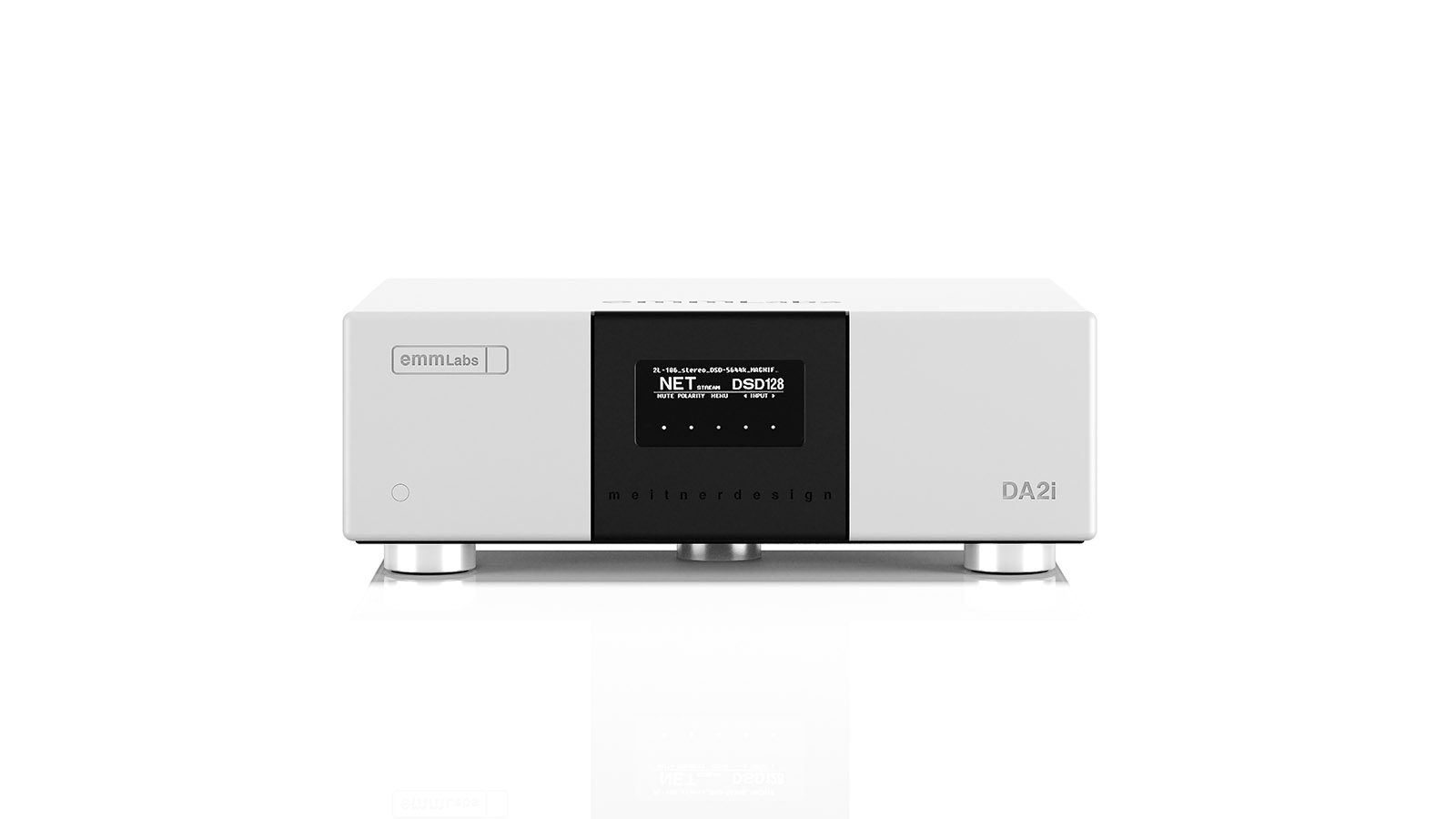
It is always exciting to review a product for a company for the first time. I have admired EMM Labs kit at shows for many years, but it was at this last AXPONA (2025) in Chicago that an opportunity arose to spend time with one of their pieces. And what a piece to start; with its flagship DAC, the just-unveiled DA2i!
What is so remarkable about that? It has to do with the history of D-to-A converters and Ed Meitner, founder of EMM Labs, and his team’s association with that technology. EMM Labs was one of the pioneers of D-to-A technology, dating back to its early association with Sony and Philips in the 1980s. Based on some of Ed’s earlier studio equipment development, Sony and Philips contacted him to assist with their new disc project.
Fast forward to today, almost every SACD player available features EMM Labs technology to manage the D-to-A conversion. This is not just a DAC review; it is the flagship of one of the founders of the process. Daunting to say the least, but very exciting.
Flagship updates
The DA2i is the latest version of their flagship DAC. In fact, EMM has updated its entire flagship line, with its new flagship monoblock amplifiers being shown at Capital Audiofest in Washington, D.C. as we went to press—no resting on laurels for EMM Labs.
Upon receiving the unit, the unboxing process was straightforward. Packed in a double box with ample foam, the DA2i comes with the usual array of accessories, including a substantial remote and a high-end power cord from Kimber Kable. The power cord was a nice touch for a flagship product.
I disconnected my Cary Audio DMS-700 DAC/Streamer from the system and installed the DA2i. The Cary piece has been at the centre of my system for a few years now, and I still love it. Its dual AKM AK4499EQ chips are a sonic favourite of mine. So naturally, one of my first questions about the unit was “Whose chip are you using?” Foolish me. “It is a converter of our own design that has been updated and refined for decades.”
Of course it is! I should have expected this answer. Reminds me of the time I asked Ralph Karsten of Atma-Sphere, whose Class D modules he used, and he informed me that as an engineer, he could design his own and did, to significant effect. Similarly, the EMM Labs D to A converter, more accurately described as a next-generation, proprietary, discrete, Dual Differential 16xDSD/DSD1024 DAC with new Class A outputs, is a knockout, as I will explain in the listening section.
Such diverse elements
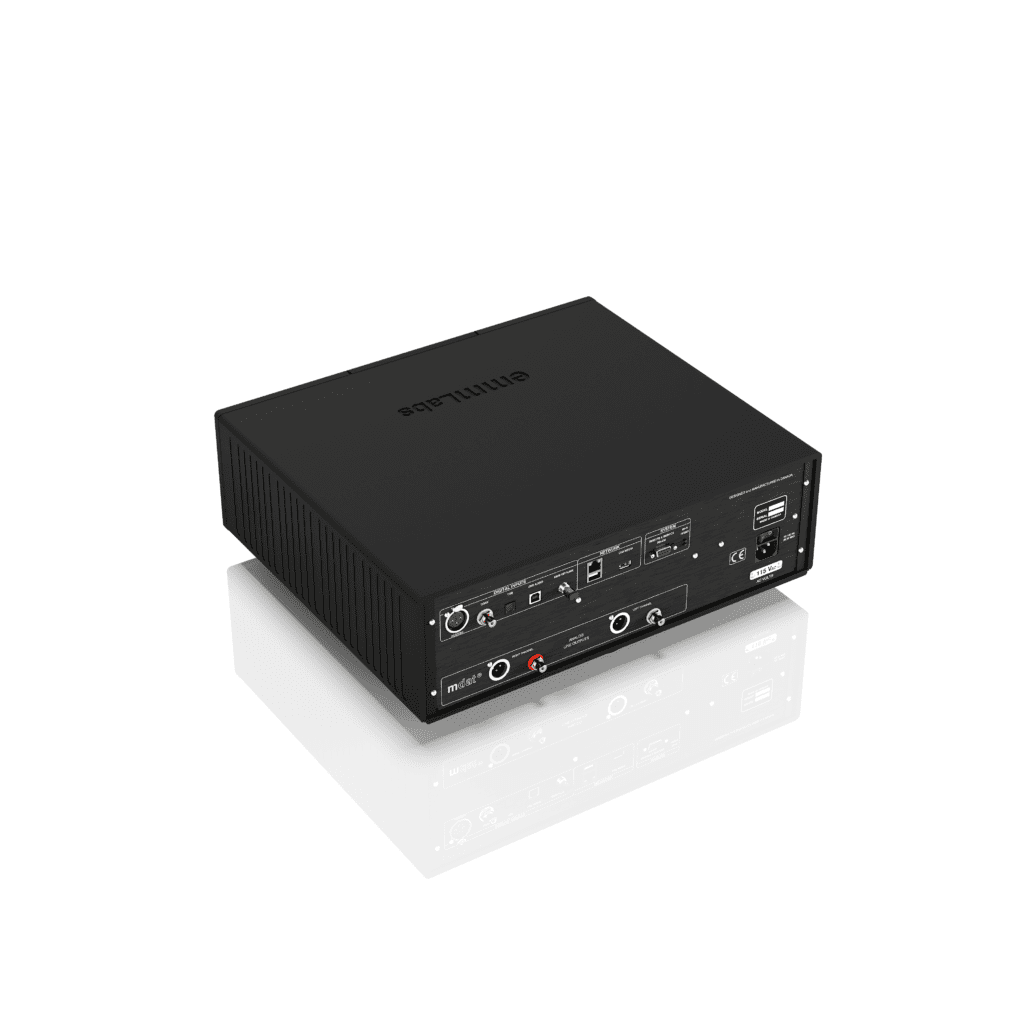
The DA2i offers a diverse range of expected inputs, complemented by its proprietary EMM OptiLink, which enables direct connection of CD/SACD data to the DA2i DAC for conversion.
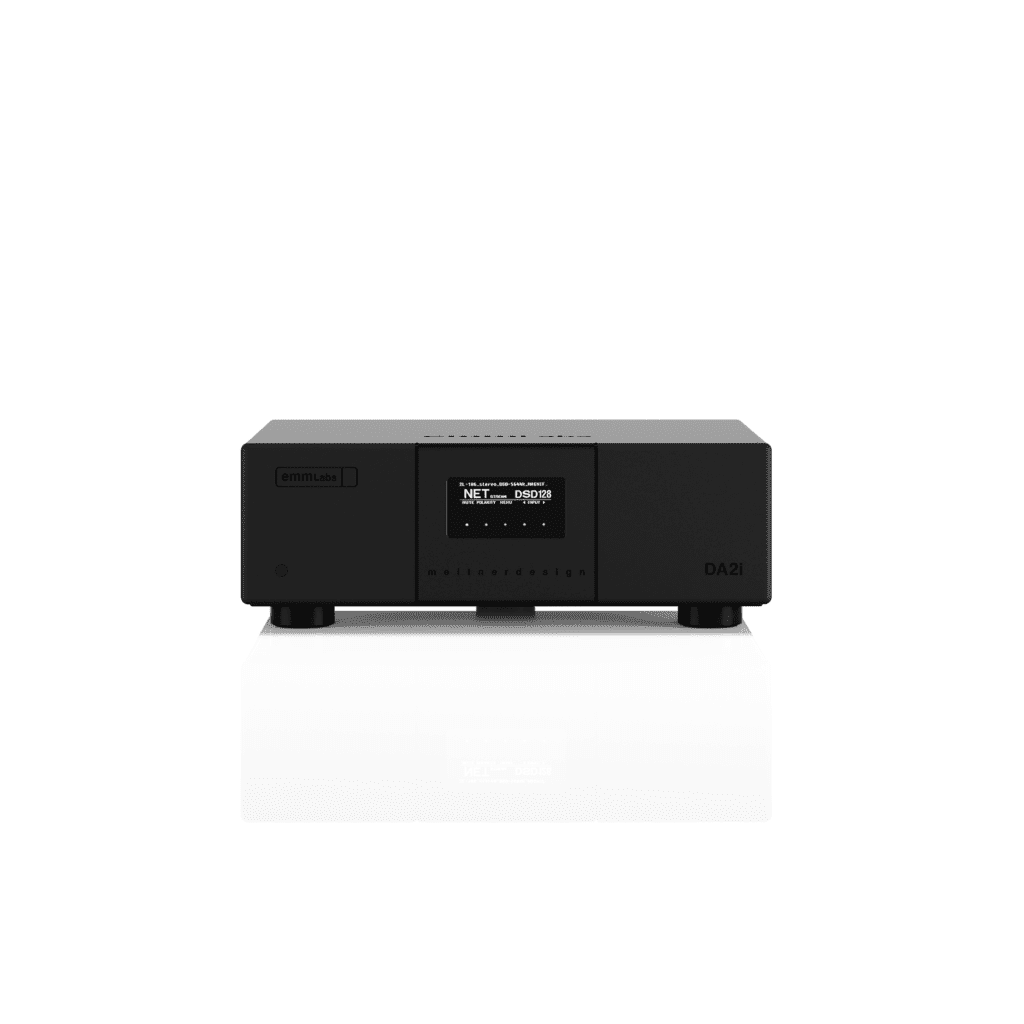
EMM Labs has also been at the forefront of reclocking for anti-jitter for decades. The DA2i features EMM Labs’ latest MCLK3 proprietary master clock, included in a single-chassis unit. Other design choices I appreciate are the aerospace-grade ceramic circuit boards and the multi-generation in-house designed power supply. This unit is a master class in managing both iterative and intentionally innovative updates, drawing on decades of research and development.
For all its technical expertise, you don’t have to be an engineer to use it. In fact, compared to many top and mid-tier DACs, the DA2i is almost plug-and-play. There is no library of filters to sort through. The inputs other than the OptiLink are all that you would expect and need for today’s flagship systems.
Digital, three ways
In my system, I have three total cables going into the DA2i. First, the Ethernet cable allows the DA2i to be your streamer, supporting Tidal, Qobuz, Deezer, vTuner Internet Radio, and Spotify. You can also stream from the cloud via Dropbox or OneDrive, and access local files via a portable drive connected via USB or through DLNA/UPnP. The DA2i is also a Roon endpoint, allowing Roon subscribers to control it via Roon. Roon instantly recognised the DA2i in my system. I used Roon for most of this review as my source via an Ethernet connection.
My second cable was an AudioQuest Water COAX cable, coming from my D.BOB Digital Breakout Box, which connects to my Oppo 205 player for CDs, SACDs, and other shiny discs. This configuration allowed me to bypass the 205’s ESS 9039 Pro chips for the DA2i’s converter. It’s my homespun version of their OptiLink.
Finally, I used the included Kimber Kable power cord, plugged into my dedicated 20-amp circuit. Only 15 is needed, but why not use my best outlet if I can?
Handsome
The handsome industrial look of the DA2i’s front features a four-inch white-on-black screen with five touch-position buttons to manage input selection and scroll through each input’s menu options, very to the point. No album art is displayed, as anyone using any of the streaming services mentioned via either the mConnect app or Roon will have all the album information at their fingertips through the app. Removing a screen also eliminates a source of noise or interference within the unit. You may also update the firmware for the DA2i via mConnect. The DAC notified me of an update during review, and the process was quick and straightforward.
A further word about updates: one of the issues regarding flagship DACs is the speed at which this audio category evolves. Expensive DACs need a valid upgrade path to retain their flagship performance for many years. Amplifiers and Preamplifiers can go decades and still be top of the line in performance. With the DA2i, besides the routinely available firmware updates, there will be, over time, hardware upgrades available as well. Hardware changes will likely involve a trip to your dealer for installation. I am always a fan of upgrade planning from manufacturers to offer these additional paths to maintain top performance as the industry evolves. No surprise to see EMM Labs accounting for this in the DA2i. The DA2i manual does an excellent job of describing its software and app flexibility. It would take a unique system setup for the DA2i not to accommodate a user’s preferred source material.
For a deeper dive into the unit’s capabilities, please visit the emmlabs.com website to review the well-written support documentation.
Arsenal of speakers
Beginning the listening of the DA2i, I had in-house a couple of review speakers, the Kharma DB9 Diamonds and the Magnepan LRS+’s, as well as my reference DeVore Fidelity O/93’s. All cables were AudioQuest, connected to my Atma-Sphere Class D monos, Sanders Sound Magtech Class AB amp, and my Cary Audio Class A CAD-300SEI Integrated amp. Preamp is Pass Labs. First up through the DB9 Diamonds was Aaron Copland’s Fanfare for the Common Man, London Symphony (1968 Columbia). One of the visceral joys of a large floorstanding speaker like the Kharma DB9 Diamonds is its ability to project powerful music presentations with impact.
What really made this listening session shine was the unparalleled depth and detail presented through them by the DA2i. Powered by the Sanders Magtech’s 900wpc into 4 Ohms, the soundstage was wide and deep with the added detail of each section of the orchestra unveiled to, for my system, an unprecedented clarity. You could separate each musician in each row. Remarkable. Bear in mind that this was also recorded at standard Redbook 16/44.1, not high-resolution. The lineage of EMM Labs was showing its worth from the start!
Next up was another Redbook recording. ‘Holding Back the Years’ by Simply Red from their Picture Book album (1985 Rhino – Elektra). Mastered by Bernie Grundman, I have enjoyed this track for forty years. I thought I knew it well until I listened through the DA2i. The sense of space and the feel of the recording studio were, by far, the most three-dimensional I have ever heard. It was a small club concert ticket rather than an evening of stereo. The location of the other members of the band was spot on, and all were there in nearly physical form.
Move to Maggies
Playing through the Magnepan LRS+ speakers with the Atma-Sphere Class D Mono, the detail was extraordinary. The brassy quality of Tim Kellett’s muted trumpet had as lifelike a tone as I have ever heard in a recording. As a French horn player myself, I greatly appreciate a recording that conveys brass accurately. Well done, EMM Labs! Mick Hucknall’s beautiful voice centred the song with a natural timbre that had me in the room with him and the band. This is the experience we all chase as audio fans.
Led Zeppelin’s ‘Ramble On’ was next up [Led Zeppelin II, Atlantic]. This remastered version, in 96kHz/24-bit, was clean and fun. Robert Plant’s vocals had an echo, and the band enveloped him with succinct and present instrumentation. Once again, the word that kept coming to my mind was clarity. The distinct space between notes and instruments was very cool, as it highlighted each band member and showcased them individually, even when playing together. Yet it did not distract from the overall song. It was a pleasant trip to Mordor with the band, no ring required.
Finally, I pulled up Donald Fagen’s solo album Sunken Condos (2012 Reprise). Miss Marlene is a fun tune with a driving beat that features John Herington on guitar. The timbre and tone of his playing really shine through on this 88.2kHz 24 Bit track. The EMM delivers Fagen’s impeccable production aesthetic as precisely as I have heard through any system. The DA2i’s ability to provide more detail, depth, and clarity is unmatched in my listening experience—quite an audible adventure.
Toward the mountaintop
When the opportunity arises to review a flagship piece of gear, you always begin wondering how you will express that company’s mountaintop experience. In the case of the EMM Labs DA2i, you enjoy two separate mountaintops. The first is the experience of, for me, the single best DAC I have ever had the privilege of listening to. For its price, it should perform to a high standard. There are DACs out there that cost ten times what this one does. However, I have never experienced this level of sonic satisfaction from other higher-priced DACs.
The DA2i delivers a completeness that many audiophiles ascribe to vinyl. To my ear, the music is all there. No thought of “something is missing” or harshness from edginess. This is music. It is musical. It is natural, and while you will pay well for the privilege, it is a worthwhile investment. I encourage the listener to reacquaint themselves with 16/44.1, as you may not need to go higher. The second mountaintop is Ed Meitner and his longtime team at EMM Labs, who know what information is there for you, as well as any team in the industry with the “From the start” pedigree to show for it, and they will put it all in your listening room. I’d give it the highest recommendation!
Technical specifications
- Type: Digital to Analogue converter
- Inputs: EMM: EMM Optilink input. Proprietary EMM Labs ST glass optical connection to an EMM Labs CD/SACD transport or player, e.g. TX2, TSDX, XDS1, etc.
- USB: USB Audio connection supports up to 24bit 192kHz PCM, DXD 352 and 384kHz, DSD64 and DSD128 (2xDSD) and MQA® using USB 2.0 cables
- NET: Network (RJ45) connection supports up to 24bit 192kHz PCM, DXD 352 and 384kHz, DSD64 and DSD128 (2xDSD) and MQA®.
- AES: Balanced digital interface supports up to 24-bit 192kHz PCM and DSD via XLR 110Ω digital cables
- COAX: COAX S/PDIF interface which supports up to 24-bit 192kHz PCM and DSD via RCA 75Ω digital cables
- TOS: TOSLINK optical interface supports up to 24-bit 192kHz PCM and DSD via TOSLINK optical interface
- System Control: Infrared remote
- RS-232 serial port
- Power & Accessories:
- Features: Ed Meitner’s next generation proprietary discrete Dual Differential 16xDSD/DSD1024 DACs along with its new class A analogue outputs
- Latest generation 16xDSD Meitner Digital Audio Translator (MDAT2™) DSP
- Updated enhanced MFAST™ signal acquisition and jitter-free performance
- Latest generation MCLK3™ proprietary master clock
- Updated source and power isolation for both USB and Network interface
- 2xDSD, DXD (352/384kHz), MQA® and ROON over USB and Network
- Exclusive aerospace-grade ceramic circuit boards
- Latest generation EMM Labs proprietary power supply system
- RS232 port for future software upgrades
- Dimensions (W x D x H, per amplifier): 43.8 x 40 x 16.1cm
- Weight: 17kg
- Price: £34,995, €37,500, $35,000
Manufacturer
EMM Labs
UK distributor
AV Technology Solutions
+44(0)1924 781011
Trending Articles
See all
hi-fi+ issue 250: the Awards
- Dec 02, 2025
Musical Fidelity M8x DAC
- Aug 03, 2026
dCS Lina DAC X
- Oct 14, 2025

By Eric Neff
More articles from this author

Read Next From Review
See all
ATC EL50 Anniversary
- Aug 18, 2026
AIM Electronics NAX
- Aug 18, 2026
Ensemble Massimo Fonobrio
- Aug 18, 2026
Silent Angel Bonn N8C, Genesis GC and S28
- Aug 10, 2026