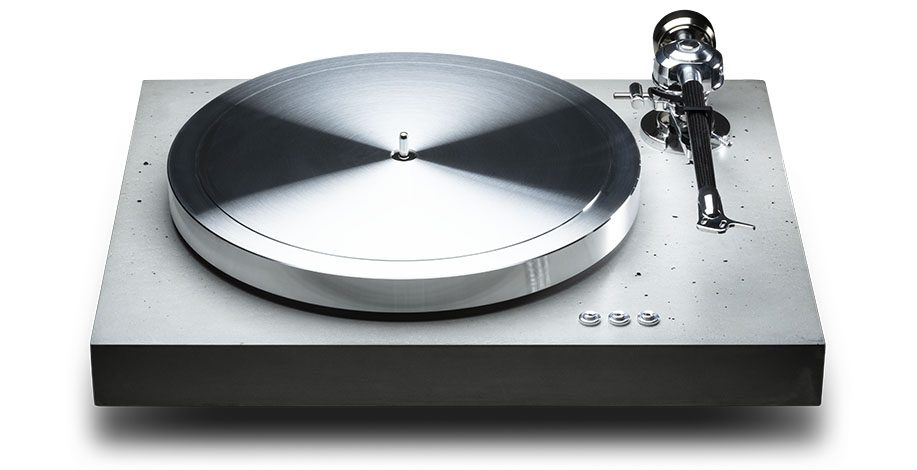
There’s a fair bit to unpack with the EAT C-Dur Concrete. That’s even before giving any consideration to the packaging (and its 42kg kerb weight) in which this turntable arrives. Let’s start with that brand name and the model name, shall we?
‘European Audio Team’ is a perfectly valid brand name, even if it does give rise to a rather try-hard acronym. ‘C-Dur’ is German for ‘C major’ – which is also perfectly valid, even if it sounds like the sort of thing Nelson Muntz might say. And ‘concrete’, well… you know where you are with concrete, right? It makes a lot of sense as a material for a turntable plinth, even if the plinth in question ends up weighing an awful lot (32kg) and pushes the asking price of the equivalent C-Dur model with its boring old MDF plinth up quite a bit.
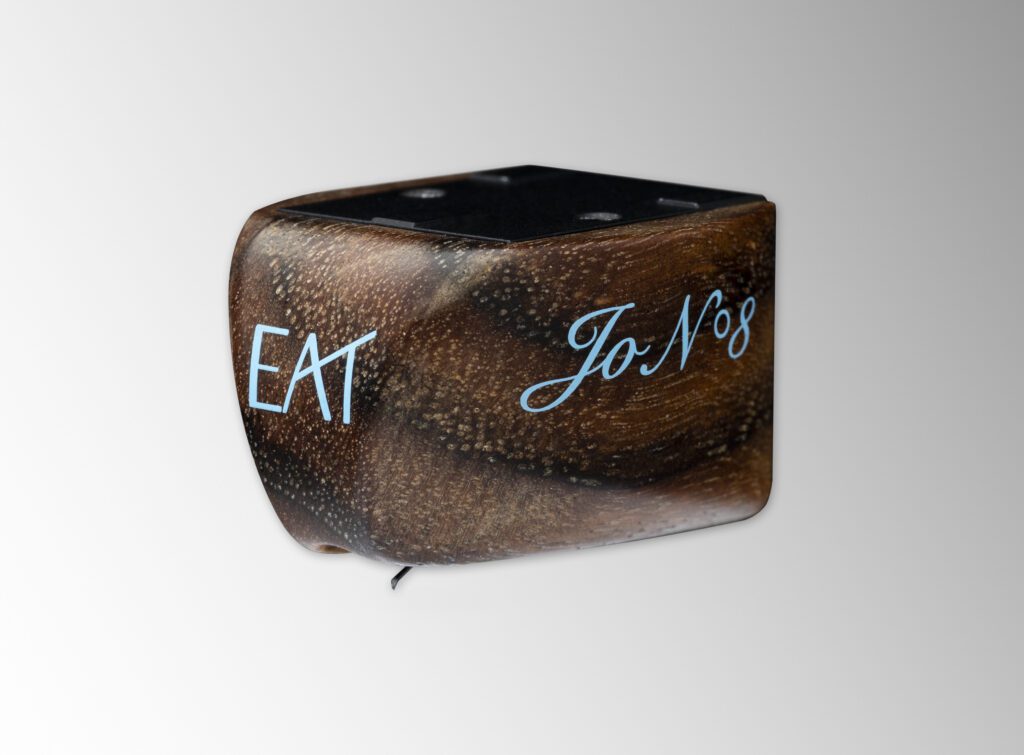
Jo No 8
£6,499, in fact, is the asking price for the EAT C-Dur Concrete with C-Note unipivot tonearm. My review sample is supplied with the company’s ‘Jo No.8’ high-output moving coil prefitted. It adds another £1,599 to the asking price if you buy the two together, or will set you back £1,999 as a discrete purchase.
(EAT also offers customers the opportunity to part with an additional £1,349 for the optional linear power supply, which can be had for a mere £1,079 if it’s specified at the same time as the turntable is rung through the till. It’s undoubtedly a more purposeful-looking item than the rather humdrum power cable the turntable is otherwise supplied with – but EAT insists the C-Dur Concrete’s AC generator, which uses the DC from the power supply, generates an almost entirely clean AC signal for the motor. It’s this ‘almost’ that’s addressed by the cost-option linear power supply.)
As a package, the C-Dur Concrete with Jo No.8 cartridge is undeniably glamorous – just the sort of thing that set-dressers around the world like to use as shorthand for ‘wealthy and sophisticated’. The concrete plinth is chic in an industrial kind of way (although it’s well worth bearing in mind that its weight is supported by three high-adjustable, damped aluminium feet that are quite aggressively conical in shape). They wasted no time in driving themselves into the wooden shelving of my Blok Stax 2G), and the combination of aluminium and carbon fibre from which the C-Tone arm is constructed catches both the light and the eye. The cartridge may be a bit of a biffer (and that’s putting it mildly – at 19.2 x 25.1 x 28.3mm (HxWxD) it looks almost comically large) but its chestnut body looks the part too.
Not just design
The C-Dur Concrete (plus its peripherals) is no mere design exercise, though. As the asking price demands, it’s got the technical chops to back up the looks, which is just as well, given that your price-comparable alternatives are, without exception, profoundly capable machines.
So the C-Dur Concrete is supplied with a hefty (5.2kg) platter that’s internally damped with TPE (thermoplastic elastomer) to provide both density and stability. A 900g aluminium sub-platter further isolates this platter from the motor and improves overall tolerances – it rides on an inverted ceramic ball main bearing that pairs with a Teflon plate for even greater rotational stability. The bearing block itself adds another 1.8kg to the kerb weight and uses a polished stainless steel spindle to support the ceramic ball.
The drive system isolates the motor within a steel ring mounted in the chassis, which further contributes to the stability and uniformity of the platter’s rotation. It also reduces resonance transfer (which is already vanishingly low, thanks to, well, all that concrete). The C-Dur Concrete is supplied with a couple of anti-static polished rubber belts to connect the motor to the sub-platter – the broader of the two fits on the upper part of the motor, and facilitates 33.3 and 45rpm (two of the three buttons on the top of the plinth are for speed selection, the other is to put the turntable into ‘standby’.) The second belt fits over the lower portion of the motor, and with this fitted, the ‘45rpm’ button actually delivers 78rpm.
C-Note
At 254mm, the C-Note tonearm is notably long, and the materials from which it’s made offer optimum rigidity – just as well, when you consider the relative heft of the cartridge it’s designed to support. The unipivot design ensures the Cardan bearing is never overloaded, and the bearing itself is designed for maximum stability and minimum friction. The tonearm, meanwhile, is internally damped with silicon grease to drive even greater resonance rejection.
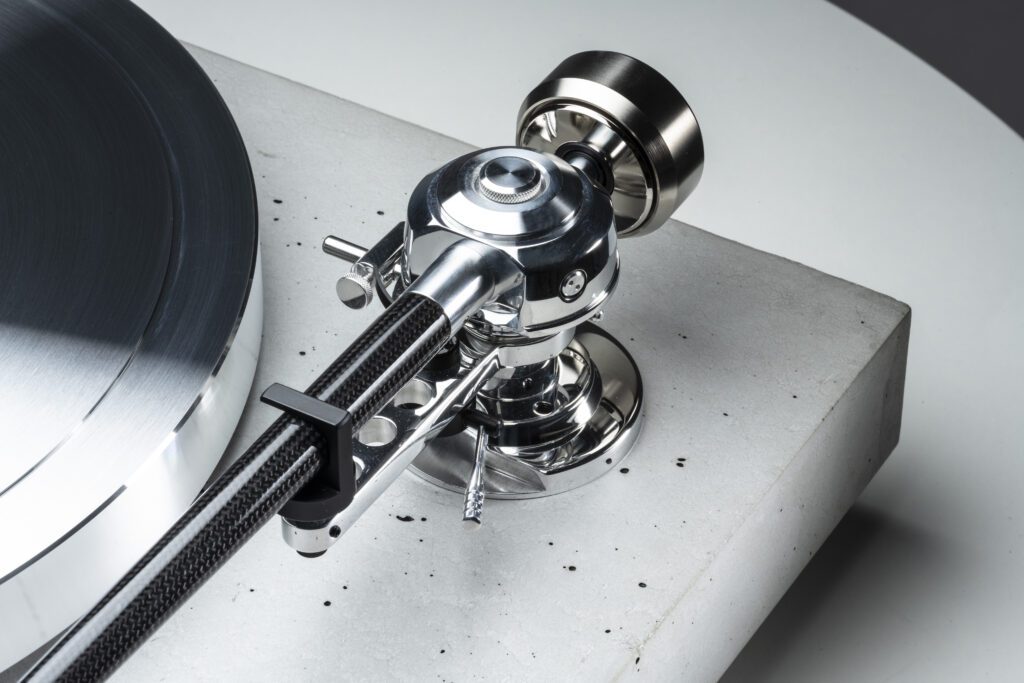
The high-output moving-coil cartridge features a nude Shibata stylus on a boron cantilever. EAT supplies a semi-balanced five-pin DIN-to-RCA cable to deliver the cartridge’s output to a preamplifier. It’s galling – but not, by this point, surprising – to discover a fully balanced alternative is a cost option.
Connected to a Chord Huei phono stage and amplified by a Cambridge Audio W Edge stereo power amplifier driving a pair of Bowers & Wilkins 705 S3 Signature loudspeakers bolted to their matching FS-700 S3 stands (with a Naim Uniti Star acting as gain control between phono stage and power amp), the EAT C-Dur Concrete doesn’t waste very much time setting its stall out. This is not one of those sources of music that takes a while to reveal itself – what the C-Dur has, it’s willing to hand over most immediately and unequivocally.
Which means that it doesn’t matter if there’s a heavyweight 2025 reissue of Kevin Ayers’ Bananamour [Cherry Red] spinning or a much-loved (for which read ‘mildly distressed’) original pressing of Pere Ubu’s The Modern Dance [Blank Records] playing – the C-Dur Concrete plays no favourites and is entirely even-handed no matter the circumstances.
Staggering
It’s a staggeringly clean and uncolored listen, and it seems able to keep the spaces and silences in a recording as dark as any record player I’ve ever heard. Its powers of detail retrieval are remarkable – there’s not a tremendous amount of light and shade in the Pere Ubu recording. Still, the EAT nevertheless finds and contextualises harmonic variations with something very close to fanaticism.
The dynamics of tone and timbre are given proper weighting, just as the broad dynamics of ‘quiet’ and ‘loud’ are (or, in the case of Pere Ubu, ‘loud’ and ‘louder still’). Low-frequency control is unswerving, and the rhythmic positivity that results is as natural as can be. Its overall tonality is very carefully neutral, and its frequency response is brilliantly even from the top end to the bottom – the sound it creates is vividly true to life, and it seems able to peer deep into a recording and locate information that even some very capable alternatives can overlook.
It hits with well-mannered determination at the bottom end, and grants the highest frequencies a decent amount of substance to go along with their undoubted bite and sparkle. It has tremendous powers of midrange resolution – so no matter if it’s the animal-in-a-trap stylings of David Thomas or the dazed Canterbury approximations of Kevin Ayers, a vocalist’s motivations, character and attitude are made every bit as obvious as their basic technique.
The C-Dur Concrete collates every scrap of information in a recording and presents it as a coherent and consequently convincing whole. Four-piece garage band or extended ensemble with numerous elements, it’s all the same to this turntable – it unifies a recording in the most unfussy manner, and hands over the results as a singular occurrence that sounds very much indeed like a performance.
Size matters?
If there’s a shortcoming, it concerns the size of the sound the EAT generates. It has no problem describing a soundstage with absolute confidence and making its layout as explicit as possible, but it just doesn’t sound huge. Everything that happens, happens strictly between the outer edges of the two speakers at the end of the chain. So while the soundstage itself is organised carefully, there’s a slight sense of confinement to the overall presentation that just isn’t an issue with the vast majority of the deck’s price-comparable alternatives.
It’s a shortcoming, there’s no two ways about it – but everything the C-Dur Concrete does so well goes a fair way towards minimising it as an issue. And it doesn’t seem impossible that the expansive visual appeal of the C-Dur Concrete might further help you overlook the slightly hemmed-in nature of its sound.
Technical specifications
C-Dur Concrete turntable
- Type: Full size
- Rotational Speeds (RPM): 33.3, 45, 78
- Supported Tonearm Length(s): 254mm
- Drive Mechanism: Belt
- Speed Control: Automatic
- Platter Type: Aluminium
- Platter Weight: 5.2kg
- Bearing Type: Inverted ceramic ball
- Dimensions (h x w x d) (mm): 170 x 496 x 396
- Weight (kg): 32
- Price: £6,499, $7,490, €7,490
C-Tone tonearm
- Type: Unipivot
- Tonearm Length (mm): 254
- Effective Tonearm Mass (g): 16.5
- Offset Angle (deg): 21.4
- Weight (g): 16.5
- Price: N/A
Jo No.8 cartridge
- Type: High-output moving coil
- Stylus: Nude Shibata
- Tracking Force (g): 2
- Load (ohms): >15
- Compliance: 15 μm/mN
- Output (at 1 kHz @ 3.45cm/s): 0.3mV
- Weight (g): 12.5
- Price: £1,999 (£1,599 if purchased with the C-Dur Concrete turntable), $2,699, €2,349.
Manufacturer
EAT
UK distributor
Henley Audio
+44(0)1235 511166
Tags: EAT C-DUR CONCRETE TURNTABLE
Trending Articles
See all
By Simon Lucas
More articles from this author

Read Next From Review
See all
HIFISTAY Sound Wings+
- Sep 16, 2026
Marantz Model 10
- Sep 16, 2026
DeVore Fidelity O/Bronze
- Sep 16, 2026
Network Acoustics Origin
- Sep 16, 2026