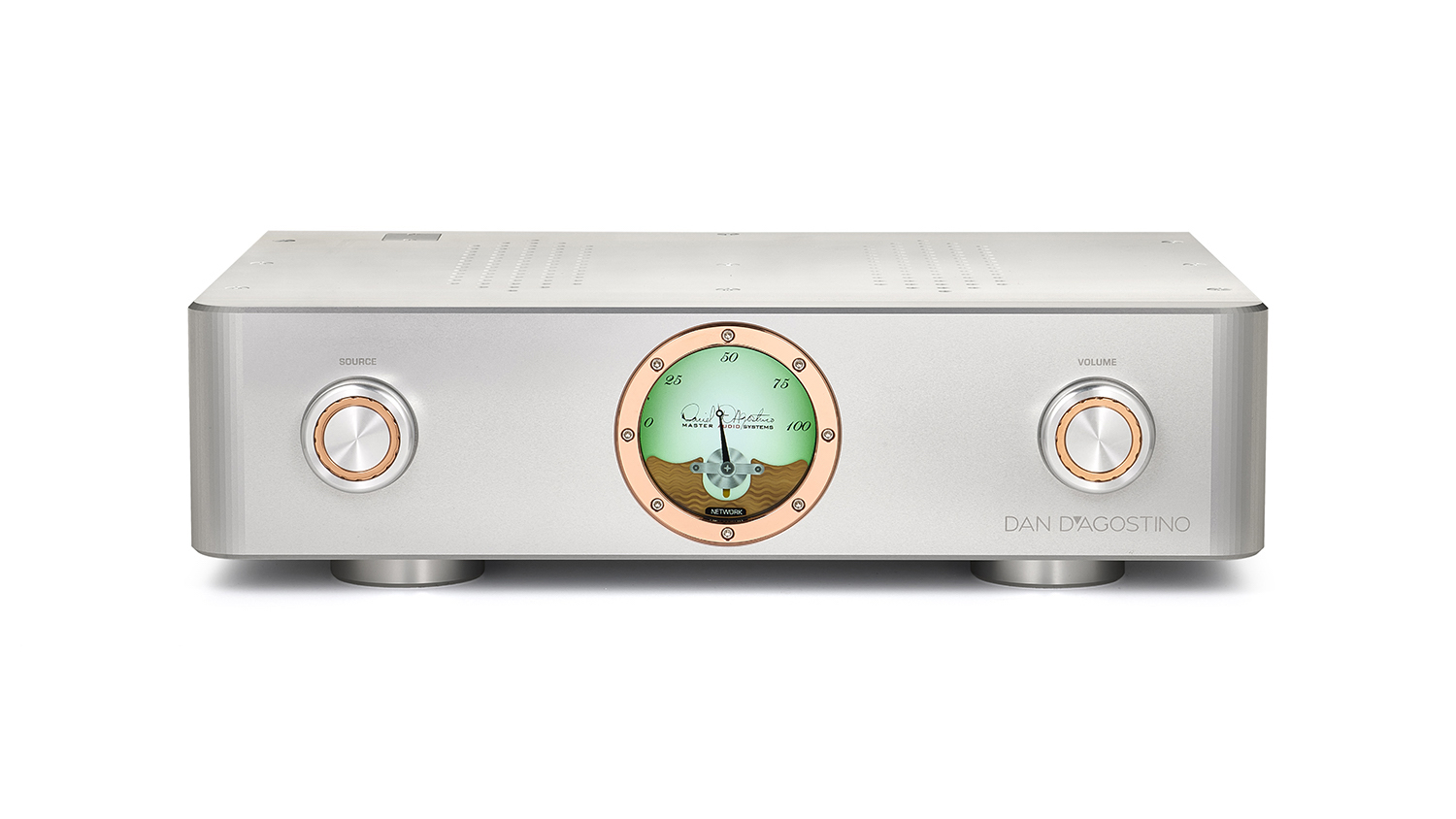
For those unfamiliar with Dan D’Agostino’s work, it reaches the heights of High-End audio. Before the Pendulum reviewed here, the starting point for the D’Agostino experience was the Progression Integrated, which begins its journey at a shade under £25,000. Therefore, the arrival of the Pendulum — a modular integrated amplifier that begins at £20k in its simplest form — is welcome. It can be customised to include a streaming function and a built-in phono stage.
The cost of the bits, i.e., the digital board, is £3.2k, and adding a phono stage will cost an extra £1,500. Therefore, it accommodates many preferences, and the additional costs are reasonable, especially in the context of high-end audio. However, as the cost breakdown shows, most of the manufacturing expenses are in the integrated amplifier section. Unsurprising, as this is D’Agostino’s primary expertise.
What’s in a name?
The brand requires little introduction, and although the full name – Dan D’Agostino Master Audio Systems – is somewhat lengthy. However, it highlights the significance of Dan D’Agostino. As the founder of the renowned Krell brand, Dan D’Agostino’s amplifier designs shaped and defined high-end audio in the 1980s and beyond. His original KSA-50, over 40 years old, still fetches a respectable price on the second-hand market.
In the 2010s, Dan left Krell to establish Dan D’Agostino Master Audio Systems. The brand’s first product – the Momentum mono power amplifier – once again set the standard for a generation of high-end audio amplifiers. Additionally, its innovative use of pure copper heatsinks as a visual element, along with that distinctive ‘steampunk’ display, created an aesthetic that D’Agostino continues to employ effectively.
Breguet-like
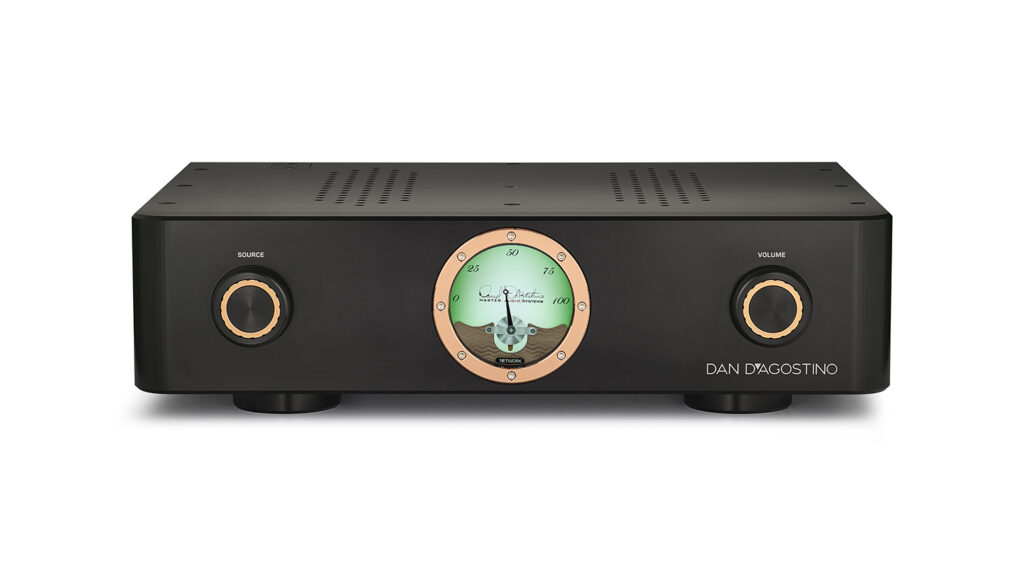
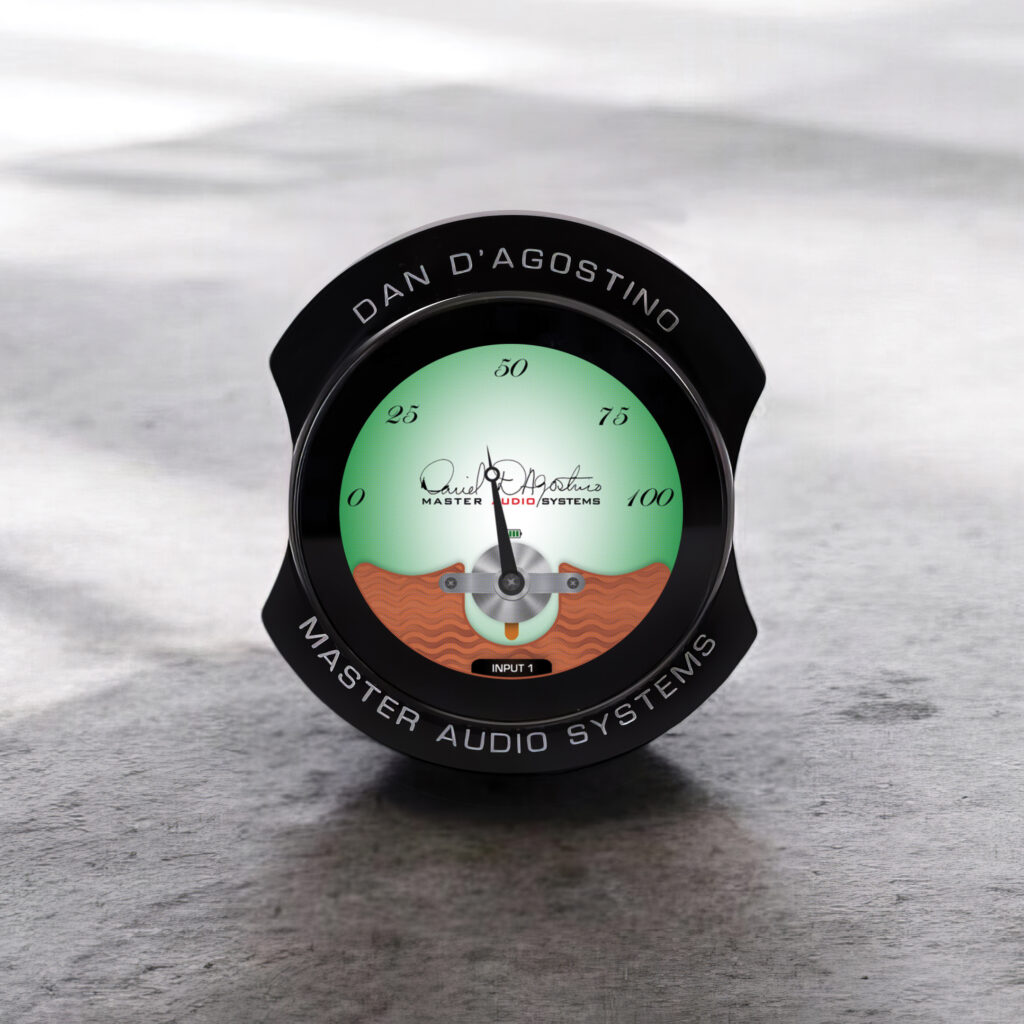
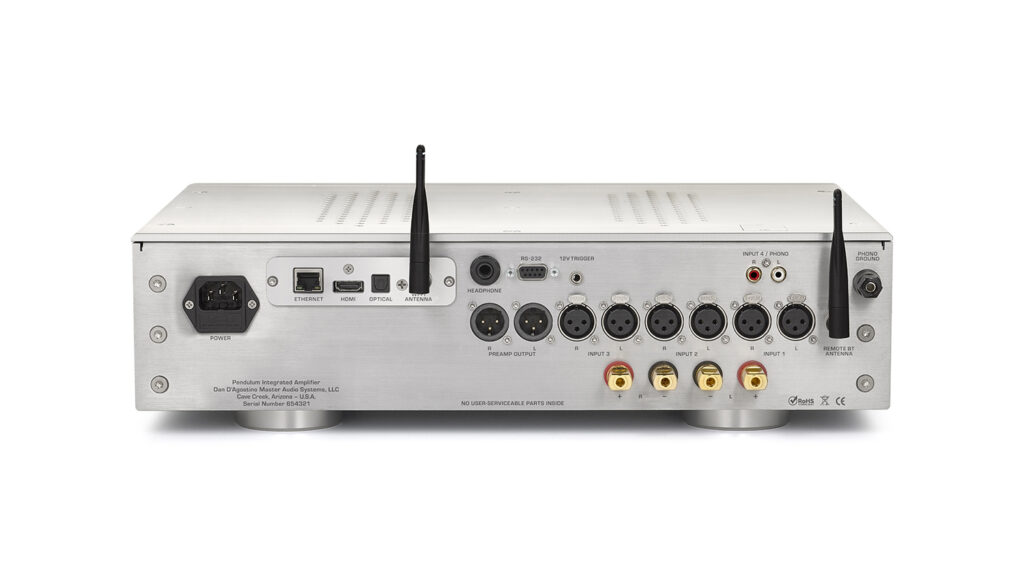
The amplifier has a very distinctive appearance. The front panel features just two knobs and a circular porthole, styled to resemble a Breguet Timepiece, encircled by a copper ring. Inside the dial, there’s an LCD screen displaying key information, such as the track name, input, and importantly, a fine digital needle indicating the volume level. Overall, it looks very elegant and quite minimalist. At the back, you’d expect to see a traditional line stage amplifier, with three pairs of balanced inputs and a pair of phono inputs, which is used for the phono stage if one is fitted. More on that later.
A headphone socket can be accessed by switching the output on either the remote control or the device itself. There is potential to install a digital board that includes Ethernet, optical, and HDMI with Enhanced Audio Return Channel (eARC) inputs. The DAC can support up to DSD256, 32-bit/192K PCM playback. The chip used is a Sabre DAC ESS9039Q2M, but the current setup does not allow for adjusting filter settings. This might frustrate dedicated tweakers, but it also offers relief to those who prefer a quieter life and do not wish to tinker!
Inside, there is a low-noise JFET similar to those used in the Momentum C2 and HD Preamplifiers. Three large bipolar transistors per side are mounted at the bottom of the case. A nearly 25,000μF capacitor bank complements a custom toroidal transformer rated at 750VA. Although the unit isn’t Roon-certified yet, I understand that plans are in progress.
Unique remote
Two Bluetooth antennas facilitate communication with the remote-control unit, which, in my opinion, is the most distinctive handset I’ve encountered in 20 years of reviewing! The remote is circular, made from Delrin—a durable black plastic—with a rotary dial and a mirror of the ‘watch face’ on the amplifier itself. It contains an internal rechargeable battery via USB-C and is quite bulky. The outer dial rotates to adjust volume and can be pressed to access input and settings. The remote closely resembles the unit’s display, making it particularly useful when streaming from your phone via the D’Agostino App and needing to quickly adjust the volume. However, if you accidentally leave the remote on and the battery runs out, the reset process borders on the arcane. D’Agostino is currently investigating this issue.
The downloadable app is well-designed and well-executed, offering access to streaming services, inputs, and volume controls. However, the D’Agostino Pendulum does not support Apple AirPlay, and the app lacks the necessary features for radio playback. This may be added in a future version. As a dedicated radio enthusiast, I find this omission noteworthy.
The amplifier is available in black or silver and is contained within a Peli case with handles, ensuring excellent protection. Its bold design exudes strength and precision, reminiscent of a watch face, making it both radically stylish and highly appealing. It will probably attract audiophiles who also have an interest in collecting watches.
Listening
Connecting the D’Agostino Pendulum to my system, which includes Bowers & Wilkins 802d4 speakers, Townshend cabling, and a PS Audio PS10 mains regenerator, I initially used a dCS Bartók APEX as a digital source to focus on the key part of the investment in this product, namely the amplification.
Listening to one of my current favourites, the recent Andris Nelson recording of Shostakovich’s First Symphony on DG with the Boston Symphony Orchestra, demonstrates a powerful amplifier that is very much in control of the B&W speakers. One of the most valuable aspects of this piece of music is its blend of chamber sounds with abundant woodwind solos, as well as the more bombastic elements typical of Shostakovich, providing a chance to distinguish both aspects. The first thing I notice is the overall grip the amplifier has on the textures of the music. The woodwind and strings are well separated in texture and space.
There is something very ‘fast’ and immediate about the sound. The double basses are solid and focused, and the transients are razor-sharp. The woodwind instruments are beautifully coloured with plenty of detail. When the bass drum makes its presence felt, the floor shakes appropriately. Still, it’s tight and dry with no splash or overhang—a superb and realistic depiction of a large orchestra at work, communicative and brilliant.
Interesting comparison
Listening to the same excerpt with the DAC/Streamer board inside the D’Agostino Pendulum offers an interesting comparison. The soundstage isn’t as deep, and the internal DAC lacks the punch and brilliance of the dCS Bartók APEX, but it is reasonably impressive for its modest price, which is about £3,200. You might reasonably ask why someone who spends £20k on an amplifier would want to compromise on a component that could be a significant part of their listening experience. However, the convenience and wire-free setup of this all-in-one system, along with the higher ‘Acceptance Factor’, are compelling reasons. Of course, this choice depends on personal preference, and I should emphasise that for a £3.5k DAC/streamer, this one is certainly not bad, though it does not match the quality of higher-end options.
Returning to the dCS Bartók APEX, I listen to and evaluate the D’Agostino Pendulum at its finest, then shift to some Mozart, conducted by Daniel Barenboim in the final movement of the 18th Piano Concerto. I notice the piano’s immediate sound, characterised by a brisk attack at each note’s onset. I also observe how the microphrasing is sharper than what my system usually produces.
Brief divergence
To diverge briefly, the sense of a musical phrase, especially in classical music, arises from the rise and fall in volume; the highest, or loudest, point of a phrase guides the human ear to the key note, creating the climax of a phrase. When this is clearly marked, a piece of music becomes much easier to understand, more coherent, and more engaging. Without it, it’s akin to someone mispronouncing words, making the listener’s brain work harder.
All this to say, the D’Agostino Pendulum excels at showcasing the musical line, which naturally draws the listener into the core of the music. I’m not a strong believer in labelling a bunch of transistors, capacitors, etc., as ‘musical’, but this demonstrates how good digital replay (dCS) and a well-designed amplifier can reveal the essence of Mozart’s phrasing. The rendition has a beautiful flow; the piano sounds not only completely convincing, but also allows me to perceive a deeper rhythmic playfulness in what Barenboim is doing at the keyboard. It makes the music sound clearer and more joyful, while also highlighting the interaction between the soloist and the orchestra.
On to vinyl
A turn now for the in-house phono stage, which exclusively supports moving-coil cartridges. There is a small removable panel on the top plate of the amplifier, which features four DIP switches for each channel to control the loading. Listening on an Inspire Monarch Turntable, with an SME V arm and Hana ML cartridge with the recommended loading, I cue up Dvorˇák’s Piano Quartet in Eb op.87, performed by the Beaux Arts Trio with Walter Trampler, a superb recording on the Philips label, which yields some good results.
My reference Phonostage is a Tim de Paravicini Ear Yoshino Phonobox (£1,349), which is a valve. To my ears, the Dvorˇák sounds a little sweeter with more spatial depth than the D’Agostino version, but not a night-and-day difference, noticeable on an A-B test, but probably not something I’d stake my life on just based on a single option. The D’Agostino Pendulum phono stage is fast and immediate, dynamic, but tonally less encompassing than the Ear Yoshino. Nevertheless, it is a pretty good value for the modest £1,500 cost involved.
Similarly, the headphone stage is not an afterthought; it offers something users can truly enjoy. It has excellent imaging and bandwidth, and when listening with my Sennheiser HD 800S, the sound is full and rich. You could pay several thousand pounds for a dedicated headphone amplifier and still not achieve this quality of sound.
Really enjoyed
Overall, I really enjoyed my time with the Pendulum; I found it to be well-designed and built, and as an amplifier on its own, a best-of-breed for the money. Fast, powerful and uniquely styled, it’ll make good friends in the high-end audio buying community and their partners. As for the extras, the Streaming DAC section and phono stages offer good value for the additional cost, but I think someone spending £20k on an amplifier may want to go further than the two bolt-ons provided.
Of course, people have a multitude of different reasons for buying audio, and more power to D’Agostino Pendulum’s elbow that ultimately the company is giving the listener a choice. An all-in-one unit occupies less space and creates less wire pollution. However, making those options modular allows the listener to use the amplifier as an amplifier alone and select their own bits. Surely this choice is more empowering to the customer than no choice at all. Whichever way you look at it, the D’Agostino Pendulum is a ground-breaking product and deserves a serious listen for anyone in the market for a £20k amplifier.
Technical specifications
- Frequency Response 1 Hz to 80 kHz, –0.5 dB / 20 Hz to 20 kHz, ±0.01 dB
- Signal-to-Noise Ratio 100 dB, unweighted; 95 dB A-weighted
- Input Impedance 1 MΩ
- Output Impedance .1 Ω
- Output Power 120W @ 8 Ω / 240W @ 4 Ω
- Distortion (full output) 120 W @ 8 Ω / .015% @ 1 kHZ
- Analogue Inputs 3 pr balanced XLR stereo; 1 pair unbalanced RCA stereo
- Phono Equalisation Curves RIAA
- Phono Stage Loads 47 KΩ, 1 KΩ, 500 Ω, 200 Ω, 100 Ω, 50 Ω
- Outputs 1 pr balanced XLR stereo; 5-way speaker binding posts; ¼-inch headphone
- Control RS-232
- Dimensions (WxHxD) 43.2 x 11.8 x 35.6 cm
- Weight 15.9 kg
- Finish Silver or Black
- Price: £19,998
Manufacturer
Dan D’Agostino Master Audio Systems
UK distributor
Absolute Sounds
+44(0)208 971 3909
Trending Articles
See all
Krell Vanguard integrated amplifier
- Apr 07, 2015
Trending Articles

By Rafael Todes
More articles from this author


Read Next From Review
See all
Eversolo T8
- Oct 13, 2026
Acoustic Energy AE Active
- Oct 13, 2026
Reiki Audio SuperSwitch X/Pro X PSU
- Oct 06, 2026
Audiobyte SuperVOX
- Oct 06, 2026