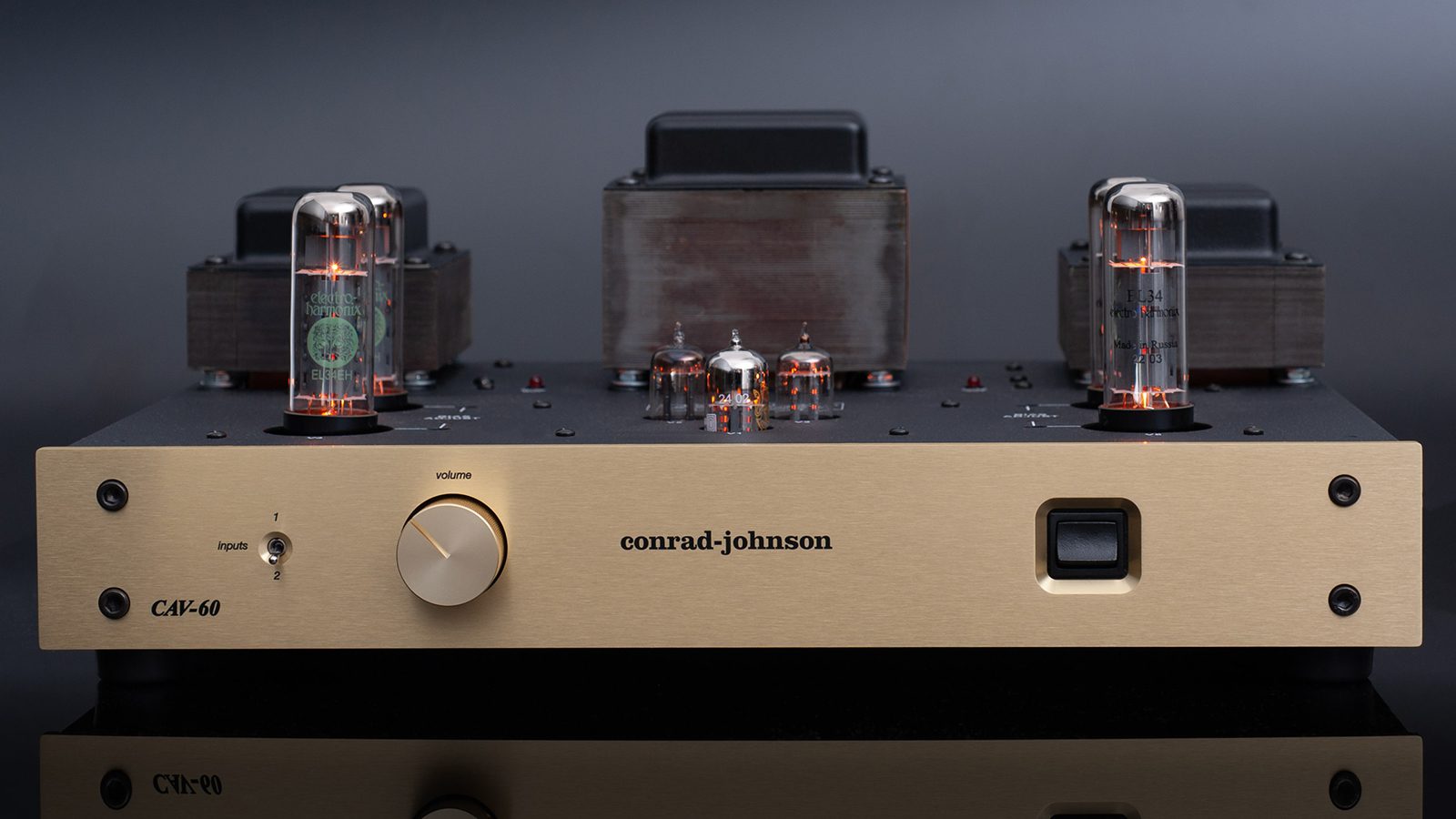
In the language of conrad-johnson, the CAV-60 is not an ‘integrated’ amplifier; it’s a ‘control’ amplifier. However, many companies (most notably Quad) historically referred to preamplifiers as ‘control amplifiers’. So, we’re going with the more commonly used ‘integrated amplifier’ term to avoid confusion.
However, the company has a point. Like the CAV-50, CAV-45 and CAV45-S2 that preceded it, the CAV-60 is a power amplifier… with some controls. The CAV-60 takes that minimalism to new levels. Before, there were three inputs on a source-selector knob. Now, there are just two on a front-panel toggle switch. This sits next to a volume control. That’s it! No balance control, no remote control. Just a power switch, a toggle switch and a potentiometer. It’s matched by two RCA line inputs on the rear panel.
Similarities
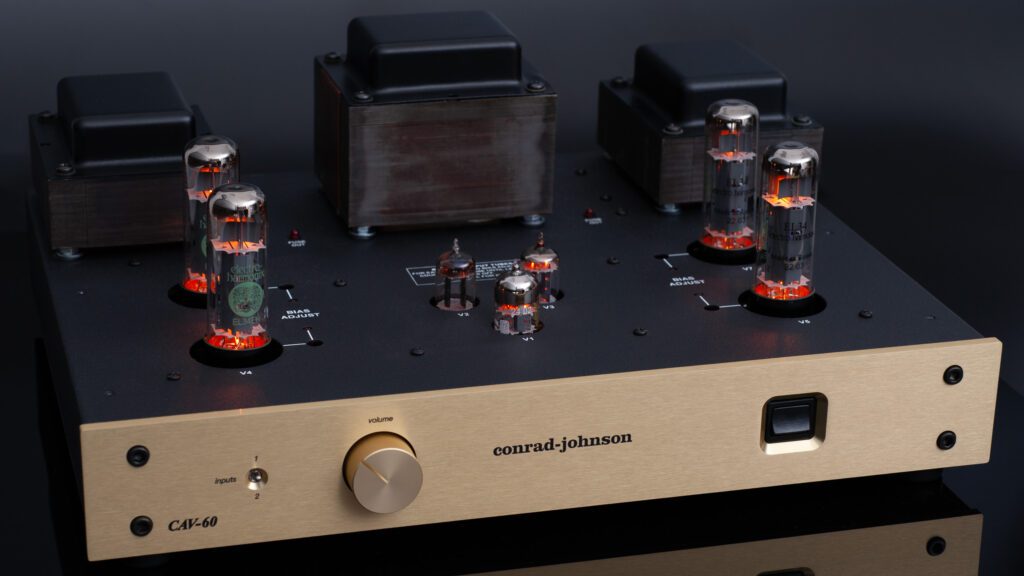
Keen-eyed c-j watchers might note a striking similarity between the CAV-60 and the Classic 62. We tested the Classic 62SE in Issue 148. Not-so-keen-eyed will also spot the similarity, as it’s one of the first things mentioned on the CAV-60’s web page. Like the Classic 62, this amplifier uses three 6922 double-triodes for voltage gain and phase-splitting duties. It also features two pairs of EL34 power tubes operating in ultralinear mode. And, also like the Classic 62, the result is an amplifier that delivers 60W into four ohms.
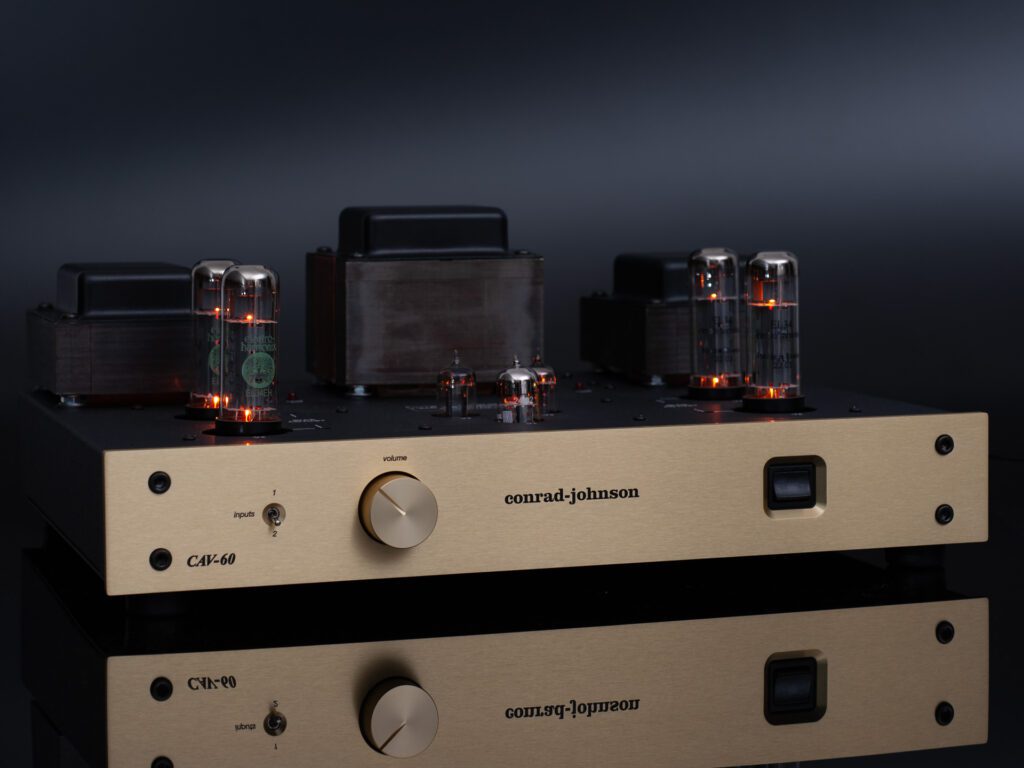
To accommodate the inputs and the potentiometer, the CAV-60 features larger-value electrolytic capacitors in the power supply. Elsewhere, as its stablemate, the conrad-johnson CAV-60 bristles with carefully selected high-grade parts. These include metal-film resistors in the audio signal path, and polypropylene capacitors everywhere except for the power supply reserve electrolytics mentioned earlier. Even these are bypassed by polypropylene caps.
Too much minimalism?
Just two line inputs seem at first to push the ‘minimalism’ argument a little too far. But, thinking on this with my 2025 head, do you really need more? Yes, if you run a turntable, disc player and a streamer as separate devices, then the CAV-60 is not for you. But for most people today, a streamer has replaced the disc player. Tuners and tape machines are now comparatively obscure devices in modern systems, too.
So, it might be two inputs is enough for a small system, and anything larger requires a more complex system. Which, in the language of conrad-johnson once more, means separate preamplifier and power amplifier. Given the Classic Phono equaliser and Classic 62 power amplifier, a matching ‘Classic’ line preamplifier might be nice. However, as it stands, that role is taken up by the ET6/ET6SE.
Easy set-up
Set-up is easy. As there is no C-J preamp in the circuit, the CAV-60 does not invert absolute phase. So, there is no need to swap positive and negative terminals at one end of the cables. Plug in the seven tubes as shown in the manual. In fairness, you’d struggle to make them fit any other way. Regardless, audio thuggery and delicate pins in tube/valve seats don’t mix. Make sure there everything is connected before powering up. Then, adjust the bias controls of the EL34s with a plastic screwdriver (supplied) until all four LEDs on the top plate blink out. Warming up takes about 15 minutes and while there is an improvement over time, the CAV-60 doesn’t feature the company’s own Teflon caps and their glacial run-in.
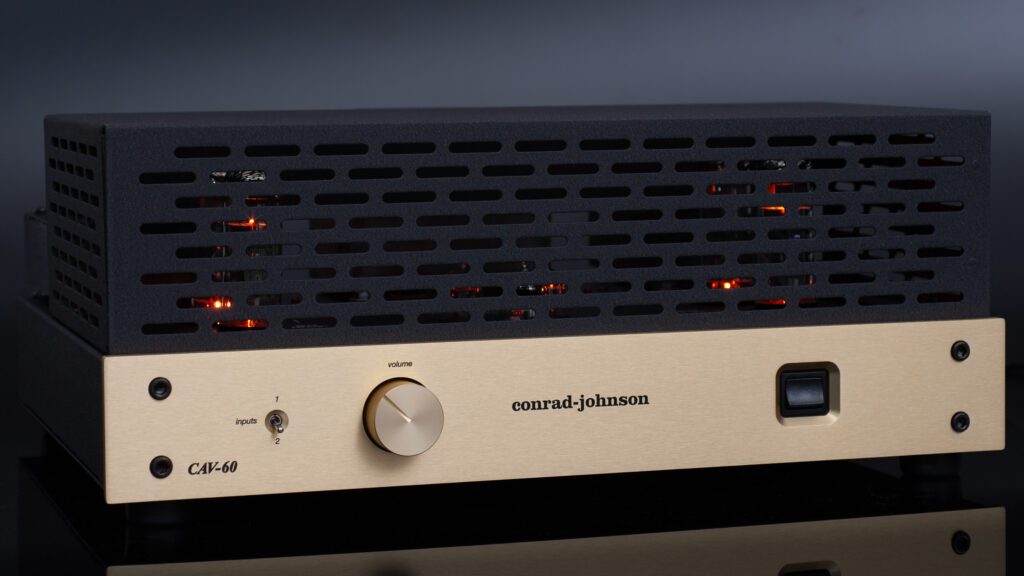
I used the CAV-60 to great effect with a pair of Franco Serblin Accordo Goldbergs, which sadly were finally picked up mid-way through the test. However, KEF’s LS60 Meta and even my trusty old Wilson Audio Duette Twos were a fine match.
Decent
Any decent line-level source works fine here; I even used a middle-of-the-range Audiolab CD player, and the CAV-60s inherently lovely, forgiving sound helped bring out the best from it.
Yes, the CAV-60, having no gain stages in the ‘preamp’ section, is contingent on having a source component with sufficiently high gain and low output impedance. However, it seems the way the CAV-60 copes with less-than-optimal gain and output impedance sources is to go warmer and smoother. Detail – especially high-frequency detail – isn’t lost unless you are trying to drive long interconnect cables. All of which means, you’d have to actively try to make the conrad-johnson CAV-60 sound bad. OK, if your music tastes begin and end with raw-sounding punk then the smoothing out might not be to your tastes. But I think most would find an amplifier that sounds ‘a little creamy’ in its worst case to be a wholly good thing.
You can keep your roof on
The amplifier is not a roof-raiser, but neither is it a delicate flower. And in many respects, it straddles the divide between the conrad-johnson sound of old and its modern interpretation. That older sound was inviting and extremely musical, but a little too ‘lush’ and warm for today’s listeners. The newer sound is more focused and forward, but some might want a touch more warmth. The CAV-60 has some of that ‘glow’ to the sound without making it sound too warm or retro. Also, those wedded to the classic Brit-fi rhythm-oriented sound will find this has more emphasis on ‘space’ and ‘grace’ rather than ‘pace’.
It shines in making an expansive soundstage that is particularly adept at resolving image depth. This is easy to hear when playing vocals in front of the rest of the musicians, such as Joyce DiDonato [Stella de Napoli, Erato]; the CAV-60 doesn’t over-project sounds into the room, so her voice is just slightly forward of the loudspeakers, but the orchestra falls back deep into the room. This sounds exceptionally natural and the extension to the scale of your room is as well-received as it is completely natural sounding.
Perfectly matched
This soundstage is perfectly matched by a sense of coherence across the frequency range. The acid test for this is piano, and in particular ‘Peace Piece’ by Bill Evans [Everybody Digs Bill Evans, Riverside]. This pastoral jazz improvisation is deceptively simple and almost mediative, but with a few deliberately discordant notes in the latter passages. A less coherent, less cogent presentation can disrupt the meditative flow or even make those later bars sound hard and angular. Here, it just flows beautifully.
The CAV-60 also shows outstanding dynamic range. This is perhaps more micro- than macrodynamic, but it’s great at both. Listening to Laura Marling’s ‘Soothing’ [Semper Fermina, More Alarming Records] the slight breaks in her voice and the deft playing of the bass line are easily defined on the micro-dynamic level, yet the changes from loud to soft in that sparse instrumentation are tracked extremely well too.
This suggests an amplifier of excellent detail resolution, and that is the case. However, this is not one of those amplifiers that throws detail at the listener. Instead, it’s a more refined and effortlessly informative design. The staging, coherence and dynamics stand out, but that ability to lay open a piece of music without laying it bare is a characteristic of classic conrad-johnson and absolutely holds here too.
Least preamp possible
But perhaps most of all, the CAV-60 holds to the ideal of having the least amount of preamplifier between source and system. There’s a group of hardcore audiophiles who reject any kind of active gain stage, preferring instead to rely on ‘a pot in a box’ passive preamp and short runs of cable between that and the power amplifier. This gets rid of the box and the cable – it just places that ‘pot in a box’ inside the amplifier itself. It gets no purer than that… and it sounds that way.
We live in a world where convenience trumps performance. The conrad-johnson CAV-60 is the soft-spoken counterargument to that modern world. Without a spread of inputs and remote control, it’s always going to be a niche choice. However, if you value how your system sounds instead of how easily you can switch sources, the CAV-60 has what it takes in all the right places. Like the Classic 62, it’s a great-sounding power amplifier. It’s a power amplifier with just the right amount of preamplification to add some control without sacrificing performance.
Technical specifications
- Type: stereo integrated tube amplifier
- Inputs: two RCA stereo pairs
- Power output: 60W/4Ω per channel RMS both channels driven
- Frequency Response: 20Hz-20kHz ±0.5dB
- THD/IMD: < 1.5%
- Small signal Distortion: < 0.1% at mid-band
- Hum and Noise: 100dB below rated power output
- Phase: output phase correct
- Input Impedance: 100kΩ
- Dimensions (HxWxD): 34×44.1x17cm
- Weight: 19kg
- Price: £7,995, $6,750, €7,995
Manufacturer
conrad-johnson design, inc.
UK distributor
Audiofreaks
+44(0)208 948 4153
Trending Articles
See all
Krell Vanguard integrated amplifier
- Apr 07, 2015
Trending Articles

By Alan Sircom
More articles from this author

Read Next From Review
See all
Reiki Audio SuperSwitch X/Pro X PSU
- Oct 06, 2026
Audiobyte SuperVOX
- Oct 06, 2026
Unitra WSH-805
- Sep 29, 2026
Wilson Audio Sabrina V
- Sep 29, 2026