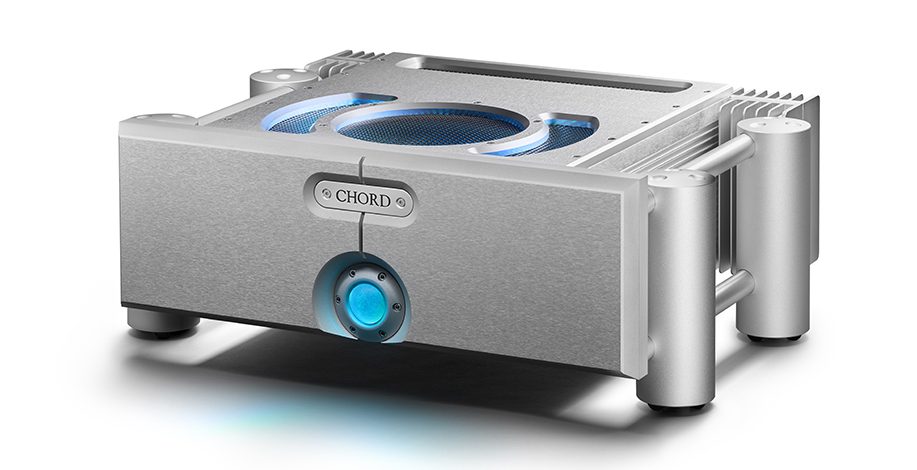
Over the years, I’ve amassed the princely sum of two laws of audio. The first is “the thermal operating temperature of a product is directly related to the ambient temperature.” In other words, the hotter it is outside, the hotter-running the product, and in mid-winter, it’s all ice-cold Class D. The other rule is, the more you want to keep hold of a product, the shorter you get to review it. At least one out of the two almost always applies. In the case of the Chord Electronics Ultima Pre 3 preamplifier and Ultima 3 mono power amplifiers, it’s very much the latter law. There was absolutely no chance of extending the listening session on these excellent amplifiers, despite my best efforts. They had already been in circulation and were in high demand for other listening sessions.
I mention this not in some ‘woe is me’ melodrama. That popularity is almost always a sign of a quality product or products. The things that are good, but a bit ‘meh!’ tend to stick around. The products that are really, really good barely get a chance to get on the shelf before someone’s clamouring to take a listen. The Ultima 3 combo were on a very short leash. When you get a chance to listen to them, that makes a lot of sense.
New to us
While the Ultima Pre 3 is new to us, it’s the Ultima 3 monos that are the latest out of Chord Electronic’s idyllic Kentish pumphouse factory. The elevator pitch is the Ultima 3 are the most affordable mono power amps in the brand’s ‘Full Size’ range. Ultimately 3 replaces the long-standing SPM 1400 MkII. It uses Chord Electronics’ unique Ultima amplifier topology, first seen in the flagship 780W Ultima mono amp.
The Ultima 3 ‘only’ manages to deliver 480W. It retains the sliding Class AB bias and dual feed-forward error-correction system of the Ultima circuit. Sliding, or adaptive, bias is a potentially ‘best of all possible worlds’ system. The amplifier works in Class A during normal operation. It only switches to the more efficient Class B under extreme or demanding conditions. The ‘sliding’ part (adapting the bias of the amplifier to suit the load) differentiates the Ultima topology from more traditional Class AB designs. Ultima’s topology also means output devices that are (to paraphrase Futurama) built like a MOSFET but handle like a Bipolar. At least, when it comes to transconductance.
Ultima Pre 3
As discussed, the Ultima Pre 3 has been around a little longer, although is new to us. It’s a line-level preamp. Ultima Pre 3 sports two-balanced and three single-ended inputs. Then, there’s an XLR-only AV loop and one balanced and one single-ended outputs to a power amplifier. Chord Electronics began life making balanced power amplifiers for BBC active monitors. Thus, Ultima runs best in balanced operation. However, if you are allergic to XLR cables, it’s no slouch in single-ended mode. The matching handset is good and is the only way to dim the amp’s top-panel and front lighting level. It also has that reassuring hewn-from-solid heft seen in the electronics and includes buttons irrelevant to the Pre 3. The extra buttons are not ‘a swing and a miss,’ however.
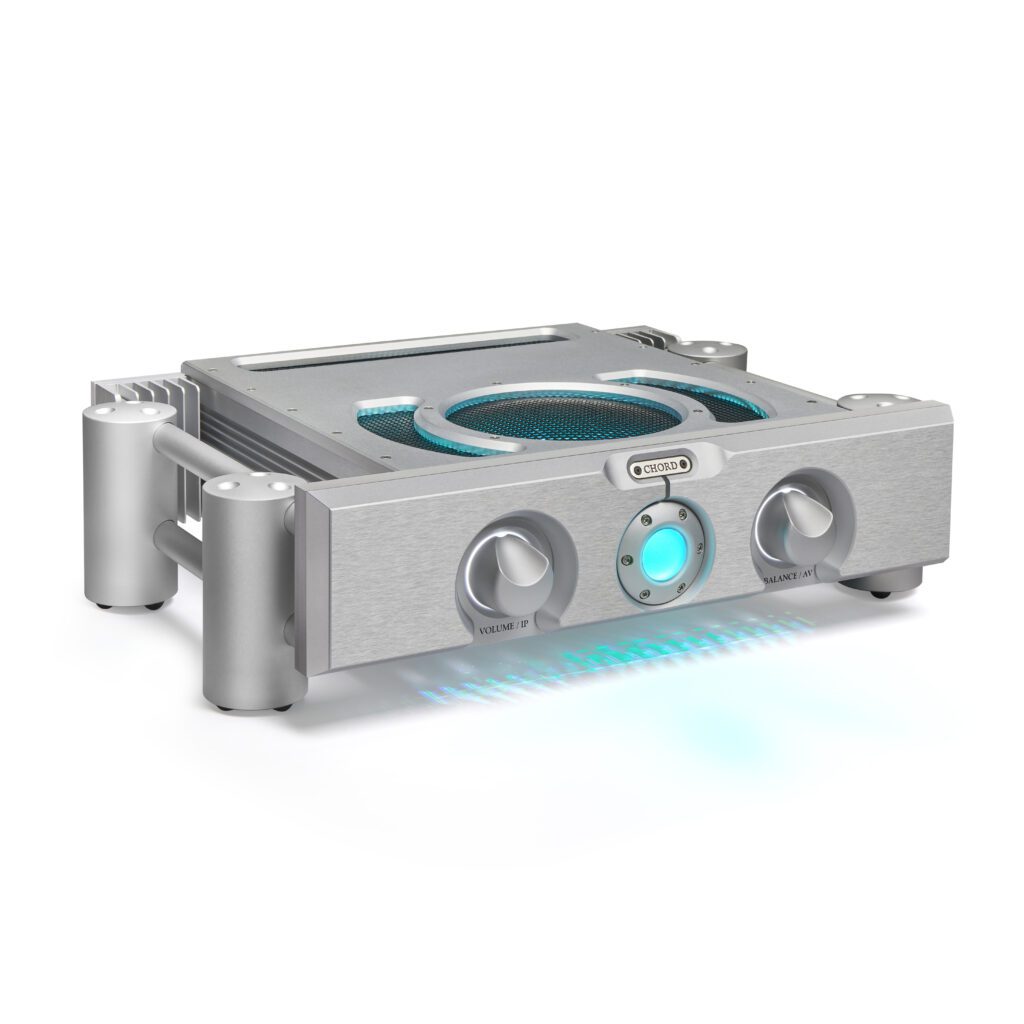
Chord Electronics clearly loves colour-coding. The glowing blue orb in the middle of the front panel will change colour to denote which input is being used. The flanking controls feel great and have dual functions. The left operates volume and input selection, while the right drives balance and AV bypass. I like the simple lines this creates, but sometimes moving between modes can get a little frustrating. The modalities seem counter-intuitive, too. I keep expecting volume and balance to share one dial, and input selection and by-pass to be on the other. As it went back in the box, I had already adapted.
Running in
My samples came with a few miles on the clock, so running in wasn’t an issue. There are reports of the amps needing several hours of playing before they come on song. Once that is over, they seem to stay in good conditioning. I found they needed a few minutes of warming up from cold, but from there, things sprang to life fast. There’s no need to leave them powered up constantly; just fire ‘em up and give it a couple of minutes to come back on song, and everything’s golden.
Not that you’d notice they had been through a few hands before I got them. The review samples came in ‘Jett Black’ with matching ‘Integra’ legs. There’s also an ‘Argent Silver’ option. There’s even an acrylic side-block option for those who will never choose to stack the amps.
Not the same ring
Chord Electronics makes its amp chassis from aircraft-grade aluminium. That doesn’t have quite the same ring to it today. Perhaps Boeing might want to claim its aircraft are made of Chord Electronics-grade aluminium in future… it would bring back some confidence.
In the late 1970s, the Top Trumps craze hit many countries. These cards had various attributes (such as top speed, 0-60 acceleration, BHP, weight and engine size for supercars) for each category. You would try to list a winning attribute, so you’d win all the opponent’s cards in that round. No single card held all the records (although the Ferrari 512 BB, De Tomaso Pantera and Lamborghini Countach got close). Teenage geeks – myself included – would attempt to memorise as many of these attributes as possible. I mention this not simply to pad out the review. These Chord Electronics Ultima devices get close to holding all the winning attributes from a sonic perspective, and most of them from a technical one, too.
Everything else is a trade-off
The Ultima pairing makes most amps sound like they are a bit of a trade-off. In particular, the Chord Electronics Ultima Pre 3 and Ultima 3 mono amps make their rivals sound slow, lacking in transparency, and often quite noisy by comparison. This is no small difference in performance; ‘Hours’ by FKA Twigs [LP1, Young] is a complex bit of post-dubstep electronica. When done badly, it sounds like a soprano James Blake. Here, the speed and clarity make it sound less disjointed, less of a motley collection of bleeps and bloops, and her voice – though at the time, still finding itself – is confident and direct.
Move on to more traditional demonstration discs, and the same can be heard. Take Rachmaninov’s Symphonic Dances {Zinman, Telarc], for example. The sense of musical movement comes across – it’s a dance, after all – thanks to the speed and directness of the Chord Electronics performance. It’s also extremely detailed. There’s also a powerful sense of dynamic range on tap; this is a perfect test of dynamic range, both small scale (the sound of keys on a clarinet) and large (those huge orchestra swells). The Chord Electronics Ultima take it in their stride. The amplifiers always feel like they are never even remotely stressed by the music, even when dynamic music is played at a fair lick. And there seems to be an absence of background noise or hash that gives that music more room to bloom.
Useful Rachmaninov
Why Rachmaninov is so useful here (both in terms of amplifier speed and dynamics) is the dynamic passages almost become a jump-scare. You know they are coming, but they arrive with such pace and power that you find yourself physically reacting to the sound; that’s usually a function of the live event, or when played by the absolute pinnacle products in appropriately well-set-up systems.
We haven’t even touched on the other aspects of performance, such as stereo soundstaging, and image solidity, but once again these are pretty much aced by the Chord Electronics Ultima group. Most importantly, there’s a fine sense of scaling up and down in these important aspects, switch from the aforementioned Rachmaninov to a small Jazz combo and the scale and size of the stage changes to accommodate.
Big Beyoncé
Move to a singer-songwriter and it shifts again, but move to a singer-songwriter where they are so close to the microphone they dominate the soundstage (I’m looking at you, Beyoncé), and you get a big, close mic’d sound. You don’t get the ‘attack of the 50 foot woman’ stage size unless it’s really badly recorded.
Vocals are fascinating through the Chord Electronics Ultima, too. Thanks to that transparency, that speed and the dynamics, you hear every nuance, every vocal cue. That can be good and bad – spitchy, sibilant recordings have nowhere to hide – but when you have a fine set of pipes in front of you – Joyce Di Donato [Stella Di Napoli, Erato], the effect is mesmerising. It’s like listening to the real deal, a sense attenuated only by the loudspeakers. It draws you deeper into the music. All of which makes more angst-driven lyrics hard to bear. ‘Not a Pretty Girl’ from the album of the same name by Ani DiFranco, on Righteous Babe records, isn’t an easy listen, but here the track – and the entire album – is pained and shockingly so. Which is how it should be.
Characteristic sound
Yes, there is a characteristic sound to Chord Electronics, just as there is to every piece of audio electronics ever made – the ‘straight wire with gain’ maxim is still a long way from being reached. But that sound is far removed from the purely cerebral sound of the older Chord Electronics amplifiers. It’s that modern, European high-end sound that delivers excellent detail and staging properties but also manages to be musically communicative and entertaining at the same time. And the Chord Electronics Ultima Pre 3 and Ultima 3 mono power amplifiers cost about 1.2 metric BMWs less than its closest sonic rivals.
If I were to try and break things up, I’d probably single out the Ultima 3 mono power amplifiers as having that special ‘something’. The Ultima Pre 3 is very good – excellent, in fact. But in terms of sheer transparency and blistering, entertaining speed, almost everything runs behind the Ultima 3 monos.
Sense of balance
That said, there’s a sense of balance to the Chord Electronics Ultima Pre 3 and Ultima 3 mono amps. They work together extremely well in a ‘why change anything?’ sense. Sure, the bigger Ultima Pre 2 and Ultima 2 monos – or the reference-grade Ultima pre and monos – bring more to the table, but there’s no ‘planned obsolescence’ here. You don’t get that feeling of ‘I wonder…’ or ‘what if…’ here. Unless you look to the Ultima 3 models as a stepping stone to something bigger from the outset and have a perpetual urge to churn products at an alarming rate, you may be surprised at just how content you will be with the Ultima 3 models. That drive to swap boxes melts away. I wouldn’t be surprised if the same three baby blue eyes are staring back at you for the next decade or more.
That’s not code for ‘stay in your lane’ style mediocrity. The Chord Electronics Ultima 3 Pre and Ultima 3 mono amps are extremely resolving, detailed, dynamic and enjoyable. There’s nothing ‘mediocre’ about that performance. It’s more that the pairing is so adept and well-built that you need to make some very large financial jumps to make a substantial dent in the Ultima 3 ‘package’ performance. And for many, those jumps will unbalance the performance elsewhere in the system. You need to be really pushing the envelope of performance in source, cable and loudspeaker before you look to the amps.
Labour of Love
There’s a labour-of-love phono stage in the Ultima line coming (it was shown at the last Munich High-End). I’d love to see a DAVE-level or even DAVE-beating DAC in the same line. However, Chord Electronics is playing its cards close to its chest on this. Regardless, if criticism in real terms is “where’s the matching DAC?” you know Chord Electronics is onto something with the Ultima line.
The Chord Electronics Ultima 3 Pre and Ultima 3 mono amplifiers are ear-opening stuff. They work brilliantly together. This combo delivers a sound that is hard – and expensive – to better both inside the Chord tent and beyond. Their speed and resolution draws you deeper into the music. The detail and dynamics when you get there keeps you enthralled. To try them is to buy them… it’s that simple.
Learn more about Ultima here.
Technical specifications
Ultima 3 Pre
- Type: Balanced and single-ended line preamplifier
- Inputs: 2x XLR balanced pair, 3x RCA single-ended pair
- Outputs: 1x XLR balanced pair (AV bypass); 1x XLR balanced pair, 1x RCA single-ended pair (pre-out), Type A USB (charging only), 1x 12V trigger output/input
- Frequency response: 10Hz-200kHz ±3 dB
- THD: 0.002 % 20Hz-20 kHz
- Signal to noise ratio: -105 dB on all inputs
- Input impedance: 100 kΩ
- Output impedance: 560 Ω
- Input maximum voltage: 10 V RMS
- Output maximum voltage: 17 V RMS
- Gain: x1
- Channel separation: 100 dB
- Finish: Argent Silver, Jett Black
- Dimensions with included Integra legs (WxHxD, as supplied): 48x13x34cm
- Weight: 12.7kg
- Price: £6,000, €7,999, $8,945
Ultima 3
- Type: Solid-state power amplifier
- Inputs: 1x phase-inverted balanced XLR, 1x non-inverted balanced XLR, 1x phase-inverted single-ended RCA, 1x non-inverted single-ended RCA, 1x 12v trigger input
- Output: 2x Pair of High Quality, High Current, Gold Plated Type Speaker Terminals (Bi-wireable)
- Power Output: 480w RMS per channel into 8Ω, 1000W RMS per channel into 4Ω
- Frequency Response: -1dB @ 0.2Hz to 46kHz and -3dB 0.1Hz to 200kHz
- THD: 0.005%
- Signal to Noise Ratio: Better than -84dB
- Input Impedance: 100kΩ Unbalanced/Balanced
- Output Impedance: 0.04Ω
- Gain: 30dB
- Finish: Argent Silver, Jett Black
- Dimensions (WxHxD, with included Integra Legs): 48x18x36cm
- Weight: 22.4kg per channel
- Price: £11,500, €14,900, $17,762 per channel
Manufacturer
Chord Electronics Ltd
+44(0)1622 721444
Tags: CHORD ELECTRONICS ULTIMA PRE 3 MONO POWER AMPLIFIERS PREAMP ULTIMA 3
Trending Articles
See all
By Alan Sircom
More articles from this author


Read Next From Review
See all
Reiki Audio SuperSwitch X/Pro X PSU
- Oct 06, 2026
Audiobyte SuperVOX
- Oct 06, 2026
Unitra WSH-805
- Sep 29, 2026
Wilson Audio Sabrina V
- Sep 29, 2026