
It’s easy to think there’s not much that changes in the world of amplifiers. Sure, we had Class D at the turn of the century, and the Class A/D hybrid that followed in 2009, but otherwise amplifier development is at the sleepy end of electronics engineering. Or so it seems.
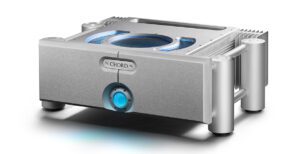
So, when Chord Electronics looked to replacing its evergreen line of Switch-Mode power amplifiers, the company looked to research from the past to find technology of the future. Amplifier designs that were almost impossible to make outside of the lab due to the component tolerances of a bygone age can now be realised as manufacturing concepts and even end-user products today. And it’s that blend of ‘clever’ from the past meeting today’s quality control and production engineering that became the genesis of Chord Electronics latest Ultima topology, which sees its way into the brand’s amplifiers, from the smallest to the giant Reference class models.
We spoke to John Franks, CEO of Chord Electronics on the pioneering work that went into Ultima, and how it became a real-world product.
A new approach to amplifier design
Chord Electronics’ Ultima topology is based on theories that Professor Malcolm Hawksford put forward in the 1980s. This work was picked up by a young American engineer, Bob Cordell, who built a low-power audio amplifier and wrote extensively about it in Wireless World magazine.
At the time, I was researching better ways to control high-power MOSFETs in audio in order to overcome their non-linear behaviour. I was so impressed by Cordell’s work that I decided to combine his approach with my knowledge of high-frequency power techniques to see where I could take this technology.
MOSFETs in audio design
There are two major types of MOSFETs: horizontal gate and vertical gate. Vertical gate MOSFETs are not normally used in audio designs because they are notoriously difficult to control in their transition region, which is where we operate in audio amplifiers. They prefer to be either on or off. Until around five years ago, like all audio companies, Chord Electronics used only the easier-to-control lateral gate structure audio MOSFETs.
These transistors have a drain, a source, and a large gate structure shaped like a waffle-iron grid that controls the flow of current. This grid must cover the entire chip, which limits the chip’s power and makes it quite expensive. Many years ago, I used some of my aerospace contacts to develop Chord Electronics’ own special dual-chip lateral structure MOSFETs, which served us well.
However, for the same die size, a vertical MOSFET can deliver ten times the current, making it much more powerful. While they are usually too difficult to control for use in audio amplifier designs, the Ultima topology, which uses several feed-forward error-correcting circuits, monitors each individual power FET in the amplifier signal path. This enables six-sigma perfect control of the music signal within each part of the waveform.
My approach to design and development
Honestly, I love my job as Chord Electronics’ chief designer, which is why I don’t intend to retire anytime soon. I enjoy sorting out each individual issue as it arises, and I didn’t encounter any serious problems when implementing this technology.
I’ve always loved the intricacies of well-designed electronics, when done well. As a child, I would hunt for broken valve radios and try to fix them. My bedroom desk was full of semi-working, but fully lethal (!), bits and pieces.
Much later, I got an engineering job at Marconi Avionics, where I first saw some truly beautiful hardware designs. I learned a great deal, and Marconi’s advanced training taught me how to design electronics that would never fail. This experience instilled a philosophy in me to strive for electronic perfection as close as possible with the technology available at the time.
Development timescales
Development timescales can vary significantly. A relatively quick change to a current design can take up to a year, especially if there are extensive changes to the metalwork or control circuits. Additionally, meeting the qualification standards of different countries can add many months to the process.
For new concepts and technologies, the timescales can increase to around three years for my analogue ideas. With our digital products, I work with consultants, which can take many opinionated and argumentative years—far too long, but I’m sure that ultimately, it’s worth the wait.
For my own analogue domain designs, such as amplifiers, preamplifiers, and phono stages, I first draw up the circuitry and run simulations. Having good software to model parts of the designs is a tremendous help, as it gives me confidence that the complete circuit will eventually work.
However, a software simulation is only a guide, and reality usually sets in once I’ve assembled some hardware and put some nasty volts through it. But by being diligent and empirically plodding through the process, the final design often exceeds my initial simulated expectations. I believe that the enforced long stay at home during the pandemic was actually very beneficial. I set up a small lab at home and was able to explore ideas and concepts that I would not normally have had time to look at. Some of these are only now coming through into our production.
The future of Ultima
Can aspects of the Ultima topology be applied to all products? Not all, but I have used aspects of Ultima ideas in products where the outputs have power sections driving very precise, low-impedance controlled inputs.
Could this have been developed historically? Yes, I believe it could have been developed in the mid-1980s as a modestly powerful amplifier. However, electronic components are improving all the time, and the massively powerful devices I’m currently working with were not even conceived of back when the theory was developed.
Is it easy to scale up or down? It was relatively easy to scale the technology both up and down. However, the smaller size and consequent power limitations of units like our miniature amplifier, the Anni, mean great care must be taken during extended internal listening sessions to ensure it still sounds like a fine-quality Chord Electronics amplifier.
This, of course, was greatly assisted by the higher current capabilities of well-controlled, small but powerful vertical MOSFETs.
Manufacturer
Chord Electronics Ltd
+44(0)1622 721444
Trending Articles
See all
Acoustic Energy Corinium floorstanding loudspeaker
- Dec 23, 2024
Xavian Unica
- Apr 07, 2026


By hi-fi+ Staff
More articles from this author
Read Next From Blog
See all
Quinton Barnes: Black Noise
- Sep 16, 2026

Tech Talk: Ben Lilly and Richard Newman of ATC
- Aug 18, 2026

High-End Vienna 2026: Part Two
- Jun 16, 2026

Meet Your Maker: Atlas Cables
- Jun 16, 2026