I think it was Krell that got the ball rolling on heavy duty chassis construction for audio. Many have picked up this ball since the 1980s but no company (in the UK at least) has run with that ball quite as enthusiastically as Chord Electronics, which manages to get more machined aluminium and stainless steel fixings into a portable DAC than many manufacturers do on a 100 Watt amplifier. It’s clearly an aesthetic that works for Chord and its customers. The DAVE DAC (I would have preferred Barry or Steve), is the only full-sized, non-portable converter in Chord’s current armoury, but it looks like it would work at depths up to 100 metres such is the solidity of the casework and the construction of porthole over the display.
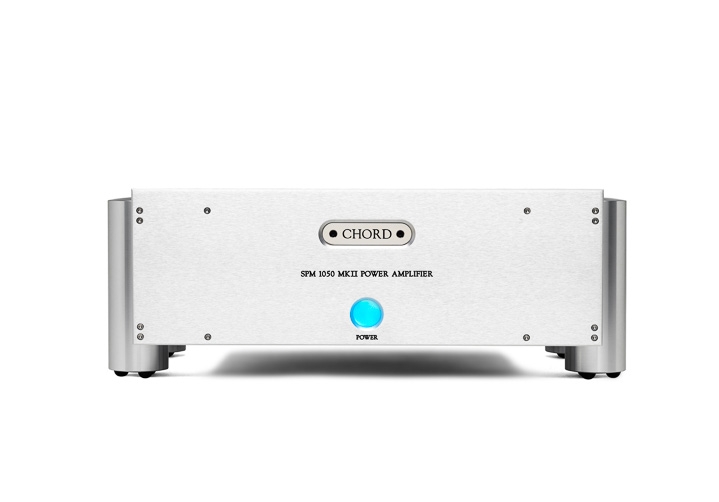
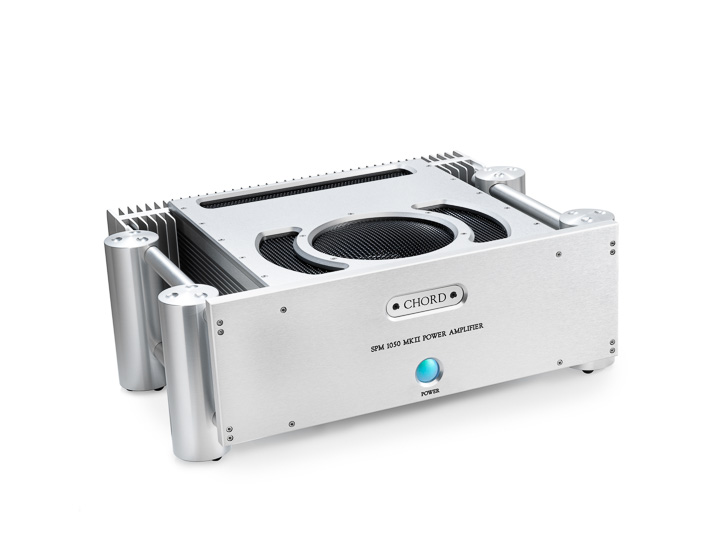
DAVE is not the primary reason for this review (we reviewed it in Issue 141); it just happened to be in the right place, my listening room, at the time when Chord’s new SPM 1050 MkII power amp turned up. But it seemed an obvious partner. This is the middle model in the Kent based company’s stereo power amp roster with a specified output of 200 Watts per channel. Like all Chord amps, it’s based around a high frequency switch-mode power supply, an approach found in Linn amplifiers among a few others, which in the SPM 1050 Mk II’s case makes up to 2kW available to the four lateral structure dual-die MOSFET output transistors used in each channel. The Mk II suffix indicates that this SPM 1050 has lower output distortion, improved capacitance, and better isolation of the mains transformer than its first generation predecessor. All are factors that Chord claims reduces output distortion and thus increases transparency, and fidelity; in listening, there’s no reason to doubt its veracity.

To recap, DAVE isn’t just a made up name, it stands for Digital to Analogue Veritas in Extremis, although I doubt that will be a question that comes up on University Challengein the foreseeable future. DAVE has rather more features up its bolted down sleeves than you might imagine, but it is the most advanced DAC that Chord has ever made. As with all such creations from the company, it’s not based on a mass-produced chipset but on an FPGA or ‘field programmable gate array’, a device that is claimed to have 1,000 times the processing power of a normal digital to analogue chipset. Chord’s digital wizard is Rob Watts, one of the only men in audio who talks about taps in D/A converters, which is partly because this term relates to an era when you tapped into a delay line to store data samples when interpolating the steps between sample points in the digital to analogue conversion process. Stay with me, here. Watts is of the opinion that for maximum timing accuracy you need an infinite number of taps and as DAVE is thus far his most advanced converter it has a fair few of them, 164,000 to be precise. Like all of Chord’s converters it upsamples quite heavily, too: 2,048 times in fact, both numbers being possible thanks to the power of the FPGA, which Watts describes as “a sea of gates that you can connect together to make any digital device you like. You could make a PC processor out of an FPGA, or a device that controls a rover on Mars.”
In terms of features, DAVE is also well equipped; it has eight digital inputs all but RJ45 and RCA coaxial types. The former is still uncommon on DACs, but the latter, while a compromise, is also very popular and it seems slightly odd that not one of the four coaxial inputs has this connector. They are all BNCs which are true 75 Ohm connections and thus well suited to the task, but only high-end sources have this as an output. Watts himself prefers optical connections and DAVE has two Toslink examples alongside computer audio favourite USB, which can cope with the highest 768kHz sample rate and is good for DSD. The converter itself supports DSD up to DSD512, both native and DoP. Switching between inputs proved more challenging than expected, there are four switches around the volume knob on DAVE but if you press the north or south ones it changes the function of the west and east buttons that usually switch between inputs, so I gave up and used the remote. Chord’s operational logic often meets operator incompetence, chezKennedy. I was able to switch between volume controlled and fixed output however, the latter being an option that isn’t often included on DAC/preamplifiers today; on most DAC/preamps you usually have to wind the level to max. This comes down to the custom nature of the DSP on DAVE, and is one of many variables you can tweak. These include high frequency filter switching, display colour options that can be quite lurid but indicate sample frequencies: e.g., red for 44.1kHz, dark blue for 192kHz, with shades in between and beyond. How you are supposed to remember which colour means which sample rate is another question but not one you really need to answer. More useful are phase switching, dual data mode for split channel digital connections, DSD and PCM specific modes that will work with the other format but are optimised for one, and headphone mode which offers four crossfeed settings and the potential to drive impedances from 8 to 800 Ohms.
Its perfect partner – the SPM-1050 MkII – is a simpler beast on the outside, but it still has a dash of colour; the on/off switch looks likea large acrylic ball and indicates its status with three colours that let you know if it’s off, warming up, or on. As the middle process takes not long at all this button is usually red (off) or light blue (on). The back panel is surprisingly cramped for a full width device, all the in- and outputs being situated in the middle around a 10A mains inlet. This takes a bigger IEC plug than usual and meant that I had no choice but use the cable in the box, but Chord’s very design is supposed to minimise the need for esoteric power cords. As it has RCA connectors, most of the listening was spent with Townshend Audio Fractal single-ended interconnects and the F1 Fractal speaker cable from the same company, but I also tried the XLR balanced connection with more prosaic cabling just to see if that would make a difference.
I initially hooked DAVE up to my regular ATC P2 power amp and to the server with a USB connection and while the result had good depth and vitality with plenty of low level detail, not to mention drive in the bass, it seemed a little lacking in overall resolution and quality of timing. So I switched to the indirect approach and put an AURALiC ARIES LE streamer between server and DAC with Ethernet to the AURALiC and then Chord Co Signature coax to DAVE and this was a lot more enjoyable. Alfa Mist’s ‘Keep On’ [Antiphon, Pink Bird] had really good high frequencies, dimensionality, and immediacy. That was via my reference PMC Fact.8 speakers – a combination that after a while proved a little bit too immediate and forward. Hence, I switched to the more relaxed Q-Acoustics Concept 500 floorstanders, which made the not quite CD standard of Qobuz sound pretty darn good with the right tunes. I tried the USB direct/coax and streamer comparison again and while USB gave decent timing it couldn’t compete with the three dimensionality of the alternative approach even though that involves more potential loss between source and converter.
Switching to the Chord SPM 1050 MkII and playing Ahmad Jamal’s The Awakening[Impulse], I was struck by both the brilliance of the playing and the distinctive late 1960s character of the recording, but that did nothing to undermine the groove, which is aided by the SPM 1050 MkII’s solid bottom end. The body of the double bass when it joins the piano’s bass notes is clearly defined and the whole band are clearly in the pocket, cooking with gas, and therefore contravening several fire safety codes. Continuing the classic jazz tip with Lee Morgan’s The Sidewinder[Blue Note], this system gave fabulous horn stabs, clear-cut cymbal action, and snare snap with bass in the background. It also digs out great subtlety in Morgan’s solo. The SPM 1050 MkII has excellent control of low frequencies, that much is obvious when playing ‘Royals’ [Lorde, Pure Heroine, Universal], which was extremely articulate in the bass and had extra helpings of reverb on the click sound.
Switching to the more revealing and demanding Bowers & Wilkins 802 D3 speakers results were similar, but more clear cut. Here the Chord pairing cuts through some of the ‘thickener’ on the Mobile Fidelity recording of ‘Company’ [Patricia Barber, Modern Cool, Premonition] and delivered tighter bass if not the full vinyl style midrange transparency that the recording is capable of. Radiohead’s ‘Decks Dark’ [A Moon Shaped Pool, XL], on the other hand, was full of detail; the various sounds on it were placed precisely between and beyond the actual speakers, so there’s plenty of differentiation between recordings, that’s for sure. Ryan Adams and the Cardinals’ live version of ‘Hallelujah’ had plenty of tension alongside the atmosphere of the live event and there was real focus on the feeling in the voice. Alison Krauss + Union Stations’ Live[Decca], on the other hand sounded very easy with natural timing, although I have heard this more ‘vibrant’.
High frequencies are slightly accented, but this doesn’t undermine transparency through the midband , which means you get plenty of expression out of everything from voices to saxophones. Denser recordings could sound a little thin sometimes: Beethoven’s 7th [Barenboim, Beethoven For All, Symphony No.7 in A, Op.92, 24/96, Decca] while having no shortage of power, did lack some nuanced musical flow. Chamber music worked a lot better, especially with recordings that benefit from the exposure provided by these components.
Usually with DAC/preamps the volume control is a limiting factor and adding my Townshend Allegri between them and the power amp is obviously beneficial, but not here. This is the first time I have found a component like this that performs better on its own, delivering greater delicacy and dynamic subtlety thanks to higher overall resolution. I also tried the AES/EBU connection to DAVE and despite not having a dedicated balanced digital cable, this connection proved nearly as good as the dedicated digital coax with a slightly less extended top end which gave it a more relaxed balance overall. I also tried a balanced connection from DAVE to SPM 1050 MkII but the relatively real-world nature of the cabling was no match for the Townshend RCA connection, especially when it came to depth of image and layering therein.
I also tried the DSD+ and PCM+ settings which clearly benefit the relevant formats to the extent that you have to wonder why these don’t automatically switch when a DSD or PCM signal comes along. The marvellous 2L label from Norway makes great recordings in all manner of formats and gives away sample tracks. It’s possible to contrast the same performance in 24/192 and DSD128, for instance. This was done with the Mozart Violin concerto in D major (Marianne Thorsen, violin TrondheimSolistene) and delivered a distinct difference between both formats via their appropriate settings and when playing DSD through the PCM+ setting. In the latter case there is more focus and a clearer sense of the recording venue with DSD via DSD+, but this increased with the PCM version on the PCM+ filter, which sounded that much more realistic.
.jpg)
Chord’s DAVE is clearly an impressive piece of digital audio hardware, but it’s not alone; going direct from DAC to amp makes a lot of sense when it’s this DAC and the Chord SPM 1050 Mk II. The SPM 1050 MkII is a powerful and precise amplifier that with the right speakers can deliver the goods in convincing fashion. Not having heard its predecessor I can’t say if it’s a major upgrade, but that’s not really the point. Chord Electronics may be making waves in the portable audio market, but it’s never taken its eye off the ‘real’ hi-fi market. With all the attention placed on the DACs, it’s easy to skip over Chord’s amps. Don’t… there’s a lot of ‘excellence’ here.
TECHNICAL SPECIFICATIONS
Chord DAVE
- Type: Solid-state high-resolution PCM and DSD-capable digital-to-analogue converter/preamplifier
- Digital Inputs: One AES/EBU, four Coaxial BNC, two Toslink, and one USB Type B
- Analogue Outputs: One stereo single-ended (via RCA jacks), one balanced (via XLR connectors). Both outputs are configurable for fixed or variable level operation
- DAC Resolution/Supported Digital Formats: All PCM from 44.1KS/s to 768KS/s with word lengths up to 32-bit, DSD64, DSD128, DSD512. The following format restrictions apply:
769KS/s and 384KS/s are supported through USB only
32-bit word lengths supported through USB only - Frequency Response: 20Hz–20kHz, ± 0.1dB
- Distortion (THD + Noise): Not specified
- Output Voltage: Not specified
- User Interface: LCD display and remote handset
- Dimensions (H×W×D): 71 ×333.5 ×154mm
- Weight: 7kg
- Price: £8,499
Chord SPM 1050 Mk II
- Type: solid state stereo power amplifier
- Analogue inputs: One pair balanced (via XLR), one pair single ended (via RCA jacks)
- Analogue outputs: One pair of speaker taps (via 5-way binding posts)
- Power output: 200Wpc @ 8 Ohms
- Bandwidth: 0.2Hz–46kHz -1dB
- Sensitivity: Not specified
- Distortion: 0.05% distortion into 8Ω
- Signal to Noise Ratio: Better than 103dB
- Dimensions (H×W×D): 128 ×480 ×355mm (including Integra legs)
- Weight: 10kg
- Price: £5,450
Manufacturer: Chord Electronics
Tel: 01622 721444
Tags: FEATURED
Trending Articles
See all
By Jason Kennedy
More articles from this author


Read Next From Review
See all
Reiki Audio SuperSwitch X/Pro X PSU
- Oct 06, 2026
Audiobyte SuperVOX
- Oct 06, 2026
Unitra WSH-805
- Sep 29, 2026
Wilson Audio Sabrina V
- Sep 29, 2026