Seeing ventilation holes on the left-hand side of the case did make me initially concerned; Anni is a very small, densely packed box and I was a bit reticent in letting it warm up straight out of the box in case it ran hotter than the surface of the Sun warm. But I put it through its paces even through the brief Indian Summer in early September and it never ran more than warm to the touch. The amplifier circuit, for all its low power, is surprisingly willing to drive all but the most difficult loudspeaker loads. This is somewhat self-limiting; loudspeakers that would really challenge the Anni are priced far beyond any reasonable expectation of partnership, and a quick survey of products more likely to be used with the Anni nets absolutely nothing that would in any way cause a kerfuffle. Note: please don’t consider that as ‘challenge accepted’ and try to scare the Anni into submission by trying to play loud dub reggae through a pair of old Apogee Scintillas. But as discussed earlier, using it with real-world products in the same ball park as the Chord Electronics amp; I used KEF’s LS50 Metas with Anni and they quickly became firm friends.
As with the other products in this three-strong line, hooking it all up is a little fiddly because you are very short on rear-panel real estate. This is compounded by the use of the DC output to feed a Huei or Qutest. You are restricted to 4mm banana plugs (they insert deep into a recess on the rear panel, so there’s no provision for bare wire or spade lugs and even BFA connectors are not an option).
There is also a ground terminal provided, but frankly, I’ve no idea why it’s there; the amp runs whisper-quiet, and I couldn’t get any kind of hum or increased noise floor out of Anni. While this terminal is a boon to those wanting to run grounding boxes, I can’t help but think this is a little esoteric for Anni’s potential customers. Chord Electronics doesn’t throw any light on its inclusion in the folded card manual provided. Like Anni itself, this is useful, if minimalist in approach. Chord Electronics does suggest that if used with a Qutest, remember to keep its output below 2V. The Qutest’s and Huei’s twin XLR outputs are not replicated as inputs here.
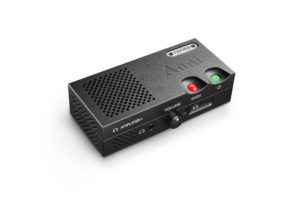
I’m generally not big on discussing packaging, but credit where it’s due; Chord Electronics really know how to make the unboxing of the Anni a bit special. It’s sleeved in a black card matching the box itself. The front of the box has a small magnetic clamp to prevent the contents of the box from tipping out everywhere. Once you lift that, you are met with a two-layer case, with the Anni sitting in a foam insert at the top, and a pull-out tray holds the power supply and cables.
Power is fed from an external 15V switch-mode supply, connecting to the Anni via a four-pin mini-DIN connector. Continuing the ‘wow, that’s good packaging’ tip, a little black drawstring bag in the bottom drawer includes a custom cable (called the Qutest range power adaptor) that connects the 12V output of the Anni to the Huei, and a short USB A to mini USB cable is included that connects the Qutest to the USB socket on the custom cable. Note that if you only have an Anni and a Qutest, there is a spare 12V power connector roaming free around the back of your system.
The great thing about Anni in both build and sound quality terms is it never once makes you think it’s a small amplifier. This is a big and clean sounding amplifier with an excellent soundstage and a keen sense of rhythm that no one had the heart to tell it quite how small it really was. So it sings its little heart out. In fact, when you hear Anni at work, saying things like ‘it sings its little heart out’ are at once trite and patronising. Anni don’t need your sympathy!
10W is surprisingly gutsy too. OK, so this isn’t The Who’s Live At Leeds [Decca] album played at ‘Dude, Where’s My Hearing?’ level gutsy, but it’s more than meaty enough to play rock and dance music at ‘healthy’ levels without strain.
In fact, ‘without strain’ is something of an oft-repeated phrase with Chord Electronics’ Anni. Not simply that the amplifier rarely strains, even when undergoing some fairly heavy lifting amp-wise. not even because the sound has something of that effortless, unfatiguing quality to it. I promised myself that I wouldn’t do this, but playing ‘It’s a Hard-Knock Life’ from Annie [Original Broadway cast soundtrack, Tidal] really showed this ‘without strain’ property to the amplifier’s sound. It’s a well-recorded soundtrack (as many are) but the children’s voices can screech. Products that tame the screech often end up making the other parts of the recording too soft, while others make the kids sound too ‘squawky’. Anni’s ‘without strain’ quality makes the song well balanced, with the brass bassline easily picked out against the vocals. Annie works with Anni.
It helps that the soundstage is wide, too. There’s a little front-to-back shortening and not much height information, but the width and precision of that soundstage works really, really well in the context of amplifiers at this level. Playing Carla Bley’s composition ‘Vashkar’ by the Marcin Wasilewski Trio [En attendant, ECM, Tidal] showed this well. The piano and upright bass were perfectly positioned in space, with the drum kit sitting not quite as far back in the mix as possible.
Bass is ‘taut’ rather than ‘cavernous’ or ‘stentorian’, but I like its snappy precision and it’s not without some heft. It’s more a ‘dry’ bass rather than the sort of big, overblown bottom end. Staying with the same ‘En attendant’ album, ‘In Motion Pt 2’ starts with a subtle drum solo followed by bass lines that demand detail, but in a very musical, rhythmic manner. Anni fares really well here. You get a real sense of players riffing off one another, and although that tempo is hard to determine at times, the Anni is good at getting its groove on and making that music flow in both a legato manner and also by teasing out the beat.
Most significantly, however. is Anni’s ability to portray musical detail with ease. It’s at this point you really have to take stock of the fact this is an amplifier intended to be used at arm’s reach, rather than in a full-sized system. You are hearing deep into the music with the Chord Electronics amplifier, extracting those nuggets of detail usually lost in the noise floor at this level. Those little but absolutely crucial key-depress noises, fretboard squeaks and more put you there in the room with the musicians. All there in vivid detail. Excellent!
It’s only when you really push it does Anni begin to falter, hardening up in the treble first then down into the midrange, but even then it’s mostly an elegant faltering rather than a faceplant. And yes, if you go head-to-head with a larger, more powerful and more expansive amplifier in a conventional system, the hardening process starts at only beyond average listening levels, but we might be missing the point here.
Trending Articles
See all
Fell Audio Amp
- Jul 27, 2026

hi-fi+ issue 250: the Awards
- Dec 02, 2025

Krell Vanguard integrated amplifier
- Apr 07, 2015

By Alan Sircom
More articles from this author


Read Next From Review
See all
Revival Audio Sprint 3
- Aug 31, 2026
Transrotor Bellini TMD, TRA 9, Figaro
- Aug 31, 2026
Burmester 232
- Aug 31, 2026
Acoustic Energy AE1 40th Anniversary
- Aug 31, 2026