Over the last few years, we’ve seen a range of products that are loving tributes to models from decades ago. Nostalgia is a major market; whether appealing to those who admired the product in the past but couldn’t afford it, or simply tapping into a broader desire to nostalgically revisit a time when things were at least differently terrible.
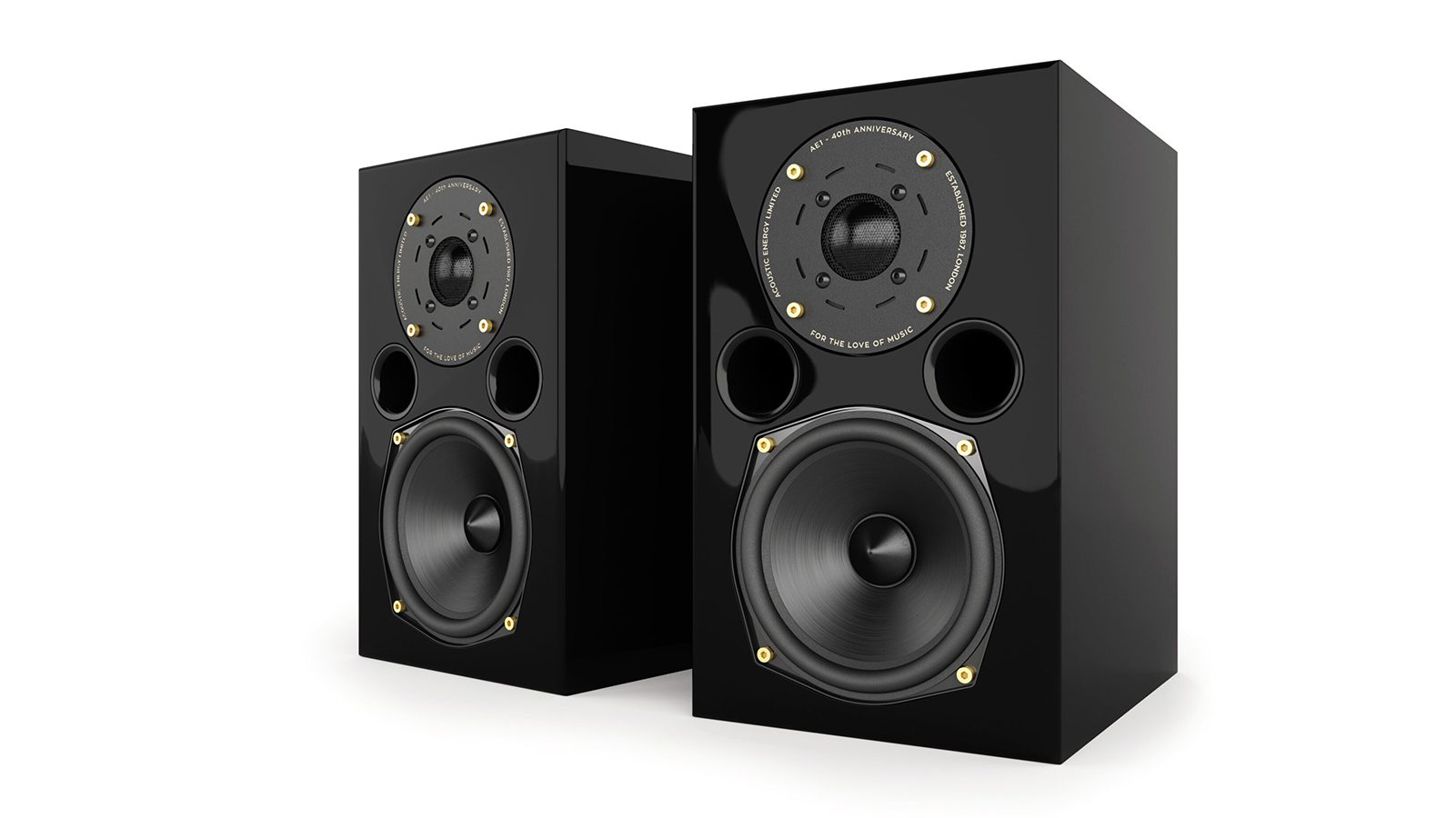
At first glance, the relaunched Acoustic Energy AE1 40th Anniversary appears much the same. The original Acoustic Energy design marked a significant advancement in what a compact speaker could do when it was launched in 1987. Each cabinet was not much larger than a BBC LS3/5 monitor, yet it offered a frequency response and power handling capabilities well ahead of the older model. It was very much the right product at the right time.
Relevance
What makes this relaunch of the 40th Anniversary model slightly different from the Neat Petite Classic I reviewed here in Issue 213 is the way Acoustic Energy has designed it. The Neat retains the dimensions and configuration of the original and applies current Neat design principles to the drivers and port arrangements. Acoustic Energy has now reached a point in its engineering where none of the original AE1’s design concepts are relevant to its current thinking. The driver materials, bass port arrangement, and cabinet design of the Corinium bear no resemblance to those in the AE1; updating the design would mean changing it completely.
This means that the Anniversary is technically not the very best speaker that Acoustic Energy can produce for £1,500. Instead, it’s the best AE1 they know how to make, which is a subtly different suggestion. What makes this significantly more interesting is that every single component of the Anniversary is new. The original tooling was not in a condition to be reused (indeed, it was one of the reasons the production of the ‘AE1 Classic’, as it was then, had ceased in 2016). The closest comparison to what AE has done here is with the relaunch of the Musical Fidelity A1 amplifier; but even here, there are differences.
Pint and a half
This is most evident in the cabinet lining. The original AE1 is well known for using ‘about a pint and a half’ of concrete to line and stiffen the cabinet. The Anniversary employs bitumen damping, as seen in the Corinium. However, it is applied in a manner that mimics the behaviour of the original concrete-lined cabinet rather than making it as inert as technically possible. For some readers, this will make the AE1 seem more like a nostalgic device than a performance machine — but no other model in the range has been removed to make it exist.
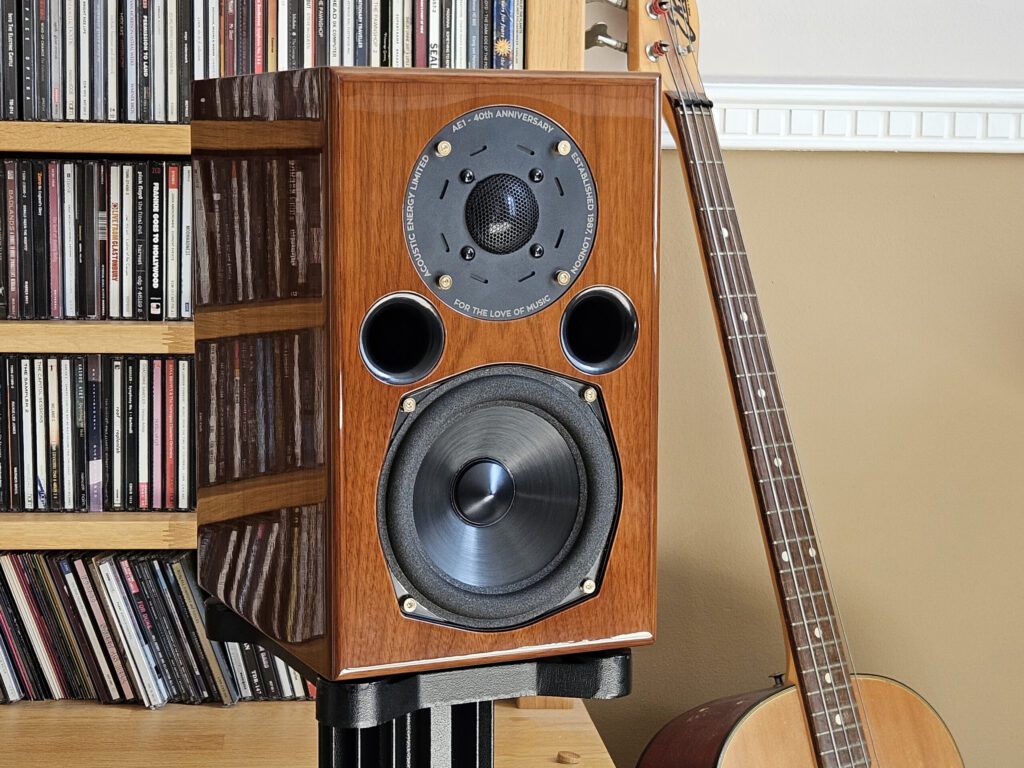
The drivers closely resemble the original units, but they are all new. Both the midbass and the tweeter are larger than before; 125mm for the midbass and 29mm for the tweeter. The result is increased airflow, reduced distortion, and a slight rise in sensitivity. The midbass retains the hard anodised cone, as ever ceramic-backed and extremely rigid. The surround remains foam, as none of the materials used in Acoustic Energy’s more recent drivers are compatible with aluminium.
The crossover still switches between the two drivers at 3kHz, but there are notable differences in its operation. The original AE1 features a relatively complex fourth-order crossover, partly to prevent the tweeter from being damaged by the power the midbass driver can handle. The more robust unit in the Anniversary does not require the same level of protection, so the crossover design is accordingly similar.
Internal changes
There are other internal changes as well. The twin circular bass ports are still present and correct, but they now feature an inner flare alongside an outer one to enhance flow characteristics. The mid-bass driver now also has a shorting ring, which it did not before. This isn’t a ‘pickled in aspic’ rebuild of the 1987 original, but more of a new speaker built based on a forty-year-old template.
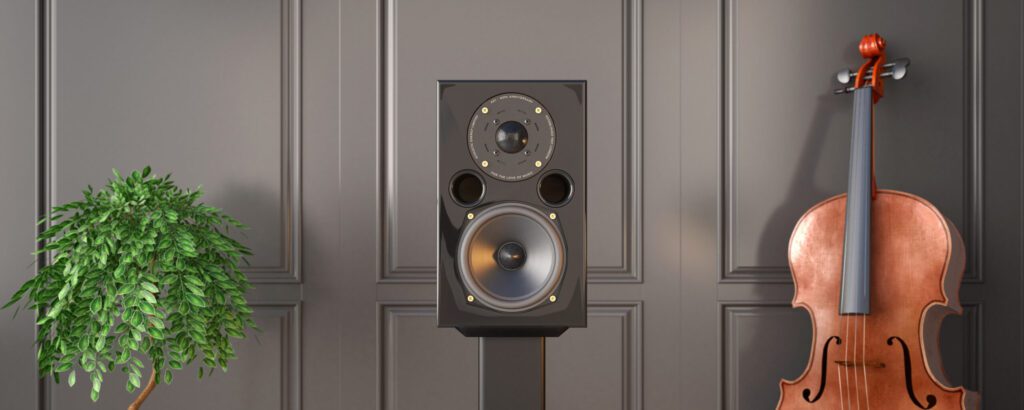
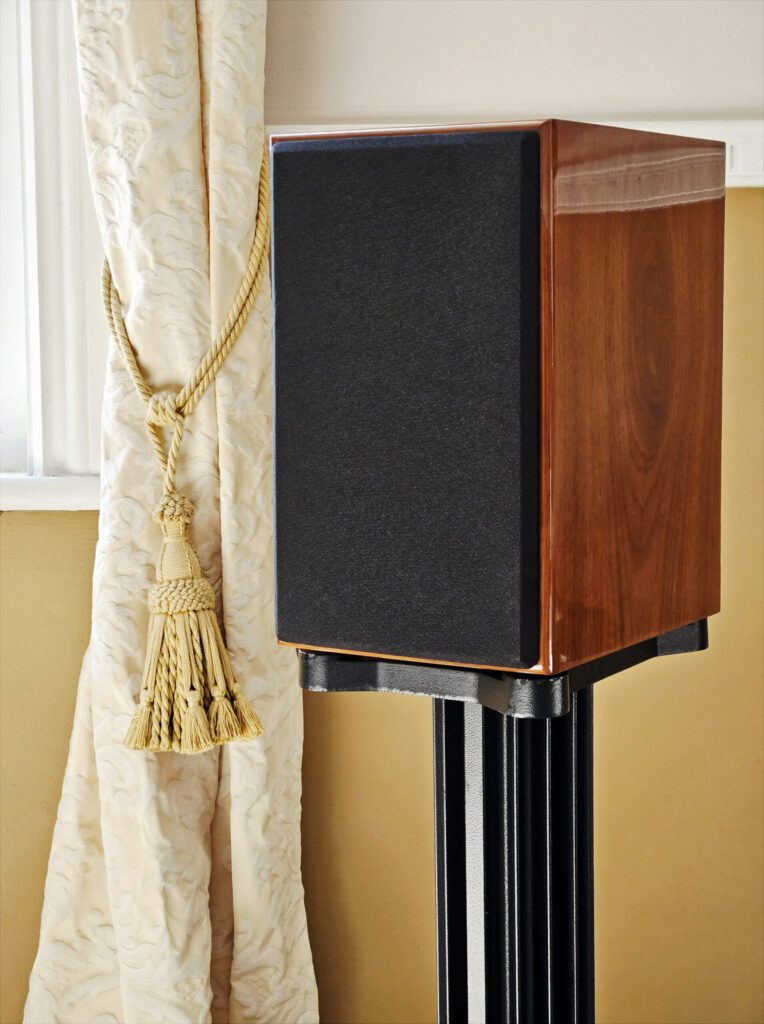
Fortunately, this design template involves leaving the appearance largely untouched. Even here, there are slight modifications: the Anniversary is the first AE1 to feature magnetic grill tabs and a corresponding reduction in the number of holes on the front panel, but the overall design remains unchanged. The AE1 is part of a specific category of industrial design that includes a few iconic objects. It lacks ‘styling’ in the typical sense and instead has the smallest, simplest exterior for the hardware involved. It looks superb because there’s not a single unnecessary element in its design. The Anniversary features some writing and a scattering of gold bolts around the tweeter housing, which I mind less than I expected, and it is available in both gloss black and walnut finishes; black crackle is definitely not an option.
For their new AE1 Acoustic Energy, the quoted frequency response is 50Hz – 45kHz at ±6dB, with a sensitivity of 87db/w at six Ohms impedance. It’s still not my first choice for a single-ended valve amp, but nothing I’ve tested here has struggled with them. Having spent some time with the new speaker, it is slightly but noticeably more efficient than the previous version, requiring a consistently lower volume increment on the precisely calibrated volume indicator of a Bryston Bi200 to reach specific volume levels.
First and last
How can I express this with such certainty? Well, besides having the first production pair of AE1 Anniversaries, I also owned the last-ever pair of original AE1s, having purchased them in 2017. I first heard a pair when I was thirteen or fourteen, as two of them were mounted on wall brackets in my school’s music department, and their performance has stayed with me ever since. I am not blind to the flaws of the AE1, but my mind rarely dwells on them when I listen to music on them. They remain one of my favourite speakers.
Listening to the ‘new’ AE1 alongside the original is captivating because, although they share no parts in common, they are, at least technically, the same speaker. The most crucial point is that the new speaker still maintains an exceptional sense of speed and engagement with its performance. Listening to The Sound of Violence on Cassius’ ‘Au Reve’ [Astralwerks] on the Anniversary remains a physical expression of pure joy. When the track shifts tone at 2:45, the AE1 is superb. The prominent synth line is perfectly defined above a bass sequence that has far more punch than the raw numbers suggest. Spend any time with the Acoustic Energy, and even well-matched speakers can seem somewhat sluggish afterwards.
Joy support
Supporting this joy are details showing that the changes to the basic recipe have yielded considerable benefits. The new driver manages to extend marginally lower than the old one without compromising the sensational transient speed that characterises the original. This is not, and never will be, a speaker that delivers bass you feel in your stomach, but crucially, there is enough bass to convince you that you aren’t missing out on anything. The laws of physics still can’t be broken, but you might be surprised at how far they can bend.
One of the more unusual aspects of switching between the old and new speaker is the behaviour of the ports. I’ve never noticed their presence in the performance of my pair, but I also can’t deny that the Anniversary is clearer and more detailed from 100Hz down, in a way that indicates its air management is more comfortable. As before, their placement on the front rather than the rear makes both models notably easy to position.
Expansive
The soundstage offered is also a bit more expansive and immersive. This remains a speaker that delivers a relatively focused presentation, but listening to the magnificent Love Is Everywhere by Laurent Bardainne & Tigre d’Eau Douce [Heavenly Sweetness], the new speaker detects slightly more width and depth, reducing the sensation that it’s like wearing a giant pair of headphones. You still notice each cabinet as part of the soundstage, but in a way that is subtly, yet noticeably, less pronounced than before. The AE1 has always sounded larger and more confident than you’d expect from a speaker of its size, but the Anniversary elevates this trait further.
The other end has really improved, though. It now offers a level of top-end clarity and control that my own pair can’t match. When you play the deliberately vintage Quatermass Seven by Little Barrie and Malcolm Catto [Madlib Invazion], the Anniversary cuts through the slight haze of the recording to reveal Catto’s exquisite hi-hat and snare work in a way that still fizzles with excitement but with greater fine detail and definition. What has truly impressed me is that, despite the unburstable excitement still baked into the presentation, the Anniversary can handle harshness and poor recordings better than the original, which avoids them altogether. You need to be both merciless and possess a very forward-sounding system to provoke the Anniversary.
Context
To provide some context for these improvements, adding the resident Neat Petite Classics to the test highlights both the limitations of the new AE1 and the enhancements that the Anniversary has introduced. The Neat still offers a level of bass extension that neither generation of Acoustic Energy (nor indeed any other stand-mount of this size) can hope to achieve, and the implementation of the AMT unit for the upper registers gives it a three-dimensional quality that even the improved top end of the new AE1 cannot rival.
What has impressed me greatly, however, is that the work undertaken by Mat Spand at Acoustic Energy has revitalised a forty-year-old speaker that the original Petite was designed to surpass, bringing it back onto the same level. It is still faster and more dynamic than the Neat, but it now matches it for refinement and tonal realism in a way that my own pair, despite every effort, cannot.
Inspired by real events?
This achievement feels less like the kind of ‘inspired by real events’ retro that characterises many of the products I have reviewed in recent years, and more like a successful ‘retromod’ of the type where a company—found in various parts of the UK—takes a decaying classic car and, after several months and many thousands of pounds, returns it in ‘as new condition’ but better than it ever was. It’s still an AE1, but one that is improved in every sonic aspect that truly matters.
Of course, when all is said and done, this is still a 40-year-old speaker constrained by design and material choices it need not have made. For more than a few people, rose-tinting will be a coloration too far. However, for rather more people, including myself, this is a rare treat: a debugged version of a bona fide classic that offers all the excitement and joy of the original in a more manageable, forgiving, and capable form. Acoustic Energy’s 40th birthday present is a gift to us all and extends beyond mere nostalgia.
Technical specifications
- Type: Two-way stand-mount loudspeaker
- Tweeter: 29mm anodised aluminium dome
- Mid / Bass Driver: 125mm spun / rigid anodised aluminium cone
- Frequency Range: 50Hz – 45kHz (+/- 6dB)
- Sensitivity: 87dB/m/2.83v
- Power Handling: 150w
- Crossover Frequency: 2.8kHz
- Impedance: 6 Ohms
- Cabinet: 18-22mm RSC™ constrained layer HDF/bitumen construction, braced, twin reflex-ported
- Grilles: Cloth, magnetic fit
- Dimensions: 295 x 180 x 240 mm (HWD)
- Weight: 7kg (each)
- Finishes: High Gloss Walnut and High Gloss Black
- Price: £1,500, €1,795, $1,995 per pair
Manufacturer
Acoustic Energy
+44(0)1285 654432
Tags: ACOUSTIC ENERGY AE1 40TH ANNIVERSARY STAND-MOUNT LOUDSPEAKER
Trending Articles
See all
By Ed Selley
More articles from this author
Read Next From Review
See all
Eversolo T8
- Oct 13, 2026
Acoustic Energy AE Active
- Oct 13, 2026
Reiki Audio SuperSwitch X/Pro X PSU
- Oct 06, 2026
Audiobyte SuperVOX
- Oct 06, 2026