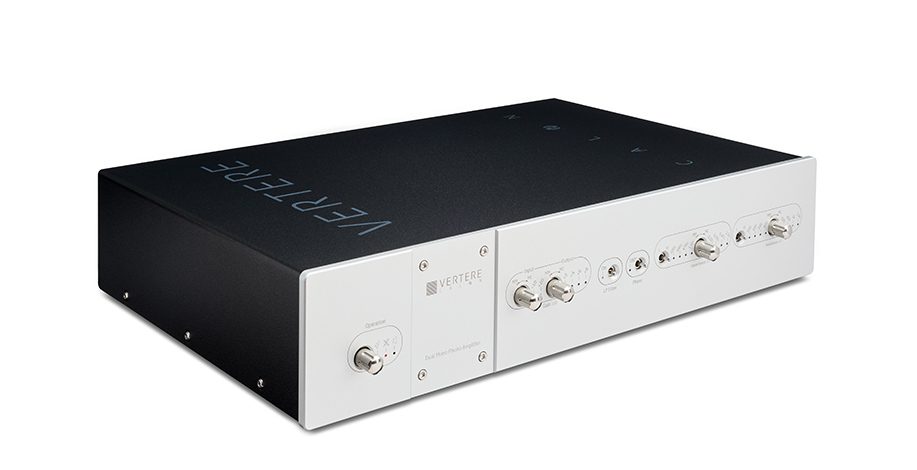
The role of a phono stage in a vinyl replay chain, along with its significant influence on overall performance levels, is such that it is not surprising several turntable manufacturers feel compelled to incorporate them into their ranges, ensuring the signal reaching your amplification is precisely as they intend. Moreover, phono stages seem to act as a gateway for certain turntable manufacturers to design the entire replay chain, simply to retain control.
Vertere Acoustics has entered this field by developing the Phono 1, now in its MkII form. This model pairs well with the DG-1S turntable and more traditional versions of the MG-1 MkII. However, it is less suitable for higher-spec MG-1s, as well as the SG-1 and RG-1 models that exceed it. In the UK, Vertere has distributed FM Acoustics hardware to meet this demand, but with a focus on international sales and maintaining control, it has now launched the Calon to position above the Phono 1 MkII.
Welsh Heart
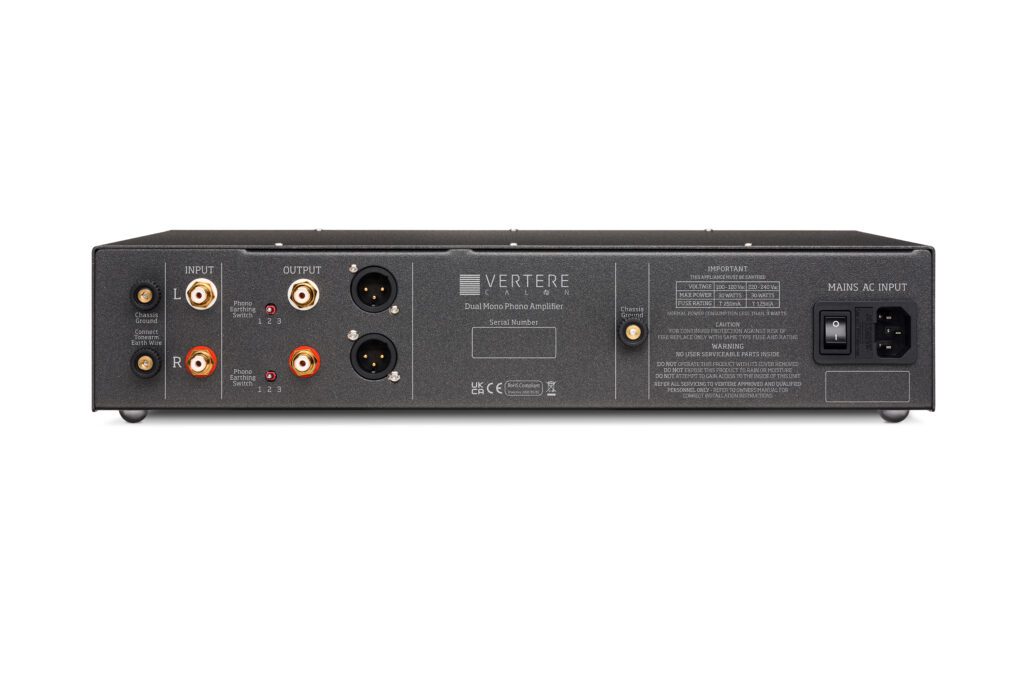
The Calon (a name derived from the Welsh word for ‘heart’) features a relatively conventional specification. It is equipped with a single input, moving magnet, and moving coil phono stage that offers adjustable gain and loading, making it suitable for both balanced and unbalanced outputs. It lacks a balanced input; Vertere founder and chief executive, Touraj Moghaddam, has expressed concerns regarding the categorisation of moving coil cartridges as ‘naturally balanced’ and has chosen to forgo this practice. In an era when some phono stages accommodate multiple inputs and feature balanced designs, the Calon appears almost austere.
It is the manner in which the Calon applies gain that distinguishes it from other phono stages. The innovation lies in applying the gain to the signal before processing the RIAA curve. Vertere argues that any under- or overcorrection of the RIAA prior to gain application will result in a significantly greater deviation from the theoretical ideal. By utilising this method, the signal remains constant, allowing for more accurate equalisation. The RIAA is then applied to the amplified signal.
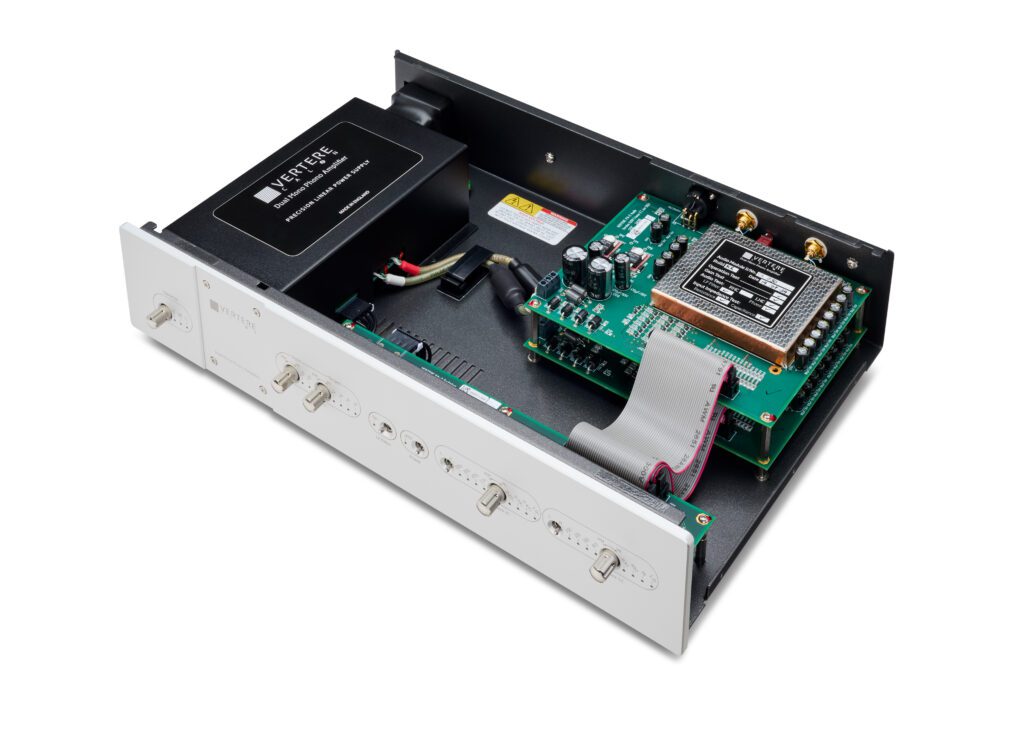
Due to this process change, the Calon can apply gain before and after the EQ stage. Gains of 10 or 20dB are available at the input, with an additional 8dB possible at the output. The theoretical maximum is 73dB, which should accommodate most cartridges, although this is considerably more than any Vertere cartridges require. For those models, the Calon offers impedance settings of both 1kOhms and 1.5kOhms, which are the preferred options that some competitors lack.
There’s More…
The Calon does not stop there. It features an innovative approach to the subsonic filter concept that can also be activated or deactivated. This constitutes a linear phase circuit, and Vertere claims that its measurable effect above 20Hz is virtually negligible. Additionally, there is a phase inversion switch, as an exceedingly small number of records have been mastered with incorrect absolute phase (to the best of my knowledge, I do not possess a single example), and there are two separate chassis grounds.
Internally, the Calon shuns flashiness in favour of impressive fastidiousness. It is crafted as a dual mono device on two four-layer boards with carefully selected components, all encased in casework made from antimagnetic stainless steel. This material imparts a distinctive quality to the Calon that is arguably more ‘businesslike’ than other Vertere devices I have tested.
In comparison to the smaller casework of the Imperium power supply, the Calon appears almost ordinary, and it’s difficult to argue that £15,500 (including a £2,950 Pulse HB power cord) could not buy more visually striking and tactile devices. Nonetheless, this does not convey the entire picture. The craftsmanship evident in the construction of the Vertere and the tactile quality of the controls imply that this may be the last phono stage you ever need to purchase.
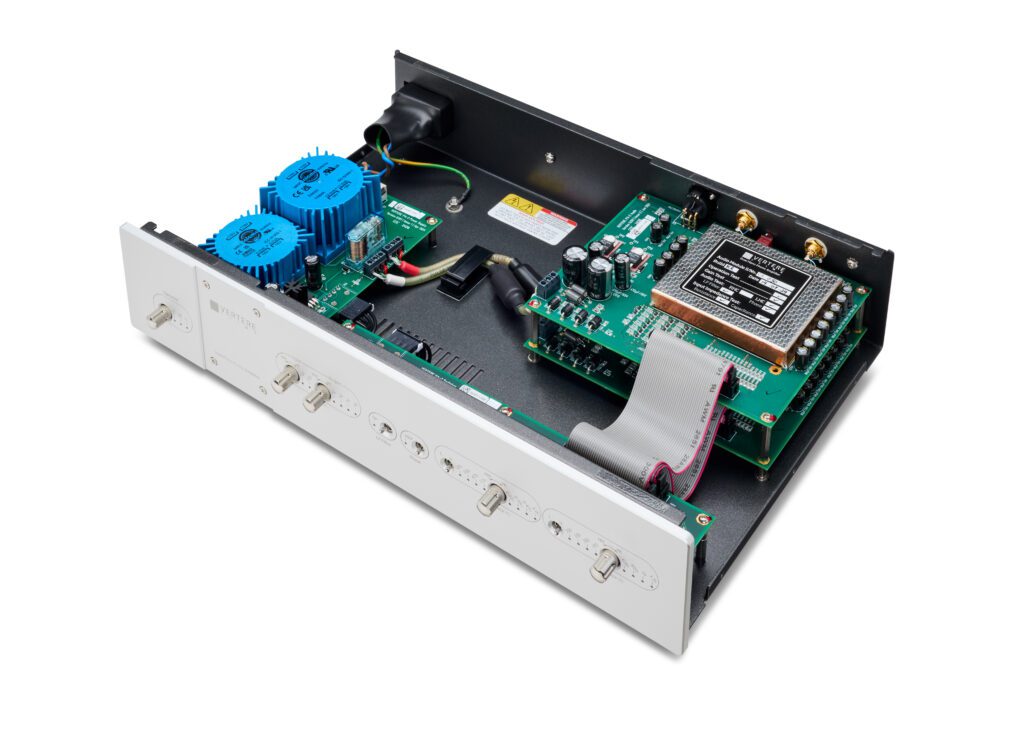
There is also a reasonably good chance that the Calon will be the last phono stage you want to purchase once you hear it; or more specifically, don’t hear it. I won’t hide the fact that I have long been a bit obsessive-compulsive regarding unwanted noise. When idling, the Calon is utterly silent, and the experience of hearing the stylus land in the run-in groove, being the only sound you can discern from the system, is immensely appealing.
Lapel-grabbing?
In keeping with the presentation I’ve experienced from the Vertere turntables, the audio performance of the Calon does not instantly grab you by the lapels. I chose Hyper-Dimensional Expansion Beam by The Comet is Coming [Impulse!] as one of the first records I tried with the Calon, and the overriding impression is confidence rather than the swagger of performative high-end. The Calon effectively pries open this dense and chaotic recording, imbuing it with excellent tonal realism and fine detail, and it does so utterly effortlessly. However, you may find yourself wondering, ‘Is that it?…’
Do keep listening, though. Continue to feed the Calon whatever random part of your record collection piques your interest, and I wager it won’t be long before the ‘Eureka!’ moment occurs. For me, it was, of all things, To the 5 Boroughs by The Beastie Boys [Capitol]. Nestled at the end of side C is ‘An Open Letter to NYC’, an unabashed love letter to the city and one of their finest later works. It’s always a pleasure to listen to (you might not consider the Beasties to be audiophiles, but it seems they never received that memo), but in the hands of the Calon, it’s truly fantastic.
Little contribution
What I have come to appreciate at this stage is how little the Calon contributes of itself, and that the arguments for applying the RIAA curve after the bulk of the gain has been added indeed hold validity. The high-speed lyrics are perfectly intelligible without losing their intensity, and the performance itself is situated in a soundstage that is expansive without ever being diffuse.
There’s no hint of embellishment or overemphasis; the effect is to simply draw your attention to the music without any discernible sense of Calon’s involvement. When paired with the resident Vertere MG-1 MkII turntable, the effect is cumulative: more equipment busily getting out of the way of the music, and adding other Vertere components only enhances this ideal.
Gently Euphoric
With a turntable that showcases a more pronounced character—my Michell GyroDec, SME309 arm, and Van den Hul DDTII cartridge in this instance—the Calon beautifully accentuates the gently euphoric nature of the turntable while contributing very little of its own signature sound. Kessoncoda’s glorious Outerstate [Gondwana] is presented with such sheer joy that it is hard not to be captivated by.
Meanwhile, the deep, beautifully defined percussion on ‘KTO’ is weighty and immediate, endowing the entire track with a tangibility that draws your attention away from the equipment and immerses you directly into the music. It’s this capability that makes the Calon surprisingly forgiving of less-than-perfect recordings as well. The self-titled debut by The Slow Readers Club [SRC] maintains its angst and intensity without sounding as brittle as it can in certain circumstances. Perhaps inevitably, there is the more mundane issue that a phono stage as quiet as this will react to dirty and worn records with fairly predictable outcomes, but this is what cleaning machines are made to address.
After about a week, what one might initially perceive as a degree of sonic restraint, or even reticence, reveals itself to be an absolute desire to avoid becoming the centre of attention. For many individuals, this self-effacing characteristic may not meet their expectations, and an element that offers a clearer sense of identity may be more appealing.
In a system where the desired balance is achieved, the Calon offers an alluring opportunity to enhance performance without altering the overall experience. The ability to do this while accommodating the characteristics of nearly any cartridge available further adds to its appeal. If the Calon signifies the pinnacle of Vertere’s influence on the signal path.
Technical specifications
- Type: MC/MM Phono Preamplifier
- Power Supply; Two Linear, Internally Mains voltage switchable transformers
- Gain Settings; 45dB to 73dB
- Input Impedance Settings Resistance 100R to 47k
- Capacitance 100pF to 1.0uF – In 9 Steps
- Frequency Response 20Hz – 20kHz +/- 0.2dB
- Noise < -83dB – AWD
- THD+N 0.01%
- Finish Silver or Black
- Dimensions 412 x 290 x 88mm
- Weight 7.0kg
- Price £15,500. $19,995, €18,998 (including Pulse HB cord)
Manufacturer
Vertere Acoustics
+44(0)20 3716 4888
Trending Articles
See all
By Ed Selley
More articles from this author


Read Next From Review
See all
Eversolo T8
- Oct 13, 2026
Acoustic Energy AE Active
- Oct 13, 2026
Reiki Audio SuperSwitch X/Pro X PSU
- Oct 06, 2026
Audiobyte SuperVOX
- Oct 06, 2026