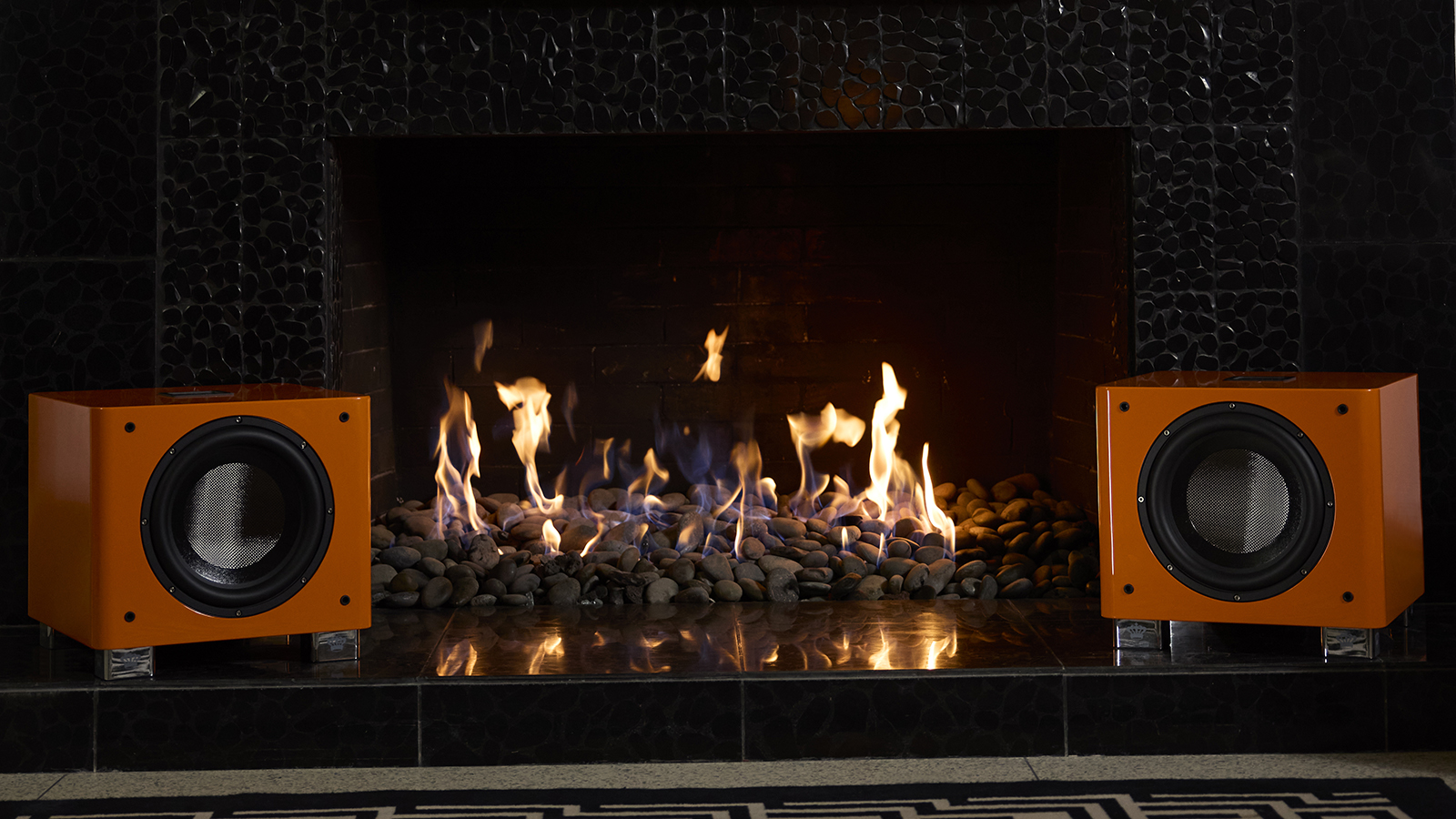
We don’t need to revisit old ground too much here. We tested the REL T/9x SE in a vivid shade of Rosso Corsa red here. The orange colour scheme might differ, but the subwoofer remains the same. This time, however, there are two of them.
However, a brief overview of the T/9x specifications is necessary. The T/9x SE features an active 10-inch long-throw FibreAlloy cone with an inverted alloy centre cap within a steel chassis. A built-in 350W Class A/B amplifier powers it. There is an almost identical passive radiating driver firing into the floor, which is why the T/9x SE rests on those stylish chrome feet. Like all REL subwoofers, the T/9x offers both high and low-level connections.
Paint has its needs
Achieving a ripple-free, ‘orange-peel’ free gloss paint finish on a wooden cabinet is quite difficult. It requires applying the final coat of primer with great accuracy. During this process, the cabinet becomes stiffer than ever. Regardless of the glossy colour you choose, this is the main difference between the standard T/9x and its ‘SE’ version. It also causes the subwoofer to sound tighter, deeper, and more responsive.
But as mentioned, we aren’t focusing too much on the T/9x SE’s performance as a standalone subwoofer. That is discussed more thoroughly in the Issue 235 review. However, the T/9x and T/9x SE are suitable for twin sub use. They are compact enough to fit into most systems and powerful enough to make a noticeable difference. My preference would be the T/9x SE, as the extra tautness in the sound results in more precise integration. However, two T/9x would also be acceptable. I am less certain that a T/9x and T/9x SE together would blend as seamlessly, but this is my educated guess. I didn’t have one of each to test.
The uncommon approach
There’s a myth about subwoofer room placement and phase. The common approach is to position one subwoofer in line with the loudspeakers, while the second is usually placed near the side of the listening chair. One is out of phase with the other. This setup offers home cinema enthusiasts a good balance of bass enhancement and room control. However, it also assumes a dedicated ‘point-one’ bass-only channel or channels. It doesn’t work nearly as well in a two-channel setup. No, you don’t get disembodied, surround-sound bass. However, what you do get is a lack of coherence between the bass and midrange, which diminishes many of the spatial qualities that REL is renowned for in the midband.
Feeding a full-range signal to a pair of loudspeakers and subwoofers presents a very different challenge. It at least requires high-level subwoofer connections to the loudspeaker terminals. This demands a different approach to installation and mindset. It’s not just about reinforcement; it’s about that word again: integration. This means ensuring that those subs blend seamlessly with the performance of your existing loudspeakers.
It’s honesty time
Let’s be honest. The best spot in the room for loudspeakers that reproduce midrange and treble is often not ideal for bass. We position loudspeakers to optimise the mid and treble response at the listening chair. Ideally, we should do the same for bass. Usually, that spot is slightly behind and to the side of the loudspeakers. This helps account for both room modes and time alignment. Having two subwoofers effectively ‘shadow’ the loudspeakers, just behind the acoustic centres of the main speakers, is optimal.
This is old news for readers of reviews of subwoofers in hi-fi+. We have repeatedly discussed how a subwoofer expands the soundstage and smooths out the midrange and treble. Bass reinforcement is at best a secondary consideration. However, despite this, when done correctly, the benefit of using two subs is not what you might expect. If some space and depth are added, two subs make the system more efficient and give the sound a sense of speed and dimensionality that the speakers alone cannot achieve.
A perfect example of this speed is when ‘Paradis Perdus’ by Christine and the Queens [Charleur humaine, Because]. The percussion has deep bass, but it’s the attack and decay of those percussion instruments that are most noticeable. Couple this with the understated use of reverb and echo, and any limitations on the system’s timing are revealed dramatically.
Important
Certainly, the improvements to soundstage and midrange from a good subwoofer remain just as important. However, it’s the speed that makes two RELs stand out as truly exceptional; it’s as if your loudspeakers become slightly quicker and more musically responsive. I used the two RELs with the excellent Audiovector R1 Arreté on their stands. These are naturally fast and rhythmically precise speakers, and they sounded noticeably better in both aspects of performance.
Adding two subs provides significant additional reinforcement to the bass as well. It ceases to be a secondary concern and skillfully adds depth and weight to the bass. As you attempt to blend in-phase and crossover networks, the tonal character of the loudspeaker remains unchanged. It simply introduces more depth. The two RELs add depth and impact to the sound that is typically only achieved with much higher-end models in the Audiovector range. The tonality stays the same, but the overall sound becomes larger and more precise.
Just one thing
The best thing about this is that there are no real downsides, apart from one. You can enhance your system’s performance in almost every way: tighter, faster, deeper bass; improved soundstage accuracy and robustness; and a more fluid, precise midrange and treble. Plus, you can do it gradually if your budget dictates. The only issue is that these colours don’t last long; they don’t fade gradually — they run out quickly. Buying an orange subwoofer today, with plans to add another in a year or two, might prove challenging. But it’s a challenge worth accepting.
REL has been promoting multiple subwoofers for many years, often with stacked arrays of its largest and best subs, enhancing some quite high-end loudspeaker designs. But, even at more modest levels, upgrading from one REL T/9x SE to two makes so much sense that it’s hard to resist. If you have a decent pair of stand-mounts or floorstanders, you owe it to yourself to try a pair of oranges!
Price and contact details
- REL T/9x SE: £1,549, €1,969, $1,650
- Standard REL T/9x: £1,399, €1,769, $1,500
Manufacturer
REL Acoustics
+44 (0)1656 768777
Tags: DUO REL T/9X SE SUBWOOFERS
Trending Articles
See all
hi-fi+ issue 250: the Awards
- Dec 02, 2025
Radialstrahler MBL 101 X-Treme
- Jan 03, 2023
REL Carbon Special Black Label
- Feb 18, 2026


By Alan Sircom
More articles from this author
Read Next From Review
See all
ATC EL50 Anniversary
- Aug 18, 2026
AIM Electronics NAX
- Aug 18, 2026
Ensemble Massimo Fonobrio
- Aug 18, 2026

Silent Angel Bonn N8C, Genesis GC and S28
- Aug 10, 2026