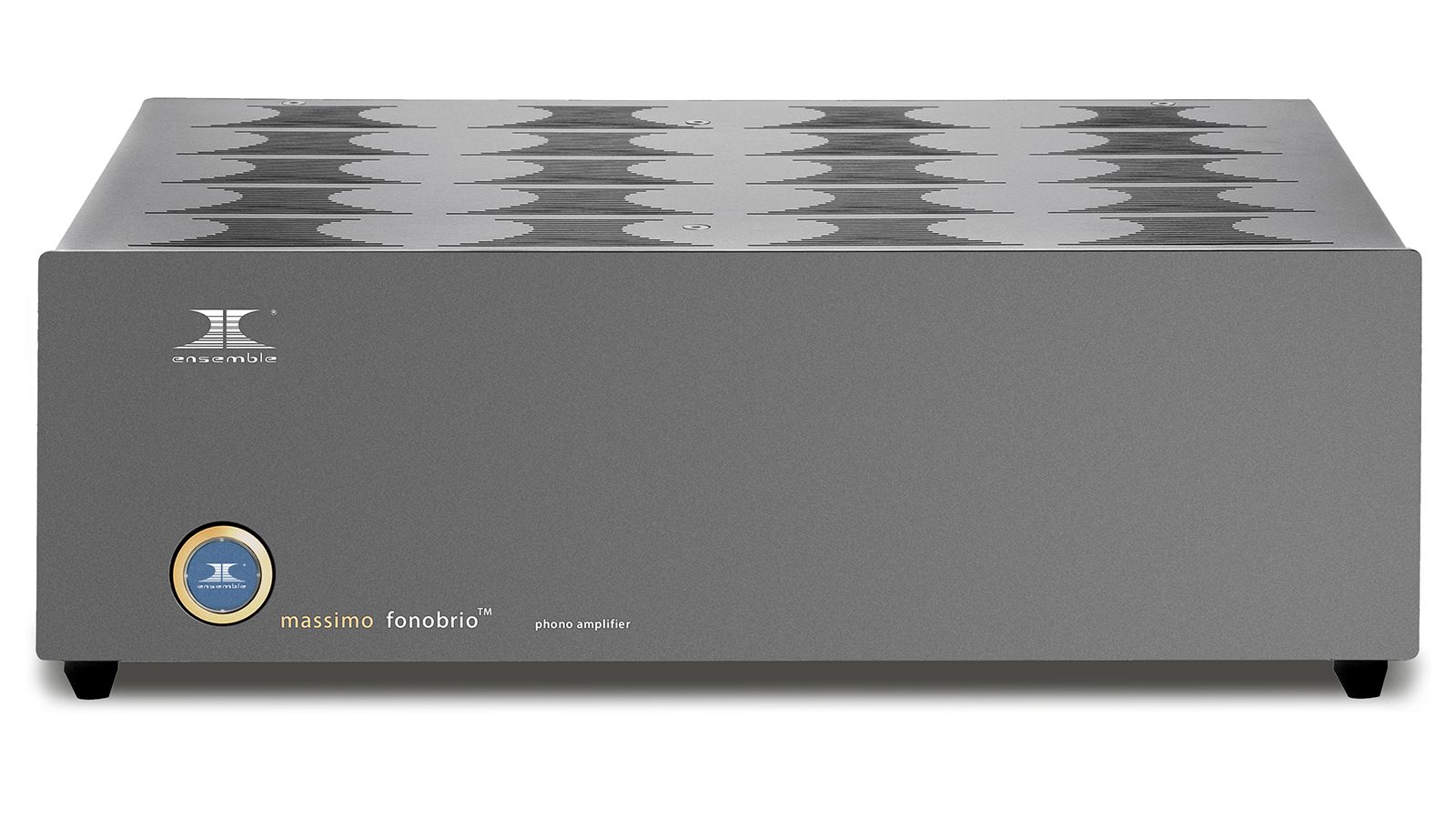
Can a single-box phono stage design that is still priced in the four-figure range truly be considered a ne plus ultra statement device? After all, the ultra-high-end standards of the 2020s suggest that, to qualify as such, it should be at least a two-box, preferably even a four-box setup (dual mono phono preamps plus their separate power supply units), retailing into the five-figure or possibly six-figure range.
Urs Wagner, the driving force behind the Swiss company Ensemble for decades (and, hopefully, for many more), has an approach to high-end audio system design that nearly contradicts the popular saying of ‘bigger is better’. The company’s line-up of electronics includes a few substantial, but not overly large, units that are not flashy and, therefore, don’t shout loud about their impressive build and finish.
Typical System
A typical Ensemble system includes a CD player and/or a phono stage, an integrated amplifier, and a pair of two-way speakers. An optional upgrade would be a mains conditioner with two isolation transformers housed in the same enclosure as the other components. However, do not view this practical, almost modest approach as a sign that Ensemble as a brand isn’t aiming high sonically.
Wagner considers the unrestrained maximalist approach prevalent in the high-end industry as immature in a society that, in all other technical aspects, aims for miniaturisation and integration. He realises that with increasing complexity (and its associated cost), a whole new set of problems arises that we hadn’t faced before.
Modularity breeds consistency
There is also a valid reason why all Ensemble ‘boxes’ look the same and have very similar physical dimensions. As any self-respecting high-end manufacturer would agree (though few practise it to the same obsessive degree), Ensemble believes that everything is essential. A modular approach with extensive commonality of everything from chassis to circuit boards and components should ensure a consistent sound across their range of equipment – a sound best described as balanced, not favouring any of the usual criteria such as dynamics, tonality, sound staging, transparency – at the expense of others.
As a result, Ensemble usually prefers you to listen to and evaluate their products within the context of a complete Ensemble system – hence the name. This balanced approach means that the contribution of any individual component in an ‘alien’ system might overshadow the links in the chain designed for more specific goals, giving it a more obvious character of its own. On the other hand, one could argue that this impartiality makes the phono stage, with its excellent flexibility in matching the transducer, very easy to incorporate into various systems, as long as they are transparent enough to let the phono stage’s high quality shine through. After all, you cannot ask more from a phono stage or any source component than to sonically vanish!
Painstaking detail
Roy Gregory tested the Fonobrio in Issue 64 and praised it as one of the best phono preamplifiers available. The Massimo Fonobrio has been around for a couple of years now, and as the name suggests, it is a ‘maxed out’ version of the Fonobrio concept – Urs Wagner himself admits he cannot think of anything really to improve further… This highlights another hallmark of Ensemble designs – consistency and longevity.
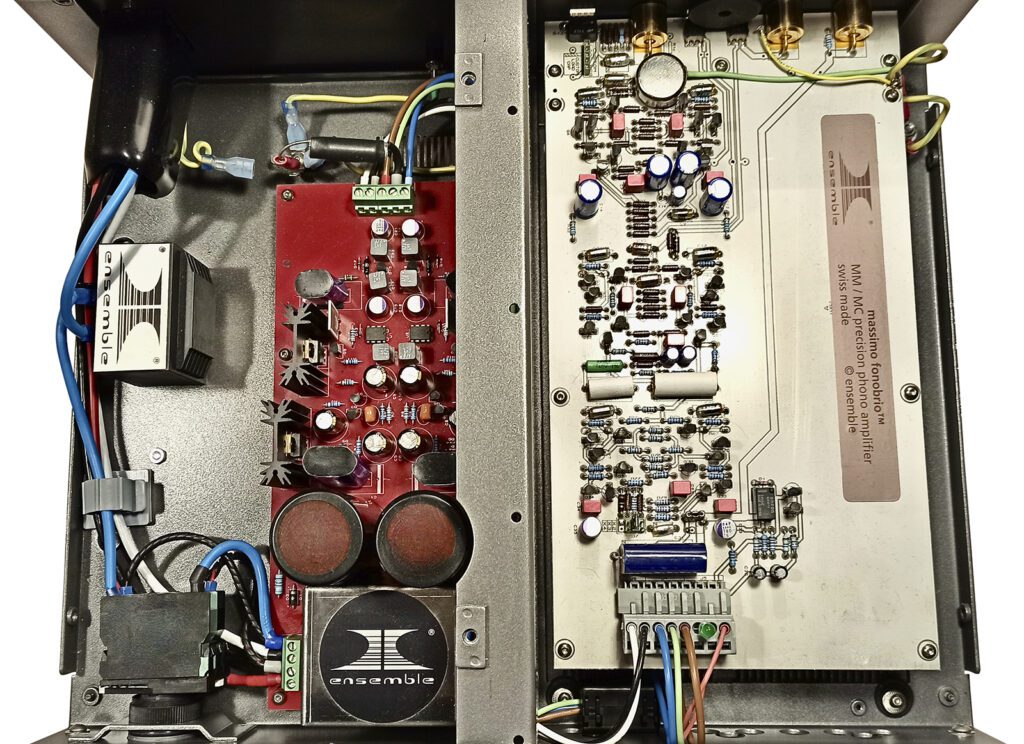
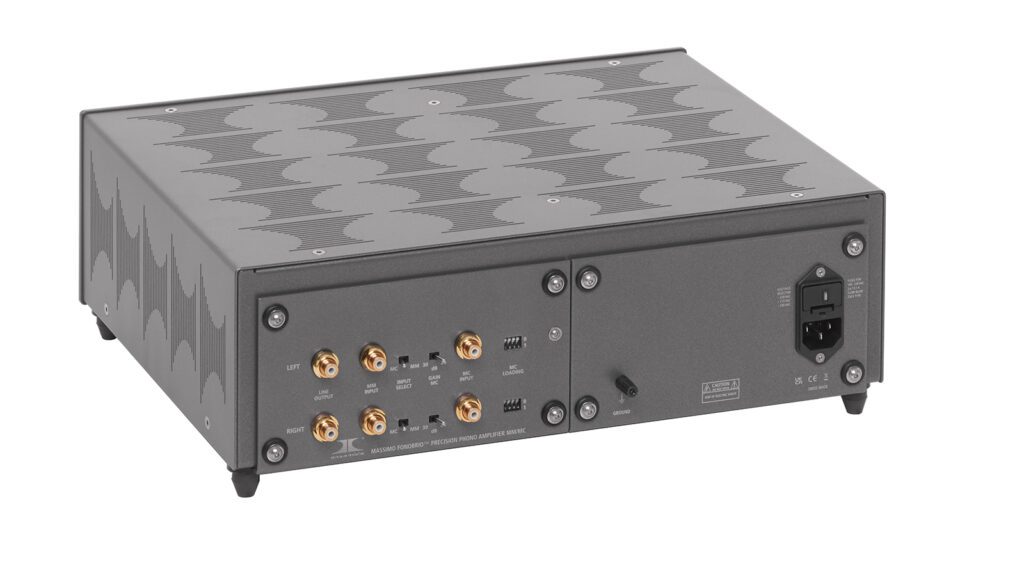
Without wanting to delve as thoroughly into detail as Wagner did when revamping the Fonobrio, technical highlights include double-laminated, dual mono circuit boards with dielectric properties six times better than those typically used even in highly expensive devices, direct-coupled (no capacitor) outputs, fourfold optimisation of the circuits to achieve the best possible operating point, all parts being mechanically isolated from each other and from the enclosure, and extensive internal shielding, partly achieved using Mu-metal caps.
Ensemble states that RIAA correction is accurate to within ±0.2 dB between 100 Hz and 16 kHz, with the signal-to-noise ratio further enhanced to 80 dB (22 Hz-22 kHz, unweighted, with a nominal 0.5 mV signal and the MC amplification stage set to 24 dB). To better isolate the phono stage from its surroundings, Ensemble also supplied an Al-Zorbo equipment platform, which cleverly divides the surface on which the component stands into four sections, providing separate decoupling and absorbing paths for each of its feet. Also included were Incanto RCA and Luminoso power cables – the IEC and Schuko plugs on the latter, like many other parts, being of Ensemble’s own design and manufacture, featuring all-copper conductors, which, according to Ensemble, are 3.5 times more conductive than brass.
Upping the ante, step by step
The Massimo Fonobrio arrived in a run-in state. It first sat in a system comprising a Zavfino Copperhead turntable with its standard-fit Ortofon Quintet Black MC cartridge, my usual pre/power combination of a custom Pink Faun Tube Pre and Audio Note Quest (low gain) 300B monoblocks driving DeVore Fidelity O/Baby speakers. Then the Viv Labs Rigid Float 7” HA tonearm arrived on long-term loan from German distributors Black Forest Audio, which was already a known quantity to me and was placed on my Acoustic Signature Challenger III turntable with the optional Eight-Silencer platter and second motor, sitting on a quartet of Levar Magnetic Absorbers, effectively making it a suspended deck, topped by Black Forest Audio’s DädMät/DädClämp combo.
The primary cartridge used was the Miyajima Lab Takumi L. I employed the aforementioned Pink Faun line preamp with Audio Note Quest 300B and modified Welter 2A3 monoblocks to drive custom-modified Avantgarde Duo XD horn speakers in a fully active setup. I also tested the Massimo Fonobrio in another system comprising an Acoustic Signature Typhoon NEO turntable with TA-7000 NEO (12”) and TA-5000 NEO (9”) tonearms, along with an MCX-4 cartridge, Zeiler tube pre/power amplifiers with Zeiler SP-02, and Audio Note AN-E SP-X Limited (field coil drivers) loudspeakers. Allnic HA-1500 II SE Plus and Gryphon Orestes/Elektra (completely rebuilt) phono stages were used for comparison.
Blank canvas (or at least, very close!)
Make no mistake: I think the Massimo Fonobrio is a reference-grade component, without doubt or reservation. Since its recent refresh, the Gryphon Orestes (with Elektra dual mono power supply units) has never disgraced itself, even among very high-level competitors. However, switching back from the Ensemble, its sound stage felt so limited that it was like driving into a tunnel.
The valve-based Allnic, with its LCR configuration for the RIAA correction network and Permalloy transformers, remains an immensely appealing device that makes it almost impossible not to focus on the music playing. In terms of sheer dynamics and energy, it can match the Massimo Fonobrio, and it possesses a wonderfully fluid, grain-free midrange. However, the Ensemble reveals it as being slightly on the more colourful side of neutral and not quite as precise and airy at the extremes of the frequency range and the outer edges of the soundstage.
Precision instrument
Yes, the Ensemble is a precision instrument, as you would expect from a highly developed, transistor-based amplifier designed and manufactured in Switzerland by the Swiss. However, it is far from being an antiseptic, dull, mere reproduction device. It is just as emotionally intense when capturing the tense build-up and dynamic swings in the opening track ‘Five Years’ from Bowie’s The Rise and Fall of Ziggy Stardust and the Spiders from Mars [RCA], or the razor-sharp guitars and icy synths in the sparse, expansive spaces that define Joy Division’s haunting closing track ‘I Remember Nothing’ on Unknown Pleasures [Factory].
I don’t recall anything — including my Allnic — being able to resolve every tiny percussive detail in those recordings to the same extent. The Ensemble’s phono stage also emerges from a completely transparent background on a life-sized 3D canvas, as wide as it is deep and high.
The Ensemble doesn’t highlight these details as much as it firmly removes every bit of noise and distortion. On less advanced equipment, this noise hampers the listener’s experience, which demonstrates the overall stability and noise rejection of the power supply as well as the internal cleanliness of this single-box unit.
Clean speed
It’s this cleanliness, along with the swift pace, that offers a new perspective on the sequenced electronic bassline of Giorgio Moroder’s groundbreaking track, ‘I Feel Love’ by Donna Summer [Casablanca] – in fact, there are two, separated in space and time within the mix. With the Rigid Float and Miyajima laying the foundation, the Ensemble presents this with unprecedented clarity, without disrupting the overall coherence.
The Ensemble Massimo Fonobrio serves as a blank canvas for any music played through it, more than any electronic component I can think of at this moment. Following Wagner’s advice for my cartridge – setting the dip switches for MC impedance to their maximum, 1000 Ohms, and the MC gain at 30 dB – it remains as dynamically unrestrained as it is free from electronic textures. It neither softens nor amplifies transients, nor does it brighten or dull the overall balance in any way – in fact, it almost feels as if it isn’t there at all. As such, it is something of a must-listen at its price point – or even higher.
Technical specifications
- Type: MM/MC phono preamplifier
- Inputs: 1x MM, 1x MC
- Outputs: 1x RCA line level
- Input impedance and capacitance:
- MC: 16 settings from 51 Ohm – 1 kOhm, with 2,300 pf parallel
- MM: 47 kOhm, with 220 Ohm parallel
- Signal/noise ratio: MM: > 80 dB @ 0,775 VRMS, unweighted;
- MC: > 78 dB @ 0,775 VRMS, unweighted
- Dimensions: (H x W x D): 138 x 395 x 315 mm
- Weight: 9 kg
- Price: €8,850, $9,750
Manufacturer
Ensemble AG
+41 61-4619191
Trending Articles
See all
By Eric van Spelde
More articles from this author

Read Next From Review
See all
Reiki Audio SuperSwitch X/Pro X PSU
- Oct 06, 2026
Audiobyte SuperVOX
- Oct 06, 2026
Unitra WSH-805
- Sep 29, 2026

Wilson Audio Sabrina V
- Sep 29, 2026