Up to 37% in savings when you subscribe to hi-fi+
hifi-logo-footer

Begin typing your search above and press return to search. Press Esc to cancel.

Meze Audio Elite over-ear headphones

One might almost describe it as a flurry of activity. In the first decade of his company’s existence, Antonio Meze has overseen the launch of precisely half a dozen products – and a solid half of them have been launched in the last 18 months.

Products four and five are both in-ear monitors of differing complexity and cost. The sixth is this pair of over-ear headphones – it’s the most expensive product in the current Meze Audio portfolio. And given that Meze Audio tries its utmost to make a statement, both in terms of specification and design, even when the product in question is a £179 in-ear monitor, it seems reasonable to expect a pretty sizable statement when Meze Audio launches a £3,699 isodynamic hybrid array over-ear headphone that sits right at the top of its suddenly burgeoning model range.

Not for the first time where a Meze Audio product is concerned, the Elite has been designed to within an inch of its life. We’ll discuss the novel and clever technologies that have been deployed here, but first it’s worth taking a moment to consider the sheer amount of designing that has gone on. After all, over-ear headphones tend to have their form dictated by their function – and, broadly speaking, that’s the case with the Elite too. But no material has been left undeployed, no decorative pattern deemed too arcane, no headband arrangement considered too extreme by Meze Audio when it comes to the design of the Elite.

Consider the aluminium earcup frame. It’s a complex shape, and assertively three-dimensional where it joins the sliding headband adjustment arrangement. This isn’t the kind of shape that’s easy to make and comes with a lot of ‘almost’ earcups getting rejected because perfection isn’t enough for Antonio Meze and the team. Inside this frame, the open-backed cover is perforated with a fairly complicated repeating design that is, once again, painstakingly adjudicated by Meze’s obsessive-compusives. There’s nothing so gauche as a hanger arrangement here – instead, what we have is a system using carbon-fibre ‘suspension wings’ (patent pending), in conjunction with a slender leather headband. That’s two more materials, and two more patterns/textures to add to the list – and an overall design that will double the width of the average wearer’s head.

Mind you, there’s no arguing with the effectiveness of this arrangement. The Elite, which is hand-assembled in Romania, weigh a significant 430g, but thanks to the way the ‘wings and headband’ arrangement distributes weight across the wearer’s head they remain comfortable for hours on end.

The Elite are supplied with a choice of earpads. There is a pair of alcantara pads, 30mm deep, based on the design Meze originally developed for 2018’s Empyrean on-ear headphone, and an alternative hybrid design of alcantara core with leather exterior. Meze suggests this new hybrid arrangement reduces bass pressure and offers a more airy sonic signature. You’ll need to specify the kind of cable you require, though – Meze Audio offers its ‘4 mini-pin XLR plug’ cable with 3.5mm, 6.3mm or 4-pin XLR terminations, but you can only have one. Unless you want to pay a little more, of course.

As you might confidently predict, on the inside the Elite is as individual as it is on the outside. Not for the first time, Meze Audio has worked in close collaboration with Ukraine’s Rinaro Isodynamics – and for this headphone, Rinaro has developed the MZ3SE ‘Isodynamic Hybrid Array’ driver. A refinement of the MZ3 driver Rinaro delivered for the Empyrean headphone, the MZ3SE is a three-part driver designed to deliver selective acoustic performance for the different areas of the listener’s ear structure.

At the back of the driver is the hybrid magnet array, arranged to develop uniform activation across the whole surface of the diaphragm. At the front there’s a reinforced polymer housing. And in between sits Rinaro’s ‘Parus’ diaphragm, which somehow manages to combine an active area of 4650mm2 with an all-in weight of 0.11g – this, says Rinaro, is due to its manufacturing process, which involves stretching the polymer, at temperature, in transverse directions. This improves structural strength, stiffness and stability despite the remarkably low mass.
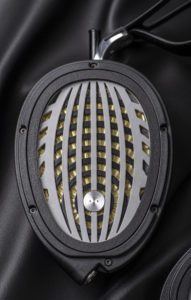
By way of an encore, Rinaro has stamped the diaphragm with a dual coil arrangement. On the upper part of the diaphragm there’s a ‘switchback’ coil, with responsibility for reproducing lower frequencies, and towards the bottom of the diaphragm there’s a spiral coil. A spiral arrangement is more adept at dealing with frequencies in the midrange and above, and its position means it’s sited more-or-less directly over the wearer’s ear canal. This, suggests Meze Audio, overcomes the tendency for the soundfield to become diffused when soundwave length is smaller than the physical depth of the inside of the ear cushion.


So with the Elite sitting comfortably in situ at one end of the chain, and attached variously to the headphone socket of a Naim Uniti Star or to an iFi iDSD Diablo being fed by an Apple MacBook Pro at the other, listening can get under way. It’s an activity best undertaken in private, mind you, because a) the Elite are quite leaky through those elaborately carved earcups, and b) it’s all too easy for bystanders to mock your appearance when the Elite are in position.

The White Stripes’ Ball and Biscuit [XL] is a recording with dirt under its fingernails, its eyes out on stalks and its heart racing uncomfortably in its chest – and when it’s delivered to the Meze Audio Elite by the iFi DAC/headphone amp, it’s absolutely unequivocal. Yes, the Elite offer an extremely impressive degree of insight, they control and integrate the frequency range with absolute authority, and they make the filthy analogue tonality sound just as ragged and overdriven as it’s supposed to… but most of all, they give the queasy head-rush levels of attack complete expression. The sheer abandon of this recording can be made obvious by far less capable headphones than these, but you’ve seldom (if at all) heard it sound quite so unhinged, quite so filled with latent threat.

The altogether more considered sound of Mountains by Prince & The Revolution [Paisley Park] is no less compelling in the Elite’s hands. Like all the best Prince songs, Mountains sounds like a high-class demo – and the Elite gives the spaces, the absences and the silences that constitute a big part of this recording full expression. The level of bite and drive they summon is deeply impressive – the steroid-assisted horn section has never sounded more clipped or austere, the vocal has never sounded more impassioned, the drag on the kick drum has never sounded so deliberate. Whatever the intentions of a recording are, it seems, the Elite have no trouble understanding them.

Some of this is down to the unforced and convincing nature of their tonality – deep, textured and straight-edged low frequencies are complemented by a deftly informative, naturalistic midrange and crisply substantial top end. Some of it concerns the amount of detail the Meze can reveal – ‘torrential’ isn’t too strong a word to describe it. Some of it will be to do with Elite’s mastery of dynamic expression – from small embouchure variations to the simple ‘loud/quiet/wildly overdriven’ dynamics of the two recordings already mentioned, the Meze Audio Elite have no problem laying it all out for your inspection. And where rhythmic positivity is concerned, the Elite are among the most accomplished headphones around – at any price. The judicious tempo and rhythm of the Prince recording is given complete expression – as far as the Meze Audio are concerned, it may as well be 1986.

In sonic terms, the Meze Audio Elite have next-to-nothing to apologise for. If we’re going to indulge in gratuitous nit-pickery, they could conceivably be more forceful where the lowest frequencies in LCD Soundsystem’s Daft Punk is Playing at My House [DFA] – but that would be asking the Elite to impose themselves on a recording and, as already observed, that’s never their inclination.

You’ve only a couple of hurdles to clear before you can bask in the remarkable fidelity of these headphones. The first, of course, is the asking-price – because it’s not just the almost-£4K you’ll need to find, it’s also the considerable outlay on source equipment that’s capable of doing them some justice. And then there’s the strong design elements, which take Elite far away from the cigar humidor aesthetics of the highly polished wood-finished high-end designs currently so popular in high-end headphones. Regardless, with the Meze Audio Elite profound sonic gratification can be yours.

TECHNICAL SPECIFICATIONS

  • Type: open-back, over-ear headphone
  • Drivers: isodynamic hybrid array
  • Frequency Response: 3Hz–112kHz (claimed)
  • Impedance: 32ohm
  • Distortion: < 0.05%
  • Sensitivity: not quoted
  • Accessories: aluminium case
  • Weight: 430g
  • Price: £3,699

Manufacturer: Meze Audio

URL: mezeaudio.com

UK Distributor: SCV Distribution

Tel (UK only): 0330 122 2500

URL: scvdistribution.co.uk 

Back to Reviews

Kronos Discovery turntable

The original Kronos turntable (a limited run of 250, that proved so popular it joined the Kronos line full time as the Kronos Pro) was one of the most lauded and distinctive high-end decks of the early 21st Century. Its distinctive second platter rotating in the opposite direction to the main platter drew a lot of attention from those seeking the best in vinyl reproduction… and some industrial-grade scoffing from those who didn’t need to bother with listening to a turntable to stop them from mansplaining why it was wrong. Usually through a subtle combination of misunderstanding the concepts behind the twin platters, pointing to counter-rotating propeller engines and the ‘Caps Lock’ button on their keyboards.

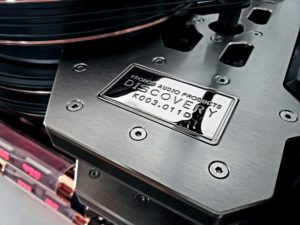
And for those people, we have the Kronos Discovery; the already large Kronos Pro writ a lot larger.

That’s already one of those absolutely wrong statements that have a touch of ‘truthiness’ to it; meaning it’s wrong but sounds right. The Discovery isn’t the Pro for the huskier record collection, as it shares no components whatsoever with the Discovery. Louis Desjardins, founder and Big Brain behind Kronos went right back to first principles for the Discovery, learning a whole lot more about how and why a turntable works along the way. So, no… despite the pithy sentence, the Discovery is not the Pro writ large. It’s not even ‘inspired’ by the Pro. It’s closer to say the two run along common evolutionary design channels. Which will doubtless be misread, throwing in ‘missing links’ and ‘throwbacks’.

A quick recap of how we got to Kronos Audio in the first place. Louis Desjardins’ Kronos Audio first appeared in Montreal in the mid-2000s. Prior to his work in the audio field and spending two decades as a commercial photographer, Louis studied science at Concordia University in Montreal, studying the physics of waves as applied to both light and sound, particularly how those waves and vibrations were transmitted, reflected, and shifted when passing through different materials.

Louis took those practical physics smarts and applied them at first to other people’s turntables; rebuilding them, setting them up, and modifying them. This gave him a good base to develop his own turntable, combining the physics he learned in college with the practical applications gained in the intervening 20 years.

Here’s the really clever bit. Louis didn’t just copy a prior design; he hit the books. He happened across an article describing how torque forces generated by a rotating platter impact the plinth of a suspended turntable. It wasn’t too great a stretch to realise that all existing turntable solutions at the time abjectly failed to deal with the problems described in this paper (and, when you find something that does address those problems, clearly audible), and set to eliminating those torque forces by effectively mirroring the drive, bearing and platter mechanism of a turntable, with the second platter counter-rotating at precisely the same speed as the first.

Using the journalistic equivalent of a Rocky-esque montage, the result was the original Kronos. OK, the result was years of experimentation and development before the Kronos even hit the drawing board, but you get the picture.

Kronos Pro (née Kronos) was the first turntable to address these parasitic vibrations head-on. Sure there have been counter-rotating platters before, but many used a single drive motor or some other ‘commoned’ part in the chain. But with Kronos, the first step in reducing parasitic vibrations was to design a suspension system that would minimise vibration transfers from the turntable drive system and motors and from the environment. If the motors are mounted on the non-suspended turntable base, then the plinth supporting the rotating platter and tonearm can be largely distanced from both motor-borne and environment vibrations. Further isolation from motor noise comes by using tuned damping elastomer drive belts, rather than direct motor coupling, or idler wheels. Using non-cogging low vibration DC motors also helps rid the system of potential vibrational elements.

Meanwhile, horizontal level stability is increased by hanging the plinth from posts rather than supporting the plinth from below. In this sort of over-hung design, the gravitational force acting on the plinth adds horizontal stability by avoiding the tendency of the plinth to topple over as happens in underhung designs. It also provides the benefit of using mass-loaded damped suspension materials, which help diminish vertical oscillations. Finally, constrained layer construction and choice of materials help dissipate vibrations within the non-suspended base of the turntable, reducing vibration transfer.

This is the backbone of the Kronos concept, and while everything about the engineering and application of the Discovery changes, these core rules remained constant. And by everything, I mean everything. Louis started with a clean sheet with Discovery. It’s a very big clean sheet, reflecting the sheer size and scale of the Discovery; Kronos was a big turntable in its own right, and its necessary physical height made it a very physical presence on the equipment table. Discovery makes it look compact. It’s taller and a lot wider. A lot heavier too. Fortunately, Kronos is making a table for the turntable, which can also hold its power supplies.

There’s a lot of technical ground to cover here in terms of just what Discovery brings to the (pun intended) table. So buckle up… it’s about to get nerdy.

Discovery began as a going back to the basics research project. Kronos had already delivered world-class levels of chassis resonance reduction, vibration reduction and keeping residual energy transfer under control… the task was to see if it was possible to go further, and whether going further delivered improved performance as a result.

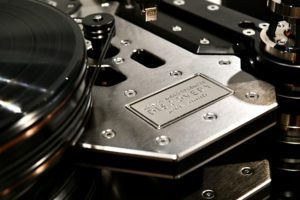
In going back to basics, Kronos designed the Discovery with a completely new chassis technology, which resulted in twice the number of parts going into the top turntable. Kronos developed a wholly new way to attach the chassis to the suspension system, using completely different soft clamping methods. This treats the chassis more like the soundbox of a guitar or a violin because in that case how it’s held dictates to some degree how it sounds. Of course, the requirements for a turntable chassis and a violin are very different and the methods of soft clamping differ too (if nothing else, it’s bloody hard to get the Discovery under your chin).

Instead, by adjusting the contact pressure between two surfaces and adding compression gaskets, a degree of movement can be dialled-in within assemblies. This permits the conversion of vibrational energy into heat and therefore helps dissipate vibration. Discovery’s surfaces are joined by fasteners, which are then torqued to allow optimal dissipation.

That new chassis technology alluded to above is, in fact, an exoskeleton. These are not a new technology (they form the core of many a sci-fi final battle since Aliens first dropped, for example), but are wholly new to audio. The closest we got was arguably the construction of the original Roksan Darius loudspeaker, and that was more of a speaker stand encircling its loudspeaker (with drivers on springs for good measure).

This exoskeleton structure helps improve energy dissipation because the sheer number of transitional points is ideal for disrupting vibrational waves. The choice of materials in every aspect of the Discovery has been re-evaluated and changed where relevant (which is, in essence, almost everywhere).

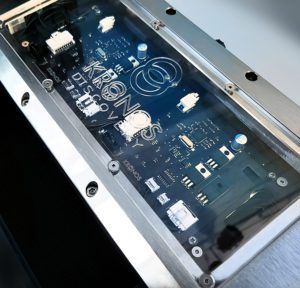
The basic Discovery power supply is radically improved over its older brother. The new model comes equipped with a massive custom hand-wound power transformer and uses a bank of super-capacitors on its output. This provides a huge power reserve and low output impedance, in the process of optimising damping (towards back EMF), improving the microdynamic motor control and increasing drive stability.

There is also an upgrade to the power supply upgrade! The Kronos could be improved by the use of the optional SCPS-D power supply. For the Kronos, that is boosted by its own dedicated super-capacitor power supply, meaning the Discovery is fed by two super-capacitor banks operating in series. This means any ripple or noise on the power line stands no chance of polluting the Discovery’s motor system.

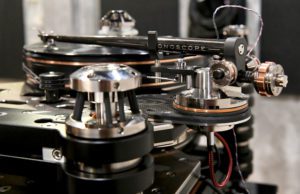
I’ve concentrated on the turntable, but the Discovery I used also sported the new Kronoscope arm. Once again using the journalistic power of trying to cram a lot of concepts into a tiny amount of column inches, this is what happens when you get the very highly rated Black Beauty unipivot arm and give it the same. Kronoscope and Discovery are a bit of an item, they are designed in harmony, use the same materials science benefits, and raise the game over existing arms to the same degree. Its clever, low-slung intelligent counterweight system makes it do the same state of the art disappearing act as the turntable, to the point where it’s basically like invisible support for a cartridge.

Basically, Discovery was an ‘I wonder…” project, a philosophical exercise in discovering just how far the mechanical aspects of the original Kronos concept can go. And ultimately, what Discovery showed was there was a lot of improvement to be had even in a turntable with the performance of the original Kronos.

Enough tech geeking… how does it sound? I liked the original Kronos Pro (and Sparta) for its ability to sound like someone got all the best turntables, pulled out what made them so good individually, then mixed it all together and produced a sound so free from noise and the sort of distortions we normally associate with vinyl. It’s like a ‘Greatest Hits’ of all the best things in turntable replay.

Then you hear the Discovery and realise… none of that gets close and that conclusion is totally wrong. Discovery is perhaps the simplest turntable to review as it just does ‘it’ better; ‘it’ being pretty much everything related to vinyl replay.

So, why was the conclusion about Kronos, Sparta and the other turntables wrong; it’s because each one of those turntables was like applying a photographic filter to the front of a camera lens. The Kronos sounded like it collated the sound of all the other decks because it applied a less intense filter in front of the sound. If the Discovery has a filter applied, it’s completely transparent enough to be functionally invisible. Or inaudible… help me out here, these metaphors won’t mix themselves!

Every recording I played on the Discovery was like listening to it the first time. I was playing pieces of music I’ve been listening to for decades and they sounded as fresh and new as if I’d just slit the plastic wrapping. This is as much down to the Discovery’s uncanny ability to just step through surface noise (it doesn’t make surface noise go away, it just makes it seem irrelevant next to the music being played). Play something light and fast [‘Venus di Milo’ from Television’s iconic Marquee Moon album, Elektra] and that fast and snappy sound comes through. But here’s the kicker; I’ve been playing that album since the mid-80s and I always thought of them as a tight art-punk band from the 1980s, but essentially little more than a vehicle for frontman Tom Verlaine. What I didn’t realise is just how good a band they were. The drummer (Billy Ficca) in particular. And, staying in the same era with good musicians, playing Ian Dury’s New Boots and Panties!! [Stiff] was another one of those records that have been in the collection for decades, one that I know so damn well and one that left me wondering what pale impression of Ian Dury I’d been listening to all these years. This same ‘your records… anew’ applied throughout, from folky guitar to smoky jazz club. From row three of the classical concert hall to head-in-the-bass-bin dub. No foot was ever put wrong, nothing sounded out of place. The Discovery was contributing so little to the sound of vinyl that swapping a cartridge had a bigger net contribution to changes in performance.

With this much musical information on show, the Discovery comes with a little in-head readjustment time. Your first listen to the turntable is spent leaning into the loudspeakers, as you savour all that information. Slowly, you start to lean back and enjoy the music, unattenuated by contributions from the deck and arm for what is probably the first time ever.

There isn’t much to dislike with Discovery, save for its size and Captain Nemo physicality. The speed controllers on the front panel are not marked, so conceivably you’ll spend some time turning the Discovery on and off when you think you are simply stopping the platter for a record change. You’ll also tend to forget whether twisting the left-hand knob ‘up’ gets you to 33.3rpm or 45rpm. There were more than a few ‘oh… bollocks!’ moments when on returning to the listening chair I was met with a fast, high-pitched voice, but you quickly learn. It’s also an intricate and complex piece of equipment to install, so unless you can field-strip a Sparta blindfolded in 20 seconds flat, it’s best left to the experts, and if you live on the fifth floor and in a room accessed by rickety, narrow stairs… those experts better include a few piano movers. In great fairness to the Discovery, though, once installed it’s pretty much fit and forget, and the tonearm is easy to use and even easier to swap cartridges.

Discovery is perhaps the aptest name for this turntable in two ways. From the position of the turntable maker, finding out what it does and why it does what it does is like the Rosetta Stone of top turntables. While a lot of what goes into Discovery remains a Kronos-kept secret, there will be engineers and designers pawing over the website, this review and – when shows finally happen in number – the actual Discovery turntable itself, in order to find just what can be reverse-engineered and applied to their own equipment. I don’t think Louis has to worry too much about this; the key component is pretty damn obvious and what is in essence a second turntable running in counter-rotation is a little hard to hide.

For the end-user, however, the Kronos Discovery’s name is just as apt. You are about to discover what’s on your records for the first time. That at first is a revelation, but once you get over that first listening bump and get used to its ear-opening performance, you will just want to tear through your record collection, in a voyage of, you guessed it, Discovery.

TECHNICAL SPECIFICATIONS

  • Rotational speed: 33.3 rpm & 45 rpm
  • Tonearm length: 9 to 12
  • Power supply: dual channel pure class A linear DC, CPU controlled
  • Motors: 2× Maxon DCX DC motors
  • Motor mounts: Delrin enclosure, height adjustable
  • Speed guidance system: continuous dual-loop feedback, continuous correction
  • Sensors type: hall sensor (platters) /optical encoder tachymeter (motors)
  • Correction cycle: 60 times/rotation. 0.015% max. 0.005% min
  • Control CPU: independent system for each platter
  • Platters type: resonance tuned compressed phenolic/aluminium/copper
  • Platter weight: 8.2kg (x2)
  • Drive belts: 2 silicone/Viton, one-piece moulded, 0.230/platter
  • Compensation pulley: Teflon and zircon bearing
  • Main bearings: dual hydraulic isolated inverted sleeve and ball
  • Shaft type: grounded heat hardened tool steel, surface treated
  • Ball type: precision ceramic 7mm
  • Suspension: full floating top suspended, level adjustable
  • Elastomers: 317 elastomers, Viton/silicone proprietary mix
  • Dimensions (W×D×H, no SCPS): 71 × 37 × 29cm
  • Weight: 65kg, PSU 22.5kg, SCPS-D 22.5kg
  • Price Kronos Discovery turntable: £100,000

  • SCPS-D power supply: £20,000
  • Kronoscope Tonearm: £20,000

Manufacturer: Kronos Audio

URL: kronosaudio.com

UK Disrtributor: Decent Audio

URL: decentaudio.co.uk

Tel: +44(0)1642 263765

Back to Reviews

AGD Productions Andante Streamer/preamplifier and The Audion mono power amplifiers

If ever the phrase ‘looks can be deceptive’ holds true, it’s regarding this duet of devices from the relatively little-known Californian audio brand AGD Productions. At first glance, you could easily be forgiven for thinking this is a valve pre-power combination, possibly a low-power single-ended triode mono amp, or at most a hybrid. The orange-glowing glass bottle in the centre of each power amp is a bit of a giveaway. In fact, the Adante and The Audion are almost exactly none of these things.

Let’s start with the Andante. It’s a highly configurable, UPnP streaming preamplifier that can turn its hand to a surprisingly wide range of PCM and DSD-shaped digital sound files, and all the main flavours of file format, as well as line level sources and can even run a natty line in software-driven MM/MC phono stage. It’s controlled from a simple Apple remote and has the sort of display that you can see across a room… the size of Lichtenstein. This can be set very dim, however, and that can make basic operation a little bit “is it on?” not helped by a slightly slow response time to Apple remote commands. Two rows of multi-function click-stop push buttons can drive all the functions of the Andante, but the Apple remote makes like a lot easier.

I’m always a little concerned about streaming solutions made by smaller companies. While streaming is no longer a hole in the company budget that can only be filled with engineers, getting a robust and easy to use streaming platform is usually beyond most small-to-medium brands. It seems, from the outside at least, that unless you devote a significant percentage of the company’s total R&D budget on streaming, you can either have something that looks nice, or something that works. AGD has gone more for the latter option, relying on third-party command & control. The Andante’s functionality is driven by Bubble UPnP if you are planning some local music serving, but it also supports Tidal, Deezer and Qobuz for online streaming and AirPlay for general music management. Note that none of these options are a UPnP/DLNA music server platform, and home networked audio systems will need to make provision for that (in my system, I tried both Melco and Naim solutions successfully).

Meanwhile, The Audion is a small monoblock amp (two of them fit atop the Andante, which is itself significantly narrower than the standard 19”/48cm amplifier size. This is the smallest of three mono amps in the range. The key innovation here is what AGD calls ‘GaNTube Technology’. This is a PWM switching amplifier using very high-speed Gallium Nitride (GaN) power MOSFETs housed inside a KT88 sized glass tube. It even uses a KT88 tube base, although swapping the GaNTube out for a real KT88 isn’t a good idea! This all means that the deceptively small amplifier can pump out a meaty 85W into eight ohms which doubles to 170W into four. It can also be driven in balanced and single-ended mode (we used balanced).

GaN transistors are not a cheap option, nor are they especially easy to implement in an audio context, but they have the sort of slew rate that most amplifiers can only aspire to. They also deliver close to textbook resistance to parasitic effects of altered resistance, capacitance and inductance even at comparatively high power across the audio frequency range, meaning the AGD’s MOSFETs of choice are inherently lower noise and higher power designs than their more commonplace silicon oxynitride brethren.

I spoke to a couple of people who simply didn’t ‘get’ the idea of The Audion at all. They couldn’t parse the idea of something that looks like a valve amp but is in fact a variation on a PWM design (albeit a unique and clever variation), and ultimately one got almost irate at the idea, thinking it a ‘trick’, comparing it to a photograph of a landscape compared to the landscape itself. I have a very different take, from a purely aesthetic position; people still buy tube/valve amps, and some do so primarily for the looks. Many of those might not actually need, want, or have the kind of loudspeakers that benefit from using a tube/valve amp. The AGD amps offer an aesthetic option that uniquely address that demand. Oh, and when it comes to that ‘photograph of a landscape’ argument, I give you… Ansel Adams!

Each one comes in its own flight case, a Peli design you could use as hand-luggage if you removed all the foamy bits. This gives an idea of just how small and light the Andante/The Audion combination really is. Those of us used to trying to lift amplifiers the size and weight of a car engine onto a stand will come to view the likes of AGD as a breath of fresh air. However, while AGD shows images of the amps stacked on top of one another, I think that goes a little far. While in use I heard no negatives in stacking amps this way, audio-compulsive disorder suggests using at least two and possibly three shelves for the combination. Functionally speaking, though, they are easy to use, and those amps require no warm-up at all.

This combination is every inch the audiophile’s dream. It’s incredibly detailed and gives an extremely precise soundstage with all that inner microdynamic detail and presence that makes well-recorded acoustic instruments in a live environment come to life. ‘Amelia’ from Herbie Hancock’s interpretations of Joni Mitchell songs [River: the Joni letters, Verve] was almost made for the AGD’s presentation. It’s a lithe, relaxed-yet-focused sound (this reads like a paradox, but once you hear that combination in action, you realise that it’s something that’s both present in the live space and all too often missing from audio reproduction). Instruments are both individuated and have their own sense of physical space within the solid and three-dimensional soundstage, and yet cohere extremely well with one another, and there’s always a sense of both a band and bandleader. This is difficult to portray with this recording, as in many supposed audiophile systems, it often ends in musical disarray… as if the band is under-rehearsed or the bandleader is ‘phoning it in’. Here, everyone hangs tight!

The amplifiers are also outstanding at taking control of a loudspeaker, controlling the drive units in an authoritative, but not authoritarian, manner. This means bass won’t boom unless boom is called for, and the midrange and treble drive units are tasked with getting on with the job less impeded by the actions of other drive units. Put simply, the AGD makes your loudspeakers sound better than they had any expectation of sounding, because the amplifier is doing its job so well.

The AGD combo is also fast. While I think they should be considered as a whole; I lay this speed primarily at the mono amps. These amps react to transient information with a speed that borders on the psychic, and couple them with some already transient-friendly cable (like Nordost Odin, for example) and the speed of delivery is very much that of an audio system getting completely out of the way of the music it plays. Playing ‘The Limit’ by Darkside [Spiral, Matador] and that idiosyncratic electronica (combining trip hop, EDM and a very fast and almost click-track beat) is played with the sort of pace that is usually the stuff of smaller, responsive single-ended triode designs.

I’m not sure whether this is a downside in wider terms, but the one thing the AGD combination doesn’t do well is ‘suffer fools gladly’. If you play some musically-compressed, thin sounding pop music, it presents it as such, warts ‘n’ all. As such, this is not the family party amp, because a night of Europop bangers or hip hop might leave you cold. That said, Billie Eilish’s Happier Than Ever album [Interscope] sounds pretty good through the AGD combo…

I’ve tried to rid myself of the ‘anti-switching’ bias some reviewers have toward PWM amplification, primarily because things have moved on a lot since they first appeared toward the end of the 20th Century. Nevertheless, some myths are persistent, especially when they come with a kernel of truth to them. One of my last negatives toward PWM-powered designs was the ‘they don’t drive difficult loads’ and that evaporated in listening to the AGD with the deceptively difficult upper bass impedance of the Wilson Duette Series 2 loudspeaker. The amps aced this low impedance point even at relatively ‘beefy’ levels and playing some balls-out AC/DC. OK, so some 1980s era brick wall masquerading as a loudspeaker with an impedance plot that burns out most amps will probably see the AGD hitting its end stops, but in truth, that ability is a bit of a revelation.

For a comparatively little-known company, AGD is hitting them out of the park here. The Andante is a fine preamplifier with a ‘first, do no harm’ streamer on board, and The Audions are some of the fastest, most expressive amps you’ll hear this side of the audio’s super league. This is an important new design and well worth checking out!

TECHNICAL SPECIFICATIONS

Andante streaming preamplifier

  • Analogue Inputs: 2 Single ended (RCA2, RCA3), 1 XLR inputs (XLR)
  • Phono input: Moving Magnet and Moving Coil selectable via Menu
    MM Input Impedance: 47kΩ, S/N ≤ -80db; MC Input Impedance: 420Ω, S/N ≤-70db; RIAA Accuracy: < 0.5dB
  • Digital Inputs: 1 USB, 1 × AES/EBU (XLR), 1 Coax, 1 × TOSLINK (max sample rate 192 kHz) LAN (Ethernet Port), Bluetooth AptX
  • Analogue outputs: 1 XLR, 2 RCA
  • File formats supported: MP3, WMA, MPEG-4 AAC, WAV, FLAC, AIFF, ALAC, DSD
  • Digital precision: PCM to 768kHz, 32-bit. DSD to 22.5792MHz and 24.576MHz (DSD512); Streaming Services: DNLA, UPnP, ROON, AirPlay (via LAN)
  • Frequency Response: 1Hz–100kHz ± 0.2db
  • THD+N (Balanced): ≤ 0.005% THD+N (Single Ended): ≤ 0.009% S/R: ≥110db
  • Dimensions (W×H×D): 28 × 9 × 280cm
  • Weight: 13kg
  • Price: From £11,695

The Audion power amp

  • Nominal Output Power at 0.1%: 85W (8Ω), 170W (4Ω)
  • THD+N 10W/1KHz: < 0.005%
  • Frequency Response: 5Hz–100kHz (±3dB)
    Dynamic Range: >120dB
  • Dimensions (W×H×D): 19 × 14 × 19cm
  • Weight: 3.1kg
  • Price: From £7,895 per pair

Manufacturer: AGD

URL: agdproduction.com

UK distributor: Whole Note Distribution

URL: wholenotedistribution.co.uk

Tel: +44(0)203 9115 549

Sole UK retailer: Val Hifi

URL: valhifi.co.uk

Back to Reviews

Eclipse TD307MK3 compact loudspeakers

From the ECLIPSE press release


ECLIPSE has launched a new loudspeaker, the company’s first new model in seven years. The new TD307MK3 is a compact, full-range speaker for the modern music lover. Several years in the making, the TD307MK3 benefits from the latest ECLIPSE technologies, ready to deliver today’s high-resolution music. It directly replaces its predecessor, the TD307MK2.

Developed and refined in the Kobe factory in Japan, the new TD307MK3 features the same technologies as ECLIPSE’s upmarket models at a fraction of the price. Highly flexible, the TD307MK3 can be used for more than just music: a clever integrated mounting bracket with angle adjustment enables wall- or ceiling-mounting for a range of A/V applications, including custom installation projects.

At the heart of the new TD307MK3 is a new high-performance 6.5 cm full-range fibreglass drive unit upgrade (the first time fibreglass has been used in the TD307 series). The new driver is supported by 12 key improvements, many of which help it deliver its full potential.

A new, larger ‘repulsive’ neodymium main and sub-magnet system have been implemented to provide greater power for the new driver. The magnet system not only increases efficiency, but perfectly complements the material, helping to deliver a wider frequency response, especially in the bass region: the TD307MK3 has an 80 Hz–25 kHz range.

The new fibreglass cone also benefits from greater speed, lower vibration, greater dynamics and a lower noise floor. Vibration has been reduced by 50 per cent over its predecessor and ECLIPSE’s engineers have achieved an 80 per cent increase in linearity.

The unique ovoid cabinet now has a greater volume to provide an improved environment for the new driver which now moves a greater volume of air. Further improvements include a new, improved terminal arrangement, that accepts both bare wire and banana-terminated speaker cables, plus a new cable-routing design, with the ability to both accommodate larger cables and obscure them from view (for desktop users).

Of course, the TD307MK3 also benefits from ECLIPSE’s established, time-proven proprietary technologies, including the diffusion stay, where the drive is internally mounted onto a vibration-eliminating five-pillar stay, and the mass anchor, giving a solid support for high-speed cone movements.

Achieving great sound quality for music, movies or TV is simple with the integrated angle adjustment which provides -25 to 30 degrees of movement when placed horizontally, plus 0 to 90 degrees when used on a wall or ceiling.

Commenting on the new model, Masaya Shirai, ECLIPSE’s Sales Executive (outside Japan) said, “There are lots of great loudspeaker systems in the UK, however, there is something unique in what ECLIPSE does in terms of ‘sound space reproduction’. We are proud to launch the TD307MK3 which achieves sound space reproduction just as well as ECLIPSE’s higher-performance models. We hope music lovers will to find an opportunity to experience them and ‘see’ artists perform in front of them, instead of just listening to loudspeakers.”

Specifications

Frequency response:  80 Hz-25 kHz(-10 dB)

Efficiency/sensitivity: 80 dB/Wm

Input resistance (rating/max): 12.5 W/25 W

Impedance: 8 Ω

Maximum dimensions: 135 × 212 × 184 (WxHxD in mm)

Weight (per speaker): Approx. 2 kg

Price and availability


The TD307MK3 is available now in black or white, priced at £300 each/£600 per pair.

[email protected]

www.ECLIPSE-td.com/uk/

Decent Audio (UK Distributor): +44 (0)5602 054669

Back to Hi-Fi+

HiFi Rose RS150B music server

High feature counts are not often to be found on audio equipment that wants to be taken seriously; less is more is a maxim that many brands have taken to heart because, in the analogue world at least, better sound should result if there are fewer switches in the signal path. It’s also convenient that fewer features means lower manufacturing costs. For many this ethos has continued in the digital world but Korean newcomer HiFi Rose clearly didn’t get the memo; the RS150B has so many features that it’s positively baffling for the old skool audio enthusiast. However, those looking for a one box solution to most of their home entertainment requirements will find a lot that appeals.

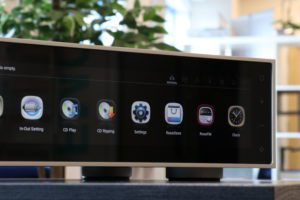
The massive 21:9 style screen that takes up the majority of the front of the RS150B is not just a display, it’s a touch screen that allows access to all of the features on this very slick media player. That’s a phrase I haven’t encountered for some time: there was a time when media players were very fashionable but the examples that existed were essentially computers attached to DACs and distinctly counter intuitive. The advent of app control has meant that such things are a lot more practical and capable today, this Rose is an Ultra HD 4K video and hi-res audio streamer, a fully featured DAC and a preamplifier. All you need is a power amplifier and some speakers and you’re all set.

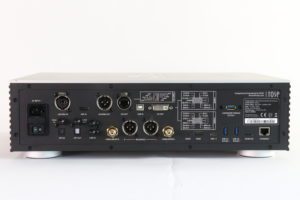
The build is as good as you get from far less heavily equipped audio equipment at the price, the case is in milled aluminium and there is a genuine plethora of high quality sockets on the back. The only connection I can’t find is one for headphones, I did ask if it catered for Bluetooth types, but no, if you want this feature there’s a cheaper Rose that fits the bill. The DAC is no slouch either with connections of virtually all varieties including AES/EBU in/out, I2S (with adjustable settings to suit different DACs) and both in- and outputs on USB. The streamer can access music files via ethernet, Wi-Fi, USB, SD card or with its own server software from an SSD drive installed in its dark underbelly.

Specwise the DAC aims pretty high too. The B suffix in the name indicates that like many other brands Rose has had to switch from an Ashahi Kasei to an ESS Sabre chip that runs at up to 32-bits/384kHz and DSD512. It offers full MQA decoding and can stream from all the usual services with control by the Rose Connect app or Roon, and UPnP controllers too. For those who enjoy a proper handset there is a remote supplied, a Bluetooth one at that which means it doesn’t need to be pointed at the box. The latter foxed me for a while until I was informed that you have to fit the Bluetooth dongle that comes in the box for any BT functions to work, presumably the solidity of the enclosure makes this a necessity. There is no specific Wi-Fi antenna as the BT dongle also provides this function; I note that the specs state “A few types of Wi-Fi is (sic) not supported”.

Having so many features does make the initial learning process a little steep for those of us not weaned on touchscreens; for instance, it took a while to notice that there are other icons than those initially shown on the home screen and that swiping sideways revealed more. I also got confused by the number of Rose apps available in the Apple Store, there appear to be at least three, two of which will operate the RS150B albeit one doesn’t do half as much as the other. With a bit of RTFMing all of this was figured out and I was able to get its server to take a good look at the music on a Melco N10 music server. The result in terms of what was shown on the app wasn’t terribly easy to navigate however as there is currently no way of showing just the albums made by a specific artist. Instead you get every track in order of album. The order in which the artists were listed was also unclear, fortunately there is a search option and it proved fairly easy to track down the desired tracks. This is one area that will hopefully be improved over time via software updates to this Android-based device.

When you get it up and running the display reveals a pair of bright yellow VU meters that twitch in rather a distracting fashion. Delving into the menu I found numerous alternative styles of meter to look at as well as the option to get rid of them and see the artwork for the selected track instead, and this proved a lot more useful and appealing. There is also an option to defeat the display entirely but that would be a pity after the makers have gone to so much trouble. Volume can be controlled on the box, in the app or with the handset and I picked the option to have a numerical indication come up when changes were made. Connected via its RCA outputs to a Moor Amps Angel 6 power amp and PMC twenty5.26i speakers the Rose delivered a detailed yet fairly smooth presentation that was relaxing if not totally engaging, it’s a polished sound that has some similarities to the design of the casework on the RS150B.

It is quietly enjoyable, however; not drawing attention to itself but delivering the soul and groove of whatever is played. As the onboard volume control is often a limitation in DACs, I bypassed this by choosing from one of many fixed output voltage settings and connecting the Rose to a Townshend Allegri Reference preamplifier. This had a distinctly appealing effect and revealed the RS150B to be a rather more subtle performer than it first appeared. I used it to listen to the new Esperanza Spalding Songwrights Apothecary Lab album reviewed at the back of this magazine, and found clear differences in the results delivered by Tidal’s Master and Qobuz’s 24/48 stream, with the latter being clearly more relaxed and three dimensional, thus much more easy to enjoy. The vocal imaging in particular was excellent on ‘Formwela 4’, and the way that the backing vocal is used to extend the sense of stage width also came across well.

I found the DAC filter settings page in the menu and used one of the two linear phase options to get a more engaging result with better timing, albeit only when I remembered to press ‘apply’. Anyone looking to get the best out of this Rose should listen to several of the options here as they make a clear difference to the sound and give it a degree of transparency that the default setting lacks. I listened to a variety of material this way and while it didn’t quite hit the highs that can be achieved with a more dedicated audio streamer the results were impressive for such a comprehensively equipped device. Chick Corea Akoustic Band’s ‘On Green Dolphin Street’ [Live, Concord Jazz] has plenty of energy and snap while John Fahey’s Your Past Comes Back to Haunt You: The Fonotone Years, 1958–1965 [Dust to Digital], containing lo-fi recordings of acoustic guitar, proved to be highly engaging thanks to the way that the Rose puts flow before detail.

I tried another filter setting, it’s hard to choose when your favourite NOS (non oversampling) option isn’t available, and alighted on minimum phase, slow roll off, which turned out to be a little on the polite side. However combine this balance with the emotionally and musically raw ‘Pensacola’ by Joan Osborne [Relish, Mercury] and you have a surprisingly gripping, clear and powerful sound. This track often sounds too raucous and edgy but the Rose delivered its intrinsic message rather well, proving that full on exposure can mask the message if that recording isn’t cut for revealing systems.

You can get a better streaming DAC for the Rose RS150B’s asking price but not one with anything like the feature set on offer here, nor the video processing powers. It’s sheer flexibility is remarkable in itself, never have I seen different levels of fixed output before nor has filter setting been so straightforward. It would be nice if more of these changes could be made with the app but I suspect that the app applies to more than one Rose device. All in all however this product sounds as good as it looks, and it looks pretty slick.

TECHNICAL SPECIFICATIONS

  • Type: AV streamer, DAC, preamplifier
  • Analogue Inputs: One single ended (via RCA jacks)
  • Digital Inputs: One coaxial S/PDIF (via RCA jack), one TOSLink, one AES/EBU, one USB B, one HDMI ARC
  • DAC Resolution/Supported Digital Formats: FLAC/WAV/MP3, etc. Sampling rate for D/A conversion 384kHz/32 bit, DSD512
  • Music services/Wi-Fi inputs: Spotify Connect, Bluetooth, Airplay, Tidal, Qobuz
  • Analogue Outputs: One stereo balanced (via XLR connectors), one stereo unbalanced (via RCA jacks)
  • Digital Outputs: One coaxial S/PDIF (via RCA jack), one TOSLink, one AES/EBU, one I2S (via DVI), one I2S (via RJ45)
  • Frequency Response: 20Hz to 20,000 (+/-0.5dB)
  • Distortion (THD + Noise): 0.0003% (balanced, 1KHz 6.5Vrms), 0.0004% (unbalanced,1KHz 2.2Vrms)
  • User Interface: 14.9inch touch screen display (on main unit), Rose application software for iOS, Android
  • Dimensions (H×W×D): 123 × 430 × 316mm
  • Weight: 13kg
  • Price: £3,899

Manufacturer: Citech Co., Ltd

URL: eng.hifirose.com

Distributor: Henley Audio

Tel: +44(0)1235 424637

URL: henleyaudio.co.uk

Back to Reviews

Chord Electronics Anni Integrated Amplifier

Back in 2018, Chord Electronics launched a DAC called the Qutest. Its goal was simple; a small, straightforward digital converter designed to sit on a desktop between your computer and your amplifier to deliver the best, no-nonsense sound possible at a reasonable price. It was joined in early 2020 by the Huei phono stage. Its goal was simple too; a small, straightforward MM/MC phono stage designed to sit on a desk-top between your turntable and your amplifier to deliver the best, no-nonsense sound possible at a reasonable price.

Are you starting to see a pattern here?

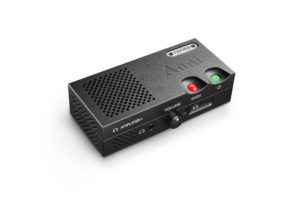
Now, Chord Electronics completes the group with the Anni integrated amplifier and it’s goal is the same as the Qutest and the Huei. All three share the same form factor, a ‘none more black’ solid rectangular box with finger indents for the colour coded ball-like push-buttons that form most of its operational actions.  Aside from the knob on the front and the absence of a glowing blue window on the top (Anni uses perforated holes to dissipate heat instead) they are almost identical and they look good laid side by side. Anni also includes a power feed to the Qutest and Huei and if you are using all three, a (modular) Qutest System Stand (QSS)  that allows stacking. Given there were just two products in the range until now and the Anni has just the two inputs and no preamp outputs, don’t expect many more additions to the range.

Anni also explains why Chord Electronics’ small army of personal audio users scratched their heads at the omission of a headphone amp section in the Qutest… it’s here in the Anni. Anni gives you the choice of 3.5mm and 6.35mm jack sockets on the front panel. These are not independently controllable and there is no balanced output option, but the Anni is not directed toward the seasoned headphonista, more someone who wants to extend their desktop system into something more potent. To that end, I suspect there will be a lot more Qutest+Anni combinations sitting next to a computer on a desk than there will be full-stack Qutest+Anni+Huei as a small replacement for a domestic stereo system. Not that the Anni isn’t capable of such a replacement, just that the lack of remote and relatively low output weigh against it.

Anni may be small, but don’t be fooled… there’s a lot of ‘clever’ inside that small box. We’ve been charting Chord Electronic’s move to its ULTIMA amplifier technology for some time now (since the Étude from 2018 in fact, which we reviewed in issue 168). To recap, this is a dual-feed-forward error-correction amplifier circuit topology based on a paper by Dr Malcolm J Hawksford’s (emeritus professor at Essex University), and the resultant design was developed in the 1980s by Bob Cordell of Bell Labs. Cordell’s design had a then-unprecedented 0.001 per cent total harmonic distortion at 20kHz. It does this by intelligently adjusting and compensating for the individual linearity of the output devices. Unfortunately, this degree of compensation placed the circuit out of reach for designers in the era of Big Hair and pastel-coloured suits with rolled-up sleeves. The amplifier circuit all but disappeared as a result. However, Chord Electronics’ secret nerd-cave beneath that Pumphouse in Kent is a treasure-trove of forgotten audio papers. Chord Electronics saw the value in developing this one, and the ULTIMA range was born.

Anni shows just how scalable that ULTIMA circuit can be. The bigger ULTIMA stereo and mono amps can pump out up to a little more than one horsepower per channel and do so in a big chassis. Anni goes in the other direction, delivering a more modest 10W per channel into eight ohms. However, in a small setting with moderately efficient stand-mount speakers operating in the near-field, 10W is comfortably loud, and the Anni is deceptively powerful. Once again the absence of remote control tends to make the Anni one of those products that stay at arm’s reach. That generally means ‘desktop’.

In fact, Anni includes a two-stage ‘Gain’ setting on the top panel, next to the power button. Press and hold the Gain button and you switch the amplifier between high and low gain. This is useful because the volume control can be either too sensitive or too insensitive when mismatched with the loudspeakers. If it is either of these things, a two-second press of the gain button and the glowing button flips between blue (for low gain) or red (for high). The moment you plug in a pair of headphones, however, the amp defaults to low gain; the button glows purple if in the high-gain mode for the duration.

Colour-coding has been a thing with Chord Electronics since the original Hugo DAC, and that continues with the Anni. Alongside the blue/red/purple Gain button, the power button glows green for power-up/headphone mode, red for standby and cyan for regular operation. The volume control doubles as a channel selector, with the ring of LEDs changing from blue (input one) to red (input two). The ring of lights does not change to denote volume level, however. Finally from the front, inside the ventilation holes on the left-hand top and front, there are red and green LEDs running whenever the amp is powered up (irrespective of settings; they are diodes, remember, they are doing diode stuff and happen to be doing it from a position of light-emitting). There’s also an echo of the blue or red LEDs from the front panel. If you add in a Qutest and a Huei, you get something of an undimmable Christmas tree of an audio electronics rig, but in truth, unless your audio equipment is in your bedroom, it’s not obtrusive. In an ideal world, however, I’d opt for a ‘lights off’ option, or at least a significant reduction in lights on show in standby. No biggie, though.

Seeing ventilation holes on the left-hand side of the case did make me initially concerned; Anni is a very small, densely packed box and I was a bit reticent in letting it warm up straight out of the box in case it ran hotter than the surface of the Sun warm. But I put it through its paces even through the brief Indian Summer in early September and it never ran more than warm to the touch. The amplifier circuit, for all its low power, is surprisingly willing to drive all but the most difficult loudspeaker loads. This is somewhat self-limiting; loudspeakers that would really challenge the Anni are priced far beyond any reasonable expectation of partnership, and a quick survey of products more likely to be used with the Anni nets absolutely nothing that would in any way cause a kerfuffle. Note: please don’t consider that as ‘challenge accepted’ and try to scare the Anni into submission by trying to play loud dub reggae through a pair of old Apogee Scintillas. But as discussed earlier, using it with real-world products in the same ball park as the Chord Electronics amp; I used KEF’s LS50 Metas with Anni and they quickly became firm friends.

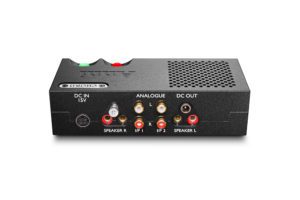
As with the other products in this three-strong line, hooking it all up is a little fiddly because you are very short on rear-panel real estate. This is compounded by the use of the DC output to feed a Huei or Qutest. You are restricted to 4mm banana plugs (they insert deep into a recess on the rear panel, so there’s no provision for bare wire or spade lugs and even BFA connectors are not an option).

There is also a ground terminal provided, but frankly, I’ve no idea why it’s there; the amp runs whisper-quiet, and I couldn’t get any kind of hum or increased noise floor out of Anni. While this terminal is a boon to those wanting to run grounding boxes, I can’t help but think this is a little esoteric for Anni’s potential customers. Chord Electronics doesn’t throw any light on its inclusion in the folded card manual provided. Like Anni itself, this is useful, if minimalist in approach. Chord Electronics does suggest that if used with a Qutest, remember to keep its output below 2V. The Qutest’s and Huei’s twin XLR outputs are not replicated as inputs here.

I’m generally not big on discussing packaging, but credit where it’s due; Chord Electronics really know how to make the unboxing of the Anni a bit special. It’s sleeved in a black card matching the box itself. The front of the box has a small magnetic clamp to prevent the contents of the box from tipping out everywhere. Once you lift that, you are met with a two-layer case, with the Anni sitting in a foam insert at the top, and a pull-out tray holds the power supply and cables.

Power is fed from an external 15V switch-mode supply, connecting to the Anni via a four-pin mini-DIN connector. Continuing the ‘wow, that’s good packaging’ tip, a little black drawstring bag in the bottom drawer includes a custom cable (called the Qutest range power adaptor) that connects the 12V output of the Anni to the Huei, and a short USB A to mini USB cable is included that connects the Qutest to the USB socket on the custom cable. Note that if you only have an Anni and a Qutest, there is a spare 12V power connector roaming free around the back of your system.

The great thing about Anni in both build and sound quality terms is it never once makes you think it’s a small amplifier. This is a big and clean sounding amplifier with an excellent soundstage and a keen sense of rhythm that no one had the heart to tell it quite how small it really was. So it sings its little heart out. In fact, when you hear Anni at work, saying things like ‘it sings its little heart out’ are at once trite and patronising. Anni don’t need your sympathy!

10W is surprisingly gutsy too. OK, so this isn’t The Who’s Live At Leeds [Decca] album played at ‘Dude, Where’s My Hearing?’ level gutsy, but it’s more than meaty enough to play rock and dance music at ‘healthy’ levels without strain.

In fact, ‘without strain’ is something of an oft-repeated phrase with Chord Electronics’ Anni. Not simply that the amplifier rarely strains, even when undergoing some fairly heavy lifting amp-wise. not even because the sound has something of that effortless, unfatiguing quality to it. I promised myself that I wouldn’t do this, but playing ‘It’s a Hard-Knock Life’ from Annie [Original Broadway cast soundtrack, Tidal] really showed this ‘without strain’ property to the amplifier’s sound. It’s a well-recorded soundtrack (as many are) but the children’s voices can screech. Products that tame the screech often end up making the other parts of the recording too soft, while others make the kids sound too ‘squawky’. Anni’s ‘without strain’ quality makes the song well balanced, with the brass bassline easily picked out against the vocals. Annie works with Anni.

It helps that the soundstage is wide, too. There’s a little front-to-back shortening and not much height information, but the width and precision of that soundstage works really, really well in the context of amplifiers at this level. Playing Carla Bley’s composition ‘Vashkar’ by the Marcin Wasilewski Trio [En attendant, ECM, Tidal] showed this well. The piano and upright bass were perfectly positioned in space, with the drum kit sitting not quite as far back in the mix as possible.

Bass is ‘taut’ rather than ‘cavernous’ or ‘stentorian’, but I like its snappy precision and it’s not without some heft. It’s more a ‘dry’ bass rather than the sort of big, overblown bottom end. Staying with the same ‘En attendant’ album, ‘In Motion Pt 2’ starts with a subtle drum solo followed by bass lines that demand detail, but in a very musical, rhythmic manner. Anni fares really well here. You get a real sense of players riffing off one another, and although that tempo is hard to determine at times, the Anni is good at getting its groove on and making that music flow in both a legato manner and also by teasing out the beat.

Most significantly, however. is Anni’s ability to portray musical detail with ease. It’s at this point you really have to take stock of the fact this is an amplifier intended to be used at arm’s reach, rather than in a full-sized system. You are hearing deep into the music with the Chord Electronics amplifier, extracting those nuggets of detail usually lost in the noise floor at this level. Those little but absolutely crucial key-depress noises, fretboard squeaks and more put you there in the room with the musicians. All there in vivid detail. Excellent!

It’s only when you really push it does Anni begin to falter, hardening up in the treble first then down into the midrange, but even then it’s mostly an elegant faltering rather than a faceplant. And yes, if you go head-to-head with a larger, more powerful and more expansive amplifier in a conventional system, the hardening process starts at only beyond average listening levels, but we might be missing the point here.

What I found with Chord’s Anni is I almost instinctively treated it as if it were a conventional stereo integrated amplifier, rather than a desktop device. If you think of it in the desktop device space, the Anni is a real winner. My concern here, however, is more philosophical than critical per se; Anni is a logical extension of the Qutest and Huei models, but where they act as small DACs or phono stages in a bigger system, Anni completes the system, and I’m wondering if the market for that system in the desktop is really that developed. Through no fault of Anni, it might be entering a market that does not yet exist. That being said, Anni is good enough to help create and develop that market for high-performance desktop separates.

Chord’s Anni is a surprising amplifier. It has pushed the envelope of what a good amplifier in this category can do, and it also shows that putting a good amplifier circuit in a small box is a practical solution, without having to resort to the strictures of products like gainclones (remember them?). Those who can never see past the 10W or the small box are missing a treat. This is a full-sized amplifier that lives in a desktop shaped box!

TECHNICAL SPECIFICATIONS

  • Type: Desktop Integrated Amplifier
  • Power output: 10W per channel
  • THD+N: 0.02%
  • Signal to Noise Ratio: -110dB
  • Frequency Response: 5Hz–60kHz
  • Dimensions: 4.5cm (H) 16cm (W) 8.8cm (D)
  • Weight: 770g
  • Price: £1,195

Manufacturer: Chord Electronics

URL: chordelectronics.co.uk

Tel: +44(0)1622 721444

Back to Reviews

Music Interview: Bernard Butler

“Have you heard the new version of the album?” asks guitarist, award-winning producer and singer-songwriter, Bernard Butler, as we’re chatting over Zoom about his latest project – a four-CD box set reissue of his 1998 solo debut record, People Move On, which includes the original album, a re-recording of it with new vocals and a few guitar embellishments, as well as loads of B-sides, rarities and studio outtakes.

When I tell him I have, that I think the new version sounds great and the new vocals are more ‘lived-in’, he says: “I’ve not spoken to anyone about this – you’re the first – and you’re the first person to have heard it. No one in my house has even heard it. I do things in a very solitary way – it has to work for me, and I don’t like any kind of input. That’s not because I don’t like criticism, but it’s because I don’t like being fed falsely – somebody saying, ‘it’s great’, when I know it’s not.”

He’s got nothing to fear – the new version of People Move On, which is released in November, on Demon Music, is arguably better than the original. Butler’s rerecorded and richer vocals enhance these songs about transience, anxiety, introversion and loneliness, and, musically, the record still stands up well today, thanks to its classic rock and pop influences.

Bernard Butler - Image by Bella Keery

‘You Just Know’, which is an anti-fame song, is a swaggering rocker, with blistering, Neil Young and Crazy Horse-style guitar; the soaring ‘Change of Heart’ sees Butler living out his Glen Campbell ‘Rhinestone Cowboy’ fantasy; ‘Not Alone’ is towering Spectoresque pop with lush, dramatic strings; the epic ‘Autograph’, with its heavy psych guitar, Mellotron flute and ‘60s blues-rock-soul vibe recalls Wild Wood-era Paul Weller, the big ballad ‘Stay’ has echoes of George Michael’s ‘Praying For Time’, as well as The Beatles/Lennon, and ‘You Light The Fire’ is a pretty, acoustic folk song, with shades of Nick Drake.

Butler, who is 51, started his career as the guitarist in ‘90s indie-glamsters Suede but left in 1994, and is now arguably better known for his production work and countless and varied collaborations, including David McAlmont, Duffy, Ben Watt, Sharleen Spiteri, Pet Shop Boys, Tricky, Aimee Mann, Edwyn Collins, Neneh Cherry, Bert Jansch, The Pretenders, Kate Nash and Sophie Ellis-Bextor, to name but a few. He is talking to me from Studio 355, his London studio, which is named after his guitar of choice – a 1961 Gibson 355.

On rerecording the vocals, he says: “We’re at a point where you can do anything on your phone or your laptop – what that means for a producer is that there’s really no point being impressed by software or the extraordinary things you can do in a studio.

“Often, I’ll hear a very sophisticated pop record and think ‘that’s amazing – I can probably go on YouTube and work out how to do it in an hour.’ That’s not to put that down, because there are skills involved and it serves the song, but it doesn’t leave me satisfied. Over the last 10 years, because of that situation, I’ve felt increasingly, what is the thread – the purest point of a song? With music, there’s only thing that has DNA and that’s a voice, because it’s a physical thing.”

“[On the new version] I’m mainly singing in the same register, but the tone of my voice is different – it’s not like I’m singing an octave below. When I recorded the album in 1997, I’d never done it before – I was asked to make a record and I just went off and did it. When it came to doing the vocals, I’d never been near a microphone before to sing – I had no idea of technique, or what I wanted to put across in the delivery or the tone of my voice, so I just did anything to get through.

“Looking back, it feels very affected and very cautious, and not truly representative of where I was at the time, but I really like the music and I really like the words. When I came back to sing them in a different way, it felt like they had a different gravitas and they meant something to me today, and what I’m like now – they didn’t start speaking to me about what I was like when I was 27 years old. That was really important.”

For the new version, Butler used the instrumental backing tracks from the original mixes, which he took from the studio DATs and transferred digitally at 96kHz in 24-bit, apart from one song, ‘I’m Tired’, which is a completely new performance – guitar and vocals. He recorded his new vocals at 96kHz in Studio 355 and the mastering was done by George Shilling, who was the album’s original engineer.

“It was really cool to have him involved, as he knew the record so well,” says Butler. “The analogue masters were on 2” tape, but the mixes were done to DATs, which then went to CD, which, of course, remains the best audio reproduction. I love vinyl, and I play it, but people always have a misconception that vinyl is the highest quality. It’s not, because you have to adjust frequencies in order for the audio to fit.”


SH: After you left Suede, you collaborated with David McAlmont, in the duo McAlmont and Butler, and then you went solo. What are your memories of that time?

BB: McAlmont and Butler happened about a year after Suede, then People Move On was two years after that. In-between, I was lolloping around Hampstead Heath on my own. During the Britpop period, which is now celebrated, I spent a lot of time retreating and I withdrew. As a young man, I was pretty scared – I didn’t enjoy it. I hated my twenties, and I hated that whole scene that was going on in London. Britpop was brash and in-your-face – it was a very alpha male period. I just wanted to go home and get away from it.

One of the reasons I stayed away from it was because I was a face and name – I didn’t like going out and being pointed at, or people coming up to me and talking to me. I became quite introverted, and I stayed at home an awful lot. I also hated most of the music coming out of that period – it wasn’t what I was listening to, and I didn’t think it would last. I knew it was a cultural moment, but I just didn’t like it. I’d been in one of those kinds of groups, I did it really well and I got out. That’s always my view of everything – do something, be the best at it and get out. It’s like all the great sitcoms or books – get out before it gets too jaded.

Why did you decide to revisit, rerecord and reissue People Move On?

I’ve done a couple of reissues with Demon, and they were asking me for quite a while to do it. I’d always resisted – I’m not a big fan of the whole reissues industry. I like living in the present and doing stuff now – I’m always trying to serve what I do, rather than serve other people. That’s a really important part of what I do, otherwise you would just stop after your first record and live it out forever. Why did I come back to this one? Because I listened to it, and I didn’t like it. I turned it off straight away. I knew instantly how I would feel – I didn’t like the vocals.

So, you hadn’t listened to People Move On much before you started this project?

I don’t listen to any of my music apart from when I’m making it, because when I’m doing it, I’m living it. I’m doing a record at the moment, and it takes you over completely – you’re absorbed by it. I don’t put on my records for pleasure. I’m not going to look in the mirror in the morning either – I’m passed that age.

The second reason for doing this [rerecord People Move On] was that I started going back to all my songs. A couple of years ago, it occurred to me that my music is scattered amongst lots of other artists, as well as myself – it’s in all different places, all different styles and all different arrangements. Most of the people involved have come through my life and then gone. Sometimes you wonder what your role in it all is.

What’s the point of living this life of collecting all this stuff and being involved in all these collaborations? I started thinking about that and if I could find a personal thread through all of my work that connected me with it.

So, to find that thread, I started renting a rehearsal room every Wednesday. I would go there on my own, with just an electric guitar, which was the purest limitation I could find, and I would try and play music that I’d made in the past, from memory, which was specific to a time, a place and an artist. I started thinking ‘was there a song, how would I play it, what were the words and what was the imprint that it left on me?’

So, I tried to remember songs, I fumbled through the words and the chords, and I found myself quite enjoying it. I did that on my own for about 18 months – no one knew I was doing it – and I recorded it on my phone. I’ve had the opportunity to record in some really great and lavish ways, but when you are performing, you’re very much limited to the tools – a guitar and a voice. I realised I had a licence to change melodies and words.

So, what effect did doing that have on you?

I’ve started writing songs again in that style – a new record will be the next thing that happens – and I started enjoying hearing the sound of my voice, which I haven’t before, and Demon asked me [to reissue People Move On], so I jumped at it. I said to them, if I do it, can I get the instrumentals and sing over them? So here we are.

The new CD set is a really nice package and well-presented. There are lots of tracks on it and some new artwork…

I worked really hard on every aspect of it. It’s taken a long time. I’m a fan. I’m the kind of person who buys records like this and looks forward to it. I don’t like it when the reissue industry does things badly – when the group aren’t involved and don’t give a shit. I find that really distressing – particularly with my own work. I don’t want to rip people off and I want my work regarded and presented in the best way possible. I want every aspect of it to be beautiful.

When you’re not working, how do you prefer to listen to music?

If you want to talk hi-fi, I live by my Bowers & Wilkins 702s. They’re in my living room and they’re my go-to speaker. Whenever I’m mixing, I then go downstairs [from the studio] and listen to it at a reasonable level on the Bowers & Wilkins speakers – they’re the gods for me and they tell me what to do. I sit and make notes and then I make changes based on that.

I listen to everything – streaming and vinyl. I tend to listen to certain things on vinyl, like Coltrane or Joni Mitchell, and I have piles of CDs. I’m really happy that people can access music in whichever way is possible.

When I’m making a record, and mixing it, there’s a side of me that wants a hi-fi person to love it and think it sounds beautiful, but, if I’m honest, the bulk of me still wants a piece of music to scream out of a car stereo and make you want to turn it up – that raw energy and excitement. That’s what I always look for.

So, finally, thanks to the new version, are you now happy with People Move On?

I’m really pleased. I listened to it the other day when I got the master of it on CD and I enjoyed it. I’m not uncomfortable with it – I like how my voice is and that’s how it will be from now on. I’m cool with the fact that there was one version made by a 27-year-old who didn’t know what he was doing, and now I’m a 51-year-old man. Shit happens.

Bernard Butler’s People Move On four-CD box set is out now on Demon Music. There is also a two-LP version of the 2021 rerecorded album, featuring new vocals.

bernardbutler.com

Back to hi-fi+ Home Page

MOON TO EXHIBIT AT AXPONA

 April 22 – 24, 2022 

This weekend, MOON will be exhibiting a selection of its premium music products at Axpona (Audio Expo North America). Following a successful product showcase at the Montreal Audiofest in March, the MOON team is now excited about meeting more of its North American customers at the Illinois event. 

For Axpona, MOON has partnered with high-end hi-fi dealer, Quintessence Audio, to create an exhibition space featuring some of the finest equipment available. From the higher end of its portfolio, MOON will be displaying an 860A v2 power amplifier, an 850P preamp, a 780D v2 streaming DAC, an 810LP phono preamp and an 820S power supply. This is a serious audio system designed to impress the audience with its powerfully articulate musical performance. 

Alongside MOON’s system there will be an exciting set of products from Clearaudio, Franc Audio, Hana, Kubala-Sosna Research and Wilson Audio. Visitors to Axpona 2022 are in for a high-end audio treat. 

Axpona 2022 will run from April the 22nd to April 24th in the Renaissance Schaumberg Hotel and Convention Centre, Schaumberg, Illinois. MOON will be with Quintessence Audio in the Perfection Room. 

FOR MORE INFORMATION: 

Show details: https://www.axpona.com/about.asp 

MOON’s website: https://simaudio.com/en/ 

Quintessence Audio’s website: https://chicagoaudiodealer.com/ 

Contact: [email protected] 

Scansonic expands M and L series

Scansonic expands the popular L and M series

L Onwall

The L On-Wall is designed to match the L-series and shares the same core technology with a 25 mm soft dome tweeter in combination with one 4,5” bas/midrange driver. The slim enclosure allows for easy placement in a home cinema or stereo setup where space is limited, but without compromising sound quality. It will also work really well in a 2.1 configuration with a subwoofer. This loudspeaker is designed as multipurpose speaker.

Features:

  • Beautiful and timeless danish design
  •  1″ silk soft dome tweeter for clear and organic sound
  •  4,5″ kevlar mid/woofer construction for dynamic bass
  •  Front bassrelex port for added bass weight
  •  Only 10 cm deep with integrated wallmounts on the rear
  •  Available in black, white and walnut finish
  •  Recommended retail price in EU: EUR 450 for a pair


L Onwall
L Onwall


L7 – A larger standmount loudspeaker

At an affordable price this speaker gives you are great musical experience. The bass is deep and low while the highs are crisp and clean. The L7 uses a special paper cone material to achieve the optimum stiffness and damping for the cone size. The woofer is flanked by a high performance tweeter to give you great
performance at this price. The cabinet has been heavily braced and increase thickness of the walls means that resonances are kept under tight control.

Features:

  • Beautiful and timeless danish design
  • 1″ silk soft dome tweeter for clear and organic sound
  • 6,5″ paper sandwich mid/woofer construction for dynamic bass
  • Rear bassrelex port for added bass weight
  • Available in black, white and walnut finish
  • Recommended retail price in EU: EUR 690 for a pair
L7 Walnut
L7 Walnut

L14 – A larger floorstanding loudspeaker

This speaker provides you with an excellent price / performance ratio. Rewarding you with deep and rich bass which ads great weight to your music. This speaker also is a great mach for home cinema due to its excellent bass performance.
The L14 uses a special paper cone material to achieve the optimum stiffness and damping for the cone size. The woofer is flanked by a high performance tweeter to give you great performance at this price. The cabinet has been heavily braced and
increase thickness of the walls means that resonances are kept under tight control.

Features:

  • Beautiful and timeless danish design
  • 1″ silk soft dome tweeter for clear and organic sound
  • 2 x 6,5″ paper sandwich mid/woofer construction for dynamic bass
  • Rear bassrelex port for added bass weight
  • Available in black, white and walnut finish
  • Recommended retail price in EU: EUR 1.690 for a pair
L14
L14

M Onwall – A performance onwall loudspeaker

This loudspeaker offers very high quality sound in an on-wall configuration. The crisp and clear ribbon tweeter gives high end performance in a form factor that has many uses. It can be used in a home cinema as rear or as stereo speakers. It will also work really well in a 2.1 configuration with a subwoofer. This loudspeaker is designed as multipurpose speaker. The design makes it easy to integrate in modern living rooms with its sleek design and black or white finish. This amazing loudspeaker will satisfy the demanding listener and the one looking for easy
integration into any room.

Features:

  • Beautiful and timeless danish design in silk mat paint
  • 1x sealed ribbon tweeter with kapton/aluminum for authentic sound
  • 1x 4,5” woofer, Honeycomb enforced glassfirber cone.
  • Downfirring bassrelex port for added bass weight
  • Available in black and white silk mat paint
  • Recommended retail price in EU: EUR 825 for a pair
M wall
M wall white

THE AUDIO CONSULTANTS MUSICAL EVENTS No 4 AND No 5 – 2022

The Audio Consultants will be hosting two Musical Events at the Crowne Plaza Hotel, Reading East at Winnersh Triangle.

The first of these, Musical Event No.4, will be on the Saturday 21 and Sunday 22 May 2022 in the Sandhurst Suite between 10am and 5pm.This will largely feature systems that we had an exceptional response to at the UK Audio Show 2021 last October. This quality venue will allow for a more comfortable and controlled listening experience for our visitors.

This Musical Event will focus on two superb CD players offered by Luxman with their reference D-10X CD player and the excellent combination from Aqua with their new La Diva Mk2 transport and the La Scala Mk2 Optologic DAC.

We will also be using the Innuos Statement CD/Streamer for a comparison with ripped music files and network streaming.

The amplification duties will be split between the AVM A6.3 integrated amplifier and the Luxman L-509X integrated amplifier. Both these designs have an above average proportion of Class A from a Class A/AB principle.

The loudspeakers will be the Kudos Titan 707, which were exceptionally well received at the UK Audio Show, and the Eggleston Works Oso. The latter is the larger version of the Emma EVO offering a more authoritative sound with a lower bass extension and greater weight to the sound.

The Special Edition of the Puritan Audio PSM 1512 made exclusively for The Audio Consultants will, again, be the hub of the mains distribution. These Studio Master mains purification systems not only reduce noise and increase transparency, but also enlarge the holographic sound stage, and greatly enhance dynamics and rhythmic pace.

All the signal cables, ground cables, and the power cords will from GutWire Cables, with digital cables from the extensive range from AudioQuest.

The HRS and Lateral Audio equipment supports will provide good isolation from acoustic feedback improving image stability, dynamic speed, and overall naturalness of tone.

The Crowne Plaza Hotel is well located a short distance from Junction 10 on the M4. All visitors to the Musical Event are eligible to free parking.

There are good rail connections from London to Winnersh Triangle which is a short walk to the hotel.

The hotel has excellent facilities with a bar and a restaurant for quality dining and refreshments throughout the day.

The second Musical Event No. 5 will be held at the same venue on Saturday 25 and Sunday 26 June 2022. The systems featured will be different to those showcased at the Musical Event No.4 in May. More details will be posted later.

—————————————————————————

We were frequently complimented on the sound we achieved at the UK Audio Show 2021; many were kind enough to deem it the best sound at the show. Even some industry and fellow exhibitors were generous enough to say the same. Here are a few comments:

“The best sound at the show by a wide margin”. Visitor on Saturday.

“Really surprised by the stunning sound in your room. Completely blown away” DS from London.

“For me, the best sound at the show”. PB from Gloucestershire.

“The most natural sound at the show”. A musician visitor.

“The best of the show”. BJ from London

German Physiks appoints Nexus Audio as UK distributor

We are extremely pleased to announce the appointment of Nexus Audio as the UK distributor

for the German Physiks range of omnidirectional loudspeakers, high-end electronics and

cables. We have been very impressed by knowledge of audio and passion for music shown by

their staff and we confident that Nexus Audio will provide our customers with first class service

and support.

Nexus Audio is a subsidiary of the leading UK high-end audio retailer Nintronics.

To find out where German Physiks products may be auditioned, please contact Adam Curtis

at Nexus Audio by phone on 01376 526070, or by email at [email protected].

hi-fi+: new look, new direction

It’s been a while; the new issue of hi-fi+ (Issue 206) is the product of the first redesign the magazine has received in more than a decade. In the past, when the printed page was far more of a driving force in media, magazines would routinely undertake a redesign at least once every five or so years, but things have changed in publishing and there is a move to remain consistent. Nevertheless, what looked good in 2010 will often look tired a dozen years later.

Unlike our previous refits, the magazine now must reflect how it is read in a wider context. However, it’s also important to periodically refresh the look of the magazine if only to prevent people from getting bored with even the most timeless style. But this is perhaps our boldest change to date.


Masthead mastery

The most obvious change here is to the masthead and the logo itself. The original hi-fi+ logo has remained unchanged since the first issue in 1999, and the gentle nod toward a play button in that logo was a classic of its time. However, the play button is itself arguably moving into the history books as we acquire more of our music through online streaming sources.

Regardless, changing the logo is no small move, as it effectively identifies the brand. Many companies change their look over the years, however; often almost imperceptible changes are made from year to year and it’s only when you compare the style of 20 years ago to the present do you see how large those changes have been. In truth, there are always unconscious changes across the years to keep everything fresh.

It was also clear that all of the pages in the magazine needed to be brought up to date: what was once clean lines look dated and tired. There is both revolution and evolution at play here; in any big change, what you see at the outset will likely have some course corrections as people get more used to what works and what doesn’t. However, most of the changes to pages of the magazine are in this issue, and any subsequent tweaks are more about fine-tuning than significant change. We hope you like our new, cleaner lines.

So meta…

Part of the reason for the change is a noticeable shift in photographic demands in magazines. While the simple, descriptive ‘pack-shot’ photography is still important, we’re seeing more ‘room set’ pictures in audio. We’ve noticed that such room set images have become increasingly more popular in our online reviews and that they draw traffic to our website in a way that traditional pack-shots do not. It’s unclear whether that uptick is because they break up the monotony of pictures on a white or black background, or they give context to the product being reviewed. Regardless, we’ll be using more of a blend of both kinds of photography when they are relevant now.


Balancing act

Publishing in the 2020s is a balancing act; it’s easy to create reviews that meet the demands of print media readers at the expense of online readers or vice versa. Readers of the printed page have long spent years learning the style of reviewers; they like that they take their time to weave a story, or that they throw in a few anecdotes about when the writer was a cub reporter and drunk in a bar somewhere. They recognise that complex concepts require long sentences and even longer paragraphs to explain the intricacies of a thing, and those long sentences might be broken up into a number of subordinate clauses; concepts that – while they run the risk of losing the reader in a sea of punctuation – are able to get the message across and might even throw in a few puns in the mix, such as sympathising with those who read old magazines in bed at night and wake up with back issues.

This is different to online reading. Online reading requires short sentences with few subordinate clauses. It also needs short paragraphs that repeat the phrase hi-fi+: new look, new direction regularly as a keyword. This paragraph is almost too long for online media.

The skill is to satisfy both equally without ending up disappointing everyone. And that’s not easy. While we won’t pander to the demands of search engine optimisation (SEO) and tailor our text purely to push our reviews further up Google’s rankings, we need to respond to the demands of readers who have spent the 21st Century reading snappier text. If nothing else, that means breaking up the text with crossheads. But what is a crosshead?


This is a crosshead!

Think of these breaks as an even bigger break in the flow of the text than a paragraph. We have traditionally shied away from crossheads in our text because many of our readers found them unnecessary and even patronising. But tastes change in reading as much as they do in music and audio and it’s time to move with the times.


Speaking of change…

The change to the look of hi-fi+ is only half the story. In the lockdowns, we realised that too many of our features were show reports; and in the absence of shows, the features begin to dry up. That changes now. We will include features that introduce new and existing technology in simple, yet not patronising ways, how to audition, build and fine-tune a system, how and what to upgrade, interviews with designers, and more. These aren’t ‘new’ features… they are a return to the core of what an audio magazine is all about. Of course, we’ll also maintain our reputation for turning up at the opening of an envelope if it’s about audio.

Beyond additional features, even the scope of the products we review is ripe for a spot of scrutiny. It’s been a little difficult looking at the worldwide audio market in the last couple of years because we’ve all been so inward-looking but despite that, we have seen changes in audio and distinct trends in high-end that we believe are going to be increasingly relevant over the coming years. We think the very nature of audio is changing too.

The big change is the growth in what we call the ‘metropolitan’ music lover, especially in Europe and the UK. Many traditional high-end systems, which are designed for American buyers with large dedicated listening rooms, are simply too large for European homes. These systems are not defined by price points, but by the sheer physical limitations of trying to fit substantial high-end systems into European listening rooms that are often considerably smaller than their American counterparts.


Indeed, in parts of the world where living space is at a premium, the concept of a dedicated listening room is alien; shared living spaces that act as a listening room when called upon are the norm.

We’ve noticed that far from a convergence, the gap between such systems is getting wider. While the obvious difference is in loudspeaker designs, perhaps the more telling difference comes in amplifier choices between the two continents. Many high-end audio systems in Europe rely on top-notch integrated amplifiers rather than the larger multi-box preamp and mono power amplifier arrangements found in American high-end homes. The change in priorities for European/metropolitan listeners is driven by space concerns, not price; they want the best, but it must come in a package small enough to fit their listening space. Until a few years ago, that meant ‘compromise’, but the modern audio design (both in terms of better electronics and more accommodating loudspeakers) has meant outstanding, high-end audio performance is not simply the plaything of those with large, dedicated listening rooms.

Best of all, while it sounds like a contradiction in terms, there’s growth in shrinking systems. With significant and ongoing developments in diverse fields – from materials science and new amplifier classes to DSP and room-correction/treatment – each successive year sees such systems increase in number and improve in performance.


Back to the future?

However, if all this sounds worrying, remember that audio is a broad church, and magazines like hi-fi+ are not just looking for the Next Big Thing. We are seeing a small, but noticeable ‘uptick’ in sales of CDs; both discs and players. Whether this is due to millennials looking wistfully to the 1990s, or the start of CD’s rehabilitation remains to be seen, and it’s too early to say whether this is a short-term blip or a decade long revival, but those of us who never got rid of their CDs in the time of streaming and downloading are doing our little smug dance right now.

This is an exciting time for hi-fi+ and for audio in general. We’ve seen increased interest in all things audio for a few years now and I genuinely think there’s never been a better and more fascinating time to be an enthusiast!

Subscribe to hi-fi+

Digital Subscription to hi-fi+

Back to hi-fi+ Homepage