Up to 37% in savings when you subscribe to hi-fi+
hifi-logo-footer

Begin typing your search above and press return to search. Press Esc to cancel.

Davone Reference One floorstanding loudspeaker

Danish loudspeaker expert Davone has been making loudspeakers since 2007. The company is the brainchild of designer and owner Paul Schenkel. His first commercial product – the Davone Rithm – established the brand as a company that challenges conventions. The Davone Reference One floorstanding loudspeaker is the company’s new top model, replacing 2013’s Grande.

A high-end loudspeaker with the word ‘Reference’ in its name usually sends red flags to bank accounts. “The ‘Reference’ model, sir? Certainly… and what small island nation would you like to leave as a deposit?” Davone bucks the trend. While the Reference One isn’t cheap, many of its flagship loudspeaker peers put an extra ‘1’ before the price tag.

Davone Reference One

Despite phrases like ‘bucking the trend’, the Davone Reference One floorstanding loudspeaker looks like a conventional three-way design. Looks can be deceiving. Yes, it’s a cabinet with three drivers in treble-mid-bass order, but this design hides some intelligent thinking.

Fun with ports

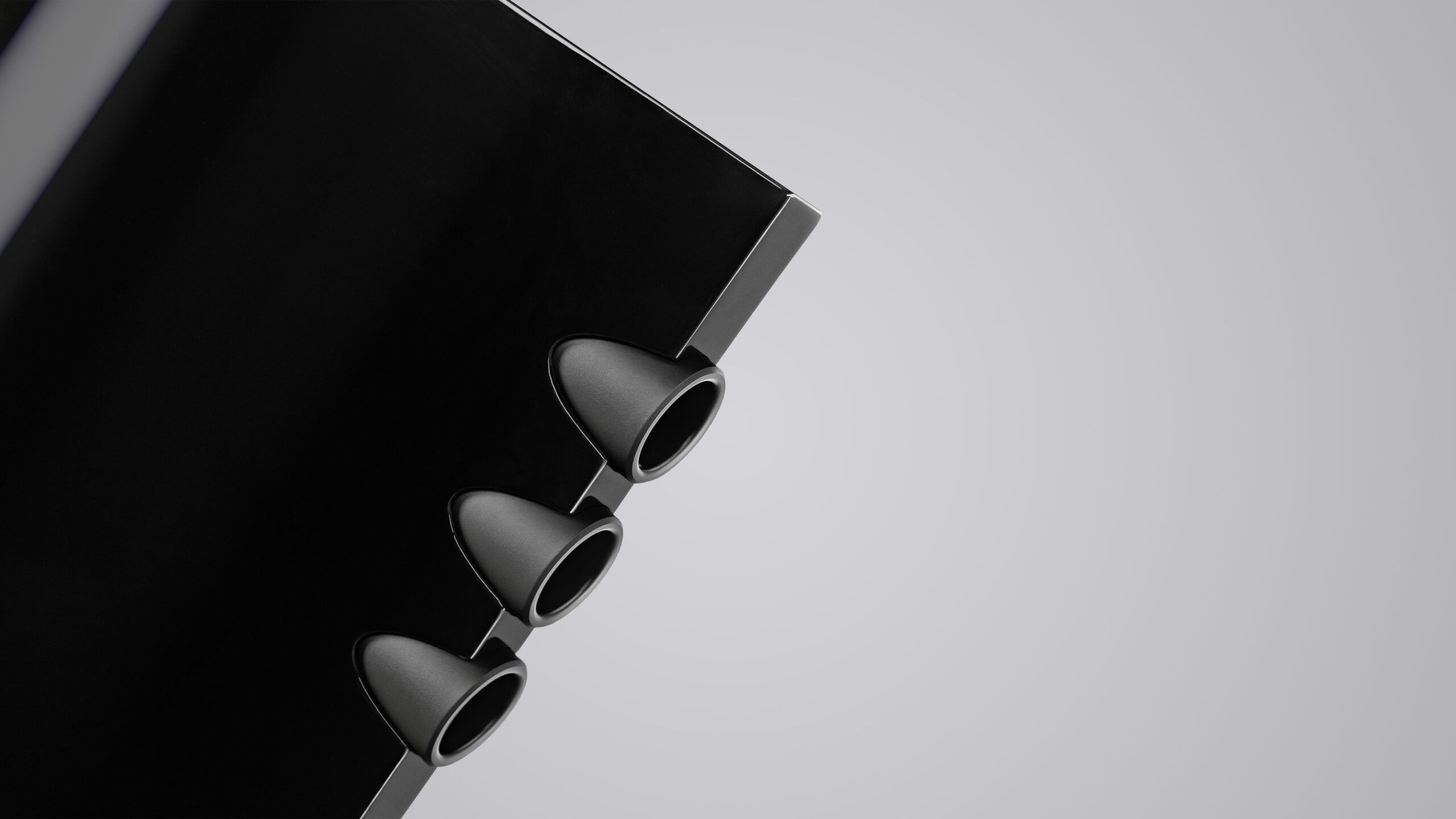
One of the most exciting concepts here is the port. That is a sentence I never expected to write, but bear with me for a while. Where most ports exit to the loudspeaker’s front, rear or base, Reference One’s port is at the top. This is hidden from view thanks to a grill resembling the demisting vents on a car window. It’s also a corner-free port shape with an area equivalent to 30% of the woofer membrane.

If you think about it, the top of a loudspeaker is a perfect spot to place the port. Firing to the rear interacts with the room boundaries, while firing to the front disrupts the sound from radiating drivers. Meanwhile, the characteristics of a port firing into the floor are variable due to the sonic differences between flooring materials. Firing into the ceiling minimises those potential interactions, and the distance from port to ceiling means its construction is immaterial.

Staying with the cabinet, the 25mm form pressed plywood exterior gives a curved shape to the enclosure. That is reinforced by 18mm and 22mm thick plywood bracing throughout. While the Reference One is not at ‘folded horn’ or ‘transmission line’ levels of internal complication, it’s still intricate.

Davone Reference One

The company’s distinctive industrial design extends to the Davone Reference One floorstanding loudspeaker. The lower section features quarter-cut walnut veneer, while the upper section is finished in black or soft white European-sourced leather. Note that means hides ‘made in Europe’, not ‘made from Europeans’… hopefully. The loudspeaker is a gentle taper in front and side aspects. It’s also mildly backswept to allow a degree of time alignment. With the gentle curve of the base, it rocks forward and back until the discrete spikes are positioned. This rocking motion does allow some fine-tuning of positioning on carpeted floors, but I’d exercise caution, nonetheless.

Compared to other models in the Davone range, this doesn’t have the same outstanding Scandinavian design. However, in fairness to the Reference One, the physics constrains the design. I would rather have a three-way loudspeaker that sounded excellent than one that looks like an objet d’art. And the Reference One does sound excellent.

A lot of that excellent sound comes down to the choice of drivers. The Reference One uses a 25mm flush-mounted Beryllium dome tweeter for the high frequencies. This is met by a 110mm woven carbon fibre ‘Textreme’ midrange with multimodal cone break-up properties. A 250mm hard paper cone – with a long 22mm deflection and a 75mm voice coil – brings the bass.

Davone Reference One

Davone has made the Reference One moderately easy to drive. The impedance dips to 3.4Ω at 26Hz and stays above four-ohms through most of the frequency range. At 87dB sensitivity, it’s not the loudspeaker for two-watt triode designs but as Davone suggests 100W and beyond is fine. This makes it a good match with amps in its price class. While the Reference One demands quality amplification, it’s not an amp-fussy design.

Neither are the Davone Reference Ones particularly troubling to install. They need to be about 2m apart and at least half a metre from the rear wall. They need some toe-in, but again nothing micrometer-precise. The only exception is level. They do need to be accurately positioned so that the top of the loudspeaker is level. Fortunately, the adjustable spikes are easy to raise and lower.

Gestalt performance

More than pointing to a specific aspect of the Davone Reference One floorstanding loudspeaker, however, it’s the gestalt that counts. The loudspeaker is an excellent blend of science and art. Many of the things it does so well happen because of the good engineering execution.

A prime example of this is the excellent imaging. The loudspeakers present an excellent sense of stereo staging, fully three-dimensional but in an unforced manner. And the reason for that is the wide baffle, the rolled edges of the loudspeaker enclosure, and its time alignment. All these elements have been known in audio for decades, and the result is good soundstaging. However, Davone brings all three elements in one speaker, creating an extremely natural-sounding stage as a result. Play anything from simple folk to complex orchestral music and you’ll hear that separation of instruments in space.

This is supported by a good underpinning of bass. Unlike many flagship designs, the Davone Reference One floorstanding loudspeaker doesn’t make its bass felt all the time. Just bass when its needed. That solidity is especially good with classical music. Orchestral pieces retain their ‘shape’ thanks to double basses, brass, and percussion instruments, and the Davone expresses that well.

The Davone loudspeaker delivers extremely good detail, although it doesn’t make too much of a song and dance about it. You can hear this by playing music with which you are extremely familiar. For me that’s Joyce DiDonato’s Stella di Napoli album on Erato. Her vocal articulation, the intonation of the French horn that accompanies her, and the orchestra are all focused and realistic. So far, I’ve discussed mostly classical works. The Davone’s strengths apply universally. I enjoyed the same excellent detail reproduction playing everything from Art Blakey to ZZ Top.

Davone Reference One

I also really like the excellent tonal balance of the Davone Reference One floorstanding loudspeakers. There is a tendency with modern loudspeakers to push a specific frequency range. For example, many European loudspeakers are ‘zingy’, with an expressive but toppy treble. On the other hand, some American loudspeakers have a strong bass emphasis and sound ‘dark’ in comparison. Davone remembers that the word ‘balance’ is involved, and that balance or evenness of bass, mid, and treble shines through. Once more relying on known musical references, I played the title track from River: The Joni Letters [Herbie Hancock, Verve]. Due to her own vocal character, Corinne Bailey Rae is a good choice to cover Joni Mitchell tracks. However, without an evenly balanced loudspeaker, that voice can sound like a Joni Mitchell impression or a pastiche. The Davone Reference One is faithful to the original tonal balance of the recording, and Corinne Bailey Rae’s voice shines! If you are used to brighter sounding loudspeakers, the Reference One might seem lacking in ‘sparkle’. However, I’ve always found that sparkle tarnishes fast. The Reference One is in it for the long haul and you’ll love that balanced presentation for years to come!

Another Reference One boon is its ability to play from loud and quiet with equanimity. Plenty of loudspeakers can play at ‘hearing loss’ loudness levels. Others can sing at whisper-quiet levels. But it takes a really good design to sound good across the board, from a whisper to a scream. The Reference One does that, with an ‘honest’ and refreshingly unexaggerated dynamic range in tow. OK, so if you are wanting a loudspeaker that can double up as a PA system, look elsewhere. But in the real world, this is all the loudspeaker most of us will ever need!

Where’s my unicorn hide?

There is a downside to the Reference One; it’s not expensive enough! It also lacks some of the touches that separate the high-end from the rest of the world. It isn’t made from unicorn hide or a veneer from the last tree of its kind. It doesn’t weigh as much as a small planet. It isn’t finished in a piano gloss that could be used to signal aircraft. This is why the Davone doesn’t cost as much as an S-Class Mercedes. Sadly, a lot of the audio world has gone full-on ‘bling’ and this fine performer may get overlooked for all the wrong reasons.

Davone Reference One

That must not happen. In a high-end audio world gone mad, the Davone Reference One floorstanding loudspeaker is a dose of sanity. It’s a great sounding performer for good, solid reasons. It’s also perfect for listeners wanting a true reference-grade sound without draining a bank account. Finally, it’s ideal for real-world listeners not holed up in acoustically perfect man-caves.

Technical specifications

  • Type Three-way, reflex-ported floorstanding loudspeaker
  • Drive Units 1x 25mm beryllium dome tweeter, 111mm Textreme cone midrange, 250mm hard paper cone
  • Frequency Response 29Hz–30kHz, -3dB
  • Impedance 4Ω nominal, 3.4Ω minimum (at 26Hz)
  • Sensitivity 87dB/2.83V/m
  • Finishes black or soft white leather, quarter cut walnut veneer
  • Dimensions (W×H×D) 47 × 97 × 37cm
  • Weight 42kg per loudspeaker
  • Price £15,999 per pair

Manufacturer

Davone Audio

 Homepage – https://www.davoneaudio.com

Review Product – https://www.davoneaudio.com/reference1.html

Contact Us – https://www.davoneaudio.com/contact.html

Tel:  +45 23 88 71 72

Back to Reviews

Gold Note DS-1000 EVO streaming DAC

The Gold Note DS-1000 EVO has been one of the company’s mainstays in its higher-end electronics line. It’s a wireless streaming DAC, making it essentially your complete digital source component in a post-physical digital age. However, given it also has extensive digital connections that a disc-spinner might use, it’s also likely to be a digital hub for CD transports and other traditional digital audio devices. It has an optional XLR and RCA line inputs if you wanted to use the DS-1000 EVO as a line preamplifier (which is called the DS-1000 EVO LINE and is the model tested here), and a 1/4” headphone socket too.

In the past, Gold Note eschewed the notion of discussing its chipset, taking the very admirable line that suggests its a Gold Note product, rather than someone’s chipset in a Gold Note box. Unfortunately, this admirable line is often shouted down, so in the new DS-1000 EVO, Gold Note informs us that it features two dual-mono AKM AK4493 DAC chips. This boosts the resolution of the EVO over its predecessor; where the last topped out at 24/192, the EVO supports PCM files up to 32bit, 384kHz resolution and DSD from DSD64 up to DSD526 (and DSD512 via USB) native now.

Simplified, not simple

The Gold Note interface is one of elegant simplicity, but it is not a simple product. The front panel has a display screen controlled by a multifunction knob and aside from the remote eye, a little blue LED and that headphone socket, that’s it. The 3.5” TFT display is just large enough to read and not so large that you start to think it’s a touch-screen, although I still spent the first day or so uselessly mashing the panel. It’s a colour display but Gold Note’s use of colours is elegant and restrained. There’s that word ‘elegant’ again… get used to it, you are going to see it a lot over the next few pages.

The DS-1000 EVO allows listeners to stream music wired though an Ethernet connection or wirelessly from a home network. It supports all the usual digital subjects (including Airplay), can use a USB drive as host, or take a USB feed from a computer (allowing native DSD streaming of DSD files) and comes with UPnP and DLNA network capabilities to control streaming, internet radio sources via vTuner, Tidal (via Tidal Connect), Spotify (via Spotify Connect), Qobuz, local media servers and so on, from the company’s own app or via the front panel. It is also Roon Ready. It can be bolstered up by the use of an optional external power supply upgrade, but this was not supplied for the test.

The Gold Note DS-1000 EVO also gives you the option of a ‘Tube’ output. This hooks directly to one of two output stages – the TUBE-1006 or 1012, which adds six (or 12 in the 1012) valves in a Class A output stage, which Gold Note says is for added warmth. This too was not supplied for test, but has been a known and popular upgrade for Gold Note’s higher-end products. In total, that would make the DS-1000 EVO take up three shelves, but if you use it as a line preamplifier too, that doesn’t sound too greedy. All three can be finished in Gold Note’s standard and elegant black, gold or silver finish.

The last link in the chain is the GN Control app, for iOS and Android products. This allows you to control all the DS-1000 EVOs functions both in the streaming section and some hands-on control of the DS-1000 EVO. Increasingly, the functionality of a product relies heavily on the quality of the app, and the Gold Note app is on the side of the angels.

The app isn’t as slick as some of the best in breed; I use an Innuos Statement Next Gen as my front end, and if I’m forced to choose between the two, I’ll go with Innuos. But, to its credit, it’s stable and fast, and isn’t overly fussy or busy. The app is backed up by a remote handset, which is itself useful for basic volume control.

In the LINE version, the DS-1000 EVO is equipped with a Class A line preamp stage to control the volume directly in the analogue domain, which can be bypassed when the DS-1000 EVO is set to DAC mode. The headphone amplifier meanwhile is more than just a feed from the line outputs, but a Gold Note developed circuit with high and low output settings to accommodate the widest set of headphone options.

Making your mind up!

I sometimes find that products like the Gold Note DS-1000 EVO seem to have trouble making up their minds. They are often a DAC that ‘does a bit of streaming’ or a streamer ‘that’s also got a DAC’. When you add a line preamp option, all bets are off. But the DS-1000 EVO is different. It has a strong sense of purpose to it; in the DS-1000 EVO it’s a streaming DAC and in the DS-1000 EVO LINE it’s a streaming DAC preamp. There isn’t a weak link in the chain, except maybe that its elegant front panel means a lack of hard buttons and control surfaces people have come to expect from their preamps.

Gold Note makes a big play about the DS-1000 EVO and EVO LINE having what it calls an ‘Italian’ sound. I don’t like this concept, any more than I liked products ‘tuned’ for listeners in a specific country… but Gold Note has a point. Play any piece of music through the DS-1000 EVO and you are instantly reminded that it is made in Florence, thanks to a sumptuous passionate elegance (told you!) about that sound. It makes the kind of music that you feel duty bound to make sweeping hand gestures during the listening session. I could get into some low-rent stereotyping here, but this is a DAC with fire in its belly, passion in its heart and dresses in style!

The song, not the numbers

I can be inwardly curmudgeonly about piling on the ever higher-resolution formats. Sometimes they are more about the numbers than the song. And the recordings that suffer the most aren’t the high-resolution ones; they are the ones we listen to time and again, in and around CD quality. But here, the CD quality sings beautifully, and the higher-resolution sounds just add to the performance.

I can’t help but describe this (once again) as elegant. The sound has good imagery, excellent detail and dynamic shading and can scale well from a simple aria to a powerful orchestral tutti. The elegance is such that it’s difficult for the Gold Note DS-1000 EVO to make a bad noise.

If that makes you think the DS-1000 EVO softens its transients or somehow rolls off the sound; guess again. Playing some harsh 1980s post-punk (Joy Division’s Closer… I felt like I could do with cheering up!) and the hard, angular sound of late 1970s Manchester studios is portrayed properly. It’s just that despite it all, the sound is likeable rather than an ear-bleed.

Refined without over-refinement. Elegance without rococo frills and finery. Detail without sounding etched. Good soundstaging without sounding too dissolute. A dynamic range that can slam as much as it can burble along with the music. These are all elements that cannot be dismissed without sacrificing a lot of musical performance.

Even that English obsession of Pace Rhythm and Timing is well handled here. No, the rhythm kings and the timing obsessives will show how their foot tapping is 1% less direct, but the rarely see a bigger picture of wonderful coherence, across the board refinement… and my elegance meter is going off again. I played the Bach Trios by Yo Yo Ma, Chris Thile and Edgar Mayer. This is an extremely refined piece of music, but one with an edge caused by the presence of the mandolin. It is all about the microdynamic subtleties of the musicians, the portrayal of space and dimensionality around the music and both the sublime playing and the interpretation of Bach’s masterpieces. Get it wrong and it sounds fake and brittle, but here it places you in the recording suite, with a sense of overall musical beauty and (here it comes again) elegance that simply draws you deeper into the music. I would rather this than have this wonderful recording force-fed through an artificially beaty sound.

Even music that has a strong sense of beat fares well with the Gold Note DS-1000 EVO. Play something that you will nod along to – ‘Paranoid’ by Black Sabbath for example, or more contemporaneously ‘Dirty Rat’ by Sleaford Mods and Orbital or even some Techno – and you can’t help but nod, foot tap, do the whole ‘big fish, little fish, cardboard box’ thing. A lot of this comes down to the combination of excellent separation and great dynamic range, but the DS-1000 EVO is no rhythmic slouch.

I’ve saved the best until last, though. It’s the way the soundstage just envelops you that really sets the DS-1000 EVO apart. This shows the sound is leveraging at once the richer, warmer sound of Gold Note and a more direct, upbeat sound more common today. This is a delicate trade-off; too much warmth and the soundstage can appear soft and diffuse but too much top end energy and the staging becomes two dimensional. The balance is excellent here, and that comes across best when playing my benchmark Joyce DiDonato tracks from Stella Di Napoli {Erato]. Her voice sits perfectly between the loudspeakers, with rock solid stability, while the orchestra rise up to meet her voice, then falls away just leaving the French horn. It’s one of those recordings that can raise the hairs on the back of your neck, and it does wonders here. It might not look good, but goose-flesh is a very positive sign here.

I’ve mentioned just how good the DS-1000 EVO is as a team, but what are the individual aspects of performance like? OK, it’s difficult to separate out the streamer because there is no digital output to by-pass the DAC. However, as a DAC, it’s an excellent performer; perhaps not as detailed as a similarly priced Chord Electronics model, but certainly sophisticated enough and more than dynamic enough to hold its own. Similarly the line preamplifier is a fine performer, but there are standalone models (including standalone models in Gold Note’s 1000 series range) that will add greater flexibility, more inputs and a touch more transparency across the mids and high frequencies.  Finally, the streamer (as separated as it can get here) works well in its own right, but is outpaced by dedicated standalones like AURALiC.

This is getting away from the point of the DS-1000 EVO. It’s a proper digital audio hub (plus preamp if you go down the LINE route) that is a great sounding and convenient way to get that degree of musical elegance with minimal effort. No, it’s not the Lazy Man’s way to good sound, but it allows you to create a fine and sophisticated performance without the need for several boxes… unless you want the power supply and tube output stage. Even the headphone amplifier sounds – you guessed it – elegant!

Early sample

Ours was one of the first samples out of the Gold Note factory and bugs were expected, met and overcome. Typically in such cases, the end result is even better than the last models out of the designers test bench. But, even if not, the Gold Note DS-1000 EVO is a fine example of the Streamer/DAC and preamp breed and a worthy addition to the pantheon of high-performance digital audio. It’s the antithesis of that strident, aggressive digital sound, and yet it doesn’t deliver that more effortless sound through softening its presentation. In other words, it’s a gold star!

Technical specifications

  • Type Solid-state stereo DAC with streaming and digital inputs
  • D/A Converter 2x AKM AK4493 giving PCM up to 32-bit/384kHz and DSD512
  • Supported audio formats AIFF (.aif, .aiff, .aifc), ALAC, WAV (.wav) packed/unpacked, FLAC, MP3, Apple Lossless, OGG, Monkey’s
  • Supported Media Servers all UPnP, DLNA, Roon
  • Supported streaming services Roon Ready, Airplay, MQA, Qobuz, Deezer, Spotify Connect, Tidal, Tidal Connect,  vTuner
  • Frequency response 20Hz to 20kHz (+/-0.1dB)
  • Total Harmonic Distortion 0.001% max
  • Signal to Noise ratio -125dB
  • Dynamic Response 129dB
  • Output Impedance 50 Ohm (RCA), 100 Ohm (XLR)
  • Network Connectivity LAN/WLAN (WiFi) 802.11a/b/g/n/ac Dual Band (10/433Mbps), Bluetooth High Definition 5.0 (44/16)
  • Dimensions (W×H×D) 43 × 13.5 × 37.5cm
  • Weight 10 kg
  • Price £5,559 (DS-1000 EVO); £7,269 (DS-1000 EVO LINE)

Manufacturer

Gold Note

Homepage – www.goldnote.it

Review Product – https://www.goldnote.it/electronics/ds-1000_evo/

UK distributor

Airt Audio

www.airtaudio.com

+44(0)754 879 6382

Back to Reviews

Java Hi-Fi Single Shot integrated amplifier

Coffee machines are a malarkey, very whimsical beasts that are always after attention, if it’s not run out of water then the grounds need emptying, then before you’ve had half a dozen cups it needs cleaning. Gaggia have a lot to answer for but the results are worth the effort, most of the time.

I’m guessing that coffee may have been the reason why Java electronics are so named, or perhaps it’s the relative proximity of New Zealand to that part of Indonesia. Either way they are stylish bits of kit with more colour and finish variations than all but the most imaginative of loudspeaker designs. The high end audio market is notoriously conservative so this is a bold move and one that is presumably aimed at bringing more music lovers into the fold, an admirable approach that more brands need to consider if this niche within a niche is to have a future.

Java is a relatively young company that developed its first product, the LDR passive preamplifier, in 2016 and brought them to market the following year on the Kickstarter crowd funding platform. Six years later they have preamps, power amps and integrated models at two different levels which share the same basic appearance and amplification technology. Both models of Java integrated amplifiers use GaN FET transistors in Class D circuits, while the preamplifier sections use LDR or light dependent resistors in a passive circuit. I have not come across this technology before but Java founder Martin Bell explains: “It works by varying current to alter the intensity of an internal LED, which in turn varies resistance to adjust the volume level, creating the purest possible path for the delicate audio signal.”

One shot or two

Class D GaN FET amplifiers are likewise high efficiency designs which makes the Java Single Shot almost green by the standards of 200 Watt integrated designs, those heat sinks are not there for looks alone however, they do get warm when the amp has been running for half an hour or so. The Single Shot appellation indicates that this is the more affordable of Java’s integrated designs with single ended connections and half the output power of the 400W Double Shot variant. The Single Shot is just over £9,000 while the Double Shot is nearly £2,000 more, so there is a worthwhile saving and the product looks the same albeit with only two RCA line inputs rather than four balanced ones.

When ordering a Java amp you get to choose from eight casework finish options and three shades of anodising for the front panel, with Copper alongside the more familiar black and silver. There are veneer and satin or gloss paintwork options for the case including ebony and walnut, I received a Single Shot with Dark Walnut Satin casework and Copper anodised metalwork, which includes the heatsinks. Apparently the walnut is a real wood veneer, it looks so slick that I presumed otherwise so Java have clearly got their quality control in hand.

The bases

The RCA sockets are made by ETI Research as are the speaker binding posts. Alongside two pairs of inputs are a pre-output pair and inputs for an MM phono stage, there are also digital connections in the form of a USB B socket and a connector for a Bluetooth antenna. Java are clearly thinking about those wanting to get good sound out of all likely sources. There’s a headphone socket on the front too, it has all the obvious bases covered with the exception of AV, there’s no optical or HDMI connection for a TV.

Operationally the Java Single Shot is pretty straightforward once you have popped the magnetic panel out of the remote handset and engaged the battery. Volume level is indicated by backlit blocks with each one covering a range of levels rather than a step, the remote gives step like changes while the knob is more progressive. Typically, this can cause some concerns with playing music at low levels. However, the volume control is deliberately dialled back slightly at lower listening levels, allowing additional steps between the volume settings displayed as ‘zero’ and ‘one’. This gives the Jave Single Shot greater nuance for late-night listening levels.

Even with casual listening it was clear that the Java has some rather appealing characteristics, prime amongst which is an immediacy that makes everything sound more alive and exciting. This amp shares a common Class D trait which is an absence of what Metallica referred to (positively) as ‘thickener’, but what’s good for music creation is not necessarily beneficial to its reproduction. Class AB amps sound a bit heavy and thick compared to this Java, it’s not unappealing but neither is it necessarily a reflection of what’s in the signal. This amp makes it clear that this fullness may well be a characteristic of that mode of operation and without it the sound becomes faster and more vivid.

Light touch

The counterpoint to this is that if not done well Class D can sound hollow and thin, lacking the body that a good Class AB brings to the party. The Single Shot manages to avoid this with a degree of richness that is unusual for its class, there is a depth of tone that while not in the same league as a tube amplifier is sufficient to give notes plenty of timbral depth. In some ways the Java sounds like a single ended triode, it has that nimbleness and absence of overhang, notes stop and start quickly but without any sense of ringing. Here however the highs do not have the smoothness of a triode, they are more extended and there is more power behind them albeit only lightly felt.

Most of my listening was via the onboard DAC using the USB input connected to variously an Innuos Pulsar, Lumin U2 Mini (with a Network Acoustics and LDA PSU) and a Melco N5. Each of these streaming sources sounded distinctive, the Pulsar being the most timely while the Melco was beautifully rounded and relaxed and the Lumin somewhere between the two. The DAC in this amplifier is clearly quite capable albeit not so keen on very high sample rates, eg those above 192kHz. The DAC/amp combo times very well and produces highly engaging results regardless of whether the music is Cian Nugent’s ‘Siamese Sharks’ sounding very polished and three dimensional, or Steely Dan’s ‘Babylon Sisters’ which sounded crude by comparison despite being musically superior IMHO. It also revelled in the detail and tonal richness of John Martyn’s rendition of ‘Glory Box’ which had serious low end extension and a sense of control without grip that few Class AB integrateds at this price can match.

The above observations were experienced with Sonus faber Amati G5 speakers that are very capable beasts indeed. Moving to the more affordable PMC twenty5.26i floorstanders ushered in a lighter, crisper sound that while it lacked the bass power of the former speakers made up for it by delivering the life and energy of everything that was played. Acoustic pieces really worked well, the absence of time smear allowing the attack and decay of each note to be rendered clearly such that it gelled with the musical whole in a highly transparent fashion. This is a very clean sounding amplifier via its line inputs as well, I connected my phono stage to these and spent a highly engaging evening playing vinyl old and new. You get all the snap and visceral excitement of a dynamic piece of music along with the vibe from the band behind it, so Michael Franks’ ‘Popsicle Toes’ has a joi de vivre while on Frank Zappa’s ‘Pygmy Twilight’ (Roxy and Elsewhere) it feels like you have a window onto the concert as the band vamps in the background while Patrick Simmonds, Napoleon Murphy Brock and Zappa go through their routine. This was one of several occasions where electric guitar stood out so well that I had to wonder if the system was emphasising this part of the spectrum, but in truth it was more likely down to the mix.

If you like the styling and enjoy the energy and vitality of music, the Java Single Shot is a great amplifier for the asking price. Its take on Class D is more rounded and substantial than most and this combined with a strong feature set make it a worthy contender for those looking to combine several functions in a single unit. It’s hard to say how much of the sound is due to the GaN side of the equation but that clearly isn’t doing any harm.

Technical specifications

  • Type Class D, two-channel integrated amplifier with built-in DAC and phonostage
  • Analogue inputs One MM phono input (via RCA jacks), two single-ended line-level inputs (via RCA jacks)
  • Digital inputs One USB port, one Bluetooth receiver
  • Analogue outputs One pre-out (via RCA jacks), one 6.3mm headphone jack
  • Supported sample rates PCM up to 24/192 inc DSD
  • Input impedance 100kΩ
  • Output impedance (preamp) Not specified
  • Power Output 200Wpc @ 8 Ohms, 400Wpc @ 4 Ohms
  • Bandwidth 10Hz–20kHz (+/- 0.5dB)
  • Distortion < 0.01% THD+N (8Ω, 1W, 20Hz to 20kHz); 0.02 % THD+N (8Ω, 25W, 1kHz)
  • Signal to Noise Ratio 108dB
  • Dimensions (H×W×D) 130 × 440 × 415mm
  • Weight 10.6kg
  • Price £9,290

Manufacturer

Java Hi-Fi

Homepage –  https://www.javahifi.com/home

Review Product –  https://www.javahifi.com/review-product/integrated-amp-single

Where to buy –  https://www.javahifi.com/where-to-buy

UK distributor

Audio Emotion

www.audioemotion.co.uk

+44(0)1333 425 999

Back to Reviews

PS Audio Is Now Shipping Its AirLens Music Streamer

Boulder, Colorado, September 12, 2023 – PS Audio is now shipping its AirLens music streamer, designed to deliver the ultimate in sound quality from streaming audio sources. The new AirLens (SRP: US $1,999.00) offers high-resolution streaming via Roon and services such as TIDAL, Qobuz, Spotify, JRiver, and Audirvana, as well as from an NAS storage device or any DLNA-compatible server.

“The secret of the AirLens’ exceptional sound quality is its galvanic isolation,” noted Paul McGowan, PS Audio CEO. “Removing the physical connection between input and output stages eliminates the unwanted noise that can be introduced by USB, Ethernet or Wi-Fi. The AirLens also perfectly re-clocks the digital signal. The result is a remarkable improvement in resolution, timbral realism, and dynamics.”

The PS Audio AirLens connects to a network via Ethernet or Wi-Fi, and provides I2S and coaxial digital outputs to connect to a DAC. Typically, noise from any number of sources including a computer, long runs of Ethernet cable, EMI interference via Wi-Fi, and modems and routers all contribute to increased jitter and a loss of fidelity. PS Audio’s galvanic isolation removes this sonic degradation by eliminating the electrical connection between the input and output stages, using only air as the interface. This ensures 100 percent isolation and noise-free delivery of the digital audio signals. In addition, the signal is re-clocked at the output stage for jitter-free, pure digital audio.

Available in silver and black, the AirLens offers PCM decoding up to 352.8 kHz, and DSD to 256 (4x). Its compact size (10 by 7 by 1.5 inches) and sleek design make it easy to integrate into any audio system. Like every PS Audio product, the AirLens is manufactured using premium-quality parts and construction.

AirLens Features at a Glance:

  • Galvanically isolated from input to output to eliminate network and Wi-Fi noise and offer extraordinary signal purity and sound quality
  • Connects to a network via 10/100/1000 Ethernet or 2.4 and 5 GHz Wi-Fi
  • I2S and coaxial digital outputs
  • Offers PCM up to 352.8 kHz/32-bit and native DSD up to 256 (4x, up to DSD 128 via coax output)
  • DoP (DSD over PCM) operation
  • Roon-ready
  • DLNA-ready
  • Compatible with TIDAL Connect (via Roon), Spotify Connect, mconnect, Qobuz (via Roon and mconnect), Dropbox (via Roon), MQA, DLNA 1.5 and UPnP A/V 1.0 Digital Media Renderer
  • Available in silver or black
  • 10″ x 7″ x 1.5″, 4.8 lbs.

SDD Intros Lumin D3 Network Music Player to UK Audiophile Streaming Fans

September 2023 – Sound Design Distribution, an independent U.K. distribution company specialising in premium quality audio systems is delighted to announce the UK availability of the LUMIN D3 Network Music Player.

Combining new processing hardware/software within a new and compact all-aluminium chassis, the D3 delivers improved features and increased resampling flexibility while retaining all the musicality of its acclaimed D1 and D2 forbears.

With the latest LUMIN processing onboard and sporting the silky chassis surface of LUMIN’s high-end P1 player, the D3’s fully balanced design offers music streaming aficionados arguably the most compatible and comprehensive feature set available at the price, and with LUMIN’s powerful and intuitive app at their fingertips, the easiest and most tactile high quality access to the entire online music universe.

The D3 will support UPnP AV protocol with audio streaming extension (OpenHome); Roon Ready, Plex, Spotify Connect, TIDAL Connect, Qobuz, FLAC Lossless Radio, Tuneln Radio, AirPlay 2, Gapless Playback, On-Device Playlist and Multi-Room (Songcast). Supported audio file formats include DSD Lossless: DSF (DSD), DIFF (DSD), DoP (DSD), PCM Lossless: FLAC, Apple Lossless (ALAC), WAV, AIFF; Compressed (lossy) Audio: MP3, AAC (in M4A container) and MQA.

Powerful new processing feeding a new output stage built around the Sabre DAC ES9028PRO chip, renders PCM up to 384kHz, 32-bit, Stereo, and DSD up to DSD2S6, 1-bit, Stereo, delivering upsampling and downsampling to every supported format up to DSD2S6/PCM384. Inputs include RJ45 1000Base-T Gigabit Ethernet and USB, while outputs include XLR balanced, RCA unbalanced analogue, and BNC S/PDIF digital for PCM 44.1kHz-192kHz, 16-24bit and DSD (DoP, DSD over PCM) 2.8MHz, 1bit.

Control over the D3’s feature-rich capabilities is provided by the celebrated LUMIN app, which features native support for TlDAL, MQA, Qobuz and Tuneln Radio, as well as Tidal MQA and Qobuz high-res icons to identify high-res music. A flawlessly easy user experience is optimised with support for high-resolution artwork, artwork caching, search, multiple tag handling, composer tag support, album-grouping in playlist, automatic internet links to artists/album/songs, and the saving and restoring of playlists (including Tidal and Qobuz).

In addition, the most precise control over volume is offered by Leedh processing, a digital volume adjustment algorithm that is designed to eliminate rounding errors now included (at no additional cost) on all LUMIN players.


LUMIN D3

Availability in Silver or Black: October 2023

Typical retail price (inc VAT): £2,195.00

LUMIN’s D3 Network Music Player will be on display at the UK Hi Fi Show Live, Ascot Racecourse Sept 29 – Oct 1, 2023. https://hifishowlive.com/

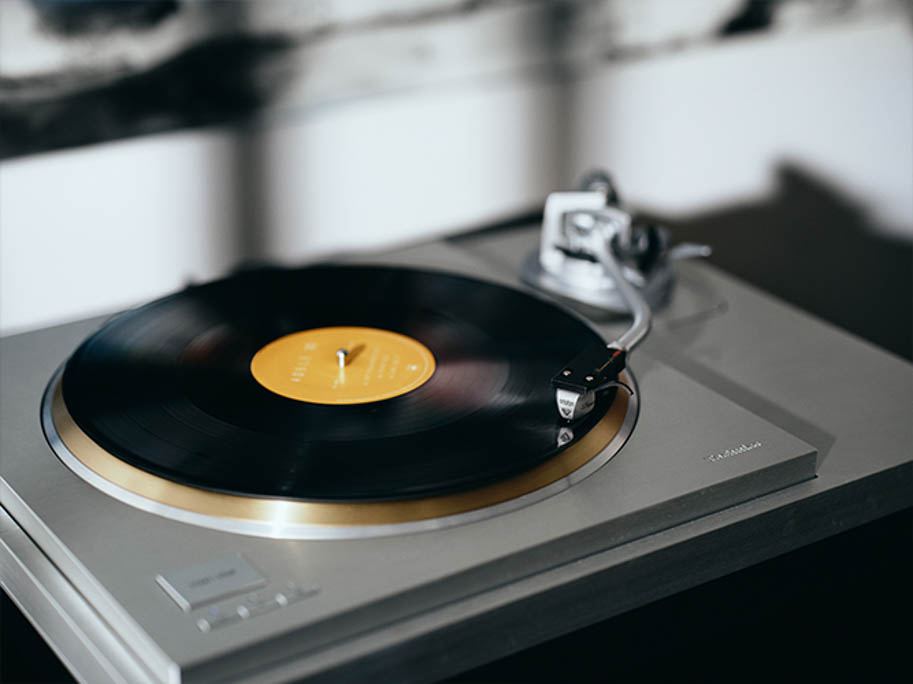
Technics Announces New SL-1200GR2 Turntable

NEWARK, N.J.Sept. 7, 2023 /PRNewswire/ — Renowned hi-fi brand Technics has released its legendary and widely acclaimed SL-1200/1210GR turntable in a new ‘GR2′ version.

This new model was planned to build on the reputation of our existing design and developed the new GR2 around the iconic iron-coreless direct drive motor with its superior rotational precision. We looked at how we have improved signal precision in our digital audio components, especially at the Reference amplifier SU-R1000, which optimizes vinyl analogue signals using complex digital technology. It’s been our goal to take our direct drive technology and take it to the next level in terms of precision. This was achievable by reducing motor vibration through optimising the driving sine waves via the PWM signal generation using ΔΣ (Delta Sigma) Modulation, as employed in our full-digital amplifiers.

The motor control signal for the new SL-1200GR2/SL-1210GR2 is a huge leap in performance in comparison with earlier versions. Looking back to the 1970s, the motor control sine wave signal was generated by an analogue RF oscillator, the precision of which left room for smoother rotation. After the revival of the Technics SL-1200 turntable in 2016, the new SL-1200GAE – along with the much-improved motor by an iron-coreless stator – inherited a new motor control based on PWM for D/A conversion, using a micro controller including a sine-wave ROM. This added remarkable impact on the whole rotational precision and helped achieving lower motor vibrations. However, despite this approach, the sine wave for motor control was still not 100% accurate.

Therefore, in the new GR2, the motor control signal is generated by the usage of a PWM signal generated by ΔΣ (Delta Sigma) Modulation, a method of high precision 1bit D/A conversion which is part of the signal procession in Technics’ full-digital amplifiers that use our proprietary technology JENO Engine. By this approach, consequently given the name ΔΣ-Drive (Delta Sigma Drive), a perfect sine wave is generated, and motor vibrations are radically reduced. This has a significant impact especially on the frequency range where the motor vibrations overlap with the natural resonance of the tonearm/pickup cartridge combination. Thus, the tracking precision is drastically improved. The result is a stunning signal precision with an accurate sound stage, superb imaging, and a very low noise floor.

In combination with the rotation feedback system based on speed detection by the usage of a frequency generator (FG) which works on magnetic power generation, the rotational speed precision of the new GR2 type is exceptional.

Along with the motor control, the general power supply has also been the focus of engineering. The new Multi-stage Silent Power Supply of the SL-1200GR2/SL-1210GR2 is a combination of a low-noise, high-speed power supply working at over 100kHz and a noise canceling circuit inherited from our reference class turntable SL-1000R, cancelling remaining noise by injecting the reversed-phase current of the actual noise. By this method, a very low noise floor is achieved, enabling exceptional signal-to-noise ratio, improving the overall signal performance.

Most of the mechanical design of the new GR2 type has been retained from its predecessor: Kept were the rock-solid 2-layered bottom chassis made of aluminium and BMC (Bulk Moulding Compound), the combination of which enables high resistance against vibrations, the 2-layered platter made of aluminium and dampened by heavy-weight rubber, the high-sensitivity S-shaped aluminium tonearm and the effective insulator feet.

The overall design has been gently refined: A new colour match of all parts and elements as well as the new body surface touch quality adds even higher desirability to the new GR2 generation of the SL-1200/1210.

To reduce environmental impact of our packaging while ensuring that Technics products are fully protected throughout their journey to our consumers, the new packaging for 1200GR2/1210GR2 is free of Expanded Polystyrene (EPS). Instead, it is made of smart shaped cardboard, maintaining safe protection of the product, also including a cardboard box for the accessories, allowing ease of removal and storage. Technics is currently working to expand new packaging to other line-ups and integrate more recyclable content into packaging materials in the future.

The new SL-1200GR2/SL-1210GR2 will be available from December 2023 at authorized Technics retailers at MSRP $2,199.99. In the Technics tradition, the silver version will be called SL-1200GR2, whereas the black will be SL-1210GR2.

SOULNOTE D-2 digital converter

Based in Kanagawa Prefecture about 27km (17m) from Tokyo, SOULNOTE is a Japanese-manufacturer of high-end audio components. Part of the CSR group, SOULNOTE divides its products into three levels or tiers. The D-2 DAC is part of their middle range.

The D-2 has the same (43 × 40.5 × 16cm) dimensions as SOULNOTE’s A-2 integrated amplifier tested in Issue 215 – and it needs to be this big. Just peer inside a D-2; you won’t find much empty space. Due to the extensive use of discrete components, the D-2’s circuits take up all-available room. Yet the D-2 is not SOULNOTE’s flagship DAC – that honour belongs to the D-3 model. However, after reading the D-2’s specifications, you might well conclude it’s about as good as it gets in terms of technology and design. It’s certainly a highly advanced, no-compromise product.

For starters, the clock used in the D-2 is claimed to have ultra-low jitter – around 45 femtoseconds. Despite this, further improvements in timing-accuracy are possible when the D-2 is partnered with SOULNOTE’s X-3 10MHz external clock (£4,500). Another key design point worth noting is SOULNOTE’s passionate advocacy for Non-Oversampling (NOS) filtering, though Finite Impulse Response (FIR) filtering is also offered to give users a choice.

NOS or FIR

SOULNOTE explain as follows… ‘In addition to conventional FIR oversampling, the D-2 has adopted the NOS mode which operates without feedback in the digital domain. In this mode, the pre and post-echo observed in the impulse response with FIR oversampling do not occur’. Basically, a short-duration transient pulse reproduces far more cleanly using the NOS filter. The FIR filter introduces noticeable ringing before and after the pulse. While the FIR filter has less distortion and achieves better phase linearity, for SOULNOTE, getting rid of ringing is more important.

SOULNOTE’s D-2 offers 32bit resolution (24bit USB) and is compatible with sampling rates up to 192kHz (768kHz USB) in PCM. DSD (64) is included, operating up to 22.6MHz (USB) and 2.8MHz (Coaxial/AES-EBU).

There are 5 digital inputs – 2 RCA/Coax, 2 XLR/AES-EBU, and 1 USB – with a choice of unbalanced (RCA) and 2.8v output, or Balanced (XLR) analogue and 5.6v output – both higher than average. As outputs are fixed, rather than variable, the D-2 cannot easily be used as a preamp.

The D-2 uses four highly regarded Sabre ES9038PRO DAC chips. According to SOULNOTE, “The ES9038PRO boasts an ultra-strong current output of 120mA. Using two per‑channel in Synchronous mode provides the highest sound quality.”

The balanced analogue outputs sound best in terms of vividness and dynamics, so use these if you can. For USB sources, you can download Microsoft drivers going right back to Windows 7 from SOULNOTE’s website. Macs are already covered.

Simple and Straightforward

Despite its internal complexity, the D-2 is very simple and straightforward to operate. It has five press buttons (plus power on/off) with a single rotary selector for the five digital inputs. The unit draws around 56W from the mains and gets mildly warm during extended use.

As mentioned, the D-2 matches SOULNOTE’s A-2 integrated-amplifier in terms of size. However, you cannot stack the two. This is because they each have floating top-panels. Also the metal support feet have no rubber protection pads. This risks damage to the lower unit.

There’s a visual display to indicate sampling frequency, but this only operates with USB inputs – not coax or AES/EBU – for sound quality reasons.

An intriguing feature is the stereo/mono switch on the back panel. This gives a normal stereo output through both channels, or just left channel through the left output, or right channel through the right output. But – why would anyone want this?

It seems SOULNOTE envisage a situation where two D-2’s are used in a dual-mono arrangement. They say, “In MONO mode, stopping the ES9038PRO on the opposite channel doubles the power margin and makes the channel separation virtually infinite.” So, there you are!

However, a less extreme (and less costly) option for D-2 owners looking to improve performance would be to add an X-3 external clock. Note that SOULNOTE’s flagship D-3 DAC does not have a built-in clock; it is designed to work with the X-3 as standard.

SOULNOTE’s goal is a vibrant vivid sound with explosive dynamics and great tonal brilliance. The D-2 certainly aims that and delivers impressive impact and luminous clarity. The result is vivid and detailed – hopefully, an arresting and intense musical experience.

Attitude

Like driving a fast sports car, the D-2 prioritises speed and excitement over smoothness. It engages your senses and makes you concentrate. SOULNOTE’s D-2 will appeal to those who want music to show attitude – not something that just sounds pleasant and un-assertive.

I got a sense of playing a 1976 jazz album called The Three with Joe Sample (piano) Ray Brown (bass) and Shelly Manne (drums). The recording was originally made direct-to-disc in Los Angeles, with the CD released much later from analogue back-up tapes made at the sessions. Inevitably the CD did not compare to the original direct-cut LP. I recall being disappointed when I first heard it 20 or so years back. But via the A-2/D-2, it was clear, bold, and very dynamic, with notable depth and separation, a big soundstage and excellent transient attack.

I did most of my early listening with the filter set to NOS. This delivers crisper dynamics and a more vivid sound compared to either of the two FIR settings. On most Jazz and Rock/Pop material, I felt very happy with the results using NOS. But, on naturally recorded classical material, I sometimes preferred FIR. If, on choral and solo voice there was a hint of tonal hardness or a slight degree of congestion when using NOS, then switching to FIR reduced this. The sound became fuller and richer/warmer.

But while FIR sounded a tad smoother and less bright than NOS, it was also slightly muted – less vibrant and immediate. On direct comparisons, NOS was always a bit better in terms of vividness. However, long term, FIR seemed slightly more comfortable to listen to.

My preference varied from disc to disc. Some were better with NOS, while others suited FIR. I liked NOS very much. On good Jazz and Pop/Rock recordings it often sounded best; on classical music I was sometimes happier with FIR. How good to have options!

Placement

Both the A-2 and D-2 proved sensitive to placement. I put the D-2 on a spring-suspended wooden shelf, which was fine. But placing the D-2 on a steel equipment rack with tempered glass shelves was not such a good idea.

The D-2’s hard metal feet on glass increased the brightness of the sound, which wasn’t good. Putting it on an old Mission decoupling platform with Sorbothane feet helped reduce treble glare without losing bite or immediacy.

After making this change, I tried the Halle recording of Elgar’s inspiring oratorio The Kingdom, and listened to the whole thing. It sounded great; still bright, but in a nice airy open highly-detailed way. Any hint of glassy-treble was gone, especially with the FIR setting.

There’s some very deep organ pedals throughout The Kingdom, and I was impressed by the sheer heft and power of the bass. The effortless reproduction of deep clean bass is always a litmus test for good digital, and the D-2 passed with flying colours.

Comparing the SOULNOTE D-2 to the DAC in AURALiC’s ALTAIR G2 was interesting. The latter costs £5,299 but includes a Streamer, MM phono stage, an analogue line input, and is usable as a preamp. The D-2 did sound slightly more dynamic, incisive, and detailed – though I had to listen very carefully.

Playing Mozart’s Salzburg symphonies with Trevor Pinnock and the English Concert on DG/Archiv, the D-2 separated the individual sections of the orchestra better, portraying strings, winds, and brass with greater individuality and a clearer portrayal of the hall acoustic.

It wasn’t a massive ‘night and day’ sort of difference, but given how good the Altair G2 DAC is, it’s quite something to better it. The D-2 always sounded that little bit more dynamic and insightful, and made the music sound livelier.

To sum up; SOULNOTE’s D-2 DAC is one hugely-impressive piece of kit that sounds vivid and vibrant. It gets the best from digital sources and is especially good when partnered with a responsive amplifier such as SOULNOTE’s A-2 integrated. So do hear a D-2 yourself and see what you think. I have a sneaking suspicion that you’ll come away impressed, and with a D-2 on order!

Technical specifications

  • Digital input USB (Type B), coaxial ×2 (S/PDIF), AES/EBU ×2
  • Input format (USB) PCM, DSD (DoP v1.1, ASIO native)
  • Input format (Coaxial, AES/EBU) PCM, DSD (DoP v1.1)
  • Supported sampling frequency (USB) Max. 768kHz (PCM)/Max. 22.6MHz (DSD)
  • Supported sampling frequency (Coaxial, AES/EBU) Max. 192kHz (PCM)/Max. 2.8MHz (DSD64 DoP v1.1)
  • PCM quantization bit rate (USB) 16bit, 24bit, 32bit
  • PCM quantization bit rate (Coaxial, AES/EBU) 16bit, 24bit
  • External clock input 10MHz (BNC50 ohm)
  • Analogue output XLR ×1, RCA ×1
  • Analogue output level (XLR) 5.6Vrms
  • Analogue output level (RCA) 2.8Vrms
  • Frequency response 2Hz-120kHz +0/-1dB
  • S/N ratio 110dB
  • Total harmonic distortion  0.008% (NOS/176.4kHz)
  • Analogue filter Two-dimensional passive
  • Power voltage 230V AC 50Hz
  • Power consumption 56W
  • Finish Black or SIlver
  • Dimensions (W×H×D) 43 × 16 × 40.5cm
  • Weight 17kg
  • Price £7,700

Manufacturer

SOULNOTE

www.soulnote.audio/soulnote-en

UK distributor

Kog Audio

www.kogaudio.com

+44(0)2477 220 650

Back to Reviews

Closer Acoustics OGY stand-mount loudspeaker

Closer Acoustics might not be a name familiar to many readers, but the Polish brand makes a fine range of high-efficency loudspeakers and low-power valve electronics to match their performance. The OGY is the newest and smallest of those speakers and the first stand-mount from the brand.

Closer – and sister brand Stereopolis – is run by Jacek Grodecki, a softly-spoken man with a lot of drive, dedicated to getting that Single-Ended Triode sound to as many listeners as possible. Building a range of highly-rated SET amplifiers helps, but so does making loudspeakers efficient enough to be driven by a low-output 300B-based amplifier.

Squared-off Minion

The simple, friendly box (I can’t help but look at it as some kind of squared-off Minion from the CGI movie franchise) uses a single 10cm LB5 full-range driver made by Katy Fertin EMS Speaker and designed in France by Michel Fertin. EMS (or ‘Electro Magnet Speaker’) also builds larger full-range and even field-coil drivers, but this one doesn’t come with the attendant need for a huge power transformer. Instead, this is an efficient drive unit with a central wooden phase plug at the acoustic centre. Having a single full-range driver has a distinct advantage in the high-efficiency stakes; no crossover network to suck a significant portion of the power output of a SET amp.

Another great advantage of a small full-range driver (or a two-way with its tweeter in the acoustic centre of the driver, in the manner of Fyne, KEF, Tannoy and more), is it acts as a near-perfect point source. This makes for truly jaw-dropping imagery compared to most box loudspeakers.

This high-efficiency and especially the point-source imaging from a small driver comes at a cost; bass. A 10cm driver, no matter how efficient, is never going to plumb the depths of dub reggae and 64’ organ pipes. But, you can throw the drive unit a very large bone in the shape of a transmission line enclosure. Made popular by Bud Fried in the US and John Wright in the UK, the origins of the transmission line loudspesaker date back to the 1930s and pioneering development continues to this day by companies like PMC.

Transmission Vamp

Transmission lines operate by directing the sound produced by the rear of the drive unit through a complicated internal, damped labyrinth, often ending in a damped port. The ‘output’ of this transmission line is in phase with the sound propagating from the front face of the loudspeaker cone, resulting in a bass performance far in excess of what is deemed possible from the drivers themselves. You aren’t changing or even bending the laws of physics; you are just using acoustical physics to your own advantage.

Now we encounter another potential bump in the road; the complexity of that labyrinth requires some relatively complex mathematics (or lots and lots of trial and error) to get right, and makes for an inherently expensive cabinet construction long before the manufacturer starts thinking of veneers and piano gloss finishes. However, Grodecki’s close working relationship with the Fertins means the parameters of the driver were ‘locked in’ early in the design, and the resulting cabinet isn’t quite as labrynthine as some larger transmission lines. Nevertheless, this is an expensive driver in an expensive (waxed birch plywood) cabinet priced on the right side of €2,000. Impressive!

Small room special

Closer Acoustics builds the six-litre OGY specifically for high-efficency needs in a small metropolitan room. This isn’t a loudspeaker for party animals, or for high power lovers wanting a show of force, or for someone wanting to fill medium-sized concert hall with sound. Try any of these with the OGY and you’ll find it comes up very short. But that is like criticising a bicycle for not being a skateboard.

Used in context then, what you get is a very well built, elegant and, thanks to that smiling port, attractive looking stand-mount that has a surprising habit of redefining what you expect from a loudspeaker in a small room.

If anything, Closer Acoustics sells itself short by claiming the OGY is “perfect for all kinds of music where the natural instruments are used – Classical or Jazz – as it is able to convey a true sound.” While this is a fair comment, it doesn’t do the OGY justice.

The first impression of these loudspeakers is that they are fast. Really, really fast. Transients are fast enough to sound spookily lifelike at times, and instruments that are all about the leading edge and the attack and decay sound like they are being directly injected into your head. That holds whether it’s Maurizio Pollini bashing seven bells out of a piano while playing Chopin’s ‘Revolutionary’ Etude [DG] or George Harrison’s awesome solo on ‘The End’ [The Beatles, Abbey Road, Apple], it’s played with the kind of transient speed and attack that keeps you enthralled.

Quicksilver

This quicksilver transient response is frequency dependent, however. Instruments with a lot of midrange and high-frequency component have that almost supernatural speed. However, staying with ‘The End’, Ringo Starr’s much-admired drum solo (which builds from the kick drum and bass tom-tom), it still sounds fast, but not exceptionally fast.

But then you begin to think about this a little further. In that small-room context, you are hearing down into the depths of that bass drum. No, not gut-wrenchingly low but low enough to make the drum beat felt in room. And all the while this bass is full and rich and ‘chewy’ enough to put a wry smile on your face.

This is early impressiveness, that immediate ‘wow!’ factor of a product being able to do something you weren’t expecting it to do. But following behind that immediate ‘wow!’ moment, the OGY does something you absolutely do expect it to do and do very well; imaging. And yes, it is here that the OGY excells with unamplified instruments especially in a natural acoustic space. The title track from Anouar Brahem’s Blue Maqams [ECM] is a perfect example; the space around the musicans is excellent, and you can almost feel the interplay between the musicians as they riff off one another too. It’s as expansive as the culture-clashing jazz they play.

The French Connection

I felt in a way that the OGY has some of the musical elements I liked about the French Rehdeko RK115 that I used years ago. The OGY has the same directness and immediacy… and it has some of the same tonal balance. Like that quirky-yet-brilliant loudspeaker, it has a distinctly rolled off treble and bass compared to more conventional loudspeakers. And like the RK115, when you listen to them, you don’t care. However, what the OGY has over that French full-range loudspeaker of old is a tonal balance that the Closer Acoustics design isn’t so ‘quirky’ that only bassoons and harmonicas sound great.

Although the Closer Acoustics OGY does so many things extremely well and its bass and drive belie its size, eventually physics sneaks up on a loudspeaker. What it ultimately lacks is headroom in both frequency and volume level. However, this sounds like stating the bleeding obvious, but it is worth stating. The OGY can go pretty loud given its size, and do so with only the smallest motive force from an amplifier, but other loudspeakers of similar size and price handle playing louder with greater aplomb. Large orchestral swells, The Count Basie orchestra in full swing [try ‘Whirlybird’ from The Atomic Mr Basie, Roulette] and the OGY tends to give you a choice of dynamic range and scale at regular listening levels, or blurring of sounds when the volume gets too hot.

In fact, this closing blast of Basie helped encapsulate the Closer Acoustics OGY perfectly; it’s a loudspeaker with a distinct and clearly defined comfort zone (small room, low power amp, not a party animal) and if that tallies with your own listening comfort zone, you are going to be extremely hard pressed to find anything that comes close to beating the OGY in its own terms. It’s so much more than nice jazz played with soundstaging in mind!

Technical specifications

  • Type One-way, crossoverless stand-mount loudspeaker
  • Drive unit EMS LB5 by Electro Magnet Speaker, France
  • Impedance 8Ω
  • Efficiency 91dB
  • Frequency Response 40Hz–18kHz
  • Power Handling 15W
  • Finish Acacia, birch ply, oak, walnut veneer, piano black acrylic, white acrylic
  • Dimensions (H×W×D) 312 × 132 × 306mm
  • Weight 6kg (8.6kg acrylic version)
  • Price From €1,490 (birch)-€2,013 (piano black) per pair, stands €249 (650mm), €279 (700mm). All excluding VAT.

Manufacturer

Closer Acoustics/Stereopolis

www.stereopolis.com

Back to Reviews

Music Interview: Jesse Malin

Watch the road, please!” shouts Jesse Malin.

He’s speaking to the driver of the van he’s sat in while talking to hifi+ on his phone from somewhere in the middle of Pennsylvania – he’s just played live on a morning radio show.

“It looks like we’re going to drive into a wall while we’re doing this interview,” he tells us.

That would be ironic considering the record we’re here to talk about is the New York singer-songwriter’s debut album, The Fine Art of Self Destruction, which recently celebrated its 20th anniversary – it was released in early 2003.

To commemorate its special birthday, the record is being reissued as a two-LP set, one of which is a reimagined and rerecorded version of the album. There’s also a UK and European tour in February/March.

Jesse Malin. Photo by Paul Storey

Produced by Ryan Adams, The Fine Art of Self Destruction was recorded live and raw over six days in New York.

It’s a wonderful and poetic debut record that perfectly captures the feel of the city it was made in – an atmospheric and wintry set of rough and ready rock ‘n’ roll tunes, alt-country troubadour tales and festive-themed ballads about failed relationships, populated by characters Malin met on the streets of New York.

Prior to going solo, he had been in hardcore band Heart Attack as a teenager, and during his twenties he fronted glam-punks D Generation.

He then left to pursue a solo career – hi-fi+ asks him to cast his mind back to when he first started writing the songs that would end up on The Fine Art of Self Destruction.

“I was still learning how to sing and tell stories,” he says. “Those songs were written in a little apartment downtown, without a record deal, a manager, or any expectation of anything coming of it – just a need to write them.”

SH:The Fine Art of Self Destruction just turned 20 years old. How does that feel?

JM: It’s surreal – it’s very odd. I’m proud of it – I still play a lot of those songs in the set and it’s the record that kind of got me started as a solo artist after being in groups. It started the next chapter of my life, but it’s a lesson in how fast life can go by. So much has changed, but certain things are still similar.

You were in your mid-thirties when you made it…

Yeah – I’m 55 now. Twenty years ago, I went to the UK and Europe on tour – it was a whole new life. I did some great tours with Ryan Adams and Counting Crows, and then on my own – I really got to connect with UK audiences.

I’ve been so lucky to keep that friendship and that crowd – I’ve watched them grow up and have kids.

I feel like some of the songs have grown up – they’ve gone through changes from being on the road and getting dirtied up over the years.

I’ve learned about the songs… It’s all experience – it’s very different than just writing a record that I did as a labour of love just ‘cos I needed to.

I recorded it very quickly – I didn’t even have a record deal or any real plan, except I knew I had to make this record and that it was going to be a change for me artistically. I wrote it in a little apartment, in the coldest part of the world, in Manhattan.

Why did the time feel right to do something different?

I wanted people to hear the songs. I always felt that in my previous groups the lyrics were very important, but I wanted to make some space for them – to make things a little quieter.

I’d been organising the bands and paying for rehearsals – I was doing all that anyway, so I might as well call it ‘Jesse Malin’, because if somebody leaves the band, unless you’re very schizophrenic, you can’t really break up with yourself.

It was easier to move that way, but it was scary, because it seemed very adult to go under my own name – it seemed serious and not very punk rock or rock ‘n’ roll, but I realised that was just my own anxiety and perception of it…

Jesse Malin. Photo by Giles Edwards.

I’ve always loved gangs and I love bands. I’ve always been in bands. Even to this day, I try and play with the same people for long periods of time if I can – the people who played on the records.

I like to have that kind of comradery and community, and to bring that gang feeling on stage, but there’s also a flexibility – I can go out solo, or in a duo, and play stripped-down, with an acoustic guitar, which is how the songs were written.

Having an acoustic guitar is kind of like having a whole band – it’s very percussive… When I was a kid, I started out busking in the subway – there’s an energy to that.

Why have you re-recorded the album as a bonus disc?

We’ve been playing these songs for 20 years – we’ve grown up with them, their meanings and the characters involved.

If we were going to have a bonus disc, we wanted to do something different musically and also for a laugh – to have reimagined versions. We had some fun with it – some came out great. It really runs the gamut.

What can you remember about writing the songs that would end up on The Fine Art of Self Destruction?

I wrote them all on a little shitty Yamaha acoustic guitar, on East 3rd Street in Manhattan, between 2nd and 1st Avenue.

It was known as the safest block in New York City because it was directly across the street from the Hells Angels motorcycle chapter. They watched out for the bikes – nobody had bars on their windows, and this was when Manhattan was pretty f***ed up and full of junkies and robbers and shit.

Some slumlord bought the building and gave me money to leave – I was only paying $400 dollars’ rent. So, I took the money and paid off some bills, so I could walk on some other blocks where I owed money, and I used the rest of it to pay for The Fine Art of Self Destruction, which we did in six days.

It was the first album that Ryan Adams produced, wasn’t it?

Yeah, and he played lead guitar on the record.

How did you hook up with him?

We met in North Carolina when I was in D Generation – he came to a gig. He liked the stuff we did back then – we connected. We bonded over songwriting, and he really appreciated the attitude of punk rock.

He started out with Whiskeytown and by the time he went solo he was living in New York, and we were hanging out a lot, just walking around, writing songs and talking about songs. It was a real feeling that New York had a new energy. He said he would come into the studio and do my record in-between tours – he was out with the Gold album.

We did it in six days – I think he showed up for five. We were looking for a lead guitarist, but one day he just went to a music store in Chelsea, picked up a Strat, brought it down to the loft, played one rehearsal with us and then wrote all the guitar parts.

It’s a raw-sounding record…

Yeah – when I listen to it, I can hear a lot of growing pains, but it was a record I needed to make lyrically too – I wasn’t just writing for five other people.

I could say anything personal – go into my personal life – take my whole psychology couch and throw it up on the board, with microphones.

Where did you make the album?

In a place called Loho on Clinton St – it got taken over by The Blue Man Group. We had an engineer called Tom Schick – my manager found him. He’d done some stuff with Sean Lennon, Yoko and Bob Dylan, and he ended up doing a bunch of records, like Cold Roses and Jacksonville City Nights with Ryan Adams and The Cardinals. Now he works exclusively for Jeff Tweedy and Wilco in Chicago. He’s very good.

The band I had was the core band I had from touring a bit, and then Ryan joined – the sessions just kind of went down. We did it on the floor in the room, like a rehearsal. There weren’t a lot of overdubs.

The record sounds like it could’ve only really been made in New York – it captures the feel and the mood of the city where you grew up and lived. Was that intentional?

I don’t know if it was intentional – I think it was just actual. You write about what you know – I couldn’t afford to live anywhere else, so it was just a product of the environment.

As much as notes and lyrics are characters in a record, the place where you make it sometimes seeps into the album. That’s just what it was – being true to your school… I’ve made records in L.A. or down south and it’s been a different experience.

In L.A. you give a record a car test – you listen to hip-hop mixes in a car, in a parking lot.

We give it a bar test – we take it over to somebody’s bar and say, “Can we play this?” You listen and see it how it sounds while you’re drinking.

Did you write The Fine Art of Self Destruction during the winter? Most of the record has that kind of vibe. You mention ‘Christmas’ in the lyrics of the song Brooklyn and one of the tracks is called Xmas…

I did write a lot of it in the winter, and it was recorded in the winter too, in January. It was written in the fall too – Christmas, changes… holidays can be significant. You look at timestamps of where you were and as the seasons close in on us… It makes you think. There’s definitely a Christmas feel to Xmas and Brooklyn – in fact we toured the record in the winter, and we’ll be touring it in the winter again.

Everyone assumes the title of the album is about drink and drugs, but it doesn’t really come from being f***ed up, does it?

It’s more of a spiritual thing – my parents’ marriage broke up and everyone I grew up with, their folks got divorced in the ‘70s. Maybe it was the Pill – women could go and do whatever they needed. They didn’t have to put up with the bondage of ‘50s and ‘60s marriages – people broke up things. When I was a kid, I used to like to break up my toys with my cousin and then I broke up bands…

When I looked back at my life, I had all these broken relationships, and I had to find a way to change that by acknowledging it. A lot of people thought I was a big junkie or a drinker and that the album title was about partying, but it’s quite the opposite – it’s more of an internal, emotional and spiritual destruction.

What sort of frame of mind were you in when you wrote the songs? Some of them are quite sad…

I always feel that sad songs make me happy because they make me feel like I’m not alone – there’s somebody else out there that feels the same way, and that it’s okay to be weird, depressed, sad, hyper-anxious or an outsider. Rock music has always spoken to me and said that.

A lot of the record was based on a couple of different women I’d had heartbreak from and split up from – sometimes you write songs like little Cupid’s arrows to send a message to someone if you know they’re listening.

You’re using that medium to say something to a person, but you might not be able to contact them, so you say it to the world. There’s a lot of sadness but when you have a place to exorcise those demons you can overcome them.

The Fine Art of Self Destruction 20th anniversary expanded edition is out now on two-LP and digital (One Little Independent records).

jessemalin.com

Images by Paul Storey, Vivian Wang and Giles Edwards

Back to Music

Chord Electronics Improves Price of Five Key Products

1 September 2023, Kent, England: Chord Electronics has reduced the price of five of its most popular digital products, thanks to the decreasing cost of critical components post-pandemic.

The global pandemic has had an adverse effect on electronic component pricing, coupled with a scarcity of digital components. With the situation now easing, Chord Electronics has been able to improve the pricing on some of its best-loved devices by as much as 20 per cent.

The following products now benefit from lower prices (effective 1 Sep):

Mojo 2 (was £495, now £395*)
Poly (was £495, now £395*)
Qutest (was £1,395, now £1,195)
Hugo TT 2 (was £4,995, now £3,995)
Hugo M Scaler (was £4,195, now £3,495)

Chord Electronics’ British-made DACs uniquely deploy powerful FPGA (Field Programmable Gate Aray) chipsets as a foundation for the company’s advanced proprietary digital-to-analogue code, and in 2021-22, these became four times more expensive.

As a responsible business, the Kent-based founder-owned company, which not only designs and engineers but hand-builds all of its products in the UK, has directly passed the savings onto its customers.

Not all digital component prices have come down, however, meaning some product prices, such as the Hugo 2 and the DAVE, remain unchanged. Build costs for the DAVE have, in fact, gone up in recent times, however, Chord Electronics has absorbed the price rises.

The improved pricing is effective immediately, globally.

*The Mojo 2 and Poly have recently benefited from a summer promotion price of £395 (from £495), and the lower price of £395 has become permanent.

Kudos Audio Titan 808 floorstanding loudspeakers

I reviewed the Kudos Titan 707 floorstanders back in issue 192. They left a lasting impression for the sheer depth of tonal colour they drew out of my recordings, and their ability to convincingly portray the scale of a performance. What also impressed me was the ease with which they insinuated themselves into my very modest listening space. So <looks sidelong at a pair of Titan 808s> we all wondered what might happen if we brought along their bigger siblings, Kudos’ flagship, four-box Titan 808 and put them in the same space. Kudos are adamant that their clever reflex port boundary loading arrangement doesn’t need much space behind the cabinet to breathe, so we’d be okay with placing them quite close to the wall, as we had done with the Titan 707s.

Kudos Audio Titan 808

So, they duly arrived, and they were right. For a reasonably substantial loudspeaker, the £28,500 Titan 808 (£30,000 in piano gloss) has been sitting happily barely a foot away from my bay window and making great music. It helps, of course, that it’s a relatively benign room, with decent equipment stands that deal well with acoustic feedback at source. So, aside from some small (and easily ignored) mid-bass room gain, there are no issues to speak of that might be energised by a full-range loudspeaker.

Different from the rest

The Titan 808 is a four-box, two-and-a-half-way design, differing from all the other models. A substantial upper cabinet houses the bespoke Crescendo tweeter and a 220mm mid-bass unit, while the lower, bass-only, cabinet features a pair of 220mm units configured isobarically – back-to-back with a sealed chamber between them; one front-facing driver and an identical unit mounted internally, connected out of phase so as one ‘pushes’ the other ‘pulls’ and the volume of air between them remains constant. The rearward-facing driver also feeds into another chamber which vents via a reflex port. The two cabinets sit one above the other, each venting a port into the space between the cabinets in a controlled boundary loading configuration, guided by a solid, shaped aluminium plate.

This loading, common to all Titan designs from the stand-mount 505 up, minimises interaction between the port vents and any nearby walls or surfaces and is mainly responsible for the Titans’ accommodating nature when placed near walls. The cabinets also feature Kudos’ panel resonance control, with thin internal walls married to a thicker front baffle, and  even thicker, but non-structural outer walls and trim attached using resonance control materials. This is a marriage of the classic BBC ‘light and stiff’ approach, for agility and minimal cabinet coloration, together with more modern materials and design techniques to better manage what is a reasonably high mass cabinet. Thanks to this design it behaves more like the BBC ideal and doesn’t store energy as much as its substantial weight might lead you to expect.

Kudos Audio Titan 808

So, they’re in and behaving themselves, and one difference between these and the Titan 707s is immediately apparent. The ‘mid hall’ acoustic presentation I noted in the 707s is not there; if your favourite seats are front row centre, the Titan 808s can oblige. But what is still very much present is that rich tonal palette which impressed me in the 707s. The 808s make every instrument sound like a better version of itself. Plucked double bass has depth, but also body and a woody sonority that some loudspeakers can only hint at; an acoustic piano is another: solid, fully fleshed-out bass notes give a real sense of the size and scale of the instrument. ‘Llego Cachaito’ from Roberto Fonseca’s album Zamazu (Enja) is one such combination, and I’ve rarely heard it more realistically portrayed. The piano has absolute power, the bass playing natural body and depth, and both exhibit a tunefulness that speaks to an accurate rendition of the complete note envelope, from fundamental to the higher harmonics. Percussion, too, the drum skins had their own textures, and cymbals a lovely, multi-layered metallic shimmer. This makes acoustic and orchestral recordings a real treat, and vocals a joy and is, I think, where the Titan 808 excels; the class of the Titan’s bespoke Kudos/SEAS drivers is very evident, and the work in minimising cabinet coloration has paid dividends.

Toe No-No

Kudos usually doesn’t recommend toeing-in of its loudspeakers because the tweeter design is intended to be listened to off‑axis, so we installed them facing straight down the room, rather than my customary toed-in positioning. But this created a bit of a hole in the middle, a mild vagueness to the stereo image, particularly evident in things like jazz trios and quartets where it’s usually easy to place individual performers accurately.

Chatting with the Kudos team, they suggested moving the two loudspeakers closer together due to the nearfield listening position, which helped a lot. This meant the cabinets could be toed-in very slightly, just a couple of degrees while maintaining focus, and better driver integration. While a bigger space than mine would allow much more latitude without needing to listen on-axis, getting a loudspeaker like the Kudos Titan 808 to work in a small room like mine is a sign of sophisticated engineering and design skills at work. Often larger speakers in a small room can sound like the World’s Biggest Headphones, but not with the Kudos Titan 808.

Kudos Audio Titan 808

As you might expect, large-scale classical is a particular forte for the Titan 808s. Freddy Kempf, Prokofiev, Piano Concerto No. 2 (BIS, SACD) has all the scale and weight I could have wished for. The power and sonority of the piano is beautifully balanced by the scale of the orchestra and lots of nuanced detail in the phrasing. Also the interplay between soloist and ensemble, including all the subtle little orchestral lines that provide a counterpoint to the main phrases. Here was a truly accomplished performance; it was effortlessly easy to hear exactly what was going on, how the composer had structured everything to produce a cohesive whole. The RPO playing Sibelius, Karelia Suite (Tring) had a gloriously rich and suitably raucous brass tone with just enough ‘edge’ but never straying into sourness; propulsive, pacey, and persuasive, the contrast between brass and strings creating layers of tonal colour you feel you can wade through.

Active or Passive

The Titan range can be configured for active or passive operation. I heard them in active mode at a recent factory tour, but this review used them purely in passive mode. Suffice it to say, active is worth exploring, greater focus and better management of the energy in the performance are clear benefits but the Titan 808s are no slouch in passive mode either. The two-box design lends itself naturally to bi-wiring; each box has its own input panel, which can be connected by bi-wiring, but Kudos also provides links for single-wired operation. Made from short lengths of Kudos’ loudspeaker cable, these are a cut above the usual links.

Kudos left the loudspeakers connected with the input to the main box, linking to the bass units, but suggested I might be interested in a small experiment with the other option. I tried the alternative of inputting the signal to the bass and linking to the main unit, but I felt this muddied the timing somewhat. This also highlighted something else; I listened to much more classical, primarily orchestral and choral, and much less jazz through these speakers in this setting.

Kudos Audio Titan 808

To a large extent, this was because the 808s are just breathtakingly good with large-scale performances, so I was hearing a new dimension to my classical collection, and the vocal and instrumental timbres have rarely sounded so rich and authentic. But on jazz, the music wasn’t drawing me in quite how it should; Yuon Sun Nah is a Korean singer with an almost supernatural vocal range and agility. Her album ‘Some Girl’ (ACT) has her perform a vocal version of Asturias; here it was stunning in its vocal acrobatics, but less so in terms of her musical sensitivity. You could easily assume the point of this track was to show off. However, I know differently, because I’ve heard how expressive and subtle she can be. Happily, there is a third way to connect these loudspeakers which more closely mimics bi-wiring mode…

Splitters!

As I have a finite amount of Nordost speaker cable, I fashioned a pair of single-wire to bi-wire splitters made up of two equal, short lengths of loudspeaker cable, twinned together into two sockets at the upstream end and split into the four plugs at the other end. This was noticeably better: timing tightened up, pieces evoked more tension, jazz made more sense and even those works which had impressed me before, drew me more deeply into the performance. Now the opening strings of the Karelia Suite created a real sense of anticipation, the early call of the distant brass full of promise that wasn’t quite fulfilled hitherto.

The opening movement of Shostakovich Symphony No. 7 (Sony, Essential Classics) built up to its compelling, relentless climax; here now was a real sense of portent, menace, and impending denouement. But it also showed that the interplay between the parts isn’t just thematic, the composer is also playing with the spatial arrangement, blocks of sound playing off against each other. These are the sort of insights you get from a live performance, and this is what you can get from active mode, but it turns out you can have much of it passively too, for a little bit of effort.

Bi-wiring links can be an Achilles’ heel if you run single-wired, and despite the quality of the links supplied, this turned out to be just such a case. I suspect that the near-field nature of my experience exacerbated these effects, or maybe it just highlighted them. And that’s the thing. These are not inexpensive loudspeakers, this is proper high-end stuff, and I’m learning that at this level, setup matters. But also, of course, using equipment in an environment it was designed for if you want the best from it. Perhaps the most important thing I learned was that yes, we could get these loudspeakers to work in a small space without overpowering it, and yes, we could get some seriously good results for the price of a little bit of experimentation with setup. Still, in all seriousness, these are not the right loudspeakers for this job.

Kudos Audio Titan 808

I didn’t want to focus too heavily on the connections to a loudspeaker and instead wanted to highlight the performance of the loudspeaker in its own right. However, this also ably describes the potential of this loudspeaker. The Kudos Titan 808 can reveal the smallest of personalisation to dial in your ideal loudspeaker. That’s a transducer of rare resolution.

Ferrari in the City

The Kudos 808s are designed to work irrespective of room size – but for a room like mine, I think pretty much any of the Titan range (including the 808s) would perform superbly – I know for sure the 707s do. However, what was remarkable was how well the Titan 808s performed, given the space limitations to which they were subjected. It’s a testament to Kudos’ design that they weren’t overpowering, overblown or overwrought, but that they nevertheless brought a sense of scale to the music which was entirely appropriate in my modest listening space. Most importantly, they communicated the music and its emotional connection in the music.

Aside from their physical size, the Kudos Titan 808s were no challenge to get working well in my ‘Lilliputian’ listening room, something I doubt holds true for most speakers capable of a 20Hz in-room response. However, such is the flexibility of the Kudos Titan 808 that most room-related ‘insurmountable obstacles’ that challenge full-range speakers can be resolved. The Titan 808 is clearly a genuinely impressive loudspeaker and is more than capable of delivering a musical experience entirely commensurate with their price. And remember, these results are from passive mode; actively driven Titan 808s raise the stakes a lot higher!


Technical specifications


  • Type Split cabinet floor standing, 2.5-way isobaric loudspeaker with bass reflex loading and staggered tune fixed boundary port alignment
  • Driver complement 2 × Kudos-seas 220mm double coated paper cone bass units; 1 × Kudos-seas 220mm tri-lam Nextel coated Bass Mid unit, 39mm voice coil with copper shorting ring and aluminium phase plug; 1 × Kudos-seas Crescendo K3 29mm fabric dome tweeter
  • Power handling 25–300W (recommended)
    Crossover frequencies wide band acoustic 200hz and 2.6khz
  • Crossover type Single wire passive/Bi-amp passive/Tri amp active, 1st order low pass bass, 1st order low pass bass mid, 2nd order high pass, hard wired using Mundorf Transformcore and MCoil Foil inductors, Mundorf Mresist Supreme resistors and Kudos Copper Connect capacitors
  • Frequency response (average in-room response) 20Hz–30kHz
  • Impedance 8 Ohms nominal
  • Sensitivity 91dB for 1 Watt at 1 Metre
  • Dimensions (H×W×D) 1,168 × 348 × 404mm
  • Weight 75 Kg (per loudspeaker)
  • Finishes Piano Gloss Black/Piano Gloss White (premium options); Black Oak, Natural Oak, Liquid Amber; Walnut.
  • Price £28,500/pair £30,000/pair Piano Gloss

Manufacturer: Kudos Audio

Tel: +44(0)1388 417177

More Kudos Audio Reviews here

Back to Reviews

Cyrus Audio Launch Classic & XR BluOS Streamers

August 30, 2023 – Cyrus announced its exciting partnership with Lenbrook International to integrate the BluOS streaming platform into their products less than 2 years ago, so we are very pleased to announce that today they have officially launched two new streamers for their Classic and XR ranges, with units beginning to ship from their UK distribution centre this week.

Both the Classic-STREAM and Stream-XR products are fully featured streaming DACs capable of wirelessly playing lossless music up to 24-bit/192kHz at lightning-fast speeds with no lag and zero loss in sound quality.

The BluOS operating system and BluOS controller via iOS, Android, Kindle, Mac or PC computers allows music playback from all the major audio streaming services such as Tidal, Qobuz, Deezer, Spotify and dozens of others as well as Roon Ready (pending), Airplay2 and MQA decoding.

The Stream-XR includes the Cyrus 2nd Generation QXR DAC, that provides both analogue and digital outputs, as well as the ability to connect the PSU-XR external power supply. The Classic-STREAM has the 1st Generation QXR DAC which is found in the Classic AMP & Pre products and can also be upgraded with the PSX-R2 power supply.

Chris Hutcheson, Head of Marketing says “This strategic partnership with BluOS is very important for Cyrus. It allows us to concentrate on what we do best, which is engineering amazing sounding electronics, with the addition of the strongest streaming platform currently in the market.”

To find out more about the new streamers from Cyrus, please visit www.cyrusaudio.com.