Up to 37% in savings when you subscribe to hi-fi+
hifi-logo-footer

Begin typing your search above and press return to search. Press Esc to cancel.

The Official Launch: The NEW Scansonic Q Series

Cabinets

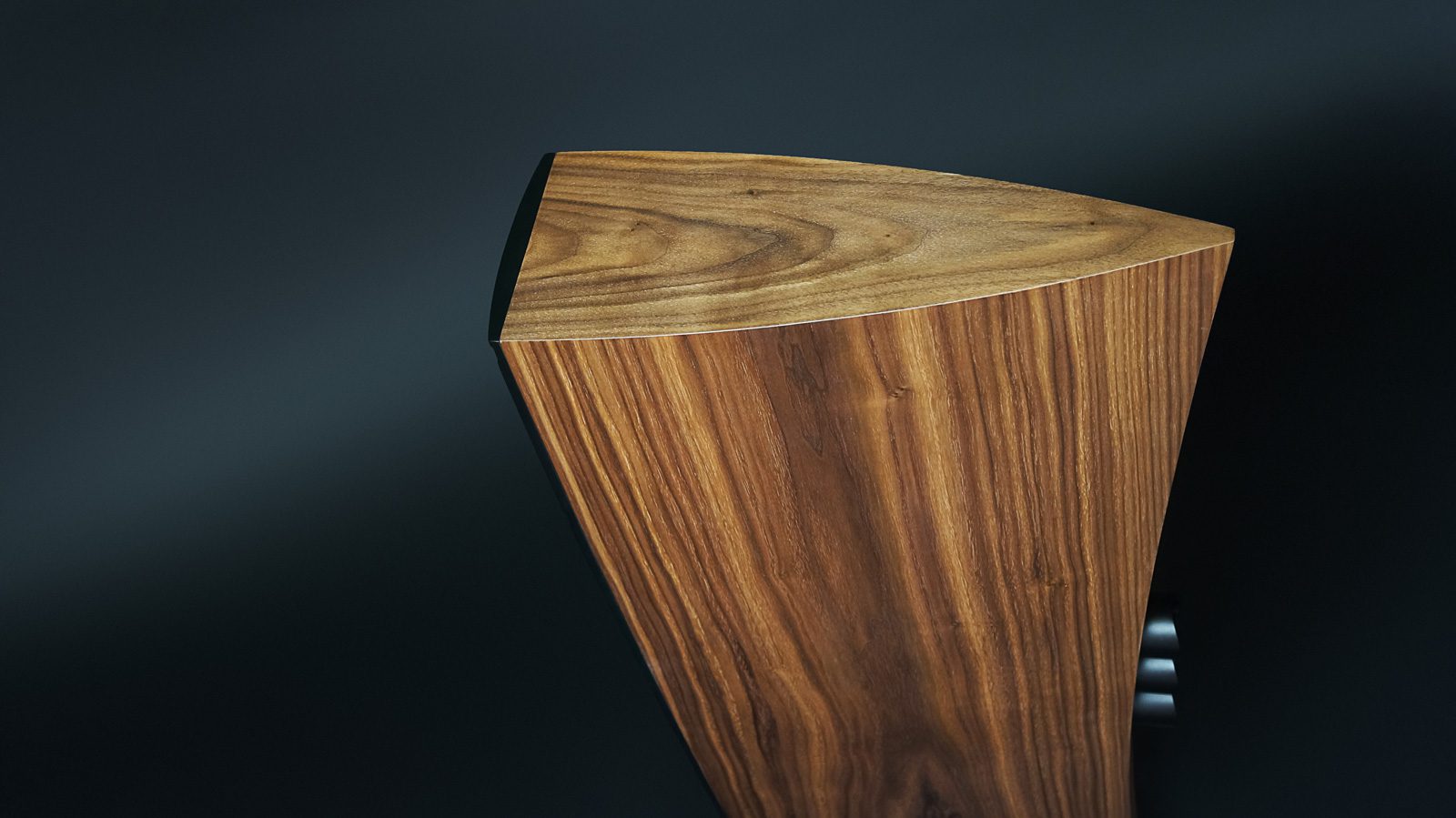
The beautiful sleek cabinets are directly out of the Raidho vision and philosophy: A very rigid constructed does not have to be heavy or ugly. This is beautiful and beneficial for the sound. Now this special combination is available in a new price class.

Drivers

The tweeter is a quasi-ribbon tweeter that deliver silky smooth high end and presenting all the details crystal clear at the same time.

The woofers are all made of one piece molded weaved carbon fiber. These are bespoke drivers designed and developed by the Raidho engineering team. The is exactly what is needed to keep up with the very fast ribbon tweeter.

Crossovers

The crossover is built on the same principle as in the world of Raidho. Build for coherence, dynamics and live sound.

Production and design

All products are designed and built in Denmark, by the same people who builds Raidho loudspeakers. All the drive units are 100% our own design and invention and are not off the shelf parts. All in all the new Q series has been built with the same passion and precision as the Raidho loudspeakers.

The Q3

The Q3 is a slim floorstander with two 5,25” carbon-coned drivers and a sealed ribbon tweeter. The MB2.5 B is a 2.5-way speaker with the second woofer assisting in the power demanding bass region. Do not underestimate the bass performance from this sleek floorstander: It has a solid foundation a sounds a lot bigger that than it looks.

The Q3 is a 2,5-way loudspeaker, which makes the sound incredible coherent. It is truly a joy to listen to.

The Raidho inspired ribbon tweeter is an amazing feature for the price class. Bringing true high end shine into this sleek and beautiful loudspeaker.

The quality of the cabinet is astonishing and fit and finish perfect. Not something you see every day, let a lot a this price.

ModelQ3
Size mm (BxHxD)170 x 1000 x 395 mm
Topology2,5-Way
Frequency response (-6dB)52 Hz – 20 kHz
Impedance6 Ohm
Sensitivity86 dB
Crossover285 Hz – 2600 Hz
EnclosureBass reflex
Weight kg20,5 kg
Drive units1 x Ribbon Tweeter
1 x 5,25″ Mid/Woofer
1 x 5,25″ Woofer
Recommended amplificationMin. 50 watts
FinishBlack High Gloss or Walnut
Pricing (EU Retail including the

VAT)


EUR 7.000 in black / EUR 8.000 in walnut


The Q8

This loudspeaker is the first in the Scansonic lineup with an 8” woofer, which delivers a deep and punchy

bass.

The 3-way loudspeaker with a true carbon fiber midrange and woofer makes for a dynamic and organic music performer. With the ribbon tweeter on top you get all the high end sparkle in a smooth and beautiful delivery.

The quality of the cabinet is astonishing and fit and finish perfect. Not something you see every day, let a lot a this price.

ModelQ8
Size mm (BxHxD)240 x 1095 x 500 mm
Topology3-Way
Frequency response (-6dB)37 Hz – 20 kHz
Impedance8 Ohm
Sensitivity87 dB
Crossover400 Hz – 2800 Hz
EnclosureBass reflex
Weight kg27,5 kg
Drive units1 x Ribbon Tweeter
1 x 5,25″ Midrange
1 x 8″ Woofer
Recommended amplificationMin. 50 watts
FinishBlack High Gloss or Walnut
Pricing (EU Retail including the

VAT)


EUR 9.000 in black / EUR 11.000 in walnut


The Q10

This loudspeaker is particularly well suited for large rooms or home cinema applications.

The Q10 is massive loudspeaker with not only one, but two 8” woofers. If you want to play at high SPL or just ejoy full range sound reproduction, the Q10 is just what you need. Especially with the ribbon tweeter on top you get all the high end sparkle in a smooth and beautiful delivery.

The 3-way loudspeaker with a true carbon fiber midrange and woofer makes for a dynamic and organic music performer.

The quality of the cabinet is astonishing and fit and finish perfect. Not something you see every day, let a lot a this price.

ModelQ10
Size mm (BxHxD)240 x 1395 x 500 mm
Topology3-Way
Frequency response (-6dB)41 Hz – 20 kHz
Impedance4 Ohm
Sensitivity88 dB
Crossover400 Hz – 2800 Hz
EnclosureBass reflex
Weight kg37,5 kg
Drive units1 x Ribbon Tweeter
1 x 5,25″ Midrange
2 x 8″ Woofer
Recommended amplificationMin. 50 watts
FinishBlack High Gloss or Walnut
Pricing (EU Retail including the

VAT)


EUR 13.000 in black / EUR 15.000 in walnut

Kii Audio announce the innovative Kii SEVEN Wireless Music System

September 29, 2023 – Building upon the success of the Kii THREE, Kii Audio introduce the Kii SEVEN Wireless Music System, available early 2024 for €3,795 / £3,495 / $3,895 (Solo Speaker), €7,590 / £6,990 / $7,790 (Stereo Pair).

Since 2015, Kii Audio have dedicated themselves to delivering innovation, quality, and the ultimate user-experience with their products. The new Kii SEVEN Wireless Music System is no exception, combining high-quality audio together with intuitive smart functionality to offer a versatile and user-friendly experience.

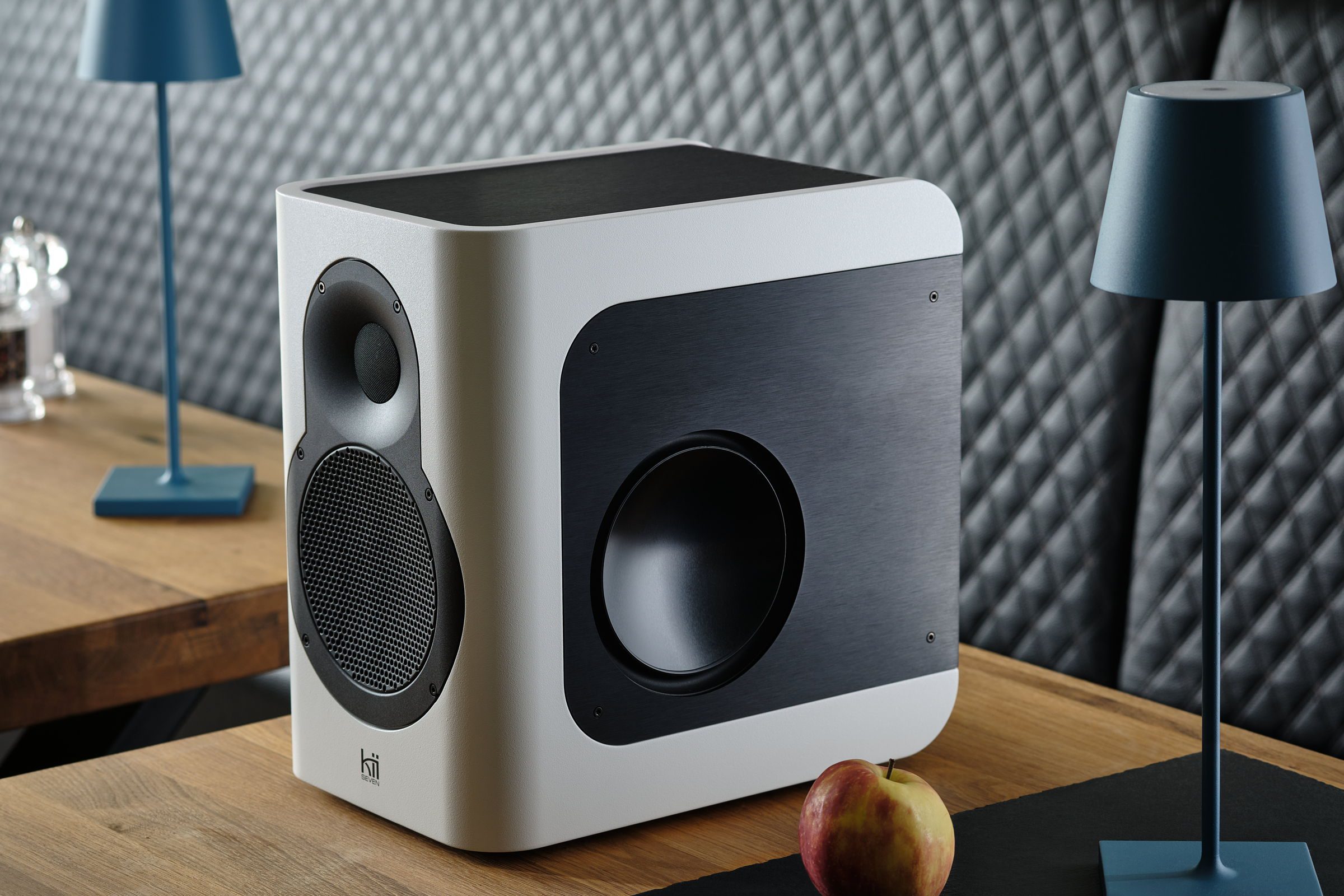
Designed from the ground-up to deliver exceptional sound quality. Unlike many traditional smart speakers, the Kii SEVEN has been designed by Kii Audio’s engineers as a cardioid speaker, thereby significantly reducing the impact of room acoustics. Thanks to its Active Wave Focusing, the new Kii SEVEN delivers detailed separation and excellent musicality; audiophile-grade audio that faithfully captures the essence of your favourite music.

Instead of just splitting the spectrum into bands, as is done with traditional crossover filters, Kii Audio’s Active Wave Focusing filters force the specially positioned drive units in the Kii SEVEN to create a completely coherent wave front, that is only emitted towards the listener. By utilising Kii Audio’s unique Active Wave Focusing Technology, the Kii SEVEN ensures perfect time alignment over the full frequency spectrum.

In addition it equips the Kii SEVEN with a Cardioid Sound Dispersion pattern down to the low-mid and bass frequencies, providing even and highly detailed bass and significantly reduced acoustic interaction with the room.

Seamlessly integrating with mobile devices, the Kii SEVEN makes it incredibly easy to access a range of useful features. From streaming playlists to controlling playback in multiple rooms, the Kii SEVEN has been designed to marry convenience with cutting-edge technology. Thanks to the versatile Kii HOME App, whether you have one Kii SEVEN or a dozen, you are able to easily customize acoustic settings for up to twelve separate zones in your home.

The Kii Audio Kii SEVEN will be available early 2024, priced €3,795 / £3,495 / $3,895 (Solo Speaker), €7,590 / £6,990 / $7,790 (Stereo Pair).

Kii Audio will be showcasing the Kii SEVEN at the UK Hi-Fi Show Live (Room 260/261) at Ascot Racecourse from 29th September – October 1st

SPECIFICATION:

  • 2 x 6.5-inch Woofer
  • 1 x 5-inch Midrange
  • 1 x 1-inch Custom Wave-guided Tweeter
  • Amplification: 600 Watt
  • Active Wave Focusing Crossover filter – Cardioid Dispersion
  • Frequency response: -3dB: 40Hz, 100Hz-10kHz: +/- 0.5dB, 10kHz – 20kHz: +/- 1dB
  • Integrated Tone Control
  • Phase Response: Minimum Phase or Minimum Latency
  • Driver Protection Limiters
  • Inputs: XLR and TRS, AES/EBU, KiiLink/KiiCONTROL, WiFi, Bluetooth, DANTE
  • Airplay 2: Yes
  • Roon Ready: Yes
  • Hi-Res Support: ≤ 24-bit / 192kHz
  • Colours: Fine Touch White / Fine Touch Dark Grey
  • Dimensions (WxHxD): 20 cm x 31 cm x 31 cm / 8-inch x 12.2-inch x 12.2-inch
  • Weight: 14kg (30lbs)

For further information, please visit: https://kiiseven.com

Goldmund Introduces the Melos Passive: A Synthesis of Sound, Design, and Engineering Excellence

September 2023 – Goldmund, the Swiss purveyor of cutting-edge audio innovation, proudly unveils its latest masterpiece, the Melos Passive Loudspeaker. Synonymous with precision, opulence, and a harmonious soundscape, the Melos Passive is a testament to Goldmund’s unwavering commitment to pushing the boundaries of acoustic engineering. Crafted to redefine the auditory experience within the confines of your home, the Melos Passive Loudspeaker transcends the ordinary. This refined sonic masterpiece merges the best of Goldmund’s avant-garde technology and meticulous craftsmanship, resulting in an audio gem that is as striking in its performance as it is in its aesthetics.

Embracing the legacy of its larger sibling, the revered Tethys, the Melos Passive draws inspiration from both the Tethys and the Gaïa speaker, seamlessly fusing advanced technology with timeless aesthetics. Its name, ‘Melos,’ an homage to the melodies of ancient Greece, captures the essence of this speaker’s capability – to deliver musical harmony and tune with unparalleled precision.

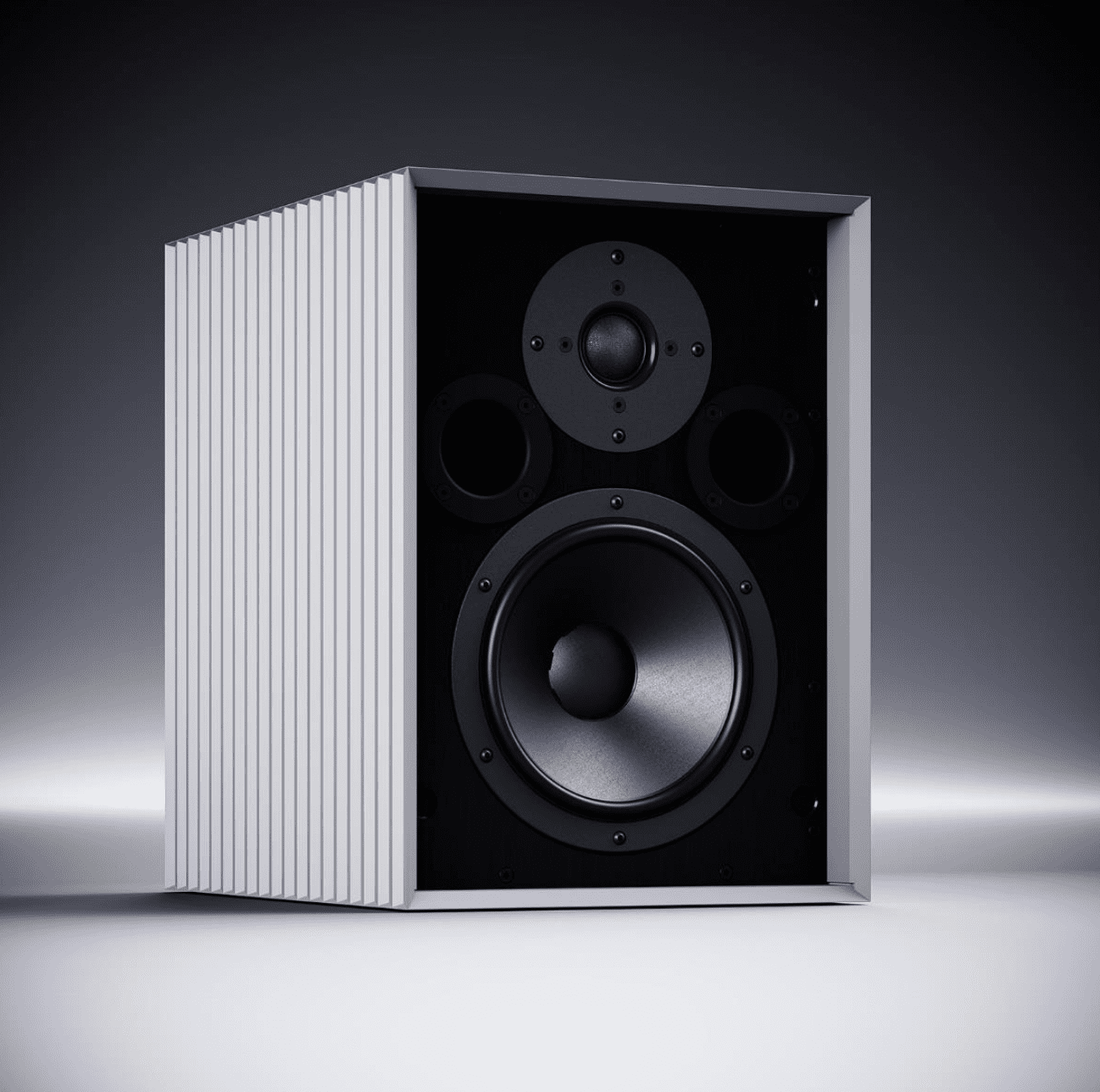
Designed as an embodiment of auditory purity, the Melos Passive Loudspeaker is housed within a sleek, monolithic cube. Engineered with utmost precision, this exquisite speaker faithfully reproduces sound in its truest form. The delicate balance between technology and aesthetics finds expression in the distinctive lines, evoking the raw beauty of rock formations – a nod to nature’s influence and Goldmund’s commitment to authenticity. Despite its compact size, the Melos Passive is anything but diminutive in its sonic impact. Draped in Goldmund’s iconic grey with black grills, it boasts high-end drivers that meticulously render every nuance and emotion within the music. With an extended frequency response and exceptional dynamic range, the Melos Passive ensures that the listener is captivated by a rich tapestry of sound.

True to Goldmund’s legacy of acoustic excellence, the Melos Passive Loudspeaker delivers exceptional bass extension and a remarkable listening experience. Harnessing advanced crossover technology, the speaker achieves seamless frequency integration and optimal dispersion. This results in a captivatingly lifelike soundstage that envelops the listener in a symphony of unparalleled realism. Melos Passive is more than a speaker; it’s a statement of luxury and devotion to sonic perfection. A bespoke stand (available soon), designed to seamlessly blend with the speaker’s aesthetic, further enhances its integration within any environment. This dedication to cohesiveness extends beyond mere audio equipment – it’s a work of art in its entirety.

Goldmund’s tradition of uncompromising excellence shines through in every facet of the Melos Passive. Crafted by meticulous artisans within the hallowed halls of Geneva, this passive loudspeaker is the culmination of precision and passion. The Melos Passive marks a milestone for those seeking to tailor their auditory universe, and Goldmund remains committed to expanding the horizons of audio innovation, catering to diverse preferences.

Introducing the Goldmund Melos Passive Loudspeaker – an opulent, harmonious masterpiece that promises to elevate your sonic journey to new dimensions. Stay tuned for the imminent revelation of the much-anticipated active version, as Goldmund continues its quest to redefine the boundaries of auditory brilliance.


Innuos Returns To Ascot For The UK Hi-Fi Show Live

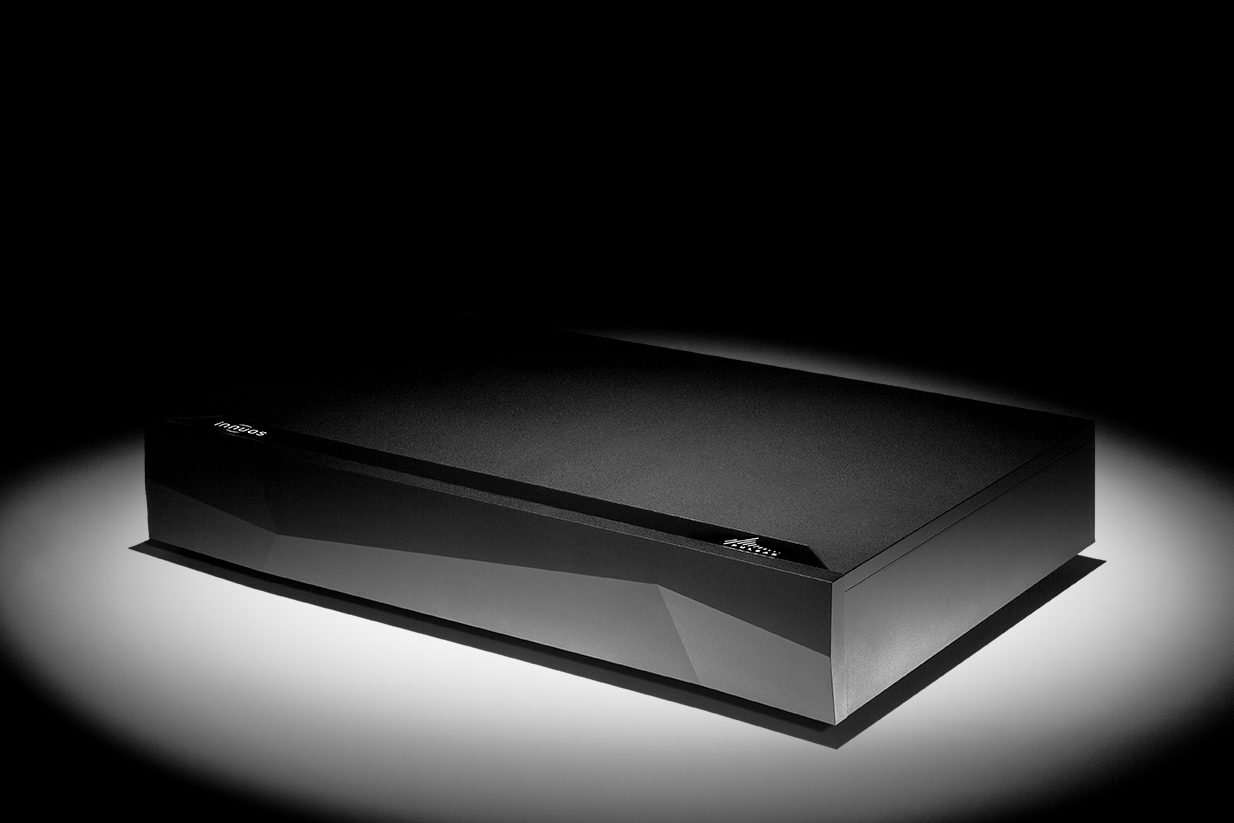
Faro, Portugal, 27 September, 2023 – The UK Hi-Fi Show Live is the UK’s longest-running premier high-end audio show; both the show and Innuos return next week after a pause last year. Taking place from 29 September – 1 October, Innuos will showcase the PULSAR network music player and STATEMENT with Next-Gen PSU alongside the PhoenixNET audiophile network switch.

This will be the first time these products can be heard together at the UK Hi-Fi Show Live. Innuos can be found in Suite 617-618 and in the Panoramic Headphone Zone.

A/B Demonstrations will be available with and without PhoenixNET, providing a great opportunity to hear the difference PhoenixNET can make when streaming HiFi music.

The demonstration system in Suite 617-618 will have the Innuos PhoenixNET passing music streaming from Qobuz or TIDAL to the Innuos STATEMENT with Next-Gen PSU and PULSAR players. A Chord Electronics DAVE DAC will pass the converted signal to a Dan D’Agostino Progression integrated amplifier driving a pair of Wilson Audio Sabrina X speakers. Power conditioning is provided by Isotek’s V5 Sigma and V5 Titan. Cables will be from Transparent Audio and an Artesania Audio Exoteryc rack will house the components.

Visitors to the Innuos demo room will be treated to a rare, exclusive preview of the forthcoming innuOS Operating System 2.5 and Sense app, with a host of new features.

In the Panoramic Headphone Zone, Innuos will be highlighting their Sense app for managing, organizing and streaming music. Visitors can listen to a ZENmini and PULSEmini, each will be going into its own Earmen Audio ST amp and pair of Meze Audio 109 headphones.

Partner rooms around the show will also feature Innuos products and can be found at Stratton Acoustics (Suite 353-354), Absolute Sounds (On 5), SCV Distribution (Suite 649 and 642), KEF (Suite 306), Bowers & Wilkins (628- 630), Renaissance (Suite 501-506), and The Chord Company (Suite 613-614).

Nuno Vitorino, Innuos R&D Director, Stephen Healy, UK Sales Manager and Steven Gomes, Head of Sales, will be on hand to demonstrate and answer your questions.

More details about the Innuos products at the UK Hi-Fi Show Live are available on the Innuos website:

STATEMENT – https://innuos.com/statement/

PULSE Series – https://innuos.com/pulse-series/

PhoenixNET Audiophile-grade Network Switch – https://innuos.com/phoenixnet/

Show information and details can be found at https://audioshow.co.uk

Tangent Announces Two New Products in its Electronics Range

Tangent Denmark and AV Industry Paris – 26th September 2023 – Tangent are delighted to announce the introduction of two brand new products to further enhance the Ampster range. The DAC II and TV II have been designed and engineered to follow in the footsteps of the other long-standing and highly successful members of the Tangent Ampster family. Compact in design, sturdy in construction and powerful in performance these two products are designed specifically for the music or movie lover who wants to cost effectively improve their streaming, CD or TV listening experience.

Tangent DAC II

Tangent DAC II

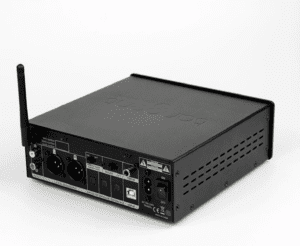
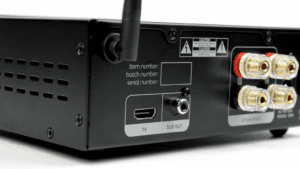
The brand-new Tangent DAC II is a high-quality hi-fi DAC with a premium Sabre ES9023 24-bit Stereo Audio DAC at its heart. Designed as a solution for anyone who has a traditional amplifier but now needs a cost effective, compact preamplifier featuring multiple digital inputs of coaxial, 2 x optical digital, and USB.

The Tangent DAC II also features the latest AptX Bluetooth technology allowing you to stream music from your phone or other compatible high- quality audio devices. Additionally, for those who prefer a more intimate listening experience, the DAC II can also be used as a quality, dedicated headphone amplifier.

In addition to its impressive digital capabilities, the Tangent DAC II also features both RCA and XLR balanced outputs, making it a great partner to Tangent’s PowerAmpster II or other power amplifiers.

The Tangent DAC II is of course designed with flexibility and convenience in mind. It features an intuitive, easy-to-use interface and a compact, sleek design that won’t take up too much space in your home or office.

UK MSRP £249.99

Tangent Ampster TV II

Tangent Ampster TV II

The Tangent Ampster TV II – the ultimate amplifier to enhance your TV audio. Featuring an advanced Bluetooth 5.0 HD connection and HDMI input, the Tangent Ampster TV II offers seamless and superior audio quality for all your A/V entertainment needs.

Featuring 2 x 50-watt amplification the TV II delivers a powerful and dynamic audio performance to enhance your TV viewing experience both simply and efficiently. It is the perfect amplifier for any stereo passive speaker set-up and allows you to fully immerse yourself in your favourite movies, TV shows and music. With the integrated subwoofer output you also have the option of adding more bass to your audio setup, giving you an even more immersive and intense audio experience.

UK MSRP £199.99

The Tangent DAC II and TV II are available now from Tangent retailers or for further information by contacting the UK distributor

Avoke Ltd, 01628 857958, https://www.avoke.co.uk

Key To Burmester… a discussion


We recently posted news about German audio expert Burmester and its ‘Key To Burmester’ industry-only factory tour. Invited media and trade could experience the company’s home and in-car audio and glimpse Burmester’s future. I was one of those attendees. While of academic interest, you might think a trade-only event is not the most exciting thing to discuss publicly.

However, the event was an interesting take on what the future holds for audio, for Burmester and beyond. I’ve divided the event into four key sections to highlight precisely ‘why’.

The Car Key to Burmester

Burmester isn’t the only audio specialist with an automotive division. It wasn’t the first to put audio equipment inside luxury cars. However, it has remained a partner with the same brands for years and has recently added Ferrari to its partnerships. So, Burmester is patently doing something ‘right’ in automotive audio engineering.

We had access to the sound systems of two examples of Burmester’s current in-car expertise. These systems were installed in a Porsche Taycan Turbo S and a Mercedes-Maybach S-Class.

The two are different, as befits different driving experiences. The Porsche sound is more immediate, punchy, and dynamic, with more slam and depth to the bass. The Maybach – and its sound system – are engineered for refinement. While the Maybach can do ‘punch’ and ‘loud’ well, the system’s forte is detail and precision. There is also a better sense of stereo soundstage in the Maybach’s rear seats.

Red cars go faster?

Basically, it’s a sonic reflection of the difference between a car you ‘drive’ and one where you are ‘driven’. This isn’t simply ‘red cars go faster’ style confirmation bias; it’s a design brief between the three manufacturers.

This was demonstrated when visiting the company’s in-car test facility during ‘Key To Burmester’. This featured a mid-range Mercedes tricked out with next-gen audio equipment in prototype form. The roadmap (pun intended) shows spatial audio systems becoming a major part of the next generations of automobiles. And this only happens thanks to long-standing cooperation with car marques.

Thanks to these cooperative ventures, car designers began to move away from limiting the options for audio companies. Loudspeaker drive unit numbers and placement can be more intelligently considered. The soundfield in the car is less of an afterthought and is integral in developing the vehicle’s interior. There is mutual respect for each other’s requirements and criteria.

The keys to the Burmester factory

Last year, Burmester decided to outsource manufacturing while redeveloping its factory floor. This was temporary, but Burmester engaged local manufacturers and ensured products were built to the company’s unstinting standards. The ‘Key To Burmester’ tour allowed us to see the factory just before it reopened. As I write this, Burmester is moving its production back to its Berlin home.

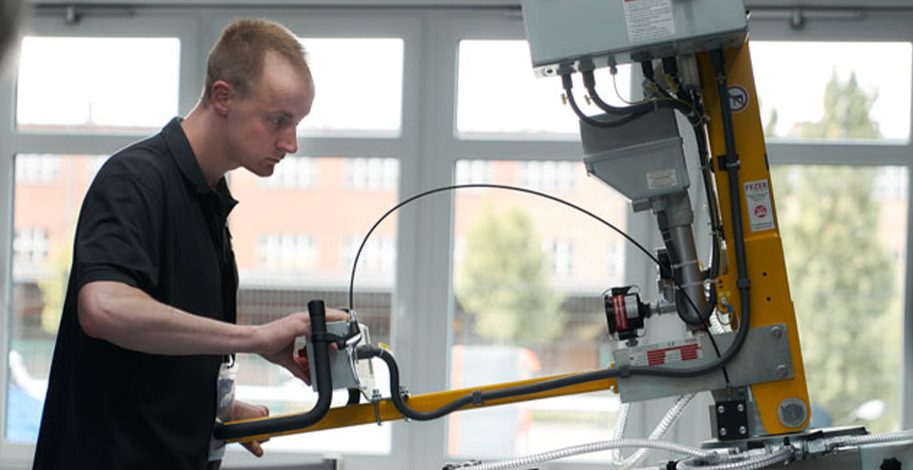
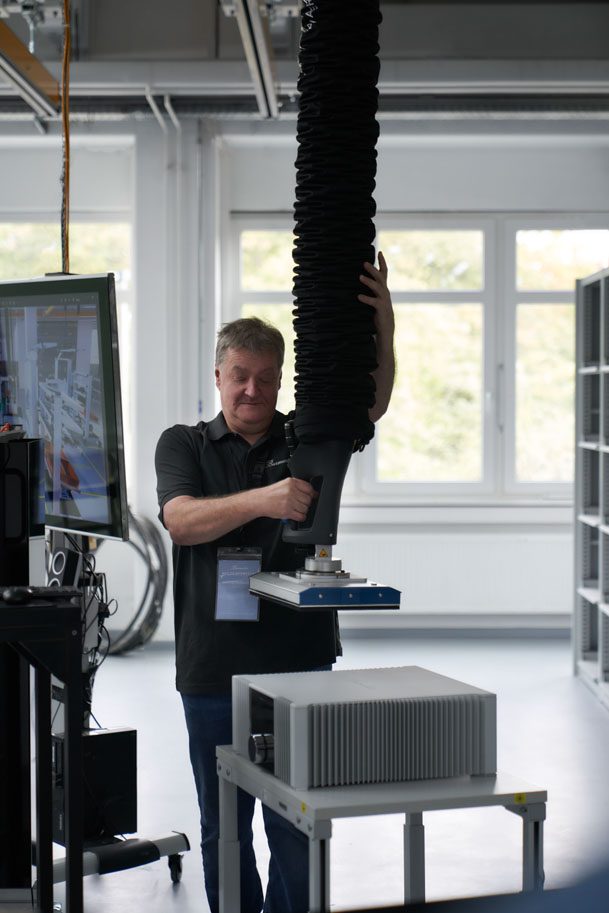
A key (another intended pun) element in the rebuilt factory is innovative workstation systems. High-end audio in all its guises has one thing in common… it’s heavy! Burmester products are no exception and lifting and turning products during their manufacture risks damage, both to the product being built and the spinal columns of those building that product. As seen at the ‘Key to Burmester’ presentation, it has installed clever workstation jigs and a powerful vacuum lifting system to counter this.

Berlin Airlift

One worker can lift a product from its storage space to a dedicated building area. The same worker can gain easy, three-dimensional access to any systems they build or install. And the same worker can return that product to storage or soak testing. They do not need to call for backup to move or lift that product. The investment is significant and primarily to reduce the risks to Burmester’s expert building team. However, it also brings a more 21st-century approach to manufacturing, which easily applies to product design.

From the outside, this might seem like nothing more than a small, in-house change in build practices. This kind of manufacturing system is key (that word again) to the next generation of Burmester audio equipment.

The keys to Burmester’s audio equipment

At this year’s Munich High-End, Burmester showed a prototype of its new 232 integrated amplifier. Part of the company’s Classic Line, the 232 has a new look, a new rotary encoder, and new circuitry. Those who tried it love the encoder that changes its haptics depending on its use at that time. This amp has cleaner lines than previous models but retains a distinctly Burmester identity. Equally importantly, the 232 bristles with new circuit designs.

The 232 uses the company’s new Single Board Computer module, which guarantees connectivity to the sources of today and tomorrow. This provides a logic-driven command and control system for preamplification. Additionally, it uses a Class A/B power amp stage, power supply, and transformer, all operating in dual mono. The 232 is also the biggest change to Burmester home audio electronics in the company’s long history.

Not your typical German

Here’s why. The man whose name these products carry was unique. Dieter Burmester was nothing like the stereotype of a German engineer. But, when it came to audio equipment, he was a traditionalist. Every product was delineated until 232. The idea of a ‘streaming DAC preamp’ would be anathema to Dieter… that’s three products, not one! But the audio world has changed immeasurably recently, and what proved popular a decade ago doesn’t ‘cut it’ today.

The 232 reflects that change in audio buying trends. It has two optional modules for phono and a built-in DAC, already a bold departure for Burmester amplifiers. In connectivity terms, it’s more “the answer is ‘yes’, now what was the question?” than any existing Burmester design. The styling, technology, and connectivity of the 232 will very likely define subsequent products from the brand.

The key to bespoke

Burmester’s fruitful connections with like-minded brands beyond the audio world are paying off unexpectedly. At ‘Key To Burmester’ the company introduced a bespoke service and showed samples of this using collaboration with various partners. Perhaps the best-known of these (outside the automotive tie-ins) is its work with the German silversmith Robbe & Berking. Building loudspeakers with silver baffles and – in one case – the deck of a Sterling Cup-winning yacht can be possible. And that’s just the start.

Alongside Robbe & Berking, the company has teamed up with the sans pareil of German manufacturing. These are pre-eminent companies in their respective fields. This is more than simply ‘a talking shop’ as they regularly interact and discuss continual improvement. This spirit of ‘cooperative competition’ is hard to imagine happening anywhere else but seems like the German way of doing things!

The key to a conclusion

A while ago, having released no new audio products for years, I feared for Burmester’s future. That fear is gone. Instead, Burmester now represents a template for high-end audio success.

key to burmester_opener

Sure, these are the edited highlights of Burmester. The company featured its mighty 159 mono power amplifier from the Signature Line. An amplifier that uses copper bars as conductors and delivers enough power to jump-start a Boeing never fails to impress. And yes, there was wining and dining. But we were also privy to new product designs and concepts that will form the next decade of Burmester. And no, those new designs aren’t for sharing… yet.

What we came away from after two days in Berlin is a sense of a company shifting gears. Burmester is a company in change but not leaving its core values behind.

www.burmester.de


Back to Home

Pangea Audio Debuts Black Chrome Record Doctor Low Profile Record Clamp

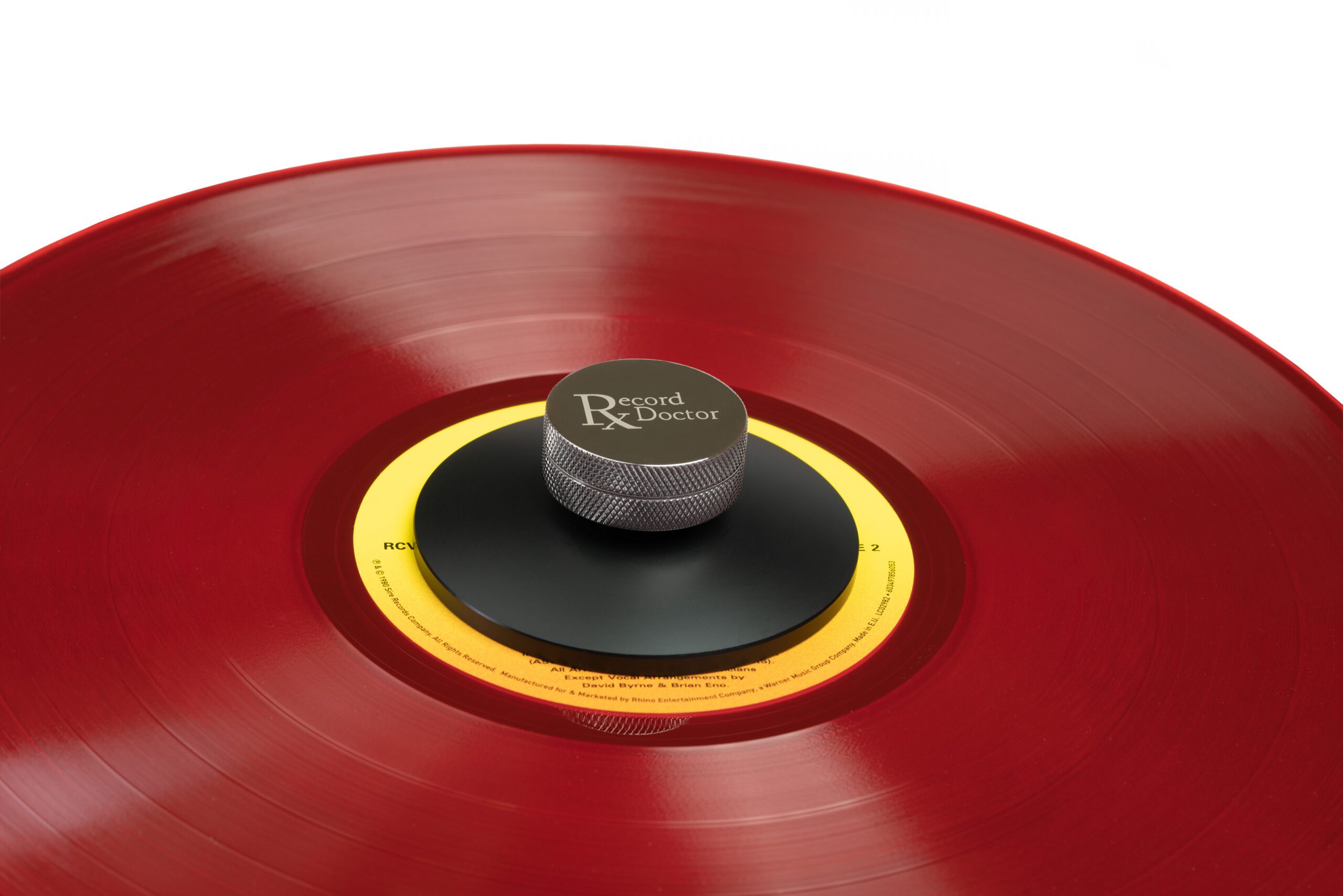
GRAND RAPIDS, MI, September 26, 2023 – Pangea Audio, developer and manufacturer of high performance, high value audio accessories, today announced it now offers its low-profile Record Doctor Record Clamp with a black chrome knob, adding a new color option for listeners who prefer to use a dust cover when listening to vinyl records.

With the same design as the original satin-silver model,  which is currently available, the new black chrome low profile clamp stands 1 1/8” high x 3 1/8” diameter, which is nearly 40% shorter than the original version.

The clamp is useful when playing all genres of music, especially where bass vibrations or high frequency resonances are an issue, and when playing slightly warped records, or recording vinyl to a digital computer file. Also, due to increased LP stability, a record clamp helps reduce both stylus and record wear, extending the life of both.

“The new black chrome variation on our popular low profile record clamp adds an aesthetic upgrade to one of our most successful Record Doctor vinyl care accessories,” says Steve Niemi, Director of Global Sales, Pangea Audio, LLC. “The new model looks good, feels right in the hand, and is just the right weight and dimensions to improve vinyl playback without having to make a sizable investment.”

The low profile Record Doctor Record Clamp, comprised of three precisely-tooled parts, comes in a black non-resonant phenolic body. Its 5.4oz (153g) low-mass design holds the vinyl in place without applying excessive stress to delicate turntable bearings, motor, or damaging LP labels. The textured aluminum knob allows for precise clamping pressure of the machined brass collet.

The new black chrome, low profile Record Doctor Record Clamp is available at a suggested retail price of $39.95. For additional information, visit https://www.crutchfield.com/p_325RDRCLPC/Record-Doctor-Low-profile-Record-Clamp-Black-Chrome.html.

NAD Announces Vintage Listening Sessions

Toronto, Canada, September 25, 2023 – NAD Electronics, a leading manufacturer of premium audio and video products, is excited to announce NAD Vintage Listening Sessions, a series of global retail events connecting fans with the brand’s storied legacy and deep rooted history in hi-fi. These special in-store events provide a deep look at NAD’s history with a branded activation featuring vintage products, expertly curated playlists, and demos of the C 3050 Stereophonic Amplifier. The Vintage Listening Sessions will take place September 2023 to February 2024 at participating NAD retailers.

EXPERIENCE 50 YEARS OF AUDIO LEGACY AND INNOVATION

These special events will embrace the last five decades of acoustic design and innovation with a display of iconic NAD products and other exclusive promotional activities. The new C 3050 Stereophonic Amplifier will be available for private in-store demos, in addition to demos of the original NAD 3030 at select locations.

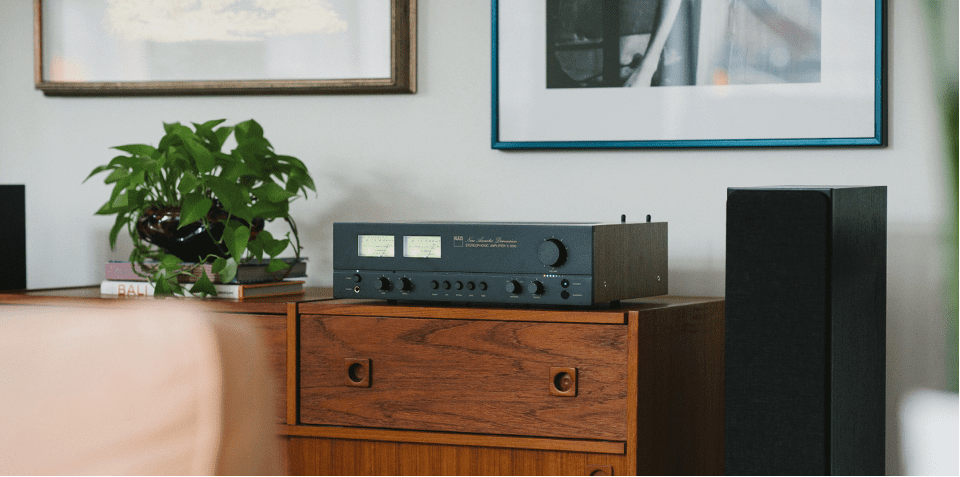
The C 3050 Stereophonic Amplifier combines NAD’s iconic sound with a retro design inspired by the classic NAD 3030. It employs advanced audio processing and the latest generation of HybridDigitalÔ amplification to deliver 100 watts per channel of FDP-rated power with stunning clarity and virtually unmeasurable distortion. The NAD C 3050 is also constructed with NAD’s patented MDC 2 technology and can be upgraded to include features such as BluOSÒ, Apple AirPlay 2, and Dirac Live Room Correction

CURATED VINTAGE PLAYLISTS BY INDUSTRY ICONS  

Each Vintage Listening Sessions event will feature specially curated playlists that transport them back to the 1970s, and the debut of the original NAD 3030. Playlists will be handcrafted by notable industry figures, including British producer EG White, emerging UK recording artist Benny Atlas, and NAD Product Manager, Cas Oostvogel. Select events to include other special guests and curators.

Visit nadelectronics,com/vintagesessions for more information and events near you.

Key To Burmester

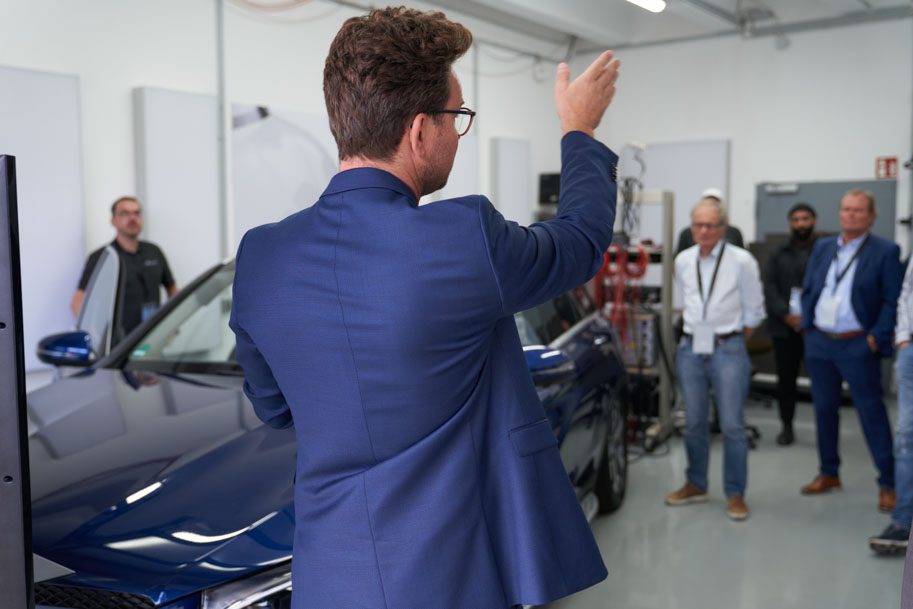
BERLIN,  SEPTEMBER  22,  2023  – Under the moniker “Key to Burmester,” the renowned audio systems manufacturer Burmester welcomed invited visitors to Berlin from September 11th to 20th, 2023. During the multi-day series of events, global trade partners, as well as media representatives, had the opportunity to experience the impressive world of Burmester up close, including an exclusive tour of the newly modernized manufacturing facility.

The event not only provided a fascinating behind-the-scenes look at the Berlin-based HQ and the company heritage but also offered an exciting preview of upcoming projects through which the company is shaping its vision, especially in the areas of manufacturing, depth of production, product design, and brand management.

To kick start the event, Burmester welcomed guests to an evening in the heart of the capital, above the rooftops of Berlin at The Loft, which serves as both a Burmester product showroom and a luxurious yet relaxed event location near the historic Bernauer Straße in the Mitte district. The following day, activities continued with a comprehensive day of events and presentations covering various topics, including:

  1. Tech Talk: The company provided insights into its latest technologies and innovations, with each technical element being developed in-house at the Berlin manufacturing facility and hand assembled on-site. Presentations included a glimpse into how the upcoming generation of Burmester products will improve in terms of user interface, build quality, user experience. In addition, proprietary developments were discussed in the areas of power supply, DA converters, technical design requirements, and in-house developments in various software areas, highlighting their differences from previous generation
  2. Design Concept: Design language is of paramount importance to Burmester, as each product embodies both acoustic and visual excellence. Participants were given insight into new design principles for future Burmester products. Using the example of the upcoming 232 integrated amplifier, details such as the redesigned heat sink profile and extensively revised user interface were Additionally, ongoing projects were visualized to illustrate the new design language and its impact on the future product portfolio.
  3. Automotive Technology: As a renowned provider of high-quality, high-end surround sound systems for the automotive sector, the company guided its guests through the development process of these remarkable systems and revealed their design
  4. In-Car Symphony: During an on-road listening experience, participants experienced the full sonic brilliance of Burmester’s high-end automotive sound systems. Various soundscapes showcased the entire audio spectrum, with a brief introduction to the individual settings for 2 sound systems:
  • Guests had the opportunity to experience the Burmester 4D Surround Sound System in the Mercedes-Maybach S 580, witnessing the power of the high-performance hybrid amplifiers in
  • In addition, all invitees had the chance to experience the Burmester High-End 3D Surround Sound System in the electric sports car Porsche Taycan Turbo S, with its high frequency clarity courtesy of the Air Motion Transformer (AMT®) tweeters included in the
  1. Insights into Quality Standards and Manufacturing: During the tour of the modernized production facility, specific processes were explained through working examples. Impressive demonstrations showed that precision craftsmanship plays a huge key role. In this context, the company presented its innovative load handling concept, aimed at ease of handling and ensuring the safety of its
  2. Crafting Uniqueness: Burmester presented five exemplary ideas showcasing various approaches to The manufacturer provided a glimpse into potential future possibilities that could one day be implemented in practice.
  3. Navigating the World of Branding: Participants had the opportunity to immerse themslves into the world of Burmester brand management. Key focuses included the art of craftsm- anship, impressive audio experiences, and the essential fusion of emotion with cutting-edge technology.


To wrap up the event, the Berlin-based team invited attendees to the Brixen event location to the south of Berlin. During dinner, participants reflected on the event and exchanged their impressions, with the bonus of live jazz music. Burmester looks back on a successful event filled with stimulating dialogue and valuable input for future projects.

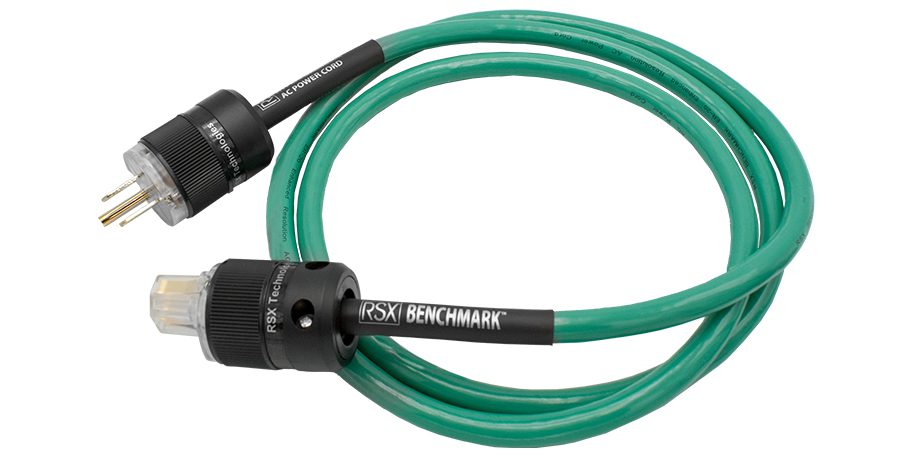
RSX Technologies Benchmark ER-20 power cord

This review is easy to write. If you need a solid and reliable yet eminently affordable, er, benchmark in power cords, the RSX Technologies Benchmark ER-20 fits the bill. It takes much of the technology that makes high-end RSX cables successful, boils those concepts down to the key salient points and retains many sonic benefits in the process. Job done!

RSX Technologies – brainchild of the originator of XLO cables, Roger Skoff – aims for maximum neutrality in all its cables; they should add nothing and subtract as little as possible while doing so. Many, many cable brands make the same claim, but it often ends as just that… a claim. Skoff’s designs remain secret but attempt to combat changes in cable capacitance and inductance caused by the geometry and insulation of the cable, and these changes to the base parameters of a cable alter both the phase and transient response of a system, and at worse can even distort the signal at source. Given that the root of all modern audio is effectively modulated current, whatever does the least harm, wins!

Automated assembly

In making Benchmark ER-20, RSX Technologies automated its conductor assembly instead of a more labour-intensive hand-building process, meaning it can make a cable that gets within striking distance of its more upscale cables at a fraction of the cost. Benchmark ER-20 uses ‘laboratory-grade’ copper, with what the company describes as ‘Balanced-Field’ geometry. This is met by a low dielectric constant, high dump-rate primary insulation, full coverage shielding, a special outer jacketing, and high-quality gold-over-pure-copper connectors.

The ’first, do no harm’ rule really does apply here. There’s a strong sense of the power supplies of your equipment having more scope to get out of the way of the music, letting that music have unattenuated dynamic and tonal accuracy. This brings out a lot in the music itself, from the harmonic structure of a piano piece through to those subtle string-squeaks and noises heard in classical guitar parts right through to some extra heft and drive when playing some cobweb-blowing Tool at a healthy level.

There are two stand-out aspects of performance here: solidity and detail. Sure, the solidity is wrapped up in the presentation of a good soundstage, but there’s something more to it than that. Instruments don’t just have a solid foundation, they appear more as physical entities in the room, relative to your standard system. If that system throws out a wide soundstage, it will be wide and solidly underpinned. If it’s narrower but deeper, that ‘solid underpinning’ applies equally. And it’s much the same with detail levels; unless you already have very high-end power cables, the Benchmark ER‑20 is your system, with more information on tap.

The downsides? You must like minty-green power cords and you don’t get the woven luxury of RSX’s more esoteric designs. You also need to factor a long weekend of bedding in before the Benchmark ER-20 lets you into its deepest caverns of bass. If you do some very tight-knit listening between this and those more exotic designs – through a suitably up-scale system – you’ll hear why spending more money is money well spent. Next, if you already have good, relatively esoteric power cords, you might get upset at how this relatively affordable cable wiped the floor with them. Especially as there’s a cryo-treated one coming that should be even better!

Yes, the RSX Technologies Benchmark ER-20 really is that good. Not just ‘good for the money’… just good, pure and simple.

Price and Contact Details

  • Price as tested £295/6ft

Manufacturer

RSX Technologies

www.rsxtech.com

UK distributor

Wollaton Audio

www.wollatonaudio.com

+44(0) 115 958 4404

Read more RSX reviews here

Back to Reviews

Synthesis Roma 117DC/Roma 98DC preamp/mono power amp combination

Certain audio technologies seem to appeal to some nationalities more than others and Italy is clearly in the valve camp. Synthesis has been making valve based audio components in Morrovalle, Macerata near the Adriatic coast since 1992, but that was not the beginning. Founder Luigi Lorenzon’s father ran a transformer business called FASEL which started in 1961 and specialised in electronics for guitar amplifiers including the Vox AC30 (as used by the Beatles) and the Cry Baby Wah-Wah pedal so beloved by one Jimi Hendrix. A good grounding in transformer design would have provided a great springboard for the fledgeling Synthesis brand in the early days, giving it an advantage over other companies during the valve amp revival of the early 1990s.

Today, Synthesis makes a broad range of amplifiers in both pure valve and hybrid forms as well as two CD players and a DAC. The Roma models are distinguished by wooden facias with a lacquered finish. But not necessarily in red, that just seems to be the company’s preferred colour. In fact, there are a variety of finishes to choose from including anodised aluminium rather than wood.

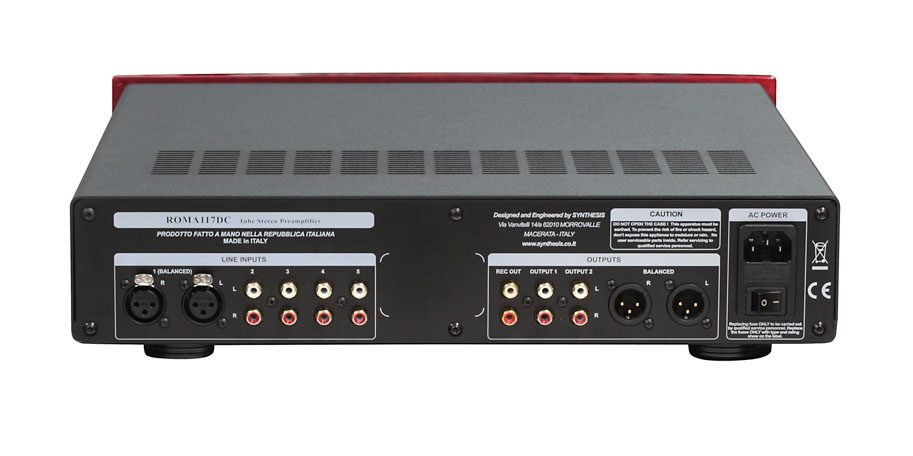
Synthesis Roma 117DC

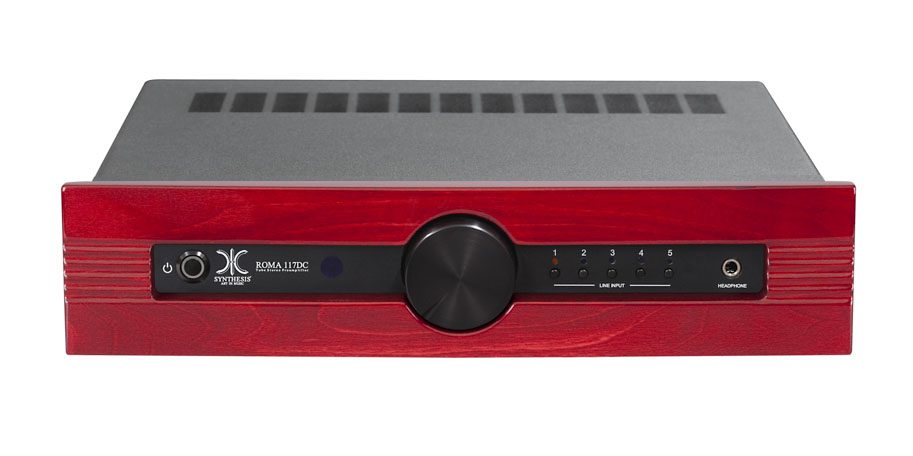
The Roma 117DC is a line stage preamplifier with both balanced and single ended inputs that runs two pairs of 6922/ECC88 double triode valves in order to offer gain should it be required. It has a transformer on the output in order to offer an impedance match with connected power amplifiers. This is not essential on a valve preamplifier, but if you are a transformer specialist like Synthesis it makes sense. The large volume control knob is attached to a motorised pot and can be controlled with a rather attractive aluminium remote handset, this will also change inputs and control functions on other Synthesis components. The circuit has been laid out with switching near the input sockets to keep signal paths short and minimise crosstalk, and precision components are used alongside valves selected for low noise and resistance to microphonics.

Window

The power switch is designed to confuse the unwary by virtue of the fact that when it’s illuminated the preamp is off, which is fine when you know what’s going on. Many years ago I had a DNM preamp with a similar peccadillo, I returned late one evening to find that my wife had nearly thrown it out the window because she couldn’t get it to work on account of the power being off when the light was on. The orange circle of light is attractive though and when you depress the button for a couple of seconds a relay clicks in and the circle flashes for 45 seconds whilst the preamp warms up, when the light is off the fun can begin.

Synthesis Roma 98DC

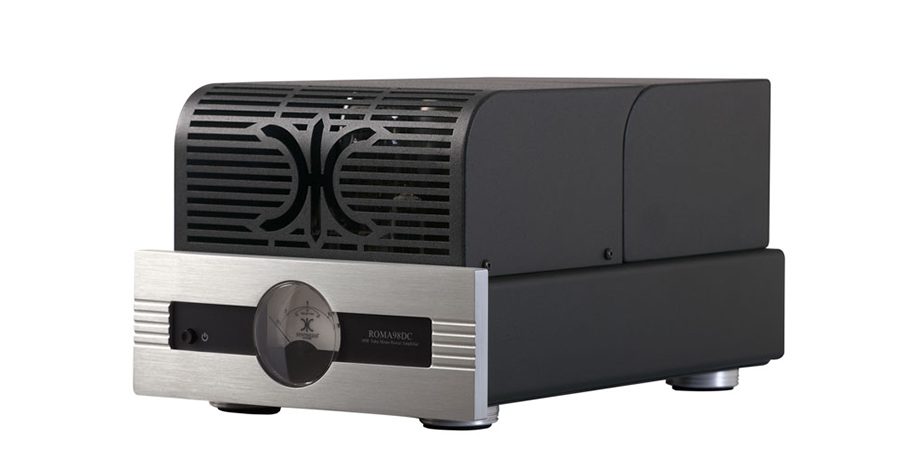
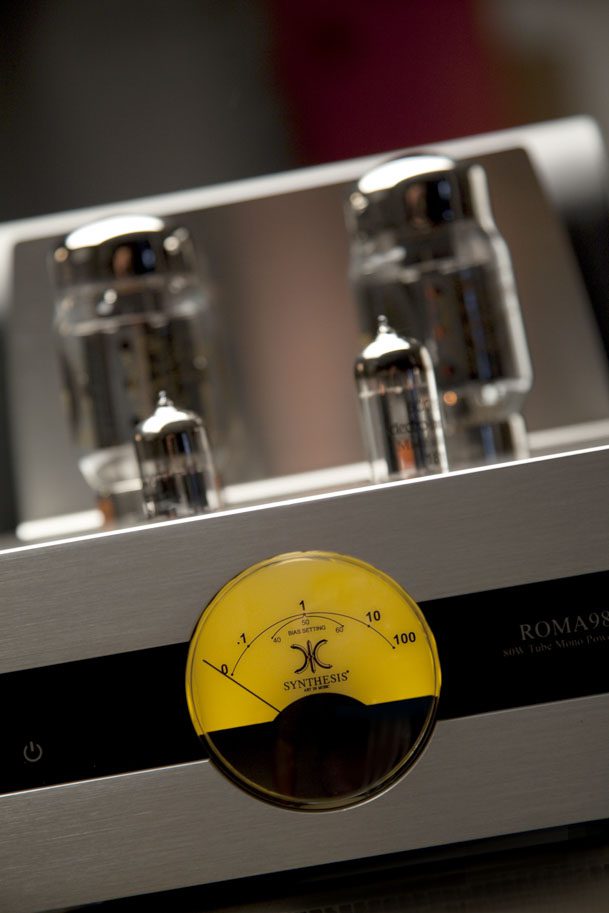
The Roma 98DC monoblock power amplifier is a chunky device that runs a pair of KT88 output valves and is specified to deliver 80 Watts. Its hefty 16kg mass indicates the presence of some serious iron in the output transformer, which is made by Synthesis in house; it claims that it delivers a wide response with low distortion. As output transformers are the most critical element in a valve amplifier, a company with so much expertise in the field inspires confidence no end. You can upgrade valves all you like but the bottleneck is often the output transformer.


I like the VU meters on the front of these monoblocks; they are backlit and twitch in response to demand from the signal. They can also be used to set the bias for the tubes which Synthesis encourage you to have done by a professional but also helpfully give instructions on how to do it yourself. Rear inputs extend to XLR and RCA sockets with two sets of speaker cable terminals for ease of bi-wiring. Unusually for a valve amp there are not alternative positive terminals for different impedance loads, presumably the output transformers have sufficient capacity not to require this. The power button illumination quandary also applies here but at least you can see the meter’s glowing when it’s on.

We need valves in our lives

Once the slightly crude nature of the volume buttons on the remote had been mastered I had an awful lot of fun with these amplifiers, once again prompting the question: why don’t I have a valve amp in my life at all times? These ones have the ability to reveal the heart and soul of the music and make listening to it that much more involving and enjoyable. Is this because they have great timing, an emphasis on the midrange or harmonic distortions that are different to those of transistor designs? It’s hard to say but very easy to hear. The Synthesis Roma pre/mono amp trio delivers the vitality and flair in all manner of musical styles and manage to bring out the good stuff in recordings that often sound crude when reproduced by more up to date tech.

Abdullah Ibrahim’s piano can sound hard and clanky but here his musical fluency takes centre stage and pushes the still slightly hard tonality out of the way, it’s less edgy but also more coherent, which means the melodies take centre stage and the music becomes truly enchanting. Steely Dan’s ‘Babylon Sisters’ is a staple of my reviewing playlist and one which in truth does not usually inspire much enthusiasm, it was chosen because it’s good but not a favourite. You don’t want to overplay the greats. Yet on the Roma powered system it came alive and induced something that, in the privacy of one’s own listening room, passes for singing. The mute trumpet is superb, Bernard Purdie’s shuffle drums irresistible and the horn section truly radiant, these amps put the joy back in this track in no uncertain fashion.

Sublime and substantial

If you stand back and stop playing music for a few minutes it becomes clear that there is some background hiss with these amps, this is not unusual with valve technology and in this case substituting a passive preamplifier indicated that the Roma 117DC preamp is the source. That said, once the music is playing it becomes irrelevant, drop Ryan Adams and the Cardinals playing ‘Hallelujah’ live and you are immersed in a sublime and substantial soundstage that draws the listener in. The balance is clearly on the warm side by transistor standards but this could also be interpreted as the cooler running technology producing a colder sound. The Roma 98DC amps are Class AB devices, hence their relatively high power, so there is muscle on tap when it’s required and their balance is in no way soft or wafty. You probably don’t get the transparency of Class A valves but most examples can’t control anything but the most sensitive loudspeakers, and there aren’t too many of those that will fit in the average metropolitan living room.

These amps are not shy when it comes to revealing the full glory of the music, this was apparent with all sorts of music but made itself obvious with Terry Callier’s ‘Lazarus Man’ (Timepeace), here the emotional power of the performance is enhanced by the Synthesis amplifiers to produce a degree of humanity that’s rarely achieved with recorded music. Valves are not tonally neutral but they have different harmonic distortion characteristics to solid state devices, and these favour what is arguably the most important thing about music, its ability to communicate emotion, and this Synthesis trio is effortless in this regard. You don’t get silent backgrounds or bone crunching bass, you get shivers up your spine and a warmth that makes the listening experience so rewarding. You also get clean, sweet treble and a degree of transparency that is hard to replicate.

Synthesis Roma 117DC

The Synthesis Roma components don’t go overboard on features but provide those that are necessary to do the job well, I for one would always prefer to have a separate DAC and phono stage as those onboard preamplifiers are usually compromised when it comes to power supply. The quality of transformer shines through in both preamp and power amps, the latter providing sufficient grip but always putting musical flow at the fore. But if you really want to know why they work, put on a great piece of music and try not to react physically or emotionally. An engineer might be able to do it but not a true music lover.

Technical specifications

Synthesis Roma 117DC

  • Type Valve-driven line-stage preamplifier with headphone output
  • Valve complement Four 6922/6DJ8/ECC88
  • Analogue inputs One pair of balanced inputs (via XLR connectors), four single-ended inputs (via RCA jacks)
  • Analogue outputs One pair of balanced outputs (via XLR connectors), two pairs of single-ended outputs (via RCA jacks), one pair of single-ended tape outputs (via RCA jacks)
  • Input impedance 100 kOhms (via XLR connectors), 47kΩ unbalanced (via RCA jacks)
  • Output impedance 1kΩ balanced (via XLR connectors), 500Ω (via RCA jacks)
  • Bandwidth Not specified
  • Gain + 22.5 dB (via XLR connectors), + 16.5 dB (via RCA jacks)
  • Distortion < 0.1% (20 Hz–20 kHz) 1VRMS
  • Signal to Noise Ratio > 90 dB (Weighted A)
  • Dimensions (H×W×D) 167 × 480 × 450mm
  • Weight 10kg
  • Price £4,249

Synthesis Roma 98DC

  • Type Valve-driven monoblock power amplifier
  • Valve complement Two KT88, one 12AY7, one 6CG7
  • Analogue inputs One pair balanced (via XLR connectors), one pair single ended (via RCA jacks)
  • Analogue outputs Two pairs of speaker taps (via 5-way binding posts)
  • Power output 80Wpc RMS @ 6 Ohms
  • Bandwidth Not specified
  • Sensitivity 600mV for max power
  • Distortion 0.07% at 1W/kHz, 1% at 80W
  • Signal to Noise Ratio > 90dB A weighted
  • Dimensions (H×W×D) 210 × 260 × 410mm
  • Weight 16kg
  • Price £3,249 each

Manufacturer

Synthesis

www.synthesis.co.it

UK distributor

Henley Audio

www.henleyaudio.co.uk

+44(0)1235 511 166

Read more Synthesis reviews here

Back to Reviews

Bowers & Wilkins 705 S3 stand-mount loudspeakers

Getting to ‘Series 3’ of the Bowers & Wilkins 705 stand-mounting loudspeaker has been a more convoluted process than it might seem at first glance. You might imagine that ‘S3’ replaces ‘S2’, which in turn replaced ‘S1’ (or perhaps just ‘705’) – but you’d be wrong.

Getting to ‘705 S3’ initially required an original ‘705’, it’s true. But after this, the entire 700 range (for reasons no one cares to remember) became the ‘CM’ range. ‘CM’ didn’t remain a thing for all that long and was replaced by the ‘S2’ range of 700 models. Then the 705 S2 (and the 702 S2 floorstander) were singled out for the Bowers & Wilkins ‘Signature’ treatment – I reviewed the 705 Signature in issue 187 of this magazine. These ‘Signature’ editions ran alongside the ‘vanilla’ S2 models on which they were based.

The third is the fifth

This means that the 705 S3 that is under the microscope here is, in fact, the fifth version of this midrange standmounter that Bowers & Wilkins has launched. All clear?

It isn’t apparent at first glance, but the 705 S3 differs in numerous ways from the 705 S2 it replaces – and naturally, we’ll get to those differences in due course. But one difference that comes leaping out at the prospective customer concerns the asking price – and not, you’ll be less than staggered to learn, in a good way.
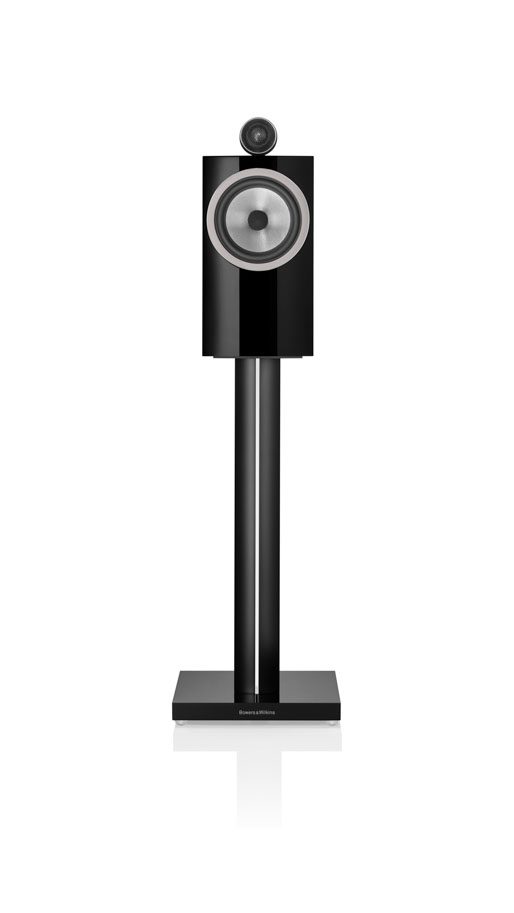
Bowers & Wikins 705 S3

Admittedly the world was very different when the 705 S2 launched in 2017. Nevertheless, the £2,599 Bowers & Wilkins is asking for this 705 S3 compares with the £1,799 the S2 cost in much the same way a UK citizen’s freedom of movement in 2023 compares with the same citizen’s 2018 freedom of movement, which is not well at all. Still, I should acknowledge that this is hardly the platform for banging on about the many and various ways the United Kingdom seeks to make life hard for itself – my obligations are much more loudspeaker-related.

No vintage here

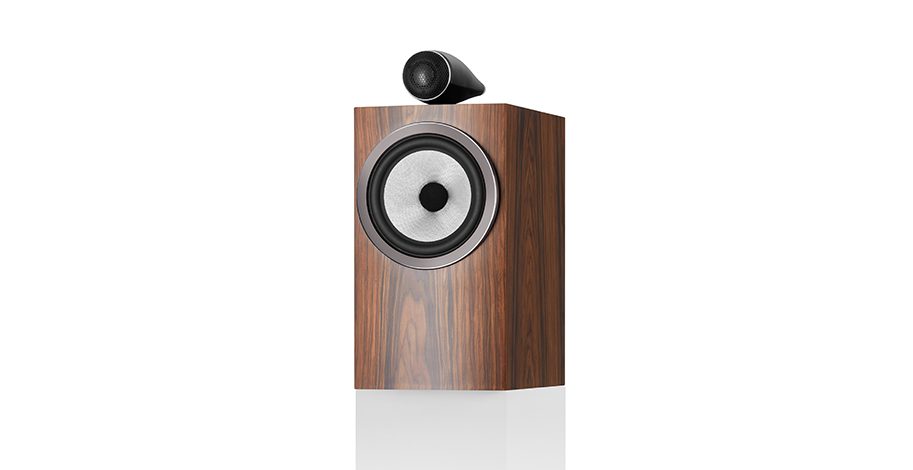
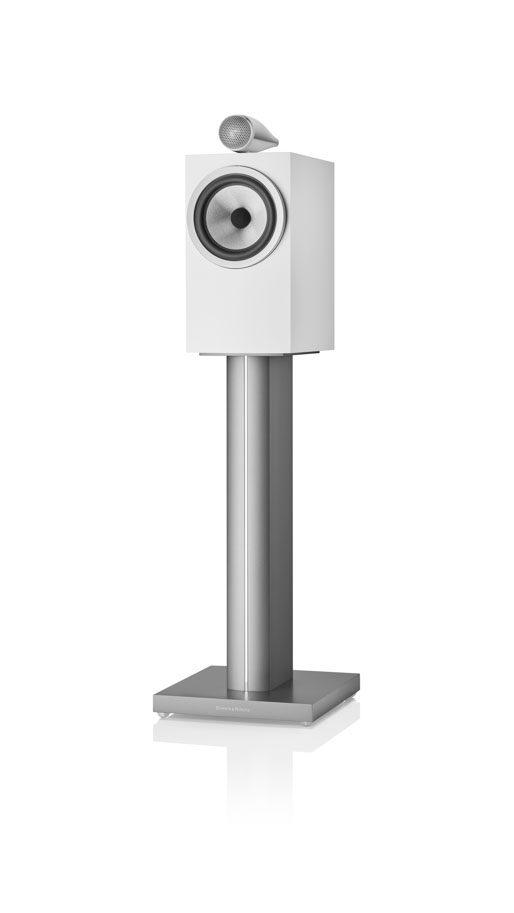
With the design of the 705 S3, Bowers & Wilkins has neatly avoided painting itself into the ‘vintage/retro’ corner that quite a few alternative loudspeaker brands currently occupy. Yes, these loudspeakers look exactly like a pair of moderately pricey Bowers & Wilkins standmounters, from their ‘tweeter-on-top’ enclosure on down – but they’re no lazy facsimile of previous glories, no exercise in nostalgia for its own sake. Instead, Bowers & Wilkins has examined its heritage and created a design with a prominent lineage that isn’t just a sentimental journey.

As far as the two drivers themselves are concerned, Bowers & Wilkins has taken the understandable and easily proven view that they weren’t broken and consequently require no fixing. So the 165mm mid/bass driver is made from Continuum, a material that the company spent a long time developing and that made its first appearance in the appropriately high-end 800 series of loudspeakers. It’s carried over unchanged from the 705 S2 and offers a bass extension down to 50Hz. The 25mm tweeter, too, is essentially the same design featured in the 705 S2 – it’s an example of Bowers & Wilkins’ wantonly complex ‘carbon dome’ arrangement. It comprises two sections: the front portion is a 30µm aluminium dome, stiffened by a vanishingly brief coating of carbon, and the second is a 300µm carbon ring (profiled to match the main dome) bonded to the structure’s inner face. The result is a low-mass tweeter that resists distortion resolutely – the first break-up point is a stratospheric 47kHz, and the upper end of the high-frequency response is 28kHz.

Reworked cabinet

But while the driver technologies are familiar, the cabinet in which they reside has been thoroughly, though subtly, reworked. For example, the ‘tweeter-on-top’ enclosure is still milled from a single, solid piece of aluminium – but it’s longer than the one fitted to the 705 S2, which allows for a longer internal tube-loading system. This reworked arrangement, which draws on learnings gleaned during the development of the 800 series, is designed to reduce soundwaves emanating from the rear of the tweeter and deliver cleaner performance. And while the decoupling between the tweeter housing and the main body of the cabinet is improved, it feels more secure (and less vulnerable) than it did on the 705 S2.

The front of the main cabinet is now gently curved. It doesn’t describe as dramatic an angle as the cabinet of the 805 D4, indeed, and the other five sides of this cabinet are flat – but then the heroically complex shape of the 805 D4 contributes no end to its asking price. The curved baffle of the 705 S3 adds strength, though, and internally it benefits from a variation on the ‘Matrix’ bracing technology the more expensive speaker enjoys. The curve also makes it apparent the 165mm Continuum mid/bass driver is sitting in a partially exposed ‘pod’ – the principle is taken to its logical, hang-the-expense conclusion in the 800 series. Still, Bowers & Wilkins intends to reap some of the same performance benefits without sending the asking price through the roof.

Flowport

The changes at the rear of the cabinet are less dramatic but, in their way, significant. The ‘flowport’ bass reflex port is of greater diameter than that featured on the outgoing model, while the speaker binding posts are now arranged horizontally on a nice shiny plate. They’re reassuringly chunky, too, and happily accept bare wire, banana plugs or spade connectors.

At 413 × 192 × 297mm (H×W×D) the 705 S3 is a little taller, a little narrower and a little deeper than the S2 it supersedes. The tweeter housing still overhangs the main body of the cabinet just a little, though, to provide ideal time alignment. Build quality is of a standard we’ve all come to expect from Bowers & Wilkins – it’s impeccable and an object lesson for many rival brands of many different sizes and levels of resource. Two of the three available finishes – gloss black and satin white – are carried over from the 705 S2, while the older model’s ‘rosenut’ is replaced by ‘mocha’. It’s a bit more brown, a bit less red. And as with build quality, the standard of finish here is beyond reproach. Making a product as functional as a pair of loudspeakers seem expensive, luxurious, or covetable may be challenging – but Bowers & Wilkins gets closer than most.

Once up and running, the Bowers & Wilkins 705 S3 prove, in some ways, to be remarkably laid-back and easy-going about the electronics in general, and the amplification in particular, they’re paired with. In other ways, though, they’re undeniably picky. It’s all to do with attitude.

No need for celebrations

Unlike a few rival designs at similar money, the 705 S3 doesn’t look down their nose at less expensive, more attainable or less celebrated electronics. During this examination, they are powered by Naim’s modest NAP100 power amp, the same company’s more robust Uniti Star whistles-and-bells all-in-one streamer/amp, and Roksan’s overachieving Attessa integrated amplifier. Rather than set about exposing any weaknesses in the more humble products here, the 705 S3 instead do what they can to make the best of their circumstances.
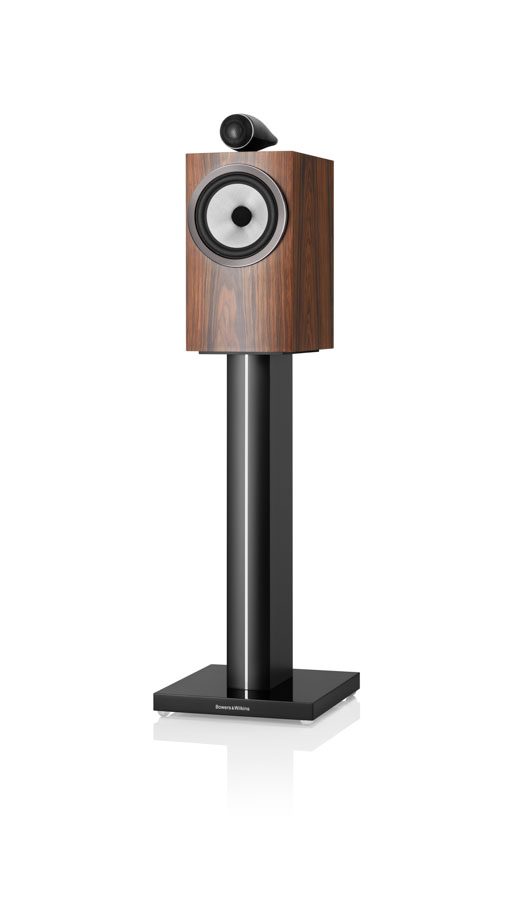
Bowers & Wilkons 705 S3

It’s worth noting at this point that all three of the amplifiers mentioned are, to a lesser or greater extent, an upfront, assertive and forward kind of listen. That’s the posture the 705 S3 thrive on. Pair them with something no less confident but a little less bold – the C3050 LE integrated from NAD, for example – and the 705 S3 can go into their shell just a little. So yes, where these Bowers & Wilkins speakers are concerned, it’s not so much about where in the hierarchy you sit but your attitude.

Nevertheless, of the amplifiers mentioned, the Uniti Star proves the best fit for the 705 S3. The speakers are mounted on a pair of Custom Design FS104 Signature stands (Bowers & Wilkins will sell you a pair of bespoke FS-700 S3 stands onto which the speakers fasten securely – but at £799 per pair, it’s not a purchase to be rushed into if you already own some competent stands), and linked to the amplifier using QED XT-400 speaker cable. The Uniti Star takes care of streaming from Bluetooth via a Nothing Phone (1) and a Buffalo TeraStation NAS device. Rega’s Apollo deals with CD content and is connected using QED Reference Audio 40 – a second pair of cables connects a Chord Heui phono stage to the Naim, fed by a Clearaudio Concept MM turntable.

Prodigiously detailed

It becomes apparent in reasonably short order that it doesn’t matter the source material or, to a lesser extent, its resolution – the Bowers & Wilkins 705 S3 are a full-scale, prodigiously detailed and thoroughly engaging listen in pretty much any circumstance. From a bog-standard MP3 of Richard and Linda Thompson’s ‘The Calvary Cross’ [Island] to a DSD64 file of Stevie Wonder’s ‘He’s Misstra Know-It-All’ [Tamla], from a compact disc of Patti Smith’s Land (1975 – 2002) [Arista] to a 180g reissue of Ride’s Going Blank Again [Wichita], these speakers are supremely even-handed – they strive to take themselves out of the equation as much as possible, and let the music do the talking.

The soundstage they create is large and convincing, with palpable depth and notable width. Low frequencies are confidently shaped, robustly textured, and decently rapid – without being pleased with themselves, bass sounds underpin a recording securely. Meanwhile, at the opposite end of the frequency range, the tweeter arrangement offers notable clarity, bite, and similar levels of detail – the top end fairly shines but never hints at edginess or hardness, even at significant volume.

In between, the midrange is articulate, eloquent and all the other words that suggest ‘communication’. Vocal technique, whether it’s the purity of Stevie Wonder or the confrontational perspective of Patti Smith, is given plenty of room in which to express themselves – and the amount of fine detail the 705 S3 reveals makes their character and competence plain.

Like cashmere

Cross-over is smooth in the manner of cashmere, and the top-to-bottom consistency of tonality makes the Bowers & Wilkins sound as natural or as processed as the source material demands. The low-end discipline means the speakers express rhythms with genuine positivity and can handle even the show-off time signatures and tempos of Joe Zawinul’s The Rise and Fall of the Third Stream [Vortex] without alarms.
Bowers & Wilkons 705 S3

There’s a similar sort of effortlessness on display regarding the dynamic aspect of these recordings, too. Whether the significant variations in volume and attack apparent in the Zawinul recording or the small harmonic fluctuations perceptible in Richard Thompson’s guitar-playing, the 705 S3 identify them, contextualises them and gives them precisely the sort of emphasis they demand. And such is the togetherness and unity of the presentation on offer here, the sense of ‘performance’, of a loudspeaker that would prefer to get out of the way of your music rather than impose itself on it, is tangible.

Or, at least, it’s tangible if you enjoy listening at volumes above those often described as ‘background’. The 705 S3 lose a good portion of their animation and drive at more modest levels, and they give away a lot of their conviction at the same time. They’re far from the only loudspeakers that give their best when pressing on, but their differences are quite pronounced. It would be stretching things too far to suggest the Bowers & Wilkins can sound ‘matter-of-fact’ at low volume levels – but they undoubtedly move further along that particular spectrum.

Still, it’s not as if these are the first loudspeakers to make a few demands of their owners – and I sincerely doubt they’ll be the last. And besides, when a speaker is as talented and straight-ahead listenable as Bowers & Wilkins, when you pander to it just a little, it’d be churlish not to. So for once, it turns out that the third time (or the fifth time, if you’re correctly keeping count) is a charm.

Technical specifications

  • Type 2-way, two-driver stand-mount monitor with rear-ported bass reflex vent
  • Driver complement 25mm carbon dome tweeter; 165mm Continuum mid/bass driver
  • Frequency response 50Hz–28kHz
  • Crossover frequency 3.5kHz
  • Impedance 8 Ohms nominal (3.7 Ohms minimum)
  • Sensitivity 88dB/W/m
  • Dimensions (H×W×D) 413 × 192 × 297mm
  • Weight 9.6kg/each
  • Finishes Gloss black / satin white / mocha
  • Price £2,599/pair

Manufacturer

Bowers & Wilkins

www.bowerswilkins.com

Read more Bowers & Wilkins reviews here

Back to Reviews