Up to 37% in savings when you subscribe to hi-fi+
hifi-logo-footer

Begin typing your search above and press return to search. Press Esc to cancel.

The Rails – ‘This record is definitely more us…’

English husband and wife duo The Rails  – James Walbourne and Kami Thompson – have just made their best album yet.

Recorded in London at the start of 2019, Cancel The Sun – their third record – was produced by Stephen Street (The Smiths, Morrissey, Blur) and sees them moving further away from their folk-rock roots – Kami is the daughter of Richard and Linda Thompson – cranking up the electric guitars and embracing power-pop and New Wave, (‘Call Me When It All Goes Wrong’, ‘Ball and Chain’, ‘Waiting On Something’); ‘60s-tinged country-soul (‘Something Is Slipping My Mind’), and Beatlesy psychedelia (the title track).

Their gorgeous trademark harmonies are still in place and there are some folky ballads (‘Mossy Well’ and ‘Leave Here Alone’), but this time around, James, whose other job is as the guitarist in The Pretenders – has really cut loose and pushed his extraordinary playing to the fore. “We felt ready to make a big record – we’ve got the bit between our teeth,” they say…

SH: Congratulations on the new album – it’s brilliant. It’s very instant and direct – it doesn’t mess around. It has a harder, poppier feel than your last two records…

KT: If it was up to me, I’d have it in the old Pop/Rock section of Our Price, but that doesn’t exist anymore… This time, we didn’t rule anything out – we just wanted to make a bigger record. We’d always wanted to do that, but time and financial constraints often means you can’t. Our sights were set a little higher this time and we were more comfortable being at home [in London] – it all came together. This record is definitely more us. 

Why did you choose Stephen Street to produce it?

JW: We wanted someone a bit different – who would take it forward – and who had perhaps more of a rock edge. 

We were thinking of the sound of Graham Coxon’s [Blur guitarist] solo records – in-your-face guitar. 

How was it working with Stephen?

KT: It was perfect – there was never a moment when we didn’t trust something he said. He’s so experienced and talented, so we could relax, take our hands off the reins and just play.

It was a really quick record to make. Ironically, we set out to do it over a couple of months, but we ended up doing it in a couple of weeks. 

JW: He was a joy to work with – I wanted to let him really go for it – he made it happen and he made the guitars sound brilliant. 


For this album, you took a different approach – for the first time, you wrote the songs together, rather than separately. Why?

KT: We set out to do it quite purposely – the way we’d gone with the last record wasn’t sustainable. We weren’t working well together and it was causing tension and friction. This time, we sat down and decided we were going to do it differently – because we co-wrote everything, the result is that we’re both fully invested and it’s made it much more personal. I think the songs are better – they’re different anyway. We’re definitely working well together and it’s made the whole experience significantly more pleasurable. We both feel very attached to these songs. 

JW: We found a way to work where Kami would sit in the pub and write lyrics and I’d go and write tunes up in my little room. It was great – if I’m presented with lyrics, I can hear songs and, weirdly, a tune comes pretty instantly. 

James – you stopped drinking a year and a half ago. How has that affected you and how did it influence the new album?

JW: I got into a real work ethic when it came to songwriting. I was doing it every day – suddenly it was my job. I didn’t f*** about! There wasn’t much procrastination – I just got it done and it was easy.

KT: The last record was pretty dark – we would both get into some dark places – but our outlook has now changed and it’s affected our relationship in a positive way. We’re a bit more confident and we’re more settled – we really felt ready to make a big record and we really want to push it. We’ve got the bit between our teeth. 

Let’s talk about some of the songs on the album. 

The first single, ‘Mossy Well’, lures us in with that dark folk music sound that you’re known for – it’s a song about drinking yourself to death – but the follow-up, ‘Call Me When It All Goes Wrong’ is a radio-friendly, power-pop song – albeit with a wry, cutting lyric about a relationship…

KT: ‘Call Me When It All Goes Wrong’ is an outsider’s view of someone else’s situation – they’re thinking they’re doing really well, but they’re flailing. You know that things are going to go tits up… We’ve tricked Radio 2 into playing it with a peppy tune.

‘Save The Planet’, the third single, has a cynical lyric about ecological issues and people’s hypocrisy– “save the planet, kill yourself.’’

It suggests that the best way to end humankind’s destruction of the world would be to end humankind…

KT: It’s my effort to try and shake people into thinking about it a bit more. Everyone’s trying to do their bit, but we’re all incredibly self-interested and there’s tokenism – everyone thinks if they just recycle a bit more, everything will be fine. I obviously don’t want anyone to kill themselves, although, if Trump killed himself, that would go some way to saving the planet, but he’ll probably never hear it…

The title track has a Beatles feel to it and some great guitar

KT: I love the guitar on that song – the wig out pleases me no end.

JW: I wanted to end it with a big, whacked-out solo with a bit of psychedelic stuff going on.

‘Ball and Chain’ – a song about addiction – is my favourite track

JW: That was one of those songs that came straight out of the sky, fully formed, in 15 minutes. Like some of the other tracks on the album, it has a New Wave / power-pop feel…

JW: Yep – that’s just part of my upbringing, what I listen to and people I’ve been influenced by. I love all that stuff, like Matthew Sweet. I was writing in a different way – the shackles came off and I didn’t have to write folk songs. I wanted it to be different, new, and exciting and to have fun playing the songs live, rather than us just having to take two acoustic guitars out with us. 

I started using Logic Pro [music software] as a platform to write – I experimented with drums. I’d make a beat, put headphones on and then sing along with an electric guitar, so it sounded like I was in a band. It was really refreshing and instant – it opened up a whole new world for me. I wasn’t toiling away on lyrics and chords on an acoustic guitar for weeks on end…

You’ve been labelled as a folk-rock act. Do you think this album will surprise people who hear it and open you up to a wider audience?

KT: I hope so – when you make records, all you want is for people to hear them. We’re feeling good about it and we hope it gets out there a little more.

I think it’s your best album yet…

JW: That’s very kind of you – I appreciate that. After you make a record, there comes a point when just you don’t have a f***ing clue about what you’ve just done. This record is a truer reflection of what we listen to. 

Cancel The Sun by The Rails is out now on Thirty Tigers.


We also spoke with Cancel The Sun producer Stephen Street. He worked his magic on classic indie guitar albums by The Smiths, Morrissey, Blur, Kaiser Chiefs, and The Cranberries. We ask him what it was like making Cancel The Sun with The Rails, what he brought to the record, and how he listens to music at home?

SH: How did you come to work with The Rails and had you heard any of their music before you started on the album?

SS: They approached me through their manager – I had no previous knowledge of their music, but I was vaguely aware of James’s reputation as a seriously good guitarist in certain musical circles.

When we first met, James mentioned to me that he wanted a ‘more direct’ record, with perhaps a bit more edge and ‘indie’ attitude, with the guitars being a bit more to the fore. I guess that’s what I’m known for. So, I just did what came naturally.

It all went so smoothly – everything we tried seemed to work well. We had a good working relationship. The sessions were fast and highly productive.

As you said, James’s electric guitar has been pushed to the fore on this record – particularly on heavier tracks, like ‘Call Me When It All Goes Wrong’, ‘Ball and Chain’, the title track, and ‘Waiting On Something’. How did you approach recording those songs?

James is a seriously good guitarist – unleash him and let him play! Rehearsals were important; making sure the rhythm section was playing the right parts and the groove to support James’s guitar parts. James and I would experiment with different guitar and amp combinations to get the tones we wanted.

James has a technique he has developed that is fantastic to watch and listen to. I loved working with him.

Cancel The Sun [the title track] was always going to make the cut. It stood out on the initial demos that I heard. Kami’s singing is superb – I loved the slightly Beatlesque feel that the song naturally seemed to lean towards, so we just went with that vibe. James’s solo at the end is scorching – so much feeling!

There are some quieter, more stripped-down songs on the album, too…

I particularly love ’Something Is Slipping My Mind’. Kami’s melody is beautiful. Rather than the whole band just strumming it, I came up with the idea of an electronic ‘heart beat’ pulse, which we added to the sound of James slapping the back of an acoustic guitar, while holding the chords, to get a slight overtone of the musical note, while being percussive at the same time. After that, we just had the chords played simply, but put through a tremolo setting on the amp, to give it a slightly shifting, liquid atmosphere, against which to set their beautiful vocal harmonies.

How have current audio trends such as the return of vinyl and the rise of streaming, as well as the emergence of hi-res audio, affected your approach to producing records? Has it made your job harder? Is it something you think about when you’re making a record – ‘how will people be listening to this?’

One of the good things about the vinyl revival is that artists are once again conscious of fitting an album onto that format – i.e., not making it too long and editing their work to fit. There was a time just after CDs became popular when acts were recording far too much music for an album just because the format could take it.

This album [Cancel The Sun] is a case in point. Ten songs, 34 minutes – bang, thank you very much, goodnight!

What’s your preferred way of listening to music at home?

I listen to music on all formats at home – CD, vinyl, and streaming. Streaming is convenient if I’m sitting at the computer, but I do love to play a CD or vinyl album through my hi-fi system, too. I have an Arcam amp and a NAD CD player.

Any new projects in the pipeline you can tell us about? And who would be your dream collaboration?

I’m currently working on a new Pretenders album, which is shaping up really well. Hopefully it will be out early next year. Obviously I would love to work with Blur again in the future, but I’m not holding my breath!

Warwick Acoustics APERIO electrostatic headphone system

It seems as if it was just yesterday that I received a review sample of Warwick Acoustics’ Sonoma Model One (M1) electrostatic headphone system (£4,995, or $4,995 US). I reviewed the system favourably for Hi-Fi+, while my colleague Steven Stone praised it in our sister publication, The Absolute Sound. Steven’s and my comments closely paralleled one another; we both appreciated the Sonoma system for its accurate, natural, and uncoloured tonal balance, its uncommonly fast transient speeds, its overall subtlety and nuance, its wise-range frequency response, and for its versatility.

Given how good the Sonoma M1 system was and is, the last thing I expected was Warwick Acoustics’ decision to create an even higher performance electrostatic headphone system—one whose capabilities promise to surpass those of the Sonoma system in every way. That super-system is here and is called the APERIO electrostatic headphone system (APERIO, says Warwick Acoustics, derives from a Latin word that means to “uncover, open, or reveal”). Naturally, such an all-out attempt to redefine the state-of-the-art in headphone performance does not come cheaply and accordingly Warwick Acoustics will be selling the APERIO system at £20,000 (or $24,000 US). However, the APERIO system aims to deliver sound quality rivalling (or surpassing) that of loudspeaker-based systems selling in the six- and even seven-figure range.

As a declaration of its intent, Warwick Acoustics states, “The APERIO is designed for the demanding professional audio market, as a reference studio monitor headphone system for High-Resolution Audio production, mastering, mixing, and recording applications,” but also for “ultra-high-end home consumer applications.” With these ends in mind, Warwick Acoustics has followed what it terms a ‘Complete System Design’ approach, meaning that the system’s analogue and digital front ends, its powerful electrostatic amplifier, and its intensely revealing headphones were designed from the ground up to complement one another in every way.

The first indication of how different the APERIO system is to the Sonoma M1 system comes when the system arrives in a beefy watertight, crushproof, and dustproof polypropylene travel case. The next comes when you first see the APERIO’s preamp/amp/DAC and realise that it is roughly three times wider than the Sonoma M1’s amp/DAC. The reason for the size increase is that the APERIO preamp/amp/DAC supports a much wider range of digital and analogue inputs than the Sonoma amp/DAC did and features circuitry specifically optimised for each input type. Further, the APERIO amp also provides considerably more power output and a more elaborate and robust power supply than the Sonoma M1 amp/DAC did, and it is fully capable of serving as a preamplifier in high-end audio systems.

In the analogue domain the APERIO provides single-ended and balanced analogue inputs and outputs, with High/Low gain switches for both analogue inputs. Digitally, the APERIO offers a very flexible set of inputs including USB, coaxial S/PDIF, AES3, and a fully DLNA compliant Ethernet interface. In turn, the APERIO DAC section, which is based on dual 32-bit, 8-channel DACs arranged in a dual mono configuration, can decode PCM files with sample rates to 384kHz and DSD files (native or DoP) up to DSD256. One crucial point, says Warwick Acoustics, is that, “all audio signals are kept in their native domain and format: analogue always remains analogue; DSD stays DSD until its final conversion to analogue; PCM samples are never converted.”

Warwick Acoustics uses the highest quality parts throughout the APERIO, leading to some impressive performance specifications. The APERIO’s costly clocking circuitry, for example, provides very low jitter (82 fSec RMS @ 100 MHz) and an extremely low noise floor (-168 dBc/Hz). Warwick Acoustics notes that any DSP performed on PCM audio data is “double precision, 64-bit, fixed point, at native sample rates—equal to the best Digital Audio Workstations (DAWs).” The APERIO’s dual DAC/dual mono architecture yields a signal-to-noise ratio of 131 dB. Separate EMI-shielded chambers enclose the DAC sections for each channel and are fed by quiet, noise-isolated power regulators.

The APERIO amp/DAC uses separate, domain-specific volume level controls. A fully differential, analogue attenuator, based on parallel, laser-trimmed, resistance ladder networks, is used for analogue and DSD signals. In turn, a DSP-based digital attenuator is used for PCM signals. Warwick Acoustics claims the attenuators are “calibrated and closely matched”.

The APERIO’s amplifier section uses eight discrete 1000V MOSFET devices per channel in a fully balanced configuration that is based on “a proprietary topology based on single-ended Class A operation.” The upshot is an amplifier that delivers a noise-free 1800 V DC bias voltage for “charging the (APERIO’s) BD-HPEL transducers” and serves up 15 Wpc of power output with very low distortion and noise.

Finally, Warwick Acoustics has gone to great lengths to maximize the performance of the APERIO’s power supply and power regulation sections, its PCB layout and construction, the design and construction of its noise-isolating chassis, and its heat management system, which features four very low-noise cooling fans. In short, Warwick Acoustics has explored virtually every design and construction detail to give the system state-of-the-art performance.

At the same time, the APERIO electrostatic headphone offers plenty of innovations of its own. The original Sonoma M1 headphone used a proprietary, single-ended electrostatic driver featuring the firm’s patented HPEL (High-Precision Electrostatic Laminate) technology. In contrast, Warwick Acoustics has used Multi-Physics Finite Element Analysis modelling to create all-new BD-HPEL (Balanced Drive High-Precision Electrostatic Laminate) drivers for the APERIO headphone. The BD-HPEL drivers are a symmetrically-driven (not single-ended) variation on the drivers used in the original Sonoma headphone.


Much has changed, though, in the course of driver development. First, the APERIO diaphragm now uses a complex multilayer film comprised of outer layers of 7µm-thick BOPP (bi-axially oriented polypropylene) that enclose and protect a thin 24 Kt gold inner layer held in place by an acrylic adhesive. Next, the new double-sided driver uses a fascinating sandwich-like structure featuring extremely rigid glass-filled polypropylene sulfide outer frames. Working from the outside in, the next layers in the ‘sandwich’ include outer gaskets, followed by gold-plated OFHC stators, polypropylene spacers, and—at the centre of the structure—the multilayer gold diaphragm. Warwick Acoustics has created an automated, high-precision diaphragm tensioning system that ensures tensioning consistency to “within a fraction of a Newton” and that, says Warwick Acoustics, ensures diaphragm tension is “differentially equalized in all axes across the film surface.”

The APERIO headphone ear cups are, as in the Sonoma M1, made of light, rigid injection-moulded magnesium, while ear cushions feature a combination of open and closed-cell foam interiors with smooth Cabretta leather outer surfaces, perforated Cabretta leather touch surfaces, and an open-weave fabric on the inner ring surrounding the ear. The headphone’s weight is a very reasonable 405 grams and Warwick Acoustics has lavished great care on its overall fit, finish, electrical integrity, and especially on ergonomics (most notably, on clamping pressures).

I ran the APERIO system with an AURALiC ARIES wireless bridge linked to a music library containing a mix of CD-quality, and high-res PCM, DSD, and DXD music material. The simple result was one of the most breath-taking headphone listening experiences I have ever enjoyed—one that in some respects was like listening to a Sonoma M1 system that had been working out in a gym, taken martial art classes, and worked to earn advanced degrees in particle physics and music philosophy. In other words, the APERIO can do everything the Sonoma M1 system could do and more, and do it with competence, sonic athleticism, depth, and refinement.

The system’s voicing comes as close to the ideal of neutrality as anything I have ever heard (including some exceedingly expensive speaker-based systems). Extension at high and low frequency extremes is exemplary, with the APERIO showing much stronger capabilities than the Sonoma M1 system on loud, low frequency passages and on fast-rising bass transient sounds. For example, I noted that the APERIO handled the mysterious, evocative, and high-amplitude low frequency sections of Nils Frahm’s ‘Chant’ [Solo, Erased Tapes, 16/44.1] with equal parts of power, clarity, and grace.

Resolution, transient accuracy, and almost blinding tonal purity are three of the APERIO’s strengths. On Hilary Hahn’s’ performance on the first movement from the Meyer Violin Concerto [DGG, 16/44.1] the APERIO beautifully revealed Hahn’s amazing fingering dexterity and bowing technique along and her distinctive string tone, which combines elements of sweetness, incisiveness, and—above all—clarity of musical intent. And there it is: the APERIO is about more than sound quality, per se, but about uncovering the very human emotions and communicative intentions underlying the sound.

Dynamic swagger and agility? Most definitely. Put on ‘Tom Sawyer’ from Rush’s Moving Pictures [Mercury, 16/44.1] and note how the APERIO renders the ultra-crisp and super-punchy attack of the late, much-lamented Neil Peart’s drums, the aggressive yet well-controlled and richly textured snarl of Geddy Lee’s bass, or the live-wire intensity of Alex Lifeson’s guitar lines. There is vigour and energy everywhere, but also subtlety and—after a fashion—delicacy shown in the masterful way the musicians modulate dynamics to create dramatic mini-crescendos and decrescendos throughout the song. The APERIO can handle high-energy rock music and other forms of power music with a dynamic athleticism that the Sonoma system could never have matched. Quite honestly the APERIO system can play (much) louder than I personally can bear to listen—meaning one will never complain of the APERIO ‘running out of steam’.

Spaciousness and soundstaging? Oh my, yes. I got a glimpse of what APERIO could do when I put on an old and well-loved audio chestnut: namely, the title track from Andreas Vollenweider’s Caverna Magica [Savoy, 16/44.1]. ‘Caverna Magica’ has long been famous for the way it produces enchanting 3D soundstages through most audio systems, but through the APERIO system I found there was suddenly not just a little but a lot more magic in the ‘Magica’. In fact, the APERIO took the song’s 3D presentation to a whole new level, creating a huge, resonant, cave-like environment, which Vollenwieder’s sumptuous-sounding harp filled beautifully. My point in this observation is to say that whenever there are useful spatial cues in music, the APERIO will find them and put them to great use.


I like to try to offer critical commentary where appropriate, but there really is nothing I can fault in the APERIO’s sonic performance. The only drawback I encountered—and it is one common to most electrostatic headphone systems I have heard—is that if I moved my head suddenly while listening, pressure levels within the ear cups would change momentarily, causing a soft ‘clicking sound’ from the diaphragms. That aside, the APERIO listeniing experience was an unalloyed joy.

The APERIO is the finest headphone system I have ever had in my home, and also the finest I have ever heard (including some that cost far more than the APERIO does). If you seek a highly capable and profoundly revealing music exploration tool, the APERIO is the system for you.

TECHNICAL SPECIFICATIONS

The APERIO headphone

  • Type: Circumaural, open-back, electrostatic headphone
  • Drivers: Full-range, low mass, balanced-drive high-precision electrostatic laminate (BD-HPEL) electrostatic drivers
  • Effective driver area: 3570 mm²
  • Frequency response: 10 Hz–60 kHz
  • Weight: 405 grams (excluding cables)
  • The APERIO preamp/amp/DAC module
  • Type: Class A solid-state, balanced output electrostatic headphone amplifier, preamplifier, and DAC
  • Analogue Inputs: One balanced stereo input (via XLR jacks), one single-ended stereo input (via RCA jack), with High/Low gain switches for both inputs
  • Analogue Outputs: One balanced stereo output (via XLR jacks), one single-ended stereo output (via RCA jacks). Both outputs deliver high current and switch-selectable +5 dB gain
  • Digital Inputs: USB digital input, one coaxial S/PDIF digital input, one AES3 input (via XLR jack), and one Network/Ethernet input (via RJ45 jack)
  • Outputs: One electrostatic/bias voltage output jack
  • DAC: Dual mono, 32-bit/384 kHz DACs with balanced outputs for PCM and DSD
  • DSP: For PCM only, 64-bit (double-precision) fixed-point processing at native sample rates
  • Digital audio formats supported:
  • USB: All PCM inputs up to 32‑bit/384 kHz and DSD native or DoP inputs up to DSD256
  • Coaxial S/PDIF: All PCM inputs up to 24-bit/192 kHz
  • AES3: All PCM inputs up to 24-bit/192 kHz
  • Network/Ethernet: All PCM inputs up to 32‑bit/384 kHz and DSD native or DoP inputs up to DSD256.
  • Frequency response: Bandwidth > 65 kHz
  • Distortion + Noise: < 0.001%
  • Dimensions (H×W×D): 68 × 413 × 351mm
  • Weight: 7.4 kg (not including power supply)
  • System Price: £20,000 (UK), $24,000 (US)

Manufacturer:

Warwick Acoustics Ltd

Mira Technology Park Suite 1.02, NW05, Watling Street, Nuneaton, United Kingdom CV10 OUT

Tel: +44 (0) 24 7722 0377

URL: warwickacoustics.com

https://hifiplus.com/reviews/

AXPONA, Coronavirus, and you…

Following last week’s announcement that the Munich High End show has been cancelled due to the coronavirus outbreak, we regret to announce that AXPONA Audio Expo North American has been postponed. The show – originally intended to run from April 17-19 – has been pushed back to August 7-9, 2020. The venue – the Reniassance Schaumburg Convention Center Hotel, in Schaumberg, IL – remains unchanged.

The decision was made in the wake of “an outpouring of feedback from the AXPONA community”, which expressed concerns about the viability of public events in April, and a desire to reschedule the event later this year, rather than cancel it altogether. Given the fluid nature of the present coronavirus situation world-wide, we think this a wise decision, and the move to postpone to early August (when, if this novel coronavirus runs similar to other coronaviruses like the common cold and influenza, it will be at a minimum) should limit the lack of exposure for smaller audio companies.

Our advice on coronavirus remains consistent with that of the UK government here: wash your hands regularly and thoroughly for 20 seconds in soap and water; avoid touching your eyes, nose and mouth with unwashed hands; trap coughs and sneezes in disposable tissues that are then disposed of regularly and carefully (if you don’t have a tissue to hand, use the crook of your arm); avoid close contact with those who are unwell, and if you are unwell self-isolate and contact whichever coronavirus hotline has been put in place in your area (in the UK, dial ’111’). Symptoms include fever and tiredness, cough, headache, muscle aches and pains, and later shortness of breath and/or breathing difficulties. 

Many experts also recommend avoiding direct contact like handshaking for the next few weeks, as a first step in what is known as ‘social distancing’, but there is no need to go the full Howard Hughes just yet. There will also likely be additional information coming soon specifically for the elderly and those with underlying conditions that might make them more vulnerable to COVID-19’s more serious symptoms. We would also recommend avoiding direct contact with hype and false information about coronavirus.

In short, AXPONA’s postponement might be just the first of several minor changes to your lifestyle over the next few months.

Keep Calm & Carry On!

Acoustic Solid Wood Round MPX turntable

A visit to the High-End show in Munich, Germany feels like being assaulted by the sheer range and variety of turntables. What’s more, between German brands in particular, there’s lots of competition to produce the biggest, shiniest turntable of the show. One of those competitors is Acoustic Solid which has recently been made available in the UK by Elite Audio who submitted the Solid Wood Round MPX for our consideration. While the Solid Wood Round MPX is a large and shiny turntable in its own right, by the standards of Acoustic Solid’s catalogue, it’s restrained. The company has two ranges, Aluminium and Classic, with the latter offering metal platters on wooden plinths, of which the Wood Round MPX is but one of 12 models.

Acoustic Solid was founded in 1997 by brothers E. and Karl Wirth who did it the traditional way by starting in the basement and working up to a fully formed factory four years later. This factory is in Altdorf near Nuremberg – which is in the south of the country – in a facility that looks far too green and pleasant to contain CNC machines… but that’s Germany for you. Acoustic Solid make a range of accessories for turntables, including some that come with this model. It also provides a booklet of ‘Plattentips’ or ‘recommended records’ and contains some well-known favourites alongside surprise choices like Lambchop’s Awcmonnoyoucmon and The Shadows Greatest Hits. I want to meet the person who put together that list and browse their record collection; it’s sure to be filled with the weird and the wonderful.

Despite its high-end styling, the Acoustic Solid Wood Round MPX is a ready-to-roll record player package with everything set up out of the box; you don’t even need to fit the counterweight. You do, however, need to fit the arm into the armboard, but that’s a lot easier than adjusting a counterweight or getting the arm height right for VTA. Acoustic Solid provides a good quality digital downforce scale and cartridge alignment gauge in the box, presumably for future upgrades. The needle supplied is an Ortofon Quintet Red, a moving coil that retails for £249 and has an elliptical stylus and high output, it works with any load impedance above 70 Ohms and runs at a highish 2.1 to 2.5g downforce. I looked that info up and put it on the scales to discover that it had been set at the lower end of this scale already; I also checked VTA and found it to be spot-on correct. The WTB 370 tonearm is a Rega that’s bolted to a collar, which slots into the armboard and sits at the right height when it’s fully seated. There is a pinch bolt in the side of the board that allows height adjustment, albeit only upwards, I suspect that Acoustic Solid supply different height spacers between the armboard and the outrigger that connects it to the wooden plinth to accommodate smaller cartridges.

There’s a school of thought that suggests once you get beyond a certain price point, the notion of a turnkey turntable becomes unworkable. The high-end, it seems, would rather pick and choose, roll their own, and set up vinyl to their own tastes than choose an off-the-shelf product. Except that, when you scratch the surface of this argument, it’s clearly nonsense. Linn owners, for example, tend to choose from a very select portfolio of (typically Linn) arms and cartridges in assembling their masterpieces, and many other turntable brands – if pressed – will admit their turntables are often used with the same arm and cartridge combinations. Acoustic Solid is not the first – nor will it be the last – company to make it easy on its customers by supplying a complete package.

The main body of the turntable is as the name suggests wood and round albeit with three posts for the feet, it’s also plywood rather than a lump of real tree, which must make for much easier manufacture. A small spike supports each leg, with the spikes having holes that allow easy height adjustment with one of the two supplied Allen keys. Spike receptors are provided to stop these pressure points from giving your equipment support a free round of acupuncture.

The whole thing comes in two sturdy boxes; when the first large box arrived, I was surprised to find that it contained only the arm and platter. The other half of the Wood Round MPX was still in the warehouse. That first box alone was large enough to accommodate most turntables. This filled me with some trepidation; the box for the turntable might be the size of a Aga. Fortunately, the two were managable and I didn’t achieve ‘cardboard capacity’.

The platter is weighty enough as it’s made from 60mm thick aluminium, and the plinth (which can accommodate two armboards) is not a lot lighter. The motor is a shiny free-standing column with a pulley that drives two long transparent belts around the perimeter of the platter. Given the elasticity of the belts and the weight of the platter startup is remarkably swift, so there must be plenty of torque on offer. It has a connection for a separate selector puck that sits wherever there is space, and this turntable requires more than its fair share of space.


The selector offers on/off, speed selection, and fine speed adjustment. Acoustic Solid provides a small strobe disc to check speed, but you need to have an ‘authoritative’ 50Hz light source to read it. The power unit is a small plastic brick that presumably contains a switched-mode supply and sits out of sight (and mind) behind the rack. A 5mm thick transparent acrylic mat covers the platter’s suede leather upper surface, which itself provides a degree of damping between acrylic and aluminium. The bearing supporting this mass has a ceramic tip and a Teflon thrust pad, or in modern parliance TL:DR, it’s a good, solid, high-end and high-mass turntable design, made for immediate out-the-box playing.

Running the output of the Ortofon into a Tom Evans Groove+ SRX phono stage with the impedance set to 100 Ohms I got a large scale (and even fulsome) image from the relatively high output of the MC. With Patricia Barber’s ‘Touch of Trash’ [Modern Cool, Premonition], there is plenty of low-end, and the trumpet is brassy and forward, perhaps a little bit more than usual, but it’s never precisely retiring on this track. The Wood Round MPX reflects the recording’s luxurious nature and the absence of de-essing in its production; which is a bit odd but probably contributes to the vitality of the sound that Premonition gets on this album. You get a nice bluesy feel on ‘Let It Rain’ which contributes to the rich experience of turntable and album.

The Acoustic Solid is not the most upbeat turntable around; it’s relaxed and the timing a little on the circumspect side, but this is often the case with high-mass platters. What they give in return is a sense of stability and ease that makes for effortless listening and – in the case of this Acoustic Solid – useful, large-scale imaging. Evidence of the turntable’s imaging properties comes from Conjure’s ‘Untitled II’ [Music For The Texts Of Ishmael Reed, American Clavé], where the sax solo was beautifully nuanced and the recording’s dynamic range well exploited. By comparison, streaming the same track on an Auralic Altair G1 resulted in a tighter, more precise rendition of events with a relatively dry balance that made the Wood Round MPX sound valve-like in its generous roundedness. KT Tunstall’s latest release Acoustic Extravaganza [Virgin] filled the room with a big blowsy soundstage in which the vocals are well defined; you can easily hear that they have been doubled up for extra depth. The bass line is also bold and chewy with plenty of impact.

I wondered whether the Ortofon might have been overloading the input on the Tom Evans phono stage, so I tried a Rega Aria where you can reduce the gain. This added some focus and reduced a sense of bloom in the sound which resulted in a more insightful experience, primarily where tonality was concerned. Lyrical intelligibility proved to be good with this phono stage and while ‘The Way Young Lovers Do’ [Astral Weeks, Van Morrison, Warner Bros] wasn’t as cogent as it might be, ‘Madame George’ was particularly moving. It extracted the energy from Binker and Moses’s superb sounding Alive in the East [Gearbox] but didn’t quite manage to give a real sense of the acoustic of the small venue. That did not undermine the intensity of the playing from a band at the height of its powers, however.

With Rymden’s Reflections and Odysseys [Jazzland] spinning at 45rpm (it sounded a bit sluggish at 33.3!) the double bass took the soundstage by storm with lots of texture and some lovely vibrato playing from Dan Berglund and deep bass notes from Henrik Schwarz’s synth. There was still plenty of space for the piano to get lyrical in; this turntable gives good melody, that’s for sure. Playing the next track ‘Bergen’ where the piano is stronger in the mix, made me think that the sound had improved since the beginning of the side, possibly a setup thing or maybe a ‘stylus warm-up situation’ even though this wasn’t the first slab of vinyl to be played on the occasion. Perhaps I was just relaxing into the music itself!

The Acoustic Solid Wood Round MPX is a substantial and beautifully made German turntable at an attractive price. It is also the most straightforward to set up high-mass record player I’ve encountered, with no need to tweak and fettle, which is quite an achievement. It gives you the effortless warmth of vinyl with a good dose of bass to boot, which is hard to achieve with less substantial alternatives. It is also a statement turntable for less than bonkers money, and that I suspect will make it very popular.

TECHNICAL SPECIFICATIONS

  •  Type: High mass wood and aluminium turntable with arm and cartridge
  • Rotational Speeds: 33 1/3 RPM, 45 RPM
  • Supported Tonearm Length(s): 9-inch to 12-inch arms supported
  • Tonearm: WTB 370
  • Cartridge: Ortofon Quintet Red
  • Drive Mechanism: Synchronous motor with twin belt drive
  • Speed Control: Microprocessor controlled
  • Platter Type: 12-inch aluminium platter with leather and acrylic mats
  • Platter Weight: Not specified
  • Bearing Type: Ceramic ball and Teflon thrust pad
  • Plinth Configuration: Single piece solid plinth
  • Dimensions (H×W×D): 190 × 310 × 310mm plus motor and control switch
  • Weight: 17kg
  • Price: £5,950

Manufacturer: Acoustic Solid

Tel: +49 (0) 71 27 / 3 27 18

URL: acoustic-solid.com  

UK Distributor: Elite Audio

Tel: 01334 570 666

URL: eliteaudiouk.com

https://hifiplus.com/reviews/

Totem Element Fire V2 Bookshelf Monitor Loudspeaker

My first opportunity to become intimately acquainted with Totem Acoustics was through my previous Hi-Fi+ review of the Sky Tower loudspeakers last fall. I admit, a bit sheepishly, that after being bowled over by the Sky’s crisp holographic presentation I had casually come to regard Vince Bruzzese’s Totem as a speaker manufacturer whose bread was buttered with floorstanders. Naturally I was quite intrigued when I got the nod to review Totem’s freshly reimagined V2 model of the Fire bookshelf monitor. The upscale new Fire V2 speaker sits on Totem’s tippity top shelf in their pinnacle Element series. Anticipation of experiencing Totem through a two-way bookshelf monitor continued to build daily until I routinely found myself making trips to open my front door just to see if I could glance the UPS truck turning down my block. 

 When the doorbell mercifully did ring quite late one hot summer evening, I confess I had not the self-control to wait even one more night before greedily tearing into the boxes. For a few spellbinding moments it was unclear if I was love struck by the shape of the Fire’s sexy tapering trapezoidal lines, or if I had actually hit my head on the front door jamb and my vision was still a bit woozy from impact. You see the new Element Fires are quite visually beguiling being purposely constructed to avoid any parallel lines, an effect that can become an optical illusion of sorts. To my eyes (and my faithful onlooking Sky Towers who were certainly turning green with envy) the unique shape was most definitely aesthetically pleasing. Visually arresting is only half the story though, the unique shape of the Element Fires are said to achieve phasing coherence and bass accuracy in the lowest octaves. The shape attempts to avoid any standing waves which will help enrich clarity in the midrange band and minimise cabinet resonance.

 My review pair was ‘Dusk’ coloured and virtually shone under three splendid coats of lacquer. The lacquer was so luminescent it might as well have been adorned in a diamond necklace, or so it seemed as the speakers were dropped into place front and centre of my home system. One of the improvements from the V1 to the V2 version of the Fires was a far larger sonic sweet spot so, it being late in the evening already, I set them up square about 6’ apart or so and let ‘em rip. It took no more than a half a minute listening to my first track before the sonic jungle quickly overtaking my living room signalled that everything I knew about monitor playback was about to get flipped right on its head. 

 The Element Fire is anchored in Totem’s success with their Tribe series. The Tribe’s celebrated 100mm version of the world-famous Torrent driver inspired Mr. Bruzzese to see how far he could push the envelope with a fairly priced bookshelf monitor. Vince isn’t shy about letting the industry know he feels he has created a dead ringer with the V2 Element Fire. Vince has anointed the Fires as “the finest monitors on the planet.” How is that for booting a new set of speakers through the curtain out into the spotlight? No pressure, right? However, big talk aside, for your entry fee it is easily demonstrable that these new versions of the Element Fire are packed and then re-packed with so much improved technology that your head is going to get woozy. Or wait, maybe that’s because you are still looking for parallel lines in the speaker cabinet. 


On top of being easier to drive than their V1 predecessors, in virtually every place one could view the new Element Fire, you will find substantive technological improvements. There are almost too many to mention here, but we could start what I have dubbed “Totem’s upgrade parade” by mentioning the titanium tweeter. The Fire sports an improved 25mm dome tweeter which now includes a 0.9cm thick front aluminium faceplate and finned aluminium alloy chamber. The tweeter section employs a new crossover and also a new internal bass tuning design that doubles the frequency response in the first audible octave. Other floats in the upgrade parade include bi-wire ready platinum WBT four-way connectors custom fitted to annealed aluminium plates, ramped up efforts to control quality by slow producing the artisan speaker cabinets, and Totem’s proven signature borosilicate cabinet dampening techniques. More reading on the list above is encouraged, but the Fire V2’s most significant technological ace in the hole is the reborn Torrent driver. 

 Fire V2’s new 178mm Torrent woofer is hand assembled at Totem’s home base in Montreal and the driver boasts more damping, a larger dust cap, and is a bit shorter and more compact than previous versions. Already a celebrated and stunning piece of technology before revisions, Totem says the more compact nature of the V2 driver will allow the neck in the voice coil a stronger connection to the driver’s cone. This stronger connection has the dual effect of smoothing out the midrange and bolstering deeper bass response. While re-tooling the physical aspects of Torrent, Totem is also begging to make its mark with new break-through magnetic field technology. Totem has found space in the driver to add another magnet (previously 16, now 17) to stretch the concavity of the magnetic cradle. The copper plating around the driver’s magnetic structure has been changed to a tri-laminate, and that Canadian warlock Mr. Bruzzese says he has also included a few more undisclosed proprietary improvements thrown in for good measure as well. These sum changes to the magnetic components assert instantaneous control sonically by continuously immersing the voice coil within the magnetic field. The result is a highly engineered driver that has virtually perfect pitch, free flow of energy, phase correctness both on and off axis, as well as incredible scale and imaging height. 

 Thankfully given such a sophisticated speaker I was allotted an extended review period to let the Element Fire V2s fully break in. When cresting approximately 200 of Totem’s listed 300-hour break in, the Fires really started to reveal the advantages of a top class monitor. The Torrent driver suspended at just below eye level instead of being tethered to the floor opened up a new level of width and depth that was undeniable in the presentation. Suspension of the driver minimised unwanted vibrational interactions with my hardwood floors and instruments as a well as vocals consistently represented vivid space and depth around them. Never once did harsh adjectives like analytical or sterile come into my thoughts while listening; this is a musical speaker if there ever was one. So enough reviewer vaugary, can I mention Funkadelic now please? My extended time with the Element Fire V2 could well be summed up by listening to Eddie Hazel’s comet guitar transform my perceived boundaries of time, space, and soundstage. Maggot Brain’s [Westbound] self-titled opening track with the Fire speakers was ten glorious minutes of trying desperately to keep up with Eddie’s serpentine guitar as it slithered and wiggled its way through an obscenely wide-open soundstage. Eddie’s shape shifting guitar continually pushed further and further past the expected edge of the Fires placement until the whole affair became nothing short of unearthly. Take my word: I have never gone that deep into Maggot Brain with a floorstander, whereas the Element Fires took me somewhere new. The Fires proved themselves versatile too when tested with two very different types of amplification and seemed to have a sixth sense about the goal of the exercise. When given pure solid-state power courtesy of my Rega Osiris integrated the Fires responded with brilliant detail and accuracy. For the tube lovers, the Fires ate up a softer sounding Luxman LX‑380 producing meaty textures and a sense of vocal presence that blew past any rival I have ever heard. So, what would I say if you twisted my arm and said, “Hey Mr. way too positive Reviewer man, give me something that brings these back to earth!” Well I would close my eyes, think for a minute, and probably tell you that in proportion for a few choice recordings I didn’t hear the top end articulated as well as I had wanted. And then I would add that bi-wiring didn’t really produce any sonic benefit at all when I tried it with the Luxman… but guy, come on, you are twisting my arm remember? 


The Element Fire V2 is an incredibly complex and nuanced sounding speaker. At its best it holds all parts of the sonic spectrum together with a consistency and continuity that I have rarely heard in a sub $10,000 speaker. For $7,000 these guys are a steal and no question several rungs up the ladder from my very capable reference of Totem’s Sky Towers. Worth every penny! 

TECHNICAL SPECIFICATIONS

Type: two-way bookshelf monitor 

Driver complement: 178mm Torrent woofer, 25mm titanium dome tweeter

Frequency response: 30Hz–22kHz

Impedance: 8Ω 

Sensitivity: 88dB

Dimensions (W×H×D): 224×422×297mm

Weight: 14.74kg

Finishes: Multi coat Dusk or Ice

Price: £7,000 per pair

Manufacturer: Totem Acoustic

URL: totemacoustic.com

Distributed by: Joenit

Tel: 0032 15 285 585

URL: joenit.com

conrad-johnson HVA-1 headphone amplifier

The name ‘conrad-johnson’ is no stranger to traditional audiophiles, but the HVA-1 is the brand’s first venture into the personal audio world. It’s clearly a product derived from the high-end audio line, with styling cues and circuit design alike hailing from the brand’s decades of high-performance audio. 

The HVA-1 is a bare-bones design, simply putting its money where it matters; in the design, execution, and build of a very good circuit. It’s a valve design, with 6922 double- triodes for each channel, coupled to a high-current FET buffer stage/source follower that delivers a healthy 3W of pure single-ended Class A power per channel into a 20Ω load. This circuit layout is derived from the company’s top GAT preamplifier. Components on that circuit are top-notch, with the company’s own Teflon capacitors nestling alongside Vishay metal film resistors. Vishays are also used in place of a conventional volume control potentiometer, in a custom-made stepped attenuator behind the volume dial. Both channels of the HVA-1 are also fully and independently DC regulated. The amplifier has two RCA line inputs (a button with two yellow LEDs on the front panel switches between the two), and a single pro-grade 6.35mm headphone jack socket. The circuit is profoundly single-ended from stem-to-stern.

Someone reading the aforementioned specifications thoroughly might point out that a pair of 6922 valves in Class A means the HVA-1 will run hot, that a stepped attenuator has more noticeable jumps in volume than a conventional potentiometer, and that the single-ended nature of the amplifier precludes any kind of balanced headphone. All of that is fair comment. Someone well used to c-j electronics will also note that the company’s own Teflon caps are notorious for taking weeks to bed in, and that is a fair comment too.

On paper, these are deal-breakers. However, we don’t tend to listen to paper, and if you listen to this amplifier honestly and seriously, any such objections just melt away. The deceptive thing about the HVA-1 is just how powerful it sounds – not just in a ‘make more noise’ sense, but in the way it grips hold of the headphones and lets them do their best work. This shouldn’t be understated; while headphones tend not to ‘flop around’ like a loudspeaker/amplifier damping factor mismatch, some of the more demanding headphone loads do benefit from an amplifier with some ‘grip’. What makes this fascinating (from an intellectual, if perhaps not strictly practical sense) is just how much this also influences the sound of more humble and easy loads; my workmanlike Sennheiser HD-25s are designed to monitor from the least competent amplifier (their ENG use implies they will be used running from the output of a camera), and yet took on about half an octave of depth and control that was a delight to hear. The deep bass tones of Nils Frahm’s All Melody[Erased Tapes] shone through with greater precision and definition, even on such low-impact headphones.

It’s a very ordered and beautiful sound, which might not bond it to those who equate bright and thin with ‘better’; this is a full, rich, and satisfying presentation and to many, it will be like trying good chocolate after years of cheap candy bars. That sense of naturalness comes across as an expansive, dynamic, and detailed sound that makes you listen deeper. Oddly, I found myself less bothered by itchy ear cups, as I sat in front of entire movements or whole opera acts. No, it doesn’t come with built-in anti-histamines; instead the HVA‑1’s performance is so musically honest, it takes you longer to reach your listening limits.

But perhaps the biggest part to the c-j sound is that it just keeps on going. Your headphones sound as if this was where they always wanted to be, music seems to be an effortless element that you hear without any form of electronicky hash or harshness, and all’s right in the sonic world. The traditional audio world has its share of very expensive products that go for ultimate sound quality above the traditional roll-out of specifications, and now that happens in the personal audio world, too. Some will be infuriated by the sheer existence of this product, others will just hear it and buy it!

TECHNICAL SPECIFICATIONS

Type: Valve, single-ended headphone amplifier.

Inputs: 2x RCA line level.

Frequency response: 20Hz – 20kHz +0dB/-0.3dB

Power: 3 watts per channel RMS into 20 Ohms.

Gain: 14dB

Sensitivity: 1.4Vrms to rated power

Hum and Noise: <200 UV below 100mw

Input Impedance: 12k Ohms

Output Impedance: 20-47 Ohms

Dimensions (WxHxD): 26×10.6x45cm

Weight: 8.6kg

Price: £7,490 incl VAT

Manufacturer Information

conrad-johnson design, Inc.

URL: conradjohnson.com

Distributor Information

Audiofreaks.

URL: audiofreaks.co.uk

Tel: +44(0)208 948 4153

Nordost QPoint harmonisers and QSource power supply

Although several cable brands have branched out into other fields in audio, Nordost was the first to extend its coherent cable ethos out to products that work throughout a good audio system. These have included QRT power purifiers, distribution, cones, feet, and risers, treatments, discs, and more recently grounding devices. QPoint resonance harmonisers and the QSource linear power supply that feeds them (and other devices) take things a stage further. 

QPoint addresses the problem that every powered component has an electromagnetic resonance; in essence, it hums along with the juice. The significance and intensity of that resonance varies from part to part, but it’s always a non-zero figure, and when you think of the number of elements in a single audio device all quietly humming different tunes, it’s not hard to imagine just how much that gets in the way of the sound of your system. You can’t eliminate that resonance so, as the name suggests, QPoint acts to harmonise or synchronise that resonance, by placing a thin puck-shaped device in line with the most component-rich part of an audio device. If you are unwilling to pop open the lid and take a look inside, Google is your friend here; look at an internal photograph of your product, find the bit of the circuit board that has the most components and place the QPoint there. QPoints emit what Nordost coyly calls ‘a subtle field’ that brings the resonance of each element in line. Before you start guffawing at the back, think of it this way; get a dozen mechanical metronomes, set them to the same tempo, wind them up, and set them off, but not all at once. You start with discord, but the metronomes quickly synchronise; one dominant metronome defines the beat, and the more submissive ones follow along, like some bizarre rhythmic BDSM session. The QPoint produces the dominant resonance, and its field brings all those components within a device into lock-step. There are two different field effects that you should experiment with to see which works best in your system. Typically, a system responds to ‘all Type I’ or ‘all Type II’ (the LED at the front of the QPoint indicates which of the two field types is operating, and there’s a toggle switch to move between them). However, in some larger pre/power systems, the sources and preamp respond best to Type I and the power amps Type II. You should aim to use one QPoint per device eventually.

As standard, the QPoints come with 5V ‘wall-wart’ switch-mode power supplies and Lemo connectors. However, Nordost also designed the QSource linear power supply to give the system a bit of a boost. QSource features six Lemo connectors, with a high-performance transformer, and QRT treatment that delivers smoother, cleaner DC to those six outputs. While this might seem like gilding the lily for the QPoints, two of the six outputs can be configured to deliver power to other devices that rely on switch-mode supplies. The most obvious candidate at this price point is Roon’s Nucleus, but those who use smaller phono stages, DACs, or headphone amps can also apply. The QSource requires a proper power cord (naturally) and has a grounding connector to attach into a QKore system.

Predictably, I got QPoints dead wrong at first; placing the QPoint under a power supply of a device does lower the noise floor of that device, but that’s only a fraction of what it can do. Fortunately, I made the bold, emasculating step of reading the instructions and tried again. The sense of bringing the whole system production together is palpable. It’s like ‘blueprinting’ and ‘balancing’ an engine, where an engineer re-builds an engine to the tightest possible tolerances, using components made as produced, only more optimally. In a similar manner, QPoints bring exactness and focus to the sound.

In most cases, the first and most immediately identifiable change to the sound is its coherence; the music sounds more ‘right’ and musicians sound more like they are playing together with QPoints in place. After that, you tend to notice an increased sense of dynamic freedom to the sound, a little like your amp and loudspeakers increased in size and power handling. This isn’t ‘wayward’, but more precisely controlled, with more broad, dynamic force.

The more integrated and complex the unit, the more significant the change; I used it to excellent effect with a Melco M10 and the Mark Levinson No 5805 integrated amp also tested in this issue. In any setting (including those mentioned above ), the change is quick and easy to hear – a minute of the title track from Nils Frahm’s All Melody [Erased Tapes] or the Sibelius Piano Trio playing the first movement of the Korpo [Yarlung Records] should do it.

Adding the QSource was impressive in its own right. The wall-wart power supply for the QPoint was sufficiently isolated from the central system AC distribution block, so its influence should have been minimal, especially as we are talking about subtle fields working on resonance harmonisation. Moreover, it helped clarify the differences between the two settings on the QSource, making one pop into focus more. Just as significantly, using the separate power feed had a significant effect when using a wall-powered hard disk drive.

However, QPoints and QSource are probably not for the neophyte. They are the kind of products that fit into an already relatively ‘Nordosted’ system, somewhere around the Tyr level of performance, and I am also reasonably sure that most QPoints go into systems that go beyond the simple integrated amp solution. The cynic in me imagines the listener is already ‘softened up’ for QPoints, but I also suspect QPoints requires an already pretty well ‘sorted’ system and this brings its ducks in a row (or more accurately, a more orderly, harmonised, and synchronised row). QPoints is more about ‘quality’ than ‘quantity’; however, so don’t just let price be your guide.

There is a sense of drilling deeper into system performance with QPoint, and deeper still with QSource.  Equipment that is already singing sings a lot better with QPoint and QSource in place. The acid test here is removing them; in a well put together system, taking them out of the system is an immediate and undeniable step in the wrong direction. If the audio components are the cake, proper cabling and physical and electrical grounding are the icing, then QPoint and QSource is the cherry on top. Ultimately, that means tastier cake!

Prices and Contact details

Nordost QPoints: £690 each

Nordost QSource: £2,300

Manufactured by: Nordost

URL: nordost.com

Distributed by: Renaissance Audio

URL: renaissanceaudio.co.uk

Tel: +44(0)131 555 3922 

WIN! Two chances to win a fantastic Allnic ZL5000 15A conventional 1.8M power cord each worth $2,200

We have teamed up with our friends from Kevalin Audio to bring you an exciting competition and a chance to win one of two ZL5000 15A conventional 1.8M power cords. Alan Sircom reviewed this in Hi-Fi+ issue 180 (pages 91 & 92). He noted that Allnic Audio’s ZL-5000 power cord uses a double shield of aluminium and nickel-plated alloy and copper mesh rather than conventional screens and shields for the power cords. “This was chosen,” says Alan, “because while copper or silver are fine electrical shields, they are still influenced by magnetic fields; this three-metal shield is less magnetically prone.”

He went on to say, “The ZL-5000 maintain a very deft touch on the music, with a strong accent on detail resolution, but not at the expense of warmth or musicality. What I found particularly attractive was the way it could help unmask subtle microdynamic cues in the musical performance, ones that usually lurk at or just below the sonic waterline”.

He concluded the review by saying, “It’s hard not to be impressed by their innate sense of rightness, making the sound of a good system really come to life, but without over-exaggerating anything.”

Competition Question

Allnic Audio uses double-shielding in the ZL-5000. What is it made from?

A. Aluminium and nickel-plated alloy and copper mesh

B. Gold-pressed latinum and Tholian silk

C. Quantum vibranium and Administrontium wishalloy

To answer, please visit the Kevalin Audio dedicated competition page at https://www.kevalinaudio.com/hifipluscontestregistration Alternatively, send your answer on a postcard (including your name, address, and contact details) to Allnic Competition, Kevalin Audio LLC, 9138 NW Murdock Street, Portland, OR 97229-8074, USA

Competition Rules

The competition will run from March 5th 2020 until May 7th 2020. The competition is open to everyone, but multiple, automated or bulk entries will be disqualified. The winner will be chosen at random from all valid entries, will be contacted via email (where possible) and their name will be published in the magazine. The Editor’s decision is final and no correspondence will be entered into. Absolute Multimedia (UK) Ltd. is compliant with the Data Protection Act and UK laws apply. Our policy is such that we will not pass on your details to any third party without your prior consent.

Audiovector R1 Arreté stand-mount loudspeaker

Audiovector’s popular core SR range has been with us for some time, but things move on. Although upgradable, the SR models had reached a point where the next generation of technology developed in top-end models like the R8 and R11 simply couldn’t filter down into the more practical and affordable models in the range, so the ‘SR’ series has morphed into the ‘R’ range.

A surface reading of the R1 might make you think it’s identical to the SR1 that precedes it. Appearances can be deceptive, however, as the cabinet and baffles are both redesigned to be 25% stronger, with a deeper and more solid rear baffle in particular. This means lower cabinet coloration.

The deeper you dig, the more you realise there is a lot new in this loudspeaker. For example, the carbon-fibre sandwich cone mid-bass driver is more than just a refinement over old models, it features trickle-down technology from the lighter, stiffer, and more acoustically ‘dead’ materials found in the cross-woven Sandwich Carbon Driver developed for the R9 Arreté, and the result is a bass driver that delivers more detail and better soundstaging than its predecessor.

As ever, there is an upgrade path on Audiovector’s R Series. You can start with the good (Signature), and upgrade over time to better (Avantgarde) or best (Arreté, tested here). Each step features changes to the tweeter, with concomitant changes to the crossover. The step up to Arreté also introduces cryogenic (NCS Freeze technology) and internal shock absorption, alongside the move to the Arreté version of the hand-made, open-backed AMT tweeter designed specifically for the R series. These changes combine to extend the frequency response of the R1 concept considerably, from 42Hz–28kHz in the Signature version up to 38Hz–53kHz in the top Arreté design, all the while retaining the same 87dB, eight-ohm load.


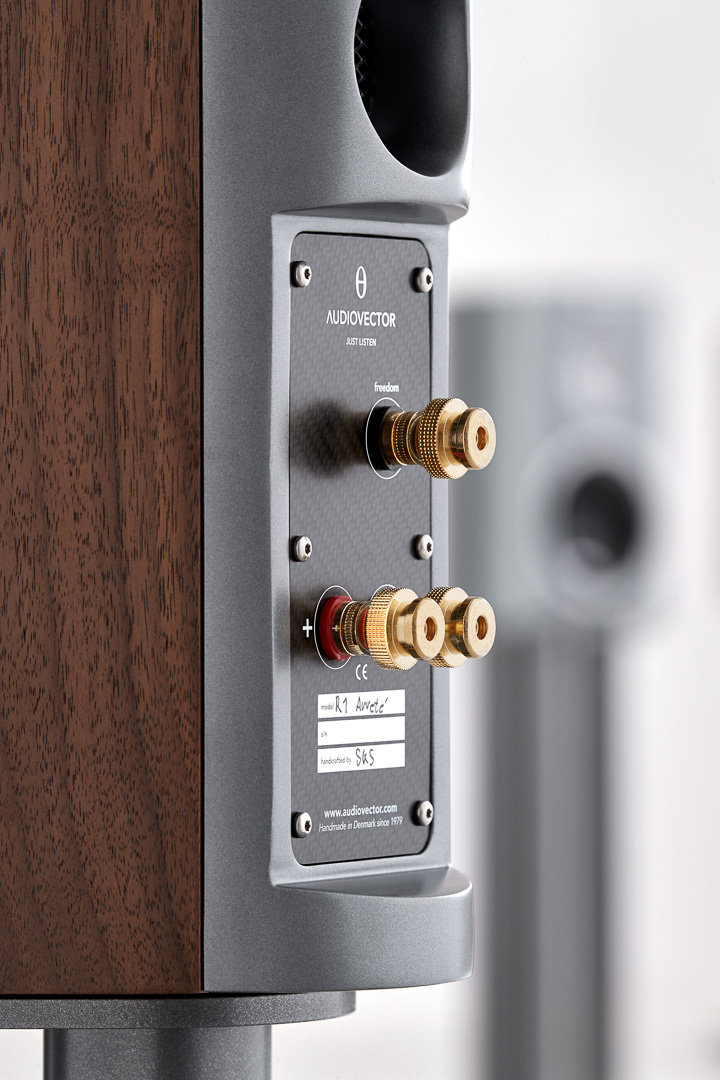
The other headline change that comes with stepping up to the Arreté plate (on all R Series models, not just the R1) is it ‘unlocks’ the option for what Audiovector calls ‘Freedom Grounding’. Freedom routes motion-induced distortion away from the magnesium driver baskets, taking a grounding feed from the loudspeakers into a spare socket of a power conditioner. You won’t need to change your loudspeaker cables, as it plugs into a separate 4mm connector on the rear panel of the loudspeakers, leaving a set of single-wired terminals for the loudspeaker signals. The Freedom cable has no live or neutral conductors, just the earth terminal and conductor are connected. This was first seen on the R8 Arreté floorstander that we tested in issue 165.

Larger models like the R8 Arrete act as technology ‘pumps’, meaning the technologies underlying their designs need to be put under the magnifying glass, but the R1 reaches an audience that expect those technologies to have already been ‘sorted’ and have trickled down into the stand-mount model. Endless and forensic descriptions of the innovations are therefore secondary to the ‘yes, but how does it sound?’ part of the test.

First up, the Audiovector R1 Arreté is extremely ‘amp-chummy’. Audiovector has had long-standing bromances with Naim Audio and more recently Gryphon and Hegel (as in, models from all of these brands have been used during listening tests of Audiovector’s speakers), but realistically, you could use the R1 Arreté with almost any amp on the market and get a good performance. OK, so I’d temper that by saying the loudspeaker seems to work best with the sort of damping factor found in most solid-state designs, and no-one is actually going to use an up-market stand-mount loudspeaker like this with a clapped out 45 year old receiver that looks like it lost an argument with a flight of stairs, are they? Used in a proportionally designed system, the R1 Arreté plays nice with its peers.

I’ve long been a fan of Audiovector’s sound, as it’s consistent, precise, and refreshingly free from nonsense. So, core changes to the brand could be a worry in case the company ‘throws the baby out with the bathwater’. But the R8 Arreté showed just how the new direction would be mapped out, producing a sound far larger than you expect from the given size of the loudspeaker, but with all the adroit timing and coherence we have come to expect from the brand. And that’s what we get with the R1 Arreté, only more so.

I’ve always liked the precision and stereo focus of a fine two-way standmount, but usually wish they had the bass drive and energy of  a decent floorstander. There are a few designs that hit both goals, but often in trying to cover both bases, they make a hash of the overall performance somewhere. You end up with a loudspeaker that delivers more bass, but sounds boomy, or uneven, or bland, or any one of a dozen different ways to go wrong. The R1 Arreté is one of the few stand-mounts that successfully straddles that gulf between stand and tower. 

The R1 Arreté has excellent imaging properties. It creates a soundstage that runs very wide of the loudspeakers and deep too. It’s not ‘electrostatic-like’ (partly because the R1 has more dynamics than most electrostatics) but it is ‘holographic’ and recordings with good stereo such as Rachmaninov’s Symphonic Dances [Zinman, Baltimore SO, Telarc] present the sound of an orchestra in layers. This track also highlights its excellent dynamic range, and it bops along at a fair pace, too. The kings of rhythm, who judge every piece of audio by its ability to ‘time’ will find much to like here. That is hardly surprising, as the previous SR range was popular with ‘Pace Rhythm and Timing’ fans, but the R1 Arreté makes toe-tapping mandatory with everything this side of listening to news broadcasts.

The R1’s ability to resolve fine detail is outstanding. The maelstrom of sounds and samples within Public Service Broadcasting’s ‘Theme From PSB’ [Inform, Educate, Entertain, Test Card] can just become a wall of sound, but each individual theme, the detail of picking, playing, and beating those instruments against a diverse set of samples is perfectly teased out here. Add to this a greater sense of musical engagement, a spot of warmth compared to previous Audiovectors, and an ever-agile sound, and the R1 Arreté shines.

The Freedom grounding system is worth a mention here. By helping make the loudspeaker a quieter environment, it makes those innate characteristics of the big speaker in a small box shine through even brighter. It seems to work especially well in the lower registers. It adds authority to the bass, though not in terms of adding extra energy or depth to the sound; instead, just by giving notes the space and air they require, they take on a sense of purpose not commonly associated with stand-mount speakers. People have been experimenting with star-earthing loudspeakers for years; this is the reality.


We are becoming a space-poor species. The pull of the big cities, the limits imposed by new buildings, and the ever-increasing costs of real estate often mean the most expensive part of even the most exotic audio systems is the room in which it resides. Rather than dismiss and disenfranchise those who cannot accommodate a full-size listening room, I prefer to think of this as the ‘Small Room Problem’. There are many ways to overcome this problem, but my preferred solution is to use a pair of bloody good small loudspeakers that deliver the kind of low-end needed for such rooms, so they neither sacrifice performance in the mids nor the highs, and don’t swamp the lows. The R1 Arreté is one of the best solutions to the Small Room Problem and have the advantage that they don’t cost as much as a new BMW.

Audiovector has successfully filtered the technologies used in the R8 Arreté into models that fit into a wider range of rooms and budgets, and yet has done so without any compromise. In fact, the biggest hurdle faced by the R1 Arreté is its price… it’s too low to be taken seriously by the high-end cognoscenti. If you listen with your ears and not your wallet, the Audiovector R1 Arreté is the one of the best stand-mounts available today and has become one of my benchmarks.

TECHNICAL SPECIFICATIONS

Type: Two-way, bass-reflex stand-mount loudspeaker

Drive units: 1× Audivector-produced 4th generation AMT folded ribbon tweeter with acoustic lens, 1 165mm Audiovector Carbon Sandwich mid-woofers

Frequency Response: 38Hz–53kHz (-6dB)

Sensitivity: 87dB/W

Nominal impedance: 8Ω

Crossover point: 2.9kHz

Audiovector Freedom Grounding (cable optional)

Dimensions (W×H×D): 29 × 37 × 19.6cm

Weight: 10kg

Price: €5,800 per pair

Manufactured by: Audiovector

URL: audiovector.com

Tel: +45 3539 6060 

Pangea Audio HPBDSS1 headphone hanger

This review covers a product so useful and so intuitively right that it falls squarely in the ‘Why-the-heck-didn’t-I-think-of-that?’ category. What is it? It is Pangea Audio’s simple, smart, and sturdy clamp-on headphone hanger—a device that neatly answers that age-old question: Where do I put my headphones when I’m not using them? Now granted, there are lots of solutions on the market, many of which work, but many of which have also proven to be unexpectedly expensive, fraught with subtle design flaws, geared more for artistic good looks than for practical use, or—gulp!—are either complicated, flimsy, or both. Happily, the cost-effective ($12.95) Pangea suffers from none of these problems and is pleased to roll up its figurative sleeves and get on with things.

The Pangea headphone hanger consists of two simple sub-assemblies: a non-marring clamping mechanism and a curved and padded headphone hanger upon which to place your headphones (the concept is that the headband of your headphones will gently and safely rest upon the hanger’s padded and curved support surface). A beefy, screw-on thumbwheel serves to tighten or loosen the clamp. There is some assembly required, but nothing too demanding. The written assembly instructions are pretty minimal, but in the manner of IKEA products worldwide there are pictographic instructions that are relatively easy to follow (even for those of us with, um, ‘ten thumbs’). 

The Pangea hanger can clamp either to horizontal or vertical surfaces that range from 1/8-inch to 1-3/8-inch thick, which gives users plenty of placement options. Once you’ve decided upon a surface to which you wish to attach the Pangea hanger, installation can proceed smoothly. The first step is assessing the thickness of the surface to which the headphone hanger will be mounted, and then choosing the mounting hole for the headphone rest that best fits the thickness of the mounting surface (three mounting holes correspond to thin, medium, and thick mounting surfaces, respectively). The next step is to decide how to orient the headphone rest (there are four options per mounting hole, allowing the headphone rest to be positioned at 0, 90, 180, or 270 degrees relative to the main clamp). 

The third step, which is the only tricky part of the installation, is latching the lower section of the clamp onto a mounting post that protrudes from the rear side of the headphone rest. This step takes a bit of finessing and a good bit of hand strength to ensure the lower section of the clamp seats properly (when done right, the lower part of the clamp snaps into place with a gentle “click”). Finally, the last step is to install the screw-on thumbwheel, hold the headphone hanger where you to mount it, and then tighten the thumbwheel until the hanger cinches firmly in place. Voila: that’s all there is to it.

Having sufficiently tightened the thumbwheel (there is no need to go all macho and end up splitting the wood of your table), the Pangea Headphone Hanger provided a firm, stable, and pleasantly unobtrusive solution for storing my headphones while keeping them ready to hand. I use four Pangea Headphone Hangers in my system (along with a good number of tabletop headphone stands—all of which cost more and take up more space than the Pangea Headphone Hangers do). The Hangers’ padded surfaces mean my headphone’s headband straps never get unwanted creases or sharp bends, which can be a problem with traditional headphone stands. What is nice, too, is that the Pangea Hangers suspend my headphones just below the top level of my audio rack, meaning the rack’s upper surfaces remain free of clutter, while my headphones remain within easy reach.

There is nothing particularly earth-shaking about the Pangea Headphone Hanger. Instead, it is a simple, sturdy, straightforward, and highly cost-effective accessory that can make life more pleasant for headphonistas on a day-to-day basis. Not bad for just $12.95!

TECHNICAL SPECIFICATIONS

Type: Clamp-on padded headphone hanger

Price: $12.95 US

MANUFACTURER INFORMATION

Pangea Audio Distributing

3427 Kraft Avenue

Grand Rapids, MI 49512 USA

+1 (616) 885-9818

URL: pangeaaudio.com 

Pathos Acoustics Kratos integrated amplifier

The Italian firm Pathos Acoustics is well-known for several things. First, it makes some beautiful-looking electronics, all chrome and wood and shiny metal. Second, it uses hybrid circuits in many of its best-known designs. Also, third is the fact that they sound outstanding; often out-performing many considerably more expensive designs.

Pathos is also well known for its InPol amplifier circuit, which effectively creates a hybrid, pure Class A amplifier, but this tends to appear on the company’s smaller products (and, paradoxically, its heavyweight flagship InPower Mk2 amp). To retain a degree of financial sanity (and not require a physiotherapist on speed-dial), the company’s big integrated is a non-InPol hybrid design, meaning the input section and preamplifier stage is pure Class A (and uses a set of Tung-Sol ECC803 valves), while the 200W per channel MOSFET-based solid-state power amplifier is a Class AB design. It also comes with a headphone amplifier that’s capable of delivering a very healthy 2W at 32Ω. In short, it’s little wonder Pathos Acoustics named this big shiny beast after the Greek god of strength; this thing could arm-wrestle a tree! 

Don’t view its lack of InPol circuit as some form of compromise, however. Under the hood, the Kratos hides some innovative new design concepts, put in place to significantly close the gap between conventional hybrid designs and InPol. Pathos couldn’t and wouldn’t have made Kratos a few years ago, as the company would not sacrifice sound quality for added power, but recent advances mean you can have your cake and eat it. 

With great power comes great connectivity (hopefully) and the Kratos as standard comes with five line inputs and two balanced XLR inputs. There are options for a built-in DAC and phono stage too, although we went with the standard line-level option.


The manual is comprehensive, and in fairness, it needs to be. The basic functionality of the Kratos isn’t that minimal, but many operations are handed over to unlabelled and identical buttons on both the front panel and the remote. It’s not entirely counter-intuitive, but familiarity comes after many days of head-scratching and flipping through the manual to see whether a specific button changes channels, puts the Kratos in standby, or mutes the volume. Eventually, you get to understanding the layout though, and the manual helps a lot at first.

The hybrid path is a road well-travelled by Pathos, and for a good reason; it sounds great. I started with Andreas Schiff playing the ‘Appassionata’ [Beethoven’s Sonata No 23 in F-minor, from Volume VI of the 2008 recordings by ECM]. This recording is useful in several ways; it should be extremely detailed, the piano tone exposes any weaknesses in the system, it should ‘flow’ musically, and make you want to listen to more of the Sonatas in the cycle. An amplifier that is too slow, too focused on one performance aspect, or just too coloured in any way would be laid bare, but the Pathos Kratos worked wonders with this recording. 

The Kratos isn’t a ‘dip into music’ amplifier; Pathos forces you to drink deep from the musical well. Kratos is not for track skippers and you stay a while as you play an album in its own right. That might lead you away from some modern albums that are little more than a badly-curated collection of an artist’s hits with a few fillers, but when you get something glorious like Nils Frahm’s All Melody recording [Erased Tapes], you start at ‘The Whole Universe Wants To Be Touched’ and don’t come up for air until at least ‘Fundamental Values’. That’s 10 tracks into a 12 track album; great for listening, terrible for writing notes for a review! In fairness, each track unveils a little more about the amplifier in its own right, from the percussive breaks in ‘Sunson’ (showing just how well the Kratos copes with a rhythmically confounding work and its outstanding transient performance), through the very fine three-dimensional space around the performance and the excellent little microdynamic cues in ‘My Friend the Forest’, to the Tangerine Dreamish and almost Mogwai-like build-up of the title track, and on.

I’m not big on audiophile recordings, but there are a few exceptions. Depending on your viewpoint ‘Angel of Harlem’ by the acapella group The Persuasions [The Persuasions Sing U2, Chesky] is either the gospel/doo-wop version of a U2 song you never wanted, or a welcome alternative to St. Bonio’s off-the-chart pretentiousness (Bonio is a brand of dog-biscuit in the UK). This track shows up the dimensionality of the Kratos, in a right way; each singer in the group has his own three-dimensional space, thrown wide of the loudspeakers, with considerable depth and even some height. There is perhaps a touch of lightness to the bass singer’s voice, in part because he is to the extreme of the soundstage to the point where some phaseiness might occur, but the energy of the singers and the sheer quality of the recording shines through nevertheless.

In terms of pop-music performances, it’s hard to beat ‘Animales Hambrientos’ by Bebe [Cambio De Piel, Warner Music Spain]. My Spanish is pretty much limited to “Mi aerodeslizador está lleno de anguilas”, but I can recognise an excellent recording in any language. In fact, not being able to understand the language has benefits in listening for vocal articulation (it disengages your in-built word assembler, and you can hear the ‘shape’ of the vocals without automatically filling in the blanks), and that articulation is excellent. 

This clarity also came through in listening to the title track from Public Service Broadcasting’s Inform Educate EntertainCD [Test Card Records]. The track is a very live-sounding recording played over a series of samples from the last 80 years of British movies, TV, and radio. This recording has everything from a Christmas speech by The Queen, to samples from The First of the Few (used extensively in the next track ‘Spitfire’), to the pips from Radio 4 news broadcasts. These samples were very ‘front and centre’ yet didn’t detract from the intensity and rhythm of the recording.

With a name like Kratos, a listless performance was never on the cards, and Pathos doesn’t disappoint. It’s full of energy and intensity, on almost everything. Also, it stays the right side of exuberant when needed. There’s a sharp tang of the very high-end here; perhaps it doesn’t have quite the top-end sheen that comes with monumental amounts of money spent on amplification, but instead, it goes for the natural and refreshing. There is a touch of forwardness, which might make some equally forward-sounding designs a little too forward, but it’s also just on the right side of exciting.

There’s one last sound quality point to note, and that’s the headphone socket. In many amps, this is an afterthought, but here this is a real powerhouse. It can drive almost any headphone you could think of and has that combination of refinement and sheer oomph that the Kratos does so well with loudspeakers. The headphone socket’s most significant limitation is it isn’t immediately visible!


The downsides are that sometimes the Kratos is a champion of style over substance. Those lovely-looking heatsinks give the amp an elegant almost Art Deco graphical appeal. However, try to pick the amp up, or somehow rap your knuckles against them, and the language is less Art Deco, more Modern Primitive. Also, as mentioned before, buttons with no information and an elegant silver remote with not a hint of a legend anywhere make the amp less user-friendly than many. Finally, the headphone socket that lives under the main front facia (just a knob and a ¼” jack socket) could even do with balanced output for more up-scale headphones, and without it almost hides its light under a bushel. None of these aspects of performance is what you might call a ‘deal-breaker’, though, and that elegant look and sound are oh so very beguiling in the flesh.

It’s hard not be drawn in by the Pathos Kratos. It’s powerful, yet can sound as refined and as elegant as any tiny valve amplifier. It’s warm, yet not soft and soggy sounding. It fills the room with sound, driving ‘difficult’ speakers with ease and making it more natural to drive loudspeakers to seem like they just got a bit bigger and more powerful. It more than looks the part too. So long as you are willing to put in a bit of button-fu at first, the Kratos might strong-arm its way into your home. 

TECHNICAL SPECIFICATIONS

 Type: Hybrid stereo amplifier, fully balanced

Analogue inputs: 2 Balanced XLR line, 5 unbalanced RCA line, 1 balanced XLR direct to the power amp

Optional inputs: HiDac MK2, Phono stage RIAA for MM/MC

Output: 1 Pre out stereo Unbalanced RCA, 1 Pre out stereo Balanced XLR

Preamplification stage: valve, class A, 2 × TungSol ECC803S

Final stage: MOSFET, bridge configuration, class AB

Output powe:r 2 x 200WRMS @ 8 Ω, 2 x 350WRMS @ 4 Ω

Max. input voltage: 5VRMS

Input sensitivity: 0.7VRMS

Input impedance: 47K

Output impedance: 0.1 Ohm

Pre out gain: 6dB

Gain: 36dB

Headphone amplifier

Output power: 3.3 W @ 16 Ω , 2 W @ 32 Ω

Max. output level: 10V RMS

Dimensions (W×D×H): 430mm × 530mm × 195mm

Net weight: 40Kg

Price: £7,099

Manufactured by: Pathos Acoustics s.r.l.

URL: pathosacoustics.com

Distributed by: UKD

URL: ukd.co.uk

Tel: +44(0)1425 460760

Bowers & Wilkins Formation Duo active stand-mount loudspeakers

It’s been almost three years now since the Munich High End Show when the audio world discovered that Bowers & Wilkins had changed hands. Long-time owner Joe Atkins had sold to a Californian entrepreneur with a much more forward-thinking outlook. Of course, the nay-sayers sprang into life, although it can’t have been an easy time for them when the company expanded its R&D team and moved to a new facility last year. This wasn’t the plan; what happened to “Bowers & Wilkins will be a footnote in audio, and making Internet radios within a year”? I guess the torches and pitchforks will have to wait.

While nu-Bowers retains and continues to improve all three of its classic lines, a few months back, word got out that the ‘forward-thinking’ bit was starting to bear fruit, and the Formation suite is the result. Formation is the first wireless system that the company has produced entirely from first principles, and it’s said to be only the beginning. Formation launched with five products: the Wedge, which effectively replaces the Zeppelin portable; the Bar (as in sound-); the Bass subwoofer, and Duo stereo system. The fifth element is called Audio, an analogue interface that allows you to connect regular audio sources to a Formation system. Various things differentiate these products from others of the same ilk; for a start where more than one Formation device is used, and it’s heavily geared toward multi-room applications, a mesh wireless network is created to tie them together and transmit/receive signals at up to 24/96. As such, Formation doesn’t rely on the integrity of the existing network for all-important aspects like synchronisation; room to room this is one millisecond and between stereo speakers it’s a microsecond, which is fast. This is because the devices talk to one another directly rather than via a router as is the case with regular Wi-Fi. To achieve this degree of channel matching Formation speakers incorporate multiple ‘radios’ to talk to one another and to the access point (router) at different frequencies. They also have one for Bluetooth.

The Duo is the most ‘B&W’ of the Formation products in appearance at least, with a tweeter on top in its own enclosure and a curved front baffle, from which the mid/bass driver protrudes. However, there are significant differences between the Duo and the 705/805 models it looks like. For a start, this is the first infinite baffle (sealed box) active stereo loudspeaker from the company. The presence of two 125 Watt digital amplifiers and DSP means that bass tuning can be done without a port. This gives Duo a more contemporary appearance and allows closer to wall positioning – there is a basic bass and treble tone control in the Formation app, too. The cabinet is made from Formi, a hybrid of polypropylene and wood fibre; the latter provides strength and damping, says B&W, and of course allows for freedom of form. They chose this over more typical speaker cabinet materials because of the need for wireless communication, which can be blocked by wood alone. There is a matrix structure within the cabinet to provide stiffness, very much in the spirit of classic Bowers & Wilkins designs.


The drivers were taken from the two models previously mentioned. The tweeter is a carbon dome from the 700 series and the mid/bass has a Continuum cone from the 800 series – or essentially from the 805D, as it’s the only two-way in that range.

Duo is a particularly attractive speaker even before you consider that you don’t need any other equipment to be visible in the room, and the finish doesn’t have any sense of the plastic about it despite its constituents. The amplifier and DAC are in the base, where there are controls for play/pause and volume up/down on the front, alongside a status light that remains off once the system is set up. There’s no on/off switch; power switching is done automatically, with the only indication of status being the temperature of the metal base.

You can connect to Formation speakers via Bluetooth, Airplay, and even Ethernet alongside its own mesh system. This last allows you to pull data from locally stored or cloud based services. The only operational consideration is that at present you need Roon in order to use the latter two sources. The Formation app is currently only designed for set up. I suspect that Bowers will incorporate playback control into their own app in due course.

Set up was not without its hiccups. Getting the system to a point where I could tell it which channel was which required a bit of patience and it took a few reboots of Formation units, router, and the Roon core in an Innuos ZENith server to get things running smoothly. The Audio box was originally set up as the controller but the system worked more smoothly when control was handed over to the Duos. However, Audio does sounds rather good; I got excellent results with vinyl, possibly because with this source there is a direct connection to the Audio box, which is part of the mesh network. You can make a direct Ethernet connection to both Audio and Duo though, and that brought about a small but worthwhile improvement in timing.

Most of my listening was done conventionally, with the only wires involved being the power leads that are neatly routed through attractively sculpted optional stands. No speaker is truly wireless of course and you could argue that a slimline speaker cable is just as discrete as a power lead. What that discounts however is that with Formation products you don’t need any other hardware; the speaker contains the wireless streamer/DAC, amplifier, and drive units. A regular system requires at least one other piece of electronics.


The Duo’s sound quality is quite unlike any other Bowers & Wilkins speaker I have tried. This is presumably as much to do with the sealed nature of the cabinet and the on-board electronics as it is with the wireless connection. They have remarkable bass extension and an articulate and revealing presentation that remains coherent even at high levels. There is also a solidity to the sound, which makes them sound a little ‘shut in’ at times. However, Bowers & Wilkins creates a loudspeaker of great detail and resolution, even if they are not as open sounding as its other lines. Regardless, the lower frequencies are remarkably articulate and extremely well extended. Some familiar tracks revealed far deeper bass than usual, and a lot deeper than a regular speaker of this size can usually manage. This bass depth is extremely attractive and presumably reflects the extra control afforded by active operation. I recall asking Bowers & Wilkins for an active 802 many years back and got the answer that such things were not commercial; perhaps now that they have done the work this dream might be realised.

The Duo is an engaging and enjoyable loudspeaker. It doesn’t ‘time’ as well as a good conventional streaming system of the same price but it goes deeper and plays at higher levels with less distortion than most. But that isn’t the point of Formation, which in Duo/Audio form is a serious sound system with the benefits of wireless operation that offers great flexibility of input and, with Roon availability, ease of control. I think it will be more universally appealing when the Formation app can be used for all streaming operations, but even as it stands, this is a very attractive proposition for the modern music lover. 

TECHNICAL SPECIFICATIONS

Formation Duo

Type: wireless, active, streaming 2-way, two-driver stand-mount monitor with infinite baffle enclosure

Driver complement: One 25mm carbon dome tweeter, one 165mm Continuum cone mid-bass driver

Frequency response: 25Hz–33kHz

Crossover frequency: Not specified

Power output: 2 × 125W digital amplifier

Features: Airplay 2, Spotify Connect, Roon Ready, Bluetooth aptX HD (AAC, SBC), DSP crossover

User Interface: Formation app

Dimensions (HxWxD): 395 × 197 × 305mm

Weight: 10.6kg/each

Finishes: black or white

Price: £3,499

Formation Audio

Type: Wireless audio hub

Analogue Inputs: One stereo unbalanced (via RCA jacks)

Digital Inputs: One TOSLink, one ethernet (via RJ45), WiFi

DAC Resolution/Supported Digital Formats: 32-bit/192kHz, FLAC/WAV/MP3, etc.

Music services/Wi-Fi inputs: Airplay 2, Spotify Connect, Roon Ready, Bluetooth aptX HD (AAC, SBC)

Analogue Outputs: One stereo unbalanced (via RCA jacks)

Digital Outputs: One coaxial S/PDIF (via RCA jack)

Frequency Response: Not specified

Distortion (THD + Noise): Not specified

User Interface: Formation application software

Dimensions (H×W×D): 44 × 215 × 263mm

Weight: 1kg

Price: £599

Manufacturer: Bowers & Wilkins

Telephone: 0800 232 1513

URL: bowers-wilkins.co.uk