Up to 37% in savings when you subscribe to hi-fi+
hifi-logo-footer

Begin typing your search above and press return to search. Press Esc to cancel.

Enjoy the Music.com And MAYORS Celebrates Luxury Timepieces During Florida Audio Expo 2020

In 2020 Enjoy the Music.com is celebrating its 25th Anniversary and wanted to do something extra special. During the Florida Audio Expo it worked closely with MAYORS Jewellers, the Southeast’s leading multi-brand retailer of jewellery and luxury timepieces retailer, for an exciting evening devoted to mechanical timepieces. For those unfamiliar, MAYORS has 17 stores within Florida and Georgia and is owned by Watches Of Switzerland, a leading luxury timepiece and jewellery company for over 50 years, and so it took a bit of doing to make this event happen…

Read on here

Fyne Audio F702 floorstanding loudspeakers

Fyne Audio is a relatively new kid on the hi-fi block, formed in 2017 by several former Tannoy staff, following the takeover of Tannoy by a conglomerate a couple of years earlier. They’ve not wasted any time, and for such a young company, Fyne Audio now has an impressive portfolio of products. However, that’s what you can do when your team includes five former directors and senior managers, including the former director of engineering, the manager of mechanical design, and the factory manager. Not to mention the former managing director and the sales manager. As Fyne itself puts it, it’s like they’ve got the band back together.

Conceptually, they remain committed to the traditional Tannoy-style co-axial arrangement of a tweeter mounted centrally within the bass/mid cone. Termed ‘IsoFlare’ this point source system is claimed to provide outstanding stereo imaging, even off-axis, because energy is radiated isotropically, following the flare of the driver cone. The drivers have undergone considerable technical development, including computer-designed beading around the outer rim, dubbed ‘FyneFlute’, to better manage the interface between the edge of the driver cone and the mounting point to reduce reflection effects. Finally, the porting via a tractrix profile vent in the foot of the speaker, which helps create a spherical wavefront from the port output, the better to couple the output to the room and aid overall coherence.

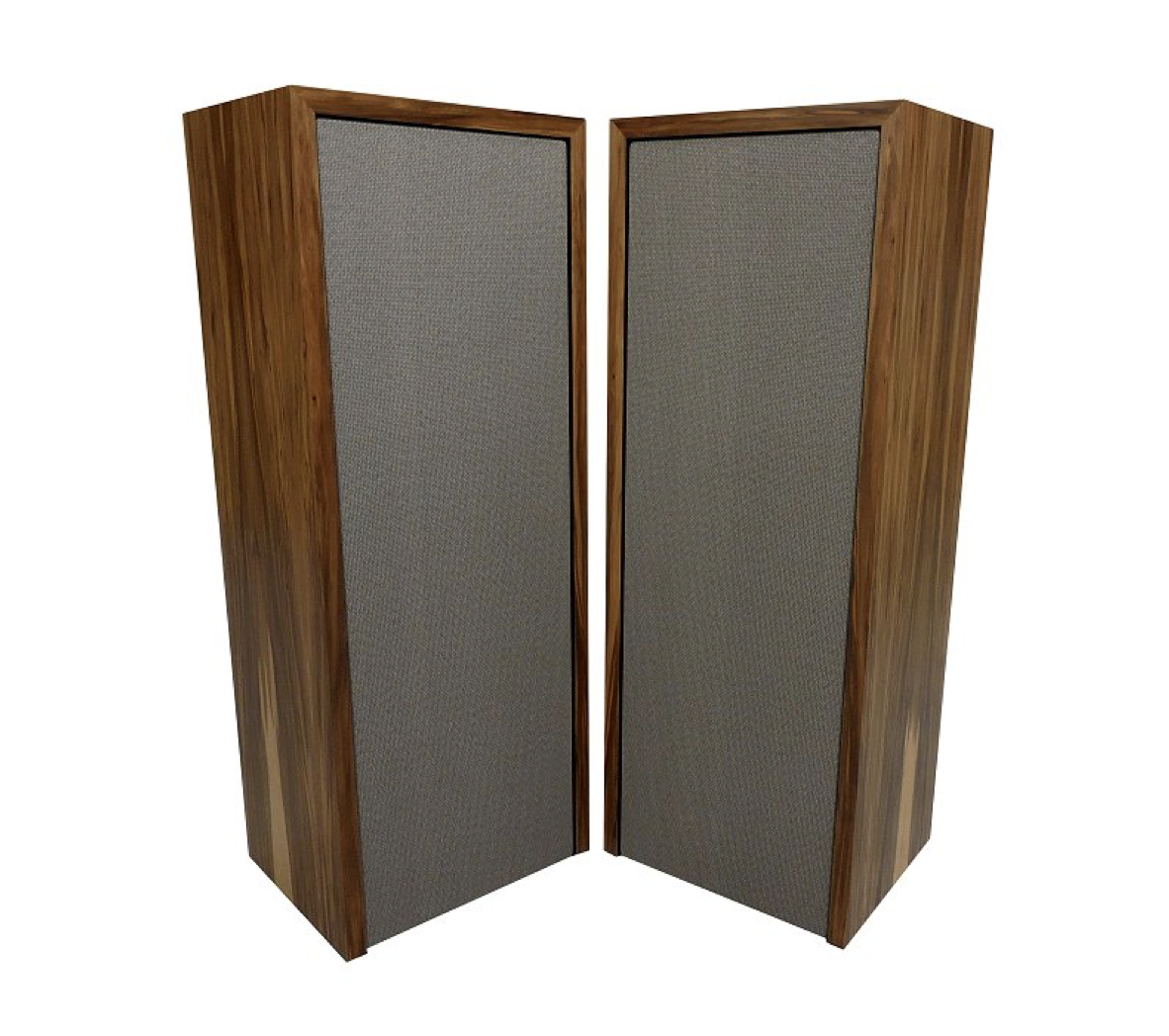
The F700 series sits one rung below the top-end F1 series, and the £6,000 F702 is a substantial two-and-a-half-way floorstander, sitting in the middle, between the F701 stand mounter, and the F703, a large floorstander configured like the F702, but with 250mm drivers in place of the 702’s 200mm units. The bi-wirable crossovers benefit from high-end components and have been deep cryogenically treated. Boat-backed cabinets and a slight downward slope to the top plate help manage internal acoustics but also reduce the sense of mass, and make for a singularly modern and elegant design. However, the 702’s are not a small loudspeaker, being more significant in all dimensions than my old Focal 1028s. There’s a passing resemblance to Tannoy’s much-admired ‘Definition’ series, but the F700 range has benefited from considerable development, which is apparent in the way it performs.

Given their size, and the generous proportions of the bass and bass/mid drivers, I was slightly concerned that they’d not work well in my modest domestic setting, but I’d also heard them absolutely singing their heart out in a small dealer dem room, so I wasn’t unduly worried, and Fyne themselves explain that one advantage of the tractrix port arrangement is less susceptibility to room placement issues. That said, they still amply rewarded a little bit of experimentation with placement; an inch or two this way or that and they quickly made themselves very much at home.

First impressions, then, and it’s pretty clear that the F702s are a very free and expressive loudspeaker. Don’t mistake ‘free’ for ‘loose’ here, either; there’s no sense of flabbiness, nor any lack of control, it’s just that control is being very judiciously applied. Dynamics are natural, unconstrained, and unforced, timbres have a real sense of texture and shape, and timing is right on the money. Andy Sheppard’s ‘Peshwari’ from Learning to Wave [Provocateur] shows his mastery of phrasing and textures; his lines follow a natural arc, and through the F702s it is easy to hear why he plays that way, and how essential those lines are to the musical experience.


The way the loudspeaker shows you the inner harmonies within the music is instructive too. As with timbre, pitch information is also exquisitely resolved; the music is just that little bit more fully-formed because the harmonies reveal themselves so limpidly. The F702 isn’t about bombarding the listener with impressive but ultimately meaningless detail either, everything in the music has its place and part to play — the F702s show you why, and throw in the quality of the musicianship for good measure. Coherence is critical here, and the top-to-bottom integration of the drivers is well sorted; there is no cause for concern about any disconnect or disjointedness between the frequency ranges. The detail is meaningless without context, and in this case, the context is the timing: unless the detail is delivered coherently, in a way which immediately locks it into place within the music, then it would be better if it weren’t there at all.

The speakers were in my system during the 50th-anniversary commemorations of the moon landings, so I dug out my copy of Brian Eno’s Apollo [Virgin] and had my little private celebration. Ambient music is sometimes a tricky reviewer’s tool, all that vagueness being a wee bit unhelpful, so I wasn’t expecting to get much by way of insight into the speakers; I was planning to wallow in Eno’s lush and evocative textures. However, the Fynes lit up the beautiful harmonic structures within those shimmering soundscapes, the bass and mid-bass tunefulness being a particular source of surprise and delight. Also, ‘Deep blue day’ has some compelling but understated work by the rhythm guitars; the Fynes found it and made sense of it where lesser speakers blend it in.

Time and again, they rewarded me with new insights into familiar music. Dhafer Youssef treads a line between jazz and world music and ‘Miel et ciendres’ from Divine Shadows [Jazzland] is an example where I usually wish the jazzman had come to the fore. The piece starts subtly, building and raising the energy to a critical point, then gently fades back from whence it came. I usually find myself slightly disappointed, because it starts to fade just at the point where the likes of EST would have stepped up a gear and taken us on a rollicking ride. This time, though, the trajectory of the piece felt so natural there was no sense of anti-climax at all. Graham Fitkin’s Kaplan [Black Box] is a dive into electronic music and initially feels somewhat different to much of his complex, rhythm-driven work. At 15 minutes long, ‘K1’ pays off in the last climactic few minutes, but the build has often felt a little diffuse and formless. Not through the F702s, though, which brought out the inner rhythmic structure and rendered the whole thing compelling and propulsive. Now all the subtle rhythmic changes fit so well and made much more sense of the whole recording.

Pulling out my copy of the Tord Gustavsen Trio’s first album, The Ground [ECM], I found ‘Tears Transforming’ is full of his trademark subtlety, but through the F702s the degree of interplay, the way thematic and rhythmic fragments passed between the musicians, was shown in ways I’d either totally forgotten or, more likely, never consciously appreciated before. Energy and detail on a micro- and a macro-scale is very much the F702’s forté (and piano), from small inflexions and gestures to large scale grandiosity, or merely pinning you in your seat (thanks, Return to Forever). All is achieved with considerable aplomb – you perceive the results, but don’t notice the work.

That goes, too, for large scale orchestral works, for which Rachmaninov’s Symphonic Dances surely measures up. In this case, Vasily Petrenko’s account, with the Royal Liverpool Philharmonic [AVIE], and in particular the ‘Non allegro’ first movement. The scale and weight of the musical forces in play was never in doubt, nor the size of the acoustic space offered by Liverpool’s iconic Philharmonic Hall. However, despite that, there was a clear dance-like quality to many sections, particularly in the way the upper strings tripped along over the solid brass, percussion, and woodwind underpinnings. By contrast, Brahms’ German Requiem and the London Symphony Orchestra under Previn [LSO Live], felt almost intimate; the orchestra and choir occupied their own definite spaces, but spaces somehow smaller than I’d expected. Having reflected on this, I’ve concluded that the sense of intimacy was more about the ambience; in a live performance there is that sense of shared space, even in a large hall, and here it was possible to feel oneself closer to the event.


The Fyne Audio F702s are all about insight; it seems. That view into the music-making which we almost take for granted at live events, but often struggle to recreate in our own homes. Yes, it’s about detail and resolving power, timing, and the ability to scale from intimate to expansive, subtle to bombastic; but above all, it’s the ability to do it in a way which doesn’t draw attention to itself. The music speaks, and a fine (pun intended) system does its best to get out of the way. The F702 is a tremendously accomplished loudspeaker, and given that Fyne Audio is such a young company, this is a truly remarkable achievement. It just shows what years of collective experience can do when given their head.

TECHNICAL SPECIFICATIONS

  •  Type: 2 ½ way, reflex-loaded floorstanding loudspeaker with downwards firing port with tractrix diffuser; twin cavity loading system
  • Driver complement: 1 × 200mm point source driver, multi-fibre bass/midrange cone with coaxially mounted 25mm magnesium dome compression tweeter, neodymium magnet system. 1 × 200mm multi-fibre bass/midrange cone
  • Crossover frequency: 250Hz & 1.7kHz
  • Crossover type: Bi-wired passive low loss, 2nd order low pass, 1st order high pass, cryogenically treated
  • Frequency response: (in-room, typical) 30Hz–34kHz
  • Impedance: 8 Ohms nominal (minimum: 5 Ohms, from 150-250Hz)
  • Sensitivity: 92dB for 1 Watt (2.83V) at 1 Metre
  • Dimensions (H×W×D): 1111 × 384 × 440mm
  • Weight: 30.5 Kg each
  • Finishes: Piano Gloss Walnut / Piano Gloss Black / Piano Gloss White
  • Price: £5,999.99/pair

Manufacturer: Fyne Audio Limited

Tel: +44 (0)141 428 4008

URL: fyneaudio.com

https://hifiplus.com/reviews/

Mark Levinson No. 5805 integrated amplifier

Here is one of the true survivor brands. Mark Levinson Audio Systems began life in the early 1970s, from the outset as the highest of high-end companies. The company separated from Levinson himself, went out of business, then became part of the Madrigal Group, which became a part of the Harman Group, which itself became part of Samsung relatively recently. The brand had some fallow periods (this is the polite version; the real deal got real nasty), as well as winding up becoming the in-car upgrade for Lexus. At the core, however, is a brand name that bespeaks of the best in high-end audio. And that has never changed.

All of which made the company’s most recent 5000 line stand out from the norm. While not built for economy, the line represents a new entry-point for a brand that frequently pushed the envelope of high-end price structure. As a result, it would be understandable if Mark Levinson 5000 models were in some way ‘Mark Levinson Lite’. That’s not what happens in the No. 5805 tested here. Instead, the No. 5805 and its No. 5802 baby brother represent a deeper change in the way audio happens. It also speaks to a design that needs deep pockets to realise.

At first glance, the No. 5805 is simply another conventional integrated amplifier. It bears a familial resemblance to the more up-scale 500 series, specifically the No. 508.2 integrated. It has many of the same elements inside, too; most notably the phono stages, although the difference between the two is the No. 508.2’s phono stage is fully discreet, where the No. 5805 bristles with chips. The biggest change is a move from essentally an amp with a DAC to a full digital hub. That might seem like a minor change – it’s not.

Plug the No. 5805 into the Ethernet and it has its own IP address with set-up screens you can access via a web browser. Or, you can configure the amplifier in the more conventional way using the front panel and the remote. Either way, you are presented with a host of options for the user, including full input trim settings (so you can control both the  starting volume levels and the maximum volume of each source, the speed of the volume level, whether ‘mute’ means ‘shut up!’ or ‘be quiet!’, there’s even options to put it into different types of standby, whether you want to be fully biodegradable and wait an hour for it to come on song, or burn through a few polar bears and have it run on a more juicy standby. You can name sources too, of course, and the loading options of that phono section are far more flexible than usual thanks to the web browser, and you can troubleshoot your system.

This also means the No. 5805 is comprehensively input-ready. It’s got eight inputs in total; four analogue (one XLR, two RCA, one MM/MC phono) and four digital (one coaxial and two optical S/PDIF, USB). Bluetooth is included too. One of the more clever features on the No. 5805 is that you can assign one of seven different reconstruction filters independently to each digital input; so if you think the first coaxial is a bit ‘Fast Linear’, the optical sounds very ‘Brickwall’ and the USB is ‘Apodizing Fast’, you can set these up in that way. Usually, the filter applies globally, so this is a step in the right direction for audio obsessiveness.


There is also an Ethernet port, but it’s for control (along with RS232 and USB-A) rather than streaming, which is a shame given its flexibilty elsewhere. It has a home-theatre by-pass though, which with the absence of Ethernet streaming does suggest it’s targeting a very traditional audio buyer with a more non-traditional design. Streaming aside, I think that its range of inputs and outputs (there’s a 1/4” headphone jack on the front panel) give the No. 5805 decent flexibility.

The amplifier delivers 125W per channel, in a direct-coupled, Class AB design. For all its modernity in installation, the amplifier itself is relatively conventional and relies on an internal preamp/power amp architecture that shares a common power input with a 500VA transformer. Even the headphone stage is a feed from a preamp rather than its own amplifier. The circuit features a voltage-gain layout that connects to an eight-transistor output stage, with two out of the eight running in pure Class A. The bias of this output stage varies according to temperature. Mark Levinson suggests that this power amplifier architecture is derived (‘descended’ according to Levinson) from the company’s No. 534 power amplifier, in a trickle-down manner. This is not a bad starting place for an amplifier.

I used the Mark Levinson No. 5805 with a range of components fore and aft. The amp more than delivered the good when used with the Audiovector R1 Arreté tested in this issue, as well as the outgoing Magico A3 and the resident Wilson Audio Duette Series 2. It was fed by the USB output of a Melco N10 and the RCA sockets of the Innous ZENmini III tested next issue. I also used it with my Kuzma Stabi S/4Point9/CAR 40 vinyl front end. Cables were cycled between Cardas Clear, Ansuz D2, and Nordost Odin 2 (although with each cable costing more than the amp, this was taking things a little too far!). The amp arrived with some miles on the clock so running in wasn’t an experience to have, but on EU-friendly standby levels, it definitely improved from a cold start after half an hour or so. The amplifier rarely got above comfortably warm, save for the times when it was sweltering in 30°C heat during the UK’s mid-summer heatwave.

I’ve had some experience of Mark Levinson products in the past, but the accent is on the past. Although I’ve spent time listening to the latest iterations, they are more passing aquaintances than close friends. Even so, that classic Levinson dark, rich, and powerful sound continues to run through modern Mark Levinson devices.

But not here.

This is Mark Levinson rebooted, with a sound more in line with what the modern audiophile wants from their equipment.  The almost brooding sound of the more upmarket models is replaced with a more immediate and forward presentation. It still retains that large and powerful sound that characterises Mark Levinson’s soundstaging properties, but where once Mark Levinson passed majestically between musical themes, on the No. 5805 it bounds more vigourously. It’s a ‘younger’ sound than I expected too; more forgiving of signal compression, more energetic on rock and dance music, and perhaps ultimately more Little Simz than Little Feat.

I don’t think added pep in its step is a bad thing, although Mark Levinson purists might not agree. Where the traditional Mark Levinson sound is ideal for accompanying long late-night sessions, the No. 5805 is great for plenty of quick-fire listening. I don’t want to overstate this; it’s not that the existing equipment can’t use party as a verb, or the newer models are too excitable to work in a late-night all-of-Yessongs [Atlantic] playing session, just that the No. 5805 plays to different strengths. And that really is a good thing.

The central aspect of the No. 5805’s performance that shines through on analogue, digital, and LP sources is its infectious, boppy sense of rhythm. OK, not quite in the manner of something like a similarly priced Naim rig, but the Mark Levinson keeps time well, and in an upbeat rather than a measured way. This makes the tribal, Iran-meets-Cuba in a London basement rhythms of Ariwo’s ‘Alafin’ [Ariwo, Manana, CD] have more drive and energy. You can’t help but tap your foot to the track. Move this over to bigger sounding systems and it sounds bigger, but slower. You are perhaps less likely to notice they are playing kitchen utensils, though!

That said, the No. 5805 is extremely detailed, and given the chance to show off with impressively recorded music, it does just that. Rachmaninov’s Symphonic Dances [Zinman, Baltimore SO, Telarc] is played with gusto and verve, and the Mark Levinson amp reproduces that and the dynamic range exceptionally well. It also creates a good stereo soundfield, albeit one that is more about width than depth. However, the detail and spatial aspects don’t tend to lay poor recordings bare, either. It just brings out the best in a track.


Where the No. 5805 comes up short next to the best is in vocal articulation and coherence. It’s not that voices are indistinct, but my go-to track for determining such things – ’Animales hambrientos’ by Bebe [Cambio de Piel, Warner Spain] – is telling. When it’s good, I think I know Spanish. Here, I thought “I wish I knew Spanish”.

Overall, though, the amplifier delivers a very fine performance. It’s crisply dynamic and presents sounds in a soundstage with excellent solidity. It’s a very much ‘turn it up’ amplifier, too; not simply a party animal and it can play well at low levels, but when you play something fun, it makes you want to turn it up.

Perhaps the acid test of the No. 5805 came when casually listening to a series of YouTube clips through the optical input, being fed from my TV. I had a few friends come round, and I’m not ashaimed to say we all got a bit ‘refreshed’ and had given up on regular music and video entertainment and engaged in a spot of random YouTube clip watching instead. Over the course of the evening, we churned through everything from Frankie Boyle insulting his audience, through the ‘let’s play the most obscure piece of music you can find’ game, and eventually to essentially giggling at silly memes and Mitchell & Webb clips. Eventually, we gave up when trying to count just how many SS soldiers Clint Eastwood shot up in each clip of Where Eagles Dare, and carriages (well, Ubers) awaited the revellers. Then it struck me. I had managed to turn on, use, enjoy, and turn off, a high-end audio system – while drunk and in the company of fellow members of the ‘inebriati’ – switch it to play from TOSlink, play it loud and enjoyable enough to shout down ‘The Knights Tippler’ and nothing went ‘bang!’, nothing required adult supervision, and fun was had. In contrast, had I been using a more conventional high-end system, I’d have never even thrown the first switch!

Finally, how you rank the headphone socket largely depends on just how much of a headphone enthusiast you consider yourself. If you use headphones on an occasional basis, and use a pair of moderately demanding headphones, it’s perfectly fine, and has the same detailed, fast, and engaging properties of the amplifier itself (primarily because it is the amplifier itself!). If you consider yourself a headphonista and spend most of your listening sessions under a headband, then the No. 5805’s headphone socket is about average; good for a ‘built-in’, but no match for a dedicated headphone amplifier. In this context, and with more demanding headphones, the headphone socket is a little grey and undynamic. I think for most users of the No. 5805, they won’t ever go for a separate headphone amp and they will use the amp with mid-range AKGs or similar and really enjoy what they hear.

Is it possible to build a set of components that do what the No. 5805 does for less? Of course, but that’s not the point. People who buy the No. 5805 would never countenance buying separates in this fashion, and neither would they go for a separates system that featured Mark Levinson’s more upmarket models. I first thought of the No. 5805 as ‘training wheels’ for the bigger stuff, but that’s not how this amp’s story arc plays out. Instead, this is a product designed for people who will likely never go for the bigger stuff. This is all the Levinson you need today!

The No. 5805 is Levinson reborn, after all. It’s not Mark Levinson for the rest of us, it’s Mark Levinson for a new generation; a generation that appreciates good things, but is time-poor, space-poor, and therefore unwilling to accept the plethora of different boxes that makes up a traditional audio system. In other words, it’s Mark Levinson for right now!

TECHNICAL SPECIFICATIONS

  •  Type: Integrated amplifier with built in DAC and phono stage
  • Power output: 2 × 125 W into 8 Ohms
  • Minimum load: 2 Ohms
  • Analogue inputs: 1 pair balanced, 2 pairs unbalanced. Phono: separate MM and MC (only one can be connected)
  • Digital inputs: 1 asynchronous USB 2.0 B Audio, 2 optical, 1 coax (S/PDIF)
  • Sample rates/Bit depth: PCM up to 384kHz up to 32 bits. DSD: native of DOP, single, double, or quad speed. Full MQA decoding
  • Control inputs: Ethernet, RS232, and USB A
  • Input Impedance: 20k ohms (balanced) 10k ohms (single-ended)
  • Phono: MM: Input resistance 47k ohm. Input capacitance: selectable. Gain: 39dB. MC: Input resistance: Selectable. Gain: 69dB
  • Weight: 28.1kg
  • Price: £7,999

Manufactured by: Mark Levinson Music Systems

URL: marklevinson.com

Distributed in the UK by: Arcam

URL: arcam.co.uk

Tel: +44(0)1223 203200

https://hifiplus.com/reviews/

FinkTeam Borg floorstanding loudspeaker

There are two types of loudspeaker designer: those that come up with a loudspeaker design and create a whole company around it, and those who take a more ‘hired gun’ approach. Often, the skill set of the founder limits the scale of the operation  – not many can design an excellent loudspeaker, market it, sell it, and run a company simultaneously – so the canny ones employ a managing director to run the business side. The ‘hired gun’ speaker designer is usually employed by different brands over a career span or works as a consultant to different brands; the latter is the rarest variety in my experience. Examples include Robin Marshall (who founded Epos but went on to work for several British and American companies) and Andrew Jones (who started at KEF but has gone on to design for TAD and ELAC among others). Karl-Heinz Fink is perhaps unique in that he has feet in both camps; his design consultancy has designed great loudspeakers for many manufacturers (often hidden under the cloak of a Non-Disclosure Agreement), but Fink is also running a fast-growing loudspeaker-making business in its own right.

The first Fink Team product unveiled to the world was the WM-4, which appeared in Ken Ishiwata’s Marantz demonstration room at the Munich High End a couple of years ago. That was the second incarnation of a WM-3 made specifically for Ken – he and Karl-Heinz seem to get along rather well. The WM-4 is a huge loudspeaker with a 15-inch paper bass driver in the bottom half and two BMR midrange units flanking a ribbon tweeter in the top section. It is naturally costly as well and such is Fink’s reputation that its appearance prompted requests for a more affordable and easily accommodated alternative.

The Fink Team Borg was the response; this shares the stealth styling of the WM-4 in a cabinet that while still in the large class is far more manageable. The Borg was launched at the 2018 High-End show but had only recently reached these shores. Mine came in a highly distinctive and beautiful finish with the two-tone combination of matt black baffle and dark Zebrano veneered rear section. The driver unit choice is pretty radical, combining a 10.25-inch paper bass driver with a massive Air Motion Transformer (AMT) tweeter, which is not something you see every day; the last speaker I saw that had anything like this combination appeared decades ago. A bass driver of this size has minimal midrange capability, so the tweeter is more of a mid cum HF unit; the crossover point is down at 1.6kHz which is crazy low for a two-way. However, it’s also below (most of) the midband where the ear is most sensitive.

I asked Karl-Heinz why he had gone for such an extreme driver combination and got the following response: “A multiway speaker is always a compromise because no crossover path is perfect. Best phase integration means a slight loss of acoustic power around the crossover region; perfect acoustic power can give you some strange behaviour on or off-axis. The theoretical best crossover with a 6dB slope does not work in real life, because the total behaviour of the electrical filter and acoustical filter have to be combined and as a driver is already a 2nd order bandpass on its own; you cannot win with first-order crossovers. Best solution: no crossover, but that has other problems. Which brings us back to two-way and that is what we did. It was a challenge. The tweeter only decided to work with the woofer after we added a passive all-pass filter to the crossover. The speaker has nice off-axis behaviour, and that makes it easy (sort of) to place in different rooms.”


With all this attention to detail it’s not surprising that the Fink Team has gone to some lengths to keep cabinet resonance to a minimum, Karl-Heinz refers to audible resonances undermining signal to noise ratio, and he’s not wrong. The approach with Borg has been to push resonances down with localised bracing and damp them to reduce audibility, and it also has reinforcement in the weakest parts such as the large opening for the bass driver. It’s worth mentioning that both design and execution are of an exceptionally high standard, I particularly like the faceting on the front baffle and the dome feet that are spike alternatives.

British designer Kieron Dunk, who worked with Karl-Heinz at Q Acoustics, developed the overall appearance. I like his style. Even the packaging is of unusually high quality and consists of plywood cases that have threaded bolts to hold them together and straps to aid the ‘shifting about’ process. The Borg is not a colossal speaker, but its 52-kilo mass commands respect.

The drive units are naturally not off the shelf types, even the tweeter which is made by Mundorf (the capacitor people) required a bit of tweaking by the Fink Team to iron out a resonance. It uses pleated Kapton with an aluminium strip, a combination of materials chosen for excellent internal damping and “particularly low distortion”, it’s also plentiful for the type, the oval opening being 118mm high. The in-house built bass driver is purpose-built for this loudspeaker; it has a sizeable three-inch voice coil (75mm) and an aluminium shorting ring on the pole piece to reduce voice coil inductance variations and to reduce flux variations. The paper cone looks old fashioned with its pleated surround, but if you don’t need a lot of driver excursion, this approach often results in excellent sound. Fink has gone to town on the Borg’s port which aims to minimise resonance in the three forms that afflict these ducts, that is material, length, and airmass resonance. The cutaway shows that it’s far from being a regular tube but is shaped and damped to control these resonances, it is also quite big, yet you don’t need to place the Borg very far from the wall given its size.

The driver combo is radical enough, but that’s not all, there are also control knobs on the rear above the four-way cable terminals. These are not marked bass and treble, but ‘damping’, ‘mid’, ‘presence’, and ‘high’ and are designed to adapt the speaker to different rooms and partnering amplifiers. Damping does the latter, with three settings to suit transistor, tube, and low damping factor amps that struggle to control the bass in some rooms. The mid setting can be used to compensate for room issues but also adjusts the position of the image, moving it back or forwards. Presence, on the other hand, is for tuning the speaker to different characteristics in the source and amplifier, balancing out elements that are a little bit soft or too bright. High adjusts tweeter output to suit different rooms or to balance the response. All of these filters only make small changes, but that is usually all you need so long as there is some flexibility in positioning, but I wouldn’t put the Borg up against the wall; it might get a bit fighty.

The load the Borg presents to partnering amplifiers is an average 87dB with a high 10 Ohm average impedance (that goes down to 6.5 Ohms at 20kHz), so it looks like a relatively easy beast to drive, especially when you consider the damping options. I used an ATC P2 power amp for the majority of the listening but started off the new Naim Supernait 3 integrated as it happened to be in the system. What first strikes you about the character of this speaker is just how gorgeous the bass is, it’s juicy, deep and when required can sound like ‘rolling glue’ as Yello put it. There is something about a large paper cone driver that sounds so real and natural, and it’s a sturdy material to beat if you want the full gamut from nuance to muscle in the low frequencies. Conjure’s ‘Dualism’ [Music for the Texts of Ishmael Reed, American Clave]sounds beautiful, the music rolling out in totally unfettered form into the room. The Borg’s mids and highs are as natural sounding as its bass, while its single driver gives rare coherence from a wide-bandwidth design. It’s powerful on immediacy, which makes everything sound more real and alive but is also excellent when it comes to the tonal depth, which enhances the palpability of the experience. Listening to the Borg is a very high-resolution experience.

One illustration of this is that it seems to have all the time in the world to unfold the music, there is no sense of hurry because the leading and trailing edges of notes are so clearly defined. There’s no blurring of the subtle differences between notes, instruments, and voices; everything is clearly separated yet presented as a coherent whole, which is much fun whatever your musical tastes.


With my usual amplification combo of Townshend Allegri+ pre and ATC P2 power amp the bass gets more fabulous still. The low pulse on ‘Rymden – The Odyssey’ [Rymden, Wesseltoft Berglund Öström, Jazzland] is both controlled and open leaving plenty of space for the speed of the drumkit to bring occupancy to the experience. The Borg are also very good at creating a sense of space, the sculpting of the deep front baffle allowing the sound to expand out into the room both upwards and sideways, and that includes the bass which on one track sounded like distant thunder; a good result methinks. However, more important is that once a track starts, it’s difficult to stop it; the Borg’s musical communication skills are in the premier league thanks to the qualities of the AMT driver in particular.

I tried some of the adjustments on the back and got the sort of results that are predicted in the manual; increasing Presence makes the balance a bit fruity and increasing the Mid setting makes the midrange a little bit exposed for my room/system/ears. However, it’s great to have these options which can be used like sophisticated image and tone controls, albeit without bass adjustment, which is often necessary to compensate for room vagaries. I preferred them flat especially where drums are involved, here the dynamics and speed of the bass, in particular, comes into its own — revealing everything that’s going on in the mix with phenomenal timing accuracy.

With a favourite tune, the Borg become mesmerising, it can’t disguise the limitations of lesser quality recordings such as Van Morrison’s ‘The Way Young Lovers Do’ [Astral Weeks, Warner Bros] but doesn’t allow this to get in the way of the music. The vitality of the acoustic guitar piece ‘Requiem for John Fahey’ [Gwenifer Raymond, You Never Were Much of a Dancer, Tompkins Square] makes a sharp contrast with the Van classic, but there have been nearly fifty years of recording technology advances since then. You’d hope that they would count for something.

I also hooked up a valve amp in the form of the Quad VA-One, an EL-84 push-pull integrated that’s somewhat on the affordable side for these speakers. However, it was interesting to hear how setting the Damping control to ‘3’ made the sound more involving and alive with inner detail. It didn’t produce a large image, but I daresay that tweaking some of the other controls might have helped here. More important is that it produced musically rewarding and engaging results. The Borg warrant a more sophisticated amplifier than I had to hand, but it didn’t highlight the limitations of the amps I did have. Rather, it brought out the best in them.

Fink Team’s Borg is a very revealing loudspeaker but not a ‘warts n all’ critic of partnering equipment; instead, it is a low distortion, high-resolution design that takes a unique approach and comes out smiling. At least that’s the result it provokes in anyone listening.

TECHNICAL SPECIFICATIONS

  • Type: Two-way floorstanding speaker with output and damping controls
  • Driver complement: One Mundorf Air Motion Transformer tweeter with 6464mm2 surface area; one 10.25inch high-power mid/bass driver
  • Crossover frequency: 1.6kHz
  • Frequency response: 41Hz–30kHz (-6dB)
  • Impedance average/minimum:
    10/6.5 Ohms
  • Sensitivity: 87dB/W/m
  • Dimensions (H×W×D):  1050 × 300 × 400mm
  • Weight: 52kg/each
  • Finishes: Choice of standard finish or any finish to special order
  • Price: €25,000/pair

Manufacturer: FinkTeam

URL: finkteam.com

Distributed in the UK by: Kog Audio

URL: kogaudio.com

Tel: +44(0)24 7722 0650

https://hifiplus.com/reviews/

darTZeel NHB-18NS preamplifier and NHB‑108 Model Two power amplifier

Regardless of how much high-end audio you have heard, when you experience something exceptional, the music lets you know all about it. It might all start with a small spark of revelation. But it will grow, and I’ve read many people say that it is like hearing a piece of music for the first time. I get that entirely and have been lucky enough to experience that same feeling several times (but not many more) over a long period of listening and writing about audio equipment. When it happens, it typically leaves a hunger for more and more of whatever a particular system is dishing up. This awakening and re-alignment of musical perspectives are truly wonderfully addictive.

Hervé Delétraz is the man, and he designs and manufactures the small darTZeel range high in the Swiss Alps. He runs a CNC facility, making custom metalwork for specialised applications and companies who need components of the very highest quality and precision. Music is his passion and darTZeel is his expression of that love. Listening to his amplifiers, I think he hears music in the same way that I do. As a name in the audio world, the company has always seemed somewhat elusive to me. It’s one of those products that I have heard much about but have only managed to hear for a very brief listen over the years. So, you can imagine how quickly I jumped at the chance to review this darTZeel pre/power in its latest form; I didn’t need asking twice. Two months down the line and I am still genuinely staggered at how good it is.

Hervé’s expensive machinery comes in handy here. The construction of both the pre and power amplifiers is exacting and distinctive, right down to the red casing with gold front and rear panels.  Internally, things are just as impressive and beautiful. On the subject of the darTZeel aesthetic I have to say that some visitors found the pair somewhat ‘bling’, but I think that is because they are unusual and undoubtedly bold. I love the look, not least because it is backed up by such a memorable performance.

The front panel of the NHB-18NS preamplifier is simplicity itself. A pair of lightly-weighted knobs fitted with rubber O-rings control both the inputs and the volume level settings. The latter is referred to as a Pleasure Control while the input choice becomes the Enjoyment Source and on the darTZeel one does not select an input but rather ‘enables’ it. NS stands for ‘No Switch’, as the preamp doesn’t use switches or relays. There are over 1,200 electronic parts in the preamplifier, and the signal path has come in for exceptional attention. There are merely seven transistors from input to output to keep the signal pure. The optional phono stage – not supplied in the test unit – has just six transistors: this is purist circuit design par excellence.

The volume dial is a continually-rotating design, and though details of its operation are scant, it seems clear that it works through the cunning and contactless use of light. It exudes a quality feel, supported by the wonderfully uncomplicated remote. Finished in matching red, it feels hewn from a solid billet of aluminium and can turn the volume up and down or mute it, and that’s about it. It is however very slippery, and I couldn’t find any rubbery ‘blobs’ in the box to prevent the remote from disappearing down the edge of the sofa. I would add discrete micro feet to keep it in place.

Power up the pre and the word ‘Foreplay’ appears in the window on the top right of the fascia and when you switch it off, ‘Climaxed’ appears. Yes, it is a bit cheesy at first, but you don’t notice it after a couple of times, and it’s just a touch of light-heartedness from Hervé. Somehow it sits rather well with the colour and other design details of the amplifiers. It didn’t bother me in the slightest when listening to the darTZeel duo, and it adds much-needed character in an increasingly corporate audio landscape.

Most importantly, the NHB-18NS is battery-powered. The separate box through which that battery connects to the mains is a recharging unit that maintains power to the preamplifier and sets it into recharge mode when the batteries are running low. A fully charged NHB-18NS will run for eight hours before the cells need recharging and then it will run direct from the mains while this takes place. Twin modes are available. ‘Auto’ is battery mode, and this is how the unit should be powered when listening. ‘BTM’ is Battery Through Mode which kicks in when the charge gets too low and before full battery mode restores. Detailed monitoring of battery condition ensures that you will always get the best available sound quality, dependent on battery condition. When the pre is running from the mains, there is a slight drop in class, but the low impedance nature of the full battery condition is always preferable. The state of the battery is verifiable through the LEDs on the front panel. If this sounds in any way complicated, it isn’t. In use, you plug it in and go as everything is completely automatic and silent. The batteries themselves are Lithium Ion Phosphate and underwent a full three years of testing before Hervé was happy to include them in his preamplifier. I have used battery-powered preamplifiers before over the years, and my memory is that they were a bit of a pain for debatable gain. Not here though, as their implementation is superb, though they do need some running-in to achieve their full duration and lowest output impedance. In its manual, darTZeel suggests fifty to one hundred cycles.


Preamplifier inputs are fascinating due to the unique inclusion of BNC alongside the conventional RCA types. Each has a small toggle switch beneath it to select various gain levels. These are named as Zeel inputs while line outputs are mirrored by BNC’s and named DarT. There are a single pair of balanced XLR sockets as inputs and a single pair of XLR inputs. I am struggling to think of components with BNC outputs that might suit the darTZeel but, in the fullness of time, there will be products from the company that use this connection. However, there are a set of BNC cables included which can be used to connect both units.

The NHB-108 stereo power amplifier – in its latest Model Two guise – has an output of 150 watts per channel into 8 ohms. It is built to the same incredibly high standards as the NHB-18NS preamplifier. It’s dual-mono and offers the expected RCA or XLR inputs plus of course a Zeel 50 ohm BNC option. The circuitry is I am informed somewhat unique and is the subject of several patents. The mineral glass top plate of the power amplifier reinforces the fact that this is indeed something different. The sculpted gold bus-bars that link each channel’s six large capacitors are beautiful.

Beautiful as they are to behold, the magic kicks into high gear when you sit down to hear how they behave when confronted with some music. In a word, they are magical and to my ears incredibly special. Where many high-end amps might have their speciality performance areas, the darTZeel is magnificent from top to bottom. They are enormously robust and extended in the bass and almost ethereal through the astonishing midband. At high frequencies, where many amplifiers show limitations, they are as dynamic, textural, subtle, and revealing as I have heard. Very, very seldom have I experienced such an intense, joined-up, and compelling view of the music.

Listening began when I took delivery of the amplifier during an unprecedented and breathless heatwave in London earlier in the summer. I had left the preamplifier charging overnight and found myself up at 5 am due to the sweltering conditions. At that time the body is enormously susceptible to musical influence, and I decided to use the still air for an early venture in darTZeel land. I was feeling in strictly non-reviewer mode, so I scrolled through the new MQA titles on Tidal and stumbled upon Gateways [DG 4836606] and the Shanghai Symphony Orchestra. The opening pieces are musical representations of five elements, and I was instead hoping to be gently introduced to the new day rather than kicked into it. The world was so calm and the sounds so precious that it gave me a whole new level of respect for the way the amplifier controlled the music. The palette of tonal colours and the endless range of textures swirled together, and the system and I shared some precious moments as the musical poetry unravelled. The darTzeel bought me entirely under its spell. Speed is at the heart of much of what it does. Not that great amplifiers ever sound particularly fast from beat to beat. It’s all to do with the way they control every nuance by utilising their power with such musical precision. The five elements, so wondrously formed and excellently recorded, let me ride that musical wave into the day. This amplifier can change character in a heartbeat and from its seemingly bottomless well of possibilities, can shock you or make you cry. Its emotionally engaging capabilities seem endless.

After that, every listening session would become an eagerly anticipated event in itself. I learned quickly that the darTZeel sound is so deep and its overall resolution so intense, that it doesn’t so much ‘play’ the music as ‘grows’ it. Listen to Billy Cobham’s Drum’  N’ Voice Vol 1 + 2 [Sony] if you want to hear what the amplifier can do with a solid rhythm section. It is enormously focussed, extraordinarily potent and utterly relentless in its drive. Cobham plays like a monster! The sound of his snare drum – with its delicate, shuffling little rolls – adds just the right amount of relief to the bass drum that forms the root of so much of the music. The darTZeel shows it to be imposing and metronomic where the tempo is concerned. It drives the speakers with a satisfying weight and a very plain view of the width of the kit, and it adds layer upon layer with unstressed ease that is remarkable.


As a huge devotee of the acoustic guitar and the luthiers who build the very finest on the planet, I was able to obtain some hi-def recordings of various high-end instruments. The art of constructing beautiful objects like these is largely about the control of tensions. With a string pull well above 150 lbs on metal-strung instruments, structural integrity is critical. The top (the bit with the hole) of the guitar does most of the resonance, and the bridge acts as an air pump, not unlike a cone speaker. The top must, therefore, be braced to resist the immense stress of the string tension from tearing the whole thing apart. Mass is the enemy of resonance, and the art is in balancing the two opposing requirements. I’ve gone into detail about guitar-making simply because the darTZeel does the same to the audio signal. As a result, I have never heard the differences in these instruments, drawn in the air, with such incredibly articulate precision and charm. It’s almost cinematic and certainly in full Technicolour. The guitar energises all these different resonances. The resultant tone, note shape, and expression that each musician can extract allow them to create a different kind of tension – this time in the listener. Each instrument drowned the room in dripping colour. The way the daRTzeel shows the differences in reverb speed, dynamics, and the layers of harmonic bloom that swirl around as the art of the luthier joins the circle is fascinating. If you think an acoustic guitar is a simple thing, then I assure you it is endlessly complex in both scale, speed, and tonality. When it comes to the sheer resolving power of the amplifier, then it goes way down to the sub-note level, and it does it effortlessly.

I loved my time with the daRTzeel amps as much as I have with any product over the years. The pair are not in any way ‘cheap’, but they are primarily so involving and musically enlivening that price becomes a secondary concern. They delivered such musical joy and involvement that it has indeed been a rare privilege to have them at home, and I was extremely sorry to see them leave. They are truly exceptional and a huge testament to Hérve Delétraz and his audio art.

TECHNICAL SPECIFICATIONS

  • NHB-18NS Preamplifier
  • Type: Battery powered line stage
  • Inputs: 5 plus optional phono stage
  • Outputs: RCA, XLR, BNC
  • Analog Input Impedances:
    RCA line – 30 ohms
    XLR Line – 15 ohms
    Zeel BNC – 50 0hms
  • Freq. Response: 5 Hz–500 kHZ
  • Signal to Noise ratio: > 92dB
  • Remote: Yes
  • Size: 170 × 440 × 335 mm (H×W×D)
  • Weight: 24kg + PS – 3kg
  • Price: £39,995

NHB – 108 model two

  • Type: Dual mono power amplifier
  • Power output: 150 watts RMS @ 8 ohms;
    250 watts RMS @ 4 ohms
  • Analog Input Impedance:
    BNC Zeel – 50 ohms
    RCA line – 30 ohms
    XLR 30 ohms
  • Size: 170 × 440 × 350mm (H×W×D)
  • Weight: 30kg
  • Finish: Red with gold facia and backplates
  • Price: £39,995

Maufacturer: darTZeel Audio,

URL: dartzeel.com

UK Distributor: Absolute Sounds

URL: absolutesounds.com

Tel: +44(0)208 971 3909

https://hifiplus.com/reviews/

Cleer FLOW noise cancelling Bluetooth wireless headphone

Friends and colleagues often approach me with inquiries like this: “I’m looking for noise cancelling Bluetooth headphones and have tried the Bose QuietComfort models (hasn’t everyone?), but are there other good models I ought to check out?” In cases where headphone seekers say they care just as much about sound quality as about convenience and noise reduction I’ve got several good recommendations to offer and one of my favourites is the Cleer FLOW headphone ($199.99). Another good option would be the just-released Cleer FLOW II ($279.99), which is priced the same as the original FLOW (which continues in the product line). The FLOW II is now available in two colours – gunmetal and metallic silver – and provides a Google Assistant Voice Interface, but is otherwise almost identical to the original FLOW.

The FLOW is an attractive, satin black, closed back, noise cancelling, Bluetooth 4.2-capable wireless headphone that offers unusually good playing time with noise cancelling engaged (approximately 20 hours, which is excellent). The FLOW also can be driven directly from a 3.5mm audio mini‑jack.

Inside, the FLOW uses a 40mm dynamic-type driver with Cleer’s patented ironless motor design, said to deliver, “bold and articulate playback via high-excursion with optimised control and exceptionally low distortion.” Honestly, the ‘Achilles heel’ for many noise-cancelling Bluetooth headphones is an element of sonic veiling that can make headphones sound as if you are hearing them through a wet pair of socks. Recognising this, Cleer has gone out of its way to give the FLOW greater measures of clarity and overall tonal neutrality than is typical for designs in its price range.

The FLOW is also admirably quiet owing to Cleer’s “hybrid noise cancellation technology and optimised passive isolation,” said to give listeners approximately 30dB of ambient noise suppression across a broad band of frequencies. For moments when one might need to hear what’s going on in the outside world, the FLOW features an Ambient Aware control switch, where the listener is offered three options for allowing ambient sound to pass through: Ambient Normal, Ambient Voice, or Conversation mode. I found the FLOW does an exemplary job of blocking out external sounds, yet does so with virtually no observable diminution of sound quality (something easier said than done).

Other controls include an on/off/pairing switch, a noise cancelling on/off switch, and touch controls on the outer surface of the left ear cup. Swiping up on the cup face increases volume (and vice versa), while sweeping a finger fore or aft provides previous or next track selections. Finally, tapping the left ear cup provides (depending on context) either play/pause or call answer/call end functions.


In day-to-day use the FLOW is a joy to use, partly because of its well thought-out ergonomics, which make the headphone all-day comfortable to wear, but also because of the fundamental simplicity of its user controls. But the best part of all is the sound. The FLOW offers very nearly neutral tonal balance with presence/treble region response that shows perhaps a subtle hint of downward shelving of response, but nothing too noticeable. The overall feel is one of balance and tonal ‘completeness’, with nothing exaggerated and nothing left out. There are also levels of clarity and articulacy uncommon for wireless headphones.

As a result, one quickly forgets the FLOW is a Bluetooth headphone at all, which is as things should be. On ‘Open Your Eyes, You Can Fly’ from Gary Burton’s The New Quartet [ECM, Tidal Hi-Fi], the ringing, almost chime-like quality of Burton’s vibraphones is presented intact with full harmonic richness, while Abraham Laboriel’s spectacularly energetic bass lines are presented with snarl, growl, and bite fully intact. The FLOW shows similar sonic excellence on the title track of Marilyn Mazur’s Flamingo Sky [Stunt Records, Tidal Hi-Fi], capturing Mazur dynamically and texturally intricate percussion work and Krister Jonsson’s penetrating and angular guitar lines with exemplary clarity and energy.

For those seeking a well-rounded and—most importantly—musically adept noise cancelling Bluetooth headphone, one priced comfortably below $250, Cleer’s FLOW is a sure-fire, go-to recommendation.

TECHNICAL SPECIFICATIONS

  • Type: Closed-back, dynamic driver-equipped, noise cancelling, Bluetooth wireless headphone.
  • Driver complement: 40mm Ironless™ dynamic driver.
  • Frequency response: 20Hz–40kHz (audio line in), 20Hz–20kHz (Bluetooth)
  • Connectivity: Analogue line in (3.5mm mini-jack), Bluetooth
  • Bluetooth
  • Sensitivity: Not specified
  • Impedance: Not specified
  • Battery: 3.7V, 800mAH
  • Playback time, full charge: Up to 20 hours, with ANC and BT functions engaged
  • Weight: Not specified
  • Price: $199.99 US

MANUFACTURER INFORMATION

Cleer, Inc.

+1 (888) 672-5337

URL: cleeraudio.com

https://hifiplus.com/reviews/

Monitor Audio appoints new UK Sales Director

Monitor Audio is delighted to announce the appointment of Ben Davidson as UK Sales Director. Ben brings with him a wealth of technical sales knowledge and is highly regarded within the industry. In his new role, he will lead the UK sales team as well as manage Monitor Audio’s UK key accounts.

Previous to his new position, Ben was managing the development of Custom Install and hi-fi products following a long and successful period in business development at Bowers and Wilkins. Aside from his role as UK Sales Director at Monitor Audio, Ben will work closely with the development team to advise and help shape the future roadmap for the company, especially in the Custom Install sector.

Ben has a deep passion for audio and is an eager consumer of all things hi-fi. As a drummer, and then a DJ for over 15 years, he started on a path to recreate sound as he had heard it himself. His experience in both product development and sales allows him to truly understand the needs of the dealer, distributor and end user. With this background, Ben is a perfect fit for Monitor Audio.

Upon his appointment, Ben said, ‘I have worked with some of the best in the industry and am hugely proud and thrilled to be joining Monitor Audio. The company has a great history and reputation for crafting exceptional products which allow for unparalleled listening experiences. I am excited to join such a prestigious brand and look forward to meeting our dealers and distributors’.

Alex Emson, Director of Global Sales and Marketing, commented, ‘We have long been aware of Ben’s strong technical skill set and outstanding reputation and I am absolutely delighted to welcome him to Monitor Audio. I am certain that his new team and our customers will be inspired by his energy and enthusiasm and will thoroughly enjoy working with him.’

For more information on the appointment of Ben Davidson, please contact: [email protected]

About Monitor Audio

Monitor Audio Ltd is a British owned and managed global specialist in hi-fi loudspeaker design. Since 1972 its stereo speakers, surround sound systems and custom installation products have delivered an industry-leading audio performance in domestic and commercial settings, both inside and outside.

HiFiMAN Jade II electrostatic headphone system

I first became aware of HiFiMAN roughly eleven years ago, when I sought to review one of the firm’s earliest planar magnetic headphones. However, in the course of reaching out to the firm I learned that even earlier on HiFiMAN had once made a full-range electrostatic headphone called the Jade. At the time I discovered the Jade was no longer in production, but I soon found that it enjoyed an almost reverent cult following among high-end headphone enthusiasts. In fact, one of my happiest memories of that time period was attending a CanJam event where I met up with the great personal audio electronics pioneer Ray Samuels (of Ray Samuels Audio fame); Samuels handed me his personal pair of HiFiMAN Jades and said, with a sly smile, “Here, try these out; you need to hear them.”

Singing sweetly when driven by a Samuels designed electrostatic amp, the Jades indeed proved to be something special. They offered the transient speed and transparency for which fine electrostatic headphones are famous, but without even a trace of the subtly edgy and analytical quality that makes some electrostatic headphones a sonic mixed blessing. On the contrary, the Jades had a certain mellifluous and full-bodied character that made them wonderfully musical and easy to enjoy. The only catch was that the Jade had essentially become ‘unobtanium’; HiFiMAN wasn’t making any more Jades and the lucky few—like Ray Samuels—who owned Jades had zero interest in parting with them. Ah, well, I suppose it is human nature to yearn for things we cannot have …or can we?

Let’s fast-forward to late 2018 and to the Rocky Mountain Audio Fest (RMAF) event held each Fall in Denver, Colorado. At that show, in the CanJam personal audio exhibit area, the HiFiMAN stand featured something many enthusiasts had dreamed of: namely a brand new electrostatic headphone called the Jade II and a matching electrostatic amplifier. The headphone and amplifier are potentially available as separate products, but HiFiMAN prefers to bundle the products as a specially priced, turnkey Jade II electrostatic headphone system ($2499 or £2499). The Jade II system is the subject of this review.

The Jade II is an open back electrostatic headphone that looks like an updated version of the original Jade, but with more refined finishes and a distinctive iridescent blue-green diaphragm visible behind the headphone’s open-mesh anodes (or stators). The Jade II’s teardrop-shaped ear cups are finished in satin black, as is its top headband frame. Beneath the frame there is a simple but effective height-adjustable leather headband strap. The Jade II ear pads feature leather (or leather-like?) outer coverings, but with comfortable fabric inner surfaces and touch surfaces capable of wicking away perspiration. Following recent design trends, the Jade II headphone frame allows its ear cup to swivel in the vertical axis, but not the horizontal axis. Apparently, the train of thought is there is sufficient flex in the frame to accommodate horizontal positioning adjustments, while the elimination of horizontal pivots improves that overall strength of the frame.

HiFiMAN does not go into great depth on the technologies used in the Jade II, but describes the headphone as having a, “housing (made) from ABS and a steel frame composed of a stainless-steel honeycomb mesh for the anode casing.” Expanding on this last statement, the product manual adds that, “The Honeycomb mesh can protect the headphone from airflow vibrations assuring that the sound reproduction remains true and accurate.”


On the inside, the Jade II uses an ultra low-mass diaphragm less than 0.001mm thick and that is coated with nano-particles said to provide, “an extreme high frequency response and an excellent musical reproduction ability.” Completing the picture is a nanometre-thick dust cover designed to prevent, “dust and other pollutants settling, thus avoiding ensuing distortion caused by electrostatic dust.” The overall design goal, says HiFiMAN, was to create a headphone capable of delivering “highly resolving audio” along with extremely extended high-frequency response with soundstages said to be dramatically open and expansive compared to a traditional ‘moving coil’ type headphone.

The Jade II electrostatic amplifier is a balanced output, solid-state design, which comes as a surprise given that HiFiMAN’s previous Shangri-La and Shangri-La Jr electrostatic amplifiers were both valve-powered units. Compared to those two mega-amps, however, the Jade II amplifier is considerably lighter, more compact, and sports an elegant and attractive minimalist industrial design created by HiFiMAN’s Boston, Massachusetts-based US design team. The amplifier chassis, states the manual, is formed from “aviation grade aluminium alloy” finished in satin black.

HiFiMAN says the Jade II circuit uses a Texas Instruments OPA2107AO high-precision dual op amp “for signal pre-amplification”. In turn, discrete Cascode MOSFET devices power the amplifier’s balanced output stage. HiFiMAN emphasizes that the amplifier uses a high voltage power supply that features an independent power supply regulator. What is more, HiFiMAN paid particular attention to the amplifier’s PCB layout, which was developed, says the manufacturer, with an eye toward reducing “interference hum” thus enabling “a more transparent sound”.

The amplifier provides two stereo pairs of analogue audio inputs—one single-ended (via RCA jacks) and the other balanced (via 3-pin XLR connectors). Also on the rear panel is an IEC power inlet socket and an AC 115V/230V power input selector switch. The Jade II amplifier’s front panel sports a large power switch, a bright power light, two 5-pin Stax-type electrostatic headphone output jacks, a simple push-button input selector switch, and a moderately large, 21-step rotary volume control. In practice, the amplifier proved extremely easy to use while generating a commendably modest amount of heat.

For my listening tests, I was able to compare the Jade II electrostatic headphone with the substantially more expensive MrSpeakers VOCE electrostatic headphone. I was also able to compare the Jade II electrostatic amplifier with my reference iFi Audio Pro iCAN headphone amplifier driving an iFi Pro iESL electrostatic headphone adapter. In short, I compared both electrostatic headphones as driven by both electrostatic amplifiers, which proved illuminating. Here’s what I learned.

The Jade II follows much in the sonic footsteps of the original Jade, in that it offers a carefully judged combination of transient speed, transparency, exceptional midrange purity, superb spatial characteristics, and an inviting quality of natural, organic warmth. If you were hoping for a headphone that emphasizes bleeding-edge, razor sharp transient definition and sub-microscopic levels of detail retrieval, then the Jade II might not be your cup of tea—not because it does not possess those qualities in reasonable measure, but because it does not make them the centrepieces of its musical presentation. So, the Jade II is not about creating hi-fi-centric shock and awe experiences, but more about conveying the vibrant tonal and textural richness of well-recorded music, while also capturing the always-engaging dynamic shadings that help bring music alive. Also, more so than many top-tier headphones, the Jade II provides large, spacious soundstage envelopes that help keep the music from sounding as if it is trapped inside the listener’s head. Several musical illustrations will perhaps help to show what I mean.

On ‘Zapateados’ from Pepe Romero’s Flamenco [K2HD, 16/44.1], the Jade II presents Romero’s exquisite flamenco guitar, recorded in a richly resonant natural acoustic space, juxtaposed against the striking handclaps and foot and toe taps of an expert flamenco dancer. Many transducers—loudspeakers and headphones alike—turn this track into a hi-fi-centric extravaganza, which sadly redirects the listener’s attention away from musical event and toward a narrowly focused preoccupation with sound quality. The Jade II, however, is different. Yes, it captures textural and transient sounds with exemplary clarity, yet it also captures the varied and subtle dynamic moods and the spatial cues that are so vital to conveying the ‘you-are-there’ sense of being present at the original performance.

On this same track the MrSpeakers VOCE offers superior upper midrange and treble extension on the rapid-fire guitar passages and the sounds of the reverberant recording venue. The VOCE also delivers slightly more taut and better-defined bass on the dancer’s powerful, percussive foot stamps. With this said, though, I found the Jade II able to hold its own with the far more costly VOCE in terms of conveying the overall feel of the performance. What is more, the Jade II’s natural organic warmth attracts and holds the listener’s attention in a deeply engaging way.

On Mark O’Connor’s Fanfare for the Volunteer [Mercurio, London Philharmonic, Sony Masterworks, 16/44.1], the Jade II does a fine job of capturing the gravitas and sonority of the orchestra’s instruments—especially brass instruments and low percussion. The tricky part about rendering brass instruments effectively is finding the balance point between the natural ‘bite’ of the attack of the horns and the rich, burnished, harmonic ‘glow’ of their sustained voices—a balance point the Jade II found time and again. Similarly, the difficulty with reproducing low percussion instruments is capturing their weight, depth, and dynamic power while at the same time preserving vital textural, transient, and pitch information. Again, the Jade II did a fine job of finding the right balance point, where the headphone’s slightly warmer than neutral tonal balance helped give low percussion the dynamic wallop it should have. Perhaps the best part of all involved O’Connor’s solo violin passage, where the Jade II caught both the incisiveness and the sweet, lilting tonality of the violin.

On Fanfare the MrSpeaker VOCE showed again its superior upper midrange and treble extension, its greater bass purity and power, and its admittedly superior resolution. Even so, the Jade II offered enough of those qualities to be musically competitive with the VOCE, although the more than twice as costly VOCE is undeniably the superior headphone overall.

Finally, on Anne Bisson’s rendition of Pink Floyd’s classic ‘Us and Them’ [Portraits and Perfumes, Camilio, 16/44.1] the Jade II did something wonderful with Bisson’s voice; namely, it captured Bisson’s breathy delicacy, her slightly off-kilter inflections, and her uncanny ability to underscore the dark humor implicit in the song’s lyrics. In contrast, the MrSpeakers VOCE offered greater extension and resolution, but at the expense of imparting very faint traces of glare on the edges of Bisson’s voice. Once again, the inherent musicality of the Jade II shone through.

In comparing the Jade II electrostatic amp to the iFi Pro iCAN/Pro iESL combo, I found the HiFiMAN amp nearly equaled the iFi combo on most material, though the iFi was arguably quieter, more resolving, and substantially more flexible. Given that the iFi combo is more than twice as expensive as the Jade II amplifier, though, I think all might agree the HiFiMAN amplifier offers terrific value for money.


What about caveats? Some of you will have discovered an online review declaring the Jade II system is a “dangerous” product capable of shocking its users. Frankly, I’m going to call that review erroneous to the point of almost irrational hysteria. I’ve used the Jade II system—and many other electrostatic headphone systems—for hours on end in both humid and dry conditions with zero problems. My opinion is that about the only way you could hurt yourself with the Jade II system would be to take it with you into the shower, bathtub, or swimming pool—something no music lover in his or her right mind would ever attempt. Enough said.

While the Jade II system is not in the strictest sense a ‘state of the art’ product in the way that HiFiMAN’s Shangri-La Jr or Shangri-La systems are (or in the way that MrSpeakers VOCE or Stax’s SR-009S headphones are), the Jade II package offers such heaping helps of the qualities most listeners seek in electrostatic systems that it qualifies as an unequivocal success. For many listeners, the Jade II system offers so much musical insight and enjoyment for such a sensible price that it may well represent all the electrostatic headphone system many listeners will ever need or want.

TECHNICAL SPECIFICATIONS

  • HiFiMAN Jade II electrostatic headphone system
  • Jade II electrostatic headphone
  • Type: Open-back electrostatic headphone
  • Driver Complement: Single full-range electrostatic driver with <0.001mm thick diaphragm and Nano-material coatings, thin metal mesh stators, and nano-material dust covers.
  • Frequency Response: 7Hz–90kHz
  • Bias voltage: 550V–650V
  • Weight: 365 grams (12.9 oz.)
  • Price: (The Jade II electrostatic headphone is included in the Jade II system, but is also available separately for $1399 US or £1249 UK)
  • Jade II electrostatic amplifier
  • Amplifier dimensions: 116 × 270 × 276 mm (4.6″ × 10.6″ × 10.9″)
  • Amplifier Weight: 6.5 kg (14.3 lb.)
  • Price: (The Jade II electrostatic amplifier is included in the Jade II system, but is also available separately for $1599 US or £1299 UK)
  • Jade II bundled electrostatic headphone system price: $2499 or £2499 UK

MANUFACTURER INFORMATION

HiFiMAN Corporation

+1 (201) 443-4626

URL: www.hifiman.com

https://hifiplus.com/reviews/

Shunyata Research Alpha USB cable

If there’s one fixed point in the audio firmament, it’s that nothing stays the same for too long. Models refresh, new products come along, and benchmarks move with the times; so it is with cables. I am guilty of a little complacence and inertia here in that my range of go-to USB cables (AudioQuest, Cardas, Crystal, Kimber, Nordost) have remained more or less unchanged for a few years, so I thought the Shunyata Research Alpha USB wouldn’t shake that tree too violently.

Wrong!

If I’d thought about this carefully, Shunyata’s explorations into power line noise reduction that gave us some fine power cables and conditioners would obviously apply to the USB cable; two of the four immediately adjacent conductors within the USB cable are there to deliver a 5V, 0.5A feed from some notoriously noisy USB chipsets. Worse, due to the high-speed nature of digital audio and the performance-lottery of USB terminals (especially from host computers not set-up specifically with audio in mind), the intrusion of interference from nearby devices can play havoc with performance. 

In the Alpha line Shunyata shields this cable from any external interference thanks to a complete silver-mesh shield. It also plays extremely close attention to the nature of the USB conductors and terminations. Each conductor is silver-plated continuous cast copper set in a FEP dielectric. The cable is impedance matched using what Shunyata calls its ‘Precision Matched Z (PMZ)’ concept. This means that tolerances of the conductor surface, dielectric extrusion, and the precision of the braided shield are held to minute variances. This is performed by running the extrusion machinery at one-quarter normal speed during manufacturing. The conductors are then connected by hand to custom-designed USB A and B terminations, said to reduce junction-related distortions in the cable. Shunyata also uses the company’s unique ‘Kinetic Phase Inversion Process (KPIP)’, which is said to be a cable-conditioning methodology based on Shunyata chief Caelin Gabriel’s investigations into why burn-in, directionality, and cryogenics occur. As a consequence, burn in is not required or recommended.

Plugged between a MacBook Pro and an APL DSD-S DAC, the change was remarkable. This excellent DAC had a jump in performance. Sounds that were already extremely open and natural sounding became that bit more natural and open sounding. The timing of this good, but sometimes perhaps a little laid-back DAC snapped into greater focus, the already quiet DAC just got that bit more chilled out in background noise resolution. Using it with the Melco N10 also made a big difference, but one that is relatively minor next to the huge change it makes when with off-the-shelf computer.

Those who hold out against USB-based audio because think it unfit for purpose. The Shunyata Research Alpha USB cable represents the last time that argument can be made with any validity. Put simply, it makes USB sound better! 

Price and Contact Details

Shunyata Research Alpha USB cable: £1,000/1.5m 

Manufactured by: Shunyata Research

URL: shunyata.com

Distributed by: The Shunyata Distribution Company

URL: shunyata-uk.com

Tel: +44(0)330 223 3769

Kuzma Stabi S turntable, 4Point 9 tonearm, and CAR‑40 MC cartridge

There’s an established hierarchy in vinyl replay that is almost inviolate. The expenditure goes from top down; spend most money on the turntable, then the arm, then cartridge, and so on. This comes from the days when the Linn LP12 held a nation of audiophiles in its thrall; I remember one magazine said (only half-jokingly) that if you were going to buy a system with limited funds, you should buy a LP12 turntable, and start saving for the amp and speakers! While this was an extreme example, the idea that the turntable should be the most significant investment in a vinyl-replay chain is still a pervasive and respected way of system building. This turntable begs to differ.

Kuzma has a substantial range of turntables, arms, and – most recently – cartridges in its portfolio, allowing for logical hierarchical systems ranging in price from the nursery slopes of high-end right up to the peaks where additional oxygen is required. And typically, that means a turntable like the entry-level Stabi S is most likely to be used with the unipivot Stogi S arm, and maybe the CAR-20 cartridge, or even an MC or MM design from Ortofon or similar. That’s the established way and it works unquestionably well.

This time, however, we paired that entry-point Stabi S with the far more up-scale 4Point 9 arm and the CAR-40 moving coil cartridge from the brand. Making the arm by far the most expensive part of the system, and the deck trailing not far behind the cost of the cartridge. OK, to facilitate this, we part-pimped up the Stabi S with its natural maple platform and optional external speed control, but this is only a couple of steps removed from the base model.

A quick refresh on all three components is in order. We first looked at the Kuzma Stabi S back in Issue 10, and since then 12” tonearm compatible versions, two arm versions, and most recently a double-height platter have been folded into the basic design. But, it’s effectively the same turn-of-the-century design; if it ain’t broke, don’t fix it. The Stabi S is perhaps the simplest turntable on the market. It comprises two brass tubes, a bearing, a motor, an inner and outer platter, and a belt. The brass tubes have rubber O-rings at either end as an alternative to feet. The standard AC motor housing has an on-off switch, while the expensive external PSU uses a housing with a captive cable connecting to the external power supply with a locking DIN plug. This makes for an extraordinarily well-built product; other turntables might be more ornate, but the Stabi S has the kind of well-trained powerlifter solidity of build to it. You could imagine the Stogi S being air-dropped out of the back of a Hercules to bring aid to the musically starving; it wouldn’t even need a chute! It comes supplied with a dust cover as standard worldwide, but unique to the UK Audiofreaks includes the optional brass record weight and composite support as part of the package, too.


The 4Point 9 is a recent award winner of this parish, having been tested in issue 155. It too has the same uncompromising build of the Stabi S. This four-pivot arm features two points to allow vertical movement, in a manner similar to a double-unipivot design, the second pair allow horizontal movement. All four are designed to have minimal starting and moving friction, and zero play in any playing direction. The larger 4Point arms have a separate tower arrangement allowing for on-the-fly VTA adjustment; the 4Point 9 is a simpler design and the arm base is fully integrated into a single tower. This means the arm is still adjustable for VTA, but through loosening an Allen bolt rather than turning a knurled knob. Personally, I favour the ‘less is more’ approach.

The CAR-40 cartridge was also tested at the same time we looked at the 4Point 9 but was not the main focus of the review. It’s a high-mass design in an aluminium body, custom made to strict Kuzma specification by a very reputable producer in Japan The CAR range all use a similar body (with a unique aluminium stylus guard that needs to be bolted in place), varying in coil wiring, cantilever material, and stylus profile. The CAR-40 is the first model in the six-strong range to feature 4N silver coil wires, but with a boron cantilever and a microridge stylus profile (the two higher-end models move to sapphire and then diamond cantilevers). Aside from a single high-output model, all have an almost identical 0.3mV output.

In fact, we used this trio of components in testing the 4Point 9 but didn’t really express just how well they worked together, as that review focused on just one part – the arm. This time, it’s how they work as a sum of the parts.

In fact, they work better than you might expect. Better than I expected. Possibly even better than Franc Kuzma himself might have expected. The turntable has an unflustered approach to music, taking the emphasises and inconsistencies out of turntable replay, creating a neutral platform for records. Those who want some immediacy to their sound in order to  impress their friends will want to look elsewhere, but if you want a right-sized, correctly-scaled musical presentation that captivates, the Stabi S is excellent. The 4Point 9 arm adds a fluidity and openness to the sound that only adds to that neutral platform of the turntable. The best way I can describe the sound of this arm is that it seems to work with the grain of the music like a fine cabinetmaker, giving everything a brilliance and elegance that is waiting to be brought out. Meanwhile, the cartridge is just sublimely musical and tonally accurate, with excellent front-to-back imagery and effortless dynamic range.

Put the three bits together, though, and the magic starts to happen. The only difficulty for a reviewer is describing that magic because you can only really make notes while you are changing records, and then you are too keen to change records. While you are listening, you are gripped by the Kuzma’s performance. The Kuzma trio here never puts a foot wrong, with bass that is as tight as it is powerful and dynamic, a midrange that disappears, a treble that soars, detail as if you are standing by the cutting lathe, and all those filigree micro-details that are so beloved by audiophiles as a sign of good performance are portrayed with complete fidelity. For all that, it also presents that music qua music; not as some experiment in soundstage height or microdynamics. Which is why you can play audiophile records back-to-back with the spiky Jane From Occupied Europe by Swell Maps [Rough Trade].


Kuzma’s whole is greater than the sum of the parts; the sound you get from the three is outstanding and so well-balanced you might be forgiven for thinking you are listening to something closer to £15,000 or more. In a world full of ‘mug’s eyeful’ style over substance products, it’s great to recommend something this well made, as you know it will last a lifetime, and always sound great. Great!

TECHNICAL SPECIFICATIONS

Stabi S turntable

  • Platter: 4kg, 30mm thick aluminium with mat
  • Bearing type: 10mm diameter pointed shaft with resin/textile material
  • Drive: flat rubber belt
  • Motor: Single AC motor
  • Speeds: 33rpm, 45 rpm
  • Armboard: optional (Kuzma arms fit directly)
  • VTA adjustment: yes
  • Max. tonearm length: 10” (12” option available)
  • Optional extras: second arm kit, PSU, 40mm natural maple platform
  • Finish: brass or black
  • Dimensions (W×D×H): 40 × 40 × 17cm
  • Weight: 13kg
  • Price: £2,149

4Point 9 tonearm with detachable headshell

  • Bearing type: four pivot
  • Maximum cartridge mass: 35g
  • Effective mass: 13g
  • Effective length: 229mm
  • Arm-mount distance: 212mm
  • Spindle-pivot distance: 212mm
  • Offset angle: 23°
  • Armtube: conical aluminium
  • Bias and VTA adjustment: Yes
  • Arm mount: Kuzma
  • Wiring: Silver as standard, options available
  • Connections: XLR, 5pin
  • Total mass: 920g
  • Price: £3,600

CAR-40 moving-coil phono cartridge

  • Frequency response: 10Hz–40kHz
  • Output: 0.3mV
  • Tracking force: 2 grams
  • Internal impedance: 6 ohms
  • Weight: 7 grams
  • Price: £2,395

Manufactured by: Kuzma Ltd

URL: kuzma.si

Distributed by: Definitive Audio

URL: definitiveaudio.co.uk

Tel:+44(0)115 9733222

https://hifiplus.com/reviews/

Kudos Titan 505 stand‑mount loudspeaker

I’ve always wanted to say something like this, but the Kudos 505 comes from a race of Titans! It’s the smallest and lone stand-mount in a four-strong Titan range, all of which use the same basic profile; a rear-ported isobaric design, like the 606 and 707 it’s a two-way design, and all of them can be powered actively as well as basic passive operation. The Titan 505 arguably lends itself to passive drive slightly better than its bigger brothers (by virtue of not having those bigger cones to move in the two largest models), and this is the ideal model for the listener in smaller rooms.

Kudos uses SEAS drive units, custom made to Kudos specification, throughout the Titan range. They all use a 29mm K3 fabric dome tweeter (a ‘Crescendo’ K3 dome in the 808). Both the Titan 505 features two SEAS‑Kudos 180mm mid-bass units, composed of double-coated paper cones, with a 39mm voice coil that uses a copper shorting ring, and an aluminium phase plug with Kudos three-lobed racetrack logo on the visible driver.

The second of the two mid-bass units is internally mounted in an isobaric bass reflex system. Isobaric loading requires two identical bass units wired in parallel inside a common cabinet, so that the front face of one unit and the rear face of the other operates within that cabinet. Kudos adopts a back-to-back driver arrangement, with a reflex port behind the isobaric chamber.

The cabinet itself is well-finished, and the side cheeks come in a range of five finishes, including the lovely shade of walnut in which our samples were supplied. However, the front baffle, top, and rear are all in a contrasting flat black. Under the surface is some fairly powerful resonance control techniques deployed throughout the loudspeaker.

The crossover is a key feature, in part because it’s inherently defeatable. If you go passive (as we did), the loudspeaker has a minimal, low-order crossover with high-grade components from Mundorf and Clarity Caps. However, the rear panel is festooned with links and connectors, and their removal gives the listener the chance to drive the loudspeakers actively. Thus far, active crossover networks have been developed with Linn’s Exakt system, Devialet’s Expert amplifiers, and Naim’s SNAXO electronics. We relied on a single Devialet Expert instead. Naturally this means more amplifiers in the chain, but the exercise is generally considered more than worth the effort and expense.

The Titan 505 is designed to be used with an integral equipment stand, which is itself deceptively heavy when filled and features some stealthy engineering in its own right. It’s a seven-pillar stand, with six of the seven pillars designed to be filled to the end user’s requirements.

Like many loudspeakers reviewed today, the review sample was the demonstration sample and had been given many hours of use before we got it, so any discussions of the run-on process or the time it takes to come on song were long past. The loudspeaker takes a few minutes to come on song when either moved or left fallow for any length of time. Give it a quick blast of Faithless for a few minutes to wake up the bass units. You can tell when the isobaric section kicks in… in an appropriately sized room, it’s like firing the bass afterburners. The sound fills in, drops an octave, and starts swinging a few gut-punches.


The first and most obvious point of the Titan 505 is its bass. For a stand-mount loudspeaker and a loudspeaker of its size, the bass is prodigious. Not overpowering or overblown, just that ‘where did you hide the subwoofer’ bass power and drive. This comes across on almost every piece of music played, but surprisingly showed up with the exposed click-track at the end of ‘Georgio by Moroder’ from Daft Punk’s 2013 hit album Random Access Memories [Columbia]. The end of the track slowly decays to a synth bass drum and then a click track, and the heft of the drum fades almost imperceptibly, but with the Titan 505 the delineation between the two is easy to hear and you know when the fade out takes place. Other loudspeakers also do this, but all that do are invariably larger designs. It’s at once a dry, taut bass and a ‘phat’ deep bass, largely depending on source material, which means it doesn’t get in the way too much; using Trentemøller’s ‘Chameleon’ [The Last Resort, Poker Flat] as a deliberate test of a port choking up and making ‘chuff’ sounds – and overall speed of transient attack at the low end – the Titan 505 behaved admirably well, and while it didn’t exhibit the absolute lack of overhang of a sealed box, overhang and port choke-up were chuffin’ minimal. In short, bass is deep, powerful, and very well handled.

I don’t want this review to focus on bass alone; although it’s the Titan 505’s signature dish, there’s a whole musical menu to be sampled and enjoyed. The loudspeaker also has a dynamic range and shade far beyond that of most conventional two-way standmounts of similar size; just play any powerful orchestral piece, such as Mahler’s Eighth symphony [Solti, LSO, Decca], and you are met with a loudspeaker that belies its size once again when the orchestra, organ, and choir go for it in the first and last movements. It’s also a subtle performer, with sufficient detail and dynamic shading and contrast to pick out delicate string noises on a DG collection of Segovia’s guitar playing. On a Bach Partita, the string squeaks are there, but at a far lower level than the playing; they should meld into the music like surface noise on vinyl on a good replay system. In effect, they make the track sound alive, but less dynamically precise loudspeakers make these squeaks sound too up front and become a distraction. Once again, the Kudos is all about the balance.

The treble is refined and extended too, without exaggeration or strong emphasis. This can be a problem with loudspeakers that deliver good bass for their size; the designer often can’t resist adding a bit of zing to the top end. Here, the treble is both well-balanced and extremely poised, staying in the Goldilocks zone between ‘strong’ and ‘rolled off’. Granted, we have become so used to a ‘hot’ treble these days it takes a few moments to remember what accurate and honest treble sounds like, but it sounds like this. The natural examples to show here are female vocals, which also highlight the ‘do no harm’ nature of the treble reaches down into the midband, too; the purity and simplicity of Joni Mitchell’s voice on ‘Help Me’ from Court and Spark [Asylum] was left entirely untouched making the record exceptionally moving and extremely easy to follow.

Stereo imagery and separation are outstanding too, although ‘outstanding’ set in the context of an ‘excellent’ performance elsewhere. Sounds within the soundstage are exceptionally well rooted in place and image stability holds throughout. However, if you are looking for some kind of three-dimensional hologram of the stage, the Kudos Titan 505 get you about 85% of the way there. The image is wide of the speakers and has excellent depth, in the manner of good wide-baffled classic British loudspeakers, but pin-point precision to the soundstage is a little illusive. My new go-to recording here is Joyce DiDonato singing ‘Tu sola, o mia Giulietta… Deh! tu, bell’anima’ from Bellini’s Capuleti e Montecchi [Stella Di Napoli, Erato]; as the song concludes, the orchestra fades into the background just leaving her voice centre-stage and a French horn behind and slightly stage right of her voice. In the best imaging products, the two are precisely delineated in a three-dimensional space; here they blend slightly. That being said, to get a loudspeaker that improves on this without sacrifice elsewhere is only possible at nearer twice the price of the Titan 505.


The Kudos Titan 505, like the other models in the Titan range, is making a lot of friends when heard in shows but is typically heard in active mode. But not everyone who buys a Titan 505 will buy it as an active loudspeaker, because the price of entry and no small amount of audiophile inertia pushing back against active operation. Played passively however, the Titan 505 is a real star too. Whether you view it as a stepping stone to active drive of a passive loudspeaker end in its own right, the Kudos Titan 505 is one of the most impressively well-balanced loudspeakers in its price and beyond.

TECHNICAL SPECIFICATIONS

  • Type: Two-way isobaric bass reflex stand-mount loudspeaker with optional active operation
  • Drive units: 29mm fabric SEAS-Kudos K3 dome tweeter, 2x 180mm SEAS‑Kudos double-coated paper cone mid-bass units
  • Frequency range: 40Hz–30kHz
    (average in-room response)
  • Nominal impedance: 6 ohms
  • Sensitivity: 87dB/W/m
  • Recommended amplifier power: 25W–250W
  • Side cheek finishes: Walnut, Tineo, Red Tineo, Black Ash, Satin White
  • Dimensions (H×W×D): 45 × 25.6 × 32cm
  • Weight: 18kg
  • Price: From £7,000 per pair

Manufactured by: Kudos Audio

URL: kudosaudio.com

Tel: +44 (0)845 458 6698

https://hifiplus.com/reviews/


A LOUDSPEAKER LEGEND REBORN

The new loudspeakers feature a complete upgrade in both performance and build quality to create Monitor Audio’s best Bronze Series yet.

The new cabinet design features a modern profile and a separate contrasted baffle complemented by a choice of contemporary finishes. The new drivers with Damped Concentric Mode (DCM) technology have been intricately engineered to optimise the audio experience. They also pair with the tweeter’s carefully designed Uniform Dispersion (UD) Waveguide to integrate seamlessly into the architecture of the baffle.

Since its launch in 2000, the multi award-winning Bronze Series has set the standard as a class leader and today has thousands of satisfied owners across the globe. The 6th generation builds upon a rich heritage to create a speaker set to delight with its superior build quality and powerful yet detailed performance.

The new Bronze Series features a choice of eight models, including a Dolby Atmos® enabled speaker, all of which have been designed to please any music or movie lover. With a choice of four finishes and a sleek form, each of the speakers look great wherever they are placed in a room.

Monitor Audio’s Technical Director, Michael Hedges, said, ‘I am truly proud of what we have managed to achieve with the 6th generation of our Bronze Series. The performance and build quality are beyond what one would normally expect at this price point and I am certain that our customers will love them.’


Bronze Series

6th Generation Bronze Series models

• Bronze 50 – bookshelf

• Bronze 100 – bookshelf

• Bronze 200 – floorstander

• Bronze 500 – floorstander

• Bronze C150 – centre speaker

• Bronze FX – rear speaker

• Bronze AMS – Dolby Atmos® enabled speaker

• Bronze W10 – subwoofer

Finishes

• Black – black vinyl and satin dark grey front baffle

• White – white vinyl and satin light grey front baffle

• Walnut – walnut wood vinyl and satin dark grey front baffle

• Urban Grey – grey wood vinyl and satin light grey front baffle

RRP: The range starts at £260 for a pair of Bronze 50 speakers.

Monitor Audio will be previewing the new 6th generation Bronze Series speakers at this year’s Bristol Hi-fi Show.

Where: Empire 1 Suite, ground floor, Bristol Marriott City Centre Hotel, Lower Castle Street, Bristol, BS1 3AD

When: Friday 21st to Sunday 23rd February 2020. 10:00 – 17:00

Press contact: [email protected]