Up to 37% in savings when you subscribe to hi-fi+
hifi-logo-footer

Begin typing your search above and press return to search. Press Esc to cancel.

Manujeol Audio AetherWarp

From the Manujeol Audio press release:

After more than two decades of research into quantum electroacoustics, Manujeol Audio from the Korean tech company /dev/null has announced the new AetherWarp network audio enhancer. The Korean company claims the new AetherWarp can reduce bit overreach errors across an audio system by as much as 98%.

The company’s founder Gajja-Nyuseu Sagikkun has studied at length the potential interference of LEDs on the sound of an audio system. After a series of critical listening tests, Sagikkun has determined that different colour LEDs (used as indicators on PCBs and displays) create distinct sonic signatures on the performance of a system, and the use of red, yellow and especially blue LEDs in a system can combine in a negative way, undermining inky black silences in even the most high-end system. In extreme cases, powerfully coloured LEDs can even contribute to network bit overfeed, filling the server’s FINO buffer and forcing a pre-dropout bit-bucket purge of the server’s EWOM chip.

Sagikkun developed an algorithm that determines the relative intensity of the effect of different colour LEDs, in solo and cumulative influence, and this algorithm is used in the AtherWarp and is stored in its on-board write-only memory. 

In an attempt to counter the negative influence of different colour LEDs, AetherWarp uses an internal array of the newly developed dark-emitting diodes. Just one AetherWarp can cancel out the impact of all the LEDs within a component. The AetherWarp also uses inverse reactive current in its unilateral phase detractors, automatically adjusting the number of dark-emitting diodes engaged to completely eliminate LED-colour influence. Moreover, as the AtherWarp relies on a magneto-reluctant inductive charge, it requires no direct AC or battery power.

The Manujeol Audio AetherWarp is anticipated to cost between £3,000-£22,000 depending on configuration. Potential distributors are being sought for this important audio device.

dev-null/manujeol/aetherwarp

Introducing the PH-1000, Gold Note’s new premium phono stage.

What if you could play back any LP ever pressed with the correct equalisation? And what if you could adjust or even modify that equalisation curve on the go? Or adjust any of the settings using a simple knob without messing around dip switches and external components? That’s Gold Note’s PH-1000, an ultra-low noise phono stage with high gain and no audio filters designed to be easy to use and easy to love in a way that will change how you think about your analogue setup.

To sum it up, the PH-1000 is a premium phono stage that combines a digital interface with a Class-A discrete component design, offering the widest range of equalisations, gain, load and capacitance adjustments to correctly match any cartridge ever developed. It doesn’t just come with 18 EQ curves available for Stereo, Mono and 78rpm records – it allows you to adjust (yes, actually adjust) the equalisation to virtually recreate any EQ curve ever used to press a record.

It also boasts a headphone output with dedicated volume control, 3 independent inputs (RCA and XLR), and the Single Knob Control (the signature rotary control) that allows you to navigate the menu on the display to change settings while playing music.

There’s more, such as the external load, Stereo/Mono control, phase inversion, L/R channel swap and Rumble subsonic filter. Not to mention that it can optionally feature a built-in Class-A line preamplifier – what more could you want?

Watch the video on YouTube www.youtube.com/watch?v=6-fAnKm4drY 

You could say this is the result of a modern approach to the concept of HiFi inspired by the needs of the contemporary audiophile. The whole design is in fact based on a very simple idea: to control analogue components through a digital interface and get rid of dip-switches, external boards and other less practical solutions. 

The other simple idea that emerges is that the audio signal path is always as short as possible to preserve the highest audio quality. The same idea that inspired the addition of the headphone output, which makes it possible to create the shortest audio chain ever, going from the cartridge to your ears in only 4 steps. Or the Class-A line preamp that allows the PH-1000 to be connected straight to your power amp.


The reason behind it is that the shorter the path, the better the audio quality. And the PH-1000 does just that.

Available in two models – PH-1000 (suggested retail price of €9.600,00) and PH-1000 LINE (€13.500,00), with the LINE model featuring the Class-A line preamp stage – it’s clearly a phono stage dedicated to high-performance systems.

Want to see the PH-1000 in your living room?

Thanks to the magic of AR (Augmented Reality) you can see it right in front of you – click on the link from your smartphone or tablet and tap the AR icon www.goldnote.it/ph-1000-3d

Moving to the specs: the phono stage features 12 load options (from 10Ω to 100KΩ), 14 gain levels (from 31dB to 74dB) and 7 options to adjust the capacitance (from off to 1000pF). There are 3 RCA and 2 XLR inputs which can also be used for external load plugs, and a dedicated connector for the external power supply. 

The rumble filter can be turned ON/OFF (it’s a 10Hz/36dB octave filter) and the Stereo/Mono control allows for 5 different settings (Stereo, Stereo 180°, Mono, Mono 180°, Mono L). Last but not least, it comes with a remote and the headphone output level can be set to High or Low to match a wide range of headphones despite their sensitivity.

There are 4 EQ curve setups that can be manually adjusted by acting on three main parameters (turnover bass, bass shelf and treble cut) using exclusively analogue technology. Each curve can also be further customised using the proprietary “Enhanced” function which comes from the Neumann Cutting Lathe project and provides superior dynamic and high-frequency extension. As always, the level of quality meets the highest standard throughout the entire production: from the precisely machined aluminium to the audio-grade components and circuitry, each part undergoes strict QC computer-controlled tests.

Visit the official page on Gold Note’s website to learn more www.goldnote.it/phono-stages/ph-1000

Black Rhodium Announces the Launch of OPERETTA USB Digital USB Cable

OPERETTA USB is a high quality low noise USB cable specially designed for high end music playing systems.


OPERETTA USB features a noise filter in the power lines to minimise the effects of noise transmitted along the 5V power lines together with highly effective screening that significantly reduces distortion to the sound quality caused by external RFI and EMI.

OPERETTA USB is available in a 1m length
1m OPERETTA USB terminated with USB connectors £450.00
Longer lengths can be supplied on request up to 4.5m

You can view this product here: 
www.black-rhodium.co.uk/Products#!/–for-portables–0x26–usb/products/operetta-usb

For further information, please contact Black Rhodium:
Tel: 01332 367261
Fax: 01332 342373
Email: [email protected]
Web: www.black-rhodium.co.uk


Authentic sound, naturally: the new Mu-so Wood Edition speaker

From the Naim Audio Press Release:

Naim Audio is delighted to introduce a new premium Wood Edition of its award-winning Mu-so 2nd Generation – the wireless speaker system that excels with music and TV. Available alongside existing models, the new Mu-so Wood Edition blends superb performance with exquisite styling.

Mu-so Wood Edition is dressed in sustainable Ayous hardwood, expertly treated and lacquered to give the appearance of a Light Oak finish. The iconic Mu-so heatsink also has a new anodised aluminium tint, with the speaker finished by a neutral-toned, woven front grille.

This new Wood finish is an ideal match for lighter-look interiors – allowing you to seamlessly enjoy harmonious style and sound throughout your home, from living room to kitchen; home office to bedroom.

“Blending class-leading performance and timeless design with a luxurious new finish, Mu-so Wood Edition is the perfect premium audio companion for homes with classic or contemporary interiors”, says Naim Product Manager, Stuart Brown.

Mu-so Wood Edition offers superlative wireless streaming of all your favourite music services, all with easy control from the Naim App or direct from your devices. Enjoy Spotify Connect, TIDAL and Qobuz baked in, while Chromecast Built-in gives access to Deezer, Google Play Music and much more, including Google Assistant compatibility. AirPlay 2 support adds Apple Music streaming and Apple Home integration, including Siri voice control potential. It also works as a Bluetooth speaker. 

Mu-so Wood Edition can transform your TV sound, too – simply connect via HDMI ARC. Whether you sit it under your TV or anywhere else in your home, room compensation options optimises the audio to suit, for a rich yet natural sonic experience.

Mu-so’s multiroom capability lets you stream the same song in beat-perfect sync or play different music in different rooms. Group with other Naim players and systems at the touch of a button, any AirPlay 2-compatible wireless speaker or with Chromecast built-in devices.

Mu-so Wood Edition (Light Oak) is available now, at a suggested retail price of £1599 / €1799 / $2290. Mu-so 2nd Generation, Mu-so Qb 2nd Generation and Mu-so for Bentley Special Edition models remain in the range as additional or alternative options.

Salisbury Meditation – Music for the NHS

Hi-Fi+ has something of a connection with Salisbury in general and Salisbury Cathedral in particular. And while 2020 was a year where the cathedral was often stilled due to the COVID-19 pandemic, 2021 has seen the cathedral become a focal point once more… for vaccination. While many of us have had our COVID-19 vaccinations in pharmacies, anonymous local authority office buildings or 20th Century built Church Halls and sports clubs, the good people of that city in Wiltshire have received their armful of vaccine amid the Early English Gothic splendour of Salisbury Cathedral.

While they waited in socially distanced quiet along the nave of the Cathedral, the people waiting for their vaccination were given a gently soothing musical backdrop of live music played on the spectacular – and recently restored – Father Willis organ. And while GPs (family doctors) from the Salisbury area who form the Sarum South Primary Care Network will began administering the second round of covid vaccinations for the over 80s in Salisbury Cathedral, this last weekend, an album of that music was released on Monday: Salisbury Meditation – Music for the NHS. This is a digital album of classics played during the vaccination sessions. Profits from the recordings will go to NHS Charities Together, the membership body for 241 National Health Service charities that give £1 million every day to help UK hospitals do more.

The numbers are impressive. The Sarum South Primary Care Network has supplied more than 25,000 vaccines at Salisbury Cathedral since the vaccination programme began rolling out in January 2021, and both the Director of Music (David Halls) and the Assistant Director of Music (John Challenger) for Salisbury Cathedral have between them clocked up more than 270 hours of organ playing for those waiting for their jabs. And now a selection of that music has become one of the only live recordings made in the UK in the first quarter of 2021.

Salisbury Meditation – Music for the NHS is a collaboration between John Challenger, the Cathedral’s Assistant Director of Music, and award-winning classical music recording producer and engineer Andrew Mellor of AJM Productions Ltd, it features sixteen tracks played by John on the Cathedral’s renowned Father Willis Organ. The album is being distributed by classical music specialist [PIAS] UK.

“I approached John about the album because I wanted both to contribute to the NHS effort but also to raise awareness of music and musicians and the role they can play in healing and coming to terms with the kinds of tragedies we have seen during this pandemic.” said producer Andrew Mellor.   

“We face difficult times ahead in art, music and culture, and this story has shown the value and importance of music, and its role in sustaining our wellbeing and happiness, and in enriching our lives.”

According to John Challenger, “Many of the patients who come in are already part of our congregation and community, and their vaccination provided their first outing in a very long time. There were tears. I think coming into this sacred building, having not heard ‘live’ music for so long, meant a lot to them, particularly hearing our beloved Father Willis organ once again. It has certainly marked a milestone in my life.”

“When Andrew and John approached me to distribute the album,” said Richard Gay, Head of Classics at [PIAS] UK and a resident of Salisbury, “we seized the opportunity to be a part of this great project. We believe there is an appetite for this sort of music at this moment in time, and the various arrangements for organ work so very well here, it has resulted in a first-class recording. John’s sublime playing, together with the wonderful tones of the recently-restored Father Willis organ, make this a wonderful collection of Meditative and Calming music that all can enjoy and in doing so, support such a very worthy cause.”

Ellie Orton, Chief Executive for NHS Charities Together felt that, “It was inspiring to see the reports on how the Cathedral had adapted to being a vaccination centre and it must have been wonderful for those getting their jabs to hear John’s music. I urge everyone to buy the album not least because the funds raised will help us continue to support NHS workers, volunteers and patients at the centre of the crisis, and every donation will make a difference.”

Salisbury Meditation – Music for the NHS is available for streaming and download from Apple Music, Spotify, Tidal, Presto Music and all other leading music service providers. The track listing in full:

·      Air in D (BWV 1068) 
Johann Sebastian Bach (1685-1750) / arr. Gordon Phillips (1908-1991)

·      ‘Jesu, joy of man’s desiring’ (BWV 147) 
Johann Sebastian Bach (1685-1750) / arr. Maurice Duruflé (1908-1986)

·      Chanson de Matin
Edward Elgar (1857-1934) / arr. Herbert Brewer (1865-1928)

·      Adagio in G minor for strings and organ
Tomaso Albinoni (1671-1751) / Remo Giazotto (1910-1998)

·      ‘Sheep may safely graze’ (BWV 208)
Johann Sebastian Bach (1685-1750) / arr. Stainton de B. Taylor (1903-1975)

·      Minuet (Berenice, HWV 38)
George Frideric Handel (1685-1759)

·      Sicilienne
(attributed) Maria Theresia von Paradis (1759–1824)

·      Air (Water Music, HWV 348)
George Frideric Handel (1685-1759)

·      The Swan (The Carnival of the Animals)
Camille Saint-Saëns (1835-1921) / arr. Félix-Alexandre Guilmant (1837-1911)

·      Salut d’Amour
Edward Elgar (1857-1934) / arr. Edwin Lemare (1865-1934)

·      Chanson de Nuit
Edward Elgar (1857-1934) / arr. Herbert Brewer (1865-1928)

·      Rhosymedre 
Ralph Vaughan Williams (1872-1958)

·      Pastorale: To a Wild Rose
Edward MacDowell (1860-1908) / arr. Charles P. Scott 

·      Andante tranquillo (Organ Sonata III)
Felix Mendelssohn Bartholdy (1809-1847)

·      ‘Es ist ein Ros’ entsprungen 
Johannes Brahms (1833-1897)

·      Prière à Notre-Dame (Suite Gothique)
Léon Boëllmann (1862-1897)


The album itself is both extremely well recorded and very well played. The tone of the Father Willis Organ is both sonorous and portrayed well in its natural acoustic. Given the material and its intended audience, this is light classical music rather than aural workout, but it’s both perfect for quiet contemplation and a good excuse to give money to a vital cause. Given that most people are emotionally frazzled at the moment, and are at ‘peak frazzle’ as they receive their vaccinations, it’s little wonder there are tears here. Also, given that this might just be the first live music some people will have heard for a year, the level of emotion here is conveyed well. 

I don’t want to focus too much on a review, and that’s nothing to do with the music or the recording itself (both of which are first rate). It’s that the reason for the music is a cause for celebration, not criticism. This is the sound of a little bit of the world coming out from under its shell once more and that’s a beautiful thing. The fact listening to that beautiful thing also helps raise money for NHS Charities Together is icing on the cake. We Clapped for Carers, now buy the soundtrack!

The image for the album cover was supplied by Declan Spreadbury, Central Booking Coordinator for Plastic Surgery at Salisbury District Hospital and a keen photographer in his spare time. All other images by Ash Mills.

WIN! One of two sets of four Kuzma Damper Feet worth £600 per set must be won!!!


We have teamed up with turntable and anti-vibration experts Kuzma for two chances to win a set of four of the company’s excellent dampers, each set worth £600!

Alan Sircom reviewed Kuzma’s Damper Feet alongside the Platis 54 equipment platform in Hi-Fi+ issue #192 (pages 85–86) where he wrote, “the Damper isolation feet can be used under any audio component without the need for platforms in order to filter structural vibrations as well as also acting as noise filter suppressors for vibrations generated by the component itself.” He went on to explain that “the top and bottom cups are machined from a solid aluminium plate. These cups are separated with multi layered silicone and aluminium dampers and are said to filter vibrations up to as high as 3kHz.”

He went on to say, “This brings a sense of order to the sound of a system. It doesn’t try to boost the mids, but instead tames the highs and lows to bring them into equilibrium. This makes for a sound that is more even-handed and capable of playing more and different kinds of music. Like many of the best things in life, it takes a little time to parse that more elegant presentation, especially if you are used to more ‘excited’ sounds. Pretty soon you’ll be finding that sound has become more refined and easy to listen to, and appreciate how dynamic range is often more about ‘shade’ and ‘texture’ rather than ‘sturm und drang’.”

He concluded the review by saying, “Because Kuzma has a track-record for making turntables, it’s perhaps understandable that people associate this form of damping and vibration control with vinyl, or at most ‘vinyl and valves’. However… you quickly realise the same rules apply to everything in audio. If you have a good system and want to make it more elegant sounding, the Kuzma [PLATIS and] Dampers are a great place to start… regardless of whether or not you play LP.” 

Competition Question

What materials are used inside Kuzma’s Damper? 

A.         Multi-layered silicone and aluminium

B.         Multi-level rubber and brass

C.         Polyvalent carbonadium and tritanium

To answer, please send your answer (including your name and address) via email to [email protected]. Alternatively, send your answer on a postcard (including your name, address, and contact details) to Kuzma Competition, Absolute Multimedia (UK) Ltd, Unit 3, Sandleheath Industrial Estate, Sandleheath, SP6 1PA UK.

Competition Rules

The competition will run from March 4th 2021 until May 6th 2021. The competition is open to everyone, but multiple, automated or bulk entries will be disqualified. The winner will be chosen at random from all valid entries, will be contacted via email (where possible) and their name will be published in the magazine. The Editor’s decision is final and no correspondence will be entered into. Absolute Multimedia (UK) Ltd. is compliant with the Data Protection Act and UK laws apply. Our policy is such that we will not pass on your details to any third party without your prior consent.

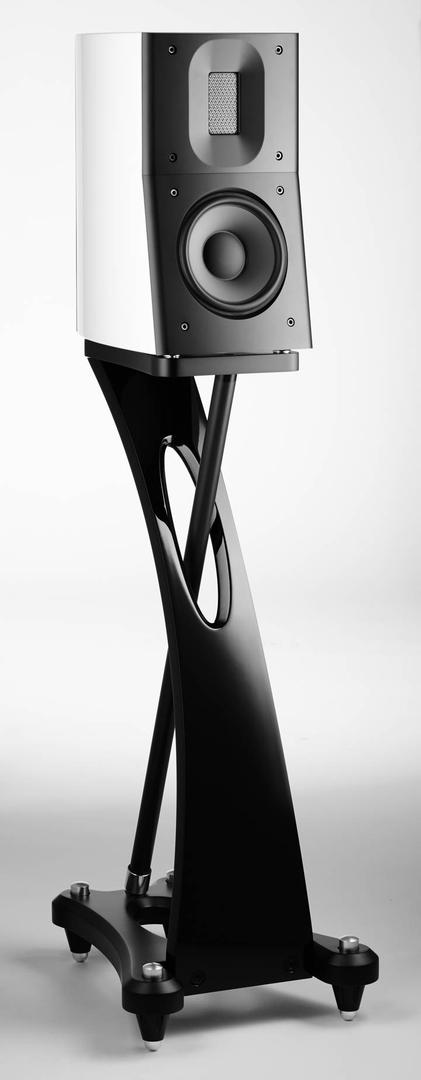
Raidho TD1.2 Standmount loudspeaker

You reach a point in the track ‘Trans-Am’ (on the album Sleeps With Angels) when Neil Young’s guitar takes solo flight, a coda rather than a middle eight, the emotional release valve for the steady, meandering yet inexorable approach to this musical climax. Of course, being Neil Young, it’s not exactly your average guitar solo; all long strings and awkward, angular phrases, it embodies astonishing delicacy and power. Gliding just above and yet totally distinct from the sporadic bass notes, it’s a thing of beauty, as complete as its structure is fragile, the perfect end to a near-perfect song. But just how perfect you’ll likely not realize until you hear it on a really good system – one that tracks micro dynamics and reveals harmonic textures, one that flows with a natural, unforced sense of pace and timing, that gives the music its own voice and concentrates instead on shading the gaps between the notes. In short a system that uses speakers like the really rather remarkable Raidho TD1.2. Even for a brand that has startled and divided the audio community as often and deeply as Raidho has, this speaker is something special.

As a company, Raidho’s history has been short but dramatic, arguably with more than its fair share of twists, turns and narrowly avoided pitfalls. But for all the excitement and drama, one thing has remained constant from (almost) the beginning: since the arrival of the original C1, with its innovative integrated baffle and driver basket and deep, boat-backed cabinet, the brand’s compact, two-way stand-mounts have been consistently the most fascinating and engaging performers in the line. The C1 quickly spawned the C1.1 and later C1.2, while also spinning off in the much more affordable (but sonically nearly as impressive) shape of the Scansonic MB-1. An evolution in cone material resulted in the seriously pricey D1 while the junior X-series offered the X/XT-1 – although that speaker was, somewhat inexplicably, shorn of the boat backed cabinet and much of its visual appeal as a result. Nevertheless, Raidho’s two-ways continued to intrigue and amuse in equal part, their considerable strengths becoming progressively better balanced against their weaknesses with each iteration, until the C1.2 finally nailed the small box tight-rope walk.

 TD1.2_front_No2_5cm_1.jpg

Along with a step-change in performance (and, far from coincidentally) the C1.2 also marked a change in ownership and some welcome financial stability. With Danish electronics conglomerate Dantax holding the purse strings, the Raidho brand has finally started to really deliver on its promise, cleaning up its act, refining its existing technology and entering a period of steady evolution. That evolution has centred on two aspects of the company’s novel driver designs: the mechanical structure and particularly the rear venting have been significantly modified, resulting in substantial improvements in performance, particularly at bandwidth extremes (and resulting in the spectacular new, integrated driver/motor structures first seen in the TD3.8 at Munich last year): the other developmental area has been in terms of driver cone and diaphragm materials and it is the latest cone technology that gives this version of the established two-way its TD prefix – and arguable much of its seriously impressive performance.

Right from the start, Raidho has relied on composite ceramic cone technology, deep treatment of the raw aluminium diaphragm producing a three-layer sandwich, with hard ceramic skins either side of a soft, aluminium core (and a distinctive, almost white colour). That creates a cone with the benefits of stiffness and good self-damping – the twin grails of loudspeaker cone design. But like all composites, the real virtue of the approach lies in the ability to alter or control the sandwich structure in order to tune its performance. The D prefix used on the flagship range denotes a stiffer, lighter, synthetic diamond coating in place of the ceramic skins, but that has now been superseded by a more complex structure that takes the original ceramic sandwich and uses a high-temperature sputter deposition process to deposit a precisely calculated mix of titanium and titanium nitride particles on each side, before that process is repeated to create the final seven-layer sandwich. The goal was to approach the performance of the D-series diamond cones at a more approachable cost. In fact, they achieved a performance that gets awfully close to the D-series drivers in some respects, and actually betters them in others, the seven-layer construction delivering superior self-damping, a lower fundamental resonance and a stiffer overall structure. The new cones, with their sombre, matte grey surface first appeared in the XT variants of the entry level X-series, allowing those speakers to leapfrog (and thus render obsolete) the more expensive C-series. Now, the TD-series steps in to take over from both the C-series and the D-series, extending performance without extending the price of the flagship line.


Looking at the numbers on the TD1.2 and factoring in the company’s claims for its cone technology, it’s easy to predict the nature of the improvements that should result and, for once, those predictions would be pretty accurate. What’s not so easy is to predict their unexpected extent or the degree to which they transform the overall performance of what was (in the shape of the C1.2) already a remarkably lucid and nimble design. Listening to the two speakers in close comparison, I was shocked by the extent to which the familiar virtues of the C1.2 were eclipsed by its more expensive, but outwardly almost identical brother. For all its clarity, crisp leading-edge definition and micro-dynamic discrimination, switching to the TD leaves the C-model sounding lightweight and threadbare. The TD1.2 goes deeper and it does it with considerably more body and weight, producing a richer and significantly more dimensional images and soundstage. Voices gain a chest and stringed instruments their rich, woody body tones, whether it’s John Williams’ guitar on the superb Concerto (JCW3 on his own label) or Ray Brown’s bass on This One’s For Blanton. But whilst I certainly welcome all that added presence and substance, it’s not just the extra weight per se that makes the real difference, but the way that it arrives. If you thought that the C1.2 possessed clarity to burn, wait until you hear the lucid, uncluttered intelligibility of the TD. This isn’t a speaker that simply fires detail at you, depending on pared-away harmonics and ultra transparency. The new driver has lost none of the speed and attack that the C-series drivers possess – but it adds greater precision and a more refined performance, both within and outside the audible band, qualities that help keep all that information exactly where it should be, preserving the pattern of the music, making more sense of its structure and the conversations between instruments. It all comes down to the shape of individual notes. The TD1.2 masters not only the leading edge of the notes, but with the extra weight at its disposal it centres them properly and captures their decay, telling you where the note starts, the way it’s accented and how long it lasts. The Raidho speakers have always leant more towards how the music is being played, with astonishing insight into the performance and technique of individual instrumentalists at the expense of the performance as a whole. The TD1.2 redresses that balance, delivering both greater insight into a player’s technique, but also fitting their contribution into a far more coherent and musically complete whole.

This new, holistic presentation is down to the extra weight and definition at the bottom end, but there’s more to it than that. The sense of a single coherent space and lock-step timing between the musicians is all about the right amount of energy in just the right place, but it’s about the seamless integration of the drivers too – which is where that revised venting comes in, massively reducing the out-of-band resonant peaks for both drivers, smoothing their transition and the easing the load seen by the amplifier. It keeps the trailing edge of notes and their upper harmonics in time and in proportion, keeping the pattern of the phrases and notes stable and ripple-free, the significance of which can’t be overstated. Take the opening passage of the Third Movement in Jan Lisiecki’s performance of Beethoven’s First Piano Concerto. Always a rapid passage, the young Canadian goes at it like he’s trying to set records. The notes arrive so crisply and so closely together that most systems struggle to recover between impulses, the result turning into a blizzard of notes, tumbling over each other. The clarity (and clipped trailing edges) of the C1.2s restored a semblance of order, but still the playing sounds hurried and imprecise. Swapping to the TD1.2 tells you just how wrong that conclusion is. Not only does the grey-coned speaker define the notes AND the gaps between the notes, but it does so with such confidence that the reproduction becomes unforced, the performance masterful. Far from playing right to the limits when it comes to speed, Lisiecki is in fact playing well within himself, the TD revealing not just the precise placement and spacing of the notes, but also their weight and the way he accents each phrase, articulating the lines as a whole. Given the breakneck speed at which all this is happening, the performance of the speaker is almost as impressive as the playing.

That relaxed sense of unhurried music making is invaluable when it comes to enjoying music, any music, at home. Like any speaker, the Raidho TD-1.2 responds to carefully chosen amplification and although the specs and the crisp, clean dynamic response suggest that it would be a perfect partner for modestly powered tube amps, it really comes into its own with several hundred Watts connected to its terminals. A little like the Stenheim Alumine 3, this is a speaker that might not demand power but it sure does like it. The Levinson 585 proven to be a startlingly effective partner, as did the VTL S-200 and the Rowland 625 S2. The power reserves and headroom that these amps provide underpin the speaker’s dynamic capabilities but also allow it to seemingly sit back, safe in the knowledge that it can respond to any incoming demand – something that allows the listener to relax in turn.


Raidho’s latest two-way is the most evenly balanced small speaker they’ve yet produced, adding convincing and beautifully judged body and weight to the marque’s traditional strengths of transparency, speed and clarity. The results are significantly more convincing than those achieved by the D1.1 or the C1.2, but I’d still hesitate to call this a speaker for everyman. Better balanced yes – a genuine all-rounder, not so much. The TD1.2 doesn’t do scale or allow music to swell as convincingly as the Stenheim Alumine 2SE or the Wilson Duette. It lacks the astonishing air and absence of the best diamond tweeters and still sounds a little closed in at high frequencies, but this is a level of criticism that can be applied to any speaker and small stand-mounts more than most. So no, this isn’t a speaker that’s a slam-dunk for every system or every listener. But if you value its special qualities and you get to hear them, then you might well struggle to find an acceptable alternative. Its poised delicacy, intimacy and precision, its unusual combination of relaxed unforced ease and energetic dynamic response make it arresting when it comes to appreciating a musician’s technique, in isolation or in ensemble. Listen and you might discover hidden musical gems in the most unlikely places; listen and you might just discover the heights a great guitarist can reach in terms of musical expression. The TD1.2 might not fool you into thinking you are there, but it sure as shootin’ will make you wish you had been!

TECHNICAL SPECIFICATIONS

  • Type: Two-way rear reflex loaded hybrid loudspeaker
  • Driver Complement: 1× “Quasi-ribbon” planar magnetic tweeter; 1× 115mm Titanium/titanium-nitride coated ceramic cone
  • Bandwidth: 45Hz–50KHz ±3dB
  • Sensitivity: 87dB
  • Impedance: 8 Ohms
  • Dimensions (W×H×D): 200 × 360 × 400mm
  • Weight: 15kg
  • Finishes: Piano black lacquer, Walnut Burl veneer or paint finishes to order
  • Price: from £20,000 per pair

Manufacturer: Raidho

URL: raidho.dk

UK Distributor: Decent Audio

URL: decentaudio.co.uk

Tel: +44(0)56 0205 4669

https://hifiplus.com/reviews/

Wilson Audio Alexx V

Standing 161cm tall, the new Alexx V sits just below the flagship Chronosonic models in Wilson Audio’s range. Alexx V features the ‘open gantry’ design devised for the Chronosonic project, increasing structural rigidity and set-up flexibility. It incorporates Wilson Audio’s proprietary, resonance-eradicating ‘X-Material’, ‘S-Material’ and newly devised ‘V-Material’, combined with carbon fibre, austenitic stainless steel and aerospace-grade aluminium to deliver cutting-edge audio and industrial art.

Alexx V features Wilson’s new ‘Convergent Synergy Carbon’ high-frequency driver sited between 5.75-inch and 7-inch midrange drivers, all individually housed. The 7-inch unit is the same QuadraMag driver featured in the Chronosonic XVX. Bass frequencies are delivered by 10.5-inch and 12.5-inch drivers originally developed for the Chronsosonic project, benefitting from a 16 per cent increase in internal volume compared to the original Alexx.

The Alexx V is fully adaptable to the listening space owing to XLF reversible bass port and individually adjustable high- and mid-frequency modules, delivering exceptional time alignment – a key Wilson Audio speciality.

Wilson Audio’s obsessive attention to detail in the pursuit of perfection is a clear part of the Alexx V project – for example, new Wilson Audio Acoustic Diode spike system incorporating ‘V-Material’, and AudioCapX capacitors in the crossover made entirely in-house.

The net result is claimed to be an astonishingly crisp, clear and dynamic sounding loudspeaker, and said to be capable of immense sonic scale. They are also suggested to deliver a sound so thrillingly realistic, you’ll swear your favourite musicians have dropped by for a private performance.

Price and availability

§  Hand-built in Provo, Utah and finished in Wilson Audio’s automotive-class paint facility, the Alexx V is now available to order.

§  21 ‘standard’, ‘upgrade’ and ‘pearl’ colour options are available, alongside a choice of grille colours. Wilson Audio can also custom-match colours upon request.

§  UK RRP in standard colour options is £139,000 per pair, including VAT and full installation.

Videos

Wilson Audio has created a series of videos about key elements of the Alexx V’s design. Click the links below to view.

§  Alexx V – convergence of nature, science and art

§  Alexx V elements – differences between Alexx and Alexx V

§  Process of handcrafting Alexx V gantry

§  Wilson Audio Acoustic Diode spike system

UK contact for consumers

Absolute Sounds – sole UK distributor of Wilson Audio loudspeakers

W: absolutesounds.com T: 020 8971 3909

Linn Klimax DSM

Linn announced this new product during some downtime on our site. Our apoligies for the delay. We have a Linn Klimax DSM in review for our 195th Issue (out early May in the UK, early June in the US), but early indications suggest it’s a real step-change in streaming audio.

26 March, 18:00 UTC: Linn today launches next-generation Klimax DSM, the ultimate streaming product and the closest you can get to streaming audio perfection. Applying almost five decades of digital technology learnings and expertise, every element has been designed from first principles and is fully optimised for the best musical performance. 

A complete reimagining of its flagship streamer, the new Klimax DSM introduces an exquisite custom-designed enclosure that provides acoustic isolation along with visual and tactile luxury. Crucially, the enclosure cradles the beating heart of Klimax DSM and its most critical component, Organik DAC – the ground-breaking, first ever, all-Linn digital to analogue converter.

Gilad Tiefenbrun, Linn Managing Director, said, ‘New Klimax DSM is the ultimate embodiment of Linn’s passion for music and is as close as you can get to streaming audio perfection.​ We’ve approached every single element with exacting attention to detail, inside and out, to ensure it’s optimised for performance in every way. 

Since launching Klimax DS in 2007, Linn has invested substantially in people, skills and manufacturing capability, and we’ve brought that together to create our new flagship streaming product featuring the first home-grown all-Linn DAC.

Organik is a momentous achievement for Linn, making next generation Klimax DSM our most natural sounding product ever. Combined with a new level of precision machined casework, and stunning visual and tactile interfaces, it’s the epitome of extreme engineering.’ 

Organik DAC: The beating heart 

Designed without compromise and manufactured entirely in-house, Organik DAC is the culmination of five decades of audio innovation and three decades of digital technology expertise. 

It has been developed from first principles and combines FPGA processing with a discrete conversion stage, enabling Linn to precisely control and optimise every stage of the digital to analogue conversion process for the first time.

The powerful FPGA processing stage uses custom-designed algorithms to provide increased upsampling, more precise volume control, and distortion free modulation. Its partnering discrete conversion stage renders the analogue signal with extremely low levels of distortion thanks to a new ultra-low jitter oscillator and carefully designed clock distribution network. These are cleverly combined within a unique double-sided design which reduces signal paths to an absolute minimum.

Employing decades of experience in optimising circuit design, every component has been selected, designed and laid out by a Linn engineer and populated on a Linn circuit board at the factory in Glasgow. Investment in the latest Surface Mount Manufacturing technology has enabled further refinements to circuit board population techniques, including smaller component placement to tighter tolerances, as well as the use of cutting edge vapour phase ovens to ensure zero oxidisation of the soldered contacts on the boards.

Organik offers significantly lower noise and distortion, measuring better than anything Linn has achieved before. It expertly performs the digital to analogue conversion to achieve the most accurate re-creation of the original music signal, revealing even more of the tiny details that provide a closer emotional connection with the music.

With Organik DAC on-board, Klimax DSM sets a new benchmark in music streaming for the ultimate musical experience.

Extreme Engineering

Advanced new in-house manufacturing technology has enabled Linn to precision engineer the new casework to exceptionally unforgiving tolerances. Every aspect of the exquisite custom-designed enclosure plays a crucial role in preserving the original musical detail while exuding a luxurious look and feel.

Machined from solid, special grade aluminium, the striking design takes on a fresh new Linn DSM family look while retaining the distinguished and much-loved signature Klimax character.

The sheer mass of the product, coupled with internal damping, isolates it from vibration in the room, and precision-cut pockets and partitions separate the analogue, digital and power stages, fully protecting the electronics from any interference within. 

The diamond-cut circles on the upper surface echo the grooves of a record, paying homage to Linn’s iconic Sondek LP12. The dial is rendered in the highest quality materials, from the turned brass bearing celebrating its provenance while creating the smooth handling of the precision-cut glass, to the photo-etched stainless steel surround that encases each of the 100 status lights.

Connected for the best possible sound

The exceptional audio performance of Klimax DSM with new Organik DAC, including support for up to 24-bit 384khz and DSD256 audio resolution, will give all streaming and connected digital, analogue and wireless sound sources a new lease of life.

Connected analogue sources will also enjoy an extra benefit thanks to a brand new higher performance, lower distortion ADC design which has its own circuit board with dedicated power supply, while Exakt Link ports enable direct connection of an LP12 with Urika II.

A USB input enables direct connection to a computer for the ultimate performance stand-alone DAC.

Built-in wireless connectivity enables convenient connection of sources via WiFi or Bluetooth.

Additionally, the AV variant offers HDMI inputs and again uses Organik DAC to enhance the performance of all connected AV sources. It also provides eARC for Smart TV support.

Linn DSM Family

Next generation Klimax DSM adds to the family line-up of Klimax DSM, Selekt DSM and Majik DSM, to offer three highly distinct offerings with a shared family aesthetic. With its striking new design, Klimax DSM clearly sits at the very top of the range.

Products

The two Klimax DSM variants provide choice depending on listening preferences. Klimax DSM (Audio) is for those wishing only to connect music sources. Klimax DSM (AV), with its HDMI connections, provides an enriched listening experience from movie sources as well.

Those seeking the highest performance from a complete Linn system, should opt for the new Klimax System Hub. It’s housed in the same exquisite new enclosure as next generation Klimax DSM so benefits from improved acoustic isolation. It also includes the new, improved ADC, and in terms of connectivity, offers all the same inputs as Klimax DSM (AV) variant, including the option to upgrade with surround capability.

The powerful pairing of Klimax System Hub plus Klimax 350 speakers or Klimax Exaktbox, both with the new Organik DAC on-board, delivers a result that’s out of this world.

Linn has also released a LinnCast of the launch: https://youtu.be/XqltfThkcDc 

There are also a collection of videos highlighting key aspects of the new Kilmax DSM: https://vimeo.com/showcase/linn1973

Pricing and availability

Klimax DSM is available to order immediately from Linn Specialists worldwide. 

Book a demonstration here (local restrictions permitting): www.linn.co.uk/try-linn

Klimax DSM (Audio)

£30,000

Klimax DSM (AV)

£30,000

Klimax System Hub

£15,000

Supported trade-in offer

Existing Linn customers can trade-in their existing Klimax DS, Klimax DSM or Klimax System hub with supporting trade-in options available from their local Linn Specialist.

Organik DAC for Exaktbox & Klimax 350s

New orders of Klimax 350 speakers and Klimax Exaktbox and will ship with Organik DAC as standard, providing a fantastic performance boost for new customers. They are available to order now with shipping taking place from April.

An Organik DAC upgrade is also available for existing Klimax Exaktbox and Klimax 350 owners.

Klimax Exaktbox with Organik DAC

£15,000

Klimax 350 Speakers with Organik DAC

£57,500

Organik DAC Upgrade for Klimax Exaktbox

£5,400

Organik DAC Upgrade for Klimax 350 Speakers

£10,800

FIRST LISTEN: PARADIGM MONITOR SERIES 7 SPEAKERS

The Canadian speaker manufacturer Pardigm pursues technology trickle-down not just as a design philosophy, but almost as a religion whose “articles of the faith” require that each new series of loudspeakers will be more sophisticated and better sounding than the last—and often without any increase in price. It’s a cool system that, I think, perhaps helps Paradigm win customers for life. For a great example of what I’m talking about, you might want to consider the firm’s new Monitor Series 7 lineup, which in many way adopts technologies and design approaches previously seen only the firm’s more costly Reference Studio-series speakers.

Playback and The Perfect Vision are jointly in the process of working up a review involving several new Monitor Series 7 models, including a complete Monitor surround system based on the flagship Monitor 11 floorstanders (estimated FMV, $799 each), but for starters we thought we would take a look at a stereo pair of Monitor 11’s, since that flagship model incorporates essentially all of the technology changes that other Series 7 models will receive.

What makes the Monitor Series 7 lineup special? I suppose one answer would be to say that, just a few years back, today’s new Monitor Series 7 models could easily have passed for earlier-generation Studio models. But let’s get down to specifics; changes found in the new Monitor Series 7 speakers include:

•New slim-line cabinet designs said to reduce model footprints by about 20%.

•An all new plinth design that accompanies the slim-line cabinets, providing plenty of stability while—at least in the case of the Monitor 11—creating the visual illusion that the main speaker cabinet is “floating” about ½” above the plinth.

•A complete baffle redesign where finite element analysis (FEA) was used to “remove resonances and vibrations” while also significantly improving cabinet rigidity/solidity.

•A grille frame redesign (something I personally welcome, since I was never completely happy with Paradigm’s old grille frames), where grilles use self-aligning magnetic fasteners (Hallelujah, no more mounting posts to break off or unsightly mounting holes in the front baffle), plus—and this is the really slick part—a new “honeycomb interior corner architectures” said to “prevent sound capture in grille corners” and to ensure “acoustic integrity remains intact whether speakers are played with grilles on or grilles off.”

•The new Monitor 11 is now the size of the Monitor 9 Series 6, but nevertheless steps up to become a three-way, 5-driver design (where the old Monitor 9 was a 4-driver design).

•Driver technology now appears to be drawn directly from the playbook of Paradigm’s more costly Studio models. Hence, the new Monitors get:

– S-PAL (satin anodized pure aluminum) dome tweeters, which are now fitted with waveguides and a protective metal mesh guard.

– S-PAL midrange cones (as compared to polymer cones in the old Monitors) fitted with Studio-derived lightweight foam rubber surrounds, high-temperature voice coils, and—in the Monitor 11—super neodymium magnets.

– Carbon-infused co-polymer polypropylene bass cones with the same motor tweaks as found in the midranges drivers.

•Greater sensitivity and deeper bass extension are promised for all Monitor Series 7 floorstanders.

In keeping with longstanding Paradigm practice, the changes seen in the new Monitor Series 7 range are more evolutionary than revolutionary, but when you make a bunch of small, positive changes in unison, the net effect can be surprisingly dramatic, as I discovered after unboxing our review set of Monitor 11 towers.


First Impressions: Paradigm Monitor 11 v.7 Towers

Right out of the box, I was struck by both the smoothness and nuance of the Monitor 11’s. In the olden days, metal drivers were often regarded as mixed bless, offering great transient speed and rigidity, but also carrying excess sonic baggage in the form of unwanted resonance (or even, horrors, outright ringing). At Paradigm, those days are long gone, so that you now enjoy the benefits of metal driver technology with essentially none of the potential penalties. Perhaps as a result, the 11’s sound quite refined and sophisticated (if I heard them in the dark and was told they were Paradigm Studio models, I might well have believed that assertion).


To give you some idea of just how nuanced the Monitor 11’s are, let me say that they are revealing enough to make child’s play of side-by-side comparisons between different DACs, making even very subtle differences between competing DACs easy to hear (which is more than can be said for many mid-priced speakers).

Next, I found the speakers remarkably easy to drive. I decided to power them with Peachtree Audio’s terrific new iNova integrated amp/DAC/dock, and found that, if anything, the iNova seemed to have more clout than the Monitors really required. In truth, Peachtree’s lower-output iDecco amp would probably have been more than enough to make the Monitor 11s “sing.” The high apparent sensitivity of the Monitor range bodes well for those who may want to drive it with a comparatively low-powered (though for obvious reasons, high-quality) AVR in a home theater setting.

Finally, I could not help but note that the Monitor 11’s offer a really nice combination of bass extension, power and control. The only potential “hitch” I can see is that the 11’s, which feature dual rear-firing ducted ports, may actually have more bass oomph than is necessary (or even desirable) for some rooms. The good news, here, is that I think you could build a perfectly satisfying Monitor 11-based surround rig without needing a subwoofer. Nevertheless, I do think Paradigm might to well to borrow a trick from the Monitor Audio game and thus to supply the Monitor 11’s with foam port-damping plugs (Monitor calls them by the British term, “bungs”) to help trim bass output in smaller room settings.

As I get more experience with the speakers, and then try them in a full-on surround system, I’ll report my findings in a full-length review soon to appear on this site. But until then, just know that the new Monitor Series 7 models are the best yet from Paradigm, and carry forward their tradition of sonic sophistication and value for money.

Happy listening.

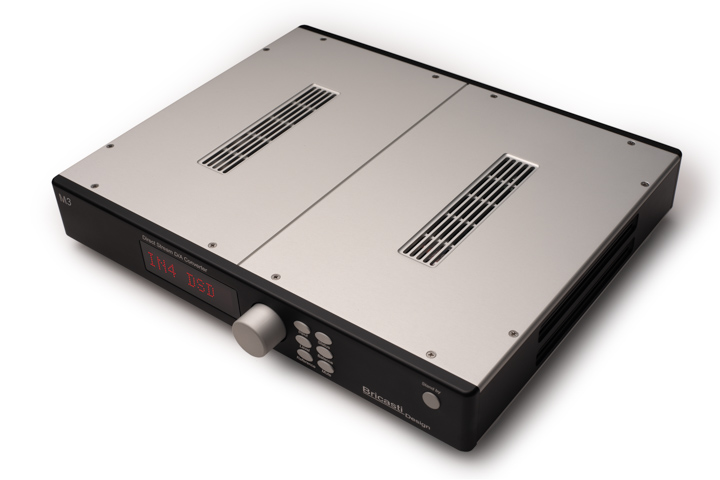
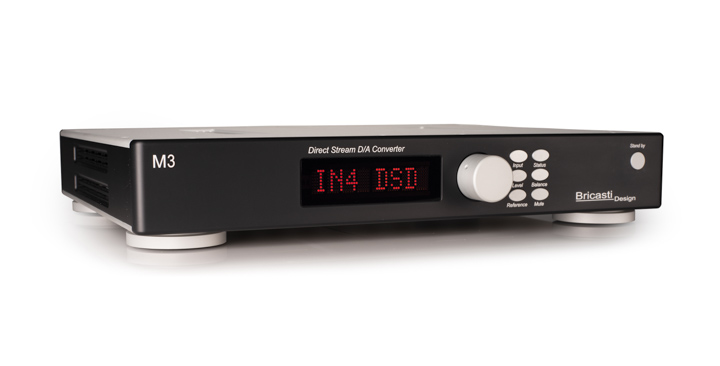
Bricasti Design M3 DAC

I am going to go out on a bit of a limb here, but the Bricasti Design M3 DAC is very probably The Shape Of Audio To Come. This clever design is incredibly flexible; starting as ‘just’ a high-performance DAC, the M3 can be configured with built-in streamer and/or headphone amplifier. Rather than either produce a slew of ‘similar-but-different’ products or force users down digital audio and personal audio pathways they might not want to take, the Bricasti Design M3 DAC lets you – the end-user – take control of what features you need and what ones you don’t. In an industry that prides itself on its ‘bespoke’ approach, it’s odd that such options are so rare that they take up the introduction of a review. Maybe the Bricasti M3 learned the ‘options’ game from its BMW namesake.

The core of the Bricasti M3 is actually two cores; a Delta-Sigma DAC for PCM processing and Bricasti’s own one-bit modulator for DSD. The digital and analogue sides of the M3 (no matter what configuration) are fed by two completely independent linear power supplies. The M3 is fed by a solid array of digital audio connectors and outputs to equally solid balanced and single-ended analogue connections. If you go down the headphone amp route, there is a 1/4” singled-ended jack and a single four-pin balanced XLR socket.

Once again irrespective of DAC options you go for, there is a sophisticated level control flanked by six hard buttons on the right and a ‘read it from space’ red LED array on the left. Operation is a little ‘modal’ as a result (press input button, turn knob until correct input selected, push knob and return to base state), but navigating these modes is a lot less complex than, say, the paged menu tree on a digital camera, for example. It’s also aided by that surprisingly informative (for the relatively limited amount of text it holds) display, and any potential confusion can be either made clearer or opaquer in the thorough manual (clarity/opacity largely dependent on the user’s ability to comprehend the comprehensive).

Everything about the Bricasti M3 exudes a no-nonsense studio approach. If it were any more solidly built, it would be named after an American general and have a gun turret on its top plate. If the anodised front panel was any thicker and blacker, matter would be collapsing into it. It looks, feels, and behaves with all the assured unburstable reliability of professional equipment that leads a long and arduous life in the studio. So, the relatively pampered years a Bricasti M3 will spend on a domestic equipment stand, are little more than a breeze to this bomb-proof DAC.

We went with the full-fat M3 with all the trimmings. Well, most of the trimmings; we went with the headphone and streaming options but didn’t include the optional remote control. I think this will be the likely divide; personal audio users will use the M3 at arm’s length and never find need for a remote, while those who use it as a DAC or streamer in a system on the other side of a room will welcome that functionality… but might not include the headphone amp.

The streamer board is functional if deliberately basic. It’s a wired-only DLNA network player, being fed music by server software on another device (typically a computer running JRiver or Audirvana). It’s not a media renderer, and isn’t Roon Ready, but if you use Roon, the M3 will be detected as an End Point. While this means there is no Bricasti-designed (or third party) software to control the M3 on a network, it also means there’s no need for such software and the M3 is about as robust a network attached device as it is possible to get in audio.

The headphone amplifier is similarly ‘belt and braces’ in approach. It’s a cost option because – like the streamer – it’s an independent circuit in its own right, with a fully differential amplifier stage, commoned for the 1/4” jack socket. This version (with or without streamer) is notionally called the ‘M3H’ by Bricasti and ‘the M3 with the headphone amp’ by everyone else. It’s a £679 upgrade on the base price of the M3.


The only downside to the options laid out here is they are not retrofittable. You specifiy the options at point of purchase, rather than an upgrade path. I also feel having the M3’s remote as a £549 cost option is a bit too ‘spendy’ no matter how well built the handset and how brilliantly it functions.

Interestingly, although the DAC features both balanced and single-ended outputs, if it’s at all possible, go with balanced. The difference in performance is marked and more than justified. Single-ended is in no way the poor relation here, but the DAC sounds just better enough through balanced connections to justify their use wherever possible.

The M3 follows the sonic line developed in the cost-no-object M1 and subsequent devices from Bricasti. In simple terms, the M3 takes the sound of the studio, brushes its hair and invites it home to meet the parents. The M3 has all the precision and leading-edge resolution, all the detail and imaging you might hear in the control room of a studio, but without that uncomfortable feeling of being exposed to all that necessary but intense analysis of mix and music that takes place from the engineer’s seat. From our comfy listening positions, we often claim we want the unvarnished truth from our audio systems, but in reality, that truth makes listening an uncomfortably intense experience. What we actually want is one or two notches back from the fully analytical presentation and instead want something resolving but allowing hour after hour of listening. And that is where the M3 shines.

I spun up all those usual test recordings of mine – Joyce DiDonato, Rachmaninov’s Symphonic Dances, John Pickard’s The Flight of Icarus, Jackie McLean, Malia and Boris Blank, King Curtis… the ‘go-to’ tracks on the ‘go-to’ albums I use to assess audio fairly rapidly. Each one effectively relates to its own sonic ‘tick box’ (King Curtis is a rhythm check, Joyce DiDonato tests for microdynamic shading and vocal clarity, and so on). And each received a solid tick or two when played through the M3. This means all the basics of what constitutes good audio (detail resolution, dynamic performance both on the large-scale and small-scale level, vocal articulation, coherence, frequency extension and accuracy, rhythmic consistency, bass depth and grip) all passed musical muster.

In most DACs, that alone would be a solid recommendation. One might expect a little more character and ‘savoir faire’ from the ‘pinnacle of performance’ DACs, but if all you get is all of those musical waypoints passed, you’re already in the top percentiles of DACcy goodness. And in truth, I expected the M3 to top out around here.

What I didn’t expect is the additional fluidity and full-bodied sound that the M3 also brings to the musical party. Moving on past those test tracks to the title track from Lana Del Ray’s Norman F***ing Rockwell! [Polydor, Tidal], the sense of organic flow and sheer enjoyment makes you hungry for more. That fluidity is normally the preserve of the highest of high-end DACs, and here it just makes even 21st Century production values more inviting and listenable.


Headphone listening is similarly first-rate through the M3. It’s infinitely capable (if you hung a pair of house bricks on a headband, the M3 would make a fair stab at getting them to sound good) and uniformly detailed, with a terrific sense of grip over the musical replay, and surprising levels of deep, yet extremely well-controlled bass as a bonus.

The Bricasti M3 is the cheapest product in the company’s line of DACs (the M5 network streamer is cheaper still but is of limited functionality). While that still doesn’t make it ‘cheap’ I feel the need to point that out because by almost any other company’s plan, a product this well-made would be at the pinnacle of the line-up. The fact Bricasti takes the digital converter to yet higher levels shows just how seriously the company takes digital audio, and right here in the M3 is the distillation of that intent. While in part a product of trickle-down technology from the epic M1, the M3 is also a damn good DAC in its own right. That it brings the kind of modularity hitherto seen in companies like Primare is the icing on the cake and shows Bricasti means business.

TECHNICAL SPECIFICATIONS

  • Digital Inputs XLR: AES/EBU 24 bit, RCA S/PDIF
  • Optical: Toslink 44.1– 96k, USB 2
  • RJ45: Ethernet (Optional)
  • Sample Rates: AES, S/PDIF: 44.1 kHz, to, 192khz, DSD 64fs as DoP. USB: 44.1 kHz, to, 384kHz, DSD 64fs, 128Fs, 256Fs as DoP. Ethernet: 44.1 kHz, to, 384kHz, DSD 64fs,128Fs, 256Fs as DoP
  • Jitter: 8 psec @ 48k / 6psec @ 96k
  • Dimensions (W×H×D): 14” × 11.25“ × 2.5”
  • Weight: 4.5kg
  • Price: From £5,395

Manufacturer: Bricasti Inc

URL: bricasti.com

UK Distributor: SCV Distribution Ltd

URL: scvdistribution.co.uk

Tel: +44(0)3301 222500

https://hifiplus.com/reviews/

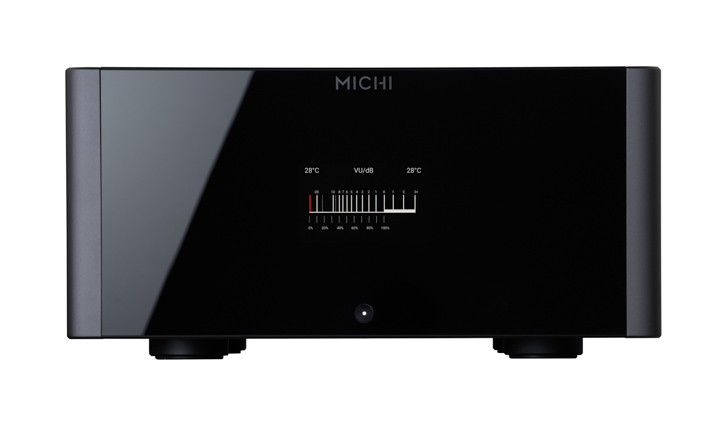
Michi P5 preamplifier and S5 power amplifier

Rotel is one of those companies that doesn’t often grab the headlines much these days yet it has a heritage stretching back over 50 years. In the late 1980s, its entry level integrated amplifiers had a great reputation for delivering better sound than most thanks in part to UK design input that gave it an edge. This approach was duplicated by other Japanese brands with the Pioneer A400 being a notably successful example. In the mid-1990s, Rotel introduced some rather more lavishly built models that it dubbed Michi. These electronics had wooden end cheeks and resembled Japanese high end to a far higher degree than anything seen in its range before.

Last year, three new Michi models were introduced that are devoid of the Rotel brand and have distinctly different styling. They are also enormous. Both physically and in terms of mass, the S5 stereo power amplifier weighs in at nearly 60 kilos which is ‘big boned’ even for 500 Watts per channel. Yet its sleek styling does not quite match the muscle amp expectations that this figure suggests, neither for that matter does its sound but I’m getting ahead of myself. The weight is largely down to the power supply, which is dual mono like the rest of the amplifier and uses the largest bulk foil capacitors I have yet encountered. Even an image of the internals from above doesn’t really hint at the true girth and height of these things, but when you consider that the 2,200 Volt-Amp toroidal transformers are contained in the boxes marked Michi it gives a better idea of the scale than the 47,000 uF rating for each, unless you’re an engineer. The black aluminium extrusions on either side are heat sinks; square section tubes that have 16 high-current output transistors on the outside and fans to keep air moving. This is a slightly controversial approach in high end audio but these are extremely quiet fans, I did hear them once or twice but only when they switched off and there was no music playing.

They succeed in keeping the large heatsinks on the sides of the case relatively cool or at least they did at the levels I was using them, if you really hammered the amp into some ‘deaf’ speakers all that metalwork might come in handy. Like the early Michi amps this has had some UK design input, this time from long-time associate Bowers & Wilkins’ research and development team in West Sussex. The styling is also British courtesy of Goodwin and Hartshorn who work on loudspeakers for Bowers, they have made the back panel a lot more coherently arranged than usual with inputs above output connections and attractive extrusions on the cooling outlets. The glass front panel looks a little plain without its full set of landing lights in shape of the elaborate graphic display; you can run it like this but there are a variety of things it can show including power output in graphical form with the option to zoom into the meters so that you can see some movement even at lower outputs. There are various functions that can be changed in the display including auto power off time, display brightness etc. Changing the display is done with an RF remote handset, the same handset that controls the matching P5 preamplifier but fortunately careful pointing means you can change the power amp without upsetting the pre.

Connection to the preamp is via balanced or single ended cables and speaker connections can be made to either or both of the terminals for each channel, enabling easy bi-wiring should that appeal. There’s also a trigger connection for the preamp making it easier to switch both on and off with a single button.

The P5 preamp has what can only be described as a wealth of features, including but not limited to a digital to analogue converter, MM/MC phono stage and Bluetooth reception. It even has tone controls and supports MQA, not to mention line level inputs on RCA and XLR connectors. There might be a more fully equipped stereo preamplifier on the market but not at this price. If I were to nitpick I’d say it’s a pity there’s no load adjustment for the MC input and perhaps some filter options for the DAC but this is being churlish given that it not only has sub and line outputs as well as digital and headphone outputs, and a USB A connection for charging purposes. There’s also an RJ45 socket but this is for network installation rather than streaming. The display allows for a huge variety of configuration including input naming, setting an input for AV bypass, balance and signal sensing. The only apparent omission is gain setting for individual inputs.


Driving Bowers & Wilkins 802 D3 loudspeakers the Michi pairing sounds a lot more relaxed and cuddly than you might expect given its power and bulk. The S5 is not a brute in a smart box; it’s a gentle giant that exudes a quiet confidence. The vibe is ‘doesn’t have to try too hard,’ which makes for easy listening at both low and high levels, using the USB input you get weighty bass with precise but not overemphasised leading edges.

Moving over to the coax input with the same AURALiC ARIES G1 streamer as source results in a more subtly graduated result with layers of detail presented over a solid and grounded soundstage. Reverb is well defined as are voices, both being delivered with decent energy and life when it’s called for. Patricia Barber’s ‘Company’ [Modern Cool, Premonition] has a hefty bass line that is kept well in line but allowed full headroom by the Michi combo, it’s one of those tracks that many amps struggle with but here the serious power on tap made sure that the music came first. Which meant that the trumpet solo had impact without any sense of glare and the drums delivered power and dynamics without the system breaking a sweat.

I gave Bob Dylan’s latest a spin [Rough and Rowdy Ways, Columbia] and these amps projected his well worn voice with considerable precision, resolving its croakiness without letting it get in the way of the narrative of the song. The opening track doesn’t really live up to the promise of the album’s title but that won’t bother Dylan fans. I played a few new albums on Qobuz and was impressed with the amount of differentiation it brought to them, systems that homogenise the sound of different recordings are doing them a disservice and masking the important details, that doesn’t seem to be the case here. The only constant seemed to be a polished glow which might be more to do with the streaming service because Tidal sounded more gritty and transparent. This could be down to bit rate variations but the point is that the Michis let you hear whatever is coming through, good or less so.

Using the MC input with a Rega Aphelion 2 cartridge didn’t really do justice to this remarkable transducer and it’s fair to say that owners of high end vinyl sources will be better off with standalone phono stages. Switching to a Tom Evans Groove SRX phono stage proved as much while revealing that the line inputs here can do depth of image while producing a fine mellow groove with an appropriately relaxed slab of vinyl.

With a pair of PMC fact12 Signature speakers in tow the result was equally engaging, this speaker’s relatively smooth demeanour doesn’t suit the Michis quite so well but offers up plenty of texture, space and all round character from various recording. I particularly enjoyed both Tom Waits and Conjure with the combo but did feel that it needed a little more leading edge definition. I tried a different speaker cable in Chord Co Sarum T which opened things up and added some pace to good effect albeit not delivering the 3D solidity that the Michis managed with Townshend Fractal F1. As ever with amps and speakers it’s a balancing act.


The return of Michi to the marketplace is most welcome, it adds a high end to Rotel’s offering and a pair of superbly built amplifiers to the market. The sound is as rounded as the casework if not thankfully as dark, anyone looking for a strong feature set with an even handed, powerful yet relaxed presentation should put them on the short-list.

TECHNICAL SPECIFICATIONS

P5 preamplifier

  • Type: Solid state preamplifier with DAC and phono stage
  • Digital inputs: Three SPDIF inputs (via coax), three SPDIF inputs (via Toslink), USB input
  • Analogue inputs: Two pairs of balanced (via XLR connectors), three single-ended (via RCA jacks)
  • Analogue outputs: Two pairs of balanced (via XLR connectors), two pairs of single-ended (via RCA jacks), one pair of single‑ended line (via RCA jacks), one pair of single-ended pre (via RCA jacks), two single-ended sub (via RCA jacks)
  • Headphone output: via 6mm jack
  • Input impedance: RCA 47 kOhms, XLR 100 kOhms
  • Output impedance: RCA 470 Ohms, XLR 100 Ohms
  • Distortion: THD (20Hz–20kHz) <0.002%
  • Signal to Noise Ratio: Line inputs 116dB, digital inputs 100dB, phono input 80dB.
  • Dimensions (HW×D): 150 × 485 × 452mm
  • Weight: 22.9kg
  • Price: £3,299

S5 power amplifier

  • Type: Solid state stereo power amplifier
  • Analogue inputs: One pair of balanced inputs (via XLR connectors), one pair of single ended inputs (via RCA jacks)
  • Analogue outputs: Two pairs of speaker taps (via 5-way binding posts)
  • Power output: 500Wpc @ 8 Ohms, 800Wpc @ 4 Ohms.
  • Frequency response: 20Hz–20kHz (+0dB, -0.15dB), 10Hz–100kHz (+0dB, -0.4dB)
  • Input sensitivity: Single ended (RCA): 2.6V, balanced (XLR): 4.2V
  • Distortion: THD <0.008%
  • Signal to Noise Ratio: 120dB (A weighted)
  • Dimensions (H×W×D): 238 × 485 × 465mm
  • Weight: 59.9kg
  • Price: £5,399

Manufacturer: Rotel

URL: rotel.com

UK Distributor: Rotel Europe

Tel: +44 (0) 1903 221 710

https://hifiplus.com/reviews/