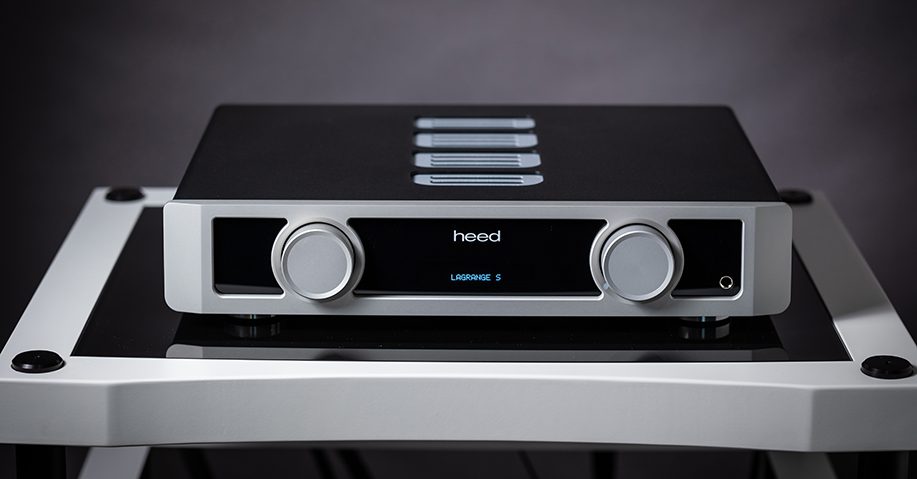
Not long ago I hosted the Heed Audio Elixir integrated amplifier and was thoroughly beguiled by its musicality and was astonished that such a diminutive enclosure could produce such a full sound. Fast forward to a little earlier this year and an approach from the UK distributor for the Hungarian brand, TFT Distribution, to see if I was interested in test driving the Elixir’s bigger sibling, the Lagrange S integrated amplifier. No second invitation was required, and the Lagrange S was delivered in person by TFT Distribution’s founder, Toby Allen.
At the heart of Heed Audio’s amplifier design philosophy sits something which they call Transcap, or in its long form, tuned non-direct coupled amplifier technology. I am neither an electronic engineer nor a physicist, but there is a very readable explanation of what Transcap is on Heed Audio’s website. It also explains why it is so influential on the sound generated through a Heed amplifier.
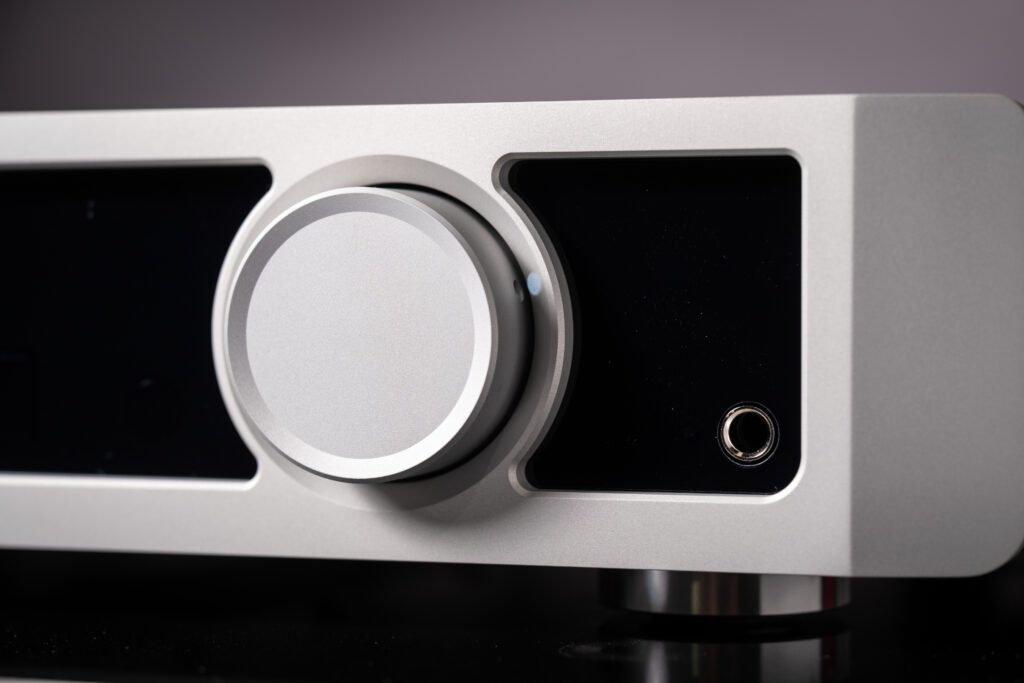
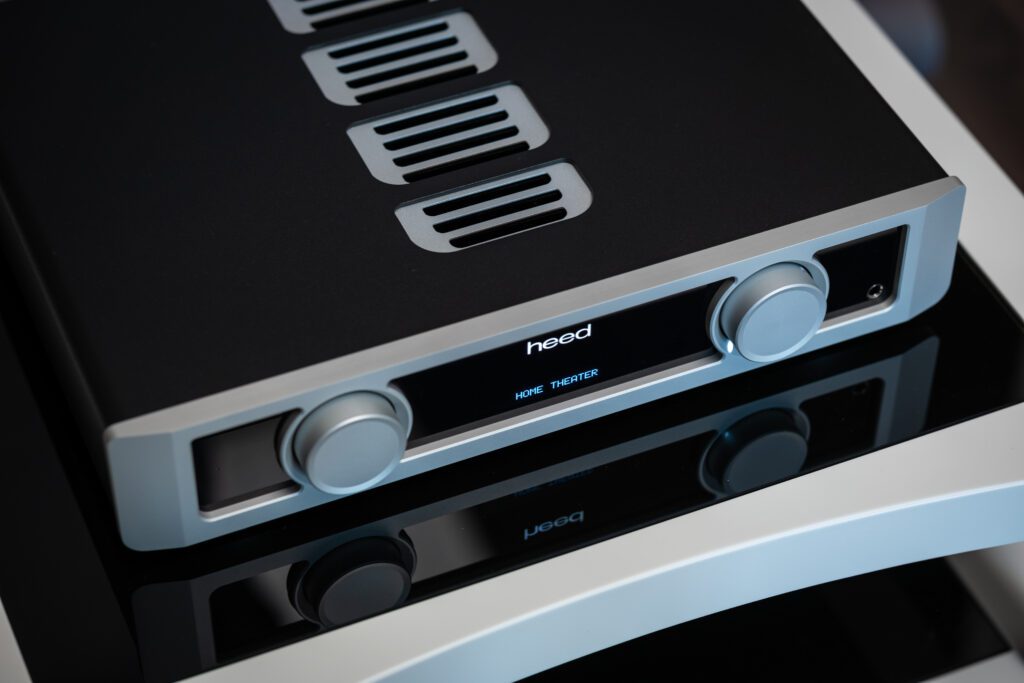
Meanwhile, let me describe what lies within and without the elegant full-width metal enclosure. First of all, upon unboxing, one finds a reasonably hefty 15kg machine, with dimensions of 43x9x36cm. The fascia is beautifully symmetrical, with large dials to the left and right of a central monochrome display taking care of volume and source selection, respectively. To the right of the selector dial is a full-size headphone jack.
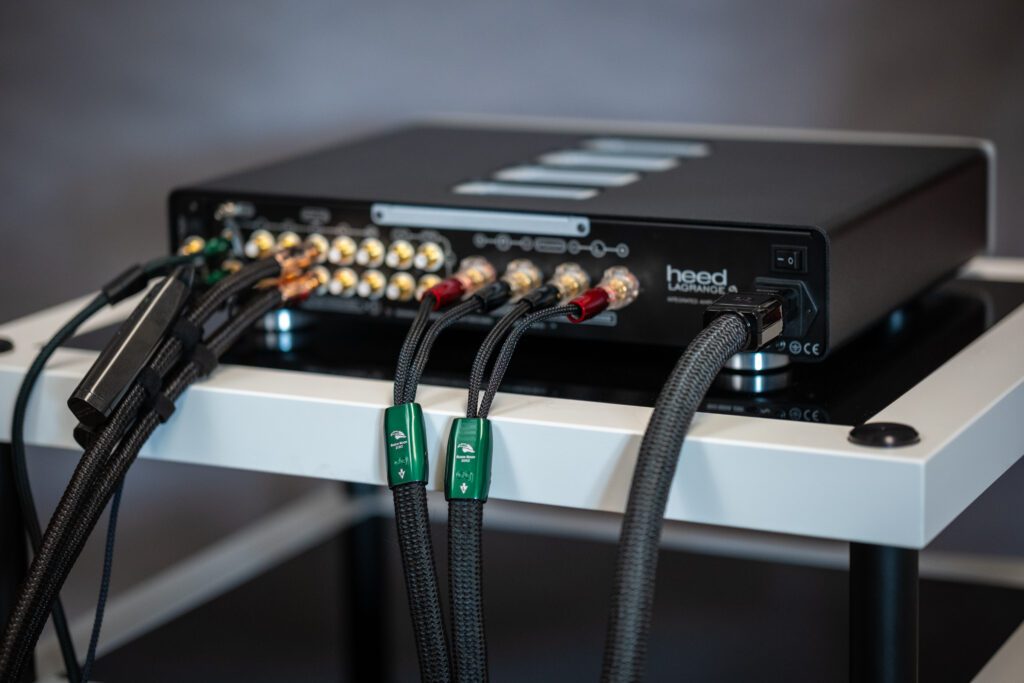
The top of the casework has a series of vents along the centre line to help keep the unit cool. The rear panel sports an array of RCA terminals. On the left-hand side is a grounding post and pair of terminals giving access to the Moving Magnet phono stage, then four pairs of analogue inputs are available. Next is a pair marked HT, allowing the Lagrange S to be integrated into a home theatre system. The next two RCA pairs are marked Line Out and Pre Out. Adjacent to those are two pairs of multiway speaker binding posts, and last but not least the IEC power input socket with an on/off rocker switch above it.
Heed Audio rates the output of the Lagrange S as 60Watts into 8 Ohms and 100Watts into 4 Ohms.
Options? Not yet!
There is an optional DAC module available for Lagrange S, fitted with inputs for USB, Coaxial and Tousling optical connections, but the review copy was an all analogue affair, which allowed me to concentrate on vinyl replay from my Linn Sondek LP12 with the Vermeer Dark Sabre moving magnet cartridge fitted into its Ittok arm, and analogue replay from my Yamaha CD-S3000 SACD/CD player and DAC. Our television was connected to the Yamaha via optical cable and my AURALiC ARIES Mini streamer (with some Network Acoustic enhancements) via coaxial.
During the review period I switched between my different Harbeth Audio loudspeaker set-ups. I have my P3ESRs sitting atop the new Harbeth Nelson stands-cum-bass enhancement units, and my larger Compact7ESXDs on their Hi-Fi Racks Fortis stands.
I used AudioQuest Robin Hood loudspeaker cables and Pegasus RCAs to connect the Yamaha, and the Linn tone-arm cables to access the phono stage.
Listening to the Lagrange S
As the Lagrange S already had a good few hours of use prior to its arrival, I started as I often do with Dave Alvin’s excellent album Eleven Eleven streamed in HiRes from Qobuz. As the opening track unfolded, Alvin’s gruff baritone and wonderful Stratocaster sound filled the room. This recording has a very live feel to it and the Lagrange S recreated that atmosphere with a spine-tingling sense of realism. The Lagrange S encourages the listener to edge the volume ever higher and I only realised just how loud I had been listening when I had sat through the entire expanded album. I was immersed in music.
From that first introduction the Lagrange S gave me no cause to allow my mind to wander – it commands the listener’s attention every time it is in use.
I played several more albums from my Qobuz ‘My Favorites’ section, starting with the rather more raucous tones of the Struts and their 2020 Strange Days album. I should here disclose a certain parochial pride in this band hereabouts, as their frontman Luke Spiller is from this area and comes back whenever his busy schedule and LA domicile permit. This is great rousing arena rock stuff, and young Mr Spiller leads his band with great panache. Inevitably those of us of a certain age will hear echoes of the Faces and even the Rolling Stones in the Struts but this no pastiche. These guys really rock and through the Lagrange S and my Harbeths they were invigorating – raunchy and energetic but with a real sense of both melody and rhythm. Once again the Lagrange S urges the listener to nudge up the volume, and it would have been churlish to refuse.
After warming things up via streaming I switched to the moving magnet phono input and having been put in a Stones riff frame of mind cued up my original copy of the Rolling Stones classic live set Get Yer YaYas Out! This was the Stones golden era and through the Dark Sabre/Ittok/LP12 I was catapulted back through time somewhere near the front of the crowd in Madison Square Garden to be carried away in that intoxicating mix of the twin guitars of Keith Richards and Mick Taylor, underpinned by the exemplary bass of Bill Wyman and Charlie Watts’ drumming. “Charlie’s good tonight” quipped the mesmerising high priest of all front men, Michael Philip Jagger. The nine minutes of ‘Midnight Rambler’ pass by in no time, the menace feels real and that change of tempo still has the power to make me smile. I think we can safely say that the Lagrange S can rock even through loudspeakers not noted for their rock and roll cred. (If anyone ever tells you that Harbeth are “pipe and slippers” sounding, refer them to me!).
The question then became whether the Lagrange S could do subtle as well as they do headbanging rock? To find out, I assembled a small stack of SACDs, starting Yevgeny Sudbin’s wonderful version of Rachmaninov’s 2nd Piano Concerto, with the BBC Symphony Orchestra under the Finnish conductor Sakari Oromo. This is one of those pieces that even those with only a passing interest in classical music may be familiar. In this version the light and shade, the contrast between moods in the three movements are handled with a wonderful deftness. It is moving without being maudlin. I sat spellbound through all 32 minutes of it. The piano is a notoriously tricky instrument to reproduce accurately but I felt that through my system of relatively modestly priced components I was being treated to a musical feast. The Lagrange S passed that unscientific but real world test with flying colours.
Next up was another mood changer in the shape of Lyn Stanley’s Interludes from 2015. Now becoming much more well known by music lovers and audiophiles, this was her third album release but the first one where she stepped up as producer as well as chanteuse. She always assembles the cream of Los Angeles fine musical community to play on her albums, and her attention to sound quality and her innate perfectionism mean that you can pick up any of her recordings and be sure that your holding something very special. This is an album of superb vocals (of course!) coupled with wonderful musicianship. Not many singers would have the chutzpah to offer a jazz version of Led Zeppelin’s Whole Lotta Love, but on track six the smokey-voiced intimacy created by Ms Stanley carries it off wonderfully well. The Lagrange S is as at home with this intimate night club vibe as it was the braggadocio of the Struts and the Stones.
Knowing my time with the Lagrange S was drawing to a close I spent my last few days in its company feeding it with a healthy balanced diet of my musical taste on vinyl, encompassing everything from the Allman Brothers Band to ZZ Top. In fact I chose to close our time together with the blindingly obvious and subtle choice of ZZ Top’s very wonderful ‘La Grange’, an every day story of a Texas house of ill-repute. For many years a hifi buddy and I haunted various hifi shows with a CD version the Tres Hombres album which we would ask to be played by anyone whose room had caught our fancy. We were listening for that moment where Frank Beard’s drums thunder into action after the first verse of Billy Gibbons and Dusty Hill’s great riffing and down and dirty vocals. Through the Lagrange S-centred system here the effect was impressive – there was real air movement as sticks met drumheads, and a solid reminder that the Top were worthy successors to the power trios of yore, like Cream and the Jimi Hendrix Experience. It was a fitting end to what had been a real aural treat with the Lagrange S in the room.
The very last part of my test was done using my AudioQuest Nighthawk earphones plugged into the Class A headphone amplifier. I cued up my SACD of Pink Floyd’s Wish You Were Here and what a sonic treat that turned out to be! Just occasionally I like to use the headphones and I suspect if owned a Lagrange S that would be a more frequent occurrence. This is no afterthought; it is every bit as accomplished as the rest of this wonderful machine.
Conclusion
There is no shortage of fine integrated amplifiers available in the same general price bracket as the Heed Audio Lagrange S, and it would be easy to overlook it when compiling a shortlist of units to audition. That would be to miss out on hearing what may just be the pick of the crop of sub-£5k solid state amplifiers. It feels really well built, with a non-attention seeking appearance but a most definitely attention-grabbing sound.
You may feel that 60watts is a modest output for your outlay, but in practice the thing feels unburstable and yet never feels strained, even at volumes which no sentient being can withstand for more than short periods of time.
In keeping with most modern amplifiers, the Heed Audio Lagrange S has no bass and treble controls, nor even a balance control. However, the designer who voiced this amplifier knew their business, for it is tonally just right. The phono stage is very well-executed, and my £1,500 (give or take) Vertere Dark Sabre sounded as good as it has through my regular stand alone phono stage, and that is no slouch.
My time with the Heed Audio Lagrange S was over far too soon. In this reviewing malarkey I have had countless components come and go in my system. For the most part I have enjoyed having them here, given them a good hearing and sent them back, pleased to have had them here but with no sadness at the farewell. The Heed Audio Lagrange S won my head and my heart, and is already on my shortlist for a new amplifier when the time comes. I can give it no higher praise.
Technical specifications
- Inputs: 4x analogue / 1x MM phono / 1x HT bypass / BT wireless
- Optional inputs: 1x USB / 1x RCA coaxial / 1x Toslink optical
- Outputs: 1x stereo speaker / 1x Tape out / 1x Pre out / 1/4” headphones
- Input impedance: 10 kΩ
- Power (8 / 4 Ω): min. 60 / 100 W / channel
- Max. consumption: 600 W
- Weight: 15 kg
- Dimensions (WxHxD): 43 x 9 x 36 cm
- Price: £5,000, $6,369, €5,750
Manufacturer
Heed Audio
UK distributor
TFT Distribution Ltd
+44(0)7841 419439
Trending Articles
See all
Krell Vanguard integrated amplifier
- Apr 07, 2015
Trending Articles

By Chris Kelly
More articles from this author
Read Next From Review
See all
Eversolo T8
- Oct 13, 2026
Acoustic Energy AE Active
- Oct 13, 2026
Reiki Audio SuperSwitch X/Pro X PSU
- Oct 06, 2026
Audiobyte SuperVOX
- Oct 06, 2026