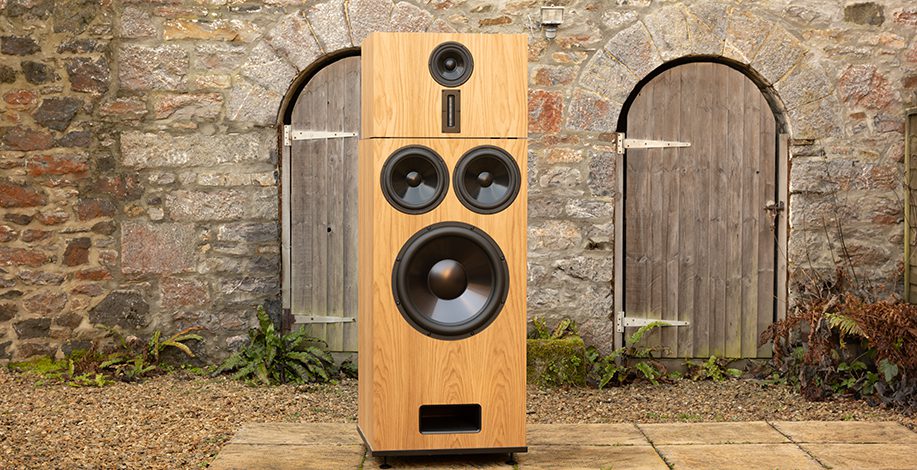
Graham Audio is renowned for its modern recreations of both popular and lesser-known BBC loudspeaker designs. Under the guidance of Paul Graham and designer Derek Hughes, whose family lineage traces back to very beginnings of the BBC loudspeaker concept, Graham Audio has produced domestic versions of some of the finest loudspeakers from the late 1950s to the early 1970s. It has also expanded these designs into newer models. Additionally, there’s the VOTU, or ‘Voice of the Universe’. The original model, launched in 2018, was an offshoot of the SYSTEM3D ‘effect fill’ loudspeakers created for the Royal Opera House in London. The new VOTU Mirama floorstander elevates that design to a new level.
From the outside, the VOTU Mirama appears to have little in common with traditional BBC design. A closer inspection reveals this is not the case. The lessons learned from reviving the LS5/5 extend beyond a sizeable stand-mount monitor loudspeaker conceived in 1967.
Derek’s pen
As with all of Graham Audio’s designs, the VOTU Mirama is from the pen of Derek Hughes. Derek is perhaps the last direct link with the loudspeaker engineering section of the BBC Research & Development team in Kingswood Warren. His father, Spencer, alongside designers and engineers such as Dudley Harwood, helped create those classic thin-walled monitors so closely associated with the BBC. Although their legacies have been passed down to subsequent generations of loudspeaker designers, that straight family link is gone in most places. Derek is the last of the line.
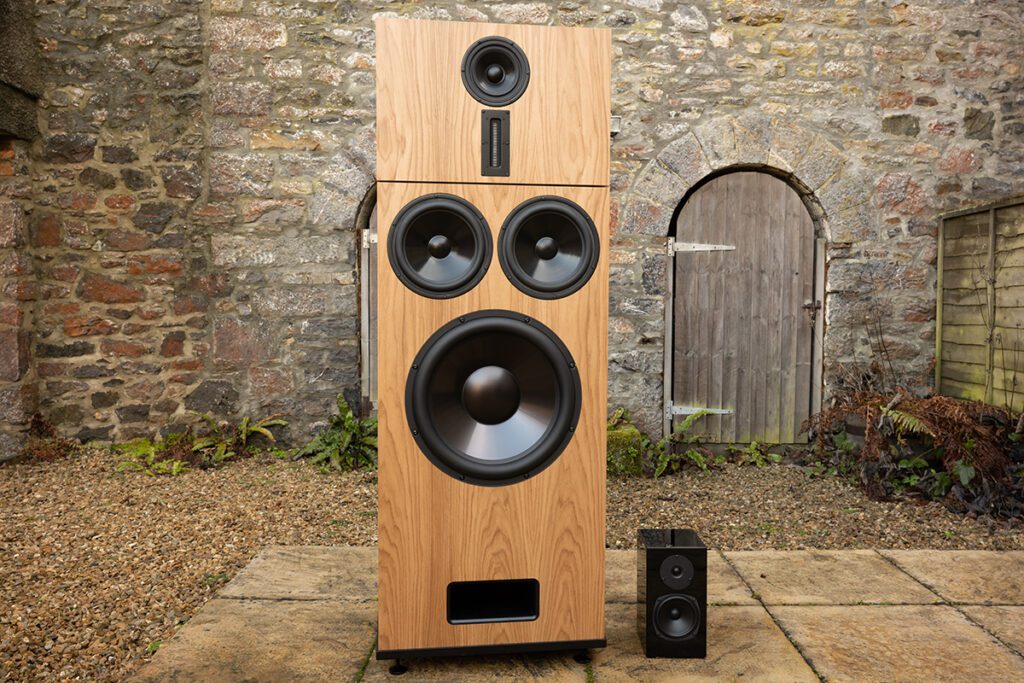
The last version of the VOTU and this are very different, suggesting Derek’s pen still has a lot of ink left to give. Yes, the link to SYSTEM3D is still there, but it’s a more distant link than its predecessor. Where the predecessor was an integrated unit, the VOTU Mirama uses two connected cabinets. This is a thoroughly wise idea given the full VOTU Mirama stands 164cm tall (or one Daniel Radcliffe in imperial measurements) and weighs in at a beefy 110kg (242lbs or 17st 4.5lbs in old money).
Sealed upper
The head unit or upper cabinet has is a sealed box, featuring a high-power 13cm ribbon tweeter and a 165mm polypropylene midrange unit. This upper cabinet is slightly larger than one of Graham Audio’s LS5/9 loudspeakers, turned on its side… that gives you some sense of scale to this loudspeaker. It has a flying lead that connects it to the crossover network housed lower cabinet. The cable is terminated in a professional grade Neutrik Speakon connector.
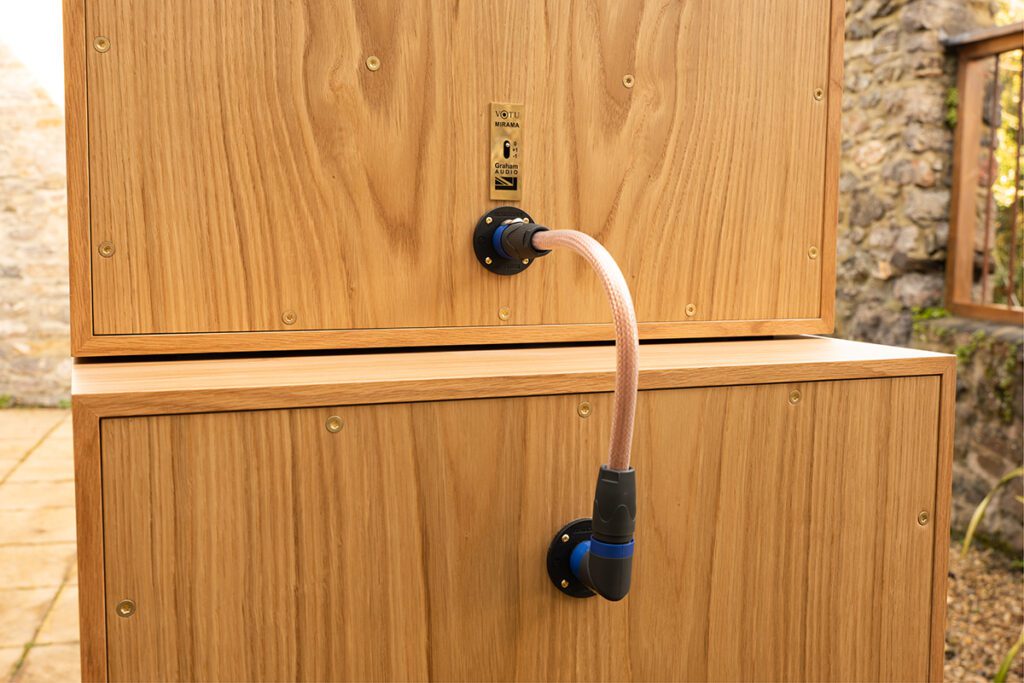
This cabinet is also fitted onto the bass cabinet with rubber feet in recesses to give accurate positioning of the cabinet, together with reducing acoustic coupling between the two cabinets. There’s no need for a tilt test here; given the height of the top cabinet and the overall mass of the loudspeaker, once fitted the only way that top-box is going to detach itself from the lower cabinet is if the words ‘ramming speed!’ get uttered first.
This lower cabinet is a game of two parts. The upper section houses two 250mm bass drivers in their own sealed chamber. Below this sits a 450mm sub-bass unit in a ported chamber with a front-firing port. Theoretically that means you could use the VOTU Mirama closer to the wall, but in a loudspeaker this big and bold, boundary installations are unlikely to be on the cards.
Sink in
Let that last number sink in for a moment. A 450mm bass unit; that’s almost 18″ or a shade under one and a half feet of bass driver pointing at you. For each channel. In a listening room. To add another number into the mix; that sits in a cabinet of 10 cubic feet. A lot of audiophiles are happy with a 20-litre enclosure… this one’s a shade over 283 litres. As the tag-line for the 1986 movie The Fly goes; Be Afraid, Be Very Afraid.
As with all Graham Audio’s designs, air core inductors are used to ensure that the sound does not suffer at all from the compression and distortion effects associated by any cored inductor. The improved sonic quality of such components more than compensates for the increased cost associated with them. High quality polypropylene capacitors match the performance of the other components of the system.
The loudspeaker has two pairs of high-grade binding posts, one pair feeding the 18″ subwoofer and the other feeding the rest of the system. This enables the user to choose between using a single driving amplifier for the entire system, or to bi-amp, using individual amplifiers for the lower and upper cabinets.
Veneer flow
The veneered version of the cabinets are arranged so the veneer grain flows between the upper and lower cabinets, giving a visual unity to the design. On a loudspeaker of this size, that’s no mean feat and a marked step-up from the previous VOTU, which came finished in a polyurethane outer shell.
If you are struggling to see the BBC connection here, the cabinets are constructed using the ‘thin wall damped’ approach used throughout Graham Audio’s range, resulting in low coloration. This design continues to ensure that any cabinet resonances are considerably reduced, and the loudspeaker system’s ‘Q’ figure (effectively the length of time resonances take to decay), is minimised so as not to impact sound quality.
However, in any cabinet there are internal standing waves which can be radiated both through the cabinet walls and back through the driver cones. Graham Audio uses rock-wool to damp out these resonances. The thickness and positioning of this rock-wool is chosen for maximum effect.
In other words, the VOTU Mirama is every inch a BBC design. Just that there are a lot more inches in this one.
Powerful power
However, it’s in power handling, where the VOTU Mirama gets closer to that original professional-grade SYSTEM3D loudspeaker design. And that power handling is where these bigger loudspeakers diverge from traditional BBC thinking. While the VOTU Mirama has a sensitivity rating of 90dB, don’t assume that means it’s the type of loudspeaker that can run off a small integrated amplifier. They need power. A lot of power to drive them. Graham Audio specifies a minimum of 250 watts per channel and they mean it. More – a lot more would be good.
However, in common with the BBC heritage they come from, the VOTU Mirama isn’t so amplifier-eviscerating that it demands super-high-end electronics as partners. It’s perfectly chummy with more modest electronics, so long as those electronics pack a punch in the amplifier department. Of course, if you have the room to house a pair of loudspeakers with the VOTU Mirama’s physical attributes – and prepared to pay a healthy amount to buy them – you are probably not going to be playing on an old and cheap system. Similarly, you could have these installed in a small room as the biggest pair of headphones in history… but don’t. Give them some room to breathe.
All the space!
Just how big a room? Well, that depends on just how much you are prepared to get out of your loudspeakers. In all honesty, you could put these on an terrace outside your house and use them as a PA system! So room size should be ‘large’. And lets be brutally honest about most of us; while this loudspeaker is capable of outstanding refinement and clarity, the temptation to make good use of that pair of 450mm bass drivers staring you down is going to be irresistible at first. You are going to play something with a lot of bass, and you are going to play it loud. And if you do that in a small room, you might find yourself in need of a new set of ears very soon.
Unleashing your inner animal is a cathartic experience on the VOTU Mirama. Subtlety comes later; this is the much-needed application of brute force and I’m all for it. Out came Trentemøller’s ‘Chameleon’ [The Last Resort, Poker Flat] and played it loud. I reckon I was about five minutes away from the police being called, and then finding them sitting at a discrete distance, waiting on the military response and maybe an air-strike.
Festival-fi
Play three or four such tracks and you’ll find people pitching tents in your garden and someone charging a fortune for falafel wraps. You aren’t just playing music loud; you started your own festival.
Naturally, the inner animal goes back into its cave, the volume gets set to less brutal listening levels and out come the more appropriate records. Except, the same thing happens at almost any listening level. There’s a sense of musical performance and real-world music playing that is underpinned by a sense of solidity that few loudspeakers at any price can reproduce.
In fact, what started out as a musical onslaught on the senses turns out to be anything but. For such a huge loudspeaker, it almost acts like a point source, producing exceptionally good soundstaging properties both on and off axis. A lot of this is down to having a front baffle wide enough to house a foot and a half of bass driver; functionally ridding the sound of edge diffraction effects makes the transparency and stereophonic precision of the drivers all the more notable.
Rooted in space
Where the VOTU Mirama departs from the typical point source or even electrostatic presentation is that the music seems rooted in space. Instrument solidity in a soundstage is exceptional; you get the sense of real people in a three-dimensional space. It’s not ‘holographic’ because it seems more realistic than a mere hologram; this is like you are moved to where the music is happening and the musicians are playing in front of you. In fact, this sense of bolted-down solidity is more prevalent than the soundstaging itself.
Yes, the VOTU Mirama produces an excellent soundstage, but that isn’t the goal here; the goal is realism. When you hear a real instrument in another room, you don’t get a sense of three-dimensionality and where they are in the physical space, but you immediately know you can hear a live event by way of physical and temporal cues that audio systems rarely get right. The VOTU Mirama ‘nails’ the physical side of that sense of presence. A voice sounds like a voice (albeit one played through a microphone) not a disembodied set of vocal-like sounds hovering in the air.
Weaponised lungs
On the subject of voices, I’ve often called on Joyce DiDonato’s outstanding mezzo-soprano as a brutal test of a system. I’ve often praised her ability to deliver so much sound from her diaphragm that I’ve likened her lungs to a form of weapons system. But it was through the Graham Audio VOTU Mirama that concept of ‘weaponised lungs’ was truly realised. In playing ‘Tu sola, o mia Giuietta… Deh! tu, bell’anima’ from Bellini’s I Capuleti e i Montecchi [Stella di Napoli, Erato], her vocals finally lived up to the statement I’d made about them.
The power the VOTU Mirama gave this Bel Canto aria was mesmerising. You appreciate just what force a voice like that can deliver, without it ever sounding hard, harsh or incorrectly sized. Yes, I’ve heard loudspeaker systems that do something similar, but they all cost many times what the VOTU Mirama does, and place higher demands on the upstream electronics.
Of course, no loudspeaker is entirely without flaw and in the VOTU Mirama that’s a slight slowing of rhythmic speed and precision. This is not a big thing unless you listen to a lot of electronica, where those tightly-packed almost square-wave glitchy percussion sounds become a little more laid-back through the VOTU Mirama, but that is a function of trying to get a large bass unit to move fast. Regardless, most won’t notice and ponderous it certainly isn’t!
The direst of straits
Quite a lot of music was played through the Graham Audio VOTU Mirama in very short order. I even played one of the bands on my personal ‘banned’ list; Dire Straits. I don’t play this because it’s still overused at audio shows, but tracks like ‘Sultans of Swing’ helped get me into audio in the first place and Mark Knopfler’s plank-spanking skills remain some of the best in the business. So, if a loudspeaker can not only sweep aside years of hearing Dire Straits at shows but bring out air guitar skills that had been put on hold for decades, the VOTU Mirama is doing something very right indeed.
In calling it the ‘Voice of the Universe’, Graham Audio could set itself up for a fall; but in the VOTU Mirama, I think it’s justified. This is one of a ‘mail’d fist in a velvet glove’ approaches to music I’ve heard from a loudspeaker, or at least from a loudspeaker that didn’t cost as much as an S-Class Mercedes! It’s a loudspeaker that can make you stand up and dance, sit down and cry, and loosen teeth at 30 paces. What more do you need?
Technical specifications
- Type: Four-way, bass reflex, two-cabinet floorstanding loudspeaker
- Drivers (top cabinet): 13cm ribbon tweeter, 165mm polypropylene midrange
- Drivers (bottom cabinet): 2 x 250mm mid-bass drivers, 1 x 450mm sub-bass
- Crossover points: 150Hz, 1kHz, 5kHz
- Frequency Response: 25-20kHz ±3dB
- Sensitivity: 90dB/2.83v/1m
- Amplifier power recommendations: 250 – 1000watts
- Finish: Veneer to order
- Dimensions (HxWxD): 164 x 66 x 66cm
- Weight: 110kg
- Price: £47,593, $51,500, €56,087 per pair
Manufacturer
Graham Audio
+44(0)1626 361168
Trending Articles
See all
Acoustic Energy Corinium floorstanding loudspeaker
- Dec 23, 2024
Trending Articles

By Alan Sircom
More articles from this author

Read Next From Review
See all
Reiki Audio SuperSwitch X/Pro X PSU
- Oct 06, 2026
Audiobyte SuperVOX
- Oct 06, 2026
Unitra WSH-805
- Sep 29, 2026
Wilson Audio Sabrina V
- Sep 29, 2026