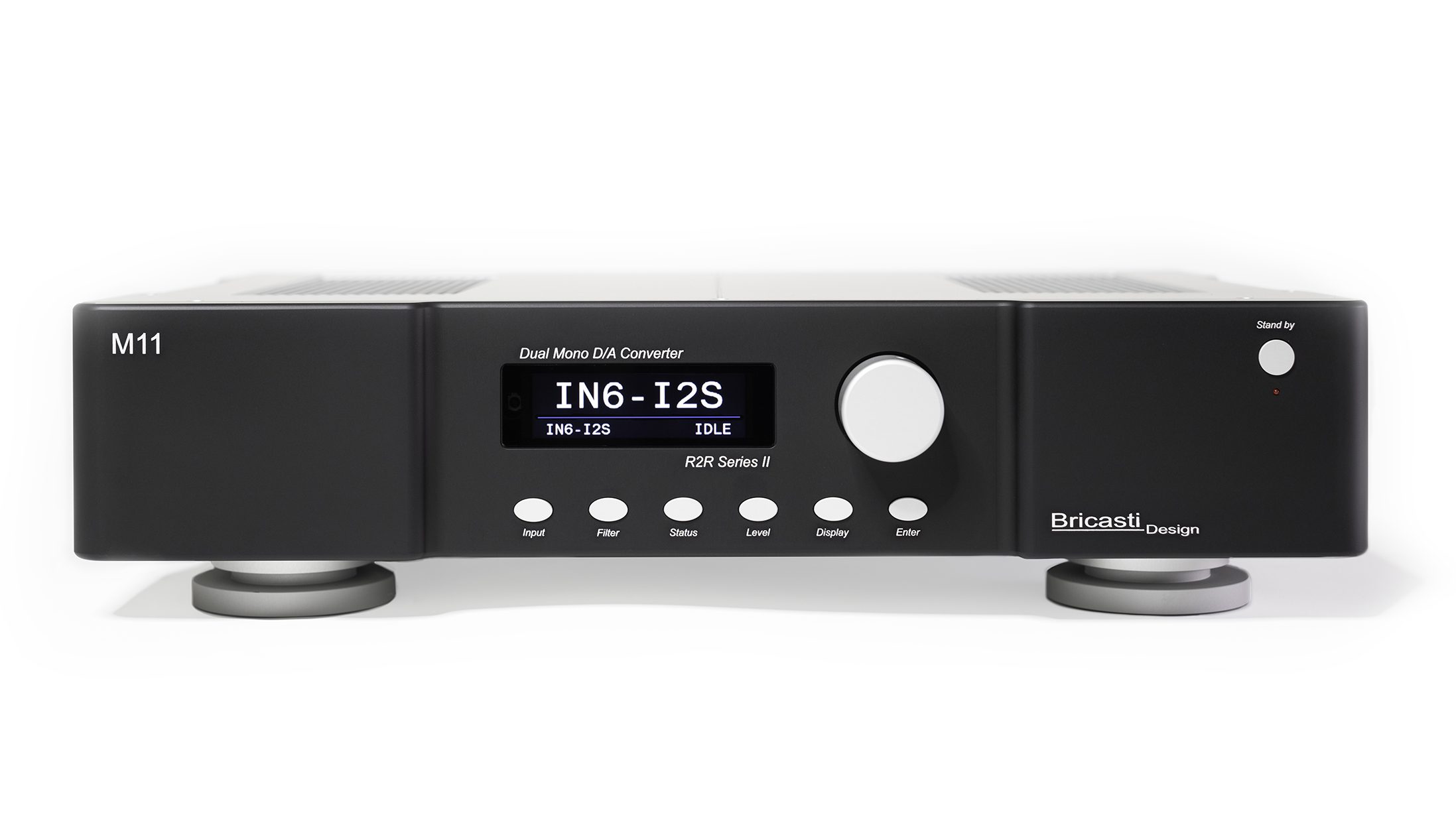
Bricasti products bear a strong resemblance to those produced by the Mark Levinson brand during the time it was part of Madrigal Labs. The black and silver aesthetics, along with the understated yet high-quality finish, are indeed quite similar. This similarity exists because both product lines were designed and manufactured by the same individuals, Brian Zolner and Casey Dowdell, who previously worked at Madrigal before establishing their current company, which maintains the same ethos. They produce both analogue and digital electronics for professional and consumer markets, including a series of substantial amplifiers and an expanding range of digital-to-analogue converters.
At the top of this DAC tree is the mighty M21 Stereo, which incorporates three distinct conversion technologies for the user to choose from: Delta/Sigma, DSD, and an R2R ladder DAC. It offers a novel approach to satisfying all music lovers but comes with an expensive retail price that exceeds the £20,000 barrier. The Bricasti M11 R-2R Classic is a more affordable option that takes the R2R converter from the M21 and places it in a slimmer cabinet while still providing nearly as many inputs and features. In fact, regarding connections, there is no external difference; I suspect the input board is very similar.
Up the ladder
R2R and ladder DACs are discrete devices that were popular in the nineties before Delta/Sigma emerged and dominated the measured performance landscape. Early ladder DACs could achieve a maximum of 14-bit performance, whereas today’s D/S chips effortlessly deliver 32-bit performance; they won the specification battle. However, there has always been a group of manufacturers and enthusiasts who appreciate the unique qualities offered by ladder DACs, particularly the timing that resembles that found in analogue sources.
The team at Bricasti asserts that they made a breakthrough a few years ago, enabling them to develop a ladder DAC capable of achieving up to 20-bits. They are understandably tight-lipped about the specifics of their achievement, but the specifications imply that it is significant. This converter can handle sample rates of up to 384kHz via the USB input, and slightly lower rates on the DSD side with the optional network input. There is also a second optional input, an I2S connection, for those utilising the Bricasti M19 SACD/CD transport.
Fully differential
The Bricasti M11 R-2R Classic is a fully differential, dual mono converter featuring fully balanced and single-ended analogue outputs that can be directly connected to a power amplifier when the digital volume control function is selected via the front display. Although this DAC comes with a remote control, our sample was a pre-production example that arrived without one; hence, this option was not tested. Additional features include four filter settings: two for linear phase and two for minimum phase. Having listened to a broader selection on a previous Bricasti DAC, I chose the slightly more rolled-off minimum phase filter 1. This filter cuts 500Hz from the top end, increases passband ripple by 0.003dB, reduces stopband attenuation by 8dB, and minimises delay by half a millisecond at most. Nonetheless, it sounded slightly more appealing for some reason, despite the minuscule measured differences.
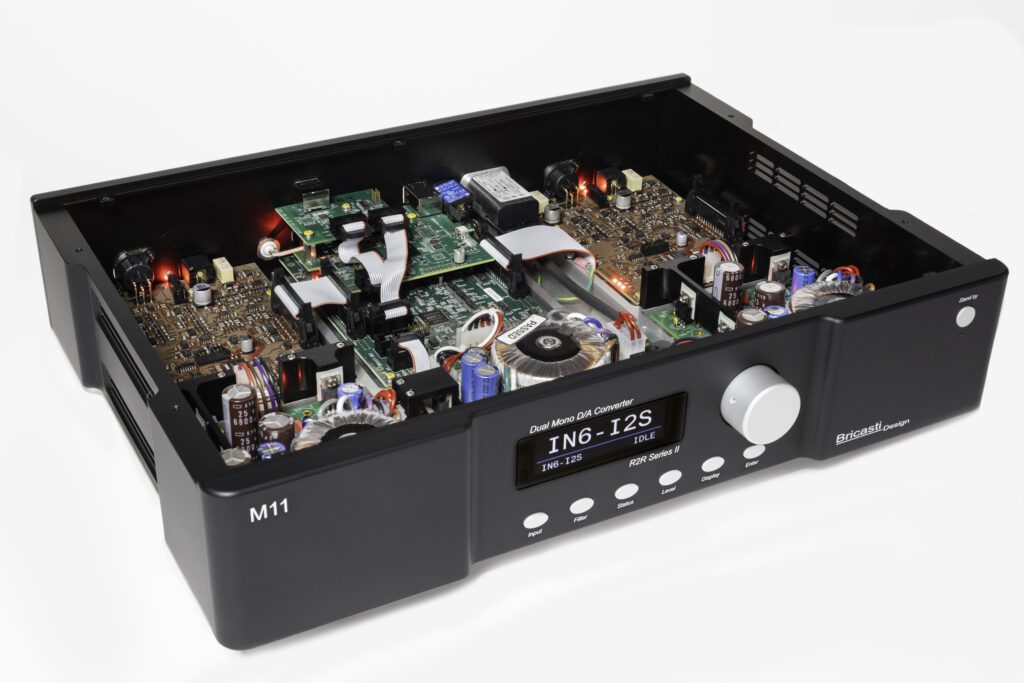
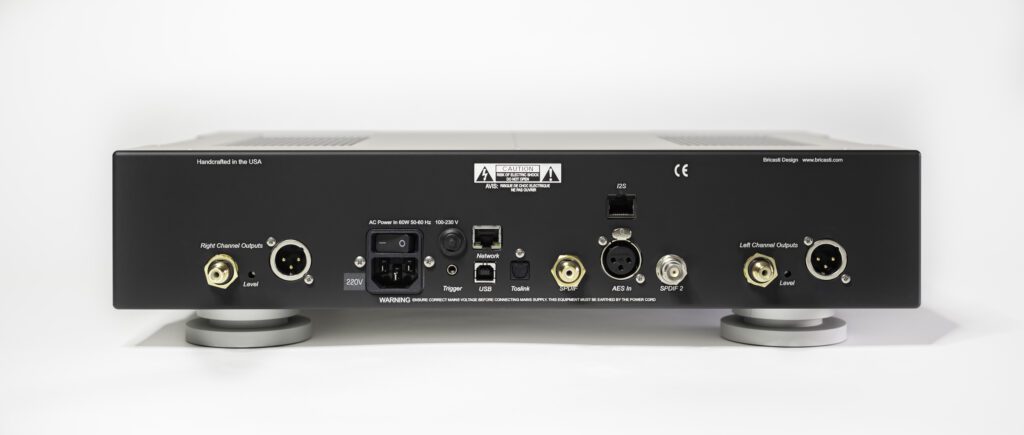
Digital inputs include all the usual suspects, such as the less common AES/EBU via an XLR socket, as well as the previously mentioned network input on RJ45 for Ethernet. The latter transforms the M11 into a fully-fledged streamer, which can be controlled with various third-party apps, including Roon, JRiver, Audirvana, and my preferred choice, JPlay. This input is a £1,350 option, but considering the price of a good streamer—even one without a DAC—that is not excessive, and it eliminates the need for a digital interconnect that could easily cost as much on its own.
Timing times two
The display and associated buttons can also be utilised to invert phase and alter input naming using a list of likely options alongside those assigned at birth, e.g. USB, SPDIF, LAN, etc. There is no clock link on the M11, and the same applies to the M21, as Bricasti takes extensive measures to ensure maximum accuracy in this regard. They handle the clocking for each channel “directly at each DAC”; essentially, each half of the converter possesses its own clocking circuit, which maintains the shortest possible signal path to each Analog Devices DAC chip, with both synchronised by the Sharc DSP. The outcome is reported to “reduce clock-induced jitter to immeasurable levels.”
I used the M11 with various sources, including a Network Acoustics upgraded Lumin U2 Mini streamer and both the Melco N1 and Xact S1 Evo server/streamers. It made the differences between them very clear while always sounding great; only the gradations of greatness varied.
Flow
What was consistently apparent was the musical flow; this converter times beautifully, allowing all kinds of music to be expressive and coherent simultaneously, stretching out in both tonal and dynamic respects, thanks to the absence of perceived restrictions in the manner this Bricasti delivers sound.
For a start there is no apparent graininess in leading edges yet detail levels are high. It feels like you can listen into recordings and hear all the quiet stuff that is often masked by the louder, more upfront deliberations of the lead instrument or voice. This is achieved because backgrounds are so quiet and there is no apparent blurring of leading or trailing edges. This blurring effect is common to many audio components and doesn’t necessarily get in the way of musical enjoyment but it does make the sound less relaxed because your brain is having to work harder to hear how notes stop, start and coalesce with their neighbours.
Listen longer
I tried both USB and AES/EBU connections and found that while the latter sources provided slightly more engaging results, the Xact S1 Evo managed to surpass the alternatives using USB alone. Thus, the method of connection is less important than the quality of the source. In nearly all cases, vocals truly shone; the M11 possesses a naturalness of tone that is simply beguiling when it comes to that most emotional
of ‘instruments’. I played various tracks, from Mari Boine to The Weather Station and Morphine’s ‘You Look Like Rain’. Each brought a distinct and clear charge to the room, making me want to listen for even longer.
This Bricasti seems to lack any distinct tonal character; it is positively neutral, allowing the essence of each performance to dominate the sound. Occasionally, there appears to be a slight midrange emphasis, but when comparing the M11 with other converters, it becomes clear that this is not the case, as the alternatives tend to sound ‘voiced’ by comparison.
This is a highly beneficial quality, provided it does not suggest that the Bricasti M11 R-2R Classic sounds grey or dull; rather, it is simply very transparent to the source and conveys the tonal richness and brilliance of every performance played. I had a particularly enjoyable experience with the recent Keith Jarrett Trio release, The Old Country (More from the Deer Head Inn). The playing is exceptional, and the venue is distinctly intimate, as evidenced when the applause arrives, allowing you to hear the room. However, when Jarrett unleashes his talent, this performance becomes incredibly captivating, and the M11 made it so easy to appreciate that I could hardly sit still.
More fluent than Jeff Beck
I also tried the network input and selected the Bricasti as the audio output on the JPlay control app. This produced a more relaxed and fluent sound than even the AES connection, a sound that brings this DAC closer to analogue than anything I have had the pleasure of using for a long time. It times beautifully yet remains cleaner, encouraging higher playback levels and thus even greater involvement in whatever is being played. It would take a pretty decent standalone streamer to surpass it, along with sufficiently transparent cables for that matter.
I truly appreciate a ladder DAC, and this is the best one yet. It offers transparency, neutrality, and timing that is simply outstanding. In fact, I am so enamoured with the Bricasti M11 R-2R Classic that I have thrown restraint to the wind and purchased one. Its wide array of connectivity options and build quality inspire confidence that the M11 will work with nearly any conceivable source and continue to do so for many years. This may not be Bricasti’s finest, but it delivers music in such a compelling manner that I don’t really mind.
Technical specifications
- Type: Solid-state dual mono ladder digital-to-analogue converter/preamplifier.
- Digital Inputs: One AES/EBU, two Coaxial, one Toslink, and one USB 2.0 (optional LAN and I2S)
- Analogue Outputs: One stereo single-ended (via RCA jacks), one balanced (via XLR connectors). Both outputs are configurable for fixed or variable level operation.
- DAC Resolution/Supported Digital Formats: All PCM from 44.1KS/s to 384KS/s with word lengths up to 20-bit, DSD64 to DSD256
- Frequency Response: 10 hz – 20 kHz +0dB, – 0.2 dB
- Distortion (THD + Noise): @1kHz: 0.002%
- Output Voltage: Adjustable +8 dbm to +22 dbm, or fixed at +13.5 dbm
- User Interface: remote control
- Dimensions (HxWxD): 50 x 432 x 305mm
- Weight: 6.8kg
- Price: £11,000, $12,500, €15,185
- Optional extras include: Network Card (£1,350)
- I2S Card (£550)
Manufacturer
Bricasti Design
UK distributor
Connecting Music Distribution
+44(0)131 221 9753
Tags: BRICASTI M11 R-2R CLASSIC DAC
Trending Articles
See all
By Jason Kennedy
More articles from this author


Read Next From Review
See all
Eversolo T8
- Oct 13, 2026
Acoustic Energy AE Active
- Oct 13, 2026
Reiki Audio SuperSwitch X/Pro X PSU
- Oct 06, 2026
Audiobyte SuperVOX
- Oct 06, 2026