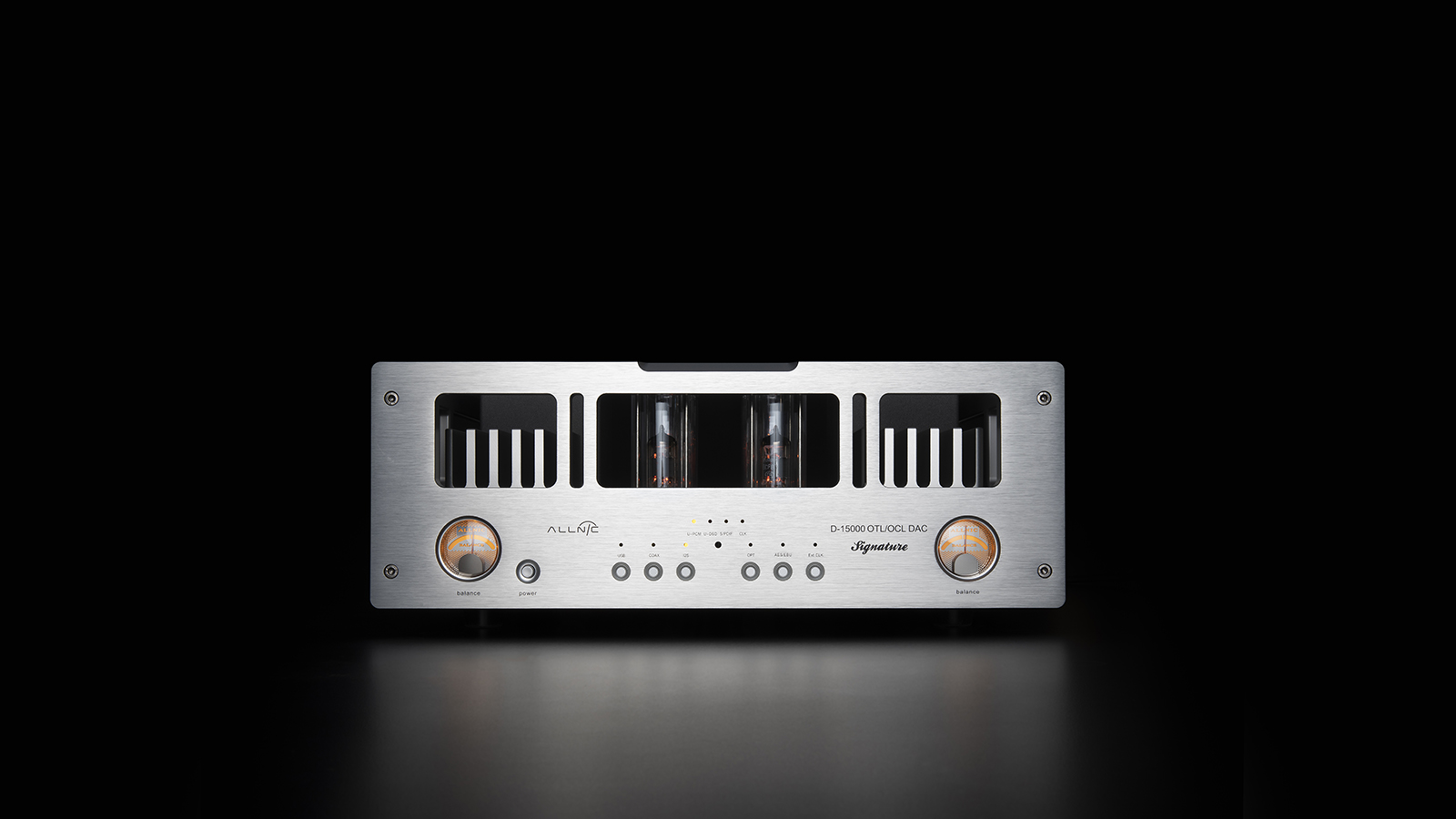
A major challenge in designing one of the world’s top DACs is that there is nowhere to hide. When you take the highly respected D-10000 DAC and build one to an even higher standard, there is no room for ‘good enough’. Everything is scrutinised closely, and self-appointed examiners are everywhere. That is the challenge faced by the Allnic Audio D-15000 Signature OTL/OCL digital-to-analogue converter. And that scrutiny begins with its name. For example, ‘Signature’ signifies a step away from the already highly specified D-10000 DAC. However, both DACs utilise the output transformerless (OTL) and output capacitorless (OCL) audio stage, which—as shown in Issue 221—gives Allnic digital products smooth refinement and grace.
Initial evaluation
The D-10000 DAC played a key role in the initial evaluation of this new flagship. Too key, in fact. At first glance, the D-15000 and D-10000 share many similarities, making it easy to assume the D-15000 is a ‘hot-rodded’ version of the D-10000. That’s not the case at all. Sure, they might share some surface features (a central tube group, twin balance meters, and nearly identical physical dimensions and weight), but the two are quite different. Furthermore, for a DAC that can be (incorrectly) dismissed as ‘an excellent output stage connected to a converter,’ the most noticeable upgrades from D-10000 to D-15000 include the addition of an I2S input and a connection to a clock.
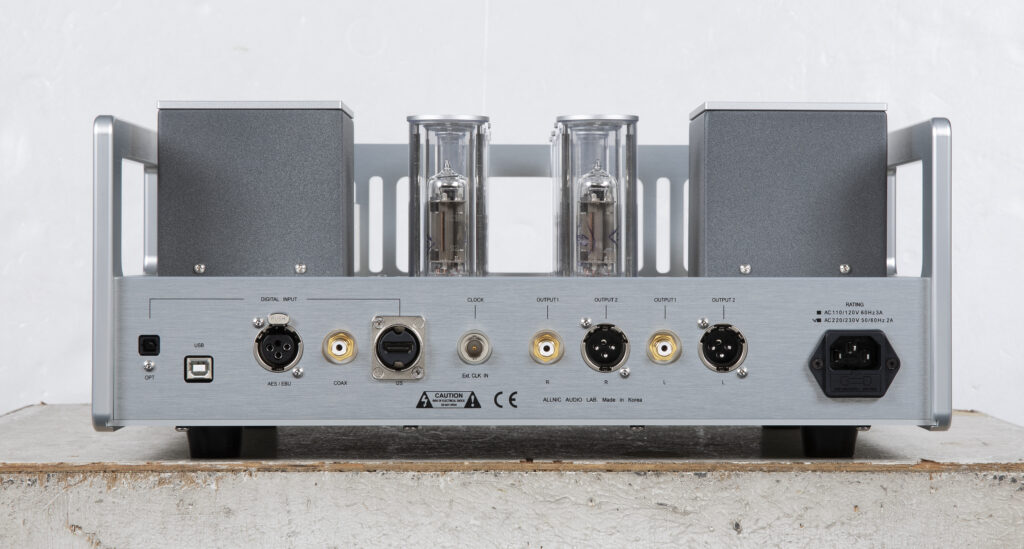
After lingering in the digital audio parts bin for decades, I2S has recently experienced something of a revival. However, unlike most digital connections, I2S lacks a standard termination. HDMI is the current de facto standard, but even here, pin configurations can vary between products. Allnic Audio adopted PS Audio’s configuration (shared by brands such as Audiobyte and Rockna). The clock input is easier to identify, and various options are available to the listener. Allnic Audio chooses to stay silent on clock recommendations, but given that you could spend less than on a good cable or more than the DAC itself, the choices are plentiful.
Chip change
The ESS Technology-based digital core of the Allnic Audio D-15000 also represents an upgrade over the D-10000. It advances from dual-mono ES9018K2M chips to ES9039PRO (the standard version, not the ‘MPRO’ variant that can render MQA). This newer SABRE DAC chipset features ESS’s ‘HyperStream IV’ architecture, which – among other benefits – includes a serial data interface that allows I2S interfacing. Arguably, the ‘among other benefits’ part signifies a complete reworking of the HyperStream architecture, which has been cited as a reason SABRE DACs are perceived as sounding ‘clinical’. However, in Allnic Audio’s case, this is moot; the D-10000 – with a chip sporting HyperStream III – did not sound ‘cold’ or ‘clinical’.
The ES9039PRO chips also feature a user-adjustable filter, but Allnic chose not to use this option. While part of me believes that having options is always beneficial, another part contends it can lead to ‘audiophilia nervosa.’ I’ve experienced that obsessive-compulsive quest through filter selections before, never quite sure which sounded best, and spending more time stressing over settings than enjoying music. By shifting its digital products into the ‘fit and forget’ category – and maintaining performance – that noisy, obsessive part of the mind can return to more sensible pursuits, such as sorting Corn Flakes by size and shape.
Only part of the experience
Describing the D-15000 by its digital component is somewhat like discussing a watch solely by its movement; while relevant, it’s only a part of the overall experience. In the Allnic Audio D-15000, the ‘OTL/OCL’ suffix ultimately adds significant power. As mentioned earlier, ‘OTL’ stands for ‘output-transformerless’ and ‘OCL’ indicates ‘output-capacitorless’. Eliminating a coupling capacitor (OCL) is common in OTL designs.
However, the circuit further depends on its tubes to create an appropriate impedance-matching environment between the DAC’s output and the preamp’s input. In the D-15000, this involves each channel using an ECF80/6BL8 combination triode/pentode as input, a 12AU7/ECC82 as a phase-splitter/inverter, and a 6C19P triode in the output. The 6C19P is regarded as a star in OTL circles, with several OTL power amplifier designs employing 16 of them. This combination of linearity and low impedance makes it an excellent choice for a line-level output.
Why bother?
So, why bother with the OTL/OCL concept at all? Well, there’s a very good reason… the sound! When you listen to any traditional valve amplifier stage, much of what you hear is shaped by the sound of the transformers and the coupling capacitors. That isn’t necessarily a bad thing – arguably, a company named after the magnetic aluminium, nickel, and cobalt alloy ‘Alnico’ knows a thing or two about large lumps of metal with wires wound around them – but that Allnic Audio signature sound is largely influenced by its valves/tubes, not its metal content. Apart from the DAC not weighing as much as a small planet, this design offers significant listening benefits. Real benefits.
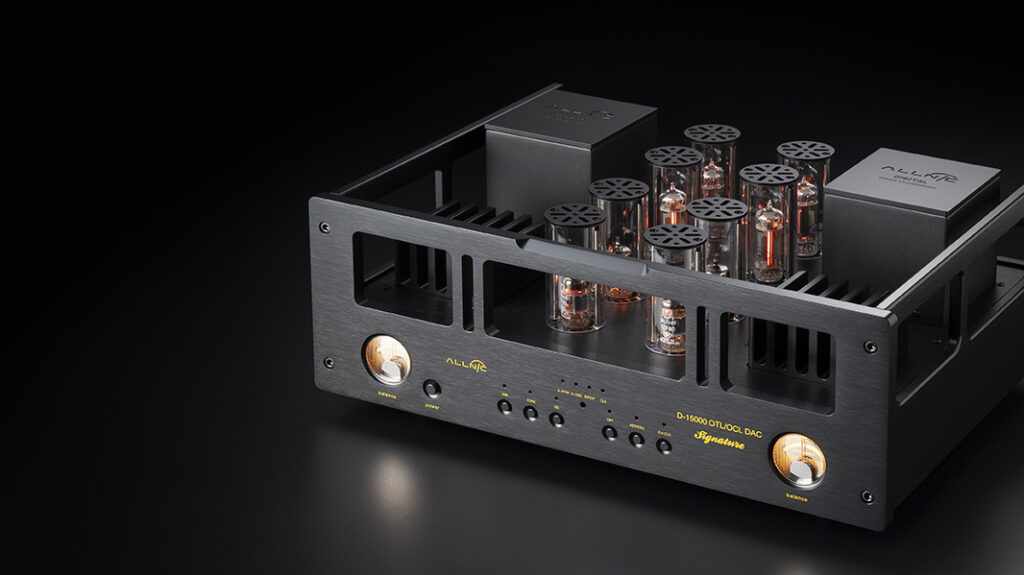
Looking back at my listening notes for the D-10000, the DAC showed exceptional transparency, very low colouration, and a sense of immediacy. The Allnic Audio D-15000 elevates those qualities further. Its sonic footprint on the music is so subtle that we had to send out search parties with sniffer dogs to try to find it. The lack of grain – already a feature of the D-10000 – is pushed to the extreme.
Rat Pack thinking
It’s almost impossible to listen to something this transparent without thinking of the Rat Pack, and ‘I’m Confessin’ (That I Love You)’ by Dean Martin [Dream With Dean, Reprise] might seem a little cheesy by modern standards. Yet, his smooth crooning voice, backed by a jazz quartet (especially Barney Kessel’s effortless guitar licks), is sublime. It’s a deliberately minimal recording, designed to evoke intimacy. Any hint of brightness, colouration, or digital artefact between you and the 1964 recording is instantly noticeable. But here, less than a minute into the track, you feel as if you’ve stepped back in time, finding yourself in a pair of slacks, sipping an Old Fashioned or a Rusty Nail.
I’m being flippant here, but the connection you feel with the music is so immediate and unlike the typical digital experience that usual terminology doesn’t quite capture it. The sense of being swept away by the music keeps recurring. Whether you are listening to something revelatory like a choral work (such as ’The Deer’s Cry’ from Arvo Pärt’s Creator Spiritus by the Theatre of Voices/Ars Nova Copenhagen on Harmonia Mundi), or the glitchy chaos of Squarepusher’s ‘Mekrev Bass’ [Be Up A Hello, Warp], you find yourself pulled deeper into the music. However, I’m not sure that’s the desired reaction with Squarepusher.
Back to sanity
Having sufficiently recovered, it’s time to describe the Allnic Audio D-15000 in more conventional terms. It’s extremely transparent and uncoloured, but not in a dry ‘just the facts’ way. The temptation to call it ‘analogue-y’ is strong, because it doesn’t have that digital edginess and brightness, but neither is the D-15000 rolled off or smoothed at the frequency extremes. It’s just musically honest. If we must stay in music format comparisons, if anything, its sonic footprint is akin to a good open-reel tape that hasn’t been overplayed.
There’s an openness to the sound, both in its staging and overall presentation. The soundstage is effortlessly ‘right-sized’; it adjusts its width, depth, and even height to suit the recording. Moving from Georg Solti, the Chicago Symphony Orchestra, and every singer in Austria’s grand version of the last movement of Mahler’s Eighth Symphony [Decca] to the deliberately claustrophobic sound of Laura Marling’s ‘Soothing’ [Semper Femina, More Alarming] is an abrupt shift, as it should be.
Jump out of your seat.
The Allnic Audio D-15000’s dynamic range is also superb. Rachmaninov’s Symphonic Dances [Zinman, Baltimore SO, Teldec] flows smoothly, and the sudden dynamic shifts make you jump out of your seat.
Most of this listening session used standard 16/44 PCM recordings, ripped from CDs, with occasional high-resolution versions streamed online. However, a brief DSD segment really demonstrates what the Allnic Audio D-15000 can do. This is a paradox, considering its listed frequency response and signal-to-noise ratio.
Strictly speaking, high-frequency performance with bat ears should make no difference to a DAC that doesn’t extend its frequency response far beyond 20kHz. However, listening to DSD transfers of Bob Dylan’s ‘Queen Jane Approximately’ [Highway 61 Revisited, Columbia] and ‘Blue Train’ from the John Coltrane album of the same name [Blue Note] challenges that perception. The sceptics might attribute it to mastering differences (and they could be right), but it amounts to the same thing; the Allnic Audio D-15000 retrieved more information from these recordings and played them with charm and plenty of detail.
Aside from Squarepusher and Laura Maling, I’ve included a lot of jazz and classical music here, so I am aware that this might suggest that this is the kind of DAC that transforms ‘the old stuff’ but doesn’t sound as good with more modern, brighter, or close-miked performances. ‘Exile’ from Taylor Swift’s folklore album [Republic] and ‘Chocolate Chip Trip’ from Tool’s Fear Inoculum [Tool Dissectional] should dispel that impression. Both are played accurately, with great energy and confidence. More importantly, they are not played like they are 1950s recordings,s and the Allnic Audio D-15000 doesn’t get stressed by the demands of modern recordings.
Visual similarities
In a way, the biggest concern the Allnic Audio D-15000 faces is its visual similarity to the D-10000. We are a pattern-seeking species, and many will notice the visual similarities and assume (as I did, incorrectly) that it’s simply a ‘pimp my DAC’ glow-up of the D-10000. It’s not just a superficial change; physical similarities often shape first impressions. That said, if it were too radical a visual departure, it wouldn’t work either. But I believe that if the D-15000 had separated its power supply into a different chassis (for example), people wouldn’t jump to the wrong conclusion.
But there are two advantages to this visual similarity. First, it makes you realise just how much bigger the jump between D-10000 and D-15000 is, which makes the achievement even more satisfying when you hear it. Also, if you’re trying to get a DAC upgrade ‘under the radar’, the visual differences between the two are small enough not to be noticeable. He said, hopefully.
Rare pleasure
Using its full name, it has been a rare pleasure sitting in front of the Allnic Audio D-15000 Signature OTL/OCL DAC. It delivered one of the most engaging digital audio experiences I have ever encountered, and it significantly surpasses the performance of the previous Allnic Audio statement piece, the D-10000. Yet, I was still only scratching the surface of its capabilities, with more potential to be unlocked through I2S (with the appropriate server or disc-based source) and an additional clock.
Then, there’s also the small matter of how it would sound in an Allnic Audio system, considering how impressive the HPA-5000XL (reviewed in Issue 214) performed. I suspect Allnic has a cumulative effect. It’s not difficult to imagine that once you hear what the Allnic Audio D-15000 can achieve, you’ll want more. A lot more.
Technical specifications
- Type: OTL/OCL DAC
- DAC: Dual Mono ES9039PRO (32-bit HyperStream IV)
- Tubes/Valves used: × ECF80, 2 × 12AU7, 4 × 6C19P
- USB Input: PCM up to 32bit/768kHz, Native DSD up to DSD512
- S/PDIF Input: PCM up to 32bit/192kHz, DoP up to DSD128 (AES/EBU, coaxial RCA)
- I2S Input: PCM up to 32bit/768kHz, Native DSD up to DSD1024 (HDMI, PS Audio compatible)
- Analogue outputs: One pair unbalanced (RCA), one pair balanced (XLR)
- Clock System: Internal OCXO (±5 ppb) + External 10MHz clock input (BNC)
- Frequency Response: 20Hz-20kHz flat
- Total Harmonic Distortion: < 0.1%
- Signal to Noise Ratio: <86dB (CCIR, 1kHz)
- Jitter: ~5ps RMS (PLL-based)
- Output voltage: 1.75V RMS
- Output impedance: 50Ω
- Finishes: Black, silver
- Dimensions (W×D×H): 43 × 32 × 17cm
- Weight: 13kg
- Price: £25,000
Manufacturer
Allnic Audio
UK distributor
Bobusian
+44(0)7922 277944
Trending Articles
See all
hi-fi+ issue 250: the Awards
- Dec 02, 2025
Musical Fidelity M8x DAC
- Aug 03, 2026
dCS Lina DAC X
- Oct 14, 2025

By Alan Sircom
More articles from this author

Read Next From Review
See all
ATC EL50 Anniversary
- Aug 18, 2026
AIM Electronics NAX
- Aug 18, 2026
Ensemble Massimo Fonobrio
- Aug 18, 2026
Silent Angel Bonn N8C, Genesis GC and S28
- Aug 10, 2026