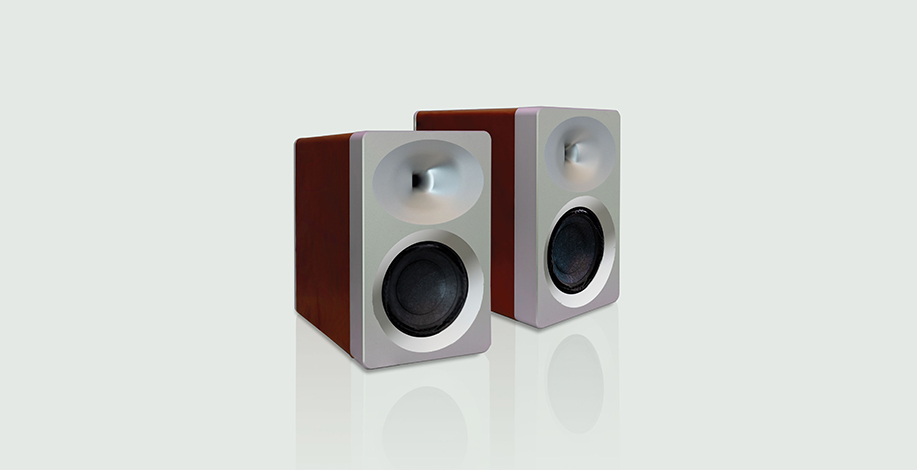
Quietly, Bulgarian hi-fi company Thrax Audio has transformed. No longer just a maker of high-end audio electronics, Thrax has become a company providing complete audiophile solutions. The brand focuses on outstanding preamps, power amplifiers, and integrated amplifiers. And models like the Thrax Audio Sirens stand-mount loudspeaker show its adeptness in the audio builder’s art.
Sirens follow the successful Lyra two-way, three-driver rear-ported stand-mount, the first loudspeaker from Thrax Audio. The plan was to make the Sirens behave entirely consistent with the D’Appolito-based mid-tweeter-mid Lyra, but in a smaller, more conventional two-driver, two-way rear-ported design. That plan could only be achieved due to developments in drive unit technology. It worked, and the Sirens’ one mid-bass unit delivers virtually the same performance as a pair of custom magnesium cone mid-woofers. That development is the introduction of the PuriFi drive units, which are transforming the performance of many high-end loudspeakers worldwide.
Sultry and moistened
Calling your loudspeakers ‘Sirens’ is a tough call. It calls up images of half-woman, half-bird creatures that lured Ancient Greek seafarers to their deaths with their alluring voices. Conversely, you are reminded of emergency alarm systems, blaring warnings of impending air raids or tsunamis. I prefer to think of them as the sultry and moistened washerwomen from the Coen brothers’ movie from 2000, O Brother, Where Art Thou? Their siren song – ‘Go To Sleep You Little Baby’ written for the film and performed by Emmylou Harris, Gillian Welch and Alison Krauss – was one of the high points in a movie filled with high points. And like that lullaby, the Sirens call – the Thrax one – stays with you.
Like the Thrax Audio Sirens’ bigger, older Lyra brother, the tweeter is a 25mm ring-diaphragm high-frequency unit. It is developed by the German professional audio brand BMS. This comparatively unusual design features a neodymium magnet in a deep, elliptical, solid aluminium horn. This horn is not an arbitrary shape but results from years of research in Thrax’s native Bulgaria.
The driver choice inside that horn is also the result of extensive listening tests by Thrax’s founder and chief designer, Rumen Artarski. In developing the Lyra, Artarski auditioned all other types of tweeters in various materials. He found that most fail to deliver at the lower end of their spectrum. This is a significant issue in a two-way design where the tweeter is expected to handle at least some midrange component. Artarski gets a tweeter that works well with mid/bass drivers – without adding a midrange – by using a compression tweeter with a ring diaphragm. Also, the unique waveguide shape gets over the quacking, shouty sound of horns of the past.
Win-win
A tweeter system with this degree of sophistication is only a win-win if matched with a suitably adept mid-bass. In the Lyra, that’s a pair of SEAS Excel units. These are state-of-the-art drivers… from the mid-2010s. However, driver technology has moved on, and the Siren features a single 170mm Ushindi mid-woofer from newcomer PuriFi. Launched in 2019, the PuriFi project is the brainchild of Bruno Putzeys and Lars Risbo – the brightest people in any room not containing Nobel laureates – and makes Class D amplifier modules and Ushindi transducers. While the most visible difference between PuriFi drivers and others is the unusual ‘inny-outy’ corrugated surround, it’s a tabula rasa design intended to improve linearity and lower distortion at any volume level. The result is a long-throw cone with a large, innovative, and extraordinarily linear motor system. It, too, is the product of years of research.
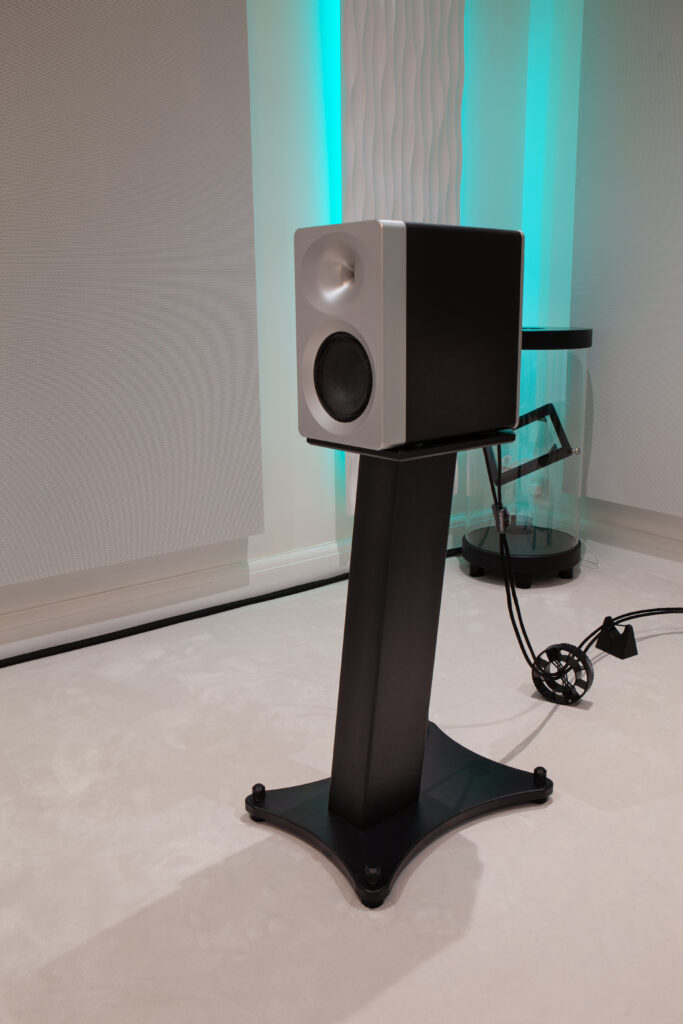
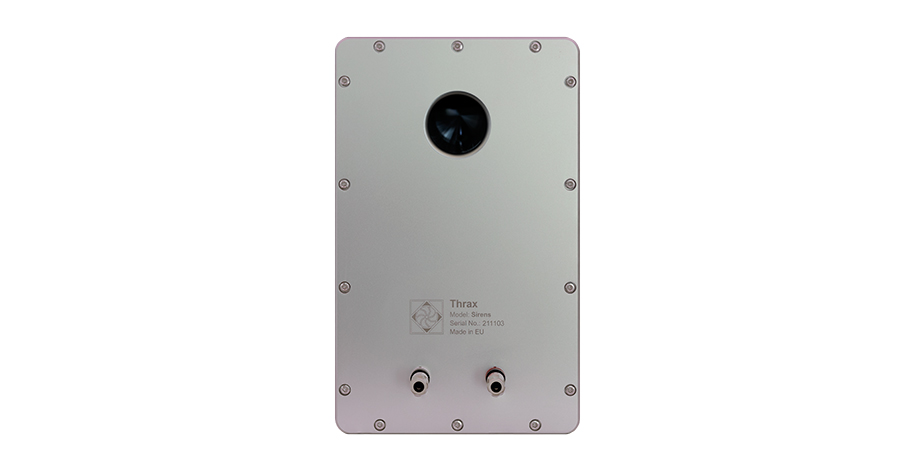
The PuriFi driver has become a panacea in European high-end loudspeaker circles. However, it cannot be a direct swap for an existing drive unit. A driver with significantly lower distortion, superior linearity and power handling will show up even the most minor idiosyncrasies elsewhere in the loudspeaker design. Such a ‘no quarter’ drive unit tests the mettle of design and designer alike; many are found wanting. Thrax wasn’t! The Thrax Audio Sirens’ thick aluminium baffles front and rear, which can also be seen in the Lyra, greatly help. However, the rest of the cabinet is now cross-braced birch ply, wrapped in leather. At the rear are a small, slightly flared rear port, a single pair of multi-way Aeco binding posts, and 14 large Allen bolts to hold the loudspeaker together.
Well constructed
Inside the Thrax Audio Sirens is a well-constructed crossover network using some of the best components. However, as these are sealed and potted (to limit the adverse effects of vibration), we have to assume that the crossover does feature wax-impregnated foil-wound inductors and silver foil capacitors on the tweeter. Its internal wiring is all custom OCC copper.
The Thrax Audio Sirens are best used on high-mass 24” stands, rigidly floor-coupled, kept away from walls, and with a mild-toe-in. They also need to be very well-fed. Since Thrax Audio offers several amplifiers capable of handling that task, it’s a good starting point. Beyond that, however, the loudspeaker is an 87dB efficient design with a pleasingly flat four-ohm impedance and 250W power handling. In other words, you could use everything from a low-power single-ended triode design to a powerhouse of an amplifier without a problem. Thanks to its headroom, the amp slightly favours the meatier end of the market, so quality and quantity would be a good choice. They aren’t unduly fussy, though.
This sounds like the worst kind of faint praise, but it isn’t. The Thrax Audio Sirens are some of the most benign-sounding loudspeakers in their category. Everything has great poise and balance. They make music sound effortless and – fed by a large amplifier – far more dynamic than you would expect from a loudspeaker of this size and volume. They fill out a room far more significantly than similarly-sized stand-mounts – they give many floorstanders a good run for the money – and are surprisingly ‘volume agnostic’ – you can play them at Whispering Around Midnight levels or at head-in-the-bass-bin-at-a-Mogwai-gig levels (well, almost; the Mogwai thing would end in severe hearing damage, but you get my drift).
Benign
This benign nature is its greatest boon, but listeners must be entirely new to audio or willing to reset their standards. Over the years, those who have become accustomed to the distortions, colorations, and limitations of conventional ‘cone and dome’ loudspeakers might find them hard to overcome. This is especially true for those of us who listen to a lot of live music through public address systems – even excellent ones. There will be a few minutes of wondering where all the fireworks went before they realise they are precisely where they should be. They are on the recording.
I noticed this by playing two of my regular test recordings back-to-back: ‘Polly Ann’s Hammer’ by Our Native Daughters from Songs of Our Native Daughters [Smithsonian Folkways] and ‘Chameleon’ from Trentemøller [The Last Resort, Poker Flat]. I tend not to mention the Our Native Daughters album too much because I use the first track, ‘Black Myself,’ mainly as a ‘palette cleanser’ to re-orient myself to the speakers in the room. However, it stayed on this time, and the bluegrass-esque track six is all-acoustic; the only electronics are in the recording chain. The Trentemøller track is a total contrast; every sound is synthesised and processed.
Distinct differences
On the Thrax Audio Sirens, it wasn’t just that the differences between the two were distinct; the intellectual and even philosophical differences between them were more marked. The acoustic Our Native Daughters track didn’t come with any extra padding or added warmth; it just sounded like a blend of blues, spiritual, and bluegrass, with all the intensity and power that track has. Trentemøller lost none of its drive and energy – and had the sort of bass depth unexpected from a box this size – but the absence of speaker distortion and lack of the cabinet joining in for a spot of bass boost took longer to parse than the acoustic track.
That said, the acclimatisation process took about a minute or so, by which time the atavistic fear of ‘big things about to eat you’ took hold. This is – and should be – a scary track, full of deep noises that hit you in the ‘fight or flight’ part of your brainstem. However, having played it so many times, most of the digits have worn flat, and that feeling is held in check. Not this time, and as it now only comes out to scare with huge, full-range loudspeakers, that is one hell of a feat of clarity on the Sirens’ part.
Song to the Siren
I couldn’t resist playing Larry Beckett and Tim Buckley’s ‘Song to the Siren’ but chose the This Mortal Coil version [It’ll End In Tears, 4AD] from 1983 rather than the Tim Buckley original from 1970. That one hit me in the feels; Elizabeth Fraser’s swooping, soaring vocals and Robin Guthrie’s guitar wizardry are atmospheric and brooding. The whole track takes on an ethereal quality that the Thrax Audio Sirens revel in.
You are immersed in a rich, dense soundstage like the musical equivalent of a dreamlike, floating world. You do feel like you are being drawn toward your fate on this track, and the Thrax loudspeakers brought that out perfectly, thanks to their absence of coloration and outstanding imagery. Notably, the track avoids the syrupy sound, a trap it often falls into. The sound is rich and sensual, but it lacks the cloudiness and stodginess that usually plague it when played on small speakers with too much upper-midrange bloom.
Not a showcase
This wasn’t the track to showcase dynamic range, although it is surprisingly good at teasing out the subtleties of phrasing and changes in instrument dynamics within a track. There’s so much going on in the mix that it’s easy to get lost in it, but you become aware of those remarkable changes in dynamics that Elizabeth Fraser is capable of. What often sounds like ‘warbling’ in many loudspeakers is presented here as an uncanny simultaneous pitch, tone, and intensity vibrato.
In more immediate dynamic range terms, I went to Rachmaninov’s Symphonic Dances [Zinman, Baltimore SO, Telarc] and the force of the orchestra is presented exceptionally well. The Thrax Audio Sirens cope with the pianissimo woodwinds, and the fortissimo percussion-led orchestra swells with equal aplomb. Once again, this gets close to being a magic trick when played from a loudspeaker of this size; close your eyes and there’s a three-way floorstander in the room.
Everything, everywhere, all at once
I felt like I had to cram as much music as possible into the Thrax Audio Sirens. Partly, that was to test them, but mostly because I wanted to hear my music unimpeded by the loudspeakers. Of course, it’s possible to get loudspeakers that do something similar and even loudspeakers that do more than the Sirens. But you’ll pay handsomely in both size and price. And in that cramming music into the Sirens, I found a final joy to them; they are remarkably adept at playing recordings at the level they should be played. This is long forgotten in audio, but some pieces of music are best played loud [I’m looking at you, Infected Mushroom], and some are best played quietly [Bill Evans]. You’ll find each recording’s Goldilocks point quickly with the Sirens.
Of course, that also requires a loudspeaker that can play loudly and quietly without strain or changes in tonality. That’s where the joy of the Sirens shines through. I can play ‘End of the Road’ by said fungal band [Legend of the Black Shawarma, Infected Mushroom, Perfecto] at ear-splitting levels without the loudspeaker straining, or I could play it so quietly I could whisper over it and enjoy the track. Similarly, if I put on ‘The Pan Piper’ from Miles Davis’ Sketches of Spain [Columbia] – or especially ‘Peace Piece’ by Bill Evans [Everybody Digs Bill Evans, Riverside], I could play it at talk-over levels or a full-throated roar. However, why anyone would want to play ‘Peace Piece’ at anything beyond ‘reflective’ levels is beyond me, because the Sirens find the volume sweet spot for each record fast.
Important
The Thrax Audio Siren is an important loudspeaker. It shows what can be done with a relatively small two-way stand-mount design when the gloves are off. The effortless compression driver digs well into the midrange, and the PuriFi driver reduces distortion across the band. This combination sets the standard for this type and size of loudspeaker. It makes many of its rivals sound small and colored, and to get something better, you need a bigger loudspeaker and a bigger wallet.
Technical specifications
- Type: Two-way, bass-reflex stand-mount loudspeaker
- Drivers: 1x 25mm ring-diaphragm compression tweeter, 1x 170mm PuriFi mid-woofer
- Frequency Response: 36Hz-20kHz
- Sensitivity: 87dB/1m/2.83V
- Impedance: 4Ω
- Maximum power handling: 250W
- Finish: Anodised aluminium front and rear panels, red or black leather-wrapped cabinet
- Dimensions (WxDxH): 21x34x34cm
- Weight: 20kg
Price: £10,500, $13,600, €12,480 per pair
Manufacturer
Thrax Audio
UK distributor
Lotus Hi-Fi
+44(0)7887 852513
Trending Articles
See all
By Alan Sircom
More articles from this author
Read Next From Review
See all
Eversolo T8
- Oct 13, 2026
Acoustic Energy AE Active
- Oct 13, 2026
Reiki Audio SuperSwitch X/Pro X PSU
- Oct 06, 2026
Audiobyte SuperVOX
- Oct 06, 2026