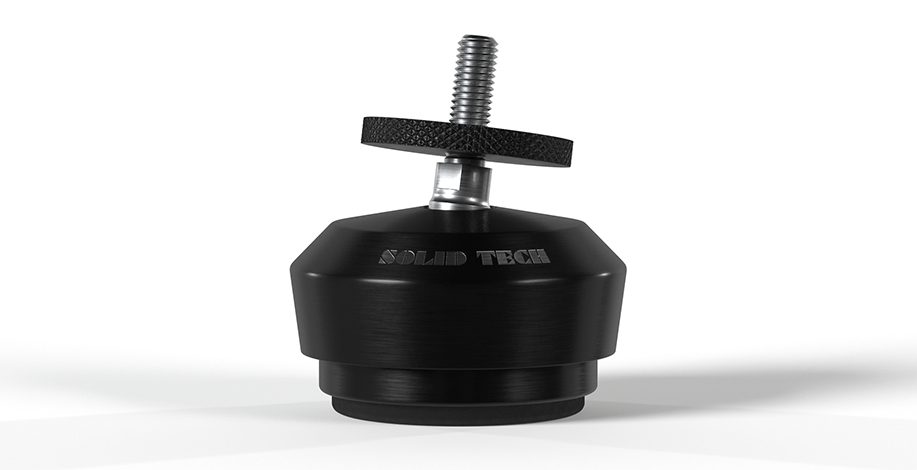
Solid Tech’s Feet of Balance are the loyal opposition in the kingdom of spikes! Back in the day, if you didn’t put spikes under your speakers, you were considered a lightweight or worse. But spikes do not isolate. They provide a rigid conduit for vibrations to travel through. Spikes also transmit specific frequencies more effectively than others. Hence, they have a tuning effect, which is what people hear. Still, the existence of a two-way connection between floor and speaker has ultimately been revealed to harm fidelity if not musical enjoyment.
The first real challenge to the hegemony of spikes saw the use of damped springs to stop energy from travelling between the floor and the speaker. Almost everyone who hears what they do realises this benefits overall sound quality. However, sprung platforms and outriggers are bulky. They are also hard to execute with the degree of precision demanded by high-end audio enthusiasts.
The Solid Tech Feet of Balance are among the most impressive examples because they allow different springs to suit different weights of speakers, or equipment racks, for that matter. This flexibility means that the chosen springs have enough range of movement. This delivers maximum isolation. A rubber foot, for instance, compresses a millimetre or two at the very most, and this doesn’t stop low frequencies from travelling through it. However, if you can use a spring that compresses by 10mm, you have a barrier to frequencies below 10 Hz. You also have a means of stopping the speaker from vibrating the floor and everything else sitting on it.
Energy travels
A Townshend demonstration struck me at the Munich High End show a few years back. One PMC speaker was spiked to the concrete floor, and the other was on a Seismic podium. Each had a tablet on top with a seismic measurement app displaying energy levels at various frequencies. When a subwoofer across the hall kicked off, the app on the spiked speaker danced around frantically. In contrast, the Seismically isolated speaker/tablet remained calm. Energy travels through floors regardless of their construction.
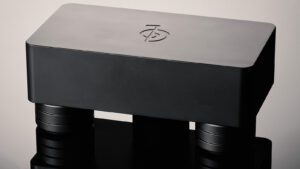
The Solid Tech Feet of Balance are constructed with a pivoting thread that you screw into the speaker, and this has a hidden spike at the bottom. This sits in a brass disc that is damped by seven magnets. Beneath this is a chamber where seven springs can be inserted to accommodate a broad range of loads. These range from 15kg to 180kg across four feet. Solid Tech supplies three sets of springs to suit different loads. The appropriate arrangements are shown in the accompanying literature.
Build quality is very high throughout, with the main cover being in anodized aluminum. The base has a rubber cap over its Delrin shell. Opening and changing the springs is a straightforward affair but is easier if you can screw the thread into an inverted stand or speaker. The nature of the design means that they add in the region of 30 – 40mm to the height of the supported speaker compared with regular spikes. The foot and the threaded stud is 53mm high, and the anodized and knurled lock disc adds 5mm on top of that.
Taking the load
I didn’t have a suitable floorstanding speaker to try them on. So I used the Feet of Balance in a pair of Custom Design speaker stands supporting PMC twenty.22 loudspeakers with a Blu-tack interface. The combined weight of the speaker and stand came in at just over 17kg. Therefore, I opened up the Feet of Balance to check which springs had been installed. Seeing that the correct number of springs was in the right place, I made a comparison. Only later did I notice in the literature that the springs installed were intended for a heavier load! That might teach me to ‘RTFM’, but I suspect not.
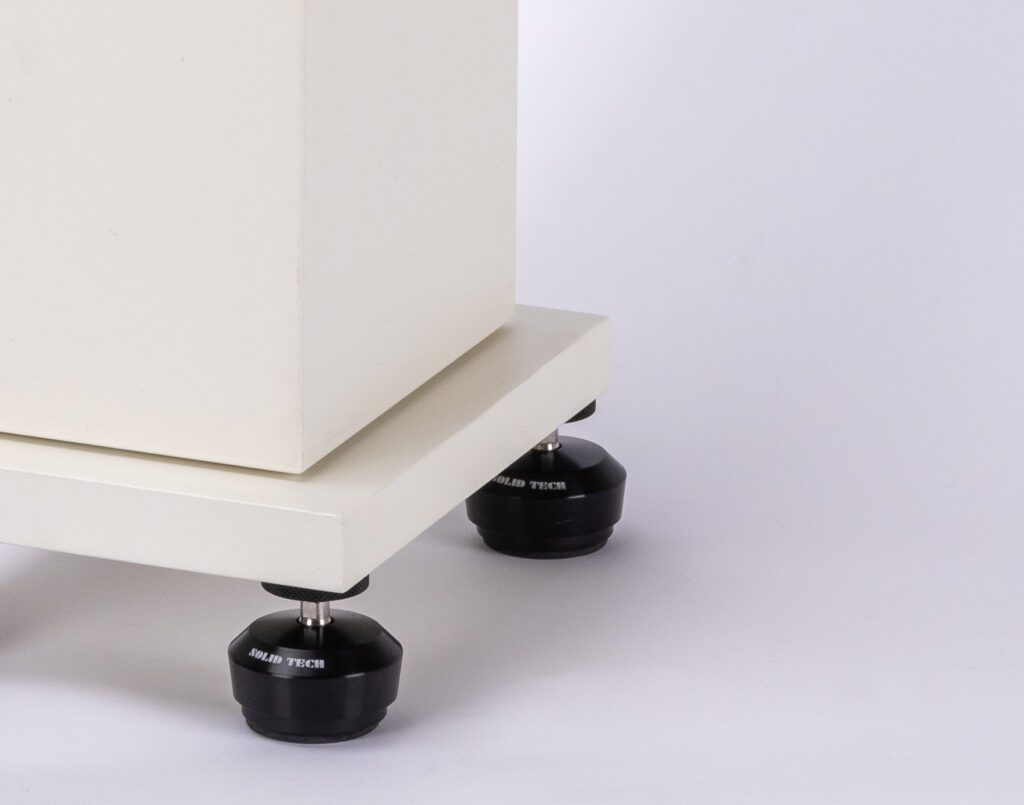
After I had gone through all eight feet and replaced the four high-density springs with four medium-density examples, I could sit down and repeat the exercise. This time, I also noticed the instruction that the logos should face in the same direction as the drive units for best results. Using four springs oriented this way means that two springs are at the back and two at the front.
Not subtle… in a good way
The effect of replacing spikes with the Feet of Balance is not subtle. It is almost akin to upgrading the loudspeakers and certainly better than a cable upgrade at this price. The Feet of Balance put the sound quality in a different class, one where clarity is more significant and, thus, image definition more decisive. It introduces an ease to the sound that is very hard to achieve by other means. This brings about a perceived reduction in distortion.
The latter is noticeable because the volume level seems lower. You might not think that a drop in perceived volume is a good sign, but it often is. It means that the sharp edges, the distortions resulting from a loudspeaker being vibrated by its partner and from both speakers vibrating the electronics, have been reduced. Lower mechanical vibration means that more of the actual signal can be heard. This happens as it is not being masked by colorations.
Stick wielding
What this meant for my music was a greater sense of projection into the room, more openness, and a better definition of low-level sounds. With Kraftwerk’s live rendition of ‘Radioactivity’ [Minimum, Maximum, Kling Klang], there was a marked reduction in hardness. Still, there was no apparent loss of bass extension, and image depth was significantly improved. As a result, it sounded massive. By the time ‘Babylon Sisters’ [Gaucho, MCA] came along, it was evident that the transparency and resolving power of the system had increased by a large margin. This Steely Dan classic had more class, polish, and accurate timing. This improvement was so great that the air drums had to come out.
I have always enjoyed the benefits of effective isolation, but finding a product that does this job so well in such a neat package is rare. The Solid Tech Feet of Balance are expensive in some respects. However, the rewards in a system in the £10k plus region will make the cost seem like a genuine bargain.
Technical specifications
- Type: Loudspeaker isolation feet.
- Material: Steel, brass and aluminium.
- Isolates from: 10Hz
- Speaker weight range: 15kg to 180kg.
- Thread options: M6, M8, M10, M12, ¼”, ½”, 3/8”, 5/16”.
- Dimensions (HxW): 53 x 65mm
- Weight: 147g per foot
- Price (per set of four): £550, €521 (excl. VAT)
Manufacturer
Solid Tech
+46 (0)40 491352
UK distributor
Harmony HiFi Distribution Ltd
44(0)1707 629345
Trending Articles
See all
By Jason Kennedy
More articles from this author

Read Next From Review
See all
Eversolo T8
- Oct 13, 2026
Acoustic Energy AE Active
- Oct 13, 2026
Reiki Audio SuperSwitch X/Pro X PSU
- Oct 06, 2026

Audiobyte SuperVOX
- Oct 06, 2026