Up to 37% in savings when you subscribe to hi-fi+
hifi-logo-footer

Begin typing your search above and press return to search. Press Esc to cancel.

Franco Serblin Accordo Essence

Franco Serblin, (1939–2013) one of the great italian speaker designers devoted his life to making some of the world’s finest speakers, initially founding Sonus faber, and then selling the company in 2006 to start a ‘Serblin’ range of speakers under the company name Laboratorium.

 Alan Sircom recently reviewed the Accord stand-mount, and hot-on-the-heels of this Laboratorium has recently released the floorstanding version, designed by Massimiliano Favella, constructed in solid walnut, and finished with chrome. It is undoubtedly one of the most beautiful speakers to grace my listening room. Sonus faber, the previous enterprise of Serblin, borrowed the names of some of the great violin makers for their ranges, Stradivarius and Guarneri. It is interesting that just as the great Italian cities were famed for their take on pizza (Neapolitans are soft and thin based, Roman are more crispy etc.), the same is true of the centres of Violin making: Cremona, Milan, Venice, Brescia.


It’s a family affair

Each family of makers had distinctive sounds; Cremona’s most famous violin-making town was famed for the sound’s sweetness and power. The Venetian sound, by contrast, has a sense of liquidity to it, a sort of liquid mellowness as opposed to the naked Cremonese sweetness. I apologise for the digression, but I am lucky enough to play on a Venetian violin, made in 1710 by Matteo Gofriller. I see a remarkable similarity between the sound of the Accordo Essence, built just 45 minutes from Venice and the sound of the Venetian violin-making school. More of that later!

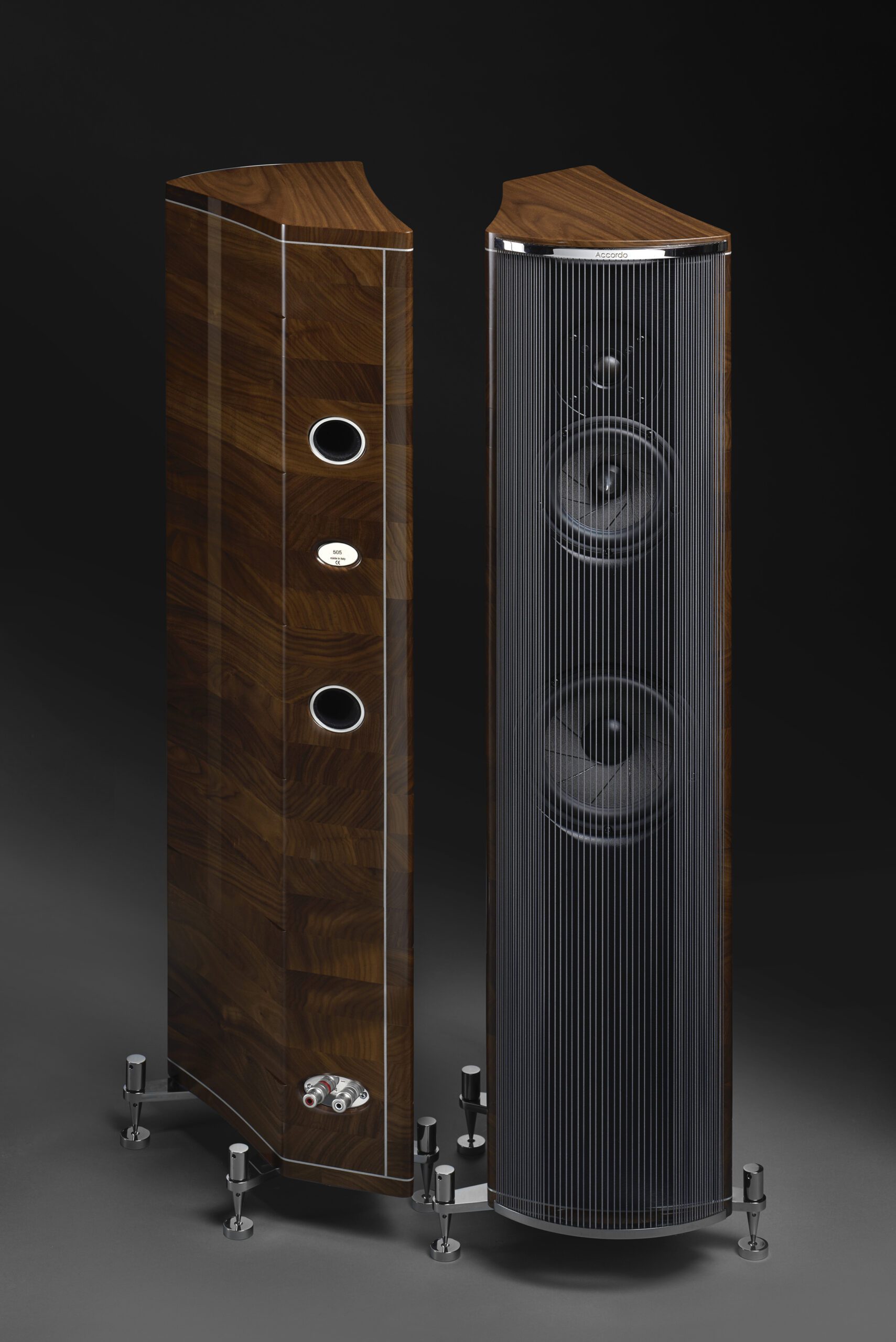
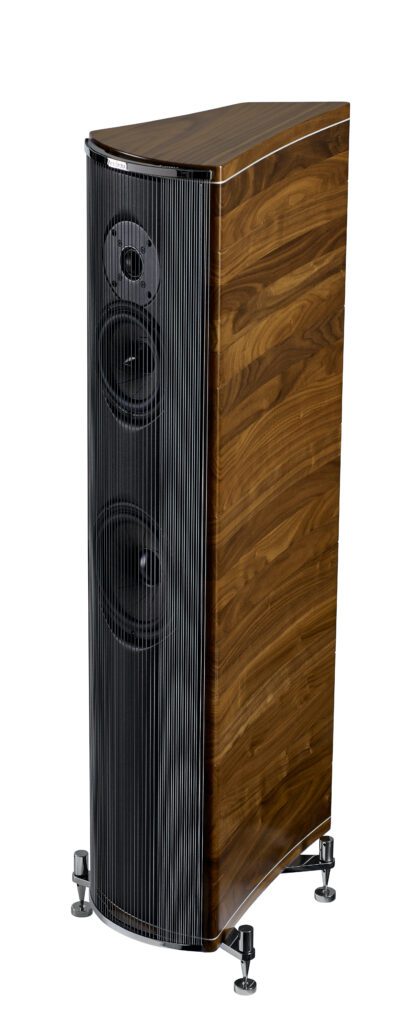
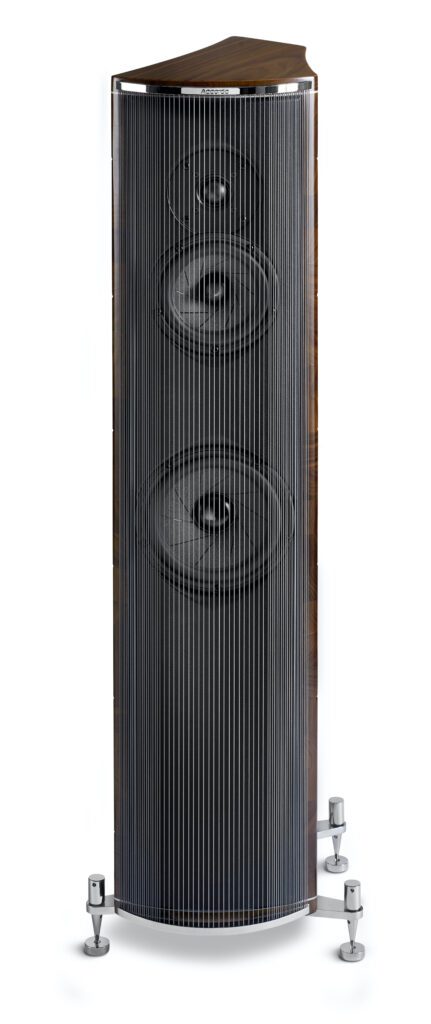
 The speaker sits on chrome spikes, which are adjustable and have small cups which rest on the floor. The Essences are a three-way ported design; a 29mm silk dome tweeter, designed by Ragnar Lian (founder of Scan-Speak), a 150mm mid-range microsphere-coned drive unit, and a 180mm woofer.
Franco Serblin Accordo Essence

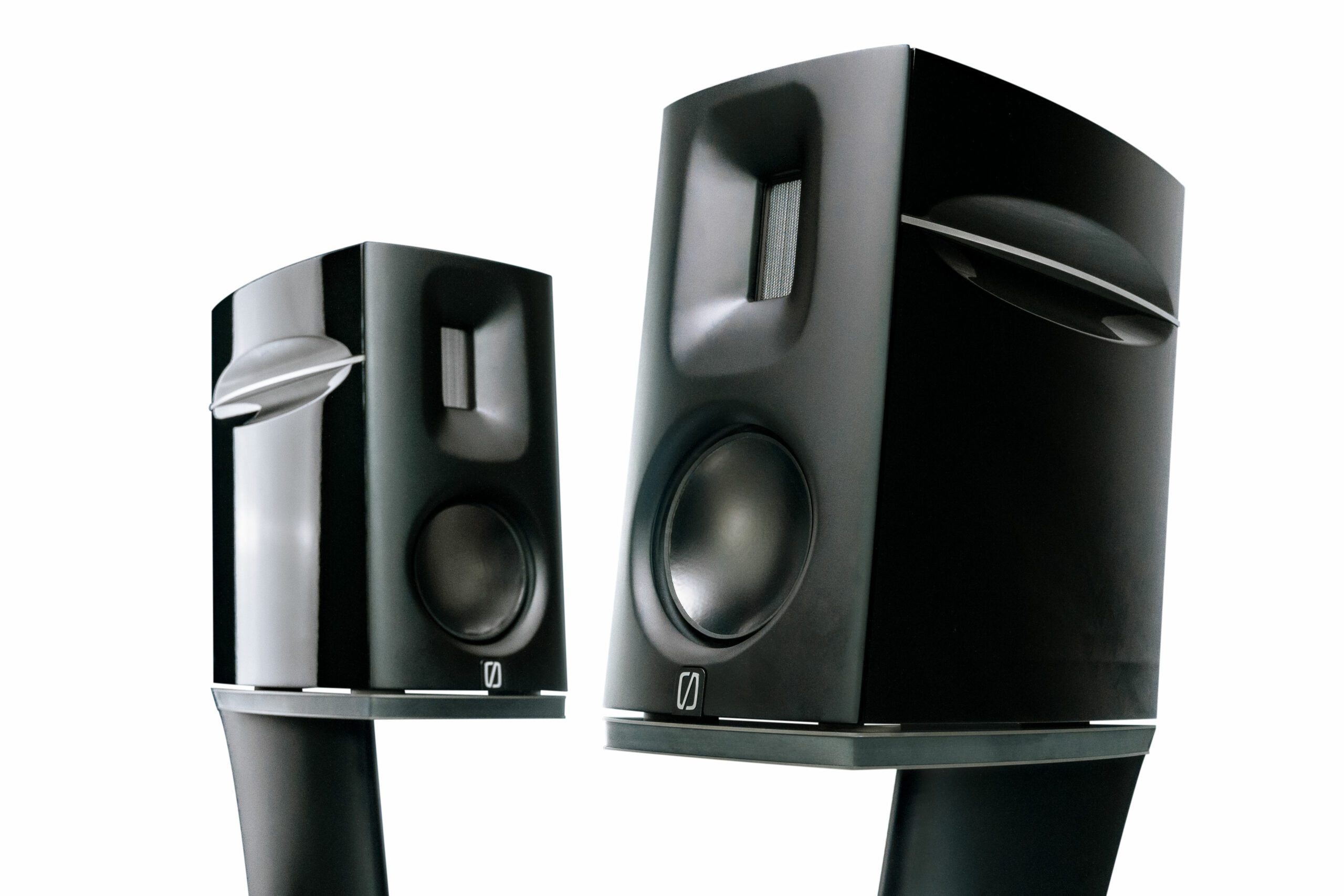
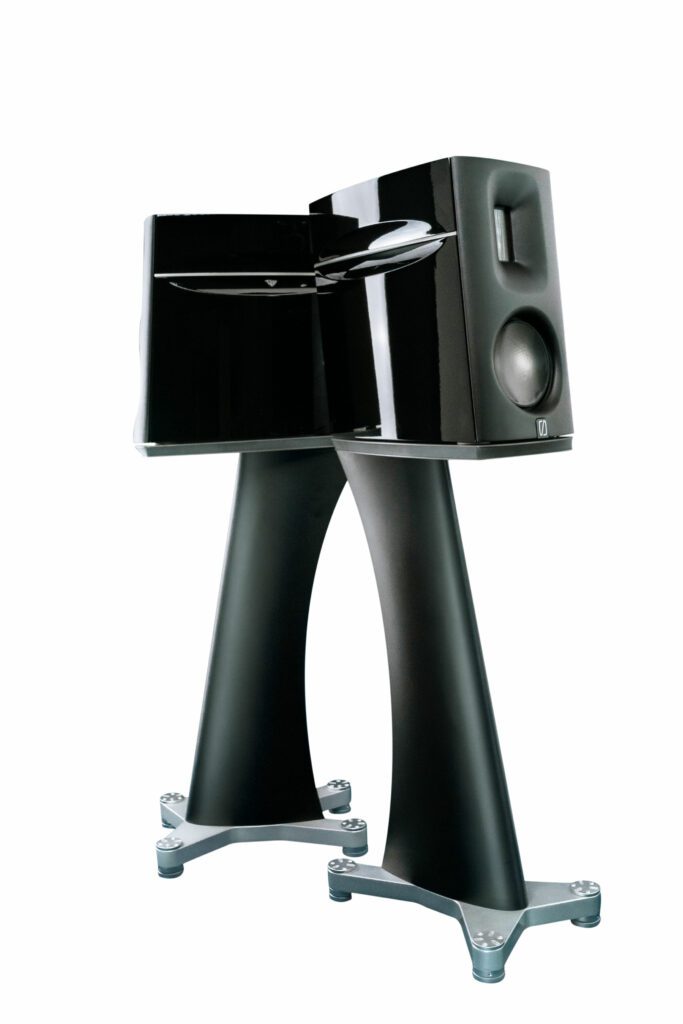
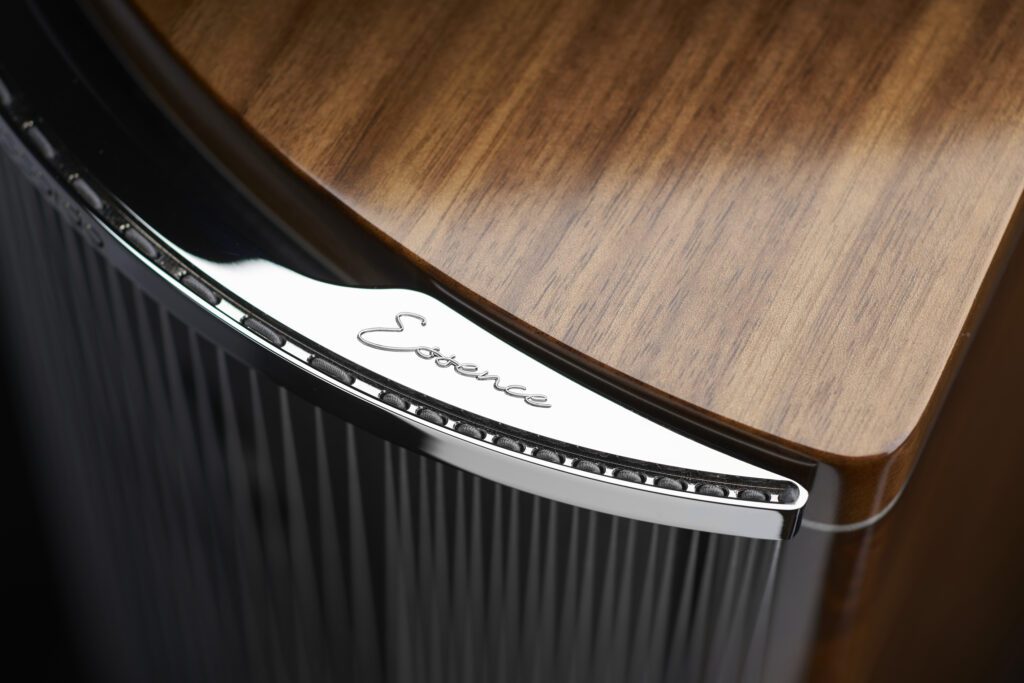
The speakers, like the stand-mounts, are handed and are a wonderfully curvaceous take on ‘rhomboid’. There are ports for both the midrange and woofers; ‘double ported’, I suppose I should say. The rear has high-quality binding posts, only a pair, and no bi-wiring tweakability here! The speakers are internally braced with aluminium and magnesium and weigh 30Kg each. Similar to the Sonus faber range, there are grills constructed with rubber strings. I couldn’t figure out if they were removable or not, but they created a floating effect, like harp strings, and I doubt they affected the sound in any discernible way. Overall, these are objects of incredible beauty and one of the highest scoring Wife Acceptance Factors of any product I’ve reviewed.


Minimum power

The spec suggests that the minimum power output for a suitable amplifier to drive this is 20 Watts. I’m using some 200 Watt VAC Phi’s, which have no problem driving them, but I suspect that 20 Watts isn’t going to be nearly enough to do them full justice with a sensitivity of 88dB.

Listening to them in my system with a dCS Bartok and Townshend Allegri Reference preamp, there is an initial familiarity with the sound. I think that the tweeters are reminiscent of the Scan-Speak tweeters on my Sonus faber Concertino’s, a smooth, mellow, warm sound, and very different to the diamond tweeters on my B&W 802d3’s, which have a stridency which can cause problems with the wrong matching. It’s a highly distinctive top end, rounded, gentle and quite sonorous.

Listening to Leif Ove Andsnes playing the rather extraordinary Beethoven Choral Fantasia [Sony], a piece whose first movement consists of a piano solo and which Beethoven hadn’t finished for the first performance, resulted in him sitting at the keyboard turning blank pages! The second movement, which was finished, has shades of the 9th Symphony, various woodwind/string moments, and a piano and a choir. Entirely off the wall!

The Accordo Essences provide a very alluring sound. That’s really first and foremost. Nothing ugly, shrill or out of place, just a sheer aesthetic beauty to the sound. The drive units show how well chosen they are, as there are no ‘sonic leaps’ between them, just one long mellow continuum of sound. The bass is articulate, clear, powerful, and goes down surprisingly deep for a speaker with a narrowish baffle. The piano texture is uniformly coherent, showing no lack of integration between the drive units. Each drive unit works its part in the overall sound in an even and balanced way. Three drive units, one instrument.

Enter the brass

When the brass enters to contradict the strings, the spatial image is good, deep and large; perhaps a little of the spatial information is not quite as present as it could be with the choice of the Scan-Speak tweeter, which prioritises beauty and smoothness above the last word in airy spaciousness. As each musical character takes their place in this bizarre piece, superbly recorded in High Resolution, the vocal soloists keep adding to the largesse of the texture. The Serblins cope admirably, producing a grand scale of sound effortlessly. Not holographic, but well spaced.
Franco Serblin Accordo Essence

Onto Bruckner’s 7th symphony, the epic slow movement, a tribute to Richard Wagner, Bernard Haitink conducting the Royal Concertgebouw Orchestra [re-released in High Resolution, on Decca] provides a powerful rendition of this magnificent work. The scale is reproduced effortlessly, never a rough sound and always beautiful; these speakers will appeal to listeners whose glass is half full. It provides the best orchestral texture you need to appreciate the music. It is at the opposite end of the scale to my B&W 802d3’s, which veer towards the concept of the ‘Monitor’, i.e. what they use in Abbey Road studios to hear the ‘warts’, to see the glass half empty.

I’m sure seasoned audiophiles find that they have the amount of water in their audio glasses that accords with their philosophy of listening. I make a few recordings of my quartet and various orchestras, and there are times when I need to hear the tiniest details, however bright and unpleasant they may sound. On the Serblins, these little eccentricities get minimised, and I was amazed, for example, at just how good the raw feed from the orchestral recording sounded. It wasn’t clear what I needed to do to equalise it because it just sounded good the way it was. Definitely speakers for the end listener and not for ‘Pro Audio’.

Playing some jazz, Art Farmer and Farmer’s Market on Qobuz, initially recorded in the mid-1950s (and remastered), the Serblins hit the nail on the head with that ‘old world’ jazz club sound. They provide toe-tapping rhythmic propulsion and timing magnificently and the rose-tinted approach they bring really works here brilliantly.


More valves!

Giving the Accordo Essences a spin with another valve amplifier I happened to have from a previous review, the Prima Luna Evo 400 integrated amplifier, which came furnished with EL34s, proved a good partnership. They are slightly less bright than my VAC Phi 200s, and EL34s are more airy and spacious than KT88s on the VACs, so in Triode mode, they seemed to complement the Serblin’s well.

Listening to Haydn’s Sinfonia Concertante, Sir Simon Rattle conducting the Berlin Philharmonic [Warner] really sounded lovely, full but with some extra space and air. Interestingly, the choice of valve makes such a critical difference here. I have to speculate whether a brighter transistor amplifier will work well; I’m not sure it would give the same airy quality that an EL34 brings to the party, but it would be worth a hearing.
Franco Serblin Accordo Essence

The Accordo Essence is a truly unique proposition. They look stunning, curvaceous and fabulously constructed in a natural wood that assures the most anti-audio partners! Their sound, as I discussed earlier, bares a striking audio resemblance to the violins made in the golden age of Venetian violin making; not bright and sharp, but liquid and smooth, not known for their vast power, but a pleasingly balanced and warm sound. They seem to extract the best from a piece of music without being overly analytical and appeal to the actual music lover who just wants to enjoy their music. Even if that music arrives in a romantic rose-tinted way. It is worth careful partnering with a suitable amplifier. Valves are a sure-fire winner, but EL34s work best in my system. In these dark times, who wouldn’t permit this marvellous sonic indulgence?

TECHNICAL SPECIFICATIONS

  •  Geometry: 3-way floorstanding vented box loudspeaker
  • Cabinet: Super – rigid, arch–shaped solid wood structure, decoupled with aluminium – magnesium parts to obtain resonance control.
  • Tweeter: 29mm silk – dome by Ragnar Lian, Mid–woofer: legendary, custom made,150 mm microspheres cone,
  • Woofer: 180 mm microspheres cone, aluminium dust cap.
  • Frequency response: 35Hz–22KHz
  • Nominal impedance: 4ohm
  • Sensitivity: 88dB/2.83V/1m
  • Minimum power amplifier: 20W/channel
  • Finish: Solid walnut – Metal parts of chrome and aluminium
  • Dimensions: 1100 × 230 × 430 (H×W×D)
  • Weight: 60 Kg /pair speaker unpacked 70 Kg /pair packed
  • Price: £12,998 per pair

Manufacturer: Laboratorium

URL: francoserblin.it

UK Distributor: Absolute Sounds

URL: absolutesounds.com

Tel: +44(0)208 971 3909
Back to Reviews

Karan Acoustics Master Collection POWERa Mono

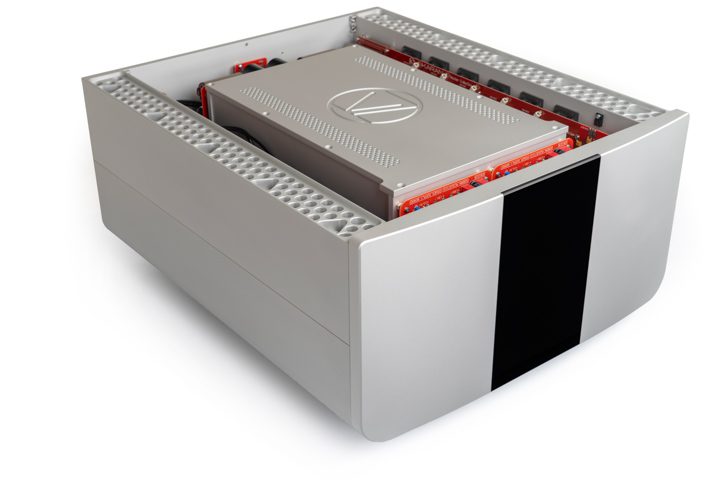
Milan Karan’s Master Collection portfolio of preamplifiers and power amplifiers is a step-change in the company’s design, leveraging decades of knowing how to make a good amplifier to produce the best product in the category. The first two out of the starting gates were the two box LINEa (reviewed in Issue 181) and single box LINEb (reviewed in Issue 191) preamplifiers, with the promise of stereo and mono power amplifiers and phono stages to follow. The Master Collection POWERa Mono amp is the first of this second wave of new electronics from the brand, and it more than lives up to the standards set by the preamps.

Oddly, although they are no strangers to the magazine, we have never formally looked at any of Karan Acoustics ‘big’ stereo or mono power amplifiers. Except for the ‘smaller’ KA M 650 monoblocks (reviewed in Issue 56), we only ever used them in the context of other reviews. It’s time to redress this error.

Both stereo and mono variants of the POWERa launched only a few months ago, and the big monoblocks were a natural choice for the first review. Leading the Karan range for almost two decades, the KA M 1200s and, lately, KA M 2000s mono amplifiers defined a standard of design and sonic performance that would never be easy to beat and outperform. So, to do so, Milan Karan has pulled out all the stops when designing the POWERa amplifiers.


From the ground up

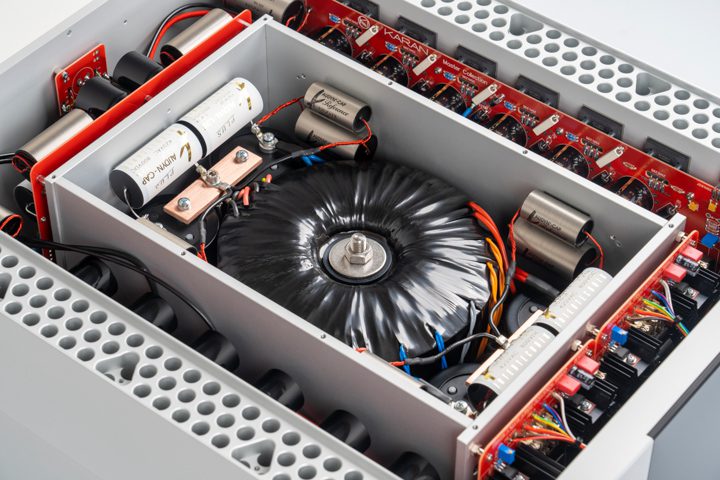
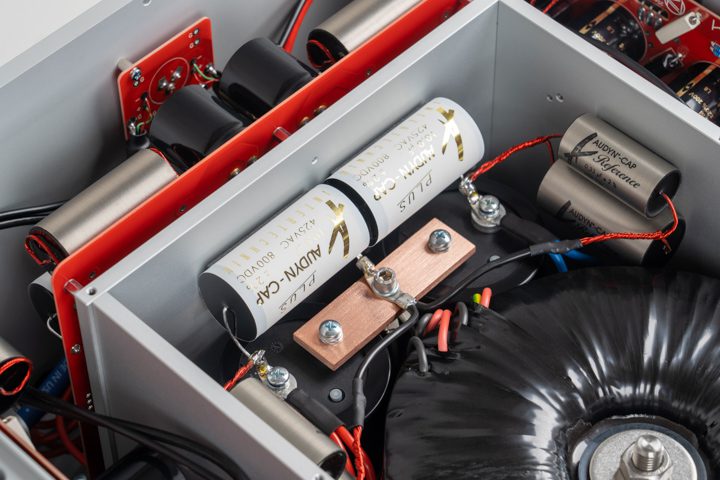
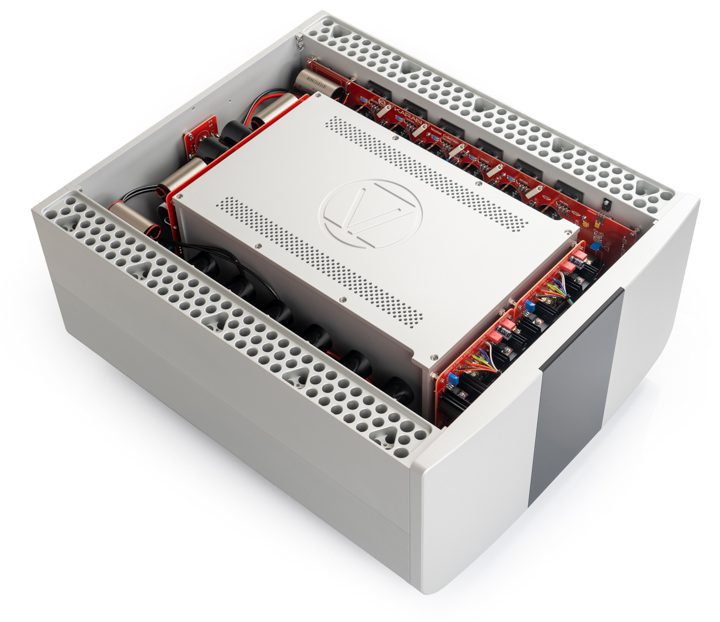
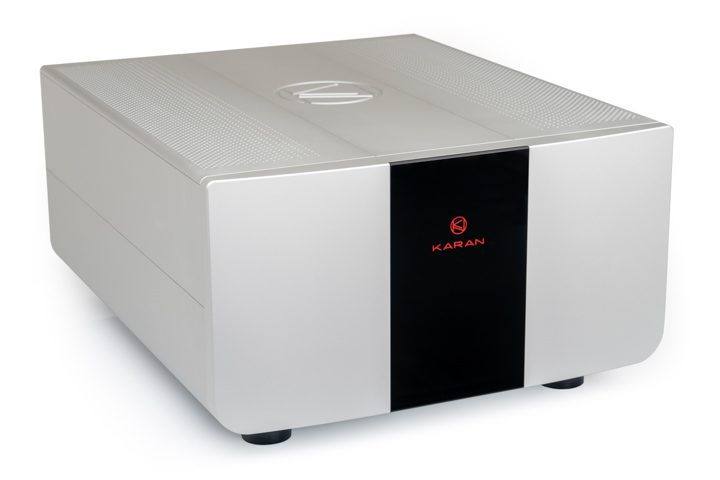
Everything inside the impressive genuine differential mono chassis shell is improved and redesigned from the ground up. While the output (power) circuits still implement the very best Sanken bipolar output devices, the power supplies and their accompanying audio infrastructure have been extensively reworked. The same applies to the input (driver) stages, with high-grade Audyn and superior, proprietary Karan Acoustics capacitors used throughout. The component list of greats includes Vishay and Roederstein resistors and Cardas Audio’s highest quality chassis wire. That, however, is not all. As with all Karan mono amplifiers, each ‘polarity half’ of each audio channel (i.e. amplifier) has its independent mains transformer and accompanying power supply; this also means we need two mains cables for each amplifier!

Karan Acoustics Master Collection POWERa Mono

For the POWERa amplifiers, Karan developed new, much bigger, more powerful, and mechanically quieter toroidal transformers. That resulted in a proportionally enlarged battery of power supply reservoir capacitors of equally high-grade specifications, giving the circuits an even greater reserve of power and current and ultra-quickly available from stock. As before, speaker terminals and RCA inputs stem from WBT, while Neutrik caters for the XLR input interface.

This amplifier’s power output is impressive even by the brute-force standards of some of the biggest big hitters. It puts out an impressive 2,150W into eight ohms and pulls up to 6kW into two ohms, and you can see why it needs two power cables per chassis. In use, that doesn’t just mean it can make a wall sing if you give it some speaker terminals; it means the amps will deliver the signal’s total bandwidth and dynamic headroom into any loudspeaker load while delivering the potential for excellent transient speed and extremely silent circuit operation.

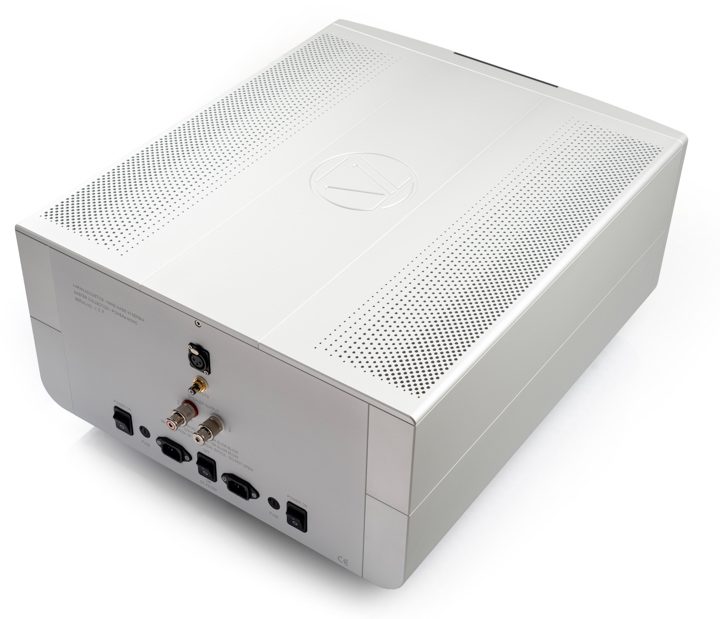
The innards of the new Master Collection power amplifiers hide another new feature; in the main chassis of all POWER models is an advanced mains (line) conditioner with the primary goal of dealing with and eliminating as much (if not all) of the unwanted DC related by-products of our electricity supply! The amplifier has a switch on the back panel allowing you to hear the sound with or without the conditioner/DC filter in use or not. You can even do this while the amplifier is switched on and playing music! While there are few categories in audio as contended as the line conditioner/DC filter market, I’d like to see this offered as a separate, universal product within the Karan Acoustics product range.


Ask Milan

When asked about this part of the design, Milan Karan said, “I believe that having our own design and solution for the treatment of unwanted DC artefacts from the mains supply is at least as important as all other circuit innovations within the Master Collection POWER amplifiers. What would be the point of having huge and capable mains transformers and other power components (which often contribute to the ultimate sound of any amplifier than the actual audio circuits) if the electricity entering the amplifier were not to be of the same, high standard?

“To make something complex sound as simple as possible, let us say that any supply of electricity also includes various ‘unwanted’ elements. Let’s just consider how many domestic electrical appliances and/or consumers tend to be powered through the electricity supply network at all times. They generate a huge number of spurious by-products as a consequence of how poorly their own power supplies may have been designed. And, for as long as they remain powered up, those ‘dirty’ components are fed back into the network and, consequently, into all other consumers, equally so switched on! Not just high-end audio components, everything! The most parasitic pollution is of a DC (direct current) nature. This, quite damaging for audio components in particular, part of our electricity, reflects itself as a DC voltage that can be either positive or negative, and has an amplitude of up to several Volts!

Karan Acoustics Master Collection POWERa Mono

“The higher this DC voltage may be, the more saturation attacks mains transformer cores within all amplifiers. Temperature of the transformer windings will rise because they feel the DC voltage almost as a short (circuit)! Transformers will begin to vibrate mechanically to a various, often high degree. We perceive this as an unpleasant mechanical vibration, like a buzz, from the amplifiers within one’s listening room. The bigger the mains transformers, the more sensitive to the parasitic DC voltage they are, and the louder the mechanical vibrations will be.

“That is not all, however. This also brings a problem with the Neutral side of the mains as a phase shift will develop, the severity of which depends on how badly high the parasitic DC voltage may be. This, ultimately, prevents the sine wave to be correctly and perfectly shaped. Negative effects on the operational performance of an amplifier and overall sound quality because of these mains anomalies are substantial!

“In order to protect an amplifier of such a (high) power output as in Master Collection POWER models, designing a suitable line conditioner with an efficient DC ‘eliminator’ was anything but easy. The main criterion was that the device had no negative influence on the inherent sound of the amplifier. Further, it had to be the very generously specified in terms of current and voltage flow from the mains supply, so it would cater for at least three times more than the maximum required. In real life that meant a rating of 60A or more. We are proud our mains (line) conditioners inside the new POWER amplifiers comfortably meet and exceed those and many other criteria. Plus, the additional bonus of an on/off switch function enabling the user to perform direct comparison of its effects at any time while the amplifier is in active use.”


Crucial function

I’ve spoken to a few amp designers about power conditioning before, but it’s rare to get such a succinct and impassioned response, so I included it verbatim. This is a crucial function of the Master Reference concept, as is the clever, elegant chassis.

The new chassis concept is a highly effective circuit resonance damping system too. Increasing the mass is the most apparent solution toward superior overall damping. Still, the problem then becomes lots of the wrong kind of metal can cause more harm than good and using just a giant lump of aluminium to mass-load the amplifier ends up being a source of resonance in its own right.

Karan Acoustics Master Collection POWERa Mono

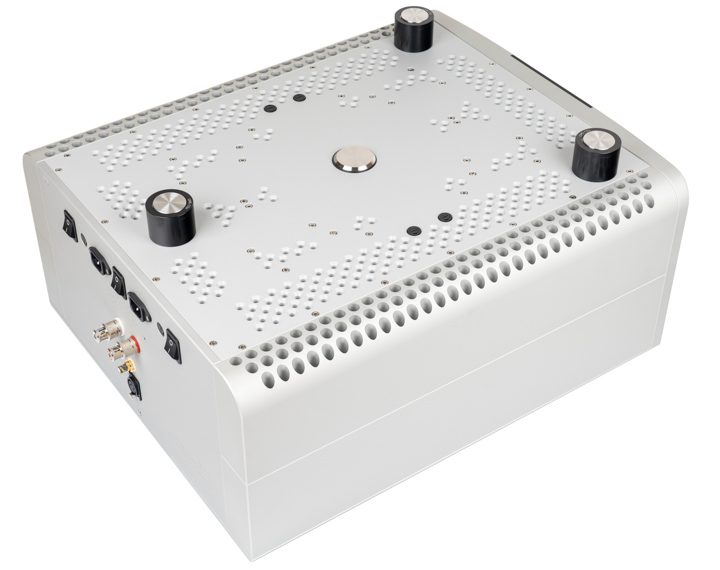
Karan Acoustics designed the main chassis to counter both concerns as a single-piece unibody made from a solid CNC-machined piece of very high-grade aluminium; this acts as a heatsink for the output devices while creating a non-resonant environment for the entire amplifier. This also helps to lower the noise floor of the amplifier itself. Continuing down the ‘impressive specifications’ line, all 105kgs of weight (per amplifier) are supported on three Critical Mass Systems CS2 1.5 supporting feet. The amplifiers are shipped in wooden crates, bringing the total shipping weight to 130kg per amplifier. Put another way; each one weighs more than a professional rugby player!

A good, big amplifier needs to do several things well; it needs to be essentially effortless in performance, with the power and headroom to express the preamplifier’s demands to the loudspeakers without getting in the way at all, but that’s a given. It also needs to have a significant sense of scale and speed so it doesn’t just sound like a big amplifier all the time. When you get to the top tier of power amplifiers, that should be a given too. But often isn’t.


Scintilating performance

However, what you get with the Karan is so much more. It’s a scintillating performance, showing you what the devices upstream and down are capable of and also pointing out where other amplifiers get it very wrong. This is the antidote to those amplifiers that push sound at you; initially impressive but ultimately wearing. Typically, that ‘doesn’t push music at you’ is code for ‘it sounds dull and dreary’, but in this case, the treble sparkles, and the midrange is clear and quicksilver fast.

The more time you spend with the top-end amplifiers, the more you realise there is usually some trade-off, even with the best of them. Some are faster at the expense of dynamics, and some vice versa. Some do detail and stellar high-frequency reproduction at the expense of making the sound too ‘in yer face’ exuberant and exciting. However, when you encounter an amplifier that doesn’t make those compromises, you discover just how common they are. The Karan Master Reference POWERa Mono amps are the amps that don’t compromise.

How this comes across is simple. Play a piece of music. It doesn’t matter what that piece of music is, just something you know well. It was ‘Entr’acte’ from Orange by Caroline Shaw and the Attacca Quartet [Nonesuch]. Other amplifiers will play you all the details in the string noises and the rest. Some will tease out the rhythmic or dynamic elements of this recording or maybe show its pace and speed.

Karan Acoustics Master Collection POWERa Mono

Eventually, they will begin to push past that initial ‘signature’ and show the recording in its complete form. The Karan amps give you the whole picture right from the opening bar. This could be unnerving but, in fact, is thrilling. It’s like hearing the recording for the first time or much more like hearing it live. Or, it’s like the first time you heard good audio, revising how you appreciate recorded music. In short, it’s that good.

All those usual aspects of performance are moved out of the way. You realise that discussing stereo soundstaging or vocal articulation is praising a product for not doing its job correctly. Those terms fall away when you hear it done right through the Karans. All that’s left is music. Sure, if you play Trentemøller’s ‘Chameleon’ [The Last Resort, Poker Flat] or Boris Blank’s ‘Electrified’ from the album of the same name [Polydor], the POWERa’s ability to grab hold of the bass and shake it out through your internal organs is deeply impressive. And it makes your loudspeakers seem physically larger when called upon in that manner.

But that’s only the start of what this is all about. Bass that treats your body to a spot of food processing is easy; listening to those synthesised pieces of music and finding the subtlety and instrumentation hidden below – and having that musical epiphany presented instantly – is something rare and to be treasured.


The Time Machine

I touched on this earlier, but where good audio is a time machine, putting you back to the point when you first heard that album, good audio takes you back to the first time you heard what hi-fi can do. The trouble with that experience is it is fleeting, and many of us spend a fortune trying to replicate and hold onto that feeling we got the first time we heard good audio.

Addiction specialists might talk about ‘reward centres’ in the brain and how that kind of fleeting ‘high’ creates a need in the addict, but with audio, the POWERa Mono resets your musical and audio levels each time you play a track; you get that ‘first time I heard it’ feeling repeatedly.

Then there’s the scale issue. Sounds played through the POWERa Mono are ‘right sized’ whatever you play. Move from a sizeable orchestral piece to something more small scale and vocal, and the Karan amps move with you effortlessly. Once again, this is something you realise more by recalling other amplifiers that do almost the same thing. This scales perfectly well, with no sign of either ‘tiny orchestra syndrome’ or ‘Attack of the 50ft Woman’ problems and to do that so thoroughly is exceptionally rare.

Karan Acoustics Master Collection POWERa Mono

To summarise the Karan Acoustics Master Collection POWERa Mono in musical terms, I need ‘Spitfire’ from Public Service Broadcasting’s Inform Educate Entertain album [Test Card]. It’s not a demonstration quality track; just a pounding rhythm coupled to some noisy samples from the 1942 British movie, The First of The Few. It’s easy to get it wholly wrong on a big system, but get it right, and I’m back building Airfix kits; and this got it so right, I could smell Humbrol enamel!

The only downside to these amplifiers is that they spell the end for Karan’s existing KA M line of power amps. While these big power amps are not in the same sonic league as the Master Collection models, they are (somewhat) more affordable. I doubt something like the KA M 2000 would be a steppingstone to the POWERa Mono (and there will likely be a POWERb line that would make such jumps even harder to justify). Nevertheless, it would be nice to have something more attainably priced in the Karan portfolio just to make the Master Collection even more of a goal for some.


Endless Scale

That’s nit-picky, however, as the Master Collection POWERa Mono is the best balance of performance in terms of sheer power output and the quality of that power that you can get right now. This is an amplifier with endless scale, and dynamic range yet doesn’t shout about those properties… simply letting you know they are there when you need them. An amplifier at once capable of brute force and terrific refinement sets the Karans apart from the pack.

Karan Acoustics Master Collection POWERa Mono

There are some exceptional amplifiers on the market at the top end, and there’s a solid argument to say there’s one no one path up that mountain (the long-winded version of YMMV: ‘Your Mileage May Vary’). But there is a personal path up that mountain, and for me, that means the Karan Acoustics Master Collection POWERa mono power amplifiers. They are the best amplifiers I have heard so far.

TECHNICAL SPECIFICATIONS

  • Type: Mono solid-state power amplifiers
  • Power output: 2.1kW into 8Ω, 3.6kW into 4Ω, 6kW into 2Ω
  • Peak power output: 2.4kW at 8Ω
  • Inputs: 1 balanced (XLR) and 1 unbalanced (RCA)
  • Input impedance: 30kΩ (balanced/unbalanced)
  • Input sensitivity: 2.0V/RMS (for max output)
  • Frequency Response: 20Hz-20kHz ±0dB, DC-300kHz, -3dB
  • Gain: +36dB
  • Distortion THD/IMD: 0.03%
  • Signal to noise ratio: >120dB unweighted
  • Dimensions (W×H×D): 50.4 × 29.2 × 60.3cm per amplifier
  • Weight: 105kg per amplifier
  • Price: £79,995 per pair

Manufacturer: Karan Acoustics

URL: karanacoustics.com

UK distributor: Audiofreaks

URL: audiofreaks.co.uk

Tel: +(0)208 948 4153

Back to Reviews

Yamaha proposes unique musical devices that work with smartphones

Yamaha drops proposal for new music devices that work in symbiosis with smartphone apps.

*from the Yamaha news release

In recent years, thanks to advances in information technology, new music experiences and music accessories are now offered by various smartphone applications. While these services are widely accepted for their convenience and are replacing traditional devices, we believe there is still a longing for more substantive and tactile interaction that cannot be achieved with touch panel operation.

Through the design of musical instruments and audio equipment, Yamaha designers are well aware of the experiential value that substantive and tactile interaction can create such as joy, beauty, discovery, and confidence. Therefore, hypothesizing on the latent desire for optimal interaction, we studied the feasibility of a new functional beauty that deepens the true experiential value while coexisting with the convenience of evolving IT technology by re-introducing the optimal parts of equipment that have lost their physical presence due to the shift to GUI.

All prototypes are built to work and can be tested and evaluated for their actual use.

When you listen to your favorite music, when you want a little sweet background music before going to bed, when you wish to play relaxing background music, or when you are playing the guitar and want an accompaniment to set the tempo – how would you like to start the music playing?


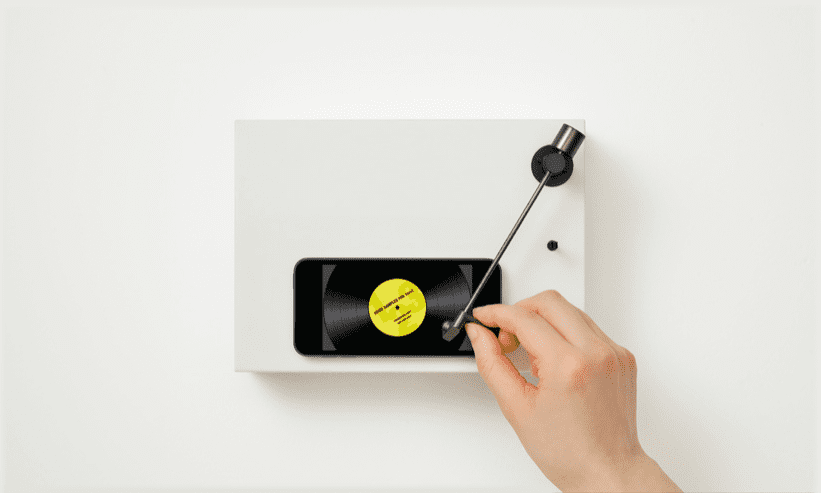
Yamaha TurnT

Like a record player(turntable).

Yamaha TurnT
Works with smartphones. Or rather, the smartphone screen works as a kind of magic record. Place the stylus on it and it starts playing. To change the song, you can change the album by swiping, and you can also reposition the stylus. The step of carefully placing the stylus on to the record will bring back the nostalgia as well as the solemn respect to the music you are about to play.


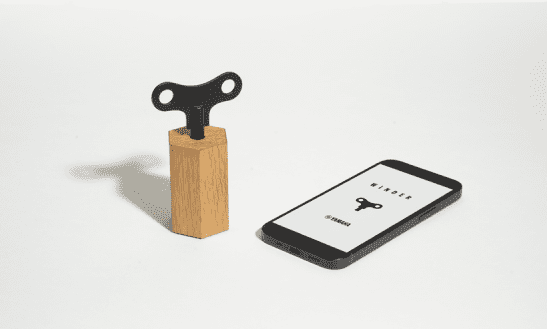
Yamaha Winder

A key, dedicated to just one song, like a music box.

Yamaha Winder

When the key is wound up, the song from the connected smartphone begins to play. Sound movements are generated according to the flutter of the spring, allowing you to enjoy the unique sound texture. The joy of interacting with the clockwork object may lead to a more intimate musical experience.


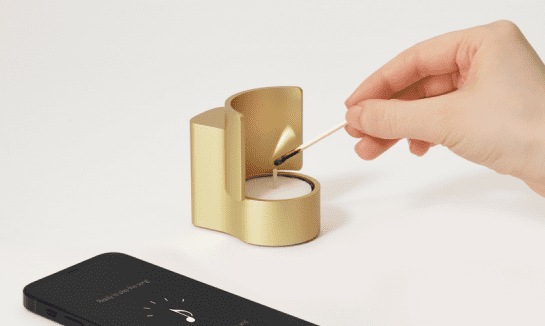
Yamaha MusicLight

Listen to music as you gaze into a candle flame.

Yamaha MusicLight

Light up a candle to start music playing from your smartphone. The sound wavers subtly with the flickering of the flame, and when the flame goes out, the music fades away with an afterglow. Like listening to a song around a bonfire, the flame flickers in unison with the sound, creating a rich atmosphere.


Yamaha RhythmBot

This is an evolutionary form of metronome that supports your performance with rhythm.

Yamaha RhythmBot
Each of these four small robots play a unique acoustic sound. They can be linked to your smartphone to play rhythms to the tempo you are playing, and they can even join in and accompany you in real-time.
Creating a rhythm through a session-like style is a great way to enhance the experience of playing music.

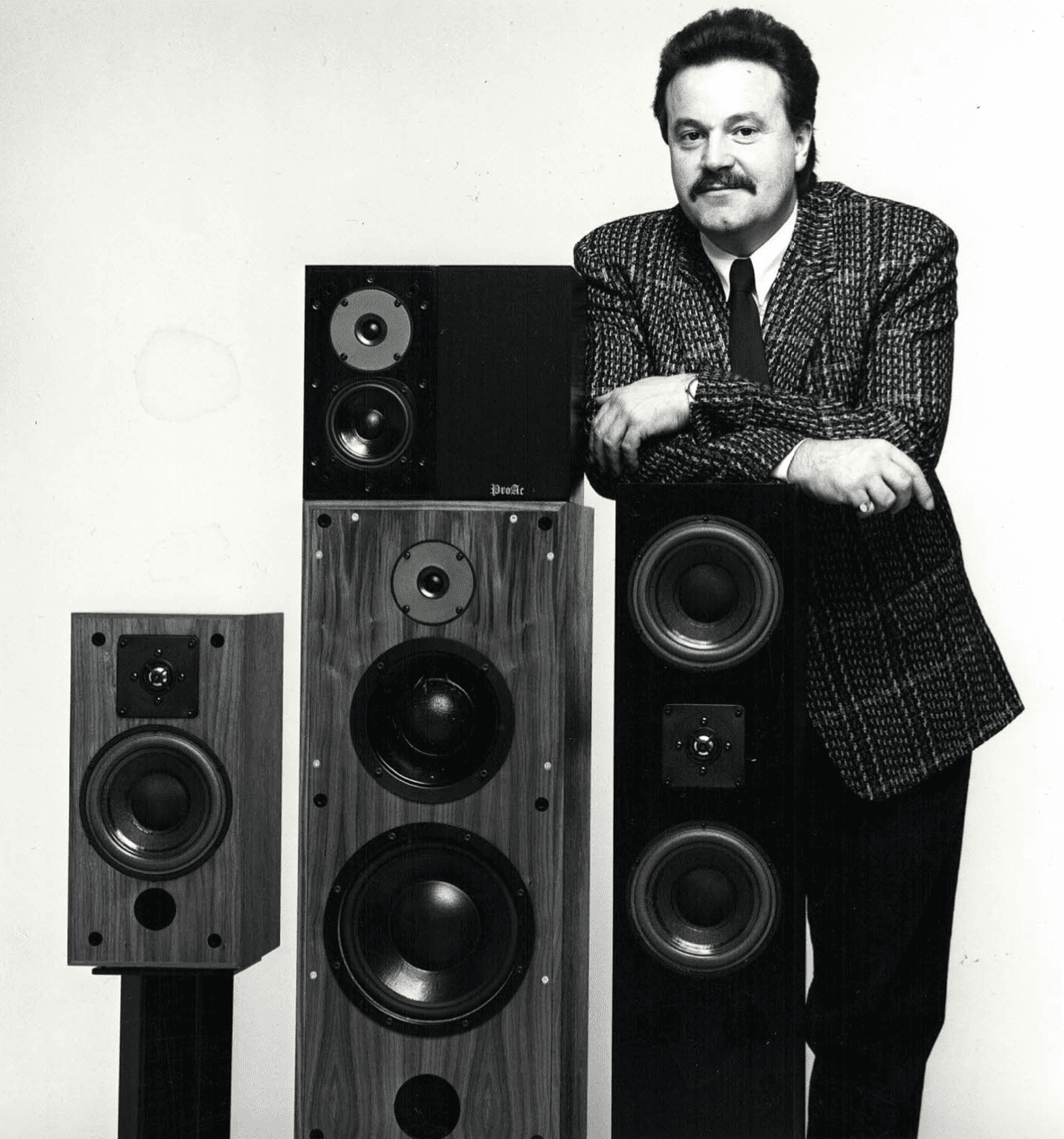
ProAc to take part in UK Audio Show

ProAc has confirmed they will be taking part in the UK Audio Show on the 8th and 9th October at the Staverton Park Hotel in Daventry, Northampton.

As well as having a dedicated room in the Winchester Suite to demonstrate speakers such as the K Series, they will also be part of the Hall of Fame programme of events.

The Hall of Fame is a tribute to the people who have played a fundamental role in the development of the Hi-Fi industry, celebrating the lives of innovative designers and manufacturers who have made the industry what it is today.

Following the sad passing of ProAc’s Founder Stewart Tyler in June 2021, the Tyler family thought this would be a great opportunity to celebrate Stewart’s lifelong passion.

From the late 70’s to the present day, ProAc’s history and Stewart’s innovative designs, will be reflected through a special retrospective exhibition. The display will feature early speaker models, old photos, hi-fi show posters and brochures, telling the story of how ProAc started, from a small unassuming hi-fi shop to a busy manufacturing factory with global distribution.

Stewart’s daughter Zoe Tyler-Mardle will also be presenting a talk at the Hall of Fame Events Suite. She will be giving an insight into what it was like growing up surrounded by her father’s business that started as a ‘kitchen table’ manufacturing operation and how, as a young child, she got involved with the infamous ‘straw portal’ production.

The excellence of ProAc speaker designs continues to this day under the direction of Zoe and her husband John, who worked closely with Stewart over the last 25 years. Wife Frances and son Tristan also work behind the scenes to keep pushing the business forward from strength to strength.

Zoe said, “We are very excited to be attending the UK Audio Show this year and particularly the opportunity to exhibit some of my father’s early speaker designs. We will honour my father’s legacy, ensuring his work and influence continue to be felt within the hi-fi industry. We are currently developing his designs and plan to release a new speaker model in the near future.”

About ProAc

ProAc, an abbreviation of Professional Acoustics, was founded in 1979 by Stewart Tyler.
Based in Brackley UK, the 42-year-old family run business designs and manufactures high-quality world renowned loudspeakers. A meticulous approach to sonic design is applied to the build quality of all ProAc speakers where only the finest components are used, reflecting the leading edge of audio technology with each new model. ProAc loudspeakers work for everyone, now gracing the homes of music and home cinema lovers, as well as professional recording studios worldwide.

Over the years the range of award winning speakers have earned international acclaim and the ProAc brand has become a byword for sonic excellence.

After pushing the boundaries of speaker design and manufacturing for over 40 years, Stewart Tyler sadly passed away in June 2021.

Today ProAc continues to flourish as a tightly-knit family operation keeping his legacy alive and producing loudspeakers which will be revered by hi-fi enthusiasts, sound engineers, music producers and music lovers worldwide, for many years to come.

Vertere Acoustics improves multi-award-winning PHONO- Preamplifier

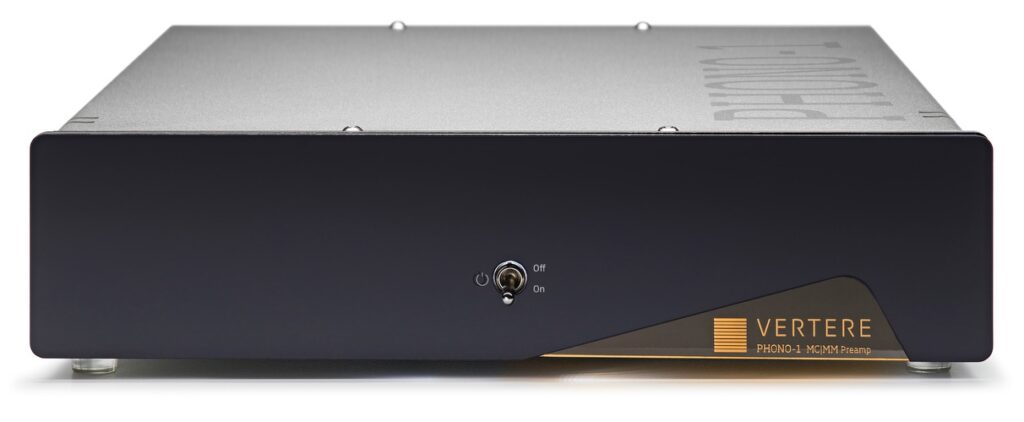
The Vertere Acoustics PHONO-1 preamplifier has been improved upon.

*From the Vertere Acoustics news release

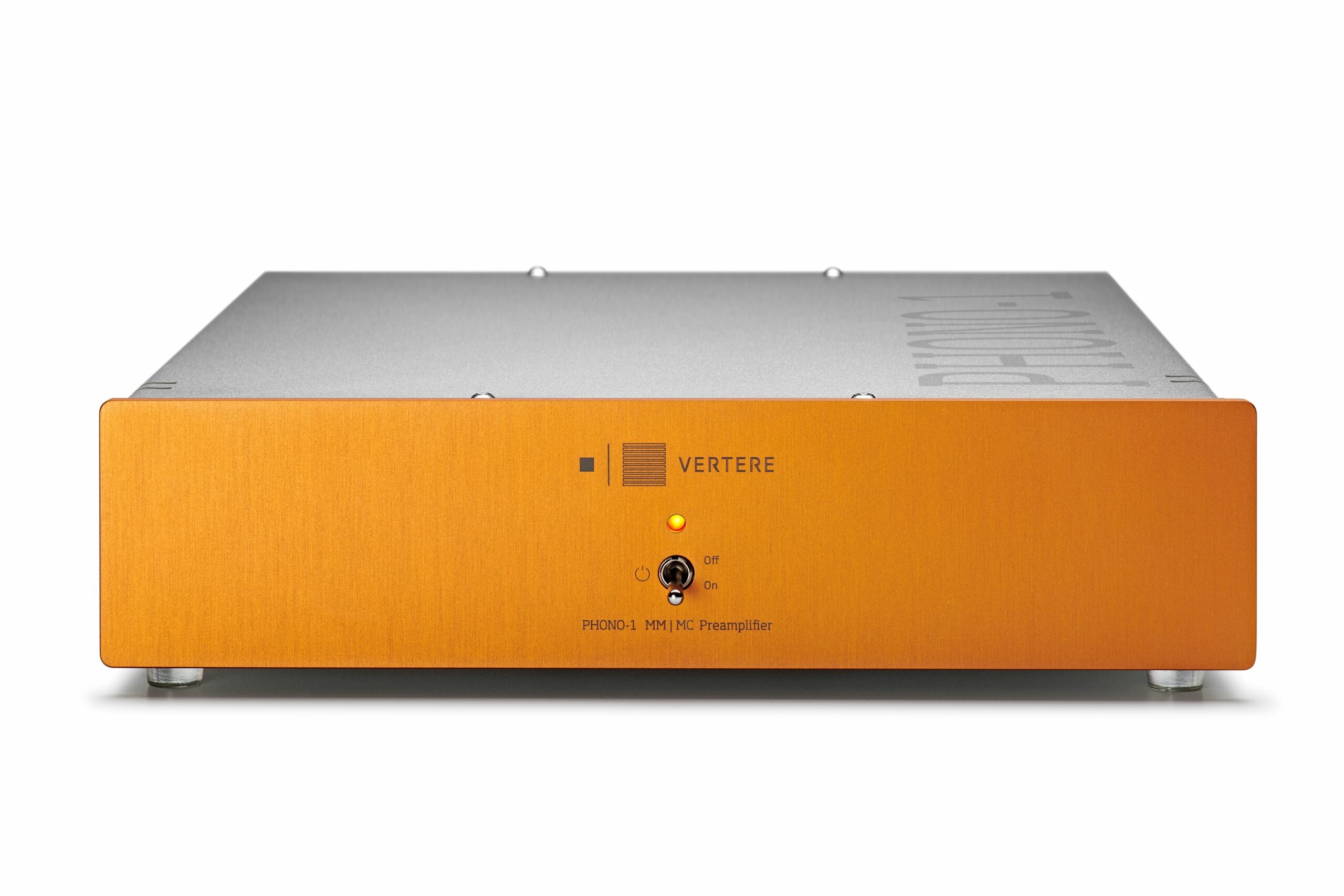
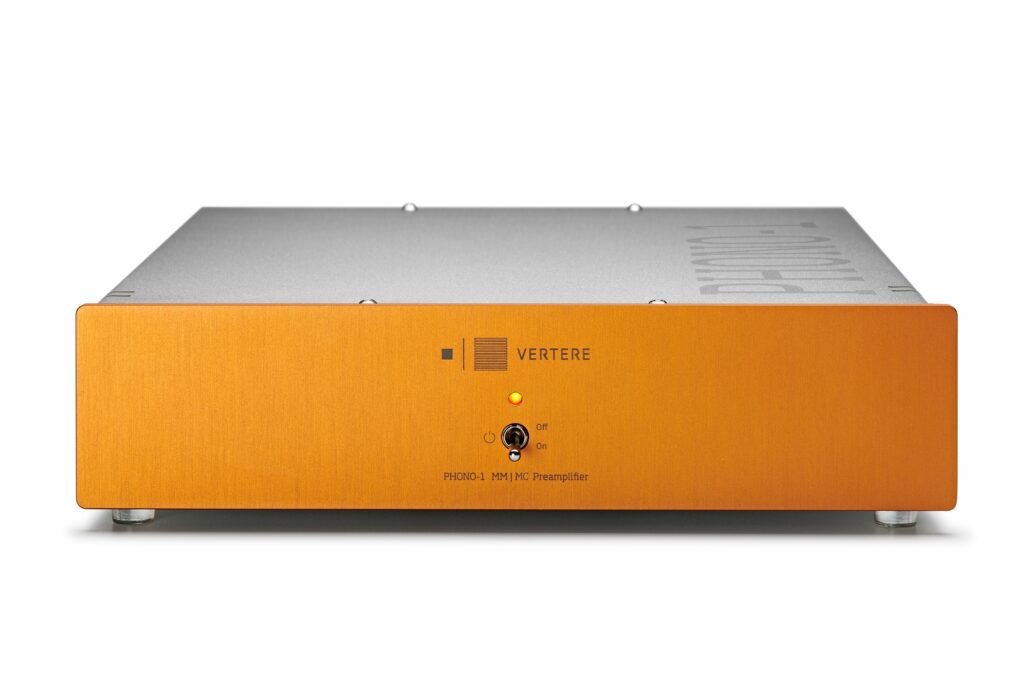
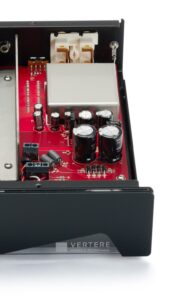
Vertere Acoustics, Park Royal London. Thursday 18th July 2022. Touraj Moghaddam, founder and chief executive of Vertere, today announced that the multi-award-winning PHONO-1 MKII, MM/MC Phono Preamplifier has been improved. The New PHONO-1 MKII L features improved performance, a new gold-plated L-shaped Printed Circuit Board and significantly enhanced accessibility for the customisation DIP switches. The PHONO-1 MKII L which is available now will sell for £1350, €1648, $1895 Aus$2700. Vertere Acoustics PHONO-1 preamplifier

The sound quality improvements are subtle but significant. The MKII already was better than the original due to the more optimal choice of components. The L takes this further with non-trivial PCB layout improvements. Moving the linear power supply to the main PCB allowed a significant track and ground plane layout optimisation. The new design ensures signal tracks are of equal length, impedances lowered, and track widths adjusted to direct current flow.

Vertere PHONO-1 MKII L with high-glass black finish

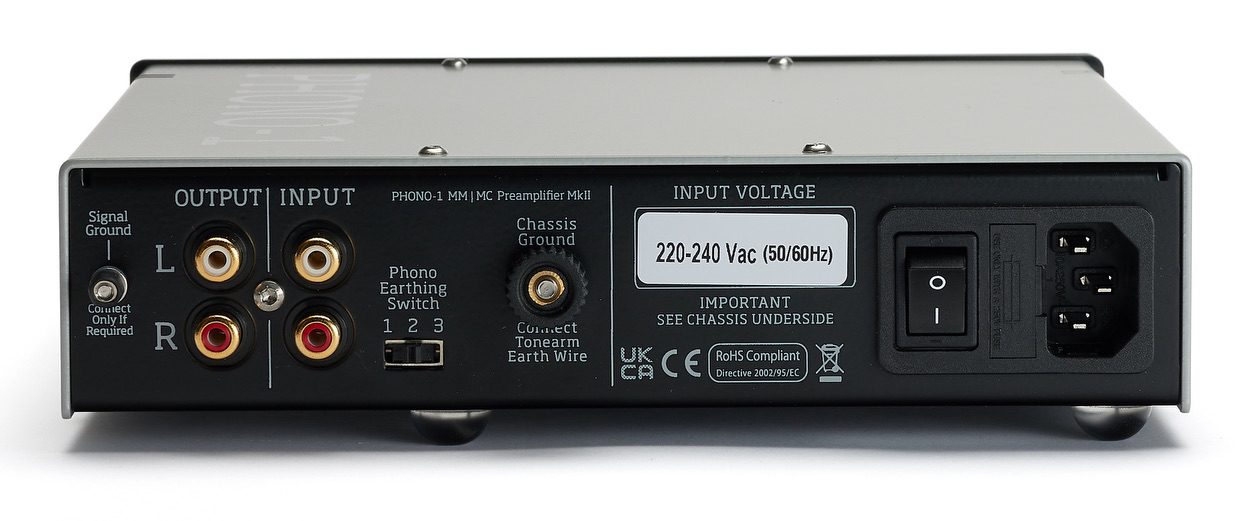
The PHONO-1 already included an unusual grounding selection switch with three positions giving a choice of Hard Ground, Ground Lift, or Soft Ground. This, in certain installations, may achieve even lower background noise from the record player.

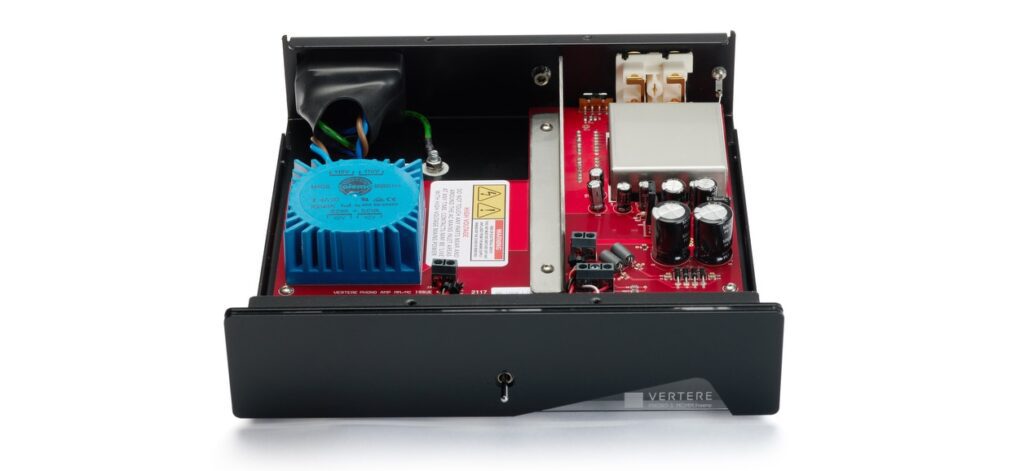
Vertere PHONO-1 MKII L showing PCB

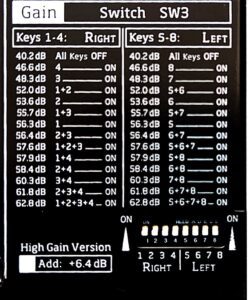
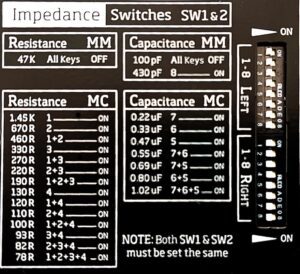
The PHONO-1 is user-configurable for most Moving Magnet and Moving Coil Cartridges available. The DIP switches on the bottom of the unit facilitate the choice of 15 input impedances and 9 options of capacitance together with 10 choices of gain. For example, it allows a somewhat peaky (with a rising HF response) Moving Coil cartridge to be tamed by adding capacitance rather than by reducing input impedance. Lowering the input impedance tends to ‘slug’ the sound, reducing musical performance and drama along with lowering the brightness. Adding capacitance while keeping the input impedance higher allows the full performance to shine.

PHONO-1 MKII L gets the best from any high-quality record player, with maximum dynamic range and supreme detail resolution.

New ‘L’ shaped high-quality gold-plated PCBs for the main phono circuit and the mains power transformer ensure optimised grounding and power distribution. In addition, stainless steel shield ensures that any unwanted interference is kept well away from the audio signal.

The shields, combined with the use of high-quality components and special solder, guarantee consistent optimum performance for the long term.

Stainless Steel Shields A 3-way switch provided at the back of PHONO-1 gives the options of ‘Hard Ground’, ‘Ground Lift’ or ‘Soft Ground’ connection of the preamp and the chassis to minimise any hum introduced between the PHONO-1 and the amplifier.

The PHONO-1 is available in a range of high-end finishes, including a new DG-1 design featuring a front panel to match the new Vertere record player. Other finishes available: Silver aluminium, Signature Vertere Orange and Semi-matt Black. L The power LED is now orange to easily identify the MKII L version.

Technical Specifications

Type

MC/MM Preamplifier

Main Phono Circuit on Separate Gold-Plated PCB

Power Supply

Linear, Internally Switchable Transformer

Gain Settings

40.2dB to 62.8dB – in 10 Steps High Gain version – Add 6.4dB to all settings

Input Impedance Settings Resistance

47k for MM78R to 47k for MC – in 15 Steps 

Capacitance

100pF & 470pF for MM100pF to 1.02uF for MC – in 9 Steps 

Frequency Response

20Hz – 20kHz     +/- 0.2dB

Noise

< -78dB – AWD

THD-N

0.03%

Finish

Front Panel OptionsVertere Orange, Silver, Black, DG-1 Gloss Black

Dimensions

210 x 235 x 55mmW x D x H (Incl. Switches & Feet)

Weight

2.00kg


Touraj explains the source of some of his background knowledge

“Our collaboration with music industry engineers has given us invaluable insights into the art of cutting. This knowledge has enabled us to advance our record player design in many ways to extract the maximum from vinyl records.

For example, with his recent remixes of the Beatles albums, Giles Martin – son of the late Sir George – used a Vertere MG-1 record player, including SG-1 tonearm and PHONO-1 preamplifier throughout, to check and approve the acetates and the test pressings.

And we’ve worked closely with the multi-award-winning mastering engineer Miles Showell: since February 2017. Miles has been using his own extensively customised Neumann VMS 80 lathe, incorporating Vertere cables, to cut normal and half-speed masters for the likes of ABBA, Cream, The Police and The Rolling Stones, and also the 50th-anniversary release of The Beatles’ Sgt Pepper’s Lonely Hearts Club Band and The Beatles (otherwise known as ‘The White Album’).

Working closely with Miles has led to the first releases on our record label Vertere Records. Releases: a three-track EP and first album by Scottish band Caezar, and the first album by Dutch singer/songwriter Elles Springs, which was specially tape-transferred and then half-speed mastered and cut by Miles for our label.

It’s only by involving ourselves at every stage of the record-making process that we can ensure our players bring you as close as possible to what the artists and engineers wanted you to hear.”

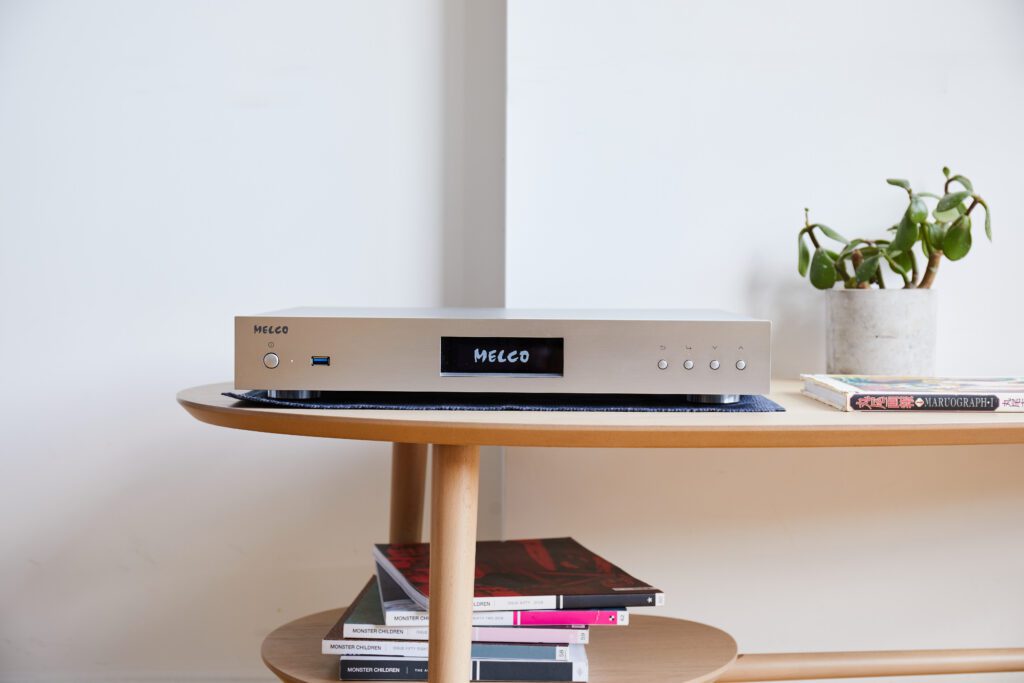
Melco N50-S38

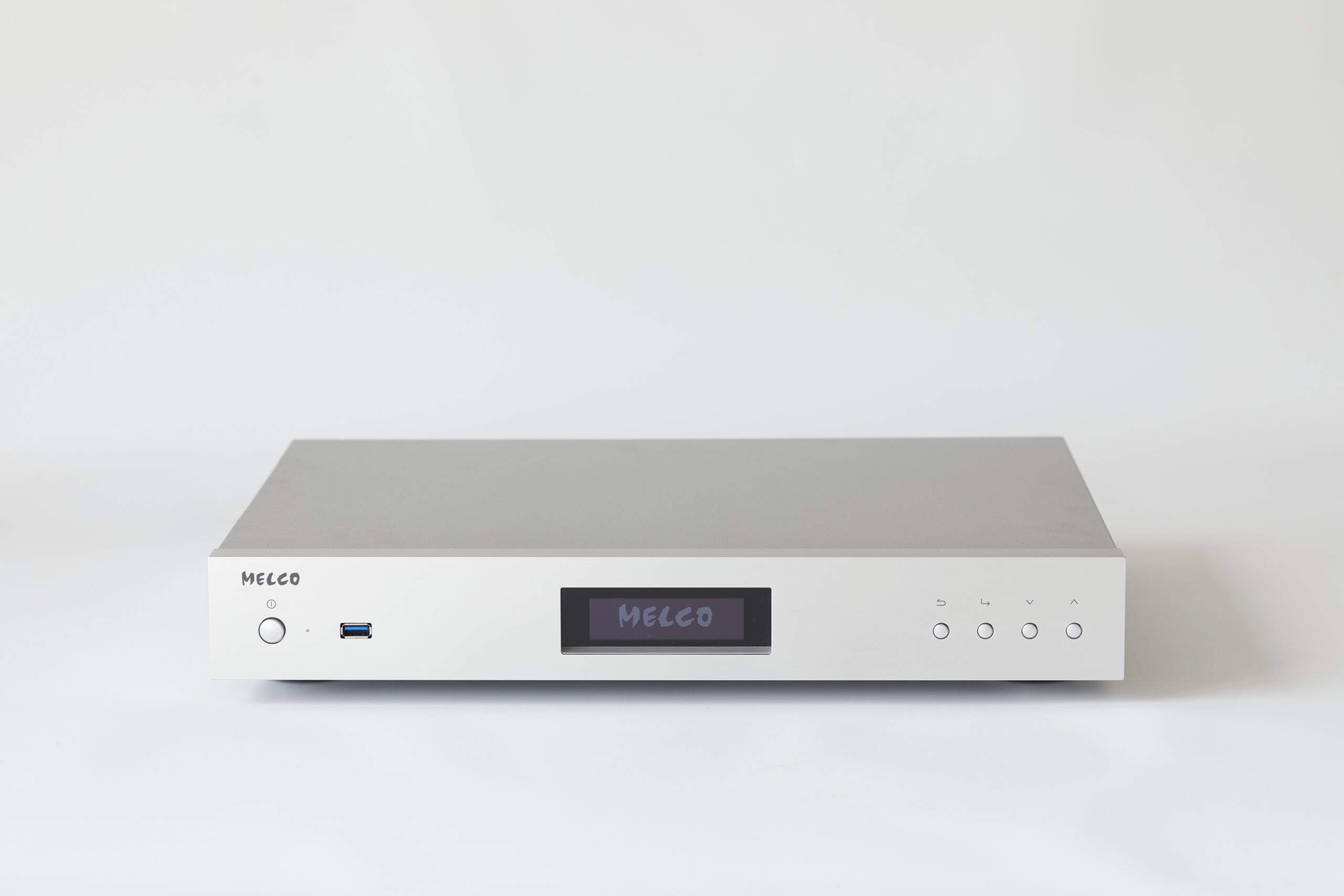
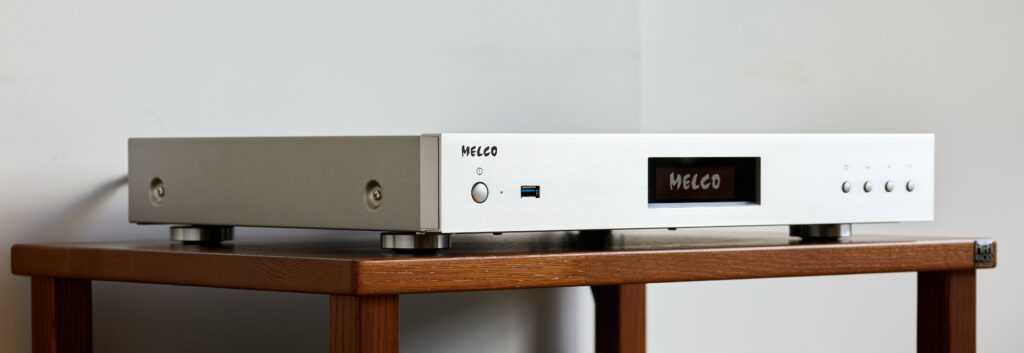
You might think that because they have no moving parts, solid-state drives (SSD) would be inherently superior to their spinning cousins (HDDs or hard disk drives), but there is much debate about which sounds the best. Melco’s new SSD-equipped N50-S38 is midway between the company’s N100 server and its range-topping N1Z EX and N10 models. It inhabits a case that’s virtually identical to the outgoing N1A, yet that is the only similarity between the two. It sticks out as being the only full-width server in the Melco range. It’s worth mentioning that the Melco servers are also streamers by virtue of their USB output; all they require is an external DAC to form a complete digital source.

The N50 is unusual among an extensive range of music libraries, as Melco prefer to call them, in having SSD storage onboard as standard. An SSD variant of the N1Z EX is available, and it’s the most expensive model in the range, but it’s not always recommended above the HDD alternative. The general feel seems that the SSD-based N1ZS is the best option for those who primarily listen to acoustic music but that the N10 is arguably better suited to those with broader tastes.


SSD… the disc for me?

I’m told that the N50 uses SSDs because the technology behind them has advanced significantly recently, and Melco has removed the elements that make them a poor choice for audio. One is that they are built for speed of access, which is unnecessary in a music server and detrimental because it produces electrical noise. Another is wear levelling. To compensate for the limited read/write cycles available from flash memory, PCs use wear levelling software; in audio, it’s a write-once-read-many situation, so that’s something else that can be bypassed.

Melco N50-S38 music server

The N50 offers a slightly odd 3.84TB of SSD storage (the reason for the S38 suffix), but the drive was chosen for its size and sound quality reasons. It’s cosseted in a ‘rigid, layered cradle’ to keep vibration at bay. This suggests that SSDs are sensitive to vibration in much the same way resistors, capacitors etc. seem to be. Just because something doesn’t move doesn’t mean it’s immune to its environment.

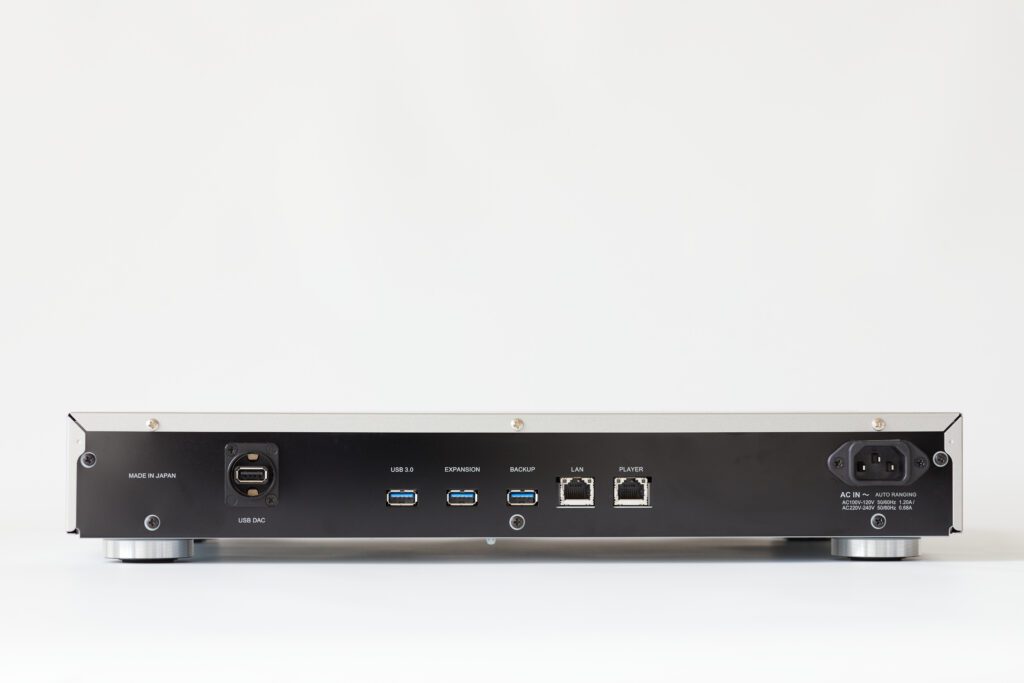
The press release for this server includes terms like ‘enhanced main [circuit] board’ and the ‘dynamic power supply having 25% more output’, which it turns out to relate to the outgoing N1A that it resembles. However, it’s only the casework that remains from that model, something that becomes more apparent when you look at the back panel and discover a chunky Neutrik housing around the USB output that’s dedicated to the all-important DAC connection. This was sonically at least a relatively weak point of the N1A, and as a result, that server generally sounded better when used with a network streamer. The N1A Mk1 had USB3 DAC architecture, its Mk2 successor and the N50 have USB2. Another case of what’s good for speed isn’t good for sound quality.

Software-wise the Melco servers have a few features you don’t often see. While the N50 is Roon Ready when you select that option via the OLED display, it can also be run from Melco’s control app. This isn’t the slickest of devices, but it can access Qobuz and Tidal and vTuner net radio, which are standard options. What is apparently unique to Melcos is the ability to download content directly from Qobuz and HighResAudio, the German site primarily dedicated to classical music. Whereas you usually have to download new music files to a PC and then transfer them to a server, this approach reflects one of Melco’s original goals, which is to be able to manage and stream music without the need for a computer.

Server options

Also, you can choose between Twonky and Minim servers, the latter providing a much broader array of parameters for tagging music with a specific aim of making it easier to access classical recordings where things are not as simple as artist/album/track but extend to multiple composers on a single release by a given artist and/or orchestra. Melco includes a basic version of SongKong software for metadata management purposes that offers a far greater degree of automation and tagging fields than other such systems. This latter is hugely flexible and, as a result, not entirely intuitive but has the potential to be a huge help when it comes to sorting an extensive collection of music files.

I connected the N50’s USB output to an iFi Pro iDSD DAC running in non-oversampled, tube output mode with USB cables from CAD and Network Acoustics, a combination that delivered remarkably smooth and clean sound. I spoiled myself by buying the Melco N10 reviewed earlier in the year, so it was not hard to hear that this rather more affordable server was not as revealing of fine detail. Still, it does have the same ability to push the noise floor down an awfully long way. The problem with server/streamers is that they are run by processors inclined to produce electrical noise, which, while it can’t be heard directly, has the effect of masking the quieter sounds in any piece of music. These quiet sounds, combined with the fundamentals of each note, make the overall presentation more realistic and natural. Electrical noise also creates the hard, cold sound associated with early digital and today marks the difference between good and wrong digital sources.

Melco N50-S38 music server

The Melco N50 is a very good digital source. That much became clear fairly immediately; after several hours of listening, that rating had to be upgraded to ‘excellent’. The speed and power it brought to Patricia Barber’s ‘Company’ [Modern Cool, Premonition] were thrilling; the double bass, in particular, goes all the way down but remains articulate thanks to the resolution of this streamer and the brilliance of the player. This track can sound bombastic on lesser sources. The combination of high-energy playing with even small amounts of low-level noise can become tiring and aggressive. Here it was only the music that was hitting hard. The hardware itself did not intrude or exaggerate for extra dramatic effect but sat back and let the groove flow.

This is also a very revealing piece of kit, digging into everything it streams and bringing out the fine details that make for a convincing musical experience. I love the way it places instruments in a precise three-dimensional soundstage, making space for the harmonics of each to radiate into the room. It’s a clean but not clinical sound, one where the only edges are from the attack of each note. This creates a sense of speed in many pieces and the effortlessness of more relaxed works.

A real impression

John Martyn’s BBC Radio 1 Live in Concert [Windsong] has some lovely songs, but the one that made a real impression with this Melco was ‘Head and Heart’. Small-scale voice and guitar are more straightforward to reproduce than larger groups, but it’s not always this easy to suspend the sense of disbelief by merely closing your eyes. I suspect it’s about as near as we can ever get to time travel. A slightly larger performance was provided by Keith Jarrett on the London leg of his Testament album [ECM]. Here you often get the sense of Jarrett stamping on the stage, but the N50 showed more of the character of the venue and made the playing highly engaging by avoiding any edginess; you can almost feel him rocking on the stool and leaning into the keyboard as he channels what he plays directly from a higher plane. When improvisation is this good, it’s hard to imagine a stronger psychic connection between performer and listener.

Melco N50-S38 music server

Those impressions were gained with PMC’s remarkable Fenestria loudspeakers; later, I used the N50 with the Enleum AMP-23R and some much smaller PMC twenty5.21 stand-mounts, which proved to be a real greater than the sum combination. Revealing significant differences between recordings and bringing out the emotional message with extraordinary ease. Tracks like Olivia Trummer’s ‘Sharing My Heart’ [Fly Now, Contemplate] proved so moving that a lump appeared in my throat.

With the N50-S38, Melco has proved that SSD has an awful lot of potential for audio when it’s managed correctly. This company is part of a much larger Japanese organisation that specialises in IT. This has given it the know-how to produce a stunning server/streamer that allows users to get far more out of digital music files than they might imagine possible.

TECHNICAL SPECIFICATIONS

  • Type: Solid-state music server with SSD storage
  • Storage: 3.84TB SSD hard drive
  • Network connection: RJ45 Ethernet
  • Digital Outputs: RJ45 Ethernet direct, USB 2.0
  • Back up connection: USB
  • Formats supported: DSF, DFF, FLAC, WAV, ALAC, AIFF, AAC, MP3, WMA, OGG, LPCM
  • Streaming services supported: Qobuz, Tidal
  • User Interface: Melco Music HD, Roon Ready
  • Other Features: UPnP server, DLNA device compatible
  • Dimensions (H×W×D): 70 × 436 × 352mm
  • Weight: 7kg
  • Price: £4,999

Manufacturer: Melco Audio

URL: melco-audio.com

UK Distributor: ADMM

Tel: +44(0)1252 784525

URL: audiophiledigital.co.uk 

Back to Reviews

Russell K. RED 120Se

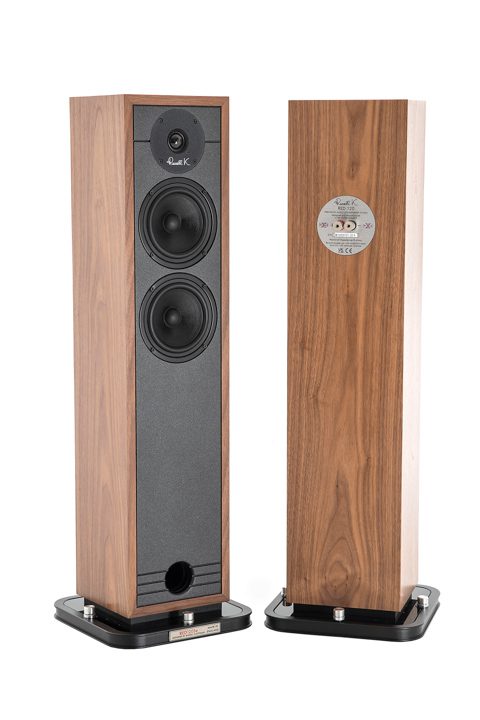
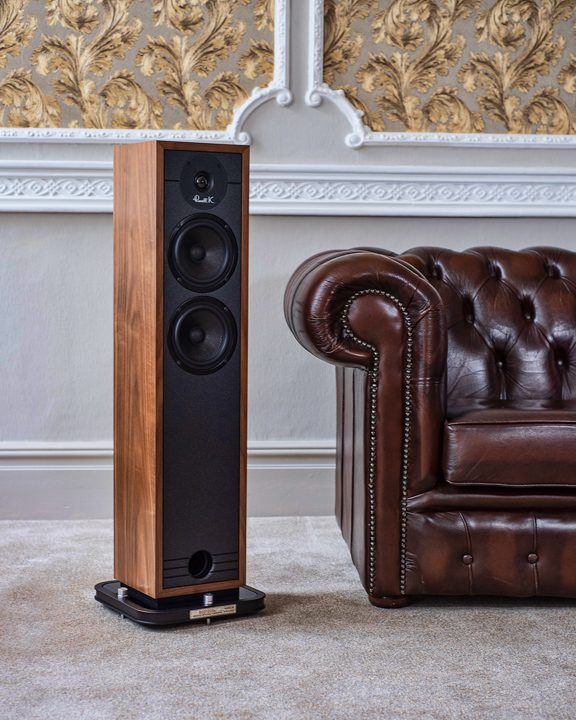
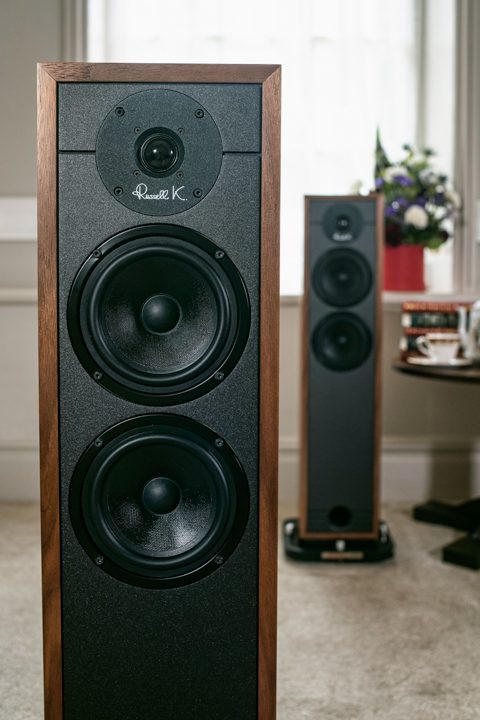
These loudspeakers got me doing something I sometimes forget to do. When I start with a new review product, I calibrate by listening to a handful of familiar tracks. But it’s easy to focus on those tracks and forget about the music on the rest of the album. On at least two occasions during the work-up for this review, I found myself listening to the entire CD rather than just the track I’d put it on for. If you compare your loudspeakers on a cost-per-unit-volume basis, I may need to help you reassess because the Russell K. RED 120Se’s aren’t priced like your typical thirty-something litre offering; but that’s OK because they don’t perform like one, either. These loudspeakers have continually reminded me I have a great music collection with some astonishing performances captured in it. Not every speaker that has graced these rooms has managed that.

Russell K. RED 120 Se

There’s no shortage of well-regarded, smallish floorstanding loudspeakers at comfortably under a metre tall and maybe 20cm wide. It’s a nice size for a domestically acceptable product that promises decent all-round performance without dominating a modest-sized living space. I expect many are sold to their owners for precisely that reason. That probably explains why the majority are also keenly priced; £3,000 will buy you a very respectable, well-reviewed product from any one of a number of makers, and they’ll doubtless do an excellent job for a lot of people. So why might you, dear reader, be interested in a speaker of this size that costs twice as much as those?

Unconventional approach

Let’s assume then that, like many people, this is a size of loudspeaker that ticks a lot of boxes for you. But you’ve been there, done that, and now require more. Moving on, you may have assumed, will require moving on to something bigger.

The Russell K. approach to loudspeaker design is a little different. And it’s why you might want to read on if you’ve got this far. Manufacturers can keep development costs down by keeping to familiar recipes; conversely, being a bit different can be costly. Neither the cabinets, nor the drivers, nor yet the crossovers here are what you would call entirely conventional, but this isn’t the sort of wilfully idiosyncratic design that screams ‘owned by a single bloke’ either.

Russell K. cabinets are undamped. Tradition has it that you’ve got to damp your cabinets, or they’ll resonate and sing along. However, designer Russell Kauffman maintains that while damping may prevent cabinets from resonating along with the music, it also stores energy, releases it out of time, smearing transients and timing cues, and generally messing up the bass in particular. His solution is to manage the cabinet resonance by careful bracing and attention to detail on the internal structure of the loudspeaker so that if the cabinets do join in, they do so manageably, notably in time with the music, and crucially, they stop when the signal stops.

Russell K. RED 120 Se

It seems to work; music I’ve thought of as complex, or dense, has revealed itself more lucidly. Take ‘Fiesta’ on the Chick Corea and Gary Burton duets album The New Crystal Silence [Concord]: you hear more deeply into the tonal differences between piano and vibraphone; the instruments remain distinct, separate and easier to discern in the busiest, most complex, or most dynamic passages. The notes start and finish when they should, and if you hear them, all the better for it. These are revealed as better, more exciting instruments, and the musicians are also clearly having a lot more fun.

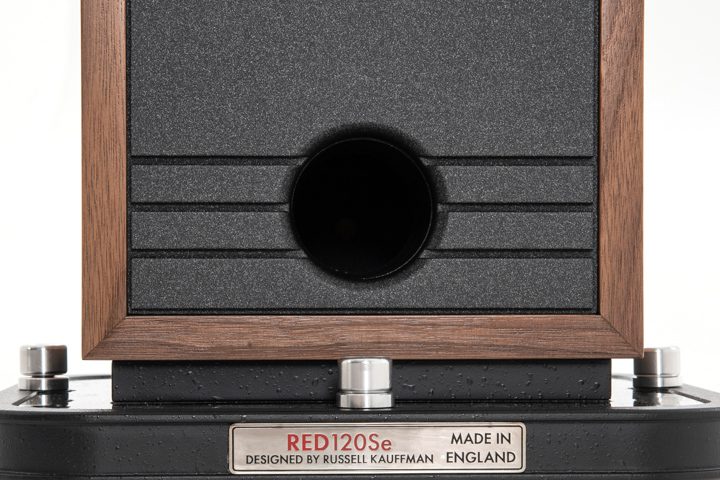
Russell also uses these internal bracing shelves to manage the drivers’ loading and airflow within the cabinet. The bracing subdivides the cabinet into zones for each driver and is perforated by carefully sized and positioned apertures that impede airflow beyond a given frequency. Each driver sits within its division of the cabinet, and thanks to the way the bracing acts as a form of acoustic impedance, the bass cabinet can behave more like a sealed box; midrange energy stays mainly in the region of the midrange driver and only the lower frequencies use the whole of the larger chamber. The bass reflex system uses an internal port to tune the output, this vents into a small cavity which effectively contains any port resonances within the box, and thence it exits into the room by a small, forward-facing port. The port system has been tuned to a positively subterranean 21Hz. Because little to no midrange energy finds its way into the chamber vented by the port, there is no appreciable chuffing or other ‘noises off’ to distract the listener.

Upgraded drivers and crossovers

Compared to the regular RED 120, the Se edition comes with upgraded tweeters and reworked crossovers. The tweeter used in the RED 120 is a 25mm soft dome with a ferrite magnet system, a copper-clad aluminium voice coil with a copper Faraday ring, a second magnet, and a metal face plate feature in the Se version. Two 5” bass units deal the lower frequencies with impregnated paper cones of curved, optimised acoustic profile. The motor uses a high-power ferrite magnet, a 25mm voice coil over an aluminium former, and a Faraday ring. The paired bass drivers are connected in a two-and-a-half-way configuration, the upper driver handling bass and midrange, while the lower one handles only lower bass with a crossover which starts to roll off above 80Hz.

Russell chooses his drivers by auditioning them ‘raw’. No enclosure, no baffle, no crossover, no test tones, just a driver connected to an amplifier via its lead-out wires. Doing this highlights how many decent quality drivers, even from respected brands, exhibit audible compression and distortion. By contrast, Russell’s drivers for his loudspeakers are cleaner and more dynamic, and the Se versions are audibly improved over the stock design.

This process allows some scope for originality on the crossovers. A modified 12 dB per octave slope rolls off both tweeter and bass/mid, with only one coil in the bass path and one capacitor in the treble signal path. Tweeter attenuation is via a Zobel network with deliberately misaligned component values as opposed to the conventional L-pad resistor set-up. This avoids having resistors in the signal path, and the component values have been adjusted by ear, using speech and music. The -Se variant crosses over at a relatively low 1800Hz (the RED 120 crosses over at 2200Hz) because this is a better match with the upgraded tweeter, and there’s an additional small capacitor in parallel, which gives the crossover a faster rise time. Low bass uses an enclosed field iron core inductor for improved power handling and low energy leakage. This Se variant has a second, similar inductor in the return path, effectively creating a balanced circuit. This is said to improve bass tunefulness.

Does it work?

It would be fair to say that the RED 120Se loudspeakers concede a little to the larger RED 150 in terms of scale and weight. I used the RED 150s happily in my room for a few years, and the ‘120s are a smaller box with smaller drivers, after all. But it’s very quickly evident that the (£700 more expensive) RED 120Se is the better loudspeaker. The difference is most noticeable in large-scale orchestral music, which trades a little of the sheer size for a lot of the purpose and musicianship. Arvo Pärt, Symphony No. 4 [ECM], the second movement features some deep, dark notes from strings and bass drum, and while there’s no significant shortage of impact here, what really impresses are the instrumental textures, the contrast between xylophone and strings, or violin/violas and cello/bass. The RED 120Ses show you how the composer creates and maintains tension and the way the conductor achieves that through the performance; other speakers which go deeper have been known to gloss over this sort of thing, concentrating instead on giving you an impressive hit of bass, somewhat divorced from its musical context. Freddy Kempf, Prokofiev, Piano Concerto No. 2 [BIS, SACD] shows his exemplary articulation and tone and a real insight into the interpretation through his phrasing.

Russell K. RED 120 Se

The RED 120Ses exert very good control of the different musical forces. The music remains lucid even in the busiest, most energetic passages, in a way reminiscent of a live, unamplified performance. When called upon, they will play very loud indeed without losing their composure, but they don’t do this by being buttoned-up; the music remains expressive and eloquent, the excellent sense of spatial detail intact, so the way the different orchestral forces have been set to work with each other, or with a soloist, is quickly and clearly perceived. Maybe there’s something to this notion of choosing the cleanest, most uncoloured drivers from the outset.

Scale, or proportion?

One takeaway is that bass, scale and depth are all very well but not sufficient. And perhaps more than that, what’s really important is a sense of proportion. Take ‘Log’, a piece for six pianos by Graham Fitkin [Decca]. Now six pianos in an average domestic listening room are about as appropriate as a symphony orchestra and chorus, so there needs to be some accommodation here. Me? I’ll happily trade some size and heft for an image that maintains the proportions. I want to appreciate the component elements’ relative masses, sizes and power, so I can hear deep into the performance. The RED 120Ses help me follow an individual pianist’s contribution, appreciate the timbral differences, the contributions of acoustic and electric instruments, and sense the way the centre of mass of the music shifts around in the soundscape as individual pianos take their lead. I am won over by the performance, not run over by shock and awe.

So, talking about overwhelming performances, Hugh Masekela’s ‘Stimela’ from Hope [Analogue Productions, SACD] has often hinted at colours and textures. Masekela’s vocal verges on uncanny, the voice and percussion working so tightly together for emphasis, and the evocative timbres of sax and trumpet just take this already compelling track to another level of immersiveness. It’s such a warhorse – I defy anybody to go to a hi-fi show and not hear it at least once – it’s quite easy to become inured to the power of its message through over-familiarity. The RED 120Se’s made it fresh again.

Russell K. RED 120 Se

They are also very good at telling you what’s going on in the rest of your system. Change what the CD player sits on, and you hear the effect. Change what the speakers rest on, and you hear that too. Most of this review was conducted with the spikes resting on AcouPlex discs, which brought out the subtleties of phrasing in ways that made regular metal spike cups, coins, or floor protectors sound unconvincingly uncommunicative. A little attention to placement, support and isolation will pay dividends here.

So many audio touchpoints and benchmarks are hit with precision by the RED 120Se: I have talked quite a lot about timbre and colour; we also have articulation, pitch and tunefulness – Renaud Garcia-Fons’ bass is an exemplar: tight, tuneful and full of texture on ‘Berimbass’ from Arcoluz [Enja], so those claims as to improvements to the bass via the crossover tweaks ring true. And perhaps implicit in the speakers’ ability to hear deep into the mix is a facility with imaging – Patricia Barber’s quartet on Café Blue [Premonition Records, SACD] has real presence and form; and last, but arguably most important of all, we have timing – the quartet is absolutely ‘on it’ with an almost telepathic cohesiveness. These modestly-sized speakers have redefined what I expect from this size of cabinet and driver complement. That £6,000 asking price doesn’t feel like a stretch at all.

Technical specifications

  • Type 2½ -way floorstanding, reflex-loaded loudspeaker with internal porting, and forward-facing reflex port. Braced, thin‑walled cabinet with no internal damping
  • Driver complement 1× 25mm soft dome tweeter; 2× 5” impregnated paper cone bass/bass-mid drivers with optimised acoustic profile
  • Power handling nominal 120W programme
  • Crossover frequency 80Hz and 1.8kHz
  • Crossover type Single-wired, phase optimised; tweeter via zobel network with misaligned component values, 12dB per octave slope; Low bass 6dB per octave via enclosed field iron core inductors
  • Frequency response (in-room, usable) 25Hz–22kHz
  • Impedance 4–8 Ohms nominal, 5 Ohms minimum at 50Hz and 300Hz (4 Ohms minimum at 20kHz)
  • Sensitivity 86dB for 1 Watt at 1 Metre
  • Dimensions (H×W×D) (including plinth) 910 × 200 × 190mm
  • Weight Approx. 18 Kg each
  • Finishes Real wood veneers Oak with white baffle;
    Walnut with black baffle; Black Oak with black baffle
  • Price £5,950/pair

Manufacturer

Russell K. Ltd, Dunstable, Bedfordshire, UK

Tel: +44(0)1582 477355

Homepage – https://www.russell-k.com

Product – https://www.russell-k.com/red-120se/

Dealers – https://www.russell-k.com/russell-k-dealers/

Back to Reviews

7 best turntables under £3,000

What are the best turntables you can find that won’t leave you broke? We’ve compiled this list of the 7 best under £3,000, in no particular order.

Beginning audiophiles may want to be sure they have the best turntable there is, but it’s more important to find which one is the best for you.

7 Best Turntables under £3,000

Gold Note Pianosa turntable with B-5.1 tonearm – £2,230 (£2,500 walnut finish)

Gold Note Pianosa
The Gold Note Pianosa

“The Gold Note models eschew the hair-shirt approach of many modern audiophile turntable designs. It seems many designers forget that, while the worst excesses of audio ugly can be hidden from view in cabinets and the like, a turntable is almost always on show, so it better look pretty good. It’s also a potential dust magnet, and Gold Note is one of the few higher end brands who supplies a dust cover these days. The Gold Note Pianosa is an elegant design with a similarly elegant sound, and it has seductive looks. Add to that the simplicity of set-up and this is one should get lots of attention. It’s easy to use, easy to live with, and easy to love.” – Alan Sircom

Read the entire review here.


Vertere Acoustics DG-1 turntable – £2,750


vertere-acoustics-DG-1-turntable
Vertere Acoustics DG-1

“The Dynamic Groove is a suave and sophisticated sonic overachiever; it makes a perfect introduction (or reintroduction) to the world of analogue playback. While even higher analogue performance is certainly possible (and is precisely what the upscale Vertere models provide), the Dynamic Groove starter system offers such well balanced performance for an accessible price that it may prove all the analogue system many listeners will need or want.” – Chris Martens

Read the full review here.


Technics SL-1200GEG-S – £2,999

Technics-SL-1200GEG-S

“The Technics SL-1200GEG-S represents the functional top of the SL1200 tree, especially as the limited edition SL-1200GAE is long gone. The SL-1200GEG-S is effectively the same model as the ‘GAE’, albeit with a slightly different finish to the magnesium tonearm and without a badge saying ‘limited edition.’

“Literally millions of Technics SL-1200 have been sold through the years, so going over the design is old news at best. However, Technics top SL-1200 rebooted is a very different beast and includes a new coreless twin rotor direct drive motor, a more robust three-layer platter, a clock originally used in Blu-ray players, and the kind of build quality that battleship builders would be proud of.” – Alan Sircom

Read the full review here.


Kuzma Stabi S – £2,149

Kuzma Stabi S turntable

Kuzma’s turntable is a fully modular integrated design, with an internal power supply, and spaces to mount a number of arm wings and additional arm balconies, in order to hold up to six tonearms at any one time. There are also optional decorative plinths to mount the deck and at least one arm wing.

In essence, the Stabi R takes a lot of the concepts and technologies found in the larger Stabi M turntable and puts them – without attenuation – into a smaller and more flexible form. This makes the Stabi R the most affordable product in the Kuzma line to feature a DC motor. The turntable is simplicity itself to install (by turntable and especially by high-end turntable standards), but everything locks down solid like it was military-grade hardware.

Read the entire review here.


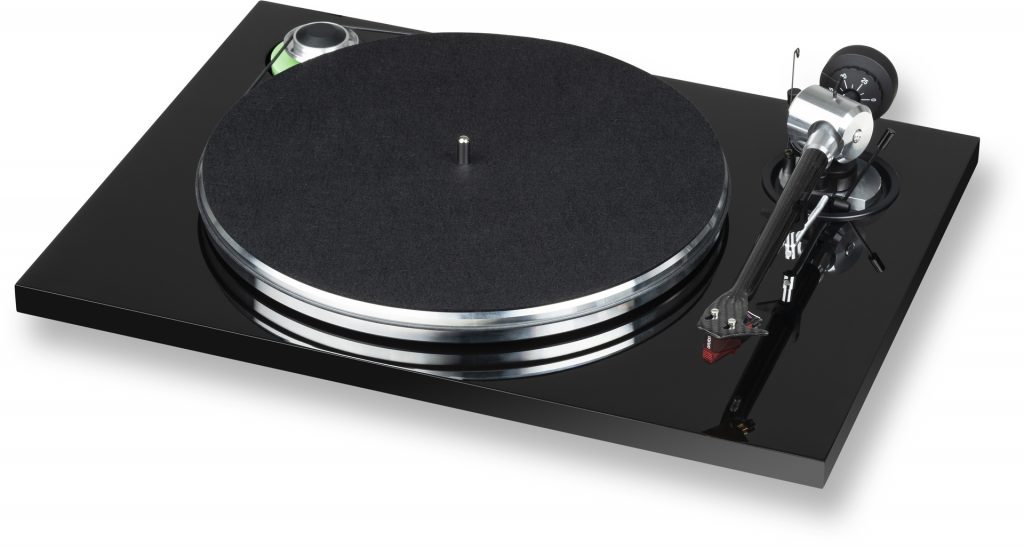
European Audio Team Prelude turntable – £999

European Audio Team Prelude turntable

“This is a turntable that consciously attempts to make a sound more in line with high-end systems costing far in excess of the Prelude’s price. And that means if you are starting out on a high-end road, the Prelude will stay with you for a lot longer.”

“Unless you look really closely and partner the turntable way out of context (no £50,000 phono stages, please!), the EAT Prelude is every bit a high-end turntable that just forgot to get too expensive. Partner this with sympathetic giant-killers and you could build a true low-cost high-end superstar system. If you want to know what real high-end audio sounds like, without opening your wallet and saying ‘help yourself!’ to the dealer, the EAT Prelude is your turntable.” – Alan Sircom

Read the entire review here.


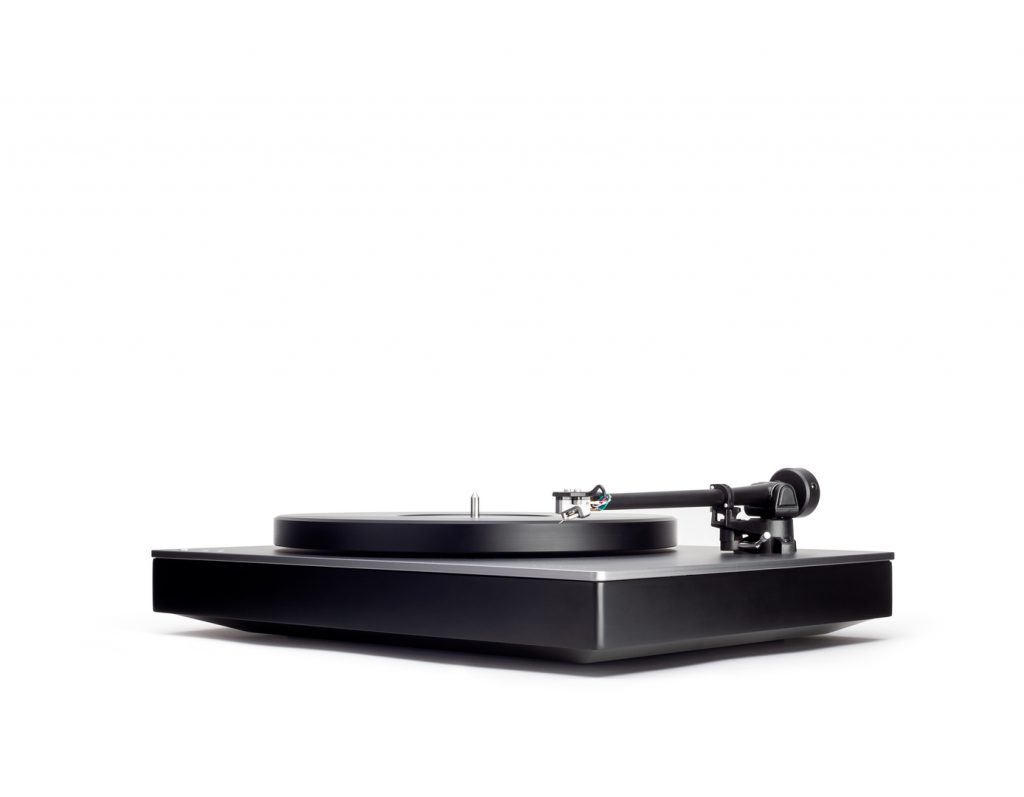
Cambridge Audio Alva TT – £1,500

Cambridge Audio Alva TT

“For listeners who want a satisfying vinyl experience without jumping through hoops and don’t want to be dictated to by their own electronics, or who are just turned on by some worthwhile modernity crashing into some venerable technology, the Cambridge Audio Alva TT is the obvious choice.” – Simon Lucas

Read the entire review here.


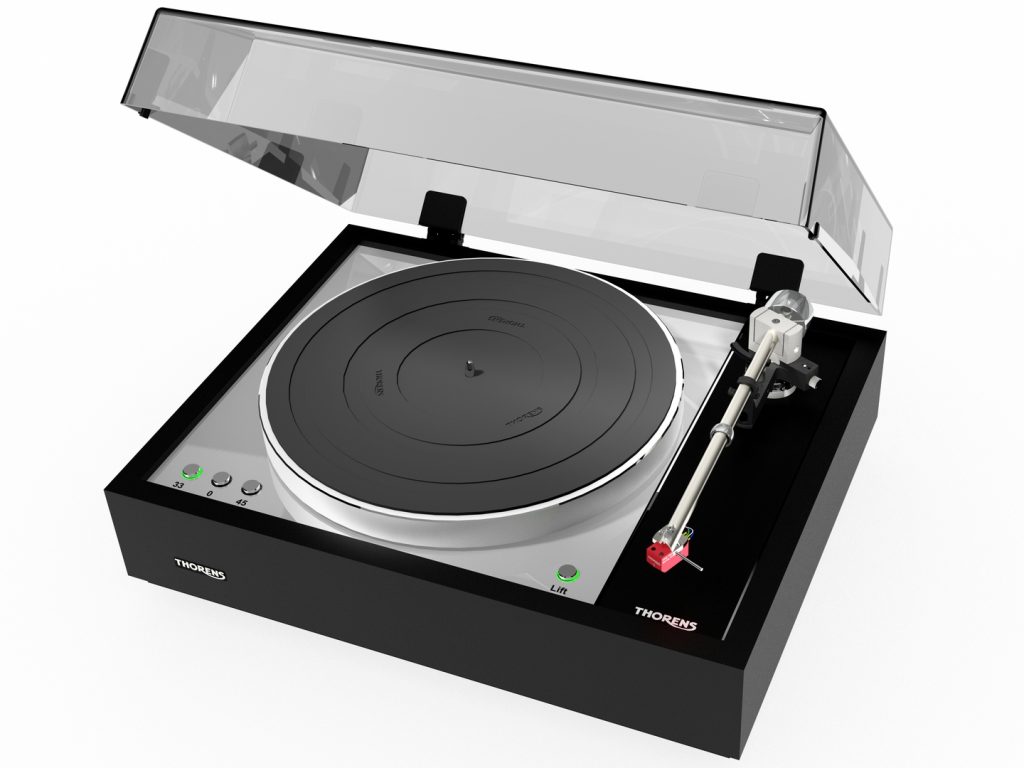
Thorens TD 1601 suspended semiautomatic turntable – £2,899

Thorens TD 1601 Suspended Semi-automatic Turntable


“Performance of the TD 1601 is well controlled and refined, doing everything well, if perhaps just a little too well-behaved. But if you want a retro looking turntable with all the history to go with it, then this is certainly a good choice.” -  Janine Elliot

Read the entire review here.


The best turntables and record players are the ones that fit your particular needs.

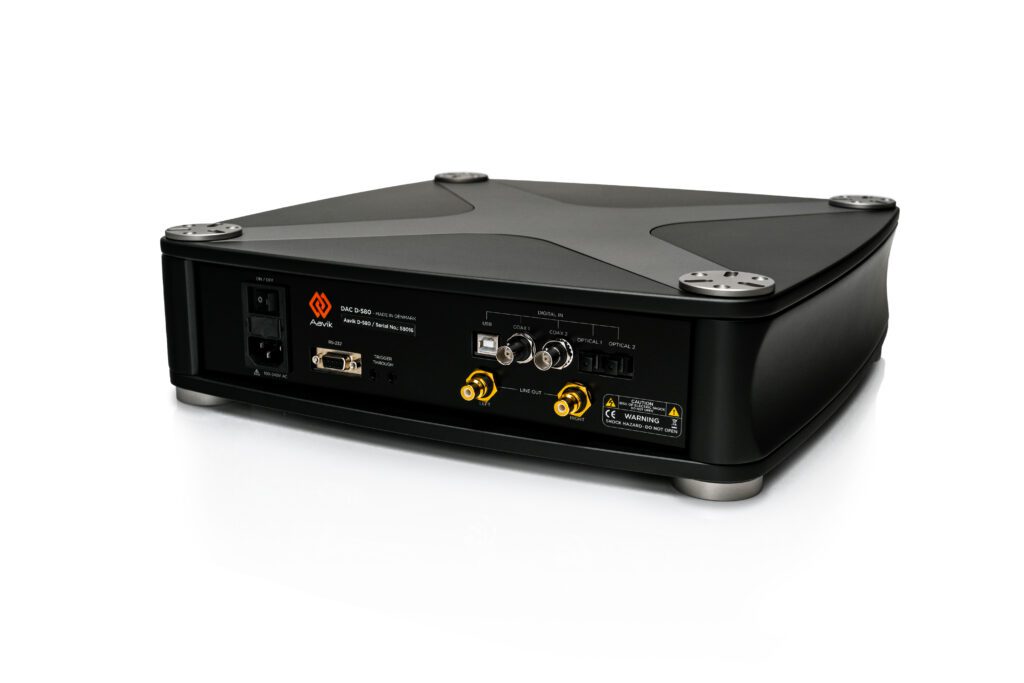
Aavik Acoustics D-580 DAC


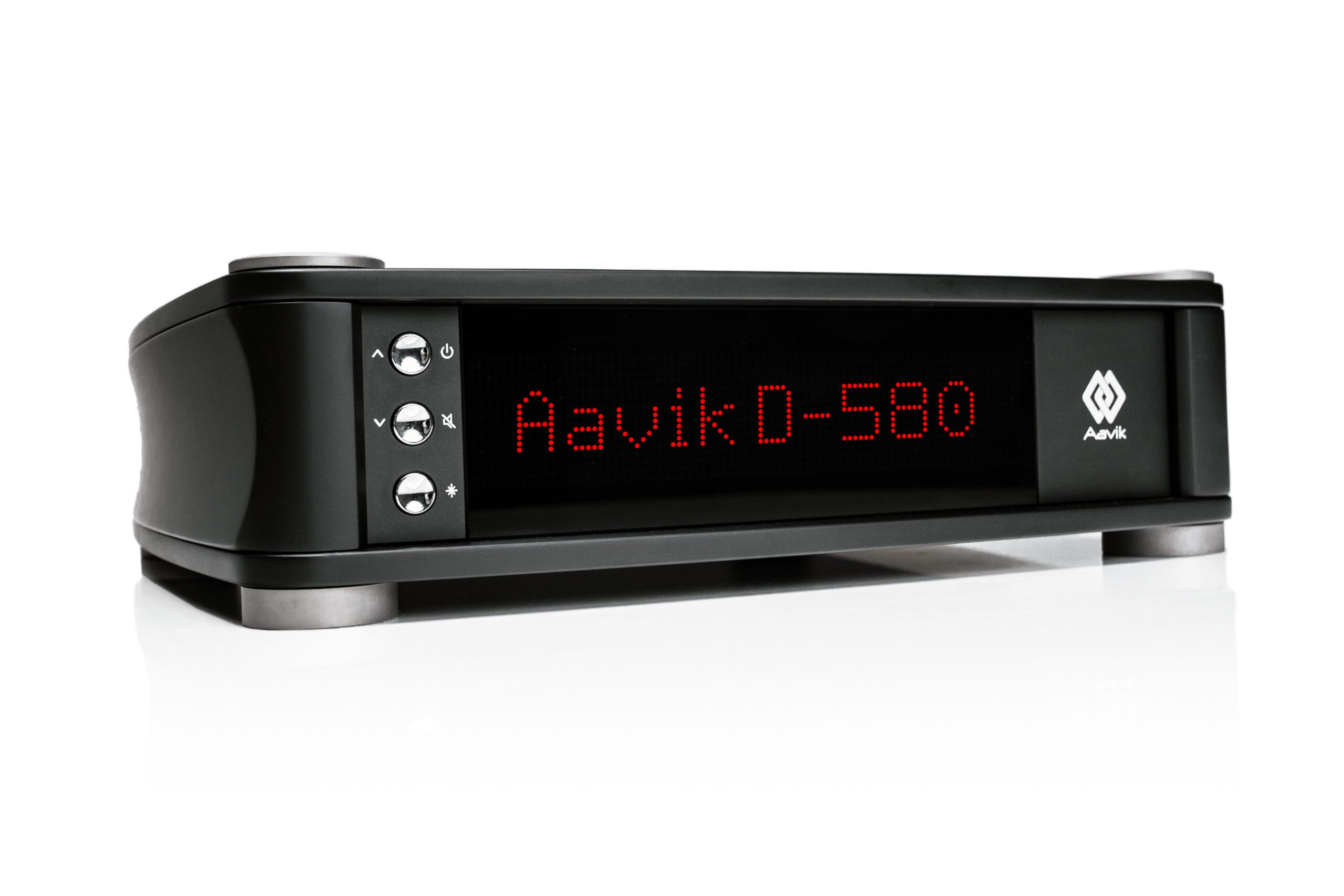
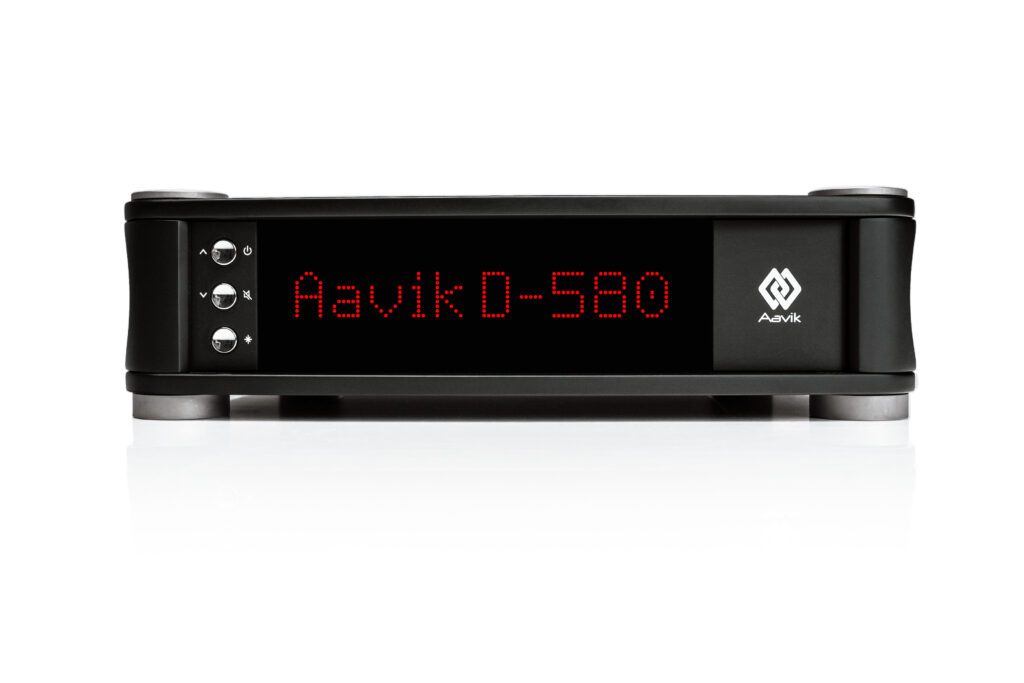
The people at Aavik Acoustics in Denmark must have had a dynamic lockdown. The last time I looked, their electronics were in an aluminium case with radical styling; sizeable central control knobs were a speciality. More importantly, the range was limited to amplifiers, albeit often with onboard phono stages and DACs. The Aavik Acoustics D-580 digital converter wasn’t on the radar at all.

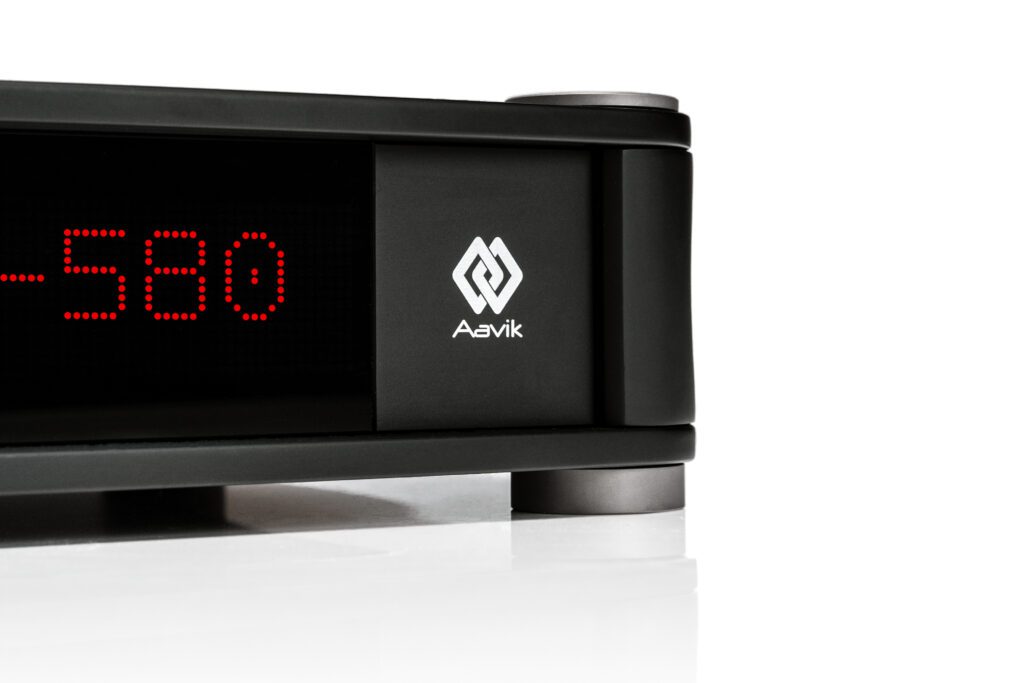
Today’s Aavik range is much more extensive and distinctly uniform, with identical casework used for all components, from phono stages and amplifiers to DACs and streamers, including the Aavik Acoustics D-580. Similar casework across a range is a good idea for several reasons; it lowers cost, and by making them all the same, you get a homogeneity that makes systems look much neater. In this case, it also allows for easy component stacking.

Standardised casework is not a new approach; Naim has been doing it for decades, but they have stuck with metal. Aavik has eliminated aluminium and reduced metalwork to almost a minimum, replacing it with a composite material that looks a bit like well-finished MDF but doesn’t feel like it. For a start, it’s tough and immaculately machined, and it integrates with the metal cross on top like marquetry.

Aavik Acoustics D-580 DAC

It turns out that the metalwork is titanium, which goes some way to explaining the price. The shape is also significant; Frits Dalmose from Aavik explains, “you will notice that they are shaped almost like an instrument. All dimensions are matched to the golden ratio, and there are no sharp corners.”

It’s Titanium Time

I also asked Frits about titanium; it must increase the cost considerably after all. He said, “We have no doubt that the materials used can be heard and that all materials have an acoustic signature. If you get glass to vibrate by hitting it with an object, you have no doubt that you are hearing the sound of glass.” He explained, “When Lars [Kristensen] and I were designing racks – actually the first products to be named Aavik – we tried replacing the aluminium uprights with titanium, and the result was extremely positive.”

The D-580 is the top model in a range of three Aavik digital to analogue converters. Like the Ansuz Power X network switch reviewed in issue 192, the different levels of Aavik DAC are based around the same architecture and features but with more goodies included in the most expensive models. So, the entry-level D-180 has five dither circuits while the Aavik Acoustics D-580 has 11.

The same company makes Aavik and Ansuz, and both incorporate what they call Tesla Coils into their products; these combat electrical Noise (the enemy of good digital sound) and come in two varieties. The D-580 has 108 active Tesla coils and 248 active square Tesla coils. You can see these on an internal shot of this DAC; they are effectively a filter constructed to eliminate the sort of electromagnetic Noise likely to be present with incoming digital signals.


No transformers here

You’ll notice that there are no mains transformers inside this DAC, and this is because it, like all the new Aavik electronics, has a switched-mode power supply. However, it’s a resonant mode design driven by sine waves rather than the square waves of conventional SMPs. The claimed advantage is that the noise floor is extremely low and further reduced by multiple regulators throughout the circuit.

Aavik Acoustics D-580 DAC

Additionally, the DAC circuit has 13 low noise voltage regulators feeding separate stages of the PCB. There are five digital inputs with BNC connectors on the two electrical S/PDIF inputs beside two Toslink and galvanically isolated USBs; perhaps surprisingly, there is no AES/EBU available. Aavik sends all incoming signals via an asynchronous sample rate converter to be re-clocked to 200kHz/24-bit, all signals except DSD, which bypasses this stage and goes straight to the D/A process.

One final differentiation between the D-580 and its counterparts in the Aavik range is that it’s the only one to have an internal copper chassis enclosing the electronics. Long considered the best shield material, copper is popular among Japanese brands and frequently appears inside high-end digital components.

The USB output of a Melco N10 server/streamer initially fed the Aavik Acoustics D-580, while its analogue signal (through single-ended cables) arrived at another amplifier combo. In this case, through a Townshend Allegri Reference preamp into Bryston 7B3 power amps and thence to PMC Fact Fenestria loudspeakers that happened to be in the system (it’s a hard life etc.). Fortunately, they are highly revealing, and the combination proved unputdownable.

Filtered for your enjoyment

First, though, I had a listen to the various filter options available via the front panel display and Apple remote. Aavik has realised that the Apple IR handset can be programmed and is a relatively inexpensive way to offer a rather lovely aluminium remote.

You can pick from four filter settings, upsampled fast or slow and non-upsampled fast or slow. Neither of the two upsampled options grabbed me; ‘fast’ has strong bass, sharp leading edges and good scale but is a little edge of the seat, while ‘slow’ was more appealing but not as engaging as the two non-upsampled options.

Of these, I had expected to prefer the slow (roll-off) option, but that sounded more forward and bolder than the fast setting, which had the best timing and thus the most significant ability to engage. Equally important is that it seemed more relaxed, not a lot, though. The settings are clean and effortless, but enough to set it apart from the jazz-rock of Joni Mitchell’s ‘Drycleaner from Des Moines’ [Mingus, Asylum].

Aavik Acoustics D-580 DAC

The Aavik D-580 is a supremely open, vital and revealing converter. It delivers an immense depth of image and presents music with all its charms in full effect. I love how it shows the reverb around acoustic instruments. Take Alfred Brendel’s piano on Beethoven’s Sonata Number 1 in F minor [The Complete Beethoven Sonatas, Philips]; it has superb attack and decay with fully rounded and tonally resonating notes into the room. The recording isn’t quite good enough to project the event even via a stonking system, but it’s more than good enough to give a strong sense of the occasion and draw you into the performance.

Breadth of character

I was particularly impressed by the breadth of character that this DAC found in the music played; compression, for instance, is hugely different, with some tracks sounding small and pinched yet still managing to project the essential qualities that make it appealing. In comparison, others expand outwards in all directions to fill the room. I would expect such changes, given the differences in production and mastering techniques over the years and how different eras favoured different styles. Still, here the variety was more expansive than usual. Importantly, this transparency does nothing to undermine the music; it just emphasises how it was captured and processed.

I haven’t played ‘Rolling in the Deep’ [Adele, 21, XL] for quite some time; the chorus usually gets hideously raucous, yet compression at ‘max’ doesn’t get in the way of a compelling song. Rarely has emotional trauma been so effectively communicated in purely musical terms; I must admit it brought a lump to the throat. On Macy Grey’s ‘Annabelle’ [Stripped, Chesky], an uncommon example of a significant artist working with an audiophile label, the sound of the small band fills the room, the guitar and voice image like they are there in front of you, it’s a living, breathing live experience.

On Patricia Barber’s ‘Company’ [Modern Cool, Premonition], a track I overuse perhaps, the clarity of voice makes the poignance of the lines “I go to the club, talk through the show, there’s nothing about jazz I don’t know” particularly cutting. This DAC brings out the character of the vocal recording and the effects applied to it remarkably well.

Bring in the Streamer

I also tried the D-580 with an APL DNP-SR streamer between it and the Melco. The addition of the APL produced a significant increase in energy and power, with the bass gaining in stature and the sense of propulsion increasing markedly. It made for one of those ‘which is correct?’ scenarios; the relatively laid-back Melco alone or this more powerful version of events. In truth, the better the recording, the more the APL presentation seemed to appeal.

Aavik’s top DAC is an impressive piece of kit. The D-580’s build quality is first class, and the attention to vibration control has paid off with extreme resolution that sounds far more musical than the oft over-polished results in other high-end converters. I couldn’t pin down any characteristics of the D-580. It was much easier just to enjoy the music.

TECHNICAL SPECIFICATIONS

  • Type: Solid-state high-resolution PCM and DSD-capable digital-to-analogue converter
  • Digital Inputs: Two Coaxial (via BNC), one Toslink, and one USB fully isolated, UAC 2, asynchronous
  • Analogue Outputs: One stereo single-ended (via RCA jacks)
  • DAC Resolution/Supported Digital Formats: All PCM from 32KS/s to 192KS/s with word lengths up to 24-bit, DSD64 (2.8224MHz) and DSD128 (5.6448MHz). The following format restrictions apply:
  • Frequency Response: Not specified
  • Distortion (THD + Noise): Not specified
  • Output Voltage: 4.5Vrms at 0dB
  • User Interface: Apple IR handset
  • Dimensions (H×W×D): 102 × 384 × 400mm
  • Weight: 7.3kg
  • Price: €20,000

Manufacturer: Aavik Acoustics

Tel: +45 40 51 14 31

URL: aavik-acoustics.com

UK Distributor: Auditorium

Tel.: +44(0)753 9499449

URL: auditoriumhifi.co.uk

More Reviews from Aavik 

Back to Reviews

The new Børresen M1 Flagship Loudspeaker

The Borresen M1 loudspeaker is Michael Borresen’s most ambitious loudspeaker to date.

*From the Børresen news release

Making a dream come true – Loudspeaker performance at its very best

Børresen’s Audio engineering division proudly introduces the new M1 loudspeaker. The M1 is Michael Børresen’s most ambitious loudspeaker project to date. The development approach and design philosophy for the M1 was to create a loudspeaker without any economic and technological constraints and with an absolutely unrivalled sound potential. A very challenging task – but also the dream of every audio engineer. Particularly for Michael, it was a long-cherished dream. Since his youth, Michael Børresen has challenged the potential of various kinds of existing devices and had a strong desire to create and redesign them to improve and enhance their potential. Due to his love of music, one of his favorites has always been to analyze individual audio components and seek ways to improve them significantly.

Therefore, the M1 project was a dream project, based on a vast amount of knowledge in the field of audio equipment manufacturing and a lifelong passion, without any limitations.

For the M1 project, Michael Børresen and his team of audio engineers and designers borrowed and applied some of the most innovative technologies from premium Ansuz, Aavik and Børresen products – all these technologies are the result of a long and intensive research and development process. No wonder, then, that the new M1 carries the best of the Ansuz, Aavik and Børresen DNA. However, the crucial technologies and most critical features of the M1 are new and unique to this model. Børresen introduces some absolutely groundbreaking and unique elements to the new M1 that take the authenticity, clarity and sophistication of musical performance to a whole new level.

The M1 bass/midrange unit – truly revolutionary in sound

The basket

The basket is a real revolution – it is a topology-optimized 3D-printed basket made of zirconium, which ensures maximum rigidity and thus minimum vibration and resonance.

The basket is not just a placeholder for the membrane. The energy generated by the membrane is also held by the structure behind it. The goal was therefore to eliminate the noise of the basket by designing a basket with maximum stiffness. Studies were conducted using computer-optimized finite element designs, resulting in a topology-optimized 3D-printed basket made of the exclusive material zirconium.

Børresen has not only designed a basket with extreme stiffness, but also added important factors such as tremendous internal damping and resonance control, resulting in extreme clarity in overall performance. Thanks to the 3D printing process, the cavities are filled with zirconium powder, which gives the basket additional damping properties. Zirconium is by far the best choice of material, since it allows the basket to generate an inconceivable quality of natural sound.

The membrane

The membrane is designed to achieve maximum stiffness with minimum noise. The membrane for the M1 is the most advanced and sophisticated speaker membrane on the market. The M1 membrane has the highest stiffness and the lowest membrane resonance. The technological requirements for this unrivalled, world-class membrane performance made it necessary to design, develop and assemble all components in-house. Michael Børresen and his team had to construct a large number of different variants and models until they accomplished their uncompromising goal of ultimate membrane performance for an unprecedented sound quality.

The result is a membrane that consists of four skins laminated into a single unit: two layers of spread tow carbon fiber, a layer of aramid honeycomb spacers in between, and a titanium skin with Ansuz Supreme coating.

The combination of all these materials gives this state-of-the- art membrane its unique properties. Spread tow carbon fiber is designed to ensure a skin with optimum stiffness in many different directions. This unique characteristic reduces sound disturbing vibrations and resonances to an unprecedentedly low level. This is also true for resonances in the frequency range above 8 kHz. Since the membrane/driver is used up to the 2.5 kHz range, disturbing resonances have been shifted two octaves outside the effective frequency range, ensuring an absolute minimum of resonances.

The aramid honeycomb also has the best stiffness to weight ratio in the vertical direction.

Titanium has perfect resonance control properties and supports a natural, organic sound of the membrane.

With the Ansuz Supreme coating, the skin of the membrane is further acoustically optimized. This coating is applied to the titanium skin in a Hi-PIMS (High Power Impulse Magnetron Sputtering) machine to create the finest and most uniform layer of zirconium, followed by a layer of tungsten and finished with a layer of aluminum chrome nitride. This coating provides the music with a truly impeccable sound quality.

The patented iron-free magnet system

To ensure the essence of Børresen DNA in the M1 speaker, it was natural to use Børresen’s patented and award-winning iron-free magnet system. Børresen’s iron-free drivers have an inductance that is about twelve times lower than conventional drivers. Silver has much better conductivity than iron or even copper. For this reason, we replaced the copper pole rings in our magnet system with in-house manufactured, handcrafted silver rings.

For Michael and his team, it was important to use only the very best both in terms of technologies, but also in terms of production processes. For this reason, as with the Børresen Silver Supreme 0 series, all metal components in the M1 undergo cryogenic treatment, which reduces inductance by an additional 6-8%. Cryogenic treatment of all metal components of the loudspeaker results in a further significant improvement in conductivity – allowing the finest and most subtle musical details to unfold. Cryogenic treatment of metal components involves subjecting them to extreme cooling. In the course of this process, the crystal structure of the metal contracts more and more. Alloying elements are displaced from the grain structure of the metal, which now becomes very similar to a single crystal. These structural changes in the metal have profound effects on its sound properties. In this way, all the performance-enhancing sound characteristics of the M1 loudspeaker fully come into their own.

The Børresen ribbon tweeter

Another fundamental element of the Børresen DNA, and thus a natural addition in the M1, is the Børresen ribbon tweeter. The efficiency of this closed ribbon tweeter is an exceptional 94 dB and operates from about 2.5 kHz upwards. The moving mass is extremely low at 0.01 grams. The fully concealed tweeter has the ability to operate at incredible speed, which is an absolute prerequisite for unlocking the subtlest and finest sonic details of any type of music. The tremendous robustness of this tweeter allows it to handle extremely high transient peaks without causing any ear deafening breakups. Elaborate finite element methods were used to linearize and optimize the magnetic flux field, facilitate driver movement, and ensure high efficiency and excellent linearity.

Crossover – M-series

Like all other Børresen loudspeakers, the M1 is fitted with a serial crossover. The reason for this is that the drivers have the same current flow in the area of the crossover. As a result, the electrical current is phase-locked across the crossover area. Unlike conventional parallel filtering, where each driver receives its own frequency and phase content, the serial filters work by diverting out-of-band currents around the current flows, creating a much more coherent system. This unparalleled and innovative technological approach takes your listening experience into an entirely new echelon of musical delight.

Tesla coil technology

When Børresen designs new audio equipment, one of the main tasks is always to eliminate as much unwanted noise as possible. This is of course also the case with the M1, to provide such uncompromising musical authenticity. In the pursuit of this benchmark, Audio Group Denmark have learned that many of the technological pioneering advancements and innovations in the product development of each of their three individual brands, Ansuz, Aavik and Børresen, can often be leveraged across brands. The knowledge and technology exchange that takes place among the three brands has turned out to be extremely insightful and valuable. Therefore, they have integrated their most effective Tesla coil technologies from the most advanced existing products from their three brands into the M1. For instance, the active Tesla coil technology, which is designed to be supplied with external clean low voltage from the Ansuz PowerBox and by far the most effective Ansuz noise reduction technology.

The principle of the Tesla coil is to have two coils wound in each direction: one coil and one counter coil. In Ansuz’s words, ‘a double inverted coil’ – the two coils both carry voltage – and when the Tesla coil encounters a voltage spike, a counter coil is activated to eliminate the noise. Since noise spikes are pure voltage and carry virtually no charge, cancellation is quite good, but still not 100%. Adding more P-TC coils in parallel, however, enhances their capacity to eliminate noise and brings the noise level further down to unprecedentedly low levels. This significantly improves the perceived blackness in the music.

Analog dither – 3rd generation

The analog dither technology that Ansuz has adopted in many of the Ansuz products with great success is of course also used in the M1 speaker. However, a 3rd generation of the Ansuz analog dither technology has been developed specific for the M1. Analog dither technology originated in radar, where it ensured a stronger signal and thus greater range. The active Tesla coils send pulsating signals at precisely defined frequencies. These signals are sent in anti-phase. This significantly amplifies the musical signal and eliminates the background noise floor.

Analysis and studies have led to new options – and a lot of listening has resulted in this 3rd generation design which is a further optimization of the most effective frequencies which opens the soundscape even more and with the tiniest details when it comes to reproduction of the recordings.

Ansuz Darkz Z2S

The M1 features built-in Ansuz Darkz Z2S resonance control decouplers mounted between the speaker and the bottom cross plate. The adjustable feet of the bottom plate are designed to sit on Darkz decouplers of your choice. Ansuz Darkz decouplers provide much better mechanical grounding of the speaker cabinet to the stand, respectively, the floor. They absorb vibrations that are not directly related to the signal path. The absorption prompts a vibration feedback that audibly purifies the sound quality. It is this natural and authentic sound that Ansuz Darkz devices are designed to preserve.

Børresen M1 Flagship Loudspeaker

The stand – Aesthetics with sonic potential

The stand for the M1 speaker was designed with auditory functionality in mind to ensure the impressive performance of this world-class speaker.

The speaker is placed on the meticulously machined top plate, which is constructed as a sandwich solution. The base material is a heavy, compact laminate panel with titanium layers on the top and bottom. This unique sandwich construction supports a natural and organic sound.

Three Ansuz Darkz Z2S resonance control decouplers are almost invisibly placed between the speaker and the top plate. The Darkz Z2S is made of zirconium and represents the flagship version among the resonance control decouplers.

The lower plate is mounted on an aesthetically designed vertical column and feet, which are designed as a cross shape. The material of the column and feet is NBCM (Natural Based Composite Material). This composite material is also used by Børresen’s sister companies Ansuz and Aavik, as it reduces distorting mechanical influence, especially hysteresis. The sonic result is clearly audible. In addition, the adjustable feet of the bottom cross plate are designed to sit on top of Ansuz Darkz.

Cabinet – Redesigned and reinforced

The design is an evolution and optimization of the stunning Børresen 01 cabinet. To ensure even higher performance, the M1 cabinet is constructed with additional 5mm braced, block-milled, pressed wood structures. In addition, braces are built into the sides of the speaker to give the cabinet even more rigidity and mechanical stability. The tweeter and woofer sections are fitted with matched terminals to ensure highest efficiency. The cabinet is covered with black piano lacquer.

Internal wiring – Ansuz Gold Signature

The internal wiring of the M1 speaker consists of Ansuz’s flagship cables, the Ansuz Gold Signature series. Ansuz Gold Signature cables feature by far the most innovative and most advanced audio cable technology, literally paving the way to an extremely clear, natural, and authentic sonic reproduction.

Børresen M1 – Loudspeaker performance at its very best

When designing the M1 loudspeaker, Børresen’s overriding goal was to challenge existing technological constraints and pioneer into new and unorthodox realms of audio technology. This comprises the absolutely new design of loudspeaker components, finding effective ways to fight resonance and vibrations, and searching for materials that provide the ultimate properties to elevate the sound quality to unprecedented new level.

The M1 is the absolute high-end version of a loudspeaker that incorporates all the premium elements of the most innovative and advanced audio technologies that both Ansuz, Aavik and Børresen stands for.

The performance of the M1 loudspeaker makes it necessary to redefine the quality of absolute high-end music reproduction. It is therefore almost impossible to calibrate the M1 along conventional audio factors such as speed, dynamics, bass range or holistic staging etc. They all fall simply too short of helping to describe and appreciate the true and absolutely unique dimension of musical experience that can be instilled by this top-of-the-line M1 Børresen loudspeaker.

Please visit the Børresen website to find your local dealer, contact your dealer, or contact us at [email protected] – we would be delighted to help arrange a personal listening experience for you.

Price:

  • USD MSRP: $100.000
  • EURO MSRP: €94.000
  • Expected to be available in October 2022
  • Specifications
  • Frequency response: 40Hz-50KHz
  • Sensitivity: 87 dB /1W
  • Impedance: 6 ohms
  • Recommended Amplifier: 50W
  • 1x Børresen planar ribbon tweeter
  • 1x M1 series bass/midrange driver: 4.5 Inches
  • Finish: Black piano lacquer

Dimensions

Speaker & Stand

  • H x W x D: 110,3x26x44 cm
  • H x W x D: 43,3×10,2×17,3 Inches
  • Weight: 23,6 kg – 52 lbs

Speaker

  • H x W x D: 36,8x20x44 cm
  • H x W x D: 14,5×7,9×17,3 Inches
  • Weight: 14,1 kg – 31 lbs

Stand

  • H x W x D: 73,5x26x41,5 cm
  • H x W x D: 28,9×10,2×16,3 Inches
  • Weight: 9,5 kg – 20 lbs

Songwrights Apothecary Lab by Esperanza Spalding

Concept albums aren’t as popular as they once were, but Esperanza Spalding’s latest creation is nothing if not highly conceptual; it even has an extended mission statement that starts: “Songwrights Apothecary Lab (a.k.a. S.A.L.) seeks to respectfully dip into the healing seas of music/musicianship/song, and distill a few grains of piquancy which carry the life-renewing flavor of the unfathomable ocean of human resiliency, then work those grains into new musical formwelas, to enhance the healing flavours and intentions innate in all works of devoted creatorship.” You get the picture.

This might give the wrong impression; it is essentially ‘now speak’ for the project that composer, singer and bassist Spalding focussed on over the pandemic. The Songwrights Apothecary Lab is also a facility that Spalding curates at Harvard. So how did someone so young (she is 36) achieve the latter whilst making some of the most unusual music of recent times?

Spalding’s first four albums were mostly instrumental jazz led by her impressively fluid and melodic double bass playing, but in 2016 she changed her approach completely with an alter ego on the excellent Emily’s D+Evolution. This covered the gamut of jazz, rock and pop and was both her most exciting album to date and the most successful, bringing an army of younger fans who lapped it up when she recorded the pop album Exposure in a multi day, live online stream, a first in any musical sphere to my knowledge. 2018’s 12 Little Spells continued in the same style and while successful didn’t have quite the same appeal to the more mature listener.

Songwrights Apothecary Lab is a return to form for Esperanza Spalding that avoids the obvious and fluctuates between the ethereal and intense with musical explorations that push the boundaries whilst remaining accessible. It consists of a dozen Formwelas created by Spalding and various musicians and collaborators, usually led by Spalding’s voice, her double bass takes up no more space than would usually be the case for that instrument. ‘Formwela 1’ is the most eerie as it uses reverb and echo to extend sung notes that don’t start to form words for several minutes, double bass provides a subtle rhythm and piano adds melody whilst thunder cracks in the background.

‘Formwela 2’ is a collab with Sri Lankan born singer Ganavya who adds an exotic earthiness to Spalding’s pure, high tones and creates a sensuous piece full of bird song sounds, bass rumbles, flute and gong, it’s a highlight of the album and a contrast to ‘Formwela 3’ that while it segues into it gradually snakes its way to a crescendo of tinkling ivories, intense sax bursts and electric bass. ‘Formwela 4’ is the first of three collaborations with singer and guitar player Corey King, whose velvet tones make a great combination with the lead. Here we have a simple acoustic guitar backing to the most traditional song on the record that slowly evolves with clever placement of backing vocals to become something both exciting and engaging. It proves that you can make the conventional intriguing with some clever arrangement and production.

‘Formwela 5’ unifies the two voices so closely that they become one harmonic medium for the healing that this music intends to bring, piano provides a tonal contrast and once again the engineer expands the stage width with King’s voice. ‘Formwela 8’ is the longest song here and the most mesmeric in its simple repeated motif using a choir of voices and full band with electric bass and guitar. The way that Spalding’s spoken voice is placed deep in the mix provides an apex for the piece and gives it a depth that works superbly beneath the ebb and hymn-like flow of the vocal rhythm.

The remaining Formwelas follow a similar pattern albeit each has its own distinctions, ‘Formwella 11’ is almost entirely vocal scales at different pitches while ‘Formwela 13’ (there is no 12) contains the heaviest jazz of Spalding’s spectacular career. There can be no doubting the talent and heart of Esperanza Spalding, she’s an example to both the musical and the larger world, and one that fills the listener with hope and inspiration.

Back to homepage

Devialet Phantom I 108dB wireless active loudspeaker system

Although Devialet has branched out into other aspects of audio (including most recently… earbuds), the hi-tech French company is perhaps best known for its Expert Pro amplifiers and its Phantom wireless active loudspeakers. This last has been the subject of some substantial change, with the development of the smaller Phantom II system. However; there’s still a lot of mileage in the original Phantom I, especially as it has received a substantial boost lately.

It’s worth going over a bit of Phantom history first. Devialet announced the original Phantom in 2014 and by 2016 there were three versions (standard, Silver, and Gold), these were beefed up again in 2017 and once more in 2020. Recently they were joined by a smaller system (originally called ‘Premier’ and ‘Reactor’, but now known as Phantom I and Phantom II) and both lines feature different models that provide more power and higher SPL levels as you go up the range.

In both lines, the tippity-top of the range is the Opéra de Paris, but there’s an otherwise identically specified and – and a bit cheaper – model without the famed opera house’s seal of approval and with rose gold instead of antique gold side cheeks. Let’s be clear, however, the latest Phantom I 108dB may look like a Phantom Gold of five years ago, but the all-important internal processing power and the ADH amplifier circuitry have all been updated. Mostly.

Devialet Phantom I 108db
The latest version of the Devialet Phantom I 108db can pack an impressive punch.


Devialet Phantom I Updates

The ‘mostly’ part refers to the DAC itself. I’m not sure how much of an issue this is to the target audience of the Phantom I, but its internal DAC remains a 24bit, 96kHz affair, with the second version of Devialet’s operating system itself topping out at 24bit, 48kHz. Why I’m not convinced this is an issue is because the wireless nature of the Devialet loudspeaker makes the notion of streaming very hi-res files ‘challenging’ at best; limiting such file sizes means easier music delivery with fewer drop-outs and – in the case of multiple Phantoms – reduces the risk of latency problems. It’s also never likely to be an issue through the Devialet Phantom I’s preferred musical pathways of Spotify Connect and Bluetooth, or even the optical digital connection provided at the rear. Nevertheless, by current audiophile standards, anything below 32bit, 384kHz with DSD512 and MQA support is perceived as a pinch-point.

Devialet still bristles with TLAs (three letter acronyms). There’s ‘ADH’ (Analogue Digital Hybrid) of course, a design that couples a small, lovely sounding Class A amplifier for that all important first watt or so of sound coupled to a more powerful Class D amplifier for the heavy lifting amp tasks. While it’s a misnomer calling Class D ‘digital’ (technically it’s using pulse-width or pulse-density modulation to drive the output devices of an amplifier as very high frequency switches), this is a somewhat academic distinction; but remember the ‘D’ in ‘Class D’ does not stand for ‘digital’. This itself is subject to its own ‘SoC’ (System on Chip) acronym in the Phantom range.

Staying with the acronyms, the ADH amplifier is coupled to the HPI driver system. While ‘Heart Bass Implosion’ might sound like Shōjo Manga or the difficult third album from a 1980s New Romantic band, it’s a useful and descriptive way of highlighting the differences between the pulsating parallel lateral woofer system used in the Phantom and the more traditional cone woofers found in most other loudspeakers. Play a deep bass note and the sides of the Phantom expand and contract like a beating heart, so ‘Heart Bass Implosion’ isn’t too far of a descriptive reach. This is further acronymed to the max by the ‘ACE’ Active Cospherical Engine, which is a neat way of saying the treble unit sits in the acoustic centre of the midrange driver and both are driven actively. In fairness to Devialet, it credits the idea of a pulsating sphere of sound to loudspeaker pioneer Harry F Olsen.

One of Devialet’s clever innovations from the Expert Pro line that easily crosses over to the Phantom is SAM, or ‘Speaker Active Matching’. In the traditional audio world, this meant Devialet had to assess the performance of a range of different loudspeakers from hundreds of manufacturers to create an optimum amplifier profile (in the digital domain). This number crunching is baked into the Phantom models, allowing a very high degree of interaction and control between amplifier and loudspeaker. This has three direct benefits: the amplifier is running at its most optimal for any steady-state or musical signal; the amp has better drive-unit control even in deep bass, and the Phantom is pretty much ‘unburstable’ unless you consciously try to destroy it. It’s not fully ‘party proof’ as those pulsating side drivers are something of a drunk-magnet and the rated 108dB peak SPL is a bit of a limit, but in real-world terms unless you are using the Phantom as a weekend-long PA system pumping out square waves at full throttle, the Phantom remains unfazed when you are in the mood to party hard.

We’re almost done with three capital letters. The new and regularly upgraded Devialet app and operating system platform is called ‘EVO’ and I’m fairly sure were some heavy backronym-invention sessions in Devialet’s Paris office to try and make ‘EVO’ have some deeper meaning, but – as someone who had to wrangle Devialet’s software of a decade ago – ‘evolution’ is fine, as it speaks of a software package that has evolved from something that barely worked to something that takes almost all of the brainwork out of the installation and operation process. Also, if you are using the Phantom’s Roon Ready, UPnP-equipped Ethernet connection, EVO now makes that more of a practical solution instead and less of a kludge, although it’s still not ‘there’ with UPnP streaming. I also found the Devialet Phantom I 108dB was comfier as a mono speaker and setting up for stereo occasionally ended up with dual mono. However, for those still needing the odd hard button here and there, Devialet revised its remote in the process making one of the nicest hockey pucks you’ll ever use at home.

Traditional audiophile speaker systems tend to start from the midband out, but the Phantoms start from the bass on up. And there’s lots of impressive bass; my go-to Anders Trentemøller track [‘Chameleon’ from his The Last Resort album on Poker Flat records] showed just how deep the Phantom I can go; bass in all its teeth-rattling, brain-liquifying, scary window-shaking glory. This is always an impressive track, but here the depth of bass was almost atavistic and visceral. Whatever it is that lurks in the shadows of this track, it was clearly set on eating me this time! As you move further up the bass frequencies, the Devialet Phantom I 108dB is good on rhythms; it’s perhaps less about a fanatical devotion to the beat and more about conveying the sense of emotion and the authority of the bass lines.

Devialet Phantom I 108db
Traditional audiophile speaker systems tend to start from the midband out, but the Phantoms start from the bass on up.

Mid and treble are extremely coherent sounding, and the Phantom has an excellent ability to act as an effective point-source, but with all the bass that a point-source tends to only have ‘notionally’. This means the Devialet Phantom I 108dB has excellent imaging properties. The overall balance of the loudspeaker and accurate, but its tonality is somewhat different from what one might expect from conventional loudspeakers; not better, not worse… just different. It’s more about the glitz and polish of recordings rather than absolute neutrality. This is very impressive and projects well into the room, but I found myself wanting a little more ‘the piano has been drinking’ and less ‘lounge lizard’ from my Tom Waits [Nighthawks at the Diner, Asylum]. The staging was excellent, the solidity and depth of the bass outstanding, and the sense of musicians riffing in a room was first rate, but the sound was almost too slick and lacked some overall transparency. This is not without its upside – it makes the Phantom more at home with less-than-perfect recordings and the loudspeaker is great at sidestepping the impact of signal compression and peak loudness.

Nevertheless, I feel the Devialet Phantom I 108dB has its place. It’s unfeasibly impressive in terms of just how much bass you can get from a loudspeaker of this size and its distinctive spot-lit sound quality and forgiving nature will find many enthusiastic listeners. I would like its stereo replay to be more robust, but I suspect even this is gilding the lily for many of those who will buy the Phantom I as a one speaker powerhouse. And in that context, it’s excellent.

 TECHNICAL SPECIFICATIONS

  • Type: Wireless active loudspeaker system
  • Connectivity: Airplay 2, Spotify Connect
  • Bluetooth: A2D and AVRCP profiles, AAC, SBC audio codecs
  • Roon Ready: Inputs up to 24bits/96kHz
  • UPnP Renderer: Inputs up to 24bits/96kHz
  • Toslink optical input: Inputs up to 24bits/96kHz
  • Network: Wi-Fi Dual-band (a/b/g/n/ac 2.4GHz & 5GHz), Ethernet RJ-45 10/100/1000 Mbps (Gigabit), CPL Homeplug AV2
  • Drive units: Grade 1 Titanium tweeter, Aluminium midrange and bass drivers
  • DAC: Devialet‘s own 24bits/96kHz DAC embedded in a proprietary intelligence Processor
  • Total amplifier power: 1100W
  • Frequency Response: 14Hz–27kHz (-6dB), 20Hz–20kHz (±2dB)
  • Maximum SPL: 108dB SPL at 1m
  • THD+N: 0.0005%
  • Operating System: Devialet Operating System 2 (DOS 2) up to 24bits/48kHz
  • Processor: ARM Cortex-A9 1.25GHz processor 512MB DDR3-1600 memory
  • Dimensions (W×D×H): 25.2 × 25.5 × 34.2 cm
  • Weight: 11.4kg
  • Price: £2,790 per loudspeaker

Manufacturer:

Devialet

Tel: +44 (0)80 8168 4944

URL: devialet.com

Back to Reviews