hi-fi+ Chief Content Officer Tom Martin reviews the Magnepan Ultrawide Bass System (UBS) woofer prototype.
For more information on this manufacturer, click here.
You can see much more on the Hi-Fi+ YouTube Channel, such as products from Warsaw Audio Video Show and Capital Audio Fest, as well as Tea Time with Alan and Pete.
Hi-Fi+ Editor Alan Sircom and Publisher Pete Collingwood-Trewin talk about what’s happening in the high-end audio world, and reveal the 2022 Product of the Year.
Tea Time with Alan and Pete is just one of several new series on the Hi-Fi+ YouTube channel designed for audiophiles of all levels.
Another series is History of Audio, which aims to teach viewers a little about the History of Audio, which might be a trip down memory lane for many. It also hopes those who watch will learn from the varying experiences of other audiophiles through their trials and tribulations with different equipment.
Soon, you can find reports from manufacturers at audio shows from around the world. You can see the likes of Aurender, Focal Naim, AudioThesis, Schiit Audio, and Magnepan, just to name a few. Right now, you can see what debuted at AXPONA 2022 and a bit from the Texas Audio Roundup, including background on the Magnepan LRS+. You can also see videos from Pacific Audio Fest in Seattle, CEDIA 2022 in Dallas, and Capital Audio Fest.
You can also see additional product reviews as well as more from the Bristol Hi-Fi Show, Florida International Audio Expo, and Capital Audio Fest on the hi-fi+ YouTube channel coming soon.
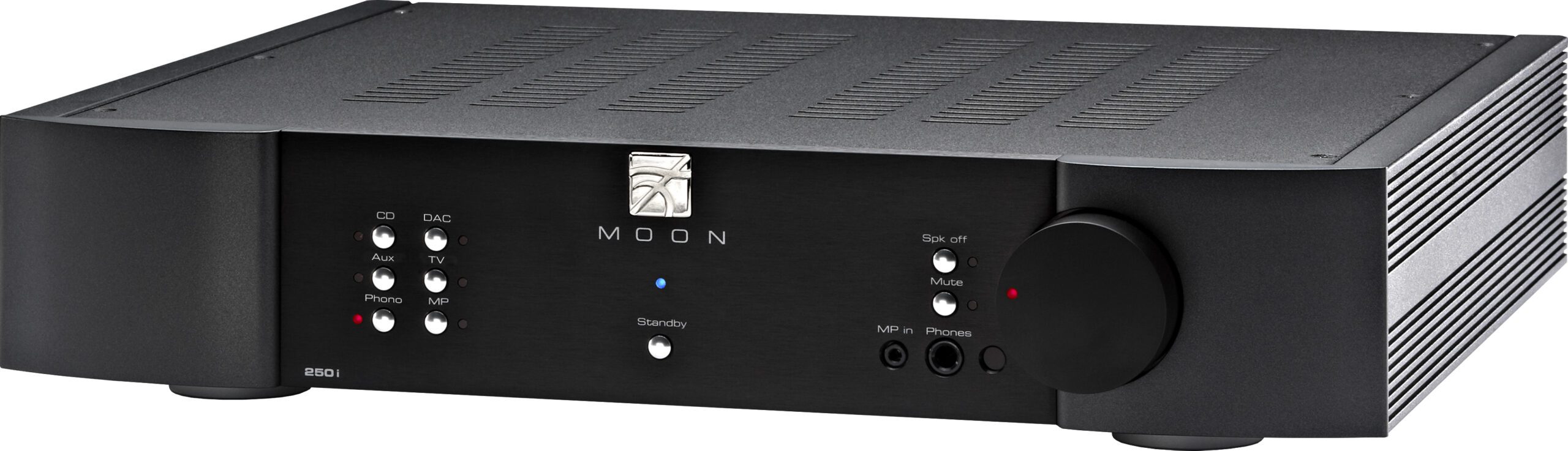
MOON is delighted to announce a new version of its 250i integrated amplifier. It features an upgraded circuit design, a new shield for the power supply and, for the first time, an MM phono preamplifier. The 250i is an analogue design classic that delivers the renowned MOON audio performance and represents outstanding value.
The new MOON 250i v2 builds on the foundations of the previous award-winning models including the current U.K. Black Edition. The upgraded circuit design uses next generation semiconductors to provide an improvement in sound quality, and the addition of the MM phono preamplifier increases functionality – for the first time, turntables can now be connected directly to the 250i allowing the listener to enjoy natural and precise vinyl replay.
The upgrades are all housed in the classic MOON 250i chassis which has been built to MOON’s meticulous audio engineering standards. It features simple-to-operate and satisfyingly tactile controls and is designed to deliver years of listening pleasure supported by MOON’s 10-year warranty. The 250i is available in either a black or two-tone black/silver finish to ensure that it will both look and sound fantastic wherever it is positioned.
The 250i v2 offers smooth musical authority combined with timeless design and is both the gateway to the range and the product with which to begin a MOON journey.
MOON 250i v2 features:
· Six analogue inputs including a convenient front panel connection.
· Headphone output on 1/4” jack located on the front panel.
· MM phono preamplifier
· Precision matched proprietary MOON Bipolar output transistors for improved bass response and accurate sonic reproduction.
· Low operating temperature for an ultra-long-life expectancy.
· Rigid chassis construction to minimise the effects of external vibrations.
· Designed and manufactured in Canada.
· 10-year MOON warranty
PRICE: £2,350
MOON products are distributed in the UK and Ireland by Renaissance Audio.
You can see much more on the Hi-Fi+ YouTube Channel, such as products from Warsaw Audio Video Show and Capital Audio Fest, as well as Tea Time with Alan and Pete.
Hi-Fi+ Editor Alan Sircom and Publisher Pete Collingwood-Trewin talk about what’s happening in the high-end audio world, and reveal the 2022 Product of the Year.
Tea Time with Alan and Pete is just one of several new series on the Hi-Fi+ YouTube channel designed for audiophiles of all levels.
Another series is History of Audio, which aims to teach viewers a little about the History of Audio, which might be a trip down memory lane for many. It also hopes those who watch will learn from the varying experiences of other audiophiles through their trials and tribulations with different equipment.
Soon, you can find reports from manufacturers at audio shows from around the world. You can see the likes of Aurender, Focal Naim, AudioThesis, Schiit Audio, and Magnepan, just to name a few. Right now, you can see what debuted at AXPONA 2022 and a bit from the Texas Audio Roundup, including background on the Magnepan LRS+. You can also see videos from Pacific Audio Fest in Seattle, CEDIA 2022 in Dallas, and Capital Audio Fest.
You can also see additional product reviews as well as more from the Bristol Hi-Fi Show, Florida International Audio Expo, and Capital Audio Fest on the hi-fi+ YouTube channel coming soon.
Ferrari’s new Purosangue, is not ‘simply’ another supercar; it’s a new chapter for the car marque. Since the brand’s launch in 1947, Ferrari has become synonymous with high-performance two-door cars. The Purosangue bucks this trend as it becomes their first production model with four doors. It’s also the company’s first Luxury Mid-Sized car; I’d hesitate to describe it as an ‘SUV’ in the same way I’d hesitate to describe a Patek Philippe Chronograph Complication as ‘a stopwatch’. It’s a Ferrari… just with four doors.
Purosangue side view – Image copyright Ferrari
However, it is clear that the Ferrari chiefs decided it was time to dip their toes into the Luxury Mid-Sized market, and I’d suggest they have jumped straight in with perfect grace and beauty. The team in Maranello are, rightly, incredibly proud of this new venture.
I had the opportunity to join the international press on a test drive high up in the Dolomite Mountains in Italy. While more expert voices in the car review world will talk at length about the driving experience (in short – fantastic!), we’ll concentrate on its outstanding audio made by Burmester Audiosysteme.
Purosangue Engine
Under the sleek bonnet/hood is a V12 engine at the front, with the transmission at the rear. While very different to the mid-engined mount seen in most Ferraris, this helps the designers balance the Purosangue to optimise performance. The car has a top speed of 192 mph (310 kph) and boasts 725hp; this is a supercar that seats four in comfort.
Driving Settings
The Ferrari Purosangue’s adaptive suspension technology has four settings – Sport, Comfort, Wet & Ice. In addition, each of these has sub-settings. This car is versatile; it could be used for a family vacation – to drive into the mountains to ski or cycle. It even has options for a bike and ski rack. The Comfort setting removes the bumps from the drive to a point where you feel you are floating above the tarmac. Sport however is a different matter. Select ‘Sport, Hard’ and you feel every single stone and bump in the surface, and you are inately connected – almost bonded – to the car itself.
Image copyright Ferrari
With an eight-speed auto gearbox, the car can purr or roar depending on your bent. And roar it does! The event consisted of some 25 international journalists with around 10 cars between us. Not only was it glorious to be in the car and hear the engine roar as we climbed the mountain roads, but also to hear the other cars’ engines echoing throughout the mountain range was very satisfying! Perhaps not so much for the locals!)
Ferrari Purosangue Interior 2
Interior – the Ferrari Lounge
The Ferrari team were keen to portray that their vision for this car was to create a lounge within the vehicle. No longer do rear passengers have to feel cramped, or as though the rear seats were a bonus. The Purosangue offers ample comfort in the rear. The majority of the interior – including the seats – are made from 68% ‘Post-consumer recycled polyester.’ This material is developed by Italian firm Alcantara, which has worked with many luxury brands around the world. It is immediately clear from the touch that this is a super high-quality material despite the ‘polyester’ label. It’s far removed from the artificial leather interiors of old.
Ready to drive!
Options Galore
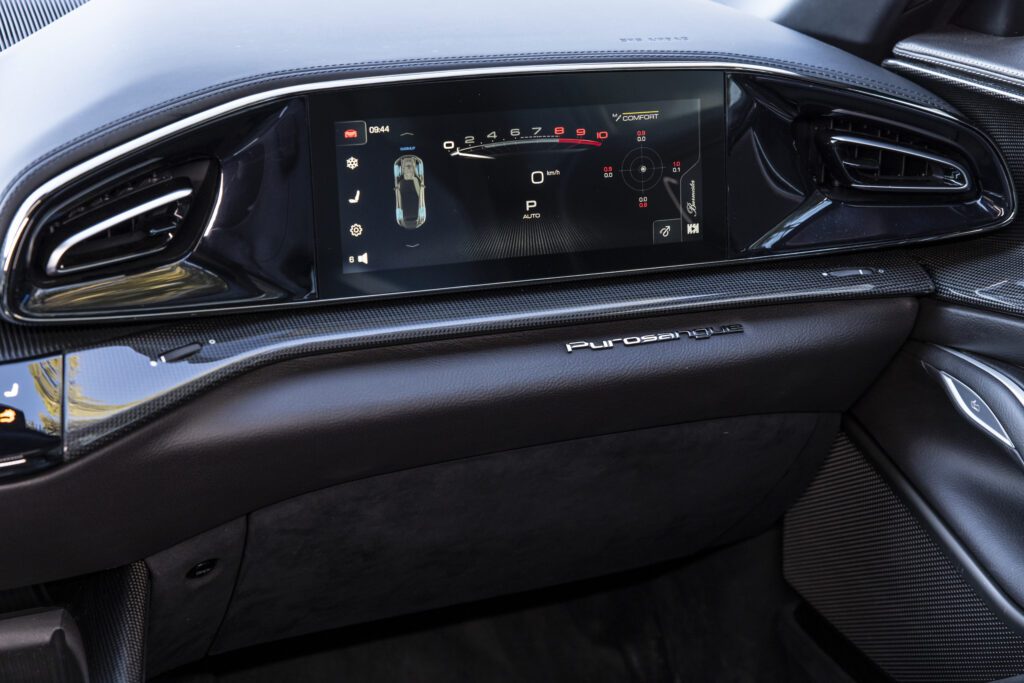
The rear section has two seats with a comfortable middle armrest with wireless charging capabilities and temperature controls. All seats have massage functionality and heating capability options. Other interior features include carbon fibre trims dotted throughout the vehicle. The front passenger has a touch screen to control non-driving settings including the Burmester system.
Image copyright Ferrari
There is an optional carbon fibre roof – to reduce weight – or a glass panoramic roof which has an electrically adjustable opacity.
As you would expect with a car of this calibre, there is a huge list of optional extras from Carbon Side Skirts or Carbon Fibre spoilers to Gold brake callipers.
That being said, the Ferrari Purosangue team have made two significant decisions with this new model. First, they do not include a GPS navigation system. They acknowledge that Apple Maps and Google Maps are better, and more up-to-date than any bespoke product they can produce, so through CarPlay the maps are more accurate.
The second decision is to remove the option of an upgraded sound system. Instead, all Ferrari Purosangues will have the high-performance 21-speaker Burmester system installed as standard.
Both decisions are a bold departure for Ferrari, as other models in the brand’s range have featured an integrated ‘infotainment’ system option complete with navigation, under the Ferrari Genuine banner.
Exquisite detail
Sounds Great!
Burmester Audiosysteme’s automotive division has already chalked up successes with systems designed for Bugatti, Mercedes-Benz and Porsche, but adding Ferrari and its bold new Purosangue is a very big feather in the Berlin-based company’s cap. It’s a cooperative venture that works for both sides; Ferrari has access to a level of top-class automotive audio and acoustic engineering that would take decades to create in-house, while Burmester adds another of the most highly sought-after car marques in history to its portfolio.
I have a theory that cars are the best place to listen to an audio system. A car is a fixed and known space – the acoustic engineers and designers know that except for variables like road noise and the number of people in the car, parameters like size, volume, and materials will not change (and even those variables are ‘constrained’; squeezing 10 people into a four-seat car is unlikely at best). This is very much in contrast to a personal listening space: no two are alike, and that space cannot be predicted by acoustic engineers.
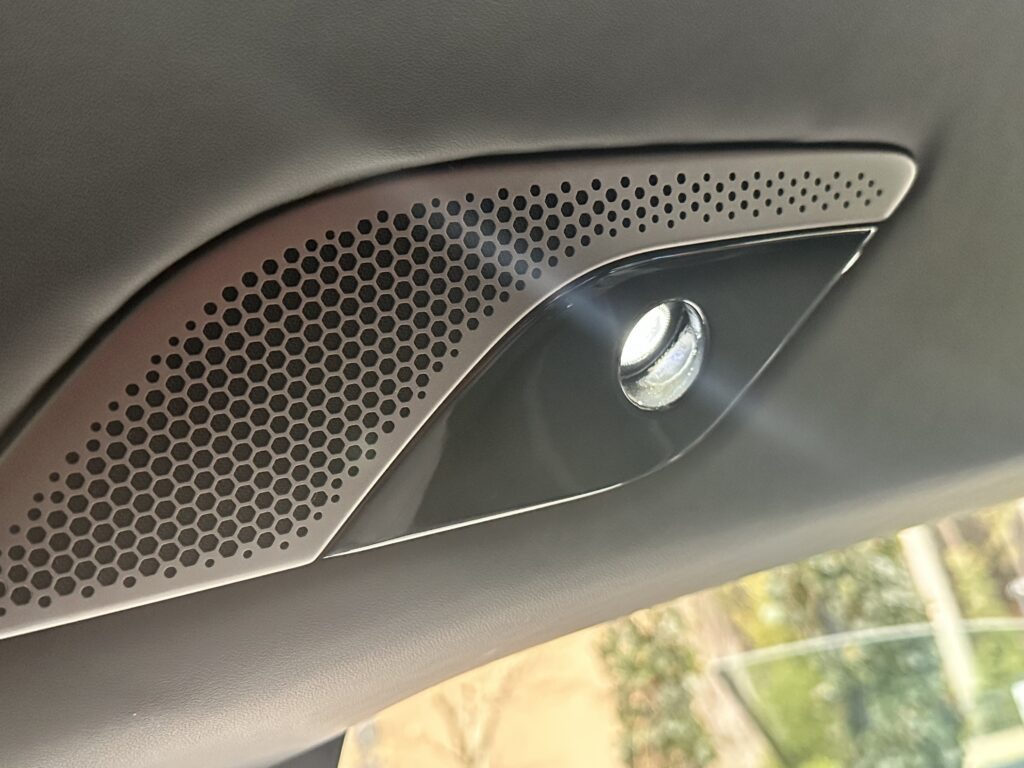
The Ferrari Purosangue’s Burmester system comprises over 1,400 watts of amplification, driving 21 speakers, including a subwoofer with it’s own 400 watt amplifier. Interestingly, the system features ribbon tweeters; this is a world first, as these have never been used in production vehicles before.
Roof-mounted tweeter
Testing
The main driving day started with a technical briefing. The majority of the journalists were already familiar with the standard Ferrari interface, so the briefing touched on additions and changes in the Purosangue. I wasn’t so familiar with that interface and I left the briefing feeling flummoxed!
We were briefed and given a route with various checkpoints along the way and a meeting point for lunch. It was probably a good hour into the driving before the sound system was switched on, as the initial fun was listening to the engine making its own music as we hurtled through tunnels and around hairpin bends at high altitudes.
Given the intensity of the driving experience, it’s useful that the passenger touchscreen enables complete control of the Burmester preset system, as the driver might be otherwise engaged.
Purosangue Passenger Screen
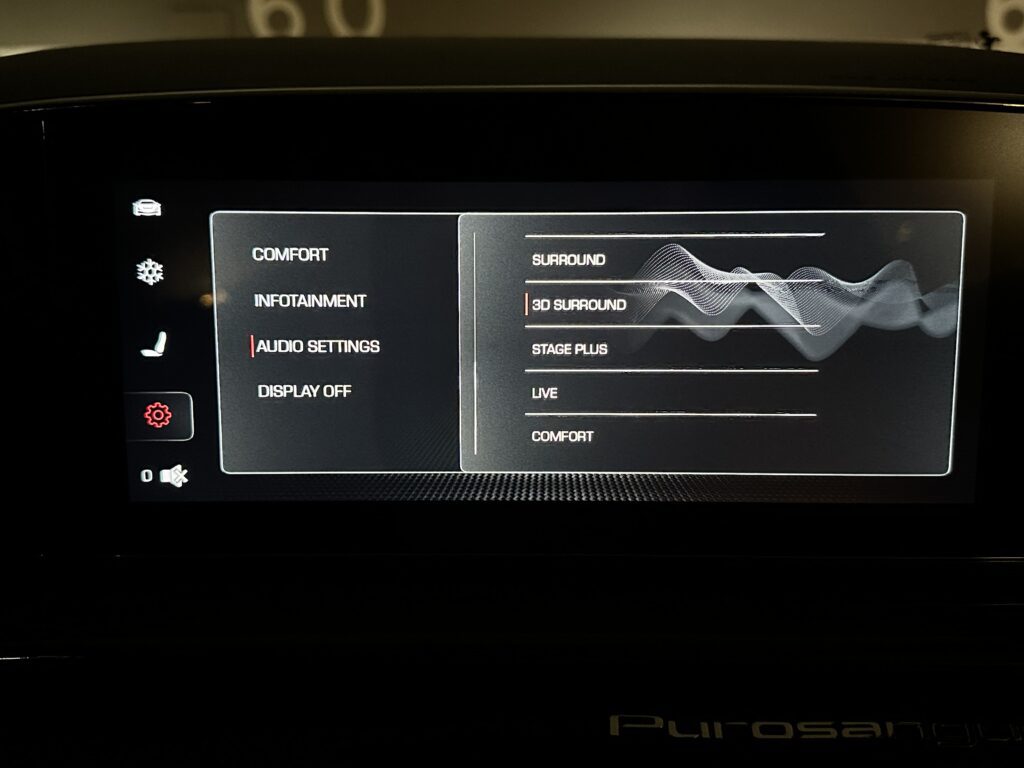
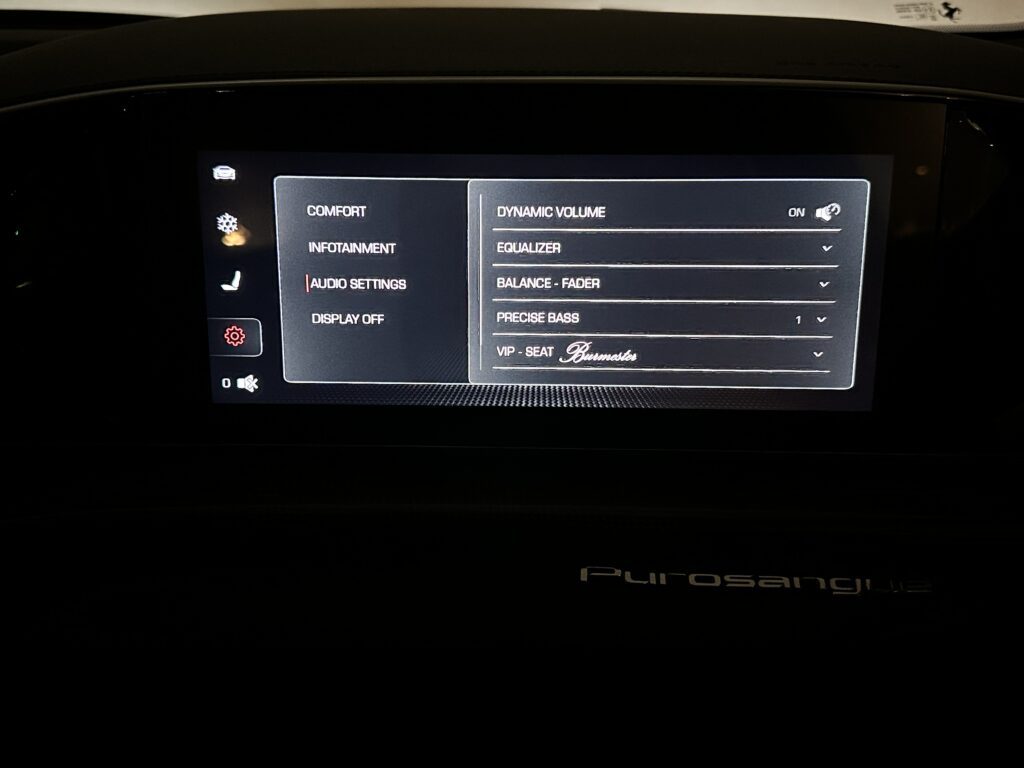
The 10.2 inch screen offers many options from Equaliser to Balance as you would expect; however, there is one setting marked ‘VIP – Seat’ that gives the option to choose any seat and have the music focussed on that position – this tightens up the soundstage and creates a sonic ‘sweet spot’ in one of the four seats. This has been used to great effect in previous Burmester systems in Mercedes-Benz and Mercedes-Maybach S-Class cars because the driver is unlikely to be the VIP. This Digital Signal Processing option is arguably even more important in the Ferrari Purosangue, as the VIP listener could be any one of the four people seated in the car.
Burmester has created five presets for the Ferrari Purosangue – Surround, 3D Surround, Stage Plus, Live and Comfort. Each of these settings involves making specific tweaks to the soundstage – I noted that vocals are crystal clear on all settings, although perhaps a little muffled on ‘Comfort’. This preset acts to soften the sound to create a background listening experience.
By far the best for me was the ‘3D Surround’ – the sense of being fully immersed in the music was created, not that you were sitting in the auditorium, rather that you were on stage in the midst of the orchestra, but perfectly balanced. The sound designers have created these presets with hours of research and development. I only hope that a Purosangue owner will explore them to enhance their listening on journeys. That fabulous engine noise might sing a siren’s song, but there’s a lot more to enjoy sonically too.
Purosangue Steering Wheel
HMI (Human Machine Interface)
Without a doubt, the Ferrari has one of the most (necessarily) complex driving interfaces I have experienced. Even the steering wheel has a touch-sensitive area, enabling you to scroll through the various options available to the driver. That said, it was ‘somewhat’ clunky and not that touch-sensitive. It took two hours of driving before I could find the steering wheel volume control. At the end of the driving sessions, there were still several buttons left completely unexplored. OK, so some of that was the fear was that one of these would inject an extra 300hp to the already highly excitable V12! In reality, any owner will likely find these features will fall naturally to hand very quickly.
Image copyright Ferrari
Regardless, the Purosangue brings Ferrari performance to the Luxury Mid-Sized car world. If there is such a thing as an ‘Everyday Ferrari’, it’s the Purosangue. Normally, when dealing with supercars, the car audio has been almost an afterthought, but with this powerful, flexible and extremely well-balanced Burmester system, it becomes an important part of the whole driving experience. Handing the keys back was a real wrench!
Thanks to Olaf Sturm, of i-fidelity for being a great copilot!
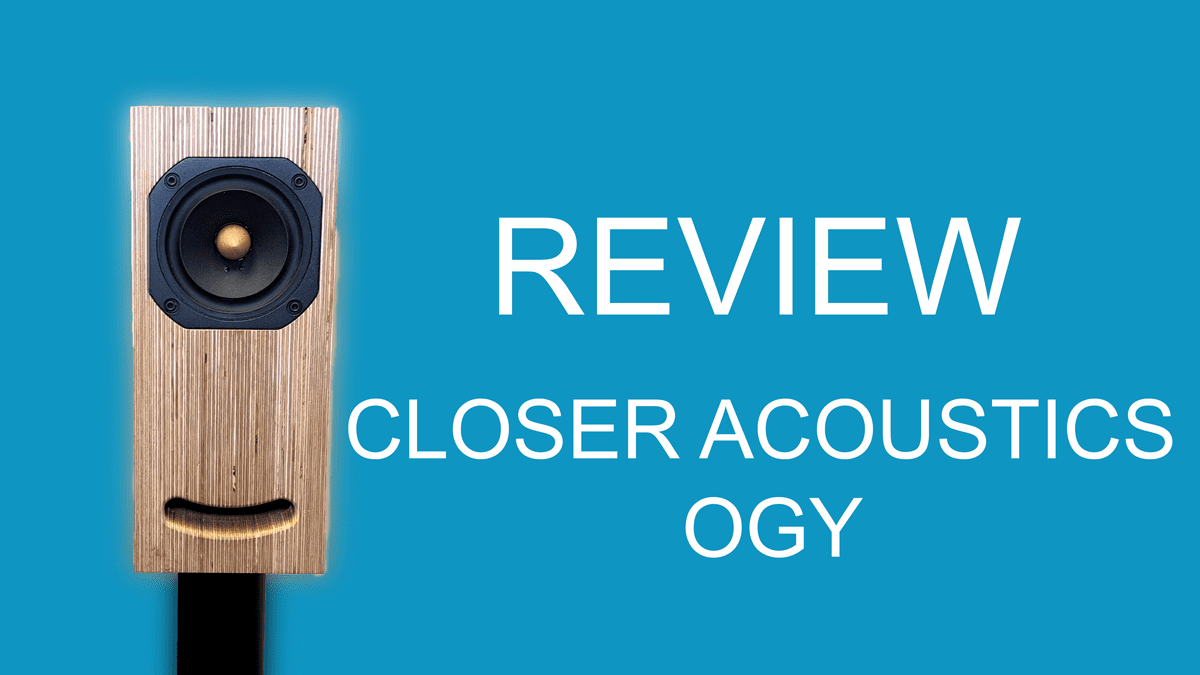
Closer Acoustics Ogy is a big little loudspeaker whose sound imaging and design is likely to leave a smile on your face. hi-fi+ Editor Alan Sircom gives a full review of the loudspeaker in the video below:
For more information about this product, click here.
You can see much more on the Hi-Fi+ YouTube Channel, such as products from Warsaw Audio Video Show and Capital Audio Fest, as well as Tea Time with Alan and Pete.
Hi-Fi+ Editor Alan Sircom and Publisher Pete Collingwood-Trewin talk about what’s happening in the high-end audio world, and reveal the 2022 Product of the Year.
Tea Time with Alan and Pete is just one of several new series on the Hi-Fi+ YouTube channel designed for audiophiles of all levels.
Another series is History of Audio, which aims to teach viewers a little about the History of Audio, which might be a trip down memory lane for many. It also hopes those who watch will learn from the varying experiences of other audiophiles through their trials and tribulations with different equipment.
Soon, you can find reports from manufacturers at audio shows from around the world. You can see the likes of Aurender, Focal Naim, AudioThesis, Schiit Audio, and Magnepan, just to name a few. Right now, you can see what debuted at AXPONA 2022 and a bit from the Texas Audio Roundup, including background on the Magnepan LRS+. You can also see videos from Pacific Audio Fest in Seattle, CEDIA 2022 in Dallas, and Capital Audio Fest.
You can also see additional product reviews as well as more from the Bristol Hi-Fi Show, Florida International Audio Expo, and Capital Audio Fest on the hi-fi+ YouTube channel coming soon.
We tested Synergistic Research’s original Foundation series of cables back in July 2020 (hi-fi+ Issue 185). A lot has happened since then, and the Synergistic Research Foundation SX series is the result. They remain the one above the entry-level range to Synergistic Research’s extensive line of tuning and power products. We’ll look at yet more of those in our next survey of the Foundation SX line.
To recap, Synergistic Research makes a range of components that treat the system rather than components in the system. The company makes power products, equipment supports, acoustic treatments, fuses, cables and more.
Foundation
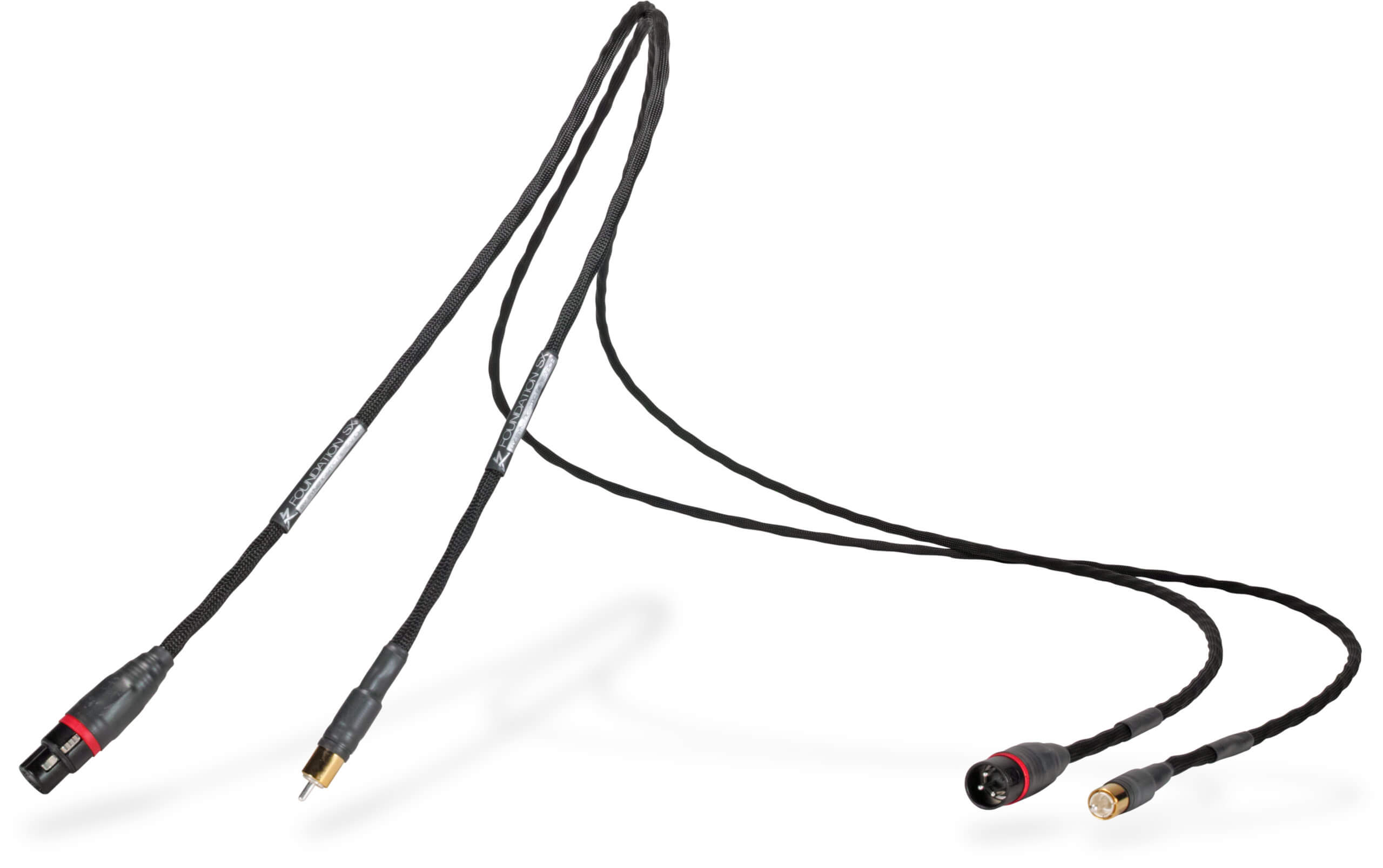
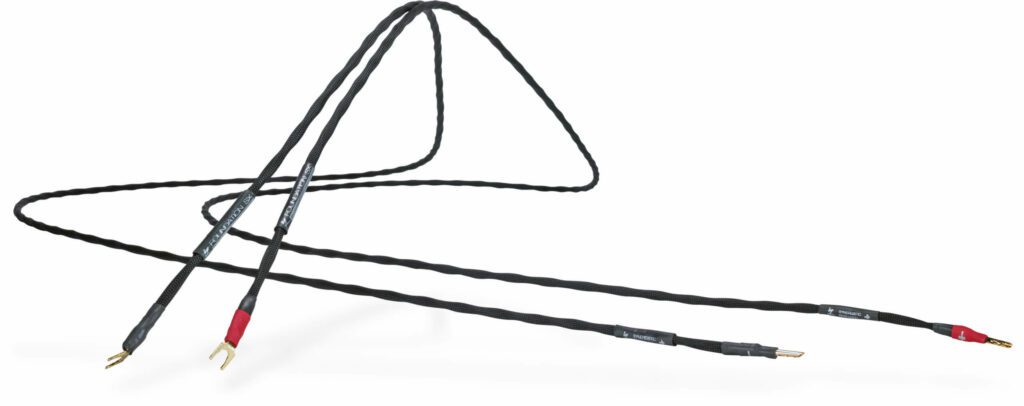
The original Foundation Series cables featured 6N purity pure silver conductors. These featured Synergistic’s own handmade Air String geometry. It also used the company’s UEF (Unified Energy Field) Matrix shielding in a grid pattern inside the cable. Foundation signed off with a graphene sleeve extending around the connector itself. The RCA cables used four of these Air String conductors per channel while the XLRs used six. All of these conductors were woven in an air dielectric and wrapped in a tight braided jacket. The loudspeaker cables looked almost identical to the interconnects, using identical materials, techniques, and jacketing. The positive and negative conductors are separated, with two distinct conductors for each speaker terminal connection. This means four cables per channel for bi-wire, six for tri-wire, and so on.
Foundation and Empire
These cables were damn good, but they were also an introduction to the whole empire of Synergistic Research’s systematic treatment of an audio system. As a result, the cables must work independently of Synergistic Research’s other treatments, but also act in harmony with them, and work with the broadest range of systems from affordable to distinctly high-end.
Covering all those bases was a tough call, but one Foundation did exceptionally well. And now it’s three and a half years later since its launch, and Foundation SX replaces the original. What’s changed… and why?
Second Foundation
The ‘OG’ Foundation was based on the technologies created for the higher-end Atmosphere X series cables. Foundation SX trickles down from the recent developments to the super-high-end SRX cable systems. The core construction of the Foundation remains unchanged. Still, it is treated with a new UEF Compound and subjected to a long-duration, high-voltage conditioning process that ensures the cable is correctly and consistently run in before it reaches the end user. The SRX project also helped create the latest UEF Carbon Tuning Discs, but more on these later.
The word ‘consistency’ is critical. Foundation worked both as a standalone single-cable upgrade and as a complete system cable rewire, but with Foundation SX, that latter all-Synergistic cable system makes even more sense. Yes, of course, you hear the benefits of one Foundation wire in the mix, but you hear the benefits even more directly if every cable in the signal path is singing the same song, and Foundation SX makes sure they all sing in harmony.
Foundation’s Edge
Used across the board, that synergy is met by some extraordinary levels of insight and detail for what is – by high-end standards, at least – distinctly affordable cables. You get more than a glimpse of the big audio picture here; with sublime soundstage width and solidity of images within that soundstage, frequency extension to make instruments with a high-frequency component sound natural instead of ‘tinny’ and ‘brash’. The cable is also analytical without being over-analytical, detailed without sounding ‘etched’ or ‘edgy’ and highly coherent and articulate right across the frequency range.
There is one final question to address. Three and a half years later, would a Foundation owner be wise to upgrade to Foundation SX? Well, yes and no. Suppose you have upgraded some parts of your system to Foundation. In that case, the rest should receive the Foundation SX treatment, and you’ll likely upgrade the more essential parts of the system with SX, and the lesser-used components will end up with the original. But if you are thinking of changing Foundation for SX? Maybe. It’s better, and there are trade-in programmes, but I think a trade-up might be better.
Foundation and Earth
I almost missed the last bit of the test; the UEF Carbon Tuning Discs are tiny and extremely light… and there’s a purple and a gold one and some White-Tack in a baggie supplied with each cable. For a few seconds, I thought Synergistic had thrown in a couple of tabs of acid with the cable. I was about to tell them that I no longer go to Hawkwind gigs when I found out about the whole Carbon Tuning Discs thing. Back on planet Earth, they are fine-tuning devices that you stick to the strain relief of the cables that broadly speaking give you more soundstage depth (gold) or more detail retrieval (purple). That’s true ‘edge of my weird wide world’ stuff and makes me wonder if they are made of LSD, after all! Regardless the Discs do something and do it consistently.
Even if you ignore the discs, Synergistic Research’s Foundation SX builds on the strengths of Foundation. It, therefore, has the correct name. It’s a perfect foundation for transforming a system through Synergistic Research’s tuning systems. But, that holds even if Foundation SX is your only shot at coordinating the sound of a system. If you have no plans to explore the rest of the Synergistic Research catalogue, the Foundation SX cables harmonise and bring out the best in any system.
Price and Contact details
Synergistic Research Foundation SX interconnect cables: $699 (excl tax), £599 (inc VAT) 1m RCA (as tested)
Synergistic Research Foundation SX loudspeaker cables: $749 (excl tax), £650 (inc VAT) 8’ spade lugs (as tested)
I was talking to a former executive at Technics recently who told me about the way the business worked in the days when separates sold in the sort of numbers that only headphones and Bluetooth speakers do today. For Technics, the game was all about market share and the way to achieve that was with advertising. This meant double-page spreads in Sunday supplements and back pages on every hi-fi magazine. It worked… and the brand made a lot of hay in the shining sun. At the same time Rega was doing things rather differently; with the Planar 2 and 3 turntables, the company became one of the main turntable makers in British hi-fi without recourse to marketing but rather by building an excellent product at a competitive price. Those turntables still hold their value today, which is more than you can say for most hi-fi of the 1970s and 1980s, Technics turntables excepted.
Rega is now the UK’s foremost independent manufacturer of complete audio systems has a broad range of turntables, electronics and loudspeakers and, in my humble opinion, makes one of the very best turntables in the world. But critically Rega also does its utmost to keep its products affordable to the man and woman in the street. There are numberless small companies in this business who make great products but because of the scale of their operations they are not able to bring them to market at prices that the casual music enthusiast would consider approachable. Rega has always looked for efficiency in production and built in sufficient numbers to achieve this enviable goal, one that only the larger brands which facilities in China can compete with.
My first Rega
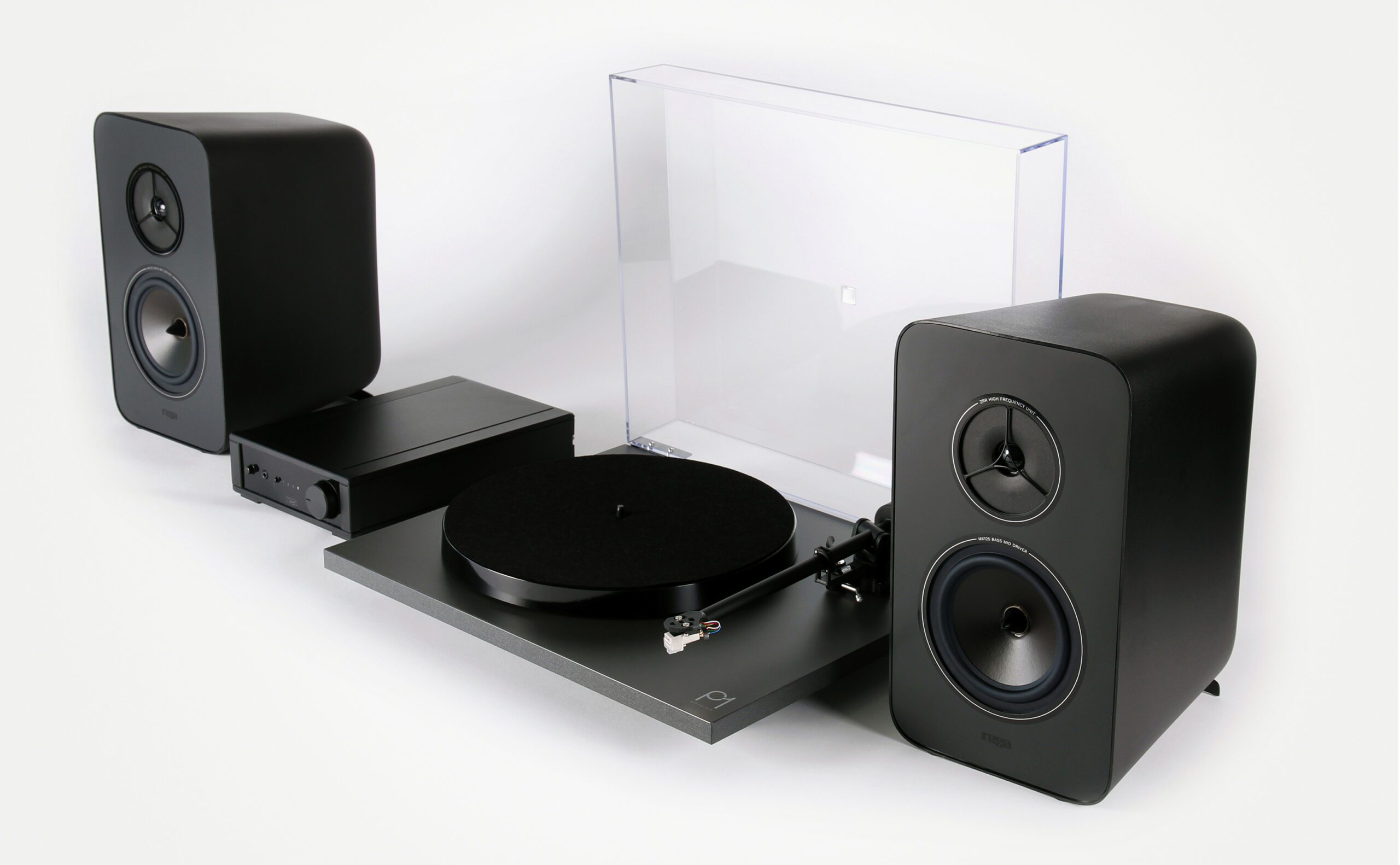
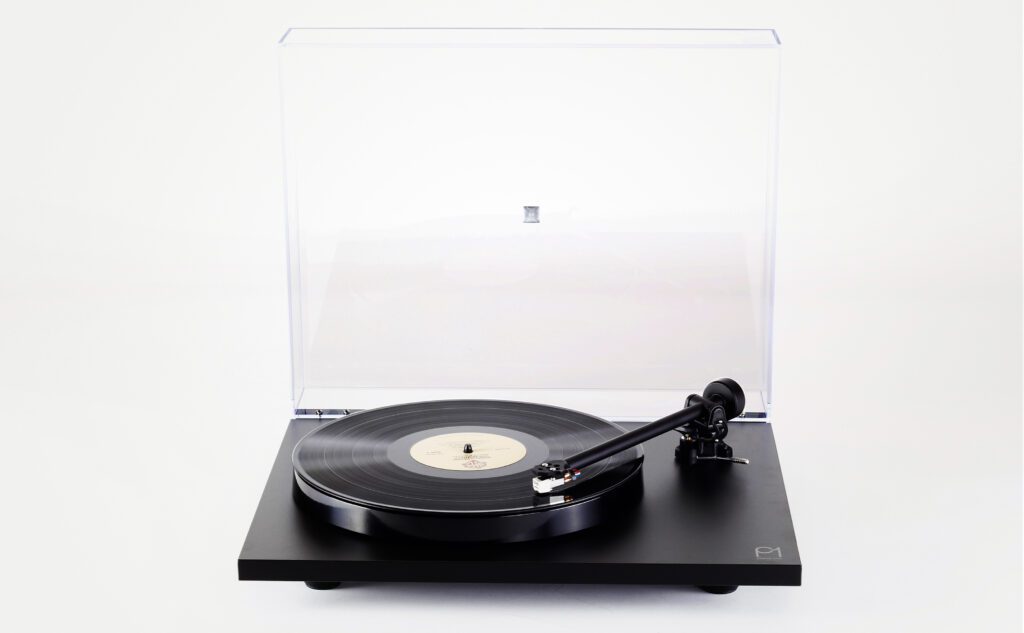
The Rega System One is the epitome of this high value ethos. It is the company’s first complete hi-fi system in a box and includes everything you need to make vinyl records sound great in your home, cables and all. The source is Rega’s most affordable turntable; the P1 is a full-size record player with a proper dust cover and high quality motor, bearing, platter, plinth, arm and cartridge. The Planar 1 to give it its full title has a phenolic resin flywheel platter; this hard plastic offers a stiff and flat surface and has peripheral weighting to aid speed stability. Like all Rega turntables, drive is achieved via a smaller subplatter, an approach that can be found in the Linn LP12 among a few enlightened others and avoids the problems inherent in driving the periphery of the platter with a belt or idler wheel. The main one being considerably lower energy transfer from the motor to the platter. Remember that a turntable’s job is to ‘read’ miniscule vibrations in a vinyl groove, anything that adds vibration to the system will distort the signal being read so extraneous vibration is to be avoided at all costs.
The Rega RB110 tonearm isn’t based on the casting that forms more costly Rega arms but instead is a high quality piece of engineering that should last considerably longer than the flimsy looking options found on many budget turntables. Bias or anti-skate is described as automatic and cannot be adjusted, and this suits the Rega Carbon moving magnet cartridge supplied. Some consider this to be a limitation but given that bias is always a compromise (like tracking angle, no single bias setting is correct across the whole side of a record), it is an acceptable way of reducing cost. Downforce is, of course, adjustable but the RB110 has a stop to suit the requirement of the Carbon, making user set up very easy indeed. The arm also has a proper lift/lower system, that looks very much like the kind fitted to Rega’s top models. The arm bearings use a patented combination of polymer casings and steel ball races and are found in both the RB110 and RB220 arms.
A 24V synchronous AC motor – as found across the Rega turntable range – powers the P1; the more expensive models get the motors that measure best of course but the basic design is the same. This motor drives a round section belt from an aluminium pulley with separate steps for 33.3 and 45rpm. This means changing speed requires the platter to be removed and the belt moved from one to the other, but in reality it’s ‘simples,’ as that mysteriously Russian-accented African meerkat insurance salesman is prone to saying.
Motor switching is under the front of the plinth and easy to find by feel. Not a great deal is said about the plinth itself save that it comes in matt white or black finishes, it feels like furniture grade wood but is presumably some kind of particulate board with a finishing skin. The turntable sits on three rubber feet for stability and damping, and has a socket on the rear for the wallwart power supply. Its tonearm cable is fixed in order to provide a direct connection between arm and amplifier. Some brands offer RCA outputs on their turntables but the low power nature of the signal produced by a cartridge means that such interfaces are detrimental to sound quality.
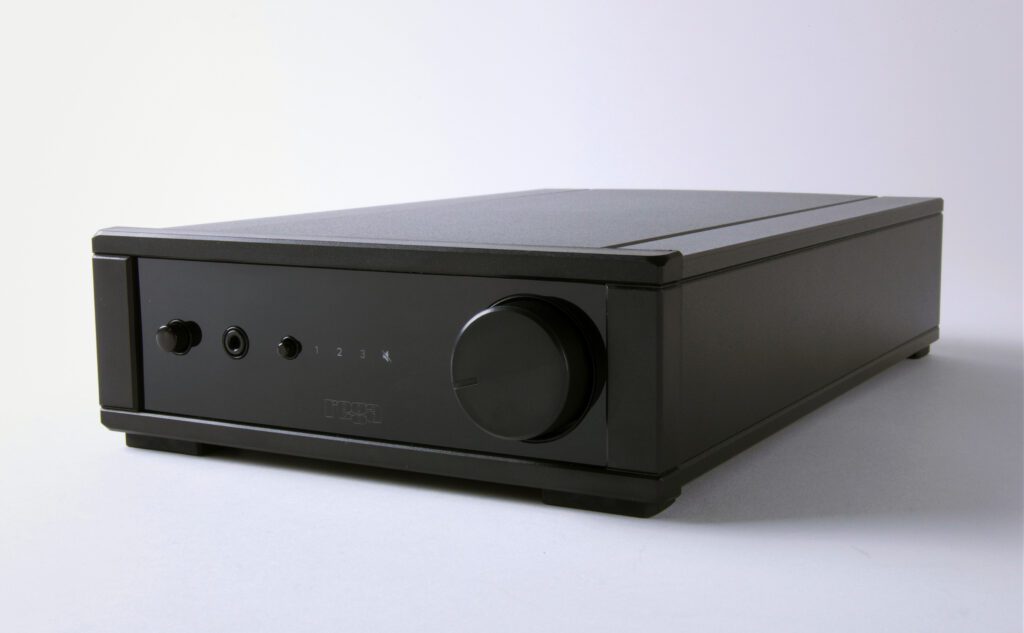
The integrated amplifier that Rega developed largely for this system is called Io. It’s (naturally) the least expensive model they make and yet offers the all important phono stage required for the P1. It is based on the same circuit as the remarkable Brio amplifier and while it has a smaller power supply and thus lower 30 Watt output, it is the least expensive amplifier that’s made in the UK. Features extend to a headphone output and remote control with two line inputs alongside the MM phono stage. It’s interesting to note that the first two incarnations of the Naim Nait offered only 13W; it wasn’t until the Nait 3 in 1993 that it reached the sort of Wattage on offer in the Io. Another similarity is that the early Naits also had just three inputs including phono… coincidence, perhaps?
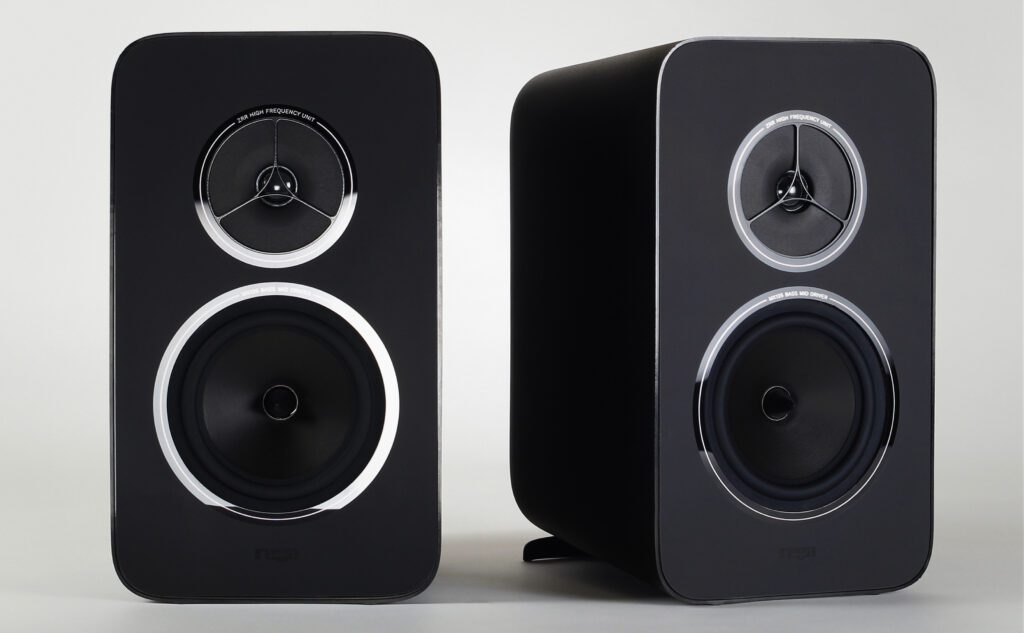
The most radical element in the Rega System One is the Kyte loudspeaker. This eschews wood almost entirely in favour of a Rega’s favourite plastic, phenolic resin. This is the material that you find in light switches and mains sockets; it’s not intrinsically expensive yet making such a large moulding proved a difficult process to get right and Rega doesn’t make enough speakers to bring the price down that far. The box is stiffened using ceramic plates and a wooden cross brace.
The drivers are pretty much identical to those found in Rega’s more conventional RX1 bookshelf model and consist of a 125mm mid/bass driver with a paper cone and the Rega ZRR soft dome tweeter. These have trim rings to hide fixings for a neat look and sit in a baffle set into the main cabinet. This has a reflex port moulded into the rear and a pair of cable terminals above one another and close to the fixing holes for a supporting leg. Because the cabinet moulding has to have sloping sides for manufacturing purposes the bottom is not at 90 degrees to the front as is the case with wooden boxes; the bolt on support means that the front baffle sits vertically but does make it nigh on impossible to Blu-tack to a stand. However, given Rega’s dislike of damping this is probably deliberate. The other consideration is that this system is for regular folk who don’t have or want stands but put their speakers on a shelf or sideboard… the weirdos!
Freedom from excitement
Being not averse to speaker stands nor particularly anti-damping I bucked convention and Blu-tacked the Kytes to a pair of Custom Design 60cm stands without using the T bar support leg. I reviewed the Kytes alone a couple of years back and discovered that this sounds better than using the leg or the metal adaptor that Rega sells for those who want to use conventional stands. This meant that the front baffle leans back slightly but plenty of speakers work like this by design and the base angle is only five degrees so the tilt isn’t extreme by any standards. The turntable went on my regular rack – which is well isolated – so it got a better chance than a typical situation and in my experience solid plinth turntables do benefit from as much freedom from external excitement as possible. I connected the speakers up with the supplied cables which are three metres long and marked for polarity, they don’t have plugs so you need to pull off the pre-cut insulation at either end and bind them to amp and speaker terminals.
Being an audio nut I took the lid off the Planar 1; it’s easy and removes a potential source of vibration (especially when left up), then dropped the needle carefully onto John Renbourn’s Another Monday and soon became immersed in fabulous playing and singing. This system does what Rega components have always been particularly good at; producing a musically coherent and thoroughly engaging listening experience. It gets to the “crux of the biscuit” as Frank Zappa used to say, bringing out the heart of the musical matter in such a direct and unaffected way that you can’t help but enjoy yourself. It’s limited in terms of bandwidth, the Carbon doesn’t quite soar to the heights of treble and the Kytes don’t go down to the lowest octaves of bass, yet all the important musical cues are present and correct. Timing is spot on, vinyl has a huge advantage over digital in this respect because it’s a real time, non-processed system involving converting a mechanical signal to an electrical one. There is plenty of potential for tonal aberration but little for errors in the time domain and those are the ones that get in the way of realism in my book.
Typically Rega
This system’s balance is typically Rega by which I mean slightly lean, the Kytes are largely responsible for this because there is so little mass to store and subsequently release energy as is the case with wood based boxes. This makes them very fast and agile with no thickness which is not to all tastes but ultimately serves the music rather well. They do attack and decay very well and even reproduce depth of image to a decent standard, and bass is strong enough to make bass guitars, drums etc very convincing. I also tried the Io and Kytes with a digital source in the Silent Angel Munich M1 streamer. Playing Ronnie Size’s ‘Brown Paper Bag’ on this proved a thrilling experience, the intensity of the drum and bass making for an adrenaline rush that left me wanting more. On the lush production of Beck’s ‘Paper Tiger’ the scale came through with ease albeit the electric guitar seemed a little more eager than usual. It’s not a rich tonal balance that’s for sure, it’s more about pace and engagement than polish but if you put a plush recording on you get a plush sound out. The caveat here is that the difference in level between vinyl and line sources such as a DAC can be quite large with some recordings so it’s wise to turn it down when switching between them.
Vinyl is the natural source for this system of course and always the most rewarding, I found myself more distracted by the Rega System One than expected truth be told; its ability to provide all the detail that contributes to an engaging and rewarding musical experience outweighs its limitations by a large factor. That it costs no more than some of the cables in my usual system is remarkable and goes to show that if the manufacturer puts its mind to it there is no need to spend more. It is possible to put together a similar system from diverse brands for a similar price but it seems unlikely that you would end up with the sonic coherence, build quality and lifetime guarantee offered here. Rega is a very unusual company in many ways but its success in both commercial and product value terms means it competes with the very best.
Technical specifications
Rega Planar 1
Type Belt drive, manual operation turntable, arm and cartridge with dust cover
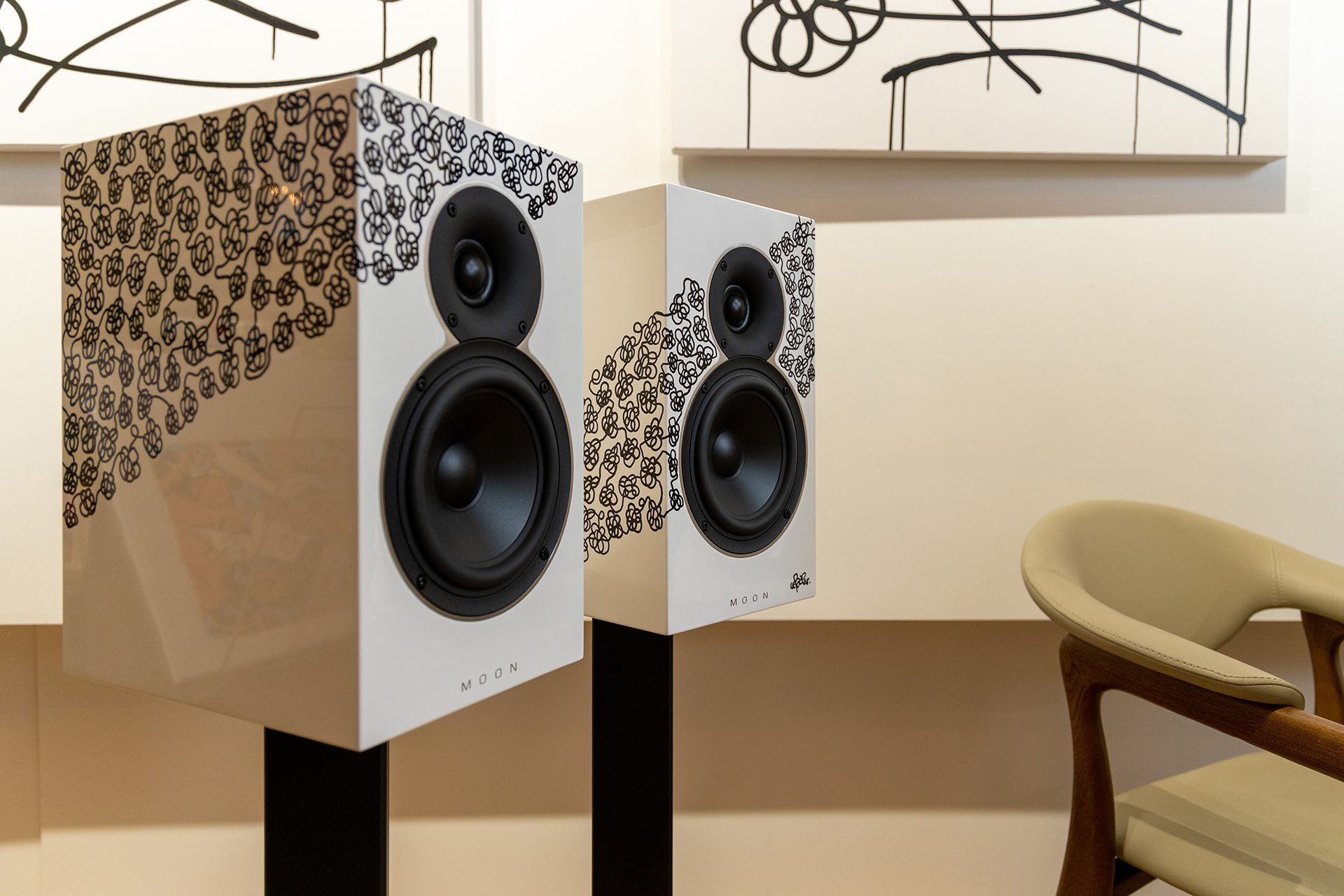
MOON has commissioned a pair of custom painted Voice 22 loudspeakers to be auctioned in aid of Oxfam Canada. The award-winning speakers feature a unique hand-painted design applied by Montreal artist LeBicar and use premium audio technology to deliver an unforgettable listening experience.
Oxfam Canada’s mission is to build lasting solutions to poverty and injustice, focusing on improving lives and promoting the rights of women and girls. It works directly with communities, partners, and women’s rights organizations to challenge the systems perpetuating inequality and keeping people poor. It seeks to influence those in power to ensure that women trapped in poverty have a say in the critical decisions that affect them, their families, and entire communities.
MOON is based in Montreal and selected renowned local artist LeBicar to create this stunning pair of loudspeakers. LeBicar is strongly influenced by both music and skateboard culture and his work is identifiable by its single continuous strokes. His visual signature is the use of black and white to express an inspiring mix of duality, contrast, and individuality.
The Voice 22 loudspeakers benefit from MOON’s more-than-forty years of audio design experience and give the company its own voice for the very first time. The speakers have been launched to global acclaim and have received many outstanding reviews including a prestigious EISA award.
A silent auction will take place from the 24th of February until the 26th of March with bids starting at CA$3000. All money raised from the auction of the loudspeakers will be donated directly to Oxfam Canada.
Etienne Gautier, MOON’s Chief Commercial Officer, said, ‘We are pleased to be able to partner with Oxfam Canada and to support its global goals. I am certain that with the MOON X LeBicar loudspeakers as a prize that the auction will be extremely popular. I’d like to thank the Quebec-based creative organisation, Artbangbang, for introducing us to Lebicar and for enabling this exciting project.’
Focal Vestia features some new technology, including a tweeter designed by the automotive team. Watch the video below as Tom from Focal Naim walks us through the new features.
You can see much more on the Hi-Fi+ YouTube Channel, such as products from Warsaw Audio Video Show and Capital Audio Fest, as well as Tea Time with Alan and Pete.
Hi-Fi+ Editor Alan Sircom and Publisher Pete Collingwood-Trewin talk about what’s happening in the high-end audio world, and reveal the 2022 Product of the Year.
Tea Time with Alan and Pete is just one of several new series on the Hi-Fi+ YouTube channel designed for audiophiles of all levels.
Another series is History of Audio, which aims to teach viewers a little about the History of Audio, which might be a trip down memory lane for many. It also hopes those who watch will learn from the varying experiences of other audiophiles through their trials and tribulations with different equipment.
Soon, you can find reports from manufacturers at audio shows from around the world. You can see the likes of Aurender, Focal Naim, AudioThesis, Schiit Audio, and Magnepan, just to name a few. Right now, you can see what debuted at AXPONA 2022 and a bit from the Texas Audio Roundup, including background on the Magnepan LRS+. You can also see videos from Pacific Audio Fest in Seattle, CEDIA 2022 in Dallas, and Capital Audio Fest.
You can also see additional product reviews as well as more from the Warsaw Audio Video show and Capital Audio Fest on the hi-fi+ YouTube channel coming soon.
You can see much more on the Hi-Fi+ YouTube Channel, such as products from Warsaw Audio Video Show and Capital Audio Fest, as well as Tea Time with Alan and Pete.
Hi-Fi+ Editor Alan Sircom and Publisher Pete Collingwood-Trewin talk about what’s happening in the high-end audio world, and reveal the 2022 Product of the Year.
Tea Time with Alan and Pete is just one of several new series on the Hi-Fi+ YouTube channel designed for audiophiles of all levels.
Another series is History of Audio, which aims to teach viewers a little about the History of Audio, which might be a trip down memory lane for many. It also hopes those who watch will learn from the varying experiences of other audiophiles through their trials and tribulations with different equipment.
Soon, you can find reports from manufacturers at audio shows from around the world. You can see the likes of Aurender, Focal Naim, AudioThesis, Schiit Audio, and Magnepan, just to name a few. Right now, you can see what debuted at AXPONA 2022 and a bit from the Texas Audio Roundup, including background on the Magnepan LRS+. You can also see videos from Pacific Audio Fest in Seattle, CEDIA 2022 in Dallas, and Capital Audio Fest.
You can also see additional product reviews as well as more from the Warsaw Audio Video show and Capital Audio Fest on the hi-fi+ YouTube channel coming soon.
ELAC VARRO Subwoofer Series: for durable and strong bass performance!
*From the ELAC news release
The new Varro Series by ELAC combines three subwoofer line-ups with different designs and looks but the same acoustic philosophy. All of them guarantee dynamic, powerful, musical, and thrilling low-frequency performance that can be perfectly balanced for every application. The PREMIUM, REFERENCE and DUAL REFERENCE line-ups include a total of seven different subwoofer models, all of which live up to the name Varro, which is borrowed from Latin: durable and strong in every respect!
PREMIUM Series: The Premium Series includes three models: the PS250-BK, PS350-BK and PS500-BK with different dimensions, amplifier outputs, and driver sizes. They utilize a 10″,12″ or 15″ driver respectively, which is paired with a large magnet and housed in a bass-reflex cabinet. Driven by powerful amplifiers that use efficient BASH® technology to deliver either 250, 350 or 500 watts, they lay the foundation for an impressive and powerful performance – ideal for completing stereo systems or home-theater installations. The ELAC SubControl 3.0 app provides extensive functions such as automatic calibration and convenient operation.
REFERENCE Series: The two models RS500-B and RS700-B in the Reference Series offer impressive acoustic performance as well as technical refinements. The eye-catching new cone surrounds for the 10″ and 12″ drivers employ HEX technology for greater linear excursion and even lower distortion. Sealed cabinets constructed from 30-mm-thick MDF paired with either 500-watt or 700-watt BASH® amplifiers guarantee an incredibly accurate and dynamic performance. The black satin finish and removable fabric-covered grilles give the compact subwoofers a subtle appearance. Here too, the ELAC SubControl 3.0 app offers extremely convenient operation with an automatic calibration function that balances the subwoofer with the room’s acoustics.
DUAL REFERENCE Series: The DS1000-GB and DS1200-GB models in the Dual Reference Series utilize the same equipment as the Reference Series but with added special features. Firstly, both models feature two drivers with HEX technology, which are installed opposite one another in an impulse-compensated configuration. This means that mechanical forces inside the sealed cabinet made of 36-mm-thick MDF cancel each other perfectly…leaving nothing but perfectly generated airborne sound. The pairs of 10″ or 12″ drivers combined with the extremely powerful BASH® amplifiers rated to 1000 or 1200 watts respectively deliver an unbelievably precise yet musical presentation in the low-frequency range. An elegant high-gloss black finish and compact dimensions make the Reference Series the ideal choice for those seeking uncompromising HiFi performance from a room-friendly device.
ELAC VARRO Subwoofer Series: Prices and availability All Varro Subwoofers are available by the end of March 2023.
For more information about the subwoofers please use this link https://bit.ly/3YXPNq5
The company ELAC is passionate about driving innovation and refining its existing products. Throughout the 90 years of our company history, we have crafted products of unmistakable quality and sound that stand out from the crowd. Our latest innovations complete the ELAC experience, enabling our discerning customers to experience the passion in our products in the form of music and film.
To find out more about ELAC, please visit www.elac.com
Featuring dual THX amplification, dual ESS DACs, support for audio up to 768kHz 32bit/DSD512, MQA, Roon Ready, Multiple inputs/outputs & Bluetooth 5.0 with aptX HD & LDAC for £649/$699. Just add active speakers for a hi-fi system.
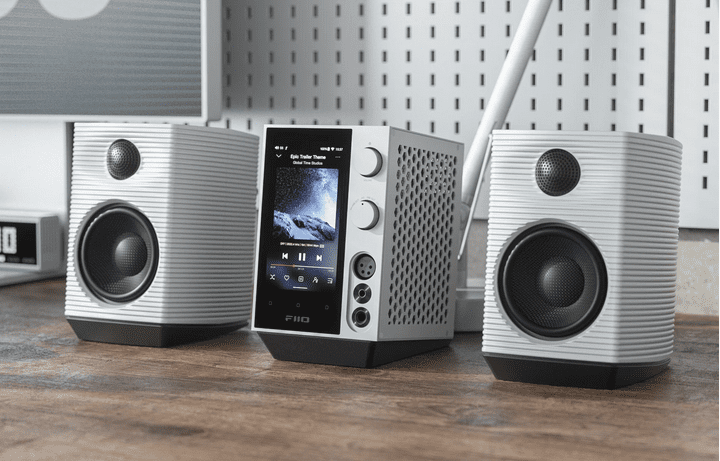
The R7 is FiiO’s first-ever desktop hi-res audio player/streamer & balanced DAC/amplifier. Equipped with high-performance ESS Sabre ES9068AS DACs and high-power THX-788+ desktop-grade amplification chipset, the R7 is a truly versatile solution for listening to your digital audio. Featuring a wealth of input and output options, the FiiO R7 has been designed to work with a host of devices, including: wired headphones, wireless headphones, active speakers and PCs.
The FiiO R7’s 64GB of internal storage is complimented by SD, USB, optical and coaxial inputs, with the FiiO R7 also supporting wireless connectivity thanks to having both 2.4GHz/5GHz Wi-Fi and Bluetooth 5.0 on board. Access your music files stored on the onboard memory or SD card; physically connect your audio source, such as an external HDD; wirelessly send audio to the R7 via DLNA or Airplay, or utilise the R7 as a Roon Ready endpoint. You can even transmit music via Bluetooth from your smartphone or PC.
The FiiO R7 supports high-resolution PCM, native DSD audio, and MQA decoding. Utilising Qualcomm’s 8-core Snapdragon 660 SoC chipset with 4GB of RAM, 64GB of onboard storage (expandable to 2TB via SD card), the R7 runs on Android 10. All of your favourite streaming applications — including TIDAL, Apple Music, Amazon Music, Spotify, Soundcloud and many more — can be installed directly on the R7 via either the pre-installed Google Play Store or FiiO Store apps.
Thanks to its dual THX AAA-788+ amplifiers and dual ESS ES9068AS DACs, the FiiO R7 is a highly accomplished headphone amplifier, offering a choice of wired and wireless connections to your favourite headphones. Single-ended 6.35mm and balanced 4.4mm connections feature, as well as a balanced 4-pin XLR output.
To ensure the FiiO R7 can be matched with your headphones — whether sensitive IEMs or power-hungry over-ears — five gain level modes are selectable: low, medium, high, super high, and ultra high. Under a 32Ω load using enhanced over-ear headphone mode, the R7 is capable of outputting up to 3.6W, more than enough to power low-and high-impedance headphones.
In addition, the R7 is able to output audio via Bluetooth using a wide range of different standards — including AAC, SBC, aptX, aptX HD, LDAC and LHDC — meaning you’re sure to get the best quality connection, whatever wireless headphones you’re using.
The FiiO R7 will be complimented with the FiiO SP3 active speakers, available later this year.
The FiiO R7 is available now, priced £649.99 / $699.99.
The FiiO SP3 Speakers will launch later this year.