Up to 37% in savings when you subscribe to hi-fi+
hifi-logo-footer

Begin typing your search above and press return to search. Press Esc to cancel.

DS Audio DS-W1 Optical cartridge and equaliser

Despite the total dominance of electro-magnetic pick-up technology – be it fixed or moving-coil in nature – there has always been a steady stream of alternative offerings or variations on the theme when it comes to extracting a meaningful signal from the squiggly grooves embedded in the surface of LP records. It’s not too hard to understand why, given the all too audible flaws inherent in and challenges presented by both moving-magnet and moving-coil designs. Throw in the essential mechanical crudity of the process and it’s hardly surprising that designers and end-users alike crave a more sophisticated and elegant solution. Yet, such is the dominant nature of these ‘conventional’ designs that they totally define the context in which any alternative is viewed or judged.

On the most obvious level, products like the Soundsmith Strain Gauge cartridges or the subject of this review, the DS Audio DS-W1 optical cartridge, dispense with the requirement for (and cost of) a conventional RIAA/phono-stage – the necessary functionality being included in the price of the cartridge. That doesn’t just muddy the water: depending on whether you have a pre-amp with a built-in phono-stage, you already own the phono-stage of your dreams, how much you paid for the phono-stage you already have, whether it’s salable (should you want to sell it), or whether you actually own any sort of phono-stage at all, the real cost of owning such a device might vary dramatically – along with the competition against which you might compare it.

But like I said, that’s just the most obvious example. Start to examine DS Audio’s DS-W1 in any detail and even a rudimentary understanding when it comes to the mechanics of phono replay should indicate that this cartridge is definitely swimming against the analogue stream. In a world seemingly obsessed with ever longer tonearms and the low-compliance cartridges they demand, the DS-W1 is both light and lively, weighing in at a mere 6.5g and with a compliance of 15cu vertically and 25cu laterally. That suggests that you’ll need the sort of lightweight arm that has long faded from fashion if you want to avoid resonance issues and actually benefit from the DS Audio’s advantages. Right about now you are probably wondering just what those advantages might be and what could possibly make them worth the bother and brain-ache of building them into your system? Which makes it time to discuss what makes the DS-W1 so different – and so special.


Don’t let the ‘optical’ in the DS Audio’s title deceive you. The DS-W1 uses an entirely conventional Shibata stylus and boron cantilever to trace the record’s groove. However, instead of a set of coils or a magnet on the other end of that cantilever, there is a tiny plate with an even tinier slot cut in it. The matching PSU/equalizer box powers a tiny LED beam that shines through that slot, a photo-electric cell measuring how and by how much the movement of the cantilever causes the slot to occlude the beam. The result is a device with an incredibly low moving mass and a lightweight reading system – which helps explain why the DS-W1, a fully clad cartridge, is lighter than most naked designs. It also produces an amplitude proportional output, as opposed to the velocity proportional output of conventional electro-magnetic designs. This means that, at least in theory, it suffers from neither the pre-emphasis of high-frequencies nor the slowing of low frequencies that afflicts those conventional designs, as well as making the task of the matching equalizer considerably easier.
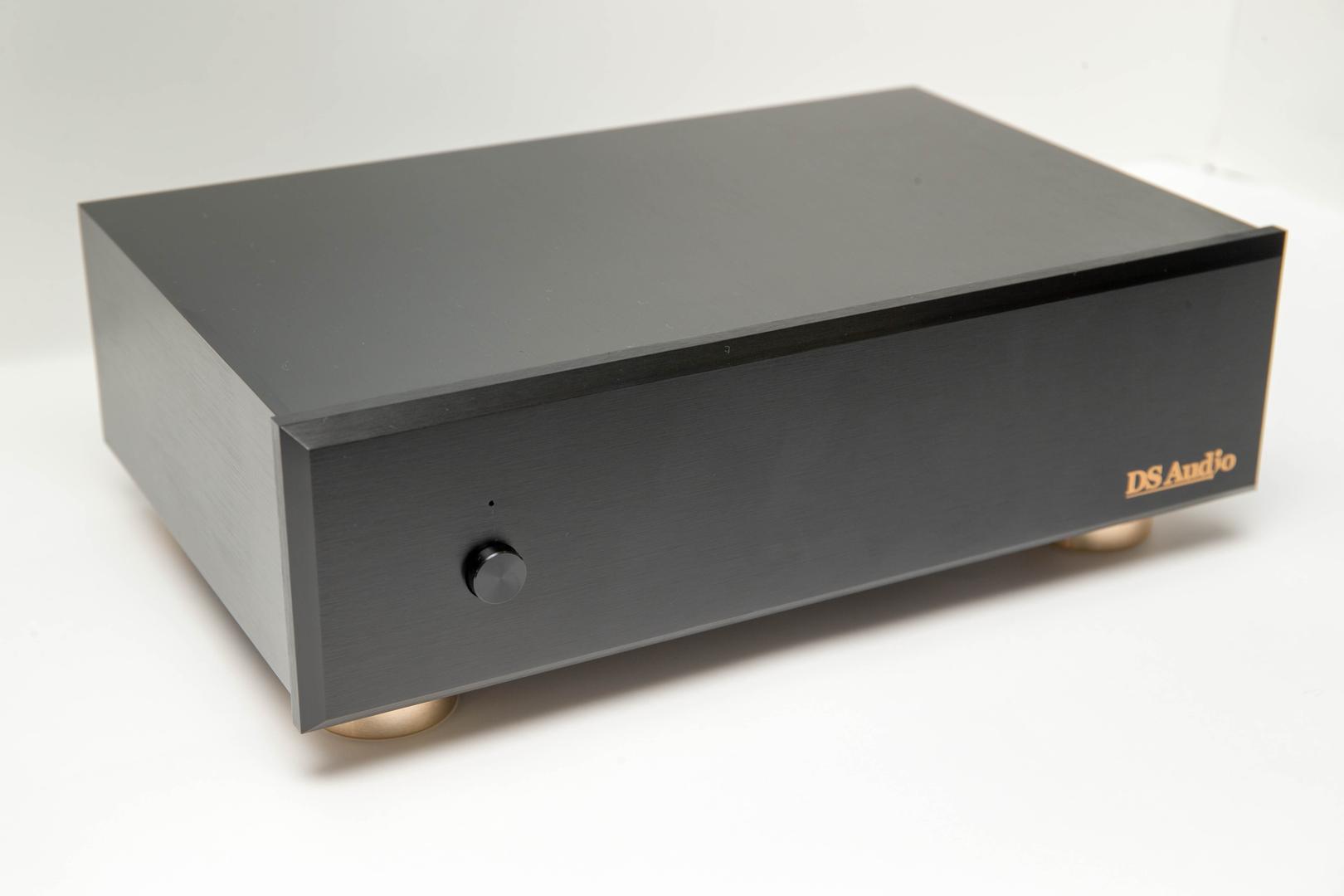
Open the large box in which it arrives and the DS-W1 itself is remarkably nondescript, with a simple matt black body that is neither particularly distinctive nor decorative. The solid block of the equally black energizer/equalizer matches the cartridge’s plain-Jane looks, and its beautifully finished casework sat on four adjustable spiked feet, complete with shoes if you need them. There’s a front-panel on-off switch and one set of inputs and two sets of outputs on the rear, all via single-ended RCA sockets. Why two sets of outputs? Partly because the DS-W1 reads low-frequency signals rather more accurately than most electro-magnetic cartridges, one set offers subsonic filtering with a roll-off starting at 50Hz, while the other goes lower, to 35Hz before tapering. Which you use will depend on your turntable, system, and situation. I used the full-bandwidth output without issues, although that’s partly because of the lengths I went to when it came to choosing a matching tonearm.

With its low mass and ‘interesting’ compliance, the DS‑W1 is seriously picky when it comes to tonearms. Do the sums and you quickly realize that the average 9“ tonearm (Linn, SME, Rega, Graham et al.) offers an effective mass of around 11g resulting in a fundamental resonance of around 7.5Hz – which is distinctly borderline. For a theoretically ideal 10Hz you’d need an arm like the ultra-light SME III or original Mission 774 – both around 5g effective mass. Instead, I opted for the 9.1g AMG 9W2, which nudges the fundamental resonance back to a shade over 8Hz, safely within the comfort zone. That might not sound like much of a difference, but believe me, you can hear it instantly in the solid presence and stability it brings to the sound. Of course, you could use tonearm damping, but in a cartridge that is itself essentially un-damped, the downsides are all too audible. It’s another indicator that this cartridge isn’t just different; it behaves differently too.

As soon as you start to set it up, it becomes apparent that the DS-W1 is super-sensitive to VTF and VTA/SRA (or tracking force and arm-height if you must). From the first moment the stylus hits the groove you can’t miss how quick and clean it is, completely free of overshoot or exaggeration. But it would be easy to conclude that it is either thin and lightweight (if you have the VTA wrong), or has a lumpy, detached bass (wrong VTF or wrong tonearm). Nor does it respond in a gradual, progressive manner to adjustment. Instead it’s either wrong or it’s right, with little or no margin for error, and with increments that are too small to measure. But patience is the name of the game: get the right VTF, the right VTA, and the right tonearm and this thing sings! It also lights up. Indeed, one reason that the DS-W1 has attracted quite so much attention is the illuminated red strip that graces its nose as soon as it’s powered up, leading the US distributor to dub it “The Nightrider”. But there’s much more to this cartridge than just a fancy lightshow.

Despite being one of the most exacting audio devices I’ve ever set-up, the DS-W1 is truly worth the effort. It’s tempting to try and equate its performance to other cartridges: it’s also a mistake. To understand just how good the DS-W1 really is you need to also appreciate that it’s fundamentally different, both in operation and presentation. By eliminating the electro-magnetic generator from the pick up, DS Audio has totally changed the way a cartridge delivers music. It has not only created a lower moving mass, but altered its natural mechanical resonant behavior and sonic thumbprint, too. Throw in the absence of electro-magnetic damping and you have a transducer that is lightning fast AND ultra responsive. The result is musical reproduction from LP that’s as devoid of baggage and padding as it is astonishingly linear, as unforced and unexaggerated as it is natural in terms of tonality and perspective. Which might just be a recipe for sounding bland, except that the DS-W1’s astonishing speed and unfettered dynamics (micro and macro) give it that breath of intimacy that brings music and musicians vividly to life; helped by the total absence of grain, within the notes themselves, or the spaces between them.


Never have I heard a cartridge that can capture instrumental textures or vocal nuance, the skin of a drum and the air inside it, or the rasp of bow on strings as naturally and effortlessly as this. This isn’t the spot-lit presentation and bouncy bass of a typical high-end moving-coil: it is something altogether more delicate, more subtle, and (if you get it right) more real. The DS-W1 doesn’t pump up the drama or fatten up the bottom end. Instead it allows musicians and recordings to speak for themselves, in voices that are at once recognizable and authoritative. Its attack and pace give bass transients natural impact, and shorn of false weight and emphasis, its timing is sure-footed and agile.

If there’s a better cartridge for playing baroque or small ensemble music (classical, jazz or pop) I’ve yet to find it: if there’s a more believable cartridge when it comes to vocal reproduction, solo or choral, I’ve yet to hear it. Which makes DS Audio’s DS-W1 pretty special. There are cartridges with bigger names, cartridges with bigger sounds, cartridges that deliver more drama, and cartridges that also perform their own brand of transductive magic – but they all cost more than the DS Audio, especially when you take the phono-stage into account. Having said that, you might be trading your existing phono-stage for a new arm if you want to really hear what the DS-W1 can do: it’s well worth considering, ‘cos this cartridge really is that good.

Technical Specifications

  • Type: Phono cartridge with optical reading
  • Cantilever: Boron Rod
  • Stylus Profile: Shibata
  • Weight: 6.5g
  • Tracking Force: 1.5g
  • Compliance: 15cu vertical, 25cu horizontal
  • Output: 500mV (from matching PSU/equaliser)
  • Price: £6,250

Manufactured by: DS Audio

URL: www.ds-audio-w.biz

UK Distributor: Sound Fowndations

URL: www.soundfowndations.co.uk

Tel: +44(0)118 981 4238

Back to reviews

Read more DS Audio reviews here

Highlights from CanJam London 2016 (part two)

Welcome to the concluding part of our round up of the highs and even highers of CanJam London 2016. During a balmy weekend in the middle of August, CanJam arrived with a view of Big Ben. Directly across Westminster Bridge in the swanky Park Plaza hotel near Waterloo rail station, CanJam London was the prime location for summer in-ear experimentation.

Being in the midst of school holiday season across Europe, some of the better known British faces in audio were absent, but the show was nonetheless featured many exciting and innovative products. Here are some of the best…


MEE Audio

MEE Audio is, along with a handful of other companies, focusing on building high-value/high-performance earphones (and headphones). In fact, the company’s name is an acronym that stands for Music Enjoyment for Everyone. With this end in view, two of the firm’s key products are the M6 Pro (£50), which is an entry-level noise isolating universal-fit earphone for musicians, and the Pinnacle P1 (£180), which is a zinc-alloy bodied, audiophile orientated, universal fit earphone. Interestingly, both models feature detachable, user-replaceable signal cables—a welcome touch rarely seen on earphones in this price class.

www.meeaudio.com

Moon Audio

Moon Audio is a North Carolina-based specialty retailer that sells an extremely extensive range of headphones, earphones, and personal audio electronics. However, Moon Audio is also a manufacturer in its own right, offering a range of Dragon Audio cable and, of particular interest to us, several impressive Dragon-series amplifiers created by Dennis Had (who was the founder of Cary Audio). European and UK readers may wish to note that, while Moon Audio is based in the US, the company is happy to ship worldwide and in fact does considerable business in the UK and Europe.

What caught our eyes and ears at CanJam London was the firm’s Dragon Inspire IHA-1 valve powered headphone amplifier, which is a zero negative feedback, direct coupled design “without any coupling caps or output attenuation resistors in the signal path. We tried the IHA-1 with a set of Focal Utopias and the sound was, well, just plain fabulous.  The IHA-1 sells for $1599 in the US, but can easily be ordered in a 220V version, while giving the owner-to-be several good options for having specialty valves installed at the factory.

www.moon-audio.co/dragon-inspire-iha-1-tube-headphone-amp.html
 

MrSpeakers

When the San Diego, CA-based firm launched its innovative Ether and Ether C planar magnetic headphones, many reviewers hailed the models as ‘best of breed’ products and with good reason. However, Mr Speaker president Dan Clark is not one to rest on his laurels and so through both subtle and not-so-subtle revisions to the original Ether pair (which remain in the product line) two new models evolved: the Ether Flow and Ether C flow, both priced at $1,799. As before, the ‘C’ in Ether C Flow denotes the fact that the model is a closed-back headphone.

Both models feature what MrSpeaker terms ‘TrueFlow’ technology to achieve even higher levels of resolution (which is saying a mouthful) coupled with an even smoother, more ‘fluid’ (hence the name), and more full-bodied presentation. Hi-Fi+ expects to receive a review sample of the Ether Flow in the near future.

mrspeakers.com

MSB

Holders of the ‘absolute cost no object’ award, MSB’s three-box DAC/headphone amplifier for Stax electrostatic headphones represented what you can do when you take the brakes off. The trio of large, chrome devices comprised the €80,000 Select DAC II (pictured) is an 80 bit, Quad DSD converter with femtosecond clock accuracy and an outstanding 173dB of dynamic range. It’s coupled to the €45,000 Select Electrostatic Headphone amplifier with two Stax outputs. This is a direct-coupled circuit without any kind of op amp, tube, or feedback in its circuit and has a dynamic range of more than 140dB. Both products were driven by the €30,000 MSB Select Dual Power Base power supply, and this can be upgraded to mono power bases if your butler’s butler can carry more than one.

The sound, played through a ReQuest Audio The Beast and into a set of Stax SR-009 electrostatics, was truly remarkable, and showed just how much more it’s possible to extract from the Stax electrostatic headphone platform if you really go for it!
 

www.msbtech.com

Mytek

NYC-based Mytek has a powerful reputation in the professional audio field. It has has brought that reputation to bear recently in the shape of two MQA and DSD compatible domestic DAC/preamps; the Manhattan and the Brooklyn. Both were available for demonstration at CanJam, although a recent redesign of the €6,000 Manhattan – using the latest Sabre chips – is not yet available.

The €2,000 Brooklyn is possibly the more interesting of the two for an audiophile, as it includes an analogue input that switches between line and MM/MC phono stage alongside the range of digital inputs and outputs on offer.

www.mytekdigital.com


Noble Audio

Noble Audio moves, it would seem, from strength to strengths, so that no sooner had we taken time to review the Savant custom-fit in-ear monitor (which until this show had been Noble’s newest model) than the firm released an even newer model called the Katana. Relative to previous Noble efforts, the Katana breaks new ground in that the design is based—for the first time ever—on a set of nine proprietary balanced armature-type drivers co-developed by Noble in conjunction with the world-famous balanced armature driver manufacturer Knowles.

Noble says of the Katana that it features, “an extended top-end that generates airiness and outstanding imaging,” coupled with, “a lush mid-range, impactful low-end, and Noble’s signature coherency.” The Katana is offered in both universal-fit versions (with CNC milled aluminium earpiece enclosures) and custom versions and is priced at £1,350 or $1850. Expect an upcoming two-man review, where Editor Alan Sircom will look at the Katana universal-fit model and Publisher Chris Martens will sample the custom-fit version.

www.nobleaudio.com

Questyle Audio Engineering

The Chinese headphone amplification and digital audio specialists at Questyle are flush with the success of their superb QP1r digital audio player and their four-chassis reference headphone ‘Golden Stack’, which consists of a stereo preamp, a DAC, and two monoblock headphone amplifiers (both the QP1r and the ‘Golden Stack’ have been reviewed by Hi-Fi+.

But not content simply to coast along on these waves of success, the firm is now focussing its attention on its new, single-chassis CMA600i DAC/balanced output headphone amplifier (£1089), which channels much—though of course not all—of the sonic goodness of the ‘Golden Stack’, but in a more compact and far more accessibly priced component. Like all Questyle amplification product, the CMA600i uses the firm’s signature Current Mode Amplification circuit topology, the sonic benefits of which, in Hi-Fi+’s experience, are not to be underestimated.

www.questyleaudio.com 

RHA Audio

RHA has some important development in the works, and we got to hear them. Unfortunately, we weren’t (and still aren’t) allowed to talk about or to publish photographs of the new item (or items?) just yet. Stay tuned.

www.rha-audio.com


RME Audio

RME Audio is a German firm with roots in the pro audio world, but whose new ADI-2 Pro AD/DA converter and headphone amplifier seem certain to with friend in the high-end headphone world. The ADI-2 Pro is an astonishingly versatile half-rack –width component that combines an AD/DA converter with capabilities to 768/24, a USB 2.0 DAC with PCM and DSD decoding capabilities, and a very powerful (2.2 watt per channel) and unusually full-featured headphone amplifier complete with parametric EQ and other desirable features. At CanJam London the ADI Pro was being used to drive the remarkable Ultrasone Tribute 7 headphones and sounded superb. The UK price is yet to be determined but roughly project to fall around £1399.

www.rme-audio.com


Rupert Neve Designs

Virtually and serious student of record engineer will tell you that some of the finest and best-sounding recording consoles ever made have been created by the legendary British designer Rupert Neve (who now lives and works in Wimberley, Texas, USA—a small hill country community located roughly 20 miles from Chris Martens home in Austin, Texas). Apparently, many of Neve’s console customers had been pressing him to create a headphone monitoring amplifier and happily his firm is now producing one called the RNHP, which is a straightforward and minimalist device sporting two single-ended and one balanced input, a high-quality volume control, a headphone jack, and not much else. The RNHP is priced at approximately £430 or $549 and is available now. Despite the unit’s diminutive size and modest appearance and price, it is every inch a real Neve—offering Neve’s signature combination of very high transparency and an elusive quality of unforced, vibrant, and natural musical warmth.

www.rupertneve.com

Sennheiser

We’re sort of breaking our ‘it must be new’ rule here, because the Sennheiser Orpheus electrostatic headphone with DAC and amplifier has been seen before. However, Sennheiser was offering CanJam goers an all-too-brief 10 minute session with this remarkable headphone device.

Orpheus is still in the final stages of build and the price remains to be finalised, but the end product is likely to now cost closer to €55,000. Nevertheless, the cost of excellence is never cheap.

www.sehhneiser.co.uk

Sonoma

Not so much a product, more a work in progress, but the Sonoma system is the off-shoot of a British university engineering project (Warwick Audio) and a small team of ex-Sony High-Resolution Audio people. Combining an electrostatic laminate transducer with a die-cast magnesium housing, and a Class A energising amplifier with built in Sabre DAC and a AKM ADC for digitising analogue sources, this system shows a lot of promise. Expect to hear more from Sonoma by the end of the year.

www.sonomaheadphones.com

Snugs

The British firm Snugs offer a somewhat unorthodox range of product for earphone enthusiasts, including custom-moulded personalised ear-tips designed to slip over the sound outlet tubes of a very wide range of universal-fit earphones—essentially turning those earphones into the next best thing to a full-on set of custom-fit in-ear monitors. But there’s more to Snugs than just the custom ear tips, because the firm also offers a range of pre-customised earphones for various applications.

Two good examples would be the Snugs Original model (£199), which is based on a set of SoundMagic E10S earphones fitted out with Snug’s custom ear tips, and the upcoming next-generation Snugs Flight model (price TBD, but project to fall at or below £399), which will be based on the next generation Flare earphones (see Flare, in section one).

One very interesting aspect of the Snugs process is that, in lieu of taking traditional ear mould impressions, the firm instead uses a comfortable and non-anxiety-inducing optoelectronic scanning process to gather data on the size, shape, and general orientation of the wearer’s outer ears and ear canals. Cool. At the show, I had scans taken of my ears in anticipation of trying out both the Snugs Original model and—later on—the Snugs Flight model. Stay tuned.

snugsearphons.co.uk


SPL

There seems to be a trend in headphone audio for professional brands to make products for the domestic market. German pro-audio experts SPL are part of that trend, and the company’s Phonitor x and Phonitor e were shown for the first time in the UK. Looking like a cross between a classic ham radio and vintage studio gear, the £1,700 Phonitor x features a 120v rail, can drive balanced and single-ended headphones, has an optional 24/192 DAC built-in, and sports a unique ‘Matrix’ system that introduces a DSP based speaker equivalence playback for those who still prefer the sound of loudspeakers.

The Phonitor e offers a stripped-down specification, most notably offering just two preset Matrix settings instead of the infinitely adjustable options in the bigger model, no ’laterabilility’ control, no VU meters, and no preamplifier outputs, for £1,200.

www.spl.info

Trinity

A clever, UK-designed in-ear brand, Trinity produces a range of balanced armature earphones at prices ranging from £99 for the Delta Hybrid  V-II up to £500 for the upcoming Phantom Hunter. All feature a range of tuning filters supplied as standard, and – uniquely for a sub-£100 design – removable cables. Like Atomic Floyd and RHA, Trinity represents something of a new wave in UK audio design, making high-quality, high performance in-ear designs of great note.

https://trinity-audio-engineering.myshopify.com

  
Ultrasone

The German headphone manufacturer is famous for making some of the finest top-tier dynamic driver headphones in the world and for its S-Logic technology, which is said to help headphones image in a manner at least somewhat more like high-end loudspeakers do (that is, where the sound appears to emanate from in front of the listener, rather than from the centre of his or her head). The most prized of all Ultrasone models are the firm’s limited production Edition series models. However, for CanJam London as at the Munich High-End show earlier this year was not an actual Edition model, but rather a headphone called the Tribute 7, which is intended as a tribute to a well-loved earlier generation Edition model that has long since sold out. A brief listen proved extremely enticing and left us wanting to hear more. The Tribute 7 sells for £2070—a sum that, though undeniably expensive, is by no means out of line given the self-evident sound quality on offer. There is, though, one catch: just 777 sets of Tribute 7 models will be produced and they are selling briskly. Thus, if you think you might want one, we urge you to contact Synthax Audio UK before it’s too late.

http://www.ultrasone.audio/english.html

Violectric

Vioelectric (and the parent company, the oddly named Lake People) is a German brand intent on making very high performance audio components. They had a range of options on show from both companies, including purposeful but outstanding analogue-to-digital converters, digital-to-analogue converters, and a large range of headphone amplifiers with or without DACs.

Perhaps the most interesting model at the show was the top €1,730 HPA V281, a balanced and single-ended amplifier designed to showcase just what a pair of dynamic driver headphones can do. The sound of the Sennheiser HD 800 through this amplifier made you question the need for anything more, even taming some of the upper frequency energy of that headphone…   

www.lake-people.de

Highlights from CanJam London 2016 (part one)

This past weekend (August 13-14, 2016) Hi-Fi+ Publisher Chris Martens and Hi-Fi+ Editor Alan Sircom attended CanJam London 2016, which is was held in the Park Plaza Hotel in central London and was without a doubt the most expansive personal audio-centric show ever held in the UK. Over the course of the two-day event, we attended a number of press briefings, saw and heard some extremely fine personal audio equipment, and—in Chris Martens’ case—also participated in a series of “Headphone 101” panel discussion and question and answer sessions.

In this report, the first of two, we hope to show readers at least some of the highlights of the event. As always, we tried to offer a slice of what’s new and what’s coming in the field, but this means a few companies attending the show (such as AKG, Chord Electronics, and Smyth Research) didn’t get covered because their products are already ‘out there’. Irrespective of whether or not we cover it here, however, much of the equipment at CanJam London proved to be eye and ear opening in the best possible way. The inspiring and fluid headphone world continues to excite!

Enjoy.

Atomic Floyd

The British earphone maker Atomic Floyd seems to be constantly at work to refine, evolve, and improve its product line and one models that gives ample evidence of this is the firm’s HiDef Drum earphone (£149), which in the run-up to full production had been demonstrated in several subtly different iterations over the past few headphone shows I have attended. What’s impressive is that with iteration the HiDef Drum continued to get better so that the production release version should prove to be well tested and thoroughly refined.

www.atomicfloyd.com


Audio-Opus

The South Korean electronics manufacturer Audio-Opus displayed an impressive array of digital audio players (DAPs) at CanJam. Among these were the Opus 1 (~£460 or $599), a 24/192 and DSD128-capable player based on a Cirrus CS4398 dual DAC, and sporting 32GB of on-board memory plus room for two Micro SD cards. The Opus 1 has an attractively finished moulded thermoplastic chassis, but for enthusiasts looking for something just a bit more posh the firm has built a limited run (just 300 units) of a metal chassis-equipped Opus 1 LE (for Limited Edition) model that will sell for £650 or S899.

Next up was the soon-to-be-released Opus 2, which in a sense could be viewed as an even more full-featured and upscale step forward from the Opus 1. The Opus 2 will be based on ESS dual DACs, will support Wi-Fi streaming, and will feature optical, singe-ended, and balanced outputs. The Opus 2 is expected to sell for £1230 or S1599.

In a simpler vein, Audio-Opus showed its minimalist, slim line Opus 11 portable headphone amp/DAC, which is roughly the size of a small metal business card case. The Opus 11 is priced at £192 or $250.

Last but not least, the firms expects to offer an Opus 12, which is essentially a ‘Super Opus 11’ model sporting more elaborate I/O options than the no-frills Opus 11. Pricing for the Opus 12 is yet to be determined.

www.facebook.com/audioopus/   

AudioQuest

AudioQuest was proudly showing new DragonFly Red and Black miniature USB DAC/headphone amp products, as recently reviewed in Hi-Fi+, both of which seemed to be well-received by the CanJam crowd.

Also on display and demonstration was an impressive new upcoming product that, at AudioQuest’s request, we will refrain from illustrating here. The new NightOwl looks similar to the current NightHawk (which will remain in the catalogue) except that the wood grain effect cups are replaced with a very dark grey version of the same material, the grille is replaced with what appears to be a dome type arrangement, there’s a different multi-stranded cable, and a set of leather and microfibre ear pads are supplied in the box. In a quick listen of the late prototype, the sound of the NightOwl sounds broadly similar to the NightHawk, but less ‘brooding’ and ‘dark’ sounding. The price is expected to be around £100 more than the NightHawk.

www.audioquest.com

Beyerdynamic

For CanJam the German firm Beyerdynamic demonstrated its very recently released new DT 1990 Pro open-back studio reference headphone (£483 or €599). While the DT 1990 Pro is not official a ‘Tesla’ model, such as the T5p or T1, it does use a 45mm Tesla-type driver whose motor features a neodymium magnet assembly.  The DT 1990 Pro sounded very good indeed, with an emphasis on openness and transparency, and interestingly comes with two differently voiced sets of ear pad (one set for analytical in-studio use and the other set offering a more musically balanced presentation). My thought was that this new model represents an awful lot of headphone for the money and that it might make a perfect entry point for listeners seeking a Tesla-like listening experience, but who are not yet prepared to invest the four-figure sums that full-on Tesla models command.

europe.beyerdynamic.com or north-america.beyerdynamic.com


Brainwavz

The first time at CanJam London, the high-performance for low cost Brainwavz line of earphones, headphones, and accessories was proving surprising. The company was showing both its current and upcoming lines, including a couple of prototypes that CanJam goers were invited to comment on, like a crowd-sourced take on earphone design.

In both lines, it’s hard not to be impressed by the company’s award-winning Delta earphone. A detailed and fast sound that goes for midrange clarity and treble detail instead of ‘phat’ bass and ear-crushing volumes, the Delta comes costs less than £20… and isn’t even Brainwavz cheapest model! Later this year, Brainwavz is planning to launch a range of more up-market sound-isolating earphones, that should still cost less than £200.

www.brainwavzaudio.com

Cavalli Audio

The renowned headphone amplifier manufacturer Cavalli Audio is in a state of transition and the firm’s demonstration products reflected this fact. At one listening station was found Cavalli’s classic Liquid Gold fully balanced solid-state amplifier, which is just famous for its powerful, low noise, wide bandwidth, and ultra high-transparency sound. While the Liquid Gold is rapidly approaching the end of its final production run, it remains what it has always been: a classic in its own time that represents a benchmark against which all other solid state headphone amplifiers must be compared.

But at a second listening station was an advanced ‘breadboard’ prototype of a new top tier amplifier that points the way forward for the Cavalli product range. The new model, which will be called the Liquid Tungsten, is valve-powered and features a circuit topology that Dr Cavalli has been contemplating, refining, and perfecting for the better part of ten years. Based on a short listening session my initial impressions were that the Tungsten can do everything great solid-state amps are know for, plus something more: namely, provide that elusive but highly desirable quality of being dynamically alive and rich in intense yet at the same time natural tonal colours.

www.cavalliaudio.com


Custom Art

Custom Art, which hails form Warsaw, Poland, is a relatively young but highly sophisticated maker of custom-fit in-ear monitors. At present, the firm’s product line consists of five models: the single balanced armature Music One (£155), the dual balanced armature Music Two (£265), the triple balanced armature Ei.3 (£275), the PRO 330v2 (£405), and the flagship eight balanced armature Harmony 8.2 (£890). Custom Art invites comparison between its products and more costly equivalent models from North American manufacturers.

But impressive though Custom Art’s present product line is, perhaps its most significant breakthrough news involved the firm’s altogether new, patent-pending FIBAE (Flat Impedance Balanced Armature Earphone) driver, which offers almost perfectly flat impedance and phase response across the entire audio spectrum. Custom Art had a proof-of-concept demonstration version of an upcoming FIBAE-base CIEM on hand at CanJam, which I thought offered very impressive openness, transparency, resolution, and smoothness. Best of all, the FIBAE-equipped model will, says Custom Art, be surprisingly affordable, with an estimated price likely to fall just under £300.

www.thecustomart.com 

Echobox Audio

The first products from the Santa Monica, CA-based firm Echobox are the Finder X1 and X1i titanium universal-fit earphones ($199 and $229, respectively), which are reviewed in the next (September) issue of Hi-Fi+. However, the big news from the firm is that it is now ready to release its very ambitious Explorer streaming digital audio player ($499), which is based on an Android 4.2 platform, is Tidal capable and in fact comes with an introductory Tidal membership, and feature both a high-quality DAC section and a promising headphone amplifier section, all fed from a 4000 mAH battering. The Explorer is also compatible with USB Audio Player Pro music playback software.

Perhaps the most striking thing about the Explorer (apart from its Tidal-compatible streaming capabilities) is that it is package in what appears to be an exotic wood “hip flask”—but one that just happens to have a full-colour screen fitted into its curved sides. We can hardly wait to try one out, though we may have to wait a bit as initial delivers will go to individuals who participated in the funding campaign through which the Explorer was created.

www.echoboxaudio.com

 
Etymotic Research

Etymotic Research is and Elk Grove Village, Illinois-based maker of high accuracy universal-fit earphones, and enthusiasts who have followed the on-going evolution of personal audio products will immediately recognise that Etymotic was one of the very first—and is still one of the very best—developers of serious high-performance in-ear headphones. Let’s put it this way: Etymotic was fiercely focused on building tonally neutral, well-balanced, and very accurate in-ear transducers back at a time when not many other manufacturers had any notion that sonic accuracy was or ever would be a significant thing.

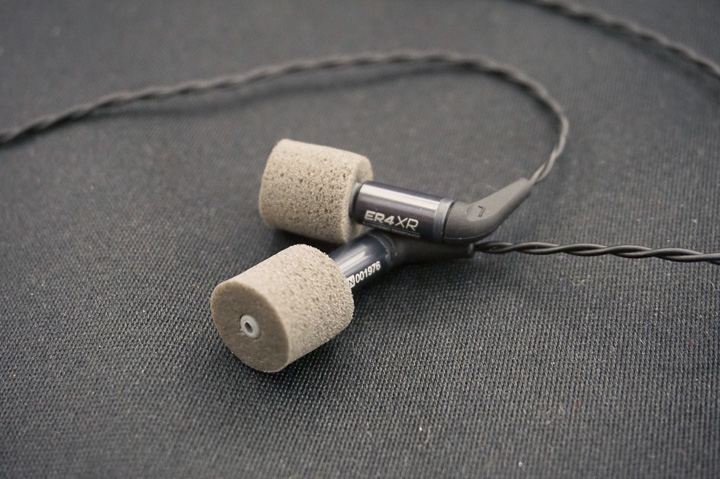
Much of the firm’s sterling reputation has been built around the firm’s ER4-series earphones, which have been in production for many years. Now, however, Etymotic has released two new models in the classic ER4 range: namely, the ER4 XR (‘XR’ for Extended Response) and the ER4 SR (‘SR’ for Studio Reference). Both models are sold at what would now be considered a mid-level price of £329 (though when the ER4 family first got its start, that sum was regarded as a stupendous amount of money to invest in ‘mere’ earphones). In a brief listen, I felt both models had real merit, but that ER4 XR, which can be viewed as an update on the classic ER4 P, strikes what I think many listeners will regard as the best balance between neutrality, resolution, and the elusive quality of ‘musicality’.

www.etymotic.com  


FiiO

FiiO is one of the darlings of the HeadFi community, for a couple of very good reasons; it makes high-performance products that remain highly affordable, and it calls on the HeadFi community to suggest design ideas that the company frequently integrates into its fast-moving range of DAPs, amps, cables, and ancillaries.

The company recently launched a pair of EX1 earphones, but the really exciting aspects of the FiiO range remain its electronics. FiiO’s Android-based X7 DAP features interchangeable amp modules for IEMs, headphones, even balanced headphones, and can also dock into the K5 docking headphone amplifier and DAC. The price is keen, too – £459 for the X7 with no amp module, £499 for the same with a single module, typically £89 per module, and less than £100 for the docking station seems great value for money

www.fiio.net


Final

Earlier this year, at the Munich High-End show, the Japanese firm had previewed a new family of ultra-slender balanced armature-driven universal-fit earphones comprising the entry-level 3100 (£149), the mid-level 4100 (£269), and the top-of-the-range 7200 (£379). As of CanJam London, all three models were released, on demonstration, and sounding very good indeed—especially the 7200. What words can scarcely convey is how impossible slim and lightweight these new-series balance armature earphones really are.

final-audio-design.com


Flare

Flare is a British earphone, headphone, and loudspeaker maker that is on the cusp of releasing a family of three ambitious new universal-fit earphones that will be called, in ascending order of performance and price, the Flares (with aluminium earpiece housings), Flare HD (with open-back titanium earpiece housings), and the Flare HD Pro (also with open-back titanium earpiece enclosures). Pricing for these three new models is yet to be determined, but all three represent the next step forward in the evolution of the firm’s in-ear product line-up. Interestingly, these three models will ship with compressible foam ear tips that, by design, will serve double-duty as sound-influencing waveguides.

A version of the new Flare models will, via a collaborative arrangement with the firm Snugs, be offered with custom moulded, individualised ear tips said to offer an exceptional degree of noise isolation, making the hybrid Flare/Snugs earphones ideal for flight applications.

www.flareaudio.com

FLC (Forrest) Technology

FLC is a noteworthy new earphone/custom-fit in-ear monitor manufacturer from China with some very innovative ideas about product configuration. Well aware that debates regarding what does or does not constitute ‘ideal’ voicing for transducers are as old as high-end audio itself, FLC has decided to something about the matter by crafting earphones and CIEMs that offer a plethora of repeatable, user-selectable voicing profiles.

The firm’s entry-level model 8S earphones (£270) or 8C CIEMs (~£460) both offer up to 36 discrete sound signatures. Then, the firm’s upcoming flagship Celeste earphones and CIEMs will take the concept even further, offer an impressive total of 108 (!) different voicing options. Interesting, the production version Celeste is meant to have miniaturised gear-driving voicing controls, with control knobs that protrude through the Celeste’s outer shells. The Celeste wasn’t finished as of CanJam, so the firm brought along prototypes that showed what FLC hopes will be three of the more popular voicing options for the finished product. The Celeste prototypes showed definite promise.

http://www.shenzhenaudio.com/forrest-flc8s-iems-hifi-triple-driver-hybrid-2ba-dynamic-in-ear-earphones.html


Focal

The French firm Focal’s first headphone models came out a number of years ago and were respectable mid-priced models, but it would be fair to say they in no way pushed the edge of the envelope for top-tier headphone performance. All of that has changed, however, with the arrival of two extremely ambitious new models from the firm: the open-back, dynamic driver-equipped Elear (£800) and the also open-back, dynamic driver-equipped Utopia (£3,250). Both models carry the states objective of offering “the high-end loudspeaker experience via headphones,” and in this they are very successful.

The result of a 4-year development effort on the part of a dedicated team of engineers, the Elear and Utopia are both world-class dynamic driver headphones. Although seemingly similar at first glance, the Elear and Utopia are actually significantly different in terms of driver diaphragm materials (an aluminium/magnesium alloy for the Elear and beryllium for the Utopia), frames, surrounds, voice coils, and magnet assemblies. Similarly, the two models also have different frames (carbon fibre for the Utopia) and ear pad assemblies. Based on some too brief listening sessions with the Elear and Utopia I would say the former is plainly a very competitive model within its price class, while the latter represents a all out, no-holds-barred assault on the absolute state of the art. Focal representative confirmed these impressions by stating that they consider the Utopia’s driver to be the best electro-dynamic driver that Focal (or anyone else) has ever mad.

We hope to arrange a Hi-Fi+ review of the Utopia later this year, but please bear with us; initial public response to the new models has been so positive that Focal simply cannot keep up with demand. Stay tuned.  

www.focal.com/headphones/

Fostex

Within the high-end headphone world, the Japanese firm Fostex is famous for its TH-series headphones, the flagship for which is the excellent TH900mk2. However, for CanJam London the firm demonstrated its just-released new TH610, which is billed as a comparatively affordable, reference quality closed-back headphone that will sell for £569.

The TH610 sports uses 50mm ‘bio dynamic’ diaphragm-equipped drivers that feature a stonking 1 tesla (1000 gauss) magnetic circuit, which is said to offer low distortion, wide dynamic range, plus “rich lows, natural midrange, and smooth highs”.  Completing the picture are matte-finished black walnut ear cups and sets of very high quality detachable signal cables fitted with rhodium contacts.

www.fostexinternational.com


HiFiMAN

HiFiMAN announced that it will very shortly begin shipping its new v2 versions of the critically acclaimed and award-winning HE1000 and Edition X planar magnetic headphones, which remain at the same prices as their earlier generation predecessors (€3000 for the HE1000 and £1800 for the Edition X).

www.hifiman.com
 

1MORE

For those unfamiliar with the brand, 1MORE is a Chinese company whose mission is to craft earphones and headphones that offer extraordinary levels of value for money, while delivering unexpectedly high levels of sonic sophistication. The team from 1MORE UK had almost all of the presently released models on demonstration, but two that stood out for me (and that have won and continue to win friends across the globe) were the E1001 Triple-Driver earphone (£99.99) and the C1002 Hybrid Dual-Driver capsule-type earphone (£89.99).  Both models will become review subjects for Hi-Fi+ in the near future, but to give you some sense for the sort of value they offer, please know that if another digit were added to the respective prices of these earphones these models would still likely be considered bargains! Stay tuned for more on them later.

uk.1more.com

Labkable

Labkable is a Hong-Kong based distributor and manufacturer of, you’ve guessed it, cables. The company’s lines are huge and run very much into the high-end. It began with traditional audio equipment cable, but has quickly gained a reputation for making cables that very much suit headphonistas the world over.

One of Labkable’s more exciting cable designs was a custom-made Lightning to micro-USB connector, ideal for the likes of the Chord Mojo. Price varied according to cable grade, but the silver-cable version on show was around £250.

www.labkable.com

Limeears

Limeears is a Polish firm specialising in high-performance custom-fit in-ear monitors. At present, the firm’s range consists of the dual balanced armature LE2 (€389), the triple balanced armature LE3 (€555-625, depending on the variation chosen), and the flagship Aether model (€1150), which a four-way design using five balanced armature-type drivers.

The company encourages prospective buyers to compare the Limeears CIEMs to equivalent models from top-tier North American manufacturers that would sell for nearly twice the price of the Limeears products. It’s a bold claim, but one that we would certainly enjoy putting to the test.

www.limeears.com


Fono Acustica Virtuoso loudspeaker cables

In a way, the most obvious part of the Virtuoso loudspeaker cable is probably going to be the pivotal aspect of how Fono Acustica’s top cable is received. The cable’s terminations, in particular the ornately tooled silver-plated copper barrels that form the cable’s connector bodies, are either going to be praised or dismissed for bringing a touch of baroque style to the otherwise minimalist world of audio. While these distinctive connectors polarise opinion, Virtuoso is so much more than the sum of its plugs.

In fact, everything in the Virtuoso cable is made to the same uncompromising level as the connector bodies, and that’s reflected in the price. Materials sourced in the design come from the best possible sources, and the level of hand-built detail that goes into the construction and design practically redefines ‘meticulous’. It’s essentially a solid-core design, using special and proprietary silver/gold alloy conductors sourced from a Canadian supplier. The conductors are hand-wrapped in carbon filaments before being inserted into loose, silicon insulation tubes wrapped in a cotton mix jacket containing conductive filaments that act as shielding. It’s all about controlling and dissipating energy, but far from the unwieldy, python-like, inflexible designs often seen at the super high-end, that energy dissipation occurs thanks to the Virtuoso’s soft, flexible, and relatively lightweight construction.

Then, of course, there are those speaker terminals. The Virtuoso connectors are based on Oyaide hardware, but the plug bodies are larger in diameter and made from silver-plated copper, which is mechanically tuned. The spades are machined from solid blocks of that Canadian-sourced silver-gold alloy, and include a hinge to optimise the cable dressing without undermining the integrity of the mechanical contact.

In fact, the construction of these cables, though excellent, is immaterial. It’s the end result that counts. Virtuoso are cables born out of passion, and you can hear that in the end result. These are truly bespoke products for people who share the designer’s passion, both for music and for detail: the sort of people who insist on just the right weight and shade of Bemberg lining on the inside facings of a waistcoat even though it will never be seen by anyone except the tailor and the wearer.

The Virtuoso loudspeaker cables exhibit a degree of integrity and balance that is very thin on the audio ground, except at the highest level. This isn’t immediately identifiable, because we are so used to a less ordered sound, but on spending time – even a very short time – with the Virtuoso cables, you begin to hear just how disordered most systems sounds are, and just how much more there is to offer when everything sounds more aligned. This begins by instantly hearing greater musical texture and presence from the instruments within a recording, backed up by a powerful sense of solidity. This all gives a sense of musical expression, which gives the music both colour and shape. You hear the inner detail, the structure, and the subtle dynamic cues that separate real musical skill from Auto-Tuned ‘talent’, but you can do this with many systems. What Virtuoso brings is a sense of folding all these diverse audio aspects into a sonic gestalt, making a result that gets just that bit closer to the intent of the artist, the engineer, and even the composer.

To most, that reads like pretentious twaddle, but anyone who has spent quality time with Fono Acustica’s Virtuoso is likely nodding along in agreement. They will know that – even in a market as contended as the super high-end cable world – there are cables that seem as if they focus the listener’s attention upon a specific aspect of the musical whole, and some that zone in on the musical whole at the expense of some of the more subtle details, but precious few that are level-headed enough to deliver the complete picture and the individual aspects of that whole. That’s a heady wine!

The listening test is quick to resolve, but this needs some nuancing. Virtuoso’s more holistic approach to musical replay is easy to hear and just as easy to understand, but some might miss this in thinking it a less ‘immediate’ cable than its rivals. There are other cables at this level that deliver a seemingly more punchy, upbeat, or forward presentation, and that can be more immediately seductive. Virtuoso doesn’t go for that immediacy, instead making a more refined and deft sound with staying power. I think if you are receptive to a level-headed presentation at the outset, Virtuoso will charm you almost immediately. If not, give it a little more listening; if you find yourself happily drawn into the music rather than its technicalities, Virtuoso is probably your kind of cable.

Ultimately even in the most well-balanced component, there are aspects of the performance that benefit slightly less well than others. In other words, in a straight fight between Fono Acustica Virtuoso and something like Nordost’s latest Odin, the overall order of the former trades blows with the greater detail of the latter. In truth, both share about 99% of the journey, and it’s that last seemingly trifling scintilla of performance we are talking about. But, as Michelangelo once said, “trifles make perfection, and perfection is no trifle”. Although what a pizza-addicted masked tortoise with anger-management issues has to do with an English sherry-laced layered dessert (or the pursuit of audiophile excellence) is unclear.

On looks alone, Fono Acustica’s Virtuoso would be worthy of audio’s top table, but the cable has the sonics to match the visuals, too. Many aficionados of high-performance cable have stuck with the same brands for years, while others change cables on a regular basis. Both now have a new name to call on, and while the price of admission is extremely high, Virtuoso also comes highly recommended for those in pursuit of the best of the best.

Technical Specification

  • Conductor type: silver/gold alloy, solid core
  • Number of conductors per cable: Four
  • Cable diameter: 18mm
  • Connector diameter: 21mm
  • Minimum insertion distance: 40mm
  • All Virtuoso speaker cables available as single wire configuration only
  • Terminals: Spade terminals as standard – 4mm available to order
  • Length: 1.0m, 1.5m, 2.0m, 2.5m lengths as standard – other lengths to order
  • Price: from €27,500

Manufactured by: Fono Acustica

URL: www.fono-acustica.com

Back to reviews

Read more Fono Acustica reviews here

Bowers & Wilkins 803 D3 floorstanding loudspeaker

Most loudspeaker companies tend to take an evolutionary approach to product development; they use the same basic design and refine it over time, a bit like a BMW 3 Series car. This is what B&W has been doing with its 800 series since the Nautilus design came about in 1998. That was the point when the cabinets went from being square to rounded, and the Nautilus ‘head’ was introduced. There have been three iterations of that model, the main change being the gradual introduction of a diamond tweeter across the entire range, starting back in 2005. For the latest D3 800 series models, there has been a ground up revision of pretty much every element of the various models. In fact, the only parts that have carried over from the previous range are the diamond dome itself and the cable terminals, which is good because they were (and are) rather nice.

At a glance, the D3 models look very much like their predecessors, especially the 802, but take a closer look and you’ll see that they are slimmer, deeper, and proportionally different. The ‘head’ is smaller in diameter, but longer and less tapered. Perhaps most significantly, the driver it holds is no longer yellow Kevlar but silver ‘Continuum’, a proprietary material that has been in R&D for several years waiting patiently for the new generation models. The head itself is no longer made of Marlan, but cast in aluminium for greater stiffness where it matters. You wouldn’t think that something as solid as synthetic stone could be vibrated by a relatively small drive unit, but it turns out that Marlan is not very stiff at 2kHz, which is bang in the midrange so crucial to this application. This, like most of the changes made for D3, is a means of reducing cabinet vibration and results in a ‘quieter’ loudspeaker that adds less of its own character to the music.

The cabinets are still made of curved plywood but, and this is strangely not obvious, the curve has been reversed. The bass drivers have to be mounted on aluminium rings to make this work and the open ‘end’ of the U-section woodwork is now covered with a full height aluminium heatsink that holds the crossovers and terminals. Internally the matrix structure that gives the cabinet rigidity has fewer parts but is made from plywood that’s much beefier than the MDF it replaces, they also feature metal parts to provide maximum rigidity at the point where the drivers are fixed. In the past, Bowers & Wilkins has used computer modelling to design its drive units; for D3 this technology has been used on the cabinet as well and this is why the designs have changed so much. The new ‘Turbine’ head is smaller and wider at the back for stiffness; it’s made from a single aluminium casting and has internal bracing in the form of radial fins. To stop it ringing, the whole thing is damped with TPE (thermoplastic polymers), as used in modern Kango breakers.

The change of colour and name of the midrange driver is fairly significant as well; apparently they have been working on Continuum since 2007, but couldn’t get consistent enough results for the 2010 800 series revision. The company now has a patent pending on it. It’s a woven material like Kevlar, but is damped on the back; apparently this makes the midrange faster, has lower noise, and better self-damping. More critical is that Kevlar is anisotropic; its performance depends on the direction of weave. I recall Bowers & Wilkins mentioning that driver orientation is critical and this must be why.

The bass drivers are no longer Rohacell, but consist of carbon fibre skins over a sintactic foam core that the company is calling ‘Aerofoil’. Unlike pretty well any other driver these cones are thicker in the middle than at the in- and outside. This stiffens the cone while keeping weight down and helps to push the first break-up mode to between 400 and 550Hz. The tweeter is still a diamond dome, but it has a new motor assembly, and it sits in a milled aluminium pod that’s shorter than it used to be. It now has a permanent grille to protect the very fragile diamond dome and avoid the thousand pound cost of having it replaced. Apparently, R&D spent many hours sweating over the precise nature of the grille frets or holes, in order to find a design that did not compromise the sound.


I mentioned at the beginning that appearances haven’t changed that much at first glance, but in the case of the 803, that isn’t true. The last example of this model did not have a separate ‘head’, but had the midrange in the same enclosure as three rather than two bass drivers, with only the tweeter pod outside the box. For the new range Bowers & Wilkins have seen fit to make the 803 more like an 802; in fact, it is essentially a compact version of that model with a smaller Turbine head containing a 130mm Continuum mid above two 180mm bass drivers. The 802 on the other hand has a 152mm mid and 203mm bass drivers. The odd thing is that the old 802 Diamond weighed only 10 kilos more than the new 803 D3; the price was very similar, too. The company even claims that the new 803 sounds better than the previous 802, and as I used three generations of that model over many years I can confirm that they aren’t wrong; this thing is a proper ‘OMG’ loudspeaker.

Set up is facilitated by built in rollers that help move the 65 kilo weight of each speaker into place. A set of burly spikes lurk under the plinth and can be screwed down once you have found the optimal position: alternatively leave the spikes locked away and put the speakers on isolation bases for better results.

I’m told that the 803 D3s sound best when bi-wired, but as I have just the one set of Townshend Isolda DCT speaker cable, the supplied bridging cables were connected to get signal to both halves of the crossover; at least they’re not bars or plates. From there on in, these speakers were a revelation: all that R&D work has resulted in a supremely articulate and transparent loudspeaker that exposed unexpected details on virtually everything I played. Steve Pearce from Bowers & Wilkins’ R&D team, who brought the 803s over, likes to play loud – rather louder than me – but it was thrilling to hear such a visceral and at the same time clean sound. The low end coming off of an NAP 250 DR was almost physical. I discovered later that more could be achieved with more power, but the result with only 80 Watts was still an experience. Several albums demanded to be played, including one from Sonny Boy Williamson whose voice, blues harp, and finger clicks were delivered with a realism that belied the age of the recording. It has to be said that this speaker delivers on a visceral level with uncanny calm; that is, they produce a very strong, wide bandwidth sound but stop and start as effortlessly as a compact monitor. Very few speakers can reproduce the power of the double bass on Patricia Barber’s ‘Company’ [Modern Cool, Premonition]without blurring the finger work. You need a grippy amplifier to achieve this but I have one of those in the ATC P1.

I didn’t mention it before but this is a ported speaker; the port points down at the base so you don’t see it and it’s so well tuned that you don’t hear it either. As a long time transmission line user, I have grown sensitized to port character, but couldn’t detect any extra bloom to the bass with the 803 D3. What was easy to hear is supremely articulate, precise, and yet musically fluent sound quality with a range of sources and amplifiers, but this level of transparency means that the less able partnering equipment is very easy to identify. It made abundantly clear that networked digital sources are more musically engaging than USB connected ones for instance, the Primare PRE60 reviewed last month proving its worth with ease in this respect. Herbie Hancock’s version of ‘Ain’t Necessarily So’ [Gershwin’s World, Verve] sounded fabulously open, the sound totally escapes the cabinets and oozes tonal depth across the board while remaining taut and coherent. It’s rare to find a speaker that does bass extension, tonal richness and finesse alongside great timing but the 803 is such a speaker. This comes down to an uncanny degree of low level resolution, a result of all the work that was done to stop the cabinet and drive units from vibrating and masking the signal.

Music reproduction is a forgiving science, even a crude loudspeaker will sound tolerable with most material at average listening levels because the distortions are usually harmonious, meaning they blend in with the signal. But, at the same time very few loudspeakers fool you into thinking that you are hearing the real thing; by reducing the sort of colorations that the majority of loudspeakers add to the sound Bowers & Wilkins has succeeded in making a speaker that gets very close. You need a great recording and replay chain for this to work of course, one that eschews character for neutrality, and does equally as much to keep noise to a minimum, but these exist and this speaker will tell you which ones are doing it the best. I have banged on about the Townshend Allegri passive controller before because I can’t find a better preamplifier and this was proved by comparing it with alternatives through this speaker and confirmed when I discovered that they use the same thing at Bowers & Wilkins R&D dept.


What makes the 803 D3 particularly appealing is the substance that it finds in every recording. If there is the hint of three-dimensionality to be found, you will know all about it. The shape and scale of imaging is precisely rendered, but without any hint of grain or brightness: it’s definition without tears, or the potential for long term listening fatigue. It also picks apart recordings in such a way that you better understand the way they have been made and the ideas behind the music. On Laura Marling’s ‘Friends’ [Once I Was An Eagle, Virgin]the voice is spectacularly real and the multiple layers of guitar opened up and laid bare to reveal the distinct influence of Jimmy Page in his Led Zeppelin III period. You can play such music quietly or at medium levels, but there is a strong urge to wind up the wick. This is largely because there is so little distortion and thus barely any discomfort involved in playing louder. I guess this is the reason why there are bigger models in the range; larger drivers usually equate to higher potential sound pressure and if you have a big room or a big appetite for volume that would be a tempting proposition.

The 803 D3 is a spectacularly good loudspeaker; play anything you know and it will deliver more of the low level detail, more of the physical scale, and more of the heart that the musician(s) who created it put in. You need a reasonable amount of good quality power to induce the speaker to do this and the best source and control equipment that you can find, but so long as the hardware can communicate the important things this B&W will deliver the goods. I’ve said it before but it warrants repeating: if this speaker had a boutique brand on it you’d have to pay two or three times the price to get this degree of transparency, control, vanishing coloration, and outright musical thrill power. But there are no boutique brands with Bowers & Wilkins’ research facilities, so the chances are you will only find serious competition from a few of the larger loudspeaker companies. Even then you will have a long, hard search to find anything that comes close at the price.

TECHNICAL SPECIFICATIONS

  • Type: three-way, four-driver, floorstanding speaker with reflex loaded enclosure
  • Driver complement: One 25mm diamond dome tweeter; one 130mm Continuum cone FST midrange driver; two 180mm Aerofoil cone bass drivers
  • Crossover frequencies: not specified.
  • Frequency response: 19Hz – 28kHz
  • Impedance: 8 Ohms nominal/3 Ohms minimum
  • Sensitivity: 90dB/W/m
  • Dimensions (HxWxD): 1160 × 334 × 498mm
  • Weight: 65.5kg/each
  • Finishes: Piano gloss black, satin white, Rosenut
  • Price: £12,495/pair

Manufacturer: Bowers & Wilkins

Tel (UK only): 0800 232 1513

URL: www.bowers-wilkins.co.uk

Back to reviews

Read more Bowers & Wilkins reviews here

Meet Your Dealer – Choice Hi-Fi

Choice Hi-Fi is a perfect example of the new wave of audio supplier, eschewing the conventional dealership for a more personal and domestic approach. Customers can pick and choose from the company’s extensive range of new and ‘pre-loved’ audio equipment in an environment more like the end user’s than any store. Featuring a range of top-class audio products from old and new, Choice Hi‑Fi works out of its Richmond-upon-Thames premises, to give a sense of real domestic products in a real domestic environment.

There are good points and bad points to this way of working, and it seems Choice Hi-Fi has addressed many of them head on. We think the company has a fascinating insight into the next phase of home audio retail, so we spoke to company top-dog Alain Abensur on how audio business is changing.

What brands/products do you stock?

Choice HiFi is unique in that we carry established and well respected brands such as SME, Avalon, Mark Levinson, Primare, Revel, Townshend Audio, Bel Canto, Furutech, Stillpoints, Entreq, TelluriumQ, VTL, and Tom Evans, as well as lesser known but equally capable newer up-and-coming brands such as B.M.C Audio, Analog Domain, Ubiq Audio, Melco, and Exogal. In addition to this we are perhaps best known for having a huge and diverse range of used equipment; right now for example we have pieces from Krell, Jeff Rowland, Classe, Koetsu, Dan D’Agostino, Clearaudio and many more.

We believe this marriage of new and used equipment allows us to offer our customers complete and cost effective solutions to their hi-fi needs.

We also offer to undertake third party sales, selling our customers products to fellow enthusiasts that want the same level of service, peace of mind, and support without resorting to vagaries of eBay and the like. More on this later, perhaps!

What inspired you to get into the industry?

For me it was simply a passion for music and a love of hi-fi. Having come from an engineering background (primarily in automated machinery and hydro/pneumatics). I was first inspired to design a turntable based on those technologies (but that’s another story).

By the late 1980’s engineering was on its knees in the UK and I was debating in which direction to take my career. Then as now it was hard to find a dealer that would a) take in a part exchange and b) that was not locked in to a narrow range of brands. In other words who offered real CHOICE. So the upgrade process was a slow and laborious one. It was the unduly painful experience of upgrading my LP12/ Naim system and the search for alternatives that provided the inspiration.

Leaving the world of engineering behind I started Choice Hi-Fi with the major differentiating principals: that I would welcome trade-ins, sell both new and used equipment, and therefore not limit the brands I offer.

High end audio is built to last so this marriage of new and used as well as the willingness to take trade-ins allows my customers to have access to a level of equipment whose quality and performance is far beyond that which their budget would otherwise allow. In short, my customers enjoy far more bang for their buck and the upgrading process is kept simple as I handle both ends of the transaction. It also means that over the years I have gained first hand experience of almost all brands as well as a deep understanding of the synergy between products both old and new.

What music do you listen to when doing a demo?

By and large, an audio system ought to be ubiquitous, meaning it should be equally at home with classical music as with grunge. The reality, however, is that some speakers tend to be better suited to one genre or another, although most attempt to be at home with all.

I have my own personal favourite recordings, ranging from Gorillaz Plastic Beach to Kari Bremnes Gate Ved Gate and from Arturo Delmoni Songs My Mother Taught Me to Beethoven’s Symphony No.9, with much in between. At the end of the day though there is no substitute for listening to your own music when evaluating a system, and that’s precisely what I encourage customers to do.

What is the best piece of advice you can give to someone who is looking to improve/upgrade their system?

To love music is to be passionate and I ask people to ‘feel’ rather than ‘think’ their way to their next purchase. Buying or upgrading audio equipment is often an emotional decision and is fraught with many conflicting factors, not least the cost. So it is hard to be sure you are making the right decision. Always ask yourself first and foremost, how is this component or whole system imaking me feel. Once that question is answered, the rest falls into place much more easily. The finer nuances of voicing, detail, dynamics, soundstage, etc. almost answer themselves.

There’s one more important aspect to this. The old adage that “People Buy People First” is as true in our industry as in any other., but is often forgotten both by dealers and by customers in search of a bargain at all costs. The key is to find a dealer that you can relate to, from whom you can learn, and with whom you can further your quest. System building is an evolutionary process; it grows and evolves as we grow and evolve and as circumstances and technologies change.

Where do you see the industry going?

I’m generally very optimistic. Our industry has always been led by innovators and I believe this will continue to be the case in the future. These innovators often become trendsetters and so each era has tended to have a “style” of sound, and a focus in certain areas; think of Spikes, cables, bi-wiring, power conditioners, mains cables grounding, and isolation.

I believe there will be an increasingly holistic approach to system building taking into account all of the above as we gain a better understanding of the their influences.

Entry-level products continue to get better as filter-down technologies get implemented. However, the gap between these and true high-end system will remain.

Differing technologies and implementations will ensure we continue to have diverse offerings, each with its own colour allowing manufacturers to differentiate themselves from one another.

Computer technology will continue to give ever-higher Bit and Sample rates interpolating the waveform to the nth degree but until we have a breakthrough in our understanding of psychoacoustics and precise algorithms for how the brain interprets sound, with a transducer to match, then the steps will continue to be small incremental ones.

There is and I believe will continue to be a dichotomy between those that want a hi-fi system but need it to be invisible and those who may have the luxury of a dedicated room or at least for whom the system takes centre stage.

We are not a one size fits all industry.

Who or what has been your biggest influence?

I can best answer that by products and their designers. In the 90s we were responsible for introducing Focal (then JMLab), Alon (now Nola), and Boulder into the UK. Each of the men behind those products had a clear vision of the best way to implement their respective technologies.

For Focal, it was the D’Appolito design and inverted dome tweeter which was capable of producing some stunning detail and dynamics albeit at some cost in the early days! Boulder was all about the unique gain stage with a then unrivalled build quality capable of enormous control and dynamic swing. And Alon was all about the open baffle design with an electrostatic style sound stage – deep, airy, and tangible. Those three manufacturers more than any others for me broke new ground and therefore influenced my understanding of what good hi-fi was capable of.

How has the Internet affected your business and do you sell online?

The Internet is a double-edged sword. We all know what a wonderful resource it can be. On the other hand it can give credence to opinions and ideas that are unfounded and based on hearsay and conjecture that spread like a game of ‘Chinese Whispers’ (‘Telephone’), and end up far from the truth.

Many sites now allow users to buy and sell their items online.

Long distance, arms length selling is here to stay. However, I much prefer the one-to-one interaction with customers where you can gain a real understanding of their needs not to mention the friendships you develop and the music you discover along the way.

In short, the need for good audio dealers is stronger today than at any time in the past, because when you are parting with your hard-earned cash, there is no substitute for coalface experience, especially when combined with service, support, peace of mind, and long-term relationship. 

Roksan Pug arm and VSC phono stage/PSU

The Roksan Xerxes is a known quantity, in part because it’s been around since the 1980s. It might have undergone several changes over the years, and in fact bears scant resemblance to the original deck, but the basics are well documented. In early days, the Xerxes featured a range of arms, but over the years Roksan developed three exceptionally good arms in their own right; the baby Nima, the mid-range Tabriz, and the up-market Artemiz.

Unfortunately, time took its toll on the Tabriz and now the Artemiz. Not in sound quality terms – both were always full of star quality, but key components within the arms are no longer available, which spells the end of the line for both. Spares will still be available for the longest time, but Roksan needed a replacement. Enter… the Pug.

The Pug is perhaps the best named product in audio, because the way the headshell fits onto the cigar-tube thick carbon-fibre arm-tube gives it the appearance of a stubby but loveable pug dog. The three-point, tungsten-carbide ball-and-cup bearing arrangement, the use of solid aluminium and brass components, and the high-grade Cardas wiring all speak to the good character of the arm, but its sophisticated screw-in counterweights within a fixed counterweight section, and its ability to adjust VTA and azimuth with ease, all make this an arm for fit-and-forget and inveterate tweaking types.

If the Pug looks broadly familiar, it’s because the arm shares a lot of the same design DNA with The Wand, from New Zealand based Design Build Listen. In fact, although the two share a lot of common design elements, few parts are actually shared between the two arms, and where The Wand is a little, er, DIY in outlook, the Pug is easy to set-up and as tweaky or as non-tweaky as you want it.

The Pug is priced as a Tabriz replacement. In fact, it’s good enough to replace the the Artemiz tonearm, too (which is notionally still available in tiny numbers, and is a good £1,000 more than the Pug). As such I requested it with Roksan’s top Shiraz cartridge moving coil instead of the Corus Black moving magnet photographed, which you might expect partnering an arm like the Pug. The Shiraz is a tough challenge for the Pug, because any hint of brightness or zing in the performance will be laid out in absolute detail by the EMT-derived top cartridge.

The Shiraz has a reputation for being a wonderful tracking cartridge, but that means it is only as good as the arm letting it do all that tracking, and the Pug scored very highly here. The two acid tests here are something dynamic (a recent reissue of Louis Prima’s The Wildest [Columbia]) and something that used to be dynamic (an old and worn Decca version of the 1812 Overture, where all the cannon fire has been worn out through decades of being played on poor cartridges). The Shiraz is one of the few cartridges that can play both with equanimity without having to set the downforce light enough to compensate for Prima’s Vegas dance band with the entertainment set to maximum, or heavy enough not to mistrack those years of damage in trying to play an LP sporting heavy ordinance. But, such things are only possible if the arm plays its part perfectly, and the Pug does just that.

More importantly than the sheer mechanical precision of the Pug, its most important sonic element is its ability to give every note a sense of precise musical space and harmonic structure, without any hint of one instrument ‘leaking’ into the other. There is a fine sense of separation here, but without ‘isolation’ (the instruments work together as a cohesive whole, but individual instruments are easy to place in space): this is of paramount importance when dealing with recordings like ‘Radio Silence’ from the Neil Cowley Trio album of the same name [Naim Label, 180g LP]. This 2010 slice of new British jazz is complex and demands good equipment to best investigate its charms. The Pug gives you a sense of a trio working together, but also the ability to focus in on the playing of each member of that trio as the music progresses. This is something that is second nature in a live event, but does not translate in anything like the same depth, to the recorded space. The Pug helps restore the balance, especially in the all-important midrange.

Where the Pug shows its limits against the ultra arms is in that architectural sense of deep bass foundations you can hear on the best of the best, but coming back down to earth, the Pug has an advantage here: there are arms in broadly its price range that have a more powerful bass, but they sound ‘stodgy’. I’d happily trade what the Pug does over arms that try to emulate the really big hitters, and fall short in the process. This is forgiveable because of the reasonable price, and the really clever design that extends right down to the arm rest; this is magnetic, rather than a basic ‘seat’.

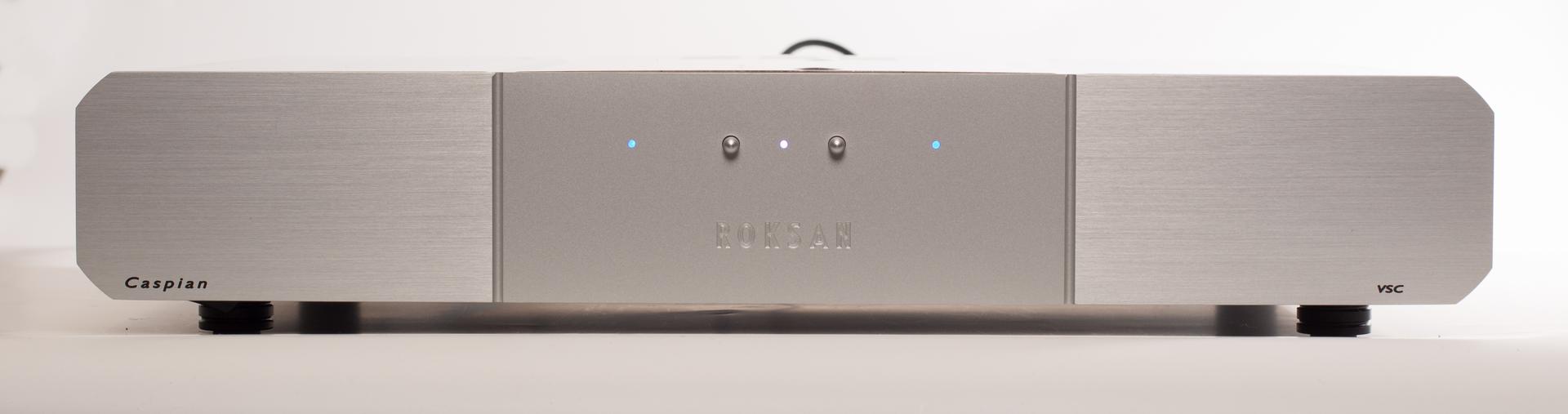
The other major change to the Roksan Xerxes platform is a series of the improvements to the power supply box, announced last year. Designed to fit inside the standard Caspian M2 housing, Roksan launched the RPM power supply and speed control, the fully switchable gain RPP reference phono stage, and the VSC, or Vinyl System Control. The ‘one box to rule them all’ VSC combines reference speed control and phono stage in a single chassis, but with an upgradable power supply: one power supply shared between the two sections, separate ones for the speed controller and phono stage. This last can be supplied at time of purchse or as a retrofit upgrade. The captive power supply lead runs from the back of the RPM or VSC, but a pair of conventional out-rigger wires and phono inputs are used to hook the deck to the phono stage. There is a cost saving of £350 in putting the phono stage and PSU in the same box. There are two options, the VSC with a shared PSU, or the VSC2, which brings a separate power feed to both sections (this can be retrofitted). Finally, there is one more update to the Xerxes; the plinth and subchassis are now available in a striking piano gloss white.

The VSC is not a marriage of convenience, although it does bring PSU and phono stage in one box. It’s more a meeting of minds, the RPM managing to make the Xerxes (already an accurate record spinner) that bit more precise and thus capable of excellent note attack and release, coupled with a whisper-quiet phono stage that is flexible enough to cope with almost any real-world cartridge, and has that distinctive Roksan balance of honesty and musicality with plenty of detail, but not the attendant ‘impressive’ sheen. The phono stage is the easiest to evaluate in the system as you can just by-pass it and move to another model. In so doing, the RPP section shows itself to be an excellent performer; not as inviting as the Audio Research Reference Phono 3 reviewed elsewhere in this issue, not as warm as our benchmark Pass Labs XP‑25, or not as ultimately detailed as our other reference phono stage, RCM Audio’s TheRIAA. But here’s the thing; the phono stage in the VSC was very close to keeping up with these top-flight phono stages, despite the price differential (each one of these top phono stages costs about as much as the whole Roksan turntable, arm, cartridge, power supply, and phono stage rig), and in each case managed to carve out its own signature that was almost the perfect balance point between the three aforementioned designs.


The Roksan Xerxes platform has been a constant in the audio firmament for several decades, so you could be forgiven for thinking the product was fully mature and development was in the past. You’d be wrong, with the VSC you get a more precise sounding turntable and a truly reference-grade phono stage in one Caspian-sized box. And – wait for it – the Pug is no dog, too. It’s a fine tonearm in perfect balance with the rest of the deck, cartridge, and power supply. The Xerxes remains a world-class deck and, in its full-spec guise, comes very highly recommended.

Technical Specification

VSC

  • Phono stage section
  • Gain Settings: MM = 40.6dB @ 1kHz
  • MC 1 = 56dB @ 1kHz
  • MC 2 = 65.5dB @ 1kHz
  • S/N Ratio: MM = > 89dB AWTD (ref. 5.0 mV)
  • MC 1 = >79dB AWTD (ref. 5.0 mV)
  • MC 2 = >70dB AWTD (ref. 5.0mV)
  • Overload Margin: 26dB
  • THD +N: < 0.01%
  • Output Impedance: <50Ω
  • Voltage Supply: Requires +26, 0, –26 Vdc (internal DS1.5 power supply)
  • Turntable PSU section
  • Output Voltage (33rpm): 16V rms
  • Output Voltage (45 rpm): 16V rms
  • Phase: 0° and 90°
  • DC Offset: <10mV
  • THD + N: < 0.1%
  • Output Impedance: <0.1Ω
  • Voltage Supply: Requires +26, 0, –26 Vdc (internal DS1.5 power supply)
  • Price: £3,000 (VSC); £3,250 (VSC2)
  • The Pug tonearm
  • Effective Length: 240mm
  • Overhang: 17.5mm
  • Headshell Offset Angle: 22.9°
  • Effective Mass: 14g
  • Mounting Hole Diameter: 23mm (28mm max.)
  • Armboard Thickness: 19mm (nominal)
  • Recommended Cartridge Weights: 5 – 9.5g
  • Recommended Tracking Force: 1.2 – 3g
  • Price: £1,375

Manufactured by: Roksan Ltd

URL: www.roksan.co.uk

Distributed in the UK by: Henley Designs Ltd

URL: www.henleydesigns.co.uk

Tel: +44(0)1235 511166

Back to reviews

Read more Roksan reviews here


Audiomat Aria integrated amplifier

Some things just work and one of them is the 25-30Watt, push-pull Class A tube amp, based around single pairs of EL34 output tubes. It’s a topology that’s been around since the year dot – well, since serious stereo systems first emerged – and while I’ve yet to discover an example that disappoints, a few have delivered truly spectacular results. My very first really serious, high-end amps were a pair of Jadis JA30s (still going strong); perhaps the archetypical example of the breed. Audiomat’s Aria is neither as ambitious as its French compatriots, nor as expensive, but for many of us, the upside of that is that it is both more affordable and in addition, rather more versatile. For starters, as an integrated amp it doesn’t require an expensive line-stage to go with it and secondly, being some three-decades younger than the JA30s it also carries a few modern niceties, like a remote control.

Housed in a simple, closed-box, bent metal chassis, the Aria nonetheless manages to be both stylish and individual, the large silver volume and source select knobs offering a pleasing contrast to the black casework, the acrylic front-panel offering a darkened window that offers a glimpse of the glow beyond. It’s a welcome contrast to some of the gaudier models typically emanating from the Far East. Look inside – something you’ll need to do in order to install the output tubes – and you discover a neatly laid out interior, with the substantial power supply and output transformers arranged behind the single PCB carrying the audio circuit. Inputs and AC connection are kept separate, located on opposite sides of the rear panel, the sort of simple but effective housekeeping that is the hallmark of this carefully considered design. Other less than obvious examples (unless you actually read the manual!) are the fact that Input One is wired with higher quality cable, intended to be used for your primary source. The IEC input is marked for AC polarity and yes you should pay attention to it. There are three conical feet on the underside of the chassis and Audiomat strongly recommend that you avoid placing the amp on metal or glass supporting surfaces: like I said, all good, sensible stuff. One other thing to bear in mind is that the 30Watt rated output is justified (over the more usual 25Watts Class A from a pair of EL34s) by the use of EL34L tubes, running at a higher grid voltage – so don’t be tempted to start a bit of impromptu tube-rolling using standard EL34s – it will be a short-lived and costly exercise.

The big issue with the 25 or 30Watt Class A amplifier used to be choosing a matching speaker, but over the years, generally increasing efficiency and easier speaker loads, partly driven by the home cinema market, means that isn’t the challenge it once was. With the 91dB/8 Ohm Focal Sopra No. 2 in-house, I needed to look no further than that. Indeed, if I had an issue with the match it is that I could have done with more travel on the volume control so that it was working further up its range. That aside, this was definitely a happy marriage, while the various Living Voice Auditorium models or the Audioplan designs also distributed by Ikon Audio Consultants, would be other excellent options. Audiomat warns of extended burn-in times for both the amplifier and the tubes – and it’s not wrong. I ran the amp constantly for over a week before it settled down to a sweetly consistent performance. Nor is that a linear progression, with one period around the 50-hour mark where it started to sound distinctly glassy and hard. Thankfully that soon passed and the sound opened out, the stage gained air and the tonality grew richer, warmer and more natural. In fact, if this amp has a single over-riding quality it is the natural warmth and immediacy of its presentation – with the emphasis on “natural”. The Aria is never overly warm, rounded, or mellifluous, but it is harmonically correct, devoid of glare and hardness, and possessing of a remarkable sweetness that nevertheless manages to avoid blunting its musically incisive sense of bite and flow. Play Sol Gabetta’s three-disc set, Il Progetto Vivaldi (Sony 888750 35952) and the Aria not only effortlessly picks the different bands on Discs 1 and 2, it perfectly captures the two different acoustics too, along with Gabetta’s muscular grasp of structure and the tonal and textural differences between the two distinct instruments she uses on Disc 3. This is the sort of incidental detail that adds so much to the vitality in the playing and the recording and which helps make a system listenable and keep it that way.

One thing I particularly like about the Aria is its remote control, objects that (as regular readers will know) I usually despise and rarely if ever use. The Audiomat handset is nicely proportioned, milled from solid aluminium with a sensibly textured finish and despite the material, not too heavy. More importantly it limits its functionality to volume and mute – but best of all, it offers two sets of latched volume controls, one for the “normal” range of adjustment and a second for “précis” or finer increments. Given the Aria’s input sensitivity that was a boon. Get the level just right and the music has presence, body and texture, an unimpeded sense of forward momentum and uninhibited dynamic range.


What that input sensitivity does allow is the use of the Aria with lower efficiency speakers. With that in mind I reached straight for Spendor’s brilliant, miniature D1, its 85dB sensitivity offset by its easy load and limited low-frequency extension. Despite my expectations, I wasn’t quite ready for just how remarkably successful this combination was. The amplifier’s easy, engaging, expressive quality and sense of musical momentum dovetailed perfectly with the Spendors’ fluid rhythmic qualities and natural sense of colour, acoustic, and presence. Voices were life-size, full of nuance and body, while drums had a satisfying solidity that utterly belied the size of the speakers and the paltry paper power of the amp. Driving the Spendors, the Aria took on an extra feeling of purpose and forward motion, although whether the explanation for that is as simple as running the volume control further up its range it’s impossible to say. Whatever the reason, the results are exceptional, both sonically and musically, suggesting that as comfortable as the Audiomat amp is with today’s compact floor-standers, many will consider its natural home to be in smaller systems or at least with smaller speakers, where it adds an impressive sense of weight, presence, and scale to proceedings.

The flood of imported tube amps heading Westward from points East places the Audiomat Aria in a difficult position. On paper it looks expensive compared to the competition, especially when you take the power output into consideration. But look a little closer at the thoughtful execution and care and attention to detail, the distinctly French appearance and the neat internal layout: Then listen to just how subtle and unforced, musically engaging, and expressive this amplifier is and you’ll quickly appreciate just why it’s worth the extra investment. Far from looking expensive, it suddenly looks just like the sonic and musical bargain that it is. From its understated exterior to its natural, unexaggerated, and unimpeded musical coherence, the Audiomat Aria is a keeper, a long-term solution in a world full of short-term fixes and buyer’s remorse. Paired with an appropriate speaker (and that field is pretty wide) it has the ability to simply get out of the way, to let the performers and the performance speak for itself, a quality that promises years of musical satisfaction. There are sound reasons why 30Watt Class A tube amps have always delivered the musical goods. The Audiomat Aria is both a timely reminder of that fact and another excellent and – perhaps most importantly – remarkably cost effective example of the breed.

Technical specifications

Type: Class A integrated tube amp

Valve Complement: 3× ECC83, 4× EL34L

Rated Output: 30 Watts per channel

Inputs: 5× line-level RCA

Outputs: Pre-out and tape out, 4 Ohm and 8 Ohm speaker taps

Dimensions (W×H×D): 445 × 180 × 380mm

Weight: 26kg

Price: £3,495

UK Distributor: Ikon Audio Consultants

Tel: +44(0)7956 476299

URL: www.IkonAudioConsultants.com

Back to reviews

Read more Audiomat reviews here

Audio Research Reference Phono 3 phono stage

Launched at the tail end of last year, the Reference Phono 3 phono stage by Audio Research marks a significant change in the company, and it’s not just cosmetic. The new Audio Research reflects the changes in the audio market, as we move further from products that are sublime on the inside only, to products that take every aspect of the design and build process seriously.

The Reference Phono 3 is a perfect example of that change in stance. It needs no back story and makes no apologies for itself, being extremely well made inside and out. There are little design touches in the Reference Phono 3 that combine to make this a far more acceptable product to a wider audience, losing the ‘lab gear’ look of previous models. In fairness, the Reference series has been steadily improved inside and out for several years, but if you compare this 2016 model with the original Reference Phono made at the turn of the century, the toggle-switches, rattling case, and contrasting slimline grab-handles have all been replaced, making the product look more like it belongs in the home, not the test-bench. It’s strange how powerful this change is, because the Reference models of a decade and a half ago seemed timeless, yet look old-fashioned by today’s standards.

Of course, the big industrial design change is the move to that central black panel and large, softer-touch buttons. This harks back to very early Audio Research designs and first re-appeared in the G-Series line. It filtered through to the Reference range last year, and this year – with the Foundation series – it looks set to be a root-and-branch design change through the whole ARC line-up. Personally, I think it a marked improvement on what went before, even though I liked what went before.

Any product bearing the ‘Reference’ name in Audio Research has some big shoes to fill, but arguably none bigger than the Reference Phono 2 SE this new model replaces. The ‘Ref 2’ and ‘Ref 2SE’ were some of the most highly praised and keenly sought after top-notch phono stages on record, and was in direct lineage to the cost-no-object Reference Phono 10 two box model. The Phono 3 doesn’t exactly tear up the rule book and start again, and ostensibly the layout is similar even if the design has changed. The row of six push buttons to navigate through every part of the ARC’s extensive menu system and the large green vacuum flourescent dot matrix display panel remain ‘effectively’ unchanges, as do the five levels of loading and the 71dB of active gain used in cartridge matching. This is a better thing than it first seems because the original navigation system was already easy to drive, and the near infinite level of cartridge matching remains state-of-the-art.

Like its predecessor, the Reference Phono 3 is underpinned by an extremely sophisticated logic control (extremely sophisticated for a valve phono stage, that is – this isn’t International Space Station grade stuff). You can adjust every parameter through a menu tree, from the amount of time the Reference Phono 3 will run before switching to standby, through gain settings, valve operational life, display brightness, and EQ. Depending on your take on the whole phono equalisation debate, however, this menu system might be completely upside down – I know of collectors who have gone through their LPs and mark whether they are best played through RIAA, Columbia, Decca, or one of several lesser known equalisation curves. The Reference Phono 3 offers the listener the option of scrolling through the Big Three – RIAA, Columbia, and Decca – but you’ll need to run through all five main pages of the menu system to get to these. Listeners who change valves once every 2,000-4,000 hours, who never adjust the display brightness or standby settings, and who use the same cartridge month in, month out – but who might change EQ curves once or twice in a listening session – have to tab through a lot of pages to get there. Fortunately, the remote obviates all this, as it has one-touch access to curves, loading, and even tube hours.


I’m trying to sit on the fence deliberately here, because the equalisation arguments rage long and hard. For my part, I have a handful of older LPs (mostly Deccas) that seem to benefit from changing tone curve, and as a consequence the placement of EQ at the ‘coffee and liqueurs’ page of the menu seems wholly appropriate. No doubt others will get exercised over the same thing. Regardless, I’m pleased there are alternate tone curves on the Reference Phono 3 (as there were on its predecessor), and when called upon, they work extremely well; as in fairness they did on the Reference Phono 2 that went before.

The change from Ref 2 to Ref 3 comes in the guise of two additional 6H30 valves in the analogue stage (now bringing the total number of 6H30 valves in the Ref 3 to seven – six in the analogue stage – plus a solid-state rectifier and a 6550 in the power supply). These two additional valves do not replace the input FETs introduced in the Reference 2, they just add linearity to the analogue stage. Although an oversimplification, that basically means the power supply stage is effectively half of a mono valve power amplifier in its own right, dedicated to feeding the three 6H30 valves for each channel. For a phono stage, that is heroic amounts of clean power delivery.

The transatlantic design team (electronics from Plymouth, in Minnesota, USA, product design from Vicenza, in Veneto, Italy) has come up with something more than just a nice case. In moving away from Audio Research’s classic design lines, the chassis has developed some elegant aluminium side panels that look great, but aren’t just for show: they help dissipate heat and resonance away from the all-important internals.

A cynical reading of the Reference Phono 3 would be “two more tubes and a nicer case. Is that it?” But, as ever with such things, the real-world take on this is that the Phono 3 is redesigned from first principles, incorporating the best elements of the Reference Phono 2 rather than simply ‘cloning’ its predecessor. In fact, the Reference Phono 3 is more like a synthesis of what Audio Research has learned from the rest of its Reference range, distilled into one big phono stage. Those two additional valves help linearity in a manner akin to that discovered in the Reference 10 and Reference 6 preamps.

Having a phono stage that is built like a power amplifier does have a short-term downside. It takes forever to run in. Whether it’s those Teflon capacitors (there are a lot of those) or the tubes bedding in or simply some mystery X factor that means the amp needs time to get used to its environment, but as with previous Audio Research products – and especially those in the Reference line – this takes hundreds of hours to come truly on song. It sounds good to excellent out of the box, but keeps on improving for the next few hundred hours (Audio Research itself suggests 600 hours… and not 600 hours of it gently warming up in a corner, 600 hours of active record playing). You could easily be talking a year of record playing before the amplifier comes on song. As I left the keys to my time machine in 1789, and this review isn’t beamed back from mid next year, there is still some room for improvement in the sound of the Reference Phono 3.

That sound combines the texture, soundstage spaciousness, and richness of valve phono stages with the detail and silent backgrounds of solid state. This is a balance, but it’s both a dynamic one, and one that will appeal to many, many listeners. This sense of balance makes for a presentation that is extremely realistic, irrespective of the music played. Of course, the more live and acoustic the recording, the more ‘real’ it sounds, but even an old 45rpm 12” single of ‘Two Tribes’ by Frankie Goes To Hollywood [ZTT] sounded ‘realistic’. In fact, this Trevor Horn throwing a studio at a remix is jaw-dropping on the least impressive audio equipment, but here it sounded unfeasibly dynamic, rich, and impressive. Listen to this dance-music-meets-1980s-paranoia masterpiece through a system worthy of the Reference Phono 3 and you’ll be left gasping by the end of the piece. Switch back to more traditionally audiophile-chummy, dynamic recordings like Tennestedt’s powerful version of Mahler’s Third Symphony [EMI], and you’ll be in the same state. This is not LP replay for the casual user; it’s for protracted musical sessions and enjoyment red in tooth and claw.

The Reference Phono 3 also always seems to have reserves in the tank. This doesn’t mean it never gets out of low gear, more that it is entirely unflappable. You might not think of a phono stage in terms of its musical robustness, but once you have experienced the authority of an phono amplifier (and let’s be clear on this, the Reference Phono 3 should be classed an ‘amplifier’ not a ‘stage’), its hard to look back at less robust designs.

Yet for all that unflappability, there’s one key word that effectively sums up the defining characteristic of the Reference Phono 3: agile. While few phono stages sound ‘arthritic’, when listening to the Reference Phono 3, one gets an underlying sense of agility. It reacts to the most subtle changes in timbre, tone, or dynamics without the least concern, and to such an extent it makes many rivals seem slightly ponderous. More interestingly, the handful of phono stages that match the Reference Phono 3’s agility often do so by sounding ‘twitchy’ in comparison. ‘A Night In Tunisia’ from Art Blakey and the Jazz Messengers’ A Night At Birdland Vol 1 [Blue Note] is a perfect example of what this phono stage does so well. The opening drum and percussion passages are full of subtle textures and dynamics, then the rest of the band kicks in like a whirlwind. The Reference Phono 3 tracks these changes perfectly and deftly, with outstanding (here comes that word again) agility.


Here’s the thing. There are some who take the whole ‘user adjustable EQ curves’ aspect as intrinsic to a good phono stage. There are some who insist on absolute adjustability of cartridge loading as key to good phono reproduction. There are some who demand a low noise floor from their benchmark phono stages. Even in high-end audio’s thermosphere (the one beyond the one beyond the stratosphere, populated by aurora, meteorites, and ballistic missiles), typically you might have to make do with a ‘two out of three ain’t bad’ approach to phono stage design. The Reference Phono 3 is that rare exception that ticks all the boxes: it is quiet, it is almost infinitely adjustable, and it does come with a profusion of EQ options. However, what makes the Reference Phono 3 really shine is that if you are simply a ‘fit and forget’ kind of listener, who will never delve deep into listening out for the optimum loading for each channel of a cartridge, and who will never, ever play anything other than the standard RIAA curve, the Reference Phono 3 still has much to offer, in sound quality terms.

The term ‘reference’ still has meaning for Audio Research, and it doesn’t use the term lightly. The Reference Phono 3 is a true reference point in turntable replay, as it extracts a remarkable amount of information from the cartridge, and yet plays it in a manner that invites you to listen to more and more albums. Those hundreds of hours of run-in will never be viewed as a chore, more as a pleasure, unveiling both what your records are capable of and just how much better your Reference Phono 3 gets. And those hundreds of hours will pass quickly, too. From a position of not firing the ejector seat on my own career at least, there can be no ‘best’ in high-end audio, but the Audio Research Reference Phono 3 is one of those rare devices that gets closer to ‘best’ than most. Highly recommended.

Technical Specifications

  • Type: Hybrid phono stage
  • Tube Complement: (6)-6H30P dual triodes, plus (1 each) 6550WE and 6H30P in power supply
  • Controls: Six Push Buttons:  Power, Menu, Option, Enter, Input, Mute
  • Inputs: 2× RCA stereo pair, earth tag, RS232 comms
  • Outputs: Balanced XLR pair, single‑ended RCA pair
  • Frequency Response: ±.2 dB of RIAA, 10 Hz to 60kHz; 3 dB points below 0.3Hz and above 300 kHz
  • Distortion: Less than .002% at 1.0V RMS 1kHz output
  • Gain: Selectable 51 dB (Low) and 73 dB (High) at 1kHz BAL; 45 dB (Low) and 67 dB (High) at 1kHz SE. (MC and MM compatible)
  • Input Impedance: 47k Ohms and 100 pF SE. Selectable loads: 1000, 500, 200, 100, 50 Ohms, and Custom
  • Output Impedance: 400 ohms Balanced, 200 ohms SE. Recommended load 50k-100k Ohms and 100 pF. (10k Ohms minimum and 2000 pF maximum)
  • Phono Equalization: (selectable) RIAA, Columbia, and Decca
  • Dimensions (W×H×D): 48×19.8×41.9cm. Handles extend 4 cm forward of the front panel
  • Weight: 16.6 kg
  • Price: £11,998

Manufactured by: Audio Research Corporation

URL: www.audioresearch.com

Distributed in the UK by: Absolute Sounds Ltd

URL: www.absolutesounds.com

Tel: +44(0)208 971 3903

Back to reviews

Read more Audio Research reviews here

Perfect Partners

4th August 2016, Hastings, England.

The Bespoke Audio Company is proud and delighted to announce our new partnership with KJ West One of New Cavendish Street, London, W1.

KJ West One is one of the most famous audio retailers in the world. Its position at the heart of London’s West End offers the ideal location to sample their exceptional range of the finest components in high-fidelity audio reproduction.

With a strong focus on the customer’s complete satisfaction and an emphasis on excellence, KJ West One is the perfect partner for The Bespoke Audio Company and will serve as our exclusive representative in London.

To mark our collaboration, we are planning a special event on the 21st September 2016 from 6pm at KJ West One.

We will present our pre-amplifier in their extraordinary sounding, beautiful looking demonstration facility together with some of the most desirable audio equipment available. We will discuss the concept and the philosophy behind our company and our products and we’ll be able to answer any questions guests may have.

To demonstrate one of the processes behind our product, we will bring our transformer winding machine to show how we make the custom components which are at the heart of our pre-amplifier. While our unique approach means there is an almost unlimited range of options, we will be showing a few examples to give those attending an idea of what is possible in terms of finish and technical choices.

Refreshments will be provided and we will invite guests to sample some local ales, wines and cheeses made in, or near to, our home town of Hastings on the south coast of England.

Audio Sanctuary

Announcing Audio Sanctuary, one of the UK’s biggest headphone, portable audio and accessory retailers (and the new name for Custom Cable, creators of headroom London)
 

05th August 2016, London: the UK’s best-loved portable audio retailer, Custom Cable, has rebranded to Audio Sanctuary, with a bigger store, a slick new website, plus prestigious new brand additions and product lines

Custom Cable has changed its name to Audio Sanctuary and has introduced a raft of improvements to both its in-store and online shopping experience. Along with the name-change comes an all-new website, a bigger and better in-store experience, plus some exciting new brands and product lines, all of which are available 24/7 online.

Consumers will still be able to enjoy one of the UK’s widest range of demonstrable headphones, Custom Cable’s legendary customer service (now under Audio Sanctuary), plus an unrivalled accessories range. The retailer has improved its in-store experience, with additional rooms in which to discover the new product ranges. The new Audio Sanctuary offers more choice, more space, plus an even better shopping experience whether shopping in-store or online.

Audio Sanctuary also offers repairs and can even refresh existing headphones. A worldwide provider for Sennheiser, the retailer can access parts and spares for most major brands, from Shure to Audeze, to Beyerdynamic and B&W.


The headroom show connection

Audio Sanctuary is the main retailer behind London’s headroom show and headroom at Indulgence, an exciting new lifestyle experience for London featuring the world’s best home and portable audio entertainment, alongside a host of complementary luxury goods.

The benefits of shopping with Audio Sanctuary

Audio Sanctuary customers can choose from a huge variety of the world’s leading brands and receive expert advice: the store offers support from Monday to Saturday 09.00 – 18.00. The online store offers fast and secure shipping, with prices from as little as £1.20, plus, all transactions are safe, secure and verified by GeoTrust. Audio Sanctuary, aims to offer the best range of products with the best customer service in the UK.

Discover Audio Sanctuary

Consumers are encouraged to visit the New Malden (Greater London) store, a mere 22 minutes by train from central London, to experience all the benefits of the Audio Sanctuary approach. Visitors can also experience one of the UK’s foremost A/V retailers, Unilet Sound and Vision, a sister company and one that shares adjacent premises.


Audio Sanctuary contact information

+44 (0)20 8942 9124 [email protected] 35 High Street, New Malden, KT3 4BY

www.audiosanctuary.co.uk

About Audio Sanctuary

Audio Sanctuary is one of the UK’s biggest independent headphone, portable audio and accessories retailer. With both a high street and online presence, Audio Sanctuary makes it easy to enjoy its vast range of products from the world’s leading A/V manufacturers.

Audio Sanctuary’s remarkable facilities at its New Malden store, which is just 22 minutes from central London, makes it a haven for expert, impartial advice and valuable product demonstrations.  The company prides itself on providing specialist advice on both home and portable audio solutions for consumers, from headphones to music streaming and all the connections in between. The friendly, knowledgeable team offers great customer service, with the store offering fast delivery to quickly get consumers up and running.

Audio Sanctuary is proud to offer the widest range of high-quality headphones in the south of England. The store is also behind London’s headroom show, held annually at Europe’s most successful recording studios, Metropolis, and the Indulgence show, an exciting new lifestyle experience for London featuring the world’s best home and portable audio entertainment, alongside a host of complementary luxury goods.

WIN! A pair of the superb Riva S Bluetooth speakers worth £199 each!!!

Following on from our hugely popular competition to win the excellent Riva Turbo X, we are delighted to offer one lucky reader the chance to win a pair of Riva S’s. The Riva S is the smaller brother to the Turbo X and Chris Martens reviewed a pair of them in issue 137 of Hi-Fi+. He wrote, “The Riva S is a compact, rectangle-shaped, oblong speaker that is – in rough ball park terms – about 20% smaller than the Turbo X.

“One striking quality of the Riva S is an impressive ability to help the sounds break free from the relatively tight confines of the speaker enclosure itself. “With the Riva S, ADX has managed to shrink boththe size and price of the original Turbo X… Better still, the clever Riva S TrueWireless™ Mode means two units can be combined wirelessly for use as a true self-powered stereo speaker system. ADX has another winner on its hands”.

Competition Question

How much smaller is the Riva S compared to the Turbo X?

A. 20%

B. 35%

C. 50%

To answer, please visit Riva’s dedicated competition page at http://rivaaudio.com/hifi-riva-s/ 

Alternatively, send your answer on a postcard (including your name, address, and contact details) to

Riva S Competition, 17835 Newhope St., Unit A, Fountain Valley, California 92708, USA.

The competition closes on October, 6th 2016.

Competition Rules

The competition will run from August, 4th 2016 until October, 6th 2016. The competition is open to everyone, but multiple, automated or bulk entries will be disqualified. The winner will be chosen at random from all valid entries, will be contacted via email (where possible) and their name will be published in the magazine. The Editor’s decision is final and no correspondence will be entered into. Absolute Multimedia (UK) Ltd. is compliant with the Data Protection Act and UK laws apply. Our policy is such that we will not pass on your details to any third party without your prior consent.