Up to 37% in savings when you subscribe to hi-fi+
hifi-logo-footer

Begin typing your search above and press return to search. Press Esc to cancel.

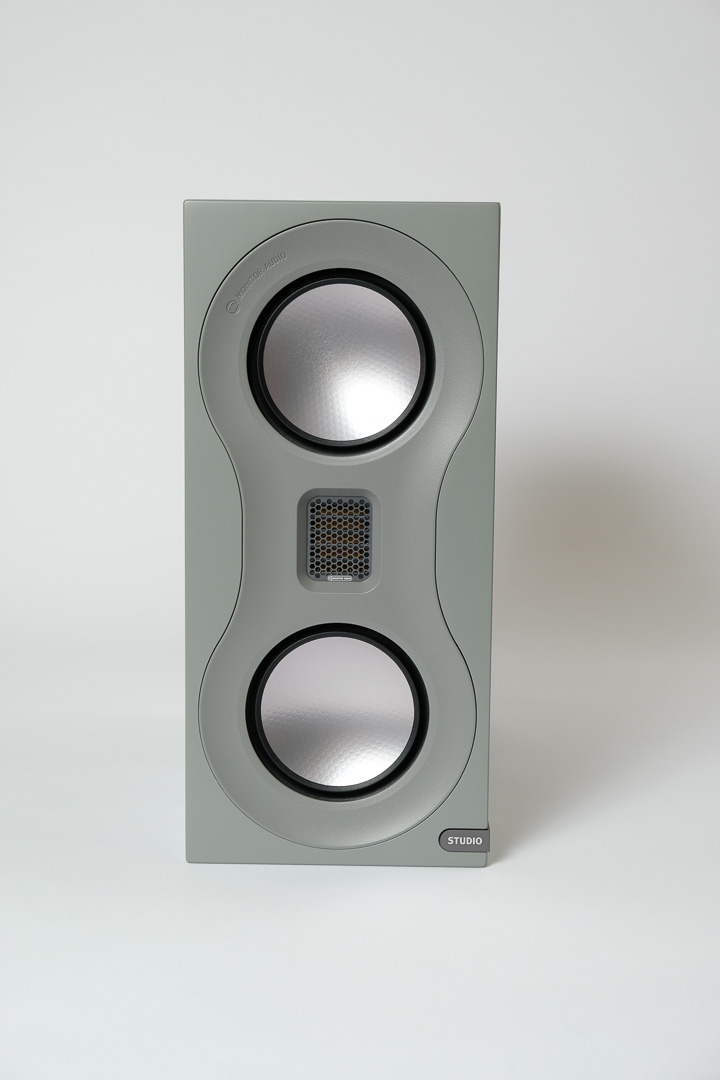
Monitor Audio Studio stand-mount loudspeaker

Studio, by Monitor Audio, is a one-off design by the company, one of the last to spring from the pen (well, the pen on the tablet of the CAD/CAM computer) of Dean Hartley, who stood down as technical grand fromage of the company earlier this year. The Studio is not intended to be a part of a range, nor is it intended to replace any of the company’s Bronze, Silver, Gold, or Platinum models; it’s a purely standalone project, although one that has more than a little bit of flagship PL500-II loudspeaker in its DNA.

The name ‘Studio’ itself harks back to a long-discontinued top of the Monitor Audio tree, although about the only things this loudspeaker has in common with that old range-topper is the name and the use of metal as a diaphragm material in all its drive units. The Studio, 2018-style is a far more down-to-earth model, set in a classic D’Appolito or MTM (mid-treble-mid) design, in line with the central section of the present PL500-II flagship. Of course, that is a cost-no-object, heavyweight multi-driver tower design, and the Studio is a slimline stand-mount that gets you change from a grand.

Most importantly, what it takes from the PL500-II (and, in fact, all of the Platinum range) is what it calls an MPD or Micro Pleated Diaphragm high-frequency transducer (tweeter). This tweeter uses a pleated aluminium film diaphragm bonded to Kapton. This aluminium is then etched away leaving a resistive trace (akin to those on a PCB), which effectively acts as a voice coil. This diaphragm is then held in place by steel plates, and when an electrical signal passes through the traces, the resultant force makes the diaphragm’s pleats squeeze laterally in a manner akin to an accordion (only much, much smaller). By now, keen-eyed audio enthusiasts will be jumping up and down saying ‘It’s an AMT!’, but they are only part right; the MPD variant made by Monitor Audio uses larger rolls than typical Air Motion Transformer designs, to eliminate frequency nulls up in the 30kHz-40kHz region, and phase shift issues in the audio band. Monitor Audio gives credit to Oskar Heil for the original AMT design but thinks its MPD variant improves upon the original.

Coupled with that Platinum Series driver are a pair of 100mm RDT II mid-bass units, bolted to the rear panel. These are also taken directly from the centre of the flagship PL500-II.  First seen in 2016, this hybrid diaphragm features a C-CAM aluminium/magnesium cone front skin bonded to a central core of Nomex, finally with a rear skin of carbon fibre. This sandwich construction is – according to Monitor Audio – ‘just like a perfect piston’ in that it is very light, yet very rigid and very strong. Monitor Audio has been developing hybrid cones for many years, and this is perhaps the company’s lowest distortion model to date.

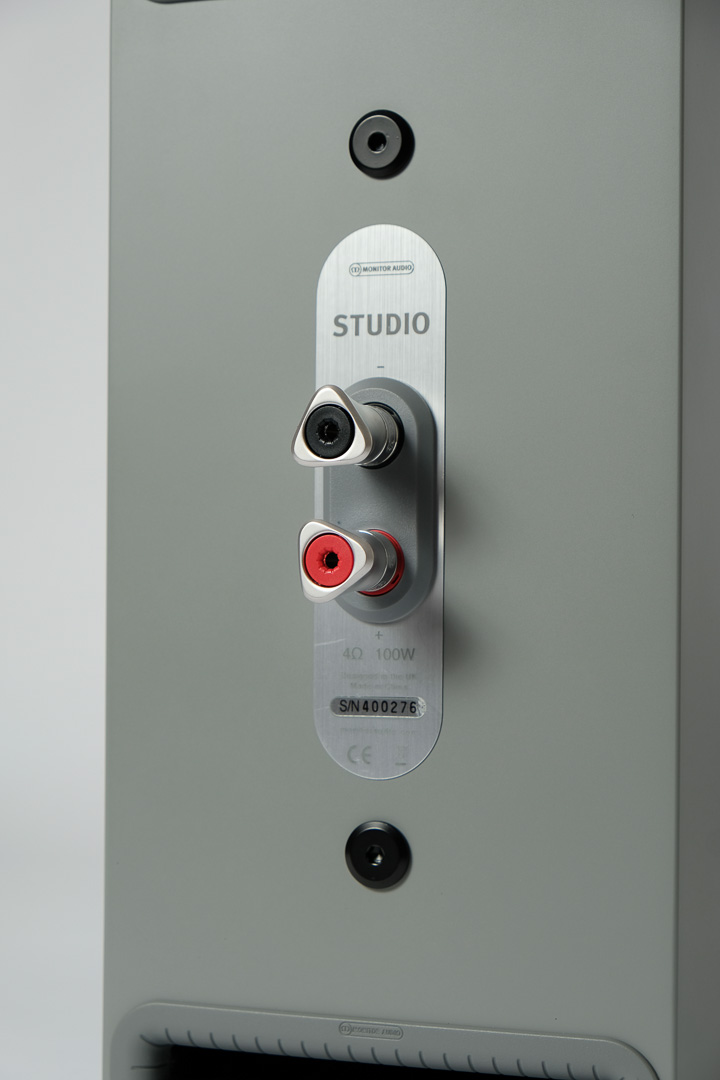
Even the cabinet has elements of the PL500-II central section in its design, with its curved, elongated figure-of-eight front baffle section, although this is a far cry from the more complex raised and scooped shape of the flagship’s centre section. The cabinet itself is a relatively standard, if tall, rectangular box, albeit finished in satin black, white, or grey to give it that studio appeal. It also features twin HiVe II flow-tuned ports, top and bottom, to give the symmetrical layout of the loudspeakers an equally symmetrical port output. In between these two letterbox ports is a single set of beefy, custom-made rhodium plated terminals, designed to accept spades, 4mm plugs, and bare wires. A matching pair of stands are available and – because the Studio’s footprint is relatively narrow compared to most stands – are recommended. Even at £350.


The difficulty a comparatively new Monitor Audio product has to face – especially one that sits outside of the standard ranges – is inertia. People over the years have come to love what the standard ranges do, and often look to more of the same, so when something comes along that does the same things differently, the reactions are mixed. And the Studio lives up to the name – it’s a very resolving studio monitor-style loudspeaker that would not look or sound out of place sitting atop a mixing desk. If you view your speakers to add that little bit of warmth, smoothness, or richness, look elsewhere. The Studio is all about speed, detail retrieval, precision, and focus. It also has surprisingly good bass given the size of the cabinet and the drive units.

It’s not just about the bedroom DJ or home studio market – although the Studio does fit these markets almost unfeasibly well – it’s about those who want to hear the bare-faced truth about their music, in a way that one doesn’t usually expect at anything near this price. That might be something of a double-edged sword (the electronics the Studio is likely to partner and the musical material it is expected to be fed is unlikely to be carefully massaged audiophile-grade stuff, and the Studio will lay those limitations bare). But coming from the high-end on down, many will see the Studio as an inherently ‘right’ – if uncompromising – transducer in the Magico vein. Which means that those wanting a pair of Magicos that have neither the room nor the depth of wallet to own them now have something with a broadly similar sonic performance at an affordable price. It’s strange, but this is more likely to attract new customers/listeners than those from the existing Monitor Audio market.
That’s missing the point; the Studio is all about detail retrieval. If a guitarist uses a phaser pedal and they meant to use a flanger (one of the differences between the sound of Jimi Hendrix’ and David Gilmore’s FX-laden sounds) you will hear the mistake effortlessly.  If a singer needs a spot of AutoTune, you’ll quickly learn to recognise its processing engine’s sonic signature, even at subtle levels. Want to know if that was an alto sax playing low or tenor sax playing high? The Studio will let you into the mix. This is standard fare for more high-end designs, but something of a rarity in the £1,000 price range. Normally, at this point, you either get something effortlessly musical, but not very revealing, or a loudspeaker that equates ‘detail’ with ‘high-frequency energy’ and the Monitor Audio Studio is one of the rare exceptions to both. It does the detail thing well, without falling into the brightness trap, but it doesn’t fall into the other great pitfall of trying to sound a little bit too ‘nice’ in the process. The Studio is meant to be revealing.

The surprising part of the Studio’s sound is the depth of it. There shouldn’t be this much bass coming out of this small a loudspeaker. I played some nasty old school dub through the Studio – the title track from King Tubby Meets Rockers Uptown[Clocktower] – and OK, while it didn’t have the teeth-loosening bass I once heard from a sound system at the Notting Hill Carnival a few years back, but the level and precision of bass coming out of these, that deep bass-line wasn’t lost in depth, weight, or intensity. Full-range it is not, but it is still deeper and more honest in the bass than a speaker this small has any right to be. The speed of the Studio was also clear from those rim-shots and the detail let you hear the truly dreadful quality of the echo (which paradoxically kind of makes the track). This is the kind of track that needs the loudspeaker to start and stop almost instantly because there is so much being fed through the reverb and echo, and these need to be very clearly delineated, and the Studio does this exceptionally well, making most loudspeakers sound sluggish by comparison.

This is more than the speed of attack, though; the Studio also preserves the harmonic structure of that sound. In fact, it’s a lot better at unveiling the harmonic structure of more sensitively recorded music (dub is great but was never recorded for its audiophile qualities). And you don’t get much more harmonic than Cannonball Adderley on his legendary Somethin’ Else album [Blue Note]. Here, the richness of his playing (especially through a CD made before the late Rudy Van Gelder took to remastering his own recordings in his twilight years) comes through well, with the sax soaring away into the upper registers, the underpinning of the piano, and the overall focus of the sound extremely beguiling. Add to that a very precise image, with instruments easy to place and position within a surprisingly large soundstage, and it’s clear the Studio punches above its weight. But most of all, it’s that midrange clarity that is most seductive; the speaker simply draws you into the mix, unobtrusively and uninterrupted. It’s a very transparent presentation that befits the name. And similarly befitting the name, it’s more about detail retrieval than dynamic range. The dynamics are ‘good’ (especially the micro-dynamics and that way of resolving small musical details in the midst of lots of musical ‘goings on’) but don’t expect musical fireworks to be overstated. This is not an over-refinement, but a part of the Studio ethos, because dynamics are often something to be tamed in the studio.

The downside to the Studios is they are demanding of installation and equipment partners. The comprehensively-languaged manual limits the instructions to three feet from the side walls, eight-to-eighteen inches from the rear wall, and six to ten feet apart, with a proviso about experimenting with toe-in, and a hundred-hour run-in. It makes almost no recommendations about electronics and speaker cables. That will get you a sound that is detailed and – if you get them the right distance from the rear wall – with good bass, but musically soulless and undynamic. Throw some good electronics at them (this doesn’t need to be a power-house, I used the Sugden Sapphire pre/power amp combination tested in issue 158), some really good cable (The Chord Company is your friend here!), and approached the installation with the kind of OCD intensity. In return, the Studio eventually unveiled the more dynamic, more expressive, and more passionate performer inside the boxes.


The Monitor Audio Studio doesn’t re-write the rulebook, it doesn’t change the laws of physics (Cap’n), and it doesn’t spell the death-knell for the rest of the Monitor Audio range. Instead, it’s a worthwhile addition to that portfolio, more than living up to its name with an incredibly detailed performance in the near-field that is hugely reminiscent of the sound of the control room. It might not be for everyone, but if more recordings were mastered through these loudspeakers, we’d have better recordings!
A studio speaker rarely needs to be dynamic (dynamic range is never an issue that close to the original instrument) and the Studio reflects that up to a point, but careful installation and partnering can expand the perceived dynamic envelope considerably. If you look to loudspeakers as providing a window on the recording, the Monitor Audio Studio is one of the cleanest windows you can get for the money.

TECHNICAL SPECIFICATIONS

Type: Two-way, rear ported stand-mount loudspeaker

Drive unit complement: 1×MPD high-frequency transducer, 2×100mm RDT II midbass driver

Frequency response: 48Hz–60kHz

Crossover frequencies: 2.7kHz

Sensitivity: 86dB SPL (2.83V/1m)

Nominal Impedance: 4Ω

Minimum Impedance: 2.9Ω at 3.5kHz

Maximum SPL: 110dBA (pair)

Amplifier power handling:40–100W

Finish: Satin White, Satin Black, Satin Grey

Dimensions (H×W×D): 34 ×15.6 ×36cm

Weight: 7.58kg each

Price: £999 per pair (stands £350)

Manufactured by: Monitor Audio

URL: monitoraudio.com

Tel: +44(0)1268 740580

Back to reviews

Read more Monitor Audio reviews here

Critical Mass Systems Center Stage2 anti-vibration feet

Critical Mass Systems is well known for making some of the finest (and largest) high-end audio equipment support systems money can buy. So, it might come as something of a shock to discover that CMS maven Joe Lavrencik’s best-ever product might just be an inconspicuous vibration-control foot called the Center Stage2.

Joe is being perhaps understandably reticent about discussing the inner workings of the Center Stage2. According to the company’s white paper, Center Stage2is made by “choosing and sequencing materials that possess the perfect combination of damping, elastic modulus, and thin rod speed to lock in the desired effect.” That effect is, “a catalyst in a complex energy reaction that occurs between your equipment and its environment.” The idea is that kinetic and vibrational energy act in an unregulated and undamped manner inside a product and Center Stage2can “change the prevailing state of equilibrium in that energy reaction and to permanently hold it in a reduced or damped state.”

According to Lavrencik, “Center Stage2was designed to exacting specifications using material science and First Law of Thermodynamics principles.  It also relies heavily on the Second Law of Thermodynamics to meet its performance objectives. There is no new physics in Center Stage2, we’re simply applying physics in new ways to an audio foot.” Lavrencik focused on three aspects: impedance mismatching to greatly reduce vibration moving upward from the floor, the reduction of the noise inherent to the materials used to fabricate the foot, and a means to transfer entropy out of the component.

What this means in real terms is a black anodised aluminium foot with an almost free-spinning aluminium foot pad on the base, and the top is covered with stiff, black paper-like material. You have three sizes of the foot, dependent on the mass of the device and the size of its own foot. You need four feet per device. They are placed on the underside of the device, not on a screw-head or as a footer under the component’s own feet. It works on practically everything except turntables and loudspeakers (but including turntable power supplies).

Here’s where it gets weird: you stick a quartet of Center Stage2under your source component and… it sounds terrible! Add a set to your preamp, power amp, or integrated amplifier and the sound gets even worse. Your hitherto full, detailed, and dynamic sound is transformed into something thin, muddy, and flat. Next day, it gets a little better, then it gets worse, then better still, then worse again, and so on. Generally, it fills itself in from the bass upwards, with the bottom end being the first to return to prior levels. You’ll get about a week and a bit’s worth of audio mood swings. And it’s at that point the transformation happens and the system blossoms.

You notice this change by a shift in your internal dialogue. “I’d forgotten just how good that really is!” (referring to both record and equipment) seems to be the first sign. About an hour later, you find yourself composing a thank-you email to the designers of the components in your system. Although it’s the bass that first comes back, it’s the midrange that seals the deal; the enhanced clarity, the walk-in detail to the soundstage, which seems to not change a thing, all the while being far more enveloping than before. This is no small change, and as the listening progresses, you begin to find this feeling of being immersed in the music, which truly transforms your listening sessions, and it becomes uppermost in your requirements for a good system. Everything just seems more natural, more real, and more like the recording engineers and the equipment designers had in mind when they got creative. And the Center Stage2is also one for the Pace, Rhythm, and Timing (PRaT) obsessives, in that a device resting on a set of four Center Stage2seems to keep time better than ever. But it’s that envelopment that really captivates you and takes your attention. If you were a PRaT obsessive before you put a set of Center Stage2in situ, you become a sonic envelopment obsessive who likes a bit of rhythm afterwards.

I’ve used all kinds of feet and pods and the like before. The best of them seem to align one product to another harmoniously. Center Stage2is not like that; instead, it erases many of the impediments that hold back a device. In the process, it gives the device resting upon these devices a promotion. Even the best audio devices have hidden strengths the Center Stage2can unveil.


You can even gauge the magnitude of improvement to be had by the level of initial awfulness of the system sound, and this is also a gauge of equipment quality – things that can never blossom will never have much of a shine knocked off their performance at first, but that’s pretty rare. It’s also self-sealing as the kind of product that is unlikely to resolve enough to show what the Center Stage2can do usually cost less than four Center Stages, and I doubt anyone is ever going to put a £500 device on £900 worth of Center Stages. Once you get to £5,000 though… Center Stage2makes a hugely convincing argument.

Unless you are pathologically impatient (or a reviewer/inveterate box-swapper who changes components in a system on an almost hourly basis) there are no downsides. OK, so if the underside of your component is more screw-head than base-plate, then there might be installation issues, and you might find your system might need a spot of speaker repositioning to accommodate the system improvement, but that’s it.

Most audiophiles have a drawer filled with magic cones, domes, pods, and pucks. All of these devices were bought initially claiming a lot, and all tried, praised, used… and removed. The Center Stage– I feel – is different. They have staying power. I suspect those who try them will never look back. Instead of being next year’s drawer fodder, the Center Stage2makes you enjoy your system more and does so for longer. Judging by my reluctance to unpack components in a Center Stage’d system (which, to me, means empty pages and ultimately no job) I’d go so far as to say the Center Stage2will make the MTBF (Mean Time Before Futzing round looking for a new audio product) stretch out longer. You only change devices when dissatisfaction strikes, and Center Stage2helps keep that dissatisfaction at bay.

In truth, I’m envious of those who don’t have to put their system into a permanent state of flux because they can gain the most benefit from a set of Critical Mass Systems’ Center Stage2. Let’s not understate their importance… all other things being equal, I’d be happier using a comparatively inexpensive system resting on a quartet of Center Stage2than I would a more esoteric system just sitting on ‘regular’ equipment supports. Although I’m generally a ‘different paths up the same mountain’ kinda guy, I can’t help thinking that this is the best of the best. If you can take the short-term pain, the long-term gain is more than worth it!

Details

Center Stage20.8 (2.03cm high, for devices weighing less than 45kg): £225 ea.

Center Stage21.0 (2.54cm high, for devices weighing over 45kg): £425 ea.

Center Stage21.5 (3.81cm high, for amplifiers on low tables near loudspeakers): £675 ea.

Manufactured by: Critical Mass Systems

URL: criticalmasssystems.com

Distributed in the UK by: Select Audio

URL: selectaudio.co.uk

Tel: +44(0)1900 601954

Back to reviews

Read more Critical Mass Systems reviews here

Dutch & Dutch 8c stand-mount loudspeaker

DSP in active speakers is not a new thing, but arguably until recently, it is not a technology that has realised its full potential. This was proved convincingly by the Kii Three that I wrote about in issue 162: a compact active digital design that combats room problems with a clever bass-cancellation system. So when I heard about Dutch & Dutch’s similarly DSP-driven design the 8c I was certainly interested, a lot more perhaps that would have been the case BK (Before Kii). And that’s not all that’s interesting about this model, as the technology behind the driver array – there are two bass units in the back of the box and a shallow, yet wide waveguide on the tweeter – is based on research done by Harry F Olson at RCA Labs in the early 1970s. Olson was trying to create a loudspeaker that mimics the behaviour of a cardioid microphone. That is a speaker that produces a cardioid dispersion pattern to minimise the effect of reflections from room boundaries. It’s the sort of thing that is very hard to create using trial and error but, with the computer modelling that Dutch & Dutch uses, becomes a whole lot more do-able. Dutch & Dutch manages to achieve around 20dB of rearward rejection, compared to 10dB of its main rivals. The first speakers that the company built were for the pro audio market under the Pro Fidelity System brand, but when this led to the 8c they decided to develop a speaker for home users.

The way that the Dutch & Dutch 8c uses the rear wall is inspired by Roy Allison’s work at Acoustic Research and especially the work performed by Dr Floyd Toole and Sean Olive at the National Research Council of Canada (and later for Harman Audio) in the 1990s. This approach integrates the room into the way the sound projects rather than trying to minimise it by placing speakers away from walls. Dutch & Dutch recommends you place this fairly substantial stand-mount between 10-50cm away from the rear wall, which seems very close and even more so when you see that there are two decent size bass units in the back. The cardioid element is provided by the way that the midrange driver’s rearward output is radiated through vents in either side of the box in anti-phase, the idea being that when the signal from the front of the driver turns the corner it is acoustically cancelled out. You can see why this technology required several generations of engineers to achieve when you consider just how radical this idea is.

Inside the solid oak cabinet of the 8c is 1000 Watts of power for the drivers which breaks down to 250W apiece for tweeter and midrange and 500W across the two bass drivers. The latter are eight-inch metal cone types that inhabit a sealed part of the cabinet and sit above a connection array that allows for balanced analogue or AES/EBU digital connection alongside an RJ45 port for a networked setup. You can, therefore, connect the speaker to an analogue preamplifier or a digital source such as a streamer or CD player. In the latter situation, the volume can be adjusted with an online app called Lanspeaker, which allows for full set up of this loudspeaker. There is another setup option on top of these which takes advantage of the 8c’s forthcoming Roon endpoint capabilities. Connect both speakers to your router or network switch and it’s possible to select them as Roon endpoints and send the signal directly from your library with no need for a DAC or preamplifier as both are built into the speaker.

The power of DSP in this design is remarkable, allowing parametric EQ set up with remarkable precision and ease. When Ultimate Stream brought them down we put them at the recommended distance from the wall and used third party software (REW’s room EQ wizard) to measure the response at the listening position using a microphone plugged into a laptop. This shows where the peaks and troughs in the response are and by making a note of them you can adjust the response in Lanspeaker to produce a remarkably flat in-room result. The worse the acoustic character of the room, the greater the potential the system has to create an even result; fortunately the room I use is very even right down into the bass, but it was still possible to iron out a few dips and peaks by this method.


The first step was to try and set up the 8c with Roon – a process that was undermined by the fact that the Roon update was not official at the time and the pair supplied were not at the appropriate firmware level. When those issues were fixed, things got very interesting indeed albeit the first track played revealed a strange phasiness between channels with the image wandering around in a disorientating fashion. I later had Dutch & Dutch investigate this and found a bug in the system that should be corrected by the time this goes to press. Oddly, it didn’t affect all recordings and even with those it did the result was so compelling that it didn’t seem to matter too much.

It became clear that this is a very revealing loudspeaker indeed, yet it doesn’t have an obviously transparent and open balance like the Kii Three for instance. This is partly because Roon seems to have a bit of reinforcement in the bass, a characteristic that’s been apparent before but not to this extent, but also because this speaker has so much headroom that it makes everything seem effortless. It has that rare combination of precision and a relaxed presentation, which is utterly addictive. You can hear right into recordings and play them as loud as you like without any sense of discomfort, it’s almost dangerous from a hearing preservation point of view. I loved the cavernous soundstage it delivered on a DSD rip of La Folia[Atrium Musicae De Madrid, Gregorio Paniagua, Harmonia Mundi], the percussion on this sounds so real it’s uncanny and the big recorder (a tenor I think) is truly fabulous, the whole ensemble of baroque instruments bursting with life and tonal colour.

On Hooker’n’Heat[John Lee Hooker with Canned Heat, Liberty] the energy and presence of the band in the studio is palpable and Hooker’s vocal is striking in its visceral realism. This is virtual reality no doubt about it. The 8c in this networked arrangement goes a long way to fulfilling the promise of digital audio. It’s been a long time coming, but finally, we are getting hardware that genuinely bridges the gap between the studio and the home; this is almost ‘reach out and touch it’ real. With a more up to date release, Black Focus by Yussef Kamaal [Brownswood Recordings], that features keyboards, drums, and bass on a sixties jazz tip the sound is positively magical through this system. Some of the credit must go to the Innuos Zenith SE server providing the data (you can’t get out what isn’t being put in), but few DAC/amp/speaker combos have got this close to realising its potential.

Given that the 8c’s also have analogue inputs I hooked these up with some long runs of balanced cable and put the more than capable AURALiC ARIES G2 and Chord DAVE DAC between server and speakers. The result here was very respectable indeed. Astral Weeks[Van Morrison, Warner Bros] sounded glorious thanks to more muscular bass that reflects the character of the DAC and which suits this slightly lean recording. If you hadn’t heard the networked set up it would make for very rewarding listening indeed but there was still the allure of the direct digital connection.

To run the 8c with a more conventional digital connection, you connect one speaker to your streamer or CD player’s AES/EBU (XLR) output and hook that speaker to the next with a second AES/EBU cable, finally an XLR terminator needs to be put in the ‘thru’ socket of the second channel. Then you use the selector switch on the back to tell each speaker whether it’s the left or right channel. Hopefully, by then, you will also have ‘grouped’ the two channels on Lanspeaker, which will give the ability to control volume and other parameters for both channels simultaneously. This sounds complicated, but is firstly the dealer’s job and secondly really not that difficult unless you break the unwritten law and use a 192kHz track as your first choice: at present this connection system is limited to 96kHz maximum sample rate, but this is due for an update in future.


The result with this connection is in a similar league to the Ethernet/Roon approach, fabulously immediate and very, very revealing. I put on a favourite Haydn Quartet and I was mesmerised by the melody alone. Loudspeakers like this are a distraction but in an extremely good way. Dutch & Dutch is to be congratulated for doing such a complex job so well. If you want to hear the future of high fidelity, grab yourself an audition forthwith.

TECHNICAL SPECIFICATIONS

  • Type: Three-way, four-driver, stand-mount speaker with active DSP drive and partially sealed enclosure with acoustic cardioid midrange
  • Driver complement: One 25mm alloy dome tweeter; one 203mm alloy cone midrange driver; two high excursion 203mm alloy bass drivers
  • Crossover frequencies: 100Hz, 1.25kHz
  • Frequency response: 30Hz-20kHz anechoic. Flat to 20Hz in room
  • Amplifier output: 500W LF, 250W MF, 250W HF
  • Input sensitivity: Not specified
  • Dimensions (H×W×D): 485 ×270 ×380mm
  • Protection: None
  • Weight: 26kg/each
  • Finishes: White/natural, black/natural, black/brown, black/black
  • Price: £9,000/pair

Manufacturer: Dutch & Dutch

URL: dutchdutch.com 

URL: dutchdutch.com/8c/

URL: dutchdutch.com/where-to-buy/

UK representative: Ultimate Stream

URL: ultimate-stream.co.uk 

Tel: +44(0)1252 759285

Back to reviews

Read more Dutch & Dutch reviews here

Vivid Audio Kaya 45 floorstanding loudspeaker

While some markets like shiny white or yellow loudspeakers, the majority of the hi‑fi market appears to prefer rectilinear boxes with a wood veneer. It has ever been thus and only slowly will it change, but we are finally seeing greater acceptance of paint finishes, especially the less challenging (although determinedly 1980s) gloss black. And I for one could happily make space for white curvy speakers such as those in Vivid Audio’s Giya range. But I am in a minority on the taste front chezKennedy and neither can I afford them, so it’s rather academic. But Vivid’s distributor has been dropping hints for a while that a less aesthetically dramatic product might be welcome in the market. So, a few years back when the company’s engineering wizard Laurence ‘Dic’ Dickie met industrial designers Matt Longbottom and Christoph Hermann, he came up with a plan to bring in their talents for what would be the Kaya range.

Up until now, the appearance of Vivid loudspeakers has been essentially a case of form following function that Dic developed alongside the acoustic aspect of the products. This is fundamentally dictated by the tapered absorber tube he developed for the B&W Nautilus when he worked for that company in the 1980s and 1990s (he also came up with Matrix bracing), although for Giya he added an all-important reflex port to the arrangement. That is what the ring in the top of a Giya speaker is, the end of a tapered tube coming off the back of the bass system. The idea with this inverted horn is that when stuffed with appropriate damping material they absorb rather than reflect the energy coming off the back of the driver. There is as much sound produced by the back of a cone or dome as there is by the front and somehow this has to be diffused or absorbed if it isn’t to bounce back at the cone and distort its output.

For Kaya, Vivid wanted a more conventional look, so Dic gave Longbottom and Hermann the disposition of the drivers, internal volume and wave guide shape for the tweeter and they went away and came up with the squarer (but hardly conventional) shape you see in these images. In fact, if you look at the Kaya from above it has a triangular section and a spine of sorts down the back. The curves are around the edges and toward the base of the speaker where the bass drivers sit. It’s a very attractive and easy to live with shape that from the front is essentially rectangular; it’s only the side view that reveals any curves.

The Kaya 45 (the number indicates internal volume) is the middle model of the three in production so far, its rangemates are the Kaya 25 (which is essentially a standmount with built-in stand) and the Kaya 90 (effectively a larger version of the 45 with four bass drivers). A standmount S15 is in the works as is the C25 centre channel. Clearly Vivid has grasped that there is more to the speaker market than two-channels. The cabinets are constructed in the same way as the Giya range using a vacuum-infused sandwich of composite skins, but unlike that range they have a Soric foam between the skins rather than myriad pieces of end grain balsa. Vivid wants Kaya to be more affordable than Giya and this is one of the key ways they have achieved this, the other is less obvious but relates to finishing. By making Kaya as fluid in shape as it is they have reduced the amount of time it takes to produce the high quality finish that Vivid speakers are renowned for.


All the drive units on Vivid loudspeakers are made in house, a very unusual state of affairs for a relatively small company. They were designed by Dickie for the very first models and have evolved since that time using catenary rather than hemispherical domes for the midrange and tweeter and dust cap free cones for bass drivers, all in aluminium. The most recent upgrade is to the magnet systems on the bass drivers in the Giya range; this consists of a rearrangement of the steel whereby the magnet sits right next to the voice coil in order to reduce non-linearities in the behaviour of the magnetic field.

This design of magnet was used first in the bass drivers of the Giya G1 but was later applied to the low mid in the G1 Spirit range topper, so the fact that the same combination is also used in a Kaya 45 makes it something of a bargain. Unlike the four-way Giya this range consists of two- and three-way designs, the Kaya 45 is of the latter persuasion with a 100mm midrange driver having to reach up to the 3kHz crossover point with the tweeter. By 3kHz the midrange driver’s output is beginning to beam or narrrow in dispersion, so the dimple or waveguide for the tweeter is designed to match the dispersion of the two drives by approximating the shape of the mid-cone.

As with all Vivid floorstanders the bass cones are arranged in a reaction cancelling arrangement by virtue of a brace between the motor systems of the two 125mm bass drivers. The tapered tube absorber on the bass system is achieved with a baffle placed within the cabinet that is invisible from the outside. What you can see is a pair of reflex ports one either side and a pair of terminals at the bottom; on our early sample these, connections were right underneath the speaker in typical Vivid style which, while it looks good, makes setting them up a bit of a malarkey, so the move to accessible terminals is a bonus. To minimise the likelihood of tipping, the Kaya 45 has no fewer than six feet and is supplied with high quality spikes and flat feet for more sensitive floors, although getting so many feet evenly weighted might be tricky without spikes.

I have reviewed a good few Vivid designs over the last ten or 15 years and feel like I have got used to their unusually relaxed character, yet as there is at least a year and quite a few other speakers between my Vivid experiences it always takes a little while to come to terms with just how effortless they are. The balance could be described as smooth but that’s because these speakers don’t exhibit the sort of colourations or distortions that you encounter in so many other speakers. The cabinets are both low in weight and highly resistant to vibration so they don’t add their own characteristics to the overall sound, the result is music that escapes the ‘boxes’ with so much ease that you merely have to close your eyes and they disappear. With a good recording it’s nearly impossible to point to each one with any degree of accuracy. I find that if my eyes close when listening it’s a very good sign; it means I’m relaxed and able to focus on the music and that’s something the Kaya 45 does extremely well: so well in fact that you can easily be absorbed in an album for far longer than expected.

This happened with Radiohead’s A Moon Shaped Pool[XL], an album from which I usually pick just one track as a point of reference, but here I ended up listening to three or four before my reverie was broken by the phone. It’s one of those recordings with a lot going on both in terms of different sounds and in the way those sounds are projected into the room; this speaker does both exceptionally well. It’s hyper-revealing of detail but in such a calm, effortless way that you are not so much impressed with the sound as you are absorbed by the musical creativity and the way that the music is being performed. Some parts, like the vocals, are centralised or stay within the space between the speakers while others are thrown out to the sides of the room. The transparent nature of the mids and highs means that the presentation is fluid, musical, and coherent. It makes other speakers sound like they are producing sonic outlines, whereas this is an oil painting and not a line drawing.

Tone and timbre are also extremely well rendered, which is a factor of the detail definition, of course. I reviewed an album called Ancient Lightsby Uniting of Opposites [Tru-Thoughts] on them. This has clarinet, double bass, and sitar among a range of acoustic instruments and sounded particularly lush on the Vivids – the clarinet’s lovely woody richness contrasting with the zing of the sitar and the thunk of double bass. The speaker adds not a hint of grain or edginess to the sound so you can play it as loud as you want for as long as you like (neighbours and partners allowing). I also played a bit of Alison Krauss + Union StationLive[Rounder] and got a hologram of the venue when the crowd’s applause comes in, and then the recording homes in on voice and instruments projecting them with extraordinary presence into the room; when that sort of ‘air’ is on the record you will easily hear it with this speaker. That much was apparent with Amandine Beyer’s solo violin [JS Bach Sonatas & Partitas BWV 1001 – 1006, Zig-Zag Territoires]; this usually sounds open and airy but often has an etched quality that fails to expose the full breadth of timbral subtlety that the instrument is capable of. The Kaya 45 allowed the instrument and the large space it was recorded in to be rendered in a more complete fashion than usual, the decay of the space being beautifully preserved around a highly lyrical performance from the violinist.


Bert Jansch’s picking and singing on Jack Orion[Transatlantic] is also surprisingly ‘out of the box’ for its sixties origins. With guitar and voice in one channel and a second guitar in the other it can be very warts and all, with a deeply etched gritty sound but here the attack is played down in favour of the tone and scale of the performance. The elements on this track are often stuck in the speakers, but here they escape into the room and take on an ease and presence that is bewitching. The bass is also particularly well extended and controlled when you have a grippy amplifier like the ATC P2 in command. I was genuinely surprised at how muscular synth and double bass could be; the bass drivers may not be big but two of them arranged this artfully are very compelling. The Kaya 45 does need a bit of power; when I tried the PMC Cor integrated it proved necessary to reduce the bass output on the amp to stop that end of the spectrum from getting overblown. You could do the same thing by bringing the speaker further into the room of course but I’d recommend a fairly stiff amp for best results.

This speaker is for those looking for the finer elements in the music, for the escape that full immersion listening can bring and the beauty of music it reveals. It makes a lot of loudspeakers sound hard edged and distorted; you just have to put on a lively acoustic recording to realise that the approach chosen here is more transparent than most. I chose the Engegård Quartet’s Haydn ‘String Quartet In D, Op. 76, No. 5 – Finale’ (one of the fabulous free downloads from Norwegian label 2L) and got imaging that was to die for and speed that totally nailed the vitality of a live event. It’s as if the players were standing there in the room–an experience that inspired me to connect up the Rega RP10 turntable to play some Tom Waits [Swordfishtrombones, Island]. There it was the dynamics of the kick drum on ‘Underground’ that caught my ear, that and the stunning guitar playing on ‘Shore Leave’ (by Fred Tackett), the speaker bringing out qualities in both that are usually hidden.

The Kaya 45 is not quite in Giya league but it gets close enough in transparency terms and possibly closer in musical ones. But that’s not the point; it costs a lot less and it looks a whole lot less wild while at the same time, raising the bar rather higher for loudspeakers at this price point in the process. With Kaya, Vivid have made a speaker that gets you very close to the music in a cabinet that while hardly a veneered box is rather more discreet than their usual fare. Kaya means ‘home’ in Zulu, the language of the people who build Vivid loudspeakers, I would happily give it some space in mine.

TECHNICAL SPECIFICATIONS

  • Type: 3-way, four-driver, floorstanding speaker with glass reinforced sandwich composite cabinet
  • Driver complement: One 26mm catenary dome aluminium tweeter; one 100mm catenary dome midrange driver; two 125mm aluminium bass drivers
  • Crossover frequencies: 300Hz, 3kHz
  • Frequency response: 37Hz–25kHz (-6dB)
  • Impedance: 6 Ohm (2.8 Ohm min.)
  • Sensitivity: 87dB/W/m
  • Dimensions (H×W×D):
    1153 ×298 ×385mm
  • Weight: 25kg/each
  • Finishes: Finishes: Matte Oyster, Pearl White, Piano Black
  • Price: £15,000/pair

Manufacturer: Vivid Audio

URL: vividaudio.com

Distributor: Vivid Audio UK

Tel: +44(0)1403 713125

URL: vividaudio.com

Back to reviews

Read more Vivid Audio reviews here

Totem Sky Tower floorstanding loudspeaker

Montreal based speaker manufacturer Totem Acoustic has always been closely identified with company president and chief engineer Vince Bruzzese’s ability to defy expectations for what can be accomplished with bookshelf monitor loudspeakers. Refreshingly, throughout Totem’s expanding journey into free-standing, on-wall, and in-wall speakers the Canadian company has managed to avoid being associated with bloated pricing and to the consumer’s benefit has always kept a keen focus on the nexus between value and performance.

Totem recently garnered a good bit of attention when it released the Sky monitor and its slightly silkier sister, the Signature One monitor, in quick succession. It seems in retrospect as if Totem was intentionally tipping its hat to their early monitor heavy days showing yet again they are not afraid to push the limits of how a fairly priced standmount speakers can be expected to look and perform. It is natural then that riding the success of the Sky Monitor and Signature One releases, Totem would be interested in squaring the circle one more time by releasing a complimenting floorstanding speaker which applies their very latest technology and design innovations. The Sky Tower purports to take the best traits of the Sky Monitor and brings Totem Acoustic’s signature sound to those who are interested in owning a high quality and affordable floorstanding speaker. As well, Totem states that the tower version of the Sky possesses the same DNA as the monitor but with more dynamic range, projects a larger soundstage and is compatible with a wider range of electronics.

The Sky Towers share the understated and elegant design that Totem has come to be identified with across their line up of speakers. Always defer to the fairer sex’s ability spot a winner on the design front, my Sky Towers experience got off to a strong start when my wife’s first off the cuff comment regarding the speakers was “Wow those look nice! I like those, can you keep them?… please?” My better half was not blowing smoke; the white satin finish Totem Sky Floorstanders I was shipped are quite visually arresting and I too found myself gawking at them for several seconds when set upright for the first time. While these speakers certainly are gracefully designed to catch your eye, what might not be readily apparent from the supplied pictures is the svelt size of the Sky Towers. At a 6.35’’ wide by 9.125’’ long base (add a few more inches to the base for the Claw Feet) and measuring only 33.4’’ high the Sky Towers offer a compelling coin-flip of design proportion. The towers are just big enough to make you pause and take good notice, and yet just small enough to invisibly slip away into your feng shui as if your room had always been built around the chief goal of procuring them. The well proportioned size for the Sky Tower, the trim lines, and expertly applied finishes (striking black ash veneer and mahogany veneers are also available) are sure to set a higher measure for how a reasonably priced speaker can stay in a constant architectural dialogue with your listening space regardless of room size. One special feature small dwelling listeners will find particularly appealing is Totem encourages the Sky Towers to be placed close to your back wall, as close as 12’’ actually. The close proximity to the back wall should free up even more of your precious living space and as I can confirm after experimenting extensively, “hugging” the wall indeed significantly enhances the bass response without ever making the output feel tubby, slow, or congested.


The Sky Towers are noticeably light weight for a floorstanding speaker. While most manufactures feel the safe bet is to go heavy to fight cabinet resonance, the Sky Towers are not ready to be written off because they haven’t packed on the pounds. A few subtle but important intricacies are worth mentioning. The first of these intricacies not readily visible to the naked eye is the MDF cabinet pieces of the Sky Tower are fit together using interlocking-mitered construction. A sophisticated woodworking method associated with high end furniture in which a zigzag pattern is cut into the ends of panels so they provide substantially more surface area on each joining piece and in turn have more area to grip and physically lock together in a fashion up to five times stiffer than conventional cabinet assembly. Second, the interior of the sturdy lock-mitered construction is dampened with borosilicate, a process that usually will only show up in much more expensive speakers. This dampening technique is accomplished by taking a glass based paste that is by nature extremely slow and difficult to degrade and ‘painting’ it on to the interior of the cabinet. Any stray vibrations found in the cabinet simply do not have the energy needed to degrade the borosilicate armor and are immediately deadened. Third, real wood veneer is applied to the inside of the cabinet to increase overall cabinet strength, comparable to that of hardwood, making the cabinet invulnerable to warping, while maintaining its acoustic and cosmetic integrity for decades. Please note that even though these first three methods of vibration killing are brutally effective the user manual encourages owners to take no chances and mass load their Sky Tower speaker bases with sand or lead shot. The final vibration battling measure incorporated is a new customized version of Totem’s Claw decoupling feet. The unique shape of the Claw feet will be familiar to many previous Totem patrons but here have been newly refashioned for the Sky Tower from an inert sound-isolating composite material.

For such a slim-bodied speaker the measured frequency response from 36Hz on the low end and 30kHz on the high end is quite a commendable range. This broad dynamic range is generated on the low end from a custom designed, underhung long throw 146mm woofer which has a built in copper capped voice coil. The woofer is expected to take the lion’s share of the low mids and bottom thumping frequencies but does get help in the upper mids from the tower’s 3.3cm tweeter which utilises a neodymium magnet assembly. The laser etched textile soft dome is durable enough to carry a portion of the midrange load but still agile enough to soar high without any metallic and tunnel like sound colorations. A first order hand-wired crossover exclusive to the Sky Tower regulates the critical interplay between the woofer and tweeter with large gauge air core coils. Totem asserts that the unified Sky package is phase coherent but is unfortunately short on details as to exactly how that is accomplished.

The Sky Towers effortlessly weaved a truly enormous soundstage that seemed to be unfairly contained only by the walls of the room. The rippling soundstage was delightfully untethered to the physical location of the floorstanding towers and was anything but diluted or mushy around the edges. Continually being surprised by the level of minute details being picked up recording after recording I found myself more often than not fully being able to concentrate on the depth of recording spaces and incredible illusion of proportion between players in the studio. Background banter and cues being passed between band mates or the previously unheard scraping of a chair on a floor quickly became common place with the Sky Towers and allowed a new level of immersion in the music.


I found after experimenting that the Sky Towers to my ears sounded much more full-bodied after being bi-wired. While not a runaway decision, bi-wiring seemed to add a deeper bass extension and gave the playback a natural breath that was just irresistible. While the Sky Towers do pack a stinging musical punch, if you are looking for loudspeaker that can forcibly knock you back down in your seat, these Totems might not be your cup of tea. Unbridled power and an iron grip choking your music to death is not what you are going to find here. The Sky Towers are a sonically graceful home run that allows you to rock when you need to rock and allows you to be carried off when you need escape. The Sky Towers offer a rounded and complete delivery with enough finesse and detail to allow you to joyfully rediscover your music collection all over again. With certainty, it is hard to imagine how anyone would think they are not getting more for their entry fee than they had expected.

TECHNICAL SPECIFICATIONS

  • Type: Floorstanding Loudspeaker
  • Driver complement: 3.3cm laser etched textile soft dome tweeters and 146mm woofer with copper capped voice coil
  • Frequency response: 36Hz–30kHz ±3dB
  • Impedance: 8 ohms
  • Sensitivity: 88dB
  • Dimensions (W×H×D): 16.2 ×85×23.2 cm
  • Weight: Not Listed
  • Finishes: Multi coat Satin White, black ash veneer, and mahogany veneer
  • Price: £2,399

Manufacturer: Totem Acoustic

URL: totemacoustic.com

Distributed by: Joenit

Tel: 0032 15 285 585

URL: joenit.com

https://hifiplus.com/reviews/

Kii Three active loudspeaker system

Put Bruno Putzeys’ name into a search engine and you get plenty of results. He is ranked among such audio engineering luminaries as Nelson Pass and Siegfried Linkwitz, yet his name has yet to enter the wider audiophile hall of fame. Bruno started out designing Class D amplifiers for Philips where he developed the UCD circuit – a technology that saw him poached by Hypex who now build these amplifiers. Putzeys used his time with the company to develop NCore Class D modules that can be found in amplifiers from Bel Canto, Jeff Rowland, and others today. He created the Mola Mola brand while working with Hypex and went on to work on Grimm Audio active monitors. Now he has his own project… well not entirely; Kii Audio is a collaboration with Chris Reichardt from the pro audio field and software engineer Bart van der Laan.

The Kii Three is the first fruit of this collaboration and if the sound quality it produces is anything to go by, it should put both the company and Putzeys firmly on the audio map, especially when you see the loud shirts he sports at shows these days. It was developed to combat the bane of all loudspeakers; the room. The space that you put a speaker in has so much impact on the sound it produces that it is almost impossible to make a one size fits all design. What Kii has done is to create a fully active loudspeaker with a cardioid dispersion pattern that goes a long way to minimising the impact of the room. The Kii Three is designed to cancel the rearward output of bass and lower midrange by sending an inverted phase version of the signal to the rear and side drivers with a delay that’s calculated to attenuate output. The problem with most speakers is that at higher frequencies output is highly directional while frequencies from the lower midrange down become more omnidirectional as they descend, so bass frequencies come out of the back to nearly the same degree as they exit the front. There are pros and cons with this, it means that the closer you put the speaker to the walls the more bass you get because it’s bouncing off the wall(s) but the problem is that this energy is delayed relative to the direct sound and thus smears the signal you hear.

The Kii Three’s six drivers are controlled by a DSP crossover that uses antiphase in the rear drivers to stop bass from coming off the back of the box and bouncing off the walls. It’s a genuinely radical solution to one of the biggest problems facing speaker designers that also attempts to deliver a flat response within half a decibel from 30Hz to 20kHz. And as if that were not enough, phase coherence is also promised. Such is the potential of DSP in crossover design that such things are theoretically possible; in fact, others have built speakers that aim to achieve the latter qualities but rarely has this been executed in a genuinely uncoloured and musically coherent product.


Digital Signal Processing means that traditionally, the signal has to be converted to digital and then converted back to analogue after the processing. The Kii Three has six drivers, each of which has its own channel of DSP, D/A conversion, and amplification. That’s six 250 Watt NCore Class D power amps combining to produce 1,500 Watts, which is generous even for a professional monitor (there is a pro version of this speaker). The drive units they power consist of four 165mm bass units, a 127mm midrange and a 25mm wave-guided tweeter, but Kii won’t tell you, or me, what the cones and domes are made of. There are three basic ways to use the Kii Three: direct analogue connection via XLR from a preamplifier, direct digital with a USB to AES/EBU cable from a laptop with Audirvana or similar software that has volume control, or the most flexible approach, which involves something called a Kii Controller. There is a fourth option of direct digital connection via a Weiss INT203 which provides digital volume control but that is a niche within a niche.

The Kii Controller connects to one speaker via RJ45 ethernet cable and the signal is passed to the second speaker with a similar cable. You can then use the Controller like a preamplifier for digital signals as it has optical, coaxial and USB inputs, it also has a knob for volume control, an IR receiver and a display where various parameters can be adjusted. These include boundary compensation across 12 settings for freestanding, against walls, and in corners. It also offers tilt style tone controls that allow subtle tailoring of the response to suit more or less reflective rooms. You can adjust latency, polarity, programme the presets on the Controller and adjust EQ for individual loudspeakers, which is useful if one has to be in a corner and the other has more space around it. Both speakers and Controller have coloured indicators to show status and these lights can be dimmed, and you can choose between auto standby or manual on/off for the system. Surprisingly the system incorporates a limiter to stop users damaging amps or drive units if the listener should get carried away or accidentally turn it up to 11 (or 99, which appears to be max output on the Controller), but in truth this is really for pro applications where some kind of visual indication might be handy for terminally deaf engineers!

Kii offers a dedicated stand for the Three which is unusually chunky with two beefy columns that are mass damped yet also have cable management routing, they stand at a higher than average 67cm without spikes and provide a stable platform for the speaker. You can connect any analogue source to the XLR inputs and adjust level with the Controller, so with digital inputs going to the latter there is the potential for four inputs with the Kii Three.

I started out by hooking up an Innuos Zenith SE server and AURALiC ARIES G2 network streamer to the USB input on the Controller, sending the signal over standard Ethernet cable to the speakers and powering them with Naim Powerline Lite mains cables. The resulting sound is a bit of a shock; the distributor told me to expect something a bit different and he was not wrong. This is because at low frequencies all loudspeakers interact with the room to some extent or another, the deeper the speaker goes the more this happens and ironically, the smaller the box the more bass comes out of the back and sides as a proportion of the total output. Take a large amount of that interaction out of the equation and you get a completely different sound that initially seems rather lean and lacking in low end waft, oomph, call it what you will. But after a while it becomes clear that the absence of this colouration allows significantly more detail to emerge from the speakers and you start to hear detail that eludes the vast majority of speaker/amp combinations. The resolution of voices, instruments and sounds of all stripes is quite uncanny.


The Kii Three is clean, detailed and even in the bass to an extent that is rare at almost any price, so it shows you both the nature of the original signal and the partnering electronics with considerable clarity. With some recordings this can slide into a degree of exposure that is less appealing than you might hope. Van Morrison’s voice on Astral Weeks [Warner], for instance, sounds as if it’s a little too much for the microphones: there is an audible strain. At the same time, what he is singing and what the band is playing has never been clearer. If you want to decipher lyrics I’m certain there is not a better speaker for the purpose; this was made clear playing Radiohead’s A Moon Shaped Pool [XL] where Thom Yorke’s mutterings were made intelligible for the first time in my experience. I’m not saying they made much sense, but the words themselves were clear. Separation of instruments and voices is likewise transparently obvious, so that you can hear the characteristics of each with utmost ease. One visitor put on a Bob Dylan track he has been playing for decades [‘Absolutely Sweet Marie’ from Blonde on Blonde, Columbia] and was stunned by how much he could hear in the mix, the way the drums sounded being particularly novel. Material with plenty of bass was even more explicitly exposed; this is where the room has the greatest impact on the overall sound and by minimising this aspect the Kii Three opens up the lower registers and makes them as transparent as the mid and top.

There is a problem with this, however. Speakers that interact with the room are the norm, it’s what we’ve been listening to all our lives; the sound of our favourite music is a combination of speaker and room. Rooms and speakers may have changed but the summing effect has always been there. Take that away and you have a different sound, one that seems less familiar. Is it less enjoyable is really the question of course. And the answer is an emphatic ‘no’. The original performance is the same, but it’s just that you can hear more of it, and with a bit of familiarisation it becomes even more engaging and transporting. The emotional quotient takes a bit of recalibration to appreciate but it’s still very much there for the taking and I found myself becoming quite misty eyed with some old favourites. I also found that for once the Innuos Zenith SE server was not the best source for the job, which became apparent when I switched to a Melco N1ZS/2A. This server has a slightly warmer, smoother character that suits the explicit balance of the Kii Three very well indeed. Both servers were streaming through an AURALiC ARIES G2 before the signal went to the Kii Controller (which sounds a lot better than taking a direct USB output from either server), but the subtle change in balance made the Melco the better partner, the one that with good recordings transcends the usual limitations of reproduced audio to create a palpably real musical experience. The recording that did this most effectively was Fiona Boyes’ Professin’ the Blues[Reference Recording], which always sounds good but here became so vivid that it was exhilarating.

Less ‘audiophile’ recordings also sounded extraordinary; Arab Strap’s ‘New Birds’ [Philophobia, Chemikal Underground]revealed its unusually wide dynamic range and more of both the Glaswegian accent of the singer and the beautiful texture of the bass guitar. It all comes back to the bass; other speakers sound warmer and fuller because the bass is being reinforced by the room. Here, the bass seems leaner because it’s not doing this but at the same time it extends very low and remains perfectly in time. The Kii Three doesn’t sound like a typically fast or timely speaker but it stops and starts faster than virtually any other. The combination of high power active operation with minimal low frequency veiling means that every nuance of the bass is that much easier to hear, and the denser the piece of music the more apparent this becomes. The dynamics on Beethoven’s 5th are bang on and the bass on Steely Dan’s ‘Show Biz Kids’ [Countdown to Ecstasy, ABC] is surprisingly deep and extended, suggesting that some tweaking must have been done for the digital release. But ultimately you are struck by how well put together this and other pieces of music are; the insight that this speaker provides makes this more apparent than ever.


I have to take my hat off to Bruno and his partners. In the Kii Three they have achieved what few others can match at a price that while high is almost a bargain by the standards of alternatives that can deliver similar resolution. Once you get a handle on what this speaker can do it’s almost impossible to stop playing your old favourites and hearing stuff that is normally only hinted at. Fortunately (unfortunately for me) my pair was whipped away before the deadline, or otherwise you might have had to wait another month to find out!

TECHNICAL SPECIFICATIONS

  • Type: Six-driver, standmount speaker with active drive, DSP crossover and sealed enclosure
  • Driver complement: One 25mm tweeter; one 127mm midrange driver; four 165mm bass drivers. Materials not specified
  • Crossover frequencies: Not specified
  • Frequency response: ± 0.5dB – 25 kHz, 20Hz -6dB
  • Amplifier output: 6x250W full-custom Ncore
  • Input sensitivity: Not specified
  • Inputs: Analogue (via XLR), AES/EBU (via XLR), KiiLink (via RJ45)
  • Dimensions (H×W×D): 400 ×200 ×400mm
  • Weight: 19kg/each
  • Finishes: standard white, graphite
  • Price: £11,000/pair
  • Kii Controller: £1,500
  • Kii Stand: £1,000

Manufacturer: Kii Audio

Tel: +49 (0) 2202 – 2356289

URL: kiiaudio.com

Distributor: Sound Design Distribution Ltd

Tel: +44 (0)2920 679779

URL: sounddesigndistribution.co.uk

https://hifiplus.com/reviews/

Kuzma CAR-60 moving coil cartridge

They say that nothing lasts forever and, judging by the standards of hi-fi fashion, that certainly seems to be true. How long did it take for diamond tweeters, suddenly the must-have audio bauble, to lose their starry status? These days, unless it’s a diamond midrange driver, who even bats an eyelid? But there is one realm in which, if not exactly popular, diamond retains an enduring ascendency. When it comes to cantilever materials in that most exotic of products, high-zoot moving-coil cartridges, seemingly nothing tops a diamond. Despite a bewildering array of gemstone alternatives, rare materials, or rarer alloys, diamond cantilevers still command respect – and a serious price-tag. How-serious? Put it this way, it’s a step up from Kuzma’s £4,945 CAR-50 (with its sapphire cantilever) to the £10,995 CAR-60 with that tiny diamond rod sticking out from the underside: this rod more than doubles the price. That might seem steep for something you can barely see, but as is so often the case with audio products, the proof is in the listening. Does the CAR-60 offer double the performance of the 50? At this point you might expect me to trot out that weary old saw, the law of diminishing returns, so often deployed in defence of under-performing or just over-priced products, but I’ve never subscribed to that philosophy. To me, any product, irrespective of price, needs to justify – indeed can only justify – its existence or relevance in terms of performance. On that scale, the CAR-60 does not disappoint. This is a very, very special cartridge indeed.

However, in order to extract that performance, you need to follow a few simple rules, observe a few basic dos and don’ts and – as with all cartridges – those start with the physical characteristics of the unit itself. Fetching red colour aside, the CAR-60 shares its blocky body, high mass and low compliance with the other Kuzma cartridges. The numbers you need to worry about here are the 17g mass and 10cu compliance. They mandate a heavy (as opposed to medium mass) tonearm – at least if you are going to avoid the counterweight dangling, cirque du soleil-esque off the back of its extension. Now factor in the sheer energy and drive that characterises the Kuzma cartridges and it should be obvious that a secure, stable platform is pretty much essential to realise their performance potential. Of course, if you are using one of Franc Kuzma’s own massive (and massively stable) tonearms, you need have no qualms, but owners of wimpy nine-inch members need not apply. Unlike the CAR-20, 30 or 40, which make a brilliant sonic match for Linn decks (even if mechanically they’re really too heavy for the arms) the 60’s natural habitat is going to be arms of 11” or more – and arms that are mechanically solid and extremely well behaved, if you really want to get the best out of it. As physically and mechanically similar as it is to its junior brethren, it’s an order of magnitude more critical when it comes to matching and set-up. Get any of this wrong and you’ll quickly erode the fragile brilliance that allows this cartridge to breathe life into your recordings, leaving it sounding flat and ordinary. I used the CAR-60 in Kuzma’s 4POINT as well as the VPI JMW 3D Signature and Timestep 12” tonearms, all with considerable success. The one-piece, 3D printed construction of the VPI arm-wand and the high-mass and titanium tube used on the Timestep are far from coincidental contributors to that experience.

Other than the diamond cantilever, the CAR-60 employs a micro-ridge stylus profile and silver coil windings that deliver an internal impedance of 6 Ohms and an output that at 0.3mV is lower than currently fashionable but perfectly adequate to avoid any noise problems. Both the Connoisseur and the Tom Evans Groove Plus phonostages proved to be perfect partners, the latter loaded at 100 Ohms. Those who favour transformer step-ups should take some serious care to match turns ratio and input impedance to the CAR-60’s internal characteristics or once again, you’ll be seriously limiting its potential. Finally, once you are getting close to ideal VTF, I found the 60’s behaviour confusingly counter intuitive. Rather than bass weight increasing with tracking force, I found the opposite happening. I don’t know why and I don’t know if it is a general tendency, but if you are not expecting the possibility, it can leave you getting things very wrong indeed…

Which rather invites the question, how does the CAR‑60 sound when everything is just right? The quick, clichéd response is that it doesn’t – although that isn’t strictly true. However, with any cartridge at this price there’s a tendency to go looking for that ‘thing’… that ‘thing’ it does better than anything else and, once again, that would be a mistake. You see, what really sets this cartridge apart is just how uncannily unforced and natural it sounds. It has an ability to convince, to let the listener relax, forget the system, and simply accept (or marvel) at the performance. This is something I remember from the Kiseki Lapis Lazuli, another heavy cartridge with a diamond cantilever – and if you think that’s praise indeed, you have no idea just how right you are!


In many ways, that preternatural capability rests as much on what the CAR-60 doesn’t do as on what it does: There’s no edge or brightness, no rounding or etching; there’s no stretch or elongation of the images or acoustic, no selective projection or spotlighting of instruments or frequencies. But above all, there’s no sense of haste or congestion, constriction, or compression. The result is a presentation that is as natural in terms of proportion as it is in perspective. You don’t realise just how many liberties most cartridges take with the shape and extent of the performance until you hear it reproduced without those aberrations or exaggerations. The result is musical performances that have all the presence, body, and power for which the Kuzma cartridges are rightly known, but with a level of integration and a natural immediacy that brings performers to life. On first listen, you might think that the CAR‑60 sounds dull or small, lacking in detail or transparency. But, just like a diamond tweeter, what you are hearing is that lack of edge and glare, combined with a level of natural organization and integration that binds all the information retrieved from the groove into a single, meaningful whole. It’s not how much detail there is, but how that detail is used. Listen longer and you soon start to realize that textures and dimensions, colours, and incidental nuances are not just there, they’re right where they should be. The incidental noises of performance, be they an instrument hitting a music stand or a player’s breathing, fingers on a guitar body or the way a singer moves relative to the microphone are captured with a natural ease that adds to the performance rather than distracting from it.

But perhaps the CAR-60’s most special quality is that it brings that sense of order and control to the time domain as well as the spatial and dynamic. Just as defining the edges of the soundstage can make it seem smaller, and just as increasing the intimate relationship between band members tends to pull things in, allowing the music time to happen can rob it of urgency – at least if you are used to expecting the system to drive things along and fire the notes at you. But once again, listen longer and you soon appreciate that things happen just as quickly as they should and that the Kuzma reacts quickly enough to let them happen just when they should. It doesn’t matter whether you want to cite the relationship between Joe Jackson’s piano and Graham Maby’s bass [Summer In The City: Live In New York, Intervention], or the inner workings of Coltrane’s elongated lines on A Love Supreme[Impulse!] the rhythmic and dynamic complexities of Martha Argerich playing Prokofiev or the sweeping momentum of a Sibelius crescendo, the CAR-60 doesn’t just bring the musicians to life, it allows the music to breathe and communicate, engage, and seduce. Because that is what makes the CAR-60 special: you don’t hear IT because you hear the performance; it’s not about sonics, it’s all about music.

No cartridge can be all things to all men or women. There will be those who crave more detail and there will be those who expect more sonic fireworks. There will be those who never get the CAR-60 working right because they use the wrong arm or just lack the necessary skills and patience. They might well conclude that it’s dull but worthy. But if you hear this cartridge singing and if you really do use hi-fi as a gateway to music (rather than an end in itself) then I suspect that many a listener will be as astonished and flabbergasted, besotted, and beguiled as I was when I first heard the Lapis. This is one diamond that just might be forever.

TECHNICAL SPECIFICATIONS

  • Type: Low-output moving-coil cartridge
  • Output Level: 0.3mV (3.54cm/1kHz)
  • Internal Impedance: 6 Ohms
  • Compliance: 10cu
  • Mass: 17g
  • Cantilever: Diamond
  • Stylus Profile: Microridge
  • Coil Windings: 4N Silver
  • Price: £10,995

Manufactured by: Kuzma Ltd.

URL: kuzma.si

Distributed by: Definitive Audio

URL: definitiveaudio.co.uk

Tel:+44(0)115 9733222

Back to reviews

Read more Kuzma reviews here


Sonus faber Amati Homage Tradition floorstanding loudspeaker

The long-running Homage series from Sonus faber pays tribute to the finest violin makers of the past with loudspeakers that look and sound fantastic. The Amati has long been the conventional top tower of the range, and with the wide-baffle Stradivari out of the latest range, the new Amati Homage Tradition represents the top of that range. It replaces the Amati Futura (tested in Hi-Fi+Issue 79); a chrome-topped floorstander with a unique damped suspension system.

Both the chrome top and the squidgy baseplate are gone in the Amati Homage Tradition, and while that gives the latest Amati a more conventional look, it doesn’t hold back from looking fantastic in the flesh. Sonus faber was always a hit in terms of looking good, but the new Homage Tradition range – in either a traditional red with chrome contrasts, or wenge with black – takes that to a clever combination of refined elegance and timeless chic that is reminiscent of Riva yachts. Unlike the Futura – which never quite shied away from a spot of ‘bling’ – this is almost understated luxury for the elegant home-owner. It remains a tall tower that needs to project into the room by about a metre, but it speaks to a home of taste and charm rather than shiny excess.

The changes in each iteration of Amati seem larger than the last, and the Amati Homage Tradition holds to that ideal. Practically no parts from the Futura cross over to the tradition, and although both models are boat-tailed three-and-a-half way designs, culminating in a pair of 220mm bass drivers, exactly noneof those drivers are shared between the two models. OK, so there are probably some screws, spikes, terminals, and wires shared between the two, and looking at them side by side, you can see they are related, but this is a long way from a few cosmetic changes.

But those cosmetic changes are pretty lovely. Alongside the Riva Yacht styling, as the name suggests, the Homage Tradition line have an instrumental look and feel to them. No, they are not directly channeling the father of the modern violin Andrea Amati (1505-77), but the range in the flesh looks less like audio components and more like the construction of master craftsmen.


Nevertheless, it’s the engineering that counts, and the intervening years have been fascinating for Sonus faber. The company has introduced some of its most iconic and best loved top-end models sonce the Futura hit the streets.  Models like the Il Cremonese, Lilium, and Aida, from which the Amati Homage Tradition inherits many technical solutions and patents.

Even that Sonus faber mainstay, the violin shaped speaker cabinet underwent major change, and is the product of careful research and major restyling. The curves blend the lines of previous Homage models with those inherited from Lilium, giving the Amati Homage Tradition speakers larger volume into the rear chambers.

This change allows the cabinet to better control internal resonances. And while there are many ways to control internal resonance, few of them look as good. For example, the top plate wood is not only the same finish as the sides, and not only does it have aluminium inlays that match those of that ‘colourway’ (brushed aluminum in the wenge finish, anodised black in the red) but there’s an ‘Sf’ logo in silk-screened glass placed right at the centre of the surface. This is also echoed in the dustcap of the midrange driver. OK, so little touches like these do not materially improve the sound quality, but when you make a true high-end purchase, you might want a true high-end product in terms of fit and finish, as well as sonic performance. The Amati scores on the fit and finish front and has done so for decades. As Michelangelo said “trifles make perfection, and perfection is no trifle.”

The speaker system is mechanically decoupled from the floor by Sonus faber’s patented Z.V.T. system (Zero Vibration Transmission), optimised suspension system with alternating surfaces metal/elastomer/metal overlapped inside the bracket-spike group. This system substantially reduces transmission of spurious vibrations to the listening room; also, acoustic feedback phenomena are inhibited. It also represents something of a miniaturisation on the predecessor’s suspension system.

At this level, it’s almost pointless to discuss installation because it’s probably going to be down to a team of professional installers and piano movers to move the Amati Homage Tradition into optimal position. As purchaser, your input is more oversight than ‘hands on’, although from experience the Amati Homage Tradition requires a very high-performance upstream system. To be perfectly frank, that likely comes from fellow McIntosh Group brand, Audio Research. In the review, we used the new Reference 160M mono amplifiers (with matching Reference CD player and preamp from the brand) and the only thing that stopped this from being a match made in heaven was that it arrived in the midst of a heatwave. Realistically, there is no reason to break-up this combination, and every reason to keep it entirely intact. Cables were that high-end industry standard… Transparent.

What is truly surprising about the Amati Homage Tradition, is just how big the change to the sound. In fairness, I liked the sound of the Amati Futura, although I know many who thought the older model – in trying to sound like a classic Sonus faber of old – sounded a little slow, and bloated in the bass, and the backswept design did make it difficult to adjust in some spaces; those who wanted to project into a big room for example sometimes struggled with the lower section, as if you raised the back too far, the squidgy block between speaker and baseplate wasn’t in its best position. But overall, I liked it as a loudspeaker design and hoped I wouldn’t be disappointed by the replacement.

The replacement (the Amati Homage Tradition) is, quite simply, leagues ahead of its predecessor. It addresses all the things the Futura was trying to address, in making the intellectual jump from old Sonus faber to new but does so with such an impressive performance in its own right; it’s like the brand shifted up a gear or three. In the process, it makes the loudspeaker more ‘now’ than ever.

There’s a sense of clarity of purpose and musical focus that has permeated the sound of Sonus faber since the beginning, and this is no different, but now that clarity of purpose is also a clarity of signal. From top to bottom, the loudspeaker has a remarkably ability to disappear, leaving the listener with just the musical sound itself. I played ‘Memphis Soul Stew’ [King Curtis Live at Fillmore West, ATCO] and found the instruments each delineated in its own three-dimensional space on the stage, but more than that the ability to hear the slightly squeaky drum pedal, the little chops and tricks played by the bass and guitar to keep the music flowing without it sounding repetitive, and then the outstanding sense of an organic ‘whole’ – these were musicians at the top of their game, used to playing together, working an audience perfectly, and every single part was portrayed brilliantly. Most importantly, Bernard Purdie’s drumming takes on an intensity, like he’s half-man, half-train, chugging unstoppably through that rhythm. The rest of the rhythm section is more than capable of keeping up, but he’s at the tiller. I’ve listened to this disc hundreds of times through different components in so many systems, and that sense of an organic, human drummer as opposed to an underpinning of rhythm has only happened a handful of times.

Again, what Sonus faber has always done well and continues to do well here is an ability to tease out the beauty in a piece of music. It’s what sets the brand apart, but in 2018, that beauty can be seen as veiling and a deviation from the truth. On the Amati Homage Tradition, you get both truth and beauty. It’s accurate, and great sounding, and that’s special.

There is a lot of headroom now, too. It’s not an unbreakable loudspeaker, but it can dish out the decibels with the best of them, and unlike previous Amati models, you’ll probably want to do just that because it does sound great loud. Playing The Race For Spaceby Public Service Broadcasting [Test Card] might not be the first choice for audiophile approval (there are lots of treated samples from the 1960s set to music) but in fact it’s truly captivating, and especially so here. You get the added reverb tail placed on JFK’s voice during the ‘We Go To The Moon’ speech, and you can hear the distortion in the original microphone, and the heavy handed end-of-the-sentence reverb whizzing off into a hard pan left or right. But not only does it all seem and sound right, it makes you want to listen to more of the album and more intensely, and intensely satisfying in the process.

We could list albums played on this for days. The sound of Duke Ellington playing at Newport, the Rolling Stones playing ‘Love in Vain’ in a warm-up to a tour, Dylan singing ‘Masters of War’ or Roy Orbison singing ‘Crying’… this is the sort of loudspeaker that shows why audio is still so important, so enjoyable, and so almost atavistic: when you hear those recordings you carry with you for all-time (for me that’s ‘Masters of War’, and Satchmo playing ‘West End Blues’) they leave you speechless and humbled when played on a system like this.

I spent a great deal of time enjoying the sound of these speakers too much to find fault, but no product is completely perfect, and the Amati is no exception. Bass is tauter and more ordered now (it passes the Trentemøller test), but still has some frequencies that are heavier than others. Also, this is not a loudspeaker that suffers fools gladly; it makes music sound good where it can, but some tracks are clearly beyond saving. This doesn’t mean the Amati Homage Tradition is making editorial decisions for you on your musical taste, but just that some recordings can end up sounding almost ‘syrupy’ through this loudspeaker. But that’s about it.


Is this the Sonus faber to take on Wilson or Magico and win? No, but that’s not the point of high-end audio, in that it’s not quite so cut-throat at times. Instead, this is the Sonus faber that high-end audiophiles can use to enjoy really good sound, and really good-looking audio components.

Don’t underestimate the Amati Homage Tradition. It is not the Sonus faber of even 10 years ago. This is a Sonus faber that combines the best of the past with the clarity and energy of the present. And yet, it’s not a forward sound… it’s just a ‘right’ sound. If you are the kind of person who thinks Sonus faber is all about the looks and not so much about the sound, then the Amati Homage Tradition will be something of a wake-up call. Don’t be surprised if you end up thinking it’s one of the best speakers on sale right now!

TECHNICAL SPECIFICATIONS

  • System: 3.5 way, full para-aperiodic vented box “Stealth Ultraflex System” and “Zero Vibration Transmission” technology , vibration transmission- decoupled from the floor, staggered low frequency floorstanding loudspeaker system.
  • Tweeter: H28 XTR-04. Sonus faber silk dome 28 mm “Arrow Point” DAD, implemented with a natural wood acoustic labyrinth rear chamber.
  • Midrange: M15 XTR-04. Sonus faber designed 150 mm neodymium magnet system ultra dynamic linearity midrange.
  • Woofer: 2 x W22XTR-08. Sonus faber designed 220 mm lightweight “sandwich” cone structure (high-tech syntactic foam core and two external surface skins of cellulose pulp) woofers.
  • Cross-over points: 80Hz – 250 Hz – 2.5kHz
  • Frequency Response: 28 Hz – 35kHz, Stealth reflex included.
  • Sensitivity: 90 db SPL (2.83V/1 m).
  • Nominal Impedance: 4 ohm.
  • Suggested Amplifier Power Output: 100W – 500W, without clipping.
  • Long-term Max Input Voltage (IEC 268-5): 25 V rms
  • Dimensions (HxWxD): 1176 x 411 x 512 mm
  • Weight: 61 Kg
  • Finishes: Red or Wenge
  • Price: £23,500 per pair

Manufactured by: Sonus faber

URL: sonusfaber.com

Distributed by: Absolute Sounds

URL: absolutesounds.com

Tel: +44(0)20 8971 3909

Back to reviews 

Read more Sonus faber reviews here

Falcon Acoustics LS3/5a stand-mount loudspeaker

There is almost no point in discussing some parts of this loudspeaker. The BBC-designed LS3/5a is the stuff of legend, and in our little world as well-known, as ubiquitous, and as popular as the original Issigonis Mini. And, until recently, it was just as consigned to history as the original Mini. That’s all changed, and the Falcon Acoustics LS3/5a is a bold attempt to recreate the original design from scratch.

A little history is in order, however. The LS3/5a was originally designed in the early 1970s, by the BBC Engineering Department team headed up by Dudley Harwood (the ‘Har’ in ‘Harbeth’). It was intended as a monitor for portable ‘OB’ (outside broadcast) vans and in small studios, but by 1975 was starting to be sold to home users. The sealed two-way small box used a 19mm SP1032 T27 dome tweeter with a Melinex diaphragm and a 127mm Bextrene SP1003 B110 mid-bass unit from KEF, and was, by 1970s standards at least, made to very fine tolerances (the BBC demanded the ability to match loudspeakers precisely, even if one of the pair had been bolted to a studio wall for five years, and the other was fresh off the production line). That could only be performed with a complex crossover network, resulting in a loudspeaker with a relatively low 83dB sensitivity but a benign impedance load (in this case, 15 ohms).

The LS3/5a continued as both a domestic loudspeaker and broadcast monitor for about a quarter of a century, but the KEF drive units were discontinued the mid-1990s, which kind of put a dampener on continued production. Also, by this time there were a number of loudspeakers inspired by or derived from the original LS3/5a, perhaps the best known being the Harbeth P3ESR.

Normally, an absence of drive units would mark the end of a loudspeaker design, and in fairness there had been more than a decade of hiatus where brands went more for the spirit of the LS3/5a than the actual design; in some cases, ‘spirit’ was closer to ‘25 year old single malt’; in others it was more ‘bathtub gin that could blind a horse’. It’s here where Falcon Acoustics comes in.

Falcon received a license to build the 15-ohm LS3/5a from the BBC a few years ago, and instead of making a BINO (BBC In Name Only) model with near-enough drive units, Falcon asked retired engineer Malcolm Jones to re-engineer the T27 and B110 drive units from scratch. Given that Jones’ job – before starting Falcon Acoustics – was to design and build drive units for KEF and both designs fell under his purview if any company can do this, Falcon can! The Falcon T27 and Falcon B110 are new production stock.

Falcon also uses the same BBC FL6/23 crossover network circuit used in the original 15-ohm version of the original LS3/5a loudspeaker. This allows the graded drive units to be matched to the sort of tolerances the BBC first specified (and which are still hard to match to this day). The cabinet is made from Baltic ply with Beech fillets, now finished in a range of veneers, and terminating in a single pair of speaker terminals, and a pair of Tygan grille cloths. Short of getting John Arlott or Brian Johnston back for Test Match Special (not easy… they both died in the 1990s), you don’t get more classic BBC than this today. Oxford-based Falcon Acoustics is also keeping the dream alive for existing LS3/5a owners by offering everything from replacement cabinets and drivers, to full crossover networks with matched pairs of HF caps for driver matching. And yes, you could also use that Falcon B110 to repair a Linn Kan.

But it’s the complete, finished LS3/5a that’s the icing on the Falcon Acoustics cake. And it’s here that I sometimes find our British sense of self-deprecation to be at its most self-destructive. The LS3/5a is one of the cornerstones of classic British audio, and yet the British are the first to point to its flaws rather than highlight its obvious benefits. Checking an LS3/5a out in mid-2018 is something of a revelation because it is still current. In fact, it’s one of those loudspeakers that benefit from a spot of modern re-evaluation and partnering; put this loudspeaker with really good, modern electronics and it shines, and some of the ‘relaxed’ criticism of the LS3/5a seems more a reflection of the amplifiers of the time than the loudspeaker itself.


The LS3/5a is an eloquent and refined musical transducer, especially when used with modern electronics: I used it predominately with the Naim Uniti Nova, and the pairing shined brightly. It is all about the precision of sound and image, and if those two aspects of performance align with your own sensitivities, then the LS3/5a is a perfect partner for many listeners, especially those in small rooms. It’s diametrically opposed to the sound of horns, that big, effortlessly dynamic, sometimes cuppy and coloured and blousy sound of a classic 1950s horn is very much at odds with the small-scale, precise, accurate, and dynamically controlled sound of a LS3/5a.

In other words, the LS3/5a is accurate from about 100Hz up to about 20kHz. It was designed at a time when post-20kHz sound was surplus to requirements, and while that might disenfranchise the high-res brigade, the sound of those high-frequencies is so sweet and likeable that they just might not care. A petty little swipe often directed at the LS3/5a is that this sweetness made it likeable to chamber music enthusiasts and no-one else, but in fact, it brings out the sonic greatness of something like Pink Floyd’s Dark Side of the Moon[Harvest]. It’s also fast and expressive enough to cope with Eminem’s motormouth on The Eminem Show[Interscope]. A loudspeaker that doesn’t stray too far below 70Hz isn’t big on ‘slam’ and bass force or depth, but it’s remarkably enjoyable when driven by a very good and modern-sounding amplifier.

Beyond all, though, it’s the imaging that really gets to you with the LS3/5a. It’s small enough to act almost as a point source and set up for outstanding imaging in the room (far enough out for good stereo, not so far as to undermine bass, or less than about 30cm from the rear wall) and you are rewarded with a natural 3D soundscape extended wide and deep of the speaker cabinets. This was the reason they were designed in the first place; as a monitor of speech and music in a small BBC control room. Such a monitor demands detail of both music and the stage it presents, and the LS3/5a does that beautifully. The Falcon reproduces the LS3/5a performance equally beautifully. The worry with any recreation is that it becomes effectively a re-enactor; like the well-fed fortysomething pretending to be a malnourished, louse-ridden teenage soldier of the English Civil War – the stitch-perfect recreation is still way better upholstered than the original. That doesn’t seem to be the case here, and it’s a testament to Falcon that they have recreated the LS3/5a anew, right down to the strengths and weaknesses inherent to that 44-year-old design.

So, those thin-walled ply cabinets remain, and perfectly show the modern listener just what a speaker with low cabinet colouration can sound like, without having to call upon a thick cabinet of modern polymers that is five times heavier and more expensive than the BBC design. It shows that although materials science has moved on greatly in the intervening generations, those early ‘plastic’ cones and domes still have their place in terms of outright fidelity, even if it is at the expense of efficiency.

Because the Falcon sticks resolutely to the original design, you don’t get much in the way of effortless dynamics or deep bass, but used in its original context (small listening rooms, not the back of OB trucks) and it works wonders because the LS3/5a doesn’t set the room off, and won’t let you set the room off by playing too loud. This is why they are still popular with companies demonstrating their audio electronics in hotel rooms at audio shows around the world. Trying to rid yourself of room nodes in an 8’x6’ room is an exercise in futility as the amount of bass trapping required would be larger than the room. The LS3/5a – by simply not going there – will sound tauter and more precise in such a room. Moreover, there’s a very slight lift (both to the treble and the upper bass), that gives a bit more body and presence to the sound in such a small room. It’s perhaps the best example of the ‘less is more’ approach, and in case you think the idea of someone trying to use any loudspeaker in so small a room is absurd, I give you… Chelsea property pricing, or Saint-Germain-des-Prés property pricing, or SoHo property pricing. And, once again, in the context of good modern electronics, the LS3/5a is a more dynamic proposition, in more ways than one. A larger loudspeaker is a better prospect for more dynamic sound with deeper bass goes without saying; this isn’t a loudspeaker that tries to tamper with the laws of physics. The LS3/5a, however, remains remarkably cogent as an option for those who are unable to use a larger loudspeaker, whether through domestic harmony or the sheer cost of real-estate. It’s the small room speaker for the listener who wants refinement, accuracy, and soundstaging.


Bringing back the LS3/5a is a bold move for a small company, and Falcon Acoustics deserves great praise simply for doing that job. The fact it not only provides new loudspeakers but can also supply all the parts to keep older LS3/5a’s alive should be shouted about. But perhaps best of all, it’s the best embodiment of the phrase ‘there’s life in the old dog yet!’ The LS3/5a is no ‘preserved in aspic’ design, even if the parameters for the loudspeaker are extremely tightly controlled. It’s not only a history lesson but a cogent small speaker for small rooms even in today’s market. And if you feed them well, the Falcons can give very satisfying results.

Technical Specifications

  • Type: two-way sealed-box stand-mount loudspeaker
  • Drive Units: 19mm T27 tweeter, 127mm B110 mid-bass unit
  • Frequency Response: 70Hz – 20kHz ± 3dB
  • Sensitivity: 83dB
  • Impedance (nominal): 15ohms
  • Finishes: Cherry, Walnut, Rosewood, Burr Walnut, Yew
  • Size (W×H×D): 19 × 30.5 × 16.5cm
  • Weight: 5.35kg
  • Price: from £2,350/pair

Manufactured by: Falcon Acoustics

URL: falconloudspeakers.co.uk

Distributed in the UK by: Karma AV

URL: karma-av.co.uk

Tel: +44(0)1423 358 846

Back to reviews

Read more Falcon Acoustics reviews here

Triangle Esprit Australe EZ floorstanding loudspeaker

I am going to try a spot of mass-hypnosis here. You are feeling calm and relaxed, relaxed and calm. You are feeling sleepier and sleepier. I want you to forget the word ‘price’ for the next couple of thousand words (and you feel a burning need to give me all your money), and when you awake, you will feel refreshed and relaxed. 3,2,1… you’re back in the room.

The Esprit Australe EZ is the top of the lower-middle of Triangle’s product lines, with the Signature and Magellan models above it, and the Elara below. The Esprit range comprises three towers, two stand-mounts, a centre, and a rear channel wall-mount. Australe EZ is the new reference point of the range and, according to Triangle, “is the result of unprecedented technological innovations.” Given Triangle’s science-led standpoint, this is likely to be more than just hyperbole.

The core technologies in the Australe EZ are the Dynamic Pulse System (or DPS) and the Driver Vibration Absorption System (or DVAS). Dynamic Pulse System uses a second tweeter to the rear of the cabinet, which is designed to improve the polar response of the front tweeter, by helping to reduce its directivity. This is not quite the same as creating a dipole tweeter, or the equal front/rear radiation pattern of an electrostatic panel, because using a second driver dedicated for the task helps control any phase issues that may arise. This is not a new concept to Triangle, but to date, the only loudspeakers that have used the DPS concept have been the top of the top Magellan series. All the other models in that or any of Triangle’s other ranges have been more conventional in approach.

On the other hand, Driver Vibration Absorption Systems technology is a means whereby the loudspeaker drivers are decoupled from the loudspeaker by what Triangle refers to as ‘reinforcements’, pushed against the magnets of the drive units to limit and damp vibration. These ‘reinforcements’ need to be a little more ‘Commandos Marine’ and less ‘raw recruit’ because the new bass drivers introduced for the Australe EZ have an oversized engine, along with a wood-pulp/carbon-fibre composite diaphragm, and a massive magnet, designed to reach down to a healthy 29Hz. We aren’t finished, though, as the Australe EZ uses the crossover design and even internal wiring of the Signature line. Even the plinth itself is new: a glass platform with a rubber absorbing plate. This both widens the base and lowers the centre of gravity (to pass European tilt test rules) and absorbs the dispersion of vibration from the cabinet into the floor.

Australe EZ is a three-way design, featuring a trio of those aforementioned 165mm bass drivers, another different design of 165mm for the midrange, and the front above and rear set of 25mm tweeters, both with a bullet phase plug and deep-set enough to be a quasi-horn. The speaker crosses over at 300Hz (bass-midrange) and 3.9kHz (mid-tweeters), using a second-order network for the bass and a third-order crossover for the top end. The loudspeaker can be bi-wired or bi-amped if so desired.


Triangle has always made its loudspeakers relatively efficient and the Australe EZ is no different, with a 92.5dB sensitivity and a nominal impedance of eight ohms that drops to just 3.3 ohms at a minimum. This means a loudspeaker that is easy to drive and is unlikely to trouble any amplifier it is likely to be partnered with. The tall tower is neatly finished in a choice of gloss white or black, and there are no veneers or RAL paint options.

The set-up is a breeze. You just need to place the loudspeakers at least 0.4m from the rear wall, at least 0.5m from the side walls, and at least 2m apart. You need to sit at least 2m from the centre of a line drawn from tweeter to tweeter.  And if that sounds pragmatic, it is, and so is the Australe EZ. It is unfussed about positioning, placement, and partnering. Just make sure the loudspeaker is level and not wobbling, and experiment with toe-in (don’t make it too acute though, as you don’t want the rear tweeter to start interacting with the front). There is one limitation to this; try not to have a very reflective rear wall. This is a good idea in general, but when there’s a rear tweeter involved, you want it to subtly reinforce the main sound, not provide too much of its influence: a wall of glass is going to do just that, so aim for a more diffuse rear wall (you might want to put room treatment panels on the back wall behind the tweeters in extreme cases).

I  preferred the Australe EZ wider and with no toe-in and sitting closer to the loudspeaker than usual. This is more of a near-field setting than most might choose, but it worked for the Australe EZ perfectly. This was just at the limits of the central image becoming distinct left and right channels. At that point, everything snapped into focus and clarity, the musical integrity of the sound went into hyperdrive, and the sound just seemed like there were real people projecting music into the room.

Amplifier and source choices are pretty much open to interpretation. I’d go with ‘quality’ rather than ‘quantity’, although if you can do both, the system will sound even better. Because of the hypnosis, I’m not talking specifics and price points, but when you are out of thrall, you’ll probably work out that this deserves a ‘commensurate’ system. I found it worked perfectly with a spot of Class D overkill in the shape of an Aavik U-150 integrated amplifier fed by a Hegel Mohican CD player and hooked together with either Ansuz, AudioQuest, or Nordost cable. In truth, I preferred the slightly earthier tones of the AudioQuest over those of Ansuz or Nordost in this context.
For a loudspeaker with two tweeters and three bass drivers, the Australe EZ leads from the midrange. It’s a midband-out loudspeaker, getting that all-important aspect of music correct first, and then letting the other parts do their stuff from there. That is not to downplay the bottom end or the treble extension but shows the design criteria of the Triangle sound. The mid and treble (but especially the midrange) are fast, dynamic, open, precise, clean, and entertaining. It’s the kind of loudspeaker where you put on a piece of music – let’s say ‘Marietta’ from Buena Vista Social Club Presents: Ibrahim Ferrer [World Circuit] – and it leads to another, and another, and another. Even with a CD front-end, this is more like a Tidal and Roon workout, with you just enjoying ‘swimming’ through your music collection. The overall presentation of that midrange is a little forward, but not troublingly so; music is a new projection further into the room, not a lap-dance.


What that midrange-primacy does with something like ‘Marietta’ is make you wish you spoke Spanish, makes you want to reach for a Cohiba Exquisitos (and I don’t smoke anymore) and mix up a Cuba Libra with seven-year-old Havana Club (and I don’t drink anymore… than the average rugby club after a big win), then you want to reach for any of those other records made by octogenarian Cubans in the 1990s. In short, that mid-forward-and-first sound of the Australe EZ makes music fun again (which sounds like it should be written on a hat). It’s just so damn enjoyable to listen to music played through the Australe EZ, you want to hear more of it, and that’s always a sure sign of musical goodness.

As is the next big acid test: each recording sounds different and has its optimum level with the Australe EZ. This is how it should be; music recorded in one studio should not sound like music recorded in another, and yet too many systems blur those lines and make everything sound a bit ‘samey’. There simply isn’t the resolution to hear the difference from engineer to engineer, or from studio to studio… but there is here. Also, the difference between a few dB listening levels is not a big one in the case of most loudspeakers, but here every piece of music has its own distinct ‘right’ level. That is a sign of deep resolution.

The Australe EZ sings from the midband on out, and the bass and treble need to give that midband a good underpinning. And they do. OK, so they don’t do ‘big boy dynamics’ in the way a much larger speaker will, but instead they deliver subtle woven texture to the bass (in particular) that makes the speaker so entertaining on most styles of music. The big hitters do better with heavy opera and large orchestral pieces – if you are expecting audiophile Mahler played at thunderstorm levels, you’ll be mistaken, and likewise, if your music is predominantly different versions of Bach’s Toccata and Fugue in D Minor, there are more satisfying loudspeakers available. But for the rest of us – including those who want a spot of Mahler, just not the full catastrophe all the time – will find the Australe EZ’s bass beguiling.

What the Australe EZ does so well is be generous with music. It doesn’t tailor your tastes to suit its performance parameters, primarily because it’s so free of those performance parameters. Instead, it’s like sharing your music with someone infinitely passionate in all things musical. You two are on a musical journey of discovery, and it will be entertaining.

As to the back-firing tweeter, it works very well, but perhaps not in the way you might expect. It seems to expand the soundstage (which you would expect), but does it from the bass on up (which you wouldn’t). It makes the soundstage seem that bit fuller and richer, and more dimensional (of course) but it also makes the sound project into the room more… not in an aggressive way, but just as you want the Australe EZ to sound. It’s easy to check – put a piece of thick piece of card over the rear tweeter and hear the difference. It’s not subtle.

A modern loudspeaker needs to be good when the sound is good and when it is bad because a lot of modern recordings leave a lot to be desired. The Australe EZ does this exceptionally well, coping with the compression of modern music as well as it does with the open dynamics of outstanding recordings. It doesn’t make compressed recordings any easier on the ear; Metallica’s Death Magnetic[Vertigo] really hasn’t got any nicer over the intervening decade, and the Australe EZ doesn’t hide the pain, but it makes it slightly less aggressively thin. However, well recorded music – such as Buddy Guy’s Damn Right, I’ve Got The Blues[Silvertone]  – is performed with sparkle and energy, just like it did the first time I heard it 27 years ago.


The best part of the Triangle sound is its naturalness. This is forward, but not aggressively so. The next best part is the soundstage, which is precise and wide of the boxes. Then comes the detail, and that bouncy bass underpinning the liquid treble. After that comes the detail and dynamic range. In reverse order, there is only really the running out of steam when the music gets dynamic and large scale, and that seems a function of…

It’s time to snap you out of the post-hypnotic suggestion. Price isn’t an issue here until it is, in a good way. These loudspeakers don’t sound like they are a pair of £3,295 loudspeakers; they sound like a pair of far more high-end designs, just with the constraint upon that full-scale, full-range dynamism. And for most people with music, rooms, and systems that are not entirely perfect, they would rather have something they can love instead of something they have to endure until the next upgrade happens. The Triangle Australe EZ is that speaker that people can love because it makes music sound great. There are many speakers at double the price that offer more (regarding frequency extension) but at the same time less (regarding sheer enjoyment). That’s the clincher; these are speakers that bring the fun back!

TECHNICAL SPECIFICATIONS

Three-way ported loudspeaker

  • Drive Units: 2x tweeter, 1× 165mm midrange,
    3x 165mm woofer
  • Sensitivity: 92.5dB/W/m
  • Bandwidth: 29Hz–22kHz±3dB
  • Power handling: 150W
  • Repetitive Peak Power handling: 300W
  • Nominal impedance: eight ohms
  • Minimum impedance: 3.3 ohms
  • Crossover Points: 310Hz, 3.9kHz
  • Dimensions (W×H×D): 20 ×113 ×37cm
  • Weight: 38.8kg
  • Available in: piano white, piano black
  • Price: £3,295 per pair

Manufactured by: Triangle

URL: www.triangle-fr.com

Tel: +33(0)3 23 75 38 20

Back to reviews

Read more Triangle reviews here

Dynaudio Music 5 wireless loudspeaker

A few years ago, products like the Dynaudio Music 5 simply couldn’t exist because the technology that underpins them didn’t exist. Even a couple of years ago, this class of product would come with such compromises, their inclusion in a high-end audio magazine would be at best ‘outreach’ and at worst highly dubious. But if anything highlights just how far and how fast the audio world is changing, it’s the Dynaudio Music 5.

The ‘5’ is one of a quartet of Music products designed by the Danish company; the Music 1 and 3 being smaller, battery-powered portable devices, the Music 7 being a larger device ideally used as the best sound-bar around, but arguably too bulky for easy transport. The Music 5, then, sits in the Goldilocks spot, as it is a sizeable, mains-driven device (so you can really give the Music 5 some beans without it running out of puff) but not so bulky that it impersonates a boulder.

The distinctive, angular look of the Music 5 isn’t just there to make it awkward to photograph. Under the grille there sits a pair of 25mm soft-dome tweeters, a pair of 75mm midrange units and a lone 128mm woofer, all fed by 250W of Class D power. The angled aspects allow the Music 5 to project a cogent stereo presentation, but also – thanks to Dynaudio’s RoomAdapt DSP – help tailor the sound to the Music 5’s position in the room. This is extremely useful in a product like the Dynaudio Music 5, because it’s unlikely to be used in more orthodox audiophile installations, and might end up being used in the corner of a room (for example). This can be adjusted using Dynaudio’s own app.

The app is remarkably intuitive to use, especially in setting up the system. Grouping loudspeakers (or turning two speakers into a stereo pair) is as simple as dragging icons into circles on your smartphone screen. Unless you have a phobia about Venn diagrams, set-up is a breeze.

The Dynaudio app also unlocks a host of functions and features that essentially transform the Music 5. Without app support, it’s a good wireless active speaker system that can connect to the outside world through Bluetooth, and a USB port for wired iDevice connectivity. Use the app, however, and it opens up on a far wider world of music, and becomes something like its own DJ. The app supports and Tidal (there’s a free nine-month trial included), but wireless DLNA connectivity, so your home music network can be accessed, or something like Spotify require third-party app support. But where the Music 5 really comes into its own is the combination of a row of five buttons along the top of the Music 5 and the Music Now algorithm within the app itself. The five buttons relate to a range of options, including user-defined – but ‘intelligently’ curated – Music Now playlists.


The app generates Music Now playlists depending on the artists you select as favourites. They can be Music Now (Your personal mix), Music Now (Discovery), Music Now (Favourites), Rock, Pop, Hip Hop, etc.

You can’t create playlists in the Dynaudio Music app but instead play the ones generated by the app/Music Now and your saved playlists from Tidal. You can, however, shape the Music Now playlists by click ‘dislike’ or ‘like’ when a specific track is playing. Also, if you create your playlists in Tidal and then they will automatically show on the front page of the Music app. The best way to think of the Music Now function, is as as an ‘always on’ playlist that is constantly adapting to your taste.

This is one of the true strengths of the Music 5, and the Music system entire. Pretty soon, the app goes away, and you just press one of those five buttons for your music (you can also assign specific albums, fixed playlists, or even internet radio stations to those hard buttons). In fact, about the only time you end up using your tablet or smartphone is when you hear something so good, you want to play it again. That happens quite a lot because the Music 5 quickly becomes spookily good at finding the sort of music you like. And I really mean ‘spookily good’… almost ‘music stalker’ good. You press that button and music you never knew you liked comes out of the speaker.

OK, you can make the Music Now algorithm fail (if you made a playlist that includes plainchant, Kabuki, Burt Bacharach, and Dead Kennedys tracks, then don’t be surprised if your virtual-music-curator acts a little psychotic), and it’s bound by the limits of Tidal, but that means it’s functionally limitless for most listeners.

Even this isn’t the end of the Music’s ‘smarts’. It includes a NoiseAdapt function that ‘listens’ to the ambient sound. It may adjust the volume slightly but it is more about adjusting and adapting the dynamics in a specific area of the soundstage. Personally, I’d like that to go further and include a ‘drowning out boring conversations’ option, but I think that’s beyond the technology as it stands. In fact, the technology has existed in recording systems for years, but usually alters the volume level alone, and as a result can ‘pump’ the volume up and down a little with the flow of speech.

Given the relative size of the Music 5, it also plays impressively loud. Not ‘PA system’ loud and not even ‘bring the club home and party’ loud, but certainly loud enough to get the party started. This can be something of a double-edged sword if you are in possession of a teenager. If this is the case, you’ll probably need to buy more than one Music 5, because your one will be purloined, reprogrammed, and played a lot, at a decent lick. That’s actually great, and great for keeping the audiophile flame alive because it’s promoting the notion of good sound to an audience that might not otherwise experience the concept. And here’s why: the audio industry keeps banging on about ‘new blood’, but what they mean is ‘younger people listening to the same stuff we did.’ This will never work; no teenager is going to be impressed by listening to well-recorded songs penned 25 years before they were born (sorry, Rickie Lee Jones), but this gives the same teenagers some kind of context in which to appreciate good music (on the Music 5). That makes these loudspeakers a gateway into good audio. Excellent!

In outright audiophile terms, the Music 5 is pretty good. OK, so it’s not ‘bulldog chewing a wasp’ audiophile-grade good, but they will be damning it for not being a pair of Special 40s anyway. There is some slight tailoring around the upper-bass, which comes across when playing fast bass drums; instead of ‘bop-bop-bop’, it’s slightly ‘blomp-blomp-blomp’. However, that tailoring is akin to reducing a sauce to make it richer, and makes for a more fun sound. The difference between Music 5 and conventional hi-fi is fairly narrow, and mostly relies on the more meticulous nature of traditional systems. Sound will be presented in full marching order on a good stereo system, where the Music 5 takes a more relaxed approach to things like dynamic range. In its peer group, however, it’s hard to beat.

Using a pair of Music 5s makes a lot of sense, too. Pair them as stereo and they make an expansive sound, albeit not a sound with a pin-point soundstage and rock-solid instruments in an audio hologram. Group them and you have a multi-room system. Run them as two standalone devices and you have two separate music systems in the house. You can switch between these scenarios easily on the app.


No, the big downside is an intellectual one. It slowly dawns on you that you are not that musically special, after all. I pride myself on having catholic music tastes, and feel “no robot could label me”. After some lengthy playlist action, including introducing me to ‘Everyday’ by Logic and Marshmello, the Music 5’s played ‘Instant Replay’ by Dan Hartman followed by ‘Rock Around The Clock’ (the Telex version, not the one by Bill Haley and the Comets)… how the hell did it know that I bought both records in the late 1970s?

The Dynaudio Music 5 is one of the best-named products on sale at the moment because it really is all about the music. Couple this with Tidal, spend a few minutes creating a few playlists, and it’s like you hired your own DJ who has spent the last few years meticulously cataloguing your music and knows precisely what you like. Who’d not love that?

TECHNICAL SPECIFICATIONS

  • Type: Wireless active loudspeaker
  • Cabinet type: vented chamber
  • Drive units: 2x 25mm tweeters, 2x 75mm midrange units, 1x 128mm woofer
  • Amplifier power: 5x 50W Class D, one amplifier module for each drive unit
  • Audio inputs: AirPlay, Internet Radio, UPnP, Bluetooth, USB-A (for iOS device, includes charging facility), TOSlink optical input, 3.5mm mini-jack line input, RC5 remote control
  • Connectivity: Wi-Fi (802.11a/b/g/n)and Bluetooth aerials
  • Audio Formats: FLAC, WAV, AIFF, ALAC, MP3, AAC, Bluetooth (aptX), from 16bit/32kHz to 24bit/96kHz
  • Frequency response: 45Hz-20kHz
  • Distortion % THD: <0.3%
  • Finishes: Light and dark grey, red, and blue cloth
  • Dimensions (WxHxD): 659 x 201 x 185mm
  • Weight: 5.4kg
  • Price: £700

Manufactured by: Dynaudio A/S

URL: dynaudio.com

Tel: +44 (0)1638 742427

Back to reviews

Read more Dynaudio reviews here

Meet Your Maker – Karl-Heinz Fink of Finkteam

This one’s a little different because Fink Audio Consulting and Karl-Heinz Fink are not so much ‘maker’ as ‘gun for hire’. Well, almost: the company does make the Finkteam WM-4 loudspeaker (see below) and more recently announced the Borg loudspeaker, but the company remains primarily a design studio of loudspeakers for a surprising number of brands. His designs include models for Tannoy, Mission, Naim, and Q-Acoustics, but many of the big names in European home and car audio have quietly called upon Karl-Heinz and his team. As a consequence, the small design studio in Essen, Germany is a hotbed of creativity and objectivity. Each room in the labyrinthine office houses cutting-edge design and measurement instrumentation, and there can’t be many freelance loudspeakers who have their own anechoic chamber. We spoke to Karl-Heinz about his background, the design team, and the future of Fink. Then we got to hear the Finkteam WM-4, in the place where it was designed.

With the benefit of 20:20 hindsight, our date of visit was probably not the best. Influenza was moving through the Fink office, and where there is usually a bristling community of designers huddled over CAD/CAM programs, or operating one of the many test, measurement, or prototyping machines liberally dotted around the plant. Instead we got empty workstations and abandoned coffee cups. There were a few exceptions…

In another way, however, this didn’t matter. There are always people at workstations in every factory or facility. What really impresses about Fink – the man, the design team, and even the loudspeaker brand – is the degree of thoroughness that goes into everything. A loudspeaker designer for hire could be a guy with a good head for numbers, a good pair of ears, and copies of Autodesk and Spice on his computer. Fink has its own anechoic chamber, runs a full Klippel test facility, an extraordinarily well-engineered listening room, state-of-the-art modelling software, and – ‘flu notwithstanding – a team of experts capable of working on every aspect of modern audio transducer design and implementation.

It isn’t hard to see where this attention to detail stems from. Karl-Heinz Fink is all about the details. Like many in the audio business, he shares common man-gadget passions; watches, cameras, guitars, pens, etc. But for many these are casual interests. ‘Casual’ does not exist in the Fink lexicon: an hour in his company, and I know more about the history of the cartridge (both ‘phono’ and ‘ink’) than I thought possible. His affable, gentle-giant demeanour and seemingly laid-back lifestyle belies an information-sponge, steel trap of a mind.

Like many designers in audio, Karl-Heinz Fink’s route into the business was through being an enthusiast. In his teens, Fink built a number of audio electronics and loudspeaker projects and was a confirmed DIY-er. Like many who take DIY project building seriously, he migrated from cookbooks and plans to designing his own loudspeakers. But unlike many of his peers in Germany at the time, he was more impressed by British loudspeaker designs than German ones. 


Soon, Karl-Heinz took his passion to new levels and started working in the hi-fi industry, in a company making, distributing, and selling DIY loudspeaker kits and components. During this time, he began designing commercial loudspeaker kits and was mentored by the late Ted Jordan, of ALR/Jordan fame.

Briefly in the 1980s, Karl-Heinz went down the audio reviewer path, but he was later released under caution. Around this time, he was approached by a family member to help out a friend who was designing a loudspeaker. This turned from a short project into years of design and development but ended with Karl-Heinz Fink’s first brand – IQ – and working in a freelance design capacity for Yamaha. The rest is history.

Karl-Heinz Fink describes himself as ‘lazy’, but any notion of him lying round watching TV while binging on Cheetos should be laid to rest. Fink’s version of ‘lazy’ means ‘not reinventing the wheel’. He uses sound engineering practice to design something and makes sure that can act as a form of module for subsequent designs. However, this is not reusing one client’s design for another client. Because Fink Audio Consulting has such a reputation in the audio world, it can also take time to perform genuine blue-sky project research into audio engineering. This is normally the preserve of universities, but with many audio courses now becoming more about coding than product design development, Fink’s lazyness is the key to many important developments in audio product implementation. 

This is especially true of DSP. Unlike many traditionally trained loudspeaker engineers – who often view DSP at best as a necessary evil and often as either an intrusion or an abomination – Fink is convinced good modern design should be a blending of hardware and digital processing. “It’s more than just about reducing the size of the cabinet,” he said, “that’s a useful benefit. But I’d love to see it used more widely because it can improve on what we can already do with acoustic engineering. An active loudspeaker with DSP can clean up group delay and the distortions that creates. I can’t do that mechanically.”  


Discussing DSP shows Karl-Heinz has also approached an important aspect of audio that rarely gets touched upon: passing the baton. Fink’s not 900 years old, but neither is he 23 anymore, and if there is a company that bears his name, he has a responsibility to nurture and develop the people who will carry that name. “No, I have no plans of retiring just yet,” he laughs, “but you always need to think about the future.” Which is why many of his team (when they are not swallowing down ‘flu remedies) are in the early stages of their careers. Fink, as ever, is charmingly pragmatic about this, “As I said, I’m lazy. There’s no point in me spending months learning how to think like a 26-year-old software engineer, when there are 26-year-old software engineers I can hire that will come up with a solution in a few days.” 

However, Fink, like many of his contemporaries, is concerned about the lack of analogue electronics training in young graduates. “They often come here with very little analogue electronics under their belts because colleges and universities concentrate on digital electronics and design today. Some just can’t handle the step back to hardware design, but most learn fast.” Fink doesn’t see this as arrogance, however. “A few think our ways are stupid and need to change, but most of them realise that’s just years of working solely in digital speaking. Although, there was this one guy…”

The separation of the different aspects of the Fink team might seem somewhat confusing. They were to me. “Well there’s me!” explains Karl-Heinz, “then there’s Fink Audio Consultants, which is the team here who help develop new designs for audio and automotive. Then there’s Finkteam, which is also the same design team from Fink Audio Consultants, and some others, who came up with the WM-4.” 

I wanted to know more about the loudspeaker and how it came into being before the listening test. “We just wanted to try something with a 15-inch driver,” he explained. “I mean, you can really hear all the music that was mixed on something like that with huge bottom end. So, we showed the original as a proof of concept at Munich 2016. After the show we got some reaction from distributors and a lot of press coverage, and then we said, okay we’ll do it! 

Easier said than done. “Nobody taught me before how much work it would be! We started to design that speaker and I almost lost my mind.” It was clearly worth the effort, though, as it might not be the last design from Finkteam. “We are working also on a smaller model,” Fink explained, “because not everyone can afford a loudspeaker for that sort of money. You don’t find people that just buy what you have to get distribution. I’ve always liked not to go too crazy with prices.”

Of course, as this is the company’s own design, it is also a testbed for concepts that will inform the next generation of Fink Audio Consultants designed loudspeakers. This has already happened. “There is a spin off from what we’ve tried on the WM-4.” says Fink, “It’s the kind of technology platform we use to try things out and do things in a different way, and this is how you get the Q Acoustics Concept 500. How the pressure equalises there originally came from the box from the W.M. because we tried it the first time. So everything gets a kind of technology update. You try old things and new things, but basically it’s a chance for us to have some fun!”  


The Finkteam WM-4: listening to the washing machine!

Finkteam was struggling to find a name for its first loudspeaker. “It looks like a washing machine” said one designer, pointing at the wide base and the 15” drive unit. That was it – the WM-4 was born. This is at once a proof-of-concept and the best loudspeaker Fink and his team (hence the name) can come up with at this time.

The design is a three-way, two-cabinet model, with the bass cab containing a custom 380mm bass driver with a corrugated GRP-impregnated paper cone, a massive magnet, and a cotton (instead of rubber) surround. This is joined by the top-box, which features an AMT ribbon tweeter flanked in vertical D’Appolito style by twin custom made FMWD (flat membrane, wide dispersion) drive units not dissimilar to Balanced Mode Radiator designs. This makes for a relatively straight-forward fourth-order Linkwitz-Riley crossover, but also uses a cabinet with compliant spacers between bass and mid/top sections, to make sure cabinet vibration does not cross from one cabinet to the next. 

This is not a review. This listening test was performed after walking through the Fink plant and hearing the loudspeakers in their natural habitat of the Fink listening room. They are, however, available to the general public. The price is still to be finalised (it’s somewhere in the mid-to-high five-figure mark) and for that money, you not only get the loudspeakers, you get Karl-Heinz Fink turning up at your door personally to fine-tune the installation. But a loudspeaker of this size and magnitude is going to be hard to audition at first.

The Washing Machine is incredibly detailed and analytical. This is the kind of loudspeaker that will tell you when a piece of music is not entirely right, whether that means the wrong type of format, some error in the coding or decoding, or simply you bought the wrong mix. Where many speakers are of sufficiently high-distortion or of limited bandwidth and dynamic range to mask these limitations, if you want to hear just why MP3 is so vexatious, try the WM-4s.

This makes the Finkteam loudspeakers appear like they are a bit ruthless, and that’s not the case. There is a subtle difference between ‘ruthless’ and ‘revealing’, and the WM-4 is revealing enough to highlight that difference. Put on a recording that isn’t undermined by signal or data compression and you get insight into the music and the recording. At that point, ‘revealing’ is a great thing. It gives insight into the music that you will struggle to find elsewhere (or at least, elsewhere at anything like this price). The sound has great texture, very good soundstaging and solidity of images within that soundstage, and excellent vocal and tonal articulation. You hear singers breathing – not as if you were researching the chest cavity performance of vocalists – but in an organic manner. It’s extremely addictive.

Perhaps most of all, however, this is a very big loudspeaker that ‘times’, when it really shouldn’t. There’s no way a loudspeaker with a whopping great big bass unit and a port you could put your fist through should be able to keep a precise beat and a sense of temporal order in the way the WM-4 can. This is not the last you’ll hear of The Washing Machine