Up to 37% in savings when you subscribe to hi-fi+
hifi-logo-footer

Begin typing your search above and press return to search. Press Esc to cancel.

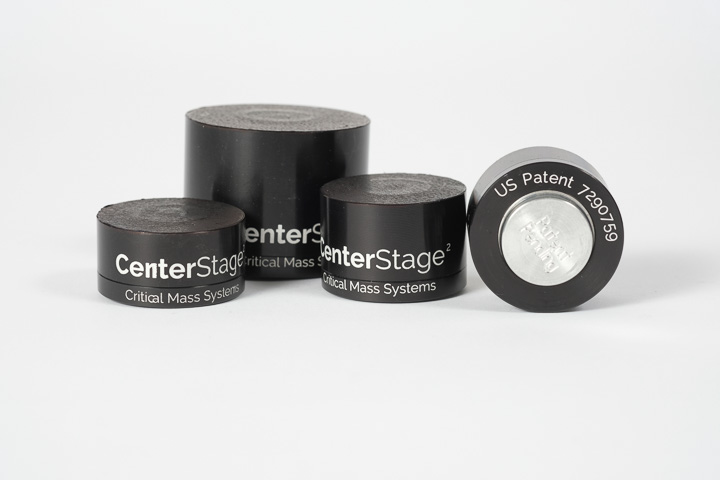
WIN! $11,900 worth of Critical Mass Systems Center Stage2 footers

Hi-Fi+ has teamed up with the clever guys from Critical Mass Systems to bring you an exciting chance to win $11,900 worth of Center Stagefooters to transform your system! Alan Sircom reviewed the Center Stagefooters in issue 163 of Hi-Fi+. He wrote, “Center Stage2 is made by “choosing and sequencing materials that possess the perfectcombination of damping, elastic modulus, and thin rod speed to lock in the desired effect.” That effect is, “a catalyst in a complex energy reaction that occurs between your equipment and its environment.”

The idea is that kinetic and vibrational energy act in an unregulated and undamped manner inside a product and by using four Center Stageunder electronic components can “change the prevailing state of equilibrium in that energy reaction and to permanently hold it in a reduced or damped state.”

He concluded by saying, “I can’t help thinking that this is the best of the best. If you can take the short-term pain, the long-term gain is more than worth it!”

Competition Question

What types of energy do the Center Stage2 footers permanently hold in a reduced state?

A. kinetic and vibrational

B. chemical and elastic

C. nuclear and solar

To answer, please visit Critical Mass System’s dedicated competition page at https://mailchi.mp/ca5f42b65418/criticalmasssystem_hifiplus 

Alternatively, send your answer on a postcard (including your name, address, and contact details) to Critical Mass Systems Competition, c/o Select Audio, Ross House, Maryport, CA15 8RX, Cumbria, United Kingdom.

Competition Rules

The competition will run from October 4th 2018 until December 6th 2018. The competition is open to everyone, but multiple, automated or bulk entries will be disqualified. The winner will be chosen at random from all valid entries, will be contacted via email (where possible) and their name will be published in the magazine. The Editor’s decision is final and no correspondence will be entered into. Absolute Multimedia (UK) Ltd. is compliant with the Data Protection Act and UK laws apply. Our policy is such that we will not pass on your details to any third party without your prior consent.

Rotel T14 tuner/streamer

Stop me if I’m being presumptuous but I suspect that most of the readers of this august journal can remember a time when the only way to listen to music without paying for it was on the radio. And, if you were listening in the UK, that was a very confined experience where the few broadcasters on FM were only interested in a mainstream audience. There were some stations that broke through the top 40 playlist barriers, like Radio Caroline and Radio Luxembourg on AM, and those prepared to stay up late enough could enjoy a genuinely eclectic mix on the John Peel show on BBC Radio One. But if you missed it that was it, there was no ‘listen again’, no music on demand, and definitely no Spotify, YouTube, or Tidal. All of which meant that the radio held rather higher status in the hierarchy of audio sources than it does today – an age when FM tuner sales were in free-fall, even before the threat to turn off analogue broadcasting came up again.

Radio still has its place for me. I frequently listen to specific shows in the hope of hearing something new and interesting (I have a Tidal account but that’s of little use unless you know what to look for or are a hip hop enthusiast). Rotel is hoping I’m not alone in thinking that, and there’s an audience for an all-singing, all-dancing multi-source ‘wireless’; a single device that can receive the majority of broadcasts and internet streams on the major platforms and more. The Rotel T14 is an FM and DAB receiver and a network streamer with access to internet radio and various streaming services, I don’t think there are many source components that provide the range of options than the T14 does. The back panel says it all, with a coaxial socket for an FM aerial, threaded coax for DAB, and twin Wi-Fi antenna for network streaming. It’s a little odd that there’s no RJ45 for a direct Ethernet connection to a network, but wires are clearly out of fashion these days. Of course, you still need wires to go to the supplied DAB and FM aerials, however the latter is redundant unless you’re living in the right place. I wasn’t initially able to get a clear signal from the T-shaped indoor antenna supplied and resorted to the DAB feed instead.

The DAB antenna has a magnetic base and when placed on a suitably ferrous bit of casework gets a stronger signal than otherwise, again this will be location specific and best results will be achieved with an external antenna, but who has one of those these days? I was able to pick up a good if not comprehensive range of DAB stations using the ‘national scan’ option, it found all the BBC stations but not Classic Rock (now on the Absolute roster). It’s fairly easy to stick your preferred stations into the preset buttons on the fascia or remote for ease of access and the nature of the input suggests you can have more than 10.

When you start to look at the internet radio options, it makes the array of DAB broadcasters seem very limited, I guess that it didn’t cost a lot more to include the terrestrial radio options on the T14 and there will always be times when the broadband is on the blink, but otherwise the net is hard to beat. For a start you can search for stations by name, albeit not always with success; for example, it found BBC Radio 3, but not Fluid, which in its ambient genre listing. You can search by location and city, which is fine if you know which city your station is coming from, but most net radios have station lists for countries. There are also podcasts listed by genre; this has Marc Maron’s WTF but not Adam Buxton’s popular show, popular in my household at least.


The network streaming side of the T14 is controlled by the DTS Play-Fi app, but can only be used once you have managed to get the unit onto your network, a process that proved slightly more tricky than usual, but at least didn’t involve inputting a password via the buttons on the fascia. The App is a little mystifying at times; getting back from the one of the streaming platforms or internet radio to the main menu confounded me for a while, but did prove possible. There is a stack of music services available, more than any other streamer I’ve tried, including favourites like Tidal, Qobuz, and Spotify Connect alongside Deezer, Amazon Music, Napster, and Pandora. Some of these are region specific of course and there’s more than a clue to the T14’s target market in that list.

Quite a lot of operations can be done with the front panel buttons, but hard as I looked I couldn’t find a seek button for FM stations. The manual suggests two methods for doing this, both of which proved reviewer-proof. However, I did note that reception had improved for Radio 3 on this occasion; it wasn’t noise free but gave the impression that a slightly better or better placed aerial would deliver decent results. Sound quality with the same station on DAB is reasonably open with some stereo solidity; it seemed a little lacking in fine detail, but given the compression used by broadcasters, even of BBC R3’s calibre, that’s hardly surprising. More importantly it made some Schoenberg sound remarkably musical and listenable – some very teenage, easy-listening Schoenberg that is; the Second Viennese School isn’t exactly on heavy rotation chez-Kennedy. Switching to the same station’s net stream produced a small reduction in quality, the DAB option being slightly cleaner and more open, but it’s a close call and switching to Play-Fi sources is not terribly quick.

That said, when you are streaming, those buttons on the right-hand side of the display can be useful. Rarely have I seen so many interwebular control options in metal; usually you have to resort to a remote or control app to skip tracks, shuffle, or repeat. Using the T14 as a network streamer with an Innuos Zenith SE server results in a somewhat vague sound by the standards of a good (wired) streamer. Whether this is due to the wireless connection or the streamer and DAC in the Rotel is hard to say, but the fact that it is also a tuner may be a factor – RF noise being the enemy of digital audio. It’s not an offensive sound but neither does it make you want to pay attention, which is a pity when there’s a server of the Zenith’s class feeding it. With Tidal the result is a little weaker than a wired streamer but the difference isn’t as marked, presumably because the signal has already travelled a fair way, and I had a lot of fun listening to a variety of different songs.

Going back to the server feed I tried a number of pieces starting with Beethoven’s ‘smash hit’ the 5th Symphony [Barenboim, Beethoven For All, 24/96, Decca], this had plenty of scale and a good helping of the drama that makes it so diverting, but the sound lacked clarity and imaging was rather vague. None of which stops you enjoying it of course but a good streamer is capable of showing the timing and dynamic subtleties that fail to come through clearly on the T14. Simpler material such as Radiohead’s ‘Decks Dark’ [A Moon Shaped Pool, XL] fares much better; its clearly defined, percussive nature comes through well even if the finer aspects of the imagery are left to the imagination. I think the Rotel’s main problem, however, is timing; the bass line on Patricia Barber’s ‘Touch of Trash’ [Modern Cool, Premonition] sounds slow, limiting the extent to which the music can connect with the listener. Removing the DAB and FM aerials did seem to help a little, but that undermines the point of the product.


There is a digital output on the T14 too, so I gave that a whirl with a rather OTT (under the circumstances) DAC in the form of a Chord DAVE, and this clearly helped. It brought refinement and clarity that made Joni Mitchell’s Court and Spark[Asylum] a joy once more, with decent definition across the board and improved if not quite kick ass timing.

The Rotel T14 is a useful piece of kit if you want to kill two birds with one stone without going down the AV receiver route. Whether it makes sense to incorporate a tuner into a product that can find the same programme, and a lot more, online is another question. It’s a niche product no doubt, but one for which there could well be a market if enough of us radio lovers still want a decent source.

TECHNICAL SPECIFICATIONS

  • Type: DAB/DAB+, FM tuner and network streamer
  • Control connections: Home automation via RS232, 12V trigger in- and outputs (via 3.5mm jacks)
  • Antenna inputs: DAB – 75 Ohm F connector, FM – 75 Ohm coaxial connector
  • Network connection: 802.11b/g/a/n Dual Band.
  • DAC Resolution: 384kHz/32 bit
  • Music services/Wi-Fi inputs: Spotify Connect, Tidal, Qobuz, Pandora, Napster, Amazon Music etc.
  • Analogue Outputs: One pair single ended (via RCA jacks)
  • Digital Outputs: One coaxial S/PDIF (via RCA jack)
  • Frequency Response: Not specified
  • Supported Radio Formats: FM, DAB, DAB+, Internet radio, Internet streaming
  • Distortion (THD + Noise): Not specified
  • User Interface: LCD display (on main unit), DTS Play-Fi application software for iOS, Android
  • Dimensions (H×W×D): 93 ×430 ×334mm
  • Weight: 5.1kg
  • Price: £699

Manufacturer: Rotel

UK Distributor: Rotel Europe

Tel: +44 (0) 1903 221 710

URL: rotel.com

Back to reviews

Read more Rotel reviews here

Zanden Audio Systems Model 9600Mk2 mono power amplifier

There’s an ‘if it ain’t broke, don’t fix it’ mindset at the heart of Zanden Audio Systems. The Model 9600 has formed the power amplifier basis of the company’s line since the turn of this decade. Zanden announced the 9600Mk2 with typical understatement, but “plus ça change, plus c’est la même chose” doesn’t quite apply here. OK, so the exterior remains almost identical, and the basic headline specifications are virtually identical between the two models, but where the first amp was awesome, this new one is ‘awesomer’.

Like all Zanden products, it is phenomenally well made. Often boxes come with white gloves, and when you see the ugly tin box of screws and powder coat inside, you wonder precisely the point of them. This is not one of those products. It’s like a giant jewel, with its flawless, mirror-like stainless-steel case and a refined, elegant viewing panel for the valves. Everything about the amplifier is refined, restrained elegance, the kind of thing that makes a Savile Row suit look garish. This is somewhat odd, because the almost gold finished aluminium panels on the front section (something close to white gold) could look very tacky, but instead just looks extraordinarily graceful. This is perfectionism, the stuff of Zanden head Kazutoshi Yamada, and that perfectionism expresses itself in every aspect of the product.

The differences between the original and Mk2 model are subtle and internal. The old and new look identical, but there are changes to the valve complement, improved circuit layout, better power supply, and a new transformer material for both the input and output transformers.

The 9600Mk2 features a cobalt input transformer, Finemet output transformers, and a double-choke valve-regulated power supply. The Finemet transformer is designed by Hitachi metals, this is a nanocrystaline soft magnetic metal, a world first. It combines excellent magnetic flux capacity, high permeability, and electromagnetic noise suppression, making it a popular choice for use in industrial lasers, and particle accelerators in nuclear medicine applications. Zanden first tried this in its ‘entry level’ power amp, and found it so successful that it was ‘trickled up’ to the top-line power amplifiers.

Zanden has been having a spot of quiet rationalisation of product lines of late. Regrettably, the digital audio side has now gone away (not least because parts were becoming scarce) as has the integrated amplifier and cables, and now the company has just six products in its electronics line-up; a phono preamp, line preamp, and stereo power amp in the company’s affordable ‘Modern’ line, and a phono preamp, line preamp, and mono power amplifiers in the cost-no-object Classic Line. The rest is a platter mat and vibration absorber. The improvements Finemet brought to the Model 8120 stereo power amp were suitably large enough to warrant investigation in the top products.

The Model 9600Mk2 remains Zanden’s flagship power amplifier. It employs two KR845 valves in the output stage, with two 6CA4, two 5R4WGB and two 5687WB, replacing the 5AR4, two 5R4WGB, and three 5687WB in the predecessor. That means a lot more valve rectification. As a result, it succeeds in combining both the high power properties of a good solid-state amp coupled with the tonal beauty of valves. It uses a fixed-bias, completely fully-balanced push-pull circuit and a fully valves-rectified power supply circuit. As a result, there are a total of eight valves per channel, including the aforementioned 845s as output valves. This means they put out 60W in Class A or 100W in Class AB. Although impressive in any valve power amp, to our American counterparts, that seems a little underwhelming, however, in use the amplifiers could drive real-world high-end loudspeakers extremely well. It might not be the first choice for power-hungry loudspeakers that need near infinite power, but neither does it fall into the trap of ‘fear the Watt’ low-powered designs. And that new output transformer has a great part to play in that sound quality.

Naturally, a power amplifier of this gravity deserves the best, and in particular the best in partnering preamplifiers. It’s hard to think of a more deserving partner than the Zanden Model 3000Mk2 line preamplifier, also running in balanced mode. The two share the same gain structure so the output of one almost perfectly matches the input of the other, but there’s nothing malign going on in making these too snug a fit. They work well together because they were designed together, rather than designed to dovetail.


This is the sort of system that focuses your attention on the music in a way that so few other systems can. It’s not only about the soundstage properties (which are both uppermost and superb), and not only about the richness and warmth of the sound, it’s the way music – even music you know so very well – mesmerises and captivates you.

In fact, ‘mesmerising’ is perhaps the best description of what the Zanden 9600Mk2 do and what they do to you while listening. Music is not simply good, or exciting, or impassioned. It is all of those things, but more importantly, it is mesmerising… you sit spell-bound  in front of your music collection, listening carefully to every piece you play.

In a way, Zanden is like the antithesis to the modern streamed concept. This is a measured, sophisticated, and knowing way to listen to music, rather than an orgy of sound, or a surf through a music collection. Music here has gravitas, and that permeates your listening as much as it permeates your listening tastes with the Zanden.

You find yourself selecting the album you want to hear, you play it in full, then repeat the process a few times, before stopping and taking a break. This is not because the music is at all aggressive or somehow unkempt, it’s that the Zanden delivers so much musical satisfaction, you feel no need to binge.

That sense of musical restraint is not a limitation, in fact it’s a freedom. We have become too accustomed to the musical world fed through Tidal and Roon. These two products combined are wonderful and allow a music lover to discover untold greats that you might never have discovered without these two titans of the post-physical digital music world. But not everyone wants to be so ‘dunked’ in different music. Bizarrely, in the time before Roon and Tidal, we used to choose a piece of music and listen to it, then maybe do the same to the next record, and then stop for the evening. In a way, this is respecting the recording. The Zanden’s musical approach is so mesmerising (that word again) that you can’t help but respect the recording, and that imposes a limit on playing time. You walk away from a Zanden-based listening session composed, refreshed, and musically satisfied enough to want to repeat the experience regularly. But that audio cliché of discs strewn round the room (which does happen, despite it being a cliché) is not what happens here.

This mesmerising property of the Zanden is simply that it’s impossible to break past the music and into the audio aspects, because your mind is drawn back to the music. So I play a piece of music designed specifically to focus on bass – ‘Chameleon’ by Trentemøller [The Last Resort,Poker Flat] for example, and you forget about the bass and focus on the gestalt of the piece. Put on the next album to evaluate soundstage – ‘Memphis Soul Stew’ by King Curtis and the Kingpins [King Curtis at Fillmore West, ATCO] and the same happens. It’s mesmerism at its best.

Eventually, after a protracted listening session, those cognitive powers begin to take hold, and you get past the sheer enjoyment music has on the Zandens, and focus on individual attributes of audio performance. This is very definitely an amplifier that leads from the midrange out; the vocal articulation and image solidity within that midrange is world leading. This extends up into the highest registers, but in a very elegant, never forced, never pinched, and never sharp manner. And it extends down into the bass, which is both cavernous and extremely well ordered. Bass can be a problem with valve amps because they lack the damping factor to really control the bottom end, but in this case, the loudspeaker feels like it’s being driven by a solid-state amplifier. All of this combines to make a sound that feels remarkably natural, and one that goes for richness of tonal palette rather than starkly etched details. In fact, the 9600 is extremely detailed, it’s just that it’s not ‘excessively’ so, unlike so many more immediate sounding devices.

There’s one important aspect of the Zanden sound that few systems do well, and it’s ‘beauteousness.’ We get so wrapped up in quantum of musical performance, we often forget how good or bad the overall sound can be. I’ve often heard extremely well liked products that somehow fail to make the cut because they work well when highlighting individual aspects of performance, but these individual components do not combine well sonically. The Zanden is the diametric opposite to this type of presentation. The way things sound on this system are always beauteous and refined. Not to a fault, but when you sit back and listen to a piece of music it just sounds so, well, beauteous.

In writing this, I’m detecting a sense in my own writing that could be seen as saying the sound lacks some guts and drama. That’s not entirely the case. Zanden is probably not the first choice of the hardcore death metal or dance music fan, because they are likely to go for something more immediate and more overtly dynamic than the 9600Mk2. But for those of us who don’t have such exclusive tastes, the elegance and approachability of the sound wins out, and wins big.

The result is – purely and simply – one of the best amplifiers I have ever heard. This is one of those career defining moments for me, like the brief time I had an Audio Note Ongaku at home when it was the most expensive thing on the planet. Or when I got to experience the Wilson WAMM Master Chronosonic in the late Dave Wilson’s own home. It’s both a humbling experience and a level resetting experience. You now know what good audio is capable of, and it’s not something you can come back from. On a very basic level, that audio reset button applies to valves specifically, because I have never heard a valve power amp sound this quiet and this capable before.


But absence of ‘valve rush’ alone does not make a good audio product. What sets the Zandens apart from the morass of good amplifiers keeps drawing me back to the music. It’s all about the music, and making that music sound more approachable, more accessible, and – yes – more musical. That happens the moment you turn them on until you turn them off. Virtually whatever the music, the Zanden rises to the challenge.

The Zanden’s limitations are few. Yes, this will not find favour among those wanting to cram as much top end energy as possible into every musical experience. And if you play this into difficult loudspeakers in a huge room, and then deluge it with heavy opera, the Zanden will eventually run out of puff. The valve regulation, however, seems engineered well enough to withstand complex themes without folding up and compressing the midrange.

You know you are onto a winner when a brand is spoken of in hushed tones. Zanden Audio Systems is one such brand, and the 9600Mk2 is part of the reason why those hushed tones are uttered. Of course this amplifier deserves world-class partners and that makes it extremely expensive in context, but it defines a musical performance the likes of which you simply don’t get from other components. That doesn’t just put the Zanden in the audio A-List, it turns out to be Audio Royalty, and you want that music in your life more and more.

The crazy thing about Zanden is no matter how good you might think a pair of very high-end, practically bespoke mono amps from Japan might be, in reality they are much, much better. Hands down, this is one of the most real musical experiences you can get from audio. Aficionados who take their audio extremely seriously have to try Zanden. It really is that good.

TECHNICAL SPECIFICATIONS

  • Type: Mono valve power amplifier (all specifications per channel)
  • Tube complement: 2 x KR845, 2 x 6CA4, 2 x 5R4WGB, 2 x 5687WB
  • Power output: 60W (class A)/
    100W (class AB)
  • Input: XLR
  • Input impedance: 7.5kΩ
  • Output impedance: 2Ω / 4Ω / 8Ω
  • Frequency response: 6Hz–50KHz (-3dB)
  • Dimensions (W×H×D): 32 × 44 × 45cm
  • Weight: 42.5kg
  • Price: £59,995 per pair

Manufactured by: Zanden Audio Systems Ltd.

URL: zandenaudio.com

Distributed by: Audiofreaks

URL: audiofreaks.co.uk 

Tel: +44(0)208 948 4153

Back to reviews

Read more Zanden Audio Systems reviews here

Continuum Audio Labs Obsidian turntable and Viper tonearm

Afew years ago, Continuum Audio Labs made the Caliburn turntable. It was an air-suspended, air-bearing, air-and-vacuum everything design that pushed the frontiers of both what you can get out of a record and – let’s be brutally honest, here – just how much you can spend on a record player. Just 100 of these six-figure decks were made, and then Continuum became little more than a footnote in sister brand Constellation Audio’s back story. The electronics brand was growing exponentially at the time and making a hundred six-figure turntables was considered saturation point, even with a deck as highly prized as the Caliburn and its Copperhead arm partner. Many thought that would be the last we would ever see of Continuum. And many were wrong, because the company is back with the new Obsidian turntable and Viper tonearm.

The Obsidian is a complete departure for Continuum. Where its predecessor was all air and vacuum, sucking the record in place and creating an almost suspension, the Obsidian is a solid chunk of deck. This doesn’t mean compromise, however, every aspect of the turntable might be different from before but that doesn’t make it inferior, more ‘differently better’, and given that you could buy almost three Obisidians for the price of a Caliburn, ‘differently better’ is one hell of an achievement.

Obsidian is actually the end result of the project that spun out of the Caliburn. Launched in 2005, that turntable was Continuum’s vision of the best turntable it was possible to make at the time. With more than a decade of research into turntable design and materials science since then, the Obsidian represents Continuum’s vision of the best turntable it is possible to make today. That the vision itself is very different does not change the goal.

The root of the clever parts of the Obsidian is that ability to not be hide-bound by past conventions, and especially by past glories, and instead to start ‘tabula rasa’. In the process, Continuum liken the development of the Obsidian to that of an elite sports car, spending dozens of man-years researching into motor technology, bearing manufacture, chassis design, platter design, and more. The company didn’t just throw out all the elements of the Caliburn for the sake of it; they analysed the original project to see what aspects of the design could be recycled, transplanted, or improved upon, and what parts could be consigned to history.

For example, the nested platter is retained, but radically improved. The turntable maker deployed a lot of finite-element analysis modelling to damp vibrations, both the ones coming from the stylus-record interface, and the ones coming through the ground via the base. By careful design, any unwanted resonances are pushed way outside of the audio band where their influence is minimised. According to Continuum, the platter is the component that contributes the largest amount of character to the sound thanks to those resonances. By removing those resonances well outside the audio band, the turntable loses an intrinsic character of its own. As you will see, this is something of an obsession at Continuum. It’s also worth noting that the new version of the nested platter is of sufficiently high mass to create its own flywheel effect.

That can be exploited if the platter sits on a bearing hard enough (both in literal ‘Rockwell’ and figurative ‘hard man’ terms) to benefit, and Continuum nailed this by going big. Really big. The massively oversized bearing in the Obsidian is larger than that of almost every other turntable brand on the planet. In fact, this is not simply to help spin a massive platter, it’s because of the relationship between bearing size and platter resonance that only Continuum and a handful of other deck makers seem to have noticed. By replacing the normal spindle-sized bearing with one that wouldn’t look out of place on an axle of a small truck, resonance is kept below 10Hz.

The really interesting part here is the bearing is magnetically opposed, but does not float, so it acts as a low-friction design, but retains a mechanical grounding path. That means none of the risk of wobble found in other mag-bearing designs. It also has a ball and shaft made from tungsten, which means torque transfer is excellent and the bearing will last a lifetime or three.

The obsessiveness applied to the bearing and platter housing are echoed in the design of the motor and its housing. Continuum refers to this motor as The Quiet One because the 35mm, 60V DC motor uses a high-power design with graphite brushes and ball bearings instead of sleeve bearings, making sure that any vibrations are damped elsewhere in the structure. The DC motor itself is servo controlled at a higher rate (53.6kHz) than its competitors, meaning cogging effects are functionally zero. This is fed by an off-board power supply that can be used to set precise, drift-free 33 and 45 rpm, or can be speed controlled slightly through a series of button pushes on the external box’s front panel. The logic to drive the speed control is a little ‘modal’ (press to engage 33 rpm, depress to disengage 33, then press to engage 45 rpm, and so on) but this soon becomes second nature. Almost.

Even the armboard has been given careful consideration, and as that is the part that is usually given lip service in a turntable design, this is impressive in the extreme. The armboard housing has two outriggers (it can be connected to both the regular position to the right of the turntable, or applied to the two covered holes in the front, allowing for two arms should you wish. The arm is actually ‘suspended’ using a magnetic attachment system, although this is – once again – to prevent vibration interfering with the arm’s operation.

This creates a high-mass arm base, but also one that is double-isolated against the transfer of vibration or resonance. Like the deck itself, much of the mount is tungsten.


Any arm could be fitted to the Obsidian, although a 10” arm is optimal. Theoretically, Continuum could build an armbase with longer tungsten mounting bars to accommodate a longer arm, but eventually such things get self-defeating, either from an engineering standing, the cost of the custom mounting bars, and so on. But more importantly, why bother in the light of the Viper tonearm, which makes such a fine and logical match, casting the net for a better arm is almost academic.

The Viper is a unipivot with a sapphire vee jewel bearing on a hardened stainless steel pivot is a work of genius; the bearing housing itself has been designed with the Continuum in mind, and features extremely precise adjustments of VTA, Azimuth, and VTF (down to 0.001g increments). Arm tubes are easily detached and are interchangable. It uses an underslung counterweight in a set position. Changing its balance point means running through a series of different counterweight washers. This is a bit of a pain, but ensures the geometry of the arm remains consistent no matter what. The armtube itself is exceptionally light (it’s about as thick and as heavy as an eggshell, although a lot more rugged and incapable of being fried over easy).

Installation of the turntable is easy, and while the turntable is high-mass, it’s not unliftable when in its component parts. You can go from box to shelf in an hour or so. The arm is not that much slower, but it demands attention to give of its best. If you aren’t the kind of person that would routinely devote a day to setting up a cartridge to get it just about perfect, then you might want to call for back-up. Like any first-rate tonearm, the performance is only as good as how much time you spend on it, and this is really worth the effort.

All that obsession about resonance and vibration pays off, big time. I guess that’s pretty obvious, if you think it through for a few seconds: a turntable is acting like a seismograph in reverse, so every time you introduce extraneous vibration or resonance you are going to undermine that backwards-seismograph’s signal, and conversely, everything you do to make that signal less interfered with by vibration or resonance, the better it is going to sound. It’s not rocket surgery!

This is perhaps the easiest part of this review to write, because the deck and arm combined do exactly what they are supposed to do: be a blank canvas for the cartridge to drag its rock through a groove. About a minute into the second album you play on this turntable, it dawns on you that the deck is just determined not to make a sound, and leaves all of that to the cartridge and the phono stage. With great power comes great responsibility, however, and this means taking an uncompromising line on those parts. Given the family history and relationships, the phono stage was from Constellation (the Perseus) and the cartridge was from Koetsu (Onyx Platinum). This was all you heard; no platter ring, no vibrations, no ‘bright’ no ‘dark’… just what the cartridge is telling you about the record.

As I said earlier, this takes two records. You listen to the first one – in this case Marty Paich Big Band’s The New York Scene[Discovery] – then you put on a second – in this case Duke Pearson’s The Right Touch[Blue Note]. You then realise they sound like they were being played on completely different record players. Both record players were perfectly optimised for that record. You move on to a third and a fourth, and the same happens again. And that makes this the worst part of a review to write, because I can’t pin anything down. Is vocal articulation good? On Sweet Baby Jamesby James Taylor [Warner, Speakers Corner], it’s sublime. On ‘Figure It Out’ from Royal Blood’s eponymous debut [Warner, again], it’s more blurred, but the guitar and drums are powerful and dynamic.

You then fall into the trap of thinking about the deck in terms of other decks, and you are in deep trouble. On one record, it sounds like a Linn, because the record has that kind of tonal balance that benefits from a Linn’s presentation. On the other, it sounds like a VPI, for similar reasons, on a third, a Rega, and so on. This is in the danger zone for a reviewer, because it leads to ‘waxing philosophically’ and then you are well and truly lost.

The trouble is, there’s nothing to see here, and that is a wholly good thing. A source component isn’t supposed to be a filter or a influence on the sound, and that’s precisely what the Continuum is or isn’t doing. It has no ‘drag’ on the sound, no influence, no footprint, nothing. Images are as wide as the record, dynamic range changes from album to album. This deck and arm do almost nothing to the sound.

When you listen to a soundless turntable, you are transfixed. You are enthralled. One minute you are wiggling along with Duke Ellington taking hold of Newport in 1958, the next you are wailing in sorrow while listening to a requiem mass. The sound of nothingness is the sound we signed up for originally all those years ago. It’s the sound records are supposed to make, but seldom do in reality.

For all this, however, the turntable and arm are relatively forgiving to bad albums. OK, so I didn’t have my copy of The Handless Organistto, er, hand, but you play something thin and clipped it will play that without making it unlistenable. The really unsaveable recordings will stay unsaveable, of course, but even here, the Continuum’s sense of even-handed order will usually make the best of a bad job.


Of course it is on the really good records where the Continuum shines. The Columbia reissue of Berlioz: Symphony Fantastique (New York Phil, Mitropoulos Cond.). ‘Un Bal’ and it’s waltz-like properties were inspiring. The changes in tempo, the sense of space around the instruments, the tonality of the instruments themselves, and the absolute lack of anything getting between you and the music was extremely alluring.

And then there’s the musically wonderful moments that make it all worthwhile: playing something like ‘Crying’ by Roy Orbison. That’s not a record that I was there for the first time round, but it’s not difficult to empathise and realise that for the length of time the record played, the turntable was a time machine. Funny how records you might have only heard on a cheap 1960s turntable and stuck away for decades can have such emotive energy when played on the really good stuff.

A parting shot here was the use of a good cleaning machine, like the Klaudio. Granted this can make changes that can be heard on almost any table, but the impact it had on the Obsidian and Viper made such a thing almost mandatory.  A small change on a normal turntable became a transformation of epic proportions through the Continuum.

This is a truly wonderful deck to experience, or rather not experience. It’s complete absence of sound and total neutrality is not stark, bright, or forward. It’s neutral, but not in a ‘Switzerland’ kind of way. It’s actively neutral, making a sound that is beguiling and exciting because the impact of the Continnums is so minimal on the music. It makes music come to life in a way few other turntables at any price can.

TECHNICAL SPECIFICATIONS

Obsidian Turntable

  • Type: Belt-drive non-suspended turntable with DC motor
  • Rotational Speeds: 33 1/3 RPM, 45 RPM
  • Supported Tonearm Length(s): up to two 9-inch arms supported as standard.
  • Drive Mechanism: Belt driven via 60V DC motor, via external PSU
  • Speed Control: via PSU (fixed and variable)
  • Platter Type: FEA-modelled Nested Platter
  • Bearing Type: Oversized magnetically opposed bearing with tungsten ball and shaft
  • Arm bases: magnetic support base for arm, tungsten rods as outriggers
  • Dimensions: not stated
  • Weight: not stated
  • Price: £39,998

Viper Tonearm 

  • Type: Unipivot tonearm
  • Bearing type: sapphire vee jewel bearing on a hardended stainless steel pivot
  • Overhang: not stated
  • Adjustment options: VTA, Azimuth, and VTF (down to 0.001g increments)
  • Dimensions: not stated
  • Weight: not stated
  • Options: Spare arm wands (£POA)
  • Price: £11,998

Manufacturer: Continuum Audio Labs

URL: continuumaudiolabs.com

Distributed by: Absolute Sounds

Tel: +44(0) 208 971 3909

URL: absolutesounds.com

Back to reviews

Read more Continuum Audio Labs reviews here 

IsoTek EVO3 Nova One & EVO3 Genesis One

When was the peak for the potential of high fidelity audio systems in the home? As audio systems have steadily improved, the amount of noise in the powerlines and even in the air has increased with it. From a noise point of view, the era before switched mode power supplies and mobile telephony, not to mention the internet and the Wi-Fi that came with it should have made life a doddle for audio equipment. In the 1980s, there was far less radio frequency interference (RFI) and lower levels of electromagnetic interference (EMI); go back further and such things would have been lower still, before microwave ovens for instance. Maybe that’s why music recorded in the sixties and early seventies sounds so good, but it was also the time that analogue studios peaked before digital came along and gave them so much power to screw things up. Analogue audio systems were reasonably advanced by the 1970s, but digital had only just begun to encroach beyond the lab, and the story of digital audio goes hand in hand with the expansion of noise-emitting devices in the world at large. Now we are at the point where it’s possible to improve a system merely by improving earthing, so it’s no wonder that the demand for mains cleaning devices has grown.

IsoTek has been making nicely encased mains filters and regenerators for some time now and they identify two key sources of interference: differential mode and common mode. Differential mode is the noise that’s on the mains supply and created by other electrical devices such as computers, TVs, etc., as well as the components in your sound system. Common mode noise is mainly at radio frequencies, from things like your Wi-Fi, mobile phone, TV, and radio transmissions. It too gets into the mains supply because power cables act like an aerial. And then there are homeplugs, which carry your network through the mains wiring – arguably the best way to pollute your power supply yet devised by man.

IsoTek’s latest creation is the EVO3 Nova One, a single outlet power filter in a very long but small section case that’s designed for source components and other low current devices such as preamplifiers. The company describes this as an evolution from the original GII Nova with a modified and improved clean power network created specifically for source components that use less power.  It’s designed to deliver high-frequency filtering, and has a nine section circuit consisting of both series and parallel filters to remove both common mode and differential mode noise on the mains. The other single outlet source specific conditioner in the Mosaic range is the EVO3 Genesis One. They call this a single-cell sine wave generations system; in other words, it isn’t a conditioner in the usual sense that it filters our noise, but rather a regenerator that that creates a precise 50Hz, 230v signal regardless of what’s coming out of the wall. You can get the Genesis One with or without a display that tells you how many volts it’s receiving and how much it’s outputting in terms of Watts, THD, and voltage. It’s quite surprising how much variation there is in terms of voltage from the mains, mine rarely goes down to 230v but usually hovers somewhere above it. It produces the desired voltage with a Class D amplifier with linear power supply and all internal connections are made with silver plated PC-OCC in a virtual air dielectric cable that you would be happy to have in pretty well any component. The Genesis One is specified to deliver up to 100 Watts and thus can power anything that isn’t an amplifier.


The very long, 470mm, deep casework looks great but does mean you need a deep rack or a bit of space nearby. IsoTek provides spikes and pucks to sit them on.

Given the price of these devices anyone with more than a single source and/or preamplifier might wonder if there is a more affordable alternative with multiple outlets. The IsoTek EVO3 Sigmas comes close at just under £3,000 but doesn’t have a regenerating output; the firm’s EVO3 Mosaic does regenerate and has outlets for power and source components but costs a shade under £8,000. If you want both options a split is inevitable. And when I start describing how the two differ in their effects you might start looking at the EVO3 Mosaic in a new light.

I tried the two IsoTek devices on a number of different components starting off with an Audio Technica HA-5050H headphone amplifier that was already connected to a (relatively affordable) Puritan Labs PSM136 multi-outlet conditioner; adding the IsoTek managed to open up the sound still further, reduce some lateralisation effects of the headphones and improve timing and immediacy. The overall effect making the tune from the clarinet and string tone in the violins of a Mozart piece far more pleasing (‘Violin concerto in D major’, Marianne Thorsen, TrondheimSolistene, 2L). Using the Genesis with a Chord DAVE DAC relaxed and opened up the layers in the mix, creating a greater musical coherence where the various parts of the orchestra played more cohesively and created a stronger overall musical experience. The effect was to make the performance far more engaging and it also caused the unleashing of the air baton, which doesn’t happen very often.

With an Innuos Zenith SE server, adding the Nova One opened up the sound and improved the timing, increasing definition of leading edges, which resulted in greater drama and an obvious cleaning up of the high frequencies. Moving the same server to the Genesis One improved things quite markedly, creating a walk-in sound stage with excellent separation and a magic being-there coherence where the potential of this remarkable server was made very clear indeed.

Contrasting the IsoTek components with the raw power from the wall and switching the Zenith SE to the Nova One and the DAVE DAC to Genesis One improved things quite significantly. Suddenly the dynamics increased with much more vitality and energy coming off the track alongside a much stronger sense of three dimensionality created by a lot more fine detail, it was almost like going from mono to stereo recordings.

With same DAC and an AVM PA 8.2 preamplifier putting the Genesis One on the converter and the Nova One on preamp and playing Doug MacLeod ‘Too Many Misses’ [Exactly Like This, Reference Recordings] had an ‘open sesame’ effect on the soundstage which expanded to an uncanny degree and brought more solidity of kick to the drum and enhanced the quality of timing. The overall result provided a far greater sense of engagement and enjoyability, which in my book is the aim of the game. Switching around with the Genesis One on the preamplifier and the Nova One on the DAC reduced the scale and calmed the overall presentation, focusing on the flow and in fact resulting in a more relaxed sound that while not so exciting might be preferable in some systems.

I tried these conditioners on a Rega RP8 turntable which was connected to the phono stage in the AVM preamplifier. Initially I put the AVM on the Genesis and the RP8 on the Nova, but switching things around (with the Nova on the preamp and the Genesis on the RP8) proved far more satisfactory; timing improved quite dramatically and the resolution with it, resulting in a calm yet dynamic and compulsive groove. This sounds counter-intuitive (regenerated mains should be more useful for a power supply) but on LP it works.

Just for completeness I also decided to see if a Valvet P2c valve preamplifier would benefit from cleaner power. Switching the Valvet from the wall to the Nova One cleaned up the highs, but didn’t really do a lot more to what was already pretty open sound. It made me wonder if thermionic devices are less sensitive to mains noise. However, the Genesis One proved that this is not the case by increasing dynamic range thanks to a lower noise floor that distinctly improved three-dimensional imaging, separation, and focus.

It would seem that mains conditioning of some form or another is pretty well essential if you are to realise the potential of a decent system. IsoTek has consistenly proved this to be the case and, with these two bricks of power, makes its point very clearly indeed. Expensive regeneration is the way to go for ultimate results but conditioning is also highly beneficial in most instances. You pays your money and takes your choice.

TECHNICAL SPECIFICATIONS

EVO3 Nova One

  • Type: filtering single outlet mains conditioner
  • Number of outlets: 1 + linking connection
  • Outlet: 2300W
  • Power cable: IsoTek Premier
  • Specifications for: UK, EU, US, ZA, Australia, Switzerland
  • Dimensions (H×W×D): 125 ×75 ×470mm
  • Weight: 10kg (boxed)
  • Price: £1,495

EVO3 Genesis One

  • Type: regenerating single outlet mains conditioner
  • Number of outlets: 1 + linking connection
  • Outlet: 100W
  • Power cable: IsoTek Premier
  • Specifications for: UK, EU, US, ZA, Australia, Switzerland
  • Dimensions (H×W×D): 125 ×75 ×470mm
  • Weight: 10kg (boxed)
  • Price without/with display: £1,995/£2,795

Manufacturer: IsoTek Power Systems

URL: isoteksystems.com

Back to reviews

Read more IsoTek reviews here

Linn Selekt DSM digital streaming platform

Editor’s note: In the weeks between encountering the Linn Selekt DSM and today, some of my opinions have changed. They are included in an addendum at the bottom of this review.

In the network streaming kennel, Linn Products is one of the alpha dogs. But, it has to be said, the DSM platform – while remaining current – is very mature… and maturity is a mixed blessing in a market that defines itself by a ‘what have you done for me lately’ approach that is locked to the product life cycles of smartphones and computers. However, Linn has been incredibly smart with the new Selekt DSM network player, in that it simultaneously makes for an upgradable, open-ended platform for the next few years, and one that sits happily in the existing product line without rendering anything obsolete.

The Selekt DSM is an entirely new line of device for Linn, one that doesn’t just sit in context of other Linn equipment. It’s something of a paradox that one of the most open-source brands builds systems that are treated like a closed loop, but that loop gets broken with the Selekt DSM. This isn’t designed to be a part of an active Linn loudspeaker system, but instead as a source component in any decent audio system. With its inherent modularity, it’s possible that the Selekt DSM will grow from a source component to a better source component (with the Katalyst DAC cartridge upgrade), and then to a complete amplifier solution or headphone amplifier (to follow). But there is no expectation of the Selekt being used with any existing Linn equipment, even Linn loudspeakers. This doesn’t sound like a big thing when discussed in the context of open-ended systems, but many Linn dealers have become so conditioned to selling Linn with more Linn, just mentioning the notion of the Selekt DSM being played with KEFs or Bowers & Wilkins loudspeakers (as they were at the demonstration provided by Linn at its Waterfoot HQ in Glasgow) is tantamount to heresy.

A modular system is not exactly a new thing, and not even new to Linn, but the Selekt DSM’s approach is unique all the same. Many modular approaches require a modicum of ‘tech savvy’ on the part of the installer; an unplugging of a wiring loom here, a solder tag there, a tea cup filled with 65 grub screws of different sizes… that sort of thing. Some even require the product being returned to the factory for its upgrades, something that becomes prohibitively expensive when international clients start shipping products around the world.

Linn’s new approach to modularity is designed to make almost anyone fully equipped with the technological know-how to upgrade, thanks to a series of what look like AGP or PCI ports running along the rear side of the Selekt’s front panel. Undo two bolts and the top-plate slides off. Unscrew four more and the front section lifts and pivots forward, then slot and decouple the upgrade cards as you feel fit. If you move to the full Class D amplifier module set, there is a beefier encased power supply to insert, which follows along the same lines. These need to be named in the Konfig app, but that’s it. In short, if you installed your own network card (or similar) in a desktop PC and didn’t need a fire extinguisher, you could update a Linn Selekt DSM. That being said, updates and upgrades will be a job for a dealer, but this can just as easily be a home visit rather than taking the Selekt DSM back to the store. It really is that simple. In addition to taking the strain off the end user, this is considered a good thing for a dealer – they get to see your set-up first hand and might be able to offer a fresh install or upgrade tips in context, and it’s also good for them to have a ‘call out’ that isn’t depressing – most times after the initial install, dealer visits to the home are all about fixing broken things; this one’s a more positive experience all round.


While we are on the subject of things Linn are doing that are not immediately connected to the Selekt DSM, the company is to quietly drop the DS versions of the Majik, Akurate, and Klimax models (meaning there will only be DSM-based source+preamp models and no more source-only variants). Apparently, almost no-one chooses the source-only models these days. At the same time, there is a significant change to the company’s Space Optimisation room correction system to allow for greater variation of room shape and position of objects like doors and windows. This is not for Exakt users, however… for the moment.

There are also a few nice design touches to the case, like the etched logo into the top plate, the 90° vents laid out like a riffle shuffle, and the fact the third of the three feet sits directly under the control/volume knob, giving the Selekt DSM the look of having a solid tube of tech running from the top to the equipment support. It is a bit ‘none more black,’ however. In short, it’s a break from Linn’s more conventional look, and a welcome one at that.

The Selekt DSM’s look is a bold departure for Linn. While it is an all-black design not dissimilar in size and weight to the Majik DSM integrated amplifier, the acrylic front panel, the multi-way top-mounted control dial, and the large OLED screen with an array of fully configurable hard buttons represents a big change for a company that doesn’t change its product design with the wind.

The aspect of the design that will draw the most attention is that dial on the top. In fairness, manufacturers have been putting knobs and dials on top of products since the first electrical goods created the need for a dial. But that’s probably not how it will be taken in some circles. The dial is more than just a rotary commander for the digital volume control, as moving it left and right or up and down allows access to set-up menus or a review through available sources. It also highlights when problems arise in the network or the pausing of a track, depending on the speed and intensity of the glowing Linn logo at the dial’s centre. It’s all very intuitive, and works well with the monochrome front screen.

Linn decided to go with a monochromatic text display, rather than a multicolour display that can support album art, even though the display itself is a full colour model. There are good reasons for staying with monochrome: there’s nothing worse than staring at a dirty great big visual question mark when you can’t find the album art; and, from a psychological perspective, large white lettering on black screen are both easy to read and stop people thinking the screen is a touchscreen. The album details are clear and can be read across the room.

Between the display and the dial, there are six small fully user configurable buttons, and in saying ‘user configurable,’ Linn is not mincing its words. You can assign anything from a single track held anywhere in your musical sphere, through a mounted source component, an internet radio stream, right through to a specific playlist or even a track you love. So, the leftmost button could be a turntable (the Selekt has its own MM and MC phono stages), the next could be Robbie Williams singing ‘Angels’ (hey, it’s your call), the next could be the internet radio stream of Dance Attack FM, the next a playlist of Stockhausen from your Network Attached Storage, then a playlist of West Coast jazz from Tidal, and so on. These are all driven from Linn’s free Kazoo app, which is a silly name for a surprisingly powerful app, available on all platforms except Linux.


There is another seemingly subtle and in fact hugely significant change to the Selekt DSM – it supports USB! The other Linn streaming devices in the range have all been exceptionally good at dealing with UPnP streaming, and more recently online streaming from Tidal or Spotify, but plugging in a humble PC full of music via USB was simply not done in Linn circles. There were accusations of elitism by Linn’s rivals (it was low-hanging fruit for the competition), and more than a few red-faces among fresh-faced Linn reps trying to find a USB port. That all ends with the Selekt DSM, as it sports a Class 2 USB port, and your computer – if not a USB hard drive – can now play from a Linn product. DSD is coming, but MQA remains steadfastly MIA.

Before we get to the performance, let’s just focus a little more on the hardware itself. The Selekt acts identically with analogue or digital sources, in that its first step is to pass any analogue sources through an A-D converter and all subsequent processing is performed in the digital domain. This means the built-in MM and MC phono stage has a lot in common with Linn’s flagship Urika II t. At its most basic configuration, the Selekt DSM is a standalone streaming source component/limited function preamplifier, and subsequent upgrades (available at launch) include the Katalyst DAC cartridge, and power amplifiers. A headphone amp module and potentially other products in the Selekt line will launch later.

But it’s how it sounds that matters. Selekt DSM sits midway between the Majik DSM integrated streaming amplifier and the Akurate DSM. In standard guise (as in without Katalyst DAC), its performance is in line with its price positioning; it’s a lot better than Majik DSM and not quite as good as Akurate DSM. Adding the Katalyst DAC cartridge upends this happy placement, however, as the Selekt DSM has more control over the music than the Akurate DSM. The differences are not substantial however; it’s more an ‘edges past by a nose’ rather than ‘pistol-whipping the Akurate into submission.’ It has that characteristic Linn lean, clean, tight, and dry sound common across the range, but the precision of that sound improves significantly by adding the Katalyst DAC cartridge. It doesn’t ‘obsolete’ Majik or Akurate. Probably.

A more interesting test is with the inclusion of its amplifiers modules, making the Selekt DSM a very close price match with the Naim Uniti Nova. Typically, this test wouldn’t be performed because of Linn’s almost shut-in approach, but the Selekt DSM is the ‘outreach’ device, and this makes for interesting listening. The Linn has both a drier sound and a more satisfying bass than the Naim product (even in standard DAC guise), and when the Katalyst DAC is in place, the differences between the two are substantial and significant. Granted at that point the Linn product is considerably more expensive than the Naim, and it was a quick test, but I suspect many people would choose the Linn if they performed the same comparison.

Finally, there’s Space Optimisation. Where before it had a basic set of room construction options, it now allows far more nuanced real-world room settings, accounting for L-shaped rooms, more accurate placement of doors and windows, and a graphical user interface that allows you to draw your room. The listening room was rectangular anyway, so we are not going to access Space Optimisation’s refinements, but once again the improvement is worth making especially if you are in a less-than-perfect setting.

Linn’s new Selekt DSM has a series of Linn-relevant ‘firsts’. It’s the company’s first fully new digital streaming platform in years, and it will undoubtedly form the basis for new models. It’s the first product in years that is designed to break free of Planet Linn’s gravitational pull, and it is modular enough to attract a range of listeners. I think Linn has got it right with the Selekt DSM.

Addendum:In reading my review back having let it settle for a month or so, I’m of the opinion that I underplayed some aspects of the product’s design and performance. Whether this was because I had just come off the end of one of the busiest writing schedules in my career, that I was setting the Selekt DSM in the wrong context, or a combination of these things remains unclear to me, but I feel like I was pulling my punches.


The biggest change I would add to this is in regard to the Selekt DSM’s modularity. This is not a small step forward; it’s a step-change in audio design. We’ve had modular amplifiers before (in fact, I’d reviewed two of them in quick succession before I got to the Selekt DSM), but not an amplifier where it’s very status as ‘amplifier’ is part of that modularity. This makes the Selekt DSM uniquely modular, not just a modular amplifier. It’s a modular headphone amplifier, a modular source component, modular preamp, or a modular integrated amplifier. In fact, a more accurate term might be a modular/modal design – the modularity of the stages (integrated amp, headphone amp, source, preamp) and modal in terms of DAC cartridge options. Given too this cartridge approach to DAC design means that if there’s a breakthrough in hardware (or software that requires more than just a firmware update), the change can be accommodated… even if it requires a beefed-up power supply.

That sort of open-ended modularity challenges what could be considered the Platonic Forms of audio categorisation. And, while valid, that is the most pretentious sentence I have written in audio… and will be until I start discussing product testing in terms of Kantian deontology. What I mean by this is we tend to use typology in audio (“it’s a power amp!” etc) and a genre-bending product that simply side-steps that kind of classification can sometimes confound where it should inspire. In reality, the Linn Selekt DSM is the perfect ‘now’ product because of its refusal to be classified. It means if you are starting out, starting anew, simply changing up your streaming source, or refreshing a few products in the chain, this becomes one of the front-runners. Which means it’s not one product in one category. It’s one product (with a lot of variations) in about six different categories. That’s what makes it so important, and not simply for Linn products. That alone demands so starry-eyed, slack-jawed fanboidom!

The other big punch-pulling was with regard to where Selekt DSM sits in the Linn echelon. In it’s standard guise, it’s better than Majik, but it’s more expensive than Majik. The full-up Aktiv Akurate DSM system is better than Selekt DSM, but it’s also a very narrow, very expensive Linn-related option. But the big issue is that bit in-between, where Selekt DSM takes on an Akurate DSM with Akurate amps in a passive context. Now it gets nuanced. The full Katalyst-enabled Selekt DSM with its brace of on-board Class D amps gets extremely close in performance terms to the Akurate DSM and power amp combination, and in many respects outguns the older platform. And yet, Selekt DSM is cheaper than Akurate in this setting. In fairness, I can’t see many Akurate users side-shifting to Selekt DSM, but I also can’t see many freshly minted passive Akurate users now that Selekt DSM exists. It’s that good.

I still stand by the notion that the Linn Selekt DSM is so strong because it’s the Linn system for non-Linn users – you don’t need to have Aktive Linn speakers and the rest in your sights and you don’t need to buy into the whole Linn ethos from the get-go. Selekt DSM could be your first Linn product, and needn’t be your last, but it doesn’t lay open a trail to the Linn factory – you could partner this with a pair of good speakers and be done with audio component selection for the next decade or more.

However, the Linn Selekt DSM’s strength lies beyond this. It takes on behemoths both inside and outside the Linn Katalogue, and in most cases wins… and wins big and hard, too. This is there for the long term and will move with the times, but right out of the starting gates, the Selekt DSM looks like a winner.

TECHNICAL SPECIFICATIONS

  • DAC Type: Switched-capacitor DAC with low-noise reference voltage
  • THD+N : 0.0002% (1kHz 0dBFS at volume 80)
  • Dynamic Range: 114dB (Measured at Line-out module XLR output with AES17 measurement filter)
  • Katalyst DAC upgrade
  • THD+N : 0.0002% (1kHz 0dBFS at volume 80)
  • Dynamic Range: 117dB (Measured at Line-out module XLR output with AES17 measurement filter)
  • Digital inputs
  • Type: FPGA based S/PDIF receiver with digital PLL
  • SPDIF ×2 | Toslink ×2 | HDMI ARC ×1
  • Supported sample rates (kHz): 32, 44.1, 48, 88.2, 96, 176.4, 192

USB input

  • Type: USB Audio Class 2 endpoint.
  • Supported sample rates (kHz): 44.1, 48, 88.2, 96, 176.4, 192
  • Analogue inputs
  • Type: Digitising analogue input stage with independent analogue phono preamps for MM and MC cartridges.
  • ADC Sample rate/resolution: 192kHz/24 bits
  • Line-in (RCA): Max input voltage : 4.25Vrms
  • MM Phono (RCA):         Max input voltage (1kHz): 67mVrms
  • MC Phono (RCA):          Max input voltage (1kHz): 5.5mVrms

Audio processing

  • Space Optimisation |Exakt crossover filtering (option) | Upsampling to 768kHz/32 bits |
  • Digital Volume Control
  • Line-out module
  • Type: Direct-coupled output stage with balanced and unbalanced outputs
  • Output Level: 2Vrms (RCA), 4Vrms (XLR) @volume 80
  • Output Impedance: 300 Ohms (RCA), 600 Ohms (XLR)
  • Power amplifier upgrade
  • Type: Bridged Class-D amplifier with post-filter feedback.
  • Max output power: 100W/channel into 4 Ohms, 50W/channel into 8 Ohms
  • THD+N (Measured with AES17 measurement filter): <0.01% (1kHz, 100W into 4 Ohms) <0.001% (1kHz, 12.5W into 4 Ohms) <0.005% (1kHz, 50W into 8 Ohms) <0.001% (1kHz, 6.25W into 8 Ohms)
  • Exakt Link: 2 Exakt Link ports to allow connection to: Exakt speakers | Exaktboxes | Urika II
  • Ethernet: 10/100 Base-T RJ45 Socket
  • Price: From £4,000

Manufactured by: Linn Products

URL: linn.co.uk

Tel: +44(0)141 307 7777

Back to reviews

Read more Linn Products reviews here

iBasso IT01 earphones

iBasso’s IT01 earphones retail for a penny shy of £90 and are the yin to the iBasso DX200 digital audio player’s yang. The DX200 DAP, when combined with the IT01, makes an impressive combination. However, as groovy as the DX200/IT01 combo is, the IT01 earphones deserve consideration in their own right. Whether or not you might be stretching out to own the upper end £750 DX200 DAP, iBasso intends the IT01 to make its own splash in the already crowded world of sub-£100 earphones.

The IT01 features a 10mm dynamic driver system developed in-house by the iBasso team that pulls together three key technologies. The first of these involves the IT01’s multi-layer driver diaphragm, which iBasso forms from ultra-thin 5μm sheets of carbon graphene material that, at a microscopic level, are significantly stronger than steel. The extreme thinness and strength of the diaphragm frees the IT01 driver from the need to be mechanically damped. Relying instead on air damping alone, the iBasso dynamic driver produces extremely low distortion. The second key technology involves the driver motor’s extremely strong customised magnets that are said to approach 1 Tesla of magnetic flux—an impressive figure of merit in any headphone, but especially so in such a compact driver assembly. The third key driver technology involves dual Helmholtz resonators into which the drivers are loaded. These unique dual resonator units operate as a series of cylindrical neck and cavity connections and were designed to prohibit unwanted standing sound waves and thus produce a clearer and more full-bodied sound.

The IT01s can be purchased in bright blue-and-red, or in all black, and they come complete with a wide array of flexible ear tips giving you several options to find a comfortable and air tight seal in your ear canals. A visually striking feature of the IT01s is a handmade braided four-wire OFC cable, complete with MMCX earphone connectors. This handsome cable looks and feels like a high-quality speaker cable and has the added benefit of being designed to reduce any annoying microphonic transmittal of sound. I found that the IT01s were initially a bit tricky to learn how to set in my ears so as to develop the proper seal, but once I got the hang of it they proved to be a very comfortable earphone that quickly let me forget about their physical presence.

During listening tests, the IT01s continually surprised by opening up space in the music. The treble and bass were well proportioned in relation to a spacious and detailed—albeit slightly forward—midrange. Regardless of what was playing the IT01s seemed to continually flout the convention that a sub-£200 earphone has to settle for a pent-up and congested sound. Apollo Sunshine’s crown jewel ‘Phyliss’ from their eponymous debut album [spinART] is a sonic tour de force that shows what the IT01 can do. The IT01s helped convey the artist’s intentions by accurately allowing the track’s tempo to tell a story, starting with a painfully slow bass line and then building to a runaway freight train of fuzz guitar that concludes the piece like a bomb exploding. Apollo Sunshine’s crescendo of chaos can absolutely bury a weak earphone that cannot precisely organise sound, but the IT01 was able to keep the complex wall of sound breathing and open in a manner on a par with earphones in far higher price classes.


For £90, the looks and build quality of the IT01 already separate it from its competition, but when you take a listen you might agree these iBasso earphones are so good that they will lead you to ask, “Why spend more?” Pair the IT01 with the DX200 for best results, but if you can’t swing the entry fee then at least you can feel confident that you are getting an excellent value for your money no matter what playback device you choose.

TECHNICAL SPECIFICATIONS

iBasso IT01 

  • Type: Dynamic driver universal-fit earphone
  • Driver complement: 10mm dynamic drivers with 5µm-thick multi-layer grapheme diaphragms, loaded into dual Helmholtz enclosures.
  • Frequency response: 10Hz–42kHz
  • Sensitivity: 108dB
  • Impedance: 16 Ohms
  • Accessories: Round tin carrying case, 10 pairs of silicone rubber and 2 pairs of compressible foam ear tips (sizes XS, S, M, L), 1.2m 4-wire braided signal cables with MMCX earphone connectors and OFC conductors
  • Price: $99 US, £89.99

MANUFACTURER INFORMATION:
iBasso Audio

URL: iBasso.com 

DISTRIBUTOR INFORMATION

UK: DAD Ltd.

Tel: +44 (0)131 665 8439

URL: dad.co.uk

USA: Extreme Audio USA

Tel: +1 (800) 978-2671

URL: Extreme-audio.com

Back to reviews

Read more iBasso Audio reviews here

Allnic Mu-7R and ZL-3000 cables

I’m hoping I’m not weird. Well, at least not that weird. To me, Allnic is that Korean company that makes seriously well respected valve phono stages. I was dimly aware that the company also made valve amplifiers and guessed that it might also make headphone amps, but cables? That one blind-sided me.

Allnic has a slightly odd nomenclature for its cables, because all the interconnects are called Mu-7R and all the power cords and loudspeaker cables are either ZL-3000 or ZL-5000 models. But they all adhere to the same ZL Technology concept, so maybe Mu-7R should be called ZL-5000, too. Or maybe they should just scrap the code names and call them ‘Ian the Interconnect’ or ‘Lenny the loudspeaker cable.’

In fact, the reason for this Mu/ZL naming is all down to the company’s ‘Zero Loss’ Technology. This is Allnic Audio’s own concept, claimed to limit signal losses through audio cables by minimising linkage, contact, and wire resistance effects. Actually, this is three separate methodologies joined together in making better wire. So, to reduce linkage resistance, Allnic eschews the regular solder and instead uses 1,000°C hot-melt welding between cable terminations and wire. This also means no more poorly screwed down terminal housings.

Contact resistance is reduced by using three separate but proprietary methods, one for analogue and digital interconnects, one for speaker cables, and one for power cords. Allnic also uses heat treatment for longer contact pressure and uses ‘patented’ double blade spade speaker terminals. Every XLR and RCA terminal is split for maximum cable contact.

The wire resistance optimisation technique is a little more down-to-earth. It involved a lot of listening sessions and finding the best possible thickness of wire for each conductor.

Perhaps the most interesting part of the Allnic cable design is the use of Mu-metal shielding. Other audio cable manufacturers tend to use copper or silver shields for signal cables. These are effective only for electric noise, not for magnetic interference. Allnic uses Mu-metal as a braided shield in its interconnect cables (both RCA and XLR), which protects the signal from both kinds of noise. Allnic claims this as a world-first in audio.

It seems no company can resist a good acronym today and Allnic is no exception, as it uses its MRCT, or ‘Mid-Range Control Technology’. Allnic contends that a forward-sounding midrange is the most formidable obstacle for harmonious signal transfer. Allnic’s MRCT uses metal plating along the length of the cable for what Allnic calls ‘slight midrange braking’, thick-gauge wire for low frequencies, and additional capacitance for more accurate high frequencies.


Like some of the best cable brands, Allnic knows the secret of elegant packaging. Each interconnect and power cord cable is packed in a thick resealable plastic bag, which is itself supplied in a black velveteen bag with nice gold ferrules on the drawstrings and the Allnic logo in gold. Meanwhile, the loudspeaker cable is housed in a thick silvery/gunmetal presentation case. OK, so Louis Vuitton it ain’t, but it’s a nice attempt to make these very good looking cables look just as good when you take them out of the box. They also have a blue cling-film attached to the speaker cable barrels and the plugs. This can be ‘fun’ to remove!

The cables themselves are extremely well made, elegant, and quite difficult to manhandle. They have a habit of springing back into shape when you are trying to set them up, and it’s so hard to find a good cable-wrangler these days. Fortunately, Allnic gave the cables some very thorough burn in treatment before sending them to us.

I was impressed from the first moment I plugged the cables into a system. I then tried them on another system and came away equally impressed. They are impressive for two very clear reasons. First, they do no harm. Sounds are portrayed not just with intrinsic neutrality, but fidelity to the performance of the electronics and loudspeakers you use. As I moved from a small British amp to big American muscle, so the Allnic cables brought out their inherent characteristics without over-stressing another aspect of the performance. It was easy to hear a step in the right direction relative to the product. In other words, a Naim amp didn’t suddenly become more Krell-like, or vice versa. Instead, it was like the Allnic read the thoughts of the device and made it perform a bit better in the ways it always wanted to be better.

If I am going to pin-point products they shine with, it’s definitely on the more valve-based models (not unsurprising, as Allnic makes valve amps). The absence of its own imposition on electronics seems to be more attractive when it’s a valve amp playing.

Which leads me to the other clear reason why these cables are so sublime… absence of background noise. OK, so audio’s Angry Brigade are sharpening their pitchforks as I write this, but cables can contribute to lowering the noise floor of a system. The mechanism as to how this happens is unclear, but they do it all the same. On a valve amplifier there’s less ‘tube rush’, on a solid-state amplifier there’s less hash, and on a digital audio device there seems to be a more focused, quieter sound. This was extremely consistent and applied universally. I’d like to try this in some of the more audio inhospitable places, like under the giant BBC transmitter in Wrotham. I think it might work!

Of the range of Allnic cables, the interconnect and power cord (in that order) are best at this noise-killing effect. The speaker cable doesn’t lag behind, and has the same ‘integrity’ performance, but its noise-reduction properties are less pronounced than the other two cables. Not by much, it must be said.

Fidelity and noise aside, I found the cables had a remarkably consistent performance, and that lends itself to a full set of Allnics from front to back. They are remarkably well made, and that doesn’t just come across in their build quality, it comes over in the sound itself. By effectively minimising the number of interfaces within the cable, it’s like the phonoxx plug of one device was plugged directly into those of the next in line. That gives the sound some of its absence of noise, but it also gives the sound some real speed of attack and release. Not to Odin 2 levels of transient speed, but not as far off as the difference in price might suggest. That particularly comes across with percussion instruments, especially things like chimes, triangles, and tubular bells – the kind of instrument where it’s all about the attack. ‘The full Allnic’ makes those percussive sounds behave like they were born to play in a hi-fi system.

I thoroughly enjoyed my time playing with the Allnic cables. They are rewarding, and consistent enough to say universally so. The speed of attack and the silent backgrounds, alongside an intrinsic sense of getting out of the way of the rest of the system, are extremely satisfying and seductive properties. It’s hard not to be impressed with these Korean cables!

TECHNICAL SPECIFICATIONS

  • Allnic MU-7R interconnect cable: $2,300/1m phono/XLR pair
  • Allnic ZL-3000 loudspeaker cable: $2,500/3m pair
  • Allnic ZL-3000 power cord: $1,400/1m
  • UK prices: £TBC

Manufactured by: Allnic

URL: allnicaudio.com

Globally Distributed by: Hammertone audio

Tel: +1 250 826 6872

URL: hammertoneaudio.com

Back to reviews

Read more Allnic reviews here

German Physiks HRS-130 floorstanding loudspeaker

We are big fans of the German Physiks Unlimited Mk II, and not exactly dismissive of the whole omnidirectional loudspeaker concept as a whole, so the chance of looking at the more uncompromising HRS-130 floorstander from the German Physiks range was met with a fairly enthusiastic ‘yes’ from the team.

The German Physiks line is comprehensive, stretching from the comparatively humble Troubadour and Unlimited models, right up to the wardrobe-sized, cost no object Gaudi Mk II, but all share a common driver unique to the brand. Brainchild of mathematician and engineer Peter Dicks, the Dicks Dipole Driver (DDD) is something uniquely and genuinely different in a world of ‘me too’ cone and dome loudspeaker driver designs. The DDD here features a carbon-fibre cone, tightly rolled into what looks like a downward-firing megaphone horn. The DDD’s voice coil, spider, and basket are built into the ‘hat’ at the top of the HRS-130’s cabinet, and the cone fires into the body of the loudspeaker. Except that it doesn’t: the large outer surface area of the cone radiates a virtually full-range signal (without crossover, the drive unit stretches down to about 70Hz, and up to 24kHz). Except that, once again, it doesn’t: the cone acts like a four-way loudspeaker system in its own right, operating within strict Thiele/Small parameters in lower frequencies, like a pistonic driver across the midrange, a fully bending wave loudspeaker (not dissimilar to distributed mode loudspeakers and balanced mode radiators) by around 1kHz, and a dipole in the high treble and beyond. All from one drive unit, with no crossover.

Conventional loudspeakers tend to produce stereo images that can only be best enjoyed from one ‘sweet spot’ in the room. Move away from that position and both the stereo image and tonal balance become progressively degraded. This is because pistonic drivers tend to ‘beam’, or concentrate their radiation pattern. Worse, this concentration is proportionate with frequency; the higher the frequency, the narrower the ‘beam’.


By contrast, the DDD driver’s omnidirectional radiation pattern means the HRS-130 is designed from first principles to produce stereo images that can be enjoyed from a wide range of listening positions in the room, while maintaining an even tonal balance. This not only frees the listener from the constraints of the ‘listening chair’, it also produces a sound not dissimilar to the kind one gets in a concert hall. German Physiks goes further, though, and suggests that freeing oneself from the tyranny of the sweet spot creates a more relaxed listening experience. The downside to all this, of course, means you no longer have the ‘only one good seat in the house’ excuse for not inviting others into your man cave.

In the more affordable models in the German Physiks range, the DDD unit sits at the top of a cabinet (usually a tall cabinet, and in the case of the HRS and Unlimited models, tall and thin). This cabinet extends to a downward firing bass unit at the bottom of the loudspeaker. In the case of the HRS-130, this is a 250mm driver used in the company’s considerably more expensive PQS-402 model. This driver covers the low frequencies (German Physiks claims down to 29Hz) up to 220Hz, letting the DDD cover the rest of the frequency range. The bass driver vents down and out through eight holes cut in the bottom of the octagonal cabinet: do not mistake these for grab handles while moving the loudspeaker, or you’ll end up possibly pushing a finger through the loudspeaker surround by mistake. Similarly, resist the urge to hold the loudspeaker by its flying saucer hat when trying to move the loudspeaker – it would be like trying to pick up a conventional loudspeaker by its magnets. The new cabinet and the choice of driver meant a new crossover design, which the company suggests improves dynamics and resolution in the process.

That octagonal cabinet is not simply for looks, although it has a sculptural appeal and the highly polished polyester finish looks really good in the flesh (other finishes are available). German Physiks learned a lot from its other designs, here, and the more expensive Borderland Mk IV loudspeaker uses a similar (albeit larger) octagonal cross-section cabinet. The panels on this cabinet are smaller and stiffer than those of an equivalent size square section cabinet would be. This is claimed to reduce cabinet vibration, which would otherwise mask fine detail. Furthermore, the cabinet’s rigidity is increased by use of critically placed internal bracing, and a special damping material called Hawaphon is applied to the inside of each panel, which converts vibration energy into heat and adds mass to the panel, ensuring that the residual cabinet vibration is extremely low.

As might be expected from an omnidirectional, installation is simple, and involves taking the loudspeaker out of the box and putting it in roughly the right places in the room. Fine tuning the installation will likely result in a better overall sound, but not to the level of conventional direct radiators. If you are the kind who needs to move loudspeakers carefully in a room to satisfy your desire to get the last one per cent out of a loudspeaker, you are either going to learn that you already got as good as it gets from a ‘first fit’ install, or spend frustrating weeks moving the loudspeakers slightly with no overall effect. Consider the HRS-130 an audio tweaker’s deprogramming course.


On the other hand, the HRS-130 does come with a four-position HF output selector on the rear panel, which can be set to -2dB, flat, +2dB or +4dB. This is more to do with the room design, materials, and furnishing (omnis are a little more sensitive to their environment than direct radiators, because they bounce sound around the room). It’s worth experimenting with this HF adjustment, but do it over a few days instead of an afternoon: we tend to go a little brighter than is truly accurate when making short, sharp decisions. Typically, though, most European domestic environments come out ‘flat’ here, with -2dB suitable for the minimalists in glass, +2dB useful for timber-based buildings, and +4dB for someone living in a Victorian drawing room filled with heavy drapes and soft furnishings. Room size may be a factor in choosing the right setting, too. Beneath this selector switch are two sets of high-quality WBT: nextgen loudspeaker terminals with solid jumpers. In fact, ‘solid’ could be the watchword for the whole HRS-130 design. It feels well-put-together, from the cap to the stainless steel spikes (I’m not convinced these are in any-way necessary here, but it’s good to have the option of armour-piercing spikes should the need arise). The whole package bespeaks of an investment in the future of your music listening, rather than a passing phase.

Our speakers arrived fully run-in and ready to roll, but a solid 24 hours or so of running in is recommended by German Physiks. But their lack of ‘fuss’, both in positioning and choice of partnering electronics suggests something as ‘foo’ as run-in is not on the company’s radar. These are reasonably unfussy loudspeakers to drive, although they worked best with solid-state amplifiers. Like the Unlimiteds before them, they love current. A goodly number of watts are gratefully received, but what the HRS-130 really needs is some nice, firm amperes.

This is never going to be an ‘all things to all people’ loudspeaker, because too many of us are too well dunked in the way a conventional loudspeaker is supposed to sound, to accept something as different as an omnidirectional speaker. We have grown used to the recording studio conceit of replacing the musicians in the room with focused images of people in a room, where in reality pin-point placement of sounds is not quite as ‘pin-point’ as it might first seem. You will locate a sound in a three dimensional space, but unless you are being hunted by something red in tooth and claw, you don’t locate it with the kind of precision one might hear from a good stereo soundstage. Where this becomes obvious is going to a concert hall, listening to the music, then going home and listening to a recording of the same music. We don’t hear strings that delineated in the concert hall. We hear a hell of a lot more information from that string section, in terms of dynamic range, timbre, tempi, scale, energy, and the rest. We know on some deep-seated level that these are real instruments. But, we don’t have the sound hovering in three-dimensional space the way it can on record. It’s a conceit we are more than prepared to put up with, because those other aspects of the recording are harder to find. The HRS-130 takes on that conceit, and shakes it loose.

Unless you go with an omnidirectional, where the spatial properties of sound seem more natural and unforced, and as a consequence so do the musical instruments on the recording. Once you get used to it, then, the sound of the HRS-130 is beguiling. Once you get it, then, it’s more like you moved the concert hall into the living room. You get a lot of the scale of the orchestra, shoe-horned into your room, and a sound that washes over you and envelops you, rather than stays on the other side of the room.

If you do find yourself liking the presentation of the HRS-130, going back to a direct radiating loudspeaker may prove impossible. It simply won’t sound right, anymore. This is not hyperbole: If you listen, and like, going back is difficult. It’s not just the imagery; the sound is naturally coherent, in a way that makes you think listening to a cone and dome box is listening to some drivers and a crossover. Jazz piano sounded particularly fine here: ‘Inception’ by McCoy Tyner on the album of the same name [Impulse!] has the physical presence and ‘thereness’ that helps accent the youthful modal experimentation of this important player, yet also helps show his hard bop roots. This doesn’t normally come across, because it often sounds like pure bebop, rattling along at speed. The space around the notes (and I know that sounds pretentious) is very well handled here, allowing the modal jazz roots to shine through.

The Unlimited II was not the most vocal friendly loudspeaker around. Vocals were articulate and detailed, but they were also diffuse and almost disembodied. Because we are so attuned to the human voice, we do pin-point voices in a three-dimensional space, and when you can’t do that with the same acuity, it can be jarring. Fortunately, the HRS-130 brings extra bass, and with it extra rootedness and solidity to the human voice. Even oddly-pitched voices, like Antony Hegarty’s occasional falsetto on ‘You Are My Sister’ from I Am A Bird Now, by Antony and the Johnsons [Secretly Canadian], hung together well and sounded more like a real person singing.


The HRS-130 is consequently more of an all-rounder than you’d expect from an omnidirectional speaker. Electronic dance music is still a little bit of a reach, but not as much as you might think. The HRS-130’s bass notes are deep and powerful – far more deep and powerful than the Unlimited, naturally – but are slightly more rounded and intended for ‘organic’ bass played on acoustic or amplified instruments instead of synthetically generated notes. The obligatory ‘Chameleon’ by Trentemøller [The Last Resort, Poker Flat] had deep, room-filling energy, but the speed of some of those sub-bass triplets get a little congested on the way out of the bottom of the HRS-130.

I liked the Unlimited a lot, but I like the HRS-130 a lot more. It brings more bass and more dynamic range to the proceedings, with no significant downsides. This is a solidly engineered loudspeaker with a sound that polarises opinion, but if you love it and love being truly immersed in sound, you’ll never buy another conventional box again.

Technical Specifications

  • Operating Principle: two-way loudspeaker with 360° surround radiation
  • Frequency Response: 29Hz–24kHz
  • Sensitivity: 86.9dB/W/m
  • Impedance: Four Ohms
  • Power Handling (Nominal/Maximum): 120W/200W
  • Amplification required: Minimum 70W/4ohms
  • Crossover frequency: 220Hz
  • Crossover slopes:
  • DDD Section: 12dB/octave (electronic), 18dB/octave (acoustic)
  • Woofer Section: 12dB/octave (electronic), 18dB/octave (acoustic)
  • Input connectors: 2×binding posts
  • High frequency adjustment: –2dB, Flat, +2dB or +4dB, centred at 8kHz
  • Drivers: 1×carbon-fibre DDD driver, 1× 250mm woofer
  • Finish: satin white, black, high-polish veneer, carbon-fibre options
  • Dimensions (WxHxD): 32.5x126x32.5cm
  • Weight: 34.5kg
  • Price: £12,950–£16,200 per pair, depending on finish

Manufactured by: German Physiks

URL: www.german-physiks.com

Email: [email protected]

Tel: +49 6109 5029823

Back to reviews

Read more German Physiks reviews here

Crystal Cable system

As the name suggests, Crystal Cable is best known for its range of interconnects, loudspeaker cables, and power cords. However, keen-eyed readers will note that the brand has spent all of this decade manufacturing loudspeakers, and for the past few years has been showing a distinctive amplifier (and plinth-like subwoofer) at Munich, Las Vegas, and more. Finally, that system is ready for prime-time.

However, unlike the other systems tested iin this issue, we took a step-by-step approach to assembling our Crystal system. We stayed with the basics: amp, speaker, and cable, although in this case it meant CCI integrated amplifier, two flavours of two-way loudspeakers, a clever little hat thing that sits on top of those loudspeakers, a subwoofer/loudspeaker stand, two ‘families’ of cable, and everything south of the dCS front end used by Crystal all made by the brand and all made in the company’s factory just outside of Arnhem in the Netherlands. Each of these steps along the way made a tangible and material difference to the performance of the system – some more significant than others.

The rationale for the whole system approach is not the usual one. The company – joined at the hip to Siltech – isn’t making loudspeakers to make an impact in the loudspeaker market; it’s instead to deliver a design that’s both revealing enough to showcase what the loudspeakers can do and is as musically rewarding as Gabi from Crystal Cable might choose for her home listening. That’s the joy of both owning an audio brand, and having a husband who is one of the sharpest tools in the audio box; the world is your oyster. Rather than make follies or one-off projects for personal use, we all get to benefit!


The place to start is the newest addition to the Crystal Cable line-up, the CCI (or Crystal Cable Integrated) amplifier. Well, newest in terms of product launches; the amplifier has been on display and on show at audio expos for several years, going through a few perfectionist final tweaks (and that’s the downside of being having the sharpest tool in the audio box on tap… the search for perfection means never signing off the design). The amplifier itself is a cube about the size of a medium-sized two-way standmount and is deceptively clever. The compact, cuboid chassis of the CCI amplifier is there for a reason: it delivers both space and thermal efficiency. So despite its 100 Watt/channel rating in Class AB, its cooling design and extensive protection means that the Cube chassis runs cool enough that it can be placed almost anywhere. Where it gets really fun is in the use of an optically-decoupled, standing bias, Class AB design. If the phrase ‘optically-decoupled, standing bias’ rings a bell, it’s because the circuit is derived from Siltech’s revolutionary Light Drive output stage used in its air-gaspingly expensive SAGA amplifier.

CCI’s fully-balanced line-stage offers six inputs, each with individual gain settings, while software controlled relays totally isolate unused source components for optimum sound quality. Each stage of the amplifier, as well as the control circuitry, has its own independent, dedicated power supply. These are sophisticated Power Factor Corrected switch-mode designs, fully enclosed and heavily shielded. In short, don’t let the size fool you; this is one serious amp design.

Crystal Cable’s first loudspeaker was the tower Arabesque Glass (which is still in production almost 10 years after its introduction). Subsequent designs (including the Minissimo) have been scaled down from that tall, glass tower, but feature very similar design principles. And those design principles are sticking closely to the parameters expressed by COMSOL Multiphysics, the modelling software used by the company. And, by treating the air inside and outside a loudspeaker as a gas (because, well, it is a gas), and using COSMOL’s gas-dynamics package, Crystal Cable  has created a design that has a natural resonant delay due to cabinet structure and not a forced resonant delay from cabinet damping.

For the basic Minissimo, Crystal Cable uses the same ScanSpeak Illuminator drivers it used in the Arabesque Mini; a 25mm beryllium tweeter and 150mm laminated cone paper mid-bass design, with the port firing downward, and a one-piece block matrix cabinet of resin and metal, from which the basic Minissimo shape is milled.

The last piece in the Minissimo jigsaw is the crossover, an updated variation on the theme of a second-order network that Crystal Cable calls its ‘Natural Science’ crossover. This is designed to create a 12dB/octave slope while trying to minimise phase and time domain distortions. This means no nasty low impedance dips, and means that while the Minissimo is 3dB down at 48Hz, the slope is very gentle and is only -6dB down at 38Hz. At the other end of the scale, the tweeter extends to 38kHz and the crossover point is 1.8kHz. The trade-off is 86dB sensitivity.


The Minissimo doesn’t stop there. There’s an uprated model called the Minissimo Diamond. Crystal Cable and SEAS developed a diamond tweeter design that improved high-frequency performance over the standard Minissimo while retaining in-phase output across both drivers. This loudspeaker is further improved by pair-matching the bass units, adding custom-designed capacitors in the crossover, adding bi-wire terminals, reworking the cabinet damping, and rewiring the internals with the firm’s top Absolute Dream cables.

There is also a top-plate baffle and mass-loading device specifically for the Minissimo and Minissimo Diamond. Called the Scala (after the opera house, of course) its 3D shape is machined from a solid billet of aluminum. The staircase shape is modelled once again using COMSOL physics. Its acoustic behaviour is also modelled carefully to further improve the sound of Minissimo series speakers, by extending the baffle and thereby moving the baffle step further from the tweeter. This is a potential add-on at any time, to either Minissimo model, and in listening it definitely justified its place in the system.

The last component in the chain was the Submissimo subwoofer. Featuring horizontally opposed 330mm drivers are arranged in a force-cancelling configuration, each driven by its own independent power amplifier. Rather than using electronic equalization to extend low-frequencies, it compensates for non-linearities and variations in the drivers themselves. The enclosure itself is a curved wall composite construction, designed to absorb and dissipate the drivers’ unwanted mechanical output before it can feed back into the acoustic output, distorting timing, pitch, and textural information in the process. This also makes the top-plate inert, allowing a pair of Submissimos to take over the role of loudspeaker stands. We could only muster one.

We started the listening session with Crystal Cable’s lone ‘off-the-reel’ Special series cables, in loudspeaker, interconnect, and power cord form. They use high-purity silver-gold alloy and silver-plated oxygen-free copper conductors, and although Crystal Cable provides the hardware, this is designed to be finished in store. At Special level, with the standard loudspeaker and no subwoofer in the mix, the system had an extremely light touch; not lightweight, but deft and delicate. It’s very audiophile, but ‘The Tennessee Waltz’ played by Allan Taylor [Hotels and Dreamers, Stockfisch], gave the perfect example of what this system does best. Just him, his guitar, and a slide Dobro. OK, this can sound impressive played through a clock radio, but what the Crystal system does is make it musically communicative. Extremely musically communicative. It has surprising bass too, for small instruments played through small loudspeakers, to the point where you think at least one of those small things is a lot bigger in reality. But it’s the musicality that makes it score so highly. It’s clear this system is not simply a technical exercise, but a set of devices born out of sheer passion for music. Normally that would sound trite, but with Gabi Rijnveld’s child prodigy musical background, it rings true.

It’s strange that a system that is designed as a platform to show up changes in cables is so comfortable playing with the company’s entry-level cables. The sound has dynamic range, energy, flow, and is extremely musical (that word again… get used to it). And yet, it’s more than that. It’s a system that invites you to listen to a really diverse range of pieces of music, like ‘Adios Amigo’ by Jim Reeves [RCA single]. Because it’s a great record, Jim Reeves has a lovely voice, and a friend probably buried his father’s horse to the song once upon a time. It’s that sort of system. You’d expect it to be more overtly resolving of difference.


That is, until you change something. Then you realise that on top of that layer of wonderful, effortless music, there’s something extraordinarily insightful playing. We stepped up the pace by adding the little Scala ‘hat’ to the Minissimos. This added greater width to the soundstage and made the mid and upper end frequency range seem considerably more engaging – on a system that was already extremely engaging in and of itself. I could have gone back to playing Jim Reeves over and over again, but moved over to ‘Chan Chan’ by the Buena Vista Social Club, from the album of the same name [World Circuit]. This had an additional sense of effortlessness compared to its Scala-free playing. Those old Cuban musicians really chugged along with an infectious rhythm, but what the Scala did was help you listen into the sound of EGREM Studios in Havana at the end of the 1990s so rich and atmospheric was the sound.

Having improved the treble, it was the turn of the bass, with the addition of a single Submissimo between the speakers. This made it a perfect plinth for the CCI amp. We played ‘Father Lucifer’ by Tori Amos from her Boys for Pelealbum [East West]. Not the best known track on the album, but its combination of her slightly thin sounding piano, breathy vocal, and very percussive playing style, with that distant horn playing in the second verse makes it a very subtle track to use with a sub. If the sub integrates well, it will sound like Tori Amos at her piano. If it doesn’t it will sound like Jerry Lee Lewis covering a Tori Amos track. No filler, and no killer here! The Submissimo integrated perfectly. Other, more typical tracks in my arsenal of listening tests (King Curtis for example) showed the Submissimo has substance as well as lightness of touch. The best praise I can heap on any subwoofer applies here; it made a good speaker sound bigger and better.

Now it was time for a cable change, and we upgraded the full set of Special Cables for Micro Diamond. Regardless of cable type, Micro Diamond uses annealed gold/silver alloy conductors, helically wrapped in a dual layer of ultra-thin Kapton foil as a shield. The different use cases in audio demand more or less conductors, but the basic properties of the cable remain the same.

We’re cooking on gas now. Out came tracks that never see the light of day normally, like ‘Stella by Starlight’ from Joe Pass’ Virtuosoalbum [Pablo]. This album lives up to its name and Pass’ chord voicing and solo technique leaves jazz guitarists speechless. It’s not a good recording to play because the jazz ennui that strikes any guitarist (no matter how good or how long it’s been since they picked up a guitar), but also because on a less than perfectly poised system, it can be mistaken for jazz noodling (it goes on a bit) usually because some element in the system is a bit too enthusiastic (or too unenthusiastic) with its legato, and it either sounds too ‘choppy’ or ‘blurred’. Here, his impossibly perfect playing is presented in all its glory. Damn him.

Around this time, I jotted down a couple of badly repetitive lines that encapsulate the whole listening process with Crystal Cable’s system: “musically speaking, this is one of the most musically musical systems to play music through. It’s musical integrity is only bettered by its ability to resolve the musical intent of the music playing.” You get the drift!

The last part of the system update was to move to the Minissimo Diamond speaker. At this point we are really cookin’. This system moved into a new level. It retained all the good points (yes, that includes sounding ‘musical’… but that was so-o-o last page), but now started to demonstrate the sort of sophistication, elegance, and high-end ‘sheen’ (in a positive way) that separates the good from the great. Curiously, the biggest change in improving the tweeter was a clearer and more defined bass, and more natural midrange. I played with moving the Scala ‘hat’ on and off at this point, and felt under the circumstances it was wholly appropriate to listen to some Maria Callas, although this time singing Mozart. I’d played this track several times during the listening test and it was clear Callas was outside her comfort zone. Her voice was forced and pinched. It was still her, but not the best of her. But on the Diamonds (with the Scala in place, naturally), it was Callas again. What sounded child-like and screechy became soaring and powerful. So it was with every track played on the Minissimo Diamonds.

We didn’t get to the end-point… not even remotely. The cables increase the performance of the system as we move from silver-gold to monocrystal and improve the lot of the whole shebang as the number of monocrystal conductors increase. We are also using just the one subwoofer, where two (one acting as a stand for each speaker) would be even better. The reason why these next steps remain untrammelled is part pragmatism (there was no second subwoofer available to test) and part practical (swapping out the already quite spendy Ultra Diamond cable for Absolute or Ultimate Dream could easily quadruple the cost of the whole system, which no-one in the real world is ever going to do). As it is, the refinement of the diamond tweeter, the subwoofer, and the cable change all take a substantial toll on the wallet of the owner, adding considerably more to the overall cost of the system.


It’s hard to pick out one component in all this for additional praise, as each step in the chain made a sound that you would struggle to think came from so small a system, but the next step made it even better. However, if it were just the one to choose, I’d probably go with the amplifier. It was a constant companion throughout the whole test, it harnesses a lot more of the performance of the extraordinary SAGA than a solid-state cube has any right to do, and it would never run out of steam at all during the test. But this is a close-run thing. I could just as easily find the Diamond loudspeakers (with the Scala) to be the best, and of course there are those excellent, svelte, cables…

The thing about this system is even at its entry point as discussed, it’s more than good enough. I suspect the reality is few will stay at this level. This is as much a proof-of-concept for Crystal Cable’s cable designs as it is a fine sounding system in its own right, and I suspect many of those who buy this system would never dream of staying with the basic cables used at the start of this test.

Details

  • Crystal Cable Integrated Amplifier black finish: €13,000
  • Crystal Cable Integrated Amplifier black/gold finish: €15,000
  • Crystal Cable Minissimo:
    €10,000 per pair
  • Crystal Cable Minissimo Diamond: €16,000 per pair
  • Crystal Cable Scala: €999 per pair
  • Crystal Cable deep bass Subissimo: €10,000
  • We started with
  • Crystal Cable Special silver/gold Interconnect: €714/1m pair
  • Crystal Cable Special silver/gold speaker cable: €1,374 (2.5m pair)
  • Crystal Cable Special Power silver/gold/copper: €274/1.5m cable

Next level was

  • Crystal Cable Ultra Diamond Interconnect: €2,749/1m pair
  • Crystal Cable Ultra Diamond Speak: €6,239/2.5m pair
  • Crystal Cable Ultra Diamond Power: €1,925/1.5m

Manufactured by: Crystal Cable

URL: crystalcable.com

Distributed in the UK by: Padood Ltd

URL: padood.com

Tel: +44(0)1223 653199

Back to reviews

Read more Crystal Cable reviews here

Acoustic Energy AE1 Active powered standmount loudspeaker

The Acoustic Energy AE1 is a long-standing fixture in the British audio firmament. The standmount loudspeaker has been around in some guise or another since 1987. We tested the AE1 Classic way back in Issue 51, and it had already been around for decades then. It’s been through enough changes that the only thing the speaker has in common with the original is the name and the number of drive units, but the concept remains the same: a small monitor-like loudspeaker that makes a surprisingly big, loud, and fun sound. It was, “The LS3/5a that rocks!”

This new AE1 Active model is the first to feature built-in amplifiers.  Each loudspeaker features a pair of 50W Class AB amplifiers driving the units, via a 4th order minimum phase crossover, and all fed by either balanced XLR or single-ended RCA inputs. The rear panel has dials for ±2dB adjustments for the 125mm aluminium coned woofer and the 27mm aluminium dome tweeter seated in what Acoustic Energy calls a Wide Dispersion Technology (WDT) waveguide. There’s also a slotted rear port at the top of the loudspeaker. And, aside from a magnetic grille and a choice of finishes, that’s it, really.

We’ve seen active loudspeakers before, and traditionally they never caught on with domestic listeners. That’s changing, however, especially with smaller two-way standmount designs. The rise of the high-performance, reasonably priced headphone amplifier with line outputs – and the rise of smaller power amplifier modules – has made the affordable active speaker a possibility.

The minimalist look of the AE1 Active is very different from the AE1 of old. The simple lines (just a trim ring around each driver, a power light set into the bass cone surround, and the logo) are very modern and elegant, and make many loudspeakers look ‘busy’ by comparison. The magnetic grille and the curved cabinet make the loudspeaker look less intimidating… if you can call a loudspeaker that stands just 30cm tall ‘intimidating’. A pair of matching stands are available, which add about £250 to the package.

The way an Acoustic Energy AE1 has to behave falls into very fixed patterns, thanks in part to that long, long history. You could never make a pipe-and-slippers type sound with an AE1 because too many people would complain that you threw out the baby with the bathwater. But, in fairness, that spun aluminium cone and dome arrangement is never going to get you to ‘pipe and slippers’, but there’s a difference between aluminium cones and domes of 30 years ago and the same things today. Back then, no-one really knew much about cone break-up, and still fewer knew how to combat it, so the original AE1 came with a bit of a zing to it, something that was only resolved by using it with behemoth amplifiers. We used to sell them with Naim 135 mono power amps, which were the most powerful thing in the shop, and they weren’t really powerful enough. The fact the new AE1 Active can be driven by 50W Class AB amps shows just how far the technology has come.

Partnering the AE1 Active is easy… just pick a good set of sources and a preamp. Depending on the distance from preamp to speakers, XLRs or phono jacks might be preferable. I’d say more than about 5m of interconnect between pre and speaker, go with balanced, and less choose single-ended. In comparison, all other things being equal, I mildly preferred the single-ended option, but the difference was not so substantial as to make it a significant influence in the decision-making process.


It’s here where you begin to realise why active loudspeakers are more of a force for good. The influence of cable on the loudspeaker is minimised compared to a passive system. Although, paradoxically, the influence of the power cord is made all the more significant, the lines between balanced and single-ended operation are reduced. In costing up a system, it’s worth remembering that an active speaker like this model does away with amplifiers and speaker cables.

Active loudspeakers seem not to need quite as much run-in, either. OK, so this is very much at the lower end of the active speaker pecking order, but it more or less works perfectly right out of the box. The cones need a few hours on the clock, but otherwise you are good to go.

There is a lot to commend here in performance terms. These are fast, taut, and ‘grippy’ loudspeakers with a prodigious amount of bass on tap given the size of the loudspeaker cabinet. They are practically designed to play transients with almost preternatural speed. Play Trentemøller’s ‘Chameleon’ [The Last Resort, Poker Flat] for example – a track normally reserved to show just how deep a loudspeaker can go, or whether the port folds up in its own right – and what strikes you is the speed of those transients, as if they were being played live in the living room. This gives a sense of realism to the sound. That realism is met by a forward presentation that, although accurate in one way, is not a perfect simulacrum of the real world. On the other hand; are they fun and exciting? Absolutely.

Although not an original AE1 user, I have spent some time in the company of these speakers and know what they were capable of. They were (and still are) a precision, insightful and open sounding loudspeaker; dynamic, consummately musical, incredibly fast sounding, and always entertaining, but with an emphasis on the treble, which could make them bright sounding. The AE1 Active’s are, by way of contrast, equally fast and insightful, but with a presentation that’s more forward than actually bright. Also, given you can adjust the treble and bass, any hint of brashness can be dialled out.

It’s here where things get a bit gnarly. I expected that the AE1 Active would unveil its character flaws, that it would ‘zing’ along with the music or be so slugged down that it would be musically suppressive. The reality is, the AE1 Active is none of these things; just a really good loudspeaker.

It’s the detail that really starts to get to you. There is a lot of information being disseminated here. Interestingly, the AE1 Active tells you what’s on the disc or in the player, but it doesn’t judge. Compressed and limited music still sounds harsh and forward, but these are more like observations rather than unlistenable musical moments. I was perfectly capable of listening to Oasis without the band sounding too thin. Of course, that doesn’t mean I actually listened to Oasis for longer than about a second!

The midrange is fast and coherent. This really works with vocal pieces, especially those beautifully recorded voices like Rickie Lee Jones or Jennifer Warnes. OK, so their best recordings sound great on a clock radio, but here something like ‘Easy Money’ from RLJ’s eponymous album [Warners] becomes a paragon of audiophillia. Her laid-back drawl can be hard to distinguish at times, but with the AE1 Active, things became far clearer and more intelligible.

Given the size of the loudspeaker, bass is a functional limitation. Acoustic Energy played the honesty card here, but that means bass has a natural roll-off. In fairness, the AE1 has no more or less bass than something like an LS3/5a, and everywhere the BBC-derived loudspeaker works well will be a fine place for the AE1. In addition, the AE1’s roll-off is gentle and benign, but although the end point is said to be around 45Hz, it seems higher because of that gentle roll-off. This makes for a recessed far left hand on piano pieces, and not much going on at all on dance music with some bass. But like the LS3/5a, this actve speaker is not exactly full-range. That being said, the simple expedient of a subwoofer (the obvious engineering solution) would fix this perfectly. But, I think advocating the combination of active speaker and subwoofer would stamp my ‘audiophile heretic’ card.

Let’s not get too carried away with criticising something that is a functional physics limit and focus on the sound the AE1’s produce. I played Cannonball Adderley’s Somethin’ Else[Blue Note] and heard a group of gifted, dead musicians spring back to life. I could wax lyrical about the reasons why this happens, citing the speed of the drive units, the integration between treble and bass, or a number of rational explanations for the effect, but the net result is the music just seems more direct and energised through these loudspeakers. I’ve played the digits off this CD and the band now sound like a group of tired session players at times. But through the AE1, you get to hear why they were Blue Note’s dream team musicians; the interplay between Adderley and Miles Davis for example sounds fresh and new, as if two leading exponents of the form were riffing in front of you. More or less anything you care to play through the loudspeakers (short of organ music, or heavy opera) will take on that directness.


That the Acoustic Energy AE1 Active is something of a pleasant surprise is an understatment. It’s the kind of loudspeaker you could happily listen to for hours on end without the slightest complaint. It’s fast, dynamic, yet sophisticated, very open sounding across the midrange, and extends nicely into the treble without complaint or break-up. It extends that unforced, fast and open sound down into the upper bass… and then stops quickly. If you use the boost/cut controls in a small room – there’s nothing to worry about. I hope the animosity that audiophiles have toward active loudspeakers is coming to an end, because they are missing out on some of the finest sounds possible from small loudspeakers.

TECHNICAL SPECIFICATIONS

  • Drivers:1x 27mm HF, 1x 125mm LF
  • Power: 2×50 watt Linear supply Class A/B amplifiers per speaker
  • Crossover: Active 4th order minimum phase
  • Controls: +/- 2dB treble adjustment and +/- 2dB bass cut for precise system integration
  • Inputs: RCA and balanced XLR input connections
  • Mains voltage: Switchable 110/240V
  • Frequency response: 40Hz-25kHz +/-6dB
  • Safety certification: CE EN55013/20
  • Grilles: Slim magnetic fit cloth grilles
  • Finishes: Piano Black, Piano White and Piano Cherry real wood veneer finishes
  • Dimensions: 300 x 185 x 250mm (HxWxD)
  • Price: from £1,000 per pair

Manufactured by: Acoustic Energy

URL: acoustic-energy.co.uk

Tel: +44(01285 654432

Back to reviews

Read more Acoustic Energy reviews here

FiiO X7 Mk II Digital Audio Player

FiiO is an approximately 10 year-old Chinese firm that enjoys a reputation for building high performance, high technology, and high value personal audio products. No wonder the company’s whimsical slogan, which translates only imperfectly into English, reads, “Born for Music and Happy!” One musical FiiO component that recently has made us happy is the firm’s flagship X7 Mk II high-resolution digital audio player.

The full-featured X7 MkII’s DAC section is based on an eight-channel ESS ES9028PRO DAC device, backed by a trio of precision crystal oscillators (one for DSD/44.1kHz multiples, one for 48kHz multiples, and one for 384kHz sample rates). The DAC can handle PCM files to 32-bit/384kHz rates, DXD files at 352.8kHz rates, and (native) DSD files up to DSD128. Storage features include 2GB of RAM, 64GB of ROM, and two Micro SD card slots. Connectivity options include a 2.4/5GHz Wi-Fi interface and an aptX Bluetooth 4.2 interface, plus a USB port (used for charging and data transfers).

FiiO says the versatile X7 MkII is based on a ‘highly modified’ Android 5.1 operating system, meaning users easily can download and install music playback apps such as Tidal, Spotify HD, or the like. Also included is the FiiO Music app, which is extremely easy to use. Physical controls include a top-mounted on/off switch, left side-mounted play/pause and track forward/backward buttons, plus a thumbwheel-type volume control. I/O ports include a top-mounted line out/coaxial/optical output, while other I/O options are dependent on the amplifier module(s) chosen.

The X7 MkII gives owners the choice of several different amp modules that attach at the foot of the unit’s main chassis. FiiO typically bundles the X7 MkII with its AM3A module, which is how our sample came equipped; the module provides a USB jack, a 3.5mm single-ended headphone jack, and a 2.5mm balanced output headphone jack.


The X7 MkII’s excellent user interface operates through the unit’s 3.97-inch 400×800 pixel full-colour touchscreen. In practice, the FiiO feels less like a DAP and more like a well-executed Android smartphone (minus the phone part, of course). The screen is clear and sharp while the interface offers pleasingly intuitive navigation. Installing and/or updating apps proved incredibly easy, while music playback controls—whether for Tidal or for FiiO Music—fell readily to hand. Once we had our sample charged up, we went from zero-to-music in well under a minute flat.

Where some DAPs can sound either congested or else almost painfully hyper-incisive, the X7 MkII quickly won us over with a sound that found the elusive sonic ‘middle path’. Thus, the FiiO offered up low-frequency traction, depth, and impact, plus a degree of natural organic warmth, while also delivering smooth yet highly revealing mids and highs. There were textural and transient details and nuances aplenty, yet the FiiO never sounded hard, etched, or overwrought. The player also had sufficient power to drive full-size planar magnetic headphones yet was quiet enough to work well with high-sensitivity earphones.

A track that nicely illustrates the FiiO’s capabilities is Mary Chapin Carpenter’s ‘Come On, Come On’ from her album of the same name [SBME Special Markets, 16/44.1]. The track leverages Carpenter’s breathy and evocative voice juxtaposed against beautifully recorded guitar, piano, and bass accompaniment. The only drawback—at least through some electronics—is a tendency for the voice and instruments to sound somewhat ‘hot’, bright, or spotlighted. Through the X7 MkII, though, the track exhibited richness of detail and textures without glare or spotlighting, and with desirable qualities of heartiness and warmth plus a welcome touch of sweetness on Carpenter’s vocals (not the cloying kind, but the sort that makes lyrics sound heartfelt and sincere).


FiiO’s X7 MkII is far from the costliest DAP we have ever reviewed, but it has emerged as a favourite for everyday use. It offers beautiful build quality, a fine user interface, and sound quality that utterly belie its modest price.

TECHNICAL SPECIFICATIONS

  • Type: High-resolution digital audio player: based on a highly customised Android 5.1 OS platform.
  • Inputs: 2.4/5GHz Wi-Fi, Bluetooth 4.2/aptX, playback from onboard storage, USB
  • Outputs: X7 MkII main chassis provides 3.5mm combination line out/coaxial/optical output port.
    Various amplifier modules are available. The standard AM3A module provides 3.5mm single-ended and 2.5mm balanced headphone outputs.
  • Supported file formats: PCM to 32-bit/384kHz, DSD to DSD128 (native DSD), DXD 352.8
  • Storage: 64GB ROM, 2GB RAM, and two Micro SD card slots
  • Output power: AM3A amplifier module
  • AM3A balanced output:
    420 mW @ 16 Ohms/1kHz
    540 mW @ 32 Ohms/1kHz
    70 mW @ 300 Ohms/1kHz
  • Frequency response: 5Hz–83kHz +0/-3dB; SNR: ≥115dB; Distortion (THD + N) <0.0008% @ 32 Ohms/1kHz
  • AM3A single-ended output:
    250mW @ 16 Ohms/1kHz
    190mW @ 32 Ohms/1kHz
    25mW @ 300 Ohms/1kHz

Frequency response: 5Hz-83kHz +0/-3dB: SNR: ≥ 115dB, Distortion (THD + N) < 0.001% at 32 Ohms/1kHz

Battery: 3800mAH Lithium Polymer

Accessories: Leatherette case, clear silicone protective case, 7H tempered glass screen protector (factory installed), decorative strip, ejector pin tool for opening Micro SD card slots, coaxial digital adaptor cable, micro USB cable, miniature Torx driver for installing amp modules, warranty card, Quick Start User Guide.

Dimensions (H×W×D): 15.5 ×67.2 ×128.7mm

Weight: 212g

Price: $650 US; £599

MANUFACTURER INFORMATION: FiiO Electronics Technology Co., Ltd.

URL: fiio.net 

Distributed by: EA Audio

URL: ea-audio.co.uk

Back to reviews

Read more FiiO reviews here