Up to 37% in savings when you subscribe to hi-fi+
hifi-logo-footer

Begin typing your search above and press return to search. Press Esc to cancel.

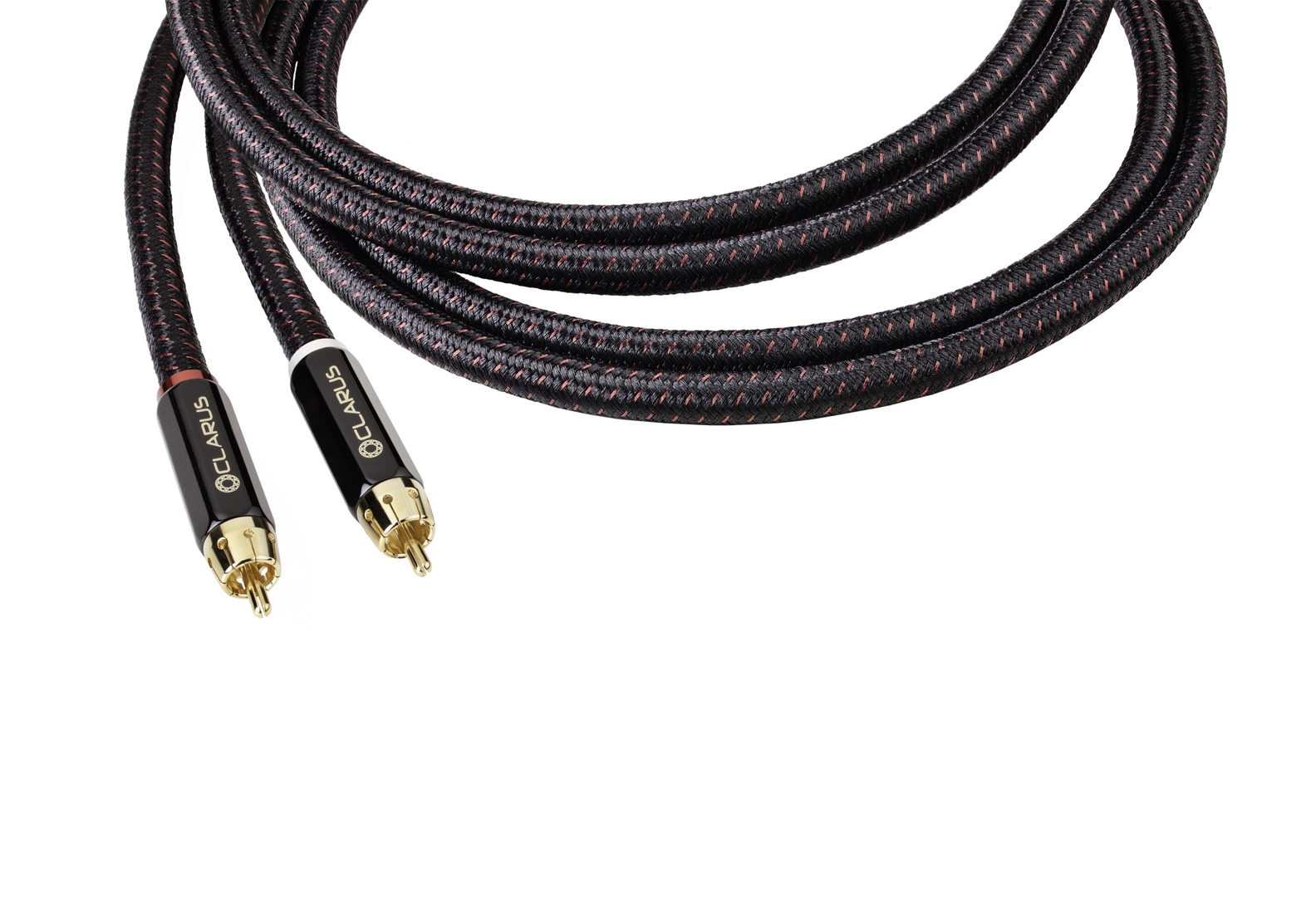
Clarus Launches Crimson Mark II Cables

March 26, 2020 — Clarus®, the high-end audio cable brand that is a “sister” company to Tributaries A/V cables, is introducing new versions of their exceptional Crimson Cables. Crimson Mark II Balanced Audio, Single-Ended RCA Audio and Speaker cables feature a multi-gauge design using three different shaped insulated ultra-low distortion PCOCC conductors – resulting in an expanded soundstage as well as improved accuracy of bass, midrange and high frequencies. The new Crimson Mark II cables are now terminated using connectors made with high purity and high conductivity Tellurium (TE) copper and military-grade Beryllium (BE) copper both providing very low resistance and superior sound characteristics 

The new male pins of the RCA and XLR are made with Tellurium Copper (TE) and have been changed from a solid design to one that is hollow. This new design helps to reduce eddy currents that can slow signal transfer. The female XLR is designed with pin 1 (the earth pin) forward in the connector. With the ground connection established before the signal lines are connected, the insertion (and removal) of the XLR connectors in live equipment is possible without hum or buzz induced from picking up external noise.

The RCA’s grounding sleeves as well as the BFA Banana Plugs and the female XLRs are made from military-grade Beryllium (BE) copper.  BE copper has a physical “springiness” characteristic that makes it ideal for use in the RCA ground sleeve, female XLR pins & BFAs.

Even more exciting is the new patented “Spring-Tension” (ST) Spade Lugs. Most high-end speaker binding posts that are designed for use with spade lugs are difficult to tighten by hand. Not only can this lead to insufficient contact that will degrade sound quality but there is also danger that the connection will vibrate loose over time. The Clarus Solution is a one-piece construction that reduces transmission resistance and improves signal flow while the spring tension ensures a long-lasting, high-integrity connection. 

The result of the Crimson Mark II cable’s superior terminations is an improved high-quality sound and long-term reliability. 

As with all Clarus products, these entirely new designs are evaluated with test instruments, but final decisions are made only after they are subjected to extensive listening tests and comparisons with reference designs, keeping firmly in mind the sound of live music. It’s no coincidence that the designer is a renowned engineer and life-long Audiophile as well as a musician who frequently attends a wide variety of live performances.

Jay Victor, the renowned engineering expert behind the development of Clarus’ new power product line is also the engineer that developed all Clarus and Tributaries audio, speaker and power cables. Holder of 50 patents, Jay has managed the design and implementation of numerous products for high-profile manufacturers serving the high-end audio market. He is also a musician, playing piano, guitar and bass guitar, and enjoys live concerts whenever possible.

His prior background included 12 years of intensive engineering work as a Mechanical Design Engineer of X-Ray cables and wire harnesses, proprietary connectors and scientific test instrument designs. His Electrical Engineering counterparts, as it turned out, were often audiophiles, and coincidently led to many audio-related “side projects”.

US Suggested Retail Pricing;

·         Crimson 1m Single-Ended RCA $1,140/pr

·         Crimson 1m Balanced Audio XLR $1,925/pr

·         Crimson 6ft Speaker Cable with Spade Lugs $4,000/pr

·         Crimson 6ft Speaker Cable with BFA $4,000/pr

·         Crimson 6ft Bi-Wire Cable with Spade Lugs $5,000/pr

·         Crimson 6ft Bi-Wire Cable with BFA $5,000/pr

Clarus Crimson Mark II cables with BFA and Spade Lug terminations are available now. The complete line will be available Q4 2020.

www.claruscable.com

VPI PARTNERS WITH NORDOST

Legendary New Jersey turntable manufacturer, VPI, has partnered with Nordost to create the new Weisline Tonearm Cable. When VPI’s designers wanted a fresh, high-performance tonearm cable that would deliver a truly class-leading performance, they turned to their friends at Nordost. With over three decades’ experience of manufacturing cables, interconnects and accessories for the audiophile market, Nordost is the ideal partner for VPI. 

The VPI Weisline Tonearm Cable is designed to maximise vinyl performance and has a complete set of features to delight the listener:

  • 4 x 28 AWG, solid core OFC Conductors 
  • Nordost’s revolutionary FEP (Fluorinated Ethylene Propylene) extrusion 
  • Twisted Pair cable construction to eliminate inter-channel crosstalk 
  • Individual shielding of the Left and Right channel for maximum defence against EMI/RFI 
  • Separately shielded, silver-plated bond wire running parallel to the signal channels for optimum grounding capabilities 
  • Terminated with high quality, low mass, gold-plated connectors 
  • Made in the USA 

The Weisline is available in a choice of three lengths:

  • 1 x metre at £600 
  • • 1.5 x metre at £700 
  • • 2 x metre at £800 

For more information visit: www.renaissanceaudio.co.uk 

VPI Industries Inc. is a high-end audio manufacturer founded in 1978. All VPI products are designed and built in the United States in Cliffwood, New Jersey. VPI’s sonic philosophy is to reproduce the dynamics of live music in the home and that the illusion of reality cannot be duplicated without a convincing resolution of low-level detail, along with a natural sense of acoustic space. VPI products are sold in over 65 countries across the globe.

Melco brightens up lockdown with new home demonstration offer via its UK retail network

25th March 2020, Surrey, UK: Melco has unveiled a new offer designed to help locked-down music lovers get the most from their collections. Acknowledging that Melco dealers are currently not able to adequately support customers new and old due to government restrictions, Melco’s UK distributor, Audiophile Digital Music Masters (ADMM), will be working closely with retailers to offer its own demo stock to anyone who wishes to evaluate products in the comfort of their own homes, with their own systems.

Melco is advising anyone interested in auditioning a Melco digital music library to contact their nearest Melco retailer (using the online tool), who will work with distributor ADMM and arrange the delivery and collection of demonstration samples, including the newly launched Melco EX Series of advanced music libraries and S100 data switch.With shows, exhibitions and events currently on hold due to nationwide restrictions, Melco distributor ADMM has a pool of demonstration units available for audition and with retailers’ physical stores closed for a period, its retail network has both the time and capacity to help arrange logistics, offering a service level Melco customers have come to expect, as best they can.  

With shows, exhibitions and events currently on hold due to nationwide restrictions, Melco distributor ADMM has a pool of demonstration units available for audition and with retailers’ physical stores closed for a period, its retail network has both the time and capacity to help arrange logistics, offering a service level Melco customers have come to expect, as best they can.  

Melco has most models available on a first come, first served basis, but will endeavour to cater to all requests for home demonstration samples. Working with distributor ADMM and Melco, the company’s dealer network will also be able to advise on part-exchange opportunities and for existing Melco users, updating libraries to the new EX specification.

Should for any reason Melco retailers be unavailable, consumers are invited to contact Melco directly: [email protected] or [email protected]

It’s not all gloom and doom…

Russ Andrews has put measures in place that allow it to remain open for business during the current coronavirus situation, and ensure it maintains its usual high levels of service to the audiophile community.

The business has as many staff as possible working from home. Telephone and online orders will continue to be processed, however, with limited staff numbers, the dispatch times may be slightly longer than usual. The company’s couriers have confirmed that collections and deliveries will continue on a daily basis. The on-site shop will remain closed for the foreseeable future.

The company is currently able to supply the vast majority of products in its range and is fortunate in that its manufacturing facility is based in-house in the UK, with components also sourced from UK suppliers. This will help avoid some of the issues facing manufacturers that rely on supplies from the Far East. The Russ Andrews exclusive UK distribution of Kimber Kable is also unaffected, as the products are supplied direct from the USA and there are currently no restrictions on freight shipping to the UK. 

John Armer, managing director, comments “We are carefully monitoring the situation and continue to follow public health guidelines for the wellbeing of our staff and customers, which has to be our priority. Clearly it is a fast-moving situation and as a business we will continue to adapt as things change.” He continues “We would like to take this opportunity to thank everyone for their support and loyalty during these difficult times and hope that you and your families remain safe.

“During this period of enforced isolation, mental wellbeing can become a serious issue and music can offer a real sense of relief. Numerous studies have shown how listening to music can be really beneficial to mental health, so we hope this will help people get through the current self-isolation period.”

The Russ Andrews website has been updated to include a blog about the situation and how it affects the business. It will be updated as and when relevant changes occur and can be accessed at

https://www.russandrews.com/coronavirus-update/

Focal Elegia closed‑back headphones

Since Focal began making headphones their roster of offerings has grown precipitously. Currently you can find Focal earphones such as the Spark Wired models for as little as £59/$69 or you can go big with their flagship Utopias (£3499/$3999). Focal’s latest headphone release is priced in the middle; the Elegia (£799/$899) is Focal’s first closed-enclosure, wired, over-ear headphone. Although they are not Focal’s most expensive closed-enclosure model, they share much of the design aesthetic and technical DNA of Focal’s premium high-performance open-enclosure designs. How do they fit into the Focal line-up and how well will they fit into your audio lifestyle? Let’s find out.

The Elegia enclosures have a similar shape and size to the Clear or Utopia headphones. They feature Focal’s front baffle design that places the 40mm aluminum/magnesium full-range driver as far forward as possible and at an angle, which according to Focal is important so as “not to have too much space between the speakers and the ears to ensure the best dynamics and an ideal tonal balance on the entire audio spectrum.” The driver itself uses a surround that is similar to the Clear, but with a different thickness of 110 microns. The Elegia also has a new internal geometry that improves the driver’s movement and allowed Focal to reduce the driver’s coil height from 5mm to 4mm. Also, to increase the new driver’s magnetic flux, Focal switched to a new copper wire and a N50 grade neodymium motor.

Although the Elegia uses a closed enclosure, it has two vents; one is part of the driver itself while the second vent is actually built into the logo design in the centre of the earcup. The entire earcup design has been optimised to an ideal volume for optimal decompression and damping. It uses both internal diffusers as well as EVA foam to break up any standing waves and spread the energy evenly throughout the enclosure. According to Focal, “The main objective here being at all costs to prevent the energy emitted by the back wave from returning to the speaker driver cone and thus turning into an additional unwanted sound signal.” Even Elegia’s microfiber earpads got a redesign so as to optimize their isolating abilities while enhancing their comfort and preserving Elegia’s high acoustic impedance.


In terms of fit, the Elegia reminded me of the Focal Clear. And while it is a medium weight design, the Elegia feels light and comfortable due to its padded headband and soft over-ear pads. At the end of several two-hour-plus listening sessions the Elegia was as comfortable at the end as at the beginning. Isolation was far greater than from an open headphone design and was almost as good at keeping outside noise from intruding as some of my most-isolating closed-back headphones, such as the AKG K-501. You could use these in a library as long as you don’t go for max volume near another patron. Bundled accessories include a 1.2-metre single-ended terminated cable that has both 3.5mm mini-stereo and standard 6.35mm jacks and a protective travel case.

With a published sensitivity of 105 dB and 35-Ohm impedance the Elegia can be driven successfully by even a smartphone. My iPhone SE achieved comfortable volume levels at only about 60% of its maximum output. On the other end of the spectrum, the Elegia really came alive when it was tethered to something with a bit more push, such as the fantastic Manley Absolute Headphone Amplifier. I was especially impressed by the Elegia’s bass control, which was nearly as extended and dynamic as the Abyss Diana Phi. Unlike some closed designs where the low bass can almost box your ears with excessive impact, the Elegia’s bass response is more like an open enclosure design.

Imaging precision through the Elegia was excellent, with lots of space between instruments. The soundstage size was big enough to provide a panoramic soundstage, but the overall size was not quite as large as from the open-design MrSpeakers Aeon or Abyss Diana Phi. The Elegia’s harmonic balance was basically natural but overall had a slightly drier harmonic character than the Abyss Diana Phi. Female vocalists have less ‘chest sound’ through the Elegia and lack a bit of overtone complexity. Also, the Elegia have a tighter, more damped overall sound than the Abyss Diana Phi. 

So, if you loved the sound, feel, and overall quality of the Focal Clear but require a headphone that provides far more isolation, the Elegia should be on your must-audition list. 

TECHNICAL SPECIFICATIONS

Type: Over-ear, closed-back

Drivers: Dynamic Driver

Frequency Response: 5 Hz – 23 KHz

Impedance: 35 ohms

Sensitivity: 105 dB/1mw

Connector: 3.5mm dual-pin custom

Weight: 15.4 oz, 430 grams

Price: £799 UK, $899 US

MANUFACTURER INFORMATION

Focal-JMlab

BP 374 – 108, rue de l’Avenir

42353 La Talaudière cedex

France

+33 04 77 43 57 00

URL: focal.com

Synthesis Soprano LE integrated amplifier

Synthesis is an Italian electronics company with a strong emphasis on valve designs, and an equally strong bias toward value for money. The range is comprehensive, with more than 20 models across four separate ranges (and more to follow). The Soprano and Soprano LE integrated amplifiers represent the entry-point for the brand.

The Soprano is a small, elegant, and somewhat minimalist integrated amplifier with a solid-state preamp stage and a 12-watt valve power amplifier section that uses a quartet of EL84 valves. The EL84 is perhaps less well-known in domestic audio circles compared to the more powerful EL34, but the little EL84 power-pentode is a popular choice in some guitar-playing circles, most notably for the ‘chimey’ sound of the Vox AC15 and the Marshall ‘Model 1974’ combo amps from the 1960s and are still highly prized today. The Soprano amp includes a built-in AKM-based DAC that supports PCM audio to 24‑bit, 192kHz precision (on USB; 24/96 on optical and coaxial S/PDIF), and a MM phono stage; moving coil cartridges and DSD are not supported, although given the relative affordability of the Synthesis, it seems unlikely that it will be partnered in systems where the absence of a MC input or DSD replay will be a problem. Similarly, the lone line input might have been a stumbling block in the days of separate CD player, FM tuner, and tape recorder, but I suspect that most Soprano amps will be used with a record player and a laptop, and for the most part, that’s how I used it.

The Limited Edition version of the Soprano is restricted to just 200 pieces. It differs from the standard version in terms of finish (the brushed aluminium or black front panel is replaced with a more refined titanium look), higher quality RCA input and loudspeaker output terminals, and a limited-edition plate with designer and owner Luigi Lorenzon’s signature (and a certificate of ownership). More significantly, the power has been upped from 12W to 15W per channel. 

The four EL84s sit to the left of the front panel, glowing away nicely, but kept from prying fingers by a horizontally-vaned, black powder-coated protector/heatsink that runs the length of the amp (it’s removed with two small Allen bolts, but actually looks good in situ). Controls are limited to five small push-buttons (with accompanying LEDs) for channel selection, and a larger push-button for power, plus a remote eye and a larger power LED above the remote control. The whole unit is narrower than most modern audio and, combining that with the titanium front fascia of the LE, gives the Soprano a timeless and classy appearance, akin to classic Quad valve devices of the 1950s.

Affordable valve audio equipment is usually dismissed with a flourish by the cognoscenti for being either badge-engineered off-the-shelf Far Eastern products, or ‘designed in Europe, built in a sweatshop’ designs. Aside from the somewhat banal nature of this gripe (especially when it arrives typed on a laptop or smartphone designed in the US and built in Asia), it’s simply not true here. Every single piece of the Synthesis range is designed and built in Italy. Not ‘assembled’… built. Managing to build both up to a standard and down to a price is difficult and admirable, but it’s something that Synthesis does well, and the Soprano LE is the result. In fact, were it not for the very slightly clunky feel of the push-buttons, the light touch to the volume knob, and a remote control that is functional but lacks the ‘blunt instrument’ heft of the big-boys in the audio world, you’d put the Synthesis Soprano SE close to £3,500 or £4,000. 


You’d make the same mistake after powering it up, too. OK, fifteen watts per channel is not what you’d call a ‘powerhouse’ and that places constraints on the listener in terms of loudspeaker efficiency. Any loudspeaker with a genuine sensitivity figure in the mid-90s or above is perfect, and those in the 88-95dB sensitivity range will be conditionally fine (depending on room size and ultimate listening levels). The Fyne Audio range (such as the F702 tested in last issue) would make a perfect combination, for example. Also, the amplifier goes ‘creamy’ and slightly ‘chimey’ (harmonically rich in the upper-mids and treble) rather than ‘edgy’ as it reaches its limits, so the occasional wig-out at volume is possible and actually quite enjoyable. 

This is very much a ‘grace’ and ‘space’ amplifier; it also does ‘pace’ well (Lorenzon listens to a lot of rock music both in development and for his personal enjoyment, so he wouldn’t let a beauteous but rhythmically flabby sounding amplifier leave his test-bench), but what first attracts you to the Soprano LE are its rich, harmonic textures, fine detail retrieval, and exceptionally well-shaped soundstage; not too big, not too small.

Like many reviewers faced with a relatively low-powered integrated amplifier that doesn’t cost as much as a moderately-successful racehorse, the listening session commenced with something of a soft start – ‘Help Me’ from Court and Sparkby Joni Mitchell [Asylum] – as this is not a densely populated mix and Mitchell’s voice is so well-known it’s easy to determine whether the basic boxes are ticked. And they were ticked, and ticked well; so well, in fact, I played the track three times in a row, running from the USB input of the DAC, from the line input and from the MM phono stage, playing an early pressing. In all three cases, it sounded at once extremely natural, very rich and enjoyable, and consistent from source to source. I preferred the vinyl version the best and the ripped to computer version the least, but that itself is consistent with my findings elsewhere.

Having passed the recruit fitness test, it was time for basic training and review bootcamp. I marched out my usual range of recordings in order of difficulty. And the Soprano SE passed the test each and every time. OK, so this is not the first choice for anyone who thinks ‘dynamic range’ means ‘playing Mahler at window-shattering levels’, but what was surprising is just how much dynamic range and bottom end energy can be extracted from 15 watts when done properly. I have almost worn out the digits on Trentemøller’s ‘Chameleon’ [The Last Resort, Poker Flat] because of the intensity, speed, and depth of those stentorian notes mid-way through the track. Granted none of these sounds exist in nature, but they are a perfect indicator of bass depth and precision; if a sub-40Hz tone produced by a PCM-based synthesiser (that is as close to a square wave as it’s possible to make without destroying a loudspeaker) is perfectly rendered, it follows by inference (and confirmed by listening) that the same applies to tympani and deep organ pedal notes. And on playing ‘Chameleon’ the Soprano LE did exceptionally well, defining the attack and release of the bass notes perfectly, all the while not undermining the range of sounds in the mid and treble. 

I’d hesitate to say this is the most neutral amplifier you can buy because the sound it makes is so sublime and satisfying. Any yet, neither does it go for the warm ‘comfort blanket’ sound of over-rich valve amplifiers. In short, it toes just the right balance. In fact, if the Soprano’s harmonically rich and elegant sound, plus its exceptional imaging, represent a deviation from strict neutrality, it’s a deviation that I’m sure many will happily go for. This also means the Soprano covers its tracks well, too, because you are enjoying the sound too much. In other words, it’s a lovely, sweet-sounding amplifier that makes you want to listen to music more… who really cares if that is not strictly accurate? 

Perhaps the biggest plus-point for the Soprano LE sound is its ability to ‘scale’ well. Put something fey and small sounding its way [Feist’s ‘Mushaboom’, Let It Die, Polydor] and it will make it seem small, close, and intimate. Then flip over to a huge wall of sound [Muse’s ‘Invincible’, Black Holes & Revelations, Helium-3] and you can almost hear the stadium (or a haunted house ride full of sci-fi skyscrapers and evil pumpkin teddy bears, if you watch Muse’s crazy video). That ability to move from the tonsils of a breathy girl-with-guitar singer to a large orchestral piece, to post-modern progressive rock with a distinctly sci-fi feel is the mark of something really good, and the Soprano LE does it so very, very well. 


We haven’t compared the Soprano LE to the more commonplace non-LE version because the price differential between standard and LE is relatively slim, meaning there’s almost no point looking at the Soprano right now. Maybe when the 200 LE models are sold, we’ll revisit the Soprano in its standard guise; as it’s possible the great sound of the LE is built on the similarly great sounding foundation of the Soprano itself. 

Regardless, the Synthesis Soprano SE is a lovely little amplifier in its own right, and those 200 owners will be getting something truly magical. If your speakers are sensitive souls, they will thank you for letting them work with so refined a Soprano. 

TECHNICAL SPECIFICATIONS

Type: hybrid integrated amplifier with built-in phono stage and DAC

Analogue Inputs: 1 Line, 1 Phono MM (47Kohm) 40dB gain 

Digital Inputs: 1 S/PDIF coax, 1 S/PDIF optical, 1 USB “B” type Windows/Mac/iOs/Android compatible 24 Bit 192KHz 

Valve complement: Matched pair EL84/6BQ5

Power stage config.: Push-Pull Ultra Linear 

Power output: 15W RMS into 6Ω Class A

Frequency response: 20Hz to 20KHz–0.5dB

Distortion: 1% @ 1KHz max power (12W)

Signal/Noise ratio: >90dB A weighted

Dimensions: (W×D×H) : 310 × 295 × 150mm

Weight: 10kg

Price: £1,899

Manufactured by: Synthesis srl

URL: synthesis.co.it

Distributed by: Audiofreaks

Tel: +44(0)208 948 4153

URL: audiofreaks.co.uk

Wharfedale Linton 85th Anniversary loudspeaker

Wharfedale’s first Linton loudspeaker was launched in 1965 and was, says the manufacturer, “bought in its millions right across the globe.” Successive and successful models followed, culminating in the Linton 3XP, which was a three-way loudspeaker and one that marked the last Wharfedale offering to bear the Linton name. Or rather it was the last, until we come to the present day where Wharfedale has now created a Linton 85th Anniversary Limited Edition stand-mount model (which I will call the Linton 85 in this review). According to Peter Comeau, Wharfedale’s Director of Acoustic design, the hallmarks of the original Linton design were “fine craftsmanship, natural sound quality, and affordability inside a beautifully proportioned loudspeaker,” and—not surprisingly—these same characteristics also define the Linton 85.

The Linton 85s sell for $1,198/pair US or £999/pair in the UK, and their matching floor stands sell for $300/pair US or £100/pair in the UK. I would encourage anyone considering the Linton 85s to buy the matching stands. Any way you look at it, a per-pair price $1,498 or £1,100 is not a lot of money for what turns out to be a bona fide audiophile-grade loudspeaker. So, consider the “affordability” box properly ticked.

Next, let’s consider the “fine craftsmanship” and “beautiful proportions” factors. Let me state unequivocally that from the moment you first crack open their shipping cartons, absolutely everything about the Linton 85s suggests that they must surely cost more than they actually do—a lot more, in fact. I say this because the first thing you see when you open the boxes will be a clear vinyl, snap-closure pouch that contains the Linton 85 user guide (printed on parchment-coloured paper), a set of protective stick-on rubber feet, and a pair of white linen gloves to use when handling the speakers. Further down in the box, when you first glimpse the Linton 85s, you will spy cabinets covered in gorgeous real wood veneers (either Mahogany or Walnut), not the vinyl wraps that are so common on speakers in this price range. 


Once you lift the Linton 85s from their cartons you realise another fine detail touch: all their surfaces (save for the front baffle) are covered in oil-finished wood veneers. This includes the tops, sides, bottoms, narrow front bezels, and even the rear panels. On said rear panels one finds two flared bass reflex ports, a pair of gold-plated speaker binding posts, and a brass escutcheon plate denoting the speakers’ 85th Anniversary Limited Edition status, and bearing both the Wharfedale logo and a small red, white, and blue Union flag. From the front, the loudspeaker looks a bit like a trip back to yesteryear, in that these are relatively large, broad-shouldered monitors with tasteful, padded black grilles mounted flush to the narrow bezel strips that frame the speaker’s face. The design harks back to classic British monitors from the past—such as bygone models not only from Wharfedale, but also from Spendor and Harbeth. Let me come right out and say it: these speakers are a feast for the eyes so that their owners will, I think, feel an appropriate sense of pride of ownership beyond all proportion to the speakers’ price.

The stands are no less lovely and they are sturdily and purposefully built. The top and bottom of the stands are satin black steel plates that exactly match the footprints of the loudspeakers, while square-section, satin black steel tubes serve as vertical risers. Then, on the underside of the top plate and the upperside of the bottom plate, there are thick mass-loading panels treated to wood-veneered surfaces to match the loudspeakers. Finally, there are nicely finished, threaded floor cones to complete the picture. These robust stands not only lift the Linton 85s to the perfect height for seated listeners, but also turn out to provide space for storing 50-60 vinyl albums beneath each speaker. Clever. Given all these factors, I think we can also consider the “fine craftsmanship” and “beautifully proportioned” boxes ticked.

This, of course, brings us to the most important question of all: namely, do the Linton 85s deliver the promised element of “natural sound quality”? 

Let’s begin by looking at the internal ingredients responsible for delivering the Linton 85s’ sound. The loudspeakers feature 200mm woven Kevlar-coned bass drivers with die cast chassis, 135mm woven Kevlar-coned midrange drivers that are housed in their own internal enclosures, and a 25mm textile soft-dome tweeter with a high flux ferrite magnet. Joining these drive units is a crossover that Peter Comeau describes as “near inaudible to the listener, resulting in a coherent, seamless musical output.” Last but not least, the cabinet panels are formed from a three-layer sandwich of MDF-Chipboard-MDF,  a panel construction said to distribute and mitigate cabinet resonances.

I found the Linton 85s to have considerable audiophile appeal as they were, by turns, engaging, energising, seductive, and just plain fun to listen to. I mention those last several points because I have heard any number of high-end loudspeakers that, while impressive in an abstract, theoretical, and academic sense, somehow manage to miss the deep emotive impact that music should have. Happily, the Linton 85s are not among them; instead, they tread the fine line between being revealing yet also inviting and at times downright seductive. They also can boogie, when the occasion arises.

One of my favourite test tracks is ‘Flamingo Sky’ from Marilyn Mazur, Josephine Cronholm, and Krister Jonssen’s album of the same name [ECM. 16/44.1]. The track is full of Mazur’s delicate high percussion and insistent, syncopated low percussion, Cronholm’s unorthodox vocals, plus Jonssen’s angular yet almost jovial guitar lines. The Linton 85s proved revealing yet never edgy on the high percussion, delivered the deep ‘thwoomps’ demanded by the low percussion, captured the desirably quirky inflections of Cronholm’s voice, and caught the energy, angularity, and underlying humour in Jonssen’s guitar. What is more, the Wharfedales imaged beautifully and managed to convey a sense of front-to-back stage depth that is often elusive.

Another fine illustration of the Linton 85s’ capabilities came when listening to ‘Chant’ from Nils Frahm’s Solo {Erased Tapes, 16/44.1], which juxtaposes middle and upper range piano phrases against powerful and sonorous low-frequency keyboard passages. The Linton 85s caught the uplifting and meditative qualities of the middle and upper range piano lines, while nailing the sheer depth and gravitas of the low-frequency elements. 


Finally, for those wondering if the Linton 85 can convey (or inspire) powerful emotions, try listening to them play ‘The Door’ from Hildur Gudnadóttir’s soundtrack to the opening episode of the HBO mini-series Chernobyl [Deutsche Grammophon, MQA]. The track features eerie high percussion elements set against ominous, throbbing low-bass passages, with warning hints of midrange voices woven in and through the composition. The entire track brilliantly expresses the terrible threat posed by the as-yet-undiscovered nuclear reactor failure. Listening through the Linton 85s, ‘The Door’ becomes an unnerving experience that triggers a fear response.

Here are some tips. If the Linton 85s have too much bass for your room, try moving them well away from walls, which helps. Next, for best imaging use plenty of toe-in. Last, keep the grills on; the smooth the sound, enhance imaging, and minimise diffraction.

Wharfedale’s Linton 85s are ideal speakers upon which to base truly affordable high-end audio systems. In fact, they are so good that for many listeners they will serve not only as a high-end audio starting point, but also as a wonderful end-destination. 

TECHNICAL SPECIFICATIONS

Wharfedale Linton 85th Anniversary Limited Edition loudspeakers

Type: Three-way, bass reflex, stand-mount loudspeakers, sold in mirror-imaged left/right pairs. 

Driver complement: 200mm woven Kevlar cone bass, 135mm woven Kevlar cone midrange, and 25mm fabric soft-dome tweeter.

Crossover frequencies: 630Hz, 2.4kHz

Frequency response: 40Hz – 20kHz, ± 3dB

Sensitivity: 90dB (2.83v @ 1m)

Impedance: 6 Ohms nominal, 3.5 Ohms minimum

Dimensions (H xWxD): 565 x 300 x 360mm (incl stands)

Weight: 18.4kg/each

Price: Speakers £999/$1,198 US. Stands/Plinths: £100/$300 US

Manufactured by: Wharfedale

URL: wharfedale.co.uk

Tel: +44(0)1480 452561

US Distributor: MoFi Distribution

URL: mofidistribution.com

Tel: +1 (312) 738-5025

MartinLogan ElectroMotion ESL X floorstanding loudspeaker

PMC patron Peter Thomas says that he “has always had a sneaking regard for electrostatic loudspeakers”. Having used stacked Quads many years ago, I’m inclined to agree. There’s definitely something ‘different’ about listening to electrostatics, whether full-range or hybrid designs like the ElectroMotion ESL X tested here. This might have something to do with the fact that they’re invariably dipoles, and therefore interact with a listening room in a rather different way to more conventional (box-type) monopole loudspeakers. It’s also important to sit down in the listening seat in order to achieve the correct treble balance.

After some years as distributors of electronic brands such as Bryston and AVM, PMC has recently formalised its UK Distribution operation as a separate division. Its first task will be to take over the distribution of MartinLogan loudspeakers from Absolute Sounds, offering hybrid electrostatic loudspeakers at the top end, plus lots of smaller and specialist niche models lower down the price ladder. This is not nefarious brand-raiding by PMC, however; MartinLogan’s smaller box loudspeakers and in-wall systems are at once part of the next-decade strategy for ML, a sector of the market in which PMC is interested. A UK speaker company distributing an overseas rival might be unprecedented, but the two companies do have very different philosophies and product portfolios, so they dove-tail rather than compete.

MartinLogan is actually larger than PMC by a comfortable margin, with an R&D operation of around 30 people in Kansas City, plus some 200 carrying out production in Toronto, Canada. Although it was originally founded in Kansas City, MartinLogan was purchased by Canadian company Paradigm some ten years ago, and is currently owned by the Bagby family, along with Anthem.

Full-range dipole Quad Electrostatics are well enough known in Britain, because they revolutionised the loudspeaker scene from 1957 via the original two-way model, or the subsequent more complex ESL63 and its variations. However, MartinLogan has always made hybrid electrostatics, with relatively narrow electrostatic panels that operate above conventional dynamic bass sections. My recollection of early ML speakers was that they experienced some difficulty in integrating the bass box with the electrostatic panel, but that doesn’t seem to be the case any longer.


Although five costly Masterpiece models have active dynamic bass units that incorporate ARC (Anthem Room Correction) room equalisation, our review is focused on a pair of entirely passive ElectroMotion ESL X, featuring twin port-loaded 200mm bass units and priced at a fraction below £5,000. (For smaller rooms there’s a £3,500 ESL with twin 150mm drivers and a smaller panel; there are also a number of Home Cinema additions.) The 21×104mm panel used by this ESL X has a gentle lateral convex curve.

While the ElectroMotion ESL X undoubtedly stands tall, with an overall height of 150mm, most of this consists of a curved and semi-transparent panel. The reflex-ported bass unit, sitting underneath the vertical electrostatic panel, has a deliberately asymmetric enclosure, and mounts the 200mm drive units at the front and the back (so that the mechanical forces cancel out). The crossover point is designated at 400Hz, which is certainly lower than most two-way designs, but that’s no problem at all here.

Basic measurements reveal a decent sensitivity (albeit somewhat below that claimed), plus astonishingly smooth and well controlled upper frequencies above 500Hz. Things are much less smooth below 500Hz, with variations as great as ±7dB, but they still supply an average 89dB sensitivity. The impedance looks a little problematic, as it appears to be rather low at both ends of the band. The bass is generally low, at around 5ohms, with good damping and reflex-tuned to around 28Hz. The top end falls steadily at higher frequencies, so that those above 12kHz are below 4ohms. (Frankly, I think it might well be compromised if used with valve amps.)

While I did find the bi-wire multi-way terminals to my taste, I was a bit perplexed by the need to energise each of the speakers with a low DC voltage. This is used to energise the upper range electrostatic panels, by plugging each speaker into the mains. Set-up involves carefully aligning the electrostatic panels by shining a torch at the two panels from the listening seat, to make sure that both panels matched and were set at the correct angle for best results. Having your speakers ‘torched in’ (This is also one of those times where British English wins out over its American counterpart; replacing the word ‘torch’ with ‘flashlight’ is fine, but ‘flashed in’ sounds a little pervy) is a unique way of installation that only applies to the curvilinear panels of MartinLogan loudspeakers. However, it is extremely effective and – if there are two of you (one in the hot-seat holding the torch and one steering the speakers) – remarkably quick. Fine-tuning from this ‘torched in’ listening position is possible and beneficial (especially in terms of relative position of speaker to length of room), but never forget to recheck the ‘torched in’ placement during the installation from time to time.

That done, I found myself falling in love with electrostatics all over again. Note that it’s absolutely vital to sit down in order to maximise the treble output and audition the speaker properly. I think it was the sheer tangibility of the image that these things deliver (or at any rate used to deliver, until one example decided to go faulty on me). With that problem fixed, I’ll happily admit that the ESL X sounds very neutral and is also quite dramatic. The smooth upper frequencies are particularly impressive, and the integration with the bottom end is both seamless and very well judged.

There’s unquestionably something altogether ‘right’ about an electrostatic top end. This might be to do with the tiny movements involved, but its behaviour is certainly smoother and flatter than most conventional point-source domes, in the author’s experience at least. When one speaker was playing in mono, during to a television documentary, I was interested to note a substantial difference in distortion between poor quality ‘live’ (direct to camera) and much cleaner sounding dubbed vocals. 

Part of the reason might have to do with the measurements, which were a little less even than I had expected, and also tended to emphasise the presence band. Indeed, although the response holds within ±3dB limits from 500Hz up to 7kHz, the output peaks at 2kHz, which is roughly the inverse of conventional dynamic speakers. As a result, while the ESL X tended to sound brighter than a dome-type tweeter, it never seemed too bright.


I’d rate the sensitivity at around 89dB, but the bass end (sub-500Hz) is very uneven. However, don’t let the uneven bass end put you off, as the smooth (albeit somewhat forward) mid-band dominates the bass end. This speaker works particularly well at modest levels, due in part at least to the forwardness that seems to emphasise the voice band.

Like most electrostatic loudspeakers in a dynamic loudspeaker world, this is a difficult speaker to summarise. In part it places an emphasis on the listener’s reaction to the sound, but if you find yourself swayed by an unparalleled lack of perceived mid-band and high-frequency distortion, there might be no going back. The MartinLogan Electromotion ESL X is an exceptional performer for the price, especially for anybody who likes to listen at modest levels (the larger models are more accommodating for the unrepentant headbanger). What the speaker offers is something that both sounds – and looks – distinctly and genuinely ‘different’ from the norm, and for many that’s a good thing. I reckon that such an observation alone should be enough to put it onto many listeners’ short-lists. 

TECHNICAL SPECIFICATIONS

Type: Hybrid electrostatic loudspeaker with reflex dynamic bass

Drive units: 102×22cm XStat™ CLS™ electrostatic transducer (HF), 2× 203mm high excursion, high‑rigidity paper cones (LF)

Frequency Response: 41Hz–22kHz ±3dB

Crossover frequency: 400Hz

Sensitivity: 91dB/2.83 volts/metre

Nominal impedance: 6Ω

Minimum impedance: 1.6Ω @ 20kHz

Horizontal Dispersion: 30°

Vertical Dispersion: 101.6cm (line source)

Recommended amplifier power: 
20–200Wpc

Dimensions (W×H×D): 
150.3cm × 23.8cm × 52.6cm

Weight: 23.6kg

Price: £4,995 per pair

Manufactured by: MartinLogan

URL: martinlogan.com

Distributed in the UK by: 
PMC Distribution UK

Tel: +44 (0)1767 686300

URL: pmc-speakers.com

Enjoy the Music.com To Rebroadcast Our Live Stream Of Blues Masters At The Crossroads 2014

2014 Blues Masters at the Crossroads event at Blue Heaven Studios, celebrating the 17th year as the preeminent authentic Blues concert in the world, featured performances by Rip Lee Pryor, Moreland & Arbuckle, Marquise Knox, Big George Brock, Kim Wilson, Joe Beard, Lazy Lester, Mighty Sam McClain, Sonny Green, Kim Wilson with Billy Flynn, and Bernard Allison. Taking place in Salina, Kansas, October 17th and 18th (2014) at a converted 1925 church sanctuary, the musical gospel continues to resonate within the walls of this historic building. To bring the ‘good word to the streets’, Enjoy the Music.com live streamed Blues Masters at the Crossroads for the first time in recorded history, so the world can see and hear the live sound of true, authentic Blues music during this momentous event.

“I think this is an awesome idea and want to thank you for both documenting Blues history and providing it for the world to watch,” said Chad Kassem of Acoustic Sounds and Blue Heaven Studios. “I hope it may bring some joy to people who watch it during this staycation due to the Cononavirus. Many of the Blues Masters performances throughout our 21 years of the concerts have passed away, but this recording will preserve their music forever. On a personal note, my mother had been to 20 of the 21 Blue Masters concerts and she was not able to attend 2014, yet becauseEnjoy the Music.combroadcasted it live she was able to watch it in Mexico!”

“Mere words can not describe the incredible musical performances during Blues Masters at the Crossroads 2014,” said Creative Director of Enjoy the Music.com Steven R. Rochlin. “Our site broadcasted the entire two days, ten-hour event of authentic, well-respected Blues musicians who have truly lived this unique genre of music that originated within African-American communities located in deep South of the USA. When hearing the Blues, it resonates deeply with one’s soul. As a genuinely American sound, there is no doubt that once you hear the Blues you are hooked for life. It was our honor to stream this event live for the first time in Blues music history back in 2014.”

“We will be once again streaming the original Friday concert on Friday, March 27th, and the original Saturday concert on Saturday, March 28th. Our live stream during 2020 is directly from our master outputexactly as it was seen during the live broadcast, warts and all! For the first time, we are rebroadcasting this event on our Facebook page, including a few performances not seen within Enjoy the Music.com‘s YouTube channel! As an important note, it deeply saddens me that Blues Masters At The Crossroads 2014 was the last high quality videoed performances of a few musicians, as they passed away since then and are now in Blues Heaven.”


Watch our rebroadcast of Blues Masters At The Crossroads 2014 on our Facebook page at this link. This two-night concert event begins at 5pm EST (21:00 GMT) on Friday, March 27th and Saturday, March 28th and includes the entire five-hour concert each evening. Each night will feature live Blues music, interviews, and more!Enjoy the Music.com‘s 2020 Facebook live stream is a ‘perfect mirror’ from our Hi-Res master output. This is the same live video we streamed back in 2014, warts and all!

Note: Friday’s and Saturday’s broadcast are two different performances, as the original concert featured a unique five hour musical lineup each evening.


Live Stream Concert Schedule
Friday March 27th (All Times EST / GMT -4
5:00pm Opening Ceremony With Randy Crump
5:05 Rip Lee Pryor
5:57 Audio Mute (Live Broadcast Hiccup)
6:18 Audio Resumes With Moreland & Arbuckle
6:57 Joe Beard
7:16 Lazy Lester
7:30 Big George Brock With Marquise Knox
7:51 Marquise Knox
8:53 Kim Wilson And Billy Flynn
10:17 Concert Ends

Saturday March 28th
5:00pm Opening Ceremony With Randy Crump
5:06 Joe Beard And Lazy Lester
5:36 Sonny Green
6:23 Mighty Sam McClain
7:27 Sonny Green And Mighty Sam McClain
7:35 Kim Wilson And Billy Flynn
8:38 Bernard Allison
9:59 Concert Ends


About Acoustic Sounds

Since 1998, Chad Kassem and his team at Acoustic Sounds have presented Blues Masters at the Crossroads, an annual celebration of Blues music in Salina, Kansas, featuring legends of the genre along with rising stars. Their 2014 lineup was especially strong, with Kim Wilson (formerly of the Fabulous Thunderbirds), Mighty Sam McClain, Lazy Lester, and Marquise Knox joining legendary past performers such as Henry Gray, Birdlegg, Barbara Carr, and others.

The concerts were originally held on October 17th and 18th (2014), taking place at Blue Heaven Studios, a sonically superb 95-year-old Gothic church in Salina’s downtown area that Kassem purchased in March 1996. After almost two years of renovations and upgrades, Chicago blues great Jimmie Lee Robinson was the first to record in the studio in 1998.

BesidesEnjoy the Music.com‘s live streaming of the event — which brought the two nights of powerful Blues music to a new, broader audience — it was the first time a live Blues concert was recorded entirely in Direct Stream Digital (DSD), which provides 64 times the resolution of CDs and a much more life-like quality than MP3 tracks. This 2014 Blues Masters concert is also available in 24-bit/176kHz lossless FLAC. This two-night concert is available as a Hi-Res digital download on Acoustic Sounds’ Super HiRez site. For questions and more information please visit Acoustic Sounds andBlue Heaven Studios.

Enjoy the Music.com is one of the Internet’s leading information sites for high-end audio and music news, equipment reviews, plus show reports of both home and portable gear since 1995. We have received critical acclaim from our worldwide readership, like-minded audio publications, and notables such as the President of the Consumer Electronics Association (now CTA). Being associated with eight print publications and two web-based magazines, Enjoy the Music.com is part of a robust grouping of magazines and journalists which features some of the best minds within the high-end audio industry. Enjoy the Music.com also offers our Review Magazine, the industry’s most extensive daily industry news, plus over 260 show reports online. Enjoy the Music.com is media sponsors for many consumer electronics events including AXPONAFlorida Audio Expo, and Rocky Mountain International Audio Fest.

Enjoy the Music.com is the only specialty audio site online withindustry news dating back over 20 years. We continue our unique ability to inform and educate both music lovers and gadget geeks worldwide, with partners further extending our ability to reach a global audience. Readers can connect with Enjoy the Music.com on leading social media sites InstagramTwitter, and Facebook.

Enjoy the Music.com is official Internet partners with print magazines Australian Hi-Fi MagazineHi-Fi+HIFICRITICHiFi MediaHi-Fi World, plus vintage print magazines Sound Practices andVALVE MagazineWe’re also partners with websites Headphone.GuruNOVO High-EndPositive Feedback, and STEREO Magazine.

Those desiring an interview withEnjoy the Music.com‘s Creative Director Steven R. Rochlin can e-mail their request by clicking here.

That escalated quickly!

It seems like a lifetime ago that we were arguing over the validity of cancelling Munich High-End 2020. It was just two weeks ago. It seems equally crazy that a week ago, people were saying the postponement of AXPONA was a step too far. And yet today, like tens of millions of workers around the world, I’m writing this from a makeshift office in my house and photographing with bits of card and Ikea table lamps.

The full impact of coronavirus on the public and our economies is yet to be felt, and many still think it hype and conspiracy. And do that in some degree of social isolation and lockdown. Whether that lockdown is for weeks or even months is still uncertain. Disruption in almost everything is rife.

However, the good news is we are well stocked for the current and ongoing unpleasantness, and if we are all locked in for weeks on end, we will continue posting up regular reviews, music interviews, blog posts and more. We will also print issues as usual. Naturally, given like all magazines we run a very tight team, should one or more of our team develop the virus, there might be temporary quiet weeks. But writing online means only your keyboard knows if you are coughing and I can write with a high fever just so long as the hallucinations don’t monkey skyscraper my toaster clams.

Better yet, the audio industry is resilient. We’ve weathered storms before – admittedly not the kind of storms that put people on life-support machines, but we survived the MP3 Wars and the rise and fall of home cinema. We’ll weather this.

Part of the reason for such confidence is audiophiles are almost made to survive this kind of disease. OK, so many of us fall into the age ranges and have the co-morbidities where critical illness is more common, but we spend hours locked away in our man-caves listening to music at the best of times. We know how to self-isolate… no biggie. Some are talking about what hobbies they can take up now that watching sport on TV is off the radar… well, we have long had the answer. Better yet, many of our man-caves are never, ever visited by other people, and that weird science project of strange new life-forms that lives under the pile of cables in the corner is only serving to stress-test our immune systems. In fact, when hopefully the world begins to return to its new normal in a few months, there will likely be an audiophile who only emerged from playing a particularly intense LP session because he ran out of Pot Ramen/Pot Noodle and peanut butter, completely oblivious to there having been a COVID-19 pandemic.

When all this is done, we will rebuild and start again. While it’s happening, we will tweak our systems and play our music. In the meantime, keep calm and carry on. Follow the guidelines laid down by the government and the healthcare professionals. Wash your hands with soap and water frequently, only touch your face with your elbow, avoid people who are coughing or have a fever, give everyone the kind of distance you might give to someone who last washed in the 1970s, and avoid public gatherings and unnecessary travel. If you are in your more mature years or have some underlying health concerns, these aren’t guidelines… they are rules to live by for the next few months, even to the point of having Skype meetings with the family instead of family gatherings.

Innuos ZENmini Mk 3 music server with LPSU power supply

Innuos’ range of ZEN music servers each have their specific niche, that perfectly suits significant parts of the audio enthusiast market. As its name suggests, the Statement speaks to the high-ender who has a cost-no-object approach to audio, while the ZEN range covers everything from those dipping their toes in the music server world to those seeking a useful high-end solution. As befits the magazine, we’ve tended to look more to the top-end of the Innuos tree, but in many respects the humble entry ZENmini is the device that has the toughest job to do, because it will have to fill in so many different gaps in audio systems.

The ZENmini Mk 3 is the most flexible Innuos product to date. Where the more up-scale models are designed to output purely to USB or Ethernet (because the assumption can be made that the prospective ZEN, ZENith, or Statement user has a network streamer or USB-supporting DAC), the ZENmini Mk 3 makes no such reductionist decisions. The ZENmini Mk 3 might be used in a networked system with one user, into an older DAC with only coaxial S/PDIF connections, into a music system that only has a TOSlink optical input, or to replace a CD player in a system with an amplifier that only has line-level RCA inputs. Moreover, because of this multiplicity of potential audio system options, the ZENmini’s interface needs to reflect a wide range of users, from the tech-savvy enthusiast who dreams in TCP/IP right down to someone who considers the ZENmini Mk 3 to be their first musical venture into the 21st Century.

The flexibility continues at the power end. As standard, the ZENmini Mk 3 comes supplied with a perfectly servicable laptop-style switch-mode power supply ‘brick’, but there is an option to upgrade that with the LPSU linear power supply unit, to bring the ZENmini Mk 3 closer to ZEN Mk 3 performance.

The ZENmini Mk 3 is a small ripping server with 1TB of WD Red hard disc as standard (you can configure it to have up to 8TB of on-board storage). It runs off an Intel N4200 Quad Core chipset with 4GB of RAM, making it on a par with an entry-level laptop in raw computing power. As with most music servers, there ain’t much to see. The half-width cases of both ZENmini Mk 3 and LPSU are almost identical, with the same gently angled front panel with a power button in the bottom right corner. Aside from the obvious slot-loading CD drawer in the ZENmini Mk 3, they look interchangeable from the front. There are no other displays and the ZENmini’s music playback, handling, and management are all removed to either a computer, a tablet, or a smartphone. It’s here, too, where Innuos needs to demonstrate a lot of flexibility. Some will want this to run under its own steam, some will want it to be controlled by a third-party controller like Linn’s Kazoo, some may even want it to operate as a Squeezebox server, or a Sonus server, or even a Roon server. And the ZENmini Mk 3 addresses all these avenues with almost equal aplomb.


The ‘almost’ part comes from the fact the company‘s products are so commonly used with third-party streaming systems, its own apps have taken a bit of a back seat compared to the demands made to ‘get products out the door.’ The company’s own app hasn’t been a major concern because so many ZEN products were used in Linn and Naim systems, where an app was almost surplus to requirements. That’s changing, however, and the company is developing an app. Meanwhile, apps like iPeng Playback (iOS) or Orange Squeeze (Android) fill in the gaps in the meantime.

For the most part, the ZENmini runs entirely under its own steam. Ripping a disc generally involves little more than putting a disc in the slot, waiting a few minutes, and taking it out again. The ZENmini does all the heavy lifting. It doesn’t go down the route of comparing to online absolutes, because accurate rip systems do not necessarily point to the optimum version of the recording.  It does allow the user a fair degree of editing a ripped disc’s metadata should you wish to go off piste, but in fairness, the ZENmini Mk 3 got things right more often than not. The joy of this is the ZENmini shares the same basic library management system used by all Innuos products, and unless you want to configure your music library in a weird manner, it works in a very logical way. Configuring the ZENmini Mk 3 to talk to Tidal, Qobuz, or Spotify is easy and quick too. In short, the ZENmini Mk 3 does what all good servers should do; act invisibly, letting other products in the chain do their jobs well.

Sonically, the ZENmini Mk3 varies according to output. It’s routinely excellent through USB and Ethernet, very good through optical and coaxial
S/PDIF connections, and pretty decent through its phono outputs. If you are looking for a direct replacement to a good CD player, I’d wager that the built-in DAC is more of a stepping stone than a destination in its own right, as it does sound a little ill-defined in the bass and the image is less precise than you hear from its own digital outputs. In this respect, I compared the interestingly ethereal ’Alafin’ from the eponymous Iranian-Cuban Ariwo LP [Manana], and the almost tribal drumming was handled well in both cases, but the ZENmini Mk 3 had less of a sense of location in three-dimensional space. However, the versatility of the ZENmini Mk 3 scores points there.

This was with the ZENmini Mk 3 running from the standard supply. Adding the LPSU (which is what it says, replacing a switch-mode power supply with the kind of multi-way linear supplies used in Innuos’ more up-scale devices) brought small, but significant improvements to all outputs, even if that pecking order remains unchanged. With the LPSU, the ZENmini Mk 3 moved from ‘good general purpose music server’ to ‘low-cost musical powerhouse.’ Some really forensic comparison between the ZENmini Mk 3 and the likes of similar sized Melco and Naim models that cost considerably more showed just how good the ZENmini Mk3 can be. Sonically, there are still reasons these higher-end devices (including those from Innuos itself) reigned supreme; all other things being equal, there is more leading-edge information and better image solidity to be had when playing Rachmininov’s ‘Symphonic Dances’ [Zinman, Teldec 16/44 rip] with the more upscale players, but this only really became apparent under close and careful comparison. In real-world terms, you would struggle to hear big differences in performance between the ZENmini Mk 3/LPSU combination and some really big hitters in the server world.

Limitations are few and far between. In real-world terms, the big one is you are going for some real network heavy lifting (say, streaming multiple DSD files from an on-board Roon server), bigger is better; the ZENmini Mk 3 will rise to the challenge, but the bigger boys in the Innuos catalogue are better suited to such tasks. But once again, this is more down to ‘you get what you pay for’ than criticism of the product.


Most UK reviewers now have some kind of dedicated hardware streaming platform, be it a Naim, a Melco, a Roon Nucleus, an Aurender, or even an Innuos of some description. Truth to tell, we use them rather a lot, even though an increasing number of new recordings come from Tidal or Qobuz rather than as CDs to play or rip. And, where most of us have devices far more upmarket and elaborate than the ZENmini Mk 3, I dare say many of us would be more than happy using this server with its power supply. It wouldn’t seem like ‘slumming it’ either. This is a cogent, powerful server that is both upgradable and very good in its own right. What’s not to like?

TECHNICAL SPECIFICATIONS

ZENmini Mk 3

  • Type: Solid-state music server with HDD storage and CD ripper
  • Storage: Minimum of one 1TB HDD hard drive
  • Network connection: RJ45 Ethernet
  • Digital Outputs: RJ45 Ethernet direct, USB 2.0
  • Back up connection: USB (x3)
  • Other connections: Optical S/PDIF, coaxial S/PDIF, 2x RCA analogue outputs
  • Formats supported: WAV, AIFF, FLAC, ALAC, OGG Vorbis, AAC, MP3, DoP (DSD over PCM), MQA (on supporting DACs)
  • CD rip format: FLAC (zero compression), WAV
  • Streaming services supported: Qobuz, Tidal, Spotify Premium
  • User Interface: Web browser, third party control applications
  • Other Features: UPnP server, DLNA device compatible.
  • Dimensions (H×W×D): 74 × 214 × 240mm
  • Weight: 4.5kg
  • Price: from £899 (depending on HDD)

LPSU

  • Type: Linear Power Supply for ZENmini
  • Compativle with: Innuos ZENmini Mk II, ZENmini Mk III
  • Connections: 2.5mm-5.5mm barrel plug
  • Connection type: DC
  • Dimensions (H×W×D): 74 × 214 × 240mm
  • Weight: 4kg
  • Price: £499
  • Combination price: £1,348 (1TB HDD)

Manufacturer: Innuos

Tel: +44(0) 1793 384048

URL: innuos.com 

https://hifiplus.com/reviews/

The Rails – ‘This record is definitely more us…’

English husband and wife duo The Rails  – James Walbourne and Kami Thompson – have just made their best album yet.

Recorded in London at the start of 2019, Cancel The Sun – their third record – was produced by Stephen Street (The Smiths, Morrissey, Blur) and sees them moving further away from their folk-rock roots – Kami is the daughter of Richard and Linda Thompson – cranking up the electric guitars and embracing power-pop and New Wave, (‘Call Me When It All Goes Wrong’, ‘Ball and Chain’, ‘Waiting On Something’); ‘60s-tinged country-soul (‘Something Is Slipping My Mind’), and Beatlesy psychedelia (the title track).

Their gorgeous trademark harmonies are still in place and there are some folky ballads (‘Mossy Well’ and ‘Leave Here Alone’), but this time around, James, whose other job is as the guitarist in The Pretenders – has really cut loose and pushed his extraordinary playing to the fore. “We felt ready to make a big record – we’ve got the bit between our teeth,” they say…

SH: Congratulations on the new album – it’s brilliant. It’s very instant and direct – it doesn’t mess around. It has a harder, poppier feel than your last two records…

KT: If it was up to me, I’d have it in the old Pop/Rock section of Our Price, but that doesn’t exist anymore… This time, we didn’t rule anything out – we just wanted to make a bigger record. We’d always wanted to do that, but time and financial constraints often means you can’t. Our sights were set a little higher this time and we were more comfortable being at home [in London] – it all came together. This record is definitely more us. 

Why did you choose Stephen Street to produce it?

JW: We wanted someone a bit different – who would take it forward – and who had perhaps more of a rock edge. 

We were thinking of the sound of Graham Coxon’s [Blur guitarist] solo records – in-your-face guitar. 

How was it working with Stephen?

KT: It was perfect – there was never a moment when we didn’t trust something he said. He’s so experienced and talented, so we could relax, take our hands off the reins and just play.

It was a really quick record to make. Ironically, we set out to do it over a couple of months, but we ended up doing it in a couple of weeks. 

JW: He was a joy to work with – I wanted to let him really go for it – he made it happen and he made the guitars sound brilliant. 


For this album, you took a different approach – for the first time, you wrote the songs together, rather than separately. Why?

KT: We set out to do it quite purposely – the way we’d gone with the last record wasn’t sustainable. We weren’t working well together and it was causing tension and friction. This time, we sat down and decided we were going to do it differently – because we co-wrote everything, the result is that we’re both fully invested and it’s made it much more personal. I think the songs are better – they’re different anyway. We’re definitely working well together and it’s made the whole experience significantly more pleasurable. We both feel very attached to these songs. 

JW: We found a way to work where Kami would sit in the pub and write lyrics and I’d go and write tunes up in my little room. It was great – if I’m presented with lyrics, I can hear songs and, weirdly, a tune comes pretty instantly. 

James – you stopped drinking a year and a half ago. How has that affected you and how did it influence the new album?

JW: I got into a real work ethic when it came to songwriting. I was doing it every day – suddenly it was my job. I didn’t f*** about! There wasn’t much procrastination – I just got it done and it was easy.

KT: The last record was pretty dark – we would both get into some dark places – but our outlook has now changed and it’s affected our relationship in a positive way. We’re a bit more confident and we’re more settled – we really felt ready to make a big record and we really want to push it. We’ve got the bit between our teeth. 

Let’s talk about some of the songs on the album. 

The first single, ‘Mossy Well’, lures us in with that dark folk music sound that you’re known for – it’s a song about drinking yourself to death – but the follow-up, ‘Call Me When It All Goes Wrong’ is a radio-friendly, power-pop song – albeit with a wry, cutting lyric about a relationship…

KT: ‘Call Me When It All Goes Wrong’ is an outsider’s view of someone else’s situation – they’re thinking they’re doing really well, but they’re flailing. You know that things are going to go tits up… We’ve tricked Radio 2 into playing it with a peppy tune.

‘Save The Planet’, the third single, has a cynical lyric about ecological issues and people’s hypocrisy– “save the planet, kill yourself.’’

It suggests that the best way to end humankind’s destruction of the world would be to end humankind…

KT: It’s my effort to try and shake people into thinking about it a bit more. Everyone’s trying to do their bit, but we’re all incredibly self-interested and there’s tokenism – everyone thinks if they just recycle a bit more, everything will be fine. I obviously don’t want anyone to kill themselves, although, if Trump killed himself, that would go some way to saving the planet, but he’ll probably never hear it…

The title track has a Beatles feel to it and some great guitar

KT: I love the guitar on that song – the wig out pleases me no end.

JW: I wanted to end it with a big, whacked-out solo with a bit of psychedelic stuff going on.

‘Ball and Chain’ – a song about addiction – is my favourite track

JW: That was one of those songs that came straight out of the sky, fully formed, in 15 minutes. Like some of the other tracks on the album, it has a New Wave / power-pop feel…

JW: Yep – that’s just part of my upbringing, what I listen to and people I’ve been influenced by. I love all that stuff, like Matthew Sweet. I was writing in a different way – the shackles came off and I didn’t have to write folk songs. I wanted it to be different, new, and exciting and to have fun playing the songs live, rather than us just having to take two acoustic guitars out with us. 

I started using Logic Pro [music software] as a platform to write – I experimented with drums. I’d make a beat, put headphones on and then sing along with an electric guitar, so it sounded like I was in a band. It was really refreshing and instant – it opened up a whole new world for me. I wasn’t toiling away on lyrics and chords on an acoustic guitar for weeks on end…

You’ve been labelled as a folk-rock act. Do you think this album will surprise people who hear it and open you up to a wider audience?

KT: I hope so – when you make records, all you want is for people to hear them. We’re feeling good about it and we hope it gets out there a little more.

I think it’s your best album yet…

JW: That’s very kind of you – I appreciate that. After you make a record, there comes a point when just you don’t have a f***ing clue about what you’ve just done. This record is a truer reflection of what we listen to. 

Cancel The Sun by The Rails is out now on Thirty Tigers.


We also spoke with Cancel The Sun producer Stephen Street. He worked his magic on classic indie guitar albums by The Smiths, Morrissey, Blur, Kaiser Chiefs, and The Cranberries. We ask him what it was like making Cancel The Sun with The Rails, what he brought to the record, and how he listens to music at home?

SH: How did you come to work with The Rails and had you heard any of their music before you started on the album?

SS: They approached me through their manager – I had no previous knowledge of their music, but I was vaguely aware of James’s reputation as a seriously good guitarist in certain musical circles.

When we first met, James mentioned to me that he wanted a ‘more direct’ record, with perhaps a bit more edge and ‘indie’ attitude, with the guitars being a bit more to the fore. I guess that’s what I’m known for. So, I just did what came naturally.

It all went so smoothly – everything we tried seemed to work well. We had a good working relationship. The sessions were fast and highly productive.

As you said, James’s electric guitar has been pushed to the fore on this record – particularly on heavier tracks, like ‘Call Me When It All Goes Wrong’, ‘Ball and Chain’, the title track, and ‘Waiting On Something’. How did you approach recording those songs?

James is a seriously good guitarist – unleash him and let him play! Rehearsals were important; making sure the rhythm section was playing the right parts and the groove to support James’s guitar parts. James and I would experiment with different guitar and amp combinations to get the tones we wanted.

James has a technique he has developed that is fantastic to watch and listen to. I loved working with him.

Cancel The Sun [the title track] was always going to make the cut. It stood out on the initial demos that I heard. Kami’s singing is superb – I loved the slightly Beatlesque feel that the song naturally seemed to lean towards, so we just went with that vibe. James’s solo at the end is scorching – so much feeling!

There are some quieter, more stripped-down songs on the album, too…

I particularly love ’Something Is Slipping My Mind’. Kami’s melody is beautiful. Rather than the whole band just strumming it, I came up with the idea of an electronic ‘heart beat’ pulse, which we added to the sound of James slapping the back of an acoustic guitar, while holding the chords, to get a slight overtone of the musical note, while being percussive at the same time. After that, we just had the chords played simply, but put through a tremolo setting on the amp, to give it a slightly shifting, liquid atmosphere, against which to set their beautiful vocal harmonies.

How have current audio trends such as the return of vinyl and the rise of streaming, as well as the emergence of hi-res audio, affected your approach to producing records? Has it made your job harder? Is it something you think about when you’re making a record – ‘how will people be listening to this?’

One of the good things about the vinyl revival is that artists are once again conscious of fitting an album onto that format – i.e., not making it too long and editing their work to fit. There was a time just after CDs became popular when acts were recording far too much music for an album just because the format could take it.

This album [Cancel The Sun] is a case in point. Ten songs, 34 minutes – bang, thank you very much, goodnight!

What’s your preferred way of listening to music at home?

I listen to music on all formats at home – CD, vinyl, and streaming. Streaming is convenient if I’m sitting at the computer, but I do love to play a CD or vinyl album through my hi-fi system, too. I have an Arcam amp and a NAD CD player.

Any new projects in the pipeline you can tell us about? And who would be your dream collaboration?

I’m currently working on a new Pretenders album, which is shaping up really well. Hopefully it will be out early next year. Obviously I would love to work with Blur again in the future, but I’m not holding my breath!