Up to 37% in savings when you subscribe to hi-fi+
hifi-logo-footer

Begin typing your search above and press return to search. Press Esc to cancel.

MOON announce 40th Anniversary Edition System

As part of the series of special events and product launches to celebrate its 40th anniversary, MOON is creating an iconic audio system. The MOON Anniversary Edition will feature the highly acclaimed 680D streaming DAC and the 600i v2 integrated amplifier. Each model will be finished in a beautiful colourway designed to give a contemporary look together with a discreet style cue recalling MOON’s 1980 genesis. 

Designed for audiophiles who will enjoy owning a part of MOON’s audio heritage, this statement system will delight listeners with its revelatory audio performance. With a production run of just forty systems, the MOON Anniversary Edition is set to be in great demand. 

Full details of the additional colour-matched components included in the MOON Anniversary Edition package will be revealed over the coming weeks on MOON’s social media channels.

The MOON Anniversary Edition will receive its first public showcase at The UK Hi-Fi Show Live on the 19th and 20th September 2020. 

www.simaudio.com

www.renaissanceaudio.co.uk

Shure KSE1200 Electrostatic Earphone System

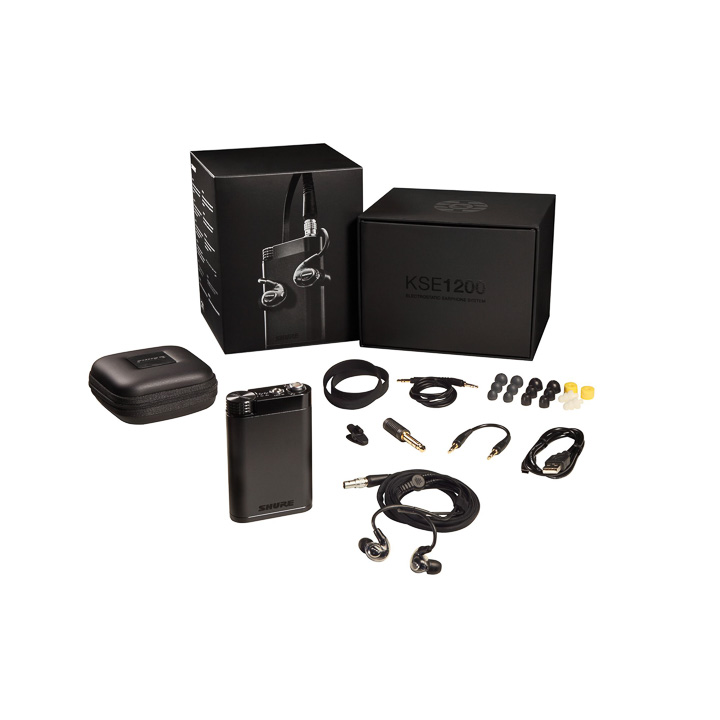
Shure has been involved with the creation and production of music since 1925, but the reason it is still around while most of its competitors from that era have vanished is Shure’s ability to stay current with new offerings. In the headphone category Shure recently launched a new model, the KSE1200. It joins the KSE1500 in Shure’s electrostatic, in-ear line-up. Priced at £1,769, the KSE1200 is £820 less than the KSE1500 and differs from the KSE1500 because the KSE1200 is a strictly analogue device that lacks the KSE1500’s digital inputs and DAC conversion circuitry. The earphones themselves and the amplifier technology used to drive them are identical on both models. For anyone who already owns a good portable player and/or portable DAC the KSE1200 could very well be a more attractive and cost-effective option than the KSE1500.

 The KSE1200 electrostatic in-ear system consists of not only the in-ear capsules containing the electrostatic elements, but also a special amplifier that supplies not only the power to energize the electrostatic elements but also a volume control for the amplification of the electrostatic elements. The amplifier has provisions for a mini-jack stereo analogue input that can be attached to any device with an analogue output, be it a fixed-level source, such as a DAC, or the variable output from a portable player or smartphone.

Accessories included with the KSE1200 include two cables with 3.5mm plugs (one 15.2 cm long, the other 92 cm long), a 6.3mm adapter, a cable clip, and two security bands for attaching the KSE-1200 amplifier unit to a smartphone. KSE1200’s rechargeable Li-ion battery is capable of 12-hour battery life and a recharge time of 3 hours using a 1A charger.

 I used the KSE1200 with a wide variety of devices, including an iPhone SE, Astell&Kern Activa, Fiio M11, Sony NW-WM1Z, Focal Arche, Sony TA-ZH1ES, and Mytek Manhattan II. With an adjustable gain range of -40 dB to +60 dB and a maximum published SPL at 1kHz with 3% TMD of 113 dB, the KSE1200 system could in every case be adjusted for optimal output levels. Generally, I found that with variable output level source devices, turning the KSE1200 amplifier just above halfway up permitted the KSE1200 system to achieve comfortable volume levels.


 The electrostatic earpieces/capsules themselves are extremely compact and lightweight. I was more aware of the KSE1200’s headphone cable than the capsules themselves. The first foot or so of cable is light, flexible, and has zero microphonics. At the junction the cable gets thicker, with a cloth jacket that twists easily inside the jacket. The termination uses a LEMO connection, which is firm, air-tight, and protrudes straight upwards, slightly more than two inches from the top surface of the KSE1200.

 The KSE1200 displayed all the audiophile-pleasing sonics that are characteristic of a good electrostatic transducer design. The sound was incisive, clean, and cohesive in a way that’s unique to a single full-range electrostatic driver. The term “straight, no chaser” came to mind while listening to the KSE1200—they neither add to nor subtract from the original source. Romantic? Nope! But if you like your music portrayed with maximum “honesty” and a minimum of romanticism, the KSE1200 delivers that and more. Are they bass monsters? Nope, again. But when properly occluded the bass is delightfully detailed and texturally complex. The imaging through the KSE1200 was spectacularly precise, with every spatial cue immediately obvious. Upper frequencies were exceptionally smooth while retaining transient energy and dynamics.

 Theoretically, the KSE1200 is ‘pocket-able’, but I suspect that in some situations a user could have issues with the volume knob moving in their pocket since there is no way to disable or lock it in place. Also, the two inches of rigid termination sticking up from the KSE1200’s top isn’t as pocket-friendly as a shorter or more flexible connection would be.

 No one pair of earphones is ideal in every situation. The KSE1200 would not be my first choice as a workout exercise companion. But, if I wanted a completely portable electrostatic monitoring system for on-location recording and playback, the KSE-1200 would be top of my list. 

TECHNICAL SPECIFICATIONS

Shure KSE1200 electrostatic earphone system

Type: Electrostatic in-ear monitor

Driver complement: Single full-range electrostatic driver

Frequency Response: 10 Hz to 50 kHz

Impedance: NA

Signal to Noise: 105 dB A-weighted

Connector: LEMO on amplifier attachment, 3.5mm mini-jack stereo analogue input

Weight: 44 g, or 1.55 oz.

Price: £1,769 UK, $1,999 US

MANUFACTURER INFORMATION

Shure Incorporated

URL: shure.com/en-US

Phone: +1 (800) 257-4873

Distributed in the UK by Shure UK

URL: shure.co.uk

Tel: +44(0)1992 703058

MOON COLLABORATES WITH RAIDHO ACOUSTICS

Canadian high-end audio manufacturer, MOON, is delighted to announce a new association with renowned Danish loudspeaker manufacturer, Raidho Acoustics. 

Raidho Acoustics develops and manufactures loudspeakers for listeners with a sense for aesthetics – those who think sound should be fantastic, want their listening experience to be out of the ordinary and expect good-looking speakers with an exceptional design and cool visual expression. This ethos makes Raidho Acoustics’ loudspeakers the perfect partners for MOON’s range of performance audio hi-fi systems. 

Later this year, hi-fi lovers across the globe can expect to see MOON and Raidho Acoustics performing together at audio shows and in retail stores.

MOON’s export sales manager, Etienne Gautier, commented, ‘I am absolutely certain that our customers will enjoy hearing the audio performance our industry-leading designs will deliver together. This is a really exciting new collaboration and I look forward to working closely together with our friends at Raidho Acoustics.’ 

For more information: 

www.simaudio.com 

www.raidho.dk/raidho-acoustics 

www.renaissanceaudio.co.uk

Cardas Audio Clear Cygnus loudspeaker cable

By definition, an audio cable of any description is doing a poor job. As a transmitter – rather than a creator – of musical signals, all any cable can do is either add or subtract things it shouldn’t. Many supposedly ‘best’ cables end up adding blooms and peaks that – while many find sonically attractive – are simply imposing their own stamp on the music. Cardas is one of the few cable companies that strive to do as little damage as possible. Clear Cygnus is arguably Cardas’ most affordable ‘do no harm’ loudspeaker cable to date. 

Sitting between Reflection and Sky (which sounds like a pretentious 1980s  album) and replacing Clear Light, Cygnus uses 4× 15.5 AWG pure copper Matched Propagation conductors in a quadaxial construction, using Cardas’ distinctive Golden Section Litz layout. The cable itself is 1.7cm in diameter and shares the blue Alcryn jacket, aluminium strain relief, and pressure forged, solderless copper connectors. Clear Cygnus can be supplied bi‑wired, too.

There’s a consistency to Cardas’ sound quality. Clear Cygnus is a cable that produces an honest and unforced sound, with a soundstage as free and open as the equipment allows, and a dynamic range that is as good as you’ll find at this price and beyond. There’s a sophistication to the performance that belies Clear Cygnus’ price; not over-refinement or sophistication at the expense of energy. Instead, Clear Cygnus has extended high-frequencies that never shout and never get in the way of the music. It’s only when you hear what so many others do, that you begin to realise just how rare that is.


Regrettably, a lot of audiophiles are stuck in the instant gratification/‘shiny things make it all better’ phase of their audio journey, trading long-term listening for short-term excitement. Their cables often help reach that ‘shiny’ goal at the expense of how music should sound in the real world. Clear Cygnus is therefore the first step into a more musically grounded world. If you try Clear Cygnus against many of its more forward-sounding peers, the oddest thing happens; your first impressions are of a cable that sounds almost rolled off, but your brain quickly recognises this as an intrinsically more balanced approach. Spend a couple of hours with Clear Cygnus and swap back to the original cable and what you once thought ‘musically exciting’ sounds hard, bright, edgy, and forward. What’s worse, those feelings you now have toward your original cable do not soften over time. The Cardas Conversion Course has begun, and you will find yourself drawn to a sound that is more about flow and elegance than edge-of-the-seat frenzy; a more ‘cygnine’ sound, if you like.

I’ve been using Cardas Clear (power cords, interconnects, and loudspeaker cables) for as long as there have been Cardas Clear cables, primarily for that effortless, do-no-harm performance they deliver. Clear Cygnus takes that Clear sound and makes it far more affordable, sacrificing nothing in the process unless you are planning to skimp on cables for a truly top-end system. If you are an audio grown-up and want a sound that’s less forward and immediate, but without sacrificing performance elsewhere, Clear Cygnus is the right choice.

Price and contact details

Price: From £1,080/1.5m pair

Options include: Spade connections, 4mm banana plugs, bi-wire variant

Manufactured by: Cardas Audio

URL: cardas.com

Distributed by: Audiofreaks

URL: audiofreaks.co.uk

Tel: +44(0)208 948 4153

Leema Acoustics creates free speaker calibration PDF guide for locked-down music lovers

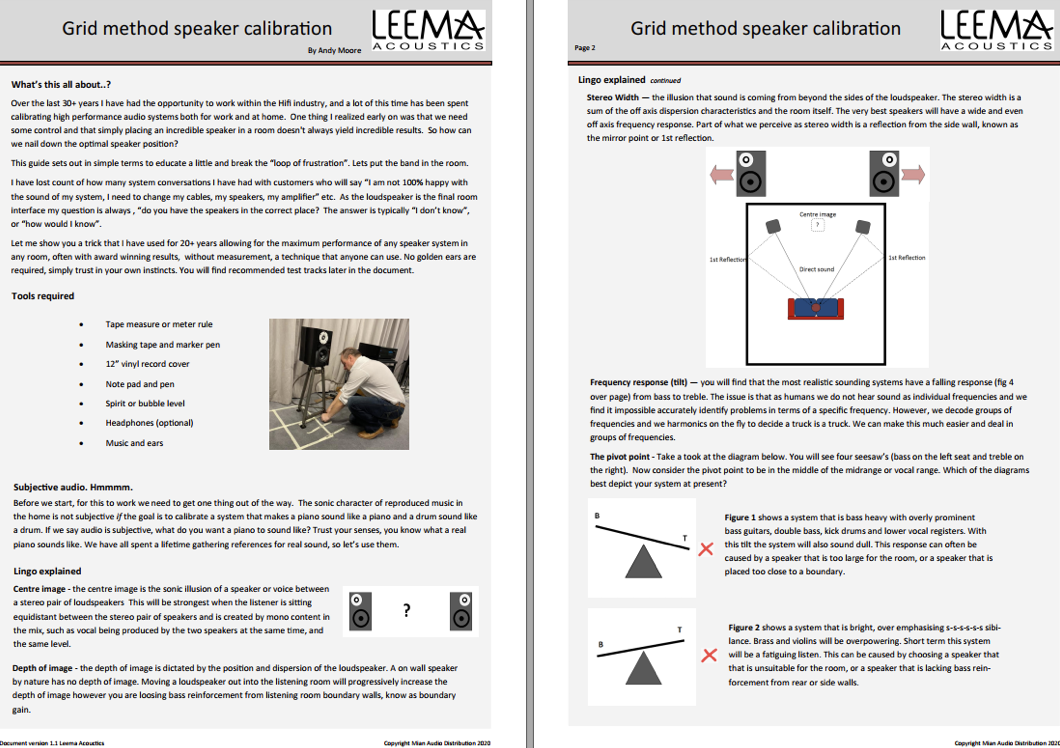
We typically run news pieces without passing comment. However, this one is worthy of note. Instead of pointing to a specific new product line, new model, a discount deal or even some ‘back office’ information about staff members, this one is simply a helpful guide to setting up a pair of loudspeakers. This is born of audio distributors and retailers setting up loudspeakers in hotel rooms for expos, in demonstration rooms and in the end-user’s listening room. Sadly, for now those ‘hands on’ experiences are performed at a distance, but if you have stripped your system down and rebuilt it for the fourth time, even aligned all the screw heads out of boredom, then maybe it’s time to set the system up using a time-honoured grid method. And Leema’s seven-page PDF shows you how.

Granted that there is more than one way to set up a pair of loudspeakers, and for some their installation is far more ‘black belt’ than this. But, if the way you set up your loudspeakers is merely using the instructions provided by the speaker manufacturer, this tape and LP-sleeve system is an excellent start. It even includes recommended tracks required to set up the system:

21st April 2020, Wales, UK: With the UK lockdown extended until May at the earliest, Leema Acoustics has published a free comprehensive speaker calibration guide for locked-down music lovers wanting to get the best from the hardware they already own. 

The Welshpool-based manufacturer, founded by two ex-BBC sound engineers in 1998, has teamed up with Andy Moore, Leema Acoustics’ Export Sales Business Manager at MIAN Audio Distribution (Leema’s UK distributor), to produce the ‘Grid Method’ speaker calibration guide, which is based on Moore’s 30 years’ industry experience. The seven-page full-colour PDF is available for free download and can be accessed here:https://bit.ly/2VzcKk5


Leema Acoustics has a long history with loudspeakers: the company’s first product was a compact five-litre micro monitor, the Xen (MkII pictured below). Founder Lee Taylor said, “I couldn’t find a really high-quality micro monitor for home and studio use; they were either compromised in the bass, or in SPL capability. My co-founder and I decided to design a micro monitor of only 5l volume with a bass response from 55Hz -6dB to 25kHz +/-1.5dB.”

This was quite a tall order and took a long time to achieve, but we managed it and produced some speakers for our own use. I took them in to commercial studios to use while mixing and other engineers said, ‘Can you make some for me?’ and things evolved.”


The free speaker calibration guide has been produced by Leema in recognition of the importance of the loudspeaker as the final interface into the room. It has been designed to help Leema Acoustics’ customers (and others) ensure correct speaker placement and, therefore, realise the full potential of their low-distortion Welsh-made electronics.

About Leema Acoustics 

Leema Acoustics is an internationally respected manufacturer of high-performance audio products founded by two ex-BBC sound engineers. Leema products are proudly hand-made in Wales using UK- and European-sourced components.

Founded in 1998, Leema Acoustics’ unique design processes, fanatical attention to detail and pursuit of accurate sound reproduction have seen the company win numerous press accolades in recent times. Today’s Leema Acoustics incorporates the latest technology into a product range that covers electronics, loudspeakers and cables, delivering complete high-performance audio solutions to consumers, with the benefits of expert design, UK hand-assembly and local component sourcing. 

https://www.leema-acoustics.com

Naim Audio Mu-so Qb 2nd Generation streaming loudspeaker system

If I am being truly honest, despite having access to more or less the whole audio toy shop, the product that has logged the largest number of listening hours in my house is the Naim Mu-so Qb. Why? Because it’s so damn convenient; it’s the streamer-meets-radio that lives just beyond arm’s reach from my computer keyboard. It’s small enough to take up minimal space (it sits on a side cabinet) but is considerably more powerful and better sounding than the ‘pencil case’ sized Bluetooth soundbars and smaller one-box systems that currently dominate the market.

All of which meant that when Naim announced a replacement – the Mu-so Qb 2nd Generation – I had an initial touch of the jitters. Naim isn’t known for ‘change for its own sake’ updates and has a very good track record of making a Mark II that’s better than the original, but when something is a constant companion, you get to fear change. Will it still look as good? Can it sound better? Will they accidentally throw the baby out with the bathwater? In a product as important to Naim – and to my personal listening experience – the Mu-so Qb 2nd Generation has to get it right. There’s no opportunity for failure, and if they mess up my enjoyment of The Now Show or I’m Sorry I Haven’t A Clue, I’ll go all Guy Fawkes on them. Actually, I’ll just keep the old model, but the potential for miffing is high.

I shouldn’t have worried. Naim made a good thing, better. Starting with the look; I find the Qb a timeless design, with its large central control wheel on the top, the gently undulating grilles, and the illuminated clear Perspex base. Naim clearly also thinks this is timeless, because where the design is changed, the changes are subtle and for the better. The grilles are more elegantly scooped. The darker grey top plate gives it a more refined aspect, and the control dial just looks more ‘right’ in context. The original Mu-so doesn’t now look like the runt of the litter, but if saw the two side-by-side and knew nothing else about the product, you’d go with the 2nd Generation. It’s just more attractive.

That intelligent controller is seriously improved upon its previous iteration but is designed to be a similarly easy-to-navigate dial with active touch controls. The two big changes are the haptics are improved, and it wakes and illuminates as you approach it. As this is essentially the only control surface on the Mu-so Qb (the rest is on a tablet), the way that panel shapes itself according to function is vital, and in this version, it always seems to correctly second-guess what you are doing. It has more ‘tap to display’ controls, includes a ‘favourites’ button and indicators for when you are using Chromecast or Airplay. However, despite a surprisingly long laundry list of functions, the new controller is every bit as easy to use as its predecessor. 


The drive units are also improved, although their size, number, and position in the Qb case remains the same (two tweeters and midranges with a racetrack bass unit to the front, and two side-firing passive radiators). The big change, however, is in the multicore DSP engine, which offers a claimed 13 times the punching power of the original single-core engine of the Qb. This in part reflects the transformation of the digital audio landscape that has happened since the first Mu-So Qb was launched in January 2016. Where the 2016 version was primarily driven by Naim’s own app, set-up now requires use of the Google Home app (as it features Google’s Chromecast) and can integrate with Apple’s Airplay 2 and Apple Home. These features were simply not accessible to the original Qb, and as a result the first model had to ‘live’ within Naim’s ecosystem, where the Mu-so Qb 2nd Generation can just be a visitor. 

Documentation is Apple-grade minimal now, because it can be. If you buy a new Apple product, the product itself is effectively its own manual and once powered up takes you through the process of installation. The Mu-so is similarly light on actual documentation, because such documentation is largely unnecessary; make it go through Google Home, load up the Naim app on your tablet or smartphone… job done. OK, there are some names and passwords to enter if you are hooking it to Tidal, but technobabble splash screens and bewildering settings are a thing of the past in modern consumer electronics and the Mu-so Qb 2nd Generation is very much a product of the now in that respect.

That all being said, there is a lot of online information on the Naim website, and I’ll give Naim a bit of a free pass here too, thanks to its forum. Unlike the dark underverse of pestilence and anger that has come to define many online communities, Naim’s forum is a mine of useful information. If you have a misstep in the set-up or operation of your product and post a legitimate question on their forum, you will get honest and reliable answers seemingly in nanoseconds from a community that genuinely doesn’t want to see you struggle. In fairness, setting up the Mu-so Qb 2nd Generation is extremely easy and any bumps in the road get repaired fast, either by the guide on the website, by the experts in the stores, or on the forum. This ease of set-up is mandatory for a product that isn’t designed to require a lot of expert on-site installation, but it’s good to know that if your network is truly weird, help is at hand. 

Knowing the Mu-so Qb 2nd Generation is easy on the eye and connects into your system like it was superglued to your router is one thing. How it performs is very much another. Here, the Mu-so Qb 2nd Generation stands or falls; not only against its older brother, but in absolute terms. In fact, the original Qb stood taller than its rivals in 2016 and is still the main rival to the Mu-so Qb 2nd Generation. But, even if the original Qb is cheaper than its replacement (at the time of writing, there are still a few companies with stocks of the first model, and they sell for almost £150 less than the Mu-so Qb 2nd Generation), I can’t imagine anyone buying the original today. The jump in performance is more than big enough to make the first model seem a little ‘old hat’.

A big change is the way the Qb handles voices. I wasn’t unhappy with the presentation of vocals on the original Qb, but the 2nd Generation makes those vocals considerably more articulate and real, and the original sounds more than a little ‘thrummy’ and ‘chesty’ in comparison. So, when I tune into ‘PM’ on BBC Radio Four, I can hear the Mother of Parliaments descend deeper into chaos in far greater clarity and detail. Less grimdark in nature, the same applies when listening to music; whether it’s the redesigned drive units or that improved DSP, the result is a Mu-so Qb that better projects those vocals into the room in a clearer, more naturalistic manner.


What the original Mu-so Qb does so well is fill a room with sound, and unless you are trying to fill an aircraft hangar or determined to play thrash metal at pain-threshold levels, it will achieve this task well, with surprisingly good bass. The Mu‑so Qb 2nd Generation doesn’t break that well-won goal, and if anything plays just that bit louder, but with distinctly more defined bass. OK, so physical constraints of size mean you are not going to hit low organ pedal notes, and the Mu-so Qb 2nd Generation really comes into its own from about 80Hz on up, but those bass notes it does play are well-formed, and have a shape and consistency that is extremely alluring. I played ‘King Tubby Meets Rockers Uptown’ from the album of the same name by Augustus Pablo and King Tubby [Yard International, TIDAL], and this track needs both a wall of sound and an ability to play a really good bass line. While the sheer depth of dub is lacking its teeth-rattle power, the precision of the bass line and the fun factor of the music is played perfectly by the Mu-so Qb 2nd Generation.

In fact, that whole ‘fun’ part is what defines the Naim Mu-so Qb 2nd Generation so well. It’s a no-fuss, no-nonsense musical fun machine that is just as comfy being your accompaniment to cooking the evening meal as it is acting as a big alarm clock in your bedroom. The new models beefed up sound makes it more attractive in these settings and its beefed up DSP and wireless connectivity makes it more capable to be used in these settings as a multi-room or standalone player too. In short, it just brings more sonic enjoyment to the home, all over the home. Love it! 

TECHNICAL SPECIFICATIONS

Type: Integrated Streaming System

Inputs: 3.5mm analogue jack, USB 2 (Type A connector), optical S/PDIF (up to 24/96), Ethernet (10/100Mbps), Wi-Fi (802.11a/b/g/n/ac), Bluetooth v4.2

Streaming options: Apple AirPlay 2, Chromecast Built-in, UPnP, Spotify Connect, TIDAL, Roon Ready, Bluetooth, Internet Radio (vTuner Premium 5)

Audio formats: WAV, FLAC and AIFF – up to 32bit/384kHz, ALAC (Apple Lossless) – up to 32bit/384kHz, MP3 – up to 48kHz, 320kbit (16 bit), AAC – up to 48kHz, 320kbit (16bit)
OGG and WMA – up to 48kHz (16bit), DSD- 64 and 128Fs, Bluetooth – SBC, AAC. Note: Gapless playback supported on all formats

Multiroom: Sync up to five Naim Streaming products and control via the Naim App

Finish: Burnished and anodised aluminium casework. Dual-tone grey and black fabric grille. Optional olive, peacock, and terracotta grilles

Dimensions (W×H×D): 21 × 21.8 × 21.2cm

Weight: 5.6kg

Price: £749

Manufactured by: Naim Audio

URL: naimaudio.com

Tel: +44(0)1722 426600

Volti Audio Proudly Introduces An Exciting New Horn Loudspeaker – Razz

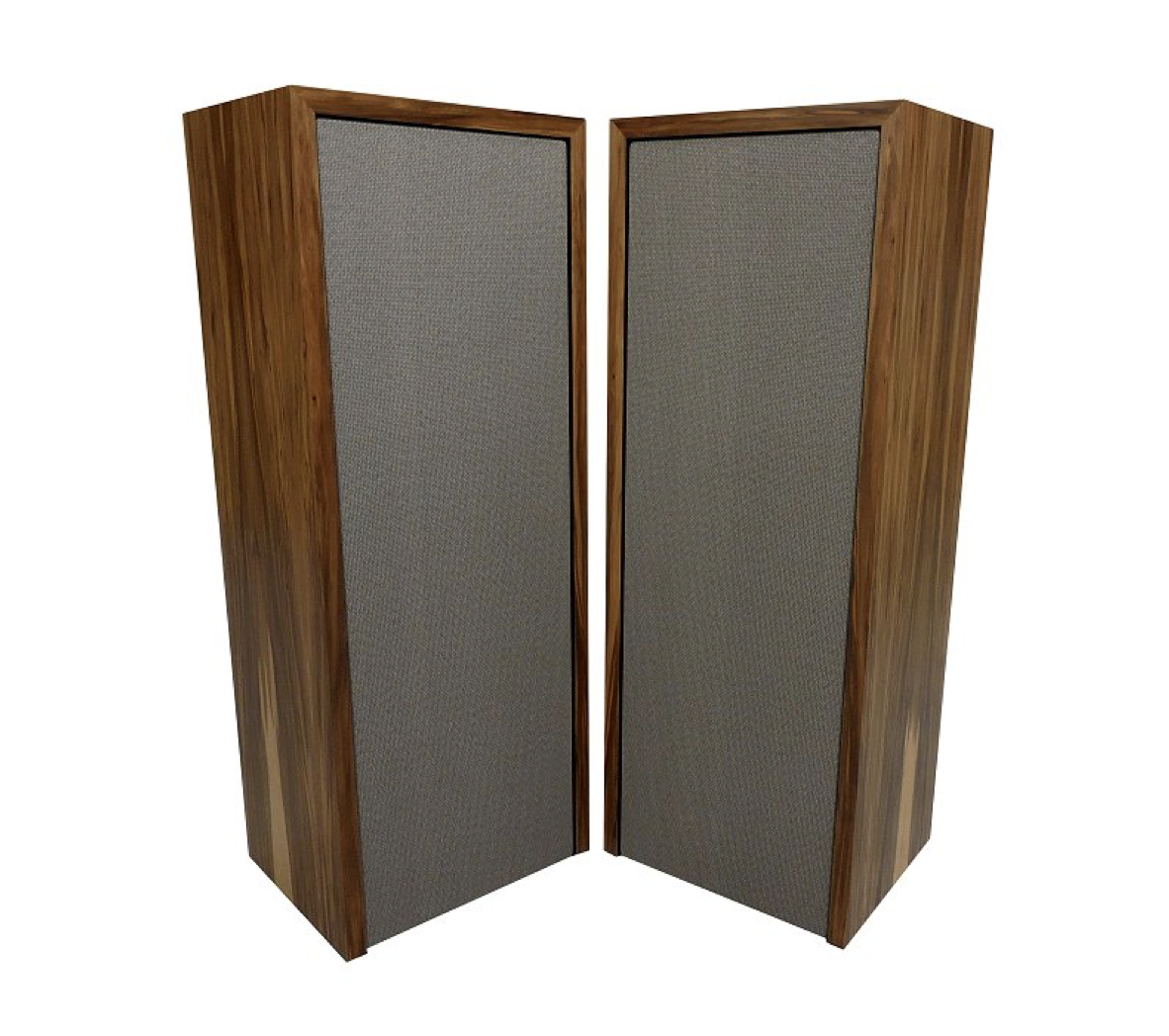
Volti Audio, makers of the highly acclaimed Vittora and Rivalhorn loaded loudspeaker systems is proud to introduce the most compact and affordable Volti horn speaker to date – the Volti Audio Razz

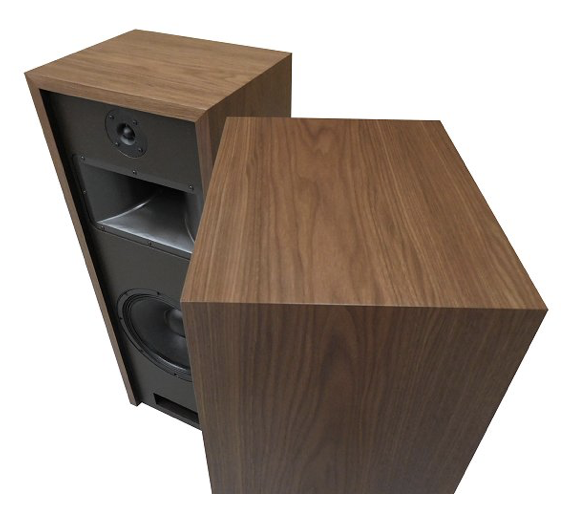
The Razz is a three-way, hybrid horn/bass-reflex loudspeaker, with high sensitivity, wide bandwidth, superb build quality and captivating sound.

Volti Audio’s direct-to-customer sales model makes the Razz thebest value for money loudspeaker on the market today, featuring Pro-Audio grade components, stoutly built cabinetry, beautiful finishes, “The Volti” sound, and a price of just $4,999! 


The Razz shares the same sound signature as all of our speakers:

Effortless power delivery

Wide dynamic range

Finely resolved articulate mid-range

Immersive, room-filling sound

Pinpoint imaging and wide soundstage

Sings-with-one-voice driver integration

Full-range bandwidth

Tight, deep bass

Accurate tone and timbre


Volti Audio is celebrating ten years in business, and the newly designed Razz speaker is the culmination of a decade of design and engineering experience, resulting in a speaker that raises the bar for the performance-price ratio among all horn speakers on the market.   Nowhere else will you find this kind of glorious, full-range, tactile, effortless music delivered with just a few watts of amplifier power, combined with beautiful wood veneers and finishes, 1” thick Baltic Birch plywood cabinetry, and a price under $5K. 


Details and Specifications

12” high-power and high-sensitivity woofer – bass reflex configuration, ported

Large midrange horn with a 2” throat and a shallow wide-dispersion design

High quality 2” outlet midrange compression driver with a composite diaphragm

High quality neodymium horn tweeter

Custom made crossovers featuring high quality components, all hand-wired

Bi-wire at the input terminals

Sensitivity: 97db

Recommended amplifier power: 8wpc (min.), 80wpc continuous (max.)


Bandwidth: 35Hz – 20kHz

Nominal Impedance: 6ohm (connect to 8ohm taps)

Dimensions: 40” tall, 15” wide and 12” deep 

Weight: 90 lbs. each


Available in four different beautiful veneer choices – Walnut, Mahogany, Cherry, and Maple with black grills for $4,999/pr.

Complete information, including many photos can be found on the Volti Audio website www.voltiaudio.com


Email: [email protected]


Call Greg Roberts 207-314-1937


Demo Room: Baxter, TN

Primephonic announce classical-on-demand radio station

Classical music streaming service Primephonic has today launched the world’s first preference based, on-demand classical radio station. This all new function merges the world of radio and streaming by allowing users to listen to a station curated on their inputted personal selections regarding period, genre and ambience (mood).

This feature is being launched in response to an IFPI survey that suggests older listeners (64% of 35-44-year-olds, 53% of 45-54-year-olds and 44% of 55-64-year-olds)  are used to radio channels selecting music for them, rather than having to select music themselves on a streaming service. Primephonic’s on demand radio combines the best of both worlds: music selected by experts like radio does, but also the ability to only listen to music that fits your personal preferences like streaming services do.

Speaking of the new update, Primephonic CEO Thomas Steffens said “We are thrilled to announce that we have become the world’s first streaming service to offer an on-demand classical radio station based on preference. And because we have opted to develop it based on inputted preferences over using an AI algorithm to select tracks for listeners, users will be able to enjoy music that’s truly curated and personal to them. This update is incredibly valuable for older listeners who are new to audio streaming and need a helping hand navigating what often can be a confusing and alien world.”

A 14-day free trial can be activated on www.primephonic.com or a full subscription activated from £9.99 (Premium) or £14.99 (Platinum) a month.

Interestingly, the team in Amsterdam have just released statistics about how our listening behaviour has changed since lockdown, plus a how streaming on Primephonic has increased by 20% across Europe since quarantine measures were put in place. During these turbulent times people are having to change the routine of their daily lives plus find ways to unwind whilst remaining indoors all day. While the classical music genre has long been touted as a method for people to stay calm, up until now the number of people downloading and streaming this genre has not been able to compete with pop and rock.

Key Primephonic information

Either 320kbps MP3 streaming or lossless 24bit FLAC streaming

Over 3.5 million classical tracks

230,000 albums

117,000 artists

2,400 labels

Unlimited streaming

Create personal playlists

Offline listening

Get expert recommendations

Adaptive bit-rate

Unique podcast content with top artists: Sheku Kanneh-Mason, Alison Balsom, Kian Soltani, Daniil Trifonov and Víkingur Ólafsson

Exclusive recordings with: New York Philharmonic, Chicago Symphony Orchestra, London Symphony Orchestra and San Francisco Symphony

Getting Hi-Fi+ in the time of Coronavirus

To use the most grammatically stunted line ever to appear in a hit record, in this ever-changing world in which we live in* getting hold of the magazine might not be quite as simple as it used to be. Many readers still buy the paper edition of the magazine through news-stands and newsagents. While many newsagents in the UK remain resolutely open because of their dual role as a Post Office, many more around the world are temporarily closed due to the COVID-19 pandemic.

We hope these stores open soon – there’s enlightened self-interest in that statement, as these stores opening will mean more magazines sold, but also means the world is beginning to move past one of the peaks in the virus’ spread. In the meantime, though, what is a reader to do?

We have a number of options open to the reader. We offer the chance to buy an individual issue (https://hifiplus.com/publications/hi-fi-plus/issues/182/) as well as taking out a one or two year subscription (see the right-hand box on the same page). There is also a subscription form in every issue and we still receive our mail and email.

Then there is our digital subscription service (https://pocketmags.com/hi-fi-plus-magazine). This allows you to access a read-anywhere digital version of the magazine. You can choose from a single issue, to six monthly and annual subscription.

Finally you can also subscribe to an Android, iPad or Kindle tablet app-based version of the magazine. Just type ‘Hi-Fi Plus’ into the search function on the relevant store on each device and you’ll find us.

We are striving to continue to provide our normal monthly service during this period of unpleasantness. The actual dates of that service might prove a little ‘looser’ than usual, but some months just seem longer than ever at the moment anyway. So bear with us.  

• In fairness to Macca, this line from ‘Live And Let Die’ might be, “if this ever-changing world in which we’re living” and this does scan better with the next line… “Makes you give in and cry”. However, this might be a spot of revisionism; I think it was “in which we live in” and it always was are be.

Lyra Etna SL moving coil cartridge

I had intended this to be a long-winded review, but then realised the shortest, simplest review is all that’s needed. The Lyra Etna SL is, quite simply, the best cartridge I have ever used. There may be better cartridges out there (including at least one more from Lyra itself), but I haven’t heard them yet. Best of all, one of the Etna SL’s strong points is you don’t feel the need to hear those products discussed in hushed tones. It’s all you need.

The Etna SL is a denuded (bodyless) cartridge based on the company’s second from the top Etna moving coil, which is itself based on the range-topping Atlas. The top Lyras are asymmetrically-structured, so that the mounting of the front magnet carrier could be moved out of the way of the mechanical path connecting cantilever to headshell. The differently-shaped structures on the left and right sides limit the formation of standing waves inside the cartridge body itself. Etna (standard or SL) features a yokeless dual magnet system, diamond-coated boron rod cantilever built directly into the titanium body structure, and a Lyra-designed variable-radius line-contact stylus. The Etna SL (or ‘single layer’) is a custom-ordered variant, with a 0.25mV output, 1.52Ω self-impedance, and a 1.9µH inductance.

What the Etna SL offers that I’ve simply not heard to anything like the same degree is ‘balance’. Some cartridges excel at some things and are simply ‘OK’ at others. Routinely those considered ‘the best’ are remarkable at one or two aspects of a performance, and don’t mess up the others. The Etna SL is balanced because it excels in all aspects of performance. You get the dynamic fireworks needed to play something exuberant and bombastic (be that Symphonie Fantastique or Frankie Goes To Hollywood’s ‘Two Tribes’ 12” [ZTT]), you get all the space and air that those audiophile faves demand (yes, I played Jazz at the Pawnshop [Proprius]… but I didn’t inhale), and you get all the speed and energy required to play the Big Black and Hüsker Dü albums you need to spin as a palette cleanser after listening to Porn at the Jazz Shop. You also get all the articulation and transparency needed to listen to the dual harmonies of Silly Sisters, the Black Belt articulation demanded to untangle the brain-wrencher that is ‘Murder Mystery’ on The Velvet Underground [Verve], and the coherence required to really parse Jaco Pastorius’ fluid bass lines throughout Joni Mitchell’s Mingus [Asylum]. But, the Lyra is not filled with suspense and drama unless the music calls for it.

Normally by now, something would have begun to pall next to the other brightly lit parts of the performance, but the Etna SL is not that sort of cartridge. It is the most perfect transmitter of information from the record to the phono stage I have yet encountered.  

In short, the Lyra Etna SL just does the LP justice. Any LP. Other words are just filler. The fact it can do justice to records that really don’t deserve justice (why did I buy a Lionel Richie album, and why the hell did I play it, even if it sounded good?) only serves to show why the Lyra Etna SL sets a standard against which all other top-end cartridges should be referenced. It really is that good. If the Atlas and Atlas SL are even better, I will have to turn to a life of crime.

Price and Contact details

Lyra Etna SL: £6,495

Manufactured by Lyra

URL: lyraconnoisseur.com

Distributed by: Symmetry

URL: symmetry-systems.co.uk

Tel: +44(0)1727 865488 

Manley Laboratories Absolute Headphone Amplifier

Most pure analogue headphone amplifiers are simple affairs with a volume knob, some gain adjustments, and that’s it. And then there is the Manley Absolute Headphone Amplifier, which has so many controls and adjustments that even an experienced reviewer will probably need to glance at the owner’s manual at least once. Instead of a simple circuit path, the Manley delivers two, and instead of a single global feedback setting the Absolute offers a 10 dB range of adjustment. Intrigued? I know I was, and I continue to be amazed by the flexibility and sonic adjustability of the Manley Absolute Headphone Amplifier. Let’s take a look and see what absolute means when it comes to a headphone amplifier.

First off, in case you didn’t glean this from the photograph, the Manley is a valve-based device. Its valve complement includes two 12AX7 input valves and four 6AQ5A (EL 90) output valves. Its rear panel has two stereo pairs of single-ended RCA inputs. For outputs the Absolute supplies one single-ended RCA stereo pair, one 6.35mm stereo headphone jack, and one balanced 4-pin XLR headphone jack, which allows two different headphones and one line output to remain connected at all times. The rear panel also contains the AC mains connection, the Headphone Maximum Level adjustment threshold control, and an instruction panel that lists the controls and their functions.

All the controls are on the front of the unit. These include a large volume control thumbwheel with LED level indicators directly above it. Directly to the left side of the volume control is the push-pull/single-ended selector, which changes the amplifier’s circuit topology. On the right side of the volume control is the mute button. On the top surface of the Absolute you will find two rows of controls, the lower row contains, from left to right, a three-way output impedance adjustment, output selector, input selector, mono/stereo switch, and an EQ on/off switch. The second row has a variable feedback adjustment knob, bass control, treble control, and balance control knobs. The Absolute comes with a dedicated RF remote control that has only two buttons: volume up and volume down.

Installing the Absolute was easy: simply connect a source to the input and a pair of headphones to the output; turn it on; select the correct input, output, and impedance from the front panel controls; and you’re done. I used a wide variety of headphones with the Absolute, but the Abyss Diana Phi and Focal Elegia spent the most time connected to the Absolute.


Because the Manley Absolute has a three-band impedance selector switch right on its front panel, matching impedances with any headphones in my collection was a push button away. Another neat feature was the ‘bypass’ function, which routes the signal directly from input to the pair of RCA output jacks. So, you can use the Absolute as an active line-level preamplifier or ‘put it to sleep,’ and let the signal go directly to the RCA output jacks.

Sonically the Manley Absolute can be anything from a push-pull amplifier with 0.16% THD to a single-ended amp with 1.0% THD. Also, you can add up to 10 dB of feedback. The sonic difference between the single-ended with no feedback and the push-pull with 10 dB of feedback is about as wide as the gap in opinions among audiophiles about the effects of cables on a system. But unlike polarized opinions, the Absolute offers you all the options in between its sonic extremes. Which setting did I find to be ‘the one?’ None, actually. Instead there was a range of settings that worked, depending on the music, the recording, and my own mood.

Generally, I found I needed to employ some feedback regardless of whether I was using the push-pull or the single-ended amplifier circuits. Without at least 4 dB of feedback the sound was a bit too ‘wild and wooly’ for my tastes. Conversely, above 8 dB of feedback the sound lost its immediacy and dynamic drive.

I haven’t mentioned the Absolute’s looks. It is a handsome piece of industrial design that is unlike any other headphone amplifier past or present. When you combine its unique looks with its abundance of features you have a headphone amplifier that lives up to its name. For me, the Manley Absolute Headphone Amplifier was an absolute joy to use, listen to, and adjust to my tastes. Try it out at your pocketbook’s peril…

TECHNICAL SPECIFICATIONS

Manley Absolute Headphone Amplifier

Type: Tube-based triode or single-ended analog desktop/studio headphone amplifier and line-level preamplifier

Valve complement: two 12ax7, four 6AQ5A valves.

Frequency Response: 10Hz to 20kHz push-pull, 20Hz to 20kHz single-ended

Output Impedance: adjustable from 12 ohms to 600 ohms @ 1kHz

Signal to Noise: 83 dB @ 100mW output

Inputs: two pair of stereo RCA connections

Outputs: one pair of stereo RCAs, one 6.35mm stereo headphone jack, one XLR balanced stereo headphone jack

Chassis Finishes: copper, silver, and black.

Weight: 12 lbs.

Price: £4,500 UK, $4,500 US

MANUFACTURER INFORMATION

Manley Laboratories

URL: manley.com

DISTRIBUTOR INFORMATION

SCV Distribution

+44(0) 03301 222 500

URL: https://www.scvdistribution.co.uk/products

iFi Audio xCAN portable headphone amplifier

The British firm iFi Audio is widely considered one of the premier purveyors of small-chassis, ultra-fidelity audio products. iFi’s new xCAN is a uniquely styled portable analogue headphone amplifier in its primary use, but also functions in a secondary use as a Bluetooth DAC for wireless streaming inputs. The xCAN is an inherently versatile product with the goal to allow users to confidently enhance sound quality of audio sources such as smartphones, tablets, TVs, or even high-end DAPs. When directly wired to external audio sources in its primary analogue use, the xCAN supports both 3.5mm TRS single-ended inputs and outputs as well as 2.5mm TRRS balanced inputs and outputs. In its secondary use as a Bluetooth DAC the xCAN sports a dedicated ESS Sabre DAC chip giving users 16-bit 44.1kHz CD-Quality Bluetooth via AAC, aptX, and aptX LL. 

The user interface of the xCAN’s attractive, curvaceous chassis is relatively simple. At the front a user will find selection buttons for ifi’s 3D+Holographic and XBassII proprietary sound enhancement circuits and a stepped attenuator volume control surrounding an intuitive LED push button that changes colours to indicate operation modes. The back face of the xCAN provides a USB-C charging port and a three-position switch that enables the user to customise various parameters of the XBassII sound enhancement circuit. 

Internally, the xCAN is built around iFi’s Cyberdrive circuit. Cyberdrive design creates a dual-mono headphone amplifier that provides a maximum of 1000mW of power per channel. This power should be sufficient to get the maximum performance out of any set of earphones, CIEMs, or full-size headphones you can throw at the device. iFi stresses that their Cyberdrive design embraces a ‘best of both worlds’ formula by offering digital control over an internally analogue amplification process. The signal attenuation conducted on the analogue side is digitally controlled in order to maximize a full dynamic range and preserve resolution even at very low playback levels. Cyberdrive also has the added benefit of being able to deliver incredible battery power control, with playing time said to last up to 18 hours per charge. 


xCAN also features iFi’s important S-Balanced amplifier technology, which is found in its much more expensive Pro iCan big brother. Much has been written on the S-Balanced circuit (essentially a single-ended compatible balanced circuit) but succinctly put, the advantage of this technology lies in the fact that regardless of the user’s choice of headphones, he or she will get the sonic benefits of balanced amplification. Also notable as a tech inclusion is the addition of parent company Abingdon Music Research’s Global Master Timing memory buffer system, which makes the xCAN virtually immune to jitter. 

In the several weeks I listened to the xCAN it continued to earn a space in my pocket owing to its simplicity and sonic effectiveness. The most exciting use I found was to use the xCAN with the various DAPs I had on hand from previous reviews. When connected with these DAPs, the xCAN rocketed playback quality to a stratospheric new level, delivering previously unheard degrees of precision, detail, accurately rendered spatial cues, and other pleasurable sonic enhancements across the board. 

As an example, consider the organ bass notes in Felix Hell’s Symphony Concertante, Op. 81: 1. Allegro-Molto Moderato from Barber, Guilmant & Jongen: Orgel & Orchester [perc.pro]. With the aid of the xCAN the low range of the track seemed to be truly unearthed with a weighty, resonant, rock-solid bass performance not unlike what you would expect to hear when listening through a very high dollar desktop headphone amp. Disconnecting the xCAN after this experience revealed an auditory gulf that was painfully evident, so that I think most users would yearn for the added gravitas the xCAN provides. 

In summary, while some might scratch their heads for a moment to wonder whether a product like the xCAN is necessary or beneficial, the proof is in the listening. To my ears, the xCAN delivers a sizeable sonic payoff beyond all proportion to its modest price.

TECHNICAL SPECIFICATIONS

iFi xCAN portable headphone amplifier

Type: Mobile headphone amplifier with high-end Bluetooth connectivity

Inputs: 2.5mm TRRS balanced input, 3.5 mm TRS input

Outputs: 3.5mm headphone jack, 2.5mm headphone jack

Frequency Response: <2Hz- >200kHz (-3dB)

THD + N: <0.006% Balanced, <0.005% S-Balanced

Power output: >7.6v/90 mW (@600 ohms) Balanced, 
>3.8v/ 45 mW (@300 ohms) S-Balanced 

SNR: >120dB Balanced, >121 dB S-Balanced

Dimensions (H×W×D): 19 × 67 × 95 mm

Weight: 127g

Price: $299 US, £229 UK

MANUFACTURER INFORMATION

Manufactured by: iFi Audio

URL: ifi-audio.com

+44 (0) 1900 60195 

Distributed in the UK by: Armour Home

URL: armourhome.co.uk