Up to 37% in savings when you subscribe to hi-fi+
hifi-logo-footer

Begin typing your search above and press return to search. Press Esc to cancel.

MoFi UltraDeck +M turntable package

MoFi or Mobile Fidelity as they started out have a long history of making audiophile quality pressings of popular albums. They were surfing the crest of the vinyl wave back in the late seventies and continue to do so today. A few years ago some bright spark at MoFi’s Chicago HQ must have noticed that the turntable market had been growing along with the revival of the black discs they played, and so suggested that the company take advantage of its transcription expertise and build a turntable. Acting on this epiphany they started an electronics division and with a bit of help from Allen Perkins at Spiral Groove and Mike Latvis at HRS, MoFi Electronics developed two turntables. These are not just rebadged OEM models but ground up designs with an emphasis on fine detail, not least in the provision of a dust lid to keep our increasingly precious vinyl clean.

The MoFi StudioDeck and UltraDeck, launched two years ago, are wider than average, but just about fit on a regular 52cm width stand. They’re built on a plinth that’s made of aluminium and MDF to create constrained layer damping in order to keep vibration under control. The UltraDeck has a thicker plinth and heavier platter, the latter being 33mm thick and made of Delrin, which is an engineering plastic often used in higher end turntables (Clearaudio for instance). Delrin has a similar impedance to vinyl, producing excellent damping properties when the two are in contact, eliminating the need for a record mat. The UltraDeck is driven via an O section belt by a synchronous AC motor that’s decoupled from the plinth. The motor itself sits outside the platter and has Delrin drive pulleys which offer the usual speeds with manual switch over. The plinth sits on four anti vibration feet made by equipment support specialist HRS.

The UltraDeck is equipped with a 10 inch Ultra tonearm comprising an aluminium armtube and headshell; ball bearings allow for both planes of movement and it’s wired with Cardas internal cable that terminates in RCA connectors on the back of the plinth. It’s adjustable for VTA and azimuth, but the UltraDeck+M, complete with cartridge, is supplied with these two settings in the correct position. There is a marking on the back of the arm to show where to position the counterweight. However this is quite a wide indicator and merely moving the weight to the back of the mark does not place downforce within the 1.8 to 2.2 gram recommended range. Rather, it takes it over, so you need a downforce gauge to get close to the desired 2g. That apart it’s an easy arm to set up until you get to the thread and weight bias system, which involves a tiny grommet and a post that’s very close to the counterweight. The trick here is to fit the anti-skate device to the arm prior to fitting the counterweight, then it’s all pretty straightforward.

The main bearing is inverted and is larger in diameter than usual. It’s designed, says MoFi, using a combination of hardened steel, bronze, and sapphire, aided presumably by a little lube (there was none in the box), because the platter appears to spin perfectly. Unusually this turntable has the power supply onboard and an IEC mains inlet, making it a little tidier round the back.

The +M derivative indicates the presence of MoFi’s top cartridge. The Mastertracker is a moving magnet type (as are all MoFi cartridges) with an aluminium body. It has a micro-line tip on a tapered aluminium cantilever connected to what MoFi calls a V-twin dual magnet generator and Japanese OCC coils.


The UltraDeck is easy to use: the peg on the headshell isn’t big but has a rubbery feel that makes it easy to pick up and it’s easy to change records without stopping the motor. Our sample was supplied with a ‘Super Heavyweight’ MoFi record puck. This is a three-inch aluminium weight with a soft base and no inconvenient thread to do up. It weighs 367g which doesn’t sound ‘super heavy’, but I’m informed that MoFi has borrowed from boxing terminology to convey its ‘knockout’ effect. MoFi is also keen to point out that 367g is calibrated for best results across a range of turntables. The HRS (Harmonic Resolution Systems) design uses proprietary tech inside and on the contact surface to help eliminate more noise and distortion than a standard weight, so I’m told. As in Tai Chi, it isn’t the weight per se, it’s how you use it, and it seems to work!

I mentioned earlier that the counterweight setting point needs a little time to get right. This was apparent when playing the first few records on the UltraDeck, all of which sounded surprisingly bright and forward. Reducing the downforce to the 2g midpoint transformed the balance to something more neutral. I actually wondered if the cartridge was overloading the Trilogy 907 phono stage but it’s specified at a fairly conventional 3mV so it shouldn’t do this. MMs do have a lot more energy compared to MCs (even with the extra gain from a phono stage), so if you’re after immediate impact, MM designs nearly always oblige. Correspondingly the sound of this deck and cartridge is muscular and substantial; a little dark through the lower mid perhaps but reassuringly solid and calm, which makes for relaxed listening even at higher levels. It also makes for good three dimensionality because the bass is firmly planted, lending higher notes greater structure and presence.

Adding the Super Heavyweight puck increases the 3D effect and improves tonal depth, especially through the midrange. Timing likewise jumps up a step or two. The UltraDeck+M is still a smooth-sounding assembly, but the puck adds extra grip, if you’ll excuse the pun.

I played an old favourite in The The’s Soul Mining [Some Bizarre/Epic] and loved the instrumental layering: the presence of an accordion being the most obvious discovery. Patricia Barber’s ‘Company’ [Modern Cool, Premonition] has slightly OTT bass and that comes through here, but so does a sound that totally escapes the speakers, bringing unusual definition to the voice and its surrounding ambience. There’s great depth to the instruments on the excellent Alive in the East by Binker and Moses [Gearbox] but this time I fancied it lacked the atmosphere I’d heard using a good MC. To check this I installed a Dynavector DV-20X2L which is about the same price as the Mastertracker (£799 when bought separately) and paired it with a Tom Evans Microgroove phono stage. This told a different story and much more to my liking (I must declare a preference for MC). Better treble definition gave the sound snap and immediacy. Steely Dan’s ‘Bodhisattva’ [Countdown to Ecstasy, ABC] gained pace with Jeff ‘Skunk’ Baxter’s guitar having more vitality. For me, the MC install improved separation, detail resolution and timing, making the music more engaging. A replay of Patricia Barber’s ‘Company’ now had power and dynamics with considerably greater fleetness of foot.

And here’s the rub. Wherever you sit on the MC/MM divide, the real star has to be the UltraDeck itself. It tells you why Barber’s Company is such a great recording. I spun MoFi’s One Step 45rpm pressing of Blood on the Tracks (Bob Dylan, as if you didn’t know) on the UltraDeck to expose so much more bass detail than is possible from regular audiophile cuts, and greater fidelity in the vocal on ‘Idiot Wind’. I played two further pressings of this album for comparison and each sounded different. The MoFi turntable had no difficulty in differentiating them.


My preference is for MC. Yours, along with MoFi’s, may favour MM. If this is the case I’d suggest that the UltraDeck+M is an excellent midrange system. A trip to your nearest MoFi dealer will confirm your favourite flavour. Either way, the UltraDeck is a serious turntable; the first from a record label with so many references at hand.

TECHNICAL SPECIFICATIONS

  • Type: Turntable with arm and cartridge with dust cover
  • Rotational Speeds: 33 1/3 RPM, 45 RPM
  • Supported Tonearm Length(s): 10-inch supplied
  • Tonearm: 10” Mofi Ultra Tonearm with gimbal bearings
  • Cartridge: Mofi Mastertracker MM
  • Drive Mechanism: AC synchronous motor with twin pulleys
  • Speed Control: Not specified
  • Platter Type: 12-inch Delrin platter without mat
  • Platter Weight: 3.1kg
  • Bearing Type: Inverted hardened steel, bronze and sapphire
  • Plinth Configuration: Composite construction solid plinth.
  • Dimensions (H×W×D): 150 × 500 × 362mm
  • Weight: 10.5kg
  • Price: £2,499 (complete package)
    Super Heavyweight puck: £199

Manufacturer: Mofi Electronics

URL: mofielectronics.com

Distributor: Karma AV

Tel: +44(0)1423 358846

URL: karma-av.co.uk

https://hifiplus.com/reviews/

iFi Audio Aurora network music system

Many enthusiasts think of iFi Audio as being primarily a ‘personal audio company’, meaning a firm geared toward the needs and interests of headphone and earphone listeners. The Aurora, however, shows that there’s another important aspect to personal audio that should not be overlooked: namely, the market for affordable and compact alternatives to full-size, speaker-based hi-fi systems.

All-in-one single-chassis audio systems are not a new idea and several strong and credible products of this type have arrived of late. Indeed, many would say the two benchmark products in this category have both come from Naim Audio in the form of that firm’s recently released Mu-so 2nd Generation and the Mu-so Qb 2nd Generation (both recently reviewed in Hi-Fi+). Given that such strong competitors are already on the field, why has iFi Audio chosen to enter this market? The answer, I suspect, has much to do with iFi having goals and intentions for the Aurora different to those Naim holds for its Mu-so products.

From personal listening experiences and conversations with Hi-Fi+ Editor Alan Sircom regarding the Naim 2nd Generation Mu-so models, my take is that both aim to serve as compact and well-engineered general purpose music sources that offer surprisingly full-bodied sound for their sizes—a mission both components address well.

In contrast, iFi Audio’s Aurora stands more as a compact, single-chassis surrogate for full-fledged, two-channel loudspeaker-based audio systems. Where many single-chassis products strive to produce a ‘big’ sound, the Aurora not only manages to play ‘big’ but to do so with serious sonic refinement and an eye toward delivering unexpectedly expansive soundstages and believable stereo imaging. Similarly, the Aurora shows surprisingly high levels of textural and transient nuance and subtlety—again, offering performance more like a traditional hi-fi system than is typical for the all-in-one genre. 

Perhaps as a reflection of this ambitious mission profile, the Aurora offers a bold and striking industrial design—one I find very appealing but that, realistically speaking, may not suit every taste. Where the Naim Mu-so models emphasise simple, elegant lines and subtle, subdued surface textures, the Aurora deliberately seeks to make a more vivid and intense visual statement. 

Accordingly, the Aurora stands as a functional objet d’art whose oblong rectangular chassis sports rounded corners (as viewed from above) and whose sides are covered with narrowly spaced vertical ribs of natural bamboo. The Aurora’s smooth top and rear surfaces are covered in panels made from laminated strips of natural bamboo, matching those vertical ribs. 

The entire Aurora is suspended at a gently upturned angle from an attached, ‘A-frame-like’ structure that serves both as the stand and as a lifting handle for the unit. The inverted or downward-facing ‘^’ of the structure neatly frames the face of the Aurora, defining a centre section that serves as both a display and control panel. In case this description of the A-frame sounds a bit scary, not to worry; the sharp points of the frame come with translucent moulded rubbed covers designed to protect furniture surfaces below and listeners—or small children—from above, A slender, matt silver remote control completes the package.


The centre panel of the Aurora offers alternating horizontal strips of bamboo and black Perspex, with three narrow strips of black below and one much broader band of black above. (If you step back a bit, the frame and face of the Aurora almost create a stylised capital letter “A”.) The narrower black strips offer rear-illuminated touch controls for the Aurora’s many features and functions, while the broader black band conceals an OLED display panel plus a viewing window for its valve-powered preamp section. As you can imagine, the Aurora makes a great first impression when you first see it powered up in a darkened room.

The Aurora is the creation of French designer Julien Haziza, who says he “drew inspiration from Japanese industrial designers and architecture – namely Shigeru Ban, Tadao Ando, Omotesandˉo  and Harajuku districts in Tokyo.” I found the design reminiscent of the works of the Finnish architect Alvar Aalto, but no matter where its design influences come from the Aurora is undeniable a visually striking product. In fact, readers might find – as I have – that it is satisfying to gaze at the Aurora much as one might meditate upon an engaging sculptural object in an art gallery. 

The Aurora is highly versatile and features a host of inputs including Ethernet for accessing NAS drives or other servers; Wi-Fi for streaming Spotify, TIDAL, and other online music sources; Airplay for audio playback from iDevices and Mac computers; Bluetooth 5.0 with aptX HD/aptX/LDAC/HWA/AAC compatibility; a USB type ‘A’ source host connection for accessing USB music storage devices, a micro SDHC cardslot for accessing micro SD music storage cards; coaxial and optical S/PDIF inputs (where the latter facilitates connecting Aurora to TV sets for use as a soundbar); and two stereo analogue inputs (via RCA jacks or a 3.5mm jack). iFi Audio intends for Wi-Fi and Ethernet/LAN sources to be managed through the MUZO Player App. In turn, Aurora supports UPNP/DLAN protocols and can be managed through apps such as AudioNet Remote Control Point, Linn Open Source Apps or dBPoweramp Asset UPNP, among others.

Aurora’s DAC section is based upon a 32‑bit ESS Sabre Hyperstream DAC chipset with, says iFi Audio, a “time domain jitter eliminator, discrete oscillator, and 112dB dynamic range.” The DAC section’s performance is enhanced through use of the iFi Audio/Abbingdon Music Research Global Master Timing (GMT) Memory Buffer System, which promises to “solve S/PDIF jitter once and for all.” 

The Aurora amplifier section features iFi Audio’s PureEmotion circuit topology, which features a preamp stage driven by a Russian 6N3P valve coupled to a ‘current multiplier circuit’ featuring a distinctive, wide bandwidth switching amplifier. The amp’s switching frequency is, notes iFi Audio “fixed at an ultra-high level – around 1.5MHz, far beyond the audible frequency spectrum.” The circuit is said to provide, “a high level of efficiency, multiplying the current output of the valve several thousand-fold, whilst maintaining far greater linearity and lower noise than typical switching amplifiers.” Finally, the amplifier’s output is coupled to a low-pass circuit and feedback loop, where everything is ‘clock-locked’ to the aforementioned GMT circuit. The PureEmotion amplifier supplies a total of 320 Watts to Aurora’s six active drive units and two passive radiators.

Aurora uses four 120mm wideband drivers with coated paper cones, which run without crossover networks and that cover the lion’s share of the audio spectrum. Two wideband drivers are side firing, while two drivers face forward on the face of the Aurora. Angled outwards at the left and right front corners of the unit are two of 28mm silk dome tweeters that cross in at 8kHz and whose response extends up to 40kHz. iFi points out that these tweeter function more as ‘supertweeters’ since the response of the wideband drivers extends to quite a high frequency as well. Finally, two oblong, bottom-firing, 120mm × 200mm steel passive radiators handle the lowest bass frequencies down to a useful low frequency cut off point of 27Hz.

Three other proprietary iFi Audio technologies help shape the overall sound of the system. The first is the firm’s Automatic Room Tailoring (ART) ‘room correction’ system, which uses six rear-mounted ultrasonic sensors to measure the Aurora’s position relative to nearby wall surfaces and then uses a 32-bit ARM Cortex processor to calculate analogue adjustments to the unit’s driver outputs to create a best sonic fit for the room. iFi Audio stresses that no DSP or feedback is used, so that room correction adjustment occur in the analogue domain only. ART is switch selectable so listeners can forego ART settings to listen in ‘Audiophile’ mode if desired. However, I found ART was so beneficial on so many levels that I soon discontinued experiments with ‘Audiophile’ mode. I experimented with the various challenging placements for the Aurora, such as locating it too close to a rear wall or near a corner, and in each case ART adjustments enabled Aurora to produce a well-balanced and well-centred sound with no egregious peaks, valleys or channel imbalances to spoil the sound. In short, ART works as advertised.

Second, iFi offers its proprietary Soundspace matrix, which is said to adjust “the level of specific drivers at certain frequencies…” to create, “…an immersive room-filling performance, enabling the soundstage to extend beyond the single cabinet.” On paper this might sounds like something that potentially could be gimmicky, but in reality it is the key to the Aurora’s exceptional performance. With Soundspace disabled, Aurora delivered a credible albeit narrow and comparatively flat-sounding stereo presentation. However, with Soundspace engaged Aurora’s sound came alive, throwing a soundstage that extended laterally far beyond the dimensions of the enclosure and that had plausible depth and unexpectedly good stereo imaging. Listen to ‘Talking Wind’ from Marilyn Mazur and Jan Garbarek’s Elixir [ECM, 16/44.1] through the Aurora and you will observe a widely-spaced array of percussion instruments with each occupying a specific space both laterally and front-to-back within a 3D soundstage—performance few competing all-in-one systems can even approach, let alone equal.

Last, TrueBass is iFi Audio’s name for Aurora’s passive radiator driven low bass system, which is said to enhance both low frequency extension and definition. In truth, it’s fairly easy to get all-in-one systems to produce a large quantity of bass if one is willing to accept a general lack of bass clarity, definition, and depth. However, the TrueBass system is different, adding readily discernible depth while preserving a very good measure of bass transient snap and textural refinement. Try Renaud Garcia-Fons’ ‘Ghazali’ from Oriental Bass [Enja Records, 16/44.1] and listen to how the Aurora renders the subtle, earthy, and expressive textures of Garcia Fons’ acoustic bass. It’s sound is rich, vibrant, appropriately woody, and dynamically alive. Similarly, listen to ‘Chant’ from Nils Frahm’s Solo [Erased Tapes Records, 16/44.1] and pay close attention to the Aurora’s rendering of Frahm’s occasionally very low frequency acoustic and electronic keyboard passages. The Aurora maintains clarity, composure, and serious textural refine on the acoustic piano passages (preserving the sound and feel of the piano’s action), while offering up downright stupendous depth and weight as the very lowest electronic keyboard notes are sounded. Perhaps many of you reacted, as I initially did, with scepticism to iFi Audio’s claim of a low frequency cut off frequency of 27Hz for the Aurora system. But, once you hear it reproduce the lowest notes from ‘Chant’ with voice-of-the-Lord-like sonority, I suspect you, too, will become a believer.


In thinking carefully about the Aurora, I have come up with three suggestions for possible improvement in the future. First, I think the unit cries out for a headphone output on its front panel. This is an area where iFi Audio typically excels, so it only makes sense to play to the company’s strength. Second, I would like to see Aurora include a USB DAC input. While I recognise that the Aurora can function as its own server, those of us who already own and use servers would benefit from being able to connect them directly to Aurora’s DAC input. Third, I feel the Aurora User Manual can and really should provide more (much more) detail on setup and use of the MUZO Player App. Maybe it’s just me, but I found MUZO far from self-explanatory.

Setting the foregoing ‘wish list’ aside, though, I must say I found Aurora to be a stunning and satisfying product. For those who want a richly rewarding hi-fi experience without the cost, complexity, and size of a full-fledged speaker-based audio system, Aurora offers a delightful alternative. 

TECHNICAL SPECIFICATIONS

Type: All-in-one network music system

Inputs: Hi-res Bluetooth 5.0 with aptX HD/aptX/LDAC/HWA/AAC; Networked Audio with playback from NAS or server, Airplay, streaming audio (Spotify/Apple Music/Amazon Music/Tidal Hifi/Deezer etc.) and USB storage /SD Card 44.1kHz/16Bit – 192kHz/32Bit; coaxial and optical S/P-DIF (Blu-ray Player, Games Console, smart TV, etc.) 44.1kHz/16Bit – 192kHz/24Bit; and RCA & 3.5mm (for Alexa or analogue audio)

Driver Complement: 4 × 4.5” (120mm) coated paper cone wideband driver, 2 × 1.1” (28mm) silk dome tweeter (8 kHz crossover), and 2 × 4.5” × 8” (120mm × 200mm) steel passive radiators

Frequency Response: 27Hz–40kHz

Maximum SPL: 115dB/1m

Amplifier Topology: Hybrid with valve class A amplification. Power buffers operating at 1.411MHz/1.536MHz clock-locked

Amplifier Frequency Response: 15Hz–150kHz

Distortion: < 0.05%

Maximum Power: 320VA (12v input for Marine/Car power supplies)

Dimensions (H×W×D): 27cm × 59cm × 28cm

Weight: 15kg (or 20kg in shipping carton) 

Price: £1,299, or $1,399 US

Manufacturer: iFi Audio

URL: ifi-audio.com

Tel: +44(0)1704 227 204

B.AUDIO ONE SERIES: THREE NEW PRODUCTS THAT INCORPORATE THE ESSENCE OF THE BRAND’S TECHNOLOGIES

Now recognized for its high-end electronics, the emerging French company is bringing their know-how in signal processing to a second product line. The One series is a comprehensive range, including digital to analog converter, pre-amplifier and amplifier.

B.audio One products feature the brand’s technological developments aimed at eliminating sources of distortion that impact sound reproduction. More affordable, they differ from the Reference series by several simplifications, particularly in the aesthetics as well as in the power supply stages.

TECHNOLOGY

The circuits implemented in B.audio electronics are the result of an innovative approach aimed at leveraging today’s technical possibilities.

Stemming from numerous computer simulations and careful fine-tuning, these developments open up new perspectives while allowing perfect integration with the other elements of the system.

More information in the technology section of our website.


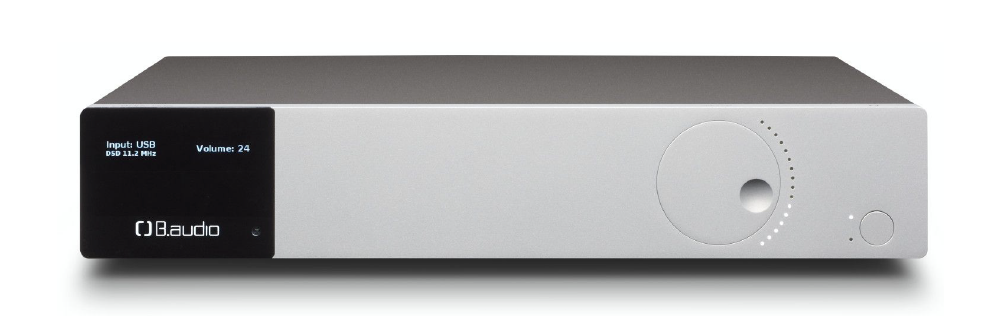
B.DAC ONE

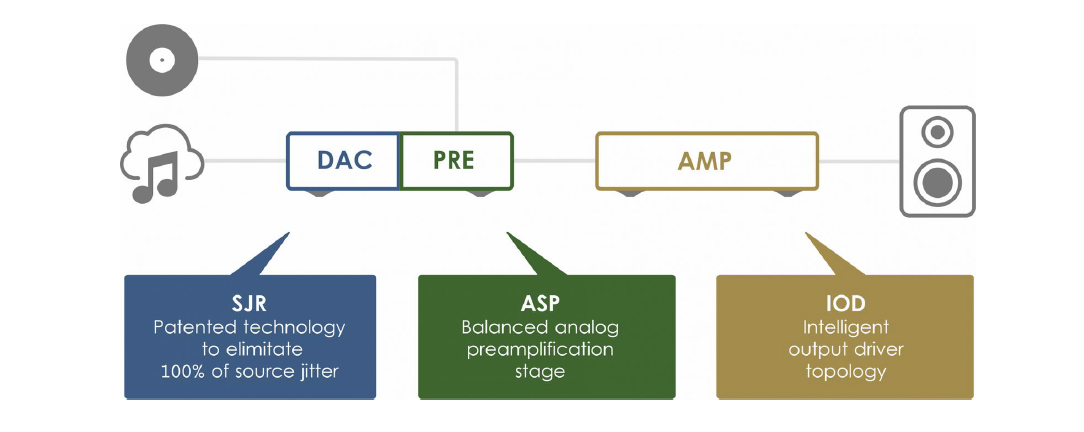
The B.dac one integrates our patented SJR “Source Jitter Removal” technology. It stands out for its absolute accuracy, allowing for optimal conversion quality even from sources with significant jitter levels, regardless of the input (USB, AES-EBU, SPDIF or TOSLINK).

detailed specifications


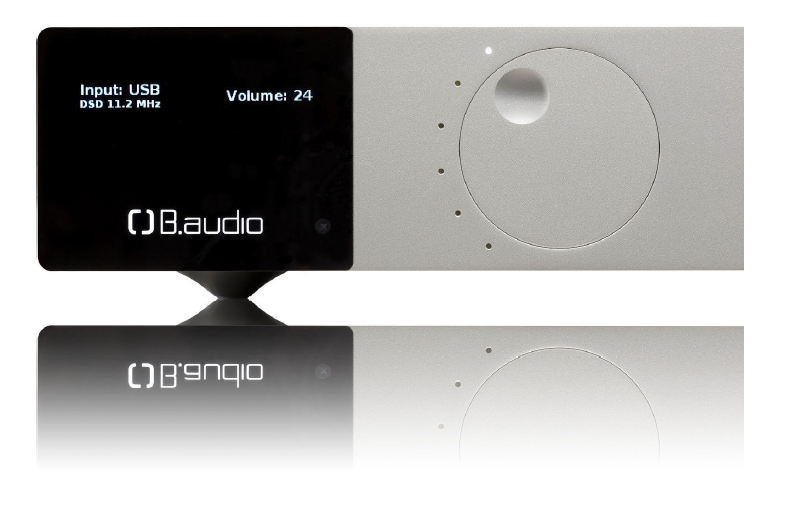
B.DPR ONE

Using the B.dac one’s digital-to-analog conversion section, the B.dpr one adds a 100% analogue symmetrical volume control and pre-amplification stage (ASP). The latter uses discrete resistor networks switched by relays, preserving the integrity of the signal. Digital losses are by construction non-existent, and the conversion circuits operate at their optimum working point.

The B.dpr one can also be fitted with optional analogue inputs.

detailed specifications


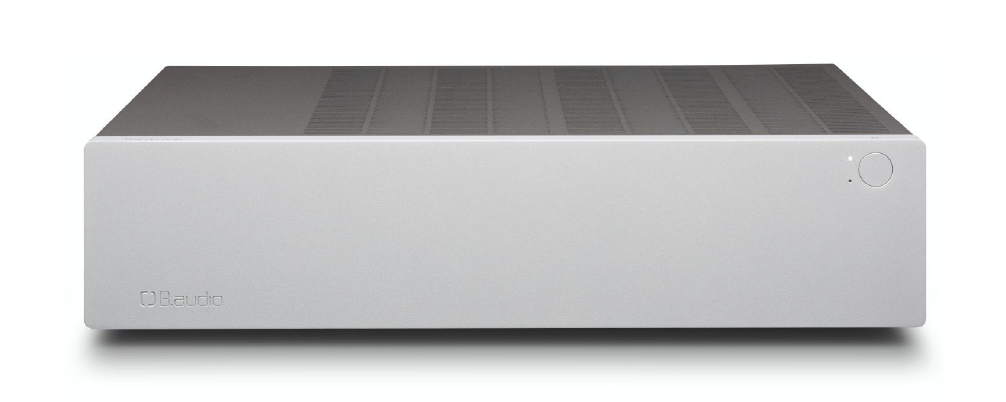
B.AMP ONE

The B.amp one is a stereo power amplifier. Its class AB operation preserves the signal from any high frequency digital disturbance.It stands out by a distortion rate below the measurement threshold (<0.0005%) thanks to the innovative IOD ” Intelligent Output Drive ” technology introduced on the Reference series amplifiers.

The B.amp one has an oversized current reserve which benefits bass handling, enabling it to adapt to any type of loudspeaker, even the most demanding.

detailed specification


DESIGN

The pure and elegant design is the work of designer Olivier Hess.


MADE IN FRANCE

The products manufactured by B.audio are handmade in the company’s workshops in Mutzig, near Strasbourg. The assembly of the electronic boards as well as the crafting of the housing components are carried out locally by partner companies. Each element is tested both electronically and acoustically to validate its performance at the end of assembly.

RMAF Cancels 2020 Show

No industry is ever immune to setbacks and disasters that loom large on our personal landscapes. Sometimes, they seem small in retrospect, but sometimes, the magnitude of the crisis is never diminished, and the only thing that matters is survival and managing the calamity with as much grace as we can muster. At RMAF, our hearts have been broken by some of those disasters, but our spirit has always triumphed. We have never shied away from difficult times. Over the years, we have endured many obstacles, including:

  • Alan Stiefel’s unexpected death;
  • The city electrical grid going down for an hour during the show;
  • A hotel kitchen fire that evacuated the hotel;
  • No working elevators and 11 flights of stairs to climb;
  • Half the hotel closed because the renovation was not completed in time, forcing us to move part of the show outside;
  • Tents that flooded and electrical circuits that were blown;
  • The bride who hung her wedding dress on the sprinkler head and took out 42 of our exhibit rooms 6 weeks before the show;
  • The restaurant running out of food and beverages;
  • Last year’s parking debacle

and through it all we had the support of our community, a sense of humor and the promise of stories to tell our grandchildren.

Here in the RMAF office, we have remained calm and quiet for weeks, waiting for the dust to settle around the COVID-19 pandemic and lockdown so that we could evaluate the possibilities for our show in the wake of a worldwide shutdown. Even now, some parts of the United States are beginning to reopen, although the numbers of people contracting the virus, and the number of deaths attributed to it are still rising, and the CDC is projecting an even more deadly second wave in the fall. We remain uncertain that this is the right course of action, although we wish it were otherwise.

We are frightened on behalf of our friends in the audio industry on many levels. While the financial health of our exhibitors is reflected in our own company’s well-being, for us that is a secondary concern. The very worst thing that we can envision is for someone to fall ill because they came to our show, whether as an exhibitor, a journalist, an attendee, or a volunteer. Good health is a precious gift, and we are learning that although recovery is possible, the residual effects of COVID-19 can be profound, and we are unwilling to risk even one case. Up until now, we have held onto the possibility that our October show could be produced as planned. After watching and listening to the news concerning the Coronavirus pandemic, and reading all the trade publications, we no longer hold that hope.

We have determined that the course of action that we must take to remain a viable entity is to cancel our show for 2020. As we stated in March, RMAF will be issuing full refunds to those exhibitors who have made their initial deposits. We understand that in times such as these, finances can be a delicate balance, so you may expect to see your refund within the next 7 to 10 business days. If your company issued a check, you may be assured that it remains un-deposited, and we will return it or shred it at your direction.

For some of you, this may come as a relief; for others, perhaps not. Either way, you may rest assured that we are facing the future with optimism and exuberance, and plan to use the coming year to explore new ways of making RMAF better and more enjoyable for everyone! We remain open to your suggestions and insights and look forward to a time when our closely knit circle of friends can gather again in celebration of sound!

Until then, we send you our heartiest wishes for good health and great happiness.

Your Friends,

Marjorie and Marcie

Marjorie Baumert, Director and Marcie Miller, Operations Director

Rocky Mountain International Audio Fest

October 7-10, 2021

303-393-7918

Facebook: ROCKY MOUNTAIN AUDIO FEST
Twitter: @audiofest or #RMAF2020 or #RMAF
Instagram: rmafdenver

Chord Company brand English Electric officially launches its first-ever product: the 8Switch

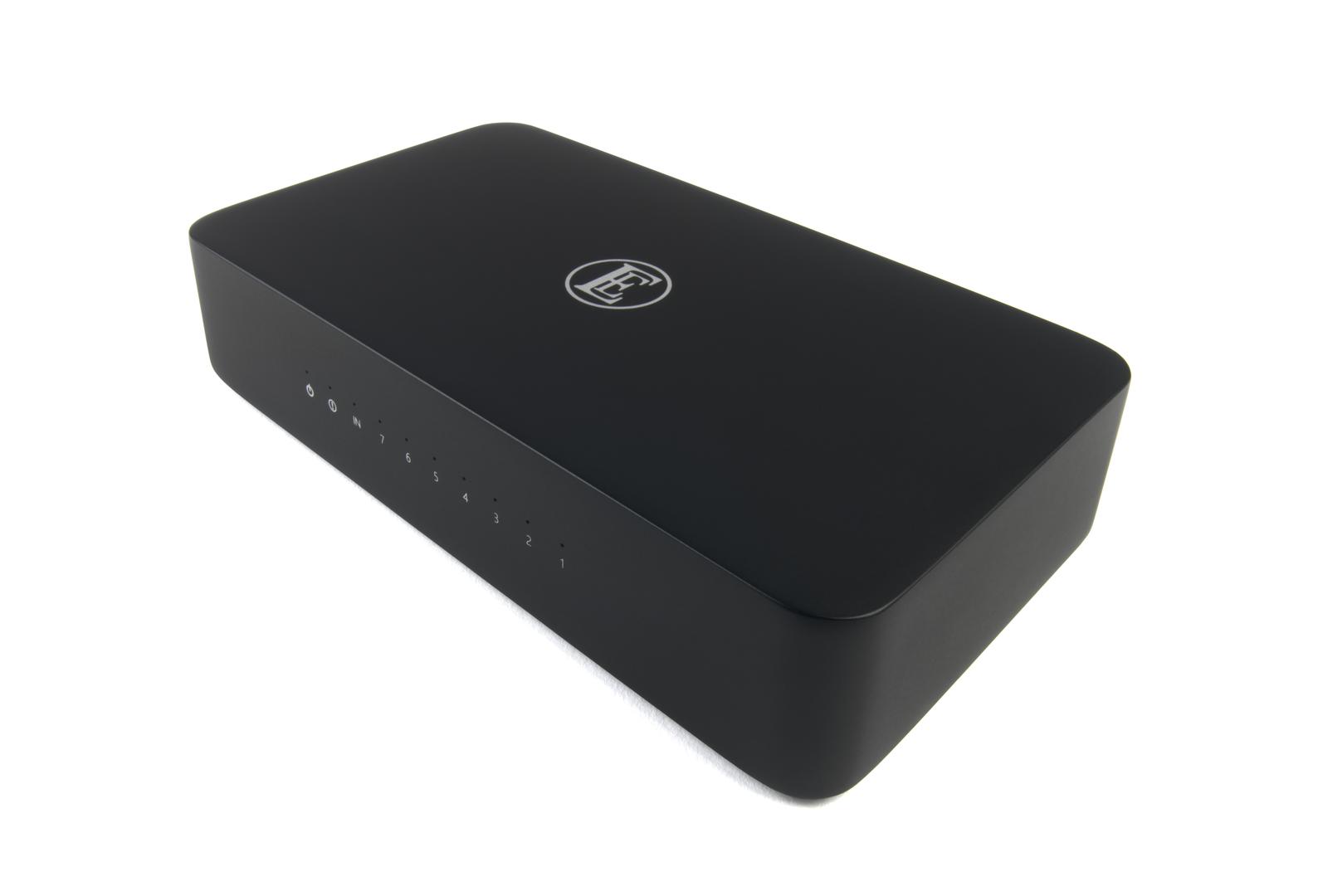
13th May 2020, Wiltshire, Great Britain: English Electric (a Chord Company brand) has officially launched its first-ever product, the 8Switch data switch. The announcement follows English Electric’s international debut at the UK’s biggest audio event, The Bristol Hi-Fi Show 2020, in February. With 8Switch stock now in dealerships nationwide, full details of the new device (£450) have now been released, along with a dedicated English Electric website: englishelectric.uk

About the 8Switch

The 8Switch is a high-quality eight-port GbE Ethernet switch designed to deliver high-quality sound from music streamed over a network. Cosseted by a high-quality machined aluminium enclosure, which offers excellent protection from both acoustic and electrical noise, the 8Switch comprises eight audio-grade 100/1000 Base-T gigabit Ethernet ports, with high and low electrical noise isolation, reducing troublesome data issues when streaming music over a network. 

A discreet LED display on the front panel includes power, alarm and the link status/speed for each of the eight ports. Resonance-damping feet are also featured to help decouple the 8Switch from unwanted mechanical vibration. Each 8Switch is also supplied with a Chord Company C-Stream digital streaming cable (0.75m) worth £40.


With data switches requiring high-speed power supplies, negating the use of linear power devices due to their speed limitations, English Electric’s engineers set about improving the power signal by using an extremely high-quality wall supply. The advanced medical-grade power adaptor permits an optimum-quality network signal, driven by high-accuracy clock technology and has been designed to reduce electrical noise from AC sources, and prevent mains quality issues from affecting network signals. The 8Switch also boasts high power efficiency, a no-load power consumption of < 0.075 W, plus protection from short circuit, overload and over-voltage.

8Switch core technologies

The 8Switch is driven by a customised TCXO (Temperature Compensation Crystal Oscillator) with accuracy rated at 0.1ppm: far higher than normal crystals and higher than a normal TCXO, allowing the 8Switch to generate higher-accuracy network signals, which in turn, help provide more stable music-data transmission.

The power supply and clock-generation circuits each have two electrical noise-isolation circuits which ensure stable network signals; an EMI (Electromagnetic Interference) absorber helps to reduce noise further from the digital circuit. Compared to a standard IT network switch, music lovers can expect increased performance and a lower jitter measurement, up to 90 per cent less! 

Price and availability 

The English Electric 8Switch is available now priced at £450 (includes a Chord Company C-Stream digital streaming cable (0.75m) worth £40.)


UK stockists

UK dealers now have stock and can fulfil online and telephone orders via post, with rest of world following shortly. 

UK dealers: A Fanthorpe; Analogue Seduction; Audience; Audio Affair; Audio T (Oxford); Audio Venue; Brian & Trevors; Canterbury Hi-Fi; Ceritech Audio; Cymbiosis; Deutsch & Deutsch; Future Shop; Hi Fi Lounge; Hi-Fi Corner (Falkirk); Hi-Fi Stereo; Ian Hammond/Martins Hi-Fi; Igloo Audio; In Phase International (Nottingham Hi-Fi); KJ West One; Martins Hi-Fi; Nintronics; Oxford Audio; Rayleigh Hi-Fi (Rayleigh);Sevenoaks Sound & Vision(Reading); Sonority Design; Soundcraft; The Audio Room/Ultimate Home Ent. Ltd and Tom Tom Audio. 

English Electric contacts for publication

Tel: 01980 625700 
Email: [email protected]  
Web: englishelectric.uk

Press contact

For further information on English Electric, images and review requests, please contact Dan George: +44 (0)7899 808918 or [email protected]   


About English Electric

Synonymous with world-renowned British engineering, the reborn English Electric brings a new range of exceptional value hi-fi equipment for the discerning music lover.

Building upon a noble heritage of aviation and locomotive design, myriad large-scale electro-mechanical equipment and power generation, this classic British brand is once again continuing its path of design innovation, this time in the audio sector, with an exciting range of high-performance electronics and accessories. 

The reborn English Electric (a Chord Company brand) is backed by a large engineering team which has been designing, building and engineering high-quality audio devices in Great Britain since 1986.

 The English Electric Company further information

From north British (Preston) industrial roots in 1897, The English Electric Company – as it became known in 1918 – grew into a multi-faceted manufacturer of electrical equipment and machinery, specialising in motors, transformers, railway locomotives and traction equipment, expanding many years later into consumer electronics, nuclear reactors, computers and aviation.

The re-ignition of a historic brand with such a rich and diverse heritage is not to be tackled lightly; the ‘EE’ marque evokes what many consider to be a bygone era of world-leading great British engineering and many of its products (such as the Vampire and Lightning jet aircraft and Deltic railway locomotives) attract an enthusiastic and emotionally engaged following, transcending their primary function.

As a fellow great British manufacturer, Chord Company is respected globally for its award-winning A/V cables and is perfectly placed to apply its successful blend of innovative proprietary technologies, design expertise and exemplary customer service to the rejuvenation of this classic British name, whilst preserving its noble lineage.

Spotify Connect for all Lindemann streamers

Good news for all old and new owners of a LINDEMANN Limetree streaming product (= Limetree BRIDGE and Limetree NETWORK) – the upcoming software update will have your devices Spotify Connect ready! 

Since the update also comprises other improvements, we recommend all our existing owners of a Limetree streamer to accept this software update. This will happen – as usual – via the web update feature in the LINDEMANN app. 

By the way; Spotify certification for LINDEMANN Musicbook streamers is also in works and will hopefully be released soon.

MORE INFORMATION 

By using Spotify Connect the world’s most popular streaming service gives you access to millions of songs. With a Spotify premium subscription you can use Spotify via app on a mobile device and play back the music over the Limetree streamer. This will get the data straight from the Spotify servers so that the mobile device can be set to standby mode or otherwise used, and incoming calls will not interrupt the music playback. 

Your contact for further inquiries:

Christopher von Delhaes

+49 (0)8153 95 333-90

[email protected]

www.lindemann-audio.de

Hegel H120 integrated amplifier

We have a bit of a Hegel problem. The magazine has reviewed almost everything that comes out of the Norwegian design studio, and we really need the company to make something bad so that we can appear to have a modicum of ‘objective balance’. The problem is that Hegel keeps making great products, so either we go rogue and attack a Hegel product undeservedly, or the magazine sounds like it is a bit of a locked groove.

The thing is, Hegel is in something of a locked groove, too… but in a good way. The line-up is just going through a series of changes; alongside the H590 flagship comes a slew of new models replacing old. This is in part trickling down technology from that new top player, and in part re-imagining the amplifier line to reflect life in the 2020s. Just a USB DAC and some line inputs isn’t enough anymore; the amp needs to support network replay, whether from a local music server or from streamed music from a variety of online sources.

Fortunately for Hegel, its recent development means making very good products can rely on combining the right modules from pre-existing designs. In the H120’s case, that is pretty much exactly what Hegel has done. The amplifier is basically the analogue side of the company’s Röst Integrated Network Amplifier with the digital gubbins of the H190 integrated amplifier. The H120 replaces the Röst, because the DAC engine of the H190 gives it greater compatibility with today’s services. It speaks UPnP/DLNA, AirPlay Connect, and SpotifyConnect out of the box, as well as custom-install IP functions like Control4. As the amp evolves, a Roon Ready upgrade will be made available.

Where most companies prefer to use TLAs (three-letter acronyms), Hegel prefers to go with CleverNames to describe its subsystems, and the 75 Watt per channel H120 bristles with technologies like OrganicSound, SoundEngine 2, DualAmp, DualPower, LineDriver, SyncroDAC and AdaptiveAutofocus (I may have snuck an extra one in for good measure). These pithy portmanteaus do aim to describe some of Hegel’s long-standing design criteria. Specifically in this case ‘OrganicSound’ denotes an iterative listening process that requires careful voicing of the amplifier against a known reference of acoustic instruments and vocalists, which relies on ‘SoundEngine 2’; the enhanced form of Hegel’s localised feed-forward amplifier circuit. Meanwhile, ‘DualAmp’ refers to a process that separates out the voltage and current gain stages and the related ‘DualPower’ provides specific power supply feeds for those separated parts of the amplifier circuit. On the digital side, ‘LineDriver’ technology is a form of high-frequency filtration, while  ‘SynchroDAC’ (synchronised – as opposed to asynchronous – upsampling) that goes with the company’s similarly synchronous USB input technology. In OtherWords, the H120 has a good spread of Hegel’s sophisticated analogue and digital design modules.


Merging the H190 and the Röst in a small chassis does make for some fairly tight rear-panel real estate. On the analogue side, the amp has a single RCA line and single XLR input pair, with an additional RCA input/output for home theatre or for those who remember the tape monitor. The digital side brings a coaxial, three optical, a USB, and Ethernet inputs. Toward the centre of the rear panel are a pair of good speaker terminals. The front panel is typical Hegel fare, with a control knob on the left, a volume on the right, a display between the two, a headphone socket, and a power button under the centre of the front panel. The central display switched from blue alphanumeric LEDs to a fluro display with the birth of the Röst, and that remains unchanged here. In fact, if you swapped out the Röst for the H120 surrpetitiously, no one would notice the difference. Similarly, the remote handset retains the weighty metal minimalist appeal. There are some omissions here; there is no wireless connectivity (Wi-Fi or Bluetooth, any wireless tablet control relies on an upstrem router) and balance isn’t on the menu either.

In a very real way, there isn’t much to write about here, save for marrying up the sound quality of Hegel’s Röst with the performance of the brand’s mid-level on-board DACs. That means a performance that is bright, breezy, alive and delivers just the right amount of leading-edge information without the sound pitching too far forward. Hegel’s other signature sound is that of bass grip, controlling the bottom end of a loudspeaker with muscularity and precision. Although this means small loudspeaker drive units don’t have unfettered freedom to flop around, this grip and tautness often gives better, deeper bass. It also presents a ‘giant-killler’ nature, where the H120 can be used with the sort of loudspeakers never normally associated with amps in its price band.

Similarly, the digital stage harks back to many of the detailed and open performance criteria observed in other recent Hegel amps; the H120 lacks the absolute precision of the H390 and H590 of course (better DAC, way better clocking mechanism), but has a lot of clarity and depth to the sound. It’s a fine match to the performance of the amp, too; as it has the same properties of being bright (but not too bright), detailed, just the right side of forward, and with excellent bass.

Even the headphone socket has more than its fair share of ‘good’. While not a dedicated amp, there are several noise-reducing tweaks performed to this tap from the speakers. It’s detailed, dynamic, and – yet again – gives really good bass. OK, so personal audio experts aren’t likely to pass up something like a Chord Hugo TT for the H120 and certainly would find better definition and range from a top-end dedicated headphone amp, but the Hegel stage acquits itself more than admirably and is no mere afterthought, which is a welcome addition.

I’ve said it before about Hegel amps, but it’s worth saying again; the H120’s gives the music and the loudspeakers what they want. And it does it better than many by doing less, rather than more. It doesn’t buff up the sound or soften the blow; it plays music honestly and lets the loudspeakers do their job unconstrained by the electronics. Yes, of course there are amplifiers that do that job better (many of them come from the same stable), but few do so with the balance of price and performance the H120 delivers. Better costs more and cheaper cuts corners.

So, we’re scratching our collective heads to find something to criticise. OK, it’s not a H390 or a H590, but that’s like criticising a BMW 3-Series for not being a BMW 7-Series. And yes, if you aren’t a fan of Hegel’s clean, upfront, leading-edge focussed sound, the H120 is probably not the amplifier for you, but that’s more an observation than a criticism. I guess the closest to a criticism is the product design doesn’t deviate from Hegel’s well-trodden path of two knobs, a central display and a power button under the front panel. That’s it! Doubtless the trolls will find something they can object to, but let’s face it, Norwegians have been dealing with trolls for centuries!


There’s a simple economics lesson here. People often want it all; the most up-to-date digital platform, with the best possible sound quality, designed and built in the West, and all at a good price. In reality, the best products can only pick any three out of four of these elements, while many of the middling products out there can only muster one or two of these factors. There is no pejorative at play here; pick the three you are most comfortable with, and if you picked the first, second, and fourth criteria, the Hegel is one of the front-runners to go for.

Replacing Röst was always going to be an interesting act for Hegel. It broke new ground for the company, and with many ground-breaking products, that meant it didn’t sell quite as well as it deserved to. The H120 is different, as it retains everything good the Röst brought to the party and also continues and extends Hegel’s ‘giant-killer’ range of amps. This is the kind of amplifier that works well in context and can support some surprisingly high-end speakers. While that sounds like the stuff of absurd review kit-bashing, what it means in reality is you can build and upgrade a system around the H120 far further than usual at this price. You don’t have to use it with esoteric audio equipment, but it won’t mask their effects if you do. In short, it’s an all-round goody.

TECHNICAL SPECIFICATIONS

  • Type: Integrated amplifier with network connected DAC
  • Power output: 2 × 75 W into 8 Ohms
  • Minimum load: 2 Ohms
  • Analogue inputs: 1 × balanced (XLR),
    2 × unbalanced (RCA)
  • Digital inputs: 1× = coaxial S/PDIF,
    3× optical S/PDIF, 1 × USB, 1 × RJ45 Ethernet
  • Line level output: 1 × unbalanced variable (RCA)
  • Frequency response: 5 Hz–100 kHz
  • Signal-to-noise ratio: More than 100 dB
  • Crosstalk: Less than -100 dB
  • Distortion: Less than 0.01% @ 50 W 8 Ohms 1kHz
  • Intermodulation: Less than 0.01%
    (19 kHz + 20 kHz)
  • Damping factor: More than 2000
    (main power output stage)
  • Dimensions (H×W×D): 8 × 43cm × 31cm
  • Weight: 12kg
  • Price: £2,200

Manufactured by: Hegel Music Systems

URL: hegel.com

Tel: +44(0)7917 685759

https://hifiplus.com/reviews/

Technics SL-G700 SACD player/network streamer

The ‘G’ in the name of the Technics SL-G700 SACD player/network streamer stands for ‘Grand Class’. From many other manufacturers in the audio world, this categorisation might seem like hyperbole, but given the build quality of this Technics, it is quite fitting. It’s hard not to be impressed at the fit, finish and execution of this Technics player: you would have to pay a lot more to get an equivalent grade of build quality and feature set from one of the many ‘boutique’ brands in this business. Whether this stonking build is backed up with a sound quality to match will be discussed later, but first impressions count and the first impression of the Technics SL-G700 is powerful.

The G700 is an unusual beast in today’s world; there aren’t many other one-box disc spinner/streamers on the market, with models from Naim, Marantz and Yamaha being the few other riders in this race. However, it’s an understandable concept, as those yet to make the transition to streaming might want something with this degree of flexibility.

The Technics player has digital inputs and outputs and both single-ended and balanced outputs. The G700 features an onboard volume control (should you choose to use it as a digital hub). Ethernet network connectivity is wired or wireless, and it even supports Airplay and Bluetooth, albeit the latter not in its better sounding aptX form. The onboard DAC can decode PCM at up to 32-bit/384kHz and is good for DSD256 with most features being adjustable via the front panel and others accessible with Technics’ Audio Centre control app. The G700 can stream from most of the essential services – including Tidal, Spotify and Qobuz – and has MQA decoding and Chromecast built-in, making it almost universally adapted for contemporary listening styles.

You can, of course, say the same for the more ambitious one box wireless ‘speakers’ that are infiltrating many homes today, but none of them has the quality of circuitry found inside the SL-G700, which continues to impress when you take the lid off. This Technics player has separate AK4497 DACs for each channel with four power supplies driving this critical section of the machine. The AK4497 is Asahi Kasei Microdevices second-generation ‘Velvet Sound’ flagship; a 32-bit differential design with a whopping 128dB signal-to-noise ratio. An even more fundamental element in a digital audio device is the clock, which here is battery powered for maximum accuracy; it’s charged onboard rather than a fixed-charge user-replaceable battery. The output stage is a discrete affair designed for low noise and distortion using a folded cascode array for improved high-frequency performance. There is a dedicated high speed, switched-mode power supply for the zero-feedback analogue circuit to deliver stable power with very low noise and the digital side power supply uses carbon film resistors and ruby mica capacitors. The network connection has a film capacitor in its power supply, and even the digital outputs (Toslink, coax) have an isolated power supply.

The SL-G700’s headphone output has its own DAC circuit that’s independent of the analogue output stage. This circuit uses various Technics processing technologies to remove jitter and optimise noise shaping and is tuned specifically for its application. Internally the chassis is separated so that the shielded power supply does not influence the analogue circuitry. The CD transport mechanism has a triple chassis construction to keep vibration under control, is delightful to use and as smooth as butter: all it needs is an eject button on the remote, and I’d be playing with it all day. More calming for audio enthusiasts with a healthy CD/SACD collection, the quality of that transport mechanism bespeaks of longevity; we’re (hopefully) not at the ‘final CD player’ point, but in case that changes it’s good to have a transport clearly built to last.

I used an Innuos Zenith SE server running Roon as the source. This combination allowed the Technics to deliver a focussed and slightly small scale rendition of artists including Fink and Lana Del Rey, the latter’s voice sounding particularly excellent in the context of a well defined acoustic. I found this to be consistent especially with female singers; a less well-known artist called Olivia Trummer [Fly Now, Contemplate Music] sings to a jazz backing to sometimes excellent effect. While the busier passages of piano and drums could have been smoother, her vocals worked a treat. The Technics does decent three-dimensionality of sound so long as the music remains reasonably straightforward, EST’s ‘Tuesday Wonderland’ [Live in Hamburg, ACT] sounds natural and well separated. However, when the interplay gets intense, the Technics starts to struggle. Give the Technics a straightforward groove, and it’s a happy bunny; ‘Sharing (Live)’ [Bugge Wesseltoft], for instance, sounds powerful and driven with a great groove. However, when the interplay gets rhythmically intense, the Technics can struggle a little.


Spinning a CD, you get a very similar result. The tonal rendering is excellent, and you don’t get the subtle glare that often accompanies the CD format; it’s not quite as resolving as streaming an uncompressed file of the same recording, but few CD players are in my experience. You can hear the effort that Technics has put into keeping noise at bay by playing anything pianissimo; gentle piano can be beautiful and highly atmospheric with plenty of reverb to fill out the picture. Putting an SACD into the tray results in the title info being displayed on the machine and in the Technics app, and you can also control the transport from the same software which is cool. My favourite SACD is La Folia by Gregorio Paniagua and the Atrium Musicae de Madrid [Harmonia Mundi]. This recording combines ancient and modern instruments in an eccentric yet charming fashion, here the tonal richness of those instruments is very nicely resolved especially the higher notes, which creates a strong sense of image depth and scale to the live recording. The Technics takes this disc in its stride.

Another high-resolution recording – this time in streamed form – is the slow blues of Doug MacLeod’s Exactly Like This[Reference Recordings], which sounds excellent on the Technics because it reveals the quality of the recording and the lovely depth and roundness of the acoustic bass so well. I tried the three filter settings that you can access via the app and found that the third one seemed the best suited to my tastes; it has a little more punch than the alternatives. Such things don’t usually have a significant effect, but there is a clear difference between the options on offer here. There are various other features available via the app such as fixed or variable output, MQA decoding, direct and re-master modes and the option to switch off digital and analogue outputs although it’s unlikely you’d get much joy without either. Look a little deeper into the features, and you can find a way of defeating the auto-off function, which is useful as it’s not very patient at all: this machine loves to turn itself off.

The Technics Audio Centre app is a little bit like Linn’s Kazoo with a playlist on the right and browsing on the left; it’s not the quickest to navigate but is relatively intuitive to use after a little practice. The fact that you can go to the top level with one button is a handy feature, especially if you’ve waded deep into Tidal’s waters. However, its approach to this service is page-heavy, and you don’t get large artwork icons when browsing. Also, searching for something is a little sluggish; if you put in a track or artist name, you then have to go through several more filters to get to the work desired.


Back with CD I dropped the Red Hot Chili Peppers Blood Sugar Sex Magik [Warner Bros] into the beautifully machined tray and gave it some beans. The straightforward amped-up funk this worked surprisingly well on the Technics, shining through with plenty of energy and power. Switching (totally seamlessly on the player’s behalf) over to a locally stored rip of the same album produced a cleaner result with lower noise and more exquisite detail. If you have a decent media server, it’s unlikely that you will be playing discs very often, but with SACDs, there isn’t much alternative, so it’s nice to have the option.

The Technics SL-G700 is a superbly executed bit of audio engineering, which reveals the advantages that large corporations have when it comes to fit and finish. The sound it produces will appeal those who are looking for depth of tone and whose tastes don’t stray too far into the murky waters of complex rhythmic interplay. This Technics is a fully-featured and classy piece of hardware for the money that’s likely to prove consistently reliable in the long term, and if you enjoy SACD, it’s a package that’s hard to match.

TECHNICAL SPECIFICATIONS

  • Type: Solid-state network streamer, SACD/CD player, DAC
  • Analogue Inputs: none
  • Digital Inputs: One coaxial S/PDIF (via RCA jack), one TOSLink, USB A
  • DAC Resolution/Supported Digital Formats:
    FLAC/WAV/MP3, etc. Sampling rate for D/A conversion 384kHz/32 bit
  • Music services/Wi-Fi inputs: Tidal, Deezer, Spotify Connect, Bluetooth, Airplay, Chromecast
  • Analogue Outputs: One stereo balanced
    (via XLR connectors), one stereo unbalanced
    (via RCA jacks)
  • Headphone output: 6.3 mm, 110 mV, 32 Ω vol max
  • Digital Outputs: One coaxial S/PDIF (via RCA jack), one TOSLink
  • Frequency Response: Super Audio CD: 2 Hz to 50 kHz (-3 dB) / CD: 2Hz to 20 kHz (-3 dB)
  • Distortion (THD + Noise): Super Audio CD: 0.0006%
    (1 kHz, 0 dB) / CD: 0.0015% (1 kHz, 0 dB)
  • User Interface: Display (on main unit), Technics Audio Centre application software for iOS, Android
  • Dimensions (H×W×D): 98 × 430 × 407mm
  • Weight: 12.2kg
  • Price: £2,399

Manufactured by: Technics

Tel: +44(0)333 222 8777

URL: technics.com

https://hifiplus.com/reviews/

VTL TL-6.5 Series II Signature line-stage and S-200 Signature power amplifier

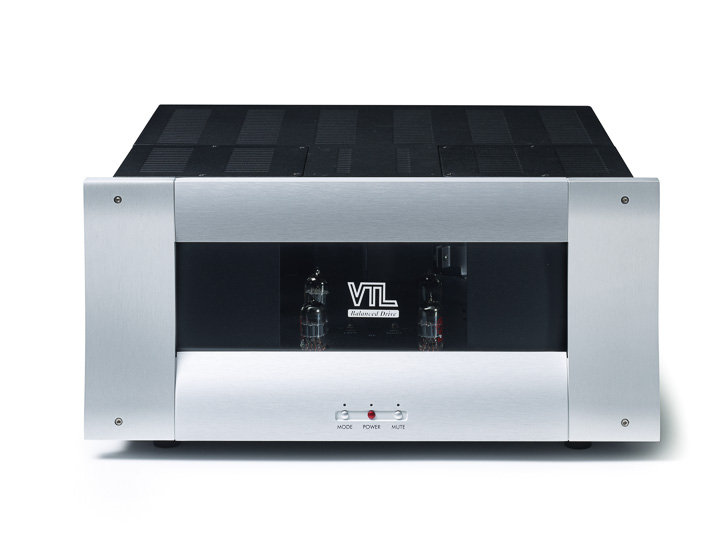
“Making tubes user-friendly”; so runs the VTL tag-line. For once it’s a sentiment that’s more than just marketing speak, one that’s embedded in the very form and substance of these amplifiers. Indeed, at first glance, you’d barely know that these amps used big glowing bottles or even bigger chunks of steel for their output transformers. The sleek, aluminium casework, sculpted, softly latched buttons and sheer range of control options are more akin to the best modern solid-state designs – and a world away from the likes of the ARC SP8 or D115, products which marched in the vanguard of the valve revival. Given that it’s over 35-years since those products helped define the nascent high-end, perhaps that should come as no surprise – except that in many cases, tube design seems to be regressing rather than the opposite. This commitment to maintaining the virtues of valve amplification, while applying modern engineering and technology to minimising its challenges is more than what makes VTL products so different; it’s what makes them so good.

When it comes to high-powered tube amps, today it is VTL that set the standard against which the competition are measured. Look a little closer at their products and it is not hard to understand why; listen and it becomes more obvious still. This pairing of the latest TL-6.5 line-stage with the new S-200 stereo amplifier is a classical UK combination, a one-box pre-amp teamed with a capable single-chassis power amp making the most of our smaller rooms and limited space. Yet despite the reduced real-estate, these products still embody everything that sets VTL so far apart.

Let’s start with the latest version of the well-established TL-6.5. Wedging the full feature set and functionality of the company’s two-box flagship line-stage into a single chassis was no easy feat, requiring a vertical extension to the established casework used for the TL-7.5’s PSU and control section. The resulting box can be supplied in silver, black or two-tone mix, the latter making the most of the original’s elegant design and front-panel proportions. On the inside it houses a fully balanced and differential circuit built around a single pair of ECC82 tubes, used for the critical voltage gain. Paired with a sophisticated FET-buffered, high-current output stage, you could argue that this should be more properly described as a hybrid design, but frankly, I’m more interested in the performance than the labels. With its large and highly regulated power supply, what the 6.5 does is deliver the coherent dynamics and presence that make tube pre-amps so musically appealing, combined with an incredibly low noise floor and the ability to drive almost any load – both extremely unusual in a tube design. Even more unusual is the functional versatility, with a full suit of balanced and single-ended in and outputs, processor and tape loops, adjustable overall and individual input gain. Look inside and you find a mirror-imaged circuit, precision resistor ladders and more by-pass capacitors than you can shake a stick at. The package is topped off with a sensibly sized, full function remote and a display that you can actually see from across the room.


Turning to the power amp, you’d normally expect fewer features and rather less sophistication, but the S-200 is a seriously surprising package. Built around the ultra traditional line-up of four 6550 or KT88 push-pull output tubes per channel, the power amp once again offers a fully balanced topology from input to output, with differential input and driver stages. That’s unusual enough, but the S-200 is only just getting started. To really extract the benefits of a higher-powered output stage, you need to use a fixed bias arrangement, which ironically means establishing the bias voltage for each tube individually. VTL has been working on precision regulated bias supplies for years now, first launching them in the flagship Siegfried mono-blocs. Along the way they also took advantage of the opportunity to create a genuinely automated and fuss free, auto-bias and tube-fault sensing system – an absolutely revolutionary step-change in the usability of high-powered tube-amps. That sophisticated technology has been filtering down the range and has finally reached the S-200, which also like its bigger brothers, offers switchable damping factor. Nor is the amplifier’s sophistication limited to the use of fancy software driven housekeeping. The all-important output transformers use complex interleavings to help extend bandwidth, there’s a J-FET constant current source for the single-ended inputs (rather than the far more usual transformers to handle balanced connections to a single-ended circuit) and fully regulated bias and screen supplies increase AC noise rejection, reduce the noise floor and improve resolution and, like the TL-6.5, the S-200 is also global-feedback free. All that regulation and precision setting of bias voltages allow the VTL amp to deliver a potent 200 WPC rated output, sensibly optimised for 5 Ohm loads. Alternatively, you can switch it to triode mode for around half that power, should your system demand it.

Like almost all true differential designs, the TL-6.5 and S-200 sound best hooked up with balanced connections. I used the VTL amps with a number of different speakers, but the most telling combination was with the latest Wilson Sasha DAW. Not so long ago I would have hesitated to use the S-200 with the Sasha 2, seeing the VTL MB-450 mono-blocs as that speaker’s natural partner. But the latest WATT/Puppy has shown a useful increase in volume and a rather more forgiving impedance characteristic, making it a more forgiving load, one that’s well within the compass of the S-200 – especially when coupled to the low-frequency drive and authority that characterise the latest version of the TL.6.5. The one-box line-stage was always quick and agile, but now it has added serious low-frequency extension and grip to the mix, moving it far closer to the flagship 7.5 in overall performance. If the 6.5/S-200 and DAWs might well be considered a middleweight rig in absolute terms, for many of us they represent an aspirational end-game – the biggest system we might actually be able to accommodate or afford. As such it needs to deliver a compelling performance and do it on any kind of music. We already know and recognise the speakers’ talents, but the VTL amps are well up to the challenge too.

You might not think that a violin sonata would provide an acid test, but the combination of Vadim Repin and the indomitable Martha Argerich playing the Kreutzer [DGG 477 6596] will soon put you right. Not only have you got the dramatic contrasts in the score, underpinned by Martha’s mighty left hand, but the elongated phrases and sudden darting accelerations mean that both the players and the system doing the playing need a firm grip on relative weight, dynamic range and temporal authority. It’s crucial that with such a sparse score, everything happens at the right time, in the right place and carrying just the right degree of delicacy, attack or impact. The VTLs performance matches what is an expressive and dynamic tour de force. Repin and Argerich might lack the absolute instrumental control and technical precision of Martzy, but their playing is at once intimately conjoined and dramatically bold. The VTLs paint a richly vivid musical picture, full of body and presence, light and shade. The instruments are held separate in space, with a beautifully natural sense of differential height and scale, surrounded by a convincing acoustic space. The connection between the musicians is as tangible and articulate as the interlocking phrases of the piece, sure sign that the amps have got the timing spot on.

That convincing sense of instrumental weight and scale – large or small – is key to the VTL’s presentation. The relative balance between violin and piano, instruments that occupy opposite ends of this continuum, is perfectly maintained by their placement in the recording and by the amps presenting it. It’s this ability to get the right amount of energy in the right place at the right time that makes these amps such natural musical communicators and places them firmly ahead of the competition. It might sound like an obvious attribute but it’s one that precious few hi-fi systems possess and even fewer possess it across their entire bandwidth. As I’ve already observed, the TL-6.5 Series II Signature reaches deeper than previous versions and does so with greater dynamic range. But what really impresses is the way in which the S-200 deals with that input. Work your way down the VTL range and one of the sonic compromises you’ll be making comes in terms of low-frequency definition and transparency. The Siegfrieds set new standards for tube amps in this regard and, price for price it’s an area where the VTL power amps generally enjoy superior performance compared to the competition. But even so, sitting four models below the big monos, the S-200 is no Siegfried and, as we know, too much bass can be worse than too little. The S-200’s neat trick is to deliver a realistic impression of weight and scale, pitch and extension, even while the definition at the lowest registers is (in absolute terms) a little soft and rounded. Part of that is down to making sure that the lowest notes happen at the right time, but it is also down to the quality of the mid-bass, the frequency band where so much musical presence and impact is based. Or, to paraphrase, grab the music by the mid-bass and the rest of the low-frequencies will follow…

Play Steve Earle’s magnificently raised middle-finger to the country music establishment [Copperhead Road, MCA MCF 3246] and the propulsive drum work drives tracks along, even when the weight and density of the instrumentation threatens to drag them back. The title track demonstrates perfectly just what the VTLs are capable of, with a phenomenal display of energy, attitude and sheer musical momentum, filled out with rich, warm colours and an almost physical presence. The achingly poignant ‘Even When I’m Blue’ dials back the musical intensity, but ratchets up the emotional impact, showing the naturally communicative vocal qualities that result from the amps’ clarity, diction and body. All that subtlety and the natural micro-dynamics that conjure the Kreutzer so vividly to life are present here too – but backed up by the scale and presence that these amps deliver so little apparent effort. It’s an object lesson in musical budget management, doing just enough of everything to create a beautifully balanced and satisfying result, whether you are looking for intimacy and delicacy or simply to worry the neighbours.


Like all great middleweights, the TL-6.5 and S-200 combination majors on delivering its energy and impact, quickly and effectively enough that you don’t miss what isn’t there. Sure, the Tl-7.5 III and Siegfrieds will show you exactly what’s missing – at a not inconsiderable hike in price and demand for real estate. But without that frame of reference the junior, one-box alternatives deliver more than most of us ever expected to hear from an audio system – and do it with utterly fuss-free aplomb. Running the amps with speakers as varied as the Vienna Acoustics Liszt and Focal Kanta 1 demonstrated their ability to work with more modest partners while retaining the ability to grow convincingly with the system as a whole. Listening to them getting hold of the little two-way Focals was as enjoyable as it was musically amazing. When the US audio industry first started mapping out the high-end landscape, it was companies like ARC and conrad-johnson who staked their claims, but the intervening decades have seen those brands at times eclipsed in terms of fit, finish, functionality and musical performance. Spending time with these VTL amplifiers, it is easy to understand how and why the company has quietly but confidently established itself as the go-to option for versatile, high-powered tube amps. The TL-6.5 and S-200 don’t just tick the boxes – they own this turf!

TECHNICAL SPECIFICATIONS

VTL TL-6.5 Series II Signature

  • Type: Fully-balanced vacuum tube line‑stage
  • Tube Complement: 1pr 12AU7/ECC82
  • Inputs: 3prs balanced XLR/single-ended RCA, 5prs single-ended RCA
  • Outputs: 1pr balanced XLR, 1pr single-ended RCA (pre-out), 1pr single-ended RCA (tape out)
  • Output Impedance: 50 Ohms
  • Dimensions (W×H×D): 445 × 153 × 445mm
  • Weight: 21kg
  • Price: £19,800

VTL S-200 Signature

  • Type: Fully-balanced vacuum tube power amplifier
  • Tube Complement: 1pr 12AT7; 1pr 12BH7; 4prs KT-88 or 6550
  • Rated Output: 200 W/Ch (pentode), 100 W/Ch (triode)
  • Output Topology: Push-pull
  • Inputs: 1pr balanced XLR, 1pr RCA
  • Input Impedance: 45 kOhms
  • Dimensions (W×H×D): 470 × 230 × 457mm
  • Weight: 47.6kg
  • Price: £16,500

Manufactured by VTL Inc

URL: vtl.com

Distributed in the UK by: Airt Audio

Tel: +44(0)7548 796382

URL: airtaudio.co.uk

https://hifiplus.com/reviews/

RHA TrueConnect wireless Bluetooth earphones

Bluetooth earphones are among the most popular products in personal audio today. This trend has emerged thanks to Apple’s decision to build smartphones that no longer include 3.5mm headphone jacks—a step that made traditional wired earphones seem obsolete and gave rise to a generation of earphones that connect to smartphones wirelessly. In response, many manufacturers developed ‘neckband-style’ wireless earphones, which feature traditional wired-type earphones tethered to neckband-style, battery-powered Bluetooth modules. 

However, since Apple’s release of its ingenious AirPod-series earphones so-called ‘True Wireless’ earphones have become all the rage. Unlike neckband-style Bluetooth earphones, ‘True Wireless’ earphones have no wires whatsoever. Instead, their earpieces contain not only the requisite earphone drive units, but also miniature, Bluetooth transceiver/amplifier modules complete with rechargeable batteries. The earpiece electronics are designed to ensure the earpieces stay in sync with one another, meaning there are no discernible time delays between the left and right channels.

‘True Wireless’ earphone carry cases serve double-duty as fast chargers that can recharge earphones multiple times before the cases themselves must be recharged. The draw, obviously, is that this solution gives listeners complete freedom of movement, although the challenge for manufacturers involves fitting an awful lot of technology (plus drive units) within the tight confines of an earpiece enclosure. One of the most attractive and appealing ‘True Wireless’ models we have encountered to date is the RHA TrueConnect earphone ($169.95 or £149.95), as reviewed here.

We have covered RHA’s wired earphones extensively in the past and two consistent threads we have observed is their emphasis on ‘musicality’ (a warm, natural, and musically engaging sound that works for all genres of music) and ‘value’ (offering noticeably higher build quality and accessories, plus better sound quality than many like-priced competitors). Happily, these traits carry forward into the TrueConnect earphones.


The TrueConnect earphones feature 6mm dynamic drive units, Bluetooth 5.0 connectivity, simple-to-use control buttons and monitoring lights, and—of course—a hard‑shell, swing-open carry case/fast-charger. Fully charged the earphones offer five hours of playing time, while the carry case offers another 20 hours of charging time. RHA advises that 15 minutes of fast charging can bring the earphones up to 50% playing capacity, while a full recharge takes one hour and 40 minutes. The TrueConnects come with an extensive set of ear tips and an ear tip carrier: seven pairs of silicone TrueConnect ear tips (S/M/L), and three pairs of Comply™ Foam TrueGrip ear tips. A USB charging cable completes the package. TrueConnect earphones are offered in matt-finish white, black, or navy blue.

From the moment I first heard them, I was struck by how similar the sound of the TrueConnects is to that of RHA’s wired earphones—in particular the well-rounded MA750 models. While close comparisons would likely show up at least some sonic advantages of the wired models, the TrueConnects manage to capture much of the warm, natural, and inviting feel of their wired brethren. Much like the MA750s, the TrueConnects are also surprisingly revealing (though never cold or analytical), especially in the midrange and on vocals. A great example would be the manner in which the TrueConnects capture the dry, sardonic humour in Elvis Costello’s voice on ‘Don’t Let Me be Misunderstood’ from King of America [Hip-O Records, MQA Master].

Another area where the TrueConnects excel is throughout the bass region, where they show exemplary depth and weight. To hear what I mean, try focusing on the potent, descending synth bass passages found on the choruses of the title track from Maroon 5’s Girls Like You [Interscope, Tidal]. As the synth dips lower and lower the TrueConnects track right along, exhibiting exuberant qualities of dynamic ‘bounce’ and punch. The top-end and upper midrange of the TrueConnects is arguably slightly recessed, but offers admirable clarity without edge or glare.

RHA’s TrueConnect earphones have become my favourite go-to recommendation in their price class. This is because they look good, feel good, and sound good, honouring the music—all for not a lot of money. 

TECHNICAL SPECIFICATIONS

Type: ‘True Wireless’-type Bluetooth earphones

Driver Complement: 6mm dynamic drivers

Bluetooth Connectivity: Bluetooth 5.0

Bluetooth Range: 10m

Battery Type: Lithium Ion

Playing Time/Charge: 5 hours

Charging Times: 15 min. = 50% recharge; 
1 hour40min. = Full recharge

Carry Case Charging Capacity: 20 hours

Accessories: 7 pairs of silicone TrueConnect ear tips, 3 pairs of Comply™ Foam TrueGrip ear tips, USB charging cable

Weight: 13 grams (earpieces only), 91 grams (earpieces plus carry case/fast charger)

Price: £149.95, or $169.95 US

MANUFACTURER INFORMATION

RHA Technologies

69 Haugh Road, Glasgow G3 8TX, United Kingdom

URL: rha-audio.com

VPI ANNOUNCES THE SAFE HAND

In its drive to support the medical services, VPI has halted its turntable production line to instead manufacture bottles of hand sanitiser, face masks and 3D printed parts for ventilators. Now, to try and help fight the spread of COVID-19, it has created the VPI Safe Hand.

The Safe Hand has been designed to ensure that when opening a door, the user does not have to touch the handle. Configured to work with most types of door handles, it also has a contact point to allow the safe operation of checkout touchscreens in supermarkets, bank ATMs, lift buttons, door entry keypads and touch screens on ‘phones and tablets. Its clever ergonomic form means that it can even be used in the bathroom!

Manufactured from antimicrobial copper, the VPI Safe Hand limits the chances of the user coming into contact with germs and reduces the spread of any possible infection. Its lightweight design ensures it is easy to carry around.

VPI will be offering the Safe Hand free of charge to the medical services and selling it online at $20.

Mat Weisfeld, commented, ‘The VPI Safe Hand is a great next step for us in our efforts to help combat COVID-19. I am delighted to be able to offer it to the medical services at no cost and I am certain many of our customers will want one too. The Safe Hand’s functionality and durability ensure that it is something people will want to continue to use long after this crisis has passed.’

VPI can be reached at: [email protected]

Company and product information can be viewed here:

www.vpiindustries.com

www.renaissanceaudio.co.uk

VPI Industries Inc. is a high-end audio manufacturer founded in 1978. All VPI products are designed and built in the United States in Cliffwood, New Jersey. VPI’s sonic philosophy is to reproduce the dynamics of live music in the home and that the illusion of reality cannot be duplicated without a convincing resolution of low-level detail, along with a natural sense of acoustic space. VPI products are sold in over 65 countries across the globe.

Magnepan’s new high-end ‘appetizer’ – the uber-auditionable LRS loudspeaker

If you’re looking for an easy and affordable way to enter the realm of Magnepan’s superb flat panel, planar magnetic loudspeakers, then look no further. The new Magneplanar LRS (‘Little Ribbon Speaker’) is just your ticket.

For some years, Magnepan has helped USA-based customers to ease their way into the world of ‘Maggies’ (as fans affectionately like to call the brand’s loudspeakers) by offering one or two more compact and affordable entry-level models for direct purchase from Magnepan HQ. The idea was to offer an ‘appetizer’ program aimed at tempting customers who loved what they heard to subsequently move up the range (or not, if their budget and / or room size was a limiting factor).Initially, most customers getting started had modestly-priced amplifiers, so Magnepan’s earlier ‘appetizer’ models had some performance limitations since they were designed to accommodate these relatively lower power amps. 

The new LRS, however, while still small in stature, aims much higher in performance. What’s more, it also extends its geographic reach and is now available to customers in UK.

While Magnepan’s previous entry-level offerings were a sample taken from the lower end of what Magneplanars can do, the LRS is a sample taken from the upper end of what they can do. You see, if you want to hear the ‘real’ Magnepan sound (and why wouldn’t you), you can’t just partner a Magneplanar with any old amplifier. So the LRS is designed to deliver that ‘real’ Magnepan sound, right from the entry level. The downside: you need a decent system, and to spend a bit of time on set-up. The upside: you get that ‘real’ Magnepan sound, within budget and room size. 

The LRS is a full-range quasi-ribbon speaker that was created from the ground up to give you a pretty good idea what to expect from the brand’s flagship 20.7 or 30.7 models. It was designed using high-end electronics and mono blocks, so while it will still perform nicely with an integrated amp, it will really give you what you came for with some high-end, high-current amplification – which is a radical departure from most entry-level loudspeakers. 

“Once you have tried a Magneplanar in your home, we know that the probability is high that you will be a life-long Maggie enthusiast,” says the company.


Technical specifications

Description

2-Way / quasi-ribbon

Frequency response

50 – 20 kHz

Sensitivity

86dB / 500Hz / 2.83v

Impedance

4 Ohm

Dimensions

14.5 (w) x 48 (h) x 1 (d) inches

Available in natural or black solid oak, dark cherry trim with off-white, grey or black fabric.

Pricing & availability

The Magnepan LRS is available now, from www.hifisound.co.uk and a select number of independent retailers. 

Price £995, including VAT and delivery.

If you choose to subsequently move up to one of the larger Magnepan speakers within a year of purchase, you’ll receive a credit from Magnepan’s UK distributor Decent Audio for your traded-in speakers, depending on the model you’re trading up to. 

Consumer contacts for publication

www.magnepan.com

For additional selected retailers contact UK distributor Decent Audio

Tel:       05602 054 669

Email:   [email protected]

Web:    www.decentaudio.co.uk

Unit 11, Castlegate Mill

Quayside, Stockton-on-Tees

County Durham TS18 1BZ

Press contact

For more information, product samples or high-resolution print-ready images please contact David Denyer on 07976 646 404 or [email protected].

David Denyer PR|

Tel:07976 646 404

Email:[email protected]

www.daviddenyerpr.co.uk