Up to 37% in savings when you subscribe to hi-fi+
hifi-logo-footer

Begin typing your search above and press return to search. Press Esc to cancel.

Celebrate 25 years of sonic excellence with the Raidho X2t Anniversary Edition

6 October 2025: To mark 25 years of uncompromising acoustic artistry, Raidho Acoustics proudly presents the 25th Anniversary Edition X2t. This exclusive celebration model is strictly limited to 100 pairs worldwide, each pair individually numbered and adorned with a commemorative anniversary badge.

A Quarter-Century of eXtreme Performance

Since its founding in 2000, Raidho Acoustics has pushed the boundaries of sound reproduction—melding cutting-edge materials, Danish craftsmanship, and relentless research into each speaker. The X series (“eXtreme performance for the price”) has embodied the Raidho spirit, culminating in the latest generation ribbon-tweeter design and Tantalum-coated Ceramix woofers.
The X2, in all its different versions, has always been one of the most popular models from Raidho, selling close to 500 pairs in total. Now, in honor of our 25th anniversary, we’ve distilled the Raidho heritage into a truly collector’s item.

What Makes the Anniversary Edition X2t Unique

  • Limited Edition Numbering

  • Only 100 pairs produced

  • Serial plate (1 of 100)

  •  

    • Enhanced Performance

    • Upgraded crossover for performance at the next level

    • Furutech High End terminals for improved signal transmission


    • New Exclusive Finishes

    • Walnut Burl high-gloss piano lacquer

    • Emerald Green Burl high-gloss piano lacquer

    • Midnight Blue Burl high-gloss piano lacquer


    • Commemorative Packaging

    • Certificate of authenticity signed by Raidho’s executive team


    Proven Raidho Engineering, Elevated

    Ribbon Tweeter
    Our in-house, planar-magnetic ribbon tweeter remains the centerpiece—11 µm foil, 20 mg mass, breakup beyond 82 kHz. A tweeter that has around 50 times less mass than conventional dome tweeters. In our humble opinion, one of the best tweeters ever conceived—highly resolving, yet very musical.

    Ceramix Woofers with Tantalum Coating
    Dual 5.25″ drivers utilize a sandwich construction that has an aluminum base with ceramic and Tantalum coatings to push breakup modes out to 15 kHz. Exceptional stiffness without added mass results in a pure midrange, expansive bass, and overwhelming scale. Finally, a woofer that can keep up with the exceptional tweeter.

    2.5-Way Topology & Bass Reflex
    Dual woofers for extended low end; mid/bass and ribbon for seamless integration. Proprietary internal vented port hides elegantly in the rear baffle, allowing bass tuning in steps to fit the room.

    Precision Crossover & Cabling
    Point-to-point, hand-wired crossover using Mundorf audiophile-grade components. Internal cabling (including the crossover) uses Nordost Norse cables for a pure signal path.

    Availability & Pricing

    The X2t 25th Anniversary Edition is available from September 2025 through authorized Raidho dealers.

    • MSRP: EUR 21,000 per pair (Walnut)
      EUR 23,000 (Emerald Green & Midnight Blue) (EU pricing)

    • Limited to 100 pairs worldwide, each uniquely numbered.

    Tech Talk: Gold Note

    You might reasonably ask how Gold Note, a company still best known for its turntables, turned its hand to the HP-10 and the technical wizardry it contains. Dig a little deeper into how the HP-10 works, and this makes a little more sense, although, if anything, it makes the HP-10 even cleverer than you might at first assume. It began as an after-hours development project of senior engineer Giovanni Rialti. As the project progressed, additional resources were brought in to evaluate and incrementally improve the audio performance, including our CEO, Maurizio Aterini, who spent hundreds of hours conducting listening tests. 

    The amplification section is derived from a study on high-end power amplification that the company has been undertaking as part of its wider product development in the field of high-end amplifiers. The HP-10 is a fully dual-mono design that makes use of components derived from that research, including single-sealed relays of both traditional and reed types. Gain transistors have been selected to minimise NFB values. The bias is controlled by quad-tracking circuitry. 

    Quad-tracking

    A key element of the brief was to be able to drive any headphone on the market except electrostatics (and don’t worry, Gold Note has plans in that direction too). While some of the gain settings feel like overkill in the context of the Focals the company uses for testing, the idea is that the Gold Note has the reserves available to handle even the stiffest of planar magnetic designs on the market. The chances are that most owners will never use the gain boost, but a subset of users will be extremely grateful that it is there. 

    Gold Note’s best practices also influence some aspects of the design in other areas. This includes the variable damping factor technology that the company has been developing for over 10 years. The feature evolved from the desire to offer possibilities to customise the listening experience (that have also resulted in the development of standalone valve buffer units). It then evolved to embody the Gold Note philosophy: to provide a flexible and high-performance audio reproduction tool. The ability to adjust the damping factor helps broaden the number of devices that the amp will pair with, and the principle is the same for headphones. 

    Beyond casual glances

    Something else that can be missed if you casually glance at the HP-10 is that all of the extensive selection of adjustments are incremented in the analogue domain. The menu-driven interface at the front is the only part of the process that is digital. Even in the case of the HP-10 Deluxe, with its onboard decoding, the digital-to-analogue conversion takes place beforehand, and adjustments are made to the signal from there. There are no DSPs or ADCs – it’s all good, discrete components and precise engineering. The signal audio is entirely analogue, and all the adjustments are implemented in the analogue domain. This is how the standard HP-10 can still implement the functionality that it does with only analogue connections on the back.  

    Some of these adjustments genuinely warrant the term unique. Gold Note’s crossfeed implementation differs from many rivals, which tend to offer a varying degree of information from the full bandwidth being fed from one channel into another. Instead, it focuses on allowing one or more parts of the frequency to be fed into the other channel rather than increasing the amount of information being sent across. This also applies to the Harman Curve adjustment, which is broken down into different parts of the frequency response that can be summed together to give the whole curve. This is topped off with the ‘Superflat’ function designed to linearise the high-frequency response.

    No ‘one size fits all’

    Gold Note’s position on the ‘correct’ settings for the plethora of adjustable options on the HP-10 is refreshingly candid. Tommaso Dolfi, Gold Note’s Marketing Manager, notes; 

    We believe that there’s no ‘one size fits all’ solution when it comes to audio. Some audiophiles love to see a 3D soundstage in front of their eyes, others crave the feeling of being surrounded by the music or enjoy the classic headphone experience. The goal of what we do as a manufacturer is to create components that bring audiophiles a little closer to the moment when music becomes magic. Spatial Audio, EQs, and Room Correction can all prove to be valid technologies when they enable audiophiles to approach their ideal experience. Part of the beauty of what we do is knowing that there are countless ways to achieve there desired result, and that each technology will satisfy a specific group of audiophiles, but not all of them. So we embrace advancements in these fields as long as they don’t turn into marketing or gimmicky tricks.” 

    Modular

    The design of the HP-10 is also entirely modular. This allows for upgrades to be purchased by replacing or adding boards. While there are no updates planned at the moment (hardly a terrible state of affairs given the extensive functionality already present), an essential aspect is the future-proofing of the product, which helps to keep it relevant for as long as possible. The presence of the external PSU also gives the HP-10 more potential for upgrades, allowing the operation to be switched from a switching PSU to a linear one that incorporates components too large to fit in the HP-10 chassis.

    The clever part is that once you have applied the settings that work for you, the HP-10 allows you to focus more effectively on the material. It can be very easy to build devices as comprehensive as the HP-10 and have them become something of an ‘effects box,’ where you hear the differences they make to the signal. Gold Note has ensured that the HP-10’s functionality is a means to a brilliant end rather than a distraction. Combined with the vast potential gain, you have an enormously flexible headphone amp. 

    Manufacturer

    Gold Note

    www.goldnote.it

    Read the HP-10 Review here

    Read more hi-fi+ Gold Note reviews here

    More from Gold Note

    Back to Home

    Gold Note HP-10 Deluxe

    Companies that make complete systems from source to speaker are always a rarer thing than those that specialise in a smaller collection of components. Even amongst this smaller group of companies, Gold Note is more unusual still. Not only will the company build you a system that goes from the tip of the stylus on a turntable to the cone of a speaker driver, but they can also do the same with digital. Although electronics is only one of the areas that Gold Note focuses on, they produce some extremely sophisticated devices. The Gold Note HP-10 Deluxe headphone amplifier is a prime example.

    Taken at face value, the Gold Note HP-10 Deluxe is a relatively conventional headphone amplifier. At the back, you will find inputs to receive an audio signal, and at the front, a selection of headphone connections – 3.5mm and 6.35mm single-ended, and 4.4mm and four-pin XLR balanced – to utilise them. What goes on between those two points is more notable, though, and marks the HP-10 as an uncommonly flexible bit of kit. For starters, there are three different versions: a ‘classic’ version featuring exclusively analogue inputs (HP-10), a version that adds Bluetooth (HP-10 BT), and the version here, which adds a USB audio input (HP-10 Deluxe). 

    Not simple

    Even the ‘simple’ Gold Note HP-10 Deluxe isn’t anything of the sort. At the front of the unit is a touchscreen display, which might seem overkill for a device with a single function, but is somewhat necessary when you start to realise how many different parameters you can adjust. Some of these are pretty predictable; you can choose the input on the rear panel and output on the front and adjust the balance to handle any irregularities in your hearing.

    From here, though, things become rather more sophisticated. There are mono options; you can choose to listen to the sum of the channels (L+R), or just one of the channels (L or R) and reverse the stereo channels should you need to. There is then a complete suite of functions that Gold Note refers to as Studio. This provides four different crossfeed settings (a feature I consider highly beneficial for headphone listening), ranging from none to effectively dual mono. There are also adjustment options around the Harman curve of headphone equalisation, along with a damping factor and a ‘Superflat’ setting that linearises the response of the headphones. For good measure, you can then assemble different profiles, either for various pairs of headphones, other user preferences or even for different styles of music. Even the standard HP-10 is a highly sophisticated thing. 

    Standard inputs and outputs

    As standard, the Gold Note HP-10 Deluxe features RCA and XLR inputs, along with a matching set of outputs. These can run as a bypass if the source outputs are required by more than one device. The HP-10 BT adds an ESS Sabre DAC to handle a suite of Bluetooth, including Apt-X. The HP-10 Deluxe retains Bluetooth connectivity and adds a USB input via a USB-C connector, which is dealt with by an AKM4493 DAC chip. This enables the HP-10 to handle PCM up to 768kHz and DSD 512, which means it can also be used as a single-input DAC if needed. 

    This extensive feature set is packed into a half-width chassis used by several devices in the Gold Note range. I will happily admit that with some members of the range, I’m not sure the aesthetic is compelling, but here I think it’s effective. There is a combination of compactness and businesslike qualities in the HP-10 that’s hard not to admire. The casework is finished to a very high standard, and you also get a remote control. The remote can be used to fully control the unit, including the Studio menu with all its features, which means that the level can be adjusted without constant trips to the unit itself. 

    Power up!

    One last feature of the Gold Note HP-10 Deluxe wasn’t supplied for testing, but is still potentially interesting. As standard, the Gold Note receives power via an IEC socket on the rear panel. Still, an upgrade is available in the form of the PSU-10 EVO power supply, which offers four transformers, three of which are entirely dedicated to the power supply and 1 to the inductive filter. At an extra £1,200, it’s a significant additional cost, but it provides further scope for upgrade. 

    There is a degree of trepidation in delving into the sonic section of this review, as the actual sonic properties of the HP-10 are enormously variable, thanks to the sheer number of adjustable increments. The review sample arrived with a selection of gain and Harman EQ adjustments that had been working for someone. Still, it resulted in the resident pair of Focal Clear MGs sounding overblown and lacking in the refinement and subtlety that I know they are capable of. 

    All off

    Switching everything ‘off’ and working from there allowed me to apply ‘Crossfeed 2’ and activate the ‘Damping’ setting, while leaving everything else unchanged. The Focal is not a tricky headphone to drive, and even without the gain boost, I never exceeded 45 on the 99-step volume control. The suggestion is that, with the gain boost still in reserve, the HP-10 should be able to drive most headphones to the point of detonation. 

    Initially, using the USB-C input, there is a great deal to like about how the Gold Note approaches making music. The most immediately arresting aspect of what it does is the sheer amount of detail it effortlessly extracts from material. Paul’s Boutique by the Beastie Boys [Capitol] shows this off to exceptional effect. This album is a layering of samples, intertwined to astonishing impact with the trio’s high-speed lyrics spread across them. The Gold Note never loses the relationship between vocals and samples, but it’s easier to understand the interplay and just how much is going on. 

    Conventionally ‘hi-fi’

    Play something more conventionally hi-fi like Agnes Obel’s Philharmonics [PIAS], and the Gold Note HP-10 Deluxe demonstrates excellent tonal realism coupled with enough dynamics to ensure that a real sense of the constrained force in her piano is conveyed in the recording. This is aided by excellent bass extension. The Focal is not and never will be a truly seismic headphone (for me, the trade-off is the truly magnificent dynamic speed they possess), but the Gold Note does a better job than most headphone amps of coaxing a little more low end from them. Using the ‘Damping’ function helps to keep everything sounding fast and tight, and from the moment I turned it on, I had no desire to turn it off again. 

    The crossfeed function also works exceptionally. Some years ago, I sat through a 90-minute presentation from a company that had introduced a product of theirs and left none the wiser about what they were aiming for. Spending five minutes with the HP-10 yields a more eloquent explanation than the presentation ever could. Listening to Mazzy Star’s So Tonight That I Might See [Capitol] ensures that when Hope Sandoval begins her stunning vocal turn in Into Dust, she’s in front of you and not simply singing into each ear. For me, it aids the suspension of disbelief in a way that almost no other single function can. 

    Decent decoding

    Although the internal DAC is good, it is only fair to point out that, if you already have decent decoding capabilities at hand, the standard HP-10 might be a better choice. The resident Chord Electronics Hugo Mscaler and TT2, connected via XLR, were able to expand the soundstage further and enhance the already excellent tonality beyond what the digital stage of the HP-10 could achieve. This is hardly momentous news- after all a dedicated £7,500 digital front end should exhibit benefits over one built into a £2,300 headphone amp- but what is interesting is the headphone section of the Gold Note is still better than the TT2 used as a headphone amp when the Focal is switched over to its 6.35mm connection (as the Chord does not have a four pin XLR out). The actual headphone amp of the Gold Note HP-10 Deluxe is quite special.

    What seals the deal here, though is knowing that if my – possibly slightly puritanical – take on turning on all the bells and whistles doesn’t work for you, they are all there waiting to be played with, and it is highly likely that some combination will deliver the sound that you desire, making this very close to a one size fits all recommendation. Gold Note might spread its resources over many categories, but it still knows how to deliver a winner. 

    Technical specifications

    • Headphone Amplifier: Class-A Dual/Mono
    • Analogue Inputs: 1x unbalanced RCA (5 Vrms max), 1x balanced XLR (8 Vrms max)
    • Digital Inputs: 1x USB-C up to DSD512 and PCM 768kHz (HP-10 DELUXE),1 x Bluetooth 5.1 HD aptX (HP-10 DELUXE, HP-10 BT) 
    • Headphone Outputs: 3.5mm jack (unbalanced), 6.3mm jack (unbalanced), 4.4mm jack (balanced), 4-pin XLR (balanced)
    • Line Outputs: 1x unbalanced RCA, 1x balanced XLR
    • Headphone Power Output: 10W Max
    • Frequency Response: 20Hz-20kHz ± 0.3dB
    • THD (Total Harmonic Distortion)+N: <0.015% @ 1kHz
    • SNR (Signal to Noise Ratio): 110dB
    • D/A Converter: AKM AK4493 (HP-10 DELUXE) or Sabre ES9023 (HP-10 BT)  
    • Bluetooth: 5.1 HD aptX (HP-10 DELUXE, HP-10 BT)
    • Crossfeed: Adjustable (full spectrum or lows/mids / highs)
    • Analogue EQ: Adjustable Harman Curve, Superflat
    • Damping Factor: Adjustable (High/Low)
    • Phase: Adjustable (0/180)
    • Dimensions: 200mm W | 80mm H | 260mm D
    • Weight: 3.5kg
    • Price:  £1,800, €1,890, $2,199 

    Manufacturer

    Gold Note

    www.goldnote.it

    UK distributor

    Airt Audio

    www.airtaudio.co.uk

    +44 (0)754 879 6832

    More from Gold Note

    Read More Gold Note Reviews here

    Back to Reviews
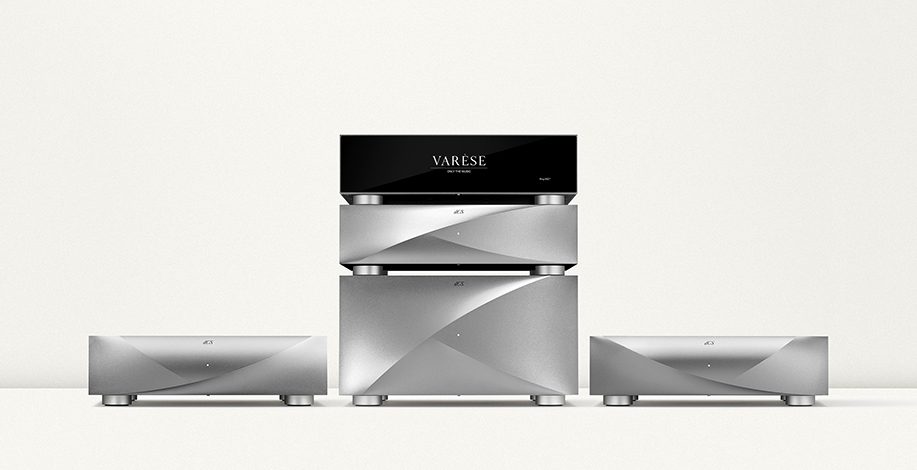
    Tech Talk: Wattson Audio

    Wattson Audio might be a relatively new name to many audiophiles, but the brand comes with a compelling backstory. The Swiss-based company has been associated with CH Precision and its team for over 20 years in a purely consultancy capacity, and there have been long-standing collaborative projects between the two.

    Wattson Audio was a child of the COVID-19 pandemic and has recently become a wholly owned subsidiary of CH Precision, bringing the two teams together. Wattson Audio is more than just a subsidiary or diffusion brand, though. We spoke to Alexandre Lavanchy, Technical Director of Wattson Audio, about the brand, its innovations and how it differs from CH Precision. 

    1. Describe the Wattson ethos from an electronic and audio perspective

    Wattson Audio’s philosophy is based on several pillars. From an electronic standpoint, we want to transpose the technologies and concepts of very high-end products to create devices that are more accessible, both financially and in terms of ease of use. Behind this aspect lies a great deal of work on the electronic circuits to select, rationalise and ultimately arrive at designs that contain the essentials to achieve the performance we are aiming for.

    When it comes to listening results and audio criteria, our primary goal is natural and neutral sound reproduction. We’re not Swiss for nothing 😉 We draw on all our experience to ensure that the digital components of the streamers and the digital-to-analogue conversion circuits deliver sound that is free of the harshness or coldness sometimes associated with digital audio, while maintaining precision, speed and dynamics. We target an analogue feel, which carries emotion so that technology as such should not be dominant in the ears of the user.

    We aim to create devices that perform a limited number of functions, but with minimal compromise, achieving a very high level of quality. User-friendliness, ease of use, and seamless integration into a contemporary living space, with both aesthetic appeal and discretion, are also very important aspects of our product philosophy.

    2. What is the CH Precision connection, both before and after the more formal collaboration?

    I was Florian’s first employee when he started an engineering consultancy and OEM company back in 2004. Florian decided to launch CH-Precision in 2009, and I took over the consultancy business which has later been renamed ‘EngineeRed’. We remained quite close, both geographically, as the two companies were only a few kilometers apart, and personally. We always kept in touch, discussing business management issues, technical topics, audio and personal matters. There have been some technical collaborations between the two companies, and EngineeRed provided the hardware module for CH-Precision network streaming interface. The mutual teams of the two companies have been in regular contact over the years.

    The first Wattson Audio products were developed by EngineeRed, and the brand was launched at the start of the COVID-19 pandemic. The following years were tumultuous and economically difficult, and a decision was made to shut down the consulting company in order to focus energy on the new brand, which was proving very promising. The acquisition by CH Precision, given the historical relationship, was quite logical and, above all, very consistent. We have thus brought the two friendly teams together under one roof.

    I feel that things have fallen into place as they always should have. We are now one team, with various departments, two brands, and an excellent working atmosphere and spirit of collaboration.

    3. What is your most significant technology in Wattson products, and why?

    It all started with the network audio streaming interface. It is a proprietary solution that is quite unique on the market and required many years of development. It was quite an ambitious project given the size of our company. Over the years, it has been very well received by the brands that use this solution, as well as by the DIY community, with whom we have had many exchanges over the years. This technical solution set us apart from other brands, and we decided that it would be the cornerstone of our first product.

    We have developed devices for a large number of brands, thereby acquiring knowledge in other technical fields, including analogue technology. While the streaming interface was the first building block, other blocks are being added to ultimately create a coherent product range. The amplifier we recently brought to market is proof of this.

    4. How important is LEEDH? Some think it’s ‘just’ a digital volume control

    LEEDH is indeed a digital volume attenuator, but a clever one. The way in which the numerical calculation is performed differs from conventional methods. The calculation error due to truncation inherent in the division of arbitrary numbers is reduced by this method.

    5. What is the difference between Madison and Madison LE

    The LE is a reworked and improved version of the standard Madison Streamer. The concept is the same, but the electronic circuits have been fine tuned and enhanced in many aspects. The measurements show a clear improvement in performances, and listening experience is significantly better. 

    From now on, we are discontinuing this distinctive designation. All Madison Streamers now contain the improved circuits, and the original circuit board is no longer being produced. The light grey or dark grey finishes are now only an aesthetic option.

    6. Are there plans for a Wattson preamp, integrated amp, or even phono stage?

    To tell the truth, there is no shortage of plans, and the road map is quite full. In terms of engineering, there is a lot of work to be done in the coming years. For each project, we like to approach the design process differently, trying to think outside the box and find a unique approach at Wattson Audio. It’s very stimulating, but it takes a lot of time. We will therefore move forward with the road map as efficiently as possible, with the priority being to bring technically mature products to market, devices that will perform well for many years to come.

    We will likely unveil some new products at the Vienna trade show next year.

    7. You exist at the cutting edge of streaming. Are there plans for greater DSP development, maybe room correction?

    Acoustic correction through digital processing is a process that interests us and is particularly in line with Wattson Audio’s philosophy of integration into a normal, comfortable living room environment. It is therefore a topic of discussion within our company, but to be honest, this project has not yet got off the ground.

    8. In a hierarchy of importance, where do the chipset, the implementation, and the firmware figure?

    Of course, everything matters. But when it comes to the hardware and architecture of a streamer/DAC, I would say that the chipset is the least important factor. We see products promoting this or that DAC chip with exceptional performance, when in fact the implementation is not up to par. At Wattson Audio, we prefer to use key components that we know well, which perform the function we need without any mystery, in order to maintain complete control over signal processing. 

    On another note, the choice of processor will only have a very limited impact as long as it is powerful enough to perform the software tasks required of it. However, it is the firmware that will be important here, as it will determine the integrity of the audio data and the quality of the user experience.

    9. Is streamer design art, science, mathematics, or electronics?

    At the risk of shattering the poetic dream, the development of a streaming device essentially consists of applying electronic theory, which stems from science. Mathematics is a necessary tool for the design of electronic circuits and is present at the software level for audio data processing.

    I like to believe that a form of art still exists, however, in the form of eccentricity brought about by the engineer who designs the electronics, in the form of sometimes irrational perfectionism, or simply in this infinite quest of a lifetime devoted to this vocation. In the end, the pragmatic and technical approach prevails.

    10. How important is your clean slate approach to audio?

    I’m not sure I can answer this question correctly, but I’ll do my best. We are exceptionally fortunate that the company’s strategy focuses primarily on the quality of work and product excellence rather than purely financial profits. This is the fundamental condition that allows us to carry out projects without rushing headlong into them. The basic philosophy is that there is no point in starting a project if we are not convinced that we are going to bring something new to the table. We must give ourselves the means and reconsider the fundamentals in order to achieve products that excel in their field. On the other hand, the team is made up entirely of highly experienced people, and there is strong collaboration between all departments. These interdisciplinary exchanges allow us to bring in fresh, cross-functional ideas or to see things from an unusual angle. 

    Editor’s note: It’s exciting to see new companies join the audio world, but it’s even better when they join with products that genuinely add useful content that provide a unique range of products for music lovers. It gets even better when that company has the techical smarts to back up its claims. That’s what’s happened here.

    Wattson Audio may be a new name on the scene, but it has all of those boxes ticked… and it comes backed by one of the darlings of modern European high-end audio; CH Precision. 

    This CH Precision link could so easily have been a double-edged sword, with the company becoming little more than a diffusion brand for the parent. But that wasn’t in the cards for Wattson Audio; the company has its own identity and sound, even if that sound is ‘CH-adjacent’. 

    We think companies like Wattson Audio represent one of the many futures of good audio. They might not be mainstream ‘me-too’ products, but they are all the better for that! 

    Manufacturer

    Wattson Audio SA

    www.wattson.audio

    +(41) 21 558 70 40

    Read the Madison LE Review here

    More about Wattson Audio

    Back to Home

    Wattson Audio Madison LE

    If you only buy audio equipment by the metre or the kilogramme, keep looking. If you are into bling, a Christmas tree front panel, and attention-grabbing displays, you’ve come to the wrong place. No, this one’s for those who want a remarkably high-performance, ‘just the facts’ headphone amp, DAC and streamer. It’s for those who don’t want a price tag that mistakes ‘streamer’ for ‘private jet’—the people who buy a product for its performance, not its label. If you are that kind of person, the Wattson Audio Madison LE speaks your language. 

    Given the audio world is awash with Special and Custom Editions that are little more than a new colour scheme, you might be forgiven for thinking the ‘LE’ suffix means ‘Limited Edition’. However, this ‘Lounge Edition’ sports some fundamental changes to the power supply architecture over the regular version. Both run concurrently in the catalogue. Like its brother, the Madison LE uses a separate power supply.

    Small, but packed

    The main Wattson Audio Madison LE chassis is small, but packed. It’s the size and weight of a hardback novel (more Pride and Prejudice-sized than a War and Peace-like tome). Unlike most rectangular audio boxes, the volume control side is tapered. It’s a Wattson Audio thing. The regular Madison, the power amplifier in the same line, and the two small Emerson converters in the range have the same taper. ‘Small’ does not mean ‘cheaply made’, however. The extruded aluminium case is solidly finished in a grey ceramic finish, not unlike a powder coat. That sits outside the more conventional black or silver, squared-off, audio-electronic aesthetic. But that isn’t necessarily a bad thing; in a world of ‘me-too’ boxes, the Madison LE stands small… and proudly so!

    The Wattson Madison LE streamer-DAC features three inputs: 100Mb/s Ethernet, S/PDIF via RCA, and TosLink. There’s no USB, no I2S, no AES3 and no external clock sync. There are no analogue inputs or a remote either. But there is a volume control, and a single-ended 1/4” headphone socket at the front and a pair of RCA and XLR sockets at the back for connecting to an amp. 

    Features?

    This isn’t perhaps the most comprehensive set of features and functions around, and there are streamers, DACs, and personal audio products that have more extensive feature sets. However, in a very real way, paring back to the basics invites a question: Do you really need more? 

    Yes, if you are using the Madison LE as a digital hub or a preamplifier, it will fall short. If you demand balanced headphone listening or require access to a range of filter options, the Madison isn’t the right product. But there’s nothing wrong with being a niche product if you do that niche very well.

    Wattson Madison LE Rear 3_4-Edit


    Part of the reason it does things very well is its use of a LEEDH volume system. It’s a genuinely lossless digital volume control that makes a lot of sense when used with the matching Madison power amplifier to create a bare-bones system. In a more conventional DAC setting, you can turn off the volume control.

    Appiness

    The Wattson Music app is the best driver for the Madison LE. Unlike its CH Precision stablemate, this is designed for iOS (there is an alternate app for Android users). The app is as stripped down as the Madison LE it controls, but it does allow the streamer to connect with the usual streaming services: Tidal (and Tidal Connect) and Qobuz (and Qobuz Connect). It also grants access to Apple AirPlay and Audirvãna, as well as a UPnP and DLNA streaming setup. The Wattson Music app is more of a facilitator than the place where your music lives. However, it does allow you to run some basic housekeeping on the Madison LE. These include volume adjustment and source switching, adjusting the display brightness, and even basic speaker placement correction. 

    The machine is also Roon Ready, making it an excellent use case for the Madison LE; it’s the perfect partner for a Roon Nucleus or similar. That’s the joy of a basic app. You don’t feel confused about whether to use the music-replay app’s functionality. This is because that functionality isn’t provided with the Wattson Music app. All it does is set up the system to play music well and then get out of the way with the least fuss possible, kind of like the Wattson Audio Madison LE. 

    Lively

    There’s one other thing the Wattson Audio Madison LE does very well. It sounds excellent! That’s perhaps not quite as much of a niche in audio (hopefully). Still, the lively, exciting and detailed sound is very much at odds with the flat and slightly dull sound often attributed to streaming-ready devices. And, ‘lively’ isn’t code for ‘it can peel paint at 30 paces’, it’s just one of those products with oodles of built-in joie de vivre. 

    OK, so if you decide to have a weekend of going through everything in Leonard Cohen’s catalogue, the Madison LE isn’t so exuberant that you will run out of the room smiling. It’s not some rose-tinted optimist. But the Madison LE is like the difference between listening to a Richmond Fontaine album and seeing the band live. The doubt is still there, but there’s more of a positive outlook at the end. I wouldn’t go so far as to say the Madison LE is ‘life-affirming’, but its energy is infectious.

    A niche product would focus on the excitement aspect and nothing else. The Wattson Audio Madison LE has got some depth to it, too. Tonally speaking, although we shouldn’t equate physical size to bass depth, the bass notes coming out of the speakers when the Madison LE was in the chain were impressive. It doesn’t overstate bass; it just isn’t shy of the bottom end. Yes, of course, this comes over well with electronica, but it’s also there in real instruments. For instance, Grant Green’s guitar licks take on a more substantial tone. This is the kind of streamer that makes you take someone like Grant Green seriously.

    Overlooked

    The jazzers of the age were all over Wes Montgomery like a nasty rash. Because Grant Green played in a more funky, less traditional style, he was largely overlooked by the 1960s jazz community. The Madison LE shows those blinding licks (rediscovered in the acid jazz era of the 1990s) are built upon solid technique. It is one of the few that could hope to replicate. The Madison LE brings out your inner musicologist, but not in the sad-faced analytical manner.

    The more you play through this pocket rocket, the more you come to like and respect what it does. It doesn’t try to be something it’s not or bite off more than it can chew. It’s clean and detailed, with a close-knit but open-sounding soundstage, and a fundamentally neutral tone. 

    Which brings us to the CH Precision connection. Yes, it shares many of those attributes in common with CH Precision digital products, but this isn’t a CH product. It uses a Sharc DSP and twin-DAC layout with a WM8742 chipset. It chose that due to the spline-filtering algorithm, which uses a short-tail filter (which is why it sounds so fast and exciting). All of which makes it very CH-adjacent. There is a commonality of sound as a result. But it’s best to think of this as a Wattson product, not CH-Precision Lite.

    No USB

    There are downsides. The lack of USB input is the most obvious. This is no longer a deal-breaker, but the absence of any USB audio or bulk storage options might deter some. Also, given the CH Precision connection and that company’s love of power supplies, I’d like to see something a lot more ‘stonky’ powering the Madison LE. But that’s it!

    The little Wattson Audio Madison LE impressed me, and it will likely impress you as well. It isn’t flashy, it isn’t infinitely configurable. It has just got it where it counts, right in the sound quality. If you want to enjoy what streaming has to offer truly, this is one of the best entry points. 


    Technical specifications

    • Type: Two-channel D/A processor, streamer, and headphone amplifier. 
    • Digital inputs: one electrical (S/PDIF on RCA), one optical (TosLink), and one Ethernet.
    • Analogue outputs: stereo pair balanced (XLR), stereo pair single-ended (RCA); single-ended headphone (¼” stereo). 
    • THD: 0.001%
    • S/N ratio: >120dB (A-weighted)
    • Headphone amplifier maximum output power: 150mW into 32 ohms, 50mW into 150 ohms, 10mW into 600 ohms
    • Supported formats: PCM to 384kHz, DSD to 256×. 
    • Control protocols: UPnP/DLNA, AirPlay, Tidal Connect, Roon Ready, Audirvãna 
    • Control app: Wattson Music for iOS. Wattson Remote for Android
    • Dimensions (WxDxH): 17.4 x 18.5 × 5.2cm
    • Weight: 1.08kg
    • Price: £4,995, €4,995, $4,995

    Manufacturer

    Wattson Audio SA

    www.wattson.audio

    +(41) 21 558 70 40

    More about Wattson Audio

    Back to Reviews
    Moon ‘Compass’ 371: First Look

    Moon by Simaudio’s recent success with its six-strong ‘North’ Collection demonstrates the Canadian brand’s strong position in the high-end market. But, when it comes to Moon’s more affordable 300 series, the line could do with a bit of a refresh. ‘Compass’ will gradually replace the existing 300 line, and, as the name suggests, it points… North. The 371 Network Player/Amplifier/streamer/phono stage/vibrating bread maker* is the first in this new line, and Moon decided to hit the ground running!

    A select group of U.S., Canadian, U.K., and European journalists was invited to Moon’s factory, located just outside Montreal. This was intended to provide hands-on experience with the introduction to the new product, offer more background information on the Compass project, and provide an opportunity to visit the company’s impressive factory. That last will be the subject of one of our upcoming ‘Meet Your Maker’ features, but suffice it to say that – except for anodising or hand-rearing capacitors in a nearby farm – the company designs, builds, tests, and assembles everything on site. That’s impressive enough in its own right.

    More than Ace

    I’ll be honest. I expected a new ‘Ace’. Moon’s Network Player/Amplifier system was launched eight years ago and proved to be one of the stalwarts of modern audio system building. And, at a surface level, the 371 could be mistaken for ‘Ace II’. After all, it has a built-in MM/MC phono stage, a useful streaming DAC function, and shares the Ace’s ‘just add speakers’ ease of installation and use. However, if we were being picky about the original Ace, it wasn’t a powerhouse; while it was—and, for those who have one, remains—an excellent introduction to 21st-century audio, it could get a little rough around the edges when pushed.

    The 371 is a distinctly different proposition, drawing on the technology from the North Collection, particularly the 641 integrated amplifier and 681 network player/DAC. Like the 641, the 371’s core design emphasises the importance of placing the gain adjustment precisely in the right place in the circuit. It doesn’t feature the BRM-1 remote control of the North Collection as standard, but the 371 is fully compatible with that clever control, and it will be independently available as an upgrade.

    Many boxes in one

     Journalists have a habit of reducing complex technology to an oversimplified ‘elevator pitch’. Years of painstaking R&D are condensed into a sentence or two. And at first glance, the need to slam everything together into the shortest possible space is irresistible. So, think of the Moon 371 as the company’s 390 preamp (with elements of the 891 network player/DAC and something between the 110LP and 310LP phono stage) with a 330A power amplifier, all designed to work in a single box. As with any oversimplification, there’s a lot wrong with this pithy description. For example, the phono stage features a simple MM or MC setting, lacking the loading adjustments of standalone models; however, it incorporates many of the high-performance circuit design elements found in these models.

    Much of the sonic performance, too. We were given an extensive listening session, both ‘directed’ and using our own tracks from Qobuz. The system in Moon’s larger listening room comprised 371 (naturally), streaming using Moon’s own MiND 2 app running a NAS drive on the server and Qobuz Connect. The turntable was a Technics SL-1200G with an undisclosed (in all honesty, my handwriting went a little ‘doctor’ at that point) cartridge and the loudspeakers were Dynaudio Contour Legacy floorstanders, with Cardas Clear cable.

    The 371 had more than enough drive to power those Dynaudios in a fairly large, sonically quite dead room. The easy-sounding character of the loudspeakers was never challenged, even when pushed musically and at volume. That’s the sure sign of a good and powerful amplifier. Meanwhile, the streaming and vinyl performances were both first-rate. The phono section had remarkably quiet backgrounds, while the streamer and phono stages were both musically adept, similar in tonality and staging properties. The streamer was also quick to react to commands, even when the app was getting a lot of random button-mashing from a room full of journalists.

    The first reaction to this was that I was very wrong about this being the Ace II. It sets a new high standard in performance, and as an integrated amplifier, it sounds more like separates than you might ever expect. It’s detailed, musical, gives out a fine soundstage and – given the deceptive amount of motive force needed to raise those Dynaudios to play loud in a very controlled room – has the potential to be extremely powerful. We look forward to seeing the product in for test soon.

    *Vibrating bread-making option subject to non-availability. 

    From the Moon by Simaudio press releases:

    Montreal, September 30, 2025 – Simaudio today launches the MOON 371, an innovative network player/amplifier delivering exceptional performance, versatility, and elegance. This new model seamlessly combines the capabilities of a premium amplifier, preamplifier, DAC, network player, and phono stage into a single, beautifully crafted enclosure. The MOON 371 is the entry point to MOON’s Compass Collection, setting a fresh benchmark for modern audio systems.

    Refined connectivity. Equipped with MOON’s MiND 2 streaming platform, the MOON 371 offers effortless access to leading streaming services such as Tidal, Qobuz, Deezer, and Spotify. It is fully compatible with Apple AirPlay, is Roon Ready, and supports Qobuz Connect, Spotify Connect and Tidal Connect for seamless operation. An additional connectivity option is provided by Bluetooth.

    Uncompromising vinyl playback. The MOON 371, equipped with an advanced built-in phono stage for both MM and MC cartridges, delivers precise analog reproduction. Drawing on the legacy of MOON’s award-winning phono stages, like the 810LP, it preserves the integrity and detail of every recording with impeccable accuracy.

    Industry-leading technology. Drawn from MOON’s flagship North Collection, the proprietary MHP (MOON Hybrid Power supply) and MDCA (MOON Distortion Cancelling Amplifier) ensure superior performance. The MHP supply provides ultra-stable power to the circuitry, while the MDCA virtually eliminates distortion and improves linearity, delivering exceptionally clean, dynamic, and accurate sound reproduction.

    Beautifully easy to use. A striking 17cm colour screen displays settings, album art and track details, while the sleek CRM-4 metal remote, designed specifically for the Compass Collection, ensures effortless control.

    Exceptional construction. The MOON 371 is designed and handcrafted in Canada using only premium materials. Each unit undergoes rigorous quality control and is backed by MOON’s industry-leading 10-year warranty.

    “The 371 represents the future of modern audio,” said MOON’s Chief Commercial Officer, Etienne Gautier. “This model embodies our commitment to redefining how we approach audio design. By listening closely to the valuable feedback of our customers and partners, we’ve developed a fresh approach to creating a MOON product. It delivers uncompromising performance and striking aesthetics in a single component, all at a price point that opens the door to premium audio for many music lovers for the first time.”

    About The Compass Collection

    In creating the Compass Collection, MOON took a fresh approach and philosophy to deliver uncompromising products that embrace leading-edge technology and advanced design, while showcasing the company’s unique, modern, and elegant Canadian identity.

    The Compass Collection follows the North Collection, which was launched in 2023. The North Collection comprises the 641 Integrated Amplifier, 681 Network Player/DAC, 761 Power Amplifier, 791 Network Player/Preamplifier, 861 Power Amplifier, and the 891 Network Player/Preamplifier. In the hierarchy of MOON’s product ranges, the Compass Collection slots in just below the North Collection.

    The new collection has been named Compass to symbolize its role as a guide to reaching high-end hi-fi performance. Its iconic logo clearly illustrates that it will point the owner in the right direction. Indeed, the Compass Collection could serve as the entry point into the world of high-end audio for some of MOON’s customers. Additionally, with this name, Compass is the perfect stablemate for the North Collection.

    Many of the models in the Compass Collection will feature technologies from the award-winning North Collection. The 371 is equipped with the proprietary MHP (MOON Hybrid Power) supply and MDCA (MOON Distortion Cancelling Amplifier) at its core. The MHP supply provides ultra-stable power to the circuitry, while the MDCA virtually eliminates distortion and improves linearity, delivering exceptionally clean, dynamic, and accurate sound reproduction. Previously, the MHP supply has been used in the North Collection’s network player/amplifiers. The 371 is the very first MOON amplifier to feature this remarkable technology.

    Each model can be operated via controls on the front fascia (colour screen where appropriate), the MOON MiND app, or the stylish CRM-4 aluminium infrared remote, designed specifically for the Compass Collection. Alternatively, the MOON BRM-1 from the North Collection, featuring its own full-colour screen and exquisite volume control, can be purchased for use with the 371.

    The Compass Collection features premium construction, exceptional styling, and functionality, ensuring performance that will satisfy the owner for many years. This is reflected in MOON’s industry-leading 10-year warranty.

    Technical Highlights

    • Output power 8ohms: 100W
    • Output power 4ohms: 200W
    • Gain: 40dB
    • Frequency response: 5Hz – 100kHz +0/-3dB
    • Dimensions (WxHxD): 16.9’’ x 3.5’’ x 15.2’’ (42.9cm x 8,7cm x 38,5cm)
    • Weight: 20lbs/9kg

    The MOON 371 is available from authorized MOON retailers. MSRP: $6,500 (US), $8,800 (CAD), €6800, £6,250.

    MOON by Simaudio

    More Moon by Simaudio Reviews

    Back to Home

    Dvořák: Symphony No 9 ‘From the New World’, Berlin Philharmonic Orchestra, Rafael Kubelik (conductor)

    In the post-war years, just about every major conductor recorded Dvořák’s ‘New World’ symphony. Indeed, many did so more than once. Rafael Kubelik, a Czech émigré, left no fewer than five versions, recorded over a period of 40 years.

    His third ‘New World’, recorded with the Berlin Philharmonic for DG, is probably his best-known performance. It was issued in 1973 as part of a boxed set of all nine Dvořák symphonies. The individual LP issue was released a year or so later, featuring a striking cover picture shot by photographer Jack Mitchell.

    It depicts Kubelik seemingly walking among the skyscrapers of New York, with the Pan Am building in the background. The low angle, with the camera pointing up, makes him look like a giant, as tall as the buildings that surround him.

    DG’s recording sounds very natural and well-balanced. The booklet in the original nine-LP boxed set of the Dvořák symphonies featured a picture of Kubelík conducting the Berliners in the Jesus-Christus-Kirche during a recording session, and it shows two Neumann stereo microphones in use.

    There’s one above the conductor, pointing down at the strings, and a second in front of the winds – presumably to focus the instruments in the centre of the orchestra. Hans Peter Schweigmann was the Tonmeister for all of Dvořák’s symphony sessions except the 8th symphony.

    Stereo mics have switchable patterns: Omni, Cardioid, and Figure 8. Figure 8 was likely chosen for the primary mic. In this arrangement, sound is picked up from both the front and behind in a figure-of-eight pattern, capturing more hall ambience than the cardioid option. 

    Used correctly, coincident mic capsules for left and right channels create a natural phase-coherent stereo soundstage. The New World recording was made on four-track half-inch tape in experimental quadraphonic format, with two tracks dedicated to ambience. 

    The four-track tape was mixed down to a two-track quarter-inch tape and used to cut the LPs. Unfortunately, this introduces an additional generation of tape noise and distortion. As with other LPs in DG’s The Original Source series, the original four-track tape was used to cut the lacquers for optimal sound quality. 

    In the 1960s, DG’s pressing quality set a standard that all record companies aspired to; LPs that were flat, perfectly centred, with surfaces that were smooth and silent. Sadly, the quality of pressing suffered in the early 1970s due to troubles in the Middle East, which led to a massive spike in the price of crude oil. 

    DG’s Original Source LPs represent a return to 1960s quality standards with near-bespoke analogue pressings that accurately convey the quality of the original master tape. The same recordings on CD sound very good, but the vinyl sounds better – freer, more open, more natural.         

    Kubelik does not observe the first movement exposition repeat in any of his recordings of the ‘New World’, which is a pity, but hardly a deal-breaker. Even though we have come to expect this now, not observing repeats was pretty standard in the 1960s and 1970s, though Kertesz and Rowicki (both LSO) did include the repeat. 

    I have always liked Kubelik’s Berlin performance of Dvořák’s ‘New World’ Symphony and haven’t heard a better one in 50 years. His shaping of the work has a natural, spontaneous feel, with orchestral playing that has plenty of bite and fire. There’s pace and drama without things sounding hard-pressed or aggressive.

    Despite the refined quality of the Berliners’ playing, there is also a nice earthiness. Karajan’s famous 1964 DG recording of this symphony is impressively opulent and sophisticated. Yet Dvorak, for all his fame and celebrity, basically remained a simple countryman at heart.  

    Kubelik understands this, which ensures his Dvořák performances sound idiomatic and authentic. His DG set of the nine symphonies is probably his most significant achievement on record. And, even with the passage of 50 or more years, it remains a top recommendation… 

    Back to Classical


    Focal Hadenys

    One must count one’s blessings. Over the past few years, I have enjoyed personal listening through Focal’s iconic £ 3,500 Utopia headphones. They are among the finest devices ever created by humans for converting wavy electronic signals into the soundwaves they represent. These no-expense-spared designs are both revealing and musical. Much of this can be attributed to their use of beryllium. You will find this rare metal in the driver’s diaphragms, the flat surfaces that, thanks to the interaction between the affixed signal-carrying voice coils and the powerful magnetic field surrounding them, shift air to produce that incredibly exquisite sound. Beryllium is ideal for the task, as it is both rigid and lightweight. This allows the diaphragm to respond swiftly without physical distortion, ensuring that musical transients are accurately conveyed. 

    Focal wasn’t the first company to harness the metal’s hi-fi potential. Yamaha fitted beryllium tweeters to its famous NS1000 speakers half a century ago. But the French firm has arguably been its key proponent since 2002. Just before those ultra-high-end phones were introduced, Focal launched their speaker equivalent – the flagship (£120,000) Utopia EM floorstanders. Their inverted-dome tweeters employ the wonder metal. It’s no surprise that others in the hi-fi game, from inexpensive OEMs in China to serious speaker manufacturers like Sweden’s Marten and Paradigm in Canada, have also seen the light.

    Paradise Lost

    One early summer’s day, that particular blessing alas vanished. Settling back in my chair with a new album to enjoy, sound flowed only into my right ear. I checked my source, the headphone amp and associated wiring. A simple continuity check revealed that Utopia’s left-channel driver had failed open-circuit. Disaster! Although Focal assured me that “an underlying issue” was not to blame. Open-circuit drivers are not uncommon with earlier-production Utopias – as a quick Google search will confirm. Fortunately, Focal has extended and made the Utopia warranty transferable. 

    Without wasting any more time, I picked up the phone and arranged for mine to be repaired. While on the call, I politely inquired about any new models that Focal might have in the works. “Funny you should ask,” I was told. The charming young PR lady on the other end, a proud hi-fi enthusiast herself, spoke enthusiastically about two circumaural headphones fresh from Focal’s St. Étienne factory. These were the £499 Azurys and £599 Hadenys. “Would you like to try a pair? We’ll also send you a loan pair of Utopias to tide you over while yours are being repaired.” How could I refuse…

    House style

    Finished in the distinctive Focal ‘house style’, these products appear pretty similar. Subtle variations in hue (characterised to me as ‘timeless’) superficially set them apart. However, beneath those elegant exteriors, the Azurys and Hadenys – named after a copper-rich mineral and the earliest period of Earth’s history, respectively – are very different entities. The first features a closed-back design, while the latter has an open-back design. Open-back headphones generally sound more natural and spacious than their closed counterparts, but they sacrifice some isolation.

    Therefore, closed headphones like the Azurys are better suited for outdoor use. Being able to identify imminent hazards would, however, be a distinctly ‘open’ advantage. They are also ideal for situations where nothing should come between you and the audio, such as gaming and music production. 

    Open Isolation

    The comparatively poor isolation characteristics of open-back headphones work both ways. Not only does ambient sound intrude on your listening experience, but your musical tastes will also be audible to those in your immediate vicinity. They are therefore not the best choice for considerate public transport users! As the Utopias belong to the ‘open’ category, I chose to try the Hadenys. How close—at just under a sixth of the price—could they come to their legendary counterparts? Open-back headphones, such as the Hadenys (and Utopia), should be suitable for quiet listening rooms. They also shine during those late-night sessions when neighbours might not appreciate the somewhat higher leakage potential of large speakers. According to Focal, the Hadenys are a “key” proposition, offering audiophiles “more affordable open-back headphones…without compromising sound quality, lightness, or comfort.” 

    As one might expect, given their lower cost, the Hadenys ‘package isn’t as luxurious as that of the Utopia. However, you do receive a neatly colour-coordinated zip-up carrying case. Thist accommodates the headphones and, with a pocket, the interconnecting cable. Only one such cable is supplied. At 1.8m long, it terminates in a user-friendly 3.5mm stereo plug. However, a ‘screw-on’ 6.3mm adaptor for conventional hi-fi is included. At the other end, the lead connects to a 3.5mm socket on the base of the left Hadenys ‘cup’ through another moulded 3.5mm stereo (‘tip-ring-sleeve’, or TRS) plug. This is non-locking, unlike the costly Lemo locking connectors of the Utopias. From a practical standpoint, this is no disadvantage. The plug will detach from the headphones without damage if the cable is inadvertently stressed. 

    Balanced connectivity

    Balanced headphone connectivity can offer audible benefits, including enhanced dynamics and a wider soundstage. Focal’s PR assured me that, much like the Utopias, the Hadenys can be connected to devices equipped with a balanced audio output if the correct cable is used. The company mentioned that “since the connector on the headphone is a standard 3.5mm, it should be straightforward to find aftermarket cables.” However, given that the plug at the Hadenys’ end of the cable is a TRS (i.e. three-connection) rather than a TRRS (four-connection), the two channels must share a ‘common’ return. Balanced operation won’t be feasible if the Hadenys socket is also TRS. 

    Subsequently, Focal confirmed that a TRS jack is indeed fitted to the Hadenys. Unfortunately, this means balanced operation is not feasible (certainly without modifications that would invalidate the warranty). “Azurys and Hadenys are only compatible with a stereo jack, and a balanced connection cannot be employed.” Therefore, it appears that Focal has restricted the flexibility of these headphones for the trivial difference in cost between a TRS jack and a TRRS jack! It’s quite a shame. In contrast, a pair of £299 (“budget”) audiophile headphones I have on hand – HiFiMAN’s excellent Sundara – can easily be adapted for balanced use, with the audible benefits clearly noticeable.

    Confidence Inspiring

    When considering construction, the Hadenys inspires confidence. Its robust magnesium yokes (the pivots on which the earcups are mounted), honeycomb-grille magnesium rear cups, and easily adjustable leather-covered headband are outstanding. However, Utopia’s luxurious earpads, featuring lambskin leather surfaces, have been replaced with fabric-covered alternatives on the Hadenys. The pads themselves are made of memory foam to ensure a snug fit around your ears. 

    Behind the earpads are the drivers, which, as Focal is eager to highlight, are manufactured in France using “patented technology.” Their domed 40mm diaphragms feature the signature Focal ‘M’ cross-section for a larger surface area and resistance to ‘breakup’ at elevated listening levels. However, they do not utilise Utopia’s premium beryllium. Instead, Focal has opted for a magnesium-aluminium alloy, which is claimed to deliver similar performance while being somewhat cheaper to produce. These diaphragms are paired with voice coils that have an impedance of 26 ohms, ensuring compatibility with practically any device! 

    Commendable

    Interestingly, Focal claims a sensitivity of 100dB/1mW (1kHz) for the Hadenys. This is a commendable figure, albeit not quite reaching the 104dB/1mW of Utopia’s lavish 80 ohm drivers. However, in one significant respect, the Hadenys surpasses the pricier model. Weighing in at 294g per pair, it is half the weight of the Utopias. As a result, it’s more comfortable for prolonged wear. Furthermore, the stepped headband adjustment, which follows a traditional design, ensures that the Hadenys delivers a snug yet comfy fit. 

    The cloth earpads are less susceptible to sweat than those made from animal skin (real or otherwise). They can be unclipped from the cups for replacement or cleaning. Once the pads are removed, it becomes apparent that the transducers are slightly ‘toed in’. Overall, the Hadenys rank among the most comfortable headphones I’ve experienced in quite some time. I’ve worn them for several hours at a stretch with no adverse effects whatsoever.

    Sensible Balance

    Focal’s sensible balance between sensitivity and impedance makes the Hadenys easy to drive—even with the modest headphone amplifier built into a Sony Xperia 10 smartphone (yes, this is quite an old model—analogue headphone sockets have all but disappeared from smart devices, now that Bluetooth has reached a decent standard). With a selection of lossless music played through the excellent VLC app, I could achieve decent sound levels with little sign of strain, even though the overall result fell short of audiophile expectations. 

    In contrast, the less sensitive (94dB/1mW) Sundaras sounded gritty and congested. Moving slightly up the audiophile scale, the Hadenys did not stress the headphone amps built into budget hi-fi systems, either. Indeed, while listening to some old tapes on a cassette deck made by the Xperia’s Japanese creator more than three decades earlier, I found myself wishing that Sony had included an output-level control. The sound levels produced by the Hadenys were so high that correctly recorded cassettes could easily become overwhelming!

    Unstressed amps

    Users of high-quality portables will genuinely benefit from these properties. Not only will the headphone amplifier remain unstressed, thereby avoiding detrimental effects on sound quality, but battery life should also improve as a result. I tested the Hadenys with three high-quality portables: a Sony Walkman Pro, FiiO X3, and Astell & Kern SR25 Mk. I encountered no compatibility issues whatsoever. The same was true for the more stationary equipment available to me; this included an ANT Audio headphone amplifier (with an Arcam CD player handling line-level duties), and headphone DACs with the 2.5mm socket that the SR25 also provides. Each performed well, even the portable units yielding decent results from Prism (Callia) and Chord (Hugo TT), fed coaxially from a Cambridge Audio CXN hi-res digital music player. 

    The headphone sockets of each were connected via the standard 3.5mm plug-terminated cable and screw-on 6.3mm adaptor; unfortunately, I wasn’t able to experience balanced operation with listening levels that had ample headroom to spare. I found that the Hadenys played to the strengths of whatever was connected—the considerable resolving power of the Callia and the more organic presentation of the Hugo TT. Focal recommends a minimum of 24 hours of ‘burn-in’ at a relatively high volume level (the pink noise of an off-station FM tuner is ideal for this, in my experience) for the Hadenys to reach their full performance.

    The Fall’s Quality 

    Working through a collection (A-Sides 1978-2016) of singles by that unique British institution, The Fall, the overall improvement in production and recording quality over time is evident, even with the remastering process (did you know that some of the songs – including ‘Mr. Pharmacist’ and The Fall’s Top 30 cover of ‘There’s A Ghost in My House’ – were recorded at no less a facility than Abbey Road?). Even the band’s early output, captured in long-forgotten studios scattered across the UK, remains enjoyable despite the variable sound quality.

    In other words, Hayden’s analytical detail does not come at the expense of musicality. Throbbing basslines, angular guitars, and the occasional quirky keyboard jostle for position against a furious rhythmic backdrop – but at the constant heart of the music, performed by an ever-changing lineup, is, of course, Mark E. Smith, whose much-imitated (but never equalled) vocal style and lyric writing always emerge with appropriate intelligibility. Basslines are deep, tuneful and articulate – a far cry from the lumpy ‘one-note’ presentation that afflicts some rather expensive headphones aimed at the mass market. 

    Coloration free

    Headphones offer a musical experience free from the colouration issues that room acoustics can introduce in traditional speaker-based listening. The intimacy found in certain types of music—such as chamber pieces and closely miked female vocals—can be absolutely breathtaking. In larger classical works, like the dynamic 2012 LSO/Noseda recording of Britten’s War Requiem (24/48), you can locate instrumental groups and even individual choristers within the soundstage. 

    They may have quite similar characteristics to the beryllium drivers of Utopia. Still, those fitted to the Hadenys can deliver an ‘attack’ that deftly accommodates music ranging from the urgent dynamic swings of the War Requiem to the percussion of fast house music (note that lightweight 40mm diaphragms will always be more responsive than larger and heavier speaker cones – that’s just physics). On this subject, the vast majority of dance and rock tracks are artificial studio creations, with elements panned into position using the mixing desk (or, these days, workstation software). 

    Occasional Holes

    This can sometimes create a ‘hole in the middle’ effect, even affecting high-quality transducers like the Utopia and Hadenys. Some headphone amplifiers, including my Hugo TT, feature a ‘cross-feed’ function (which Chord refers to as ‘X-PHD’) that subtly blends the two channels. The effect is minimal (Chord’s model offers three selectable levels) and simulates, through proprietary electronic methods, what a listening room’s acoustics achieve with speakers. The notion of ‘playing around’ with music in this manner might deter purists—but believe me, it works! 

    However, one listening scenario that should not involve cross-feed is binaural recordings, which are specifically designed for headphones using ‘dummy-head’ microphones (or advanced workstation spatial-audio plugins during the mixdown phase). When played through speakers, binaural recordings can sound unnatural; at times, they can be disconcerting. When listened to through headphones as intended, they provide a completely different experience.

    Up, down, front, back

    Indeed, there are limitations regarding up/down and front/back localisation. These are performance areas where modern speaker-based surround sound technologies, such as Dolby Atmos, truly excel. In contrast to headphones, however, such systems are far from compact or portable. Despite these limitations, the subjective sense of realism offered by binaural audio can be overwhelming with headphones of the Hadenys’ calibre. I had access to some remarkable binaural music (including a BBC session featuring Lucy Rose) and drama (a radio adaptation of Nigel Kneale’s The Stone Tape). Still, the most convincing examples were ‘ambient’ recordings. 

    Among these was a 1976 BBC documentary about life on an oil rig, a stroll through New York City, and some binaural recordings I made myself fifteen years ago. Cars move in and out, drills roar to life between your ears, and human hubbub seems so realistic that you’ll think someone’s in the room with you. So effective were the latter that I retrieved my homebrew mics and ‘updated’ them for the present day! While we’re on the subject, speech is natural and uncoloured… more so than most conventional loudspeakers I’ve heard.

    Conclusion

    A direct comparison between the two models reveals how closely the Hadenys approximates the Utopia. In particular, it gets close in terms of tonality, punchiness, and detail resolution. However, the Utopia maintains a degree of ‘airiness’ that the Hadenys cannot fully replicate. Also, some of the finer details of high-resolution recordings – revealed by my somewhat analytical Prism Callia – are not as readily apparent. 

    Overall, the Hadenys performs admirably, especially considering it is just under three grand cheaper. Its open, detailed, and tonally neutral presentation does justice to every genre of music. If you take headphone listening seriously and have £ 600 to spare, the Hadenys should undoubtedly be on your list of models to audition. Regarding the reliability issue, Focal has assured me that the Utopia problem has been fully resolved. The Hadenys, which benefits from a six-year warranty and is entirely different internally, should last a lifetime. 

    Technical specifications

    • Design: Open-back, circumaural
    • Impedance: 26 ohms
    • Sensitivity: 100dB/1mW (1kHz)
    • Maximum SPL: 105dB (peak @1m)
    • THD: <0.2% (1kHz, 100dB SPL)
    • Frequency response: 20Hz – 22kHz (+/- 3dB)
    • Transducers: 40mm, aluminium/magnesium ‘M’-shaped dome
    • Weight: 294g
    • Connection: 3.5mm TRS, unbalanced. 
    • Supplied cable: 1.8m (terminated in 3.5mm jack; 6.3mm adaptor supplied)
    • Price: £599, $699, $699

    Manufacturer

    Focal

    www.focal.com

    More from Focal

    Back to Reviews

    Peak Consult Sonora

    It’s almost twenty years since I first encountered Peak Consult. I recall the then-current Princess model as a modestly sized, yet inordinately heavy, floorstander. It was beautifully and elegantly built, as many Danish products are – real hardwood cabinets gorgeously finished, with leather front facings. The speaker sounded as it looked: beautiful, elegant, and understated, if a little traditional. It was easy to admire, though I never loved it. The Princess’s problem was that it didn’t quite boogie as well; tonally rich and expansive, with exemplary timing and coherence, but dynamically, it could be a little self-contained.

    That was then. 

    Things are different there now. It all changed with a change of ownership. Wilfried Ehrenholz was seeking a new project to keep him engaged after selling Dynaudio, the loudspeaker company he co-founded. Together with Lennart Asbjørn in the role of CEO, they acquired Peak Consult in 2021, retaining Per Kristoffersen, Peak’s founder, who was put in charge of designing the exquisite cabinets for the model range. 

    Per’s talents are strongest in cabinet design and construction, and these are now complemented by Wilfried’s tremendous expertise in loudspeaker and driver development. They engaged the services and measurement facilities of Karl-Heinz Fink’s team for crossover and final tuning development work. The results of all this collaboration have led to a truly remarkable four-model lineup.

    The Sonora sits at the bottom of the Peak range (plus a centre-channel speaker if you’re so inclined), but this is about as far from an entry-level product as I have encountered. For starters, the £23k selling price doesn’t exactly scream ‘entry-level’, but also, the construction and overall quality are every bit as good as the larger Sinfonia, El Diablo and Dragon Legacy models that sit above it. 

    Any given configuration

    Peak’s approach is to create the best loudspeaker possible for any given configuration; there’s no cost-cutting or compromise evident here; it’s not a question of hitting a price point. Wilfried determines the best component, or driver specification, for the task, and that’s what is used, regardless of the ‘bill of materials’ cost. 

    Peak Consult - Sonora

    The aim for the Sonora was to produce a loudspeaker that rivals Sinfonia, but is easier to accommodate in smaller spaces. To that end, the Sonora is a two-way design, whereas the others are all three-way, with increasing driver complements as you move up the range. It further differs in having a rear-firing auxiliary bass radiator, rather than a ported cabinet. It may be a floorstander, but conceptually, it’s closer to a standmount design. The actual loudspeaker enclosure occupies a little under half the cabinet volume, and an internal divide runs from just below the mid/bass driver to under the ABR at the back. 

    fine sand filling

    Below this is the crossover, in a space filled with fine sand to isolate the network from structural and airborne vibrational energy. The crossover uses Peak’s Linear Impedance Control technology, which helps keep the loudspeaker impedance as amplifier-friendly as possible.  Alongside the choice of solid hardwood and deep-section HDF for the cabinet itself, the sand-filled base helps explain why each domestic-friendly size cabinet weighs in at a substantial 68 kg.

    The front baffle, where the drivers are mounted, is canted backwards for time-alignment, subtly faceted to minimise diffraction effects, and the rear panel slopes forward, avoiding parallel faces. Hence, the cabinet tapers from bottom to top. This taper also helps reduce the impression of size and visual mass, while retaining a footprint broad enough to ensure stability. A gloss black strip of acrylic runs down each side of the cabinet, the better to break up the ‘wooden slab’ appearance of the sides

    Domestic-friendly

    The ‘domestic-friendly’ aspect is important here; my listening room is not large, roughly 4x4m, and the bass output of the larger, three-way designs can be prodigious, not to mention the somewhat larger and deeper cabinets they occupy. Although the Sonora, Sinfonia, and El Diablo are not hugely different in size, if space is tight, the Sonora is usefully slimmer and shallower, with a footprint much the same as a moderately sized standmount. It also partners my Accuphase DP570/E5000 combination more appropriately from a cost perspective, albeit still around twice the price of the FinkTeam Kims that usually sit there. And comparison with those Kims is worth a quick mention, too.

    The Kims’ cabinet volume is larger than the loudspeaker section of the Sonoras, and their 8” bass/mid driver is larger than the Sonora’s 6” design (though the Sonora’s 8” ABR does mean their total bass radiating area is somewhat greater). Two different approaches to getting decent bass output from a modestly-sized driver set, and both are equally successful in their own terms. I’ve previously described the Kim as a standmounter that thinks it’s a floorstander; the Sonora might almost be thought of as a floorstander that thinks it’s a standmount.

    Bass performance

    And in case you think that driver complement and enclosure volume are definitive in terms of bass performance, be very clear here that the Sonora’s bass is not lacking in depth, weight, or impact, and goes deeper and more complex than the Kim, at the end of the same system.

    All Peak loudspeakers arrive with a set of outriggers which mount securely across the underside of the baseplate. A set of snub-nosed, adjustable feet screws through these outriggers, secured on the top side by a cylindrical stainless steel cap that screws down onto a threaded section of the foot and bears against a washer made of a damping polymer material. The combination of outrigger, baseplate and feet forms the interface with the floor, damped to some extent by the washer between the clamping cap and the outrigger’s upper surface.

    The feet’s rounded shape obviates the need for floor protectors on hard surfaces, though I experimented with my usual 50mm AcouPlex disc floor protectors under them. And it’s definitely worth experimenting with how the caps, washers, and indeed floor protectors affect the sound during setup. The Sonoras sound different if the caps are screwed down firmly, finger-tight, and in my room, this wasn’t a great success. Nipped up gently was better; just screwed down until the barest resistance was felt against the washer was better still, but in my room, on hard wooden flooring, I got the best results leaving the locking caps off entirely. The threaded part of the foot has a relatively large diameter and screws snugly through the outrigger, so even given the weight, this was entirely secure. The review was mainly conducted with them configured in this manner. 

    Sound

    Michael Gandolfi’s orchestral suite, ‘The Garden of Cosmic Speculation’ (Telarc, SACD) musically depicts various areas of a real garden inspired by cosmology and physics. It opens with ‘The Zeroroom’ in which pulsating woodwinds lead us into the garden. I found myself thinking, ‘How are they making that pulsing sound?’-something that had never previously occurred to me to wonder, but which is now quite clearly not the usual way these instruments are played. The next track, ‘Soliton Waves’, passes thematic material around the orchestra, and there’s real movement here, a vivid invocation of the propagation of energy. The pizzicato in ‘Passepied’ was, frankly, uncanny, and so it went on.

    Almost from the first moment you play music, there is a ‘rightness’ to the sound of the Sonoras. Textures, timbres, pitch and spatial information are resolved so finely and accurately, it’s as though what you’ve experienced before has been an approximation. Instruments sound natural and real; it’s not just timbre, they have texture and form. Pianos have an appropriate sense of mass and size, and vocals are scarily real. The soprano saxophone is an instrument I have real problems with, as it is often strident, brutal, and oppressive. Which is a shame because experienced live, it can be almost ethereal.

    Case in point

    Jack de Johnette’s ‘Ahmad the Terrible’ from Album Album (ECM) is a case in point. Often, I play this as a test because if the timing doesn’t work, it’s just a bit of a racket. This time, not only was the timing absolutely on the money, but the timbre of John Purcell’s soprano sax breathed like a real instrument; the sax and bass pairing now feels playful, a lighthearted dance like a cakewalk, and it soars over the rest of the ensemble when the groove really gets going.

    And insights like these keep coming. Alongside the tonal colours and textures, there’s also a pretty extraordinary level of spatial resolution. Listening to the LSO/Previn account of the Brahms Deutsches Requiem (LSO Live), it’s clear that this was recorded in an auditorium, not a studio. The orchestra and chorus are laid out before you; the scale and space between the various sections are very redolent of a live concert. The impression of effortless realism persists. In the opening ‘selig sind’, the orchestra and choir are clearly being held back; the sense of substantial, powerful forces being restrained is palpable. This is a very humane requiem, and Previn’s evocation of the human spirit comes through very clearly.

    Digging deeper

    I found myself digging ever deeper into my collection of classical recordings to revel in the structure and organisation the Sonoras bring to large-scale works. Usually, if I find myself gravitating to one genre of music, that’s a warning sign. In the case of the Sonoras, I listened to more classical than usual because I’ve never heard my classical recordings rendered with such a natural sense of scale, form and structure.

    Sometimes, it felt like I could resolve sections of the orchestra down to the level of individual instruments; indeed, it became much easier to understand what the composer was trying to do, how they employed the parts of the orchestra, and how the conductor had marshalled the forces at his disposal to bring us their interpretation. Sonora’s ability to organise and keep separate a multitude of interwoven parts is unmatched in my experience, certainly at this price. One aspect of this is the accuracy of pitch information.

    Energy and drive

    Tearing myself away from large-scale classical: Bokante and the Metropole Orkest, What Heat (Real World) and ‘Fanm’ has massive energy and drive, but still finds space to show us the variety of voices, allowing the music to develop its own shape and form over the powerful ostinato that propels the piece. The various lines are easier to follow partly because you can hear deeper into the music, but also because the pitch information is so finely resolved; you find yourself noticing a line of music because you can follow the melody, or hear how the notes played contribute to the harmony.

    Jazz in particular stands or falls on the interrelationship between the performers, so when one performer pulls back and supports another solo, you can still hear their contribution. Renaud Garcia-Fons, from ‘Berimbass’ on Arcoluz (Enja), features the double bass and Spanish guitar as the two leads. When the bass passes the baton to the guitar, it doesn’t stop playing; instead, it contributes to the harmonic structure below and behind the guitar lines. Mostly, I’m just vaguely aware of it, but here and now, I can hear the notes he plays and how they underpin the music.

    So…

    There is absolutely no doubt that the Peak Consult Sonora is an extraordinarily accomplished and musical loudspeaker. Their ability to resolve timbral, spatial, pitch and timing data is beyond anything else I’ve experienced, and the results are uncannily real. They put the listener in front of a musical event, requiring no willing suspension of disbelief, and they do it without apparent effort or artifice. That also requires them to deliver on the dynamic range, too, and here they are not found wanting either, though this is the area that is most obviously rewarded by careful setup.

    Like many products at this capability and price level, the performance the Peak Consult Sonora is capable of requires and expects your attention to setting up, and the rewards when you do amply repay the effort involved. These may not be ‘entry level’ in any meaningful sense of the term, but they could easily be an end-game loudspeaker.

    Technical specifications

    • Type: Two-way, passive, floorstanding loudspeaker with sealed enclosure and auxiliary bass radiator
    • Driver complement: One 25mm soft, silk dome Scan-Speak Illuminator tweeter, built to Peak Consult specifications, pair matched to 0.1dB. 
    • One 15cm (6”) audio Technology mid/bass unit, one piece sandwich moulded cone, die cast magnesium chassis with internal magnet system comprising 6 neodymium magnets in star configuration, Kapton voice coil with aluminium wire and hexacoil winding.
    • One 20cm (8”) passive, polypropylene, rear-mounted auxiliary bass radiator.
    • Crossover frequency: 2500 Hz
    • Frequency response: 28Hz – 30kHz (± 3dB) (in room, typical)
    • Impedance: Typical 7Ω, minimum 4Ω
    • Sensitivity: 85dB/W/m
    • Dimensions (HxWxD): 1130 x 280 x 385mm 
    • Weight: 68kg/each
    • Finishes: American Black Walnut/acrylic with leather front trim; pure white or midnight black acrylic with smooth leather front trim
    • Price: £23,000, $25,000, €25,000

    Manufacturer

    Peak Consult Denmark ApS

    www.peak-consult.dk 

    UK distributor

    MusicWorks (UK) Ltd

    www.musicworks-hifi.com

    +44(0)161 491 2932

    Back to Reviews
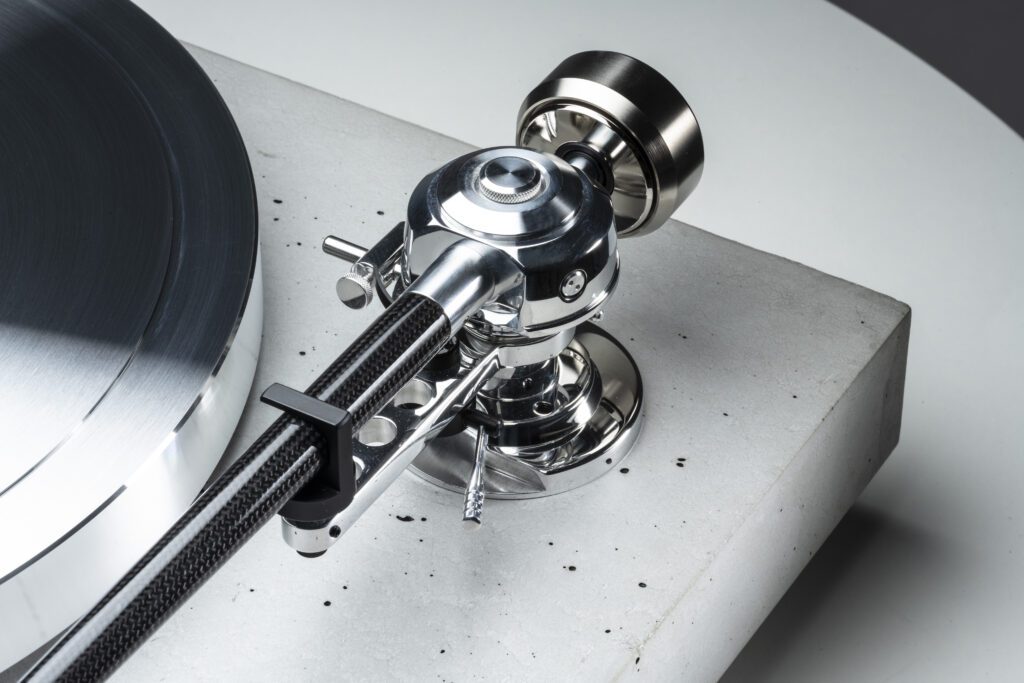
     

    Quad 33/303

    Nostalgia ain’t what it used to be.” This aphorism has been circulated for as long as I can remember. However, it is only thanks to the power of the internet that I can assert, with some degree of certainty, that it is formally attributed to the American writer Peter de Vries in his 1959 novel The Tents of Wickedness. Just eight years after that publication, another Peter, Peter Walker, founder of Quad Electroacoustics, released the company’s first solid-state technology amplification system in the form of the 33/303 combination. He referred to them as a control amplifier with a matching power amplifier. 

    Pictures used in advertising at the time show a couple sitting in front of a single Quad ESL electrostatic loudspeaker, which was launched in the same year as the amplification system. When I first saw pictures of the new Quad 33/303 combination in the late months of 2024, my first and overwhelming sensation was a wave of nostalgia, reminiscent of what it used to be. Although I was only a teenager when Quads appeared, I was already well aware that the Dansette player I was using might not be the last word in audio reproduction.

    Burning a hole

    In 1981, with money from a significant commission cheque burning a hole in my pocket, I ventured into a hi-fi shop close to where I worked in Tottenham Court Road, London. After several visits and long chats with the salesman, Lee, I purchased my first ‘proper’ audio system. A Quad 44. control amp, a Quad 405 MkII stereo power amplifier, a pair of Rogers Studio One loudspeakers, a Luxman direct drive turntable and a Luxman cassette player/recorder. That system served me for over a decade until I replaced the 405 with a later Quad design, the 606, while the Rogers gave way to another British design, the Castle Howards.

    So why am I dwelling so much on the past? In the intervening decades, I spent tens of thousands of pounds on audio equipment without finding anything that served me better than that original system. Only when I stepped from in front of the counter to behind it in audio retail could I start building what I now consider my ultimate system, which combines terrific sound with domestic acceptability. As a reviewer, I am privileged to hear many different components, which I enjoy hugely. Still, I usually have them here for some time, learn their strengths and occasional weaknesses, write about them, and send them back. I rarely get excited about a forthcoming “guest” component, but when I read about the new Quad33/303 combination, I was bursting with enthusiasm.

    Nostalgia was a factor, but so was curiosity and an enduring fondness for the Quad brand.

    Enthusiasm justified?

    Before we determine whether I was right or wrong to be so enthusiastic, let me describe these brand-new, twenty-first-century versions of the pre- and power amplifiers. They may strongly resemble their ancestors, but they are very much contemporary underneath. Starting with the 33, my first impression when I lifted it from the box was its solidity. It feels sturdy, and the toroidal transformer within it gives it a reassuring weight. Once on the rack and wired up, the LED illumination gives off a wonderful orange glow.

    Looking at the front panel, on the left is a rotary control for volume, and below that are four rectangular buttons marked Aux 1, Aux 2, Aux 3, and XLR. To their right are two small black circles: one serves as the receiver for the remote control, and the other is a full-size headphone input. To the right are four rectangular buttons: Phono, Tone, Backlight, and Standby. Above that is the backlit LED screen, which displays the amount of bass adjustment applied, the amount of tilt dialled in, and whether the balance has been adjusted. These three functions are controlled via rotary controls above the LED screen.

    Tilt?

    So, what is Tilt? Peter Walker developed this idea because he felt that separate tone controls were inadequate and clumsy. Quad says, “The Tilt control differs in that it adjusts both ends of the frequency spectrum together, either attenuating the bass and lifting the treble or lifting the bass and attenuating the treble in 1dB steps.

    “It rotates – or tilts – the audible frequency range on a 700Hz axis, thereby adjusting the overall sound balance with ‘warm’ or ‘cool’ hints without altering volume or adding colour to the sound. This feature is unique to QUAD and offers a subtle, precise, and consistent way to adjust your system’s performance and compensate for recordings or environments.” My old Quad 44 was equipped with a Tilt control, so this was not a new concept for me, but it may take some acclimatisation for someone new to Quad.

    Switchgear

    The rear panel features an IEC input socket for mains power, located at the bottom left. Above that is an on/off rocker switch. The next cluster of sockets relates to output. There are two pairs of XLRs and two pairs of RCAs, allowing the user to choose either. Additionally, a second pair of output RCAs is marked ‘Aux’ for connection, for example, to a subwoofer. The right-hand side is given over to inputs, comprising a pair of XLRs and two pairs of RCAs, with two additional pairs of RCAs positioned above them. The right-hand ones are specifically for access to the built-in phono stage.

    There is a grounding pin to the right of those. A small pair of sockets for the 12V trigger system is also available to power up the 33 and the matching 303 power amplifier simultaneously. The supplied remote control is excellent, allowing access to the tone controls and the inputs while giving precise level settings for the volume.

    Faithful

    Turning to the 303 power amplifier, the designers at Quad have remained faithful to the original version in terms of size and shape but have again built a contemporary piece of engineering within the familiar exterior. At the flip of a switch on the rear panel, the 303 can be used as a standalone stereo amplifier, delivering 50W per channel into an eight-ohm load or 70W into a four-ohm load. It offers the user the choice of XLR or RCA connections to a pre-amplifier, two pairs of multi-way binding posts, and an IEC input socket with an on/off rocker switch above it. The front features a single orange rectangular switch in the lower centre, which activates the unit and is illuminated when the power is on. 

    I started the review using a single 303 in stereo mode. I connected the visiting Gold Note CD5 using Tellurium Q Ultra Silver II XLR cables, and the guest turntable, a Michell Orbe SE, fitted with Michell’s own Cusis M moving coil cartridge in the Michell TechnoArm A-II, was plugged into my own Gold Note PH10/PSU phono stage. This was connected with Vertere RedLine RCA cables to the 33. My pair of Harbeth Compact 7ES XD loudspeakers completed the system, connected to the 303 using Tellurium Q Ultra Silver II cables.

    Listening To the 33/303 

    As I do not own a standalone DAC, and the 33 is strictly an analogue-only device, I used only CD and vinyl throughout the sojourn of the Quads at Kelly Towers. I let the units warm up for a day with a selection of compact discs before starting to do any serious listening, but even cold from the box, I was struck by the engaging nature of the sound being delivered.

    The first CD to be loaded into the Gold Note’s drawer was an Audio Fidelity gold CD, issued in 2011, of Crosby, Stills, and Nash’s eponymous first album from 1969. As the opening notes of the first track, ‘Suite: Judy Blue Eyes’, poured into the room, I was drawn into the music. Stephen Stills and his bandmates had wandered into my room and were positioned just ahead of the loudspeakers. Their voices were clear, well-defined and, for me at least, as lovely as ever. I had intended to play just a few tracks, but could not tear myself from my chair until the last track ended. 

    Terrific

    I played a couple more compact discs, then switched to vinyl, and was not surprised that from the outset, this sounded terrific. As I was on a Stephen Stills kick, the first album onto the Orbe SE’s platter was an original 1972 copy of Manassas on the Atlantic label. Although Stills’ name is prominent on the cover, this is truly a band effort, and all the better for it. The four sides each have a theme, and side one is titled ‘The Raven’, and starts with the rocking ‘Song Of Love’ and ends with the gorgeous ‘Both Of Us (Bound To Lose)’, on which Stills shares the writing credit with Chris Hillman, formerly of the Byrds, but a key member of this band. The music had real rhythmic drive, and with the volume advanced halfway through, it was an awe-inspiring performance. 

    Unable to resist, I reconfigured the system, adding the second 303 I had been sent and now running a pair of them, bridged to mono. The power output was increased to 140W into an eight-ohm load and 170W into a four-ohm load. I cued up Manassas again and lowered the stylus onto the black disc. Oh my goodness! The same music positively leapt from the Harbeths, transporting me to the studio with the band and encouraging me to listen to their contribution while immersed in the overall sound.

    Keep playing

    Record after record followed because this system made me want to keep playing music. From modern pop, à la George Ezra, through 1950s jazz, to rock, folk, classical, and electronica, the 33/303 trio delivered. Two final system changes were made to complete the review process. First, the Gold Note PH10 was disconnected from the 33, and Michell’s cables were attached to the phono input on the pre-amplifier. Setting up the Moving Coil was a straightforward process. I cued up the second side of my early 1970s pressing of Pink Floyd’s Meddle. I sat through the 20+ minutes of ‘Echoes’, absolutely absorbed in the complex music. This fine phono stage is quiet when not in use and will make a fine match with many mainstream cartridges.

    Lastly, I removed the Harbeths from the system and replaced them with a pair of Wharfedale Super Lintons mounted on their dedicated stands. Again, I allowed the newcomers some time to warm up before sitting to listen more closely. What a team they make, the Quads and the Lintons. Yes, this turned the nostalgia to 11, as I had lived with a pair of original Lintons in the early 1970s. However, this modern version is a better-built and sounding device than its illustrious forebear. Modern drive units, a carefully designed crossover, and significantly higher-quality cabinetry and internal bracing make this new version impossible to ignore at its price point. That said, I found this whole system’s visually retro appeal irresistible. 

    Warmer

    At the end of the review period, I reluctantly dismantled this system. I liked the way it looked at the other end of our lounge, and I also enjoyed the sound it created. If you have grown up with modern audio equipment, the Quads are slightly less analytical, perhaps a tad warmer tone than you are accustomed to. However, you will not want to hear details or musical communication.

    If I were buying and had the budget, I would go for the 33 with a pair of 303s. You will own a first-class amplification system for under £4,000 here in the UK. If they were coming here, I would site each 303 close to the speaker, which would drive the use of XLR to carry the signal the width of the listening room for the 33, requiring much shorter runs of loudspeaker cable.

    I would also set up the 12V trigger system so the 303s woke up when I took the 33 off standby. More than once during the first days of their stay, I took the 33 out of standby, cued up some music, and then was momentarily puzzled by the absence of music, having forgotten to wake up the power amplifiers. They turn themselves to standby mode if they detect no signal for a period. My feeble excuse is that my amplifier is integrated, so I never have to take that extra step.

    Streaming?

    If you prefer to stream your music, remember that the 33 will require you to connect an external DAC, as it is resolutely analogue only. I enjoyed the forced abandonment of my iPad and a full-time return to using physical media. One unexpected but welcome consequence was that I listened to whole albums, undistracted by fiddling with an app to find the next piece to play. 

    It came as no surprise that the Quad/Harbeth combination worked so well. I know that Alan Shaw, who designs Harbeth loudspeakers, uses a Quad 405 Mk II as one of the tools in his development laboratory. However, I am sure the amplifiers will work well with many modern loudspeakers. They have enough power to stir even the most challenging loads into musical action.

    When the Quads arrived, I fell for their looks. By the time they left, I had fallen for their performance. These are a first-class, carefully conceived, and brilliantly executed homage to Quad’s illustrious history, but should appeal equally to those unfettered by the remembrance of times past and are highly recommended. 

    Technical specifications

    Quad 33

    • Type: Line and Phono Preamplifier with headphone amplifier
    • Inputs: 3 x RCA, 1 x Balanced XLR (pair), 1 x Phono (MM/MC switchable)
    • Outputs: 1 x RCA (AUX), 1 x XLR, 1 x RCA (Pre Out), 1 x Headphone, 2 x 12V Trigger Out
    • Frequency Response: 20Hz – 20kHz (±0.2dB)
    • THD: <0.0005% (1kHz, Line/XLR), <0.002% (1kHz, Phono MM / MC)
    • Signal-to-Noise Ratio: > 108dB (A-weighted, Line/XLR), > 82dB (A-weighted, Phono MM), > 74dB (A-weighted, Phono MC)
    • Output Impedance: 120Ω
    • Headphone amplifier output impedance: 2.35Ω
    • Headphone amplifier load impedance: 20-600Ω
    • Dimensions (WxHxD): 25.8×8.3×16.5cm
    • Weight: 4kg
    • Price: £1,199, $1,599, €1,499

    Quad 303

    • Type: Class AB bridgeable stereo power amplifier
    • Inputs: RCA stereo pair, XLR stereo pair, 12V trigger
    • Outputs: Loudspeaker terminals, 12V trigger
    • Rated power output: Stereo: 2 x 50W (8Ω, THD<1%), Bridged: 140W (8Ω, THD<1%)
    • Frequency Response: 20Hz – 20kHz (±0.3dB)
    • THD: <0.002% (1kHz)
    • Signal-to-Noise Ratio: > 108dB (A-weighted)
    • Input impedance: 15kΩ (Line), 22kΩ (XLR)
    • Dimensions (WxHxD): 12×17.6×32.5cm
    • Weight: 8.4kg
    • Price: £1,199, $1,599, €1,499

    Manufacturer

    Quad Hi-Fi

    www.quad-hifi.co.uk

    +44(0)1480 452561

    More from Quad

    Back to Reviews


    Scions: To Cry Out In The Wilderness

    Scions is a Canadian musical ensemble featuring members from notable groups such as the minimalist chamber-jazz quartet New Hermitage, the Polaris-nominated drone-hymn duo Joyful Joyful, and producer/composer Michael Cloud Duguay. This is probably as near as it gets to a Canadian jazz ‘supergroup’, only hopefully without the histrionics and the crazy backstage riders that came with rock supergroups.

    The group’s origins trace back to an improvised performance at the Sappyfest music festival in New Brunswick in 2022, where New Hermitage and Joyful Joyful collaborated live with Duguay. Following an enthusiastic response, the group solidified their collaboration, with Duguay transitioning to the role of producer and musical director.

    In early 2023, Scions spent a week at a residency on Wolfe Island, Ontario, crafting original music through collective improvisations. Their sound draws from free jazz, experimental choral traditions, and orchestral composition, exploring themes like climate disaster, dystopia, and healing through sound. Recorded in Halifax’s historic St. George’s Round Church, their debut album To Cry Out In The Wilderness merges influences from jazz, drone, folk, and beyond.

    While Joyful Joyful’s Cormac Culkeen’s vocals play a prominent role, this is truly a group effort. To Cry Out In The Wilderness incorporates each member’s unique contributions to create a bold and experimental soundscape that spans an eclectic array of musical traditions, spanning everything from the spiritual influences of Pharoah Sanders to the post-rock of fellow Canadians Godspeed You! Black Emperor, and even pushing into avant-garde territory – but don’t worry, it’s fantastic!

    The opening track, ‘Moss Lung’, firmly places the album in the avant-garde arena. It starts with laboured breathing that builds into the sound of an enveloping storm. Snatches of instrumentation emerge, resembling an orchestra tuning up in an open concert hall across a tumultuous moorland landscape. It’s unsettling, yet beautiful.

    ‘Even When All Was Silent I Was Not Alone’ introduces vocals, with Culkeen’s delivery using their voice as an instrument, rather than your standard singing. The drawn-out effect is drone-like in intensity, as sax, harp, violin, and other elements create an emotionally charged six minutes.

    ‘The Mountain’ continues with mournful strings and multitracked vocals. The crashing percussion builds, evoking the feeling of a mountain collapsing, before bowed double bass brings a sense of calm. It’s like the score to a Film Noir movie that never got made.

    ‘To Cry Out In The Wilderness’, both the title track and the album’s spiritual heart, is close to 10 minutes long. It reflects the band’s environmental concerns, especially through a spoken-word story centred on the timber industry. Shimmering harps and electronics depict a majestic natural landscape, grounded by words that remind us of Earth’s peril.

    ‘Fight Song’, the album’s lead single, initially gave an incomplete impression of the album. It leans more toward almost Jefferson Airplane like folk, though it ends with an electric guitar solo and a section of distorted radio reception that builds into a powerful finale.

    ‘Equals In Hope’ is a superbly paced, longer piece with strings, swelling percussion, and an electronic backdrop, leading directly into the closing track, ‘Over’, a two-minute fading drone that flows seamlessly from the previous track.

    This leaves this exceptionally creative album ending on a low-key note, leaving you wanting to hear more from both Scions and the individual artists who form the group.

    Back to Music

    Rockna Wavedream Reference Signature

    Rockna’s outstanding Wavedream DAC is now a decade old. It pushed the limits of what could be extracted from a digital signal at its price and beyond. However, technology has progressed. The new Wavedream Reference Signature DAC is the result. It’s a DAC that stands toe-to-toe with the best. Do not assume this ‘Reference’ DAC is just a ‘tarted up’ version of the original. This is the outcome of years of research and development on Rockna’s part. The result is a new product and a complete brand transformation. So, no big deal, then!

    However, Rockna, old and new, remains dedicated to doing everything correctly. Rockna shuns the ordinary and opts for proprietary hardware and custom software throughout. No off-the-shelf solutions, such as DAC chips, OEM streaming modules, or signal op-amps, are used here. Instead, it continues to uphold its core ethos of creating original products that look appealing on the outside and feature elegant technical solutions beneath the surface.

    Not a crank

    Audiophiles spend considerable time discussing the brand and model of DAC chips within our converters. We liken them to the ‘engine’ of digital audio, though ‘crankshaft’ or even ‘flywheel’ might be more fitting. The other elements of the digital audio circuit, such as sample rate conversion, clock accuracy, filtration, and the nature of the conversion algorithm, are all more significant than who ‘fabbed’ the silicon. 

    Rockna’s ‘chip’ is an evolution of the DAC modules in the original Wavedream DAC. The modules remain a discrete sign-magnitude hybrid ladder array driven by an algorithm embedded into their FPGA (field-programmable gate array). They can sustain rates up to 6 MHz, and the output of the DAC modules is unbuffered.

    Although the digital ‘architecture’ resembles the Wavedream, the ‘town planning’ (circuit layout) differs significantly. The Reference Signature features a 10-layer central core board for the digital front-end processing and the network renderer. It also features a new dedicated low-noise power supply board and new conversion boards in a symmetrical configuration, two for each channel. To preserve and maintain signal integrity, the clock and data signal paths were shortened and featured higher-quality board-to-board connectors. 

    Linear supply

    Unlike many DAC designs, the Rockna Wavedream Reference Signature features linear power supplies primarily. There are always pre-regulator stages, and each stage has additional local regulation. Twenty power integrated circuits drive roughly 90,000µF of capacitance.. The audio-grade toroid transformers are concealed beneath a thick copper sheet that serves as a shield. A similar copper cage also shields the display.

    An AMD ZynQ MPSoC (Multi-Processor System on Chip) handles general processing, running under a custom Linux kernel. This is a planet-sized sledgehammer to crack a nut; the ZynQ has more than enough processing power to cope with even the toughest audio operations. Nothing we can put in its path will trouble this circuit. 

    The last stage of the signal path is the analogue output stage. Designed from scratch to work with the new conversion modules, it is discrete and acts as a high-speed buffer. Combining JFET and bipolar devices into a class A design, the Wavedream Reference Signature’s output stage features a low closed-loop output impedance and equivalent input noise as low as 1nV/√Hz.

    Sample conversion

    Arguably, the most significant difference Rockna has over most of its rivals is its removal of any ASRC, or asynchronous sample-rate converter. When moving the audio information from the digital to the analogue domain, the clock system plays a critical role in giving the sound a sense of realism and dimensionality. Most DACs take the easy route by relying on the ASRC built into their chipset. While the ASRC may have a distinctive signature, the quality of the ASRC implemented in DAC chips is influenced more by cost and silicon real estate than by outright performance. Instead, the Wavedream Reference Signature uses an advanced, ASRC-free digital PLL clock solution.

    The Wavedream upsamples any material at a fixed rate of 16x. The DAC modules decode the digital stream at either 768 kHz or 705.6 kHz, depending on the input sample rate. Rockna claims this rate is optimal for the analogue performance of the DAC modules.

    Processing power

    Upsampling is closely linked with the filter options and relies heavily on processing power to perform effectively. Rockna opted against standard Nyquist-Shannon filters, believing they do not deliver the desired performance for the DAC. Instead, after conducting extensive mathematical simulations and meticulous listening tests, Rockna developed a custom Parks-McClellan upsampling filter with variations for linear, minimum-phase, and hybrid-phase responses. In the linear phase, the ringing energy (Gibbs’ overshoot) is evenly distributed before and after the impulse. The minimum phase type displays all this energy following the impulse. In contrast, the hybrid phase filter presents a combined response between linear and minimum, showing very low overshoot before the impulse. There are also selectable dither and DSD bandwidth settings.

    We’ve concentrated on the internal layout, but the styling has been gently revised, moving forward while echoing the previous models so they won’t look out of place on the same rack. At the centre of the front panel is an 800×480 pixel, 3.5” touch panel, and there is a control app (for set-up rather than day-to-day operation). The rear includes low-impedance XLR and RCA outputs. 

    This is more than just a DAC. The Wavedream Reference Signature features a network renderer that seamlessly integrates into the DAC’s digital front end. There is no separate ‘streamer section’ on board, as it’s part of the software built into the FPGA. This removes the need for a dedicated external connection and unnecessary obstacles in the digital signal path. There is even a 32-bit volume control that operates in 0.5dB steps; while most will choose a preamp to take on that task, it’s not a bad option, even at low listening levels.

    Job well done

    There’s a lot of technology here, and I’m not sure which part contributes to the Rockna Wavedream Reference Signature’s outstanding sound quality, but whatever it is, it does the job correctly. It also didn’t matter how the track reached the Rockna, whether on a spinning disc, in a local store, or online; it delivered a good performance regardless.

    I started the listening with ‘Paradis Perdu’ by Christine and the Queens [Chaleur humaine, Because]. His voice is played extremely naturally, with excellent vocal articulation. It’s always helpful to not use your native language here, as your brain doesn’t fill in the lost diction or increased spitchiness, and as I’ve been known to order a fried orange in suitcase sauce in France, this is a great track. It’s also extremely well produced with excellent separation between instruments, which is brought out perfectly with the Wavedream Reference Signature.

    More significantly, there’s a sense of ordered refinement to the sound, regardless of what you play. And by that, I mean ‘jazz covers of AC/DC songs’ [Jens Thomas, Speed of Grace, ACT] and ‘Hollow (16 Bit Remix)’ by Björk [Bastards, One Little Independent] and ‘Glory Box’ [John Martyn, The Church With One Bell, Independiente]. Each delivered a sound far less like ‘digital’ (with no glare or top-end detail), but not like a faked vinyl version. If anything, they sounded like really well-produced open-reel tape, but not one that had been played to pieces.

    Part of the reason it sounds less digital than usual is the lithe and legato nature of the performance. In the wrong hands, this could sound saccharine and overly polished, but the Rockna treads a careful line between sounding refined and elegant and overly refined and ornate. 

    Musical Rodeo

    Of this flurry of tracks, the Björk is particularly telling. This is more like a musical rodeo than the kind of track you’ll want to sit down and listen to. Interesting, gut-rumbling noises aside in the introduction, when the broken beats and her singing kick in, the sound is pretty forward and can pitch into brightness. It’s never a ‘pretty’ sound, but the Rockna’s ability to process music with refinement and grace makes it more listenable. You can listen to the whole track without wincing, and that’s impressive. Replace ‘Björk’ with ‘harpsichord’ (it’s an easy mistake to make), and the same holds; the plucked sound can be grating on the wrong system, while others overcompensate and make the sound too legato. Here, it was just right.

    Digital audio has a punctuated equilibrium. Nothing really changes, with only minor differences in performance over the years. Then, there are significant leaps in performance over the course of a couple of years. This is one of those times. The Rockna Wavedream Reference Signature DAC is a perfect example of just how good digital is today. It joins that select handful of products where you can find ‘different’ in digital, but not ‘better’, no matter the price. 

    Technical specifications

    • Type: R2R based DAC/Network Audio Processor
    • Inputs: LAN, USB, I2S on HDMI, AES/EBU on XLR, S/PDIF coaxial and Toslink
    • Outputs: RCA and XLR
    • Audio Renderer support: Roon bridge, UPnP, OpenHome, AirPlay, HQPNAA, Spotify Connect
    • Standards supported: PCM to 705.6/768kHz, DSD to DSD512
    • THD: -102dB (-3dB)
    • DNR: 139dB
    • Finish: Matt black, matt silver
    • Dimensions (WxHxD): 45 x 39 x 10.5 cm
    • Weight: 10kg
    • Price: £23,999, $26,600, €26,600

    Manufacturer

    Rockna Audio

    www.rockna-audio.com

    UK distributor

    Audiofreaks

    www.audiofreaks.co.uk

    +44(0)208 948 4153

    More from Rockna

    Back to Reviews