Up to 37% in savings when you subscribe to hi-fi+
hifi-logo-footer

Begin typing your search above and press return to search. Press Esc to cancel.

hi-fi+ issue 250: the Awards

This month, hi-fi+ turns the ripe old age of 250! That’s 250 editions of the leading guide to all things audio, from personal audio and active bookshelf speakers to multi-million dollar high-end systems. We’ve seen thousands of products since our first edition hit the newsstands back in 1999.

A monumental issue affords the reader the chance to look back at how the audio world has changed over the years. It also allows us to look forward to what the next few years may bring. Every attempt at prediction is prone to inaccuracy, but having seen many changes in the first 250 issues, we’re good at predicting what might happen in audio over the next five years.

But that’s not all…

Our 250th issue falls at the same time as our annual awards. Each year, we pick the finest products across all audio categories to find the Winners and Highly Commended products of the year. Will these form the basis of your next audio system? Well… probably. Covering everything from network audio cables and switches (connecting it to the outside world) to custom isolators that your system rests upon, we’ve got it covered.

But that’s still not all…

We’ve not skimped on the regular features that go into an issue of hi-fi+. The usual reviews, music reviews and more also feature in our 250th Issue. Perhaps that’s why at over 250 pages (of course!), it’s the biggest issue we’ve ever published.

So, while we take a lie down to recover from all that, why not drop over to our Magazine section and buy a copy now…

hi-fi+ Issue 250; the celebration and Awards issue

Doves: Constellations For The Lonely

Manchester indie-rock trio Doves released their last album, The Universal Want, in late 2020, after a hiatus of more than 10 years – the record was their third UK number one – but, sadly, no sooner were they back than they disappeared again, following concerns for the health and wellbeing of frontman, Jimi Goodwin, caused by substance abuse.

The good news is that they’ve returned with Constellations For The Lonely, which is their sixth studio album. Goodwin will miss out on this year’s UK tour, as he steps back from live duties to focus on getting well. 

He’s still a big part of the new record though, which was written, recorded and produced by Doves between locations in Greater Manchester, North Wales and Cheshire, with additional production from long-term collaborator, Dan Austin.

Sessions began at the band’s Frank Bough Sound III studio back in 2020, but, unfortunately, Doves were forced to leave the premises soon after.

Opening song and first single, the atmospheric ‘Renegade’, plunges us straight into familiar Doves territory – it’s a cinematic song that’s shrouded in rain-soaked, Northern melancholy.

Commenting on the track, the group’s drummer, vocalist and co-songwriter, Andy Williams, says: “We wanted to go for a dystopian feel – thinking about Manchester itself over the next century or so. It’s a totally imaginary thing… Blade Runner set in our home city.”

The moody soundtrack feel continues with ‘Cold Dreaming’, which sees Goodwin and guitarist Jez Williams sharing vocals, and was inspired by the psychedelic blues of Charles Stepney and David Axelrod’s experimental funk-soul. 

“Resilience is the thing that you need more than ever, certainly as a musician,” reflects Andy Williams, adding: “Perhaps the lyrics do touch a bit on what we’ve been through – it hasn’t been the easiest record to make, having to leave our studio in Hatton [Cheshire] was a kick in the nuts, but we really did get the wind in our sails at times.”

It certainly sounds like it – the wonderfully haunting and autumnal ‘Last Year’s Man’ is The Smiths’ ‘Please Please Please Let Me Get What I Want’ if it had been arranged and produced by John Barry, ‘A Drop In The Ocean’ has a touch of The Cure’s ‘80s gloom-rock about it, and the lighter, soulful and funky vibe of ‘Stupid Schemes’ nods to the Isley Brothers and Curtis Mayfield – Goodwin says that the track started out as a jam in Gothenburg with members of the Swedish psych-rock band Dungen.

There are some lovely jazzy guitar lines on the wistful and pastoral ‘In The Butterfly House’, and ‘Strange Weather’ starts out stripped-back – an ethereal lullaby – but transforms into a superb and arresting mood piece, with a fuzzy bass groove, church-like organ and ghostly backing vocals.

Penultimate song, ‘Orlando’, is a fragile and fractured piano-led soundscape that was inspired by Wim Wenders’ neo-Western drama, Paris, Texas, and, rather nicely, 

The album comes to a spectacular end with the moody and filmic ‘Southern Bell’, which begins with Ennio Morricone-style, Spaghetti Western guitar and is partly set in the desert at night, in the light of a campfire.

By the morning time, we’ll be gone from here – some blaze of glory – the last stand in our story,” sings Goodwin, as he and his partners ride off into the distance, and the track turns into a full-on, dramatic widescreen epic.

From its opening on the wet city streets of Manchester to its conclusion in the harsh desert heat, Constellations For The Lonely is an inspired and imaginative album that’s steeped in a love of great influences – be they cinematic or musical.

Let’s hope Goodwin returns to playing live with Doves soon – it’s great to have them back, and with a record that, like its predecessor, is up there with their best.

“Loads of artists that have been around for years are making music as good as they ever did,” muses Goodwin. “With us, it’s a matter of chemistry – for all the things that we wind each other up about, the love’s there.”

It sounds like Doves might have finally found their peace. 

Back to Music

Xact S1 Evo

Marcin Ostapowicz developed a passion for computer audio early on and has been immersed in it for over 20 years. His dedication to building a file streaming system that meets the standards of ears attuned to live music and authentic instruments has resulted in numerous achievements. These include the release of the JCAT software player for Windows in 2009 through JPLAY. This was followed by its commercial version a year later. He introduced his first USB audio card in 2013 and launched the JPLAY iOS app in 2022. 

I had been following his progress from the early days, but JPLAY truly captivated me; it was a control app that provided near-Roon levels of metadata and significantly outperformed native apps on various network streamers. I have been using JPLAY for a year now, and nothing I have encountered makes me want to switch.

Server/streamer or switch

In 2023, Marcin launched his most ambitious product yet, the XACT S1 server. This is a comprehensive digital source developed over six years, offering file storage, network switching, and streaming output. At least, that’s what I initially thought when I examined the array of RJ45 Ethernet sockets on the back panel. It turns out that this switching element functions in an either/or capacity. The XACT S1 can operate as a server/streamer or a network switch. Given its exceptional performance in the former role, this must be its trump card. 

Internal

The XACT is available in two forms: the standard S1 and the S1 Evo, with the latter priced at £4,000 more than the former. Both models are based on a custom motherboard developed exclusively for audio playback, featuring a linear power supply and a high-stability OCXO (oven-controlled oscillator) clock. They offer USB outputs both with and without a 5V power bus. Allegedly, some DACs function without this ‘handshake’ voltage. Music files are stored on a selected 4TB solid-state drive (8TB available on request). This connects to the motherboard using XACT’s dedicated SSD drive cable.

Operating system

The operating system for the XACT S1 is stored on an SD card that slots into the back of the unit. This is an unusual approach. It has been adopted to allow for server updates without running software that is constantly alert to updates, which generates noise in the process. Updates must be flashed onto the SD card using a computer and a card reader. I found a reader originally purchased for a camera card. I was able to update the software on the review sample, so it’s not exactly rocket science. 

Marcin is keen to point out that this is not just any SD card; it’s a single-level cell (SLC) type, which stores only one bit of information per cell. This means faster write/read speeds and significantly greater longevity. The spec indicates that it’s good for 100,000 program/erase cycles.

The Evo upgrade adds Immotus CL isolation feet to the S1. These aluminium feet have a ceramic ball-bearing interface that is said to enhance sound focus and dynamics. Xact recently launched two versions of Immotus footers, with prices starting at €1,000 for three. You will not be surprised to hear that the Xact S1 Evo also features three feet. 

Furthermore, the OCXO clock is “significantly upgraded” from the standard version. As one would expect, it was developed in-house with an emphasis on precision and stability. The third benefit of the Evo is a Phantom music drive cable. Xact produces USB and LAN cables under this name, so they are likely to be of good quality.

The JPLAY way

Purchasers of the Xact S1 in either form receive a lifetime licence for the JPLAY app (worth £199). The app was launched prior to the Xact, but both were developed in tandem, and their combination must significantly contribute to the results it delivers. Marcin tells me that it sounds better than other control apps because the traffic between the streaming engine and the controller is kept to a minimum. In other words, they are not constantly communicating with one another. This creates low-level electronic noise in the process. 

Rear panel

This means that playback cannot be rewound from pause, and the play cursor will move even if the signal is not reaching the DAC due to an issue in the signal chain. This is a concern for those of us who need to change cables and components for a living. However, in other respects, it’s a highly informative and user-friendly app. Once you are familiar with these quirks, it is easier to use than many others. It provides native access to all the usual streaming services and displays plenty of metadata where available. Sonically, it is far ahead of the competition, somewhat like the Xact S1 Evo.

Immediately gratifying

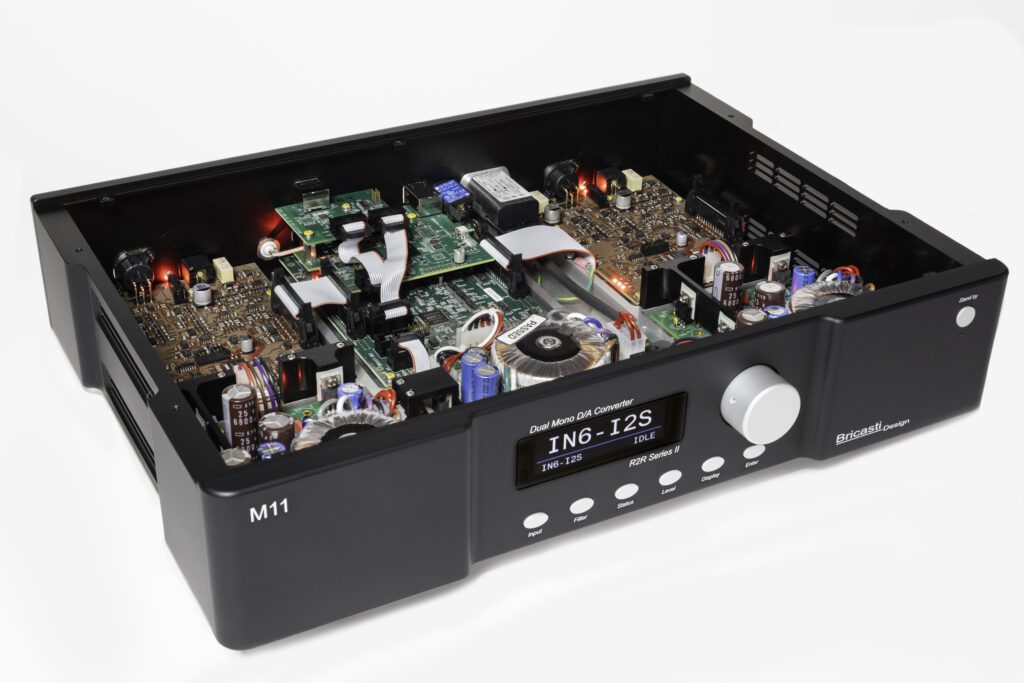
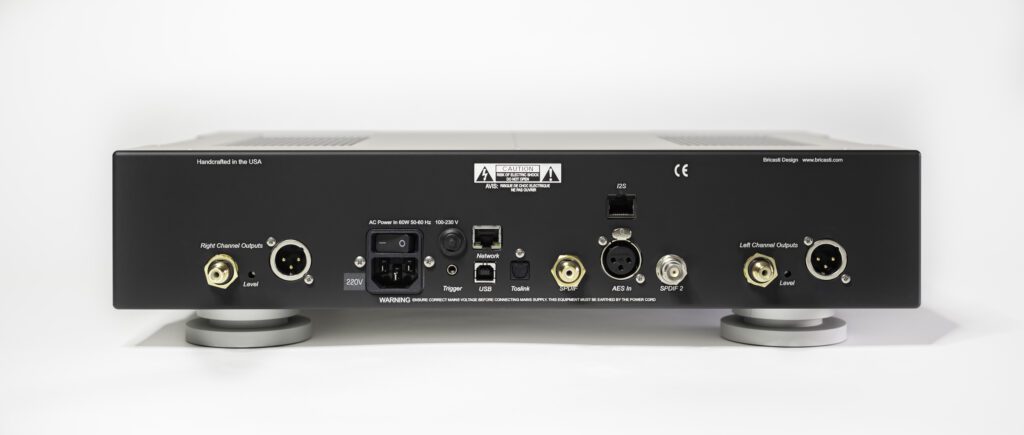
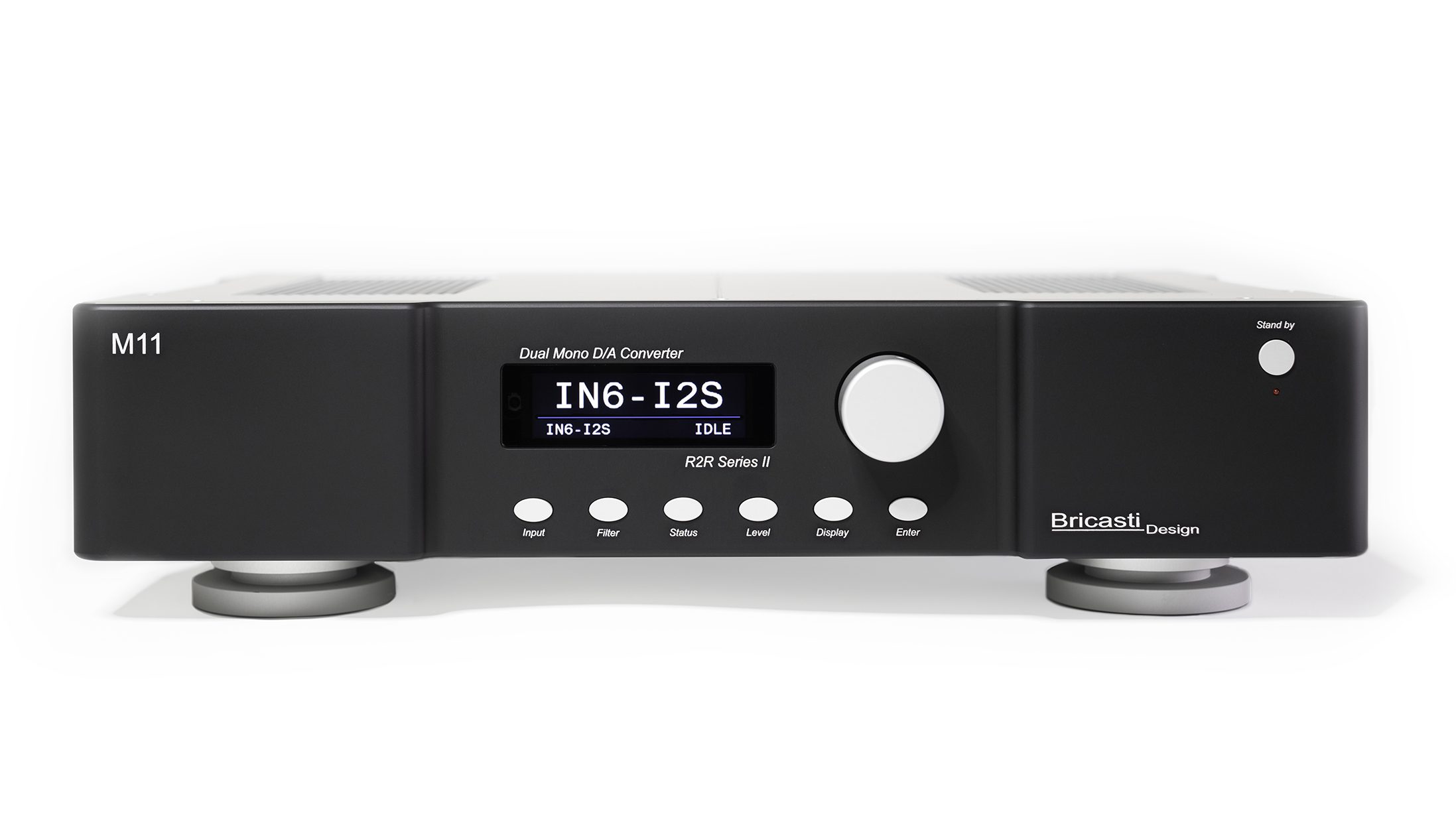
I utilised this server/streamer with a Bricasti M11 Classic DAC, connecting it to the 5V USB output with a Network Acoustics muon2 USB cable. The result was immediately gratifying, thanks to a distinctly calm, low-noise presentation. This made even a Tim Hecker ambient track (Sunset Key Melt via Qobuz) sound remarkably rich. It featured low yet clean synth bass and heavily distorted mids. The sound was both clear and gritty. The gritty aspect is clearly part of the original signal. 

With a more familiar track from the onboard drive, things became even more interesting. There seemed to be so much occurring, showcasing extraordinary dimensionality. Once again, the word “clean” appeared in the notes. The noise floor on the Xact S1 Evo is incredibly low, allowing one to hear significantly more. This reduction in electronic noise eliminates any trace of harshness from the sound and permits higher playback levels. The perception of loudness is considerably diminished. It resembles analogue with a flat response, which is a very rare occurrence.

The thrill is back

In recent months, I’ve relied on an AES/EBU connection between my streamer and DAC due to its superior musical fluency and detailed sound. Consequently, switching back to USB may have produced a sound that is usually detailed but somewhat less engaging and slightly harsh. The Xact S1 Evo shows that this connection isn’t a limitation. Instead, many implementations struggle to use it effectively. This might highlight the importance of the custom motherboard. 

With the Keith Jarrett Trio’s “The Old Country – More from the Deer Head Inn” live performance, the Xact effectively eliminated distracting glare from the sound. It uncovered the speed and immediacy of the performance, offering a very natural-sounding perspective with genuine room acoustics. When Jarrett, Peacock, and Motian get into the swing of ‘Everything I Love,’ the result is absolutely thrilling. The way the pianist merges intensity with joy and fluency is remarkable. You simply have to turn it up to ‘be there’; it’s not difficult. I adore how it discovers melodies where none were previously evident. I also love how it enhances the dynamic range, allowing you to follow the finest nuances of playing while others play with gusto. 

Very revealing

The Xact is very revealing of what it’s connected to, by which I mean power and switching. Changes in both departments are obvious. You will only get the best results when both are sorted. At one point, I had to put the switch on a lesser mains source, and the change in perceived distortion was shocking. Switches shouldn’t make this much difference. When you open the window as wide as the S1 Evo does, everything shows. 

I had a very well-regarded server/streamer at my disposal during Xact’s too brief tenure. It wasn’t quite as expensive, but it was in the same ballpark. Yet the comparative benefits that the S1 Evo brought to the table were significant. It offers a sense of presence that is as close to magic as I have heard from a digital source. The backgrounds are darker, and the dynamic and tonal contrasts are more pronounced. Vocals are extraordinarily real and solid in the room— the Dali Epikore 9 speakers certainly assisted in this—but nonetheless, I have rarely heard such purity and untarnished truth as that produced by Tamara Lindeman on ‘Free’ (The Weather Station). Her high voice often sounds thin on digital systems that leave some trace of their processing. However, here it was pure and natural. We vinyl junkies rarely get this kind of thrill from digital.

No hesitation

Marcin and his team deserve the highest praise for what they have achieved with the Xact S1 Evo. It delivers everything that is good about digital audio, apparently without any of the problems that afflict the format. If I could afford one, there would be no hesitation in placing an order. As it stands, I will have to love and lose and save up for that day when streaming can sound as good as this again. 

Technical specifications

  • Type: Solid-state music streamer and server with SSD storage.
  • Storage: 4TB SSD hard drive (optional 8TB).
  • Network connection: RJ45 ethernet.
  • Digital Outputs: One USB, one USB without 5V power bus.
  • Back up connection: USB.
  • Formats supported: DSD: DSF, DFF, PCM: FLAC, Apple Lossless (ALAC), WAV, AIFF; MQA (pass-through)
  • Streaming services supported: Qobuz, Tidal, HQPlayer.
  • User Interface: JPlay control app for iOS, Mac.
  • Other Features: Includes lifetime JPlay licence.
  • Dimensions (HxWxD): 100 x 439 x 315mm
  • Weight: 10kg
  • Price: £16,000, $18,600, €16,000

Manufacturer

JPlay  

xact.audio

UK distributor

Elite Audio UK

www.eliteaudiouk.com

0800 464 7274 (UK only)

Back to Reviews

Nordost Red Dawn 3

In late spring of 2024, Nordost launched the third generation of what it describes as its entry-level Leif family, including Nordost Red Dawn 3. It’s a four-layer line-up, starting with White Lightning, progressing through Purple Flare, Blue Heaven, and culminating with Red Dawn, the subject of this review. So, in many respects, ‘entry level’ is not really an apposite way to approach Red Dawn, as it sits at the top of a hierarchy that, itself, forms the foundation of a pyramid of products.

The next level of the pyramid is the three-layered ‘Norse’ range, top of which is the Tyr 2, which I’ve used for several years; then there’s the ‘Reference’ range of Valhalla 2, topped by the ‘Supreme Reference’ Odin 2 and Odin Gold. Nevertheless, in terms of price, the Leif series is unquestionably more approachable than those ranges that sit above, and thus represents the likely way in to the Nordost ecosystem for many users. Given this price disparity, some will always question whether this truly represents ‘proper’ Nordost. I’d quite like to address that question here.

Construction

The loudspeaker cable retains the familiar ribbon topology that has defined Nordost’s speaker cables since Flatline and the early Red Dawn, decades ago. Where the Leif Series departs is in eschewing the complex and costly micro mono-filament and twisted micro mono-filament construction in the interconnects and loudspeaker cables of the ranges above it.

This is, no doubt, a large part of what keeps the price within a realistic ballpark for many. Still, it does mean users don’t get the benefit of the (almost entirely) air dielectric that the monofilament creates between conductors and the fluorinated ethylene-propylene (FEP) outer sheathing, which has featured in Norse, Valhalla and Odin interconnect and loudspeaker cables from their inception.

Instead, the Leif series favours a more conventional layout for the FEP insulation/dielectric, in physical contact with the conductors. It uses Nordost’s own silver-plated OFC copper recipe connectors, though. Notably, the Leif series power cords do retain the micro mono-filament construction used in their more expensive stablemates.

Leif 2 to Leif 3

Changes for the third-generation Leif 3 range are largely structural in nature: beefier wire gauges and/or increased conductor count for many items, twisted-pair construction in the interconnects, physical reinforcement and mechanical tuning, and tighter, tougher, and more secure terminations.

Nordost Red Dawn 3 analogue interconnects

The analogue interconnects now use the same Neutrik connectors as the Norse series, and the loudspeaker cables use more robust versions of the familiar Z-plug banana or spade connectors, which are said to be easier to terminate consistently. Nordost considers the way its cables are terminated to be, in its own way, as critical as the cable topology itself, so improved consistency here is clearly a desirable outcome.

As a long-term Nordost user, my core system has relied on a Tyr 2 cable loom for some time now, but I also have a set of Blue Heaven 2 to draw on when the occasion merits it. These have now been supplemented by the selection of Nordost Red Dawn 3 single-ended interconnects, loudspeaker cables, and mains leads in this review.

Internal logic

One thing that has always been true of Nordost is the internal logic and consistency of their product ranges: there’s a common sound signature but still a clear hierarchy as you move up the ranges. So you always knew that moving from Purple Flare to Blue Heaven or Red Dawn would bring benefits in the sense of ‘more of what you like about what you’ve got, and less of what you don’t’, which isn’t always true of every cable manufacturer out there. Moving from Blue Heaven 2 to Red Dawn 3 has been illuminating, therefore, as it’s quite a significant jump in performance, both within the hierarchy, but also across the generations.

Nordost Red Dawn 3 Power Cord UK type

If forced to sketch my old Blue Heaven 2 in a few words, I’d probably class it as a safe pair of hands, a smooth, even-handed, reliable go-to for a wide variety of situations, that isn’t likely to go rogue and wayward under pressure. But its limitations probably lie in that smoothness – a creamy, slightly soft-focus delivery which, nevertheless, still delivers the musical goods. It flatters, without deceiving. The outgoing Red Dawn 2, as I recall, brought more heft, clarity and detail. Still, there’s always been a clear gap between the top of the Leif range and Heimdall at the bottom of the Norse, where the more revealing, but more uncompromising, honesty of the micro mono-filament technology starts to make itself known. 

Performance

Now, hearing Red Dawn 3 in my home system, my first thought is how much that gap might have just closed. There’s a level of subtlety and insight here beyond what I was expecting. If you haven’t listened to Nordost cables in a while, or if you have heard the conventional internet ‘wisdom’ that Nordost is bright, with spotlit treble and lightweight bass, you should put your prejudices to one side and take a listen. Moments with any recent ranges quickly dispel that notion, and the Red Dawn in particular is solid, hearty and cohesive.

The Red Dawn 3 loudspeaker cable has the grainless, even-handed quality that has become a Nordost hallmark. The even-handedness translates in musical terms into a level of coherence that at this price, and even considerably beyond it, cannot be taken for granted in many cables; in a fundamental sense, the energy is in the right place, at the right time.

The complex and lengthy percussion solo on ‘Nardis’ from Patricia Barber’s Café Blue (Blue Note – ‘un-mastered’ edition by Premonition Records) is fast, tight and well-controlled, the complex polyrhythms are well handled, easy to access and make more sense of; the interactions with the bass are layered and nuanced, and the moody opening section has structure, purpose, and a sense of direction – not merely the noodly meanderings that some cables might let you assume.

Similar stomp

Similarly, ‘42nd St. Stomp’ from Joanna MacGregor’s Play (Sound Circus) is tight and together, replete with inner detail and structural cues. The excellent articulation these cables are capable of brings out the complexity and dexterity in the playing, the better to show us MacGregor’s skill and musicianship in making Alasdair Nicholson’s piece more than just a novelty take on a hoary old Broadway number. And the Ligeti ‘Autumn in Warsaw’ from the same album retains its devastating power; these are definitely cables that help you explore and appreciate the more challenging elements of 20th-century music, rather than getting in the way.

Playing Philip Glass – Piano Works (Deutsche Grammophon) showcased the interconnects ‘particular strengths. ‘Etude #9’ has all the complex, rhythmic shifts and drive that Vikingur Olafsson draws out of this music. This was the disc that first made sense of Philip Glass for me. Olafsson’s portrayal of the interleaved nature of the parts makes this a study in poise and elegance, not merely a technical exercise in metronomic exactitude.

Similarly, the off-balance rhythmic underpinnings of ‘Etude #2’ help highlight how the interconnects show Olafsson adjusting the weighting of the various voices, how he moderates and modulates his touch to keep track of the interwoven phrases, and the threads that layer up the study. And the piano has weight and mass, despite much of the piece being played barely more than mezzo forte. If I had to pick the strongest from what has quickly become a convincing range, it might well be these interconnects.

Mains block

Using Red Dawn 3 power cords via the Nordost QB6 v3 mains block, it’s clear that these power cords and my regular Tyr 2 power cords are stablemates. Direct comparisons, given the price disparity, are unhelpful, so it makes more sense to focus on common strengths: the cords’ ability to deliver the energy in a performance and maintain the integrity of the innumerable components of that performance. There’s an underlying sense of organisation, composure and surefootedness, without obvious compromise to freedom or expressiveness. Yes, the Tyr 2 can deliver even more in terms of structure, intent and purpose, but all these attributes remain clear and present here.

Collectively, this adds up to a cabling loom which doesn’t draw attention to itself. Music is presented without artifice or preference, whether classical, jazz, girl and guitar, or electronica; all were rendered with equal finesse and assuredness. I found myself ranging widely and freely across my music collection, not gravitating towards any particular genre. As a foundation for a capable system, this is a prerequisite and Red Dawn 3 doesn’t falter.

Value judgements

This third-generation Leif series is more expensive than its predecessor, but in the broader scheme of things, not significantly so. Factor in the performance uplift, and a sub 20% rise doesn’t feel at all excessive. I’ve assessed it on its own terms, above, but a quick comparison with my regular Tyr 2 adds some helpful context. The micro-monofilament in the Norse series interconnect and loudspeaker cables is most apparent in the further increased freedom and spaciousness it provides. That freedom manifests in many ways; speed, for one: sudden dynamic shifts can happen more suddenly; conversely and relatedly, slow, contemplative moments have more time and space to develop within.

They are also more emphatic, so there’s a second freedom: scale. There’s more ‘stomp’ in the Joanna MacGregor ‘42nd Street Stomp’, for example, and notes decay for longer, which nicely bookends those faster, cleaner leading edges. So there’s an additional layer of expressiveness, a degree of focus, limpidity and poise that the Leif series cable approaches, but you do need to progress to Norse or beyond, to realise it fully. There’s still a clear gap in performance between these levels of the Nordost pyramid, then. But keep in mind, the equivalent Tyr 2 prices: 1m mains cable – £3,470; 0.6m interconnect –  £2,600; 2m loudspeaker cable – £8,025. 

The Red Dawn 3 delivers a feeling of musical intent and integrity. You’re never left feeling that the cable has somehow ‘edited’ your musical experience. Yes, it was entirely clear where the value lies in the Norse cables when I eventually reinstalled them. Still, the Red Dawn 3 retains the full-range coherence and cohesiveness that are Nordost characteristics. 

Valid and sensible

In that respect, the Leif series is an entirely valid and sensible entry point to the Nordost ecosystem, and Red Dawn 3 represents the ultimate statement of that level’s capabilities. We talk often about the importance of a coherent ‘one-make’ cable loom, about the need to ensure that the limitations of another don’t compromise the strengths of one cable from a different brand, and it’s very accurate, whatever the performance level you are at. And for a disappointing number of cable brands, mixing and matching from different performance tiers is equally ill-advised.

For many, Red Dawn 3 will be enough, but if you want to go beyond, one strength that quickly becomes obvious is that you don’t need to make the leap wholesale from one level to the next. You can make the move to Norse, or beyond, in stages, and be confident that you can realise the benefits of the Norse cables’ performance without them being undermined by whatever Red Dawn sits elsewhere in the system. If I were contemplating such a process, I’d start with the mains power cord to the block, then the power cords to key components, then loudspeaker cable, but the mere fact that you can take such an approach at all, and make sense of every step in the process, is testament to the level of performance the Red Dawn 3 offers in the first place. 

Technical specifications

Power cord, UK to 15A IEC (20A IEC optional at extra cost)

  • Insulation: FEP
  • Construction: Micro Mono-Filament Design
  • Conductors: 3 x 12 AWG
  • Material: 168 Strand 99.9999% OFC
  • Capacitance: 10.0pF/ft
  • DC Resistance: 1.64 Ohms per 1000ft/304M
  • Price: 1m length, £530, $560, €560

Analogue interconnect

  • Insulation: FEP 
  • Construction: 3 Twisted Pairs, Individually Shielded 
  • Conductors: 6 x 24 AWG 
  • Material: Silver-plated 99.9999% solid core OFC 
  • Overall Shield Coverage: 97% Braid 
  • Termination: Gold-plated Neutrik Profi RCA or Neutrik XLR
  • Price: 0.6m pair £710, ¢750, €750

Loudspeaker cable

  • Insulation: FEP
  • Conductors: 22 x 24 AWG 
  • Material: Silver-plated 99.9999% solid-core OFC 
  • Termination: Gold-plated Spade or Z-plug Banana
  • Price: 2m pair £1,100, $1,120, €1,130

Manufacturer

Nordost Corporation

www.nordost.com

UK distributor

Renaissance Audio

www.renaissanceaudio.co.uk

+44(0)131 555 3922

More from Nordost

Back to Reviews

Luphonic R3 turntable

Luphonic didn’t have the most auspicious of startup experiences. The company was just a few weeks old when the COVID pandemic broke out. Still, Thomas Luh used this time well, going back to basics and experimenting with different materials and shapes for his distinctive, discreetly attractive, and immaculately finished turntables. The result of that experimentation was a recipe for the basic materials and structural elements of his designs. Oh, and a tonearm; having tried various OEM offerings, Thomas decided that he needed to make his own. 

So the R3 follows the design principles and aesthetic of the other turntables in the range, from the H-shaped chassis of the H1 and H2 (reviewed by CF in issue 236), and the rectangular R2; the R3 continues with the rounded corners which soften the rectilinear shapes, and the layered Corian/elastomer sandwich of all but the entry-level H1.

Next level

The R3 takes this literally to the next level, being a five-layer sandwich: three Corian slices (the R2 has two), separated by two cellular rubber damping layers, with essential functions attached to different layers to isolate them from each other. So the bottom slice of Corian forms the base, with its adjustable feet, which is isolated from the middle slice, on which the motor and armboard assemblies mount, which in turn is isolated from the top slice, which houses the main bearing. 

R3_subplatter

The armboard for the R3 is worth a mention in its own right. It’s a disc of Corian, onto which the arm mounts in an off-centre hole. The disc can be rotated, so arm geometries from 200-300mm can be accommodated by simply rotating the armboard until the desired pivot-to-spindle distance is achieved. Luphonic offers the R3 with either a 9” or 12” version of their K2 tonearm, a gimballed design with a low-resonance carbon armtube and a headshell of sintered polyamide with a filler of tiny glass beads. The armboard can be drilled for many alternative tonearms by arrangement, but you’d better be sure what you want to mount is an excellent arm and worth the trouble, because the K2 is no slouch. The review sample of the R3 came with the 12” version, onto which I mounted my regular Hana ML moving coil. 

Cool control

The R3 also retains the coolest control mechanism I’ve seen for a long time. A double-sided magnetic puck the size of a checkers piece, one side white, the other black, is placed over a backlit patch on the top plate. Black face uppermost gives 33.3 rpm; white face gives 45 rpm; the speed is displayed in numeric form just below the surface of the translucent Corian top plate once the platter rotation has stabilised. Take the puck off and put it to one side, and the motor stops. The pucks are £20 each, and it may be worth ordering a spare, because for sure, one is going to end up down the back of the sofa, or in the dog, or something…

The motor speed is electronically controlled, factory-calibrated for minimum vibration of the specific motor unit before shipping, and can be user-adjusted via a discreetly sited potentiometer.

Monochrome, not grey.

I think the monochrome colour palette is very pleasing, though it probably won’t suit everybody. If your domestic style is more Jane Austen than Austin Powers, the Luphonic’s ‘liquorice allsort’ aesthetic might jar slightly, but for anybody who has moved beyond the mid-20th century, and in particular anybody who has embraced the clean, simple lines of the Scandinavian or Bauhaus design schools, this is going to fit right in. But while black & white defines the look, the sound is very far from grey. 

The R3 competes broadly on price with the VPI Prime Signature, which I used for a fair few years. Still, despite both being solid chassis designs, their engineering approaches are somewhat different, and thus they perform differently. The more ‘massy’ approach of the VPI is reflected in a substantial sound with gravitas, scale and stability; the Luphonic is arguably more about poise and responsiveness. So, the R3’s rendering of ‘Anitra’s dance’ from the Grieg Peer Gynt Suite (Marriner; EMI) has a graceful, balletic feel, with themes passing effortlessly through the orchestra, all underpinned by pizzicato strings tripping lightly. The VPI is perhaps bigger and bolder, majoring more on ‘orchestral suite’ rather than ‘dance’. Which you prefer may come down to personal preference or musical tastes, but it’s a testament to the rightness of the newcomer that it’s an entirely credible alternative. Me? I’m going with ‘dance’ here.

Happy years

So, having spent several happy years with the VPI, I’m finding myself increasingly won over to Team Luphonic, and it’s partly because of that poise I mentioned. It’s not a trivial thing, not merely prissy and elegant, it’s balance, subtlety, and unobtrusive control of basics like timing and energy. Take something large-scale and orchestral, like the Rimsky-Korsakov Scheherazade (Lorin Maazel/Cleveland Orch.; Decca), the R3 clearly lays out the structure of the orchestra, there are substantial forces at work here, and dynamics are vivid, but tight – the energy is used to excite the listener, not bludgeon them into submission.

Tonal colours are rich but not accentuated, instruments get to be themselves, and it’s intriguing to note how the composer puts these colours together to create his images. This was also very apparent in Saint-Saëns’s Piano Concerto No. 5 (Collard, Previn, Royal Philharmonic; EMI), where it was clear how the composer built the music in layers, using the sections of an orchestra like an artist applying paint. The sense of dialogue between soloist and orchestra, which makes this one of my favourite interpretations, was very well resolved. The turntable is clearly very adept at enabling the system to make sense of the music. 

John Ogdon’s account of the Shostakovich Piano Concerto No 2 (EMI) takes a harder line than many others, which sometimes treat it as a relatively slight piece. I love the Ogdon version because his physicality is very apparent, both in the sheer muscularity of the fortissimo bits and in the way he brings out the subtle syncopation between piano and strings in the choppy first movement. And again, this elusive, but musically vital nuance is so easily overlooked.

Poise and responsiveness

Some of this poise and responsiveness may be down to the additional stability and tracking accuracy of the 12” tonearm compared to 9” alternatives, but that only comes to the fore if the turntable platform does its job correctly, too. I think you can be pretty confident that these attributes would be just as clear with the shorter tonearm; indeed, that responsiveness might even be better still. 

Andy Sheppard, ‘Java Jive’ from his eponymous debut album (Island), starts intriguingly. Sometimes, people use ‘intriguing’ when what they really mean is ‘noodly and self-indulgent’, but here I do mean intriguing – there’s enough sense of purpose and communication in the less structured elements of the opening, to keep the listener interested and draw them in.

And then the groove settles in, and Sheppard’s sax is sinuous, agile, sensuous, all those things you want it to be. It’s not a track I’ve played much, so it’s not a particularly familiar one, and the R3’s ability to make sense out of unfamiliar music is winning me round to its way of thinking.

Not inexpensive

The Luphonic R3 is not an inexpensive turntable, so a fairly significant minimum level of performance is expected. And on this evidence, it delivers on the promises it makes. Perhaps more to the point, it’s not a ‘me, too’ design. You wouldn’t only buy this because of how it fits your décor, you’d buy it because it offers something different to many of its peers, something which, it turns out, is musically meaningful.

Being a turntable is one of those jobs that sounds superficially very simple but turns out to be very complex. The care that Luphonic has taken in its choice of materials, the layering and separation of the basic functions, and the attention to detail in things like tailoring the power supply to each motor have brought about a turntable that is different enough and better enough to warrant serious attention. Clearly, the time Thomas Luh spent during lockdown wasn’t wasted. 

Technical specifications

Luphonic R3 turntable and K2 tonearm

  • Type: belt drive, rigid chassis turntable with electronic motor control and K2 tonearm
  • Rotational Speeds: 33 1/3 RPM; 45 RPM, fine adjustment by potentiometer
  • Platter type: matt black finished, 24mm machined Corian, separate sub-platter with integral bearing spindle. Dedicated platter mat available as an option.
  • Suspension: solid, with adjustable feet for isolation and levelling
  • Tonearm: 9.5” or 12” low to medium mass, straight, gimballed tonearm with high precision ball bearing races; 
  • carbon armtube and sintered polyamide headshell;
  • adjustable VTA, VTF, azimuth and anti-skate
  • Tonearm Effective Length: 9.5”: 239.3mm; 12”: 304.8mm
  • Overhang: 9.5”: 17.3mm; 12”: 12.8mm
  • Cartridge weight: 4-14g
  • Turntable Dimensions: (HxWxD) 150 x 510 x 370mm
  • Weight: 15.2Kg
  • Price: Turntable with 9.5” K2 tonearm: £5,550, €4,990, $8,490

Manufacturer

Luphonic Labs GmbH & Co

www.luphonic.de 

UK distributor

Auden Distribution

www.audendistribution.co.uk

+44(0)7917 685759

More from Luphonic

Back to Reviews

Introducing the AUVA SW – Precision Isolation for Subwoofers

25 November 2025 – Stack Audio introduces the AUVA SW, a purpose-built isolator designed to manage the powerful low-frequency energy produced by subwoofers. By preventing vibration from transferring into floors and equipment, the AUVA SW keeps bass tight, controlled, and focused — preserving the clarity and composure of the entire system. By removing the structural vibration that normally smears fine detail, it also helps maintain the spatial clues and midrange coherence that contribute to a stable, natural soundstage.

Purpose-Built for Subwoofers

A well-integrated subwoofer adds scale and depth to music, but without proper isolation, low-frequency energy can travel through floors and furniture, blurring detail and masking subtle nuances. The AUVA SW stops those vibrations at the source, ensuring the subwoofer works in harmony with your system. The result is a cleaner, more cohesive sound where every element shines.

Hybrid Isolation

https://www.youtube.com/watch?v=yTi4Mu7L5pc

Energy-Absorbing AUVA Pods

At the first point of contact with the subwoofer, each isolator features an AUVA particle impact damping chamber inside an aluminium pod. In the chamber, a tuned mass of particles absorbs and disperses vibration, converting kinetic energy into heat.

CSA Isolation, Tuned for Subs

Directly attached to the AUVA pod is a Custom Silicone Absorber (CSA) insert designed to match the subwoofer’s weight. Building on the proven technology used in our AUVA EQ system isolators, this version uniquely features 8 “prongs”, tuned specifically for the energy profile of subwoofers. Six weight ratings ensure consistent, optimised isolation—whether your sub is compact or heavyweight.

Precision-Guided Compliance

Like the EQ, the AUVA SW uses the CSA element to absorb vibration—but what sets it apart is how that movement is controlled. Each case is machined from solid aluminium into a rigid, braced housing which is carefully shaped to guide the CSA and prevent it from buckling, ensuring it moves exactly as designed. This precision allows us to push the boundaries of compliance, maximising low-frequency isolation without compromising stability.

Together, they deliver exceptional control over structural vibration without sacrificing stability.

Engineered Through Modelling, Refined by Listening

Developed using advanced Finite Element Analysis (FEA) and refined over twenty nine design iterations, the AUVA SW balances scientific precision with extensive listening tests. Every element, from material density to cavity geometry, was tuned to achieve optimal energy dissipation and audible realism.

Different Philosophy: Subwoofers vs. Speakers

While Stack Audio’s AUVA loudspeaker isolators are designed to keep speakers rigid to maintain mid-range and high frequency driver alignment and imaging, the AUVA SW is different. Subwoofer energy is omnidirectional, producing long-wavelength vibrations that travel through structures. The AUVA SW’s tuned compliance targets this specific low-frequency energy, decoupling the subwoofer from the floor while maintaining composure and control.

Flexible Installation

The AUVA SW is designed for effortless integration with virtually any subwoofer. It can be placed directly beneath the cabinet—no threading or modification required. A height-adjustable silicone/metal pad is available for added stability. Alternatively, for subwoofers with removable feet or threaded inserts, optional adapters are available for a secure, threaded fit if preferred. This flexibility ensures the best possible performance regardless of subwoofer design.

AUVA SW Specifications

  • Diameter: 50mm

  • Height: 35.4mm

  • Weight: 120g each

  • Available in six CSA weight ratings (per set of 4):

    • CSA 1: 1–16kg

    • CSA 2: 16–24kg

    • CSA 3: 24–32kg

    • CSA 4: 32–40kg

    • CSA 5: 40–48kg

    • CSA 6: 48–56kg

AUVA SW Price and Availability

The AUVA SW is priced at £270 ex. VAT for a set of 4 (for all CSA ratings). It is available to buy now, direct from www.stackaudio.co.uk. Each set is hand-assembled in the UK and tuned for its specified weight range.

Flexible shipping – US and EU fulfilment

All European orders are shipped from within the EU. Location-based VAT is included in the pricing shown on the website.

US orders are now shipped domestically from Stack Audio’s new US fulfilment centre, providing peace of mind from international delays and no import duties or tariffs to pay on delivery. All duties are included in the pricing shown on the website.

Orders outside the EU, UK and US are shown without VAT or regional adjustments.

Every Stack Audio product is backed by a 60-day worldwide money-back guarantee, giving customers complete confidence to experience the improvement in their own system.

More info: www.stackaudio.co.uk/auva-sw

Gold Note CD-5

In the interests of full disclosure, I’d like to clarify my remarks about the Gold Note CD-5: I am a delighted Gold Note customer. I have owned the excellent PH-10 phono stage and matching PSU for several years now. These were purchased with my own funds before the pandemic. I have experienced other products from this Florentine company in my listening room. All have left a lasting, positive impression. Therefore, when the CD-5 arrived, it had much to live up to.

The unboxing ceremony was straightforward. The CD-5 conforms to Gold Note’s now familiar half-width form factor. It also echoes the minimalist fascia design of its siblings. On the top left is a small embossed company logo, and to its right is the CD drawer. There is no greedy slot swallowing your discs here. Below that, and offset to the left of the centre line, is the display, a very crisp monochrome affair. Other than that, we find the IR receiver for the supplied remote control below the logo. There is also the small LED that glows blue when the unit is switched on and ready for action. 

Rear panel

The rear panel is neat and functional. On the top left is a pair of RCA output sockets. Next to them is a pair of XLR output sockets (a welcome feature on an ‘entry-level’ player). A socket for connecting the optional external PSU (PSU-10 EVO) and the IEC input socket are also included. The lower array contains output sockets for coaxial and optical cables. Additionally, a USB-C socket is provided for firmware updates, and a reset button is provided.

Once the CD-5 is activated by a three-second finger touch on the left-hand side of the display, all functions are controlled via the remote control. This remote is compact, only slightly larger than a credit card. It comes with a CR2025 installed, and becomes operational once the user removes the small piece of cellophane protruding from the battery tray. Not only is the remote control small, but it is also designed to operate various other Gold Note units. There are buttons labelled AMP, CD, DAC, and PRE. 

Communications

To communicate with the CD-5, press the CD button on first use. Granted that other mode buttons are not pressed afterwards to control different units. I would have preferred a slightly larger unit, one that is less likely to get lost down the side of a chair. Ideally, it would be powered by a battery type that most of us keep on hand, such as AAA or even AA. That said, once I had got the hang of it, the remote worked perfectly from across the room. There’s a new remote due, so this quibble is likely resolved.

The review unit’s arrival coincided with that of an integrated amplifier featuring XLR inputs, so I connected the two using my preferred Tellurium Q Ultra Silver II cables. The loudspeakers used were my own Harbeth Compact7ESXD stand mounts, which were also connected with Ultra Silver II cables.

In use

With the CD-5 alive and ready for action, I pressed the CD button on the remote, followed by the Eject button, conveniently located at the top left of the bijou control. After the briefest pause, the drawer opened silently and swiftly. The first disc was carefully placed in the tray, and the CD and Eject buttons were pressed again. The drawer responded with the same silence and alacrity as it did on its outward journey. After a short pause while the table of contents was examined, the number of tracks was displayed. 

A further press of the CD button, followed by the Play/Pause button, initiated the music. The Play/Pause button is elliptical and slightly tilted, as is the Stop button adjacent to it. This thoughtful design, characteristic of Gold Note, ensures the button is easy to identify even in a dimly lit room. It eliminates the need to fumble for glasses to read the tiny script on the buttons.

It’s beginning to look a lot like…

The arrival of the CD-5 coincided with the commencement of the “official” Christmas celebrations here at Kelly Towers. It was early December. This serves as my defence for the music—or at least some of it—to which the CD-5 was subjected in its initial weeks in situ. The very first disc played was a perennial favourite here. It has been since its 1995 release on the Arista label. Have Yourself A Tractors Christmas is a collection of festive songs performed by Tulsa’s very own western swing band, the Tractors. 

GoldNote_CD-5_ copy

Even straight out of the box, it was clear that the CD-5 is a competent player. This is feel-good music with plenty of boogie appeal, and the band is clearly enjoying themselves as they perform. Some are composed by the band leader Steve Ripley and his bandmates, while others are well-known yet given a Tractors twist. Feet were tapping, and there was likely some singing along. This only occurs when I’m home alone—thankfully for those who would otherwise have to endure the noise.

Mood swing

Changing the mood somewhat, the next disc loaded into the player was Harry Christophers and the Sixteen’s 2016 release, Song of the Nativity, on the Coro label. The opening track is Morten Lauridsen’s ‘O Magnum Mysterium’. It is about as far removed from the Tractor’s rumbustious boogie as it is possible to get. Ethereal, cerebral, and reverent, this is contemplative music of the highest order. The acoustics of the recording venue—the church of St Alban the Martyr in Holborn, London—greatly contribute to the quality of the listening experience. Through the CD-5, the music was by turns subtle and majestic. I sat spellbound through the nearly 74 minutes of music on this disc.

Of course, even in December, there was room for the secular on any playlist here. I had put together an eclectic pile of discs to enjoy. Chosen largely at random, the first selection to be played was Bob Seger and The Silver Bullet Band’s Greatest Hits, another mid-90s release.

Starting point

If you are not familiar with Bob Seger, this compilation serves as an excellent starting point. He has been a part of the soundtrack of my life since the 1970s. Bob Seger can switch effortlessly between full-throttle rock and melodious ballads. The CD-5 performed admirably, conveying each song with just the right balance of heft and subtlety as needed. A very credible soundstage spread across the room, extending beyond the boundaries of the loudspeaker cabinets. There was height and depth, with every instrument having just the right weight. Seger’s voice received ample air and space. 

Space constraints prevent me from elaborating on all the discs that the CD-5 played for us, but suffice it to say that it performed excellently regardless of the genre selected. The sound was never harsh or fatiguing, making extended listening sessions a genuine pleasure.

40 years of discs

I bought my first compact disc 40 years ago, and my most recent purchase was this year. Over those 40 years, I have acquired literally thousands of them. They have provided me with immense pleasure, even though they have been surpassed in convenience and sometimes audio quality. This applies to music streamed from services like Qobuz (my preferred option), Tidal, Spotify, and many others. 

Recently, I read that in some markets, vinyl records now outsell compact discs. I am as keen a vinylista as anyone, but having the CD-5 here has reminded me of the absolute cornucopia of music that I have collected on silver discs over these past decades. Yes, the plastic jewel cases in which they were usually packaged are not ideal for ecological and practical reasons. However, the issuing companies have started to use alternative materials, which is good. It has no detrimental effect on the music when all is said and done.

A pleasure

Do not allow minor complaints about the remote control to deter you. I quickly became accustomed to it and now don’t give it a second thought. The player is indeed a pleasure to use. In terms of sound quality, it performs at an extraordinarily high level. Don’t heed the naysayers—the Compact Disc is still alive, thriving, and a viable option more than 40 years since its invention. I am truly delighted that Gold Note envisions a future for the Compact Disc format. They have introduced such a remarkable player to the market in 2024.

The CD-5 is yet another outstanding product from the design studio at Gold Note. The matching power supply will be available later this year. Based on my experience with the PH-10 and other components I have reviewed from Gold Note, I am confident that performance will reach a new level of excellence when integrated with the CD-5. A player like the Gold Note CD-5 is required to maximise CDs potential. 

Technical specifications

  • Type: tray-loading CD player 
  • CD formats supported: Red Book CD, CD-R, CD-RW only
  • Analogue outputs: 1x unbalanced RCA stereo pair, 1x balanced XLR stereo pair
  • Digital outputs: 1x coaxial S/PDIF, 1x TOSlink optical S/PDIF
  • Frequency Response: 20Hz-20kHz ±0.3dB
  • Total Harmonic Distortion: < 0.001%
  • Signal to Noise Ratio: 124dB
  • Dynamic Range: 123dB
  • Dimensions (WxHxD): 20 x 8 x 26cm
  • Weight: 3kg
  • Price: £1,100, €1,250, US price to be confirmed

Manufacturer

Gold Note

www.goldnote.it

UK distributor

Airt Audio

www.airtaudio.com

+44(0)1223 344053

More from Gold Note

Back to Reviews


Divorce: Drive to Goldenhammer

There’s part of me that doesn’t want to spoil things by saying it out loud, but I think we are edging our way into a new Golden Age of British and Irish indie music. New, highly promising acts such as O, Heartworms, and Maruja are joining already established names such as Black Country, New Road, Wet Leg, The Big Moon, and massive crossover bands such as Idles and Fontaines DC. It almost makes you wonder why the hell we need an Oasis reunion when there is so much more interesting new music to listen to!

That leads us on to Divorce, a Nottingham-based quartet that emerged in 2021, quickly gaining attention for their eclectic blend of country, indie rock, folk, and chamber pop. The band comprises Tiger Cohen-Towell (vocals/bass), Felix Mackenzie-Barrow (vocals/guitar), Adam Peter Smith (guitar/synth), and Kasper Sandstrøm (drums). Their music is characterised by dynamic vocal harmonies, genre-defying compositions, and a rather distinctive British sense of humour. And, to expand on my earlier point, it’s all a very promising breath of fresh air.

Drive to Goldenhammer is Divorce’s debut album, following on from their acclaimed EP, the wonderfully named Heady Metal, which was released in 2023 with a limited Record Store Day re-pressing in 2024. That EP was promising, but Drive to Goldenhammer is the real deal. 

It was recorded with Catherine Marks, who has previously worked with the likes of boygenius, Wolf Alice, Foals, and even The Killers and Alanis Morissette, and that smart production has led to a coherent but not overly polished sound.

If you are a BBC 6 Music regular, then you almost certainly heard the single ‘Antarctica’, which was on heavy rotation in January, and opens this 12-track album. Kicking off with a dash of laughter, it immediately captures the spirit of this joy-filled record. 

Yes, as you’ll discover, Divorce jump around genres like someone with money burning a hole in their pocket in a record shop that closes in 10 minutes, but the kernel of the whole record is here. There’s a nicely recorded guitar, the heavenly harmonies of Mackenzie-Barrow and Cohen-Towell, and some quirky instrumentation. It’s a cracking start.

Following on is ‘Lord’, which immediately shows the strength of the double-handed vocal duties as Cohen-Towell takes the lead on this one… but only marginally, as they are generally tightly knit. This track has a little more dynamics and makes you crave hearing it live.

‘Karen’ shows a softer, folkier side of Divorce, and it’s a beautiful interlude as it slowly builds to a raucous, almost show-tune-like crescendo – it’s a great track. ‘All My Freaks’ is another standout, with an engaging melody, smart, witty lyrics, and a radio-friendly break that will get you humming along.

‘Pill’ is an electronic banger, although the synth string element sounds heavily inspired by Hannah Peel’s and the Paraorchestra’s excellent ‘If After Weeks Of Early Sun’, which is no bad thing, but did crave my attention.

The closing ‘Mercy’ is one of my favourite tracks on the album and a great ending. It feels a little more Americana-inspired as opposed to a lot of the British-focused tracks here – there’s even a reference to ‘Heavy Metal Drummer’, which I assume is the Wilco song.

At the end of the day, Drive to Goldenhammer is a joy-filled, highly creative, peculiarly British album, and I can’t get enough of it. The genre shifts, the harmonies, the unusual instrumentation – it all works for me, and it could well do so for you as well.

Back to Music


GutWire Consummate loudspeaker cables

In Issue 191, I reviewed GutWire’s Consummate interconnect cables. A lot has happened since then, including the passing of the then-distributor. However, one of the last discussions I had with Peter Djordjevic was about the GutWire Consummate loudspeaker cables. It’s time to honour that request.

Like the interconnect cables, Consummate stands at the peak of the GutWire range. It employs 16 AWG and 24 AWG solid-core, high-purity, oxygen-free copper insulated with silicone and protected by two shielding layers: pure copper and pure Mylar. The conductors are arranged in a rope-like, golden section configuration, measuring one and a half inches in diameter. The connectors are sourced from Furutech, featuring CF-201(R) spades or CF-202(R) banana plugs, which are cold-welded to the conductors. 

No Added Quantums

GutWire avoids exaggerating its claims. There’s no ‘quantum’ magic here. Instead, the company produces high-quality cables through good engineering principles and rigorous testing and listening. Minimising EM and RF interference from internal or external sources is core to these cables. 

When discussing speaker cables, they refer to eliminating ‘near-end crosstalk’ (or ‘NEXT’), which occurs when adjacent conductors influence each other. The cube at each end of the Consummate is not merely a breakout box for the positive and negative conductors; it also helps reduce that NEXT figure.

Whether it’s due to those NEXT-busting ceramic boxes or simply a characteristic of GutWire cables in general, this cable requires some time to acclimatise to its environment. This process isn’t just a few hundred hours of signal passing through the cable; it also pertains to the system and its movement. If you swap the cable, it requires a few hours to recondition. The same applies when you replace a power amplifier. The effort is worthwhile because the result is so good, but it also explains why it rarely features in reviewers’ systems; we often change components in our system so frequently that Consummate would forever be in its ‘warming up’ state. 

Bring out your best!

Cynically, I’d also suggest that GutWire Consummate’s ability to bring out the best in components ultimately undermines the relentless pursuit of changing them, making the promotion of The Next Big Thing in audio more challenging. When you incorporate Consummate into your system, it sounds enjoyable, encouraging you to play track after track. You’ll first notice the size and scale; the soundstage is expansive, and the dynamic range is entirely unrestricted by this cable. Not ‘big’ in an exaggerated sense, but ‘big’ in the way well-recorded orchestras can sound. If you play something smaller in scale, it delivers on that front as well.

It’s also extremely fast and detailed, more than keeping up with the fast, glitchy rhythms of Aphex Twin, Burial, or the latest James Blake offerings. The sheer amount of detail puts you in the studio control room or with the musicians. The difference between recording styles is so easy to distinguish here that you find it frustrating when switching to other cables.

However, more important than all this is GutWire Consummate’s ability to set aside the usual musical granularity of audio, allowing you to focus on the musical whole. It’s the performance that matters, and the ‘two-minute twitch’ of audiophiles wanting to showcase their systems (often to themselves) is diminished. Consummate aids you in enjoying the music rather than fixating on the sound it produces.

If you are obsessed with audiophile ephemera or having a system featuring big-brand cables, look elsewhere. GutWire’s Consummate loudspeaker cables don’t do ‘high profile’ or ‘big-brand’ marketing. It just makes great cables. The name checks out; this is a Consummate performance. 

Price and contact details

Price: £12,990/8’ pair (£1,300/1’ additional lengths)

Manufacturer

GutWire

www.gutwire.com

UK Distributor

The Audio Consultants

www.theaudioconsultants.co.uk

+44(0)118 981 9891

More from GutWire

Back to Reviews

dCS Varése digital system

The Cambridge-based digital expert dCS names its products after noted classical composers. We’ve seen Scarlatti, Paganini, Puccini, Debussy, and even Elgar for those with long memories. Until the end of 2023, the current range included Bartók, Rossini, and Vivaldi (all now in APEX form). Then – in a break with tradition – Lina. And now there’s dCS Varése digital system at the absolute pinnacle of what the company can currently achieve.

Edgard Varèse differs slightly from the other composers that dCS uses in their nomenclature. He was been dubbed ‘the Father of Electronic Music.’ Moreover, Henry Miller described Varèse as “The stratospheric Colossus of Sound.” Why is that important? Because I don’t think I could sum up the dCS Varèse better than Henry Miller’s quote. It is a stratospheric Colossus of Sound. On the other hand, while Varèse might be a fitting name for dCS’s new range-topper, his music is best described as ‘hard work’. This is in stark contrast to the five-box system that carries his name.

One boxier

Five boxes? Isn’t the dCS Vivaldi APEX, with its four-box configuration, sufficient? Well, no. The dCS Varése digital system goes ‘one louder’ for a reason. That reason is to reconsider the fundamental workflow of a digital signal from first principles. Our traditional view of digital audio playback is a relatively linear progression from input to output. This is entirely understandable, as it stems from our conceptualisation of digital as an extension of the spinning disc. Data is extracted from the disc and subjected to error correction. The resulting datastream is then passed on to upsampling (if necessary) and to digital processing. From there, it heads to digital-to-analogue conversion, filtering, and subsequently to a set of analogue outputs. Aside from a few power supply and clock inputs, this forms a direct line from spinning the disc to the output.

Varese Stack Rear

Varèse reconsiders this from a conceptual ‘what if?’ perspective. What if the data didn’t require such extensive manipulation? What if, instead, the digital audio layout operated more like a client/server system? Or, what if devices such as the User Interface carried out their specialised tasks remotely? What if all the digital heavy lifting occurred within the same core device? What if a DAC could be just a DAC?

The dCS Varése digital system results from rethinking digital audio beyond conventional approaches. It emerges when conventions are set aside and a fresh start is made. Well, almost fresh; the Ring DAC, a crucial component of every dCS converter since the brand’s inception, remains present. However, even here, the boundaries are pushed. 

Core values

The largest of the five boxes is the Core. As the name suggests, it is also the centre of operations. This section is where files are imported, noise-shaped, filtered, and prepared for conversion and output. It features only an Ethernet and USB input as standard, alongside eight LEMO-equipped ACTUS cable connectors. For an additional £11,500, dCS will install an Input/Output module for those wishing to connect other sources. Furthermore, a Varèse-grade CD/SACD transport (which utilises ACTUS) was released after this review was originally published.

Core interacts with the external environment through the User Interface box, which boasts a configurable front panel display. This works in tandem with the Varèse Remote; a round, CNC-milled aluminium handset with capacitive glass hotkeys. These keys encircle a central dial that controls both track functions and volume. The device charges via USB-C and connects to the dCS Varèse through Bluetooth, with the aerial positioned at the rear of the User Interface. 

Back to DAC

Varèse’s Mono DACs are the ultimate result of the most successful lockdown project in audio: the Ring DAC APEX. Most of us were learning not to bake sourdough bread or failing to learn a language during the COVID-19 lockdowns. At the same time, Chris Hales (dCS Director of Product Development) spent time re-evaluating the Ring DAC. This was itself the subject of many years of refinement.

The developments that led to APEX in 2022 and transformed dCS’s existing line-up of digital converters also paved the way for the creation of a mono Differential Ring DAC. I mean, creating a Ring DAC with twice the current sources and operating in differential mode… surely that involves quite a bit of digital jiggery-pokery. No big deal? In fact, creating this Differential Ring DAC is quite challenging; it represents the single largest change to dCS’s central architecture in a generation and resembles the company’s Manhattan Project more than a leisurely weekend with the CAD/CAM package. However, were it not for that APEX lockdown project, ‘hard’ would likely have been ‘functionally impossible’. 

Clocking on

As dCS pursued a monophonic DAC approach, it soon became clear that synchronising two DACs is a challenging task. To tackle this, the dCS Varèse incorporates a Master Clock featuring its innovative and patented dCS Tomix clocking technology. The company claims that this delivers “unrivalled jitter performance,” building on decades of dCS Master Clocks. During the development of Varèse, dCS found that “no existing technology allowed us to achieve perfect synchronicity when transmitting signals via IP link.” The Tomix-equipped Master Clock connects to the system through a single two-way ACTUS connection from Master Clock to Core.

We continue to refer to ACTUS because it is the proprietary connection infrastructure that links every aspect of Varèse together. The term is an acronym for ‘Audio Control Timing Unified System’. ACTUS connects each of the five components with a single, custom cable that terminates in multi-pin LEMO connectors. Given that the various digital cables between the four boxes of a dCS Vivaldi APEX have been known to exceed the cost of the hardware, transitioning to a single link between the devices is a welcome change. 

ACTUS

A high-quality power cord is still necessary for each box (ACTUS does not transfer power from one device to another). I also suspect that aftermarket ACTUS cables will soon emerge, but the era of complex wiring diagrams for the rear panels is over for Varèse. I’m confident this won’t be the last time we encounter ACTUS in a dCS system. Even dCS’s own Mosaic app receives a boost with Mosaic ACTUS, a variant currently unique to Varèse.

Remarkable

When it comes to industrial design, dCS has certainly achieved something remarkable here. The dCS Varése digital system reflects many of the design elements seen in the Vivaldi and Rossini APEX, featuring a User Interface box that draws heavily from the Lina, but on a larger scale. The ‘handed’ front panels of the Mono DACs are a particularly nice touch, so understated that you may not notice them until someone points them out, yet they make perfect sense when placed in front of you.

Varese UI Front

I’d argue that Varèse does such an excellent job of shifting the dCS styling needle that it makes Vivaldi and Rossini APEX suddenly seem dated. These are fine products launched in 2012 and 2015 respectively, and despite firmware updates, the DACs, and a few modifications to the choice of CD transport, they possess a certain timelessness in their design. Or so I thought; in the wake of Varèse, those small clusters of tiny buttons appear rather tired compared to the elegant remote handset and button-free panels of the Varèse.

Subtle curves

The subtle curves of the front panels now seem less elegant and refined when juxtaposed with the Varèse’s understated look. Of course, this is understandable; the Varèse’s price point and the time that has passed would render the newcomer more representative of a 2020s project than models that have been in the catalogue for a decade or more, yet the speed at which the Vivaldi APEX transitioned from ‘timeless state-of-the-art’ to ‘it’s showing its age’ was quite remarkable.

Remote control

The dCS Varèse reveals the potential of digital audio, but its capabilities rely on proper care and attention. The ACTUS cabling system means you don’t need to spend a small fortune on digital interconnects between devices, and the money saved should be directed towards a truly exceptional server. I used this with the Antipodes Audio Oladra tested in Issue 239, and it’s a perfect match. 

No words

It’s a bit of a ‘fail’ for an audio reviewer; I find myself at a loss for words when it comes to sound quality. That’s not entirely accurate; I have the words, but it all comes down to one word; that f-bomb running through my notes. My audio vocabulary peaked with the dCS Varèse, prompting me to exclaim a series of expressions. There were two reasons for this: I’d never experienced that piece of music in such a way before, and unless I happened to get lucky in the lottery, I probably won’t hear anything quite like it again.

Nothing can prepare you for this. It’s nothing like digital or analogue. It feels like being in the studio. You are closer to the music and the musicians playing it. I tried to analyse my reaction to this sound, and at first, I thought it was the lifelike dynamic range. But that’s not it. I turned to ‘Smoke on the Water’ from Made In Japan by Deep Purple [Purple] because the dCS Varése digital system unlocks your inner teenager. It’s a visceral experience; you are there.

It’s the percussion—closer, more precise, faster, with every snare hit and all that hi-hat work. Wonderful. It’s almost a musical onslaught, and nothing’s hidden from view. If it were just the better dynamic range, I might have wanted to play air guitar, but this was a full-on air band event. I was hammering that Hammond like Jon Lord, smashing that hi-hat like Ian Paice, and pounding that bass like Roger Glover. I was about to attempt singing like Ian Gillan, but I realised that would probably cause something to burst. 

Resonating hat

In all that, it was the hi-hat that truly resonated with me. It didn’t sound like a recording; it felt as if Ian Paice were sitting on a drum throne right in front of me, playing the hi-hat. It sounded authentic. The dynamic element was the snare, but that sense of timing… that was something beyond typical audio, digital or otherwise.

Everything I played after that— and I played a considerable amount of music following Deep Purple— reconfirmed those initial impressions, adding to them along the way. It was the little things; with everyone talking about Dylan at the moment, I played ‘Masters of War’ [The Freewheelin’ Bob Dylan, Columbia]. It’s astounding. Like a time machine. You instantly begin to ponder how all that talent could have been packed into one brain at such a young age. His voice remains distinctly Dylan’s, but no matter how skilled Chalamet is at mimicking him, he simply isn’t him, and that’s abundantly clear here.

Then there’s ‘West End Blues’ by Louis Armstrong [Hot Fives & Sevens, JSP]. It’s 97 years old and I’ve played it to pieces. It’s probably the best three minutes of music in history. I know it backwards, and I connected with it directly, just like the first time I played it.

Terminology fail

The same thing happened whether I played any genre of music. Interestingly, my notepad never contained the usual terminology. There were no discussions of dynamics, staging, or details; it was all about the music and how it made me feel. This was because those aspects of performance had been so well executed that they ceased to be a concern.

It’s the duty of a reviewer to identify any shortcomings in a product’s performance, but that’s not my role here. The only observation I would offer is this: be mindful of what you choose to listen to during that initial session. This isn’t due to your system’s inability to cope, nor is it because the Varèse is unkind to musical novices. It’s that your emotions are laid a bit more bare than you might expect by how this dCS stack presents music. If you play something evoking strong feelings, you have to confront those emotions. 

I was listening to ‘Go!’ by Public Service Broadcasting from the 2015 album The Race For Space [Test Card]. For those unfamiliar with this album, it beautifully blends samples from 1960s US and Soviet space missions with indie dance electronica. ‘Go!’ captures the sound of Mission Control as the Eagle module of Apollo 11 approaches the lunar surface. It usually evokes strong emotions, but this time, I experienced both the ‘lump in the throat’ moment and a sudden urge to kick a moon landing conspiracy theorist down a flight of stairs. I should have left it there.

Ugly cry

Instead, I went bleak. I put on ‘Old Shep’ by Elvis Presley. You know the one; boy meets dog, dog gets old, boy shoots dog. It’s always been a bit of a tearjerker, but with the dCS Varèse, it becomes a full-on ‘ugly cry’ moment. So, be careful; this equipment unlocks emotions in ways that most other audio devices can’t.

There’s one more observation. I believe this settles the ‘analogue vs. digital’ debate. The dCS Varèse elevates digital audio to such a high level that record collection need no longer be an essential part of your daily musical ritual. While it’s still enjoyable to play and collect LPs, if you focus solely on the music rather than collecting for its own sake, you might find your trips to record stores becoming a bit less frequent. Naturally, it’s not an ‘either/or’ situation, and the existence of the Varèse doesn’t diminish the value of listening to music on LP; rather, those LP listening sessions can finally transition to digital.

Many elephants

Of course, there’s an elephant in the room; 217,000 elephants to be exact, and closer to a quarter of a million elephants when you include the I/O module. That’s a price tag that requires a bit of a run-up. And yet, when you spend time in front of it, that price ceases to be the focus of attention. 

If, like most of us, you can’t afford it, merely sitting in front of it for a few minutes isn’t tormenting you; it’s indicating the direction of digital audio’s travel. It will take time for what the dCS Varèse achieves to filter down to increasingly practical levels, but it will occur. Yes, you return home and enjoy digital audio with a sense of regret that you can’t attain that peak just yet, but it exemplifies what can be accomplished, and perhaps it will inspire innovation to achieve that goal at every level. 

Put your name down!

On the other hand, even if this is achievable for you, put your name down, now! This is what digital audio is meant to be. It’s not a false, overly warm analogue sound, nor that thin and shrill detail machine that most people mistakenly believe represents digital at its best. The dCS Varése digital system is something much more than that. It’s a lens on your music, not a microscope on a musical experiment. In audio terms, this is reminiscent of the first time you heard music that truly moved you, whether it was Beethoven, the Beatles, Metallica, or Miles Davis.

This is why we entered this hobby in the first place: a chance to experience a piece of music as the musicians or composers intended. If achieving that requires five boxes, a multitude of LEMO-connected cables, and costs as much as a house, then so be it. Returning to Public Service Broadcasting, this is our Apollo space mission, and no one approaches a Saturn V booster rocket and says, ‘Meh! I bet I can create one cheaper!’

A grave problem

My biggest criticism has nothing to do with the size, the number of boxes, the price, or the cabling. Nope. It’s that blasted grave; I keep spelling it ‘Varése’ instead of ‘Varèse’. It’s trivial, but getting to that grave on the keyboard is much more complicated than simply adding an acute accent. Even though I must have written ‘Varèse’ dozens of times now, I still get it wrong!

Saying that the only issue with a £217,000 digital player is the need to type a grave accent over a letter is likely to provoke apoplexy in some. However, it’s the only criticism I have of the dCS Varèse. It resets your listening criteria so effectively that you feel humbled in its presence, and your usual methods of contextualising an audio product become obsolete.

The wonderful thing is, you don’t care! That dCS Varése digital system experience resembles that unforgettable moment from years ago. It’s sneaking into your friend’s dad’s listening room and enjoying music on his extraordinary audio system. That system was likely far beyond your comprehension and budget, resembling musical science fiction.

Lifelong journey

Nevertheless, it set you on a lifelong journey. We have all been attempting to recapture that experience, and the dCS Varèse accomplishes just that! There will be individuals showing up at exhibitions solely to demonstrate what a bunch of fools we audiophiles are. We should be turning up with burning torches and pitchforks for a dCS Varèse demonstration. They, too, will leave with silly grins on their faces, delighting in music with child-like joy.

We’re at a pivotal moment in audio. The dCS Varése digital system demonstrates the capabilities of digital audio. That is worthy of the highest praise for dCS, but that’s only the start. Varèse is such a step change in digital that it throws down a gauntlet to other digital audio manufacturers. And not just those in the stratosphere. Now, it’s the turn of the rest of the digital audio world to catch up!   

Technical specifications

  • Type: Digital Music System
  • Digital Inputs: Ethernet on RJ45 connector for network streaming. USB Type A connector for mass storage devices (navigated using Mosaic ACTUS).
  • If the Digital I/O Module is fitted to the Varese Core: USB 2.0 interface on B-type connector, 3x AES/EBU inputs on 3-pin female XLR.
  • Analogue Outputs: 2x pair balanced outputs on 4x XLR connectors. Output impedance: 1.5Ω. 2x pair unbalanced outputs on 4x RCA connectors. Output impedance: 52Ω.
  • Maximum load: 600Ω (10k-100kΩ is recommended).
  • Output levels: 0.2V, 0.6V, 2V, 6V rms for a full-scale input, set in the menu.
  • Digital Outputs: If the Digital I/O Module is fitted to the Varese Core: 1 x S/PDIF interface on RCA Phono connector,
  • Wordclock I/O: If the Digital I/O Module is fitted to the Varese Core: 1 x Word Clock Output on 1x BNC connector.
  • Sample Frequencies and Formats: 44.1-384kHz up to 24 bits, DSD/64, DSD/128, DSD/256, DSD/512, Native DSD + DoP, FLAC, WAV, AIFF
  • Residual Noise: Better than 118dB0, 20-20kHz
  • Spurious Responses: Better than -115dB0, 20-20kHz
  • Finish: Silver
  • Dimensions (HxWxD): 
  • User Interface: 13.1 x 44.4 x 45cm 
  • Master Clock: 13.1 x 44.4mm x 43.7cm 
  • Mono DAC: 13.1 x 44.4mm x 43.7cm per channel
  • Core: 24.4 x 44.4 x 43.8cm
  • Weight:
  • User Interface: 14.6kg 
  • Master Clock: 15.7kg 
  • Mono DAC: 18.7kg per channel
  • Core: 33.1kg 
  • Price: £217,000 (without Digital I/O module)

Manufacturer

dCS  

www.dcsaudio.com

UK distributor

Absolute Sounds

www.absolutesounds.com

+44(0)208 971 3909

More from dCS

Back to Reviews


EAT C-Dur Concrete

There’s a fair bit to unpack with the EAT C-Dur Concrete. That’s even before giving any consideration to the packaging (and its 42kg kerb weight) in which this turntable arrives. Let’s start with that brand name and the model name, shall we?

European Audio Team’ is a perfectly valid brand name, even if it does give rise to a rather try-hard acronym. ‘C-Dur’ is German for ‘C major’ – which is also perfectly valid, even if it sounds like the sort of thing Nelson Muntz might say. And ‘concrete’, well… you know where you are with concrete, right? It makes a lot of sense as a material for a turntable plinth, even if the plinth in question ends up weighing an awful lot (32kg) and pushes the asking price of the equivalent C-Dur model with its boring old MDF plinth up quite a bit.

Jo No 8

£6,499, in fact, is the asking price for the EAT C-Dur Concrete with C-Note unipivot tonearm. My review sample is supplied with the company’s ‘Jo No.8’ high-output moving coil prefitted. It adds another £1,599 to the asking price if you buy the two together, or will set you back £1,999 as a discrete purchase.

EAT Jo No 8

(EAT also offers customers the opportunity to part with an additional £1,349 for the optional linear power supply, which can be had for a mere £1,079 if it’s specified at the same time as the turntable is rung through the till. It’s undoubtedly a more purposeful-looking item than the rather humdrum power cable the turntable is otherwise supplied with – but EAT insists the C-Dur Concrete’s AC generator, which uses the DC from the power supply, generates an almost entirely clean AC signal for the motor. It’s this ‘almost’ that’s addressed by the cost-option linear power supply.) 

As a package, the C-Dur Concrete with Jo No.8 cartridge is undeniably glamorous – just the sort of thing that set-dressers around the world like to use as shorthand for ‘wealthy and sophisticated’. The concrete plinth is chic in an industrial kind of way (although it’s well worth bearing in mind that its weight is supported by three high-adjustable, damped aluminium feet that are quite aggressively conical in shape). They wasted no time in driving themselves into the wooden shelving of my Blok Stax 2G), and the combination of aluminium and carbon fibre from which the C-Tone arm is constructed catches both the light and the eye. The cartridge may be a bit of a biffer (and that’s putting it mildly – at 19.2 x 25.1 x 28.3mm (HxWxD) it looks almost comically large) but its chestnut body looks the part too.      

Not just design

The C-Dur Concrete (plus its peripherals) is no mere design exercise, though. As the asking price demands, it’s got the technical chops to back up the looks, which is just as well, given that your price-comparable alternatives are, without exception, profoundly capable machines.

So the C-Dur Concrete is supplied with a hefty (5.2kg) platter that’s internally damped with TPE (thermoplastic elastomer) to provide both density and stability. A 900g aluminium sub-platter further isolates this platter from the motor and improves overall tolerances – it rides on an inverted ceramic ball main bearing that pairs with a Teflon plate for even greater rotational stability. The bearing block itself adds another 1.8kg to the kerb weight and uses a polished stainless steel spindle to support the ceramic ball. 

The drive system isolates the motor within a steel ring mounted in the chassis, which further contributes to the stability and uniformity of the platter’s rotation. It also reduces resonance transfer (which is already vanishingly low, thanks to, well, all that concrete). The C-Dur Concrete is supplied with a couple of anti-static polished rubber belts to connect the motor to the sub-platter – the broader of the two fits on the upper part of the motor, and facilitates 33.3 and 45rpm (two of the three buttons on the top of the plinth are for speed selection, the other is to put the turntable into ‘standby’.) The second belt fits over the lower portion of the motor, and with this fitted, the ‘45rpm’ button actually delivers 78rpm.

C-Note

At 254mm, the C-Note tonearm is notably long, and the materials from which it’s made offer optimum rigidity – just as well, when you consider the relative heft of the cartridge it’s designed to support. The unipivot design ensures the Cardan bearing is never overloaded, and the bearing itself is designed for maximum stability and minimum friction. The tonearm, meanwhile, is internally damped with silicon grease to drive even greater resonance rejection.

C-Dur-Concrete-Tonearm

The high-output moving-coil cartridge features a nude Shibata stylus on a boron cantilever. EAT supplies a semi-balanced five-pin DIN-to-RCA cable to deliver the cartridge’s output to a preamplifier. It’s galling – but not, by this point, surprising – to discover a fully balanced alternative is a cost option. 

Connected to a Chord Huei phono stage and amplified by a Cambridge Audio W Edge stereo power amplifier driving a pair of Bowers & Wilkins 705 S3 Signature loudspeakers bolted to their matching FS-700 S3 stands (with a Naim Uniti Star acting as gain control between phono stage and power amp), the EAT C-Dur Concrete doesn’t waste very much time setting its stall out. This is not one of those sources of music that takes a while to reveal itself – what the C-Dur has, it’s willing to hand over most immediately and unequivocally. 

Which means that it doesn’t matter if there’s a heavyweight 2025 reissue of Kevin Ayers’ Bananamour [Cherry Red] spinning or a much-loved (for which read ‘mildly distressed’) original pressing of Pere Ubu’s The Modern Dance [Blank Records] playing – the C-Dur Concrete plays no favourites and is entirely even-handed no matter the circumstances. 

Staggering

It’s a staggeringly clean and uncolored listen, and it seems able to keep the spaces and silences in a recording as dark as any record player I’ve ever heard. Its powers of detail retrieval are remarkable – there’s not a tremendous amount of light and shade in the Pere Ubu recording. Still, the EAT nevertheless finds and contextualises harmonic variations with something very close to fanaticism.

The dynamics of tone and timbre are given proper weighting, just as the broad dynamics of ‘quiet’ and ‘loud’ are (or, in the case of Pere Ubu, ‘loud’ and ‘louder still’). Low-frequency control is unswerving, and the rhythmic positivity that results is as natural as can be. Its overall tonality is very carefully neutral, and its frequency response is brilliantly even from the top end to the bottom – the sound it creates is vividly true to life, and it seems able to peer deep into a recording and locate information that even some very capable alternatives can overlook.

It hits with well-mannered determination at the bottom end, and grants the highest frequencies a decent amount of substance to go along with their undoubted bite and sparkle. It has tremendous powers of midrange resolution – so no matter if it’s the animal-in-a-trap stylings of David Thomas or the dazed Canterbury approximations of Kevin Ayers, a vocalist’s motivations, character and attitude are made every bit as obvious as their basic technique.  

The C-Dur Concrete collates every scrap of information in a recording and presents it as a coherent and consequently convincing whole. Four-piece garage band or extended ensemble with numerous elements, it’s all the same to this turntable – it unifies a recording in the most unfussy manner, and hands over the results as a singular occurrence that sounds very much indeed like a performance.

Size matters?

If there’s a shortcoming, it concerns the size of the sound the EAT generates. It has no problem describing a soundstage with absolute confidence and making its layout as explicit as possible, but it just doesn’t sound huge. Everything that happens, happens strictly between the outer edges of the two speakers at the end of the chain. So while the soundstage itself is organised carefully, there’s a slight sense of confinement to the overall presentation that just isn’t an issue with the vast majority of the deck’s price-comparable alternatives. 

It’s a shortcoming, there’s no two ways about it – but everything the C-Dur Concrete does so well goes a fair way towards minimising it as an issue. And it doesn’t seem impossible that the expansive visual appeal of the C-Dur Concrete might further help you overlook the slightly hemmed-in nature of its sound.

Technical specifications

C-Dur Concrete turntable

  • Type: Full size
  • Rotational Speeds (RPM): 33.3, 45, 78 
  • Supported Tonearm Length(s): 254mm 
  • Drive Mechanism: Belt
  • Speed Control: Automatic
  • Platter Type: Aluminium
  • Platter Weight: 5.2kg
  • Bearing Type: Inverted ceramic ball
  • Dimensions (h x w x d) (mm): 170 x 496 x 396
  • Weight (kg): 32
  • Price: £6,499, $7,490, €7,490

C-Tone tonearm

  • Type: Unipivot
  • Tonearm Length (mm): 254
  • Effective Tonearm Mass (g): 16.5
  • Offset Angle (deg): 21.4
  • Weight (g): 16.5
  • Price: N/A

Jo No.8 cartridge

  • Type: High-output moving coil
  • Stylus: Nude Shibata 
  • Tracking Force (g): 2 
  • Load (ohms): >15
  • Compliance: 15 μm/mN 
  • Output (at 1 kHz @ 3.45cm/s): 0.3mV
  • Weight (g): 12.5
  • Price: £1,999 (£1,599 if purchased with the C-Dur Concrete turntable), $2,699, €2,349. 

Manufacturer

EAT

www.europeanaudioteam.com  

UK distributor

Henley Audio

www.henleyaudio.co.uk

+44(0)1235 511166

More from EAT

Back to Reviews

Wattson Audio Announces the Madison Power S — A New Standard in Compact Power Design

Préverenges, Switzerland — 12 November 2025 —Power lies at the foundation of musical performance. Within Préverenges, the engineers behind CH Precision and Wattson Audio work as one—two brands guided by a single vision, a shared language of precision, and the conviction that true musical expression begins with flawless power delivery.

At CH Precision, power supply design has long been elevated to an art form—redefining how scale, speed, and silence can coexist within a digital source. The new Wattson Power S embodies this philosophy, distilling that expertise into a compact, purpose-built supply for the Madison Streamers. Crafted with the same intent, by the same minds, it carries forward the artistry of CH and Wattson alike—completing a system built on the harmony between innovation and musical soul.

“The Power S represents more than an accessory—it’s an expression of how we think about energy and emotion,” says Alex Lavanchy, lead engineer at Wattson Audio. “When power is delivered with absolute control and silence, the music that follows becomes more lifelike, more effortless, and more complete.”

An Upgrade by Design

The Madison Power S was conceived as the natural companion to the Madison Streamers, engineered to elevate their performance through cleaner, more stable power delivery. Compatible with all Madison Streamers—past and present—its compact chassis shares the same footprint and proportions, allowing the two components to form a seamless visual and mechanical whole when stacked.

Beyond the Madison range, the Power S can also be paired with the Emerson Analog and Emerson Digital, where its precision-regulated supply further enhances dynamic range, resolution, and musical coherence. Designed with both function and form in mind, the Power S brings new depth to the Madison Streamer and Emerson ecosystems—a seamless union of sound, precision, and aesthetic balance.

Engineered for Silence and Stability

At the heart of the Madison Power S lies a meticulously engineered hybrid power architecture that combines the efficiency of a high-frequency switching stage with the finesse of discrete linear regulation. This approach minimizes noise and ripple while maintaining speed, stability, and exceptional current delivery.

Every stage of the circuit—from input filtering to voltage regulation—has been optimized to preserve signal integrity and dynamic precision. The result is a power supply that provides not only unwavering electrical performance but also the sonic benefits of greater resolution, contrast, and musical flow.

Built from the same design philosophy that defines CH Precision’s reference-grade power systems, the Power S brings that expertise to a compact, purpose-built companion for the Madison Streamers—a foundation of quiet strength that allows the music to breathe.

Crafted with Swiss Discipline

The Madison Power S, milled from a solid block of aluminum and finished with immaculate precision, embodies Wattson Audio’s design philosophy—quiet sophistication shaped by purpose. Every surface, curve, and proportion speaks to restraint and refinement, mirroring the aesthetic of the Madison Streamer to create a visually unified, perfectly balanced system.

Beneath its minimalist form lies Swiss engineering distilled to its essence. A hybrid power architecture—combining high-frequency switching efficiency with discrete linear regulation—delivers current that is both silent and instantaneous. Noise is eliminated, voltage remains unwavering, and the musical signal is allowed to emerge uncolored and free.

By transforming raw energy into stability and control, the Power S completes the Madison ecosystem, linking technical mastery with musical intent in the purest expression of Wattson Audio’s craft.

Availability and Price

The Madison Power S is available now at your favorite authorized Wattson Audio retailer.
MSRP—$2,495.00; €2,495.00 (inc. VAT)