Classical


- Music


- Sonics
- A
- A
- A
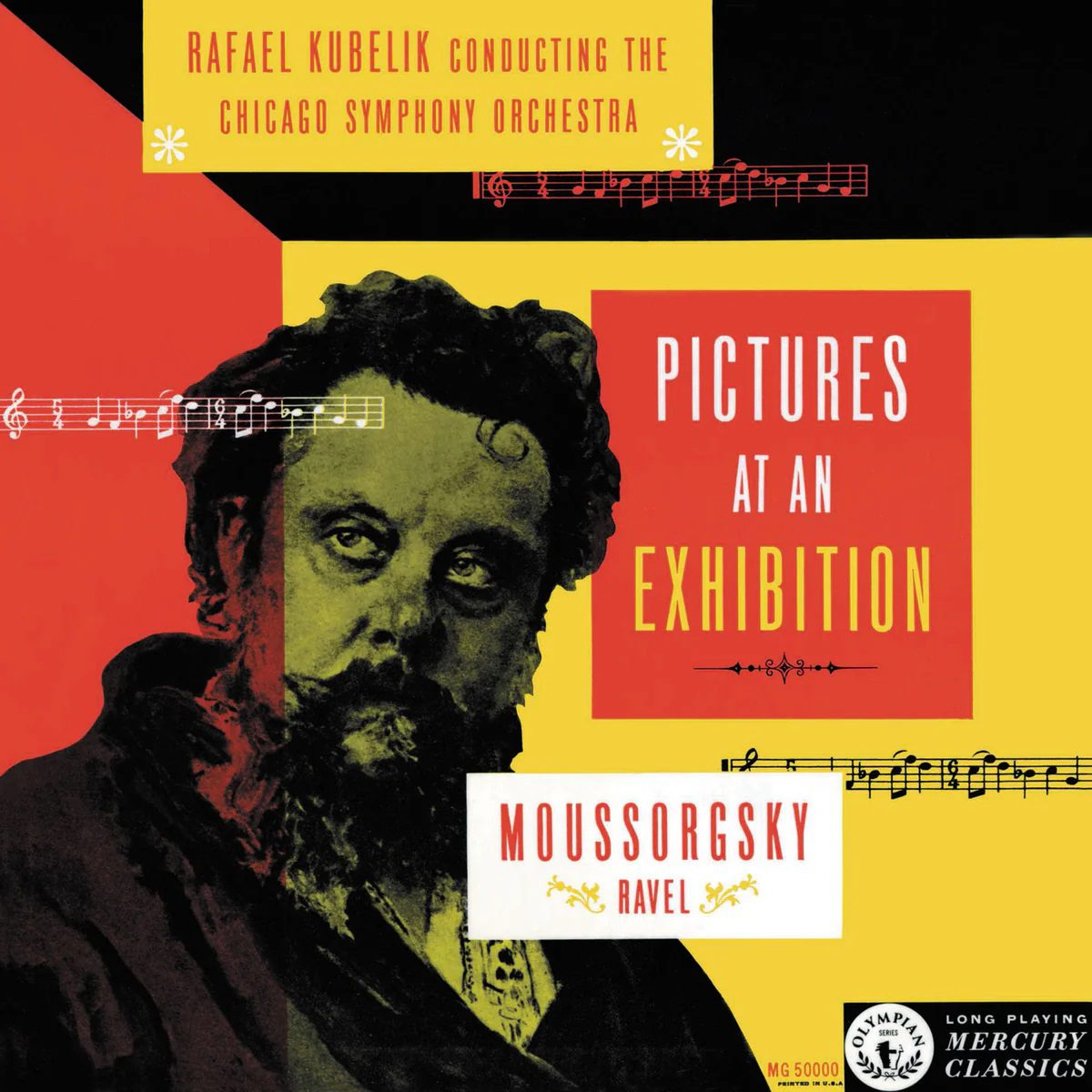
Despite having a dozen or more stereo recordings to choose from, Universal Music chose Rafael Kubelik’s 1951 mono recording to issue as a vinyl LP of Mussorgsky’s Pictures at an Exhibition.
Kubelik tenure as music director of the Chicago symphony began in 1950, and Pictures was his first recording with the orchestra. The 1950s saw the dawn of the LP era, and Mercury – new kids on the block – were poised to exploit the possibilities of this exciting new medium.
Pictures at an Exhibition by Russian composer Modest Mussorgsky (1839 – 1881) became famous after Maurice Ravel’s 1922 orchestration. It’s a stunning display of orchestral colour.
Mercury’s amazingly detailed recording hugely impressed listeners when they heard it. Kubelik’s direction, and the virtuosity of the Chicago Symphony, were praised, but the main talking point was the recording. The New York Times’ Howard Taubmann felt himself ‘in the Living Presence of the orchestra’. So, that’s how Mercury’s ‘Living Presence’ moniker was born.
If Mercury were aiming to make a hi-fi blockbuster recording, selecting Mussorgsky’s Pictures was an inspired choice. Mercury engineer C. Robert Fine took a minimalist approach to microphone technique. Just a single Telefunken condenser microphone was used, carefully placed to achieve a natural balance between different sections of the orchestra.
The recording is mono, but the impression of depth and space remains quite remarkable. Kubelik’s expert balancing of the instruments ensures excellent clarity and striking definition.
With the microphone positioned above the conductor at a height of about 25 feet, the sound captured was surprisingly clear and focused. Every detail of Ravel’s marvellous scoring can be heard without effort. Even after 70+ years, the results impress.
Ravel scores the opening for a solo trumpet, and it’s played here by the legendary Adolph Herseth, the Chicago symphony orchestra’s principle-trumpet for 53 years from 1948 to 2001, who featured on no fewer than seven recordings of Pictures.
Being taped in Chicago’s Orchestra Hall with just a single microphone, they surely capture the true natural sound of the Chicago Symphony as faithfully as the technology of that period allowed. There’s no electronic messing. Everything you hear is authentic and real.
The fabled power and opulent sonority of the Chicago brass are heard to great effect. Of course, some of the richness warmth and breadth you’d get with stereo is missing. Mono typically sounds drier and less-spacious – the bass leaner and less-voluminous.
But dynamic range of is comparable to a good modern recording. There’s no gain-riding, limiting, or compression, so extremes of loud and soft are wide. Despite a bit of tape squash and sizzle during climaxes, the overall sound is impressively fresh and clean for 1951.
Despite the age of the tapes, sound quality seems not to have deteriorated with the passage of time. Standard quarter-inch magnetic tape was used, but (being mono) the full-width was utilised, rather than about 45% for each track in stereo.
Despite a fast performance lasting around 30m, the work was extravagantly spread over two sides of a 12in LP with no filler. In the UK it was issued by HMV on a 10in LP (BLP 1002) as Mercury had no distributor in Europe. Used HMV copies turn up surprisingly often on sites like eBay.
The reissue on 180g vinyl was half-speed mastered at Abbey Rd studios. The result is full-bodied and surprisingly detailed. The CD issue is coupled with Bartok’s Music for Strings, Percussion, and Celeste, recorded during the same April 1951 sessions as Pictures.
But how did the original LP sound? I’ve never heard the 10in HMV pressing but recently acquired a 1950s US 12in Mercury LP. It sounded surprisingly good. Peaks were around 1dB hotter than the new Abbey Rd transfer. Not bad!
The sound itself was a tad less crisp and immediate – even after careful ultrasonic cleaning. But all the same, it wasn’t significantly worse…
More Info
| Media | 180g LP |
|---|---|
| Label | Mercury |
| Contributors | Rafael kubelik (conductor) |
| Contributors | chicago symphony orchestra |



By Jimmy Hughes
More articles from this author

Read Next From Music

Sting: All This Time (Live)
- Sep 08, 2026
Johan Lindvall Trio: End
- Aug 31, 2026
Talk Talk: It’s My Life (40th anniversary)
- Aug 25, 2026
Tom Hickox: The Orchestra of Stories
- Aug 18, 2026