Jazz


- Music


- Sonics
- A
- A
- A
The list of top-notch Scandinavian pianists just keeps growing. Take Johan Lindvall. A relative newcomer to the scene, he has played with saxophonist Mette Henriette on two albums for ECM and released two previous albums with his trio, in which he is backed by Adrian Myhr who plays double bass and Andreas Skår Winther on drums.
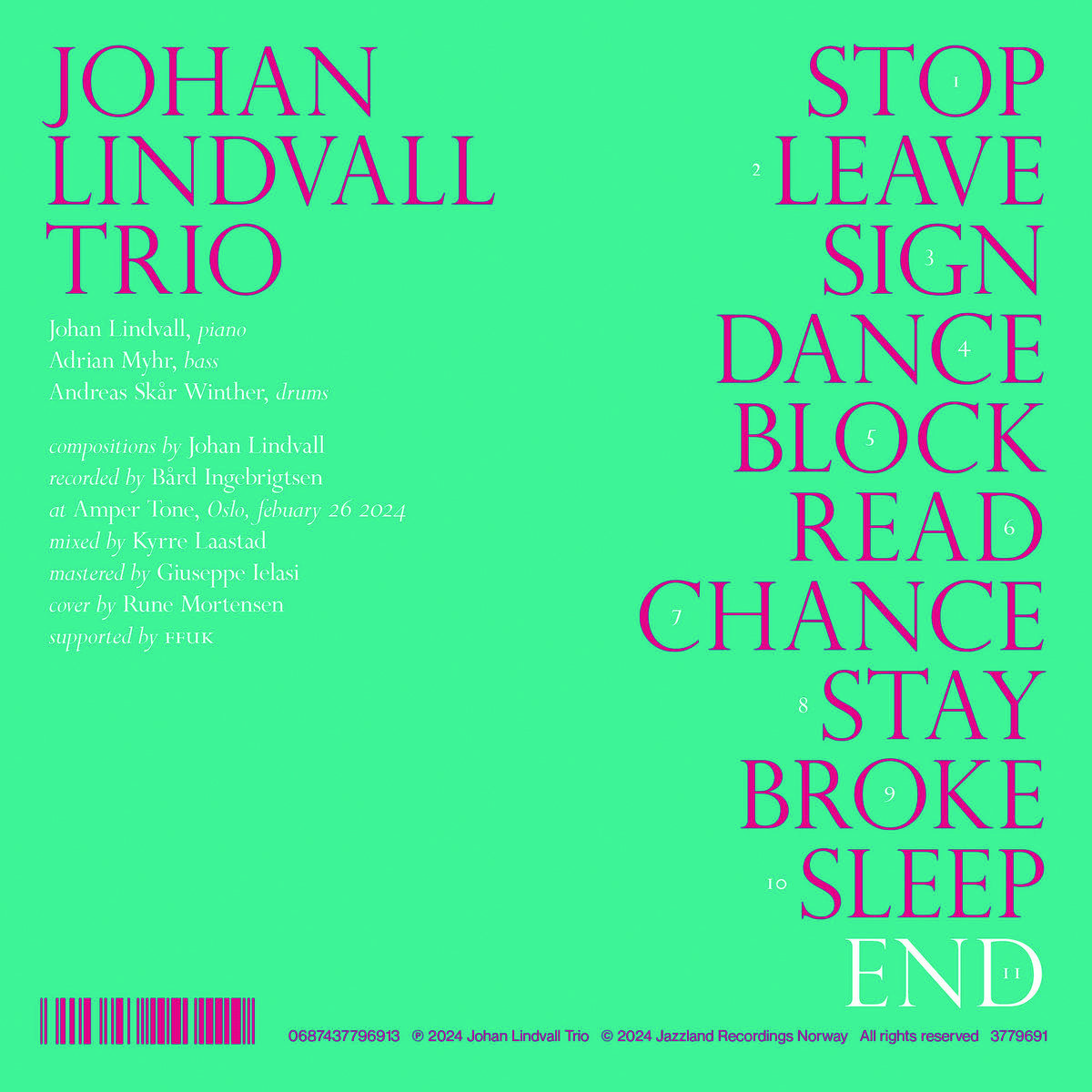
A glance at the artwork reveals 11 succinct track titles that sound like commands, yet the music this trio makes is far from commanding, it is often Gustavsen-like in its calm and gentility, nothing is pushed at the listener yet if they are sensitive to its nuances they will be drawn in and carried along by its entrancing flow.
The piano playing is rarely complex and often chord-based, it forms part of the overall sound rather than leading it but there is plenty of variety nonetheless. Album opener ‘Stop’ is a gentle shimmering awakening of a piece, more of a prelude than the title would suggest with the piano sounding like the babbling of a stream. The sound ebbs and flows in subtle shifts that is rather pleasing. ‘Leave’ is a tune proper, a slow burn groove created with what sounds like two chords played across different keys. This is accompanied by sparse percussive rhythms and big boned double bass which fills out the sound and gives it body, meanwhile the piano pursues its cause with the minimum of fuss but the cumulative effect is powerful and engaging.
‘Sign’ comes in with variety from all three musicians before a tune appears that could actually be by Tord Gustavsen. This is very simple yet it takes over and brings a tranquillity that few can match. This pattern continues with the lively, less obvious element seeming to form the chorus while the repeated chords anchor the piece and allow it to build to a subtle climax, definitely an album highlight. For ‘Dance’ Johan Lindvall and his accomplices move to Capetown and take on the guise of Abdullah Ibrahim, or that at least is the sound they make. It’s nice to have a proper groove for a while but this is soon eclipsed by more explorative piano work where Lindvall goes off piste and leaves it to the band to keep the groove alive.
‘Block’ is a slow tempo number in a minor key that is thoughtful rather than sad, it is really just understated with the keys playing at the same level as the rhythm section, yet things move in mysterious ways because without any obvious changes the mood lifts as the piece progresses. ‘Read’ is a spare, relaxed and yet precise tune where there is a sort of call and response interaction between piano, bass and drums. It’s a brief track but Lindvall injects a yearning into his playing that gives it extra depth of feeling. The first few bars of ‘Chance’ sound like a reworking of ‘Stop’ but while the piano is similar there is a heavier feel to the whole thing, the bass produces low bowed sounds while the drums are dark and heavy, getting thicker and more ominous as the piece develops.
‘Stay’ has an anthemic feel to its first few bars and it sounds like it’s going to build, that it’s got some place to be, albeit not in a hurry. In practice the tune calms and quietens as it progresses, ending on a slow fade out by the musicians rather than someone at a mixing desk. This restraint continues with ‘Broke’ which is pared back to its essence with a slow, gentle tempo, brushed snare and an ebb and flow from the keys that transitions into a steady groove for a second half that barely resembles the start. Here we get a groaning double bass and the darker side of Lindvall and co comes through. The album finishes appropriately enough with ‘End’, a solo piano work in which runs of notes gradually work their way down the scale, the finale being ruminations in the instrument’s bass with heavy reverb adding to the ominous feel. You know the album is over before it stops.
The 24-bit, 96kHz recording is very good and it’s a pity that End is not available on a physical format such as vinyl, who knows, if it proves popular perhaps it will. I certainly hope so.

By Jason Kennedy
More articles from this author

Read Next From Music
The Teskey Brothers: Half Mile Harvest
- Oct 13, 2026
Emma-Jean Thackray: Weirdo
- Oct 06, 2026
Klaus Mäkelä: Stravinsky; Debussy
- Sep 29, 2026
Sting: All This Time (Live)
- Sep 08, 2026