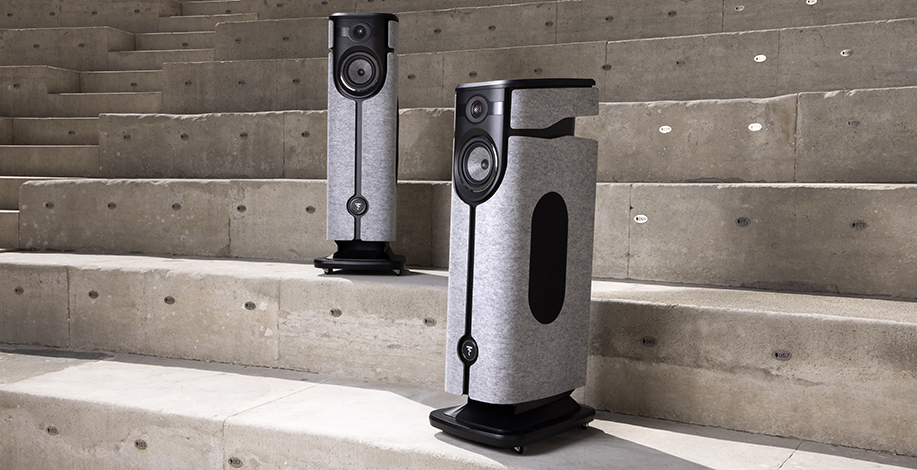
 Focal and Naim announced their merger over a decade ago. Back then, many couldn’t visualise an actual engineering liaison between the two companies. Both firms have been highly prolific in the ensuing years. However, the nature of those products is that they have been either ‘Naim’ or ‘Focal’. Only at the terrestrial end of proceedings, with the Mu-so devices (new ground for both firms), has there been any actual collaboration. Until the Focal Diva Utopia, that is.
The Diva Utopia sports a Focal badge. However, that badge lights up, which indicates that there is as much Salisbury as Saint Etienne inside those cabinets. Focal’s Diva Utopia is an active speaker. It’s wholly self-contained, replacing streamer and amps in a conventional system. This category is going great guns at lower prices, but it’s more singular to encounter at £30,000.
Utopian dream
The Focal contribution to the Diva is entirely in keeping with the Utopia name. Like other range members, it sports a beryllium tweeter for high frequencies. Focal believes that beryllium’s combination of strength and lightness is unmatched by any other material. Only hydrogen, helium and lithium are lighter than beryllium. Two of those are gases, and the other spectacularly reacts with oxygen and water. Not good properties for loudspeaker designs.
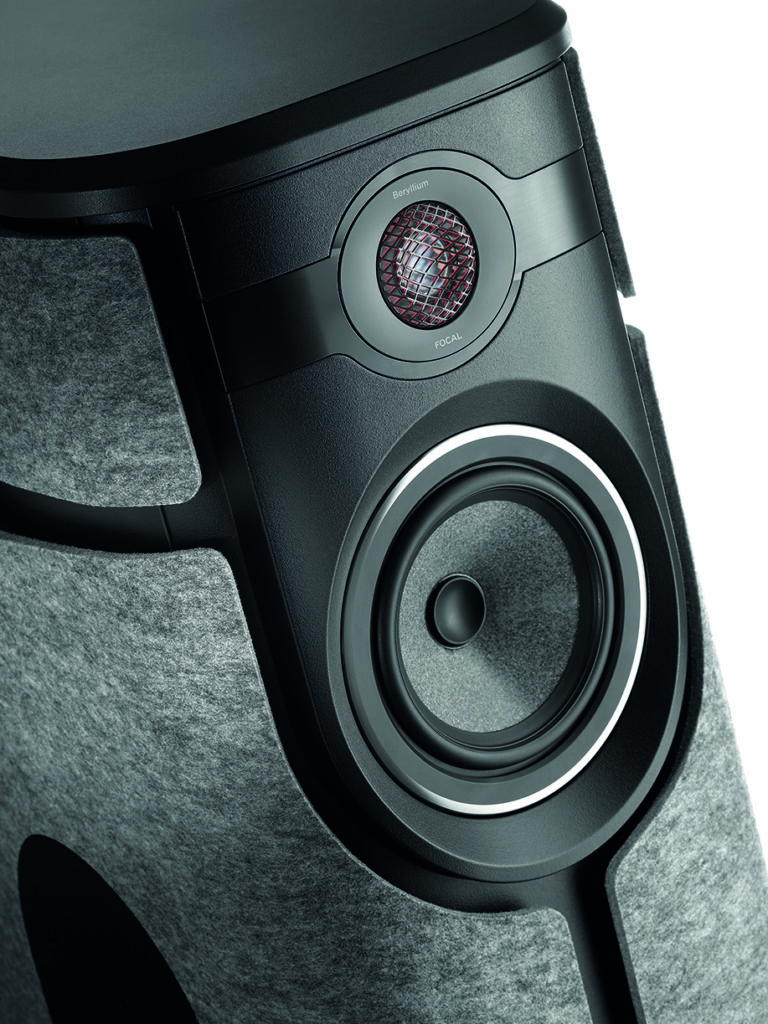
The Focal Diva Utopia is the first speaker to use the ‘M’ shape profile in a beryllium tweeter. This development first appeared in the automotive division. It increases the relative rigidity of the dome for the same amount of material used.
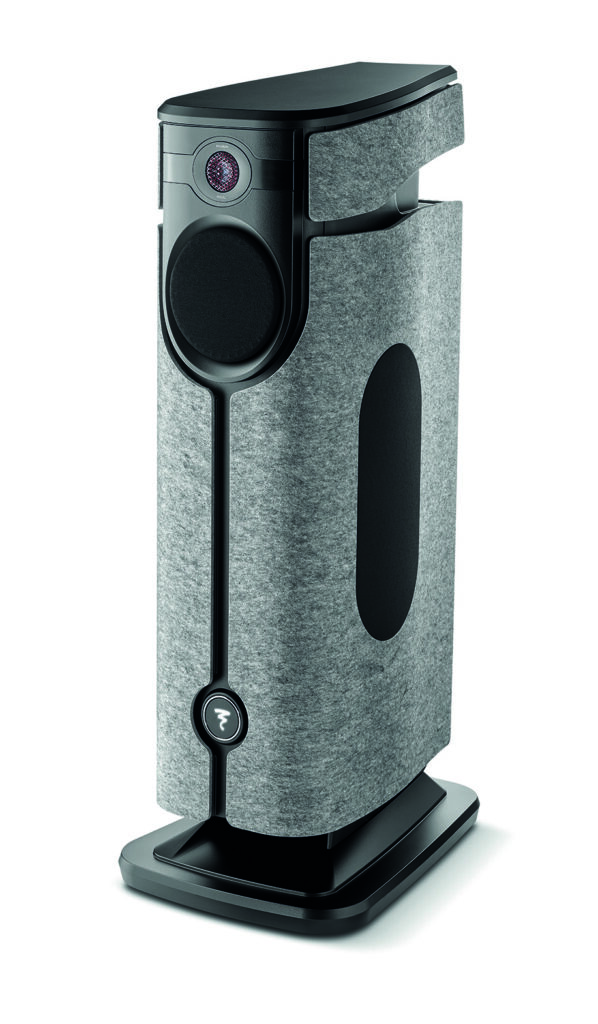
This hands over to a 6.5-inch composite midrange driver that shares a baffle with the tweeter. It’s also a Utopia-pattern composite engineered for stiffness. However, as a midrange unit, it is lighter than a dedicated bass driver. To find those, you’ll need to look down the side of the Focal Diva Utopia. Another four 6.5-inch drivers in counter-firing pairs sit on either side of the cabinet. These are aided in their excursions by a port integrated into the cabinet’s bass near the plinth. One of the reasons why the Diva carries that name is that an earlier passive Utopia model of the same name was the first in the range to mount a driver on the side.
Spine of Naim
Naim’s contribution to the Diva is less visually apparent but significant nonetheless. At the back of the cabinet is a ‘spine’ that contains the electronics required to make the Diva Utopia function. Naim’s distinctive circuit architecture, philosophy, and component choices abound. The amplification is derived from the New Classic series of amplifiers. It breaks down into 75 watts each for the tweeter and midrange and 140 watts for each linked pair of bass drivers. Typical of a Naim product, the board’s layout is meticulous, and the power supply is very hefty indeed.
Notably, much of what makes the Diva work has been developed specially for this application. A combination of SHARC DSP and Burr Brown DACs perform the digital heavy lifting. It’s a pairing that underpins most of Naim’s recent offerings. In the Diva, though, this is operating at 64 bits for the first time, dramatically increasing the amount of processing available. This DSP sends material to DACs specifically assigned to treble, midrange, and bass, meaning that each Diva Utopia has significant decoding horsepower. The two speakers then communicate via a custom implementation of the UWB wireless protocol designed to ensure that the bandwidth available is enough for any task handed to the speaker while offering the pre-requisite stability.
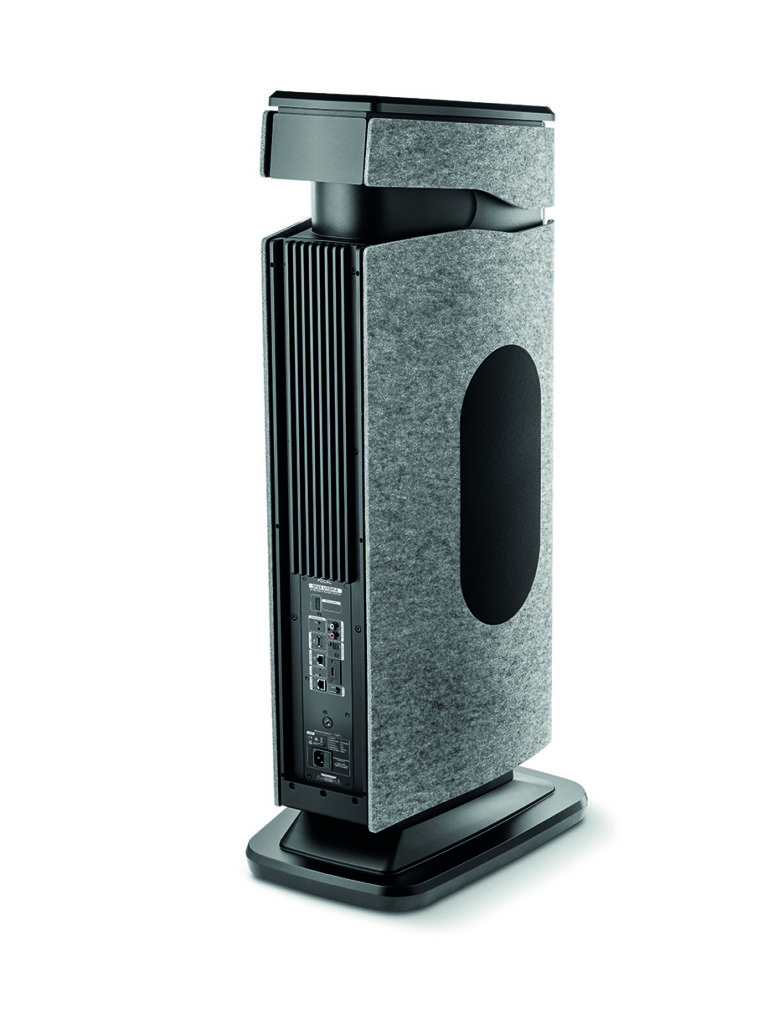
This digital platform is made available to an enhanced version of the Naim/Focal streaming app. The app incorporates the setup and specific adjustments of the Diva. It also accesses streaming options, including stored content with Tidal, Qobuz, Spotify, internet radio, AirPlay, and Chromecast. HDMI eARC, a single optical, and RCA analogue pair complete the inputs line-up. Sure, a device like Triangle’s Capella active wireless speaker at one-thirteenth the cost of the Focal has more inputs to its name. Still, I suspect the Diva Utopia will do enough for most applications.
Intriguingly different
All of this technical and engineering work creates a speaker that is at once familiar and intriguingly different. Many aspects of the design of the Diva Utopia could only be Focal; the drivers and prominent top plate, together with the ‘slash’ at the back of the cabinet, have been company calling cards for years. This familiarity blends with elements like the prominent groove down the front and the repositioned (and, of course, illuminated) logo that presumably points to the direction other members of the Utopia family will head in.
It does work better in the flesh, though. When Focal sent some low-resolution images before going to have a listen, I wasn’t convinced. The proportions looked wrong, and the grey finish was worrying, akin to ferroconcrete. In reality, the Diva is entirely more convincing.
Reducing mass and size
The lines effectively reduce the perception of mass and size, and what looks a little disjointed in two dimensions comes together effortlessly in three. The grey is more likeable, too, but these outer sections are removable, and, in time, more finishes will become available. Owners can easily change these outer sections.
I went down to Naim HQ to listen to the Focal Diva Utopia as their size and other items I have on test precluded installing them at home. The Salisbury massive had run the review pair through their basic EQ process. They had been placed near (but intriguingly not exactly in) the tape marking point for passive Utopias. The business of selecting the first track of the day was the same as if I were using the Mu-so Qb2 that lives in my kitchen, and it led to a slight sense of mental friction regarding what to expect when the music started. Steve Sells, Naim’s Technical Director, showed me a circuit diagram of the Diva’s main board, but its density puts it somewhere close to Minoan Linear A in the intelligibility stakes. Still, the message was clear- this is a formidably complex device.
Beautifully sultry
What resulted, as the beautifully sultry ‘No Depression’ on My Baby’s Loves Voodoo [Embrace Recordings] filled the room, is a sound that gently but firmly subverts expectations of what that technical complexity ‘should’ sound like. Yes, six drivers are in each cabinet, firing in multiple directions, being coaxed, corralled and contained by that formidable electronics package. You receive Cato Van Dyck’s stunning vocal turn from the listening position. Also, the pared-back instrumentation supports that voice in a way that is utterly free of embellishment. The most important thing that the Diva did in that opening 3:54 of music was to demonstrate that engineering brilliance is a means to an end. It’s a means of creating the story rather than being the story itself.
Digging deeper and leaning harder on the Focal Diva Utopia with Public Service Broadcasting’s Electra [So Recordings] began to show what it can do. Electra is an urgent, frantic and unavoidably congested recording due to the older samples that run through the music. The Diva takes this in its stride, delivering the thumping low end with cohesion and control while the delicate chorus is maintained perfectly over the top.
IMAX
Public Service Broadcasting has long had a knack for almost cinematic scope in its material. Here, that presentation gets the IMAX treatment.
This effortless ability to deliver scale is more than a function of those hefty cabinets. The Diva consistently generated a stereo image that I could all but walk around in but one that rises and shrinks to fit the requirements of the material. Fink’s live rendition of ‘Sort of Revolution’ at La Cigale in Paris on Wheels Turn Beneath My Feet [Ninja Tune] has the space of the venue effortlessly stitched into the recording. Change tack entirely and give it Dodie’s Build a Problem [Doddlenoddle], an album that often feels like a boxroom studio recording, and that scale bleeds away entirely and convincingly. In both cases, the vocalist is the centre of your attention as they should be, but they arrive in the broader context of a recording that makes effortless sense.
Beyond proficient
Crucially, Naim’s influence makes its way into the presentation at a level beyond simple technical proficiency. Give the Diva ‘Strange Times’ by the Chameleons [Geffen], and the simple propulsive energy they lend to the track is type-standard Naim. ‘Timing’ is a thorny and hopelessly subjective construct. It’s also impossible to argue that much of the actual business of how the Diva coordinates its many drivers is a function of software rather than innate mechanical wizardry. For all this, though, as you listen to John Lever’s epic gated drumming, it is abundantly clear that the Diva Utopia times perfectly.
The application of digital cleverness might be subtle, but its effectiveness is hard to overstate. As you lower the volume, Focal’s Diva Utopia gently enhances the bass frequencies. The Focal can purr effortlessly in the background while the sound remains fuller and larger than expected. For some people reading this, the concept of a DSP-based bass ‘boost’ at low levels is an anathema. It goes against those purist ideals ingrained in the high end.
Traction control for audio
It reminds me of traction control in cars. Traction control has gone from a slow-witted digital nanny that could – on a good day – intervene to prevent you from dying into something that can apply in stages to make the whole vehicle more exploitable. So is the case here; this isn’t DSP from the turn of the century.
The Focal Diva Utopia is a glimpse of the future. Granted, not the only future but a persuasive template nonetheless. It forms a convincing template for delivering a high-end audio product in a broader ecosystem where the ideals of ‘good, better, best’ are distorted by quite how good the ‘good’ rung is. People are buying affordable powered and active speakers right now for whom the Diva Utopia will look far more like their logical endgame than passive speakers with supporting electronics ever will.
Suffering-free art
The peculiar notion that genuinely great audio requires you to suffer for your art is, fortunately, beating a retreat. However, even with this change in audio sensibilities, the Diva still feels like a step forward. So long as you can accommodate the cabinets, living with them is easy. The Diva carries out the day-to-day sonic drudgery with aplomb.
When you have the time and inclination, that convenience fades into the background. Instead, the formidable ability to deliver the sonic performance that only a large, well-engineered speaker can generate shines through. In that case, the Diva will be ready and willing to provide it. So long as it has access to two main sockets and an internet connection, of course. The collaboration between Focal and Naim has been a long time in the making. Regardless, the Focal Diva Utopia is both superb and likely to be a portent of things to come. It’s been worth the wait.
Technical specifications
- Type: three-way bass-reflex active streaming floorstanding loudspeaker
- Floorstanding bass: 4 x W 6.5” (16.5cm) push-push configuration
- Midrange-bass: W 6.5” (16.5cm) with TMD surround and NIC motor
- Tweeter: IAL2 1 1/16” (27mm) pure beryllium M-shaped inverted dome
- Bandwidth (+/-3dB): 27Hz – 40kHz
- Low-frequency cut-off (-6dB): 24Hz
- Maximum volume (per pair): 116dB SPL (@ 1m)
- Amplification power per loudspeaker: LF: 250W Class AB / MF: 75W Class AB / HF: 75W Class AB
- Power supply: 110-120V/220-240V ~50/60Hz
- Power consumption: 280W
- Network standby mode: <2W
- No-network standby mode: <0.5W
- Inputs on primary speaker: HDMI eARC, CEC / TOSLINK Optical / RCA analogue / Type A USB 2.0 / RJ45 Ethernet / RJ45 Speaker Link
- Inputs on secondary loudspeaker: RJ45 Speaker Link
- Internet radio format: Streaming containers: HLS, DASH, OGG. Codecs: MP3, AAC, Vorbis, FLAC. Icecast, Shoutcast, XPeri Extended Metadata support
- Audio formats: WAV, FLAC and AIFF – up to 24bits/384kHz, ALAC (Apple Lossless Audio Codec) – up to 24bits/384kHz, MP3 – up to 48kHz/ 320kbits (16bits), AAC – up to 48kHz/320kbits (16bits), OGG and AAC – up to 48kHz (16bits), DSD64 and DSD128
- Bluetooth codecs: aptX Adaptive, SBC, AAC
- Multiroom Sync with up to 32 Focal & Naim streaming devices
- Control: Focal & Naim app, remote control, voice assistants
- Wireless streaming: AirPlay, Google Cast, UPnP, Bluetooth 5.3, Spotify via Spotify Connect, TIDAL via TIDAL Connect, QQ Music via QPlay
- Music streaming services via the Focal & Naim app: TIDAL, Qobuz, Internet radio and podcasts
- Network: Ethernet (1000/100/10Mbps), Wi-Fi (Wi-Fi 6)
- Wireless connection: UWB 96kHz/24-bit
- Connection with Hi-Res Link: 192kHz/24-bit
- Focal & Naim control app: iOS and Android
- Remote control: Zigbee
- Dimensions (HxLxD): 121x42x56cm
- Weight: 64kg
- Price: £29,999, $39,999, €34,999
Manufacturer
Focal
Trending Articles
See all
Acoustic Energy Corinium floorstanding loudspeaker
- Dec 23, 2024
Raidho TD2.2
- Jun 21, 2023
Trending Articles

By Ed Selley
More articles from this author

Read Next From Review
See all
HIFISTAY Sound Wings+
- Sep 16, 2026
Marantz Model 10
- Sep 16, 2026
DeVore Fidelity O/Bronze
- Sep 16, 2026
Network Acoustics Origin
- Sep 16, 2026