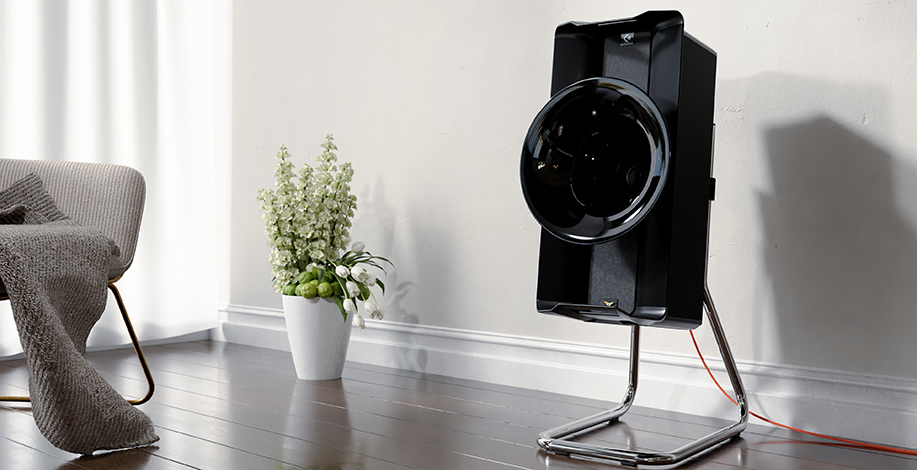
The Colibri C2 is not a direction change for Avantgarde Acoustic. It’s an ‘adding more strings to the bow’ loudspeaker concept. It’s a recognition that the audio world is undergoing a fundamental change. The company’s more regular output of very large, distinctive horn loudspeakers remains in effect. However, the Colibri C2 is aimed at a wholly new audience. An audience more used to a more connected world. An audience who might not even know of Avantgarde Acoustic.
Avantgarde is perhaps the most prominent member of the German horn loudspeaker gang (please, no jokes about oompah bands). These companies rose to notoriety in the latter decades of the 20th century. The company operates from the darkest depths of the Odenwald (about three-quarters of an hour drive away from Frankfurt Airport). This is one reason why Avantgarde Acoustic has always danced to a different tune than the majority of ultra-high-end manufacturers. Avantgarde’s classic series of semi-active (and latterly fully active, too) horn systems typifies this approach. Consisting of variations on the Uno, Duo and Trio themes, this tech has been honed to near-perfection.
Beginning with flawed-genius origins, over three decades of development, Avantgarde was never about the usual audiophile bean-counting. And it was never about A-B-X comparing. There was no ‘can you hear the coughing on the third row, seven seats from the left.’ Or any of the pastimes favoured by an ever smaller niche of, let’s face it, predominantly older white males. They’re simply about recreating the thrill and emotional impact of music events.
Life-like dynamics
According to Avantgarde’s founder and CEO, Holger Fromme, the key to realising this is offering life-like dynamics. “Take your average hi-fi loudspeaker,” says Fromme. “That can go to maybe 100dB in a room with a lot of amplifier power behind it. At 90dB, it will already display noticeable dynamic compression,” he continues. “Much of the impact will be gone, especially with many modern, often electronic music styles.”
Therefore, Avantgarde’s speakers feature minimal crossovers, with sensitivity ratings that extend well into the three-figure range. These meet powerful drivers acting on tiny moving masses. The ambient air couples as efficiently as possible through those vast, colourful, injection moulded ABS spherical wave horns. Finally, this is supported in the low-frequency department by potent, DSP-controlled amps and large drivers. The entire system is front-loaded with horn-like waveguides or even genuine horns in the most extensive and expensive models. ‘Spendy’ speakers are great if you’ve got a high five-figure sum (or more) to spend on a hi-fi. Not everyone has that luxury.
Enter Colibri. We have seen ‘entry-level’ speakers from Avantgarde before. Although they were admirable efforts, none quite captured the magic of the core line. Also, the current ‘entry-level’ Zero/Zero One still costs in the five-figure range, anyway. Avantgarde Acoustic demonstrated a ‘concept car’ version of the Colibri C2 at the Munich High End 2023.
Different audience
Colibri targets a distinctly different audience. An audience who scoff at buying a £400 cable because that’s the cost of a pair of stunning headphones. For music in the home, they might spend between €2,000 and €3,000 on loudspeakers. So, the Avantgarde Acoustic Colibri C2 remains a very expensive loudspeaker for many people. Therefore, what we offer them should be extremely compelling, and we believe it is. Now, everyone has the means to play music with full bandwidth and uninhibited dynamic range at their fingertips.
Any smartphone today has sufficient computing power to render data reduction formats like MP3 obsolete. Meanwhile, streaming platforms have been transitioning to high-resolution files. The music source is no longer the bottleneck; it’s the transducer. I’ve just bought a pair of headphones for €150, and the sound quality is outstanding for that price. The problem is that a loudspeaker system has to pressurise an air volume thousands of times larger. So, to overcome this, we had to distil and concentrate the technology of our state-of-the-art horn loudspeakers in a much more compact and easier-to-produce package. It also means that where twenty years or so before, one would normally spend 50 per cent of their overall hifi budget on speakers, there is a strong case to be made that one might spend 90 per cent on loudspeakers and 10 per cent on source and amplifier.”
Light is right
Unusually for the brand, the Avantgarde Colibri C2 is a passive speaker. At some point, there might be a fully active, DSP, wireless version. However, we have become increasingly aware of the importance of sustainability as a general concept. So, it’s wise not to incorporate digital technology into a loudspeaker that will likely be obsolete within two years. Coupled with a rugged build quality from materials like cast aluminium for top and bottom panels, the Colibri should be as usable and relevant in twenty years as it is now.
The driver complement, too, is innovative and a departure for Avantgarde as a single driver covers the entire frequency band upwards of circa 700Hz. Right in the middle what looks like a baby (Duo) Mezzo by way of the enclosure’s horn flares, a 35 cm (about 14-inch) horn is energised by a 1.5-inch compression driver with an extremely light 2.2 grams membrane, flanked by a pair of 6.5-inch cone drivers that also couple very strong motor systems (according to Avantgarde the voice coil air gap is as small as 0.95 mm) to super light moving assemblies – hence the name Colibri.
Quasi-d’Appolito
This quasi-d’Appolito arrangement also means the Avantgarde Acoustic Colibri C2 is as near-as-dammit a point source acoustically. This is unusual for a horn loudspeaker. The flip side is that this is not a full-range speaker. The horn driver tops out at 19kHz (which is a small price to pay for the temporal consistency that costs with using a single driver for much of the audible frequency range) as a one-inch driver wouldn’t reach down nearly as low while still offering the sort dynamic headroom that Avantgarde sees as mandatory for its products.
A more practical consequence is the lack of bass extension, reaching -3dB at around 65Hz, making a subwoofer a compulsory addition for a stereo system built around a pair of Colibris. “Had we set the -3 dB point at 35Hz or so, efficiency would be down to about 89dB from the current 98dB, and that was a choice we would never make given the object of this exercise… The crossover point is low enough to allow a seamless transition to a big subwoofer offering the sort of cone surface desired for depth, impact and freedom of distortion, anyway.”
Although Avantgarde will offer their own 18-inch active-DSP controlled subwoofer (which also can be doubled up with the Colibris placed above them horizontally in a cradle or ‘nest’ specifically designed for this purpose), it will cost about €4,500. The manufacturer suggests the Colibri can be successfully used with any number of mass-produced, much lower-priced units to arrive at a significantly lower system cost. Also, the Colibri can act as a centre speaker in a multichannel setup, wall or ceiling mounted for use in home theatres, clubs and bars or anywhere else where high-quality music reproduction forms an integral part of the concept, et cetera.
Ninety-to-ten
For the test, we used a Klipsch SPL-150 subwoofer. This is a slightly prosaic but undeniably practical device that can be picked up for well down into three figures, to fill in the bottom two octaves or so for the Avantgarde Acoustic Colibri C2s. On-message with Fromme’s 90/10 budget suggestion, we started our listening with an SMSL DA-9 Bluetooth 5.0 amplifier, a tiny device built around a 40 Watts Class D amp sporting a single stereo pair of RCA inputs and another balanced (!) one using XLR in addition to its Bluetooth input; binding posts for a single pair of speakers plus an RCA subwoofer out (mono) on the output side. The going price of all this is around €250.
The first thing one notices about the Colibris is that the music grabs your attention even when playing at low volume from reduced data formats like internet radio. Instead of serving a more or less homogeneously textured sonic wallpaper, even under these circumstances, it separates the elements – vocals, bass lines, percussion – with a sense of space around them, making, for instance, lyrics, guitar riffs, melody lines more intelligible and impactful than normally would be the case under these circumstances – making ‘hey, this is a cool song – what is it?’ when something not previously heard comes along on the radio, a more regular occurrence.
Not an illusion
This is not a case of being fed the illusion of a fast, clear, dynamic sound by way of tonal leanness as per some of the smaller or budget speakers known for their sense of immediacy and connection in the past – all leading edges and little substance after that. Rather than this, the Colibris, when supported adequately in the lowest registers, sound like a much bigger speaker system – their brand of immediacy is more like a big, torquey engine pulling a very lightweight sports car along than that of a hot hatch with a smallish engine. Small as they seem, those horn flares loading the pair of 6.5-inch midbass drivers add a useful 2-3 dB towards the lower edge of their working range.
Adding a CD player (Rotel RCD-1570) to the setup, the intro of ‘World in My Eyes’ on Depeche Mode’s Violator sounds arresting, with the synth bassline having plenty of weight and texture to make one sit up and notice. Again, the Colibris don’t just lay the arrangements and individual sounds wide open with a clarity on vocals that’s exceptional by any standard; they involve the listener emotionally more than I’ve heard anywhere near their price range.
No further explanation
Being Avantgarde, it needs no further explanation that dynamics are as effortless as they are thrilling and that you don’t need to bring out some special audiophile recording to demonstrate it – the intro of Rammstein’s ‘Mein Herz Brennt’, more specifically the point where the kick drums and ‘wall of sound’ guitar riff comes in and all hell breaks loose, will have you jump out of your seat and reach for the volume control if you were foolish enough to set high enough volume in the first place – and that’s just regular, overall somewhat compressed, mainstream production fodder.
Similarly, Massive Attack’s seminal Mezzanine album plumbed the depths of one’s hearing with deep, rumbling bass underlining er, massive soundscapes, the opening track ‘Angel’ working itself up to a devastating climax. Even with this modestly priced subwoofer, the Avantgarde Acoustic Colibri C2 will shake the walls and your furniture before showing any signs of strain. Remember, this is still with a couple-of-hundred-quid Chinese Bluetooth amp the size of a cigar box.
Bring out the tubes
Hooking up the custom Pink Faun preamp (which offers separate outputs for bass, mid and highs on the main system, with the former two output pairs unfiltered bar a 30 Hz subsonic filter on the mids) and Audio Note 300B monoblock amps from my ‘big’ set-up, with source components of a similar calibre, brought a very significantly lowered noise (or rather: sound) floor, microdynamics, richer tonal colours and an even more expressive midrange.
Is it as refined as the big Avantgardes backed by an appropriate supporting cast? No. Of course not. Is it as compelling an experience? Yes, albeit in slightly different ways. I can imagine the happy few running Duos and Trios in separate listening rooms full of CDs, vinyl albums and acoustic treatment, buying Colibris with some streaming amplifier for the living room where music might be heard more casually and more as a social event.
No plonking
Although the Colibris are not quite plonk-them-anywhere speakers, they are much less demanding in terms of placement than the larger systems (which, in turn, by way of their horns’ directionality and DSP-controlled low-frequency section, are somewhat less sensitive to their acoustic environment than more conventional high-end speakers – but they do require a relatively higher level of care in setting them up to get them performing anywhere near their potential). They manage to connect, involve and thrill in a very similar fashion.
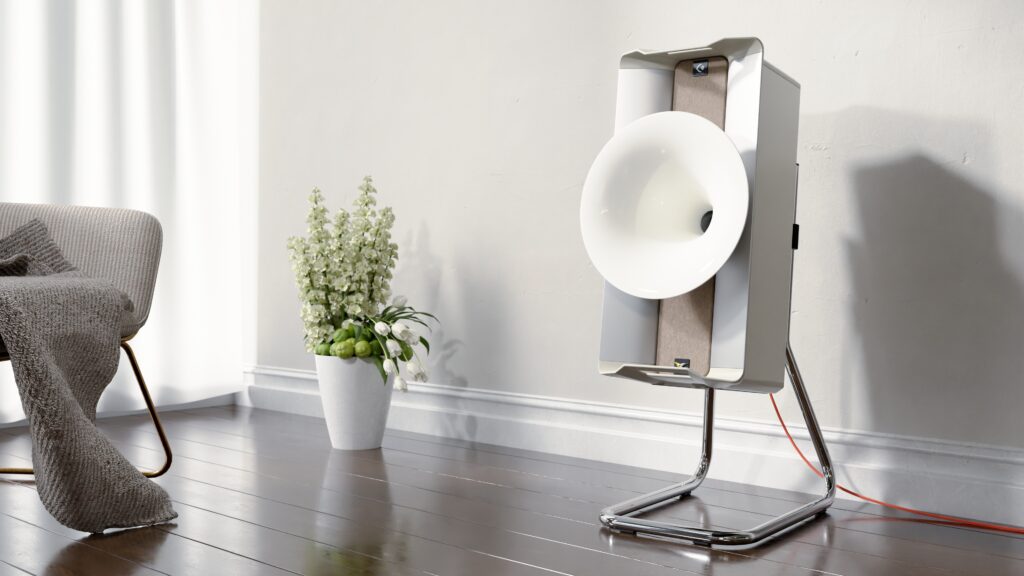
Also, they’re compact enough not to overwhelm smaller rooms visually. That said, they will fill larger rooms with ease and look like the design statements they are. Although the first batch comes in black and white/silver grey, more adventurous combinations of enclosure, grille, and horn colours will be available on demand.
The brand is concentrating on the assets that set it apart. The Avantgarde Acoustic Colibri C2 provides an intense, dynamic and thrilling music experience. Better yet, it distils that experience into a compact, lifestyle-friendly and semi-affordable product. Avantgarde Acoustics might have found its Lotus Elise moment. Avantgarde has a product that will likely sell well (though still far from becoming ‘mainstream’ numbers). The Avantgarde Acoustic Colibri C2 is a future classic in waiting, as relevant and compelling tomorrow as it is today. Only time will tell.
Technical specifications
- Type: Three-driver, two-way, stand mount, horn-loaded satellite speaker
- Driver Complement: 1.5” compression driver, copper-electroplated, titanium membrane, 2.2 g moving mass and 20,000 Gauss magnet, coupled to 35 cm diameter spherical horn; 2x 6.5” midbass, carbon cone membrane and acrylonitrile-butadiene surround, 12.5 g moving mass and 23,500 Gauss magnet
- Frequency Response: 65 – 19,000 Hz (+/-3 dB)
- Sensitivity: 98 dB/W/m
- Maximum SPL: 117 dB @ 1 m
- Dimensions (H x D x W): 66 x 30 x 33 cm
- Price: €7,000 euro/pair, SUB C18 (active, DSP-controlled subwoofer, from October/November 2024) €4.500 – UK and US prices on both products to be confirmed
Manufacturer
Avantgarde Acoustic GmbH
UK distributor
Cambridge Acoustic Sciences
Tags: AVANTGARDE ACOUSTIC COLIBRI C2 STAND-MOUNT LOUDSPEAKERS
Trending Articles
See all
By Eric van Spelde
More articles from this author

Read Next From Review
See all
Eversolo T8
- Oct 13, 2026
Acoustic Energy AE Active
- Oct 13, 2026
Reiki Audio SuperSwitch X/Pro X PSU
- Oct 06, 2026
Audiobyte SuperVOX
- Oct 06, 2026