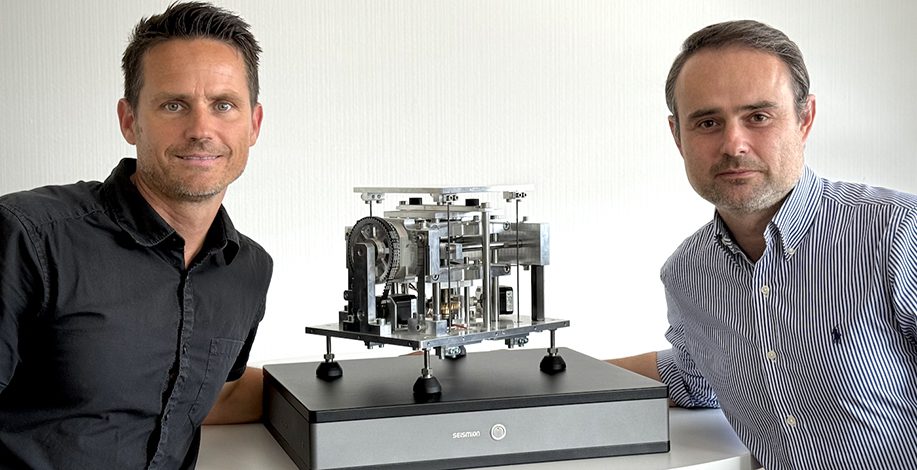
While there are some very bright people in the audio world, few are as adroitly qualified as Dr Marcus Neubauer of Seismion (pictured above left). Neubauer studied mechanical engineering in Hanover, concentrating on dynamics and vibration research (in particular, using shunted piezoelectrics to damp vibrations) to receive his PhD in mechanical engineering.
He continued with post-doctoral work in vibration damping and absorbing mechanisms.
After spending two years heading up a research team in China, in 2017, Neubauer returned to the family home in Hanover, but continued this research into vibration isolation. In the wake of the COVID-19 pandemic, Dr Neubauer teamed up with electrical engineer and fellow vibration isolation specialist Sebastian Mojrzisch (pictured above right), to create Seismion.
How did you and Sebastian meet?
We have known each other for maybe 20 years and we were working in a very similar field; not exactly in isolation but in piezoelectrics and vibration technology in general. Sebastian was formerly with Volkswagen and was a project manager over there before we decided to start this company together. We can do all the design of the mechanical parts and electronics as well.
Aside from audio, what fields typically use Seismon platforms?
We’re in the business of metrology (the study of measurement)! That’s where we started; in industry, typical applications might include under a microscope, roundness testing, or micro-harshness. We have other types of isolators which are used for applications which weigh significantly more.
The Reactive can cover weights up to around 150 kg, but we have a ‘plus’ system where individual isolation feet can be connected in a group of four or even more isolators. They can carry a weight of up to one ton per module. We have even developed a ten- or twelve-piece system to meet the customer’s needs for isolating devices weighing over 10 tons.
How big is the company?
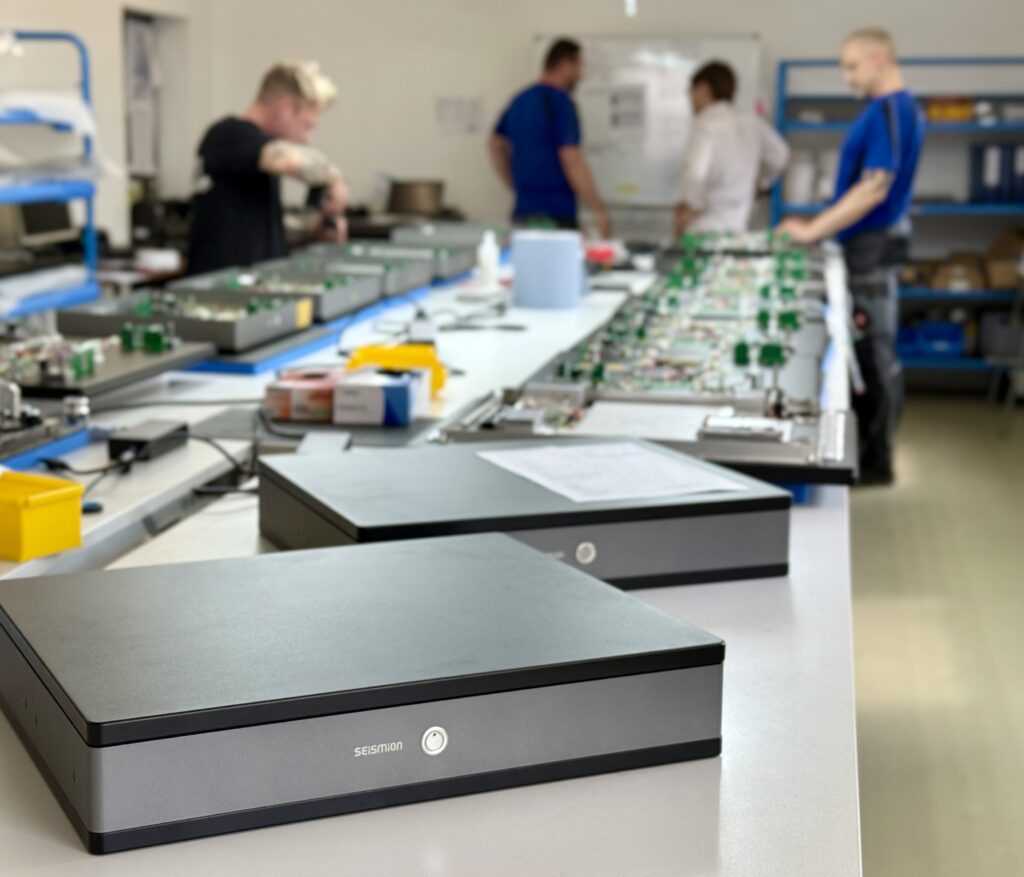
We’re still quite small. We have a very broad knowledge, but at the moment we have four employees. One is an engineer and the other three are in the production. We do all the production and quality testing in-house. Our suppliers are mostly all around Hanover, so we build very locally, meaning that we can go to our suppliers and check products on site. This is especially useful because we do a lot of prototypes and make new modifications. It doesn’t make sense to produce somewhere in China because you never know what you get back and so this is all done locally.
How does your approach differ from passive vibration isolation systems?
A passive vibration isolator typically features a coil spring to support the weight. They try to compensate for the stiffness of that with negative stiffness. You end up with nearly zero stiffness, and that makes the equipment ‘float’; if you touch this kind of system, it will vibrate at a very low frequency, maybe as low as 0.5Hz. We also developed very similar passive negative stiffness isolators in the past, but we found out that the market is much bigger for active systems.
They don’t need to be adjusted so carefully. That aside, the advantage of active isolators like ours is that the spring we use is not that soft. If you see our isolator, it does not feel as it would isolate that much. In fact, it does. We have passive coil springs but we don’t use stressed leaf springs to generate the negative stiffness.
We use a full active system which is operating in a feedback control. This changes the behavior of the mechanical system totally, so we use a lot of sensors below the top plate to to measure the vibration in all degrees of freedom.
We have six degrees of freedom and our sensors are very sensitive. We developed them ourselves and they are connected to a linear control. This control generates the required counter force to stop vibrations. These counter forces are generated by actuators (similar to loudspeakers). They are frictionless and don’t have a contact point so they work very linearly. Also, in very small amplitudes, they don’t wear out!
How do you provide stabilisation?
We stabilise the top plate isolation. So, when the base is vibrating we want to cut the transmission path from the vibrating floor to the top plate. This is done by a very soft spring because the force is equal to the deflection times the stiffness. In this case, when there are only small forces getting to the top plate, what we do is we measure vibration and it doesn’t matter if vibration excitation comes from the floor or from the top. Maybe it’s being struck or there is a rotating machine… to the sensors, it doesn’t matter. They measure vibration and generate a appropriate amount of force to stop it.
The big advantage is the settling time. If I touch my desk it will vibrate. Those vibrations are decaying but very slowly. With very low frequency Isolators, they vibrate maybe for one cycle and then stop.
That period is shorter because of the higher frequency, so it’s just like a small peak and then it stops. That’s quite impressive, especially if you have lots of dynamics in your music.
How did Seismion become a part of the audio world?
We developed our products here in Germany and sold many to industrial customers in China. Some of those who own and operate facilities in China are also audio enthusiasts, and we started getting calls from Chinese audiophiles.
We always knew that the high-end audio field is susceptible to noise and vibrations and that our isolators should be a perfect match for these applications. The good thing is that we could use nearly the same isolators for both industrial and audio applications, so the requirements are almost the same: low noise and low frequency isolation linear behaviour.
What audio devices benefit most from your platforms.
Naturally, we’d say ‘all of them’ but most of our customers in the audio world are turntable users, followed by people with valve amplifiers. We know of people who use the Reactio 2 throughout their systems, though. They often start with one under the turntable…
Are the isolation requirements for turntables and amps identical?
As our isolation works below 1Hz… ‘yes’. Maybe if somone has an air pump, which is generating a 20Hz vibration, then we can add more isolation in this frequency range, but of course the other frequencies will then somehow suffer a bit. so it’s often a case of balancing conflicting goals.
We found a setting which works well for the largest number of customers. I don’t think there would be any benefit in having one setting for turntables and another for amps.
Manufacturer
Seismion
Trending Articles
See all
By hi-fi+ Staff
More articles from this author
Read Next From Blog
See all
Tech Talk: Nigel Bell of Reiki Audio
- Oct 06, 2026
Tech Talk: Nicolae Jitariu of Audiobyte
- Oct 06, 2026
Tech Talk: Wiktor Schulfer of Unitra
- Sep 29, 2026

Tech Talk: Daryl Wilson of Wilson Audio
- Sep 29, 2026