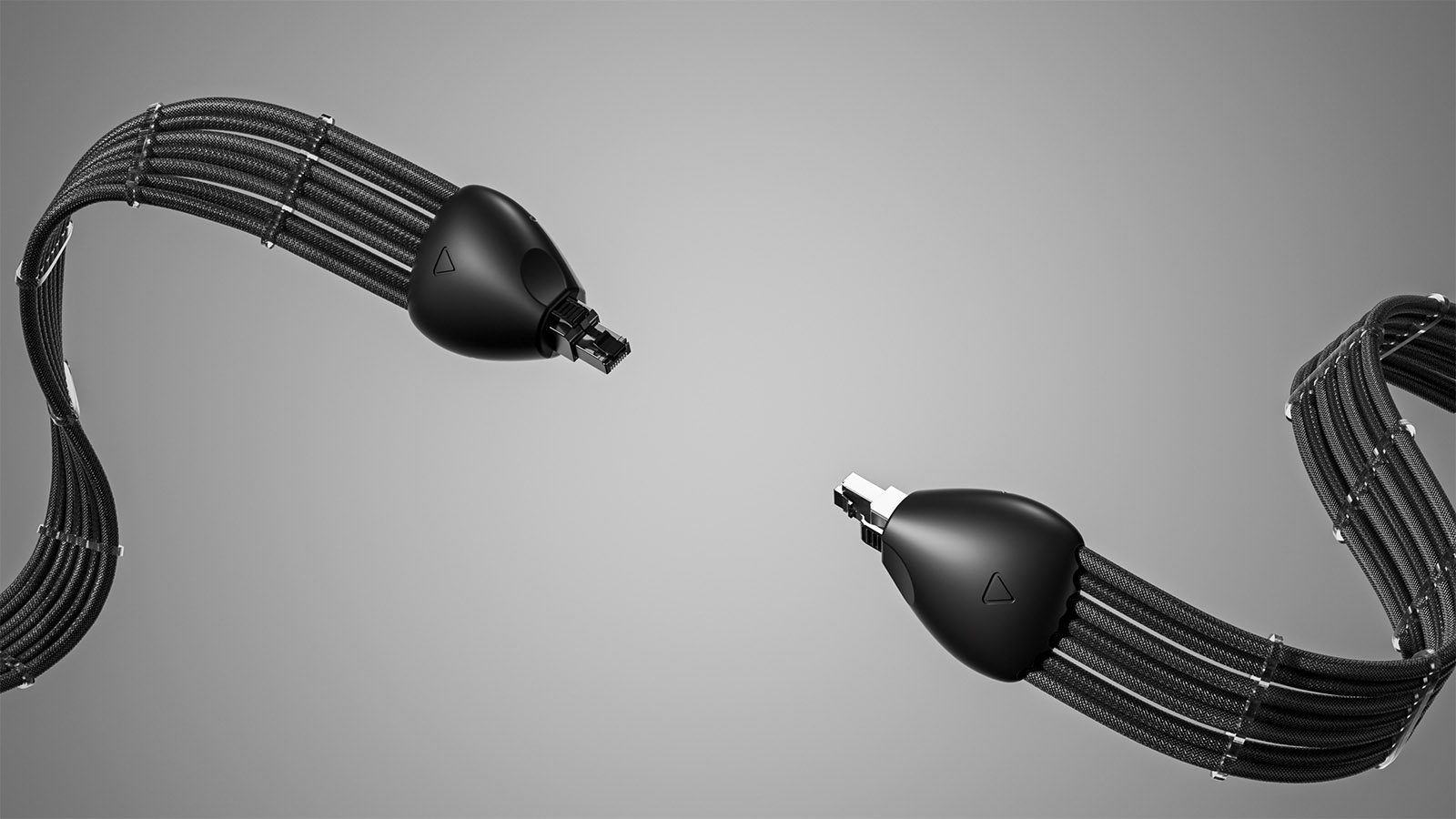
Albeit slowly, the high-end audio world often comes around to the notion that things make a difference. For example, when it came to power, it took a while for enthusiasts to realise that everything matters. From the Consumer Unit and cable in the walls, through to the power sockets, the terminations and cables… handled with due care and attention, they make a fundamental change to the performance of good audio. The same reluctant realisation is happening with networked audio now. Reiki Audio’s JundoStream Reference is at the forefront of this musical epiphany.
Being at this inflection point, we’re seeing a range of opinions about the ‘back office’ side of networked audio. These components connect the router or cable modem to the streamer, such as Ethernet switches and cables. Those opinions range from ‘this is nonsense on stilts’ to ‘my system is transformed’. JundoStream arguably garners more ‘flak’ than most because of its radical looks and layout. But that cable’s physical structure is the very thing that makes JundoStream so different and why it performs so well.
JundoStream is designed as the last link in the network chain, sitting between the switch and the streamer or DAC. You could use one before the switch, but it’s not essential. That’s useful because its design prevents it from being used in places where regular Ethernet cables can go.
Audiophile-chummy
Every other Cat-compliant bi-directional Ethernet cable or directional audiophile-chummy Network cable uses four adjacent foil-wrapped twisted pairs of conductors, with a braided shield around the whole cable. Inside such a cable, there’s a trade-off between RFI noise rejection and crosstalk. The higher the twist rate of a pair of conductors, the greater the noise rejection. However, conductor pairs must use different twist rates to prevent excessive contact between adjacent pairs which would lead to crosstalk ie. actual data corruption. That also means only one of the twisted pairs ‘wins’ in the game of RFI rejection.
Reiki Audio takes a radically different approach. Each twisted pair of cables has the highest possible twist rate that delivers RFI rejection performance above that of Cat 8 cable, yet is physically separated from the other pairs to reduce crosstalk. This requires three air-filled silicone spacer tubes and a large, flat layout unlike any other cable. It can only be assembled by hand. As a result, JundoStream is significantly more expensive than other high-end designs to date for an Ethernet cable.
Each of the four conductors uses silver-coated copper wires in a PTFE dielectric. Each twisted pair also includes a ground wire. All three are then shielded with a 100% coverage aluminium foil shield, a protective polymer layer, a second shield of copper braid with 95% coverage, an anti-vibration silk braid, and an outer PET anti-abrasion braid. The four conductors and three spacer tubes are laid side by side in a flat cable. They are held in place by strategically placed acrylic ‘combs’ to maintain the correct spacing. This terminates in a custom-made seven-into-one plug. Then it connects to an RJ45 connector.
It’s big!
The cable’s physicality is the sole source of criticism of the Reiki Audio JundoStream. It’s big! Necessarily so, but its funnel-shaped cowl may make access a bit tight for those with tightly packed rear panels. You should also leave a few centimetres of JundoStream straight at both ends. This helps reduce strain on the cable or the terminator.
JundoStream serves as a ‘proof of concept’ for a wider Reiki Audio network system, but there’s a caveat. While JundoStream represents a significant step forward in audiophile network audio connectivity, it’s not a panacea. So this shouldn’t be the first step beyond off-the-shelf generic network infrastructure. It’s more for someone who has already explored the improvements that can be made with more carefully aligned networking components. They might want a glimpse of the ultimate.
If anything, JundoStream should be the icing on the cake for the Reiki Audio network. In the real world, many will be drawn to that distinctive-looking cable, even over the more foundational SuperSwitches (which we looked at in Issue 222). In other words, Reiki Audio’s JundoStream is not your first network audio rodeo. Regardless, we predominantly (but not exclusively) used Reiki Audio’s JundoStream with an Innuos ZENith Next-Gen (reviewed in Issue 247).
Alarm clock!
I mentioned the audio world waking up to network infrastructure for a reason; this is the audio world’s alarm clock! If you are sitting on the fence about how big a difference such cables can make, a few minutes with Reiki Audio’s JundoStream in the mix will convince all but the most resolute naysayers. There’s usually a difference between stored and streamed music, and many still feel there’s an even bigger difference between music played through a network and that played directly from a CD or SACD. JundoStream helps level the playing field. It narrows the gap between physical discs and streamed or networked music. It also makes online and ‘locally grown’ sound closer.
There’s a sense of musical expressiveness and passion that is so easily lost in the networked environment, and it is brought to the forefront here. That grey flatness of streamed music gives way to a physical ‘thereness’ of sound, usually the domain of a well-put-together disc-replay system. The musicians play more cohesively and sound less like they are ‘phoning it in’. It really doesn’t matter whether you are playing Mahler, Miles Davis or Metallica; that feeling of being closer to the musicians, and of musicianship being more prevalent, comes across perfectly with JundoStream. Yes, you can break this down into audiophile terms (there’s a more expansive soundstage, improved articulation across the board, and enhanced dynamic range), but ultimately, it’s a closer connection between you and the music.
I’ve heard CD holdouts criticise networked audio, saying it sounds like the difference between the band and a tribute act. With Reiki Audio’s JundoStream as the last link in the chain, you’re sitting in front of the real deal once more. Imagine what a whole Reiki Audio network system can do… but that’s the subject of a later test.
Price and availability
- Reiki Audio JundoStream Reference: from £3,900, €4,650, $4,350/
1m cable - Available in black or white
Manufacturer
Trending Articles
See all
By Alan Sircom
More articles from this author


Read Next From Review
See all
Eversolo T8
- Oct 13, 2026

Acoustic Energy AE Active
- Oct 13, 2026
Reiki Audio SuperSwitch X/Pro X PSU
- Oct 06, 2026

Audiobyte SuperVOX
- Oct 06, 2026