Welcome to a very special hi-fi+ Awards. Fate (and producing a dozen issues a year) has colluded to make this issue a combination of our 250th edition and our annual Awards special edition. We have scoured the last 12 months of issues to find the best products we’ve seen across a range of categories.
In the past, we had very fixed categories for our annual awards, but that doesn’t fully reflect the current shape of the audio industry. While some categories remain constant, others change and branch out into new avenues. For example, a few years ago, there were so few streaming integrated amplifiers that the category did not need to exist. Now, we have enough to make them distinctly different from integrated amplifiers, without the need for a streamer or DAC. It’s not that one has eclipsed the other; it’s not that one is obsolete and the other state-of-the-art. These are now two divergent lines of ‘integrated amplifier’ that demand their own Awards. To lump them all together as ‘integrated amplifiers’ does the reader no favours, as it adds to confusion rather than pointing out the best we’ve tested.
Similarly, we have sometimes found categories where new products were commonplace a few years ago have reached a zenith. Thus, the category hasn’t received as many new products this year. Portable Audio DACs are a fine example. There are doubtless new models coming soon, but there aren’t enough yet for us to choose an example this year.
Each year we say this, but it’s worth repeating. The best in each category may or may not combine to build the best systems. There have been many cases over the years of people buying an Award-winning source, amplifier, and loudspeakers only to find the pairing a sonic mismatch. Our view of our awards is that they are a finger pointing the way. That finger often points to a good dealer who can assemble a system around that component, blending it with other devices like a master cocktail mixologist.
This is also why we include Highly Commended products. Not everyone likes the same things, and not every component works beautifully with every other. Our Highly Commended products are the result of the audio world being so good at its job, picking the very best from the already excellent is sometimes a very nuanced decision. By including Highly Commended products, we introduce a wider selection of outstanding devices to your next shortlist.
Awards and celebrations
Combining this Awards issue with our 250th also means we get to think about past masters in audio. There’s an interesting question surrounding the best of the past with today’s finest products. How do they compare? I think in many respects, the outstanding products this year are as good as we can get at the moment. They hold no comparison with even the finest past glories of 26 years ago; things have moved so far forward.
Sonically speaking, the very best in digital audio today leaves everything from even five years ago in the dust, so looking back to the last century is almost not worth it. And while things might seem less clear-cut in other aspects of audio design, I still maintain that today’s audio outperforms nearly everything from the 1990s, and today’s best is the best you’ll ever hear. Hopefully, that trend continues, and the sound of good audio in five or ten years keeps getting better.
We’re still a long way from achieving sonic realism in the home, and even the best audio systems cannot fully replicate the whole live experience. But they get ever closer; the top-end has the drama, scale, detail and dynamics to take your breath away, but even the most affordable audio gets closer than ever now!
One thing is sure: your next hi-fi product is on the following pages of this magazine! I hope you enjoy the search for the best as much as we did.
Welcome to a very special hi-fi+ Awards. Fate (and producing a dozen issues a year) has colluded to make this issue a combination of our 250th edition and our annual Awards special edition. We have scoured the last 12 months of issues to find the best products we’ve seen across a range of categories.
In the past, we had very fixed categories for our annual awards, but that doesn’t fully reflect the current shape of the audio industry. While some categories remain constant, others change and branch out into new avenues. For example, a few years ago, there were so few streaming integrated amplifiers that the category did not need to exist. Now, we have enough to make them distinctly different from integrated amplifiers, without the need for a streamer or DAC. It’s not that one has eclipsed the other; it’s not that one is obsolete and the other state-of-the-art. These are now two divergent lines of ‘integrated amplifier’ that demand their own Awards. To lump them all together as ‘integrated amplifiers’ does the reader no favours, as it adds to confusion rather than pointing out the best we’ve tested.
Similarly, we have sometimes found categories where new products were commonplace a few years ago have reached a zenith. Thus, the category hasn’t received as many new products this year. Portable Audio DACs are a fine example. There are doubtless new models coming soon, but there aren’t enough yet for us to choose an example this year.
Each year we say this, but it’s worth repeating. The best in each category may or may not combine to build the best systems. There have been many cases over the years of people buying an Award-winning source, amplifier, and loudspeakers only to find the pairing a sonic mismatch. Our view of our awards is that they are a finger pointing the way. That finger often points to a good dealer who can assemble a system around that component, blending it with other devices like a master cocktail mixologist.
This is also why we include Highly Commended products. Not everyone likes the same things, and not every component works beautifully with every other. Our Highly Commended products are the result of the audio world being so good at its job, picking the very best from the already excellent is sometimes a very nuanced decision. By including Highly Commended products, we introduce a wider selection of outstanding devices to your next shortlist.
Awards and celebrations
Combining this Awards issue with our 250th also means we get to think about past masters in audio. There’s an interesting question surrounding the best of the past with today’s finest products. How do they compare? I think in many respects, the outstanding products this year are as good as we can get at the moment. They hold no comparison with even the finest past glories of 26 years ago; things have moved so far forward.
Sonically speaking, the very best in digital audio today leaves everything from even five years ago in the dust, so looking back to the last century is almost not worth it. And while things might seem less clear-cut in other aspects of audio design, I still maintain that today’s audio outperforms nearly everything from the 1990s, and today’s best is the best you’ll ever hear. Hopefully, that trend continues, and the sound of good audio in five or ten years keeps getting better.
We’re still a long way from achieving sonic realism in the home, and even the best audio systems cannot fully replicate the whole live experience. But they get ever closer; the top-end has the drama, scale, detail and dynamics to take your breath away, but even the most affordable audio gets closer than ever now!
One thing is sure: your next hi-fi product is on the following pages of this magazine! I hope you enjoy the search for the best as much as we did.
With a 30-year track record, the Norwegian Hegel brand has established itself as a significant player. It offers a range of well-regarded integrated and pre/power amps, plus a CD player and phono stage. I’ve had good experiences with their integrated amps/DACs/streamers in the past. Therefore, I was particularly keen to get my hands on the Hegel H400 streaming integrated amp, which replaces the old H390.
Although the external changes to the £5,900 H400 integrated amp with built-in streamer and DAC may be subtle – new knobs and slightly revised casework – there are significant changes beneath the surface. The main updates include a brand-new streamer with enhanced functionality and a completely new DAC, both based on those used in its larger counterpart, the H600. It also features an improved power supply and enhancements to the preamp section. Additionally, it comes with a new app. When I unpacked it, the unit was impressively heavy and felt well-made and finished, which is always the case with Hegel products.
Control freak
This dual-mono Hegel H400 amplifier packs 250 watts of Class AB power into 8 ohms. It also boasts a high damping factor of 4,000. Hegel says this ensures tight control over the drive units in your speakers.
Like all Hegel integrated amps, the H400 features a dual-mono layout. This provides separate voltage- and current-gain stages for each channel. It also has completely separate power supplies for the input, voltage gain, and current stages. The custom-designed Hegel transformer features dual power windings. These feed independent high-speed rectifiers and high-capacity power supply capacitors, all intended to reduce distortion and increase dynamic range.
Like its other integrated amps, the Hegel H400 includes Sound Engine technology, which uses adaptive feed-forward error correction. Feedback corrects the errors and distortions that occur at each stage of amplification. However, rather than applying global feedback by simply comparing output to input, Hegel uses local. This involves adaptive feed-forward error cancellation, which it says preserves the original detail and dynamics.
The streaming platform and DAC in the H400 are based on those in the H600. The DAC features the highly respected ESS 9038Q2M chipset. It also employs a new digital-to-analogue conversion technology known as synchronised upsampling. This, along with its Direct Master Clock technology, is said to minimise jitter and conversion errors. Hegel has also carefully considered its circuit board design to reduce noise.
Keeping it simple
The best description of the Hegel H400’s front panel is ‘minimalist’. The central display screen, which shows input and volume, is flanked by a rotary knob on the left for selecting your chosen input. Meanwhile, the right-hand knob adjusts the volume. Naturally, the remote control duplicates these functions. The rear panel includes one set of speaker connections, variable and fixed line-level outputs. It also has one balanced line-level analogue input (XLR), and two unbalanced line-level analogue inputs (RCA).
The H400 does not have a phono input so that that vinyl fans will need a separate external phono stage. The built-in DAC has digital inputs via three optical Toslink sockets, one coaxial S/PDIF socket, and one USB port. Hegel also provides a BNC DAC loop, allowing users to upgrade to a higher-quality external DAC at a later date.
Unusually, Hegel has intentionally excluded Wi-Fi from the H400. The unit connects to your network solely via Ethernet. As Hegel’s Sales and Marketing Vice-President, Anders Ertzeid, confirmed to me, this decision was made to prevent any chance of RF interference and noise from entering the audio circuits. This preserves the sound quality.
The Hegel H400 streamer supports popular streaming platforms, including AirPlay, Spotify Connect, Tidal Connect, Roon Ready, Google Cast, and UPnP. Users can control the amplifier directly through these services. The Hegel Control App also enables users to adjust playback volume and select a specific input. Furthermore, it provides access to internet radio and podcasts. However, it does not offer access to the Qobuz streaming platform, which is my preferred source of high-quality streaming music.
The H400 also supports multi-room operation through Roon, AirPlay, and Google Cast.
Oh so easy
I, for one, found the H400 easy to set up, and it was a pleasure to use. Rear panel connections have clear labels. Additionally, the front panel doesn’t overwhelm the user with information. It displays only volume and the selected input, and, under that, much smaller, the resolution of the chosen digital source material. Additionally, the Hegel H400 automatically recognises connected digital audio sources and switches to the correct input. Therefore, you don’t have to select the input manually.
I installed the Hegel Control App to see what it offered for internet radio and podcasts. However, if those are not of interest to you, you could certainly limit yourself to third-party control apps such as mConnect. I used mConnect because it allowed me to access Qobuz, which is not available on the Hegel app.
Sound quality
Eager to test it thoroughly, I inserted the H400 into my usual setup. The CD source was the excellent Audio Note CDT Five transport, paired with the company’s DAC Five Special. It drove either the Russell K Red150 Se or Audio Note AN-J LX Hemp speakers. The speaker cables were QED Supremus Zr, and all other interconnects were from Audio Note. I provided the streamer with an Ethernet signal through an English Electric switch box and a Network Acoustics eno2 network filter.
Another good integrated amp/streamer stood on standby. This served as a benchmark for assessing the H400’s competitiveness at its asking price.
I began by searching for some of my favourite tracks on Qobuz, using the mConnect app. First up was ‘Broad Daylight’ by jazz singer/songwriter/pianist Ben Sidran. I was immediately impressed by Hegel’s balanced presentation, grip, and effortless power. Sidran’s vocals were crystal clear and expressive, while his piano playing was effectively conveyed. Fast runs of notes were nimbly captured by the H400. The track flowed well, and the bass line was well-defined and tight. It was also rhythmically strong. The competitor amp/streamer had a warmer balance, was a little more ponderous in rhythm, and was not as open in the vocals or piano.
Stay jazzy
Continuing with jazz, I then played the title track from the Harlequin album by keyboard legend Dave Grusin and guitar virtuoso Lee Ritenour. Ivan Lins’s vocals in the intro were clear and open on the Hegel H400, while Grusin’s piano had excellent definition and space surrounding it. Ritenour’s guitar was fluid and well-defined in terms of voicing and note shape. The percussion and drums were snappy, tight and detailed. The H400 effectively conveyed the delightfully quirky rhythm of this track. I felt Hegel provided more insight into what each instrument was doing than my benchmark competitor.
Switching to CD as a source, I played a track from one of my favourite guitarists, ‘I Can See Clearly Now’ from Peter White’s Groovin’. Hegel conveyed White’s guitar sound very well, offering excellent insights into how he crafted each note. The percussion was crisper and easier to follow. Additionally, the reggae-style, lilting bass line was weighty and tuneful. I felt the H400 once again delivered a more detailed, clean, and open sound.
Open and expressive
I was keen to hear what it could do with female vocals, so I spun up ‘Get Here’ from Oleta Adams’s Circle of Life album. Her voice was very well conveyed on the Hegel—open and expressive—while the piano had excellent presence and definition. The bass line was well controlled and seemed a bit weightier and more purposeful than on its rival. The drums also had exceptional power and snap.
I briefly compared the H400’s built-in DAC to that of a well-respected mid-priced CD player. Its performance is impressive. In fact, if you have a CD player priced below £2,000 with a digital output, it is worth checking whether the H400’s built-in DAC might deliver better sound.
I also used the Hegel Control App to enjoy internet radio and podcasts, which alone makes the app worth downloading.
Compelling
I really liked the new Hegel H400. It is well-made, easy to use, and robust. It offers a clean, detailed, and musically compelling sound that lets you hear what’s happening in the music. Additionally, it conveys its emotional and rhythmic impact with remarkable ease. It features an excellent streamer and delivers impressive performance from CD sources. It’s a fantastic purchase at this price, and not including it on your shortlist would be a mistake if you have between £5,000 and £6,000 to spend on a streaming integrated amp.
Technical specifications
Type: Dual-mono class AB integrated amplifier with built-in streamer and DAC
Power output: 250 watts into 8 ohms
Analogue inputs: One balanced XLR, two unbalanced RCA
Digital inputs: One coaxial BNC, one coaxial RCA, three optical, one USB, one Ethernet
Digital outputs: One BNC
Line level outputs: One unbalanced fixed, one unbalanced variable
Streaming: Spotify Connect, Roon Ready, Tidal Connect, Google Cast
Right back from the first days of Linn loudspeakers, there have always been active models. From the original Sara and Isobarik through to the latest 360 flagship, Linn has always had active (formerly ‘Aktiv’, in Linn-speak) models in the range. However, the active models have also always been at the top end of the catalogue. The Linn 119 stand-mount loudspeaker, the replacement for the venerable Majik 109, is an active drive from the ground up.
In fairness, from the outset, the Majik 109 had an active loudspeaker option. However, it was more of a sideline. Also, in fairness, the Majik 109 was 16 years old when it was discontinued. Linn’s Aktiv technology required a lot more electronics in the chain. That wasn’t the trajectory for Linn’s entry-level loudspeaker of 2008. Times change, and technology has moved on. The 119 is far more ready for active power. The 119 driven by Linn’s Exakt technology is a core part of the company’s 2025 (and beyond) plans.
Changes
Linn’s Majik 109 used a 19mm fabric-dome supertweeter covering all frequencies above 6kHz. There is also a 30mm soft-dome tweeter covering 1.5–6kHz, and a 127mm woofer. The supertweeter and tweeter combination (sitting in front of a port) was known as the 2K array. It was derived from the 3K and 4K arrays in more up-market Linn loudspeakers. However, the development that went into the 360 flagship spelt the end of these arrays. The technology in that loudspeaker then filtered through the range, right down to the 119.
The enclosure’s size harks back to the original Linn Kan. This was Linn’s more tuneful, ‘can do’ response to the classic BBC LS3/5a. The 119 is almost identical in size to its predecessor. The Majik 109 is about a centimetre deeper. Both are bass reflex designs. Where the 109 used its front ‘scoop’ for its port, the 119’s rear-firing port needs a little more ‘breathing room’. However, foam bungs are provided for use against a rear wall.
As in the 360, the supertweeter is history. The 19.55mm Sonomex dome tweeter sits behind a tweeter guard styled like the Linn logo. A 160mm Nextel-coated paper mid/bass unit also joins the party. This makes a loudspeaker that’s weighing in at a shade over seven kilogrammes. That makes it almost two kilos heavier than its predecessor. The price has increased, too.
Active or passive
The 119 can be provided in active or passive form straight from Linn’s Glasgow factory. Alternatively, passive loudspeakers can be prepped for active use at a Linn dealer. In theory, the move from one to the other could be performed in situ. It’s even potentially ‘doable’ by a customer if they’re very distant from their dealer. It’s not a complex upgrade (mostly involving the careful removal of a crossover), but Linn’s famed attention to detail puts the upgrade in the hands of professionals.
The more complex part is the change to the amplifiers. Traditionally, this called upon a series of model-specific ‘Aktiv’ cards to be installed in a Linn amplifier. However, today all it takes is the regular all-purpose power amplifier cartridges, which are then programmed using software to teach them which drive unit on which model of speaker their output is tailored. You need cartridges for each driver, of course.
Linn has stopped using terms like ‘Majik’, ‘Selekt’ or ‘Klimax’ for its loudspeakers, reserving those names for LP12 turntable variants and electronics. At present, an Exakt active upgrade is beyond Majik-level amplification, but the Selekt DSM is such a flexible platform, it lends itself to the process.
A quick Selekt DSM recap is in order. With two different finishes, the choice of three DAC options and four levels of amplification – from ‘none: streamer only’ to ‘multi-channel home cinema amplifier’, the Linn Selekt DSM is the company’s ‘Flexible Friend’ (citing a popular credit card TV advert from the late 1970s that ran until 30 years ago doesn’t date me, oh no).
It’s hammer time!
I’m no stranger to an Allen bolt. However, I think casually mentioning that most things can be ‘fixed’ with a hammer is why Linn sent me two of everything. Linn sent two pairs of 119s and two Linn Selekt DSM integrated amplifiers/streamers. One set was purely passive; the Selekt DSM had a standard stereo amplifier cartridge, and the 119s had passive crossovers. The other moved the crossover inside the Selekt DSM, doubling the number of amplifier modules inside the amp in the process, with the 119 configured for active drive.
The Selekt DSM is a known quantity to hi-fi+, having tested the streamer only version in Issue 164. The amplifier modules are 50W/8Ω, 100W/4Ω Class D designs. However, while these amp modules were not tested in the previous review, Linn’s overall musical presentation remains the same; these are extremely clean, tight and muscular amplifiers with a characteristic ‘dry; like a martini, not a desert’ sound. There’s no artificial richness or warmth here, but the sound isn’t cold or dead. It’s just that Linn places the demands on the recording rather than the electronics to create any sense of lushness or legato-like flow to the music.
In search of space
The Linn toolkit includes Space Optimisation, which allows the listener or installer to enter room parameters and characteristics and apply correcting DSP to the output of the amplifier. This differs from the room correction provided by companies such as Lyngdorf/Steinway-Lyngdorf or Trinnov because it doesn’t use microphone measurement to provide the room compensation. It instead relies on inserting room size, construction, the presence of windows and doors, furnishing and the position of the loudspeakers to build a sophisticated ‘4D’ model of the room.
In an ideal setting, the listener sits at the apex of an isosceles triangle in a slightly non-parallel rectangular room, in the real world sometimes that’s impossible. Maybe room or domestic demands mean that triangle becomes more scalene or even obtuse. Maybe one loudspeaker needs to be closer to the rear wall than the other. Or perhaps you sit in the corner of a large L-shaped room. By entering those parameters into the Manage Systems webpage, you can accommodate almost any limitations. Moreover, even in ideal conditions, Space Optimisation works well. Switching it in and out clearly removes some of the overt bass booms and cuts in most rooms and simply makes the room less of an impactful element in the overall sound.
Mild but wild
Space Optimisation’s DSP impact on music is mild, too; it trades a little bit of temporal precision for a better in-room performance and unless most of your listening is the glitchy rhythms of Autechre or Squarepusher, it’s a trade-off you’ll happily accept. And in the 119, it also means you don’t need to use bungs in close-to-wall settings.
There are also some Custom Filters buried deep in the Advanced menus of the configuration settings. While these can tailor the tonal balance of a pair of loudspeakers, they are buried for a reason; they aren’t tone controls. Think of them as slightly more useful than that weird package-carrying hook thing on a Swiss Army Knife.
The 119 is the perfect partner for the Selekt DSM. The loudspeaker is extremely detailed and open sounding, with excellent bass. Even without Space Optimisation in place, they more than deliver the goods. They also deliver a surprisingly big and articulate sound, both in terms of soundstage and just sheer scale. Unless you are listening in an aircraft hanger of a room, if you close your eyes and listen, at no point will you get a sense of a stand-mount loudspeaker in the room. In fact, you’d lay bets you were listening to a far larger three-way design.
Energetic
It’s a clever combination of an energetic yet not over-enthusiastic sound. It gets under the skin of the music, whatever music you’re playing. However, ‘fun’ loudspeakers are often ‘inaccurate’ loudspeakers and that’s not the case here. This is an extremely accurate, transparent and faithful representation of the music, with exceptionally deep bass. While clearly made for Linn’s own amplification, I used it to great effect with amps like the Primare I35 Prisma, too. That deep bass, articulate and big sound shone through regardless.
Musically, it took everything I threw at it with aplomb, whether the amplifiers had the Linn logo or not. The precision shone through when playing string quartets, such as ‘Entr’acte’ by Caroline Shaw and the Attica Quartet [Orange, Nonesuch]. Sometimes with two-way stand-mounts, this music can get a little lost, sounding cerebral and nothing more. The 119 brings out the emotion and ‘juiciness’ of the music (juice factor has nothing to do with the orange on the cover, honestly). Play something swampy and ZZ Top shaped, or complex hip-hop like ‘Homerton’ by Loyle Carner [Hugo, AMF] and you are met with the same detail and precision, but the vibe always remains powerfully present.
While we never reviewed the Majik 109, I always had a soft spot for its fast and fun performance. But the 119 makes its predecessor sound flat and drab. The combination of detail and energy puts the 119 at the top of the ‘bookshelf’ or ‘mini-monitor’ tree. More importantly, this means the 119 passes the golden rule of active loudspeaker design; don’t try make a mediocre design better with an active crossover and amplifiers. The Linn 119 has all the right elements in place in its passive design, so it bodes well when suitably ‘beefed’.
Such a little jump
Moving to active with Exakt technology seems like such a small physical jump. The bi-wire terminals at the rear of the 119s become direct connections to bass and treble, and an extra cartridge slot is filled at the back of the Linn Selekt DSM. In fact, if you use Linn’s own K40 bi-wire cable, unless you take a close look at the terminations at both ends, you could easily pass the upgrade off as a product recall or repair. This gets closer than ever to that elusive ‘invisible upgrade’ that every audiophile in history has tried – and usually failed – to get past their partners. However, once you get the active system in place, the ‘invisible upgrade’ switches to ‘what did you just change?’ in that accusatory ‘that sounds like you spent holiday-grade money on the hi-fi’ tone.
Active 119s call on a series of Exakt filters in the ‘Manage Systems’ part of the user configuration webpage. This shapes the Exakt engine within the Selekt DSM and allows some degree of fine-tuning of the 119’s profile. These don’t change the fundamental characteristics of the loudspeaker but can highlight one of its strengths or go for a more balanced presentation.
Going Exakt takes Space Optimisation to Space Optimisation+ levels, which takes the timing control down to the more granular level of per-driver control. Put simply, it simultaneously makes Space Optimisation do its job a little better while making those minor temporal effects on the music shrink to close to zero.
Practical application
All of which would be nice in theory, but the practical application in the Linn 119 is stunning. The loudspeaker effectively disappears, acting like a point source in soundstage terms and a direct injection of music into your head in all other aspects. Suddenly, the passive 119 sounds like it was dynamically compromised. It wasn’t, but the degree of snap and focus to the sound coupled with a performance that sounds like most of the loudspeaker got out of the way that Exakt Aktiv brings to the party is hard to miss.
It’s not simply extra information – although play any Rolling Stones recordings from this century and you can almost hear the crepitus in Keef’s arthritic hands. Nor is it just extra dynamic and volume headroom – although playing Mogwai at a fair lick can loosen fillings at 30 paces. It’s the level of musical communication the Exakt-configured 119s bring that takes a great loudspeaker and transforms it.
All the V’s
Music here is a vivid, vivacious and visceral experience. Listen to one of Nick Cave’s more harrowing albums and those emotions run deep. You could turn the most hawkish person you know into an anti-war campaigner if they spent an hour with these speakers and Polly Harvey’s Let England Shake [Island].
Exakt takes the good basic formula of the Linn 119 and shows what that loudspeaker is capable of. And, it turns out, that’s quite a lot! And there’s no going back – I tried switching back to the passive Linn Selekt DSM and 119 and, while it was still an excellent performer, it had lost that magic that active drive delivered. Could I still live with the passive version? Absolutely, but having had a taste of what they can do, the mental gymnastics required to move back to passive are too great. This means be careful of Yoda-ing yourself in the demonstration: “Do, or do not. There is no ‘try’.” If you have an active demonstration, be prepared to have active loudspeakers. It’s that simple.
Nit-picking
The downside with active is nit-picking at best. It locks you into a Linn ecosystem and specifically an ecosystem that includes the Linn Selekt DSM integrated amp. Yes, there are active crossovers (I’d be interested to hear this through the Kudos Audio Sigao Drive and other amplifiers, for example). Still, you lose Space Optimisation+ and other options in the process. In addition, doing so with third-party electronics would likely drastically raise the cost of amplification, making the exercise difficult to justify on economic grounds. However, sonically speaking, the Linn 119 is more than up to the task. And that’s the point; the Linn 119 is capable of pushing the limits of what you can expect from a two-way stand-mount of this size, to the point where everything else in the system gets really expensive, to keep up.
The 119 could be the gateway into that Linn ecosystem. This is an excellent passive two-way stand-mount loudspeaker – one of the best, in fact. Many will use the 119 at the end of decent electronics from other brands. For some, the temptation to switch to active is going to keep getting under their skin. Sooner or later, they’ll hear how far Exakt has raised the bar. Even if they don’t make the jump at that point, they’ll probably opt for a Linn Selekt DSM. That way, the option is open for the future. Then, it’s just a short hop to Exakt active drive. That’s it; you’re a ‘Linnie’, and you are picking out the finish on your LP12 plinth. Best of all, you’ll do all this with a big smile on your face. All thanks to the music the 119s make.
Standard features: Utopik Power Supply, Wireless Streaming via WiFi, Bluetooth and AirPlay 2, Support for FLAC, Apple Lossless, WAV, DSD (64/128/256), MP3, WMA (except lossless), AIFF, AAC and OGG at up to 24-bit/384kHz resolution, MM/MC Phono Stage, Analogue Input (RCA Pair), Space Optimisation, Exakt Ready
Standard inputs: Ethernet, HDMI ARC, Toslink S/PDIF and coaxial S/PDIF (in/out, configurable), USB Type B, RCA line level, MM phono, MC phono
Standard outputs: HDMI 2.0, Exakt link, RCA subwoofer out, ¼” headphone jack
Amplifier sections: 100W into four ohms (Class D) modules
The Deer Head Inn is situated the Delaware Water Gap close to the border between Pennsylvania and New Jersey and seems an unlikely place to find a famous jazz venue, it wouldn’t be so well known if it weren’t for a Keith Jarrett, Gary Peacock and Paul Motian performance in 1992. It was the first place where Jarrett played his first gig as a leader in 1961 at the unlikely age of 16, such is the way of the prodigal. At theDeer Head Inn was up until now the only performance released by this particular trio, and according to Jarrett “Not only had I not played piano at the Deer Head for 30 years, but I hadn’t played with Paul Motian for 16 years. So, it was like a reunion and a jam session at the same time”.
In this era, the majority of Jarrett’s performances were with the so-called Standards trio with Gary Peacock on bass and Jack DeJohnette on drums. Still, for reasons unmentioned, Paul Motian stood in on this occasion. Motian, you may recall, played with Bill Evans’ most celebrated trio alongside Scott LaFaro and was in Jarrett’s American quartet with Dewey Redman. Motian brings a different flavour to the table, which must, in part, be why this was such a successful date.
The Old Country – More from the Deer Head Inn is, as the title suggests, a second volume of performances from this September 1992 date and takes its title from a rarely heard Nat Adderley tune. All the titles on this release are standards, albeit some are more familiar than others; it’s not hard to hear why the set opens with Cole Porter’s ‘Everything I Love’. The playing is inspired in its verve, and the musicians are clearly having a whale of a time. Not least Jarrett, who soon lets rip with brilliant improvisation that is full of joy. The energy and excitement are infectious, and you can’t help but be carried away.
Jule Styne’s ‘I Fall in Love Too Easily’ follows with a beautiful solo piano intro that brings intimacy to the fore; it’s interesting to contrast this sound with that on the recent Tord Gustavsen Trio release Seeing, which is naturally a much more pristine studio recording. Yet, the quiet playing here is somehow enhanced by its live nature, which gives it more poignancy and charm.
Monk’s trademark tune ‘Straight No Chaser’ follows with high energy and a great live sound that can’t quite disguise Jarrett’s ‘yodelling’, he clearly can’t stop himself from joining in when a tune is swinging so fluently. Once again, he illustrates the piece precisely before following his heart and digging deep into the groove. Unlike some of the more navel-gazing players, Jarrett takes the listener with him, and soon the ‘vocals’ become irrelevant because the spirit of the piece is so well communicated. There is a bass solo on this number, and thanks to Peacock’s skill and the positivity radiated throughout the piece, it fits right in.
‘All of You’ is another Cole Porter number, which has a gentler feel and a sweetness that suits the title. It’s a piece that could all too easily become schmaltzy, but this trio stay on the right side of the divide and reveals its inner soul. The title track is a clear standout among a robust selection of eight pieces. It features some beautiful piano and fabulous accompaniment, but it’s the quiet middle eight that really grabs you.
‘Golden Earrings’ is a down-tempo tune where there’s space for the atmosphere in the room to reinforce the live feel and likewise to hear the nuances of Peacock’s double bass playing. It’s one of those tracks that makes you appreciate just how good these musicians are at listening to one another. There is a rare synergy, yet the rhythm players here were relatively unknown to each other. This tune draws you into its intricacies rather than having your feet dancing, and this makes for a good contrast to the earlier numbers.
The Old Country – More from the Deer Head Inn is an excellent performance, superbly captured and sounding remarkably fresh considering its vintage. Jarrett is clearly in his element and sharing the love with both his bandmates and the small audience. It’s not hard to hear why the venue was so full and that people were standing outside the building to get an aural glimpse of greatness in action.
World Machine, the sixth studio album by Level 42, was the record that changed everything for the British jazz-funk-pop band fronted by singer and slap-bass legend, Mark King.
Released in 1985, it broke them internationally and was a hit on both sides of the Atlantic – the single, ‘Something About You’, one of their most successful songs, reached number 6 in the UK and the top 10 in the US.
The follow-up single, the ballad ‘Leaving Me Now,’ was also a UK hit.
To celebrate the 40th anniversary of World Machine, the group embarked on a 28-date tour of the UK, during which they played the album in its entirety, as well as other songs from their impressive back catalogue.
hi-fi+ spoke to King, who was in his home studio on the Isle of Wight, where he was born and grew up, about just how vital World Machine was for the band’s career and asked him to share some of his earliest musical memories and influences.
SH: This year, you’re celebrating the 40th anniversary of World Machine. How does that feel?
MK: It’s great that this article is for a hi-fi magazine because World Machine was very high fidelity – there was no expense spared in production techniques. We were always ‘go ahead’ in the studio – we used the latest technologies that would make the audio quality extremely high.
We had a great team, with our co-producer, Wally Badarou, and our fantastic engineer, Julian Mendelsohn. We recorded at some of the best studios in town – Sarm [West], Red Bus Studios…
For World Machine, you worked at Maison Rouge Studios, in Fulham…
Yes – that was great. We had such a nice time there that we did a lot of the work for the follow-up album [Running in the Family] there too.
What was great about Maison Rouge was that it had a bar and a bistro in the lobby.
During the World Machine sessions, we were all in awe of the fact that the great John Barry was in there, working his way through a bottle of brandy, which was extremely impressive to us. I’m a big John Barry fan.
World Machine got to number three in the UK albums chart, but also made number 18 in the US Billboard 200. It was an important album for you because it broke you internationally, and it took you into the mainstream…
It did – and we meant to do that; it was planned. We’d just got to the end of our initial contract with Polydor – we’d been bouncing along quite happily, but we’d always be doing maybe 60,000 copies in a territory, excluding America, which was somewhere we’d found quite hard to get a foothold in.
I don’t think they really knew quite what to do with us or what we were about, and, more importantly, we hadn’t delivered the music that they could run with and would be attractive to them.
That was uppermost in my mind, and I remember talking to Wally Badarou about it and I tried to explain it to our then manager, John Gould, but he wasn’t quite on the same song sheet as me.
I knew that we had to focus on making our music more broadly appealing – some people said that it was self-indulgent, but we didn’t see it that way.
In hindsight, I can understand why people might have thought that, because there were instrumentals… but that’s what we did.
We were players and that’s where we came in, but if we wanted to move on, we had to smell the coffee, as somebody said back at that time, and try and come up with something.
Now, that’s easier said than done – I’d defy anybody to say, ‘Right – I’m going to go and write a hit record…’
Well, maybe Amy Wadge and Ed Sheeran could knock one out…
It certainly wasn’t easy for us, but we did it. We had a chordal run up to a chorus that Phil [Gould – drummer] had been suggesting while we were writing – it had been hanging around and it suddenly came of age… That became ‘Something About You’, then Boon [Gould – guitarist] delivered a wonderful lyric, and I was able to chuck in what became the verse melody and chord sequence – it was a real group effort.
When we’d written that song, I think we all felt that there was something different, and once we nailed that, it opened the floodgates to write other things, like the ballad, ‘It’s Over’, [from Running in the Family] because we were so much more open to ideas. It worked out great and it changed everything – Polydor signed us for another five years. Job done, really.
Have you got a favourite song on World Machine?
The title track is a fave, and I’m seriously looking forward to focussing on getting the tour ready. I always put a lot of time into creating the set and the arrangements of the songs. Obviously, we’re going to be playing all the songs from World Machine…
Will you play them in the order they’re on the album?
I don’t know, as I haven’t really started on it yet. I’ll find out if that’s going to be the best running order when I string it all together.
The album itself is only 45 mins, but with the technology that’s available and the ideas that I’m inspired by and want to expand on with those tunes…
The track ‘World Machine’ is going to be a great intro song for the set, so I’m 99% sure it’s going to start with that, because I can really develop it. Who knows? You might be sitting there 15 minutes into the gig and we’re still playing ‘World Machine…’ We’ll see how it goes.
Even though there were commercial pop songs on World Machine, there were still some nods to your jazz-funk roots, like the track ‘Physical Presence…’
There were. That’s a bass and guitar riff … a really loping thing… and it’s a pretty classic Level 42 track in that respect.
Going back a few albums before, we had a song called ‘Kansas City Milkman’ that is kind of similar. I was probably looking for another ‘Kansas City Milkman’, as it always worked great… What is it they say? If it ain’t broke, don’t fix it.
You’re constantly touring, but the last new music you released was the Sirens EP in 2013…
I still noodle – I’m talking to you now, sat in my studio, and I’ve got my trusty old bass here, which is the first bass I ever had – the old girl, as she’s called.
I pick it up, stuff comes, and I get inspired, but I don’t get inspired as much as I did back then, because we’ve kind of done it.
I know that if I’m going to go out live, we’ve got such a good catalogue of songs that it would be remiss of me not to deliver those to the fans that are coming to see the shows, because they will want to hear them. They don’t necessarily want to hear what a 66-year-old, comfortably off guy is going to come up with… Is he going to write a song about his Tesla, or something? I’ve got enough songs in the bag…
If you go and see Bob Dylan, I’m sure you want to hear the great songs that he’s written and not necessarily hear what his take is on things now. I think we all know what his take on things now would be – Trump’s a w*****, etc, etc.
Do you get a lot of young people at your gigs?
For sure – that’s why we’re still able to go out, and business gets better. I can assure you that our promoter, AEG, would not be booking us if business was dropping off. That’s not the way it works. We just do better and better business. In November, we played to over 5,000 people at Indigo at The O2.
How do you listen to music? Are you a hi-fi person?
I would love to say, ‘oh, yeah, my Linn Sondek and all the gear is set up…’ I’m terrible. How do I listen to music? Mainly in the car. In all my years of working in studios, mastering and everything else, the best way to hear music back is in a situation that everybody else is going to hear it in. It’s quite rare that people are in the most pristine, wonderful, acoustic environment – nine times out of ten, you’ll be listening to music en route somewhere, in a car.
I guess you’re always travelling, as you tour so much…
Yes – exactly. When I’m listening to stuff, I’m always travelling. With Spotify, you can get anything at any time. That’s a wonderful thing to have, but, at the same time, it almost spoils everything because nobody is as interested in the idea of an album as a concept or a complete package anymore.
The last thing we recorded was Sirens – it’s an EP. I cottoned on to the fact that there’s not a lot of point in coming up with 12 songs… I’ve got six songs that I’m happy with, let’s go with those and if they go down brilliantly, we’ll write another six the next year.
People will just cherry pick anyway. On that EP, we had a song called ‘Build Myself A Rocket’, and, according to our PRS, it was the third most popular Level 42 song after ‘Lessons In Love’ and ‘Something About You.’
That was just incredible – what a bizarre selection. You would’ve thought it would be ‘Hot Water’, ‘Love Games’, ‘It’s Over’, or ‘Running in the Family.’ People just choose one track from the EP they like, and they download it, rather than the whole thing.
What are your earliest memories of hearing music?
Getting up one Christmas morning, when I was four or five, and my dad had bought my sisters a record player. They both had two seven-inch singles each – Rachael had The Rolling Stones and Belinda had The Beatles and something else… It was fantastic because they were the only records we had, and they got played to death. I found myself loving The Rolling Stones more than The Beatles back then, because I liked that whole blues vibe.
I think one of the records was ‘Little Red Rooster’ or ‘Not Fade Away.’ Having two older sisters was marvellous, because they had their finger on the pulse of what was happening, and I was getting exposed to it a lot sooner than my friends were. My first real love was Cream.
How did you get into jazz?
I was obsessed with drumming, and I absolutely loved Ginger Baker. Then, through getting Melody Maker and New Musical Express I got to hear about a guy called Buddy Rich and, when I was nine years old, boom, that opened up a whole new world. I saw him on a chat show and was blown away, and then I went down lots of other rabbit holes.
Welcome to a very special hi-fi+ Awards. Fate (and producing a dozen issues a year) has colluded to make this issue a combination of our 250th edition and our annual Awards special edition. We have scoured the last 12 months of issues to find the best products we’ve seen across a range of categories.
In the past, we had very fixed categories for our annual awards, but that doesn’t fully reflect the current shape of the audio industry. While some categories remain constant, others change and branch out into new avenues. For example, a few years ago, there were so few streaming integrated amplifiers that the category did not need to exist. Now, we have enough to make them distinctly different from integrated amplifiers, without the need for a streamer or DAC. It’s not that one has eclipsed the other; it’s not that one is obsolete and the other state-of-the-art. These are now two divergent lines of ‘integrated amplifier’ that demand their own Awards. To lump them all together as ‘integrated amplifiers’ does the reader no favours, as it adds to confusion rather than pointing out the best we’ve tested.
Similarly, we have sometimes found categories where new products were commonplace a few years ago have reached a zenith. Thus, the category hasn’t received as many new products this year. Portable Audio DACs are a fine example. There are doubtless new models coming soon, but there aren’t enough yet for us to choose an example this year.
Each year we say this, but it’s worth repeating. The best in each category may or may not combine to build the best systems. There have been many cases over the years of people buying an Award-winning source, amplifier, and loudspeakers only to find the pairing a sonic mismatch. Our view of our awards is that they are a finger pointing the way. That finger often points to a good dealer who can assemble a system around that component, blending it with other devices like a master cocktail mixologist.
This is also why we include Highly Commended products. Not everyone likes the same things, and not every component works beautifully with every other. Our Highly Commended products are the result of the audio world being so good at its job, picking the very best from the already excellent is sometimes a very nuanced decision. By including Highly Commended products, we introduce a wider selection of outstanding devices to your next shortlist.
Awards and celebrations
Combining this Awards issue with our 250th also means we get to think about past masters in audio. There’s an interesting question surrounding the best of the past with today’s finest products. How do they compare? I think in many respects, the outstanding products this year are as good as we can get at the moment. They hold no comparison with even the finest past glories of 26 years ago; things have moved so far forward.
Sonically speaking, the very best in digital audio today leaves everything from even five years ago in the dust, so looking back to the last century is almost not worth it. And while things might seem less clear-cut in other aspects of audio design, I still maintain that today’s audio outperforms nearly everything from the 1990s, and today’s best is the best you’ll ever hear. Hopefully, that trend continues, and the sound of good audio in five or ten years keeps getting better.
We’re still a long way from achieving sonic realism in the home, and even the best audio systems cannot fully replicate the whole live experience. But they get ever closer; the top-end has the drama, scale, detail and dynamics to take your breath away, but even the most affordable audio gets closer than ever now!
One thing is sure: your next hi-fi product is on the following pages of this magazine! I hope you enjoy the search for the best as much as we did.
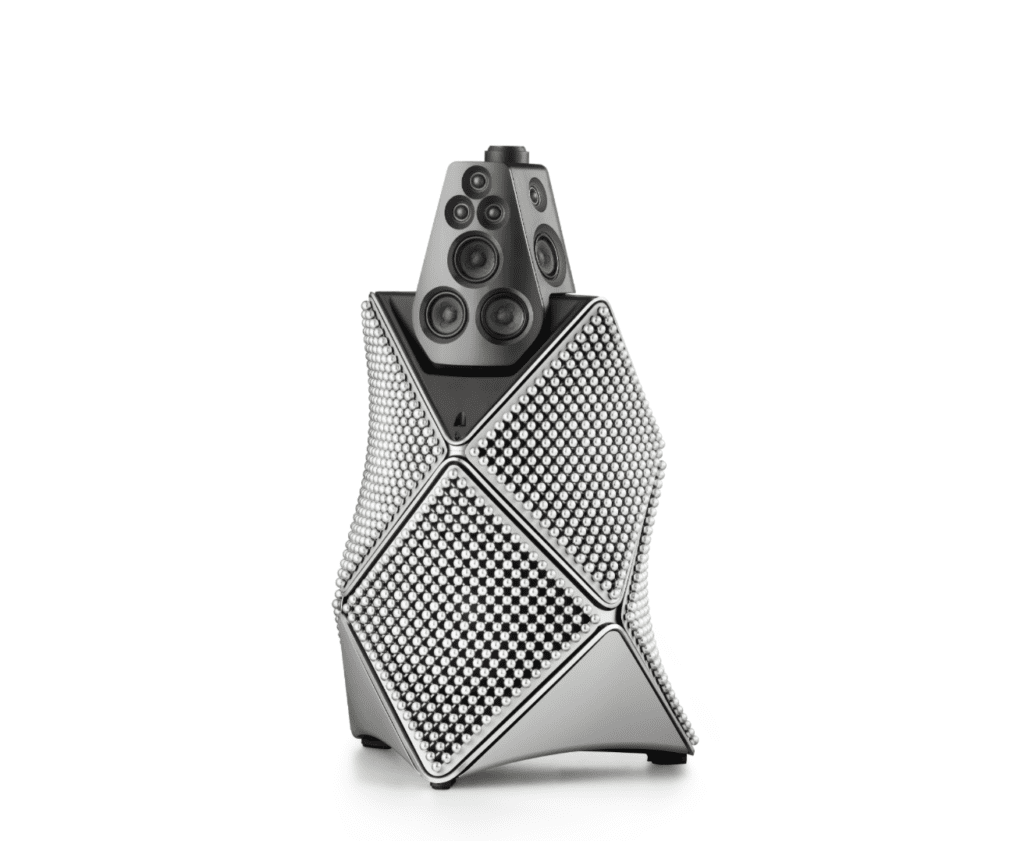
Struer, Denmark — 11 December, 2025 – In a world where sound becomes sculpture and colour becomes emotion, Bang & Olufsen introduces the next two masterpieces in its centenary celebration: Beolab 90 Phantom Edition and Beolab 90 Mirage Edition.
Following the Titan Edition, these two creations represent a rarified expression of Bang & Olufsen’s Atelier capabilities—transforming the brand’s flagship loudspeaker into bold statements of emotion, materiality, and colour.
Beolab 90 Phantom Edition: The Power of Darkness
The Beolab 90 Phantom Edition is a study in monochromatic drama and technical sophistication. Cloaked in deep black tones, the Phantom Edition channels the raw power of motorsport aesthetics into a sculptural form.
Key Design Highlights
Material Mastery Semi-transparent black PVD metal mesh reveals the speaker’s inner architecture, creating a holographic effect that changes with every angle.
Carbon Fiber Accents A sculptural face mask, base panels, and shoulder plates crafted from carbon fibre celebrate lightweight strength and motorsport-inspired aesthetics.
Architectural Details A pearl-blasted aluminium skeleton frames the acoustic mesh panels, while the unified aluminium structure integrates beams and knots into one continuous form, complemented by precision trim rings for refinement.
Every detail of the Phantom Edition has been obsessively engineered and hand-finished. Carbon fibre panels are layered by hand using a pure artisan process, resulting in a loudspeaker that feels both elemental and futuristic—a bold statement for collectors who seek purity in design and emotion.
Beolab 90 Mirage Edition: An Explosion of Colour
In stark contrast to the Phantom Edition, the Beolab 90 Mirage Edition is a celebration of colour, elevating Bang & Olufsen’s mastery of anodization and surface treatment.
Key Design Highlights
Electrifying Palette A hypnotic iridescent fabric dances between sapphire and magenta hues, echoing the fluidity of sound waves and the dynamism of light.
Gradient Aluminium Five precision-milled aluminium parts per speaker are anodized with bespoke gradients, complemented by wave-textured surfaces that echo sound ripples.
Artisan Techniques From manual polishing by master craftsmen to gradient anodization in Bang & Olufsen’s dedicated laboratory, the Mirage Edition creates a chromatic crescendo that celebrates individuality.
Unlike any other loudspeaker, the Beolab 90 Mirage Edition is a visual symphony—designed to captivate the senses and transform any space into a gallery of sound and colour.
The Second and Third of Five Masterpieces
The Beolab 90 Phantom and Mirage Editions mark the continuation of an extraordinary journey: five exclusive editions handcrafted by Bang & Olufsen Atelier to celebrate the brand’s 100-year legacy.
Each edition is produced in an exceptionally limited series of just ten pairs, accompanied by a certificate of authenticity that underscores its collectible status.
A Legacy Reimagined
Originally launched in 2015, the Beolab 90 remains the pinnacle of Bang & Olufsen’s acoustic innovation. Featuring 18 bespoke drivers and advanced beam-forming technology, it delivers unparalleled precision and power.
These Anniversary Editions preserve the legendary performance of Beolab 90 while elevating its aesthetic expression to new heights.
Unveiled in Bang & Olufsen’s San Francisco Culture Store
The Beolab 90 Anniversary Editions were unveiled at Bang & Olufsen’s new San Francisco Culture Store—the largest Bang & Olufsen showroom in the world and one of three Culture Stores opening in California during the brand’s centenary year.
The editions will tour globally, offering discerning clients an intimate encounter with the pinnacle of acoustic artistry.
11 December 2025: Few albums have defined an era and redefined a generation of pop music quite like FAITH, George Michael’s groundbreaking 1987 debut solo album. Nearly four decades later, its influence continues to resonate across music, fashion, and culture, an enduring testament to the artistry, courage, and creative vision of one of the world’s most beloved and successful performers.
To celebrate its continued impact and influence, George Michael Entertainment and Sony Music have announced that on 20th February 2026, multiple limited-edition FAITH vinyl variants will be available on Red + Black Marble vinyl, Picture Disc as well as 1LP and 2LP black vinyl plus audio Blu-Ray. More than a decade since FAITH has been available to purchase in vinyl anywhere in the world, today’s announcement marks an exciting new era for any avid vinyl collector and George Michael fan. Pre-order HERE.
Written, arranged, produced, and performed almost entirely by George Michael, FAITH marked the emergence of a new type of pop icon, an artist capable of blending soul, R&B, and rock into a sleek, emotionally charged, and deeply personal sound. The album catapulted the then 24-year-old artist to global superstardom, outselling Michael Jackson, Madonna and Prince, and earning him a GRAMMY® Award for Album of the Year, three American Music Awards and a record-breaking run of four U.S. No. 1 singles, including “Faith,” “Father Figure,” “One More Try,” and “Monkey.” All of which makes George the only British male solo artist ever to achieve four U.S. number-one singles from a single album on the Billboard Hot 100, a record that remains unmatched.
FAITH has sold more than 25 million copies worldwide, topping charts in over 10 countries, and cementing George Michael as one of the best-selling British solo artists of all time. Emerging as a defining anthem of its era, its title track with its instantly recognizable guitar riff and iconic leather-jacket-clad video became a cultural touchstone of the late ’80s, inspiring countless artists and defining the MTV generation.
Beyond its commercial triumphs, FAITH was a bold artistic statement. It showcased George Michael’s exceptional songwriting, vocal prowess, and meticulous production; a creative tour de force that challenged genre boundaries and redefined what a pop album could be. From the sensual introspection of “Father Figure” to the gospel-tinged power of “One More Try,” every track remains a masterclass in emotion and craftsmanship.
As the world continues to rediscover George Michael’s genius, FAITH stands as a monument to his brilliance, a timeless reminder that true artistry transcends decades. Today, its spirit lives on in the voices of artists inspired by his honesty, style, and unwavering individuality.
Made with care and respect for the planet: At every step in the process, aiming to minimise the environmental impact through sourcing sustainable materials and using environmentally responsible manufacturing methods, the vinyl was pressed on Biovinyl, a bio-based PVC derived from renewable sources instead of traditional petroleum-based materials. The packaging was manufactured using a combination of FSC-certified paper and cardboard from sustainably managed forests, and the artwork was printed using vegetable-based inks. The outer polybag is designed to stay with the album to protect it for eternity instead of disposing of it after the record is opened for the first time.
This album was manufactured at Optimal Media in Germany. For every album pressed, a contribution is made to their regional nature conservation project at Nature Park Nossentiner/Schwinzer Heide to support tree planting, forest maintenance and management. Optimal commits to resource conservation throughout its production process, minimises production waste to achieve 100% waste recycling within the company, and sources 65% of electricity from renewable sources.
The CD disc is made with 90% recycled polycarbonate and packaged in FSC-certified materials from sustainably managed forests, and the artwork was printed using vegetable-based inks. Manufactured at Sonopress who commit to ensuring their production processes are environmentally sound and aim to minimise energy consumption using combined heat and power in their production process to emit 52% less CO2 compared to traditional energy consumption in Germany.
One of the more subtle criticisms I’ve encountered among hi-fi enthusiasts is the idea of not being a ‘valve person.’ Some believe that a preference for solid-state amplification means sacrificing a certain implicit and fundamentally more analogue pleasure. Personally, I find this perspective somewhat simplistic. I often enjoy listening to vacuum tube products and have coveted several of them. However, the caveat is that the valve devices I prefer, which tend to have simpler circuits and lower outputs, don’t pair well with my favoured speakers, as they lack the necessary sensitivity. By the time a valve amp generates the required power, I typically lean towards the solid-state option.
Into this vacuum-tube-equipped counterpart to a Joseph Heller novel comes the PrimaLuna EVO 300 Hybrid Power Amplifier. This 100-watt output is designed to appeal to people like me. Although the speakers I enjoy are not particularly sensitive, they also do not gravitate towards the ‘drivers of solid granite’ approach that requires a power station to operate. The output is achieved through a combination of valves and solid state, striving to provide a ‘best of both worlds’ scenario.
Silver label sextet
As such, the new hybrid power amp’s front features a sextet of 12AU7 valves from PrimaLuna’s Silver Label range. These valves follow the same pattern as the integrated amp and are responsible for the amplifier’s input and driver functions. They also have their own power supplies and transformers to help them do their job.
The solid-state section to which these valves connect is an improved version of the one that first appeared in the EVO 300 Hybrid Integrated Amplifier. Designed in collaboration with Floyd Design – a collective of designers and engineers who have contributed to other PrimaLuna product – this power amp section combines Junction FETs, hand-matched transistors, and a double pair of MOSFETs for each channel.
This configuration gives the hybrid power amp a robust 100 watts into eight ohms, increasing to 150 watts into four ohms. Most prospective owners will find this sufficient, but the power amp, distinct from the integrated version, can take this a step further. It can be bridged and run as a mono amp with another EVO 300 Hybrid Power Amplifier, providing a strong 220 watts into eight ohms and 300 watts into four ohms, which should be sufficient for all but the most willfully power-hungry systems.
This amplifier section offers both RCA and XLR inputs, which feature high and low gain modes. At first, this decision may seem odd because the matching EVO 300 Tube Preamplifier is only equipped with RCA connections (though XLR outputs are available on the 400 model). However, this demonstrates sound thinking on PrimaLuna’s part. As many source devices increasingly function as preamps, a significant number of EVO 300 hybrid power amps will likely be connected to non-PrimaLuna preamps, ensuring compatibility with whatever you choose.
Standard language
Aesthetically, the EVO 300 Hybrid Power Amplifier embodies the standard design language of PrimaLuna, which is a positive aspect. By utilising a pattern of chassis components, the company can manage costs more effectively, resulting in an attractive and well-finished piece of equipment. The hybrid design means that there is somewhat less valve, causing the trademark curved valve cage to appear slightly truncated compared to its more conventional counterparts, and there is somewhat more ‘transformer’ at the back, which, in reality, is also the amplifier in this case.
It still matches well with an all-valve PrimaLuna preamp and won’t look completely out of place alongside other equipment. Internally, the shift to partial solid-state operation has not altered the straightforward approach to the power amp’s construction, featuring high-quality components arranged logically. The transition to solid-state hasn’t reduced the mass either, as the amp still weighs a hefty 31 kilos unboxed.
UK distributor Absolute Sounds supplied the review sample with a EVO 300 Tube Preamplifier (a device we have previously reviewed alongside the pure valve, non-hybrid EVO 300 power amp in Issue 177). Initially, I set them up together with the resident Kudos Titan 505 standmount, a speaker that might not be the best match for more conventional PrimaLuna offerings. Right from the start, this combination fulfills the fundamental premise of delivering a sound that incorporates a degree of ‘valve character’ along with the current delivery needed by a device like the 505.
Impact and confidence
What this means in reality is that the heroically overdriven guitar amp at the beginning of T-Rex’s Mambo Sun [Fly Records] is a huge and invigoratingly scuzzy sound that frames Marc Bolan’s sultry vocals. The vocals are underpinned by percussion with a very solid state level of impact and confidence. This is not the sort of bass that should make your vision wobble, but there is a heft and potency to the kickdrum that really only results from the Kudos being driven properly.
If you ask for more heft, particularly with regard to the brooding and majestic “Songs of Silence” by Vince Clarke [Mute], the PrimaLuna is still capable of delivering the force and scale of these electronic musings. Simultaneously, there is an almost liquid quality to the upper registers and a sense of three-dimensional space that often surpasses what exclusively solid-state options can provide.
The caveat to this happy balance of attributes is that a significant portion can be attributed to the preamp. I used the all-valve EVO 300 from the PrimaLuna range to great effect. However, if it is replaced with the resident Chord Electronics Hugo Mscaler and TT2 combination- an excellent preamplifier but perhaps the epitome of ‘unvalvey’- it alters the presentation of the power amplifier. This device remains an invigoratingly potent-sounding unit. It powers through the driving rock of Rival Sons’ Pressure & Time [Earache] with a confidence and dynamism that is very likeable, but the more delicate Blue Heron Suite by Sarah Jarosz [Rounder Records] loses some of its tangible presence and sweetness in the process. That is how a good power amplifier should behave; its performance remains constant, even if it is shaped by the devices that feed it.
Solid with a twist
If you reframe your view of the PrimaLuna as a solid-state amp with a unique twist, it starts to charm you all over again. While some of the glorious fluidity of the all-valve PrimaLuna designs is lost, what remains is an amplifier that balances a forgiving edge with a delightful ability to provide great fun when the moment arises. This is further enhanced by an impressively detailed retrieval of material, which is particularly evident when the extremely forensic Chord duo controls it directly.
It also retains the ability to work with speakers that are not usually a perfect match for a 100-watt solid-state amp. During its time here, the PrimaLuna ran with the Tannoy Turnberry GR-OW, and the result sounded happier and more cohesive than when the Tannoy was connected to a Cambridge Audio Edge A, another solid-state amp boasting 100 watts. At times, it feels like the PrimaLuna hasn’t forgotten how to generate the emotional response akin to that of a valve amplifier, even if it isn’t technically a valve amplifier anymore.
Chameleon
It’s this chameleonic character that makes the EVO 300 Hybrid Power Amplifier so likeable. I believe it serves better as a power amp than as an integrated. When paired with the company’s matching preamps, it offers a genuine ‘best of both worlds’- a presentation convincingly infused with vacuum tube richness and a level of power delivery that surpasses most pure valve solutions.
Outside this pairing, it becomes a characterful yet highly capable device that, while perhaps not as identifiably valve-infused as it is with the preamp, still offers a presentation intriguingly distinct from most solid-state amps and is compatible with speakers that some of those designs simply won’t mesh with. I might not ever be a natural ‘valve person,’ but I recognise clever applications of the technology when I see them, and the PrimaLuna EVO 300 Hybrid Power Amplifier is indeed a very clever one.
Graham Audio is renowned for its modern recreations of both popular and lesser-known BBC loudspeaker designs. Under the guidance of Paul Graham and designer Derek Hughes, whose family lineage traces back to very beginnings of the BBC loudspeaker concept, Graham Audio has produced domestic versions of some of the finest loudspeakers from the late 1950s to the early 1970s. It has also expanded these designs into newer models. Additionally, there’s the VOTU, or ‘Voice of the Universe’. The original model, launched in 2018, was an offshoot of the SYSTEM3D ‘effect fill’ loudspeakers created for the Royal Opera House in London. The new VOTU Mirama floorstander elevates that design to a new level.
From the outside, the VOTU Mirama appears to have little in common with traditional BBC design. A closer inspection reveals this is not the case. The lessons learned from reviving the LS5/5 extend beyond a sizeable stand-mount monitor loudspeaker conceived in 1967.
Derek’s pen
As with all of Graham Audio’s designs, the VOTU Mirama is from the pen of Derek Hughes. Derek is perhaps the last direct link with the loudspeaker engineering section of the BBC Research & Development team in Kingswood Warren. His father, Spencer, alongside designers and engineers such as Dudley Harwood, helped create those classic thin-walled monitors so closely associated with the BBC. Although their legacies have been passed down to subsequent generations of loudspeaker designers, that straight family link is gone in most places. Derek is the last of the line.
The last version of the VOTU and this are very different, suggesting Derek’s pen still has a lot of ink left to give. Yes, the link to SYSTEM3D is still there, but it’s a more distant link than its predecessor. Where the predecessor was an integrated unit, the VOTU Mirama uses two connected cabinets. This is a thoroughly wise idea given the full VOTU Mirama stands 164cm tall (or one Daniel Radcliffe in imperial measurements) and weighs in at a beefy 110kg (242lbs or 17st 4.5lbs in old money).
Sealed upper
The head unit or upper cabinet has is a sealed box, featuring a high-power 13cm ribbon tweeter and a 165mm polypropylene midrange unit. This upper cabinet is slightly larger than one of Graham Audio’s LS5/9 loudspeakers, turned on its side… that gives you some sense of scale to this loudspeaker. It has a flying lead that connects it to the crossover network housed lower cabinet. The cable is terminated in a professional grade Neutrik Speakon connector.
This cabinet is also fitted onto the bass cabinet with rubber feet in recesses to give accurate positioning of the cabinet, together with reducing acoustic coupling between the two cabinets. There’s no need for a tilt test here; given the height of the top cabinet and the overall mass of the loudspeaker, once fitted the only way that top-box is going to detach itself from the lower cabinet is if the words ‘ramming speed!’ get uttered first.
This lower cabinet is a game of two parts. The upper section houses two 250mm bass drivers in their own sealed chamber. Below this sits a 450mm sub-bass unit in a ported chamber with a front-firing port. Theoretically that means you could use the VOTU Mirama closer to the wall, but in a loudspeaker this big and bold, boundary installations are unlikely to be on the cards.
Sink in
Let that last number sink in for a moment. A 450mm bass unit; that’s almost 18″ or a shade under one and a half feet of bass driver pointing at you. For each channel. In a listening room. To add another number into the mix; that sits in a cabinet of 10 cubic feet. A lot of audiophiles are happy with a 20-litre enclosure… this one’s a shade over 283 litres. As the tag-line for the 1986 movie The Fly goes; Be Afraid, Be Very Afraid.
As with all Graham Audio’s designs, air core inductors are used to ensure that the sound does not suffer at all from the compression and distortion effects associated by any cored inductor. The improved sonic quality of such components more than compensates for the increased cost associated with them. High quality polypropylene capacitors match the performance of the other components of the system.
The loudspeaker has two pairs of high-grade binding posts, one pair feeding the 18″ subwoofer and the other feeding the rest of the system. This enables the user to choose between using a single driving amplifier for the entire system, or to bi-amp, using individual amplifiers for the lower and upper cabinets.
Veneer flow
The veneered version of the cabinets are arranged so the veneer grain flows between the upper and lower cabinets, giving a visual unity to the design. On a loudspeaker of this size, that’s no mean feat and a marked step-up from the previous VOTU, which came finished in a polyurethane outer shell.
If you are struggling to see the BBC connection here, the cabinets are constructed using the ‘thin wall damped’ approach used throughout Graham Audio’s range, resulting in low coloration. This design continues to ensure that any cabinet resonances are considerably reduced, and the loudspeaker system’s ‘Q’ figure (effectively the length of time resonances take to decay), is minimised so as not to impact sound quality.
However, in any cabinet there are internal standing waves which can be radiated both through the cabinet walls and back through the driver cones. Graham Audio uses rock-wool to damp out these resonances. The thickness and positioning of this rock-wool is chosen for maximum effect.
In other words, the VOTU Mirama is every inch a BBC design. Just that there are a lot more inches in this one.
Powerful power
However, it’s in power handling, where the VOTU Mirama gets closer to that original professional-grade SYSTEM3D loudspeaker design. And that power handling is where these bigger loudspeakers diverge from traditional BBC thinking. While the VOTU Mirama has a sensitivity rating of 90dB, don’t assume that means it’s the type of loudspeaker that can run off a small integrated amplifier. They need power. A lot of power to drive them. Graham Audio specifies a minimum of 250 watts per channel and they mean it. More – a lot more would be good.
However, in common with the BBC heritage they come from, the VOTU Mirama isn’t so amplifier-eviscerating that it demands super-high-end electronics as partners. It’s perfectly chummy with more modest electronics, so long as those electronics pack a punch in the amplifier department. Of course, if you have the room to house a pair of loudspeakers with the VOTU Mirama’s physical attributes – and prepared to pay a healthy amount to buy them – you are probably not going to be playing on an old and cheap system. Similarly, you could have these installed in a small room as the biggest pair of headphones in history… but don’t. Give them some room to breathe.
All the space!
Just how big a room? Well, that depends on just how much you are prepared to get out of your loudspeakers. In all honesty, you could put these on an terrace outside your house and use them as a PA system! So room size should be ‘large’. And lets be brutally honest about most of us; while this loudspeaker is capable of outstanding refinement and clarity, the temptation to make good use of that pair of 450mm bass drivers staring you down is going to be irresistible at first. You are going to play something with a lot of bass, and you are going to play it loud. And if you do that in a small room, you might find yourself in need of a new set of ears very soon.
Unleashing your inner animal is a cathartic experience on the VOTU Mirama. Subtlety comes later; this is the much-needed application of brute force and I’m all for it. Out came Trentemøller’s ‘Chameleon’ [The Last Resort, Poker Flat] and played it loud. I reckon I was about five minutes away from the police being called, and then finding them sitting at a discrete distance, waiting on the military response and maybe an air-strike.
Festival-fi
Play three or four such tracks and you’ll find people pitching tents in your garden and someone charging a fortune for falafel wraps. You aren’t just playing music loud; you started your own festival.
Naturally, the inner animal goes back into its cave, the volume gets set to less brutal listening levels and out come the more appropriate records. Except, the same thing happens at almost any listening level. There’s a sense of musical performance and real-world music playing that is underpinned by a sense of solidity that few loudspeakers at any price can reproduce.
In fact, what started out as a musical onslaught on the senses turns out to be anything but. For such a huge loudspeaker, it almost acts like a point source, producing exceptionally good soundstaging properties both on and off axis. A lot of this is down to having a front baffle wide enough to house a foot and a half of bass driver; functionally ridding the sound of edge diffraction effects makes the transparency and stereophonic precision of the drivers all the more notable.
Rooted in space
Where the VOTU Mirama departs from the typical point source or even electrostatic presentation is that the music seems rooted in space. Instrument solidity in a soundstage is exceptional; you get the sense of real people in a three-dimensional space. It’s not ‘holographic’ because it seems more realistic than a mere hologram; this is like you are moved to where the music is happening and the musicians are playing in front of you. In fact, this sense of bolted-down solidity is more prevalent than the soundstaging itself.
Yes, the VOTU Mirama produces an excellent soundstage, but that isn’t the goal here; the goal is realism. When you hear a real instrument in another room, you don’t get a sense of three-dimensionality and where they are in the physical space, but you immediately know you can hear a live event by way of physical and temporal cues that audio systems rarely get right. The VOTU Mirama ‘nails’ the physical side of that sense of presence. A voice sounds like a voice (albeit one played through a microphone) not a disembodied set of vocal-like sounds hovering in the air.
Weaponised lungs
On the subject of voices, I’ve often called on Joyce DiDonato’s outstanding mezzo-soprano as a brutal test of a system. I’ve often praised her ability to deliver so much sound from her diaphragm that I’ve likened her lungs to a form of weapons system. But it was through the Graham Audio VOTU Mirama that concept of ‘weaponised lungs’ was truly realised. In playing ‘Tu sola, o mia Giuietta… Deh! tu, bell’anima’ from Bellini’s I Capuleti e i Montecchi [Stella di Napoli, Erato], her vocals finally lived up to the statement I’d made about them.
The power the VOTU Mirama gave this Bel Canto aria was mesmerising. You appreciate just what force a voice like that can deliver, without it ever sounding hard, harsh or incorrectly sized. Yes, I’ve heard loudspeaker systems that do something similar, but they all cost many times what the VOTU Mirama does, and place higher demands on the upstream electronics.
Of course, no loudspeaker is entirely without flaw and in the VOTU Mirama that’s a slight slowing of rhythmic speed and precision. This is not a big thing unless you listen to a lot of electronica, where those tightly-packed almost square-wave glitchy percussion sounds become a little more laid-back through the VOTU Mirama, but that is a function of trying to get a large bass unit to move fast. Regardless, most won’t notice and ponderous it certainly isn’t!
The direst of straits
Quite a lot of music was played through the Graham Audio VOTU Mirama in very short order. I even played one of the bands on my personal ‘banned’ list; Dire Straits. I don’t play this because it’s still overused at audio shows, but tracks like ‘Sultans of Swing’ helped get me into audio in the first place and Mark Knopfler’s plank-spanking skills remain some of the best in the business. So, if a loudspeaker can not only sweep aside years of hearing Dire Straits at shows but bring out air guitar skills that had been put on hold for decades, the VOTU Mirama is doing something very right indeed.
In calling it the ‘Voice of the Universe’, Graham Audio could set itself up for a fall; but in the VOTU Mirama, I think it’s justified. This is one of a ‘mail’d fist in a velvet glove’ approaches to music I’ve heard from a loudspeaker, or at least from a loudspeaker that didn’t cost as much as an S-Class Mercedes! It’s a loudspeaker that can make you stand up and dance, sit down and cry, and loosen teeth at 30 paces. What more do you need?
Want to add a soundbar to your TV set? Don’t. Buy the Kanto Audio RENs instead. These compact, powered speakers have all the connectivity you’ll ever need. They are as easy to install and operate as anything. They don’t take up much space and, for sound quality, blow the doors off any soundbar you name.
Suppose you want a no-fuss, do-it-all stereo system to stream music from your smartphone or laptop computer as well as to connect physical media readers like CDs or turntables, which is untypical for Kanto. In that case, the RENs don’t feature a built-in phono stage. In that case, too, the Kanto Audio REN constitutes a compelling option. It works well for the living room or as a desktop speaker.
The Essence
What we have here, then, is a remarkably straightforward product. It reduces the matter of high-quality domestic sound reproduction to its very essence. There is no app or network configuration to complete before you can use the speakers for their intended purpose—just one speaker to plug into a wall socket—the left speaker by default. However, you can easily reverse that by holding the ‘next track’ button on the remote for five seconds if the nearest wall socket is on the right.
The other one is connected to it with a length of speaker cable, about a gazillion feet of which is included in the box. I’m exaggerating, but not by much – just how far apart does the manufacturer reckon people will place these?
Digital choices
Plug in your digital device of choice via the USB-C input. It will automatically recognise the speakers. Plug in a powered subwoofer at the Kanto Audio REN’s dedicated output. It will automatically cut off the lowest frequencies (below 80Hz) from the main speakers. The remote does everything you want from it.
Additionally, the speaker that contains the amplifiers (there’s a generous 100 Watts RMS aside from a pair of Class D power amps) has a rotary control on its front baffle. Turn to adjust volume. Push to turn the speakers on or off.
You’d normally leave them on, anyway, as they’re configured to switch on and off depending on the presence of an input signal. It does take them a few seconds to turn themselves on. You can disable this feature, though.
This rotary control is probably the only control you’d normally use in a desktop setup. If the RENs were any more intuitive, you’d operate them by thought…
Nothing cheap
In addition to all this, there’s nothing about the Kanto Audio RENs that looks or feels cheap, either. Their design is neat so that it will work in pretty much any environment. The MDF cabinets feel solid. The matte finish is flawless. Unfortunately, Kanto apparently didn’t dare send the review samples in orange, blue or green. They settled for the matte black option, with matte grey being the fifth of five available finishes.
There are no visible screws or other hardware in sight on anything but the rear panels. For those who would desire to hide the drive units, there’s a pair of magnetic grilles included. A 25mm soft-dome tweeter and a 130mm aluminium-coned bass/midrange unit, both recessed into the front panels, with the high-frequency unit’s recess obviously shaped as a waveguide, do the driving. They are supported by a generously flared reflex port on the rear. The speaker wire terminals are smaller than we are used to, but they all feel sturdy enough.
Good news
Here’s where the really good news starts. The Kanto Audio RENs play music with exceptional clarity and separation, not just by modestly priced, powered speaker standards. You will hear pretty much everything going on. It will also be clearly laid out in front of you as part of a vast soundstage. The speakers’ bandwidth is also such that while adding a subwoofer can be a sensible option, depending on the setup, it is by no means mandatory.
In a nearfield desktop setup, there’s weight and dynamics that belie the speakers’ modest dimensions. While the bass ultimately can play a little fast and loose at times, it is more than happy enough to propel bass-heavy electronic dance tracks of any description. Most of all, the RENs play music with infectious enthusiasm. It keeps one’s attention for hours of digging into online playlists, without ever really getting ahead of themselves and into trouble.
Thoughtful addition
A thoughtful addition for the many who use a smartphone or tablet as their primary music source is the USB five-volt output on the rear panel of the ‘active’ speaker of the pair. It is for charging those devices and keeping them charged while listening. Another example of the laser-guided precision with which the Kanto Audio RENs have been engineered and aimed at their intended purpose(s) and audience is the provision of DSP modes such as ‘Vocal Boost’ and ‘Night Mode’. These are for those late-night movie viewings. When it’s less opportune to shake the walls with sound effects, you still want to be able to follow dialogues.
The Kanto Audio RENs work as intended, just like the whole package does. No fuss, no drama, no unnecessary tinsel, no special requirements – unbox, place to the left and right of your screen, wire them up and enjoy true, clear, stereo sound. At this price – not ‘bargain basement’ as powered monitors go, but far from being into ‘serious’ hi-fi territory either – one really can’t say fairer than that. These should fly off shelves anywhere in the civilised (well, as far as you can call any place ‘civilised’ these days…) world.
Technical specifications
Type: Two-way, stand mount/desktop, powered, DSP-controlled loudspeaker with HDMI ARC and CEC, Bluetooth 5.3, USB-C optical digital, analogue RCA and 3.5 mm jack inputs; 5V USB power supply output
Driver Complement: 1 x 1-inch (25 mm) dome tweeter, 1×130 mm midbass speaker with concave aluminium cone
Amplification: 100 W/ch. Class D amplifier
Frequency Response: 50 – 22,000 Hz
Dimensions (H x D x W): 27.7 x 21.5 x 17.8 cm (10.9 x 8.5 x 7.7”)
Weight:4.5 kg (active speaker), 3.9 kg (passive speaker)