Up to 37% in savings when you subscribe to hi-fi+
hifi-logo-footer

Begin typing your search above and press return to search. Press Esc to cancel.

Out Of The Box – Coppice Audio

Our ‘Out of the Box’ Series features companies who might slip through the net from time to time. Companies with something more than hot air, who make loudspeakers but make them with a rare passion that drives them and shapes the products they design and build.

Coppice Audio

When did you start the company?

Coppice Audio was founded in 2019 by two friends who wanted to diversify from their normal carpentry based work, Ryan is a talented music producer and Mal always had an interest in Hi-Fi. The result has been an extremely rewarding journey into high end speakers.

Is making a loudspeaker an ‘art’ or a ‘science’?

Making speakers is both an Art and a Science. We start with a concept then use science to work out the technical aspects. After making a prototype it is back to the Art of critical listening to fine tune.

What makes your loudspeakers different to other brands?

Through multiple listening tests we found that some woods sound more musical than others. We use locally-sourced solid hardwoods for our cabinets. Wood is a natural product that can move and shrink and it took us a couple of years to come up with a method to overcome this issue.

What challenges do you face in making and selling loudspeakers?

Our biggest challenge is getting our brand known, we have dedicated any spare funds into doing as many shows as possible as you really need to hear the products, this has paid off as we are building a reputation for good sound and good quality as well as getting feedback from the hundreds of people who have seen us at the shows so we know for sure that we have great products and built Coppice Audio on a solid foundation.

Where can consumers hear about your products and find out more?

For more information visit our website where you can sign up for a newsletter or keep an eye on the show guides. Alternatively you can visit our listening room in Malvern, UK.

Coppice Audio Website

Music Review: The Cure – Songs of a Lost World

A lengthy introduction featuring guitar riffs, soft-toned keyboards, and pounding yet subdued drums marks The Cure’s return to the musical world with the opening track, ‘Alone.’ More specifically, it showcases Robert Smith’s return—the lyricist and composer who plays guitar, bass, and keyboard and provides lead vocals. He also produces, mixes, and more. You can see where this leads: Robert Smith is The Cure. Trusted longtime musician Simon Gallup plays bass on many tracks in their latest album, Songs Of A Lost World. This 14th studio album appears 16 years after The Cure’s previous release and follows years of extensive touring. Many of the tracks were written and recorded years earlier.
I lost touch with The Cure when Robert Smith switched from guitars to bass as his main instrument on Kiss Me, Kiss Me, Kiss Me, on which the poppy electronic-sounding drums and poppy ‘Why Can’t I Be You’ became too poppy for me (even though the album had a few good tracks).
Eight tracks are on their new album, and they feature many familiar features to The Cure fans, such as Robert’s unusual vocals—like a whispering, desperate voice crying out from the void!
Robert’s vocals sound as they always did, and you would never mistake his vocals for someone else’s. Likewise, as in the past, the lyrics on this latest album seem devoid of hope. With a grim outlook on life, love, and relationships, they are similarly familiar. Robert’s lyrics have not become more joyful or hopeful with age.
But many things are different. I am happy this is not a ‘poppy’ album, even though Robert has kept the soft-sounding keyboards on many tracks. But the guitars are ‘noisier’ and more dominant. Likewise, before Robert starts singing, the long intro that we encounter on the first track, ‘Alone’, continues on all the tracks. On many tracks, more than half of the opening is only instruments until his characteristic vocals finally kick in. His guitar use has also changed somewhat, and he seems more atmospheric than on previous albums.
‘Warsong’ plays like a noisy yet melodic funeral hymn about how hateful a couple can treat each other. Likewise, ‘Drone:Nodrone’ is an insightful song about how you can ruin your life, even while you know you are ruining things.
The very personal song ‘I Can Never Say Goodbye’ is about his brother’s death and is heartbreaking and very catchy at the same time. This track musically stands apart from the rest of the album, with its almost innocent/naive feel. Repeating pleasant piano notes and laidback guitars create a pleasant soundscape. You can almost feel the rain falling on the window as you feel Robert’s tears.
The lyrics of the album, especially the last track, ‘Endsong’, tracking at over ten minutes, deal with him dealing with old age and mortality – “It’s all gone, it’s all gone//I will lose myself in time//it won’t be long//It’s all gone, it’s all gone, it’s all gone.”

If you’re feeling down about your age, you should probably not listen to those lyrics—or maybe you should, as you will most likely feel better about your life.

Robert Smith is the only constant member of The Cure, but nothing indicates that Smith is slowing down musically, even though he might feel he is. On this album, lyrically, there is no hope in sight. But musically, The Cure has created a very atmospheric album, making one recall their earlier albums from the early 80s. This album is a welcome surprise from a man who started the band back in 1976 and who once again has returned with his unique voice and outlook on life. The Cure, a.k.a. Robert Smith, is back!

Stillpoints Ultra ESS equipment support

For more than a decade, Stillpoints has specialised in products addressing vibrations in audio equipment. its isolators specifically address the fact that when electricity is supplied to any discrete component, it vibrates. Those very high frequency vibrations cloud the signal, and in turn faithful musical reproduction. Further, Stillpoints recognises the internal architecture of every audio component is different. This is why all their isolation products bypass existing equipment feet, meaning Stillpoints isolators can be placed closer to internal components, sources of vibration, such as circuit boards and transformers. 

In this review, I take a holistic look at the new Ultra ESS rack fully loaded with the latest V2 Stillpoints isolation products. I will be comparing the new Ultra ESS with Rail Grids to my ESS rack with X Grids and a combination of older V1 Ultra isolators. There are many Stillpoints V2 isolation products in this review rack that can be used in many permutations on any rack. Therefore, part two of this review, in a future issue, will look at the V2 products and the new, very special, Component Stand. 

Looks different but…

The new Ultra ESS rack looks quite different to the open frame ESS rack with masts and central cross bars. The ESS remains a current product. The Ultra ESS retains the ingenious, precisely highly tensioned stainless-steel ropes, to which internal stainless steel support bars attach, that can be easily spaced as required. I say ingenious, because, in a previous life, I learnt that steel ropes have inherent compliance and mechanical vibration damping, provided by friction between individual wires. Think of a vehicle suspension leaf spring, albeit in helical form.

Stillpoints Ultra ESS equipment support system

The reason the Ultra ESS rack looks so different to the ESS, is to address the needs of modern high-end turntables that can be big, heavy, and sometimes have two arms. They require a larger, higher load capacity platform, more so if you have a wobbly suspended wooden floor. 

That explains the four solid legs complemented by Ultra 7 V2 feet at the floor, and Ultra 6 V2 feet at the top, supporting a beautifully and dimensionally precise formed black stainless-steel top shelf. Speaking to Paul Wakeen, Stillpoints founder, about the development of the rack, he mentioned the importance of metal to metal contact between isolators and supported components. So, where the underside of the top plate contacts the Ultra 6 V2 isolators, there is no coating. That’s just one example of the immense attention to detail invested in the design, development and manufacture of the rack, and the latest V2 isolators. Although initially the design goal was for turntables, it soon became clear the new design of the Ultra ESS greatly benefited all components, as I have found with my dCS Rossini APEX Player and Master Clock.

Evolution not revolution

Good news for upgraders. The design of the new Ultra ESS rack considers owners of the current ESS rack by allowing their existing support bars and shelves (be they Acrylic, X Grids or Rail Grids) to be simply transferred to the new Ultra ESS. Further, at the time of writing, Stillpoints are developing a trade-in programme should ESS owners want to upgrade to the new Ultra ESS rack.

Dismantling and rebuilding a system always takes forever so I was very grateful for the help and guidance from Fraser Robertson of Airt, who is the distributor for Stillpoints in the UK. Rebuilding the system together gave me some fascinating insights into the rack’s design and attention to detail. The rack is supplied in modular form, where the sides are pre-built with the pretensioned stainless-steel ropes. The sides are connected by two pairs of crossbars, top and bottom precisely joined by spigots locked by stainless steel socket head grub screws. All perfectly selected tools are supplied for assembly and set up.

Ultra precision

Getting the Ultra ESS rack and support bars perfectly level is critical. First, we levelled up using the supplied spirit level which was then supplemented by my own engineers’ precision level which can measure with an accuracy of 0.02mm per metre. After that we added the internal, beautifully machined, stainless steel Rail Grids, and the top plate, also precisely levelled. 

Rail Grids are Stillpoints’ latest and most advanced interface between the support bars and isolators, allowing optimal positioning of the chosen Stillpoints isolator under components. We were then ready to present the components. 

Stillpoints V2

The Ultra ESS arrived with four shelves, three internal and one on top.  Within the rack, I positioned my David Berning QZ mono power amplifiers on the bottom two and my Pre-One preamplifier above. The support bars were linked with two Rail Grids to support four Ultra 6 V2 isolators. My dCS Rossini APEX and Master clock were on the top plate supported with Ultra 6 V2 Isolators and Bases for perfect levelling without rocking. 

Locked-in confidence

As a mechanical system, the Stillpoints Ultra ESS rack is a joy to set up with ease and micro millimetre precision. It gives confidence that once set up, it will remain that way for consistent performance that will not change with temperature, humidity or over time. More so because every interface is a solid mechanical connection that cannot go out of adjustment, ever. I can’t wait to set up a turntable on the Ultra ESS!

Important: The system had just been fully rebuilt into a new mechanical support infrastructure. So, as with all high precision electromechanical systems, our audio systems, over the following days, the system sounded better and better as everything warmed up and restabilised. 

Freedom to experiment

This is the setup stage that really highlights the benefits of the new Stillpoints Rail Grids compared to previous solutions. I could easily position the Ultra 6 V2’s under each component and experiment where I thought the sound was best. As mentioned at the start, every component is different. Please don’t underestimate this. I remember being at a dear friend’s house many years ago listening to a high-end CD transport thinking “yeah that’s okay”, but then my friend repositioned the Stillpoints Ultra 5’s and I was shocked how much better it sounded to the point where I said, “I would now buy that transport!”. So, please do exploit the freedom Stillpoints allows to experiment. You will be shocked.

There is a common theme with all the music I’m enjoying with the new Ultra ESS. A new level of detail and understanding. What really stand out are nuances and subtleties in vocals, instruments, 3D space, atmosphere, and especially timing changes. Combined as a whole, those things can transform your listening experience and emotional response to another level, one that I have rarely experienced with any upgrade. 

There is also a greater sense of full bandwidth with unlimited resolution throughout the spectrum, especially lows. For example, I continue to be blown away by how a bass guitar, a damped kick drum, a cello, brass instruments and more are now so clearly separated, on display with full colour, 3D and texture yet integrated with artistry and beauty I haven’t experienced before from an audio system. It’s both astonishing and moving.

Freedom to explore

I was listening to Peter Gabriel’s version of David Bowie’s ‘Heroes’ from the album Scratch My Back [Real World]. It is intimate and staggeringly authentic where the almost crying Peter Gabriel, feels to be performing only for you, perhaps for the last time.  The track starts quietly and builds with modulating violins, a double bass is joined by a cello where, with the Ultra ESS, I can virtually see the low frequency waveform of the cello’s bowed strings with beautifully superimposed harmonies. Yet the higher frequencies of the violins and cello both interplay without interfering with each other.

It feels like a privilege to be allowed to witness a magical collaboration between amazing musicians with staggering results. At any time, I could choose to marvel at an individual musician yet, whenever I wanted, stand back and equally marvel at the whole; there was a newfound freedom to be inquisitive and explore at will.

I then noticed how sounds started, phrased and stopped, the leading and trailing edge, be that a note or a vocal. My system had a newfound clarity and without any sense of lag or smearing. Listening to ‘That’s the way’ from the album Led Zeppelin III [Atlantic], starts with multiple guitars, a ukulele plus a beautifully voiced electric guitar in the right speaker, of which I became aware that the rise and decay of the notes was far from linear. It was a complex profile that I could easily visualise that added new meaning to the lyrics. I was left open mouthed thinking how can a song take on a new meaning, and how did that happen? 

Noise floor

I must comment on my systems new low frequency performance. It was always amazing, a trademark of David Berning amplifier designs. But it is now on a new super intelligent intuitive level. My system with the Stillpoints Ultra ESS rack somehow knows when to produce more bass depth with more resolution, texture and resonance at the right time. Yet another time, reign it in, all in proportion and with magical balance and empathy. Stillpoints has always been about adding nothing but removing noise, lowering the noise floor, and never has it been so evident as now, allowing the music to breathe, unrestricted, with ease.

Stillpoints Ultra ESS rack

That leads into another effect of the Stillpoints Ultra ESS rack, one that I had not previously considered. I was listening to ‘Ein deutsches Requiem, Op. 45: I. Selig sind, die da Leid tragen (Choir)’ by the Swedish Radio Symphony Orchestra from the album Brahms: Ein deutsches Requiem [Harmonia Mundi], that once sounded, dare I say it, dark and tonally slightly dull. The music is concentrated in the low to mid bands where there is so much happening both quiet and loud including the choir (male and female), their precise interactions, an organ, plus the hall. With the lowered noise floor, greater resolution was liberated – another Stillpoints attribute – and the piece now made perfect sense. The piece took on a new musical brightness where the close concentration of sounds was something to behold. 

And I thought I knew

Before the new Stillpoints Ultra ESS rack with V2 isolators was installed, I had no complaints with my system’s performance with the ESS rack and V1 isolation products. Sure, there were some recordings where I felt things could be ‘better’ but, given I had a beautifully transparent, open and musically involving system, I put that down to the odd recording. 

It’s now clear. Crystal clear. The excellent components I have can perform at an astonishingly higher level when floated on a lower, subterranean, noise floor. This is amongst the most significant upgrades I’ve ever experienced. The Stillpoints Ultra ESS rack with Rail Grids and V2 technology is an essential foundation product for high-end audio systems. It looks great too. 

Pricing and Contact Details

  • Note: The review sample features Stillpoints Ultimate Ultra 6 V2 Isolators and Shelf Support options on each level. The Ultra ESS support can be configured in both height and width like a standard ESS support. This allows options for any performance level a client chooses based on either budget or preference for individual components, this includes the choice of Shelf Support and/or Isolator for each tier as well.   
  • Review Rack configuration:
    • 1 x Pair Ultra ESS 34” Tall Masts – price includes 4 bespoke               $19,700        £17,500
    • Ultra 7 Isolator Footers, 4 Ultra 6 V2 Isolators for top plate,
    • 1 x Stainless Steel Bespoke top plate as support for a Turntable or other Source Component.
    • 3 x Pairs 20” Blank Stainless Steel Support bars                                     $4,500           £3,300
    • 3 x Pairs Rail Grids – Stainless Steel Shelf Support                                 $7,500           £6,000
    • 12 x Ultra 6 V2 Isolators – 4 for each Shelf Support                             $15,408        £13,200
  • Total cost as tested:   $47,108        £40,000
  • Current ESS owners should contact Stillpoints or Airt Audio to cost/facilitate upgrade options to Ultra ESS.

Manufacturer

Stillpoints

www.stillpoints.us

UK distributor

Airt

www.airtaudio.co.uk

+44(0)754 879 6382

More from Stillpoints

Back to Reviews

Acoustic Energy Corinium floorstanding loudspeaker

For audio manufacturers, few activities are as fraught with risk as designing a product to occupy a new price point, particularly one a good bit higher than where you have built your reputation. Your existing engineering must be present in the new product but augmented so that you are seen as competing against the established order. If you change the basics beyond recognition, however good the product might be, there will be little to no association with the existing models lower down. These hazards all apply to the Corinium floorstanding loudspeaker for Acoustic Energy. 

Corinium is the Roman name for the town of Cirencester, which is close to ‘home’ for Acoustic Energy. Since its early days of designing and building sophisticated AE1s, the company has long been perceived as making smaller rather than bigger speakers. Thus, the decision to make the Corinium a floorstander looks slightly risky, but there is a nod to the company’s past in how the Corinium is laid out, which is quite a clever one. 

Audentes fortuna iuvat

Or, as the Romans said, ‘fortune favours the brave’. Unlike other floorstanders in the Acoustic Energy range, including the hitherto range-topping AE520, the Corinium doesn’t space its drivers evenly down the front panel. At the top, the Tetoron 29mm soft dome tweeter and 120mm carbon fibre midrange are in close company with one another and handle everything from the claimed +/- 3dB roll-off of 25kHz down to 260Hz. They operate as a two-way stand-mount in the vein of the classic AE1 in terms of their relative position and their crossover point at a relatively traditional 3.4kHz. 

The two 140mm bass drivers at the foot of the cabinet are designed to act in the same manner as augmenting a small stand-mount with a subwoofer (although, thanks to the bass drivers being on axis with the smaller ones and working in stereo, the crossover can be high enough to risk a slight directionality to it). In addition to separating them visually, the gap also improves the mechanical aspect of this relationship. While it might look like a relatively big speaker, the Corinium is, in some ways at least, intended to behave like an augmented little one. 

Acoustic Energy Corinium - British Racing Green

To fulfil this premise, Corinium uses several new engineering concepts. Initial prototypes used the same carbon fibre tweeter as the 500 Series, but the decision was made early on to push for something lighter. The exact nature of what this lighter material might be is not something that Acoustic Energy wants to broadcast, but it’s a soft dome slightly larger than the carbon unit at 29mm across. It has a prominent surround and sits inside a shallow waveguide. The 120mm midrange is carbon fibre like the 500 Series but has been reworked to optimise it for the role. The 140mm bass drivers, while still relatively compact for something described as such, are the largest drivers that Acoustic Energy has ever employed. 

Alea iacta est

Acoustic Energy’s ‘the die is cast’ moment that sets the Corinium apart from regular loudspeakers is in the crossover network. The crossover that manages the relationship between drivers is bespoke and benefits from componentry that simply isn’t commercially viable at the 500 Series price point. This factors heavily in the sensitivity and impedance measurements of the Corinium. In sensitivity terms, the 92dB/w claimed figure is usefully high but is matched with an impedance firmly pegged around the four-ohm mark.

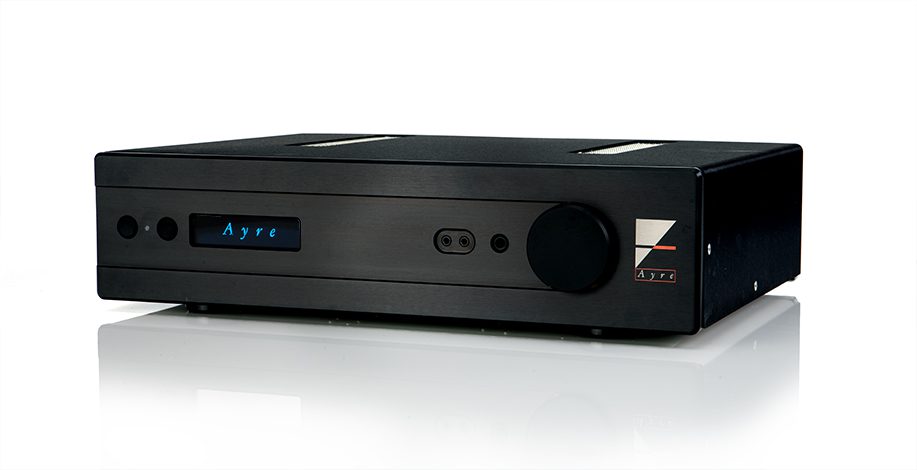
What this means, in reality, is that the speaker isn’t hard to drive; the 100-watt output of Ayre EX-8 that is also reviewed in this issue was entirely sufficient, but it does benefit from good current delivery (at which the Ayre excels). Unless you own something valve-based, it is unlikely that the Corinium will be beyond most commensurately priced amps, but it isn’t as easy to drive as you might assume. Connection to an amp is made via a single set of speaker terminals.

Acoustic Energy Corinium - Tectona (Rear)

The cabinet that contains all of this is relatively unusual by the standards of Acoustic Energy because it features a curved edge that helps with standing wave issues and looks rather smarter than more terrestrially priced models. This is partnered with a metal front baffle of 6mm thick aluminium. The cabinet is made from varying thicknesses of Resonance Suppression Composite depending on where it is used. Another departure is that the whole cabinet leans back at four degrees to help with time alignment, although this can be adjusted slightly by levelling the spikes. 

On the rear spine are two ports, one venting the upper chamber and a larger, rectangular one helping the lower drivers. These ports have very little effect on the Corinium’s usefully high tolerance of boundaries. Under test, they were roughly fifty centimetres out from the rear wall. Still, they could have gone closer if needed, and their overall behaviour has been entirely benign, with only a little attention to their toe-in to ensure they performed at their best.  

Aesthetically, the Corinium is, to this set of eyes anyway, a good-looking thing. You can reasonably argue that save for pointed dust caps on the drivers, there isn’t a considerable amount that ties it to Acoustic Energy designs of old, but the proportions and overall design are an attractive balance. Four finishes are available: a ‘Tectona’ wood, black and white sheen for £6,000 and the green of the review samples commanding an extra grand.

Described as British Racing Green, this colour scheme has grown on me considerably in the time they have been here, partly because it isn’t British Racing Green, which, heritage aside, is not a terribly prepossessing colour. This one is from the Bentley paint swatch. It lends the Corinium a sense of identity that is further helped by the fit and finish, even on these very well-travelled samples. It feels entirely in keeping with a speaker at the price and arguably of a higher standard than a few key rivals. 

Sic infinit

‘And so it begins’… the listening, that is! Mat Spandl; Director and head of acoustics for Acoustic Energy showed up with the demo pair. Upon unboxing and placing them, his requested ‘sighting’ track was Taylor Swift’s ‘Exile’ from her Folklore album [Republic Records]. With no disrespect to Miss Swift, I think this is a fine album, and I own a vinyl copy myself; but she’s not necessarily the artist I associate with Acoustic Energy of old. The company also makes no secret that various rival designs were benchmarked against the prototypes and, while some of these were expected, some are a long way from what I associate with the company. 

Credit where credit is due though, the Corinium does a tremendous job with this simple but heartfelt track. Bon Iver’s distinctive vocal turn has the weight and sheer presence it needs to dominate the opening section, and he’s underpinned by a piano with a persuasive amount of heft to it, as well as notes that decay beautifully away to nothing. When Swift begins singing, she’s no less believable, anchored between the two speakers: it’s delicate yet convincingly human-sized. The Corinium’s extensive comparative testing has imbued it with skills that weren’t necessarily in the repertoire of its ancestors.

Acoustic Energy Corinium - Matte White

Neither is this an aberrant one-off. Across a wide selection of musical material that requires delicacy, sweetness, and finesse, the Corinium has shown itself to possess all of them in abundance. Above all these things, there is emotional engagement that is consistently impressive. The astonishing ‘In the Morning (Grandmother Song)’ by Eliza Shaddad on The Woman You Want [Rosemundy Records] is delivered with every ounce of its sadness and anguish intact. Without ever suggesting it’s anything other than a fundamentally accurate performer, the Corinium can ensure that what you listen to is a performance rather than a rendition, driven by the superb performance and integration of those upper two drivers.

Up the scale, and the Acoustic Energy loudspeakers do an excellent job of delivering the extra space and weight that comes with it. Give the Corinium the live performance of ‘Hammers’ on Nils Frahm’s Spaces [Erased Tapes], and the result is profoundly and lastingly impressive. Here, some of the virtues that I have come to associate with the Acoustic Energy brand begin to make themselves felt. How it ensures that every rapid note is defined, delivered, and perceived as such rather than a more slurred general flavour of piano and hints that the speed and articulation that the Corinium’s ancestors that so endeared them to so many of us has not been forgotten in the bid to add new skills. It then defines the space Frahm performs in with accuracy and conviction. 

Quam bene non quantum

Something else that begins to manifest itself as these larger scale pieces unfurl is that the low end of the Corinium is going to be the element that is most likely to divide opinion. For me, a man who owns a pair of original AE1s that he’s likely to be interred with, the Acoustic Energy has enough bass; indeed, it would be somewhat churlish to describe a speaker that bettered its ±3dB low frequency roll off of 38Hz in this room as being ‘bass light.’ Nevertheless, the Corinium is relatively lean in how it operates.

The substantial low note that begins Dead Can Dance’s Song of the Stars [4AD] is deep and beautifully defined, but it lacks the almost stygian depth that some similarly sized speakers at this price can attain with the same material. However, regarding a stentorian bottom end, I feel ‘how well, not how much’ reigns supreme in the Corinium’s bass performance.

Acoustic Energy Corinium - Matte Black

There is a trade-off to this that is worth the price of admission. For all the tonal richness that the Corinium possesses, when you want it to go ballistic, every metallic green inch of it is an Acoustic Energy. Give it the heavyweight electronic workout that is Hybrid’s Morning Sci-Fi [Distinctive Records], and that bass response you queried earlier is suddenly perfectly judged. All too often, the speed and dexterity of this album are lost as the loudspeakers trip over the layered high-tempo basslines. The Corinium dances through them with dexterity and sheer urgency that has you ping an apologetic WhatsApp message to your long-suffering neighbour and nudge the volume up a little more. Pending them not demanding you receive an ASBO, the Acoustic Energy loudspeakers can take a lot of nudging, too, staying usefully uncompressed even when you lean on them. 

Across the less couth side of my music collection (which, if I’m being in any way honest, is rather more than half of it), the way that the big Acoustic Energy has gone about its business has emphatically proved that it still knows the old ways of doing things. Emotional engagement comes in a few flavours, and while sometimes it is conveyed in the sadness and reflection of a piece, sometimes it’s every bit as present in something like the raucous Youth and Young Manhood by the Kings of Leon [Handmedown] where four young men are not going to let their big break get away from them and their determination leaks from every note. The Corinium is detailed, tonally correct and impressively forgiving. It’s also about as much fun as you can have with your clothes on. 

Ad meliora

And then, when it’s time to stop being a headbanger, this new face of Acoustic Energy is all primed and ready to revisit its Taylor Swift sighting track and be all the things it demonstrated there. This speaker does things I haven’t always associated with Acoustic Energy, and it does it well enough to ensure that it earns its admission to the price point it contests without a shadow of a doubt. The most impressive part of all, though, is that it has done that without forgetting where it has come from, and I hope the Acoustic Energy Corinium points out the way of things to come for the company at all the levels it contests. As the Romans say, the Corinium points ‘towards better things.’ 


Technical specifications

  • Type: three-way reflex-loaded floorstanding loudspeaker with curved RSC cabinet and aluminium baffle
  • Mid-Range Driver: 29mm Tetoron soft dome tweeter, 120mm Carbon Fibre cone midrange, 2 x Frequency Range: 32Hz-30kHz (-6dB), 38Hz-25kHz (-3dB)
  • Sensitivity: 92dB/m/2.83v
  • Power Handling: 200W
  • Crossover Frequencies: 260Hz, 3.4kHz 
  • Impedance: 4Ω
  • Connections: 4mm Single wired banana sockets / 9mm spade connections
  • Finish: Matte Black, White, Tectona, British Racing Green
  • Dimensions (HxWxD, inc. spikes): 110 x 23.5 x 38.5cm 
  • Weight: 40kg (per speaker)
  • Price: £6,000/$7,499 per pair, (British Racing Green finish, £7,000 per pair)

Manufacturer

Acoustic Energy

www.acoustic-energy-corinium.co.uk

+44(0)1285 654432

More from Acoustic Energy

Back to Reviews

Out of The Box – Chario

Our ‘Out of the Box’ Series features companies who might slip through the net from time to time. Companies with something more than hot air, who make loudspeakers but make them with a rare passion that drives them and shapes the products they design and build.

Chario


When did you start the company?

Chario was founded in Milan in 1975, and since our inception, we have consistently produced our loudspeakers in Italy. The company was established by Carlo Vicenzetto, known as “CHArlie,” and MaRIO Murace, our chief engineer, whose names inspired the company name, CHARIO.

We have always maintained a small to medium company size. Today, the company is led by Michele Nebel, who follows in the footsteps of his father, a key figure in the business. Consequently, we are now a second-generation family business, although we consider all our long-standing employees to be part of the family. This strong sense of camaraderie is essential to our company culture.

We also view our sales partners and distributors as extended family members. Carefully selected for their alignment with our values, we cherish the strong relationships we have built with each of them.

Is making a loudspeaker an ‘art’ or a ‘science’?

Chario respects the traditional Italian art of handcrafting. Each piece is unique, thanks to the use of natural walnut. A core principle of the company is to deliver loudspeakers without coloration. A loudspeaker is not an instrument; it should disappear into its environment, seamlessly blending with the sound. Achieving such a natural performance is the scientific aspect of our work. Since 1975, Chario has been dedicated to research in the fields of acoustics and psychoacoustics.

What makes your loudspeakers different to other brands?

We believe it can be classified into 3 simple processes. The solid handcrafted walnut construction, innovative sonic technologies and our distinctive styling. Our Academy drivers are full-apex, treated paper and Rohacell sandwich cone. This innovative construction, requiring specialised expertise and time intensive shaping of the Rohacell, results in exceptional driver rigidity, leading to more precise and powerful bass performance. Our walnut cabinets represent the pinnacle of our design philosophy. The use of solid wood is a deliberate choice, reflecting our commitment to both form and function. While many manufacturers opt for less demanding materials, we believe in the enduring value of traditional craftsmanship.

What challenges do you face in making and selling loudspeakers?

Our unique process is deeply rooted in nature. Each piece of wood embarks on a four to five-month journey of air-drying before we even touch it. We meticulously monitor its moisture levels, dancing with the elements to capture the perfect moment to craft. This natural approach guarantees exceptional quality but can sometimes challenge us to meet the overwhelming demand for our products. The wood is the heart and soul of our instruments. It must meet rigorous standards for both sound and beauty. Anything less is unacceptable.

Where do you hope the company will be in five or ten years?

Chario is more than a brand; it’s a passion. Our philosophy is our compass, guiding us as we expand our reach. As pioneers in the audio world, we’re committed to growing our influence while staying true to our sonic heritage. Our vision is a world where Chario is synonymous with exceptional sound.

Where can consumers hear about your products and find out more?

Chario has a global footprint, with products available in nearly 40 countries. In most markets, we collaborate with distributors who manage a network of dealers. These partners provide dedicated listening spaces where audiophiles can experience the Chario sound firsthand.


Chario Website

2025 Awards – DAC – Up to £10k

Our annual Awards are a celebration of the best in audio. Specifically, we have seen the best audio products over the last 12 months. In most cases, that means products introduced between late 2023 and the final months of 2024. However, if they are new to us, that counts too!

Over the following pages, we’ve found what could well be your next great audio purchase. We’ve tried where possible to cover the broadest spread of product categories and prices. We have also listed both award winners and highly commended products in many categories. In these categories, we have been almost universally blown away by the performance of these products. It’s amazing to think that an industry as inherently mature as audio (the first audio products predate the widespread home electrification schemes of the 1910s and 1920s, and the first branch of ‘consumer electronics’ was all hi-fi related) can still produce innovative products that move the needle and improve audio performance. But, each year, we keep seeing improvements in almost every aspect of the replay chain, and often those improvements are significant.

It’s also fascinating to see how the audio industry changes over time, which can be seen by how our categories shift from year to year. Certain products remain perennial members of the Award roster; it’s unlikely that any audio Awards will ever exclude loudspeakers or integrated amplifiers. However, we’ve noticed that categories that almost didn’t exist a year ago are now a significant part of the audio landscape. Network Switch, Network Filter, and Active and Streaming Loudspeaker categories were all sections of the audio world that either didn’t exist or were way outside of hi-fi+’s purview to be considered until recently.

Selection

Selecting products for awards is never easy, but our product selection process makes it harder. We want to replicate the experience of those who enjoy their audio devices rather than those who approach every component with a face like a bulldog chewing a wasp. That means we have a two-step pre-review process before a product reaches the review stage. A potential review product is loaned to the reviewer; if they feel it isn’t the kind of product they would buy, it’s sent to another reviewer who might be more in step with how that product performs. If, at that point, we can find no one who likes what it does, we send it back. Why? The product may not have been suitable for any of our review team members. If not, and the product is just wrong, we find denying it the oxygen of exposure is better than people buying it because “it can’t be that bad!” Or worse, the review is subjected to careful and unscrupulous massaging; I come from a theatrical background. I’ve seen excoriating ‘crits’ of shows dressed up to sound upbeat on billboards. The same goes for audio. If it’s bad, it’s far better not to have our name by it, than someone buy it!

The crème of the crop

This means that every review in hi-fi+ has already made the grade. Our reviews are already the crème de la crème. So, our Awards are the crème de la crème de la crème! That’s damn crème-y! But even in a list of products that is so admirable, there are always some that stand above the rest.

Audio magazines seldom exist in isolation. Our team interacts with people in the industry and enthusiasts. Some products keep coming up because they have ‘a bit of a vibe’. An example of this (from last year’s Awards lineup) is Soul Note. If the name ‘Soul Note’ is brought into the conversation at an audio event, it’s usually followed by someone else saying, “Oooh… that stuff’s nice!” There are always a few products each year that keep getting mentioned in and around the audio business. Some of those ‘vibe’ brands are in the pages of our Awards, every year.

Regarding product shortlisting, we’ve found that relying on the review published at the time is often more critical than cross-examining the memory of the reviewer months after the product was shipped back to the manufacturer. While, once again, those ‘vibe’ products stick in the memory, a reviewer that might look at several products a month – and has done so for many years – is unlikely to remember the nuances of something they tested almost a year ago. As reviewers, we should look at each product with fresh eyes, so we should purge our memories of what came before (some of the least valuable reviews compare the 2024 model with long-discontinued previous designs from the last century). The review itself is more of a snapshot of what the reviewer felt while reviewing it.

Trickle down

Many of the products over the next pages are the stuff of dreams. And some dreams don’t always come cheap. While some are in the ‘affordable’ class, many of these products are at the ‘aspirational’ end of audio. Some are at the ‘astronomic’ (literally… one costs as much as a short space flight). But crucially, what we’ve seen over the years is that these products form the basis for more attainably priced products. The lessons learned in making something that costs a small fortune filter down into the real-world.

This is not simply an attempt to justify sky-high prices, it’s an understanding that the bandwidth of audio is expanding in more ways than one. By making products that cost a fortune, companies haven’t abandoned the entry-level products. They’ve ceded the floor to a new generation of manufacturers. And they are winning Awards!

2025 Awards – Digital – Disc Player

Our annual Awards are a celebration of the best in audio. Specifically, we have seen the best audio products over the last 12 months. In most cases, that means products introduced between late 2023 and the final months of 2024. However, if they are new to us, that counts too!

Over the following pages, we’ve found what could well be your next great audio purchase. We’ve tried where possible to cover the broadest spread of product categories and prices. We have also listed both award winners and highly commended products in many categories. In these categories, we have been almost universally blown away by the performance of these products. It’s amazing to think that an industry as inherently mature as audio (the first audio products predate the widespread home electrification schemes of the 1910s and 1920s, and the first branch of ‘consumer electronics’ was all hi-fi related) can still produce innovative products that move the needle and improve audio performance. But, each year, we keep seeing improvements in almost every aspect of the replay chain, and often those improvements are significant.

It’s also fascinating to see how the audio industry changes over time, which can be seen by how our categories shift from year to year. Certain products remain perennial members of the Award roster; it’s unlikely that any audio Awards will ever exclude loudspeakers or integrated amplifiers. However, we’ve noticed that categories that almost didn’t exist a year ago are now a significant part of the audio landscape. Network Switch, Network Filter, and Active and Streaming Loudspeaker categories were all sections of the audio world that either didn’t exist or were way outside of hi-fi+’s purview to be considered until recently.

Selection

Selecting products for awards is never easy, but our product selection process makes it harder. We want to replicate the experience of those who enjoy their audio devices rather than those who approach every component with a face like a bulldog chewing a wasp. That means we have a two-step pre-review process before a product reaches the review stage. A potential review product is loaned to the reviewer; if they feel it isn’t the kind of product they would buy, it’s sent to another reviewer who might be more in step with how that product performs. If, at that point, we can find no one who likes what it does, we send it back. Why? The product may not have been suitable for any of our review team members. If not, and the product is just wrong, we find denying it the oxygen of exposure is better than people buying it because “it can’t be that bad!” Or worse, the review is subjected to careful and unscrupulous massaging; I come from a theatrical background. I’ve seen excoriating ‘crits’ of shows dressed up to sound upbeat on billboards. The same goes for audio. If it’s bad, it’s far better not to have our name by it, than someone buy it!

The crème of the crop

This means that every review in hi-fi+ has already made the grade. Our reviews are already the crème de la crème. So, our Awards are the crème de la crème de la crème! That’s damn crème-y! But even in a list of products that is so admirable, there are always some that stand above the rest.

Audio magazines seldom exist in isolation. Our team interacts with people in the industry and enthusiasts. Some products keep coming up because they have ‘a bit of a vibe’. An example of this (from last year’s Awards lineup) is Soul Note. If the name ‘Soul Note’ is brought into the conversation at an audio event, it’s usually followed by someone else saying, “Oooh… that stuff’s nice!” There are always a few products each year that keep getting mentioned in and around the audio business. Some of those ‘vibe’ brands are in the pages of our Awards, every year.

Regarding product shortlisting, we’ve found that relying on the review published at the time is often more critical than cross-examining the memory of the reviewer months after the product was shipped back to the manufacturer. While, once again, those ‘vibe’ products stick in the memory, a reviewer that might look at several products a month – and has done so for many years – is unlikely to remember the nuances of something they tested almost a year ago. As reviewers, we should look at each product with fresh eyes, so we should purge our memories of what came before (some of the least valuable reviews compare the 2024 model with long-discontinued previous designs from the last century). The review itself is more of a snapshot of what the reviewer felt while reviewing it.

Trickle down

Many of the products over the next pages are the stuff of dreams. And some dreams don’t always come cheap. While some are in the ‘affordable’ class, many of these products are at the ‘aspirational’ end of audio. Some are at the ‘astronomic’ (literally… one costs as much as a short space flight). But crucially, what we’ve seen over the years is that these products form the basis for more attainably priced products. The lessons learned in making something that costs a small fortune filter down into the real-world.

This is not simply an attempt to justify sky-high prices, it’s an understanding that the bandwidth of audio is expanding in more ways than one. By making products that cost a fortune, companies haven’t abandoned the entry-level products. They’ve ceded the floor to a new generation of manufacturers. And they are winning Awards!

Chord Electronics Ultima Integrated

A year ago, when I was visiting my local hi-fi dealer, he told me rather excitedly about a new integrated amplifier he had heard an early pre-production sample of. He was so enthusiastic that I made a mental note to get hold of one for review. That amplifier was the Ultima integrated amplifier from Chord Electronics.

It made its world debut at the Munich High-End Show last May but was only unveiled in the UK at the Bristol Hi-Fi Show in February. 

It has an interesting backstory because, in this model, we see the Ultima technology Chord Electronics introduced five years ago in its high-end amplifiers trickling down to an integrated amplifier for the first time. 

Chord Electronics started producing amplifiers for consumers and professional recording studio environments such as the BBC and Abbey Road. Since then, it has expanded into streamers, DACs, and phono stages.

Avionics background

John Franks, who founded the company in 1989, had a background in the avionics industry with the likes of Raytheon, AT&T, and Marconi Avionics. This experience, he told me, shaped the way he approaches design. 

Chord Electronics Ultima Integrated

I was interested in learning more about the Ultima and how it came about, so I went to talk to him at the Chord Electronics factory. Asked to summarise his design philosophy, Franks said: “Being prepared to go as far as you need to go to make the very best thing that the technology of the time can do. And technology is always improving. In avionics, you cannot short-change and compromise a design because, if you do, planes can depart from proper flight. You must be prepared to push the envelope, and I think I have brought that philosophy over from avionics. It’s no compromise. It’s what I always wanted to do, and it’s been a helluva ride.” 

The technologies that have trickled down to the new Ultima integrated are Chord Electronics’ dual feed-forward error correction and ultra-high frequency, switching power supplies.

Dual feed-forward

The dual feed-forward technology is based on a paper by the legendary Malcolm Hawksford at Essex University. It was then taken up and refined by Bob Cordell of Bell Labs before being further developed by Chord Electronics’ John Franks. Franks progressed Cordell’s dual feed-forward error correction topology and incorporated his own concepts in ultra-high-frequency power supplies that have underpinned Chord’s amplifier range since 1989.

As many regard the power supply as the beating heart of an amplifier, let’s look at that first. In a nutshell, the Chord Electronics switch mode power supply runs at 80kHz, which Chord says means it doesn’t interfere with any audio signals. The incoming power is filtered and rectified and then chopped using high-voltage MOSFETs. It is then passed on to a special ceramic-cored high-frequency transformer, rectified again and is then fed to Chord’s Dynamic Coupling system. 

This couples the amp’s positive and negative rails with a strong magnetic flux to help cope with any high demand. Running the power supply at 80kHz also means the transformer can be much smaller. 

Such power supplies were initially developed for use in the aerospace, telecommunications, and data processing industries where they needed high power in a space-efficient format. However, early variants used in the audio industry were often criticised for electrical noise, poor reliability, high engineering costs and generating electromagnetic interference.

Ten years after

In his white paper on his amplifier designs, Franks admits that it took him 10 years of “perseverance and innovative engineering” to overcome those problems, but he is adamant that this was the right approach.

He told me: “It is about controlling a drive unit rapidly and some of these 15in drivers are big and maybe have a compliant mass of 100g. It takes a lot to stop and start them within microseconds and you’ve got to draw down energy from your power supply very quickly. High-frequency switching power supplies can do that, whereas analogue supplies struggle. 

“Smaller capacitors are faster to respond and also the recharge time on a high-frequency power supply is so much faster. People think they always have RF noise, but there isn’t if they’re designed right. Analogue supplies are passing anything that’s on the mains, and that could be anything, and a lot of it could be RF. So it is a total misconception.”

For those reasons, Franks has stopped using huge storage capacitors in his power supplies and opted for multiple, smaller ones. He believes smaller capacitors respond faster to charging and discharging demands than larger ones. The Ultima boasts four high-power line input phase-corrected power supplies designed to deliver excellent transient response. 

Sliding bias

The amplifier operates as a Class AB sliding bias design, which means it operates in Class A most of the time, with Class B operation only coming into play in the most demanding situations. The output stages use Chord’s own metal-on-silicon MOSFET devices, made for them in an aerospace-sector fabrication house. They are a dual-die design, which means they are thermally coupled in production to match each other perfectly. 

Franks’s development of Hawksford and Cordell’s original dual feed-forward technology is the other exciting part of the amplifier circuit topology. The Ultima has two additional amplifier circuits that monitor and correct the difference between the output of the reference input, both inputs fed to the MOSFETs, and the output of the power MOSFETs. If this detects a discrepancy, the circuit will add a ‘difference signal’ to the input of the MOSFETs to correct it and provide an accurate output. This corrected output is then fed back as part of the amplifier’s overall global feedback.

Franks says that Class AB and B amplifiers have an Achilles heel. While more efficient than Class A designs, the N channel devices that handle the top half of the music waveform hand over to the P channel devices that deal with the negative part of the waveform, which is where crossover distortion is generated. The dual feed-forward circuitry is designed to minimise this.

Unboxing

As I unpacked and handled the Ultima, it exuded quality. It shares the same 28mm thick solid aluminium front panel with the recently introduced Ultima PRE 3 preamp. All of its casework is made from precision-machined, solid aircraft-grade aluminium.

It is a stunning piece of modern industrial design, and its reassuring solidity is complemented by the customary Chord Electronics light show supplied by an internal ring of LEDs. Although mainly cosmetic, Franks hinted when we spoke that any spurious RF can be dissipated within LEDs. 

The amplifier is minimalist in its styling, with just two large rotary knobs on the front panel to the left and right of the spherical on/off switch, which glows red when in standby mode and cycles from green to cyan to indicate it is ready to use. 

The left-hand knob controls the volume and, when pressed, allows input selection. It has a light circling that changes colour to denote the selected input. Input 1 is a balanced XLR while the other three RCA line inputs are unbalanced. It also has an XLR AV bypass and a balanced XLR preamp output on the rear panel. The right-hand knob controls balance and AV bypass.

You have chosen, wisely 

To evaluate the Ultima integrated I connected it to a pair of Russell K Red 120Se speakers, which are a favourite of mine. The Ultima, with its 125 watts of power, would drive them well. 

My music source was an Audio Note CDT-Five CD transport and DAC 5 Special, which provided a super-high-quality input. I did not use the balanced input, but anyone who has source components that provide a balanced output is well advised to do so.

Setting the Ultima up was child’s play. Controls are minimal, so you can’t go wrong. Inputs are clearly marked, and polarity is easy to discern, and with the coloured light that surrounds the volume/input selector knob easy to see even from a distance; once you have memorised which colour denotes which input, you should be ready for action. 

The remote control provided is also easy to use and responsive, so I used it throughout my listening. There is, of course, no phono input on the Ultima, but that is not unusual these days. Chord Electronics has its own to offer with the Huei MM phono stage and the Symphony if you have a moving coil cartridge.

Warmed to

I am pleased to say that the Ultima was one of those products that I warmed to from the very start. Straight in with a favourite track from guitarist Peter White, his version of the Johnny Nash classic ‘I Can See Clearly Now’, the Ultima impressed with its easy, detailed, layered, and dynamic presentation, portraying each player of this gorgeous instrumental in their proper place within the music. It was free from random fireworks or pitching elements at me that did nothing to enhance my appreciation of the music. No, the whole track hung together well, with great insight into how White played each note. The bass line was tight, tuneful and the Ultima conveyed its twists and turns beautifully. Drums and percussion were controlled and syncopated and the accordion part, often lost in the mix on poorer products, was well conveyed and separated.

Switching to the lovely ballad ‘Lo Siento Mi Vida’ from Linda Ronstadt’s Hasten Down the Wind album, the Ultima brilliantly conveyed the two guitars on the intro. It allowed you to hear the differences between them, while Ronstadt’s vocals came across as powerful yet sensual. The walk and growl of the bass line were well handled, and on the drumkit, you could hear various strikes of differing power and delicacy on snare or cymbals. And it all flowed beautifully with that dreamlike feel this track has.

Grabbing the Saxophonic album by sax ace Dave Koz, I was keen to play the track ‘All I See Is You’. The Ultima did not disappoint, conveying the body and ‘raunch’ of Koz’s tenor sax that gives it that typical quality you can only describe as ‘sexy’, and here it had all of that. The electric bass line that really drives the track along was conveyed with great pace and everything was in its place musically, playing its proper role in the appreciation of the track.

Ben Sidran is a favourite jazz singer/songwriter/pianist of mine and following up for me was ‘Sunny Side of the Street’ from his Enivré d’Amour CD. I know his voice well from seeing him live on many occasions and I can say the Ultima did justice to his style and sound. His vocals were expressive and characterful, while his Yamaha DX7 synth had the top-end sparkle and liveliness it should have. The excellent, raunchy bass line was tight and tuneful, while the saxophone was nicely voiced and articulated. The track moved and flowed well, and its staccato, lilting rhythm was conveyed well.

Mood change

Changing the mood, I reached for George Benson’s excellent 20/20 album and played the track ‘No One Emotion’. This track flies along at a breakneck pace and is unbelievably tight regarding the musicianship and arrangement, and the Ultima took it in its stride. Pacey, detailed, tuneful, dynamic, and controlled, it captured Benson’s immaculate vocals very well while that relentless synth bass line drove the track along at breathtaking speed. I could also savour Michael Sembello’s scorching guitar solo, which the Ultima pitched with just the right combination of raunch and poise.

Whether it was delicate guitar work from Larry Carlton or Earl Klugh, scorching sax from Dave Koz or David Sanborn, heartfelt vocals from Linda Ronstadt, or hardcore rocking from ZZ Top, the Ultima handled it all with control, detail rendition, and dynamics while holding it all together as a musical whole. 

The integrated amp market has heated up in recent years, and buyers are spoilt for choice for good-sounding amps. Thanks to the Ultima, things just got even hotter. If you are in the market at this price point, you should consider the Chord Electronics Ultima.

Technical specifications

  • Type: Sliding Class A/AB, 2-channel integrated amplifier
  • Analogue inputs Four line inputs. Three unbalanced (RCA) one balanced (XLR). One AV bypass (XLR)
  • Digital inputs: None
  • Analogue outputs: One balanced pre out (XLR)
  • Input impedance 100k ohms 
  • Power output 125Wpc @ 8 ohms 
  • Frequency response 10Hz-200 kHz ±3dB 
  • Distortion THD 0.01 % (20Hz-20kHz) 
  • Signal-to-noise ratio 90dB on all inputs 
  • Dimensions (WxHxD) with Integra legs 480mm x 130mm x 380mm 
  • Weight: 14.75 kg
  • Price: £8,500, $11,250

Manufacturer

Chord Electronics  

www.chordelectronics.co.uk

+44 (0) 1622 721444

More from Chord Electronics   

Back to Reviews

Reed Audio Muse 1C and 3P

There are times as a reviewer when I find myself thinking along the lines of US Patent Office Commission Henry Ellsworth, who noted in 1843; “The advancement of the arts, from year to year, taxes our credulity and seems to presage the arrival of that period when human improvement must end.” In the case of turntables in particular, we’ve been working on the basic design process for some time, and it doesn’t require a terribly negative attitude to find yourself thinking like Ellsworth did. 

Of course, for every Ellsworth, there is a Vidmantas Triukas; Founder, owner, and chief designer of Reed Audio. His work with Reed is a physical riposte to the notion that there are no new ideas in analogue. We have already looked at the genuinely innovative 5P tonearm in Issue 219. Now it’s time to look at what happens when Reed produces something more conventional… to a given value of conventional anyway. The Muse 1C turntable and 3P tonearm have a cumulative price that could, with a straight face, be called accessible. Does this dampen Reed’s endlessly innovative approach?

Simplicity

The short answer is, ‘not really.’ The Muse 1C is the brand’s most affordable turntable, and this has resulted in some simplification compared to the more ornate models, but less than you might expect. Key to this is how the 1C rotates its platter. While larger models have the option of both belt and idler drive, the 1C requires you to choose one of those options and have the 1C built to that format. While the belt drive is the less expensive of those options, the Reed 1C we tested uses the arguably more exciting choice.

Reed 1C

This is a take on an idler drive where two opposing DC motors act on the central spindle. Reed avoids the issue of the motors working against one another by running them at slightly different speeds and fitting one with a different-sized drive wheel to ensure the rotational force is equal at all points. The assembly is then phase-locked loop controlled to ensure that it is synced together. One additional benefit of this wholly custom approach is that the 1C can rotate at 16 and 78 RPM as well as 33 and 45. 

This drive unit, which looks for all the world like an oversized watch mechanism, acts on a Delrin platter that, at a whisker under 3kg, is relatively light by the standards of turntables at this price point. This is topped with a leather mat and sits semi-flush to the plinth. Given the relative potency of the motors and the lightness of the platter, the Muse is unsurprisingly pretty quick to spin up and has been utterly pitch-stable during the test. 

Birch ply

The plinth itself is made from layers of birch ply, which can be left in its natural finish or sprayed black. Power comes via a supplied SBooster unit that connects at the back of the plinth. It is somewhat utilitarian but doesn’t need to be anywhere near your line of sight. The 1C is wide enough to accommodate any arm between 9 and 12 inches in length and has a mounting plate that will accommodate pretty much anything. If you fancy a new idler drive but don’t want to part with your existing arm, I would be surprised to find it doesn’t fit. 

Of course, Reed’s reputation for tonearms means I suspect that most Muse 1Cs will be equipped with one of the company’s models, and any in the company portfolio will fit. As we have already looked at one of the more sophisticated Tangential 90-degree pivot designs, the 3P seen here is a simpler model with a conventional single pivot point. The wand itself is available in 9.5, 10.5, and 12-inch lengths, and the latter was supplied for testing. 

This being a Reed device though, the fact the 3P only pivots around a single point doesn’t necessarily mean I’d describe what results as simple. The bearing had the behaviour of a unipivot but was secured via three pivots and both vertical and horizontal axis magnetic stabilisers. The wand arrives detached from the mount, and while connecting it up is more straightforward than with the Tangential Pivot models, it is still not a task to undertake lightly. One little bonus is that the headshell can be detached to simplify the cartridge fitting. 

Necessary complexity

Part of the reason for this complexity is that the 3P scratches any itch you could conceivably have about setup and adjustability. I’ve seen arms with the means to adjust VTA on the fly, but the Reed trumps that with the ability to adjust azimuth in use, too. A small control that, more than anything else, resembles a tiny regulator allows for fine adjustment around the pivot point. A heavier counterweight is available for weightier cartridges, but the stock one could balance a relatively large and heavy Vertere XtraX without issue. Depending on your life choices, the lead-out cable can be captive or attached via a terminal block. 

Reed 3P

The combination of deck and arm appeals more the longer you spend with it. The two products are undoubtedly engineering-led in terms of their design; nothing here that  doesn’t need to be, but there’s a beauty to the Reed that manifests itself via the fastidious nature of its construction and implementation. The drive mechanism is beautiful, and the 3P arm is barely less wondrous to look at, bridging the gap between engineering and sculpture. You don’t need to know anything about turntables to know this one is special. My inner Puritan would probably choose the black finish over the naked birch, but you have at least both options.

Using the Reed is logical enough once set up. It takes a few days to get used to the first button above ‘stop’ being 16rpm; a speed I’m not inundated with content for. The 3P arm also only sits very gently in its armrest unless you tighten a small screw on the underside to lock it into place. There’s no cover as standard but this doesn’t put the Reed at any significant disadvantage to most rivals that also do without. 

Idler no idea

I had no clear expectations for what the Reed would sound like before I heard it, partly because my experience of idler turntables in my domestic listening environment is effectively none. To this end, I started listening to The Cinematic Orchestra’s Every Day [Ninja Tune] because the opening duo of tracks are firmly etched into my brain after two decades of use. From the moment the double bass in ‘All that You Give’ delivers its first plucked note, it becomes clear that the Reed does things in its way.

Those double bass notes have a heft and tangibility that, for a fleeting second, brings to mind direct drive but, just as quickly, has you noting that the Muse 1C is articulate in a way that isn’t always the case with such systems. The potency of the low-end is balanced against Fontella Bass sounding as delicate yet tangible as I can recall hearing her. As she pushes the peaks, the fractional waver and break in her voice are apparent in a way that isn’t always the case when she’s underpinned as effectively as this. 

Further listening reveals this ‘hefty delicacy’ consistently repeats itself across a broad swathe of listening material. The excellent reissue of Ray Charles in Person [Atlantic] benefits hugely from what Reed can do. As a period recording, this isn’t something you would look towards for spleen-wobbling low end, but in the hands of the Reed, there’s a weight to the delivery that means the sublime ‘What’d I Say’ is that bit more forceful. When Charles begins singing, he’s the instant focus of your attention. That same tangible energy across the midrange and upper frequencies ensues that the Reed brings the material to life rather than simply reproducing it. 

Walking the balance

The balance that the Reed Audio walks in terms of the accuracy of what it does is very carefully considered. Given the attention to detail that has gone into its engineering, it perhaps isn’t surprising that it tends to come down on the side of accuracy over and above out and out joy with most material you play on. While it was in on test, a copy of The Egg’s Albumen [Indochina] showed up after a spell of nostalgia-driven browsing on Discogs. Listening to this on the Reed back-to-back with the resident Vertere MG-1 MkII showed the differences in approach between the two. The Vertere is the more euphoric of the two devices. It’s keener to latch onto the time signature of what’s being played and slightly airier while it does it.

The Reed hits back – quite literally – with a low-end extension beyond what the MG-1 and, indeed, pretty much anything else at this price point can generate. It’s also easier to discern specific instruments. The flute refrain in ‘The Fat Boy Goes to the Cinema’ is a much more tangible and vibrant experience on the Reed. The more constrained feeling of space around the recording should not be confused with any reduction in the scale of the recording itself, which still has a good degree of separation and three-dimensionality. 

The tests with the Vertere cart had been helpful and a decent way of getting a handle on what the Reed can do, but it undersells what the 3P arm can do because it makes very few specific demands. Removing it and running with a substantially less expensive but significantly more idiosyncratic Van den Hul DDT II was a rather impressive demonstration of its functionality. The DDT II is capable of monumental performance for its relatively sane asking price, but only if its particular needs, which are perfect alignment, VTA, relatively light tracking force, and respectably high compliance, are met. The 3P effortlessly adjusted to these requirements and secured what realistically counts as the best performance I’ve ever had out of this particular DDT II in the many years it has lived here. 

The Whole Story

The character of the DDT II then makes itself felt in the Reed Audio Muse 1C/3P’s performance as a whole. It loses some of the utterly mesmerising bandwidth and accuracy of the Vertere. Still, listening to the brilliantly atmospheric Quatermass Seven by Little Barrie and Malcolm Catto [Madlib Invazion], there is a liveliness and richness that makes the Reed’s performance feel more natural and involving. It’s still the same balance the Reed struck before, but the gentle coloration of the Van den Hul works well in this instance. 

This absolute confidence and flexibility to respond to your ancillaries is the core of Reed’s abilities. The fastidious engineering and attention to detail have been done in a way that looks out rather than in. I suspect that any arm you mount to the Muse 1C, be it made by Reed or not, will deliver everything it is capable of without drama or issue and mounting a 3P on any deck that can accommodate it is likely to yield spectacular results, too. Together, they are ready for whatever the rest of the signal path holds without fear or favour.  

However intimidating it might appear at first glance, none of the engineering is here for the sake of being clever, and the more you use it, the more Reed’s Muse 1C and 3P’s distinctive way of looking at the challenges of analogue replay make sense. As long as the company keeps probing the limits of what turntables are capable of, I suspect any belief I might harbour that there is nothing more to achieve with vinyl can be put to bed.


Technical specifications

Reed Audio Muse 1C 

  • Type: turntable
  • Drive System: Friction, belt, two direct current (DC) motors
  • Speed: 16, 33, 45, 78 rpm; 78 rpm can be manually adjusted
  • Speed stabilisation: Quartz-based phase-locked loop (PLL). Max deviation ±0.05%
  • Inclinometer accuracy: 1mm per metre
  • Finish: Moonlit Black, Karelian birch
  • Packaging dimensions (LxWxH): 65x52x35cm
  • Weight: 15kg
  • Price: £9,998 (belt drive), £11,998 (idler drive)

Reed Audio 3P

  • Type: tonearm
  • Arm lengths: 9.5”, 10.5”, 12” (12” version tested)
  • Armwand options: Wenge, Makassar Ebony, Cocobolo, Teak (light, dark)
  • Mounting distance, mm: 205.5/266.1/283.8
  • Pivot-to-spindle distance, mm: 223/251.6/295.6
  • Overhang, mm: 17/15.4/13.4
  • Offset angle: 22.9°/20.7°/17.6°
  • Effective mass: depending on armwand
  • Price: £4,298

Manufacturer

Reed Audio

www.reed.lt

UK distributor

Absolute Sounds

www.absolutesounds.com

+44(0)208 971 3909

More from Reed

Back to Reviews

Out of the Box – BAYZ Audio

Our ‘Out of the Box’ Series features companies who might slip through the net from time to time. Companies with something more than hot air, who make loudspeakers but make them with a rare passion that drives them and shapes the products they design and build.

Bayz Audio are an independent manufacturer based in Hungary. We currently produce two loudspeaker models, the smaller Courante 2.0 and the bigger Counterpoint 2.0. Our loudspeakers come in a standard black matte finish. Custom finishes (different colour finish, black piano or carbon fibre enclosure etc) are available for a premium.

When did you start the company?

I have been designing high-end audio devices since 1982. I started working as an independent contractor in 1986 and founded BAYZ Audio in 1997. My first patent was in 1982 a power amplifier free of TIM distortion (Transient Intermodulation Distortion) with a slew rate above 100 V/µs, with open-loop bandwidth above 10 kHz, and class A operation with moving working point. I hold the patent for this solution.

Is making a loudspeaker an ‘art’ or a ‘science’?

I think that a good designer takes advantage of the possibilities offered by computer-aided design, modern measuring procedures and measuring systems. If the question concerns speakers as works of art, i.e. as musical instruments, then I must say that it is natural for the designer to shape his “work” to his own taste. Forty years of experience behind me helps me to use the two seemingly opposite directions in synergy. I always tried to get the best instruments as much as I could and I also went to many classical concerts, both of which helped my speakers to sound close to live music. If the question is about design, it is not for its own sake with my loudspeakers: completely rethinking the loudspeaker design with the opportunity provided the BRS (Bay Radial Speaker), the resulting form is absolutely functional, yet, fortunately, it also meets the taste of many, although the quite unconventional shape of the speaker also surprises a lot of listeners at first.

What makes your loudspeakers different to other brands?

First, I designed dynamic speakers, upright cabinets, then hybrid electrostatic, and broadband electrostatic speakers.   Then, I produced an electrostatic tweeter with 360-degree radiation, which was followed by its dynamic version, the BRS, which I patented throughout the world in 2011. Before 2017, I only sold my equipment in Hungary and Switzerland, mainly custom-designed systems; but then, I decided that the world needs to know about my tweeter. In 2018 I brought out my new carbon and composite-based speakers, which contain revolutionary new solutions. Not only the BRS, which is an extremely linear omni-directional tweeter with a bandwidth of 1-50 kHz without breakup mode. The arrangement of the speakers, the lowmass cabinet with its aerodynamic design are no everyday features either. The BRS gained me my reputation in the profession, but it is my current product line, the Courante and Counterpoint speakers, for which I am known by the general public throughout the world.

Where do you hope the company will be in five or ten years?

I have a big decision to make now in this respect. One option is to develop new electronics to advance the state-of-the-art. The other is to design a more reasonably priced loudspeaker for a wider audience using the same phenomenal BRS tweeter. I will probably go in both directions in the future, but, unfortunately, it is never as fast as we want.

Where can consumers hear about your products and find out more?

We have a dedicated website, a Facebook page – The Bayz Audio Lovers Group and any further information can be had through our extensive list of distributors throughout the world. In the UK, we are distributed by Hifi Traders based in Rye. They will be also happy to organise demo sessions in the comfort of one own’s living room (Contact number +44 (0)7842 126218 or dave@hifi guy.co.uk)

We also plan private presentations in our showroom in Hungary.

Bayz Audio Website


2025 Awards – Product of the Year, Innovation & Extreme Audio

Our annual Awards are a celebration of the best in audio. Specifically, we have seen the best audio products over the last 12 months. In most cases, that means products introduced between late 2023 and the final months of 2024. However, if they are new to us, that counts too!

Over the following pages, we’ve found what could well be your next great audio purchase. We’ve tried where possible to cover the broadest spread of product categories and prices. We have also listed both award winners and highly commended products in many categories. In these categories, we have been almost universally blown away by the performance of these products. It’s amazing to think that an industry as inherently mature as audio (the first audio products predate the widespread home electrification schemes of the 1910s and 1920s, and the first branch of ‘consumer electronics’ was all hi-fi related) can still produce innovative products that move the needle and improve audio performance. But, each year, we keep seeing improvements in almost every aspect of the replay chain, and often those improvements are significant.

It’s also fascinating to see how the audio industry changes over time, which can be seen by how our categories shift from year to year. Certain products remain perennial members of the Award roster; it’s unlikely that any audio Awards will ever exclude loudspeakers or integrated amplifiers. However, we’ve noticed that categories that almost didn’t exist a year ago are now a significant part of the audio landscape. Network Switch, Network Filter, and Active and Streaming Loudspeaker categories were all sections of the audio world that either didn’t exist or were way outside of hi-fi+’s purview to be considered until recently.

Selection

Selecting products for awards is never easy, but our product selection process makes it harder. We want to replicate the experience of those who enjoy their audio devices rather than those who approach every component with a face like a bulldog chewing a wasp. That means we have a two-step pre-review process before a product reaches the review stage. A potential review product is loaned to the reviewer; if they feel it isn’t the kind of product they would buy, it’s sent to another reviewer who might be more in step with how that product performs. If, at that point, we can find no one who likes what it does, we send it back. Why? The product may not have been suitable for any of our review team members. If not, and the product is just wrong, we find denying it the oxygen of exposure is better than people buying it because “it can’t be that bad!” Or worse, the review is subjected to careful and unscrupulous massaging; I come from a theatrical background. I’ve seen excoriating ‘crits’ of shows dressed up to sound upbeat on billboards. The same goes for audio. If it’s bad, it’s far better not to have our name by it, than someone buy it!

The crème of the crop

This means that every review in hi-fi+ has already made the grade. Our reviews are already the crème de la crème. So, our Awards are the crème de la crème de la crème! That’s damn crème-y! But even in a list of products that is so admirable, there are always some that stand above the rest.

Audio magazines seldom exist in isolation. Our team interacts with people in the industry and enthusiasts. Some products keep coming up because they have ‘a bit of a vibe’. An example of this (from last year’s Awards lineup) is Soul Note. If the name ‘Soul Note’ is brought into the conversation at an audio event, it’s usually followed by someone else saying, “Oooh… that stuff’s nice!” There are always a few products each year that keep getting mentioned in and around the audio business. Some of those ‘vibe’ brands are in the pages of our Awards, every year.

Regarding product shortlisting, we’ve found that relying on the review published at the time is often more critical than cross-examining the memory of the reviewer months after the product was shipped back to the manufacturer. While, once again, those ‘vibe’ products stick in the memory, a reviewer that might look at several products a month – and has done so for many years – is unlikely to remember the nuances of something they tested almost a year ago. As reviewers, we should look at each product with fresh eyes, so we should purge our memories of what came before (some of the least valuable reviews compare the 2024 model with long-discontinued previous designs from the last century). The review itself is more of a snapshot of what the reviewer felt while reviewing it.

Trickle down

Many of the products over the next pages are the stuff of dreams. And some dreams don’t always come cheap. While some are in the ‘affordable’ class, many of these products are at the ‘aspirational’ end of audio. Some are at the ‘astronomic’ (literally… one costs as much as a short space flight). But crucially, what we’ve seen over the years is that these products form the basis for more attainably priced products. The lessons learned in making something that costs a small fortune filter down into the real-world.

This is not simply an attempt to justify sky-high prices, it’s an understanding that the bandwidth of audio is expanding in more ways than one. By making products that cost a fortune, companies haven’t abandoned the entry-level products. They’ve ceded the floor to a new generation of manufacturers. And they are winning Awards!

HiFi Rose RS130

Viewed objectively, the arguments for dividing streamers into their front-end and decoding sections are good. All sonic and engineering ideals applied to splitting CD players into two boxes remain applicable. Still, they are augmented by ones specific to the streaming process. Over the years, I have tested several devices that have been sonically brilliant but about as pleasurable as a root canal to operate. Splitting off the front end of a streamer allows you to ensure you have an interface you can swear by rather than at and then choose the decoding to suit. 

HiFi Rose is one of the more consistent high achievers in terms of interface. The South Korean-based concern makes point-of-sale software, which benefits from stability and ease of use. Its Android-based streaming platform has some idiosyncrasies (more of which in a bit). Still, the platforms are ones borne of unique functionality rather than because the software was developed on a microscopic budget by a confused intern. For the most part, the company’s products include decoding on board (and, on occasions, amplification, too), but the RS130 is a transport only and will only output digital streams to the DAC of your choice. 

Impressive hardware

The hardware employed to achieve this is impressive. The RS130 employs a two-pronged method of ensuring signal integrity. The first concerns signal isolation. HiFi Rose has joined the increasing number of companies active in network audio in fitting an SFP-type network connection to the RS130. The principle behind this connection is that it avoids requiring a ‘PHY’ bus interface for a more conventional RJ45 connection. This reduces data errors and loss in the incoming stream. An adapter is supplied for those of us still muddling through on plain ethernet, and you can also use Wi-Fi via a dongle.

HiFi Rose RS130 

Neither is this the only means of cleaning up the incoming signal. The RS130 uses USB over fibre and HiFi Rose also produces the RSA720 USB hub that can have USB drives connected to it and then sent to the RS130 via a dedicated umbilical. Distributor Henley Audio supplied an example for testing, which was used in addition to my more conventional NAS library. Finally, you can simply connect a USB or SATA drive straight to the unit and it will index it. Anything that the RS130 plays is again buffered on a 256GB drive in the pursuit of signal stability. 

Clocks rock!

Having obtained the signal, the RS130 uses a high-precision OCXO 10MHz clock to maintain the sync and will also accept an external word clock feed (although HiFi Rose doesn’t make such a thing). The internal power supply is a 15v DC system and the board layout pointedly separates AC and DC sections to reduce the chances of interference. The signal is made available to optical, coaxial, AES/EBU and USB outputs, and you’ll need the latter if you want to stream the notional maximums of DSD512 and 768kHz PCM.   

Where the RS130 takes a swerve from normal streaming functions is the same as other members of the HiFi Rose family. In addition to accessing stored content and music streaming services (including Apple Music which remains a rare thing to find), the RS130 has an HDMI output that can send video content from a curated ‘Rose Tube’ channel or from Tidal while outputting the audio via the outputs. If you don’t want to connect a screen, show it on the whopping full-width 15.4” 1920 x 382 resolution LCD on the front panel. 

Love at first sight

This display dominates the visuals of the RS130, and not everyone who has encountered the review sample has been as enamoured with it as I am. I make no bones about the fact I love the RS130. It has a bit of visual drama that streamers are frequently devoid of, and it makes the RS130 a pleasure to use across the various ways you can interact with it. I find the app odd; the focus on video means it ‘flows’ a little differently from some rivals but is unconditionally stable and plays nice with Roon should you want to use that. Like everything I have ever tested from HiFi Rose, the build quality is peerless too. This is not a cheap device, but you can see where the money has gone. 

HiFi Rose RS130 silver

The bulk of testing for the RS130 has taken place with the resident Chord Electronics TT2 and M Scaler and these represent a stiff challenge for USB streaming transports.

Extensive reclocking

The extensive reclocking that the two devices do, Chord deliberately ‘aims off’ for indifferent quality USB connections and eschews all forms of external clock input as well, means that the effort that HiFi Rose goes to in the preservation of the signal ought to have a decidedly limited effect. It is a testament to the thoroughness of the engineering in the RS130 that this isn’t the case. 

What the HiFi Rose does, in comparison to running direct from a Roon Nucleus or going via a SOtM SMS-200 Neo, which are the two standard options here, is conspire to eke more order and coherence from the material being played. The ‘semi-live’ Disappear on Emily King’s Despite the Snow [Linn Records] is a raw and immediate recording that can start to sound slightly constrained as the scale builds. Some of this is baked into the recording itself, and removing it would sound wrong, but I was genuinely surprised at how long the RS130 delays the onset of it becoming apparent. 

Audio Decongestant

This effect is vaguely akin to an audio decongestant. Across a significant material selection, it allows specific passages of music you had long thought to be bandwidth-limited to reveal elements of their content you weren’t necessarily sure were present. I’ve also found it interesting that this is not consistently tied to the sample rate either. The 24/192 Qobuz stream of REM’s Automatic for the People [Warner] benefits from the gentle sense of order that the RS130 brings to proceedings where many 16/44.1kHz recordings don’t necessarily respond similarly.

HiFi Rose RS130 rear

Using the HiFi Rose with a Cambridge Audio Edge A, which has a decent digital board but one that is less absolutely committed to indifference over digital sources, the benefits of the RS130 are more repeatable and extend to a consistently greater sense of three-dimensionality and order to the material being played. Something else that is very repeatable is that using the RS130 as a Roon Endpoint and applying Roon upsampling settings to the RS130 to send on to the Cambridge Audio was consistently more enjoyable than running direct from the Nucleus. There’s an element of guesswork to this but I suspect that the effort that the RS130 goes to stabilise the signal before it is sent onwards for decoding does come into its own when the signal itself is being altered further up the chain.

Nuts and Bolts

And, even after the nuts and bolts of the performance of the HiFi Rose have been considered, the value-added elements still need to be considered. The USB over optical functionality did not yield an enormous step forward when tested here. However, this must be caveated by the admission that the drive in question is my NAS backup and was selected for resilience rather than sonic prowess. It sounds better via the RA720 hub than when connected directly to the back of the RS130. The video functionality is a more subjective area. I always enjoy playing with it when I have a HiFi Rose product here, but I honestly don’t know whether my enthusiasm would be sustained long-term. 

It’s important to stress that I think the RS130 is a convincing bit of kit, even if it never came within a mile of a television. This is a seriously proficient streaming front end that is a pleasure to operate and look at in a way that many rivals that can match the engineering at work can fall relatively short at. This device doesn’t forget the golden rule of network streaming, that the experience must match the cleverness and the result is a seriously impressive network front end that will drop into a wide selection of systems and delight with all of them. 


Technical specifications

  • Type: Network Streaming Transport
  • Inputs: USB+SATA, Wi-Fi (with dongle) and Ethernet (with SFP module), HDMI (video in and out)
  • Digital outputs: Coaxial, Optical, AES-EBU (XLR), USB, I2S
  • Master Clock Connections: 50Ω + 75Ω Input (10MHz input frequency)
  • Supported Streaming Services: Spotify Connect, Tidal, Qobuz, Apple Music, RoseTube and Rose Podcast Supported
  • Internet Radio: HiFi Rose Internet Radio App
  • Additional support: Apple AirPlay, MQA Renderer, RoonReady, Bluetooth V4.2 (with dongle)
  • Codecs Supported: WAV, FLAC, ALAC, AIFF, WMA, MP3, OGG, APE, DFF, DSF, AAC, CDA, AMR, APE, EC3, E-EC3, MID, MPL, MP2, MPC, MPGA, M4A Supported
  • Video formats supported: ASF, AVI, MKV, MP4, WMV, MPEG-1, MPEG-2, MPEG-4 H.263, H.264, H.265, VC-1, VP9, VP8, MVC,H.264/AVC (Base/Main/High/ High10 profile @ level5.1 up to 4Kx2K @ 30fps) H.265/HEVC (Main/Main10 profile @ level 5.1 High-tier up to 4Kx2K @ 60fps) Supported
  • CPU: Hexa Core: Dual-core Cortex-A72 up to 1.8GHz / Quad-core Cortex-A53 up to 1.4GHz with separate NEON coprocessor
  • Display: 15.4” TFT LCD & Capacitive Touch Screen (eDP)
  • Oscillator: High Precision OCXO Clock
  • Dimensions (WxHxD): 430 x 125 x 317 mm
  • Weight: 12kg
  • Price: £4,299, $5,195

Manufacturer

Hi-Fi Rose

www.hifirose.com

UK distributor

Henley Audio

www.henleyaudio.co.uk

+44(0)1235 511166

More from HiFi Rose

Back to Reviews