Up to 37% in savings when you subscribe to hi-fi+
hifi-logo-footer

Begin typing your search above and press return to search. Press Esc to cancel.

McIntosh MA5200 integrated amplifier

You know where you are with a McIntosh Labs product. And it’s probably middle America. The brand is hugely popular in the United States, but also has a strong following across most of the world. The solid build, the bold changing yet changeless styling, the glass front and the blue meters… these all define the McIntosh brand as much as the big, powerful sound. The one word you can use across the board to describe McIntosh Labs products is ‘big’; big sound, big case, big blue VU meters. It’s the polar opposite of the small, minimalist monochrome understatement of UK products, which might explain why in McIntosh’s worldwide domination, Blighty has always been a tough nut to crack.

The MA5200 might just be the right nutcracker for the job.

This is a 100W per channel, extremely full function amplifier by most company’s standards (although almost stripped to the bone by McIntosh levels), with hardly any controls on the front panel, a stack of source inputs and a remote control that can make the MA5200 do anything apart from bark when called. To discuss its full range of options would take up dozens of pages; suffice it to say that with the bare minimum of button pressing and that two-deck blue LED read-out in the MA5200’s centre, you can make the glass fronted, chrome bumpered McIntosh perform almost anything audio aside from UPnP streaming and grow a front-mount USB. You want a cinema pass-through setting – it can be done. You want to rename, pre-set the level, balance, start volume, information display and the rest for each source – not a problem. Multi-way comms for a multi-room system – you got it. Balanced inputs, a three input DAC and using the MA5200 as a preamp – it’s yours. You can even connect up a turntable (MM only). All from something that could match a McIntosh tuner installed 50 years ago.


It is, however, slightly smaller than most McIntosh amps. In this way, it perfectly matches the brand’s SACD/CD players and AM/FM tuners. By European standards, although our amplifiers are growing larger with each season, this one’s still an above average amp, but it’s manageable and doesn’t have the grabhandle, hernia-creation build of the really big McIntoshes.

In use, once configured to the way you like it (or for that matter left in its factory default), the MA5200 is the perfect house guest. It has heatsinks along the back of the top of the amp, but doesn’t get that hot. It behaves flawlessly, in part thanks to the company’s Power Guard technology, which compares the input signal with the output to prevent clipping. This works dynamically and responds automatically if you get too outlandish with the volume control, although in fairness I didn’t feel the need to go animal enough to trigger the Power Guard. Maybe less efficient speakers in larger rooms played at clubby PA levels might elicit a response, but in normal domestic use, this may be a useful under-utilised system. Hopefully.

The MA5200 is a giant-slayer. Forget the 100W rating… it’s more conservative than the styling and I’d be surprised if it isn’t pumping out far more power than its on-paper specs suggest. It is also one of the most singularly lovely sounding amplifiers around. Not in a kind of warm and fuzzy way and certainly not trying to emulate a valve sound, but one of those rare amps – these days especially – that doesn’t go for brightness or brashness, just balance.

There’s a drive toward making audio sound brighter. It’s been going on for years, but is gradually taking over. It started because brighter and louder sell more products, and hasn’t been helped by cheap iPod earphones exposing people to an intrinsically bright sound from the start of their musical journey at one end, and cynical companies compensating for presbyacusis (age-related hearing loss) in an increasingly aging audiophile buying market at the other. As a consequence, a lot of what passes for ‘good audio’ is often ‘bright sounding audio’ today.

This is not that kind of amplifier. It’s nicely poised, neither bright nor dull sounding, making the kind of sound that is at once capable of taming some of the excess brightness found in thin and loud modern casualties of the loudness war, and also capable of playing classic 1950s and 1960s recordings without making them sound excessively rolled off in the treble. That doesn’t sound important, but is a valuable commodity in today’s increasingly bright sounding world.


Perhaps the big thing about the MA5200 is it just refuses to draw attention to itself, sonically at least. Everything about it seems like it is competent; in fact is a whole lot more than that, but it bestows an air of quiet confidence on every source, so you kind of forget it’s in the chain and get on with listening to music. It’s only at moments of reflection do you realise just how damn good the MA5200 sounds. And how consistent too; the line stages, the DAC inputs and the phono stage all behave equally well with a similar tonality and integrity.

Like all McIntosh products, it produces a ‘big’ sound, but not ‘big and brash’, just big. Images are not overlarge, but the soundstage the MA5200 presents is far larger than most. It has an grand sense of scale to the presentation, which manages to just get the right side of not enlarging everything fed to it. So you don’t get a 50ft wide piano played by an 18ft tall Alfred Brendel and neither do you get a 100ft tall Billy Gibbons (perish the thought… imagine the potential for beard entanglement). But what you get instead is Mozart’s Piano Sonatas played on a grand piano in a grand space and ZZ Top playing in a studio setting with great drama and a lot of energy. That’s the big thing of the ‘big’ sound – it gives the music space to breathe.

Whether it’s a function of that Power Guard module or just the way this amp sounds in general, but it gives a sense of effortless grace and energy, not as if it’s listlessly waiting to get out of first gear, but as if its happily cruising through music and nothing will get in the way of that enjoyment. It doesn’t matter if it’s the sturm und drang of the closing bars of Solti’s version of Mahler’s Eighth or the soft, silken tones of Sarah Vaughan singing ‘Willow Weep for Me’ at Mister Kelly’s, the MA5200 takes all in its stride.

It’s very ‘infra-dig’ in some audiophile circles to like McIntosh or to consider McIntosh a worthwhile partner for some of the better quality loudspeakers out there. This is brand bigotry, pure and simple. I’d be perfectly happy to see the MA5200 on the end of a good pair of Avalon or Magico or Wilson loudspeakers, and I think it would work perfectly, but we’d rather ignore the ‘Big Mc’ in favour of less established, sometimes more kitchen table brands because they are more ‘real’. This shouldn’t be considered ‘only’ a McIntosh, it’s an outstanding amplifier with a beguiling sound quality and a build quality that is off the scale next to many of its rivals.


In part, I mention this because I’m as guilty as the next enthusiast in unjustly pigeonholing McIntosh before this review. It was one of those ‘nice product, but you’d never catch me using one!’ brands. And how wrong I was. I could sit in front of this and listen, and listen and listen without fatigue or struggle. I’d feel no compulsion to change cables, fiddle with sources, worry about supports or any of the things those infected with audiophile nervosa seem to focus on. Perhaps that’s why McIntosh does so well with music lovers and is almost side-lined by enthusiasts. It’s so good at its job, it exhausts the opportunities for audio enthusiasm through tweaking and you’re left with the music loving.

For me though, the McIntosh MA5200 was something of a revelation. It’s not just a good amp – I expected ‘good’ – it’s an excellent amplifier, with a fine DAC and a refreshing ‘get things done’ approach that is the polar opposite of audiophile tweakery. That’s hard not to love, and probably why McIntosh owners remain McIntosh owners for life. Oh, and finally… you can turn off the blue backlights for the meters on the MA5200. It’s just that nobody ever wants to. There’s something so very satisfyingly right about the big blue glow…

Technical Specifications

Analogue inputs: 1x MM phono, 4x RCA single-ended line inputs, 1x XLR balanced inputs

Analogue outputs: pre-power loop IR, RS232 power control and four multiroom data ports

Digital inputs: S/PDIF coaxial and optical, USB

Digital Input Sample Rates:

Optical: 16Bit, 24Bit – 32kHz to 96kHz

Coaxial: 16Bit, 24Bit – 32kHz to 96kHz

USB: 16Bit, 24Bit, 32Bit – 32kHz to 192kHz

Power Output: 100 watts per channel, both channels operating

Output Load Impedance: 8 ohms

THD: 0.005% maximum with both channels operating from 250 milliwatts to rated power, 20Hz to 20,000Hz

IMD: 0.005% maximum

Damping factor: greater than 200

Signal To Noise Ratio (A-Weighted): High Level, 95dB below rated output Phono MM, 82dB below 5mV input Power Amplifier, 110dB below rated output

Input Impedance: High Level, 20K ohms

Phono MM, 47K ohms; 50pF

Power Amp In, 10K ohms

Preamplifier Output Impedance: 220 ohms

Headphone Impedance: 20 to 600 ohms

Dimensions (WxHxD): 44.5×15.2×55.9cm

Weight: 17.2kg

Price: £4,995

Manufactued by: McIntosh Labs

URL: www.mcintoshlabs.com

Distributed by: Jordan Acoustics

URL: www.jordanacoustics.co.uk

Tel: +(0)1202 911886

Back to reviews 

Read more McIntosh Reviews here

AURALiC VEGA Digital Audio Processor

AURALiC’s VEGA Digital Audio Processor (£2,890) is a powerful and versatile digital-to-analogue converter that can also serve as a digital input-only, balanced output-capable preamplifier. Specifically, the VEGA supports all PCM files from 44.1 kHz/16-bit resolution on up to 384 kHz/32-bit resolution, whilst covering all sampling rate/word-depth combinations in between. Moreover, the VEGA is DXD and DSD compatible and can decode both DSD64 and DSD128 bitstreams via the DoP V1.1 data transmission protocol. In short, the VEGA is an ambitious, premium-quality DAC/preamp that aspires to top-tier performance. Does it reach this goal? I think it does as I will explain in this review, but first let’s first take a look at AURALiC’s company background and at the VEGA’s underlying technologies.

As mentioned in my recent Hi-Fi Plus review of the firm’s TAURUS MkII balanced headphone amplifier, AURALiC is a Hong Kong-based high-end audio electronics company co-founded in 2008 by President and CEO Xuanqian Wang and his business partner Yuan Wang. Xuanqian Wang has had formal training as an electrical and audio recording engineer and is an accomplished classical pianist, while Yuan Wang has a background in sociology and management science. The common denominator is that both men share a passion for music and sound quality, having met (where else?) at a musical event—the 2008 Festival of Waldbühne, Berlin. Not long thereafter, the men decided to launch AURALiC Ltd.

More so than many DACs in its price class, the VEGA is chockfull of advanced technical features, yet it is also informed by Xuanqian Wang’s thoroughgoing familiarity with classic analogue audio circuit designs.  In practice, this means the VEGA is a modern-as-tomorrow DAC with stellar performance specifications, yet one that goes the extra mile not only to measure well, but to deliver sound that, first and foremost, holds true to the sound of live music. As we survey the VEGA’s rich set of technical features it is important to bear in mind that this is more a ‘music first’ design than it is a ‘technology über alles’ product.

As noted above, the VEGA is a 384 kHz/32-bit-capable DAC/digital preamp that is also DXD and DSD compatible. The VEGA provides five digital audio inputs: one AES/EBU, one Toslink, one USB input, and two coaxial S/PDIF inputs. In turn, the VEGA provides single-ended and balanced analogue outputs, with volume levels controlled by 100-step digital controller said not to compress dynamic range at all.


Digital audio processing is handled by AURALiC’s proprietary Sanctuary Audio Processor, which the company says is based on a ‘multi-core ARM9 architecture’ and that provides a prodigious 1000MIPS (Millions of Instructions per Second) of data-crunching power. Unlike many competing DACs, the VEGA upsamples all incoming PCM audio data to 1.5MHz/32-bit resolution levels prior to decoding. Further, the VEGA provides six user-selectable digital audio filter modes (four for PCM formats, two for DSD formats). The PCM Filter Modes each consist of four individual filters optimised for a specific group of sampling rates. One can choose Filter Mode 1, a high accuracy/high transparency mode that offers the best laboratory performance measurements, Mode 2, which reduces group delay while imposing minimal amounts of treble attenuation, Mode 3, which minimises pre-echo and ringing effects but with a somewhat higher degree of treble attenuation, or Mode 4, which applies minimum phase type filters and is said to allow “no pre-echo effect at all” with “very small group delay so as to eliminate ringing.”

Filter Modes 5 and 6 are designed specifically for use with DSD files and they address the problem of very high frequency noise that DSD bitstreams can entail, providing strategically chosen levels of ultrasonic treble roll-off. The concept is to preserve the music intact while getting rid of ultrasonic noise that could potentially damage wide-bandwidth amplifiers or speakers.

Significantly, the VEGA permits users to switch between its various filter modes on the fly to compare their subtly different voicing characteristics and overall impact on the music.  Xuanqian Wang wisely observed that one’s choice of filter mode might depend to a large extent on the recording quality of the material being played. Great recordings, he says, often sound best through Filter Mode 1, while user comments suggest that Filter Mode 4 is the best ‘general purpose’ setting for day-to-day use with a mix of audiophile-grade and more commonplace recordings. The important point is that the VEGA allows users to fine-tune the DAC’s sonic persona to fit the musical material at hand.

Another signature feature of the VEGA is its Femto Master Clock, which yields a spectacularly low 0.082 picoseconds (or 82 femtoseconds) of jitter—a figure few DACs at any price can match. The VEGA provides three master clock control settings: the default ‘AUTO’ setting, which maintains “a balance between lock-in ability and jitter performance,” plus ‘FINE’ and ‘EXACT’ settings (available only after the VEGA has warmed up for an hour), which “force the (clock controller’s) PLL bandwidth into a very narrow range to maximize jitter performance.” Not all digital sources are precise enough to use the FINE or EXACT settings, but Xuanqian Wang notes that with the EXACT settings in play he sometimes hears “a significant improvement, compared to the AUTO setting, for certain sound tracks, such as a well-recorded classical piano solo.”

As expected, the VEGA is compatible with both Macs and PCs and with most popular music playback software. The VEGA auto-installs in Mac environments, but requires installation of an included Windows driver when used in PC-based systems. AURALiC does feel that music software packages have a big impact on the DAC’s sound and for this reason supplies a free copy of recommended JPLAY software with the VEGA. Accordingly, I used JPLAY software in conjunction with jRiver Media Center 19 music management software in a PC-based system for my review listening.


The VEGA’s analogue outputs are driven by a pair of AURALiC’s signature ORFEO Class-A output modules, whose design was inspired by the circuitry of the classic Neve 8078 analogue recording console and whose sound is said to “share the same warm and natural sound with (the) Neve 8078.” Perhaps as a result, the VEGA claims vanishingly low THD and Noise (just 0.00015%).  Part of the performance equation, naturally, involves not only having high performance analogue output modules, but also addressing noise issues wherever possible. To this end, AURALiC constructs the VEGA’s chassis of a highly EMI-resistant metal alloy called AFN402 and coats the chassis’ interior surfaces with a multi-layer electro-mechanical damping material called Alire, which is used in most other AURALiC components.

The VEGA sports an easy-to-read OLED front panel display that shows the input selected, the format and data rates of whatever digital audio input has been selected, and the volume level (on a scale of 0 – 100) to which the processor is set. By design, the VEGA can be operated from its faceplate or from an included remote control. The control menu offers options for adjusting absolute phase, left/right channel balance, or selecting preferred filter models. Users can also control the OLED display itself, turning illumination up, down, or off (for zero visual distractions at all). Overall, the VEGA is an ergonomic delight, though it is sufficiently complex that it pays to read the manual to understand the scope of the control options at hand.

If the foregoing technical description seems promising, then please know that the sound of the VEGA is fully as good as, if not better than, the description might lead you to expect. Frankly, I’ve been around the world of computer audio for years, but I never felt a keen desire to make a dedicated high-performance DAC a permanent part of my reference system until I heard the VEGA in action. Up to this point, most of the computer audio/DAC-based systems I have auditioned seemed to me to fall short of the sound quality I was used to hearing from top-tier disc players. I also found that those DAC-based systems that were sonically satisfying tended more often than not to be astronomically priced.

In contrast, what makes the VEGA so captivating to my way of thinking is that it is reasonably priced yet consistently supplies a rich panoply of serious audiophile virtues (with superb specifications to boot) whilst also demonstrating an uncanny ability to keep the focus on the musical whole. In short, the VEGA represents the intersection of good value, great (and forward-looking) technology, plus terrific musicality—a compelling combination indeed.

If you asked me to cite several specific qualities that characterise the sound of the VEGA two that come instantly to mind would be transparency and resolution—effortless, elegant, and unforced openness and detail that sound more like the real thing than like hi-fi artifacts. On the track ‘Embraceable You’ from The Larry Coryell Organ Trio’s Impressions [Chesky, high-res 24/192 file] the VEGA lets you listen deeply into the voices of each of the instruments at play and so to savour the round, ripe tone of Coryell’s guitar, the reedy and breathy voice of the organ, and the delicacy of the drum kit’s contributions in general and of the cymbal work in particular. Moreover, the VEGA shows you the worth of high-res files, helping you to appreciate how much more full and complete they make the music sound. The beauty of the VEGA’s sound is that the additional layers of detail it provides are delivered in a relaxed and lifelike manner; additional music information is simply there—whole and complete without unwarranted spotlighting or pyrotechnics, so that the music is free to breathe and flow.


Another quality that typifies the sound of the VEGA are its dramatic and at times explosive dynamics, which likewise unfold in a naturally expansive way. As with musical details, the dynamic qualities you hear seem to flow more from the music than from the equipment. Consequently, the music seems energised and illuminated from within, much as it does when heard live. To hear what I mean, try listening to Silvestre Revueltas’ ‘Sensamayà’ as captured on the Chicago Symphony Orchestra Brass Live recording [CSO Resound, SACD]. This exotic-sounding piece is full of lithe twists and turns and it progresses from one dynamic highlight to the next, with tension building as the composition unfolds. I’ve heard this piece through many digital source components, but none I have had in my system made Sensemayà sound as powerful or expressive as the VEGA did, nor could they convey the tsunami-like force of the composition’s final crescendo as effectively as the VEGA.

Finally, I was struck on multiple occasions by the VEGA’s unfailing musicality, which I sometimes—tongue-in-cheek—called the “Neve factor.” Neve recording consoles are known for pulling off a difficult but highly rewarding tightrope act of sorts; on the one hand, they deliver exceedingly high levels of transparency, clarity, and timbral purity, whilst on the other hand preserving a naturally warm, organic, and lifelike sound. I think it is significant that Xuanqian Wang has chosen the classic Neve sound as his sonic model for the VEGA and that the VEGA strives (successfully) to strike a similar sonic balance. As a result, the VEGA’s sound is every bit as revealing, crisply defined, and informative as any ‘analytical’ DAC would be, but without the drawbacks (coldness, sterility, or a vaguely “mechanical” quality) that analytical products usually entail. Rather than dissecting or de-constructing the music, then, the VEGA simply reveals the musical textures, timbres, tonal colours and dynamics at hand, and then gets out of the way to let the music speak for itself.

I compared the VEGA to my primary digital reference, Rega’s superb Isis CD player/DAC, and found the VEGA’s sound competitive, though somewhat different. I had a slight preference for the Rega’s sound on 44.1/16 material owing to its somewhat more coherent upper midrange and treble presentation, though in truth the contest was very, very close. But a key point is that the VEGA is less than half the price of the Rega and is capable of exploring high-res PCM and DSD files, which the Rega is not. In particular, listening to DSD files through the VEGA proved revelatory, because DSD files as rendered by the VEGA seemed to do a much better job than standard resolution PCM files in terms of filling in the ‘spaces between the spaces’ in the music, making the presentation sound markedly more three-dimensional and realistic.

Although I’m not ready to part with my top-shelf Rega Isis CD player just yet, the VEGA is the first sensibly-price DAC I’ve heard that I could readily embrace as one of my primary digital source components. For less than £3,000, the VEGA takes discerning audiophiles and music lovers quite far up the high-end audio performance ladder, providing them with a versatile and technically advanced digital playback solution they will not soon outgrow.

Technical Specifications

Type: Digital-to-Analogue-Converter/Digital Preamplifier

Digital Inputs: One AES/EBU, two Coaxial, one Toslink, and one USB 2.0 buffered by ActiveUSB.

Analogue Outputs: One stereo single-ended (via RCA jacks), one balanced (via XLR connectors)

Frequency response: 20Hz – 20kHz, ± 0.1dB

THD+N: <0.00015%, 20Hz – 20kHz at 0dBFS

Dynamic Range: 130dB, 20Hz – 20kHz, A-weighted

Supported Digital Formats: All PCM from 44.1KS/s to 384KS/s with word lengths up to 32-bit, DSD64 (2.8224MHz) and DSD128 (5.6448MHz)

Important Format Information:

352.8KS/s and 384KS/s are supported through USB only

32-bit word lengths supported through USB only

DoP V1.1 transmission protocol supported through USB only

User Interface: AURALiC RC-1 remote control, 512 x 64 pixel OLED display

Output Voltage: 4Vrms at maximum, with dynamic-loss-free digital volume

Dimensions (H x W x D): 6.5cm x 33cm x 23cm

Weight: 3.4kg

Price: £2,890

Manufacturer: AURALiC LIMITED

Tel: +86-10-57325784

URL: www.auralic.com

UK Distributor: Audio Emotion Limited

Tel: +44(0)1333-425999

URL: www.audioemotion.co.uk

Back to reviews

Read more AURALiC reviews here

Electrocompaniet Nordic Tone Model 1

It was only when the pallet came off the truck that I realised what I had let myself in for. The Nordic Tone Model I speaker itself weighs a respectable 75kg, but add in the weight of the flight case and you have a lump that few could attempt to drag into the listening room without some serious cursing taking place.

What makes them so dense? They’re just over a metre tall and they look like they could be made of GRP, but in fact their shells are sand cast aluminium. This material is rarely seen in loudspeakers; weight obviously, but also a tendency to ring bell like at certain frequencies. Electrocompaniet has combatted this with damping materials and tensioning rods.

The Nordic Tone is a statement of Electrocompaniet’s ambitions and abilities. It could have made a sensible speaker, instead it did it the fun way, the expenisve way and have delivered a (virtually) cost no object loudspeaker. Such extreme engineering from a company best known for its electronics might seem radical, but the Nordic Tone’s origins lie outside the company. It started with a government funded research project that spent four years developing the speaker, but had not managed to get it to final production. Electrocompaniet bought Nordic Tone the company and took on some of its expertise so that the speaker could be finished and brought to market.

The use of cast aluminium came about as a result of a search for a light, stiff material; the holy grail of loudspeaker cabinet design, since Celestion used in Aerolam back in the eighties. The theory is that lighter materials resonate at higher frequencies, and these are easier to damp. Electrocompaniet cites the construction of jet aircraft where a thin, light fuselage keeps the noise of jet engines at a tolerable level. This speaker is built in much the same way. The reason why the Nordic Tone isn’t a light speaker is that its outer skin is 7mm thick and the cabinet is pre-stressed with tension rods, which presumably increase the resonant frequency. Internal absorbent panels are wedge shaped in order to minimize the amount of energy that reflects back to the rear of the cones.


Usually foregoing a port has a negative effect on sensitivity but the specs of this Infinite Baffle design quote 90dB with a six Ohm nominal impedance, which is not too taxing for most amplifiers. It doesn’t, of course, indicate the full challenge that might be lurking within but that doesn’t appear to be worse than a 2.4 Ohm impedance minimum in the bass.

The drivers are from respected Scandinavian brands ScanSpeak and SEAS who provided the magnesium alloy bass cones, paper midrange and soft dome ring radiatior tweeter. The mid and treble inhabit a separate enclosure to the bass drivers, but this is bonded to the bass cabinet so doesn’t help with installation.

It does however look good in the context of the sculpted design with a ‘waist’ between the two housings.

In my system, these mighty speakers worked well with the relatively modest 50 watt output of Valvet solid state, class A power amps; they look like they could handle more but that sensitivity figure is clearly accurate. I was initially somewhat underwhelmed by the Nordic Tone, as it is not a demonstrative loudspeaker that reaches out a grabs the listener. In some respects, the harder a product is to install the higher ones expectations, but like most components this speaker took a while to settle in. And sure enough, in so doing, it turned out to be a calm and assured speaker that slowly revealed its capabilities with extended listening.

One reason that it doesn’t make an instant impact I suspect is that it’s unusually neutral. There is no apparent emphasis on certain parts of the audio band, so it doesn’t elevate certain details – which is often how speakers give the impression of being revealing. This approach keeps everything under control and lets the source and amplifier dictate the result. If they are worth their salt they will let this speaker deliver a high resolution, powerful and spacious result that reveals an enormous amount of detail in a confident manner. Everything is in fact laid bare and delivered in a coherent manner, what’s more it’s clear that the cabinets are remarkably inert. This brings the noise floor down so that all the quieter sounds are easy to appreciate. This in turn makes for a more complete musical picture; with Rickie Lee Jones’ Flying Cowboys album there is often a film of polish between listener and music but here you only hear the immaculate musicianship, charming voice and slick but involving production values.

The cabinet design clearly plays a part in the Nordic Tone’s imaging abilities because these are of a very high standard. Samuel Yirga’s ‘Abet Abet’ filled out the soundstage well beyond the cabinets, the brass section coming through in full effect at the same time, indicating strong dynamics and no shortage of energy. With this and many of the pieces played, it was very easy to hear what each musician was contributing; the lack of colouration from the speaker means that it can resolve far more detail and bring out the character of each note without having to try. It is not in the slightest bit romantic, but if you play music with that inclination that is the result you will get, and in the context of solid, palpable imaging.


The bass was always going to be a strong point on the Nordic Tone; a rock solid cabinet, decent metal cones and a sealed box will always deliver on that front, and I was not disappointed. James Blake’s ‘Limit to Your Love’ can be an uncomfortable listen with many speakers. It has very low and powerful notes which can shake the average wooden box well out of shape, here it remained clear and controlled so that just my diaphragm and the sofa were shaking – who needs a massage chair? Being very revealing it makes the quality of recording blindingly obvious, a double edged sword of course but one that rewards great recordings to a massive degree. And not just audiophile ones either, Forever’s La Cancion de Sophia is a trio performance where the Stanley Clarke gets to show off his chops on the double bass in a live show. The Nordic Tone gives you the full depth of timbre in the instrument, the body of the cymbals at start and finish and the vibrant atmosphere of the event. It’s proper sonic transportation no doubt about it.

I tried these speakers with Electrocompaniet AW180 monoblocks to see how they would respond to home grown power, the result was increased resolution and improved timing. They also added weight and speed to the bottom end, which was fun especially when I put on ‘Angel’ by Massive Attack that displayed an intensity and grip that is rare. Once again, I was forced to remark on the fact that serious bass energy did nothing to undermine the speaker’s unflappable demeanour.

The Nordic Tone Model 1 is a tour de force of engineering technology. It’s not hard to see why it took so long to get right nor difficult to hear that the effort was worthwhile. Totally at the mercy of source and amp, it’s the sort of speaker that takes a while to get sounding the way you like… but once you do so it’s hard to put down. All in all, it’s a pretty stunning result for any brand, let alone one that specialises in electronics.

Technical Specifications

Three-way infinite baffle loading

Frequency response: 28 – 35000 Hz ±2dB

Sensitivity: 90 dB, re 2.83V @ 1m

Nominal impedance: 6 Ohm

Bass drivers: 2x 8inch magnesium

Midrange: 5.25inch slashed paper

Tweeter: 1inch soft dome ring radiator

Dimensions WxDxH: 36x52x108cm

Weight: 75 kg

Price: £22,500 per pair


Back to reviews

Read more Electrocompaniet reviews here

Hi-Fi Network is pleased to introduce the German cable brand in-akustik to the UK.

The in-akustik range offers both breadth and depth, with a comprehensive selection of cable types, from loudspeaker to ethernet, interconnects to HDMI, across four ranges:

REFERENZ – The measure of all things in picture and sound. It doesn‘t get better than this.


The in-akustik class for perfectionists. The benchmark for uncompromising sound and picture experience. The world leader in quality. Gets right under your skin.

EXZELLENZ – For connoisseurs of the perfect picture and sound experience.

The in-akustik class for superior taste. Selected materials, the best workmanship. A passion for high-end sound and picture pleasure.

PREMIUM – Picture and sound for advanced users


The in-akustik class for finest technology. Gets the best out of electronics. For love of sound and picture performance.

STAR – The best introduction to the world of picture and sound


The in-akustik class for aspiring beginners. Always suitable. More performance at low prices. A necessity for sound and picture luxury.

Many of the cables, and all of the Referenz range are Made in Germany.

About in-akustik

in-akustik is part of the Braun group. Whilst we have been committed to the utmost in pure sound and sharp pictures for over 30 years, other companies in the group have not been any less passionate: Brawa is known as the “Rolls Royce” of model railways and produces them with a love of detail. Braunkabel, manufacturer of data and sensor leads, creates connections out of passion. All of us stand for high-quality products and uncompromising dedication to detail.

CES 2014: Miscellaneous

There’s always so much more at CES. Much of it doesn’t fit the standard categories of turntable, digital player, amplifier or speaker. And some cover more than one base at once. Hidden in this rag-tag list of random devices and components might just be the next big disruptive technology.

Rather than list a variety of similar products, we thought we’d include a few personal bests of the best. Some of these might disappear without a trace. Some might be the next must buy device. Only time will tell.

Best desktop system

Eclipse TD-M1. This $1,200 amp and speaker system might seem like a lot of money for a desktop system, but it’s based on Eclipse’s single-driver Time Domain speaker design, and features everything from a non-oversampling DAC to AirPlay and more.

Best wireless system

ELAC AIR-X. German loudspeaker brand ELAC has announced a wireless active loudspeaker system, currently in a standmount and floorstanding speaker from its 400 series range. Comprising X-BASE transmitter and wireless receivers inside the active speaker designs, the system can transmit 24-bit/48kHz datastreams losslessly.

Best power product launch

UK based IsoTek has been busy recently. Its evergreen $4,495 Sigmas power conditioner has received the EVO3 treatment, with greater power handling, far greater RFI reduction and metering for power and THD. This is joined by the more powerful EVO3 Titan ($4,995), and the EVO3 Mosaic Genesis three socket regenerator, for $11,995

Best New Tube:

EAt 300B – No, really. Anyone who thinks the whole tube market is just raking over old coals should look to EAT. The company’s 300B power triode is an entirely new design, said to be far better than its predecessor:

Top ‘next gen’ system:

Crystal Cable – A prototype cube amplifier (drawing heavily from the Siltech SAGA amplifier design, but said to be considerably cheaper) and standmount speakers. All running off a relatively prosaic aftermarket DAC and distinctly ‘nothing special’ audio files, with oodles of Crystal cable. Price, details, delivery date, even the name… all remain to be seen. But this was still one of the stars of the show.

Other notable products:

MarinLogan Crescendo – this $900 wireless and Bluetooth speaker system looks like nothing we’ve ever seen before… in a good way. Is it a sound bar? Is it a speaker system? Who cares!

Nordost Sort Füt and QRT Qkoil – Nordost’s system tuning methodologies now extend to the feet of tables and speakers with the new Sort Füt. It also announced the new $280 Qk1 ‘load resonating coil’, the cheapest product in the QRT line-up.

HRT Stage – We saw this last year in prototype form, but is now beginning to be understood for what it is – a potential replacement for budget audio systems. The new addition of a remote control helps a lot too.

Resolution Audio Blackjack – not a company known for its cables, electronics company Resolution Audio launched the Blackjack power cord, an $895 solid-core, unsheathed design. A refreshing change from power cords as thick as a firehose.

CES 2014: Loudspeakers, $15,000+

If this year was the time of ‘Statement’ amplifiers, when it came to top-end loudspeakers, CES 2014 was more the year of filling in gaps in the portfolio. While there were new top-end loudspeakers to be seen – perhaps the most high-end of the high-end were the Nola Concert Grand Reference Gold ($197,000) and the Marten Coltrane Supreme 2. This last was a huge statement of loudspeaker intent; 16 drive units per side, standing almost 6’ tall in its stocking’d feet and weighing in at more than 500lb, this long-time-coming statement of Swedish intent, claimed by the company to be the best speaker in the world. Sadly, we didn’t get a chance to hear the best speaker in the world, but those who did all reported it sounded very good indeed. But, very good or $480,000 good… for that, you’ll just have to wait for the review!

Elsewhere in the show, the new launches were more about what has become the middle of the high-end line-up. It’s perhaps a fairly positive sign of much needed re-growth in the more affordable end of the sector that my colleague Chris Martens can muster four individual reports on the sub-$15,000 market and I can cover the higher ground in a single piece, but this is possibly because there has been so much concentration at the top end recently.


The big three launches in this more lofty part of the market this year were arguably from Magico, Wilson Audio and YG Acoustics. Just to be contrary, starting alphabetically from the back, YG’s new $42,800 Hailey 1.2 shares a lot in common with the company’s flagship Sonja 1.3 loudspeaker, albeit in a smaller form factor. The two both use a thick CNC milled aluminium cabinet with its ForgeCore tweeter and BilletCore bass units said to be capable of delivering a realistic 20Hz-40kHz in room. The suffix does not denote model changes, it’s that Hailey 1.1 is the compact two-way loudspeaker that sits atop the bass module that forms the full 1.2 model. This makes the loudspeaker design upgradable, in the manner of the three-box Sonja. The Hailey was played through D’Agostino mono amps.

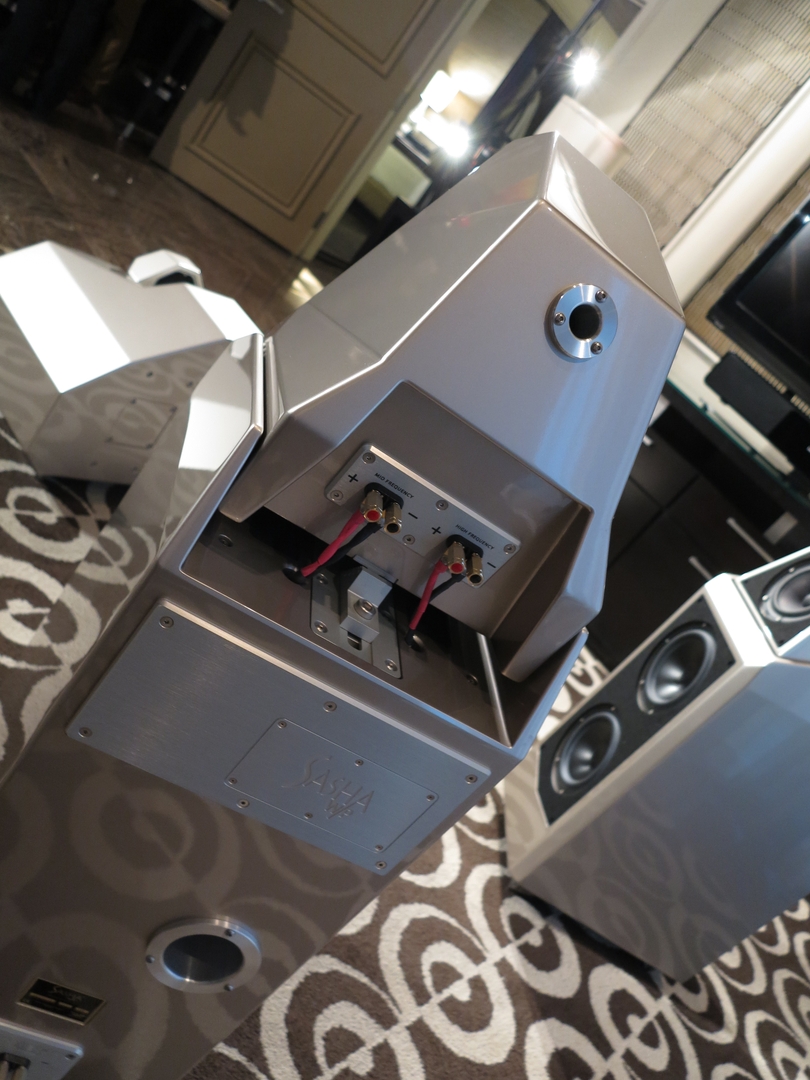
Wilson Audio was showing (although not playing) its new Sasha W/P Series 2. This stood alongside the original Sasha W/P and although you could see the heritage (and the same heritage reaching back to the WATT/Puppy models), the new model has been extensively redesigned, with new laser measuring techniques to help reduce cabinet resonance by 30% (already hardly a problem with the original Sasha), as well as borrowing top-box mounting adjustment and the soft dome tweeter from models like the Alexandria XLF and the Alexia. The price of the new Series 2 will be $29,900. Elsewhere, many companies were demonstrating using Wilson speakers, notably Nagra (Alexias) and VTL (Alexias and the new Duette Series 2).

Magico was showing the new S3 in what has become its entry-level S- range. The new speaker retains the 1” beryllium dome tweeter and 6” Nano-Tec mid-bass unit found in the S1 and S5 models, but brings a pair of 8” Nano-Tec drivers to the rounded aluminium tower speaker. The $22.600/pair S3 is claimed to deliver 26Hz-50kHz.


On a larger scale, Magico’s Alon Wolf also brought the whopping Ultimate III loudspeaker along. Of course, it’s so big, he only brought one, but at $600,000 per pair and standing as tall as a room, one is enough!

At the other end of the size scale, the Vivid Giya G4 loudspeaker is a $33,000/pair floorstander was shown for the first time to the American market. This diminutive four-way, five driver loudspeaker looks like massive G1, only a lot smaller looking. This was being played at a private event at the Mirage, powered by the clever Mola Mola amplifiers.  

There were others well worth noting, that had either been seen before or I simply didn’t have time to cover at length. Among those, the Kharma Elegance Double Eleven Signature loudspeaker (at $54,000 per pair) were proving universally popular and the new three-way version of the two-way Stenheim Alumine from Switzerland (the secret’s in the stand, all for $46,000). Avalon Acoustics was apparently showing its cost no object Tesseract, but – in an nod to old-school Vegas, was showing this at the Golden Nugget and the no-one can afford to spend the two or three hours out of the schedule in travelling across town anymore and – while covered by Chris Martens in his own round-ups, on a personal note, the DeVore Fidelity Gibbon X ($12,000) and the $7k X-1 from Raidho were some of my loudspeaker highlights this year.

CES 2014: Analogue

Given all the fuss about the ever-increasing interest in all things vinyl, you might have expected CES to be packed full of turntables. This wasn’t quite the case. Where two or three years ago, manufacturers were keen to show their analogue credentials with turntables or even playing reel-to-reel, such devices were a lot less prevalent this year. I suspect this has a lot to do with many electronics manufacturers wishing to showcase new DSD-compatible digital components. Vinyl was being played – even reel-to-reel was being played in the Nola room – but many of those playing vinyl this year were makers or distributors of vinyl. I suspect this is a temporary vinyl hiatus, with companies returning to their LP roots when high-res audio is more established.

This was also the year the Germans came to town. Top tier turntables usually reserved for the Munich show mid-year began to appear in Las Vegas. This is no bad thing – if there’s one thing German audiophiles love more than their record players, it’s very well built record players, and they give good engineering – Brinkmann, Clearaudio, Sperling, Transrotor and TW-Acustic are all popular choices among the European platternspieler cognoscenti, and their decks were very well received on the other side of the pond. Of these, arguably the most impressive (and certainly the most expensive) setting was the Transrotor Crescendo Nero, which didn’t look out of place in among hundreds of thousands of dollars worth of VAC system, (including the new $70,000 Statement Phono stage), a Soulution CD player, a pair of Focal Utopia Grande EM and lots of Critical Mass Systems equipment supports.

Staying with products sweeping majestically Westward, we’d seen the Rega RP10 when visiting the UK factory in the middle of last year, and it’s easy to forget that this is the new deck’s first public showing. This new turntable and RB2000 arm combination (also playing through the new Aria phono stage, alongside the recently introduced Elicit R amplifier and Saturn R CD-DAC player, and into PMC’s Fact.12 loudspeakers). Bundled with the company’s Apheta moving coil cartridge for $6,495, the deck takes the stressed-beam, dual braced magnesium and phenolic race-track plinth of the company’s RP8, and adds a high flywheel effect diamond-cut ceramic platter, a DSP-driven power supply and an ultra high-grade, polished for lowered mass version of Rega’s ever popular arm design. Elsewhere in high-end vinyl replay, $6,495 often represented the cost of a single component part – until and unless the almost mythical Naiad appears, this is the top of the Rega vinyl tree.

VPI Industries has a commanding reputation for pushing the vinyl envelope, and this year was no exception. The fabled 3D printed version of the JMW tonearm was being shown in a number of rooms. No longer a virtual product, the $2,500 9” arm and $3,000 12” arm is not just printed 3D for the sake of it; there are some very solid structural reasons why a one-piece unipivot armtube makes a lot of sense in engineering terms. With this and a DD version of the Classic and rumours of yet more new decks that could even undercut the Traveller on the drawing board, the company’s place at the head of the US turntable, er, revolution is assured.


A product that was not playing, but still gaining a lot of attention was the Japanese TechDAS Air Force Two. This pulls together many of the threads of the striking Air Force One – including the complex combination of air suspension, air bearing and vacuum disc hold down – but in a lower cost cast chassis. Although it had been damaged in installation, rumours abound that it delivers almost all the performance at ‘only’ $55,000.

Another turntable bringing top deck performance to a wider audience is the new Sparta from Kronos Audio. This smaller, slimmer, lighter (and, at $21,500, cheaper) version of the large counter-rotating turntable was shown – rather than played – in prototype form in the Magico room. Elsewhere, the big Kronos also showed off the Black Beauty 12” unipivot arm, first seen at RMAF.

The ‘first seen at RMAF’ mantra was common with turntables at CES. Products that were showcased at RMAF had come to market at last at CES. Alongside the Black Beauty arm and the VPI Classic Direct, Music Hall’s new $1,195 Ikura turntable (seen here at the top of a Creek/Epos system) was a popular choice in white or black.


Over at T.H.E. Show, the legacy of the late Tom Fletcher (of Nottingham Analogue fame) lives on. Not only in the shape of the Notts Analogue turntables, not even in the recently launched Fletcher Audio range, but now with the Slovenian Pear Audio Blue trio of turntables. The model in play was the $5,995 Kid Thomas turntable with the £2,195 Cornet arm, but prices start from $2,850. As ever, the design features a high-mass platter with a low-torque, perma-powered motor, and a wooden plinth made of ‘undisclosed’ tree, as well as a unipivot.

Slovenia is proving to be a hotbed of modern turntablism, with Kuzma finally showing its CAR range of cartridges. To mix things up a little, the demonstration used the top $6,550 CAR-50 cartridge, coupled to a $6,500 4-Point tonearm, and a $1,800 Stabi S turntable. While not the usual way of presenting things, no one seemed to complain.

Last, but far from least, Zanden Audio announced its new 120 phono stage. This LCR phono stage retains the elegant musical characteristics and multiple EQ curve settings of the company’s two highly respected models in the line-up, but this is the first phono stage from the brand to use an all solid-state implementation. A veritable pig to photograph, the new phono stage also brings Zanden vinyliciousness to a new low price of just $7,500. Given the company’s top 1200mk3 phono stage costs several times as much as this new 120 model, the word ‘low’ applies. Sort of.

Head-Fi meet in Austin, TX

It occurs to me that many readers familiar with the traditional world of speaker-centric high-end audio systems may be unaware that there is a rapidly evolving, parallel high-end audio universe that revolves around high-end headphones, earphones, and related electronics. The organization that serves as both an information clearinghouse and rallying point for these sound quality-minded headphone enthusiasts is Head-Fi (www.head-fi.org), which is headed by our friend and colleague Jude Mansilla (a headphone visionary if ever we saw one).

Over the course of the year, Head-Fi practice is to stage regional headphone meets where members (and like-minded friends) are invited to gather to compare notes and to show-off their personal systems. Vendors, too, are encouraged to exhibit both to show newly released products and to preview prototypes of upcoming products in order to gather feedback on emerging “skunk works” designs.

The feel of a Head-Fi meet is, then, very different from that of a typical high-end audio show, in that there is no push-push pressure to buy anything or to become a dealer for this, that, or the other brand of equipment. Similarly, there is very little of the snobbish one-up-man-ship that is sadly so prevalent in the traditional high-end world. Happily, there is very little of vitriolic “my widget is better than your widget” posturing that can make the traditional high-end seem a less-than-welcoming place to spend time. Instead, there is much more a sense of shared discovery, a sincere mutual interest in finding out what works, what doesn’t, and to see how products and listening experiences might be made better for all involved.  This blog offers snapshots from a recent Head-Fi meet held in Austin, TX, USA on January 18, 2014.
 

New Products and Novel Concepts

Cavalli Audio

Perhaps the most noteworthy new product release for the meet came in the form of the debut showing Cavalli Audio’s new Liquid Cobalt hybrid valve/solid-state amplifier ($3,250), which is the long-awaited replacement for Cavalli’s then-groundbreaking Liquid Fire amplifier.

The Liquid Cobalt used a dual-triode 6922 valve for its front end with a solid-state output stage. Also on demonstration was Cavalli’s flagship Liquid Gold amplifier (Hi-Fi+ review pending), which was being used to power the amazing Abyss AB-1266 planar magnetic headphone. Dr. Alex Cavalli seemed pleased with reactions to his new Liquid Cobalt amp, which is at present the most affordable of all Cavalli designs.

__________

Leckerton Audio

Nick Kettman of Leckerton Audio was demonstrating two of his high quality portable headphone amplifier/DACs: the UHA760 asynchronous USB DAC/headphone amp with crossfeed and digital volume control ($439) and the UHA-6S Mk2 slimline USB DAC/Amp with crossfeed and digital volume control ($279). Both units are beautifully made and admirably quiet in operation.

__________


MrSpeaker (Mad Dog)

Headed by Dan Clark, MrSpeaker is a manufacturer (or perhaps a more accurate phrase would be “modifier/manufacturer”) of relatively affordable planar magnetic headphones. MrSpeaker’s first headphone, called the Mad Dog ($299) starts life as a Fostex T50Rp, but then receives hand-tuned modifications calculated to improve both sound quality and wearer comfort. Despite these modifications, however, the Mad Dog still looks a fair amount like the T50Rp upon which it is based.

More recently, however, MrSpeaker has launched an even more ambitious model called the Alpha Dog ($599). The Alpha Dog is also based on Fostex components, but unlike the Mad Dog it has been so extensively modified that it looks nothing like anything Fostex has ever produced. The Alpha Dog is a vented but otherwise mostly closed-back planar magnetic headphone featuring an enclosure system of MrSpeaker’s design (the enclosure is sufficiently complex that Clark has elected to produce the enclosure housing on a 3D printer). The Alpha Dog claims to offer reference-grade sound quality for what must be considered a bargain basement price.

Clark was showing the Alpha Dog in Austin, but it was interesting to see that Alpha Dogs were showing up with some regularity both in member’s systems and in vendors’ systems. Based on several brief listens, we think the Alpha Dog offers terrific value for money.

__________
 

Patrick Sutton at Nice Cans

Patrick Sutton runs Nice Cans—an Austin-based high-end audio shop that focuses exclusively on headphone-based systems. Thus, Sutton was showing a range of the product he offers, including headphones from AKG, Audeze, Beyerdynamic, and Fostex, plus headphone amplification products from Benchmark, Musical Fidelity, and other suppliers. Sutton should be congratulated, first for addressing the real need for a specialty shop where discerning enthusiasts can check out and purchase top-shelf headphones, and second, for understanding that—for whatever reasons—traditional (that is, speaker-centric) high-end shops tend to want little to do with top-tier headphones (which in our view is a mistake on the part of traditional high-end dealers, but a fine market niche for Nice Cans).

__________

RK Audiology – Westone earphones and music friendly Lyric hearing aids

Paula Rivers and Janet Krueger (the “R” and “K” of RK Audiology) are full-service audiologists who recognise there is much more to hearing health than helping clients to score well on standardized speech intelligibility tests. The big difference, here, is that Rivers and Krueger take a music-first attitude toward their profession and thus want to help their clients not only understand day-to-day conversations, but also to enjoy music as fully and naturally as possible

To this end, Rivers and Krueger offer high-quality hearing protection devices as well as custom-fitted in-ear music monitors and high-quality universal-fit earphones from Westone. At the Austin meet, RK had on display a smattering of Westone’s recently revamped W-series universal-fit earphones, and it was refreshing to see audiologist promoting well-made music playback devices rather than simply dispensing garden-variety hearing aids.

However, for music lovers who may already have suffered some degree of hearing loss, RK offers the fascinating Lyric hearing aid system, which, says Ms. Rivers, just might be one of the few hearing aid solutions on the market suitable for audiophile use. The Lyric is a miniature, in-ear, always-inserted, and always-on device that—get this—uses analogue-only audio circuitry to achieve a natural, organic sound (unlike typical hearing aids which often use well-intended but garish-sounding DSP circuitry to improve speech recognition, but at the expense of sound quality that is not well-suited for music listening). It is encouraging to find audiologists willing to work toward solutions that may help clients stay in touch with the music they have loved all their lives.

__________


Members’ Headphone Systems

In keeping with Head-Fi tradition, I though I might offer snapshots of several Head-Fi members’ systems, where you will be able to see firsthand some of the rich diversity of the high-end headphone community (the systems will be listed by the owner’s Head-Fi usernames).

BBOPHEAD

BBOPHEAD’s headphone system features an analogue front end and showcased a variety of valve-powered headphone amplifiers.

__________

DAN1SON

DAN1SON’s features Grado headphones, and Audio-gd Compass headphone amp/DAC, a Fubar USB DAC, with a Sony disc player and a MacBook as primary source components.

__________


HO1YSWORD

HO1YSWORD’s PC-based system featured popular (though admittedly strangely-named) electronics from Schiit Audio (yes, it’s pronounced just the way you might expect. No, Shiit…).

__________

KC JAG

KC JAG’s demo table featured an absolutely mind-bending collection of headphones as our photo here shows. His collection of ‘phones raises an important point; because top-tier headphones are relatively inexpensive (at least as compared to top-tier loudspeakers), many enthusiasts—this author included—are able to own and use a wide variety of ‘phones without obliterating their household budgets. Consider this just another plus in favour of becoming a confirmed headphone enthusiast.

__________

MAXVLA

MAXVLA was the host of the Austin meet and accordingly his system featured several loaner components supplied by manufacturers who hoped he might showcase their components at the Austin meet. Accordingly, MAXVLA’s system featured DACs and headphone amps from Matrix and Violectric, playing through MAXVLA’s custom, black-finished Sennheiser HD800 headphones (not shown), 

Special thanks go to MAXVLA for all the hard work in putting the event together. MAXVLA is a terrific headphone ambassador and throughout the day he went out of his way to make sure that all in attendance felt welcome and were having a good time.
__________


MORBIDTOASTER

Austin-based audio omnivore MORBIDTOASTER is perhaps representative of a new breed of audio enthusiast—one who cares passionately about sound quality (as do we all) and who enjoys listening through both loudspeakers and headphones. The centerpiece(s) of MORBIDTOASTER’s system are a Kuzma Stabi/Stogi turntable and tonearm fitted with a Dynavector phono cartridge, a Vincent Audio phonostage, and a valve-powered Leben integrated amplifier/headphone amplifier. MORBIDTOASTER is between transducers at the moment, but we understand he favours Sennheiser HD 800 headphones (he has owned them in the past) and is looking, quite possibly, to acquire a set of DeVore Fidelity Orangutan-series loudspeakers. In short, he likes the good stuff.

__________

Jesse Anderson at SOUND CHECK

Jesse Anderson of SOUND CHECK, who specialises in Nagra, Stellavox, and 2-track analogue recordings, brought along cool system featuring a brace of Nagra reel-to-reel tape decks playing master tapes of recording Anderson had made of the Trinity University Jazz Ensemble and Trinity University Wind Ensemble. The system used a vintage Marantz 2270 receiver as a headphone amplifier. However, experimentation throughout the day convinced many listeners that top-tier headphones often sounded their best when fed directly from the Nagra’s analogue outputs, rather than through the venerable Marantz. As so often proves the case when first-generation analogue master tapes are involved, the sound quality pouring forth from those Nagra decks was stupendous.
__________

THAILAND

Head-Fi member THAILAND exhibited a system featuring an Oppo universal/Blu-ray player, a classic Cavalli Liquid Fire hybrid valve/solid-state headphone amplifier with Sennheiser dynamic-driver headphones and Audeze planar magnetic ‘phones.

__________


…and Hi-Fi+ gets into the act, too.

Although we’re not technically Head-Fi members (or at least the author is not), we decided that we, too, would participate in the sharing, free-flowing, “show-and-tell” spirit of the Head-Fi meet. To this end, we brought along two pieces of headphone-related equipment that are destined to become the subjects of upcoming Hi-Fi+ reviews. The products in question were iFi’s recently announced iCAN Nano portable headphone amplifier ($179) and Chord Electronics’ brand new Hugo high-res DAC/headphone amplifier ($2,395).

The tiny iFi amp got passed around amongst various Head-Fi members and the general consensus was that the little portable offered astonishing performance (and thus value) for the money. Many were floored by the amp’s rich, vibrant, full-bodied sound. One member, in particular, tried the iCAN Nano with a set of relatively demanding Sennheiser HD800 ‘phones and was shocked to hear the bold, muscular, and eminently musical sound the tiny portable amp produced. 

The Chord Hugo, in turn, wowed many attendees. One Head-Fi member nicely summed up the sentiments of the majority of listeners who tried the Hugo, saying,  “I went into severe temporary ‘sticker shock’ when you told me the price, but once I heard the Hugo in action everything started to make sense. It really is a viable replacement both for expensive high-performance DACs and for costly desktop headphone amplifiers.” The DAC section of the Hugo, in particular, came in for very high praise for its smooth, clean, and yet highly detailed and resolving sound.

IMPORTANT NOTE: Our decision to bring along products drawn from Hi-Fi+ reviews in progress should not be construed as favouritism or bias in favour of iFi or Chord Electronics. Rather, we hoped to show that Hi-Fi+ was not just reporting on but also actively participating in and contributing to the Austin Head-Fi meet. Besides, both the iFi and Chord components have their roots in Europe (and specifically in the UK), as does Hi-Fi+, so we felt it made sense to introduce Austinites to some new components that help to show what headphone-minded audio manufacturers have been creating in our part of the world.

__________

Summing Up

We had a great time at the Austin Head-Fi meet and, as always, learned a lot, too. If you ever have the chance to attend a Head-Fi meet in your local area, we strongly encourage you to do so. You will be impressed, we think, by discovering audiophiles of all ages and genders united in their passion for great music and for putting together high-quality music systems based on headphones and earphones. Besides, it’s almost impossible to envision a more friendly and welcoming group of music/audio lovers; their enthusiasm is downright contagious!

CES 2014: A personal viewpoint

There’s a famous inscription on the James Farley Post Office that fits, It reads, “Neither snow nor rain nor heat nor gloom of night stays these couriers from the swift completion of their appointed rounds.”

It doesn’t mention Norovirus. Probably for good reason.

Having rebooted my digestive system, and despite loudspeaker and turntable round-ups still to come, it’s time to look back on the annual CES in Las Vegas. The show is constantly awash with thousands of new technologies in all consumer electronics categories striving for column inches online or in print. With an endless stream of wearable tech, curved smartphones and smart TVs, and cars with an IQ 50 points higher than their owners, it’s hardly surprising that seemingly sleepy, old-fashioned grandpa of consumer electronics – audio – barely gets a look in. Sure, the mainstream journalists and bloggers might latch onto the big talking points or the even bigger tickets in high-end audio, but for the most part the best sounding high-end system just isn’t as soundbyte-friendly or as shiny as the main attractions .

We specialists can get carried away in the event to see the bigger picture, but pulling back a while to take in both the trends and the show itself (more accurately, ‘shows’ – there’s T.H.E. Show running in parallel to contend with too).

For once, discussing attendance figures is slightly unfair. Numbers were down this year, but that was thanks to two-thirds of the US suddenly exposed to freezing weather and snowstorms blanketing the Eastern seaboard and into the Midwest. Those scheduled to attend the show from these states – and even those from far away places who had connecting flights into New York and Chicago – were left stranded, and that thinned down the number of people attending the show as a whole. Those who were there were putting a positive spin on this, saying it was all about quality, not quantity, but in reality it was more about the Polar Vortex.

Nevertheless, there were distinct trends taking place. This year, there seemed to be fewer turntables playing than usual. There were turntables on show, and many of them were in system and playing, but less than usual. In particular, those with no axe to grind either way (as in people showing off amplifiers and loudspeakers, rather than a turntable or a digital front end of some description) were in the main more content to play music from a laptop or networked source than install a turntable. Not sure why this should be, especially as vinyl replay is something of a hot topic at the moment. Perhaps it had something to do with High Resolution Audio (HRA).


2014 is supposedly the year HRA catches the interest of more than just the audiophile contingent. However, if early reports from the mainstream press are anything to go by, the movement didn’t make anything like the impact expected, and the format received the merest nod from the news media and a whole lot of ‘meh!’ from the tech press. The exception – as in hindsight, might have been predicted – was the Astell & Kern AK240 portable player, which was received with a kind of semi-quizzical ‘so it’s a super iPod?’ questioning.

Nevertheless, among the high-end audio contingent, HRA was far better received. From a hardware perspective, a slew of new servers, portables, DACs and networked audio devices appeared, capable of hitting DSD or even DSD 128 resolution. In fact, almost overnight the market has changed to adopt DSD so dramatically, a company launching a new DAC with ‘only’ 24-bit, 192kHz resolution was met with the kind of dismissal you might expect to see if they were trying to relaunch 8-Track. Despite the average listener having almost no DSD software, the paucity of DSD software widely available DSD software, the paucity of DSD recordings actually worth owning and the costs involved, audiophiles are seemingly afraid of being left behind (it’s called ‘FOMO’ – Fear Of Missing Out – and is perfectly encapsulated in a blog from Paul McGowan of PS Audio http://www.pstracks.com/pauls-posts/foma/12955/).

A potentially good thing to be taken from this year’s CES is it begins to seem like the endless upward spiral of audio prices has slowed a little. OK, so this was also the year of $200,000 amplifiers from Kondo and Naim, but these were the exception rather than the norm. Granted, there were a lot of new product launches in the $25,000-$50,000 per unit mark, so the high-end industry is still some way from playing a low cost hand, but it seems this year the astronomical end of the market has paused for now. Whether this is part of the new cycle of ultra high-end product design and next year we’ll see a plethora of $100,000 products again, or whether audio is finally beginning to pull itself back from the brink and we’ll see more products at the more affordable end of the market remains to be seen, but it strikes me as showing just how far we’ve come that $25,000-$50,000 is now the ‘more affordable end’ of the market today.

Finally, I’ve consciously avoided making value judgments on the sound quality of the rooms, because it seems somewhat unfair to judge a product – and by extension, a company – on the basis of a quick audition in a room some 5,000 miles away from my own listening room. These should be snapshots of what a product can do, an introduction at best to the product like a visceral news item. I’ve tried to do this based on feedback from readers (both online and in print) who seem polarized between finding such subjective comments off-kilter at such an event, or look at these ‘good room’/’bad room’ statements as an exercise in company destruction. I think bad sound at a show is inexcusable, but sometimes (from personal experience) unavoidable, and there have been products that performed well in show that ended up being rejected in test, and products that distinctly underwhelmed in show but performed extremely well when reviewed.

As a result, I chose not to comment on performance this time, but merely state the facts where possible. But this is in part an experiment – is it something worth striving to continue with, or should we go back to making value judgments about room sound? The decision ultimately rests with you.

CES 2014: Electronics (Amplifiers)

OK, there is an elephant in the room when it comes to audio amplification this year – Naim Audio. By upping the ante by an order of magnitude, to make its Statement NAC S1 preamp and NAP S1 mono power amplifiers, by building them big (263.5kg/581lb all up), by building them powerful (one horsepower per channel, capable of reputedly 9kW peaks) and by building them with a price tag in excess of $200,000, it was the talking point of the show. I wore down a camera battery or two showing people in other rooms this picture:

Just because the “What The F…” comments that hit home afterward were so entertaining. The raw specs don’t really do the Statement justice (when do they ever?), but some of the interesting factoids surrounding this freestanding BBQ-sized amplifier bear some repeating – Aluminium Nitride transistors, all sited on individual ‘nano’ diamond thermal conductors (as used in low earth orbit satellites). 4kVA transformers, a mass loaded vertical suspension system that looks like steampunk-meets-sci-fi, a stepped attenuator volume control that moves in and out of the circuit in milliseconds, just leaving the volume setting behind.

No one really knows whether this was designed to showcase Focal’s Utopia Grande EM loudspeakers (as the gossip suggested) or just to prove what Naim is capable of when the breaks are taken off (designer Steve Sells has been squirrelling away at this design since forever, apparently… he just didn’t think anyone would go this ape crazy enough to actually build the thing), but the myths behind the Statement almost add to the amp’s cachet, and the reputed 20+ pre-orders for an amplifier that costs almost as much as a new Cessna, show that there really is perhaps no upper limit to the buying power of the modern audiophile.

The interesting thing was this wasn’t the only $200,000 amplifier launch. Constellation Audio released the Hercules II Mono power amplifiers, at a healthy $90,000 per channel. Moving to a more conventional form factor from its predecessor, the new Hercules II Mono delivers 1.1kW up to 100kHz, but the amps are more than just about power. Constellation Audio was one of the first brands to reach this über-high-end market with its Reference series, and – while it now has a Performance range and more to follow, it hasn’t abandoned it’s top-notch roots. 

Also, Kondo from Japan also launched the mighty Kagura mono power amplifiers. To prove just how much power they deliver, Kondo was playing the beast amplifiers into B&W 801D loudspeakers – a loudspeaker that demands heavy driving. This massive 211-based single-ended triode 55W monoblock has been seen before at shows, but in prototype form, and with no fixed price tag. Now it is finished and has a price tag, and it’s stuffed full of zeros!


Let’s put this into perspective. Having been exposed to repeated doses of ionizing $200,000+ price tags in relatively quick succession, I was feeling a little dazed. Near to one of these ‘radiological’ price tags was Dan D’Agostino Audio’s room. First, I heard the words “You think that’s bad? My wife spends more than that on handbags every year!” from a Chinese visitor in the room at the time. Then, I found myself thinking how much of a bargain a Momentum integrated amplifier sounds, when considered in terms of fractions of a handbag! The D’Agostino Momentum integrated ($45,000, Hermès crocodile-skin Birkin bag definitely not included) successfully combines the all-balanced Momentum preamp and 200W stereo power amplifier in ‘one’ chassis – in fact, the amplifier itself sits on a separate massive power supply that acts as the base, and two hefty hausers link the components together. The amp has a redesigned heatsink arrangement that still retains the amp’s Nemo-esque style, but keeps even cooler under pressure.

While we are skirting round the subject of super high-end prices, two of Switzerland’s top names in top-end audio both announced amplifier products this year. CH Precision launched its bridgeable 200W M1 mono power amplifier at the show. Expect a price somewhere between ‘much’ and ‘a lot’. Meanwhile, Soulution showed its new $65,000 dual-mono 711 stereo power amplifier, a switch mode, ultra-wide-bandwidth design that delivers 150W into eight ohms and ‘doubles down’ perfectly right to 600W into two ohms. One thing’s clear; apart from penknives and alp-shaped chocolate, quality doesn’t come cheap in Switzerland.

Staying with Central European esoterica, German technologists T+A Elektroakustik marked its 35th birthday by bringing its 3000 HV range to the American market for the first time, adding a new $15,000 P 3000 HV preamplifier, A 3000 HV power amp ($37,000 per pair) and optional PS 3000 HV power supply for the power amps ($25,000 per pair). HV here stands for ‘High Voltage’ and the T+A flagship line is designed to run at the sort of voltages normally seen in tube amplifiers and uses fully discrete circuits, allowing the power amps to deliver 500W in stereo mode and a kilowatt in bridged mono mode.


There’s an odd inversion here. Traditionally, the Europeans tend toward making more minimalist, lower powered, cheaper and sometimes less extravagant audio amplifiers than our American counterparts, but this year, often the reverse was true. Take US high-end mainstay Krell, for example. The company’s new iBias system is an intelligent, constantly self-evaluating Class A circuit that allows the company to build amplifiers with all those traditional Krell values, but without the heat and energy consumption that are less well-suited to today’s environmentally-snuggly world. The intelligent bias circuit is so smart, it can warn the user or the supplier of impending problems with the amplifier, just like the HAL 9000 computer did in 2001 A Space Odyssey, only this time without the frozen scientist killing spree. A seven-strong launch, Krell announced four models in the two-channel power amp range – which range from $7,500 for the Duo 175 stereo chassis up to $11,250 for the Solo 575 (the numbers denoting power per channel in watts, naturally), and it’s logical to assume there will be preamps and processors to match.

On the subject of simultaneous multi-launches, Pass Labs only had one thing to show this year, but it showed it nine times in a row. Pass’ X-Series and XA-Series nine-strong power amplifier range moved up to ‘point 8’ status this year, Each model has undergone fairly significant changes, including improved voltage gain and input blocks, larger power supplies, better filtration, and more, higher power MOSFETs in the output stages. Prices range from £6,400 for the X150.8 stereo chassis up to $40,000/pr for the XA200.8 Class A monoblocks.


Ayre is also updating its top amplifier range, but also offers existing customers the chance to upgrade their current models. Having learned a significant amount in developing its latest 5-series amplifiers, the company has turned its attention to the popular KX-R preamp and MX-R monoblocks, with the VX-R to follow later. The new ‘Twenty’ version of the KX-R (to celebrate the brand’s 20th year) features increased capacitance in the power supply, improved gain stages and the use of the new/old ‘Diamond’ output stage. Even less is retained of the older circuit in the MX-R in the update, and the new circuit sports the company’s ‘Double Diamond’ layout. Anglophile audiophiles with fairly long memories may remember the advertising campaign for Double Diamond India Pale Ale – “Double Diamond Works Wonders” – we shall see…

Where Ayre has taken its latest pre-power design cues from its integrated, Constellation Audio has worked in the other direction. Shown – but not played – at the HFN Show just outside of London, the new Constellation Audio’s new $20,000 Argo integrated amplifier from its Performance line pulls together elements of the Virgo preamplifier and Centaur power amps to create a 125W integrated more than able to partner Magico’s S5s. An Inspiration Line that lowers the price of Constellation Audio admission to just interplanetary levels is planned, too.

Moving over from solid to hollow state, VTL showed two revised products at the CES event; the $33,500 S400 Series II tower of power had been seen before at RMAF, but the $13,500 TL-6.5 Series II Signature line preamp is new to the show. It features an improved power supply, a redesigned current gain stage and better quality capacitors. The two combined were an obvious match with Wilson Alexias.

Staying with tubes, VAC pushed the boundaries of everything once more. The idea of Focal Utopia Grande EM being driven by tube amplification is absurd to many on the other side of the pond. I don’t think anyone had told VAC, because it went ahead and drove them. Admittedly it took the company’s $116,000 self-biasing Statement 450iQ monoblocks, fed by the $66,000 Statement Line preamp and $70,000 Statement Phono preamplifier, but drive them they most certainly did.


Moving back to solid-state Boulder has finally waved a fond farewell to its 2000 series amplifiers, replacing it with its 2100 series. The Boulder 2110 preamp in particular is a tour-de-force, a $54,000 mainframe with pull-out modules and the kind of power supply that most big power amps would be proud of. It’s joined by a stereo and mono power amplifier that effectively define ‘solid’ build. Boulder’s top-of-the-Venetian room was almost back to front, however, with the show and tell part front and centre, and the listening room consigned to a too-small room in the corner. Nevertheless, when it comes to sheer muscle power, this is more powerful than most.

Not demonstrating, but very much on show, Simaudio’s Moon launched three products at CES. The first, the 260D is a CD transport in the Neo series ($2,000 CD only, $3,000 CD and DAC) was interesting in its own right, but the company also announced two slim units from the Evolution Series; the 820S power supply ($8,000) and the 760A 130W stereo power amp (also $8,000). The PSU is designed to aid performance in the 740P preamp, 650D and 750D DAC/CD transports and the 610LP and 810LP phono stages. Meanwhile, the 760A is a no-feedback design with balanced and single ended inputs and bipolar output stages. It’s designed to provide a bridge between Neo and Evolution power amp lines.

Finally, one of the more real-world brands at the show, Arcam demonstrated the first of its new ‘64’ platform, the $5,000 A64. Built on a chassis normally reserved for home theatre amps for the brand, Arcam’s new Class G circuit means the 200W per channel amplifier is capable of delivering 50W in Class A, yet goes super green in sleep mode with just 0.5W power consumption and is said to go so loud, the company was considering putting a dial that goes up to 11. Like the popular A19, it includes power supplies for the rSeries products (Arcam doesn’t like onboard DACs) and is supplied with a MM phono stage that can be switched out for more line inputs. This marks the start of Arcam’s new ‘designed in the UK, built in Canada’ venture.

CES 2014: Headphone, Earphones, and Related Electronics – Part 3

If I had to name one broad high-end audio product category that is growing rapidly and for all the right reasons, that category would be Headphones, Earphones, and the specialised electronics needed to drive them. No other product category can provide so much music rendered—in the best case—at exceptionally high levels of performance for so little money. For a new generation of music lovers (and more than a few traditional high-end audio enthusiasts, as well), the quest for serious high-end sound starts right here, and what’s not to like about that? Check out this report to learn about important new headphone and earphone offerings seen and heard at CES 2014.

This is Part 3 of a three-part report.

_________

Obravo

The last few years have seen dramatic increases in the amount of R&D work being done on very high performance headphones with exotic drive units. A case in point would be the soon-to-be-released Obravo HAMT-1 headphone ($1,800), which is based on dual Heil-type air motion transformer-type drive units. We weren’t able to form clear-cut impressions during a too-brief listen to the Obrava ‘phones near the end of the show, but this firm and the entire concept of headphones based on Heil-type drivers certainly bears watching. By the way, the HAMT-1 is quite a looker, in our view.

Oppo Digital

During CES we took the opportunity to meet up with Oppo Digital Chief Technology Officer Jason Liao and to learn more about the firm’s upcoming planar magnetic headphones and HA-1 DAC/headphone amplifier.

Oppo’s planar magnetic headphones are being developed with technical help from planar magnetic driver specialist Igor Levitsky of BG Radia fame. Truth to tell, we have been listening to a first-generation prototype of the Oppo headphone for several months now and based on our talks with Levitsky and Liao, we expected the second-generation ‘phones will improve on an already very good design. Fit, finish, and industrial design on the ‘phones is very fine indeed as is only appropriate given that the intended selling price will likely be in the $1,200 range.

The DAC/headphone amplifier, called the HA-1, basically leverages much of the digital audio section of Oppo’s flagship BDP-105 (or, in Europe, BDP-105EU) universal disc player, marrying that digital section with a fully-balanced, Class A headphone amplifier section. The HA-1, like the new Oppo headphones, is expected to sell for about $1,200. 


Sennheiser

Many of Sennheiser new offering fell well outside the high-end headphone market space, but two families of models, both new since last year’s show, were the Momentum On-Ear headphones ($229, available in a very wide range of colours) and three new “DJ” models. The new DJ offerings include the HD6 Mix ($279), the HD7 DJ ($329) and the HD8 DJ ($389).

As you would expect from Sennheiser, even its self-proclaimed DJ models offer a relatively well balanced sound (at least as compared to many competing DJ offerings, many of which can sound like horrible “boom/sizzle” machines). 

Sony

Sony, quite frankly, did not show any new headphone-related products that it had not shown earlier at the Rocky Mountain Audio Fest 2013, but what was perhaps significant was the fact that Sony’s Venetian Hotel demo suite, which has in the past has focused on Sony’s top-tier loudspeakers and related electronics, was this year split into two sections: one centered on loudspeakers and the other devoted to headphones and DSD-capable headphone amp/DACs.

The message couldn’t have been any clearer: headphones have, in Sony’s view, become acceptable (and indeed, desirable) vehicles for high-end listening experiences. The two Sony models feature most prominently in the suite were the HAP-S1 DSD-capable DAC/music server/headphone amplifier ($999) and Sony’s top of the range MDR-1R headphones ($299).


Stax

For the first time in many years, the legendary electrostatic headphone manufacturer Stax had a beautiful, full-sized display booth at CES. Within the booth we found some surprising affordable Stax models we have not encountered before. One was the compact, portable SR-002 electrostatic headphone and amplifier system ($525), whose power unit is in the midst of updates, including an optional power unit plus DAC that should arrive on the market in three to four months.

Also in the booth was a prototype of an affordable (but yet to be named) desktop electrostatic amplifier that will be priced around $800 for the amp alone or at higher price for a version that will combine amp and DAC functions in one chassis. In what we regard as both a wise and welcome marketing move, Stax will offer this new desktop amp bundled with a pair of SR-207 electrostatic headphones for somewhere between $1,200 – $1,400 (a very attractive price, considering users will be getting both set of real, full-size Stax electrostatic ‘phones and an amp to drive them for comfortable less than $1500.

Important updates: A Stax spokesman advised that, within a few months, Stax will be opening a new Japanese factory located near the present Stax facility (both will operate side-by-side). This step should make for a 5X-to-10X increase in production capacity, meaning that the factories might eventually be able to catch up with the seemingly perpetual backlog of orders for the flagship SR-009 electrostats (and other Stax models). What is more, we learned that Stax has begun development work on a new top-tier electrostatic amplifier geared specifically for use with the amazingly transparent, world-class SR-009 electrostatic headphone.

Urbanears

As many of you know Urbanears is a maker of value-priced headphones that offer both genuinely competent sound and styling that gives trendy listeners a heaping helping of Scandinavian design at a bargain basement price. But what you may not know is that Urbanear has a track record for clever, innovative ergonomic designs such as the firm’s clever pass-through headphone jacks that enable two pairs of ‘phones to be daisy-chained on one signal cable, or the distinctive “turncable” that offers a mini-jack plug on one end and a full-size phone jack plug on the other (either end can be plugged into the headphone, making it possible for the cable to be used with whatever size of output jack one might encounter).

For CES 2014, Urbanears’ big ergonomic idea involved a sweet little headphone called the Humlan ($50), whose headband pad cover and earpad covers are readily removable (via an easy-to-use system of snaps) and are—get this—machine washable. Thus, if you manage to soak your Humlans during a particularly vigourous workout at the gym, you needn’t worry; once you’re home, just pop off the covers, run them through the wash, put them back on, and your Humlans will be fresh and good to go. 


Velodyne

Though best known as a subwoofer manufacturer, Velodyne has moved very rapidly to embrace a new role as a headphone/earphone maker—an area where the firm’s product line has grown be leaps and bounds over the past year.

The line-up now includes an earphone specifically geared for physical fitness enthusiasts, called the vFit ($99), which is characterized as a “lifestyle, action earphone,” an entry level headphone called the vLeve ($199), a wireless version of the vLeve called the vFree ($249), a noise-cancelling headphone called the vQuiet ($299), a high performance Bluetooth headphone called the vBold ($349), and a top-of-the-range performer known as the vTrue ($399).

Westone

In very many ways Westone, a veteran earphone and custom-fit in-ear monitor maker, has reinvented itself over the past year, partly by adding models in new product categories, but also by substantially re-vamping, upgrading, and expanding existing product ranges in ways that not only make the products look better but also, more importantly, improve upon their already very goo sound quality. Thus, the changes at Westone are no mere “once-over-easy” product facelifts, but rather represent much more substantial and far-ranging enhancements to the line.

One new area for Westone might be classified as “adventure earphones”—models that sound good but that are also built to stand up to vigourous use in rugged environments (e.g., snowboarding, hiking, jogging, and so on). Last year’s category-opening adventure product was the ADV earphone, but for CES 2014 the firm rolled out its new ADV Beta earphones ($179) which feature zinc earpiece housings, single balanced armature drivers, and come with clever and potentially life-saving reflective signal cables (the better to protect runners who jog in low-light environments).

In the universal-fit earphone market space, Westone has completely revamped what used to be called its Westone or TrueFit models to create a revised W-series range. At the entry level of the range is the W10 earphone ($249), which is based on a single balanced armature driver, while at the top of the range are two newly-announced models: the W50 ($749, based on five balanced armature drivers) and the W60 ($999), based on an impressive array of six balanced armature drivers). Westone VP of Audio Products, John Lowery let us try his pilot production pair of W60s for a brief listen and we found them very, very impressive indeed (a solid contender, we suspect, for best-in class honours, regardless of price).

Interestingly, all the new W-series models feature certain elements in common, including an assortment of interchangeable external earpiece shells (allowing owners to change colours at will), detachable and user replaceable signal cables (one set for purists, the other with remote smartphone controls), new ruggedized carry cases with what appear to be airtight seals, and what is arguably the finest set of both rubber-shell and compressible foam eartips being offered with any range of universal fit earphones on the market. All in all, these are some very impressive offerings. (Incidentally, Westone UM-series universal fit earphones have also been renewed, though our sense is that music lovers will—in almost all cases—prefer the tonal balance of the W-series models for listening to recorded music.).

But the innovations don’t stop with the universal fit models, since Westone has leveraged some of the same sonic insights poured into its W-series models to improve its range of custom-fit in-ear monitor. At the lower end of that range are three almost shockingly affordable custom-fit monitors: the new AC10 ($349), based on a single balanced armature driver, the AC20 ($479), based on dual balanced armature drivers, the CR10 “recreational monitor” ($289), whose low-profile earpiece is designed to fit comfortable within helmets.

Updating the CustomElite-Series monitors are a range of new ES-models, including the ES10 ($449), ES20 ($749), ES30 ($899), and ES50 ($999, with a Hi-Fi+ review of the ES50 slated for later this year). Although it is a bit too early to say, we think it is a safe bet that, within the not too distant future, there will also be an ES60 model that will leverage the technology of the upcoming W60.

Last but not least, we should give you notice that Westone is in the process of developing a potentially spectacular new full-size headphone that will feature—get this—a beryllium-foil tweeter/midrange ribbon driver pair with a beryllium diaphragm-equipped mid-bass driver. Projected pricing for this super-phone is roughly estimated at about $5,500, with release slated for late in Q3, 2014 or possibly Q4, 2014.

CES 2014: Electronics (Source Components)

CES (don’t call it the ‘Consumer Electronics Show’ any more, it’s a self-referential acronym now, so ‘CES’ is short for… ’CES’) remains the most important event on the American audio business calendar. Although now its worldwide primacy has been somewhat eclipsed by specialist audio-only events like Munich High-End, the Singapore International Sight & Sound Exhibition and the Tokyo International Audio Show, it remains one of the few places where audio can get coverage in the mainstream media and is still a vital arena to showcase and share your wares.

This year, the big push was for High Resolution Audio, whether that be 24/192 or DSD. Amid the large Microsoft lecture theatres in the Sands convention center, a contingent of HRA hardware manufacturers and software providers joined forces to promote the format to more than just the audiophile community. With, it must be said, somewhat mixed success. The highlight in software terms is HDTracks is beginning its service roll-out into Europe at last, starting with the UK in March this year. It’s also worth noting that with HDTracks being the biggest software supplier of the bunch, with the largest selection of titles, this represents a significant potential step forward for acceptance of HRA in Europe, allowing room for the smaller labels to grow into a freshly minted marketplace. The Korean contingent have it nailed though; they sell hi-res SD cards packaged as albums:

Of course, the software is only half the story. Although the Sony HAP-Z1ES 1TB high-resolution audio streamer ($2,000) was first shown at RMAF in the US, it was the first time this 1TB music server – preloaded with 20 high-resolution albums – was shown to a wider audience than just audiophiles. Intriguingly, the 24/192-compatible £550 NWZ-ZX1 high-resolution Walkman – which has been formally announced in Europe – was almost forgotten about.

Fortunately, the Astell & Kern AK240 player – reputed to cost $2,400 and which can support up to DSD 128 native – was providing the interest in portable players. You can read more on this here (https://hifiplus.com/articles/ces-2014-headphone-earphones-and-related-electronics-part-1/?page=2).

Now where we have two photos of the same thing, sometimes the reverse happens. Musical Instrument specialist Korg announced its stunning looking AudioGate DS-DAC-100, a wing-shaped $599 DSD 128-ready USB only DAC capable of outputting to headphones, as well as to balanced or single-ended audio systems, and the $350 DS-DAC-100m, which does the same in a more slimline case, eschewing the balanced output and sporting a 3.5mm headphone jack. Interestingly, there were a lot of common-ground products between Chris Martens’ round-up of the headphone world and digital source components at CES, simply because so many companies were releasing high-grade DSD-supporting DACs with headphone amplifier components at prices that didn’t end in a long string of zeros.


What we saw instead was a gap emerging between the DAC market and the network streaming product category, with a few companies occupying (more accurately, retaining) the middle ground of higher-priced DACs. The network streamer issue is interesting, however; where this category was dominated by UK brands like Cyrus, Linn and Naim as recently as last year, there were now a slew of newcomers appearing with potentially stronger product. Although the Korean brand Aurender is hardly new on the streaming scene, its latest $3,499 X100L and $2,999 X100S digital music players represent a new entry point for the brand. These iPad-controllable, network-equipped players both feature a 120GB SSD drive for the custom operating system and can support virtually every music file format you can think of, including DSD and even .APE. But what is the difference between the two players? The L model is longer, and has two 3TB hard disks, while the S just has a single 1TB drive.

A sign of how fluid this market is today, less than 18 months ago, almost no-one had ever heard of the Hong Kong brand Lumin, then came its first twin DAC A1 model at $7,000 (and now available in black). That is now joined by a trio of additional streamers; the S1 (anticipated price, $10,000), which sports two eight-channel ESS Sabre DACs per channel, running in parallel, can support and upsample to DSD at up to 5.6MHz precision and output that to HDMI. Then, below the current A1 comes the T1 (essentially an A1 in a less funky box, for $4,500) and then the D1, which features a cut-down version of the A1 circuit in a smaller box for $3,500. There is even a small network server on the way, designed to be the same size and shape as one of the company’s power supplies. Watch this space, folks… this company looks like a force to be reckoned with.

DSD wasn’t the only game in town, and two new launches from Fine Sounds showed there’s still mileage in delivering 24/192kHz replay. The elegant Wadia 321 Decoding Computer delivers to this precision from USB, to both headphones and main systems using Wadia’s in a full-sized aluminium chassis that looks elegant and very ‘now’, for $3,000. Meanwhile, at the Audio Research end of things, the company was playing a full ARC/Sonus Faber system, with the $9,000 SP20 full-function preamp being fed by the new CD6 one box CD transport and upsampling DAC, also priced at $9,000. This replaces the evergreen CD5 from the company, and leverages technology from the Reference CD9. The new data player features asynchronous USB alongside the usual digital input suspects and the top-loading CD transport. The new four-DAC circuit upsamples data received from the CD transport, or the digital inputs.

Meanwhile, over at T.H.E. Show, German audio guru Audionet was demonstrating its own 24/192 network streaming system, the $10,000 DNP (I should learn to take better notes… I had this down as ‘DNR’ on my pad, and ‘do not resuscitate’ is harsh criticism for what appears to be a very well sorted networking system), short for Digital Network Preamplifier. It combines network media renderer with built-in DSP delay, bass and EQ management with user-adjustable room acoustic analysis and even a line and digital preamplifier, all driven by a useful iDevice or even Android app. It’s even upgradable, thanks to the EPX external power supply. Definitely one to check out.


The lines between source component and amplifier have been blurred recently. Products like those in the Devialet or Naim Audio Uniti ranges cross the lines between where a DAC or network audio device stops and an amplifier starts. Cyrus continues that tradition with its new Lyric 09. Eschewing the half-sized ‘singing shoebox’ design the company is perhaps best known for, the British manufacturer has crammed CD transport, aptX Bluetooth, internet radio, DAB/DAB+, FM, a pair of USB inputs, a proprietary 32bit DAC, UPnP network replay, headphone amplifier and 170W stereo amplifier into the new $6,200 smart looking box of tricks. This is the largest of a currently two-strong range; the Lyric 05 dropping the power down to 80W and 24/192kHz precision. Sometimes, even the best camera can spend its time playing dirty tricks, so here’s a press shot, in place of a blurred photo of a mirror!

Similarly, darTZeel displayed its upcoming $13,000 LHC-208 integrated digital player at T.H.E. Show. With a full touch-screen, the amplifier can also stream DSD 128 and up to 24/384 precision audio, sports a built-in 200W amplifier and, if you think those three red blobs one the front panel are blobs, guess again… one is a headphone socket, one is an infra red eye for a remote control and one is a mini-jack for line level sources. These were played – as ever – with Evolution Acoustics loudspeakers.

It’s a mark of just how deep digital streaming has permeated the audiophile consciousness when Cary Audio makes a $4,995 UPnP Network Media Renderer, called the DMS-500. That is not meant as a slight on Cary – far from it, in fact; the brand takes the audiophile temperature better than most. So, if Cary is making a DSD and 32bit/384kHz compatible device with three USB inputs and AptX Bluetooth connectivity, you know it’s time to start building that network. This played through a full Cary system (SLP-05 preamp, CAD-211FE mono amps) ending in the $75,000 Tannoy Kingdom Royale Carbon Black ultra efficient, high volume speakers.


At the ‘off-piste’ rooms over at the Mirage, Nagra showed off its $23,750 HD-DAC in an (unsurprisingly) all Nagra system with Transparent cables and Wilson Alexia loudspeakers. This frankly gorgeous DAC plays to 24/384 and DSD 128 precision, supports USB alongside a host of other inputs, can play balanced and single-ended and if you are done with analogue sources, even can act as preamplifier. With its distinctive Nagra power meter, two-line display and controls built for the aficionado, the temptation to roll out the ‘built like a Swiss watch’ cliché is impossible to resist, although it makes me think that perhaps watchmakers should be saying ‘built like a Nagra’.

Staying with Switzerland briefly, Le Son is a new name on the scene, building a duo of high-concept, European boxes with state of the art technology within. This includes a clever aluminium foam heatsink, a chemical milled grid as EMI shielding and a design that could make audio enthusiasts out of the most minimalist architect or designer. The ‘range’ comprises $35,000 LS001 DSD 128 ready network media streamer/DAC and the $35,000 LS002 100W power amp, used at the show in dual mono form. Partnered with the similarly elegant $46,000 Stenheim Alumine three-way speakers (also from Switzerland), show photos do not do these amps justice, so here’s a press shot (that also doesn’t quite do them justice, either).

Finally from one of the most ‘spendy’ source components shown new, to one of the cheapest. Creek’s new Evolution 50CD is, in fact, a $1,495 data player; it is essentially a DAC with a built in CD transport. It’s nevertheless a sophisticated,  dual differential DAC design based around a Wolfson 24/192 DAC chip, featuring a separate high-grade clock for each sample rate, and asynchronous USB input (although at 24/96 precision). The range also has a matching 50W integrated amp, the $1,195 Evolution 50A, and both feature a neat OLED screen instead of the LED readouts so common in what has almost become ‘entry-level’ these days. It’s partnered here by the new $1,195 Music Hall Ikura turntable and the $1,750/pr Epos K2 loudspeakers.

This is far from a definitive list of products, and there are many we simply couldn’t cover in the allotted time. We didn’t get a chance to see the new Simple Audio Roomplayers, the new Cambridge Audio Azur 851 DAC or DACMagic XS, the Esoteric Grandioso P-1 flagship CD/SACD player or the Genesis Muse server. We did get a chance to see the Arcam miniBlink (a low-cost Bluetooth or wifi pebbleDAC) and got a chance to hear the TAD D1000 CD/SACD transport and DA1000 DAC, but the room was remarkably full (under the circumstances) and there was no chance but to look and wonder.