Up to 37% in savings when you subscribe to hi-fi+
hifi-logo-footer

Begin typing your search above and press return to search. Press Esc to cancel.

Linn Majik DSM integrated streaming amplifier

Linn products always seem expensive for what you get. There are various reasons for this, including the fact that they use switched-mode power supplies that make its products relatively light, and that Linn builds them from the ground up in Scotland. But, a hidden significant factor is the scale of research and development that goes on in Linn’s Waterfoot facility; few audio companies employ an R&D team on Linn’s scale. It’s maybe why even in 2015, Linn still commands poweful loyalty from its fan base. Linn products tend not to look bling in a very bling world: a lot of Linn’s line-up reflects the dour Presbyterian aesthetic of their Glasgow surroundings. This is not the case with the range topping Klimax components, but even though they are made in Glasgow, they use Californian aluminium, and it seems that geography makes itself felt even when the designer is looking at the rain!

What goes on inside is another story, one that is beautiful in its logic and elegance, and helps explain those price tags. Linn is one of the few companies in the network streaming game that makes decent software: control apps that do what you want, when you want, even if you are new to them. Setting up the Majik DSM was merely a matter of connecting it to the mains and the network. The hardest bit was finding the power switch: it turned out to be underneath the front panel, because apparently rear panel power switches are now banned, thanks to our friends in Brussels.

Control software is a big problem with many network streaming systems. In some cases, the hardware company doesn’t even write an app, so a third party one has to be used. This often causes problems with interfacing, and even with those that do make their own apps the nature of the media server on the NAS drive can get in the way of a seamless experience. These issues are rarely insurmountable, but to have a system that works well and can be easily set up out of the box is a pleasant surprise, and arguably one worth paying for.

The Majik DSM is the least expensive ‘serious’ model in Linn’s latest range of electronics, a range that eschews the preamplifier in its traditional sense. Linn no longer makes an analogue preamp, but rather includes analogue and digital inputs in its DS and DSM network streamers. The Majik DSM is ‘serious’ because it incorporates connections for Exakt Link, Linn’s most extreme variant on active operation yet, whereby the signal remains digital right up to the speaker. The theory is that analogue signals are easily degraded and the longer you can keep a signal digital the more of it will get through to the final output. You can also manipulate digital signals in a lossless fashion, which is where Linn’s Space Optimisation software comes in.

Space Optimisation is Linn’s solution to the unpredictable nature of room acoustics. You only have to put a transistor radio in a bathroom to realise that room acoustics play a major part in the final sound that we hear. However, despite many, many attempts to counteract them with room treatments and equalisation systems, there have been few successes. The majority of DSP solutions (which would appear to be the way forward) seem to screw up the overall sound so much that the disadvantages outweigh the benefits. Most use a microphone to measure the linearity of speakers within the room, but Linn’s Space Optimisation uses the shape and size of the room as defined by tape measure. It relies on the installer measuring the room, noting the features such as doors and windows within that room, and entering those parameters into Linn’s Konfig software. This takes into account the nature of the wall construction and the amount of glazing and door area to come up with the likely room modes, the frequencies that will be amplified or possibly attenuated by the physical nature of the space.


The room optimisation aspects of Space Optimisation do not boost any frequencies. A pressure null at a given frequency at the listening position won’t be fixed by increasing the output from the speakers at that frequency.  The null is an artifact of the acoustics of the room and stays so irrespective of the speaker pressure response at that frequency.  Providing boost would only risk damage to the loudspeaker. Room optimisation operates up to the lowest frequencies of a typical male voice, or 80Hz.  In psychoacoustics (human perception of sound), the precedence effect dictates that above this frequency the human brain and ear are well evolved to discriminate the direct sound from the loudspeakers from the reverberant behaviour in the room.  Effectively we are able to ignore the room and instead listen to the loudspeaker only. Applying aggressive processing above this frequency would be clearly audible. Below 80Hz, the brain and ear cannot discriminate the direct sound from room behavior, so pre-optimising the signal is beneficial. Loudspeaker placement optimisation, which applies more gentle filtering, will often operate at higher frequencies, typically between 100-150Hz.

A dealer starts by establishing the ideal speaker position by ear, essentially finding the spot where the bass to mid/treble balance is optimal, and puts that speaker position into Konfig. The software has a simple diagram that shows the position of speakers and main seating position, if you have put in an incorrect measurement this graphic makes it pretty obvious. The software can only work with rectilinear rooms, so irregular shapes have to be averaged. In my knock-through living room/dining room space there is quite a large aperture for a glazed door which Linn’s Tony Franchi chose to ignore in the set up. Once all the information is in the system you press ‘optimise’ and it essentially reduces output at the identified room modes. In my case, there were only three, but some rooms have two or three times this amount. There is the option to change the amount of attenuation to each mode to accommodate factors that Konfig cannot, and it’s easy to save your settings so that different speaker positions can be compared.

The point of the exercise with speakers that can be placed optimally is to eliminate or minimise low frequency excess that masks detail at higher frequencies and makes the bass thick and poorly detailed. The fact that it takes into account the frequency response of specific loudspeaker models is another string to its bow: Linn has been measuring both its own and third party speakers, so that not only is the room’s character taken into account but so is the speaker’s. At present Linn has between 250 and 300 models in the software, with more being added on a regular basis. If yours is not on the list it’s worth petitioning to have it added, should this technology be of interest.


Space Optimisation has another equally useful function in that it makes it possible to place speakers where they would not normally work, essentially that is when they are too close to room boundaries. Thanks to the inability of interior designers to appreciate that great sound means loudspeakers in free space, many of us have to endure system set ups that are less than ideal. While owners of man-caves need not be troubled by this, many European listeners listen in a common living room. In the Konfig set up, this boundary setting is called the ‘practical’ position, and as you might surmise it compensates for the bass reinforcement that close to wall positioning induces. Once the speaker is where it has to be, you measure distances to walls (and floor if it’s the speaker is a standmount), drop these numbers into Konfig, press optimise, and the system will compensate to provide domestic bliss. A dropdown box reveals what factor is causing the increased output, the offending frequency, and how much attenuation is applied. This is also revealed in a graph for maximum tech-nerd effect.

I tried Space Optimisation out with Bowers & Wilkins CM10 S2 floorstanders that, thanks to a rear firing port and serious low end output, require a fair amount of free space to give an even response in my room. The ideal position according to Linn’s ‘tunedem’ set up was with the top front corner of the left-hand speaker, 98cm from the front wall (behind the speaker) and 69cm to the left wall. The right speaker had the same space behind it, and 73cm to its right. Applying optimisation to this position opens up the midrange and treble and tightens the bass, this makes bass lines considerably clearer and has the effect of improving timing overall. On Gregory Porter’s ‘Hey Laura’ [Liquid Spirit, Blue Note] for instance, the bass line stopped sounding thick and started to drive the rhythm more precisely. The piano, meanwhile, was pulled up in the mix. If you have a particularly bright and reflective room with perhaps a lot of glass in it, Konfig offers a treble ‘shelf’ that can be used to subtly reduce high frequency output, but that was not necessary here.

The next step was to put the CM10 S2 into a likely real world practical position. This left 18cm between the back of the speaker and the wall on both channels. Listening to Pink Floyd’s ‘Money’ [Dark Side of the Moon, EMI] after applying optimisation made a surprising difference to the realism of the cash till sound; suddenly they sounded like real trays full of coins rather than splashly metallic sounds. This was a convincing demonstration of the benefits to a part of the audio band that Space Optimisation doesn’t touch, but which clearly benefits from a removal of low end smearing. It’s often stated that the treble provides the leading edges that give bass more precision and impact but you don’t often hear the benefits that cleaner bass brings to the mids and highs. You can hear that the bass becomes a lot more controlled compared to its bloated nature at this near-the-wall position, but the clarity gained higher up the range is the real reward.

The Majik DSM as an amplifier is a pretty remarkable beast when the Space Optimisation is used, it’s no slouch without it however, providing an always tuneful and engaging sound. The Linn is maybe not quite as thrilling as something of a similar price and functionality from Naim, but probably more even-handed. I didn’t have its most obvious competitior, a NaimUniti 2, to hand but would not imagine that the differences are small: if you like one the other will be unlikely to appeal.

The Majik DSM is very even toned and well timed. It’s not the last word in transparency and is tonally a little grey, but not so much as to intrude: in fact, it’s a lot of fun. I installed my regular PMC fact.8 speakers in what I have found to be the ideal position on Townshend Isolation Bars, then did the Space Optimisation set up. Playing Nils Frahm’s electronic ‘Our Own Roof’ [Music For The Motion Picture Victoria, Erased Tapes, via Tidal] revealed the calming effect of the optimisation. The bass is heavy on this track and it doesn’t take much to push it into sounding uncomfortable, but this was something that Linn’s software cleans up to deliver a much more open, detailed, and enjoyable sound. The sticks on the rim and guitar opening of ZZ Top’s ‘La Grange’ [Tres Hombres, Warner Bros] sounds a little pared down but were also attractively spacious, with good edge definition that doesn’t glare. It doesn’t deliver the full dynamics of the piece in the way that some amps can, but there’s a lot to hear and enjoy. Imaging is strong especially in terms of height and width; depth is good, but not up with the very best in class.


It’s important to bear in mind how much the Majik DSM does. It is pretty much all you need apart from loudspeakers and a network. It has digital and analogue inputs including MM phono (MC optional), HDMIs for your viewing pleasure, and a pretty capable amplifier. That it manages to cram so much into a compact case that is very professionally built and finished is remarkable. Add to that the residual value of Linn products and the fact that the company’s support is second to very few in terms of updates, and you can see why this looks like an attractive proposition for anyone that’s interested in ‘sorted’ audio entertainment. It seems unlikely that a Majik DSM could end up controlling a multi-amped Exakt system, but it’s nice that the option exists.

Space Optimisation is very impressive. It’s easily the least intrusive room correction system I have encountered, and it clearly benefits the music and your enjoyment thereof. I was very pleasantly surprised at what it did for James Blake’s voice on the heart-rending ‘Retrograde’ [Overgrown, Polydor], essentially separating it out from the electronica beneath and making it shine. I hate to admit it, but it does make it easier to follow the beat and get your foot tapping in true Linn style as well, and this purely because the room’s unwanted effects on the low-end have been significantly curtailed. The fact that this can be done with a wide range of loudspeakers is a real boon that increases the value of the Majik DSM to a significant degree. So, while the asking price might look high, this is one book that amounts to a lot more than its cover might suggest.

Technical Specifications

Type: integrated streaming amplifier

Analogue inputs: One MM phono/line input (via RCA jacks), three single‑ended line-level inputs, one single ended line‑level input (via 3.5mm front panel jack)

Digital in/outputs: Six S/PDIF (three coaxial, three optical), two outputs (one coaxial, one optical)

HDMI in/ouputs: Four inputs, one output

Analogue outputs: One pre-power loop, one line out (via RCA jacks)

Suppported formats: FLAC, WAV, Apple Lossless (ALAC), MP3, WMA (except lossless), AIFF, AAC, OGG with up to 24-bit 192 kHz native sample rate

Features: Access to Tidal music service, Space Optimisation room correction, Exakt ready with two Exakt Link connections

Streaming: Compatible with UPnP™ media servers and UPnP™ AV 1.0 control points

User Interface: remote control, Kinsky (iOS, Android) & Kazoo (iOS, Windows, OSX) Apps

Supported sample rates: Coaxial and optical S/PDIF: up to 24-bit–192kHz

Input impedance: not specified

Output impedance (preamp): Not specified

Headphone Loads: Not specified

Power Output: 90Wpc

Bandwidth: Not specified

Distortion: Not specified

Signal to Noise Ratio: Not specified

Dimensions (H×W×D): 75 × 380 × 352mm

Weight: 5kg

Price: £2,965

Manufactured by: Linn Products

Tel: +44 141 307 7777

URL: www.linn.co.uk

Back to reviews

Read more Linn Products reviews here

Spendor D1 floorstanding loudspeaker

Too often, changes seem to be made for change’s sake. So excuse me if I feel a little cynical when one of my favourite loudspeakers is unceremoniously replaced with a new, ‘improved’ model, especially when the affection for that speaker is invested in both its historical antecedents and a current version that I consider a small-box reference. The model in question is Spendor’s SA1: I loved the original and always preferred it to the LS3/5A. I loved the recent version and have come to rely on it for both reviewing and listening pleasure. This goes way beyond a reviewer’s fling or even a steady relationship. This is a marriage that’s fast approaching Ruby Wedding status. How dare that man Swift (that being Philip, emininence gris at Spendor) simply dump the SA1?

In fact, it’s not just the speaker that’s gone. Just to add insult to injury the model designation has been changed, too. Thing’s were definitely not looking good, but just when my seething outrage was threatening to bubble over, I received a cardboard carton of familiar size and minimal weight – at least by audio standards. Inside was a pair of the brand spanking new D1s, sporting exactly the same attractive proportions as my much-loved SA1s. Okay, so they didn’t have the glossy Zebrano finish, but their darker, satin-coated veneers were certainly classy. I could feel myself starting to waver… Still, the proof of the pudding would be in the eating – or, in this case, the listening – so plenty of scope for disappointment yet.

Which is when a strange and wholly unexpected thing happened. Even from cold, the new D1s were clearly impressive, but more than that, it was just as clear that they were musically superior to the SA1 in every single respect. There was nothing subtle about this: there were no swings or roundabouts involved: the D1 was just plain better than the SA1 – and by a considerable margin. Now, this is not supposed to happen. I love(d) the SA1, finding it preferable to any of the equivalent sub-miniatures out there. It was a genuinely great little speaker. So how come the D1 comes along and all of sudden it makes the SA1 sound broken? Because that’s exactly what happened: all of a sudden my concerns over the new model were transferred to its predecessor as I started wondering how I could have tolerated its now obvious flaws?

The answer of course lies in expectation. We judge by what we think is possible and what is possible is defined by what is. It’s not that the SA1 is a bad speaker. It really is a genuinely excellent performer, especially compared to its peers. But the D1 is a class apart and it shows. So I guess the question becomes, why the great leap forward?


If you want to nail the difference between the SA1 and D1, just listen to them side by side, preferably with a familiar voice. Playing tracks by Eliza Gilkyson and Don Henley from the Jackson Browne tribute album, Looking Into You (Music Road Records MRR CD018) it’s difficult to believe that the two speakers share common DNA. The increase in presence, body and immediacy with the D1 is remarkable, as is the added range of texture, tonal colour, and harmonic complexity. It all adds up to making the voices more natural, more familiar, and much more believable. But that believability also depends on something less obvious but actually, musically much more significant: There is a an easy sense of rhythmic flow and articulation, continuity, and dynamic expression with the D1 that underpins the attack, emphasis, and phrasing in the performance, revealing a positive, definite quality to the placement and shaping of notes, adding drama, and expressive range to the songs. Play them on the D1 and the singers sound far more accomplished, their performances more serious and heartfelt.

In truth, the clue to the new model’s superiority lies in plain sight, with the change to the D1 designation marking the miniature speaker’s elevation to Spendor’s flagship D line, along with the adoption of the driver and cabinet technology that goes with it. The most obvious example of that is the flat, perforated front-plate of the novel LPZ tweeter. A Spendor in-house development, it looks different and it works very differently to traditional soft dome units. The micro-foil ‘grille’ in front of the polyamide dome creates a pressure zone that equalizes loading on either side of the diaphragm. Effectively acting as a coupled cavity (an approach more often used at the opposite end of the frequency response) it works to control the tweeter’s mechanical behaviour and dispersion, producing a smooth, phase coherent, linear output across the driver’s range.

Those familiar with the SA1 might also note the black-coned bass unit, in place of the original’s translucent driver. It signals the adoption of Spendor’s EP77 diaphragm material, offering superior stiffness and self-damping. Built onto a cast, magnesium chassis, and using the same central phase plug as its predecessor, the new driver offers quicker, more dynamic response, and better mechanical characteristics. It’s lightweight yet stiff chassis is adept at transferring spurious energy away from the driver and into the cabinet. Of course, that could be a case of out of the musical frying pan and into the sonic fire, if the cabinet isn’t up to dealing with that energy, but it’s here that in many ways we find the basis of the D1’s remarkable breakthrough. I’m certainly not dismissing the contribution of the drivers, the tweeter being especially impressive, but it’s changes to the cabinet that let you really hear those benefits.

The SA1’s cabinet was no slouch, constructed from three different thicknesses of MDF to help spread resonance and critically positioned bituminous damping pads to help absorb it. But the D1 takes things to a new level with a thin wall construction employing constrained layer bracing. As well as the use of asymmetrical cut-outs in the multiple braces, small but extremely efficient elastomer pads are clamped at critical points between those braces and the cabinet walls, effectively dissipating spikes of mechanical energy in the structure by converting them to heat. Combined with the stiffness inherent in such small panels, the result is one clean, audibly unintrusive mechanical foundation for the drivers bolted to its front face, with little or no stored energy filtering back through the structure to blur or shift the pattern of musical energy they produce. Take these changes into account and suddenly the remarkably natural, lucid presentation of the little Spendors starts to make perfect sense. Despite retaining the same high 4.8kHz crossover point, those new drivers mandate a revised crossover, while other detail changes all help lift performance. For those using banana plugs, removing the heavy collars from Spendor’s own binding posts will add a little further clarity, removing a subtle but pervasive layer of grain.

Just as the D1 adds a chest to back up Gilkyson’s characteristically nasal voice, it adds body to guitars and drums too – and not just snares; toms get a sense of body and pitch as well, adding power and pattern to drum figures and impulse to the tracks they drive. The Cure might not seem like natural material to demonstrate the abilities of a refined sub-miniature like this, but playing ‘Seventeen Seconds’ brings home just how readily the D1 can separate bass guitar and the left-hand of piano, just how quick and taut its bottom end is (a characteristic that allows its use closer to walls than you might imagine). Yes, it lacks weight when compared to larger speakers, but it avoids the cardinal sin of padding its bottom end for effect. Instead the transparency, precision, and clarity of the D1’s bass matches and integrates perfectly with the rest of the speaker. I don’t know what the numbers say, but it seems to go deeper than the SA1 and it is certainly much more effective. No speaker this small can do real bass, but the D1 does the next best thing, giving you pitch and pace so that you can hear exactly what’s going on beneath that gloriously open, natural and expressive midrange. Just listen to the deeply fingered walking bass on the track ‘In Your House’ to really appreciate just how articulate and effective the D1’s bottom end can be.

Having made the little speaker do tricks with inappropriate partners, it’s time to play to its strengths. It’s neutrality, seamless integration and rich tonal palette make the D1 a natural for all forms of acoustic music. Even so, large scale orchestral works wouldn’t seem to be the natural choice, yet play Barbirolli’s EMI recording of the Sibelius 2nd Symphony (with the Hallé) and the D1’s will surprise you. Their musical integrity, sure-footed temporal grasp, and enthusiastic response to dynamic demands create a compelling musical picture, revealing the way Barbirolli’s mastery of tempo and structure brings order and purpose to this most fractured of compositions. Okay, so the presentation lacks the sense of an overarching acoustic space, but the extended pizzicato bass passage at the beginning of the second movement highlights just how agile these speakers are. The urgency and sense of purpose in the playing seem to naturally attract the attentions of the rest of the orchestra as the piece slowly builds, the brass tutti explode convincingly and each restatement or development of a major theme is clearly stated. Few speakers that I’ve heard can unravel this complex orchestration and lay bare the musical structure (as well as the character of the performance) with such ease. Play the Berglund/BSO performance and you’ll see what I mean: where Barbirolli is all restraint and slowly building tension, poise, and balance, Berglund’s reading is sweeping, full-blooded, and lyrical, all about broad brush strokes where Sir John is all about textural intimacy. Rarely have the differences seemed so obvious, a clear indication of this little speaker’s remarkable musical coherence and insight. More than any other quality this is a carry over (and extension) from the SA1, a speaker that had the uncanny knack of allowing each recording to sound individual and distinctive. The D1 takes that so much further, its ability to respond to sudden dynamic shifts and its added range of colour, the body it brings to voices and instruments, and the remarkable rhythmic coherence it displays across its entire range revealing not just the character of each performance but the nature of the recording itself. If ever there was a little speaker that could, then this is it…


Which brings me to what is perhaps the most intriguing aspect of the D1’s musical offering. Most people using a speaker this size will do so because they can’t afford, accommodate, or don’t feel they need, something bigger. The natural musical advantages of a small box with only two drivers are well recognised. After all, the fewer the ingredients the less damage they can do. But so too are the disadvantages, when it comes to scale, bandwidth, and power. Yet such is the sheer musical coherence and expressive range available from the D1 that, as astonishingly satisfying as it is playing solo, it is simply crying out to be used with a good subwoofer (or even two). Suddenly, rather than a stop-gap solution or compromise, it could become part of a genuinely full-range, high-end loudspeaker solution on an instalment plan. The Wilson Benesch Torus is an obvious candidate, while models from Eclipse TD offer a more affordable alternative. But standalone or as part of a longer-term growth strategy, this is one remarkable little speaker. So, Philip Swift, all is more than forgiven. The SA1 impressed a lot of people, myself included. Just wait until they get a load of this!

Technical Specifications

  • Type: Two-way sealed box loudspeaker
  • Driver Complement: 1× Spendor LPZ soft dome tweeter, 1× 150mm EP77 mid/bass driver
  • Sensitivity: 85dB
  • Nominal Impedance: 8 Ohms
  • Crossover Frequency: 4.8kHz
  • Dimensions (W×H×D): 165 × 305 × 190mm
  • Weight: 5.7kg ea.
  • Finishes: Black or white lacquer, satin Ebony
  • Price: £1,895 pr. £595 pr. matching stands

Manufacturer: Spendor Audio Systems Ltd, Hailsham, UK

Tel: +44 (0)1323 843474

Net: www.spendoraudio.com

Back to reviews

Read more Spendor reviews here

What a week!

No, not the Queen becoming the longest serving English monarch, or the election of left-field, left-winger Jeremy Corbyn to the post of Leader of the Labour Party out of almost nowhere, we’re talking audio here.

New product launches from UK manufacturers are like waiting for a double-decker bus in London – nothing happens for ages, and then several come along at once. So it was at the tail end of last week, when important launches from major brands all arrived at the same time. Within a few hours of one another, Bowers and Wilkins, Linn Products, dCS, and exciting newcomer Entoterm had all delivered major new products and product lines, and a few hours later, Audiolab followed suit. Reviewers and audio journalists more used to days of quiet between the end of IFA and the start of the new season at the end of September were criss-crossing London in order to try to get the bigger picture.

Bowers & Wilkins was first in line, and its new 800 Series Diamond range, which will be given the suffix ‘D3’ to differentiate it from previous diamond-tweeter 800 series models. This is a complete overhaul of the company’s flagship range, and is significant because it marks Bowers & Wilkins moving away from the distinctive yellow Kevlar midrange unit that has been a signature part of Bowers & Wilkins designs for decades. The diamond tweeter, however, remains unchanged. According to Martial Rousseau, Bowers & Wilkins Head of Research,

“This is not a product update. This is a completely re-imagined entity. One of the sole remaining elements is the Diamond tweeter. We found it impossible to improve on the performance offered by diamond.“

The company is keen to stress that this is not simply a cosmetic reworking, with an as yet undisclosed ‘Continuum Cone’ midrange device, as virtually every other component from the ground up has been changed in the new 800 range. This meant a complete retooling of the company’s Worthing factory in West Sussex, England. We’ll know more on these loudspeakers in time (I couldn’t attend the formal launch), but the prices range from £4,500/€6,000/$6,000 per pair for the 805 D3 stand, to £22,500/€30,000/$30,000 per pair for the flagship 800 D3. Every loudspeaker in the range save for the flagship will be available from next month, with the top dog rolling out in Spring next year.

Next up, Linn Products. Linn is repositioning itself from an audiophile brand to a high-end audio lifestyle brand, rather like a sort of hyper-B&O. Its latest products in this transition fall into the System 5 series. Currently comprising two Exakt active tower loudspeakers – the £9,250 per pair 520 and £12,000 per pair 530. Both designed with an Akurate Exakt DSM network music player in mind, all the drivers in the two-way reflex 520 and isobaric-loaded three-way 530 loudspeakers, are powered by internal 100W Chakra Class D amplifiers. Linn has pitched these loudspeakers very much at the designer end of the market, by completely encasing the loudspeaker in Linn Fabrik (Linn loves its letter K); currently a choice of three weaves in eleven different solid colours, by 2016, the company will offer these loudspeakers in vibrant ‘timorous beasties’ and Harris Tweed, to drive home the company’s Scottish roots. The System 5 speakers do appear to play well to audiophiles and non-audiophiles alike, so domestically acceptable floorstanders might be one of the ways forward for audio.

Cambridgeshire digital expert dCS has been discussing the new Rossini player/streaming DAC for some time – prototypes were supposed to be shown at Munich in May – but the company announced the new devices in finished form at a roadshow in London’s swanky KJ West One audio store. By virtue of several SACD devices ceasing to be made available to third-parties like dCS, the company has had to make a bold decision over its product lines, and the Debussy DAC, the Rossini, and Vivaldi lines are the only ones still in production. While the up-market four-box Vivaldi retains CD/SACD disc replay, this is only because dCS has a finite number of Esoteric transport mechanisms available, and not enough to continue production of the Paganini or Puccini lines (the Scarlatti being phased out with the development of Vivaldi). So the new Rossini is available as either with or without its CD-only transport inside the dedicated streaming DAC. Essentially a Vivaldi stripped to the bone, the new Rossini sounded extremely promising playing everything from MP3 to DSD files, the accompany app shows considerable development in that field, and the player will be quickly followed by a matching Rossini Master Clock. Price is £18,000 for the CD player with DAC, or £15,500 for the standalone DAC. Price for the Master Clock has not been finalised.

Entotem’s Plato is a unique Android-based home entertainment player/server. Like the Rossini, it has been seen in early form, but the continuous development of the system has achieved something of a plateau, and the £3,600 audio/video file serving device is now being rolled out across Europe. Because it eschews off-the-shelf solutions, it uses a linear power supply in place of the usual switch-mode PSU, and a device that supports US voltages is still in the pipeline, but the Plato has two or three aces up its sleeve to make it worth waiting for. It’s most immediate ‘must have’ function is an ability to use a Shazam-like algorithm when ripping LPs, so that track information can be automatically populated from music databases, and a muting system can be used to create individual tracks. This makes digitising LPs a practical solution, rather than a chore. It also has provision to automatically downconvert audio files to suit restricted bandwidth devices on a network (so a 24/96 file will automatically be converted to 16/44 for any Sonos players on the network, and can do this conversion on the fly). Finally, it can stream many different high-resolution audio and video channels across the home network – at the launch, Development Director Dave Belcher showed this by playing two HD streams simultaneously to two different systems, while downmixing high-resolution audio on the fly at the same time.

Last, but not least, Audiolab announced its new £900 8300A amplifier. A completely new design, and one of the first in its 8300 Series (following the 8300CD), the new integrated harks back intellectually (if not quite physically) to the popular 8000A first seen in 1983, because the 75W integrated includes a built-in MM/MC phono preamp, can be used as an integrated, preamp, and power amplifier, and is designed as a ‘step up’ from basic amplifiers. The old Audiolab aesthetic (as well as the headphone socket and tone controls) is gone, however, with a centre OLED display in place of unlit knobs and dials.

This was a busy week for the UK audio industry, and potentially shows there is some excitement back in the business. A year or two ago, this kind of launch ‘frenzy’ would not be seen in three months of product launches. We live in interesting times, and for once that might not be a curse!

Pristine Vinyl ViVac RCS2 record cleaning machine

The clues to the pros and cons of a Record Cleaning Machine are lodged in the name. The record cleaner part is increasingly vitally important, because as people buy up ‘mint’ albums from eBay (which turn out to be nothing of the sort) and from second-hand dealers at ever-increasing costs, a record cleaner does much to turn the clock back, making that LP sound as best it can. On the other hand, the ‘machine’ part means most record cleaners are big, noisy cubes that should be housed in a garage or a machine shop, and definitely not a listening room.

The Pristine Vinyl ViVac cleaner goes some way to address the needs of the home user, by making the cleaner small enough, good looking enough, and quiet enough to make its way into the listening room. OK, so in use it vibrates and hums a little, so no listening to a record while you are cleaning another, but turn the Pristine off and it’s smaller than most record decks, and represents just another shelf in your system. By bringing the cleaner into the listening room, and by not making it sound like you are trying to start a tractor with a howitzer, it means you are more likely to clean a record. By making the process quick (when you get adept and the ViVac is primed and ready to go, cleaning takes about a minute and change per side), it means you are likely to clean more records, too. The logic is if it’s in the room where the records live and where the records are played, it will get used, but using your record cleaning machine means dragging a bunch of records into the basement like some kind of hipster dungeon master, you’ll give up the cleaning schedule after a few goes.

This dichotomy between ‘record cleaning’ and ‘machine’ is not trivial. Most of us keep our records (or at least most of our records) in the listening room. This is ideal, because the journey from shelf to platter is only a few feet. However, putting a RCM into the equation often throws this delicate ecosystem out of balance, because you either need to move the big, heavy, and often ugly box of noise into the listening room, or move the records to be cleaned into another room. What usually happens is either an orgy of record cleaning once or twice a year, or the records simply don’t get cleaned, and sooner or later the RCM ends up being attic fodder.

There are, in fact two ViVac models: the RCS1 where the cleaning fluid is applied with a squeezy bottle and the RCS2 (tested here) where the cleaning fluid is applied by an electric pump and swing arm. The base model will be upgradable. It comes in some nice shades of tree, along with matt black and white, with other funky colour schemes to order.

There is no great reinventing the wheel here. Keen eyed followers of all things RCM will notice some similarities between this design and a Keith Monks, although this shows some increased refinement in terms of getting fluid onto the record (using a push button connected to a small dialysis pump, rather than a hand-operated dispenser) and improved cleaner arm and platter bearings. It also goes for a manually operated brush, rather than a combined fluid dispenser/brush arrangement seen in the Monks designs. This is a good idea, because it allows more accurate dispersion of the cleaning fluid, but it means if there’s a few weeks of inactivity, you should prime the brush with a small squeeze bottle of fluid. Pristine supplies its own fluid – using a vegetable-based anti-static cleaning agent combined with distilled water. Or, you can roll your own using something like Ilfotol or Kodak anti-static wetting agent, again heavily diluted.

There’s another thing common to both the Pristine and KM – the ‘cotton’ reel that is commonly considered to pick up the dirt from the LP and wick it away to the gunk tank. This is wrong on two counts. It’s not cotton – cotton would expand in the fluid, so it’s a reel of nylon thread. This should last for about 1,000 albums before it needs replacing. More importantly though, it’s not there to collect gunk; the thread is designed to give the vacuum pump space to operate. Think of the nozzle on a domestic vacuum cleaner: if you cover that nozzle with your hand, all it does is latch itself to your hand, stay immobile, and eventually overheat, but with a small air gap, the vacuum still sucks dust away, but can move more freely. Of course, in the process the thread does end up getting dirty and collecting dust and dirt; a small amount of thread (around a centimetre) is pulled off each time you move the vacuum arm across to the centre of the record.  This thread is then sucked into the waste container when the vacuum arm drops off of the record after a cleaning sweep.

All this Keith Monks homage is very much ‘a good thing’. The KM has been road tested extensively in its time. Practically every British record library of note that has an ‘archive’ has a Keith Monks, and dozens of the machines were used day-in, day-out in more up-market record and hi-fi stores for decades. Some of them are still in use today, despite many being built more than 40 years ago.

It’s extremely difficult to determine levels of record cleaning (beyond a surface inspection) because even the most basic cleaner will remove years of crud, rendering that LP not entirely worthy for subsequent testing. However, experience suggests the amount of before vs. after difference in grunge around the instruments in the mix and background vinyl noise is directly proportional to the level of deep cleaning, and this is a transferrable listening skill. The Pristine Vinyl lived up to its name. Records lift off the platter in pristine condition, both on the surface and deep in the grooves. I used a crinkly late 1960s of Rachmaninov’s Concerto No 2 in C Minor [Anievas, New PO, EMI] which is not a particularly stellar copy of an excellent rendition, and the Pristine Vinyl cleaner wiped away many of the intervening 47 years. It couldn’t do anything about the scratches, but many of the more minor pops and crackles simply disappeared while others diminished significantly. I repeated that with some 1980s pop I am seriously not proud of still having in my collection, and it repeated the same cleaning, even if it couldn’t make the music listenable again.


I would suggest that ultrasonic cleaners deliver an even deeper clean and remove yet more of that background noise on an LP, but do so at significantly increased cost, noise, and pet angst. This is more than a ‘good enough’ solution though; the Pristine Vinyl cleans very deep – the ultrasonic solutions are for those with archival application on their minds or record collections that stretch into the high tens of thousands.

In fact, the Pristine Vinyl makes the record cleaning process so easy and direct, that two observations spring to mind. First, it could be a test for scrupulousness: vinyl-loving dealers with their own record cleaning services may try to dissuade you from investing in the Pristine Vinyl, because they will lose you as a regular record-cleaning client. And second, because record cleaning becomes so trivial a project, you may be tempted to put the record straight back in its original sleeve. Instead, buy some modern antistatic sleeves and keep the newly cleaned records cleaner for longer.

The Pristine Vinyl is more than just another RCM. It brings record cleaning into the listening room without making the listening room look ugly and without making jet engine noises. It will make you clean records more often, and that will make you enjoy them all the more. Highly recommended!

Specifications

Price: £1,995 (RCS2 as tested), £1,795 (RCS1)

RCS1-RCS2 Upgrade: Expected to cost around £350

Manufactured by: Pristine Vinyl Ltd

URL: www.pristinevinyl.com

Tel: +44(0)1837 871 288

Postcards from CanJam London – Part 2

This pictorial blog represents Part 2 of our “Postcards from CanJam London” series and is our attempt to convey some of the sheer diversity of the products on display at the event. From mega-priced/ultra-high-performance headphones and headphone amplifiers on down to excellent yet reasonably priced model, CanJam London featured something for everyone interested in the best personal audio has to offer.

As always, we apologise in advance to any worthy manufacturers whose products we inadvertently may have overlooked.

Acoustic Research

Once associated primarily with bookshelf-type loudspeakers, the name Acoustic Research now refers, among other things, to an ambitious range of portable digital audio products such as the GBP 899 M2 digital audio player/headphone amplifier shown here.

Audeze

Audeze’s powerful and sensibly priced £599 Deckard headphone amplifier/hi-res DAC was used as the power plant of choice for Audeze’s many headphone demonstration stations at CanJam London.

Audeze

The open-back Audeze EL-8 planar magnetic headphone (£599) shown here makes a concerted effort to bring the vaunted Audeze sound available at a more accessible price point than ever before. 

Aurisonic

Hailing from the great American music city of Nashville, Tennessee, Aurisonic’s Bravo-series universal-fit earphones–the £249 Kicker, the £379 Forte, and the £489 Harmony–leverage technologies drawn from Aurisonic’s more costly range of custom-fit in-ear monitors.

Beyerdynamic

For CanJam London, Beyerdynamic rolled out its brand new DT 1770 Pro headphone (£699), which represents a significant update on the design of the firm’s venerable DT 770 model.


Brimar

High performance audio cables featuring exotic conductors and advanced internal geometry are not just for speaker-based systems as these specialised headphone cables from Brimar demonstrate. In fact, several Brimar cable models use conductors comprised of 5% 24k gold and 95% ultra high-purity silver.   

Brimar

Brimar not only offers headphone and earphone signal cables, but an extensive range of personal audio orientated adapter cables, as shown here.

Fostex

It is not lost on Fostex that a number of headphone makers have been successuf in offering modified versions of Fostex’s T50RP headphones, so that the firm has chosen to release a significantly updated, mid-priced planar magnetic headphone of its own: namely, the TH500RP (£529) shown here.

HiFiMAN

With HiFiMAN’s flagship HE 1000 headphone garnering so much attention these days, it is important not to overlook the firm’s achievements at the other end of the pricing spectrum, where HiFIMAN has recently released the entry-level HE 400S planar magnetic headphone (£219). Many who have heard the HE 400S in action are astonished by its extraordinary value for money (it is a bargain, pure and simple).

HyperDynamic

The HyperDynamic dual-driver universal-fit earphones, which use the distinctive combination of a dynamic and a piezo-electric driver, offer impressive performance at the modest price of $200 USD.


Jerry Harvey Audio (JHA)

In recent month, Jerry Harvey has expanded his firm’s range of Siren-series CIEMs and universal-fit earphones to include the new top-tier Layla ($2,595) and the third-from-the-top Angie ($1,299 CIEM, or $899 universal-fit). Both the Layla and Angie are characterised and monitoring-grade transducers with extremely neutral voicing, where the middle model of the range, the Roxanne, has a slightly more rock-orientated voicing curve. By special arrangement, Astell & Kern has been granted exclusive rights to sell the universal-fit versions of Layla and Angie (as shown here).

Lotoo

The powerful and versatile Lotoo PAW Gold digital audio player (£1,499) has already found favour among many headphonistas–especially among those seeking less expensive alternatives to Astell & Kern’s premium-priced top-tier models. The deceptively compact PAW Gold features a chassis carved from solid Duralumin and appears to be built like the proverbial tank. Watch for an upcoming Hi-Fi+ review. 

Lotoo

In addition to its flagship PAW Gold player (right), Lotoo also showed its significantly less expensive entry-level player, called the PAW 5000 (left, £329).

MrSpeakers

Making its UK debut at CanJam London was the USA-made MrSpeakers Ether open-back planar magnetic headphone (£1,150). The Ether uses a distinctive diaphragm technology called V-Planar technology said to promote more linear and uniform excursion across the entire surface area of the diaphragm. Many who have auditioned the Ether feel it offers sonic purity, resolution, and neutrality of voicing to rival the best headphones available, regardless of cost.

MrSpeakers

Here listener enjoy the all-new MrSpeakers Ether C, which is a closed-back planar magnetic headphone loosely patterned after the open-back Ether model. Look more closely, though, and you will discover the Ether C has an entirely different driver to the one used in the standard Ether–one that offer terrific openness, transparency, and transient speed. While the Ether C and Ether are not strictly identical in voicing, they are very, very close and provide somewhat offsetting sonic virtues. For perhaps the first time in recent memory, then, we have a closed-back headphone that is every inch the performance peer of its open-back sibling.


Oppo Digital

Shown here is Oppo’s extremely easy to drive and highly accomplished PM-3 closed-back planar magnetic headphone (£350), which is earning a reputation as great choice for discerning listeners on a budget who want planar magnetic performance in a model that lends itself to on-the-go listening.

Oppo Digital

Shown here is Oppo’s lovely HA-2 portable headphone amp/DAC (£259), which makes the perfect companion for the PM-3 headphones above.

Pendulumic

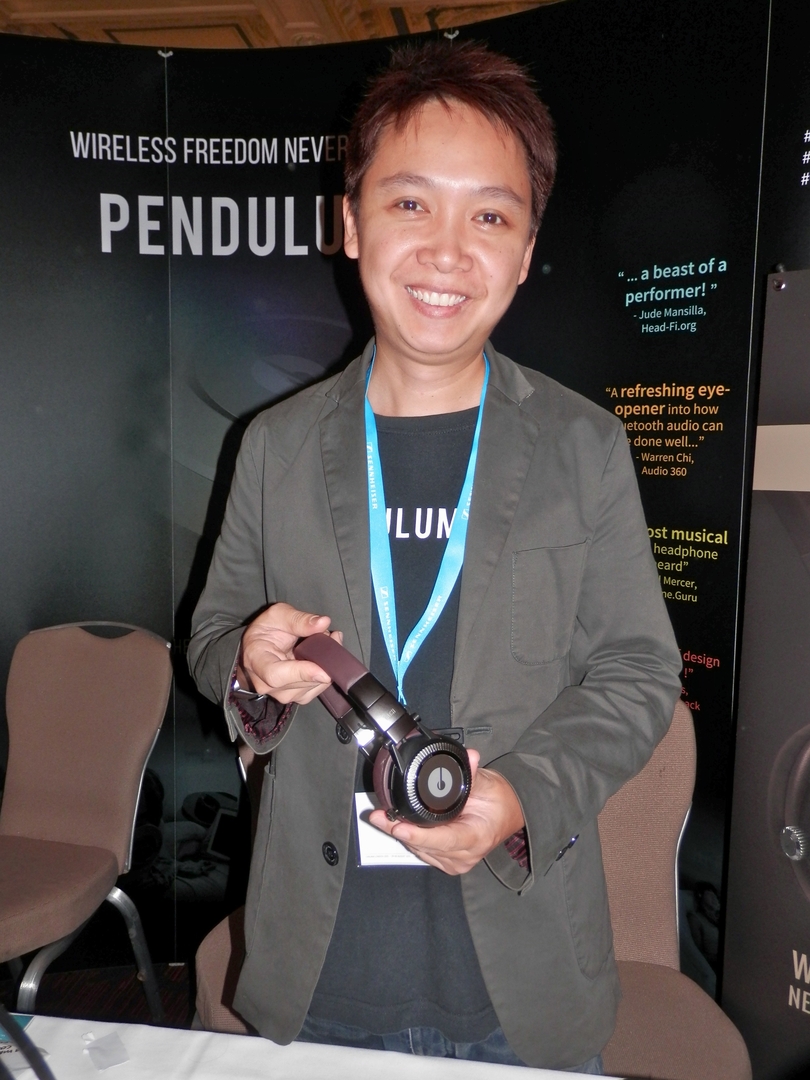
Rather than resting on the laurels earned by the firm’s Stance S1+ wireless headphones, the specialists at Pendulumic have been hard at work on the new Tach T1 wireless headphone shown here (projected price £199 or $249). The Tach T1 should arrive in November of this year–just in time for Christmas shoppers.  The Tach T1 is a smaller, on-ear headphone as compared to the larger over-the-ear Stance S1+ and it introduces a number of subtle refinements and improvement over the technologies used in the critically acclaimed Stance, such as an all-new low latency version of the popular aptX Bluetooth implementation.

Schiit Audio (Europe)

Behind the MrSpeakers Ether headphone in the foreground we see Schiit Audio’s new Mjolnir 2 headphone amplifier (top, £850) and Gungnir Multibit DAC (bottom, £1,200), but of which made their UK debut at CanJam London. The Mjolnir 2 shown here can potentially be valve-powered, but this sample is fitted with Schiit’s distinctive LISST (Linear Integrated Solid-State Tube) device. The Mjolnir 2/Gungnir Multibit combination is intended to provide performance close to Schiit’s flaghip Ragnarok amplifier and Yggdrasil Multibit DAC, but at a substantially lower price. All Schiit Audio products are manufactured in the USA. What’s with the product names? Suffice it to say the folks at Schiit Audio are big fans of Norse mythology.

Soul

Soul’s main point of emphasis at CanJam London was to show its new range of sports/active wear-optimised headphones and earphones such as the Pulse (£39.99), the Flex (£49.99), the Transform (£69.99), and beefy and aggressively named Combat+ (£159.99).

SoundMAGIC

The Chinese firm SoundMAGIC is perhaps best known for its keenly-priced universal-fit earphones, but at CanJam London the firm previewed its new full-size P55 “premium portable” headphone (projected price, £199), as shown here. 

Rebooting classical music

You probably missed it, but Western Civilisation came to an abrupt end last week. Its end was not due to instability in the worldwide financial market, the wanton destruction of archeologically important antiquities in Palmyra, or even the migrant crisis unfolding across Europe. No, this was a whimper, not a bang: a small-scale marker, indicating the end of the West’s ability to be a cultural force.

What happened was this. I heard someone receive a phone call, and their ringtone was the most famous five bars and eight notes in classical musical history – the short-long-short-long ‘duh-dur-dur-durrr’ opening of Beethoven’s Fifth Symphony. This in itself might be a little crass, but it actually makes a really ringtone, and didn’t presage the end of Western Civilisation. It’s what I heard after that, spoken by one well-dressed individual to another, which made me realise just how far we have fallen:

“Who uses the Judge Judy theme as a ringtone?”

The other shook his head, not at the idea that one of the most instantly identifiable motifs in all of western music was completely missed by his colleague, more to express incredulity that someone would like the Judge Judy theme so much, they’d put it on their phone.

These were not kids playing dumb, they looked like middle-management types chewing through ‘their lunch’ not ‘the restraints’, and he sounded entirely genuine in his incredulity. There was no understanding that this eight note ‘riff’ was, in fact, one part of one of the cornerstones of classical music. I started thinking of Arthur Dent desperately singing those first five bars to the Vogon guard before being thrown into deep space in The Hitchhiker’s Guide To The Galaxy. It didn’t have an effect then, it didn’t have one now. Beethoven is just a writer of theme tunes and ringtones.

If you look deeper into the Classical abyss, nothing stares back at you. The majority of Classical music sales are compilations of ‘Classical Chill-Out’ or ‘Mellow Classical Moods’ often played by the likes of André Rieu, Il Divo, or Katherine Jenkins, with five-minute snippets of well-known orchestral music knitted together into one. If you read the ‘blurb’ surrounding such compilations, the composer, conductor, and orchestra are rarely mentioned, just the ‘talent’; the violinist, pianist, or singer. And it’s almost always a violinist, pianist, or singer.

In part, the problem is one of education, or lack of it. A generation ago, school children in the UK and the US used to receive music lessons. While some of those lessons were grudgingly received, they were still lessons… and they rubbed off. While not every school student wound up listening to Brahms on a regular basis, they did at least learn some appreciation of music beyond that in the charts. Music education is now optional in middle, junior high, and high school in the US, although in the UK, the Protect Music Education campaign has managed to successfully preserve music education in schools. However, even this hides a darker tale: UK school funding cuts have reduced the number of children learning an instrument.

Without a basic music education, listener musical attention spans shrink, and that applies to all kinds of music. This is one change we’ve seen hit the audio world hard. It’s a relatively well-known ‘trick’ in audio demonstration circles that if you want to clear a demonstration room, nothing works as fast as ‘difficult’ music. In the past, that meant playing Boulez, Ligeti, or Messiaen, but today that applies to almost any piece of classical music. Even those audiophile staples, such as Rachmaninov’s Symphonic Dances or Un Bal from Berloz’ Symphony Fantastique, are not popular with much of today’s audio show public, who will leave a room at the first sound of a string section. And yet, classical music played right can be captivating: I’ve seen a room fill with listeners at the sound of a virtuoso violinist playing Paganini.


But why should someone listen to classical music, anyway? In fairness, there is a snobbery surrounding classical music to say that the compositions of a series of Dead White European Males somehow ‘good for you’: the findings of experiments to play Mozart to improve cognitive function have been largely debunked (exposure to musical stimuli is shown to improve cognitive function, but we don’t discriminate… that stimuli could be Mozart, or Metallica). But snobbery aside, listening to classical music often helps enhance your appreciation of the music you like, and can open up appreciation of styles of music you don’t currently like. An appreciation of Bach, for example, comes with an appreciation and understanding of counterpoint, which leads to greater understanding of not just the Beatles and the Beach Boys, but progressive rock, metal, R&B, and especially the inner game of jazz guitar.

Without such an overview, it’s possible to get ‘stuck’ on the music of your youth and struggle to move past the emotional context of that time in your life. There is a tendency to think that there was a magical time in the past when music was sublime (which, surprisingly, occurred somewhere between your eleventh and your twenty-eighth birthday), and the music before that time was ‘leading up to its pinnacle’ and has been ‘on a downturn’ ever since. Discovering that what came before was every bit as passionately created and appreciated is part of the way out of being stuck in time musically.

So, why mention this now? There are three reasons, one entirely personal. In the UK, we’re coming to the end of the annual BBC Proms season (which runs from mid July to mid September), which almost proves me wrong. However, the panning shots round the audience in most of these events show a preponderance of white hair and blue rinses, suggesting the classical audience is not getting any younger. However, the eight-week season of summer concerts are always oversubscribed, and cover the full spectrum of orchestral music from Seth MacFarlane singing the works of Frank Sinatra, to Mark-Anthony Turnage’s structurally-dense On Opened Ground. Every year, this gives the perfect opportunity to capitalise on interest in classical music, and many countries have similar festivals. Second, it’s the start of the academic year, and that makes it the perfect time to encourage children to start learning instruments, and helping them discover there are more instruments worth learning than just the guitar. And on a personal note, one of my ‘gateways’ to classical music – Gilbert & Sullivan’s Pirates of Penzance, with the LSO and the D’Oyly Carte recorded in the late 1950s by Decca – has just been issued for the first time on CD.

There’s no easy solution to the lack of interest in classical music among listeners in general. There is no ‘take two Mozarts and call me in the morning’ prescription to help (although listening to the Carlos Kleiber/Vienna Philharmonic version of the full unplugged version of the Judge Judy theme might be a start), and you can’t force feed people classical music to kick-start their interest – although it works for some six year olds, it certainly doesn’t work on 36 year olds. It needs to be a grass roots thing, involving everyone from audiophiles to music teachers to music lovers in general. And if you have a good system and little or no interest in classical music, it’s a perfect time to learn, especially as great music on CD is available at almost giveaway prices. I’d say start with Beethoven’s Fifth Symphony, Bach’s Brandenberg Concertos, Mozart’s Piano Concertos 20 and 21 and maybe Schubert’s ‘Death and the Maiden’ String Quartet.

Horror stories of Grammy-winning classical albums with a few thousand sales abound. It’s time to put a stop to that! Let’s put away the snobbery and the inverted snobbery, and start enjoying hundreds of years of good music.

WIN! LH Labs Geek Out V2 USB Headphone Amp/DAC worth $299 must be won!!!

HiFi+ has teamed up with the good folks at LH Labs to give away one of the company’s excellent Geek Out V2 USB Headphone Amp/DACs, worth $299. The Geek Out V2 was reviewed in issue 126 of Hi-Fi+ by Steven Stone who described it as “…an ultra-powerful portable DAC/headphone amplifier that was designed to handle the most challenging and difficult to drive headphones.” It was the company’s first pre-order campaign on Indiegogo, with $345,000 in advance orders. He concluded the review by highly recommending it and one lucky reader will receive one for free.

Competition Question

What was the value of advance orders for the Geek Out V2?

A. $34,000

B. $345,000

C. $3,450,000

To answer, please visit LH Labs dedicated competition page at http://lhlabs.com/hifiplus.

Alternatively, send your answer on a postcard (including your name, address, and contact details) to “LH Labs Competition, 920 Reserve Drive #160Roseville, CA 95678, USA”. The competition closes on November, 5th 2015.

WIN! A Pristine Vinyl ViVac RCS2 Record Cleaning System worth £1,995!!!

Jason Walker from Pristine Vinyl has created a thing of beauty that will make cleaning records a breeze. This exciting start-up company launched two models in its ViVac range of record cleaners: the RCS1 where the cleaning fluid is applied with a squeezy bottle and the RCS2, where the cleaning fluid is applied by an electric pump and swing arm.

Alan Sircom commented in his recent review of the RCS2 (HiFi+ issue 126), “The Pristine Vinyl is more than just another RCM. It brings record cleaning into the listening room without making the listening room look ugly and without making jet engine noises. It will make you clean records more often, and that will make you enjoy them all the more.” He concluded that the Pristine Vinyl comes, “Highly recommended!” by Hi-Fi+, as one lucky winner will discover.

Competition Question

How is the cleaning fluid applied on the ViVac RCS2?

A. Electronic trowel

B. With a fire hose (fireman not included)

C. By an electric pump and swing arm

To answer, please visit Pristine Vinyl’s dedicated competition page at www.pristinevinyl.com/index.php/competition.

Alternatively, send your answer on a postcard (including your name, address, and contact details) to “Pristine Vinyl Competition, Hilcrest, Northlew, Okehampton, Devon, EX20 3PH, UK”. The competition closes on November, 5th 2015.

Competition Rules

The competition will run from September, 3 2015 until November, 5 2015. The competition is open to everyone, but multiple, automated or bulk entries will be disqualified. The winner will be chosen at random from all valid entries, will be contacted via email (where possible) and their name will be published in the magazine. The Editor’s decision is final and no correspondence will be entered into. Absolute Multimedia (UK) Ltd. is compliant with the Data Protection Act and UK laws apply. Our policy is such that we will not pass on your details to any third party without your prior consent.

WIN! RHA T20 universal-fit earphones worth £179.95!!!

We at HiFi+ have followed the evolution of the Scottish earphone specialists RHA Audio closely over the past few years.

Starting from a solid foundation in audiology, Glasgow-based RHA now appears in Apple Stores worldwide, and the brand’s products are commonly considered to be among the best in value and performance.

Time and again, RHA has found a way to serve up luxury class products without high-end price tags. HiFi+ Publisher Chris Martens stated in his recent review (issue 126) that RHA’s latest universal-fit earphone, “…the T20 is fitted with its all‑new DualCoil dynamic driver, which injects a considerable amount of fresh thinking into the traditional dynamic driver design formula. Highly recommended and then some!” We can’t say fairer than that, as one lucky winner will discover.

Competition Question

What type of driver does the T20 use?

A. DualCoil dynamic driver

B. Balanced armature driver

C. Treble alternating driver

To answer, please visit RHA’s dedicated competition page at www.rha.co.uk/competitions Alternatively, send your answer on a postcard (including your name, address, and contact details) to “RHA T20 Competition, RHA Audio, Unit 3, 69 Haugh Road, Glasgow, G3 8TX”. The competition closes on November, 5th 2015.

Competition Rules

The competition will run from September, 3 2015 until November, 5 2015. The competition is open to everyone, but multiple, automated or bulk entries will be disqualified. The winner will be chosen at random from all valid entries, will be contacted via email (where possible) and their name will be published in the magazine. The Editor’s decision is final and no correspondence will be entered into. Absolute Multimedia (UK) Ltd. is compliant with the Data Protection Act and UK laws apply. Our policyis such that we will not pass on your details to any third party without your prior consent.

Postcards from CanJam London

Hi-Fi+ was proud to be the media sponsor for the first-ever CanJam London event held in London’s swanky Hotel Russell. Here are some of the photographic highlights of the show. As always, we apologise in advance to any worthy manufacturers or service providers we fail to cover here.

FINAL

Final’s flagship Sonorous X vies for position at the pinnacle of dynamic headphone performance. And price! 

Astell & Kern/JH Audio

Astell & Kern’s £899 universal-fit Angie IEM (from Jerry Harvey Audio) is said to offer monitor-quality sound.

Astell & Kern

Astell & Kern’s flagship AK380 portable digital audio player, shown here complete with its optional dock, auxiliary amplifier, and CD ripper.

AKG

AKG N90Q Quincy Jones edition flagship headphones will feature sophisticated DSP-controlled voicing optimisation and noise cancellation. The N90Q is shown here in its near-final form.


AudioQuest

AudioQuest’s NightHawk headphone laid bare, proving that it really has loudspeaker like build.

Audeze

Audeze’s EL8 is a high-performance closed-back planar magnetic headphone whose lovely (and clever) industrial design comes courtesy of BMW Design Group.

Audio-Technica

CanJam London marked the launch of Audio-Technica’s new high-performance ATH-W1000Z Maestoso–the successor to A-T’s very well like Grandioso headphone.

Beyerdynamic

The German headphone specialists at Beyerdynamic rolled out a newly revised, 2nd-generation version of the firm’s flagship T1 Tesla headphone.

Ear Sonics

Ear Sonics‘ Velvet universal fit earphones are said to provide sonic sophistication that far exceeds expectations given their mid-level price.


Echo Box

How about a ‘hip flask’ full of hi-res music? Echo Box’s new Explorer X1 digital audio player is based on an Android platform and therefor supports Tidal and Spotify streaming services right out of the box.

Echo Box

Echo Box’s Finder X1’s are well-priced universal fit earphones featuring Titanium earpieces.

Fostex

Fostex is one of very few manufacturers to offer a valve-type portable headphone in the form of its innovative HP-V1 (bottom).

HD Klassik

HD Klassik headphone amplifiers offer a very high degree of customisation as they incorporate dedicated EQ correction systems custom-tuned for the user’s choice of headphone. When the EQ circuit is engaged the left hand pilot light glows green, switching to red when the EQ circuit is bypassed. Version are available to support one or two different headphone models, and there is a version that can support both dynamic and electrostatic-type headphones.

HeadAmp

HeadAmp, one of America’s most highly regarded makers of bespoke headphone amplifiers, showed several of its amps in London, including the two-chassis, balanced GS-X mk2 model shown here.


HiFiMAN

HiFiMAN’s new flagship HE 1000 planar magnetic headphone attracted non-stop interest throughout the CanJam weekend–so much so that HiFiMAN eventually decided to run three sets of HE 1000’s in order to keep up with listener interest. 

Chord Electronics

Chord’s tabletop-sized Hugo TT headphone amp/DAC/preamp takes up where the famous Hugo portable unit leaves off, offering even better sound quality and greater versatility than the original Hugo (which is saying a mouthful).

KEF

KEF demonstrated its entire range of headphones and universal-fit earphones, including the well-made and very well-priced M100 earphones shown here.

Noble Audio

San Diego, CA-based Noble Audio demonstrated universal-fit versions of its extensive range, so that prospective customers could do direct comparisons between models to determine which model’s voicing profile might best fit their needs. Noble also teamed with London-based Aid2Hearing, full service hearing specialists led by audiologist Gisele Flower, who worked tirelessly throughout the show to take earmould impressions for clients who wished to order custom-fit in-ear monitors.

Aid2Hearing

London-based Aid2Hearing, a full service hearing specialist and Noble Audio dealership led by audiologist Gisele Flower, was on hand through out the show to take earmould impressions for clients who wished to order custom-fit in-ear monitors. Here, Hi-Fi+ Associate Publisher Pete Trewin has earmould impressions taken in anticipation of ordering a new set of Noble Kaiser 10 CIEM’s.


Questyle

Questyle previewed its upcoming CMA600i desktop, blanced output headphone amplifier and high-res, native DSD-capable DAC, which will sell for $1,250. In essence, the CMA600i is a ‘junior’ verison of the firm’s more costly flagship CMA800i, though the CMA600i will still incorporate the firm’s terrific-sounding signature Current Mode Amplifier.

RHA Audio

The Scottish firm RHA Audio offered up proof positive that very good things can sometimes come in extremely small packages with its new S500 and S500i earphones, which sound great, are incredibly compact and sell for between GBP 29.95 (for the S500) and GBP 39.95 (for the S500i version).

Sennheiser

Sennheiser showed its new HD630VB (VB stand for Variable Bass), which is newest member of its HD-series range of headphones. 

Snugs

Snugs is not so much and earphone maker as it is a maker of custom-fit ear tips that can be installed on a wide range of existing universal fit monitors to improve fit and overall sound quality. Interestingly, Snug uses digital eFit Station-scanning technology to create digitally modeled custom moulds. Onscreen, you see the digital map of the author’s ear canals, which have just  been eFit scanned.

www.snugsearphones.co.uk

Soundaware Audio

Soundaware Audio’s new Esther is a DSD/PCM capable digital audio player that uses an FPGA-based DAC and that can accommodate up to two 128GB microSD cards for music storage, all for the very low price of $599.

V-MODA

V-MODA’s new ZN earphone has been under development for several years and features earpiece housings made of zinc (hence the ZN moniker). The attractively priced ZN sounded very good indeed.

Viva Audio

Viva Audio’s Egoista headphone amplifier is intended as a no-compromise design that is based on dual 845 valves. The amp uses no negative feedback and is a pure class A design that puts out about 15 Wpc. The sound of the Egoista, when paired with the superb Abyss AB-1266 planar magnetic headphones, was incredibly engaging.

NADAC DISTRIBUTION IN EUROPE Merging Technologies announces key European appointments

Puidoux, Switzerland. August 2015:  The appearance of Merging’s NADAC (Network Attached DAC) at the High End Show in Munich created quite a stir and attracted interest from distributors of high end audio products worldwide. As a direct result of that interest, several appointments have been made, including the previously announced North American partnership with On a Higher Note.  In some cases, existing Merging professional distributors have already demonstrated expertise in the consumer audio arena and many of the appointments recognize that. Digital Audio Service have shown considerable acumen in promoting Merging’ s pro products in Germany since their appointment in 2012 and with some compatible high end lines, the company was a natural choice for Germany and Austria.

Long time UK partner, eMerging was also a safe pair of hands for taking NADAC into one of the centres of the high end market.   Compatible brands and good technical support were strong arguments in favour of this choice.

Merging Denmark has also been a partner for many years and CEO, Peter Scheelke, has considerable knowledge of the Nordic high end market and has recently launched his DXD download website, Promates. It made absolute sense to ask him to combine the resources and look after the region.  Peter has been contributing to the area’s high end shows with DSD and DXD product presentations and speaking in seminars for some years, making him familiar with the local key dealers and installers.


For the Benelux region, Merging chose a loyal customer of theirs who has a background of working with the best DAC products available over recent years.  Bert van der Wolf is also a well known recording engineer/producer and releases excellent high resolution audio content on SACD and as downloads on his Spirit of Turtle site. The distribution company is aptly named Edison and one wonders what Thomas Edison would have made of the audio quality achieved by playing a DSD256 file back through NADAC in full surround!  A fascinating thought.

The choice for Italy was also easy as, in common with some other Merging distribution companies; VDM had been requesting Merging to launch a consumer DAC product for some years. Igor Fiorini also has much experience of recording in DSD/DXD and has similar complementary lines in his portfolio.  Located in Rome, VDM is centrally placed to appoint key dealers in the North and South of the country.

France is another very important territory and here there was no immediately obvious partner. However, High End Munich changed all that. The Merging team was bowled over by the enthusiasm of François Gourdain and his Synergie-Esoteric company. It was easy to recognize that Synergie was the perfect fit from the product standpoint, was very experienced in the market and had the drive necessary to succeed.

The home territory of Switzerland will be managed from Merging’s headquarters in Puidoux. The country is relatively small but significantly important and specialist outlets have already been identified. Merging will share a demonstration room with PSI Audio at the forthcoming High End Swiss show in Zurich, being held at the Mövenpick Hotel, Zurich Regensdorf from 16th to 18th October. The room number is 309 on the third floor of the Convention Centre.  This demonstration of Swiss audio excellence on home soil will successfully introduce the unique features of NADAC to the local audiophiles.

For more information please see the NADAC web site at nadac.merging.com

GamuT D3i preamplifier and D200i power amplifier

I have some history with the GamuT D200 power amplifier; the original version was my reference amplifier for many years and powered at least two generations of Bowers & Wilkins 802 Diamond speakers. I liked it a lot, but somewhere along the upgrade path to MkIII status, it began gathering dust and I let it go. Hearing the latest D200i brought back what I loved about this Danish beast.

GamuT makes two power amplifiers, of which this is the stereo option. The M250i is an even more powerful monoblock, but the as the name suggests, the D200i’s delivers a healthy 200W in its own right. GamuT amplifiers use a single high-current MOSFET output transistor per channel, where most other solid state amplifiers use multiple output devices and if these differ in their electrical characteristics, distortion creeps in. Manufacturers therefore tolerance their output devices as tightly as possible; Naim takes this to its logical extreme with its Statement amps, where each set of output transistors are made from adjacent pieces of silicon from the same die – but that is clearly a pricey approach.

The reason that solid state amps have multiple output devices is because this gives more power and more power needs more heat dissipation. So how does GamuT get away with using only one device? I asked engineer Benno Baun Meldgaard this question and he explained that they use industrial transistors that were developed for motor control and welding, and are even able to handle 400 amp peaks. This type of transistor is not available in the usual complimentary positive and negative pairs (PNP and NPN), but just NPN or ‘negative’ and GamuT had to do a lot of work to stabilise two of these devices for each channel, effectively turning them into a pair. To Benno’s knowledge, Constellation Audio is the only other company that does this and then with multiple pairs rather than one.

The latest D200i now has a single emitter resistor network, which consists of three paralleled 0.12ohm resistors, creating a combined resistance of 0.04ohms. That is about 5-10x lower than most amps. The transistors themselves are of higher quality and the power supply has been reconfigured with better parts and a quieter transformer than before. Rectification is now balanced and has twice the capacity, in the process halving resistance and lowering noise. Finally, the internal cabling has been changed to GamuT’s Wormhole speaker cable, an unusually thin type for a high power amp maker.

GamuT only makes one preamplifier: the D3i. This is described as a dual-mono design and has both balanced and single ended inputs and outputs on its substantial yet not overly weighty carcass. One pair of the RCA phono inputs is marked RIAA with a matching legend on the backlit front panel. However, as things stand it does not connect to a GamuT phono stage, which is still in development but should be available by the end of the year. At present, this input functions as a balanced input on RCA sockets; it works with an XLR to RCA cable, wired positive to centre pin and negative to the collar, plus a flying earth lead screwed under the ground connector. This configuration can also be used with any balanced line level input. The HTH/home theatre input can be used in bypass mode for combined stereo and multichannel systems.


I kicked off the listening by using the D200i with the Townshend Allegri passive controller; this proved a nostalgic experience because despite the many changes to the amplifier and to my system since I last used a D200 the same character was evident – an effusive vivacity made possible by excellent dynamics and the authority of serious power reserves. This, however, is not a leaden muscle amp and it doesn’t sit on the music in the way that so many do; instead, it infuses the music with life and energy, giving orchestral works the vitality they require if they are to move you fully. The D200i has a slightly sparkly, bright sound compared with my regular ATC P1 power amp, and this quality requires a suitably calm, maybe even restrained loudspeaker to make a good match. The PMC fact.8s are very open and revealing, but not quite as good a choice as the Bowers 802Ds were. However, they do allow this amp to pull tons of space and ‘air’ out of recordings like Gregory Porter’s ‘No Love Dying’ [Liquid Spirit, Blue Note]. This seems a little crisper than usual, but you can also hear more detail so it’s hard to say whether the amp is revealing or adding it.

Chris Jones ‘Roadhouses & Automobiles’ [Roadhouses & Automobiles, Stockfisch] is a rather more polished recording and here you can appreciate the effects that have been used on his voice and those of the backing singers. In some respects the D200i has valve like characteristics with transistor style control. It doesn’t have the smoothness of a good valve amp but it has a lot more grip, albeit not in a way that gets between listener and music. It doesn’t, for instance, match my ATC P1 for low end extension and grip, but has a far more open and dynamic style, it delivers detail better than power but that serves the music extremely well.

Adding the D3i preamplifier to the mix opens out the soundstage even further. This is because the strict dual-mono preamp design yields extremely high channel separation, which in most cases results in a wide soundstage; consequently, the speakers should be toed inwards further, to create correct width. This will result in a soundstage with even more depth and precision. Depth of image is particularly good with Javier Perianes playing on Manuel Blasco de Nebra’s Piano Sonatas [Harmonia Mundi], while the reverb is massive and the richness of tone beguiling. Timing appears not as strong as it is with the Allegri, but a passive preamplifier will typically create a small phase shift depending on volume setting, so changing to a buffered preamplifier will actually result in a linear phase behaviour. The potential for high frequency attenuation in a passive preamplifier is a consideration, too.

Taken as a pair, the GamuT duo put on a fine show. ‘Goodbye Pork Pie Hat/Brush With The Blues’, from Jeff Beck’s Live at Ronnie Scott’s [Eagle Records] is not short on scale and has oodles of detail, which makes for a truly electric atmosphere that seems more than a small club like Ronnie’s could contain. What I really like, however, is the way that these amps focus on the playing more than the sound; this apparently obvious aim is not always achieved by high-powered amplifiers, but here the combination of light-handed control lets you hear all the elements in the mix in perfect balance.


The GamuT pair, especially the D200i, manage to combine power with tonal subtlety – a quality that serves whatever music you want to play very effectively. The D3i is not the most relaxed or natural-sounding preamplifier on the planet, but it can produce a vivid and entrancing sound that lets you hear the meaning in the music. It is extremely good at resolving reverb and timing, though not in the front league, is certainly not sluggish. With Barenboim’s Beethoven For All Symphony No.1 in C, Op.21 [24/96, Decca], the orchestra really breathes (again!): it’s too big for the room, but you get a strong sense of the power and dynamics on tap. Some might want a bit more authority – essentially more power in the bass – but that is very difficult to achieve without undermining musical flow, something at which the GamuT pair excel. Stiffer power amps give a Beethoven symphony gravitas, but if you are after the joy alongside the ‘Sturm und Drang’ the GamuT have the upper hand.

The GamuT D200i retains the combination of musicality and power that kept me listening long into the night. It is more transparent than before and, when partnered with the D3i, makes for amplification that put music under its spell. Those looking to shake the furniture may have to look elsewhere, but anyone who wants to be spirited away should lend GamuT an ear.

Technical Specifications

GamuT D3i

  • Type: J-FET NPN line-stage preamplifier
  • Analogue inputs: Four pairs of single-ended inputs (via RCA jacks), one pair of balanced inputs (via XLR)
  • Analogue outputs: Two pairs of balanced outputs (via XLR connectors), one pair of single-ended outputs (via RCA jacks), one pair of single-ended Tape Outputs (via RCA jacks)
  • Input impedance: 20kOhms single ended
  • Output impedance: 75 Ohms single ended
  • Bandwidth: 5Hz-100kHz
  • Gain: 5dB
  • Distortion THD+N: < 0.0008% (/2Vrns)
  • Signal to Noise Ratio: 110dBA
  • Dimensions (HxWxD): 108 × 430 × 410mm
  • Weight: 12kg (packed)
  • Price: £5,499
  • GamuT D200i
  • Type: Single pair NPN MOSFET output device transistor power amplifier
  • Analogue inputs: One pair balanced (via XLR connectors), One pair single ended (via RCA jacks)
  • Analogue outputs: Two pairs of speaker taps (via 5‑way binding posts)
  • Power output: 2x 220 Wpc into 8 Ohms, 2x 400 Wpc into 4 Ohms, 2x 700 Wpc into 2 Ohms
  • Bandwidth: 5Hz-100kHz
  • Dimensions (HxWxD): 155 x 430 x 390mm
  • Weight: 34kg
  • Price: £9,299

Manufacturer: Gamut A/S

URL: www.gamutaudio.com

UK Distributor: Sound Fowndations

Tel: +44(0)118 981 4238

URL: www.soundfowndations.co.uk

Back to reviews

Read more GamuT reviews here