Up to 37% in savings when you subscribe to hi-fi+
hifi-logo-footer

Begin typing your search above and press return to search. Press Esc to cancel.

Postcards from Whittlebury Hall

Like the audio world itself, the UK’s National Audio Show (NAS) – held at every year at the Whittlebury Hall spa hotel near the legendary Silverstone racetrack in Northamptonshire – is undergoing significant change. The NAS still features great traditional audio at all price levels, but the revolution in headphone and in-ear listening has made its mark, and the show’s HeadZone section is growing at an almost exponential rate. Coming so soon after CanJam London, however, there wasn’t a great deal of new equipment shown there that hadn’t been seen a few weeks earlier (with two exciting exceptions), but the energy and excitement of that headphone world is definitely rubbing off on traditional audio.

There remains some reluctance among traditional audio enthusiasts in embracing this sea change in audio, with many of the more curmudgeonly audio enthusiasts avoiding the HeadZone altogether. But they were not disappointed by the sheer variety of two-channel audio on offer. We have tried to focus specifically on what’s new and what’s good here, rather than a complete room-by-room account of the event. There were also several rooms (for example Teddy Pardo, Kralk Audio) where the Audio Fates conspired to fill the room to bursting each time I tried to visit – it took three attempts to get into the Audio Note room, for example.

When I did make it into the room, Audio Note was playing its standalone £5,000 M3 RIAA phono stage. This is usually incorporated into the M3 preamp and left to its own devices helps improve the performance a notch.

Henley Designs showed the completely renovated Pro-Ject RPM line, teased at Munich. The baby of the range RPM5 now costs £899 without a cartridge (up from £650) and sports a better tolerance 9V motor, a carbon-fibre 9cc Evolution arm as standard, a carbon fibre layer on the plinth to aid rigidity, a decoupled motor and better platter.

Roksan showed off a wholly Oxygene 30 new turntable, to match its Oxygene line, which comes bundled with a Pro-Ject 9cc arm. Price is expected to be around the £2,000 mark.

Speaking of Roksan… Inspire Hi-Fi (which is gaining a reputation as a turntable maker of note as well as one of the principle hot-rodders of decks old and new) has announced upgraded 25mm thick MDF top and bottom plinths for the original Xerxes. These can be supplied as a full restore and upgrade by Inspire for £695 or as a £595 kit of parts for DIYers. While some brands might get snippy at third-party upgrades, as Roksan provided Inspire with its new £1,375 Pug tonearm, that’s clearly not the case here.

£7,890Acoustic Signature Thunder turntable, with the new £1,950 Perreaux PP3 phono stage, into a £6,995 C-700 and £6,995 M-700 pre and power from Luxman to a pair of £10,000 Triangle Magellan Cello floorstanders. Other components in the system included digital sources from Aurender and AURALiC and equipment tuning from Vertex AQ and Leading Edge.

Origin Live showed its new £12,900 flagship Voyager turntable, which is built to a very high standard. Mark Baker of Origin Live was typically laconic about the new design: with not even a flyer available, he simply referred people to his website for more details. In fairness, this describes how impressive the player really is far better than any live chat possibly can, but sometimes a little bit of demonstration helps!

New to the UK, DS Audio’s £6,250 DS-W1 cartridge (with matching equaliser) is a truly unique design: an optical design, which detects stylus vibration by laser. It is distributed by Sound Fowndations and was installed in a top Clearaudio turntable.

The company also showed Clearaudio’s £3,250 Double Matrix Professional Sonic record cleaning machine, which automates the entire record cleaning process.

Two of the most impressive demonstrations were more about the vinyl than the equipment, although the equipment helped. Recording supremo Mike Valentine’s direct-to-disc Chasing the Dragon label has just launched its second album – a big band recording of the Syd Lawrence orchestra, which comes with a master-tape recording version too for comparison.

Always a sell-out event, previews of the Queen Studio Collection LP box were cut to be played loud, and through a large PMC monitor speaker system… they did just that.


One of the best high-end demonstrations at the show, dCS showcased its new £18,000 Rossini player, £15,500 DAC, and clock, through D’Agostino amplification, into Wilson Alexias. With a Stillpoints rack and runs of Nordost V2 cable, this was one of the most expensive systems at the event. It was also one of the very best sounding.

Once again dominating the launches even on the digital source side, Roksan announced the new £1,250 K3 DAC, which supports up to DSD 256 and comes supplied with K-Link USB 2.0 wireless dongle with proprietary high-resolution wireless music transmission up to 150m.

Roksan also showed its new Blak range, currently a two-strong line of £2,250 CD player, and £2,500 integrated amplifier. These don’t replace the brand’s high-end M2 series, but add a new level to the line – rather like an M2 with a bit more of a kick to it!

One of the true stars of the show, Chord Electronic’s new £7,995 DAVE (Digital to Analogue Veritas in Extremis) joins HUGO in its use of an FGPA-based conversion system – and a trite name – but raises the performance bar considerably, we’re led to believe.


Wholly new amplifiers were in relatively short supply at the show, but Music First Audio’s prototype headphone amplifier, expected to cost around £2,000 was a rare exception. Curiously, MFA chose to play this from a cassette tape source, and the queue to listen to this headphone amp was significant, but it promises much, and may just deliver…

Pro-Ject was one of the other brands launching an amplifier, in the guise of the MaiA DS £700 integrated amp; an app-controlled (with IR blaster), aptX Bluetooth-driven Class D design with a MM/MC stage and a 24/192 DAC.

Unison Research’s new £4,250 Unico 150 hybrid flagship integrated amplifier was on display; an extension of the Unico 100, with 2x ECC88 and 2x EL84 tubes, and ‘locally grown’ components.


On to loudspeakers now, the forthcoming 5l Leema Xen Elite is expected to cost somewhere between £2,500-£3,000, and uses a machined 20mm aluminium billet for the front and rear panels, a 30mm dome tweeter and a GRP-infused mid-bass driver. A very small speaker, yes, but one that can really deliver.

Opera’s new Prima takes the entry level Mezza to new levels, thanks to a front-firing port and a new crossover, for £1,500 per pair.

Vivid’s new £18,500 per pair B1 Decade pulls in technology and drivers from the up-scale Giya range in the distinctive, 10-year-old oval standmount design.

ME-Gethain is a German pro-audio company that makes some extremely good, and relatively inexpensive active monitors. Prices range from just over £2,000 per pair for the diminutive RL 906 up to £10,050 for the three-way coaxial RL 901 K.

Russell Kauffman of Russell K loudspeakers stands with his first floorstander, the soon-to-be-launched Red 150.


Zeta Zero is a Polish high-end company new to the UK, with a diverse range of loudspeakers that feature ribbon drivers: everything from the relatively conventional looking Venus Piccola (left) to the Orbital 3D 360° ribbon tweeter system. Prices will probably start from around £15,000

Second-hand audio specialist Hi-Fi Hangar is also the supplier of the high-value Class D Atsah 500 mono power amps, based on Hypex cores. Not much to look at, but great value at £799 per channel. Meanwhile, Hi-Fi Hanger is also the importer of Eminent Technology loudspeakers. The LFT-8b floorstanders with Sound Anchor stands cost just £2,650 per pair.

Finally Devialet’s new Phantom speakers were playing in a too-large room, but still had an ability to impress listeners. An upgrade is expected in January that will allow the Phantom to be run from existing ‘Expert’ Devialet amplifiers, through Ethernet. 

LH Labs Geek Out V2 USB headphone DAC/amplifier

Many people think that the first big audio crowd-funding success story was Neil Young’s PONO launch, but that’s not the case. LH Labs Geek Out USB DAC brought in $303,000 and its Geek Pulse and Geek Wave brought in respectively an unprecedented $2.9million and $1.665million in their respective Kickstarter campaigns. Since then LH Labs has rolled out numerous Geek Out products for both portable and home use. Their latest product, the $299 Geek Out V2, was the company’s first pre-order campaign on Indiegogo, with $345,000 in advance orders. As opposed to crowd-funding, pre-order campaigns allow faster delivery times, at least in theory. Let’s look at LH’s Geek Out V2 to see if this new DAC delivers the same level of performance as previous award-winning Geek Out components.

Packaging for the Geek Out V2 is simple – the cellophane-wrapped outer sleeve box holds a piece of felt-covered foam with a cutout where you’ll find the V2 along with a 9cm by 15cm triple-fold owner’s manual. No additional cables, connectors, or carrying case are included, but the optional LightSpeed Extender USB cables are available.

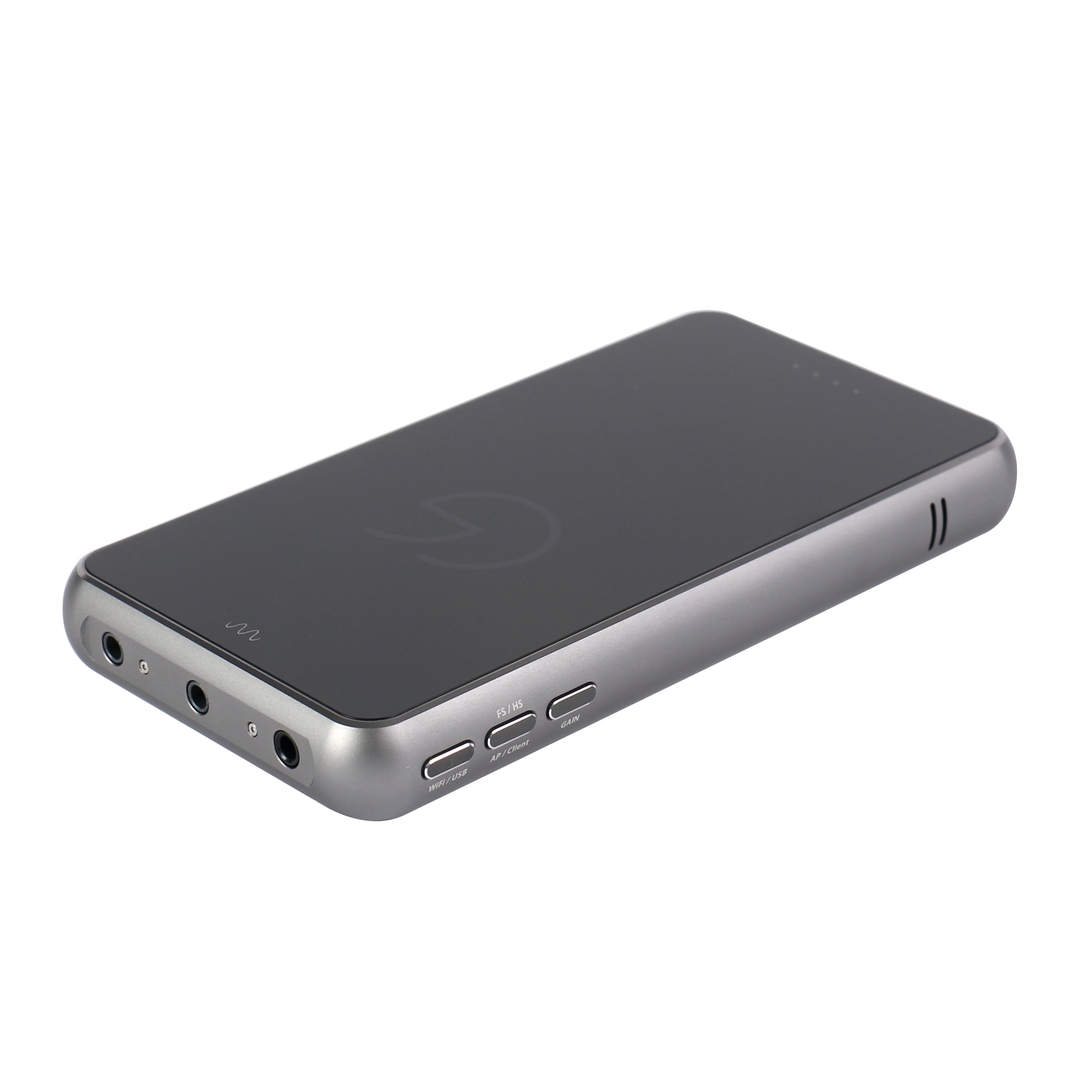
The Geek Out V2 is 78mm long, 37.5mm wide and 13mm thick, or approximately the same size as a Zippo lighter. Its case is made of 3D-printed high-temperature resin that features a curvy graphic and a lot of open space for air circulation. Ventilation slots for heat dissipation populate almost the entire backside of the V2. The V2’s top has a standard USB 2.0 connector while the bottom has single-ended and balanced mini-plug output connectors. One side of the V2 has two buttons. The top button switches between two gain settings (100 and 1000mW) while the bottom switches between three user-selectable digital modes. These three modes are Time Coherence mode which uses a minimum phase filter to remove pre-ringing from the signal; Frequency Response mode which uses a slow roll-off digital filter; and Stable Streaming mode which is optimized for streaming sources. Power for the Geek Out V2 comes from your computer as the V2 itself has no batteries or internal power source. If you plan to use the V2 attached to a USB dock, make sure it is a powered one.

The Geek Out V2 supports all PCM formats up to 384/32 and DSD up to 128x. It has both balanced and single-ended outputs and the digital circuitry is based around the ESS SABRE9018AQM DAC chip. The analogue section of the V2 utilizes a pure class-A design, which like all Class-A designs, generates substantial amounts of heat. The board-mounted heat sinks and extensive ventilation on the V2’s chassis were created to help alleviate any heat build-up problems.

Setting up the V2 is simple. For a Mac OS, you merely have to plug it in and the Mac will recognise it immediately. The next step is selecting the V2 as your audio output via Apple’s Midi Control Panel and you are all ready to play music. With Windows PC you will need to download a driver from LH Labs’ website, install it, and then select the Geek Out V2 as your audio device.


Upon setup the first thing a user will want to know is, “How do I adjust the volume?” The Geek Out V2 has no volume control knobs or switches besides the two-position overall gain control. On a Mac you can use the master volume slider or the volume sliders in your playback application to adjust the volume. And although you adjust the volume via digital controls, the volume is not attenuated by your computer. The Geek Out itself has a 64-step lossless volume control so even at the lowest output levels no data is lost.

During the review period I used a wide range of file types and resolutions from 320 MP3 and FLAC streaming to my own 192/24 and DSD 128x live concert recordings. Not once did the Geek Out V2 balk or play any of the files at the wrong speed (don’t laugh; I’ve used several DACs recently that occasionally play PCM and DSD files at the wrong speed, though switching to another track and then going back to the desired track usually solved the problem).

In the early days of the current headphone revolution it was a status symbol to own a pair of headphones that were difficult to drive because then you could complain about all the headphone amplifiers, especially portable headphone amplifiers, that could not drive your “cans” to what you considered adequate volume levels. This ‘power imperative’ encouraged portable DAC/headphone amplifiers to increase their new introductions’ power capabilities. The Geek Out V2 is far more powerful than any first or even second-generation portable DAC/headphone amplifier I’ve seen. But headphone manufacturers, even those responsible for some very hard to drive headphones, have now begun to produce far more efficient headphones, so prospective buyers of headphones and amplifiers need to look carefully at both their headphone’s power requirements and their DAC/AMP’s power capabilities to put together a system that is optimally matched. Given the Geek Out V2’s 1000 mW power capability, obviously it was designed to handle high-impedance, low-efficiency headphones.

If you are the proud owner of a pair of high-efficiency in-ear monitors, such as the Westone ES5 (first review on hifiplus.com) or JH Audio Roxanne (‘First Listen’ blog on hifiplus.com), using them with the Geek Out V2 could present some problems depending on your playback software. ROON was the best interface with the Geek Out since it has a 0 to 100 calibrated master volume control. With both the Westone and the JH Audio custom-fit in-ear monitors my volume settings were down at the low end of the scale between 8 and 17 with the Geek Out in low-output mode. The iTunes volume slider was only 1/3 of the way up at maximum volume levels. The good news is that unlike many high-gain headphone amps I’ve heard, the Geek Out V2 does not generate additional hum or hiss even with ultra-sensitive earphones. So while the Geek Out V2 wasn’t designed principally for high-sensitivity earphones, it does work better in this application than many amps designed to handle primarily difficult loads.

The least efficient headphones I had on hand are a pair of beyerdynamic DT990 600 ohm version (full review on hifiplus.com). In the high gain mode at maximum volumes I was running at 27 out of 100 in Roon while in iTunes the slider was never more than ¼ of the way up. Although I don’t own any difficult-to-drive or especially ‘power hungry’ headphones, given the additional gain and power capabilities of the V2, I can’t imagine how anyone will find a pair of headphones that can’t be powered to well above what we humans refer to as ‘loud’ when attached to the V2.

If you are looking for a closed-ear budget-friendly pair of headphones to mate with the Geek Out V2 I heartily recommend the new AKG K-553 closed-ear headphones sold through Massdrop ($120US). They fold flat so you can pack them easily and they are efficient enough that you could use them with your smartphone if need be. But if you want to hear the K-553 headphones full capabilities tether them to the V2. When connected to the V2 the K-553’s bass had substantial drive and impact. Low bass definition rivalled some far more expensive headphones.

The most synergistic headphones with the Geek Out V2 were the Audeze LCD-2 and HiFiMan HE-560. Coupled to the V2 both of these headphones produced a well-defined and specific image that was full of musical information. Bass with both headphones was well controlled with excellent low frequency extension. Treble was airy and smooth with no signs of any harmonic discontinuities or aberrant frequency response. The only negatives with both these headphones is the connection to the V2 – once you add an adapter to get from 1/4 inch headphone to mini-stereo, you end up with a 4” long column of metal coming off the back of the V2 that weighs more than the V2 itself.


While I understand why LH Labs chose to use the kind of USB connection they did, I still dislike it for several reasons. The principle reason is that it can put the Geek into awkward and possibly perilous playback positions. If I insert the V2 into one of the USB connections on the back of my MacPro titanium trashcan desktop, the V2 ends up hanging in space, just waiting for something or someone to knock into it or pull it out. And if you attach the kind of heavy headphone cable that often accompanies an audiophile headphone to the V2, the additional weight can pull the USB connection right out of the MacPro.

Hooked up directly to a MacPro portable’s USB slots the V2 ends up with its primary heat vents pointing downwards with virtually no airspace below. That makes for a hot-running unit. The obvious solution is to put some kind of USB extension cable between the Geek Out V2 and your USB outputs. Ideally, LH should have included a USB extension cable with the Geek Out V2, just as they did with the original Geek Out. If you buy a Geek Out V2 you simply must get a USB extension cable for it.

The LH Labs Geek Out V2 is an ultra-powerful portable DAC/headphone amplifier that was designed to handle the most challenging and difficult to drive headphones. If you have headphones that don’t require a lot of power, the V2’s most outstanding attribute could very well be underutilized. But if you need the power, the Geek Out V2 can deliver the goods in a clever, compact, and highly portable package.

Technical Specifications

  • Type: USB DAC and headphone amp
  • Frequency Response: 2Hz-55kHz (–0.1dB)
  • Max Power Output: User switchable 1,000mW @ 16Ω, 100mW € 16Ω
  • Max. Output Voltage: 4.0Vrms (high gain setting)
  • THD+N: < 0.01%
  • S/N: >105dB unweighted, >108dB A-weighted
  • Input: USB 2.0 (asynchronous)
  • Outputs: Dual 3.5mm analogue stereo (one TRRS balanced, one single‑ended)
  • Output impedance: 0.47Ω
  • Sample rates supported: 44.1kHz-384kHz (PCM), 2.8224MHz-6.144MHz (DSD)
  • Bit rates supported: 1bit-32bit
  • Dimensions (W×H×D): 37.5 × 13 × 78mm
  • Weight: 34g
  • Price: $299 (+shipping)

Manufactured by: LH Labs

URL: www.lhlabs.com

URL: http://marketplace.lhlabs.com/collections/portable-audio/products/geek-out-v2-usb-dac-headphone-amplifier

Back to reviews

Read more LH Labs reviews here

Stax SR-507 II earspeakers and SRM-006tS ‘Kimik’ energiser

When it comes to personal audio, the audiophile choice for the longest time has been Stax. The Japanese company has been making audio electronics since 1938, originally concentrating on cartridges and electrostatic tweeters. Stax has been making electrostatic ‘earspeakers’ since the SR‑1 of 1960 and – although Stax continued to develop other audio products into the early 1990s – electrostatic headphones have been the brand’s primary focus for more than 50 years. Put this into perspective: Stax was making ‘earspeakers’ years before the designers of many of its rivals were born.

Of all the designs in the Stax back-catalogue, few can have been as distinctive or as successful as the SR‑Lambda. Not as ‘out there’ as the SR‑Sigma (which looked like you were wearing a pair of small loudspeakers, and perhaps the most legitimate reason why you can’t call a pair of Stax earspeakers ‘headphones’), the unique flat rectangular electrostatic block design is surprisingly comfortable and durable (it’s also arguably the ideal shape for an electrostatic panel). The SR‑507 II is a direct descendent of that 1979 design.

As an electrostatic driver energises the whole diaphragm surface uniformly, the original design concept was to give priority to the exact response to signals over rigidity – although greater rigidity makes the system less prone to environmental problems from high humidity or temperature (not necessarily a UK problem), older materials meant the benefits of a more robust assembly were often outweighed by increased resonance and reduced high and low frequency extension. However, the latest and best iteration of the Lambda, the SR‑507 II uses a new GRP shell, which gives the whole assembly more rigidity and robustness, because it is now coupled with a thinner diaphragm made of a new variant on Mylar, which is itself more robust than predecessors. All of which adds up to a design with even less resonance and distortion than its predecessors, which is saying a lot.

Elsewhere on the Stax SR‑507, the connector cable is also now made from silver-plated high-purity PC‑OCC copper, and the wide, flat spacing of the conductors also helps to lower capacitance. The new Lambda also features a more comfy headband, with more adjustment, goat skin cushions, and better moulded ear shapes for better pressure to the rear of the earspeaker.

An electrostatic headphone/earspeaker cannot just plug into any headphone amplifier, as it needs power to energise its panels: this is why they use a large five‑pin connector that looks like a valve seat instead of a jack or XLR. The SRM‑006tS is the top energiser in Stax’ Lambda series (with the valve SRM‑007tII and solid-state SRM‑727II destined for the top SR‑007Mk2 and SR‑009 earspeakers). This is a high-voltage, low current amplifier designed specifically to drive electrostatics; it uses two 6FQ7/6GC7 double triodes and sports two sets of RCA inputs and one set of XLRs. There is also a solid-state SRM‑323S, which undercuts the 006tS, but remains untested at this time. It has its fans, but many also suggest the money spent on the 006tS is money well spent.

This is, however, in its standard guise. Fortunately, Nigel Crump of Symmetry the UK distributor hands the SRM‑006tS over to his engineer (Mark Dolbear of High End Workshop, who also runs Electromod and knows a thing or two about headphones) for what is known as ‘Kimik’ modifications. Dolbear spent a considerable amount of time learning how to drive Stax’s own test equipment, but in becoming an expert in the testing, also learned how he could improve the performance of the energiser in several key areas. First, he replaces the standard tubes with cryogenically-treated, matched valves, and fits these with EAT tube dampers. Then he replaces the standard case fuse with one from Synergistic Research (Electromod is the UK distributor for Synergistic)… and then spends the better part of a week precisely setting up bias and offset, essentially ‘blueprinting’ the energiser.

In use, the rectangular shape of the Lambda sits extremely well over the ears, although it can feel a little ‘clamped on’ if you are a big-headed reviewer. There is a lot of adjustment possible, but the overall feeling is one of always being aware there is an earspeaker in position. It’s not uncomfortable, though, and certainly not claustrophobic in the manner of the old Jecklin Floats (which always made me feel like I was being fitted for a particularly tight crash helmet). And, as with any electrostatic system, there is a lot of sound leakage in and out of the headphone – this is not a headphone to wear while someone else is listening to the TV, because you’ll only upset each other as the TV sound leaks into your listening and vice versa. In a quiet room, though, and the Stax combo is an incredibly different beast.

We had one of Symmetry’s demonstrator sets, which arrived fully run in, but the sound it makes is very Stax indeed. It seems like a paradox to say something is at once ‘warm’ sounding and ‘neutral’ sounding, but when you hear the SR‑507 II/SRM‑006tS ‘Kimik’ package, it becomes an obvious and natural description of things. Although it’s a lot less warm than it used to be.


I remember listening to a pair of Stax Lambda headphones some years back, and they made a lasting impression. The overall performance was one of incredible clarity in the midrange, coupled with a slightly soft, but hugely enjoyable bass and a treble that was detailed and informative, but slightly laid back. The overall impression was one of warm, satisfying detail, not unlike the sound one might hear from a pair of original Quad Electrostatics. The latest SR‑507 II/SRM‑006tS ‘Kimik’ are very different beasts, in the way more modern Quads are different to those original ‘57s. A deeper, tighter, and more dynamic bottom end has replaced the lush, soft bass and the treble has been extended, while retaining its informative and detailed demeanour. I think this makes for a better overall balance.

The SR‑507 II is a mature listening choice. That doesn’t mean you need to be in your 60s and it doesn’t mean you only listen to ‘old geezer’ music. It means it’s the kind of headphone you buy when you are done with the fireworks and the glitz, the bright and the instantly impressive. Your listening is refined and focused, and you make a discerning choice of equipment based on those criteria. You will want an earspeaker that creates excellent soundstaging, effortless and real dynamic range, detail, good frequency extension, and an absence of strong character, preferring instead to let the music sing for its own supper. And the SRM‑006tS ‘Kimik’ completes the package brilliantly.

Jazz is an obvious partner here: Pure Desmond by Paul Desmond [CTI] is a very laid-back collection from the composer of ‘Take Five’, and ‘Nuages’ sees the interplay between Desmond’s alto sax and Canadian guitarist Ed Bickert rendered beautifully, with delicate, almost non-existent underpinning from bassist Ron Carter and sticksman Connie Kay. It’s easy for this to slip into sounding like bland dinner jazz, but instead the Stax pairing helps show this to be one of Desmond’s more sophisticated solo offerings. In particular, it shows that if Bickert had stepped into the limelight more, he’d be as well known in jazz circles as someone like Kenny Burrell. I think jazz is an obvious partner for the Stax earspeakers in part because they both seem like late night travellers. This kind of jazz isn’t the kind of thing you would play early in the morning, and the refinement of the Stax combo isn’t like a musical jolt of coffee – more like a brandy at the end of a fine evening: something to be relished, not rushed.

As we moved through the musical repertoire, so the Stax rose to most challenges. Vocals, especially the purest of female vocals, were intelligible to an excellent degree – ‘My Husband’s Got No Courage in Him’, by Silly Sisters (Maddy Prior and June Tabor) from the Chrysalis album of the same name, is a fine piece of English folk-rock (with the accent on the ‘folk’), and the two pure voices singing harmony are just made for the clarity and soundstage separation of the SR‑507 II/SRM-006tS ‘Kimik’ combination. The dynamic range and bass depth gave them an uncanny sense of two people being in the room with you. The same happened with orchestral music, although here you can hear a slight foreshortening of soundstage width and depth next to the very best in breed. Then again, you can own I think it’s about two and a half sets of this Stax combination for the cost of the best of breed, so I’ll trade a slightly smaller soundstage! Piano in particular though is outstanding – and it makes dynamic drivers sound like they are dividing a piano up into its component parts, where here, it’s just a piano.

Stax earspeakers have one design limitation: they do not go loud, and the SR‑507 is a fine example of just how much volume they deliver to your ears. It’s worth putting this into perspective. These are not whisper quiet designs. They go more than loud enough for most listeners, especially those who tend to know their way around audio systems and like their ears undimmed by excessive SPLs. But if you are looking to find a headphone that can play Metallica at volume, you need to be looking at headphones, not earspeakers. The SR‑507 II/SRM-006tS ‘Kimik’ is an elegantly dynamic and informative transducer, but it’s not for headbangers.

In many respects, the SR‑009 flagship we tested (and seriously loved) is almost ‘too’ good. It’s incredibly detailed, demanding, and – ultimately – rewarding. It will tell you if the mastering engineer was not playing their ‘A’ game, and it will tell you when not all your audiophile ducks are in a row. Things sound outstanding through the SR‑009, but there are times when you want to just relax into the music a little more. You still want the insight, the definition, and that sense of supreme fidelity. But, and this is important, you don’t want to be so wrapped up in the fidelity that you lose the enjoyment. Put simply, the SR‑009 is so revealing it can leave you sometimes wanting less!


In fact the two are very close in tonal terms. The SR‑507 II/SRM‑006tS ‘Kimik’ is every bit as detailed, but not as expansive, as focused, or as ‘profound’ in the bass. However, the SR‑507 II is also revealing of source and system, and that often means longer listening sessions to a wider range of music. Don’t view this as a negative in either direction: both are hugely entertaining, hugely revealing earspeakers delivering a quality of performance that you will struggle to achieve in the room with loudspeakers at virtually any price. The SR‑009 justifies its place at the top of the Stax stack by virtue of uncanny levels of information, while the SR‑507 II sweetens the pill slightly. Another way of putting this is the SR‑009 is close to perfection, and the SR‑507 II is close to close to perfection. On balance, I’d recommend going for the SR‑009 if you can possibly justify it, but I’d still hanker after the SR‑507 II for some ‘end of the evening’ chilling out.

The Stax SR‑507 II/SRM‑006tS ‘Kimik’ would be highly recommended if it came at the separate price of £2,240, but Symmetry prices the package very aggressively at £1,895. I think this makes the Stax SR‑507 II/SRM‑006tS ‘Kimik’ the best overall balance of performance and price in the high-end headphone world, if you are prepared to trade volume for detail and refinement. Very highly recommended.

Technical Specifications

SR-507 II

  • Type: Push-pull oval sound element, open-back, electrostatic headphone
  • Frequency response: 7Hz–41kHz
  • Electrostatic Capacitance: 110pF (including cable)
  • Impedance: 145kOhms nominal (including cable)
  • Sensitivity: 100dB/100V rms @ 1kHz
  • Maximum Sound Pressure: 118dB/400Hz
  • Bias Voltage: 580V DC
  • Weight: 533g (with signal cables)
  • SRM-006tS ‘Kimik’
  • Type: Vacuum tube output stage Low noise dual FET input Class A operation, Pure balance DC amplifier configuration Earspeaker driver unit
  • Vacuum Tubes: 2× 6QF7/6CG7
  • Inputs: two stereo single-ended (via RCA jacks), one stereo balanced (via dual 3-pin XLR jacks)
  • Outputs: one RCA parallel output, five pin balanced headphone socket (×2)
    Frequency response: DC – 80kHz, +0dB, –3dB
  • THD+N: Max. 0.01%, (1kHz, 100V rms)
  • Gain: 60dB (×1000)
  • Rated Input Level: 200mV/100V outputs
  • Maximum Input Level: 30V rms at min. volume
  • Maximum Output Level: 300V rms (1kHz)
  • Dimensions (H×W×D): 104 × 195 × 420mm
  • Weight: 3.4kg
  • Price: £1,895 (package price. Sold separately, £2,240)

Manufacturer: Stax Ltd

URL: www.stax.co.jp

UK Distributor: Symmetry

Tel: +44 (0)1727 865488

URL: www.symmetry-systems.co.uk

Back to reviews

Read more Stax reviews here

WIN! RHA T20 universal-fit earphones worth £179.95!!!

We at HiFi+ have followed the evolution of the Scottish earphone specialists RHA Audio closely over the past few years.  Starting from a solid foundation  in audiology, Glasgow-based RHA now appears in Apple Stores worldwide, and the brand’s products are commonly considered to be among the best in value and performance. Time and again, RHA has found a way to serve up luxury-class products without high-end price tags. HiFi+ Publisher Chris Martens stated in his recent review ( issue 126) that RHA’s latest universal-fit earphone, “…the T20 is fitted with its all‑new DualCoil dynamic driver, which injects a considerable amount of fresh thinking into the traditional dynamic driver design formula. Highly recommended and then some!” We can’t say fairer than that, as one lucky winner will discover.

Competition Question

What type of driver does the T20 use?

A.         DualCoil dynamic driver

B.         Balanced armature driver

C.         Treble alternating driver

To answer, please visit RHA’s dedicated competition page at www.rha.co.uk/competitions Alternatively, send your answer on a postcard (including your name, address, and contact details) to “RHA T20 Competition, RHA Audio, Unit 3, 69 Haugh Road, Glasgow, G3 8TX”. The competition closes on November 5th 2015.

Competition Rules

The competition will run from September, 3 2015 until November, 5 2015. The competition is open to everyone, but multiple, automated or bulk entries will be disqualified. The winner will be chosen at random from all valid entries, will be contacted via email (where possible) and their name will be published in the magazine. The Editor’s decision is final and no correspondence will be entered into. Absolute Multimedia (UK) Ltd. is compliant with the Data Protection Act and UK laws apply. Our policy is such that we will not pass on your details to any third party without your prior consent.

Acoustical-Systems Introduce the NEW 10” Reference Tonearm – The AQUILAR

 The AQUILAR – features:

* VTA on-the-fly

* 10” effective length

* Very easy and swift set up

* Comes w/ special 3D-alignment template

* Non-touch magnetic Anti-skating – on-the-fly

* Inner wiring is fine 5N pure soft silver litz wire

* Dynamic anti skating following the tangential curve

* Unique acoustical-systems titanium/carbon-hybrid arm wand

* User can select static or dynamic balance mode and combination of both

* Adjustable SRA, VTA, Azimuth, Overhang and Offset angle – all at the headshell

* Design based on unique UNI-DIN geometry – available only in AXIOM and AQUILAR

* Available with direct-to-phono 1.2 m length phono lead or DIN 5-pole

* Available in 2 fine finishes:

Black satin matt and Ceramic-alloy silver matt

* Available in 2 mounting versions:

With flat top mount plate (same as Tri-Planar, Jelco or DaVinci) or Drop-in replacement for standard SME-mounting plate.

Contact: www.hmfsolutions.com

WIN! A Pristine Vinyl ViVac RCS2 Record Cleaning System worth £1,995!!!

Jason Walker from Pristine Vinyl has created a thing of beauty that will make cleaning records a breeze. This exciting start-up company launched two models in its ViVac range of record cleaners: the RCS1 where the cleaning fluid is applied with a squeezy bottle and the RCS2, where the cleaning fluid is applied by an electric pump and swing arm. Alan Sircom commented in his recent review of the RCS2 ( HiFi+ issue 126), “The Pristine Vinyl is more than just another RCM. It brings record cleaning into the listening room without making the listening room look ugly and without making jet engine noises. It will make you clean records more often, and that will make you enjoy them all the more.” He concluded that the Pristine Vinyl comes, “Highly recommended!” by Hi-Fi+, as one lucky winner will discover.

Competition Question

How is the cleaning fluid applied on the ViVac RCS2?

A.         Electronic trowel

B.         With a fire hose (fireman not included)

C.         By an electric pump and swing arm

To answer, please visit Pristine Vinyl’s dedicated competition page at www.pristinevinyl.com/index.php/competition. Alternatively, send your answer on a postcard (including your name, address, and contact details) to “Pristine Vinyl Competition, Hilcrest, Northlew, Okehampton, Devon, EX20 3PH, UK”. The competition closes on November, 5th 2015.

Competition Rules

The competition will run from September, 3 2015 until November, 5 2015. The competition is open to everyone, but multiple, automated or bulk entries will be disqualified. The winner will be chosen at random from all valid entries, will be contacted via email (where possible) and their name will be published in the magazine. The Editor’s decision is final and no correspondence will be entered into. Absolute Multimedia (UK) Ltd. is compliant with the Data Protection Act and UK laws apply. Our policy is such that we will not pass on your details to any third party without your prior consent.

HiFiMAN HE1000 planar magnetic headphones

The Chinese firm HiFiMAN has been developing high-performance headphones for many years. Over time, HiFiMAN headphones have won a reputation for methodically pushing the limits of planar magnetic technology both in technical and sonic terms, and nowhere is this trend more apparent than in HiFiMAN’s eagerly awaited new flagship, the HE1000 headphone (£2,549).

Through conversations with HiFiMAN founder Dr Fang Bian over the years, I have discovered the man possesses a certain restlessness of imagination, which leads him always to think of ways to revise, re-imagine, improve, and enhance even his most accomplished products. More importantly, Dr Bian cares deeply about the various elements that together comprise sound quality, so that he regards design not purely as a technical exercise but as a means of expressing a sincere passion for music. HiFiMAN’s intent in creating the HE1000, then, was not just to offer a worthy new flagship, but also to build the finest headphone in the world.

With those lofty goals in mind, the HE1000 incorporates a number of groundbreaking technical advancements and design refinements. Perhaps the area where this is most evident is in the HE1000’s planar magnetic driver.

The HE1000 driver is said to be the first in the world to use a diaphragm made of ‘nanometre thickness’ material (a material so thin, says HiFiMAN, that if turned on edge it would “be invisible to the naked eye”). The idea, of course, is that this ultra-thin diaphragm reduces the driver’s moving mass, thus allowing greater transient speed, superior resolution of low-level details, and lower overall distortion. So important is this new diaphragm material that HiFiMAN considers it the “cornerstone of (the HE1000’s) remarkable sound.”

But the driver’s advancements go further still. For example, the HE1000 driver assembly is now oblong rather than circular in shape, a design choice that I suspect helps to spread out and minimise the effects of any resonant modes that might be present. Moreover, the driver uses a new double-sided, asymmetrical magnetic circuit said to offer “the optimum balance between high driver efficiency and high sound quality.” As proof of this, the HE1000 carries an efficiency rating of 90dB/mW—much higher than that of past HiFiMAN flagship models.


To further increase openness and transparency, HiFiMAN has given the HE1000’s open-back ear cup enclosures a new, patented ‘Window Shade’ system to protect the drivers. The ‘Window Shade’ system consists of a metal grille plate that provides a set of strong, but extremely widely spaced protective ribs that guard the drivers while offering an absolute minimum of resistance to back wave radiation from the diaphragms. HiFiMAN claims this grille system, “keeps the sound waves from second refraction(s) to avoid unwanted vibration and distortion,” thus improving sound staging and imaging and increasing overall clarity.

In my experience, the system proved very effective at creating a free-flowing, non-restrictive operating environment for the HE1000’s drivers. In fact, when I put the headphones on, the ‘Window Shade’ grilles offered so little restriction that the sensation was nearly that of wearing a set of empty headphone shells with no drivers inside—meaning I could hear virtually everything going on in the room outside (HVAC noises, household sounds, etc.). As an experiment I tried partially blocking the ‘Window Shade’ grilles with my hand and immediately detected a sharp drop-off in clarity and sound quality. In short, the ‘Window Shade’ system is an important, integral part of the HE1000’s high-definition sound.

In a welcome step forward, the HE1000 now features easy-to-use, plug-in-type signal cables as opposed to cables equipped with tricky screw-on-type fittings, as provided in past models. The HE1000 comes with three sets of high-quality signal cables that feature crystalline silver and crystalline copper conductors. Two sets of cables are meant for use with single-ended amplifiers, one terminated with a 6.35mm headphone plug, and the other with a 3.5mm mini-jack-type plug, plus one cable with a 4-pin XLR connector that is intended for use with balanced output amps.

The HE-1000 sports ergonomic touches galore, including oblong, ear-shaped ear cups said to provide a more natural, comfortable, and less confining fit, plus a set of bevelled ear pads that are thicker toward their rear edges for superior comfort. The headphone also incorporates an all-new ergonomic industrial design developed by the firm Catalano Design, elements of which first appeared in HiFiMAN’s recent HE560 and HE400i models, taken to the extreme. All visible metal parts receive brushed silver surface treatments, while the ear cups are wrapped in oiled-wood veneers; the headband strap is fashioned from a rich, brown suede-like material. In sum, the HE1000 is the most polished, refined looking, and comfortable headphone the firm has yet produced.


For my listening tests I drove the HE1000s with two superb headphone amplifiers (the AURALiC TAURUS MkII and the Moon 430HAD) and three excellent DACs (the AURALiC VEGA, the PS Audio DirectStream DAC, and the DAC section of the Moon). For comparison purposes, I listened to the HE1000 alongside three other flagship-class planar magnetic headphones: the Abyss AB-1266, the Audeze LCD-3, and the Oppo PM-1 with updated ear pads. My tests revealed several things.

First, the HE1000 sounds superb straight out of the box, but improves further still with additional run-in time (HiFiMAN recommends about 150 hours of run-in, which I provided). Though the before/after differences were fairly subtle, the run-in process takes an already excellent headphone and gives it a smidgeon more smoothness, nuance, and delicacy, plus the ability to dig even deeper into fine low-level sonic details (something at which the HE1000 excels from the outset).

Second, the HE1000 offers a smooth, even, and neutrally balanced frequency response curve—one that places it on a par with such acknowledged masters of accuracy as the critically acclaimed Sennheiser HD800 (but without the German headphone’s tendency to sound stiff and analytical at times). In practice, this means the HE1000 treats music in an honest, even-handed, and accurate way, but without sounding clinical or austere in the process. As a result, this headphone draws out the naturally rich and vibrant tonal colours of fine recordings, while refraining from adding its own embellishments or euphonic colourations.

Listeners seeking distinctively flavoured headphones that tend to over-emphasise certain frequency bands or downplay others might initially be frustrated by the HE1000, because it’s simply too honest to provide the variety of intentional colourations those customers might crave. On the other hand, listeners who approach recordings with open and enquiring minds—seeking only to hear a clear, complete, and candid rendition of the contents within—might find, as I did, that the HE1000 is their dream machine.

This headphone is as honest as the day is long, but it is not, as a general rule, ‘brutally’ honest. In other words, it will tell you in no uncertain terms what’s going on in the recordings you choose, but it tends not to punish you should you decide to explore less than audiophile-grade material. For obvious reasons, this ‘forthright-but-not-obnoxious’ characteristic entails one of the most delicate balancing acts in all of high-end audio, and it is one of the HE1000’s most desirable qualities.

Third, the HE1000 offers terrific openness, transparency, and very high levels of resolution, effortlessly capturing fine, low-level textural, transient, and ambient details in the music. Together, these qualities add up to a heightened quality of three-dimensionality—in several different senses of that term.

Where some headphones render individual musical notes in a stiff, mechanical, ‘colour-by-numbers’ way, the HE1000 instead presents them in a far more fluid, expressive, and sculpted manner. Through the HE1000, sounds and voices exhibit continually varying qualities of pitch, timbre, attack, sustain, and decay, in the process conveying their vitality, movement, directionality, and shape. This is one sense in which resolution makes the HE1000 a more three-dimensional performer.


But the HE1000 is also three-dimensional in the more traditional sense of providing superb imaging and sound staging. While headphones handle imaging and sound staging differently than fine loudspeakers do, they can nevertheless produce soundstages of remarkable depth and width, complete with precise placement of human and instrumental voices upon those stages. So it is with the HE1000. Its sound stages stretch well beyond the confines of the listener’s head, extending from the far right to the far left and covering every point in between. When you hear instruments through the HE1000, their sounds emanate from very specific locations and convey an almost uncanny sense of immediacy and presence, not to mention a believable sense of place. The HE1000 treats listeners to rare qualities of vividness, palpability, and musical intimacy that few other transducers can so effectively convey. When switching from the HE1000 to other headphones, I found it common to experience a brief burst of disappointment, as the switchover usually meant that the sound had ‘gone flat’.

Last but not least, we come the matter of the HE1000’s dynamics, which are spectacular in several different ways. First, the HiFiMAN makes child’s play of large scale shifts in dynamic emphasis, as became apparent when I listened to violinist Mark O’Connor’s Fanfare for the Volunteer [O’Connor/Mercurio/London Philharmonic Orchestra, Sony Classics]. In this piece, one often experiences passages where an orchestra is heard at full song in contrast to lighter, sprightlier passages where O’Connor’s violin becomes the centre of attention. The HE1000 easily takes these shifts in stride, powerfully gearing up for the big moments, but then sensitively throttling back down for the more intimate passages.

I also discovered, by listening to the raucous ‘Black the Sky’ from King’s X’s Dogman [Atlantic] at full-tilt volume levels, that the HE1000 can rock out with the best of them (while gleefully reproducing the thunderous power and depth of Doug Pinnick’s 12-string bass guitar).

But the HE1000 can also tease out extremely subtle dynamic shifts in individual instrumental or vocal lines, thus encouraging listeners to follow multiple lines at once. On ‘Book’s Bossa’ from The Jimmy Cobb Quartet’s Cobb’s Corner [Chesky, 96/24], for instance, the HiFiMAN showed a wealth of dynamic information in trumpeter Roy Hargrove’s brilliant solos. As a result, I was treated to an up-close view as Hargrove deftly adjusted his embouchures to shape notes, or subtly used breath control to create delicate crescendos or decrescendos on the fly. The HE1000 tempted me to get lost in the sound of Hargrove’s horn, but in fact it handled each of the instruments in the quartet with similar attention to dynamic expression—meaning that each musical line led a full and independent life of its own. When recordings are up to the task, the HE1000 offers intensely revealing views of dynamic interplays in the music.

Comparisons between the HE1000 and its top planar magnetic competitors on showed all to be admirable performers, though the HE1000 unquestionably stood as ‘first among equals’ at the end of the day. Here’s why. The HiFiMAN narrowly edged out the Abyss AB-1266 in terms of detailing and dynamics, while providing more evenly balanced frequency response and superior ergonomics. In those same areas, the HE1000 also handily outperformed the Audeze LCD-3, while offering plainly superior transient speeds and agility, plus a lighter and more comfortable fit. Interestingly, the Oppo PM-1 sounded like a ‘HE1000 Junior’, but ultimately the HiFiMAN headphone prevailed through its superior speed, detailing, three-dimensionality, and bass extension.

But can the HE1000 also compete with the mighty Stax SR‑009 electrostatic headphones? In a word, yes. My sense is that the HE1000 is on a par with the Stax in terms of speed, detailing, and transparency, but without—and this is important—the Stax’s occasional tendency to overlay the music with a subtle touch of treble ‘sheen’ that makes small details stand out in almost exaggeratedly sharp relief. Add to this the fact that the HE1000 offers arguably superior dynamics, better and more incisive bass, and can be driven by conventional (rather than purpose-built electrostatic) headphone amplifiers, and I think we have a winner.


Overall, HiFiMAN’s HE1000 does more musically significant things well than any other top-tier headphone I’ve yet heard, regardless of the driver technologies used. While the HE1000 is expensive, I would argue that it is fairly priced and worth every penny, given that best-of-breed products never come cheaply. Whether you are in the market or not, I encourage you to hear the HE1000, if only to learn what a top-class headphone can do for you and the music you love.

Technical Specifications

  • Type: Open-back, circumaural, planar magnetic driver
  • Driver complement: Planar magnetic driver with ‘nanometre’-thickness diaphragm and double‑sided asymmetrical magnet assembly.
  • Accessories: Presentation case, user-replaceable signal cable sets featuring crystalline copper and crystalline silver conductors (one cable set with a 4-pin XLR connector for use with balanced output amplifiers, one set with a 6.35mm headphone plug, and one set with a 3.5mm ‘mini-jack’ plug)
  • Frequency response: 8Hz – 65kHz
  • Impedance: 35 Ohms ± 3 Ohms
  • Sensitivity: 90dB
  • Weight: 480g
  • Price: £2,549, or $2,999

Manufacturer Information: HiFiMAN

URL: www.hifiman.com

Tel.: +1 201-443-4626

Back to reviews

Read more HiFiMAN reviews here

RHA T20 earphones

Over the past few years, Hi-Fi+ has followed the evolution of the Scottish earphone specialists RHA Audio closely. Over time the firm has consistently shown that it knows how to make musically satisfying, well constructed, beautifully finished, and keenly priced earphones that stand as a reference standard in terms of value for money. First we favourably reviewed RHA’s MA750i (£89.95) and then the T10i (£149.95), keeping close tabs on the firm’s successive new flagship models. Now, we have the firm’s latest flagship earphone, the T20 (£179.95), which may well represent RHA’s greatest single leap forward in sound quality to date.

If you are familiar with typical earphones in the sub-£200 price class, you might picture them as comparatively generic and, frankly, unexceptional products—products built down to a price point rather than up to a quality standard. Happily, RHA’s T20 proves the exception to the rule. Instead, from the moment you first crack open the packaging, everything about the T20 exudes quality, refinement, and attention to detail.

For example, where some competitors might mould their earpieces from comparatively cheap-looking thermoplastics, RHA fabricates the T20’s earpieces from injection moulded stainless steel. Similarly, where competitors might provide flimsy-looking signal cables fitted with fragile connector plugs, RHA instead equips the T20 with multicore, steel reinforced, oxygen-free copper cables terminated with robust, gold-plated plugs enclosed in stainless steel housings. When you hold an RHA earphone in your hand, then, it has the unmistakable feel of something built with genuine care and precision.

RHA’s list of differentiators doesn’t end here. Where some competitors provide only minimal earpiece strain reliefs for their signal cables, RHA equips its earpieces with ingenious, mouldable wire guides that users can form into comfortable over-the-ear shapes (and that retain those shapes until re-formed by the user). While such guides are not a new idea, it is rare to see them so well executed on earphones as affordable as these. Over and again, one has the sense that RHA has found a way to serve up luxury-class products at near-utilitarian prices.


The T20’s accessories show similar attention to detail. The earphones come with two pairs each of three sizes of single-flange silicone ear tips, two sizes of dual-flange ear tips, and two sizes of compressible, closed-cell memory foam ear tips, all of which attach to a stainless ear tip holder sized to fit inside RHA’s included, zip-closure, leatherette earphone carry case. Thoughtfully, RHA provides a detachable signal-cable garment clip, which can help keep cables from flopping about.

Two design key details lie at the heart of the T20’s sound. First, like the T10-series models, the T20 provides three pairs of screw-in, metal-sleeved, colour-coded tuning filters (labelled Bass, Treble, and Reference); an RHA frequency response chart shows the effects of these filters are blessedly restrained—never garish. In simple terms, the Reference filter provides the most neutral voicing overall, the Bass filter adds a judicious touch of low-frequency lift, while the Treble filter adds upper midrange and treble lift above about 2.5 kHz. A case could be made for using any of these filter sets depending upon the listener’s tastes, though I strongly preferred the Reference filters and used them for most of my listening. The key point is that RHA—unlike many of its competitors—gives users freedom of choice.

Second, and most important of all, RHA has fitted the T20 with its all-new DualCoil dynamic driver, which injects a considerable amount of fresh (perhaps even iconoclastic) thinking into the traditional dynamic driver design formula. While astute observers will note that the T20 looks much like the T10i/T10 on the outside, the fact is that it sounds different to and significantly better than its precursor—an improvement I would attribute directly to the DualCoil driver.

As its name suggests, RHA’s DualCoil driver incorporates a single diaphragm that is powered by two discrete voice coils, which in turn are powered by an annular (ring-shaped) motor magnet. The inner coil, positioned at the inner rim of the magnet, handles bass and lower midrange frequencies while the outer coil, positioned at the outer rim of the magnet, handles midrange and treble frequencies. RHA stresses that, “each coil operates independently to produce part of the frequency range.” The voice coils are fed by a miniature two-way crossover network and together drive an unorthodox three-section diaphragm that looks something like an archer’s target with a central ‘bull’s-eye’ surrounded by two broad concentric rings. The inner coil attaches to the diaphragm’s central ‘bulls eye’, while the outer coil attaches to the next ring out from the centre. Finally, the rim of the diaphragm attaches to the driver’s metal frame, providing a surround of sorts. RHA emphasises that the driver’s voice coils, “are able to manipulate the different areas of the diaphragm to generate sound waves.” In short, the DualCoil driver provides the benefits of a two-driver array, but with the coherency only a single-diaphragm driver can provide.


After a bit of initial run-in the T20’s sound opened up, smoothed out, and was ready for critical listening; immediately, the substantial sonic benefits of the new model became apparent. First, with the Reference filters in place, the T20 driver preserved but also expanded upon RHA’s traditionally smooth, neutrally balanced, and full-bodied sound—in particular offering greater extension at both frequency extremes. Second, the T20 driver handled large-scale dynamics with a heightened and exuberant kind of athletic grace, while rendering small-scale dynamic shifts with superior delicacy and subtlety. Third, and perhaps most importantly, the T20 resolved small textural and transient details with dramatically enhanced focus, acuity, and speed vis-à-vis earlier RHA models. Though RHA’s T10i was and is a very good earphone in its own right, the fact is that the T20 sounds dramatically better.

Honestly, I could cite dozens of musical examples to illustrate the sonic benefits I have just mentioned, but it occurs to me that it might be more useful to describe just one well-recorded piece of music that shows all those benefits in play at once. That piece would be the track ‘Farrucas’ from Pepe Romero’s justly famous Flamenco [Philips/FIM]. At first glance, flamenco can seem deceptively simple owing to its minimalist instrumentation, which according to Romero consists of only “four elements, cante (singing), baile (dancing), toque (guitar-playing), and jaleo (rhythmic accentuation and spontaneous verbal comments).”

‘Farrucas’ features dancer Paco Romero, whose contributions include sharply incisive toe taps and almost violent heel stamps, delivered with the utmost in dynamic control. Pepe Romero provides a guitar foundation that is at times sweet, lilting, and moderately paced, but also at times laced with blisteringly fast and beautifully controlled runs of notes, with dynamics ranging from mild to wild. Finally, the track is seasoned with piquant rhythmic accents consisting of handclaps, finger-snaps, and the sound of castanets. Together, these music elements can prove very challenging for any hi-fi system, headphone, or earphone to reproduce.

Amazingly, though, the T20 handled that challenge with a brilliant performance that would have done a far more expensive earphone proud. First, the RHA’s captured the sweetness and delicacy of Pepe Romero’s acoustic guitar, while also revealing its more fierce and hot-blooded character—especially on Romero’s sometime ferociously fast-paced runs. Second, the T20’s were spot on in rendering the sheer precision of Paco Romero’s sharply accentuated toe taps and positively thunderous heel stamps, on which the RHA’s reproduced the violent bursts of low-frequency energy launched out across the (I think) hardwood floor of the recording space as the heel strikes hit home. Third, the T20 deftly delineated the slightly differently flavoured pitches and textures of the supporting handclaps, finger-snaps, and castanets (a task made more difficult by the fact that these three elements were similar in pitch, timbre, and attack). Even so, the RHA’s made child’s play of the task. Finally, the Scottish earphones did an excellent job of capturing the reverberant characteristics and high frequency ‘air’ afforded by the live-sounding recording venue—in the process conveying a terrific sense of three dimensionality.


If you stop to think about it, the description I’ve just provided would constitute a favourable review for most any premium-priced earphone you might name. But, the fact that this description fits an earphone selling for a tick under £180 reflects both the brilliance and, if I might say so, the generosity of RHA’s T20 design. This is not, then, just a good earphone ‘for the money’; it’s a fine earphone, period. On the basis of sound quality alone, the T20 is an earphone that music lovers really need to hear. Highly recommended, and then some.

Technical Specifications

  • Type: Universal-fit earphone with DualCoil driver
  • Driver complement: DualCoil dynamic driver
  • Accessories: tuning filters with holder (Bass, Treble, and Reference), six pairs of dual density ear tips (S, M, L), two pairs of dual‑flange eartips (S, L), two pairs of memory foam ear tips (universal-fit), stainless steel ear tip holder, premium carry case, garment clip.Frequency response: 16Hz–40kHz
  • Impedance: 16 Ohm
  • Sensitivity: 90dB
  • Weight: 39g
  • Price: £179.95, €229.95, $239.95

Manufacturer Information: RHA Audio

URL: www.rha.co.uk

Tel: +44 (0) 141 221 8506

Back to reviews

Read more RHA reviews here

Linn Majik DSM integrated streaming amplifier

Linn products always seem expensive for what you get. There are various reasons for this, including the fact that they use switched-mode power supplies that make its products relatively light, and that Linn builds them from the ground up in Scotland. But, a hidden significant factor is the scale of research and development that goes on in Linn’s Waterfoot facility; few audio companies employ an R&D team on Linn’s scale. It’s maybe why even in 2015, Linn still commands poweful loyalty from its fan base. Linn products tend not to look bling in a very bling world: a lot of Linn’s line-up reflects the dour Presbyterian aesthetic of their Glasgow surroundings. This is not the case with the range topping Klimax components, but even though they are made in Glasgow, they use Californian aluminium, and it seems that geography makes itself felt even when the designer is looking at the rain!

What goes on inside is another story, one that is beautiful in its logic and elegance, and helps explain those price tags. Linn is one of the few companies in the network streaming game that makes decent software: control apps that do what you want, when you want, even if you are new to them. Setting up the Majik DSM was merely a matter of connecting it to the mains and the network. The hardest bit was finding the power switch: it turned out to be underneath the front panel, because apparently rear panel power switches are now banned, thanks to our friends in Brussels.

Control software is a big problem with many network streaming systems. In some cases, the hardware company doesn’t even write an app, so a third party one has to be used. This often causes problems with interfacing, and even with those that do make their own apps the nature of the media server on the NAS drive can get in the way of a seamless experience. These issues are rarely insurmountable, but to have a system that works well and can be easily set up out of the box is a pleasant surprise, and arguably one worth paying for.

The Majik DSM is the least expensive ‘serious’ model in Linn’s latest range of electronics, a range that eschews the preamplifier in its traditional sense. Linn no longer makes an analogue preamp, but rather includes analogue and digital inputs in its DS and DSM network streamers. The Majik DSM is ‘serious’ because it incorporates connections for Exakt Link, Linn’s most extreme variant on active operation yet, whereby the signal remains digital right up to the speaker. The theory is that analogue signals are easily degraded and the longer you can keep a signal digital the more of it will get through to the final output. You can also manipulate digital signals in a lossless fashion, which is where Linn’s Space Optimisation software comes in.

Space Optimisation is Linn’s solution to the unpredictable nature of room acoustics. You only have to put a transistor radio in a bathroom to realise that room acoustics play a major part in the final sound that we hear. However, despite many, many attempts to counteract them with room treatments and equalisation systems, there have been few successes. The majority of DSP solutions (which would appear to be the way forward) seem to screw up the overall sound so much that the disadvantages outweigh the benefits. Most use a microphone to measure the linearity of speakers within the room, but Linn’s Space Optimisation uses the shape and size of the room as defined by tape measure. It relies on the installer measuring the room, noting the features such as doors and windows within that room, and entering those parameters into Linn’s Konfig software. This takes into account the nature of the wall construction and the amount of glazing and door area to come up with the likely room modes, the frequencies that will be amplified or possibly attenuated by the physical nature of the space.


The room optimisation aspects of Space Optimisation do not boost any frequencies. A pressure null at a given frequency at the listening position won’t be fixed by increasing the output from the speakers at that frequency.  The null is an artifact of the acoustics of the room and stays so irrespective of the speaker pressure response at that frequency.  Providing boost would only risk damage to the loudspeaker. Room optimisation operates up to the lowest frequencies of a typical male voice, or 80Hz.  In psychoacoustics (human perception of sound), the precedence effect dictates that above this frequency the human brain and ear are well evolved to discriminate the direct sound from the loudspeakers from the reverberant behaviour in the room.  Effectively we are able to ignore the room and instead listen to the loudspeaker only. Applying aggressive processing above this frequency would be clearly audible. Below 80Hz, the brain and ear cannot discriminate the direct sound from room behavior, so pre-optimising the signal is beneficial. Loudspeaker placement optimisation, which applies more gentle filtering, will often operate at higher frequencies, typically between 100-150Hz.

A dealer starts by establishing the ideal speaker position by ear, essentially finding the spot where the bass to mid/treble balance is optimal, and puts that speaker position into Konfig. The software has a simple diagram that shows the position of speakers and main seating position, if you have put in an incorrect measurement this graphic makes it pretty obvious. The software can only work with rectilinear rooms, so irregular shapes have to be averaged. In my knock-through living room/dining room space there is quite a large aperture for a glazed door which Linn’s Tony Franchi chose to ignore in the set up. Once all the information is in the system you press ‘optimise’ and it essentially reduces output at the identified room modes. In my case, there were only three, but some rooms have two or three times this amount. There is the option to change the amount of attenuation to each mode to accommodate factors that Konfig cannot, and it’s easy to save your settings so that different speaker positions can be compared.

The point of the exercise with speakers that can be placed optimally is to eliminate or minimise low frequency excess that masks detail at higher frequencies and makes the bass thick and poorly detailed. The fact that it takes into account the frequency response of specific loudspeaker models is another string to its bow: Linn has been measuring both its own and third party speakers, so that not only is the room’s character taken into account but so is the speaker’s. At present Linn has between 250 and 300 models in the software, with more being added on a regular basis. If yours is not on the list it’s worth petitioning to have it added, should this technology be of interest.


Space Optimisation has another equally useful function in that it makes it possible to place speakers where they would not normally work, essentially that is when they are too close to room boundaries. Thanks to the inability of interior designers to appreciate that great sound means loudspeakers in free space, many of us have to endure system set ups that are less than ideal. While owners of man-caves need not be troubled by this, many European listeners listen in a common living room. In the Konfig set up, this boundary setting is called the ‘practical’ position, and as you might surmise it compensates for the bass reinforcement that close to wall positioning induces. Once the speaker is where it has to be, you measure distances to walls (and floor if it’s the speaker is a standmount), drop these numbers into Konfig, press optimise, and the system will compensate to provide domestic bliss. A dropdown box reveals what factor is causing the increased output, the offending frequency, and how much attenuation is applied. This is also revealed in a graph for maximum tech-nerd effect.

I tried Space Optimisation out with Bowers & Wilkins CM10 S2 floorstanders that, thanks to a rear firing port and serious low end output, require a fair amount of free space to give an even response in my room. The ideal position according to Linn’s ‘tunedem’ set up was with the top front corner of the left-hand speaker, 98cm from the front wall (behind the speaker) and 69cm to the left wall. The right speaker had the same space behind it, and 73cm to its right. Applying optimisation to this position opens up the midrange and treble and tightens the bass, this makes bass lines considerably clearer and has the effect of improving timing overall. On Gregory Porter’s ‘Hey Laura’ [Liquid Spirit, Blue Note] for instance, the bass line stopped sounding thick and started to drive the rhythm more precisely. The piano, meanwhile, was pulled up in the mix. If you have a particularly bright and reflective room with perhaps a lot of glass in it, Konfig offers a treble ‘shelf’ that can be used to subtly reduce high frequency output, but that was not necessary here.

The next step was to put the CM10 S2 into a likely real world practical position. This left 18cm between the back of the speaker and the wall on both channels. Listening to Pink Floyd’s ‘Money’ [Dark Side of the Moon, EMI] after applying optimisation made a surprising difference to the realism of the cash till sound; suddenly they sounded like real trays full of coins rather than splashly metallic sounds. This was a convincing demonstration of the benefits to a part of the audio band that Space Optimisation doesn’t touch, but which clearly benefits from a removal of low end smearing. It’s often stated that the treble provides the leading edges that give bass more precision and impact but you don’t often hear the benefits that cleaner bass brings to the mids and highs. You can hear that the bass becomes a lot more controlled compared to its bloated nature at this near-the-wall position, but the clarity gained higher up the range is the real reward.

The Majik DSM as an amplifier is a pretty remarkable beast when the Space Optimisation is used, it’s no slouch without it however, providing an always tuneful and engaging sound. The Linn is maybe not quite as thrilling as something of a similar price and functionality from Naim, but probably more even-handed. I didn’t have its most obvious competitior, a NaimUniti 2, to hand but would not imagine that the differences are small: if you like one the other will be unlikely to appeal.

The Majik DSM is very even toned and well timed. It’s not the last word in transparency and is tonally a little grey, but not so much as to intrude: in fact, it’s a lot of fun. I installed my regular PMC fact.8 speakers in what I have found to be the ideal position on Townshend Isolation Bars, then did the Space Optimisation set up. Playing Nils Frahm’s electronic ‘Our Own Roof’ [Music For The Motion Picture Victoria, Erased Tapes, via Tidal] revealed the calming effect of the optimisation. The bass is heavy on this track and it doesn’t take much to push it into sounding uncomfortable, but this was something that Linn’s software cleans up to deliver a much more open, detailed, and enjoyable sound. The sticks on the rim and guitar opening of ZZ Top’s ‘La Grange’ [Tres Hombres, Warner Bros] sounds a little pared down but were also attractively spacious, with good edge definition that doesn’t glare. It doesn’t deliver the full dynamics of the piece in the way that some amps can, but there’s a lot to hear and enjoy. Imaging is strong especially in terms of height and width; depth is good, but not up with the very best in class.


It’s important to bear in mind how much the Majik DSM does. It is pretty much all you need apart from loudspeakers and a network. It has digital and analogue inputs including MM phono (MC optional), HDMIs for your viewing pleasure, and a pretty capable amplifier. That it manages to cram so much into a compact case that is very professionally built and finished is remarkable. Add to that the residual value of Linn products and the fact that the company’s support is second to very few in terms of updates, and you can see why this looks like an attractive proposition for anyone that’s interested in ‘sorted’ audio entertainment. It seems unlikely that a Majik DSM could end up controlling a multi-amped Exakt system, but it’s nice that the option exists.

Space Optimisation is very impressive. It’s easily the least intrusive room correction system I have encountered, and it clearly benefits the music and your enjoyment thereof. I was very pleasantly surprised at what it did for James Blake’s voice on the heart-rending ‘Retrograde’ [Overgrown, Polydor], essentially separating it out from the electronica beneath and making it shine. I hate to admit it, but it does make it easier to follow the beat and get your foot tapping in true Linn style as well, and this purely because the room’s unwanted effects on the low-end have been significantly curtailed. The fact that this can be done with a wide range of loudspeakers is a real boon that increases the value of the Majik DSM to a significant degree. So, while the asking price might look high, this is one book that amounts to a lot more than its cover might suggest.

Technical Specifications

Type: integrated streaming amplifier

Analogue inputs: One MM phono/line input (via RCA jacks), three single‑ended line-level inputs, one single ended line‑level input (via 3.5mm front panel jack)

Digital in/outputs: Six S/PDIF (three coaxial, three optical), two outputs (one coaxial, one optical)

HDMI in/ouputs: Four inputs, one output

Analogue outputs: One pre-power loop, one line out (via RCA jacks)

Suppported formats: FLAC, WAV, Apple Lossless (ALAC), MP3, WMA (except lossless), AIFF, AAC, OGG with up to 24-bit 192 kHz native sample rate

Features: Access to Tidal music service, Space Optimisation room correction, Exakt ready with two Exakt Link connections

Streaming: Compatible with UPnP™ media servers and UPnP™ AV 1.0 control points

User Interface: remote control, Kinsky (iOS, Android) & Kazoo (iOS, Windows, OSX) Apps

Supported sample rates: Coaxial and optical S/PDIF: up to 24-bit–192kHz

Input impedance: not specified

Output impedance (preamp): Not specified

Headphone Loads: Not specified

Power Output: 90Wpc

Bandwidth: Not specified

Distortion: Not specified

Signal to Noise Ratio: Not specified

Dimensions (H×W×D): 75 × 380 × 352mm

Weight: 5kg

Price: £2,965

Manufactured by: Linn Products

Tel: +44 141 307 7777

URL: www.linn.co.uk

Back to reviews

Read more Linn Products reviews here

Spendor D1 floorstanding loudspeaker

Too often, changes seem to be made for change’s sake. So excuse me if I feel a little cynical when one of my favourite loudspeakers is unceremoniously replaced with a new, ‘improved’ model, especially when the affection for that speaker is invested in both its historical antecedents and a current version that I consider a small-box reference. The model in question is Spendor’s SA1: I loved the original and always preferred it to the LS3/5A. I loved the recent version and have come to rely on it for both reviewing and listening pleasure. This goes way beyond a reviewer’s fling or even a steady relationship. This is a marriage that’s fast approaching Ruby Wedding status. How dare that man Swift (that being Philip, emininence gris at Spendor) simply dump the SA1?

In fact, it’s not just the speaker that’s gone. Just to add insult to injury the model designation has been changed, too. Thing’s were definitely not looking good, but just when my seething outrage was threatening to bubble over, I received a cardboard carton of familiar size and minimal weight – at least by audio standards. Inside was a pair of the brand spanking new D1s, sporting exactly the same attractive proportions as my much-loved SA1s. Okay, so they didn’t have the glossy Zebrano finish, but their darker, satin-coated veneers were certainly classy. I could feel myself starting to waver… Still, the proof of the pudding would be in the eating – or, in this case, the listening – so plenty of scope for disappointment yet.

Which is when a strange and wholly unexpected thing happened. Even from cold, the new D1s were clearly impressive, but more than that, it was just as clear that they were musically superior to the SA1 in every single respect. There was nothing subtle about this: there were no swings or roundabouts involved: the D1 was just plain better than the SA1 – and by a considerable margin. Now, this is not supposed to happen. I love(d) the SA1, finding it preferable to any of the equivalent sub-miniatures out there. It was a genuinely great little speaker. So how come the D1 comes along and all of sudden it makes the SA1 sound broken? Because that’s exactly what happened: all of a sudden my concerns over the new model were transferred to its predecessor as I started wondering how I could have tolerated its now obvious flaws?

The answer of course lies in expectation. We judge by what we think is possible and what is possible is defined by what is. It’s not that the SA1 is a bad speaker. It really is a genuinely excellent performer, especially compared to its peers. But the D1 is a class apart and it shows. So I guess the question becomes, why the great leap forward?


If you want to nail the difference between the SA1 and D1, just listen to them side by side, preferably with a familiar voice. Playing tracks by Eliza Gilkyson and Don Henley from the Jackson Browne tribute album, Looking Into You (Music Road Records MRR CD018) it’s difficult to believe that the two speakers share common DNA. The increase in presence, body and immediacy with the D1 is remarkable, as is the added range of texture, tonal colour, and harmonic complexity. It all adds up to making the voices more natural, more familiar, and much more believable. But that believability also depends on something less obvious but actually, musically much more significant: There is a an easy sense of rhythmic flow and articulation, continuity, and dynamic expression with the D1 that underpins the attack, emphasis, and phrasing in the performance, revealing a positive, definite quality to the placement and shaping of notes, adding drama, and expressive range to the songs. Play them on the D1 and the singers sound far more accomplished, their performances more serious and heartfelt.

In truth, the clue to the new model’s superiority lies in plain sight, with the change to the D1 designation marking the miniature speaker’s elevation to Spendor’s flagship D line, along with the adoption of the driver and cabinet technology that goes with it. The most obvious example of that is the flat, perforated front-plate of the novel LPZ tweeter. A Spendor in-house development, it looks different and it works very differently to traditional soft dome units. The micro-foil ‘grille’ in front of the polyamide dome creates a pressure zone that equalizes loading on either side of the diaphragm. Effectively acting as a coupled cavity (an approach more often used at the opposite end of the frequency response) it works to control the tweeter’s mechanical behaviour and dispersion, producing a smooth, phase coherent, linear output across the driver’s range.

Those familiar with the SA1 might also note the black-coned bass unit, in place of the original’s translucent driver. It signals the adoption of Spendor’s EP77 diaphragm material, offering superior stiffness and self-damping. Built onto a cast, magnesium chassis, and using the same central phase plug as its predecessor, the new driver offers quicker, more dynamic response, and better mechanical characteristics. It’s lightweight yet stiff chassis is adept at transferring spurious energy away from the driver and into the cabinet. Of course, that could be a case of out of the musical frying pan and into the sonic fire, if the cabinet isn’t up to dealing with that energy, but it’s here that in many ways we find the basis of the D1’s remarkable breakthrough. I’m certainly not dismissing the contribution of the drivers, the tweeter being especially impressive, but it’s changes to the cabinet that let you really hear those benefits.

The SA1’s cabinet was no slouch, constructed from three different thicknesses of MDF to help spread resonance and critically positioned bituminous damping pads to help absorb it. But the D1 takes things to a new level with a thin wall construction employing constrained layer bracing. As well as the use of asymmetrical cut-outs in the multiple braces, small but extremely efficient elastomer pads are clamped at critical points between those braces and the cabinet walls, effectively dissipating spikes of mechanical energy in the structure by converting them to heat. Combined with the stiffness inherent in such small panels, the result is one clean, audibly unintrusive mechanical foundation for the drivers bolted to its front face, with little or no stored energy filtering back through the structure to blur or shift the pattern of musical energy they produce. Take these changes into account and suddenly the remarkably natural, lucid presentation of the little Spendors starts to make perfect sense. Despite retaining the same high 4.8kHz crossover point, those new drivers mandate a revised crossover, while other detail changes all help lift performance. For those using banana plugs, removing the heavy collars from Spendor’s own binding posts will add a little further clarity, removing a subtle but pervasive layer of grain.

Just as the D1 adds a chest to back up Gilkyson’s characteristically nasal voice, it adds body to guitars and drums too – and not just snares; toms get a sense of body and pitch as well, adding power and pattern to drum figures and impulse to the tracks they drive. The Cure might not seem like natural material to demonstrate the abilities of a refined sub-miniature like this, but playing ‘Seventeen Seconds’ brings home just how readily the D1 can separate bass guitar and the left-hand of piano, just how quick and taut its bottom end is (a characteristic that allows its use closer to walls than you might imagine). Yes, it lacks weight when compared to larger speakers, but it avoids the cardinal sin of padding its bottom end for effect. Instead the transparency, precision, and clarity of the D1’s bass matches and integrates perfectly with the rest of the speaker. I don’t know what the numbers say, but it seems to go deeper than the SA1 and it is certainly much more effective. No speaker this small can do real bass, but the D1 does the next best thing, giving you pitch and pace so that you can hear exactly what’s going on beneath that gloriously open, natural and expressive midrange. Just listen to the deeply fingered walking bass on the track ‘In Your House’ to really appreciate just how articulate and effective the D1’s bottom end can be.

Having made the little speaker do tricks with inappropriate partners, it’s time to play to its strengths. It’s neutrality, seamless integration and rich tonal palette make the D1 a natural for all forms of acoustic music. Even so, large scale orchestral works wouldn’t seem to be the natural choice, yet play Barbirolli’s EMI recording of the Sibelius 2nd Symphony (with the Hallé) and the D1’s will surprise you. Their musical integrity, sure-footed temporal grasp, and enthusiastic response to dynamic demands create a compelling musical picture, revealing the way Barbirolli’s mastery of tempo and structure brings order and purpose to this most fractured of compositions. Okay, so the presentation lacks the sense of an overarching acoustic space, but the extended pizzicato bass passage at the beginning of the second movement highlights just how agile these speakers are. The urgency and sense of purpose in the playing seem to naturally attract the attentions of the rest of the orchestra as the piece slowly builds, the brass tutti explode convincingly and each restatement or development of a major theme is clearly stated. Few speakers that I’ve heard can unravel this complex orchestration and lay bare the musical structure (as well as the character of the performance) with such ease. Play the Berglund/BSO performance and you’ll see what I mean: where Barbirolli is all restraint and slowly building tension, poise, and balance, Berglund’s reading is sweeping, full-blooded, and lyrical, all about broad brush strokes where Sir John is all about textural intimacy. Rarely have the differences seemed so obvious, a clear indication of this little speaker’s remarkable musical coherence and insight. More than any other quality this is a carry over (and extension) from the SA1, a speaker that had the uncanny knack of allowing each recording to sound individual and distinctive. The D1 takes that so much further, its ability to respond to sudden dynamic shifts and its added range of colour, the body it brings to voices and instruments, and the remarkable rhythmic coherence it displays across its entire range revealing not just the character of each performance but the nature of the recording itself. If ever there was a little speaker that could, then this is it…


Which brings me to what is perhaps the most intriguing aspect of the D1’s musical offering. Most people using a speaker this size will do so because they can’t afford, accommodate, or don’t feel they need, something bigger. The natural musical advantages of a small box with only two drivers are well recognised. After all, the fewer the ingredients the less damage they can do. But so too are the disadvantages, when it comes to scale, bandwidth, and power. Yet such is the sheer musical coherence and expressive range available from the D1 that, as astonishingly satisfying as it is playing solo, it is simply crying out to be used with a good subwoofer (or even two). Suddenly, rather than a stop-gap solution or compromise, it could become part of a genuinely full-range, high-end loudspeaker solution on an instalment plan. The Wilson Benesch Torus is an obvious candidate, while models from Eclipse TD offer a more affordable alternative. But standalone or as part of a longer-term growth strategy, this is one remarkable little speaker. So, Philip Swift, all is more than forgiven. The SA1 impressed a lot of people, myself included. Just wait until they get a load of this!

Technical Specifications

  • Type: Two-way sealed box loudspeaker
  • Driver Complement: 1× Spendor LPZ soft dome tweeter, 1× 150mm EP77 mid/bass driver
  • Sensitivity: 85dB
  • Nominal Impedance: 8 Ohms
  • Crossover Frequency: 4.8kHz
  • Dimensions (W×H×D): 165 × 305 × 190mm
  • Weight: 5.7kg ea.
  • Finishes: Black or white lacquer, satin Ebony
  • Price: £1,895 pr. £595 pr. matching stands

Manufacturer: Spendor Audio Systems Ltd, Hailsham, UK

Tel: +44 (0)1323 843474

Net: www.spendoraudio.com

Back to reviews

Read more Spendor reviews here

What a week!

No, not the Queen becoming the longest serving English monarch, or the election of left-field, left-winger Jeremy Corbyn to the post of Leader of the Labour Party out of almost nowhere, we’re talking audio here.

New product launches from UK manufacturers are like waiting for a double-decker bus in London – nothing happens for ages, and then several come along at once. So it was at the tail end of last week, when important launches from major brands all arrived at the same time. Within a few hours of one another, Bowers and Wilkins, Linn Products, dCS, and exciting newcomer Entoterm had all delivered major new products and product lines, and a few hours later, Audiolab followed suit. Reviewers and audio journalists more used to days of quiet between the end of IFA and the start of the new season at the end of September were criss-crossing London in order to try to get the bigger picture.

Bowers & Wilkins was first in line, and its new 800 Series Diamond range, which will be given the suffix ‘D3’ to differentiate it from previous diamond-tweeter 800 series models. This is a complete overhaul of the company’s flagship range, and is significant because it marks Bowers & Wilkins moving away from the distinctive yellow Kevlar midrange unit that has been a signature part of Bowers & Wilkins designs for decades. The diamond tweeter, however, remains unchanged. According to Martial Rousseau, Bowers & Wilkins Head of Research,

“This is not a product update. This is a completely re-imagined entity. One of the sole remaining elements is the Diamond tweeter. We found it impossible to improve on the performance offered by diamond.“

The company is keen to stress that this is not simply a cosmetic reworking, with an as yet undisclosed ‘Continuum Cone’ midrange device, as virtually every other component from the ground up has been changed in the new 800 range. This meant a complete retooling of the company’s Worthing factory in West Sussex, England. We’ll know more on these loudspeakers in time (I couldn’t attend the formal launch), but the prices range from £4,500/€6,000/$6,000 per pair for the 805 D3 stand, to £22,500/€30,000/$30,000 per pair for the flagship 800 D3. Every loudspeaker in the range save for the flagship will be available from next month, with the top dog rolling out in Spring next year.

Next up, Linn Products. Linn is repositioning itself from an audiophile brand to a high-end audio lifestyle brand, rather like a sort of hyper-B&O. Its latest products in this transition fall into the System 5 series. Currently comprising two Exakt active tower loudspeakers – the £9,250 per pair 520 and £12,000 per pair 530. Both designed with an Akurate Exakt DSM network music player in mind, all the drivers in the two-way reflex 520 and isobaric-loaded three-way 530 loudspeakers, are powered by internal 100W Chakra Class D amplifiers. Linn has pitched these loudspeakers very much at the designer end of the market, by completely encasing the loudspeaker in Linn Fabrik (Linn loves its letter K); currently a choice of three weaves in eleven different solid colours, by 2016, the company will offer these loudspeakers in vibrant ‘timorous beasties’ and Harris Tweed, to drive home the company’s Scottish roots. The System 5 speakers do appear to play well to audiophiles and non-audiophiles alike, so domestically acceptable floorstanders might be one of the ways forward for audio.

Cambridgeshire digital expert dCS has been discussing the new Rossini player/streaming DAC for some time – prototypes were supposed to be shown at Munich in May – but the company announced the new devices in finished form at a roadshow in London’s swanky KJ West One audio store. By virtue of several SACD devices ceasing to be made available to third-parties like dCS, the company has had to make a bold decision over its product lines, and the Debussy DAC, the Rossini, and Vivaldi lines are the only ones still in production. While the up-market four-box Vivaldi retains CD/SACD disc replay, this is only because dCS has a finite number of Esoteric transport mechanisms available, and not enough to continue production of the Paganini or Puccini lines (the Scarlatti being phased out with the development of Vivaldi). So the new Rossini is available as either with or without its CD-only transport inside the dedicated streaming DAC. Essentially a Vivaldi stripped to the bone, the new Rossini sounded extremely promising playing everything from MP3 to DSD files, the accompany app shows considerable development in that field, and the player will be quickly followed by a matching Rossini Master Clock. Price is £18,000 for the CD player with DAC, or £15,500 for the standalone DAC. Price for the Master Clock has not been finalised.

Entotem’s Plato is a unique Android-based home entertainment player/server. Like the Rossini, it has been seen in early form, but the continuous development of the system has achieved something of a plateau, and the £3,600 audio/video file serving device is now being rolled out across Europe. Because it eschews off-the-shelf solutions, it uses a linear power supply in place of the usual switch-mode PSU, and a device that supports US voltages is still in the pipeline, but the Plato has two or three aces up its sleeve to make it worth waiting for. It’s most immediate ‘must have’ function is an ability to use a Shazam-like algorithm when ripping LPs, so that track information can be automatically populated from music databases, and a muting system can be used to create individual tracks. This makes digitising LPs a practical solution, rather than a chore. It also has provision to automatically downconvert audio files to suit restricted bandwidth devices on a network (so a 24/96 file will automatically be converted to 16/44 for any Sonos players on the network, and can do this conversion on the fly). Finally, it can stream many different high-resolution audio and video channels across the home network – at the launch, Development Director Dave Belcher showed this by playing two HD streams simultaneously to two different systems, while downmixing high-resolution audio on the fly at the same time.

Last, but not least, Audiolab announced its new £900 8300A amplifier. A completely new design, and one of the first in its 8300 Series (following the 8300CD), the new integrated harks back intellectually (if not quite physically) to the popular 8000A first seen in 1983, because the 75W integrated includes a built-in MM/MC phono preamp, can be used as an integrated, preamp, and power amplifier, and is designed as a ‘step up’ from basic amplifiers. The old Audiolab aesthetic (as well as the headphone socket and tone controls) is gone, however, with a centre OLED display in place of unlit knobs and dials.

This was a busy week for the UK audio industry, and potentially shows there is some excitement back in the business. A year or two ago, this kind of launch ‘frenzy’ would not be seen in three months of product launches. We live in interesting times, and for once that might not be a curse!

Pristine Vinyl ViVac RCS2 record cleaning machine

The clues to the pros and cons of a Record Cleaning Machine are lodged in the name. The record cleaner part is increasingly vitally important, because as people buy up ‘mint’ albums from eBay (which turn out to be nothing of the sort) and from second-hand dealers at ever-increasing costs, a record cleaner does much to turn the clock back, making that LP sound as best it can. On the other hand, the ‘machine’ part means most record cleaners are big, noisy cubes that should be housed in a garage or a machine shop, and definitely not a listening room.

The Pristine Vinyl ViVac cleaner goes some way to address the needs of the home user, by making the cleaner small enough, good looking enough, and quiet enough to make its way into the listening room. OK, so in use it vibrates and hums a little, so no listening to a record while you are cleaning another, but turn the Pristine off and it’s smaller than most record decks, and represents just another shelf in your system. By bringing the cleaner into the listening room, and by not making it sound like you are trying to start a tractor with a howitzer, it means you are more likely to clean a record. By making the process quick (when you get adept and the ViVac is primed and ready to go, cleaning takes about a minute and change per side), it means you are likely to clean more records, too. The logic is if it’s in the room where the records live and where the records are played, it will get used, but using your record cleaning machine means dragging a bunch of records into the basement like some kind of hipster dungeon master, you’ll give up the cleaning schedule after a few goes.

This dichotomy between ‘record cleaning’ and ‘machine’ is not trivial. Most of us keep our records (or at least most of our records) in the listening room. This is ideal, because the journey from shelf to platter is only a few feet. However, putting a RCM into the equation often throws this delicate ecosystem out of balance, because you either need to move the big, heavy, and often ugly box of noise into the listening room, or move the records to be cleaned into another room. What usually happens is either an orgy of record cleaning once or twice a year, or the records simply don’t get cleaned, and sooner or later the RCM ends up being attic fodder.

There are, in fact two ViVac models: the RCS1 where the cleaning fluid is applied with a squeezy bottle and the RCS2 (tested here) where the cleaning fluid is applied by an electric pump and swing arm. The base model will be upgradable. It comes in some nice shades of tree, along with matt black and white, with other funky colour schemes to order.

There is no great reinventing the wheel here. Keen eyed followers of all things RCM will notice some similarities between this design and a Keith Monks, although this shows some increased refinement in terms of getting fluid onto the record (using a push button connected to a small dialysis pump, rather than a hand-operated dispenser) and improved cleaner arm and platter bearings. It also goes for a manually operated brush, rather than a combined fluid dispenser/brush arrangement seen in the Monks designs. This is a good idea, because it allows more accurate dispersion of the cleaning fluid, but it means if there’s a few weeks of inactivity, you should prime the brush with a small squeeze bottle of fluid. Pristine supplies its own fluid – using a vegetable-based anti-static cleaning agent combined with distilled water. Or, you can roll your own using something like Ilfotol or Kodak anti-static wetting agent, again heavily diluted.

There’s another thing common to both the Pristine and KM – the ‘cotton’ reel that is commonly considered to pick up the dirt from the LP and wick it away to the gunk tank. This is wrong on two counts. It’s not cotton – cotton would expand in the fluid, so it’s a reel of nylon thread. This should last for about 1,000 albums before it needs replacing. More importantly though, it’s not there to collect gunk; the thread is designed to give the vacuum pump space to operate. Think of the nozzle on a domestic vacuum cleaner: if you cover that nozzle with your hand, all it does is latch itself to your hand, stay immobile, and eventually overheat, but with a small air gap, the vacuum still sucks dust away, but can move more freely. Of course, in the process the thread does end up getting dirty and collecting dust and dirt; a small amount of thread (around a centimetre) is pulled off each time you move the vacuum arm across to the centre of the record.  This thread is then sucked into the waste container when the vacuum arm drops off of the record after a cleaning sweep.

All this Keith Monks homage is very much ‘a good thing’. The KM has been road tested extensively in its time. Practically every British record library of note that has an ‘archive’ has a Keith Monks, and dozens of the machines were used day-in, day-out in more up-market record and hi-fi stores for decades. Some of them are still in use today, despite many being built more than 40 years ago.

It’s extremely difficult to determine levels of record cleaning (beyond a surface inspection) because even the most basic cleaner will remove years of crud, rendering that LP not entirely worthy for subsequent testing. However, experience suggests the amount of before vs. after difference in grunge around the instruments in the mix and background vinyl noise is directly proportional to the level of deep cleaning, and this is a transferrable listening skill. The Pristine Vinyl lived up to its name. Records lift off the platter in pristine condition, both on the surface and deep in the grooves. I used a crinkly late 1960s of Rachmaninov’s Concerto No 2 in C Minor [Anievas, New PO, EMI] which is not a particularly stellar copy of an excellent rendition, and the Pristine Vinyl cleaner wiped away many of the intervening 47 years. It couldn’t do anything about the scratches, but many of the more minor pops and crackles simply disappeared while others diminished significantly. I repeated that with some 1980s pop I am seriously not proud of still having in my collection, and it repeated the same cleaning, even if it couldn’t make the music listenable again.


I would suggest that ultrasonic cleaners deliver an even deeper clean and remove yet more of that background noise on an LP, but do so at significantly increased cost, noise, and pet angst. This is more than a ‘good enough’ solution though; the Pristine Vinyl cleans very deep – the ultrasonic solutions are for those with archival application on their minds or record collections that stretch into the high tens of thousands.

In fact, the Pristine Vinyl makes the record cleaning process so easy and direct, that two observations spring to mind. First, it could be a test for scrupulousness: vinyl-loving dealers with their own record cleaning services may try to dissuade you from investing in the Pristine Vinyl, because they will lose you as a regular record-cleaning client. And second, because record cleaning becomes so trivial a project, you may be tempted to put the record straight back in its original sleeve. Instead, buy some modern antistatic sleeves and keep the newly cleaned records cleaner for longer.

The Pristine Vinyl is more than just another RCM. It brings record cleaning into the listening room without making the listening room look ugly and without making jet engine noises. It will make you clean records more often, and that will make you enjoy them all the more. Highly recommended!

Specifications

Price: £1,995 (RCS2 as tested), £1,795 (RCS1)

RCS1-RCS2 Upgrade: Expected to cost around £350

Manufactured by: Pristine Vinyl Ltd

URL: www.pristinevinyl.com

Tel: +44(0)1837 871 288