Up to 37% in savings when you subscribe to hi-fi+
hifi-logo-footer

Begin typing your search above and press return to search. Press Esc to cancel.

CES Scene: Analogue and Digital Sources

In this, our final round-up of all things audio in Las Vegas this year, we decided to combine the best of turntable with the most impressive digital sources launched at CES. The choice of terminology in that last sentence is different to the headline and that change is deliberate here – in the past, ‘analogue’ was a cover-all to include any non-digital source: the tape machine was the first to go (although open reel players still appear at shows, they are refurbished models), but this year there were no new analogue tuners, either: FM radio is still popular in some circles, but its popularity is waning sufficiently that we can go a few years without a single FM tuner launch. Meanwhile, the popularity of all things vinyl continues to rise: as we were at the show, amazon.com announced that its biggest sellers in the technology sector were a turntable and instant film – two items once thought ‘dead’.

Digital, on the other hand, is diversifying rapidly. The number of new disc players is in fairly steep decline, yet new ways to access digital music are increasing on an almost daily basis. CES saw a groundswell of manufacturers including the MQA standard on new and revised digital players, and both streaming and computer/DAC systems proliferate, at prices and sizes to fit almost all pockets. And for once, the audio industry seems prepared not to run away with itself, leaving owners wondering about the relevance of the products in the real world: unlike the never-ending DSD arms race, with brands competing for ever-higher speed processing irrespective of the availability of music to play at those rates, those hitching themselves to the MQA wagon are doing so on the basis of upcoming announcements from the music ‘majors’. Time will tell which formats find favour with listeners, but there is an increasingly strong vibe of ‘it’s all good’ from digital audio makers, adding yet another string to the bow of a DAC or a streamer.

A full round-up of all the new sources at CES would make for long and excruciatingly uninteresting reading. Instead here are our edited highlights:

Arcam’s popular irDAC has been one of the cheapest ways to get high performance digital music into the home, but it has looked somewhat limited of late due to its lack of DSD decoding. In response, the company announced the £495 irDAC II. The new ESS Sabre-DAC based design now delivers signals up to 24/192 and DSD128, but also includes full AptX Bluetooth wireless streaming, and a new headphone stage, drawn from the company’s A49 flagship amplifier. 

Better known as a cable company, AudioQuest’s range of ‘digital critters’ will see a significant expansion in 2016. The company announced the popular DragonFly 1.2 DAC now spawns two variants; the $99 DragonFly Black (basically an original DragonFly with reduced power consumption allowing it to work with iDevices, and a lower price tag) and the new DragonFly Red. This latter is a $199 version with a 64-bit digital volume control compared to the base model’s analogue design, and sports a better class of DAC from ESS. These are joined by the $199 Beetle desktop DAC, which has been seen before in prototype form. This adds greater input flexibility and a plug-in linear power supply. Gordon Rankin of Wavelength Audio is considered one of the shining stars of the digital audio domain, his design input runs deep in these three converters.

Bryston announced the $3,995 BDA-3 DAC toward the end of 2015, and this was the first time the product – alongside a RoonReady version of the company’s BDP-2 – was shown to the wider public. The new DAC not only uses Bryston’s reputation for building power supplies to the party, it also includes a host of HDMI connections. Thus far, HDMI’s use has been strictly limited in audio circles, but with companies like Apple dropping connections like optical from the latest Apple TV, the use of HDMI may begin to appear in the audio chain. With all the talk about Bryston’s new amplifiers – and the company’s ability to build a new generation DAC into almost exactly the same case seen in previous Bryston models – it would be easy for this DAC to pass unnoticed. 


Clearaudio travelled across the ocean to show its new $6,000 Innovation Basic Wood turntable, that sits alongside the company’s popular Innovation Compact and Innovation models. The new model uses a DC motor, a magnetically raised platter with a ceramic ball bearing system, Panzerholtz plinth, and all the elements that makes the Innovation line so popular, in a smaller package. It’s also joined by the new $3,750 TT-5 linear tracking turntable and the $1,500 Essence moving coil cartridge. The company’s US distributors, Musical Surroundings, was also showing off its exceptional $4,999 Sugar Cube ripping phono stage.

Unlike most models, this phono stage samples the music on the album playing, runs off to its own Gracenote-style database and then populates the metadata of the ripped tracks. This allows the system to insert track breaks between tracks (done by the absence of music, rather than arbitrary track times), imports the album cover, allocates track data and more… automatically in the way iTunes does when ripping a CD. This is the first standalone phono stage to do this (the Entotem Plato can also automatically populate metadata on vinyl, but is currently a part of a complete music server system).

The high-end community was talking about the rebirth of the Continuum turntable brand before CES, but it seemed like so much hot air. But there, in the Constellation Audio room (of course) was the prototype of the Obsidian turntable and the new Viper arm from the reborn brand. This is a radical departure for those who can recall the original Caliburn table, although the Viper looks to be a distillation of all things Copperhead and Cobra (the arms from the original Continuum project). The vacuum platter and bearing are gone, as is the large plinth. Instead, we have mechanically isolated housings for platter, arm(s), and motor, with opposing magnets to part-float the platter. The DC motor itself is designed specifically for the project. The only real secret is the price: although said to be considerably less than its predecessor, the price of the new Obsidian and Viper remain deeply hush-hush.

Having just launched two new lines in the last few years, dCS is not planning on bringing any new models to market. However, it is not resting on its laurels, and CES saw the company present one of the first in a series of significant updates to its DSD filter algorithms in the Vivaldi system, and was running blind A-B tests in its excellent-sounding room at the Mirage. The company has a regular system now, comprising dCS front ends on a Stillpoints ESS rack, into a pair of D’Agostino Momentum power amps and to a pair of Wilson Alexias, all with Transparent cable, and this just works wherever you hear it. It was certainly nuanced enough to hear the striking differences between the two filters.

Currently, the new filter options will roll out to Vivaldi customers, alongside a slew of other upcoming software developments in functionality and especially streaming. It’s likely that Rossini users will eventually receive the same benefits, but sadly the upgrade path is not open to users of older dCS electronics.


Perhaps the most significant new product of the show, Naim Audio announced its new Mu-so Qb, a smaller $999/£545 version of the popular Mu-so all in one player in an elegant cube shape. We’re not going to say too much about that because we now have one in house for test, and you can read about it here: https://hifiplus.com/articles/exclusive-first-listen-naim-mu-so-qb/

One of the best DACs we’ve ever heard came from the Nagra brand, but the top-line HD is possibly too rich for many listener’s blood. However, by moving to a solid-state output stage, not making the outboard power supply virtually mandatory and eschewing the headphone socket and volume control, the new $15,000 Classic DAC brings a lot of the company’s ideas about DSD replay down to a more attainable level.

Mark Levinson’s new launches at the show were not in the main event, but at an off-shoot show. Of course, with a company the size of Harman, an off-shoot show is larger than most audio shows in its own right, with automotive, portable, wearables, and all things audio or electronic on display. Levinson’s new No. 519 audio player is the perfect expression of this multi-standard company; it’s a full-function audio player that supports CD replay from its front-mounted drawer, wired or wireless streaming vie ethernet, USB connections, or Bluetooth. It supports every streaming service you can point a keyboard at, at every format from MP3 to DSD, and can even help make the best of a bad source with its Clari-Fi digital signal enhancement. An equally full function No 526 dual mono preamplifier was also launched at the same time. Prices of these products are to be confirmed.

Mobile Fidelity, or MoFi, is a music label of note, making high-grade masters of classic albums on disc. It’s perhaps best known for its vinyl, however. The company has recently diversified, now making the means whereby those wonderful slabs of the black stuff can be played. At CES, MoFi announced two turntables; the $999 Studio and $1,799 Ultra. Both feature a Delrin platter, a 10” arm, and an inverted main bearing, the principle difference between the two being the rigidity of the chassis and the thickness of the platter. If that triumvirate of performance attributes sound familiar, it’s because the design of the turntable is intrinsically linked to Spiral Groove designer Allen Perkins. MoFi also announced a trio of ‘Tracker’ moving magnet cartridges, two phono stages and a pair of record clamps, all priced aggressively.  


Music Hall’s ever-popular range of affordable turntables saw a lot of great change for 2016, with three new turntables, and a new phono stage, all the right side of affordable. The trio of new decks – the MMF 2.3, 5.3, and 7.3 all feature a carbon-fibre arm, with the 2.3 featuring a Music Hall Spirit cartridge and the other two variations on the Ortofon models. All three feature an isolated DC motor, with the 5.3 adding a Sorbothane-damped wooden plinth, and the top model taking that level of independent isolation to the highest degree. Expect to pay from around $750 for the 2.3 rising to $1,599 for the 7.3. A 9.3 will be available soon, too.

Meanwhile, Music Hall also announced a $399 PA 2.2 two input MM/MC phono stage complete with USB output for ripping and headphone socket.

If 2016 was the year MQA came to Las Vegas, then it was closely followed by Roon. The software company had announced a RoonReady software development kit for manufacturers in late 2015, and companies were already starting to take advantage of the system as a digital endpoint, and many rooms were combining Roon’s user-friendly interface and general MQA-chumminess to good effect.

This is something of a perfect storm of software goodies, with MQA-ready and RoonReady devices making the seamless transition to the new format, making for seemingly effortless streaming from host computer to endpoint device without wire or performance sacrifice. It’s still early days for both, but with a large number of brands at all price points looking at both Roon and MQA as future upgrade paths, expect to hear more soon.

Naturally MQA was playing in the Meridian room, but it was also featured in a number of other rooms at the show, sometimes with and sometimes without Roon. And Roon was also featured independent to MQA. This was not simply an upgrade for well-heeled audiophiles, as evidenced by Bluesound’s inclusion in the MQA club.

While all the attention went to Technics, that other Japanese giant Sony also made a turntable; its first ‘serious’ model in many years. The $599 PS-HX500 is tellingly a part of the company’s ‘Hi-Res’ range, and although it can be used as a standalone turntable in its own right, the deck’s hidden secret is its ability to rip vinyl directly, right up to DSD128. The belt-drive deck comes complete with Sony-designed tonearm and moving magnet cartridge, so it is essentially a one-stop hi-def ripping shop for budget-conscious record collectors.

Finally, the Technics SL-1200 direct drive turntable garnered an unassailable reputation in some audio circles, where it is considered the best turntable that ever is, was, or will be. Regardless of whether or not you agree, with millions sold over its almost 40 year reign over the domestic and DJ market, the 1200 was sorely missed when production was finally halted. With unavailable parts, a broken-up factory, and the 1200 team scattered to the four winds, the turntable – and indeed the Technics name – once looked as if it were consigned to memory. However, Technics (the brand) reappeared a couple of years ago, and this year saw the announcement of the Technics SL-1200G, a complete from the ground up reboot of the iconic deck, available in two guises: the first, a magnesium-based limited-edition ‘GAE’ turntable (just 1,200 units, of course), followed by an aluminium SL-1200G model later in the year. 

Such is the importance his was one of the few audio products to appear in the mainstream press. Twice: when it became clear that re-engineering a complex direct drive turntable from scratch (in the process introducing an improved motor system and microprocessor control to reducing cogging effects) came at a cost, the mainstream press that first welcomed the rebirth of the Technics railed at its $4,000 price tag. 

As mentioned at the outset, this barely scratches the surface of the products on offer, and only focuses on the launch models, completely ignoring the that have already spent some time in the market. Although I have some very deep misgivings about CES and the audiophile world, this is still a very active market!

PMC twotwo.6 active standmount loudspeaker

Strange name for a loudspeaker twotwo.6. But it has a logic of sorts: it has a two-way design that can be used in two ways, and it has a six inch main driver (well almost). The dual usage comes from its pro origins, the tweeter is placed close to one edge of the cabinet so that when the speaker is laid on its side the treble dispersion characteristic does not change. Laying the speaker on a shelf will of course affect its overall dispersion because you are providing a reflective surface at right angles to the drivers, but having the tweeter on one side keeps it away from the surface and gets it as high as possible relative to the main driver.

This is an active speaker with built in amplification that can be hooked up with both digital and analogue signals via balanced and RCA phono connections (analogue that is, digital can only go in via AES3). As audio preamplifiers do not have variable digital outputs the analogue route is the way to go. The presence of a digital input is, however, a sign that there is more to this speaker than a crossover and amplifiers on the back. For a start it has a DAC to cope with that digital input, and more importantly it has DSP (digital signal processing) that can be used to tailor the speaker’s response to suit the room, with variable high and low frequency shelving: a tilting of the response up or down. You can also change the bass slope to suit operation with a subwoofer, as (wait for it) two twotwo Subs are available.

Even if you leave all that alone and just tweak the level to suit your system, the DSP provides the crossover prior to power amplifiers for each drive unit. With 50 Watts for the tweeter and 150 Watts for the woofer, it has plenty of power on hand. It is slightly controversial that this is Class D power because this technology has yet to be wholly accepted by the high end audio fraternity. But the efficiency of both cost and power requirements means that it is the likely future of domestic audio at all but the extreme end of the scale.

As ever with a PMC the twotwo.6 uses advanced transmission line loading rather than a reflex port or infinite baffle cabinet. So the black lozenge shape on the front is a grille covered vent for a labyrinthine tunnel that folds its way around to the back of the bass driver and manages, with the aid of cunning damping, to deliver only low frequencies that are in phase with the bass driver.

There are some clear similarities between this speaker and the twenty.22 standmount in PMC’s domestic audio range. They have the same main driver and similar cabinet volumes, the tweeter is also the same except for magnet type. The twotwo has a neodymium magnet and the twenty a ferrite. While the former is generally considered the better material, in this instance it was selected for its smaller size. The domestic model comes in a slope style veneered cabinet, and the pro, a very dark blue paint finish. Even if you factor in the cost of digital crossover and amplification this makes the twotwo.6 look quite expensive next to its rather more attractive cousin at the £2,000 plus premium you have to pay. But active operation has advantages that passive systems cannot compete with in terms of power and control, thus they should have lower distortion at a given level and (theoretically) the ability to deliver higher volume levels to boot.


The twotwo.6 is the middle model in a range of three, it’s just over 40cm tall and weighs a manageable 8.4kg, a figure that reveals just how little Class D amplifiers with switched mode power supplies weigh. The mid/bass has a six and a half inch doped paper cone that crosses over to the soft dome tweeter at a low 1.8kHz. The lower this figure the closer the dispersion character of each driver at crossover, something that is key to the resolving powers of PMC designs.

The twotwo.6 is a fast and precise loudspeaker that produces a lot of low-level detail without sounding forward; in fact, it’s extremely even handed. These are qualities that I have come to expect of PMC speakers, they have better bass control than most of the competition, which makes for tighter and more musically engaging sound. They also have very wide and even dispersion, which in practice means that you get a consistent sound both in different places in the room and in different rooms.

Hooked up to a decent source and preamplifier with single ended cabling, the twotwo.6 brings out the tension in pieces like Felix Laband’s ‘Whistling In Tongues’ [Dark Days Exit, Compost]. This is a slow burning track that needs a quiet speaker to get right. And I am not referring to quiet as in low volume, but quiet as a sound with minimum overhang. Notes should be audible right to the end of their reverb tails, as they say, and then they should stop. With bass notes this is all the more necessary – and tricky –  because the cabinet usually joins in as the note fades. The cabinet doesn’t ‘join in’ here, since things start and stop when they should do, and you get clear differences between notes as a result of that ‘dead’ cabinet. Which all sounds very dry, but when applied to slowly a building tension that is drawn out until you are fit to burst, you are offered a pretty intense experience.

If you are familiar with Class AB amps – as most of us are – then Class D can sound slightly dry; it’s a subtle thing, but then so is music. You do get used to it quite quickly though, especially when you start noticing how big the differences between recordings have become. This speaker digs right down into the mix and does what the pros want by revealing precisely what’s going on at the lowest levels. But it also has a flow and expansiveness in its presentation that makes the emotional content of the music equally clear, and in many cases more so. It makes reviewing new music rather easier than more relaxed systems because the control exerted by direct connection between amplifier and drive unit means there is less blurring of information and it’s easier to hear what’s going on. In truth, you hear something far closer to what was heard by the producer and artist(s) in the studio than you do with passive speakers, especially since active speakers are pretty much ubiquitous in pro circles, even if not all studios have PMCs.


This degree of transparency might be a little analytical for some, the flagrant use of compression by producers is rather more apparent than with passive speakers. The version of ‘Hey Joe’ on Miami Pop [Jimi Hendrix, Sony Music] is obviously limited, which is what you expect of a live recording of this vintage but would perhaps prefer to ignore. Fortunately it does not stop the ferocious intensity of the playing blowing your mind (once again) nor dilute the genius of the man. The counterpoint is that good recordings sound absolutely blinding, the size and atmosphere of room on Doug MacLeod’s Exactly Like This [Reference Recordings] is immediately obvious. You get the warmth of the high resolution recording and the depth of tone in voices and instruments pretty well exactly as they were recorded. You get an easier sound with a twenty.22 and a good amplifier, but you don’t get the resolution on offer with this active design.

I tried a couple of ancillary products with these PMCs, a power conditioner and a subwoofer. Both proved to be beneficial, increasing the transparency still further when the bass duties were removed from the PMCs and left to the sub, and refining the mid and treble in the case of the conditioner. So contrary to the idea that active operation limits upgradeability there are plenty of things you can do to make these speakers potentially even better.

I used the twotwo.6 with both passive and active preamplifiers and got engrossing results with each. I tried some of the tweaks available through the DSP, but being a purist, stuck with maximum flatness of response for the most part. At the end of the day, this is a very fine loudspeaker, those interested in hearing more precisely how their favourite music was made will find them addictive. Those that just want to be carried away by the message being communicated by the music will be equally happy, this is because the clarity they bring to the occasion makes the nuances of emotional and artistic expression that much easier to appreciate.

Technical Specifications

Type: 2-way, two-driver stand-mount active monitor with transmission line enclosure

Driver complement: One 27mm soft dome tweeter, one 170mm natural fibre mid-bass driver

Frequency response: 40Hz – 25kHz

Crossover frequency: 1.8kHz

Inputs: Low-level input via RCA jack, low-level input via XLR jack, digital input via AES/EBU on XLR jack

Low frequency extension: not specified

Amplifier power: 200W RMS

Controls: Variable driver response, crossover & EQ settings

Dimensions (H×W×D): 406 × 194 × 364mm

Weight: 8.4kg/each

Finish: Blackblue paint.

Price: £4,194/pair

Manufacturer: Professional Monitor Co

Tel: +44 (0)870 4441044

URL: pmc-speakers.com

Audio Origami PU7 and Uniarm tonearms

The call was from the inestimable Johnnie Nilsen at Audio Origami in Glasgow, who wanted to tell me about his new tonearm, the Uniarm which, you won’t be surprised to learn, is a unipivot design. Johnnie is rightly proud of the reputation his established gimballed tonearm design, the PU7, has gained for itself. The Uniarm is his claim to a state of the art unipivot tonearm.

Not long after the call, two parcels arrived in fairly quick succession. The first contained an immaculate black Audio Origami PU7 tonearm, a distant descendant of the much-praised Syrinx PU3. The second, a lustrous silver Audio Origami Uniarm, an entirely new design that unipivot intended, Johnnie told me, to fill the gap left by the Naim Aro. Arriving first, the PU7 got to bear the brunt of my thumb-fingered ineptitude, but aided immeasurably by Johnnie’s excellent online video setup guide, the Avid Diva II, Ortofon 2M Blue, and PU7 were soon intimately acquainted and made beautiful music together. Johnnie also kindly sent me a Dynavector DV10X5 high-output moving coil cartridge, the better to do his arms justice. After a little acclimatisation using the Ortofon, the remainder of the listening done for this review took place with the Dynavector installed on each arm in turn.

The contribution a tonearm makes to turntable performance is one of those things people have opinions about. The Avid Diva II is a very good, if mechanically uncomplicated, turntable which achieves its performance through a first-rate bearing and careful engineering; when equipped with the ProJect Carbon tonearm, it puts in the sort of entertaining performance entirely consistent with its price – and one that is rather better than many of its peers. Replacing the tonearm with one costing four times as much, and more than the price of the turntable itself, probably doesn’t make all that much sense on paper, but the PU7 raises the performance of the Avid to a degree which was entirely unexpected. This, perhaps, reflects the fact that both companies take considerable care to get the fundamental engineering properly sorted.

Those familiar with the Syrinx will certainly recognise its DNA in the PU7, albeit I suspect they’d be hard-pressed to find any of the PU3’s flaws and foibles in the AO design. The PU7 might reasonably be thought of as a PU3, reimagined and reengineered to do things more consistently and reliably. That does, however, risk doing Audio Origami a disservice; the PU7 is far more than merely a reworked PU3, Johnnie has put a great deal of careful thought into this arm’s design and execution, reflected in the impeccable fit and finish, and the painstaking, perhaps even obsessive, attention to detail and quality. Some tonearms impress, or intimidate, visually through their sheer complexity. Not so with the PU7. It is undoubtedly a thing of great beauty, the elegant simplicity of line combining to produce a tonearm which easily justifies its cost in appearance alone. When you factor in the three weeks it takes Johnnie to complete an arm, the £2000 asking price starts to look like a bargain. When you hear it, any remaining doubts quickly evaporate.

Borodin’s Polovtsian Dances [RCA Red Seal, RL25098] is one of those regulars I pull out for occasions like this. With the PU7, the performance was quick, dynamic and confident. The arm gave a sense of calmness and security which left the ProJect arm sounding somewhat coarse and crude in comparison. In its own terms, the ProJect arm is fun, engaging and lively, but the PU7 concedes nothing in terms of pace, energy, and dynamics – it also brings a sense of scale and authority, which makes for a much more mature performance. Bass was solid and weighty with the instruments having an excellent sense of mass, but this wasn’t at the expense of detail; the PU7 is extremely insightful, illuminating inner detail and nuance with a nicely judged sense of balance. Despite its title, I tend to think of the Polovtsian Dances as an orchestral suite rather than a series of dances, but the PU7 brought a rhythmic integrity to the performance which rendered many parts considerably more dance-like.

Sometimes, even the most expensive and highly-engineered tonearms achieve degrees of solidity, security and consistency at the cost of a bluff bluntness which renders the performance a tad stolid, or a slight greying at the expense of tonal colour. Like a slightly imperious butler, such tonearms seem to radiate disapproval of your musical choice and render it up grudgingly. The PU7, in contrast, felt more like a new friend, keen to explore the outer reaches of my music collection.  Thus encouraged, I put on Jeff Wayne’s War of the Worlds [CBS, 96000], another, er, warhorse which keeps getting trotted out partly because I find recorded speech so revealing. Richard Burton’s voice was rich and sonorous, with the arm providing a very good rendition of its distinctive timbre, the orchestral introduction had very good scale and pace, and excellent textures, tunefulness and inner detail. Despite the weight and mass, rhythmically, there was plenty of movement and forward motion, with a real sense of the percussion setting to work.

And so it went on, the PU7 adding a sense of purposeful control and authority, without any suggestion that the control was achieved by constraint. If it eschews a ‘look at me’ aesthetic, it also spurns any ‘listen to me’ approach to music making; its contribution to the performance is discreet, yet fundamental, detail and expressiveness is abundant, without being thrown in your face, and nuance goes hand in hand with weight and scale. A neat trick. Equipped with the PU7, the Avid turntable put in a performance I’d hitherto had no inkling it was capable of, despite having heard Avid TTs with different and costly arms in other circumstances.


So then I unpacked the Uniarm. Audio Origami offers a standard matt silver, beadblasted, finish on its tonearms – the silky black anodised finish of the PU7 is an extra cost option. The Uniarm came in this standard finish and I have to say, much as I love the look of the black, the silver is so beautifully done I personally would be entirely happy to take either arm in this basic finish.

The Uniarm addresses some of the shortcomings of unipivot designs by machining the arm, with pivot bearing cutout, and headshell from one piece of aluminium (including the finger lift), for unimpeachable rigidity. Thus, a unipivot has the ability not only to trip along lightly with the best of them, but the potential to deliver scale, weight, and authority to boot. The pivot bearing is sapphire, seating into a tungsten cup. Audio Origami supply a small phial of sticky silicone damping fluid whose use is optional, but seems to aid stability.

Setup was barely more complicated than the procedure for the PU7, indeed the unipivot’s lack of need for azimuth adjustment more than offset the slightly tricky matter of aligning a cartridge in an arm with more degrees of freedom than a gimballed design. The Uniarm also comes with a very clever baseplate which replicates the Linn mount, and both types of Rega mount (threaded tube and three-hole) within the same, beautifully machined, collar. This will make it much easier to accommodate one’s arm on turntables of differing types (but, ironically perhaps, meant I needed an adaptor from Avid to convert from its standard SME mount).

Going back to the War of the Worlds, Richard Burton’s voice was more natural, still sonorous, but devoid of any hint of emphasis on any particular part of its frequency envelope. The opening theme, when it entered, still had that portentous feel, but with a lightness of touch, and a subtlety, I’d hitherto not noticed. The opening chords resolve a cadence where the last note is sustained. What I’d not noticed before was the subtle crescendo on that sustained note. It is there of course, when you go back, but to have it pointed out on music I’ve played to death over the years is enlightening. And enlightening is a very good way to describe how the Uniarm goes about its business, both in terms of the degree of insight and musicality it brings forth, and in the way the music seems so light on its feet.

Percussion, in particular, is lively, fast and detailed, with subtle inflections brought out to great effect. The closing section of Mike Oldfield’s Incantations [Virgin, VDT101] uses a repeated motif played on vibraphone, and for many years I’ve been trying to replicate a memory of hearing this piece on a friend’s top-end Linn LP12 back in the 1980s. The woody sonority of the vibraphone, the feeling of rhythmic solidity yet with a sense of ‘bounce’ has proven elusive. But here it was again, yet more than that, there was also an inflection on the off-beat which I had not been properly aware of. This extra pulse contributed to the momentum of the piece, keeping up a subtle pressure and driving the music forward.

Pitch and tunefulness are also exemplary, no doubt this is a corollary to the natural and unforced sense of timing the Uniarm allows. Music drives along when necessary, and it is propulsive without being relentless, while bass is both agile and tunefull. Dave Grusin’s Mountain Dance [Arista, GRP5010] skips along, yet is constantly underpinned by a repeating ostinato bass riff. It is easy to ignore the contribution this bass makes to the coherence of the piece, focussing instead on the piano and the effortlessly subtle percussion, but via the Uniarm this bass riff is just so darn tuneful it takes its rightful place at the heart of proceedings. Guitar and bass on Joni Mitchell’s ‘God must be a boogie man’ from Mingus [Asylum, K53091] explodes with a speed and precision which takes the breath away. Charles Ives’ A Symphony, New England Holidays [CBS, M42381] has all the scale, drama, dynamics and impact I could wish for, yet its complex timing is rendered intelligible, and tonal colour and subtle detail is beautifully expressed. I’ve heard criticism of the bass quality from unipivot designs in general, to the extent that unipivots are all about midrange and concede bass depth and weight to gimballed designs. Yet here was bass with utterly sufficient scale and weight, while remaining fluid and agile, and supporting rather than dragging down the music.


What the Uniarm does so effectively is allow the listener to perceive a piece’s gestalt while also presenting all the individual components without any suggestion of deconstructing it. This is closer to how you experience live music, being aware not only of the parts and their respective contributions, but most importantly, perceiving the music as a whole. Some systems throw detail in your face, but without enough precision (and context) to enable the listener to make sense of it all. This can be exciting (in the same way that plummeting down a snowy hillside on a tea tray would be exciting), but ultimately unsatisfying and fatiguing. The Uniarm’s remarkable resolving powers, coupled to its stability and timing precision, allows music to unfold naturally in front of the listener, and any drama is all in the performance, not the presentation. It’s been a while since I listened to a vinyl system which had me looking forward to getting home from work so I could play some music, and my music collection has also expanded in hitherto unexplored directions.

All of which makes the Uniarm’s £1,500 asking price look like a bargain. For me, it is the arm I’d take from this pairing, but there is also something very special about the PU7 which the Uniarm, for all its capabilities, doesn’t negate. The PU7 is a very grown up arm, it brings confidence, gravitas, and insight, yet isn’t afraid to get down and boogie with the best of them. It also offers more options in terms of configuration – length, effective mass, which may suit some cartridges better. The Uniarm is keen to make its mark. Like the PU7, it doesn’t draw attention to itself, preferring to let the music do the talking. And boy, does it communicate. Which of these two arms you ultimately prefer may well depend on what you are partnering it with, and what sort of music and presentation you are looking for. There are no winners or losers here, just two limbs of a very convincing argument.

Technical Specifications

Audio Origami PU7

Type: gimbal bearing phono pickup arm

Tonearm length: 239.3mm (Rega geometry, mount distance 222mm), 228.6mm (Linn geometry, mount distance 210.4mm)

Effective tonearm mass: 11g standard, configurable up to 20g

Offset angle: 23 degrees (Rega), 24.1 degrees (Linn)

Weight: (typical customer configuration) approximately 900g

Signal cable length: variable (typical 1.2m)

Price: £1,999 (standard specification); extra finishes and lengths at additional cost, by arrangement. As tested (9” length, black finish) £2,460

Audio Origami Uniarm

Type: unipivot, sapphire bearing pickup arm

Tonearm length: 239.3mm (Rega geometry, mount distance 222mm), 228.6mm (Linn geometry, mount distance 210.4mm)

Effective tonearm mass: 11g

Offset angle: 23 degrees (Rega), 24.1 degrees (Linn)

Weight: approximately 650g

Signal cable length:variable (typical 1.2m)

Price: £1,499 (standard specification); extra finishes at additional cost

Manufacturer: Audio Origami

Tel: +44 (0)7581 184189

URL: www.audioorigami.co.uk

Exclusive first listen: Naim Mu-so Qb

This was the audio buzz of CES, and not in the wrong way. Although many rooms at the show were frighteningly empty at times, Naim Audio’s room was not one of them – there was a steady through-flow of visitors looking specifically at the new £545/$999 Mu-so Qb. Following in the footsteps of the Mu-so, this new, small, cube of sound is designed to reach a new set of music lovers.

In a way, this new device has the toughest job to do of all the products in the Naim line. On the one hand, it has to stand alone, inviting new listeners to join the club. On the other hand, it has to be exciting enough to entice existing Naim users to add more rooms to the mix. On the, er, third hand, it needs to be the perfect introduction for people who want something a bit better than a Sonos Play (which is harder than it seems, it’s a very good package at the price), and on the fourth hand it needs to do all that while being simple enough for almost anyone to use, with or without aid from specialist retailers. All in a package better thought out than this Shiva-esque paragraph.

The original Mu-so works in part because it combines the elements that makes good traditional audio in a more modern aspect: it’s basically amps and speakers in a wooden cabinet. The size and complexity of the Mu-so Qb shape (it looks like an olmec stone head under the grille) meant wood was out of the question at the price, so the cabinet is made from a tough glass-filled polymer. From the front there are two angled tweeters, two slightly less angled midrange units, one ‘racetrack’ bass units, and two well-made passive radiators firing out to the sides. Both the tweeters and midrange drivers are driven by their own 50W amplifiers, while the bass is powered by a single 100W device. Naim could have gone for exotic DSP to create more of a stereophonic sound, but instead went for a less processed sound with a slightly-stereo presentation. It uses the same 32-bit digital processing as the Mu-so, however.

Mu-so Qb’s rear panel is a heatsink for the amplifier and digital audio circuitry, and it gives the device some weight, solidity, and surprising tactile advantages – you can’t help putting your hand reassuringly on the heatsink when first installing it. Like its bigger brother, the Qb sits on an acrylic sheet that has three levels of illumination and a white Naim logo, and the top plate is given over to that super cool touch multiway controller, volume control dial. 


The device is ludicrously easy to install, with one notable caveat. Take it out the box, power it up, and play. That’s it! OK, so you need a device to control the Mu-so Qb, and that means an iOS or Android phone or tablet, and Naim’s own app. Nevertheless, once you installed the Naim app, the process needed to add a new Mu-so is unfeasibly ‘light-switch’ easy. The caveat is there is no display as such on the Mu-so Qb, just different coloured lights in set-up: if you live in a place of massively contended wireless internet, there’s no obvious way to make sure your Mu-so Qb has glommed onto the right wireless router. In most cases, it will take you longer to take the Qb out of its box than it will to get it up and running. 

There are a range of options, inclusion display brightness, loudness options, two alarm functions (it makes one hell of a clock radio), and the optimum installation configurator (is it less than or more than 25cm from the wall!). You can even get different colour moulded grilles for the Qb, and ‘skin’ your app to match. 

Mu-so Qb – and for that matter, the original Mu-so – can play digital sources (wired through USB or optical digital, or wireless through AirPlay and Bluetooth), or stream digital audio from the wired or wifi ethernet, whether local UPnP network streaming or from online streaming sources. The box comes with a voucher for a month’s free Spotify Premium, and there’s also a 90 day Tidal trial (both are fully integrated into Mu-so Qb’s system). There is also vTuner internet radio services, and even a 3.5mm analogue input jack. Multiroom use is entirely possible (although currently there is no planned provision for turning the Qb into a master-slave stereo pair in one room) and just as easy to operate and install as that first Mu-so.  

Technologically, then, Naim Audio’s Mu-so Qb ticks all the boxes. But does it sound any good? We are going to defer to our upcoming review for that aspect in greater detail, but in a nutshell, it sounds a lot better than you might expect. It does very well with voices: a day into using the Qb it became a part of the morning ritual, playing The Today Programme from BBC Radio 4’s HD internet radio channel around the room at a shake out the sleep dust level. And when it comes to music it’s similarly fun, projecting a good sound around the listening room. OK, let’s be totally honest here, this is no high-end performer and in absolute terms there are a few undernourished strings when hearing the sound of open guitar chords, the sound is slightly boxy and where the Mu-so was bass-heavy, if anything this errs on the side of upper bass warmth and not much else. But this is coming straight after a system where one single power cord cost almost 23x as much as the Mu-so, and the loudspeakers have about eight times the cabinet volume. 

Coming back down to earth, and looking at the Qb for what it does, where it does it, and the price it does it for, the ‘Qb’ in Mu-so Qb clearly stands for ‘Quite brilliant’. It’s music stripped down of all that pretentious nonsense that good audio can sometimes add, and it’s got that intrinsic fun factor that a good clock radio has, only a lot, lot bigger sounding. Whether it’s the effortless of the set-up, that it looks pretty damn good, the fact it doesn’t overdrive the room, the sheer clean-ness of the overall sound, or just the fact everything works together in a package that’s about the size of a teapot doesn’t ultimately matter. Ultimately, I’m not surprised Mu-so Qb was one of the big hits of CES – it puts a smile on your face!

www.naimaudio.com/mu-so-qb

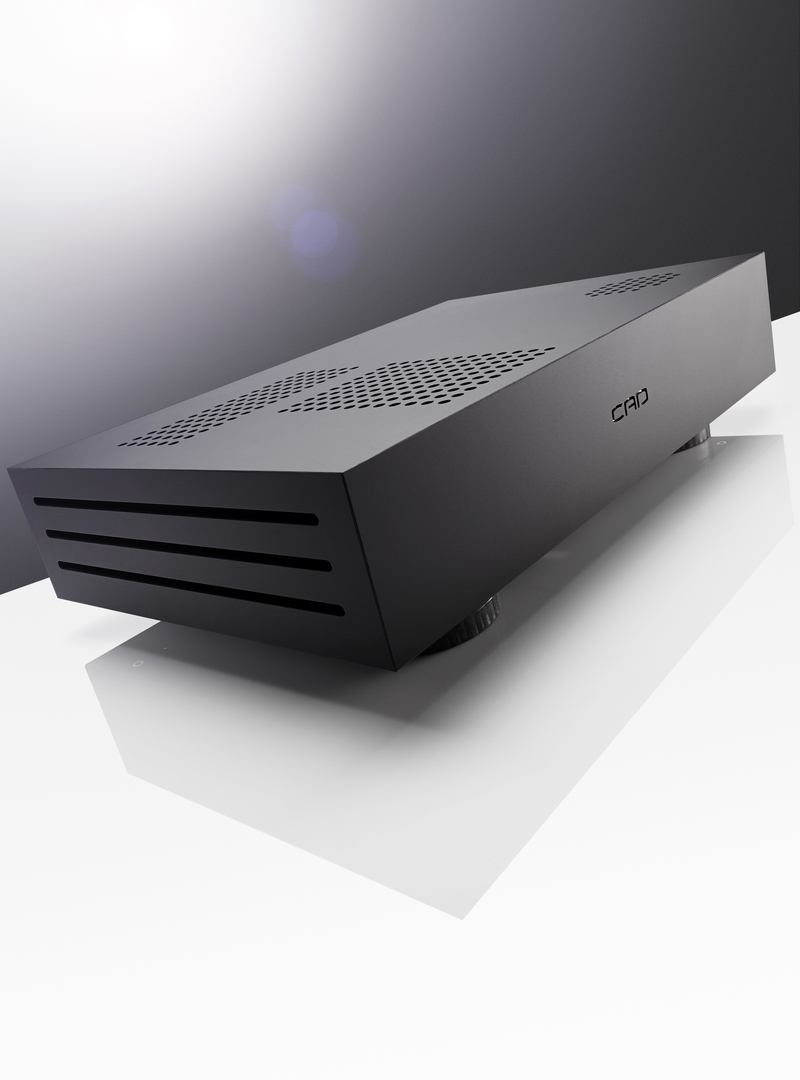
Computer Audio Design 1543 MKII DAC

The world’s finest dedicated USB digital-to-analogue convertor has been upgraded. Computer Audio Design has announced a refit to its unique CAD 1543 DAC, now using proprietary EMI/RFI reduction materials, improved DAC circuit boards, single-crystal UP-OCC internal wiring and refined power supply filtering, to create the CAD 1543 MKII DAC.

It retains the key technologies that contribute to a performance lifted far above normal expectations for digital audio, leading with the innovative use of prized vintage resistor-ladder DAC chipsets, and the daring removal of the standard digital interpolation filter.

CAD is one of a handful of digital audio companies offering resistor-ladder DAC technology, along with no oversampling and no filtering, which CAD believes offers a distinctively different sound than most digital audio products on the market today – a sound that is tangibly closer to the original performance.

DACs and ladders

The CAD 1543 MKII DAC takes its name from the application of an increasingly rare resistor-ladder convertor chip, the Philips TDA1543/N2, with its selected 16 devices now mounted on a revised four-layer circuit board. This new layout minimises intrinsic noise, optimising the chips’ specifications to now allow native conversion of 192 kHz PCM audio.

And where almost all conventional modern D-A convertors employ over-sampling techniques and a digital interpolation filter, the CAD DAC unashamedly adopts the non-oversampling (NOS) approach in order to protect precious timing resolution. With no filter to ring and smear the fundamental timing of impulsive data – the shape of natural music – the 1543 MKII brings to life both the subtle and macro dynamics of recorded sound.

The result is a total tonic to the usual time-deaf sound of digital, restoring the open and boundless soundstage of the finest analogues sources from reel-to-reel tape and vinyl replay.


When less is more

The hyper-minimalist design is engineered with the fewest number of switches and connectors between mains plug and output sockets. It features a single USB 2.0 input that galvanically isolates the 16 TDA1543 chips from a connected PC. The analogue output sees a single pair of low-mass pure copper RCA phono sockets wired directly to the chips through a passive I/V stage. The summed output of paralleled multi-bit convertor chips means there is no need for additional signal amplification or buffering, thereby removing unnecessary signal stages.

Signal wiring has been updated to single-crystal OCC (Ohno Continuous Casting) copper, custom manufactured to CAD specifications. The casework retains its laser-cut 10 mm-thick acrylic construction – available in black as standard or other colours to special order– and is now supplemented with internal RFI/EMI materials to reduce the effects of high-frequency interference on the circuit boards and their ground planes.

Further fighting the insidious effects of EMI/RFI, Computer Audio Design has redesigned the power conditioning at the unit’s power input, helping minimize AC line noise from the DAC; as well as isolate neighbouring audio components from any residual digital noise released by the DAC.

The overall result of such scrupulous attention to power supplies and potential noise sources is an audio convertor that seems to paint ink-black quietness behind the sound. A DAC that preserves and projects the rhythm and drive of dynamic music. A digital convertor for the 21st century dedicated solely to computer audio, to unlock with new clarity our archives of digital audio recordings.

Computer Audio Design 1543 MKII DAC key features:

·         Five independent transformers feeding five fully discrete linear voltage regulators for the cleanest power to each modular section of the unit.

·         Custom 10 mm acrylic case selected for superior acoustic properties.

·         NEW: additional internal EMI/RFI materials to lower electromagnetic interference noise floor.

·         NEW: redesigned mains power conditioning to reduce ingress and egress of mains-borne noise.

·         Sixteen Philips TDA1543/N2 resistor-ladder chips.

·         Filterless NOS design for unparalleled time-domain replay accuracy.

·         NEW: custom four-layer PCB to support DAC chips.

·         Passive output stage with Duelund Coherent Audio capacitors and selected US-made audio resistors all made to CAD specifications.

·         NEW: internal signal wiring upgraded to custom UP-OCC copper.

·         The 1543 MKII DAC is made in a modular fashion to make future upgrades possible ensuring your investment will last a lifetime.

Pricing and availability

The CAD 1543 MKII DAC is available now, priced at £7,250 (incl. VAT).

Owners of the original 1543 DAC can opt to have their units refitted to full MKII specification at a cost of just £600.


Consumer contacts for publication

Computer Audio Design products are sold through specialist dealers in the UK and worldwide. For more information visit www.computeraudiodesign.com

About Computer Audio Design

Computer Audio Design (CAD) is a high-end audio company founded in 2011 by electrical engineer Scott Berry. With 10 years of electrical engineering experience in the US at Tektronix, and later as an R&D engineer at Xerox, Scott Berry combined his digital design experience with a life-long interest in music and hi-fi to develop the initial prototypes of the 1543 DAC.

Computer Audio Design was established in the UK as a specialist computer audio manufacturer, with the aim of making available to other music lovers this unique digital-to-analogue convertor design that Scott had been refining over 10+ years.

Following the critical success of the 1543 DAC, Computer Audio Design developed a dedicated audio transport unit – the CAD Audio Transport (CAT) – as the best digital source available for playing CD-ripped, hi-resolution audio files and streaming online music sources. The company’s other products now include proprietary accessories such as the patented CAD USB Cable and GC1 Ground Control unit.

Press contact

For more information, product samples or high-resolution print-ready images please contact David Denyer on 07976 646 404 or [email protected]

Chord & Major earphones

Chord & Major is a new name in the in-ear ‘space’; a Taiwanese brand with a range of similarly priced earphones designed with subtle variations in finish and voice to suit the tastes of different listeners. The company calls this the ‘Tonal Earphone’ concept and this results in five basic ‘flavours’ – Rock, Classical, Jazz, Ballad, and World Music. We had three separate sets in for review – Rock, Classical, and Jazz.

There’s something of a paradox in audio; a lot of the best audio is aimed at the luxury goods market, but somehow audio equipment makers can’t own up to being providers of luxury goods the way a Swiss watch-maker can. I guess it comes down to the idea of ‘the way a product looks is less important than how it sounds’. However, I’ll see that and raise you Jadis, Sonus faber, Michell…

A product built to ‘luxury’ standards doesn’t mean it’s a triumph of nice finish over performance – typically luxury goods have high performance as standard, and build upon that with ‘the trimmings’. Yes, buying something bespoke and professionally finished is probably going to cost more than something that looks as if a guy knocked it together in a shed with some shears and a rivet gun, but I suspect what Apple’s stunning success demonstrates is people are not quite as ‘sackcloth and ashes’ about their products as they used to be.

The Chord & Major project is unashamedly ‘gifty’ – which is why this review is happened in a Christmas issue and goes online in time for Valentine’s Day. To some, the packaging is just a box in which the product arrives. Others have a more ‘Tiffany’ approach. If you have ever given or received one of those unique light robin egg blue boxes, you’ll know the impact of that packaging is deeply significant.

The different Chord & Major products are easy to differentiate in store and in ear. The Major 8’13 Rock Tonal Earphone is a black earphone in a black presentation case with black accessories (this fits well with the ‘none more black’ Spinal Tap meme). The Major 9’13 Classical Tonal Earphone is supplied in a red wood case and the earphones are in matching wood and gold, while the Major 7’13 Jazz is in a mid-ash presentation case and the earphones are finished in ash and a kind of light gun-metal finish. The packaging also highlights the instrument central to that musical genre – electric guitar for rock, sax for jazz, violin for classical, and so on. In the box is a little cleaning device, a set of small and large silicon tips (the mediums are fitted as standard), a velveteen pouch, and a cable winder card. Empty the case and you have something that looks like a bento box for a hobbit (realistically, it makes a nice small jewellery case after its days as a presentation box are over). The metal colour of the ear buds themselves is echoed in the Y-connector, while the sleeve of the headphone jack socket matches the wood finish. There is no inline microphone on any of these earphones.

A clever little ergonomic touch is the strain-relief connector on the rear of the earphone, which extends beyond the earphone itself. This not only keeps the cable in place, and is a useful place for a fairly obvious Left and Right indicator, but it is also a natural place for your thumb when inserting or removing the earphone. Additionally, it helps positioning the cable for the earphone if you want to use them in over-ear ‘sport’ mode. The cable itself is a 1.2m long ‘no-tangle’ rubber finish, although in the long-held tradition of all things ‘no tangle’, I immediately created some kind of Gordian Knot out of the cables. The little plastic card and the pouch do help.


The overall fit and finish is more ‘custom’ and ‘hand-made’ than maybe the slick, OCD finish of the likes of Sennheiser or AKG. In part, this comes down to materials choice – the wood of the earphone barrels is not as uniform as ABS or aluminium, and the earphones reflect that. That, in a way, adds to the pride of ownership, rather than detract from it; you are buying something unique and very personal. One point to note here, though: the metal end of the barrel that fits in the ear ends abruptly, and some will notice this hard edge at the outside of their ear canal. Overall though, this is an elegant and sophisticated package.

The single-driver earphone is common to all C&M designs, but is tailored slightly to suit the model. The on-paper specifications of the Rock and Jazz are identical (16Ω impedance, 94dB sensitivity) although the Classical delivers a 21Ω impedance and a 96dB sensitivity, but their characteristic tonal balances are shifted slightly. In a way, the names ‘Rock’, ‘Classical’, and ‘Jazz’ do the C&M models no favours. It might make people think of exclusivity – that the Classical earphone is no good at anything else, for example. In fact, it’s more like a loose impression of that musical genre, expressed in earphone form. You can ‘rock’ through the ‘Classical’ earphones quite well (in fact, that slight extra sensitivity of the ‘Classical’ models helps, especially with European volume-limited iDevices). They are voiced slightly differently though, with the Rock and Jazz distinctly bassier than the Classical, with the Rock having faster, more aggressive bass and the Jazz having deeper and more textured bass. On the whole, I preferred the even balance with the slight top-end emphasis of the Classical. It’s not ‘toppy’ enough to sound bright or forward, just honest.

But here’s the thing. I suspect those who get into the whole Chord & Major concept will end up with more than just one set of earphones. They will treat them like little gifts to bestow on family and friends, and you’ll have a little collection of earphones to fit your specific mood.

Details

Chord & Major 7’13 Rock and 8’13 Jazz earphones: £170

Chord & Major 9’13 Classical earphones: £180

Manufactured by: Chord & Major

URL: www.chord-m.com

Distributed by: Nue World Ltd

URL: www.chordmajor.co.uk

Tel: +44(0)20 8991 9200

Back to reviews

Read more Chord & Major reviews here

Karan Acoustics PH1 phono stage

The Karan Acoustics Phono Reference phono stage is one of the very best we have ever tested in the pages of Hi-Fi+. It is extremely quiet, is capable of being used with unfeasibly demanding cartridge loads, and has a useful set of alternate EQ curves for non-RIAA equalised recordings. However, these superlatives come at a price, in pounds sterling and avoirdupois: the Phono Reference is a heavy two-box design with a matching power supply that both weigh in at 27kg, and the complete deal costs just shy of £15,000.

Although until recently Karan also produced the one-box PH2 Mk 3 phono stage, but it was clear to chief designer Milan Karan that many of the elements that made the Phono Reference so good could be slimmed down into just the one chassis without making too many sacrifices on performance. The result is the new PH1 phono stage. Of course, the reality of designing such a device isn’t as easy as simply writing about it happening, but a surprising number of core elements are shared between the two designs, least of all a true differential (balanced) circuit approach.

The principle differences between the Phono Reference and PH1 (aside from the extra box, of course) is the Reference’s ‘unconstrained by price’ stance. The Phono Reference is a fully dual-mono, balanced design, featuring three sets of RCA and XLR inputs physically isolated from channel to channel across a whole PCB. Essentially, this makes three sets of paired mono RCA/XLR phono stage input banks with a common dual mono balanced and single-ended output stage. The PH1 has one RCA input and one balanced XLR input, each with their own balanced output stage. The other half of the board is given over to power supply, with three separate transformers (one for each channel and a third for the control circuitry). Neither section is as comprehensively specified as the Phono Reference, but that comes down to PCB real estate as much as anything.

In a way, the PH1’s ‘less is more’ approach might pay dividends for some turntable users: the Left and Right inputs for the Phono Reference are spaced across the whole of the rear panel, and this might be too long for some conjoined phono cables. The shorter gap between left and right channels makes the PH1 more user friendly. Those multi-arm users might bemoan having just the one input, but the rest of us will love the simplicity of the PH1’s connections.

What is completely retained from the Phono Reference is the near infinite range of cartridges you can use with the Karan PH1. The input load, capacitance, and gain settings can all be adjusted from a series of DIP switches on the circuit board. This is less convenient than the front panel dials of our reference Pass Labs XP25, which allows more of a ‘dial-in-to-taste’ control over the loading of a cartridge, but this is more of a ‘fit-and-forget’ adjustment as befits the once-per-cartridge matching process. Both ways have their merits – but the Karan has the advantage of not being prone to ‘readjustment’ by cats, children, cleaners, and the curious.


This near-infinitely configurable box is functionally identical to the bigger Karan. Take the top of the PH1 off, and you’ll be faced with two sets of five, four-pole DIP switches. These allow you to trim input capacitance from 50pF to 400pF, input impedance from 450Ω to 47kΩ, and gain from 48dB to 71dB; 48dB and 52dB for high-output cartridges, 64dB for medium output and 67dB to 71dB for lower-output designs. This means the PH1 can cope with any moving magnet, moving iron, and right up to the toughest of moving coil loads without fuss. I used it with the trusty, but aging, ‘cartridge in search of a load’ Ortofon MC 7500 – chosen because this is one of the toughest cartridge loads to get right, and normally requires a step up transformer. Only the very best phono stages manage this load without drowning in noise, and the Karan PH1 passes this test with its colours flying.

Once again, those using multiple cartridges on multiple arms will declare the Karan Phono Reference the better choice, because it allows different loadings to be set for each input. But that’s the price you pay for multi-source perfection. For the rest of us, losing a box and gaining a bank balance are about the only ‘sacrifices’ you’ll make in going for the Karan PH1. The two have identical specifications elsewhere. A quick turn of one of the two front panel knobs racks through a list of EQ curves: RIAA, EMI, Decca, Columbia, and Teldec. The argument over how important these curves actually are to collectors rages on, with lines drawn between an ‘idealist’ view of a near-immediate switch over to RIAA with the coming of stereo in the late 1950s, and the ‘realist’ counter argument that suggests EQ curves were changed at a more relaxed pace, which means records cut well into the 1960s (and beyond) might not all subscribe to the RIAA standard. How much of an issue this is depends largely on where you sit on this idealist-realist continuum, and how many LPs you own that were cut around half a century ago. It’s not a big thing for me, but your mileage may vary.

My take here was to ignore anything written about the KA Phono Reference and listen without prejudice. Only when I finished the review did I look back on Roy Gregory’s findings in issue 117, and at that point I realised two things: just how consistent Karan is with its phono stages, and just how close the PH1 gets to its bigger brother.

In fact, two words neatly sum up the Karan PH1: ‘consistent’ and ‘realistic’. The sound it makes is extremely realistic, a window on the recording process be that last week or 50 years hence. I’m still reeling from just how much information the re-released Queen box manages to put on the LP, and it’s helped by just how much information the PH1 manages to extract from the same. These Queen LPs are not necessarily my first choice in music listening, but the insight into the mix is so profound, one can’t help but be drawn in. The dynamic range especially was almost shocking, and you could hear Brian May and his sixpences as plectrums tear into a set of guitar strings causing his Vox AC30 amps to scream apart in beautiful, creamy-sounding pain. But that insight happened with every record, as befits a phono stage as consistent as the PH1.

In sonic terms, the Karan PH1 sits equidistant between my two favourite phono stages. It’s not as inviting-sounding as the Pass Labs XP25 and it’s not got the same ‘scrubbed clean’ detail as RCM Audio’s TheRIAA, but instead it walks between these two paths carefully and well. In a way, these three phono stages share a common trait of almost total cartridge load control, and all three benefit from getting the set-up absolutely right. It’s just when the PH1 gets all its ducks in a row, it has an ability to disappear from the system in an almost uncanny manner. You feel as if you are listening to the record without a phono stage impeding the process. Reading back RG’s test, I didn’t feel the PH1 had a ‘warm mid-hall balance’ but it retained the richness and harmonic structure of every recording, which makes me think it comes very close to the Phono Reference in sonic terms.


In fact, the PH1 is good enough to render the Phono Reference pointless. Except… in those rare shoot-for-the-moon systems where money is no object, where every turntable has many arms, and were the idea of ‘compromise’ is alien. At that point, the differences between the Phono Reference and the PH1 tip in the bigger phono stage’s favour. That doesn’t mean the Phono Reference is a device for ‘more money than sense’ users, it’s just that if you have a system of such magnitude, then the ‘no limits’ performance of the Phono Reference will be more in line than the ‘near as damn it no limits’ performance of the PH1.

Most of us, however, would be more than happy with the Karan Acoustics PH1 phono stage as an example of the best it’s possible to get from vinyl. Very highly recommended!

Technical Specifications

  • Type: Solid-state phono-stage
  • Inputs: 1pr balanced XLR; 1pr single-ended RCA
  • Gain: 48dB – 71dB + one user definable setting
  • Loading: 450Ω – 47 kΩ + two user definable settings
  • Capacitive Loading: 50pF – 400pF
  • Replay EQ: RIAA, EMI, Decca, Columbia, Teldec
  • Absolute Phase: Switchable 0/180 degrees
  • Outputs: 1pr balanced XLR; 1pr single-ended RCA
  • Dimensions W×H×D: 50 × 11 × 39cm
  • Weight: 18kg
  • Price: £7,900

Manufacturer: Karan Acoustics

URL: www.karanacoustics.com

UK Distributor: Audiofreaks

Tel: +44 208 948 4153

URL: www.audiofreaks.co.uk

Back to reviews

Read more Karan Acoustics reviews here

CES Scene: Ten Fascinating New Headphones & related components

As many Hi-Fi+ readers know, I am an ardent fan of all things headphone-related, so naturally I volunteered to cover the product category at CES. What I present, below, is a handpicked list of ten of the most significant new models (or groups of models, in some cases) as seen at the show.

As always, I apologise in advance to any worthy manufacturers whose products I fail to mention. No slights are intended; rather, it’s a case of there being too much show and not quite enough ‘me’ to cover it all.  Enjoy.


Astell & Kern AK320 portable digital audio player, $1,800

Astell & Kern’s flagship AK380 digital audio player has won considerable praise from reviewers, but there is also the sense that its $3,499 price may have placed it a bit too far ‘over the top’ for the unit to appeal to a widespread audience (veteran headphonistas love the ‘good stuff’, but even so there are limits).

To tackle this issue head on, Astell & Kern introduced at CES a new cost-reduced model called the AK320 that is directly based on the AK380 platform, but that sells for about $1,699 less (the AK320 is still an expensive player, to be sure, but one much more in line with what many enthusiast feel premium DAPs ought to cost). To achieve this substantial reduction in price, the AK320 makes the following changes:

  • 128GB of onboard memory vs. the AK380’s 256GB,
  • No native support for DSD vs. the AK380’s full native DSD support (although the AK320 will happily play DSD files via DoP, but converts them to high-res PCM format for playback),
  • Support for DSD playback up to DSD128 vs. the AK380’s DSD support for up to DSD256,
  • Bit-for-bit support for 24/192 files vs. the AK380’s bit-for-bit support for files up to 32/384, and
  • USB DAC functions limited to 24/96 vs. the AK380’s USB DAC functions, which extend to 32/384 PCM and up to DSD256.

The great news, though, is that in many respects the AK320 is almost identical to the AK380, sharing the same dual AK4490 DAC devices as its big brother, plus the same amplifier circuitry, the same professional grade PEQ (parametric EQ) system, and the same ultra high-tech Femto clock. What is more, the AK320 also shares the same DLNA functions, the same AK Connect app compatibility, and the same elaborate accessory set as the higher priced AK380.  Cool though the flagship model is, our guess is that many will conclude the AK320 offers most of the important features of the AK380 at a far more accessible price.


Audeze Sine planar magnetic headphone & Cipher DAC/headphone amp, offered as a bundle, $599

Last year, the big news from Audeze involved its then new EL-8 family of planar magnetic headphones (both open and closed-back versions were offered), priced at $699, which certainly helped pull down the typically high cost of Audeze ownership. Even so, the EL-8s were fairly big headphones that did not necessarily lend themselves to true on-the-go listening. Very early on, I also wondered whether the EL-8’s voicing might be work in progress, as I initially encountered some samples whose voicing showed a noticeable degree of unit-to-unit variation (an issue I am sure Audeze has long since sorted out).

Now, however, Audeze has launched a new compact and very lightweight planar magnetic headphone, called the Sine, priced at $499, which I feel is certain to be a runaway smash hit, and for all the right reasons. For starters, the Sine offers an immediately likable and accessible sound that is chockfull of the traditional Audeze virtues: wide range frequency response, high resolution, evocative dynamics, and a downright enchanting quality of musical expressiveness. Next, the Sine is compact (but not too compact, if you know what I mean) and light enough to qualify as a headphone you could and would want to take along with you when you travel. Finally, the Sine is remarkably comfortably—especially so as on-ear headphones go (yes, the Sine is an on-ear model!). Roll in an ever-so-manageable price and I foresee Audeze setting off (please pardon the awful pun) a veritable Sine wave.

But wait; there’s more. Along with the Sine, Audeze has also whipped up an amazingly clever little device called the Cipher that is—get this—a combination Apple Lightning connector equipped headphone signal cable, a remote/mic module, an in-line amplifier module, a DSP-drive EQ engine, and a 24-bit DAC! And did we mention there’s an iDevice/Cipher app to allow users to create and store EQ presets for their favourite headphones?  Better yet, the presets are stored in the cable module, so that your favourite setting travel with you as you plug the Cipher into different iDevices (a very clever idea, no?). My understanding is that Audeze will in time offer the Cipher as a standalone, add-on accessory for its headphones, but that in the immediate future it plans to offer a Sine + Cipher bundle priced at about $599.


HiFiMAN Shangri-La electrostatic headphones, price to be announced.

Almost every CES event in recent years has seen the launch (or at least the preview) of a singular headphone product that stops listeners in their tracks and makes them collectively say, “Wow!” For CES 2016, that product was HiFiMAN’s pre-production prototype of the firm’s brilliant new Shangri-La full range electrostatic headphone.

Knowledgeable listeners might be thinking, “Wait a minute; doesn’t HiFiMAN focus almost exclusively on planar magnetic designs?” The answer is that in recent years many of HiFiMAN’s most advanced designs have used planar magnetic technology, but if you look back far enough you’ll discover that at a much earlier stage in his company’s development HiFiMAN founder Dr Fang Bian once made an excellent electrostatic headphone called the Jade. Sadly, the Jade proved extremely difficult to build in volume, so that it was dropped from the firm’s product line relatively early on. Even so, those of us who have heard the Jade have often encouraged Dr Bian to consider doing another electrostatic headphone using the latest available materials and manufacturing technologies.

Apparently, Dr Bian was thinking along the same lines because at CES he was proudly demonstrating his new Shangri-La electrostatic headphone with a purpose built, although not yet finalised, 300B valve-powered electrostatic headphone amplifier. The result was what can only be described as a stunning sonic achievement—one of the most natural sounding and effortlessly transparent transducers I’ve ever heard. Some show-goers even went so far as to say they felt the Shangri-La was competitive with (or maybe even superior to) Sennheiser’s stupendously expensive new Orpheus 2 electrostatic headphone/amp package.

There are many advances in the Shangri-La design, not all of which we know about. However, several important ones we do know about involve the headphone’s use of a submicro-metre thickness diaphragm and a proprietary method for evenly coating the diaphragm surface with conductive nanoparticles (remember, Dr Bian’s PhD is in the field of Nanochemistry). Also, says Dr Bian, another critical design element involves his use of precisely tensioned metal mesh stators, which offer great self-damping and facilitate sonic transparency.

Best of all, Dr Bian says he has not yet tapped the full potential of the Shangri-La design, so that there is reason to hope its already superb sound quality will be further enhanced by the time the headphone enters production. What will the Shangri-La cost? The generic answer is, “A whole lot!” HiFiMAN’s aim is for the Shangri-La to be the best headphone on the planet, period, so expect it to be priced accordingly.


LH Labs Vi DAC SS and SS + Valve DAC/headphone amp, $5000 and $7000

LH Labs products tend to roll out into the market in an evolutionary way, meaning that it’s difficult to pin down a singular ‘release date’. For this reason, I hesitate to declare the LH Labs Vi DAC SS (for ‘solid state’) or its sibling Vi DAC SS + Valve model as being truly new for CES, although the company was certainly treating them that way in its demonstration room at the show.

The Vi DAC (where, says LH Labs, the word ‘Vi’ is Latin for ‘force’) can be seen as significant step up from the firm’s Geek Pulse DAC and as being second only to the firm’s awe-inspiring, cost-no-object Light Harmonic Da Vinci DAC Mk II in terms of overall sophistication. Basically, the Vi DAC SS and Vi DAC SS + Valve units are both intended as extremely sophisticated and highly versatile DACs suited primarily for use in high-end home audio systems, but with the added twist of incorporating superb single-ended and balanced output headphone amplifier sections.

The Vi DAC is a dual mono, dual ESS DAC design that used high precision Femto clocks and a proprietary three-level (3L) digital buffer system to reduce timing errors. The Vi DAC can decode PCM files up 32-bit/384kHz and DSD file up to DSD256. The angular chassis of the Vi DAC is beautifully finished and visually striking, so that the only question potential customers must wrestle with is whether they want solid-state outputs or hybrid solid-state/valve outputs.


Manley Laboratories Headphone Amplifier, $2950

Expert valve (tube) amplifier designer EveAnna Manley is perhaps best known for her beautifully made and superb sounding valve-powered preamplifiers, phonostages, power amplifiers, and integrated amplifiers, many of which are whimsically named for various type of fish (no, I’m not joking).  For example, Ms Manley offers preamps called the Jumbo Shrimp, the Chinook, and the Steelhead, as well as power amplifiers such as the Stingray, Stingray II, Mahi, and Snapper.  But don’t let all those colourful names fool you; Manley’s products are carefully designed and built with quality and longevity in mind (the names may be whimsical, but the products are dead serious in their intent and execution).

For CES, however, Manley introduced her first-ever headphone amplifier, which is of course valve powered and which is—somewhat surprisingly—not named after a fish. (I must confess that, in light of the fact that the headphone amplifier is one of Manley’s most compact products, I suggested that it be named the Anchovy, which netted me dirty looks; but hey, I like anchovies.) The distinctive looking Manley Headphone Amplifier (that’s its actual name) offers a number of distinctive features of potentially great sonic importance.

For instance, the amp can be switched on-the-fly between all-triode push-pull and single-ended topologies and features a variable feedback switch that can apply between 0 and 10 dB of global negative feedback. Then, the fully symmetrical circuit enables the amp to drive balanced headphones via its XLR output jack or single-ended headphones via its TRS jack. Further, the amp provides high precision volume level and balance controls, plus studio-quality tone controls. Last but not least, the amp is configured so that, when the headphone amplifier section is shut down, the Manley Headphone Amplifier can continue to function as a high quality, transformer-coupled preamplifier for use as the front end of a traditional high-end audio system.


Mitchell & Johnson/Electrostatz hybrid electrostatic headphones, $169 – $599

Mitchell & Johnson is a new start-up company focusing on building audio components (principally electronics components) that offer very high value for money. As part of this effort, the firm is also developing an important sub-brand that will manufacture and sell a range of Mitchell & Johnson Electrostatz headphones.

What’s in a name? The proposed Electrostatz models use hybrid dynamic/self-biasing electrostatic driver technologies (conceptually similar to the driver technologies used in the high-end ENIGMAcoustics Dharma D1000 headphone), but deliberately scaled for use in mid-priced headphones priced at $599 and below.

The planned models in the Electrostatz range generally fall into two categories: populist headphones with deliberately colourful voicing curves (typically with a smidgeon of bass and treble boost and lightly scooped mids, yielding a ‘smiley face’ EQ curve) and audiophile headphones with much more neutral voicing. There are, too, some DJ-friendly models contemplated. Our working assumption is that Hi-Fi+ readers will care most about the audiophile models, which are the HP1 ($299) and HP2 ($299). It’s interesting to see a firm pushing formerly exotic technologies down to accessible, real-world price points. We wish Mitchell & Johnson/Electrostatz well in this venture.


MrSpeakers ETHER C high-end gaming headphone, $1649

Last year, the San Diego-based firm MrSpeakers (which ironically makes headphones, not loudspeakers) launched its superb open-back ETHER planar magnetic headphone, which was followed later in the year by the perhaps even more impressive closed-back ETHER C planar magnetic headphone, which has won recognition as the Hi-Fi+ Closed-Back Headphone of the Year, 2016.

For CES, however, MrSpeakers pushed things in an innovative new direction by showing a prototype of a high-end gaming version of the ETHER C, which was demonstrated at the Creative Labs stand in conjunction with a Creative Labs Sound Blaster X7 high-resolution DAC/amplifier. Significantly, MrSpeakers and Creative have done some work to create amazingly realistic headphone/surround sound-orientated DSP presets that give the ETHER C gaming headphone absolutely jaw dropping surround sound capabilities. The point was brought home to me vividly as a listened to the surround soundtrack of a game being played while standing in the crowded Creative display stand.

Imagine this scene: All around you there are crowds of people listening to (heavily amplified) Creative Labs presentations on various products, complete with raucous backing soundtracks thumping away through PA systems. But, you don’t really notice the noise all that much because you’re wearing MrSpeakers ETHER C gaming headphones, which offer true audiophile grade neutrality of voicing, realistic dynamics, and high resolution—plus a terrific amount of isolation from outside noise. So, instead of being swamped by the racket and uproar of the show, you hear the gentle, highly three-dimensional, and believably realistic sounds of a rural forest scene in which the action of a game is being played out. 

It’s a downright eerie experience, because you eyes tell you that you are standing in densely populated trade show booth while your ears tell a very different story: namely, that you are outdoors in a thickly wooded area with occasional gust of wind rustling the tall grasses at your feet. The long and short of this is that at long last someone has finally offered a serious audiophile-grade headphone that is also ideal for gaming applications. Better still, MrSpeakers founder Dan Clark indicated that in the coming year we might expect to see an ETHER C + Creative Labs Sound Blaster X7 bundle, priced at or just under $2000.


Pass Labs HPA-1 headphone amplifier, $3500

Pass Labs founder Nelson Pass enjoys ‘living legend’ status among amplifier designers so that it is highly significant that his firm has now seen fit to launch an ultra high-quality headphone amp, called the HPA-1. Note, please, that the HPA-1 has not made its way to the Pass Labs web site just yet, so please be patient.

The design philosophy behind the HPA-1 might best be termed ‘everything you need and nothing you don’t need’; in other words, it’s a very high quality but decidedly no frill product, which as we see it is a good thing. The HPA-1 is a strictly single-ended design (for now) with two stereo analogue inputs, a very robust faceplate-mounted single ended headphone output, and rear panel mounted stereo preamplifier outputs. Pass maintains that the HPA-1, if viewed purely as a preamplifier, is more than competitive with other preamps in its price class. Happily for headphone enthusiasts, though, the HPA-1 is more than a mere line-level preamplifier.

The HPA-1 was, according to Pass Labs, designed very much as if it were a power amplifier writ small. Thus, at its heart, the HPA-1 features a massive toroidal transformer fed power supply, a wide-bandwidth/low-feedback input stage based on discreet JFET devices, and a Class A-biased, direct coupled MOSFET output stage.  Volume control settings are adjusted via a very high-quality ALPS potentiometer. Pass claims the HPA-1 can effortlessly drive headphone loads ranging from 15 to 600 Ohms.

What about those who favour balanced output headphone amplifiers? Not to worry; at CES a Pass spokesperson indicated that a balanced version of the HPA-1 is under development (though we can expect it to cost a fair amount more than the single-ended HPA-1 that is available now).


Questyle ‘Gold Edition’ headphone preamp, DAC, and monoblock amplifier reference system, $12,495

Questyle has been vigorously pushing the limits of both DAC and headphone amplifier technologies of late and for CES the firm rolled out a new four-piece ‘gold standard’ reference system in the form of a group of Gold Edition components that together represent one of the most ambition headphone amp/DAC systems on the planet.

The Gold Edition Reference system comprises performance-enhanced Gold versions of the firm’s CMA800P current mode amplification preamp the CAS192D DAC, and a pair of CMA800R current mode monoblock headphone amplifiers. The imposing four-unit stack is an impressive sight to see and it sounds even better than it looks, as I was able to verify by trying the system with a set of Audeze’s new flagship LCD-4 headphones fitted with balanced signal cables.

What sets the Gold Edition components apart from standard Questyle models? Two of the biggest differences are that all Gold Edition models feature distinctive Rogers ceramic printed circuit boards (rather than conventional PCBs), plus selected tight-tolerance components. As a result, an already exceptional preamp/DAC/monoblock amp package becomes that oh-so-important, extra Nth-degree better.


Sennheiser HD 800S dynamic headphone, $1699

For many years Sennheiser’s HD 800 dynamic driver-equipped headphone has stood as the benchmark against which all other dynamic headphones must be compared, but for CES Sennheiser raised the bar even higher with its new HD 800S model. With the HD 800S, the new design offers sound images that have, “been further optimized in the medium and low ranges,” although based on a too-brief listening session in side-by-side comparisons with the original HD 800 I felt the new model offered top to bottom improvements in overall transparency and nuance.

The HD 800S is directly based on the HD 800 platform, complete with 56mm dynamic drive units, but the new model applies the internal absorber technologies originally pioneered for the firm’s IE 800 universal-fit in-ear monitors. This technology is said to help prevent high-energy bass and midrange sounds from ‘masking’ or obscuring crucial low-level midrange and treble details. Other changes include a distinctive new frame colour and a new symmetrical XLR4 signal cable system.   

With the advent of the new HD 800S, the price of the original HD 800 (which will remain in the Sennheiser product line up) will drop down to $1,399.

CES Scene: A Baker’s Dozen of new Amplification Components

The last of my CES show coverage topics involved high-end amplification components, which category proved to be a veritable hotbed of product development activity for the show. For this reason, I’ve expanded by coverage to highlight a baker’s dozen of new models (rather than my usual ten models), but even so I’m afraid I’m only scratching the surface of important new entries seen in Las Vegas.

Once again, my apologies to worthy manufacturers whose products I did not have space to cover. No slights are intended. Instead, we are simply trying to catch a good representative sampling of great products from what proved to be a very exciting show. Enjoy.

Aesthetix Saturn Atlas ECLIPSE monoblock amplifiers, $25,000/pair

At CES, Aesthetix introduced the latest and greatest iteration of its Saturn Atlas 350 Wpc hybrid valve/solid-state monoblock​ amplifiers, known as the Saturn Atlas ECLIPSE (because its performance eclipses all prior versions of the Saturn-series amplifiers). What make an ECLIPSE an Eclipse? Aesthetix adds exotics StealthCap capacitors, ultra precisely matched output devices, a chassis featuring a superior mechanical isolation system, and a very sophisticated power supply grounding system. The result should be very special indeed.


Audio Research Corporation Reference 6 preamplifier, $14,000

ARC is famous for its preamplifiers and the firm’s Reference 5SE was one of the most popular and critically acclaimed models to date, until it was surpassed by the superb but also expensive and elaborate two-channel Reference 10 model. To help bridge the gap, a new single chassis model was needed—one that channelled much of the sonic goodness of the Reference 10, which is precisely where the new Reference 6 model comes in. The Reference 6 uses a complement of six 6H30 valves and an all-new chassis said to help dissipate “electrical and mechanical interferences”. According to ARC, sonic benefits include “better bass control, relaxed purity and more dimensionality”, while further “improvements include a more grainless presentation, greater transparency, better speed, and more continuity across the musical spectrum.”


Bryston 7B3 monoblock amplifiers, $10,400/pair

Cynics will tell you there’s nothing new under the sun, but according to the US Patent Office, sometimes there is. A case in point would be the newly patented front-end circuitry used in Bryston’s ‘cubed-series’ power amplifiers, some of the most popular of which are the mighty 600 Wpc model 7B3 monoblock amplifiers. According to Bryston, the cubed-series amplifiers afford “dramatically less distortion at (the) input stage, improved common mode noise rejection, and a major reduction in EMI/RFI noise rejection.” In honour of these improvements, cubed-series models are also treated to “updated dress panel aesthetics with clean lines and a new finish.”


Cary Audio AiOS streaming integrated amplifiers, $2,500

Versatility is the name of the game for Cary Audio’s new all-in-one streaming integrated amp/DAC, called the AiOS. The AiOS provides analogue inputs, a broad range of digital inputs, a Bluetooth input, network/streaming connectivity, an upsampling DAC capable of handling up to DSD512 files, and a power amplifier section capable of 60 Wpc output. Moreover, the amp is available with various colours of anodized side cheeks and is configured so that its impressive backlit front panel controls (which typically remain blacked-out most of the time) can be set to illuminate in any of the AiOS’ available chassis colours. The concept is that, for many listeners, the AiOS might either serve as a great and highly versatile entry level Cary amplification product, but might also be all the Cary componentry one would ever need or want.

Constellation Inspiration Integrated 1.0, $13,500

Have you found the occasional Hi-Fi+ reviews of Constellation products at once inspiring but also a little bit frustrating inasmuch as Constellation products are often priced beyond the means of many of us? Well, Constellation may have an answer in the form of its gorgeous new Inspiration Integrated 1.0, which will sell for $13,500. Now that sum is certain not cheap, but for the level of build and sound quality invariably on offer from Constellation, it seems downright accessible. The Inspiration Integrated 1.0 puts out 100Wpc and is said to incorporate a superb and powerful headphone amplifier section, which gives the component an added dimension.

Crystal Cable CSI (Cube System Integrated) amplifier, €12,000 (ex. VAT)

Crystal showed a prototype version of its CSI (Cube System Integrated) integrated amplifier at last year’s CES event and most of us assumed the final production version would be quite similar, but not so. Instead, designer Edwin Rijnveld went back to the drawing board to create an all-new CSI amp that is differently dimensioned, comes with a very cool looking and fun-to-use remote control, and the puts out a very substantial 200 Wpc at 8 Ohms, 400 Wpc at 4 Ohms, and 800 Wpc at 2 Ohms. The CSI is intended as the logical companion to Crystal’s Minissimo and Minissimo Diamond speakers, although we think it might sound great in other systems as well. Interestingly, the entire amplifier is internally configured as a cooling ‘chimney’ of sorts, which perhaps explains how it is able to deliver so much power into low impedance loads.


Dan D’Agostino Master Audio Systems Progression monoblock amplifiers, $45,000/pair, and Master Power Classic Stereo amplifier, $13,000

Dan D’Agostino Master audio systems has been on quite a roll ever since launching its top-tier range of Momentum-series amplification components. However, recognising that not all enthusiasts can afford Momentum grade components, D’Agostino took the opportunity at CES to at once expand his Momementum range (via a new Momentum-series phono stage), while at the same time launching not one but two new ranges of (somewhat) cost-reduced amplifiers.

Specifically, D’Agostino showed his new 800 Wpc Progression monoblocks ($45,000 pair) as well as his 300 Wpc Master Power Classic Stereo power amp ($13,000). For those who can’t quite manage the price of the Momentums, the less costly Progression amplifier leverage similar design concepts and aesthetic motifs without trading away significant levels of performance, while the Master Power Classic Stereo addresses an even broader range of potential customers at a substantially lower price point.

EMM Labs MTRX2 monoblock amplifiers, $80,000-$90,000/pair

In the world of ultra high-end solid-state power amplifiers there are block busters and then there are BLOCKBUSTERS, and EMM Labs’ Ed Meitner designer MTRX2 definitely falls in the latter camp. It’s one of those amps where, if you need to ask the price, you probably can’t afford it and if you ask how heavy it is, you probably forgot to bring along an audio ‘pit crew’ of he-man amp lifters and/or an engine hoist to help lift these massive beauties into place in your listening room. The MTRX2 promises all the expected detail and finesse associated with the EMM Labs/Meitner name, while also delivering a full kilowatt of Class A/B power sufficient to drive most any loudspeaker on the planet.

McIntosh Laboratories C1100 two-chassis preamplifier, $11,000

McIntosh doesn’t release entirely new preamplifiers all that often, so that when it does it’s considered a fairly momentous occasion. So it is with the two-chassis C1100 preamplifier. In conversations with McIntosh spokesperson Ron Cornelius, we learned that a big key to the new preamplifier’s delicate, subtle, detailed, and highly nuanced sound is its remarkably low noise floor, which in practice seems lower even than McIntosh’s extremely conservative specifications might lead listeners to expect. As is often the case, one has less of sense of the absence of noise, per se, but more a sense of low-level textures and details suddenly becoming more readily apparent to the listener, with beneficial musical results.


Moon by Simaudio Neo ACE all-in-one streaming integrated amplifier, $3,500

Moon’s new Neo ACE (A Complete Experience) is a do-all integrated amplifier offering extraordinary versatility. To this end, the ACE provides three analogue inputs, eight digital inputs (one USB, two SPDIF, two optical, aptX Bluetooth inputs, and WiFi and Ethernet inputs), a moving magnet-type phonostage, a 50Wpc power amplifier section, plus full integration with Moon’s well thought out MiND app. In short, the ACE supports virtually any and every musical input source imaginable, and comes with a 32/384 and DSD256-capable DAC section to offer a good measure of future proofing.

Nagra HD Amps, $80,000/pair

If you have read Hi-Fi+ Editor Alan Sircom’s very enthusiastic review of the Nagra HD DAC you might have wondered exactly what sort of power amplifiers Nagra might propose that you use in conjunction with its world-class DAC. Now we know the answers and they are the exquisite Nagra HD monoblock amplifiers, priced at $80000/pair. The Nagra HD amp arrives in a tall, slender chassis inspired by the Nagra VPA. The amp puts out 30Wpc of pure Class A power, then up to 270 Wpc in Class A/B mode, and finally can deliver a stonking 1kW of power into a 2 Ohm load. We can’t wait to hear the big beauties in action.

Questyle R200i wireless (or wired) monoblock amplifiers, price TBD

Questyle had a slew of new product offerings at CES (honestly, too many to mention here), but one of the most fascinating was the firm’s new R200i next-gen ICEpower-driven, 200Wpc monoblock amplifier, which can be configured as either a 5GHz wireless amplifier or as a direct wired amp with XLR inputs.

If used wirelessly, the amp can be fed either via Questyle’s existing two-channel T2 wireless transmitter ($999) or the firm’s new eight-channel, surround sound-minded T8 transmitter.  The point is that listeners can enjoy high quality power amplification without having to worry about stringing lengthy analogue interconnects or speaker cables all over their listening rooms.

VTL TL-2.5i linestage preamplifier with optional phono stage, $5,000

Enthusiasts accustomed to reading about VTL components carrying dauntingly high price tags will be delighted to learn that the firm’s new TL-2.5i valve-powered linestage preamplifier starts at just $3000, or $5000 with VTL’s hybrid valve/JFET powered phonostage installed. In other words, for not much more money than a garden-variety preamp would cost, you could have a real VTL with what the firm terms’ “stiff power supplies for each gain stage”, high quality parts throughout, a remote control, precision volume and balance controls, user selectable gain and mono function switches and an analogue circuit based on dual 12AU7 and dual 12AT7 valves.

The optional phonostage section is no less interesting, in that it supports MM cartridges via a circuit based on dual 12AX7 valves and then supports MC cartridges, either via a gain stage based on a single 12AU7 valve or via an optional low-noise step-up transformer. 

CES Scene: Loudspeakers $25,000 and above

Whether it’s a sign of the top tier of the audiophile world going ‘off the boil’ or a reflection of wider changes taking place in the political world, but this year, the number of launches in the $25,000+ loudspeaker market was considerably curtailed. Our criteria in attending a show is very much “what’s new” and usually it’s possible to find dozens of brand new loudspeaker systems in audio’s upper atmosphere, but this year at CES it was more of a struggle. There were good loudspeakers on show that had been seen before, and many of those were worthy of note, but in terms of new launches in this sector, things seem quieter this year.

Normally, we try to find either a top ten or a ‘baker’s dozen’ of best new products in a particular class. This year, that simply couldn’t happen. Nevertheless, there were some premium model launches and announcements of super-high-end and high-end loudspeaker systems. So here is our 13 best new, and sometimes not-so-new top-end speakers at CES:

GamuT announced its special $139,000 Zodiac loudspeaker, so named because only twelve will be made per year, each one with a serial number that begins with an astrological star sign. Similar in look to the company’s top RS5 loudspeaker, the hand-built Zodiac features custom designed drive units hand selected for their phase properties, a new crossover network, extremely carefully designed and cost-no-object built cabinets, and comes complete with installation and on-site fine tuning by GamuT’s designer Benno Baun Meldgaard. Although the headline figures show a loudspeaker with a frequency response from 16Hz to 60kHz, the real result is a loudspeaker of extremely fine impulse response, time and phase alignment and dynamic range, even in a room far smaller than optimum for the loudspeaker itself.  

MartinLogan learned a lot from the development of the Neolith loudspeaker, and a lot of it went into the new MartinLogan Renaissance ESL 15A. Available from March with a US list price $25,000 per pair. Its ForceForward system allows fine-tuning for surprisingly bad room positions, such as close to the wall. MartinLogan has also incorporated Anthem’s room correction system, and the metal frame in which the stator panel rests makes the speaker one of the most effortlessly dynamic loudspeaker sounds you will hear from a thin panel.

Magico stayed away from the main Venetian complex and instead presented its upgraded $38,000 S5 and $16,500 S1 loudspeakers. These two new loudspeakers are more than just ‘updates’ on the existing models: everything (apart from the basic alumimium extrusion) is completely new on both designs, featuring the beryllium-coated diamond tweeters found in the awesome S7, graphene mid and bass drive units, redesigned crossovers and cross-bracing, even new curved top plates and – in the case of the S1 – plinths. At my time of visiting, the S5 was on passive display and the S1 was on demonstration, driven by valve amplification (from CAT), dispelling the myth that Magico only works with solid-state amplification. The $16,500 S1 capable of significantly more scale than its predecessor, too: it sounds larger, with a far deeper soundstage. Its bass is deeper too.


Even with its Platinum range, Monitor Audio is not known for its budget-busting loudspeaker designs, so the $29,000 PL500 II – flagship of the new Platinum II range – came as a bit of a shock. However, in a world where seven-driver, three way designs featuring custom-made drive units in a cabinet that stands as tall as a man can cost the spendy side of $100,000, a loudspeaker that sounds this good commands respect. Monitor Audio is one of the UK industry’s recent success stories, and judging by the PL500 II, that success will extend to the high end soon, too.

Like Magico, Raidho is undergoing a root-and-branch improvement to its D-Series loudspeakers. Having ‘history’ with the D-1, it was fairly clear the $23,000 D-1.1 was a markedly improved beast, thanks to a new motor design for the drive units, improved crossover, and a better-modelled internal airflow and porting. I’ve logged far fewer hours with the D-3, but the $65,000 D-3.1 sounded suitably awesome, too. Both were driven by the new Aavik pre/power combination and a host of Ansuz Acosutics tables, cables, juicers, risers, and (anti)resonators. Both speakers had that characteristic Raidho detail and dynamics, coupled with the kind of dynamic thwack that made ISAM by Amon Tobin sound just like Megatron assaulting a record store in an disconcertingly ‘real’ way (you had to be there).

This was the first time the $45,000 Sonus faber Il Cremonese floorstanders were shown to the wider public in America; having been only shown in October last year at the Festival Son et Image in Paris, and to a select audience of dealers and press at World of McIntosh’s swanky NYC venue. Named after the 18th Century Stradivarius violin of the same name and playing through a complete Audio Research system (also a part of the WoM group), the elegant five-sided Il Cremonese floorstander captivated people with its looks, but they stayed for the sound. A fine example of ‘trickle down’ technology from The Sonus Faber loudspeaker and the Lilium, this three-way, four speaker technology. The Il Cremonese manages to combine the musical refinement and elegance of previous S-f speakers with faster transients and excitement.

Vandersteen’s popular Model 5A floorstander has undergone something of an upgrade, in the shape of the new $30,000 Model 5A Carbon. The change – as you might expect, given the name – involves changing the front-firing 25mm tweeter and 100mm midrange to carbon-fibre designs; the 177mm Kevlar sandwich midbass and 300mm aluminium active bass units remain. Playing MQA tracks through Meridian and into Vandersteen’s own power amps (a Brinkmann analogue front end was also on call, but not playing at the time I visited), the sound was fast, deep, and authentic, all the while retaining the sumptuous qualities that make Vandersteen users some of the most loyal owners in audio.

Wilson Audio loudspeakers are often featured at CES, playing on the end of a number of systems both in the Venetian and the satellite shows. The company itself, however, uses the show to highlight upcoming products. Last year, Wilson showcased its upcoming top-of-the-range loudspeaker (currently still a work in progress). This year, the company showed its new Alexx, designed to replace the venerable MAXX 3. A new departure for Wilson, the new loudspeaker will be a four-way design, featuring ‘trickle up’ and ‘trickle down’ technologies from the Alexia below it (in the shape of the micrometer adjustment of the midrange and treble units), and above from the Alexandria and even the future flagship (the drive units derive from the WAMM development project). Shipping very soon, the loudspeaker will cost $109,000. Another notable prototype on show was the Paradigm Concept 4F (seen at the front of this feature), first heard at Munich.


There were also products that were not technically new per se, but were used in rooms highlighting new equipment, that were worthy of note. Among these, perhaps the most interesting was the strictly limited edition Kaiser Kawero! Classic loudspeaker in the Kondo room. Rewired using the top Kondo cable, the system was designed to showcase the new $100,000 G-1000 Kondo preamplifier designed to replace the M1000 MkII. This created one of the most effortless sounds at the show.

Similarly, B&O was showing off its $40,000 BeoLab 90 in timed seminars on the other side of the Venetian hotel. The active, DSP-driven multi-driver system launched in 2015 can be optimised for single user sweet spot listening, and the difficulty is getting 30 people to listen to a loudspeaker under its best possible conditions in a seminar means you get a little more than a minute in front of these behemoths, and have no choice over musical content, especially as most of the seminar was geared toward the launch of the new $2,785 BeoSound 35 sound bar. However, what was heard from the BeoLab 90 was very promising.

Crystal Cable’s Minissimo Diamond and Submissimo powered subwoofer (combined cost, $26,000) were first seen in Munich last year, but being driven with the completely revised Cube amplifier and using a combination of top Crystal and Siltech cable, made for a system that seriously belied its size. Most people see the Submissimo as some kind of plinth for the stand rather than a subwoofer and are therefore surprised at the prodigious bass seeming to belt out of these tiny standmounts. Correctly set (even experts tend to turn the bass up too high on any subwoofer) this system must be one of the ultimate ‘big sound, small speaker’ systems.

There was much chatter about the fine quality of the $225,000 Kharma Exquisite Midi Grand playing in the LAMM room (for good reason, it sounded very good indeed) but surprisingly few talked about the excellent little $11,000 Butterfly sub/sat system. Neither of these systems are new – although the F-Driver technology featured in the Midi Grand is one of Kharma’s most recent innovations – but both represented the top tier of what their respective technologies can achieve. In a way, although this sector is all about the more up-scale models, it’s this little Butterfly system – like the aforementioned Crystal – that represents a big part of the Way Forward for audio – if you can create great sounds in small packages (even if they are expensive small packages), those who don’t have sufficient man cave space can also get good audio.

Finally, there was also a prototype of the upgrade to the YG Sonja flagship loudspeaker in a private room, although we were given strict ‘no photography’ instructions. Effectively adding another virtually Sonja sized loudspeaker ‘chassis’ per side, the Sonja ‘XV’ upgrade replaces the middle module from the standard Sonja with a section containing three 178mm midrange drive units, and creating a second tower of three 250mm bass units. The price of the complete four-box Sonja XV is expected to cost somewhere around $270,000 and the upgrade for existing Sonja owners will be a no-loss upgrade for the differential between Sonja and XV models. Along with a ‘no photo’ policy, there is currently no formal launch date.

CES Scene: Ten Fascinating New Loudspeakers, $25,000/pair and below

One of my assigned product coverage categories for CES is a traditional favourite of mine and of many Hi-Fi+ readers; namely, sensibly priced loudspeakers priced at $25,000/pair and below.  As you will see below, there are many sonic gems in this category, spanning a wide range of price points.


What of even higher-priced loudspeakers? Well, Editor Alan Sircom (the lucky fellow) gets to cover those, proving once again that it is indeed good to be ‘King’.

Rather than offer the proverbial ‘laundry list’ of all the speakers I saw and heard at CES, I’ve tried to single out just ten new models that caught my eyes and ears, and that I believe many of you will find rewarding to learn about and—eventually—to audition for yourselves. I offer my apologies in advance to the many worthy manufacturers whose loudspeaker I have left out of this blog. Please know, then, that this is purely an attempt to capture some (but not all) noteworthy highlights from CES and to share insights about some speakers that put a big smile on my face at the show.

Crystal Minissimo Diamond monitor €16,000, & Subissimo subwoofer, $10,000

Hi-Fi+ Editor Alan Sircom has favourably reviewed the original Crystal Minissimo monitors and now Crystal has gone and improved the breed with an updated and performance enhanced Minissimo Diamond model. The new version, which on cursory inspection appears similar to the old, differs in that it uses a diamond tweeter fitted with a voice coil whose coil windings and run-out leads both use silver conductors, with 6dB/octave crossover slopes, and internal cabinet volume pushed up form 4.5 to 5 litres. As before, stands are included for the Minissimo Diamonds. The result is a good thing made even better—a highly capable and truly lovely looking standmount monitor.

However, to really hear the Minissimo Diamond be all that it can, the monitors should be heard in conjunction with Crystal’s elegant new Subissimo subwoofer. The Minissimo Diamond/Subissimo sub combination is one of those sonic matches ‘made in heaven’, where the whole is greater than the sum of the already excellent parts. Oh, and did we mention the Subissimo makes a perfect ‘stand’ for Crystal’s CSI integrated amplifier, should you choose to use one? It does, as shown in the photo here.

ELAC Uni-Fi UB5 monitors, $500/pair

ELAC designer Andrew Jones has been on a roll of late, where the name of the game is to create well and truly affordable loudspeaker products that offer what ELAC competitors are sure to regard as embarrassingly high levels of performance. A perfect case in point would be Jones’ new ELAC Uni-Fi UB5 bookshelf monitors, which feature a concentric tweeter/midrange array (1-inch tweeter at the centre of a 4-inch midrange driver), plus a 5.25-inch bass driver. The three-way monitors are, to put it bluntly, ridiculously affordable given the sheer levels of technology and performance on offer. Show-goers left the ELAC demonstration room shaking their heads in disbelief because the little UB5’s sounded so good that, in all honesty, ELAC could probably have tacked an extra zero on the end of the speaker’s price tag and no one would have batted and eyelash. Value—and plenty of it—spoken here.

GoldenEar Technology Triton Two+ and Three+, respectively $2,500/pair and $3,500/pair

When I reviewed GoldenEar’s to-of-the-range Triton One floorstanding loudspeaker for Hi-Fi+, my sense was that the speaker represented a ‘sea change’ of sorts—a dramatic step up in overall performance relative to the firm’s already very good product range as released up to that point. Apparently, GoldenEar felt much the same way, so that for CES it introduced revised version of two of its top-tier Triton models, with an eye toward bringing their overall performance and sound much more in line with the critically acclaimed Triton One.

As result, we now have the Triton Three+ ($2,500/pair) and Triton Two+ ($3,500), both of which have received massive infusions of Triton One-inspired design know-how and voicing. So, in a nutshell, what make the ‘+’ models a plus for consumer is that they can now stand shoulder-to-shoulder with their bigger brother, offering levels of refinement and overall resolution that are now comparable to their illustrious sibling. To accomplish these goals, the Triton Three and Two were treated new mid-bass drivers, new crossovers (balanced types, as in the Triton One), new polypropylene capacitors, new bass tuning, and—most importantly—Triton One voicing. If you’ve yearned for Triton Ones, but couldn’t quite swing the price, GoldenEar has now given you a big taste of Triton One-like performance in its new Triton “+” series models.


Kii Three self-powered monitors, $13,900/pair

Most audiophiles recognize the great Belgian designer Bruno Putzeys as the creator of both the Philips Hypex UCD (universal Class D) and the NCORE Class D audio amplifier modules, and as the guiding founder of Mola-Mola electronics. But for CES, Putzeys revealed himself in an entirely new role: namely, that of a very high-tech, high-end loudspeaker designer.

Let me come right out and say it; Bruno Putzeys first effort in the loudspeaker category, known as the Kii Three monitor, category is a stunning success and one that is surprisingly reasonably priced given the levels of performance and technology on offer. The Kii Three is a 3-way, six-driver, self-powered monitor speaker that provides both an analogue and digital input.  The speaker incorporates a front firing tweeter and midrange driver, two side-firing woofers, and two rear-firing woofers. Each driver is powered by (what else?) its own NCORE amplifier module operating under the control of driver-specific DACs that help provide crossover functions, plus what Kii terms “Active Wave Focusing’ filter functions said to retain “full time alignment all around the speaker” whilst minimising the influence of the walls behind the speaker to a point where “the rear wall has no impact.”

These compact monitors produced a big, taut, full-bodied sound that was very well balanced, detailed and transparent, and full of dynamic life. Based on my initial listening, hope is that Hi-Fi+ will have a chance to review this exciting new design in the year to come


MartinLogan Renaissance ESL 15A, $25,000/pair

Last year MartinLogan rolled out an impressive new flagship hybrid electrostatic speaker called the Neolith, priced at about $80,000/pair. The trouble with flagship loudspeakers, though, is that despite their admittedly soul-stirring performance and striking good looks (both of which the Neolith has in spades), they tend to be either too large and/or too expensive for any but an elite few to own and enjoy.

To address this issue, while still preserving the essence of the core design concepts behind the Neolith, MartinLogan introduced at CES a new very high-performance hybrid electrostatic loudspeaker called the Renaissance ESL 15A. The speaker is large (but not nearly as big as the Neolith) and expensive (but less than one third the price of the Neolith) and so stands as what I would consider to be a real-world flagship for the rest of us (well, those of us who have a spare $25,000 waiting to be well-spent).  The Renaissance spots a 46-inch and 15-inch midrange/high-frequency panel, married to a self-powered, dual 12-inch woofer system driven by a pair of 500-watt woofer amplifiers. To ensure proper matching between the dynamic woofers and the electrostatic panel, the speaker uses a Vojtko crossover and ML’s signature ‘ForceForward’ woofer alignment. Adding further refinement and tuning capabilities, the woofer also features a woofer-optimised version of the Anthem Room Correction system, meaning the built-in sub can in large part adapt to your environment as needed.

A too brief listen convinced me the Renaissance ESL 15A is an awful lot of speaker for the money: highly refined and, like the Neolith, exceedingly transparent. 

Nola Brio Trio, $2,700/three-piece system

Nola design chief Carl Marchisotto is perhaps best know for his costly and physically imposing tower-type loudspeakers, but a passion of his has long been to bring the famous Nola sound to a much wider audience through a compact, scaled-back (but pointedly not scaled ‘down’), and accessibly-priced speaker system. That system turn out to be the new three-piece, satellite/subwoofer Brio Trio system, which consists of a pair of 5.5-inch x 5.5-inch x 12-inch, 1 ½ -way, quasi-dipolar satellite speakers and a matching Brio subwoofer with an 8-inch woofer, a sealed enclosure, and a 250-watt Class A/B (not Class D) amplifier. The result is very simple and affordable three-piece system that, in due Nola fashion, sounds much more muscular, expansive, and musically evocative than it has any right to do for its size or price.


Scansonic MB-6, $9,900/pair

Many audiophiles think of Michael Borresen as the talented designer of Raidho’s upscale, world-class loudspeakers, but what they may not realise is that Borresen has recently been doing some of his best work in creating speakers for Raidho’s sister company, Scansonic. In fact, Borresen has designed a Scansonic range that bears his initials, a new flagship for which—called the MB-6—was introduced at CES. The MB-6 is a comparatively tall, slender floorstander fitted with a central ribbon tweeter flanked by two sets of three 4.5-inch carbon fibre mid-bass drivers. The pair of drivers immediately adjacent to the tweeter handles midrange frequencies only, while the drivers further out from the tweeter handle progressively lower frequencies. Together, the six mid-bass drivers have the area of a 12-in woofer, but the speed and agility of much smaller drivers. The MB-6’s will sell for $9,900/pair in the process giving a significant taste of Raidho-like sound at a more than fair price.

Sonus faber Venere S, $4,999-$5,499/pair

The Venere range of speakers could be considered, along with the firm’s Chameleon range, as Sonus faber’s entry-level models, but at the very top of the Venere family tree stands one model, the Venere S (or Venere Signature), that stands apart from the firm’s other ‘V’ models. For starters, if my information is correct, the Venere S is the only Venere model that is produced in Italy, with all the attention to fit, finish, and design that Italian craftsmanship can bring to bear. Moreover, though, the Venere S deliberately straddles a performance line between the already very good Venere models and the even better (but also markedly more expensive) Olympica models.

The result is a strikingly beautiful 3-way, five-driver, floorstanding loudspeaker fitted with a 29mm DKM dome tweeter, a 150mm midrange driver fitted with a thermo-moulded polypropylene/textile cone, and three 180mm aluminium-coned woofers. At first glance, the speaker appears to be a sealed enclosure design, but as it turns out the built in floor plinth/riser stand neatly conceal a downward firing, aluminium ducted port.

Sonically, the Venere S is every inch a ‘real’ Sonus faber, exuding the suave, sophisticated, and oh-so-accessible musicality for which the brand is famous. Upon first encountering the Venere S, everything about its appearance and sound might lead you to expect a high four-figure or low five-figure price tag, so learning the actual price comes as a present surprise indeed. There is an awful lot of speaker here for the money, and—if you decide to acquire a pair—there’s absolutely no need to tell your audio buddies how little you actually spent.

Spendor SP200, $25,000/pair

Las Vegas loves big spenders, but for audiophiles attending CES a key attraction was a different kind of Big Spendor in the form of the British firm’s new SP200 floorstanding loudspeaker, which takes its place atop Spendor’s Classic range and will sell for $24,995/pair.  The SP200’s driver array consists of a pair of 30cm  bextrene-coned woofers (similar in concept to those used in Spendor’s BC3 Broadcast reference monitors) in a sealed enclosure, an 18cm EP77 polymer-coned midrange driver, and a 22mm wide surround polyamide dome tweeter. The cabinets, in turn, used construction methods and thin, lightly braced, visco-elastically dampened panels that hark back to classic Spendor models of old (think of the legendary BC-1 monitors, for example), but in an updated form. The cherry woodwork, by the way, is exquisite. The result, to my ears at least, is a loudspeaker that sounds at once highly capable and revealing, yet that perfectly captures that elusive quality of all-purpose musicality. If the time pressure of the show had not been upon me, I could have listened to the SP200’s for hours.

TAD White Carat concept monitor, ~ $12,000 – $15,000

Not unlike automakers who bring ‘concept cars’ to shows as a means of gauging reactions among potential customers, TAD decided to bring an important new ‘concept speaker’ to CES—a speaker known, for now, as the White Carat. A company spokesman told me that, brought to full production status, the White Carat would likely sell in the range of $12,000 – $15,000/pair, which would place it well under the price of the TAD Compact Evolution 1 monitors reviewed in Hi-Fi+ issue 129.

In fact, upon closer inspection, the White Carat could in some respects be considered a take on the Compact Evolution 1, but in a smaller and less costly format. Like the Compact Evolution 1, the heart of the White Carat is a coincident tweeter/midrange driver array, but with a twist: the White Carat uses a hybrid magnesium/beryllium driver array rather than TAD’s traditional all-beryllium array. In the cast of the Carat, the midrange driver diaphragm is magnesium, while the tweeter diaphragm is beryllium.

Honestly, hybrid mixes of driver materials don’t always turn out well, but in the case of the White Carat the hybrid mix works out spectacularly well—judging by the proof-of-concept prototypes on display. The result is a speaker that retains most if not all of the transparency of the Compact Evolution 1, but that introduces a very subtle (and very musical) touch of natural acoustic warmth that, if anything, makes the White Carat an even more inviting and engaging speaker than its bigger brother—at least for general purpose, day-in/day-out listening. The White Carat is no ‘diamond in the rough’, either; instead, to my ears, it seemed a more or less production-ready diamond that exuded equal parts brilliance and gracious musical refinement.

New Kudos Audio flagship Titan 808 loudspeaker with ground-breaking Linn Exakt technology now shipping

Previewed at last year’s Bristol Show and officially launched at The National Audio Show and Hi-Fi Show Live 2015, the long-awaited new Titan 808 flagship loudspeaker from Kudos Audio is now shipping to audiophiles worldwide.

The Titan 808 has deliberately taken its time to come to market. Not only because of the considerable investment in research and re-engineering, but also because Kudos were keen test and refine prototypes extensively with a wide range of expert listeners.

“At Kudos, we use music as our primary tool in designing and assessing loudspeakers,” says designer Derek Gilligan. During his many years as a live sound engineer, Gilligan discovered that technical measurements, while extremely useful, don’t reflect everything that we hear.  “There’s no substitute for extensive critical listening in a variety of scenarios,” he says.

As the new flagship of the Kudos range, the mighty Titan 808 takes the place of the original Titan 88, which acquired a fervent cult following among audiophiles in-the-know. But while the two may share a name, the new Titan 808 is a completely unique design. From the ground up, it has been engineered to be one of the fastest, clearest, most coherent and musically engaging loudspeakers available.

Only the two isobaric bass drivers remain the same as those in the original T88. The mid-bass driver, tweeter and crossover have all been advanced and refined, while the all-new and even more complex cabinet features a stunningly avant-garde design.   

Industry-leading drive units

The Titan 808’s drive units are among the best in the world, crafted exclusively for Kudos by renowned Norwegian specialists SEAS. The two companies have worked closely together to further advance SEAS’ legendary Crescendo K2 fabric dome tweeter exclusively for Kudos. An improved magnet system incorporating copper shorting rings, a completely new resonance chamber and a new face plate profile all combine to deliver an even cleaner, faster and more musically detailed performance.

The mid/bass driver, also exclusive to the Titan 808, has been similarly reengineered to further enhance its match with the new tweeter and hence to produce seamless integration and response over the frequency range.

The twin bass drivers feature high quality hard paper cones, double-coated to ensure excellent stiffness while retaining the natural damping properties of paper. A long voice coil and injection-moulded alloy framework maximise the linear excursion of the drive cone.


The crossover connection

Kudos’ obsession with seamlessly matched drive units is driven by designer Derek Gilligan’s firm belief that one of the keys to a truly musical performance from a loudspeaker is a minimalist, low order crossover.

No expense has been spared in reworking the Titan 808’s crossover, which features even higher-spec hand-matched Mundorf componentry, as well as now having the ability to be completely by-passed in order to facilitate ‘Aktiv’ operation using Linn Exakt technology (more on this below).

The 808’s minimal crossover is a two-and-a-half-way design, where the bass section in the lower cabinet is rolled off early in the frequency range; the mid/bass driver and tweeter are then operated as a two-way design.  A slow roll-off from all the drivers ensures optimal coherence though the crossover regions.

Complex cabinetry

Each speaker consists of an independent upper and lower cabinet, separated by precision-machined spacers and a port resonance guide. The upper cabinet houses the tweeter and mid/bass drive unit while the lower cabinet houses the two bass drivers. These are positioned in an isobaric arrangement, where the second driver is placed internally back-to-back with the first, designed to deliver a significantly improved bass response and minimise bass distortion. By separating the cabinet into two parts, the higher and lower frequencies remain unaffected by each other, preserving a remarkable clarity to the sound even at high volumes.

Considerable investment has been made in controlling panel resonance with a minimum of damping. The cabinets are made from a combination of high-density fibreboard laminates of different thicknesses. A triple laminate front baffle, profiled to improve dispersion, provides a solid mounting platform for the drive units to further eliminate vibration.

Both cabinet sections are port-loaded into the gap between them and are controlled by the port resonance guide. Venting the ports into a shared and controlled fixed boundary gap reduces port resonance and minimises phase error, producing a beautifully natural and life-like sound free from the usual issues associated with reflex designs.

The lower cabinet is attached to the plinth via a membrane to control energy transfer.  The plinth itself provides the best possible grounding interface with very high-density fibreboard being combined with damping compound and a 5mm steel plate, into which precision-milled stainless steel spikes are fitted.

Internal wiring from The Chord Company has been carefully selected for its high quality musicality and resistance to the effects of vibration.  In addition, Chord Company cables link the two cabinets, which are also fitted with WBT Nextgen binding posts to ensure a superb connection.

Kudos & Linn Exakt

Kudos Audio have been working with industry leaders Linn to bring the incredible performance of Linn Exakt to the Kudos range of loudspeakers. Launched by Linn in 2013, Exakt is a ground-breaking technology that allows the loudspeaker to be an intelligent, connected, software upgradeable product.

Exakt enables a wide range of performance- and personalisation-enhancing capabilities in design, in manufacture and in-home. In a system using a Linn Exaktbox, the original analogue crossover in the loudspeaker is bypassed and instead, the Exaktbox performs the crossover digitally, while applying Linn’s Exakt technology to eliminate distortion, correct for drive unit variation and optimise the loudspeakers’ performance for the room.

Kudos three top-of-range speakers, the Titan 808, Super 20 and Super 10 are all Linn Exakt-enabled.


Technical specifications

Type:

2.5-way isobaric bass reflex

Recommended power:

25W – 300W

Sensitivity:

91dB / @1W / 1m

Nominal impedance:

8 ohms

Frequency range:

20 Hz – 30kHz “AIRR” (average in-room response)

Tweeter:

SEAS–Kudos Crescendo K2 29mm fabric dome

Mid bass driver:

SEAS–Kudos 220mm Nextel coated paper cone with 39mm voice coil

Bass driver:

SEAS–Kudos 220mm double coated hard paper cone with 39mm voice coil (x 2)

Dimensions:

1115mm (h) x 275mm (w) x 370mm (d)

Weight:

66kg

Finishes:

Tineo veneer (high gloss paint finishes available to special order)

Pricing and availability

The Titan 808 is available now priced at £21,250 per pair (including VAT).

About Kudos Audio

Kudos Audio’s award-winning loudspeakers have established themselves as some of the best-sounding available, with each model setting a standard at its respective price point.

Why? Kudos takes an uncommon approach to loudspeaker design. In his earlier career as a live sound engineer, designer Derek Gilligan discovered that traditional technical measurements don’t reflect everything that we hear. While these measurements are useful for fault analysis, they don’t necessarily optimise a product’s musical abilities. This inspired Derek to pursue an alternative methodology, using music as the primary tool in loudspeaker design and assessment. This departure from traditional approaches takes confidence and a wealth of experience, and contributes towards what makes Kudos different – as well as making it one of the fastest-growing UK loudspeaker companies in recent years.

Derek and his team, based in Country Durham, work closely with some of Europe’s finest suppliers to ensure that the best possible components, connections and craftsmanship are brought together in the development of the Kudos range.

Consumer contacts for publication

Kudos Audio

Derek Gilligan

Tel:       0845 458 6698

Email:   [email protected]

Web:    www.kudosaudio.com


Press contact

For more information, product samples or high-resolution print-ready images please contact David Denyer on 07976 646 404 or [email protected].