Up to 37% in savings when you subscribe to hi-fi+
hifi-logo-footer

Begin typing your search above and press return to search. Press Esc to cancel.

Constellation Audio Inspiration Preamp 1.0 line preamp and Mono 1.0 power amplifier

The march of progress in high-end audio often seems to be centred on the price of the product. As things get better, so prices get ever higher. It rarely goes in the other direction. But Constellation Audio is one of the rare exceptions to the rule. Starting with its top end Reference range, then came the Performance series that saw the price of admission come down, and now Inspiration offers Constellation Audio performance at a new level. I hesitate to say ‘low’ level, because there is nothing about Constellation Audio’s brands that could be considered ‘low level’, unless you are talking about resolution or bass response.

Relatively speaking, then, Constellation Audio brings the brand to a new level. The company is never going to make amplifiers that would be considered ‘cheap’. But we are talking the difference between a First Class air ticket, flying in a private jet, and owning your own airline. When you think how close Inspiration gets to Performance and Reference in terms of sound and build quality, and how much more Performance and Reference cost in outright terms, it’s hard not to be a little impressed.

The big thing with Inspiration is it has many of the attributes of the bigger electronics, benefiting from the circuits pulled together from the company’s famed ‘dream team’ of designers. So the Preamp 1.0 could be thought of as pulling together key elements of the Altair II and Virgo III preamps from the brand, and the Stereo 1.0 and Mono 1.0 pull in concepts developed for the Hercules II and Centaur II power amps. That is easy to write and incredibly difficult to do in reality. For example, cramming in the dual-mono, three-transformer preamp that routinely takes up two huge boxes in a single chassis is no mean feat, all this while managing to make it look very similar to the Altair II preamp by using CNC-machined aluminium, but this time with a tongue-and-groove design in place of the ‘machined from solid billet’ nature of its bigger brothers. You’d never notice this tongue-and-groove finish from the feel of the amplifier, so solid is the construction. And, like its bigger brothers, audio circuits are isolated, although not using the same ‘raft’ design. It’s an intrinsically balanced design, although it features three RCA single-ended inputs and two RCA outputs. If you can, XLR is the way forward.

The power amps are equally drawn from Constellation’s master plans for the Hercules II and Centaur II. It retains the same Line Stage Gain Modules found in its bigger brothers, and relies on making balanced amps with only N-type output transistors, instead of mirrored N-type and P-type transistors. The difference is using N-types only allows the circuit to perfectly balance, which is otherwise impossible. The difference in output between banks of NPN and PNP transistors is minute in absolute terms, but it’s this kind of trifle that makes perfection. Just ask Michaelangelo.

The principle difference between the Stereo 1.0 and Mono 1.0 and the Performance or Reference models is the input and gain stages are no longer mounted on individual circuit boards, but are fed separately. Placing these modules on one board means a considerably simpler power supply, meaning a smaller and less heavy chassis. The net result is the 200W per channel Stereo 1.0 and 400W Mono 1.0 we tested are not made up of smaller 125W modules (although the basic topology is very similar), and the amplifier only has ‘sensational’ dynamics instead of the ‘revolutionary’ dynamic range of the bigger brothers. This is not an idle claim; the NPN-only output design makes for greater dynamic range not unlike a single-ended triode amplifier, only with a lot more power behind it. This is what has made Constellation Audio so popular with today’s top-end audiophiles. Inspiration follows in these footsteps.


If anything, Inspiration faces a tougher challenge than Reference and Performance because it is in the ‘achievable’ sweet-spot of upper tier professionals. To senior doctors, lawyers, and dentists with significant amounts of disposable income, no mortgage, and kids out of college, the cost of Inspiration models isn’t unattainable today. And, unlike the more upscale products in the Constellation line, your amplifier probably doesn’t cost as much as the car in your driveway. This means there is a lot of well-established competition to take on, and the buyers are arguably more thoroughly aware of what that competition does. In a way, the Inspiration buyer might even be more careful with their purchases, because although this amplifier system is ‘attainable’ it is not an ‘impulse’ buy.

There’s a common trope surrounding Constellation Audio that still applies here – ‘valve-like sweetness and openness’, with people even going so far as likening the sound to a single-ended triode amplifier, only with a lot more power. It’s not the best way to describe the sound of Constellation because using one amplifier to describe another is always prone to failure, and the whole ‘single-ended triode’ thing can erroneously point one at a sound that’s too warm and rose-tinted. And yet, the Inspiration amps are warm sounding. At least by comparison to most solid-state amps. This is a warm sound in a musically-inviting manner, without the hyper-detailed top end (it makes many amps sound ‘etched’ by comparison, a criticism levelled at a lot of amps recently and claimed -with tongue only slightly in cheek – to be a function of amp designers producing amplifiers made for an enthusiast community with ageing ears).

Inspiration has also got that fabulous openness and natural harmonic structure of good tubes. People (erroneously, in my opinion) view the simplicity of the circuit, the lack of global feedback, and the use of one honking great power tube per channel as the reason why SET amps sound so attractive. Personally, I think it comes down to our love of even-order harmonics doing to the sound what good lighting, slightly soft focus, and a lot of Max Factor can do to someone in a photograph. There is nothing wrong with this (OK, so eHarmony romance seekers might disagree), but it’s not the ultimate in visual (or tonal) accuracy.

Where the Constellation Audio Inspiration models do so well is they manage to achieve the almost-impossible; the grace, clarity, and open mid-band of a small single-ended tube amp (or possibly a low-power Class A design) with the precision and power of some major solid-state muscle. This is old news to those fortunate enough to be playing in Constellation Audio’s normal price breaks – those who have heard what these amps are capable of are nodding along in agreement, here – but that Inspiration can bring this sublime sound to that more attainable level is heady stuff.

The other big feather in Constellation Audio’s cap is imaging. Basically, whatever your loudspeakers can do in terms of throwing out a soundstage, the Inspirations will improve upon that. It will be deeper, wider, even higher than before. Not in an ‘attack of the 50’ singer’ over-exaggerated soundstage, but just with better control and potential for space. A close-knit jazz club [Art Blakey’s A Night At Birdland Vol 1, on Blue Note, for example] is small and almost claustrophobic, while a large concert hall, such as King Curtis playing ‘Memphis Soul Stew’ on the Live at the Fillmore West album [Rhino] is expansive, and you get a sense of real live musicians on a big stage. And there are a heck of a lot of musicians! This also showcases another of the Constellation Audio talents – dynamic range. This is a harder concept to get across than the usual ‘it’s got oodles of dynamic range’, because the Inspiration is not in any way ‘showy’ with its dynamics. It just seems to dig deep and pull out a greater sense of the natural dynamics of the music than most. This last track really highlights this because it starts with a bass guitar and a hi-hat ticking away, and ends with a full funk band (complete with horn and percussion sections) going ‘hammer and tongs’. This is also one of the places where the Performance and Reference show up the limits of the Inspiration series – if the Inspiration gets to ‘uncanny’ levels of dynamic realism, the Performance and Reference get to ‘you are there!’. That being said, I would struggle to think of any product this side of Constellation’s Performance that does a better job of dynamic range than the Inspiration models here.

Most importantly though, what really justifies the Constellation Audio Inspiration Preamp 1.0 and Mono 1.0 as staggeringly good audio is the way none of these individual elements actually matter. Yes, the amp as a package is phenomenally detailed, creates an extraordinary dynamic range, and throws out a soundstage every bit as good as the recording you are playing, but when you listen to a piece of music, it’s all that counts, and the Inspiration models never once lose sight of that. For all their power, sophistication, technological appeal, and ability to ‘scale’ to the piece of music with near perfect accuracy, it’s that ability to musically hang together that really sets the Constellation Audio models apart. I’m going to have to repeat a concept I first said of the Performance power amps, but it applies equally here: The Inspiration amps are like the best little amp in the world brought along a really big friend to help out.


There’s an obvious question hanging over the Inspiration range… why pay more? Staying just with the Constellation Audio line-up thanks to that consistency, why would you pay about three times as much for a Performance model or eight times as much for a Reference model? On the surface, it’s a tough question to answer. Yes, there’s more power on tap, the components get ever closer to an ideal (even calling upon past glories to make the best devices for the task), and the complexity of those more upmarket chassis make for a more intrinsically ‘right’ product in look and feel. These aspects all add up to greater pride of ownership, and that also is reflected in the comparative exclusivity of those more up-scale products. But that’s all ‘surface’ stuff. There is, of course, that dynamic range of the Performance and Reference power amps; the Inspiration gives you more than just a taste of that dynamic range, but it’s not in the same ‘leave you shaking’ manner of the big models. Also, while there is a ‘house’ sound, the increased control, finesse, and space the more up-scale amps bring to the presentation restores order to the line-up; the Performance is better, the Reference better still. Constellation Audio has not cannibalised its own market for upper end products, because the opening bars of Beethoven’s Fifth played through the Performance models will explain to you in seconds why that extra money is money well spent more than 10,000 words could ever achieve. Instead, what Inspiration has done is light a torch under the competition; these are products that play in the £50,000 league for £10,000 a piece. In fairness, bringing better performance to more attainable prices has been something Constellation Audio has been doing for a while, in that the Performance sounded more like the Reference models than they had any right to… and the Reference sounded like nothing heard in amps before.

The old saying of “99% perspiration, 1% inspiration” works here in an unexpected way. If I were an amp maker producing a rival in the same price point as this new Constellation Audio Inspiration duo, I’d be sweating too! These are profoundly good amplifiers that anyone seeking the best from their music must take into account. Very highly recommended!

Technical Specifications

  • Preamp 1.0
  • Type: line stage preamplifier
  • Inputs: 3pr XLR, 3pr RCA, USB (for control)
  • Outputs: 2pr XLR, 2pr RCA, 12V trigger
  • THD+N: <0.001% 20Hz–20kHz @ 2V,
  • Frequency Response: 10Hz-100kHz, ±0.5dB
  • S/N ratio: >-105dB, A-weighted
  • Input impedance: 20kΩ (balanced), 10kΩ (unbalanced)
  • Dimensions (W×H×D): 43.2×13.3×38.1cm
  • Weight: 11.3kg
  • Price: £9,000
  • Mono 1.0
  • Type: Mono power amplifier
  • Inputs: 1× Constellation direct XLR, 1× standard balanced XLR, 1× unbalanced RCA
  • Output: Metal binding posts
  • Power output: 400W/8Ω, 800W/4Ω (1kHz @ 0.2% THD+N)
  • Frequency Response: 10Hz-80kHz, +0/-0.5dB
  • Gain: 14dB Constellation direct, 26dB balanced and RCA
  • Output impedance: 0.1Ω
  • Input impedance: 20kΩ Constellation direct, 10kΩ RCA, 20kΩ XLR balanced
  • S/N ratio: >-95dB, A-weighted
  • Output noise: <70µV, 500kHz BW, –116dB @ 250W
  • Dimensions (W×H×D): 43.2 × 21.6 × 48.3 cm
  • Weight per channel: 36.3kg
  • Price: £9,988 per channel

Manufactured by: Constellation Audio

URL: www.constellationaudio.com

Distributed in the UK by: Absolute Sounds:

URL: www.absolutesounds.com

Tel: +44(0)20 8971 3909

Back to reviews

Read more Constellation Audio reviews here

We need to talk about Vegas!

OK, I kind of want this to be a genuine discussion topic, not simply an excuse for spleen venting or attacks on people, places, or things. But there are grumblings within the audio industry that need voicing in the wake of this year’s CES.

In short: where was everyone?

The show in a wider context was more successful than ever. More than 170,000 attendees visited the various halls and exhibition spaces scattered across Las Vegas; simply moving from one to another was to surf through a human sea of alpha geeks. The local news was, as ever, ablaze with the hottest new products from the show. However, the Specialty Audio section in the Venetian Tower was empty. If there were 170,000 visitors at CES then the Specialty Audio section got maybe a half of one per cent of the total number of visitors, if we are being very liberal with the numbers. Visitors to the audio section have been dwindling in recent years, but they dropped off a cliff between 2015 and 2016.

It wasn’t even in decline because of the soaring prices. The show is a trade event, and that trade is OK with dealing with products at high and low prices, but that trade was staying away in droves. Moreover this year, CES exhibitors at the Venetian Tower pitched up with a lot of high-performance, lower-cost products that would attract more than the usual high-ender community, and many of these products were touted to the wider media world. But that wider media world largely stayed away, too (Wired sent a two-man team to a handful of companies, and picked up Bang & Olufsen, Naim Audio, Sony, and Technics in the audio sector, but that was one of the rarities). Understandably, with thousands of exhibits on show, most never had time to leave the Las Vegas Convention Center.

There are possible reasons for this. First, and perhaps most encouragingly for the audio industry, CES has been eclipsed in our field by other shows; With possibly more than 10x the number of visitors than to the Venetian towers, Munich High-End is the most important of these challengers, but also Axpona, T.H.E. Show Newport Beach, and The Rocky Mountain Audio Fest in America, as well as shows in Hong Kong, Taiwan. Shenzhen, Beijing, and Singapore. International distributors are all looking to these events as more viable places where business in audio takes place.

In part, the success of these shows is predicated on the next possible reason for a disappointing CES. These are all shows with trade and public visitors. This not only adds significantly to the numbers attending a show, but gives buyers a hand’s on guide to what will and will not sell in the market far better than any forecasting, and in audio this free market research is extremely valuable. In past years, the combination of T.H.E. Show (first in what used to be the San Tropez hotel next door to the CES Specialty Audio event at Alexis Park), and until recently in the Flamingo hotel) and relatively lax entrance rules for CES ‘buyers’ meant the specialty audio section of the event was well populated by customers and trade alike. Gradually, as both CES toughened up its admissions policies, and Las Vegas realised just how much it can charge for a room during that first week in January, the public began to stay away and both shows began to feel deflated. I admit that I got this wrong: I though T.H.E. Show moving from Las Vegas to Newport Beach would make CES the ‘one-stop shop’ for audio events in America. Instead, it may have dealt it a death blow.


Perhaps most important though is the sheer costs involved for manufacturers in our sector. High-end audio is big and bulky and heavy: all things that make for expensive shipping costs. The fact that a number of manufacturers (who will remain nameless in the interests of not upsetting the Venetian staff should they decide to attend again in the future) said that equipment cost less to ship from one side of America to the other than it did to ship from the Las Vegas warehouse to their room doesn’t help matters. But, regardless, the costs are substantial for all involved. A distributor isn’t going to spend $5,000 or more in airfares and hotel bills per person visiting CES when they can see the same manufacturers for the equivalent of $3,000 or less in Munich. A specialist audio store in America isn’t going to spend $2,500 doing the same if they have a dedicated audio show coming to their region soon. A manufacturer isn’t going to spend $10,000 on a room, another $10,000 on shipping costs, another $10,000 on flights and hotels for the staff, and more if no distributors, dealers, or members of the public turn up.

If we are being truly honest, we in the media are tarts when it comes to shows: the media will turn up to the opening of an envelope if their company will pay them to do so. But our budgets are not infinite and it’s increasingly difficult to field large editorial teams to a show where everything is chargeable, and every cost increases by 200% when CES rolls into town. If the downturn in visitors this year causes a downturn in exhibitors next year, there will come a point where CES becomes unviable.

Perhaps this is inevitable. Perhaps CES already is unviable for the audio industry. Not everyone agrees with this, but we stagger our coverage of CES primarily because the tech world is so focused on shiny new gadgets in that first week of the year, our little world gets lost in a sea of wearables, drones, and autonomous automobiles. By waiting a week or two, we not only give ourselves time to ruminate on what was actually interesting, but allow these devices their place in the sun without being obscured by shiny things that burn out quickly. Faced with headline-grabbing products filling the column inches, the news footage, and the web pages of the tech media, audio rarely and barely gets a footnote outside of our world, despite companies spending large sums trying to get that ‘above the fold’ (that dates me!) coverage.

So, what do we do? Should the audio business simply abandon CES altogether? Should we approach the CTA (perhaps tellingly, the Consumer Electronics Association has now become the Consumer Technology Association) and try – as our Publisher Chris Martens has suggested – for an offshoot show in a different part of the country at a different time in the year for audio in all its guises (I don’t think we could include the audio-video industry, as ‘video’ at CES means LG, Panasonic, Samsung, and Sony taking up hundreds of thousands of square feet of exhibition space at CES proper)? Or should we just accept that CES is an expensive event that you have to do… just because it’s CES?

I open this up to everyone; not just end users, but manufacturers, distributors, dealers, other members of the press. Spread the word, too. And lets play this by Chatham House Rules – what’s said here is strictly off the record. If you prefer anonymity, that’s what Discus does well.

In other words, what happened in Vegas, stays in Vegas – but should audio stay in Vegas?

Naim Audio Statement amplifiers

Naim Audio’s Statement is the easiest amplifier I’ve ever had to review. The clue is in the name. It’s every inch a statement piece from the brand, and making that statement demands a hell of a lot of inches.

Of course, the Statement isn’t a single statement; it’s a preamplifier and mono power amplifier combination, designed to physically – and sonically – match one another. The pairing is the NAC S1 preamplifier and the NAP S1 mono power amplifier which have been sold separately. But in the main, those who can afford £57,000 on a preamp can also afford £49,000 on each of the power amps.

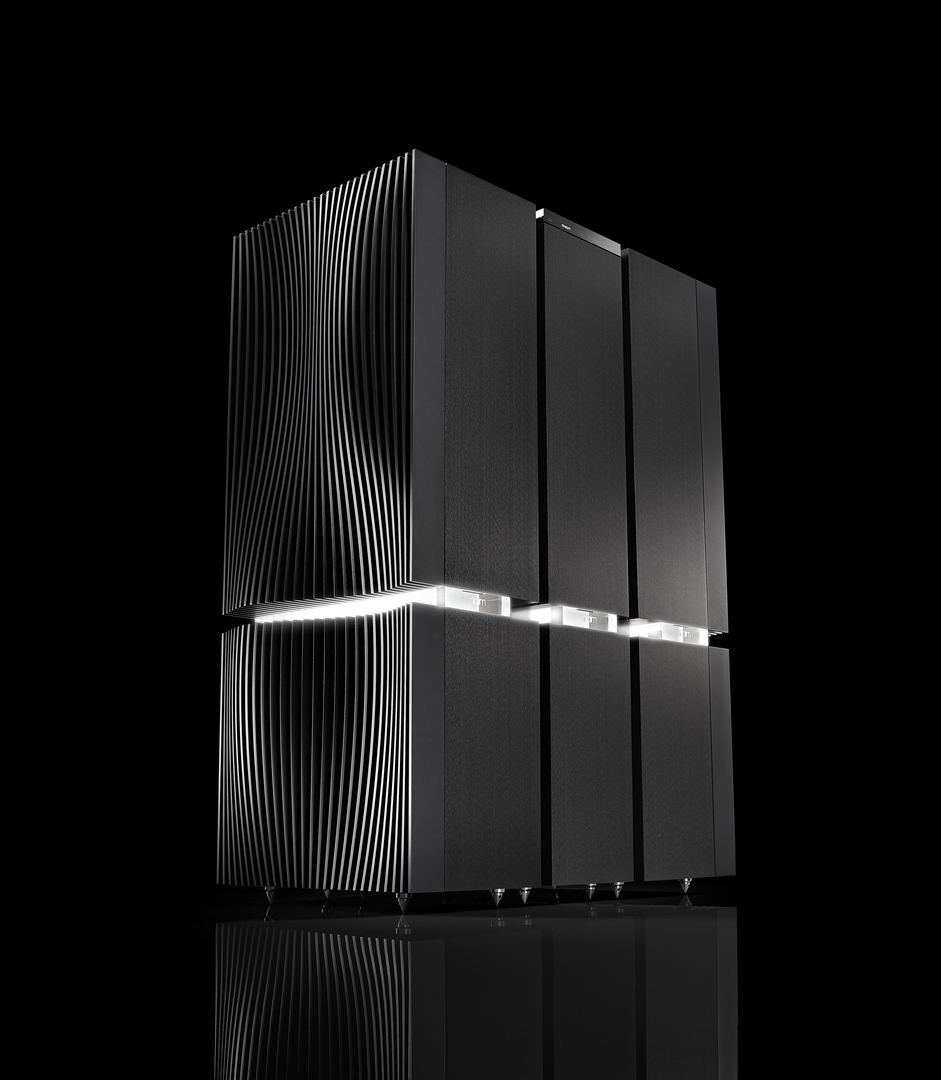
No matter how you sidle up to those numbers, they are substantial amounts to spend on audio electronics. One might be tempted to suggest they are ‘Statement’ amounts of money. Visually, it’s a bold statement, too: we have seen a few tower power amplifiers, but the S1 is a skyscraper in comparison, and its 20mm thick aluminium front and side panels only accentuate this powerful appeal. And the matching preamplifier sandwiched between the two powers is unique. The control surfaces are minimalist and elegant: the large illuminated volume dial invites touch that rewards with a tactile sense that defies description. The ‘cylon’ volume indicator (a white light that moves from the left to right side of the top panel to indicate relative volume) is subtle and understated, but easily understandable. And then there are the heatsinks – elegantly curved in an opposing but matched pattern that might be a far cry from the aluminium sleeves of yore, but look excellent in the flesh. Finished in a choice of black as standard (custom finishes are available, just not commonly discussed), and standing waist height and as wide as a kitchen range, this is not the kind of product you hide away. In fact, it’s a bit of an audiophile statement in the room. But for all that, it’s not the imposing giant slab of audio blackness you might expect.

The black of the Statement is broken up with an illuminated acrylic section on each of the amplifier modules. This also separates the power supplies and toroidal transformers that feed the amplifiers from their more delicate amplifier circuits. These power supply modules also house the amplifier input and output connectors, which are in their own screened ‘Faraday cage’. The preamp features six single-ended inputs (although three are DIN connections, as used by Naim and no other company these days) and two balanced inputs, and the amplifiers are connected using XLRs (although single-ended DIN outputs are also supplied). These power supply chassis are also a statement on their own. For example, there’s the 4kVA toroidal transformer, which is about the size of a wheel for a classic Mini, and weighs almost as much as the rest of the Mini. This sits bolted to the base plate of the amp using brass plates. Above this is a collection of some of the largest capacitors you’ll see this side of a 1950s sci-fi movie. As a result, this not only sinks any potential EMF forces and vibration from the power supplies into the ground, it also keeps its centre of gravity so low that even Sonny Bill Williams at full charge couldn’t tip the amps over.

At 101kg per channel (and 61.5kg for the preamp) all sitting on armour-piercing spikes, tipping over is not an issue. Installation, on the other hand, is a big issue, and requires a team of four piano movers to extract the devices from their flight cases and manoeuvre them into place (Naim installers are currently sharing horror stories among themselves, of no parking zones, trying to carry these monsters up narrow and twisting flights of staircases, and old and saggy floorboards.)


Inside each chassis is something more like a military mainframe computer than an audio amplifier. Individual sub-sections of both preamp and power amp sit in their own PC-motherboard sized circuit boards, each one bolted to its own brass plate, then held in a frame by a series of springs, and the plates then slot together using a series of standoffs. This is amplifier construction on a grand scale, leaving absolutely nothing to chance. So, that smooth volume control isn’t a potentiometer; it controls a microprocessor that connects to a daughter board with 100 separate resistor pairs in a stepped attenuator. Normally, such stepped attenuator networks end up being crowded round a rotary device to save space, but here they are laid out precisely on their own large board for absolute signal integrity. It also means the best possible resistors can be used for the task, not simply ones small enough to fit.

On the subject of individual components, an undisclosed maker of custom semiconductors makes the output transistors specifically for Naim. These NA009N (for N-type) and NA009P (for P-type) are used in complementary push-pull pairs, run in Class AB in a new dual bridged architecture. Each transistor is potted for mechanical damping and deliver a mighty 746W per channel into eight ohms. Put another way, one horsepower per channel. And that load doesn’t quit when the going gets tough: the amplifiers deliver 1.45kW into a four ohm load and can burst power up to 9kW at one ohm. Naim is suitably silent about all other specifications, in the manner of Rolls Royce’s ‘sufficient’ understatement.

Naim has traditionally been somewhat dismissive of the whole high-end cable world. Naim didn’t so much think such cables didn’t do things to the sound quality as maintain that most high-end cables did wrong things to the sound. This posed a potential problem for Naim with the Statement, because the company recognised that no self-respecting super-high-ender will be content with £30 per metre copper stranded NAC A5 cables, and the resultant sound could be compromised by exotic designs making one aspect of the performance better at the expense of the whole. So Naim introduced Super Lumina cables, both as a high-end upgrade for existing Naim users and more importantly to offer a ‘first, do no harm’ solution for Statement owners. While Super Lumina is not in Nordost’s Odin 2 league in this context (or price), it does seem to tie into the Naim ethos. Some later, extra-Statement listening is required.

Similarly, the use of DIN implies connection to Naim’s own sources, but I feel Naim is selling itself short here. Not because Naim’s source components are weak links (the reverse is true), but because someone with something truly spectacular without a Naim badge might think this is just another amp in Naim’s ever-expanding range. In fact, it’s using Statement with non-Naim source components that you begin to get an idea of just how flexible this amplifier can be. Its character does not impose itself on the sound of the player, and it doesn’t limit the source options. If you like the sound of a particular player, Statement will respect that sound. Naim’s own sources are a logical match, but not a necessary one.

The final piece in the Statement jigsaw is the sound, and once again it lives up to the name. This time, however, it proclaims its statement to both the high-end audio world, and Naim’s loyal following. To the former, it shows not only that the company can ‘do’ high-end audio, but that it can bring Naim’s sensitivities to the table. To Naim’s party faithful, it shows the company’s sonic values can sit in a high-end context.

Of course, a lot of this gets diluted slightly because Naim now so often gets played with Focal loudspeakers, for obvious ‘family ties’ reasons. While this is great, and a good match, it has led to a mindset that points Naim away from other high-end components. So, we put aside the Focals and went with a more standard high-end benchmark speaker brand – Wilson Audio. This proved an awesome match: the Naim Statements really love being driven hard, and Wilson loudspeakers are more than capable of taking that kind of punishment. So there was a standoff: me, the amp, the speakers, and Trentemøller. Who would back down first?

I did. I felt more than a little bit scared. I thought I’d rupture something. Those bass notes on ‘Chameleon’ [The Last Resort, Poker Flat] were a physical assault on the person – fast, full, and threatening. I could feel those bass notes pushing at the back of my eyes, but the Naim was barely out of first gear and the Wilsons were taking it all in their stride. I backed off the volume control when the really deep bass notes began to hit and I felt like a synthesiser was probing me. This was home PA levels, but with all the subtlety fully intact.


Of course, this is fairly typical behaviour, both for an amplifier with this much power delivery on tap, and someone sitting down to the Statement for the first time. The temptation to ‘open her up’ for a quick blast is almost irresistible. But the Statement is more than just brute force. A lot more, in fact.

The curious thing about the Statement’s sound is just how effortless it is. Effortless in the way a three-watt single-ended triode amp can be, but with all that power in reserve. It’s extraordinarily dynamic, possessing cavernous, powerful bass, and yet also extremely fast, despite these attributes seeming to be mutually exclusive in most amplifiers. This all combines to make a sound that is just… effortless. And here’s the thing: it’s a Class AB design that doesn’t sound at all like a Class AB design – it sounds like a very large, very cool running Class A design, with none of the crossover distortion that can be perceived as harshness. It’s not a warm sound either, but it’s the antithesis of a sharp-sounding Class AB design.

You’d think any review of a Naim amplifier would include discussion of its rhythmic properties, but that’s almost unnecessary here. The amplifier has such a colossal control over the loudspeakers the beat is effectively pinned down and mastered. It’s so adept that there’s nothing to see here. It just keeps a beat in a way other amps, frankly, don’t. More importantly, Naim is not known for its strong stereophonic performance. In fact, the equipment can ‘do’ imaging, but that property is simply not on the brand’s radar. The Statement amps sort of change that. They throw out a surprisingly wide soundstage with fair image depth. The really big hitters in the soundstaging world probably get a little deeper into the spatial properties of a mix, but this would come with deep trade-offs.

The interesting part of this is swapping out bits of Statement for other statement-grade electronics. For example, replacing the preamplifier with an Audio Research Reference 10 line preamplifier. This unbalances the Statement sound and is not something I’d recommend as an option. However, it also shows up the big difference between the two options. The ARC preamp is the more ‘beauteous’ with greater image depth and possibly greater coherence across the frequency range, but the Statement preamplifier is very obvious step in another direction. It shows what Naim is trying to achieve, in making an amplifier that does all the filigree stuff high-end amps are so good at, but adds in its own musical mastery. It’s as if the people who made Spectral amps suddenly developed a taste for Funkadelic, while still staying true to their Reference Recordings roots.

Above all of this though, the one thing the Naim Statement amps do so well is they make music fun. That doesn’t mean it makes light of the music played, but it simply helps you enjoy music more. That’s usually a function of smaller amps: bigger amps bring more detail, space, and majesty to the sound, but can often be authoritarian as well as stentorian in their sound. The Statement, for all its endless power, never does that. Statement doesn’t push all its high-end rivals out, but it buys Naim a seat at the top table. Hugely expensive, yes… but that’s the price you pay for the best!

Technical Specifications

  • NAC S1 line preamplifier
  • Audio inputs: 3×DIN single-ended , 3×RCA single-ended stereo pair, 2× XLR balanced stereo pair
  • Audio outputs: 1× XLR balanced stereo pair, 2× four-pin DIN single-ended
  • Dimensions (HxWxD): 94×27×41.2cm
  • Weight: 61.5kg
  • Price: £57,000
  • NAP S1 mono power amplifier
  • Audio Inputs: 1× XLR
  • Audio Outputs: Binding posts for spade and 4mm banana plug
  • Power Output: 746W into 8Ω, 1450W into 4Ω, 9kW burst power into 1Ω
  • Dimensions (H×W×D): 94×25.6×38.3cm (per channel)
  • Weight: 101kg (per channel)
  • Price: £49,000 per channel

Manufactured by: Naim Audio

URL: www.naim-audio.com

Tel: +44(0)1722 426 600

Back to reviews 

Read more Naim Audio reviews here

AURALiC ARIES Wireless Streaming Bridge

After scanning the title of this review article my bet is that your first question might be: ‘What exactly is a wireless streaming bridge?’ The question is perfectly understandable given that the lines of distinction between audio streamers, servers, renderers, and DACs are already blurred and becoming more so over time. So, in order to understand the many and diverse functions of the AURALiC ARIES wireless streaming bridge it helps first to take a ‘big picture’ view of how digital audio playback is evolving these days.

Let’s start by acknowledging that DACs are essential components whereby digital audio files of various formats and types are converted from bits and bytes to become high-quality analogue audio signals that can be amplified and used to drive our favourite loudspeaker or headphone-based systems. In short, in any digital audio system, you’ve got to have a DAC in order to make the music happen. Things get complicated, though, when one has to decide where digital audio files will be stored and how they will be delivered to the DAC. Another essential question involves deciding how the whole digital audio playback process will be controlled.

AURALiC’s ARIES serves as a flexible, multipurpose ‘bridge’ that can deliver high-resolution digital audio files from just about anywhere to the DAC of your choice, while wirelessly controlling the process via AURALiC’s Lightning DS application running on an iPad.

Would you like to listen to Internet radio or to stream content from Tidal, WiMP, Qobuz, Songcast, or Airplay? The ARIES supports all those options. How about streaming content from network-attached resources such as NAS drives or from OpenHome, DLNA, or UPNP-compatible PCs or Macs? The ARIES supports all of those options, too. One upshot of these capabilities is that, for listeners already accustomed to using music software packages such as jRiver Media Center, it is possible to continue using their chosen software as the control point application of choice while still using the ARIES as the bridge that delivers digital audio files to the system DAC.

Or, what about those who wish for a simpler, more server-like solution? Once again the ARIES fits the bill because—by attaching a USB music library drive to the ARIES—one can effectively turn the AURALiC into a simple, fully featured, and high-effective music server in its own right. Similarly, for more casual file-sharing applications, visiting friends can bring music-laden USB memory sticks to your home and then plug them in to the ARIES’ USB drive port. The ARIES, in turn, will read and catalogue the files on the memory stick in a matter of minutes (or less) and then allow users to pick and choose files for playback.


And what of those seeking a high-performance whole home audio solution? Once again, the ARIES system has answers ready at hand. AURALiC offers two versions of the ARIES product: a high-end ‘master’ version, which is the version under review here, and simplified and thus cost-reduced ARIES LE versions (with slightly less elaborate power supplies and clocking systems than the full-on ARIES provides), which can be deployed throughout the house and used, in essence, as ‘satellites’ operating in conjunction with the master ARIES. In short, ARIES offers an ambitious and very flexible digital platform.

If the foregoing description makes it sound as though the ARIES system has all the digital connectivity bases covered, then that’s about right. Better still, the ARIES excels at delivering high data rate, very high-resolution digital audio file formats that other competing server/streamer products are not necessarily able to handle. Specifically, the ARIES can stream PCM/DXD data at rates up to 32-bit/384kHz as well as DSD64, DSD128, and DSD256 files, meaning it offers a degree of flexibility and future proofing that few competitors presently can match.

On a hardware level, AURALiC’s ARIES is offered as a two-chassis solution. One chassis houses the stylish (but not ostentatious) ARIES unit proper, while the other is a dedicated and outboard low-noise linear power supply module that leverages the ‘Purer Power’ technologies AURALiC developed for use in its familiar, standalone, high-end audio components. The ARIES provides high-speed, dual-band Wi-Fi and Gigabit Ethernet connectivity, plus a high-speed USB 2.0 port that is reserved for purposes of attaching a USB music library drive, if desired. As for outputs, the ARIES provides a second high-speed USB 2.0 port intended for connections to a USB DAC, as well as AES/EBU, coaxial S/PDIF, and TOSLINK outputs (these latter three support PCM files at rates between 44.1kHz and 192kHz, and DSD64).

Perhaps equally important from a performance perspective, the ARIES provides two individual FemtoClocks, both similar in concept to the that used in the superb AURALiC VEGA Digital Audio Processor (reviewed in Issue 106). One FemtoClock serves USB audio hosts, while the other serve all other digital outputs. Between these FemtoClocks and the unit’s outboard ‘PurerPower’ power supply module, the idea is to deliver low-noise, very low-jitter, digital audio files to your DAC of choice on a consistent basis.

It’s been said that products of this type are only as good as their user interface software allows them to be and it is in this area that the ARIES excels. AURALiC’s command and control app for the ARIES is known as Lightning DS, which is available as a free download from the Apple app store for use with iPads and soon iPhones. Almost all of my experience of ARIES has been through using the iPad app, which has now been extensively tested in the field and has gone through a number of significant updates, revisions, and improvements. My review sample of the ARIES is running firmware version 2.9.2 while my sample of the Lightning DS app is version 2.3. Prospective owners should be aware that AURALIC continually develops and releases ARIES firmware and Lightning DS software updates over time, meaning that the ARIES system you buy today will likely offer even better performance a year from now (or at least that has been my experience).

Lightning DS and the architecture of the ARIES itself go a long way toward making the system relatively easy for first-timers to set up and configure. One astute AURALiC design choice was to configure the ARIES so that, when powered up for the first time, it initially serves as its own Wi-Fi network. In this way, AURALiC establishes a clear-cut starting point from which one’s controller tablet and the Lightning DS application can establish communication with the ARIES, thus simplifying the setup tasks to follow. Lightning DS provides simple, step-by-step setup instructions for the ARIES to guide the listener at each point along the way.

Setup steps include connecting the ARIES to the desired music library (or to a local USB music library drive directly attached to the ARIES, if so desired), building a database of the library contents, connecting the ARIES to one’s home network, selecting preferred digital outputs (USB, AES/EBU, TOSLINK, or coaxial S/PDIF), and then finally connecting the ARIES to the desired playback DAC or device. In truth, there will inevitably be a certain amount of technical complexity involved whenever preparing any audio server or streamer for use, but the Lightning DS’ instructions are good enough to allow those of us not blessed with degrees in computer science to get the ARIES up and running with a minimum of hand-holding.


Happily, the ARIES/Lightning DS system is so straightforward that many listeners need only a few minutes of familiarisation (and a bit of trial and error experimentation) to be able to use the app effectively. The app provides specific control screens for each of the ARIES’s primary use modes, which include: Library mode (selecting and playing music from your library resources), Internet Radio mode (without being tied to a service like vTuner), Streaming mode (selecting and streaming content from Tidal, WiMP, or Qobuz subscription streaming services), AirPlay mode (streaming content from AirPlay-enabled sources), and Songcast mode (streaming Songcast content via the ARIES). There is also a very flexible Search mode that allows users to seek out specific content from the ARIES library, streaming services (if any), and from Internet Radio sources.

During my listening tests, I used the ARIES with a variety of DACs (such as the latest-generation AURALiC VEGA, the Exogal Comet, the Moon by Simaudio 430HAD, and the PS Audio DirectStream DAC) and with many different high performance loudspeakers (e.g., GamuT RS3s, GoldenEar Triton 1s, Magnepan 3.7i’s, and YG Acoustics Carmel 2s). For my application, I chose to use the ARIES with a fast 2TB Western Digital USB music library drive, though you might find you could achieve even better result by configuring the ARIES for use with NAS drivers or other network accessible server. In every case, the ARIES system rose to the occasion whenever I made improvements in ancillary system components.

My listening tests revealed that the ARIES is a superb high-resolution digital audio delivery system that is, despite its relatively modest price, entirely suitable for use with very high performance DACs. When listening to files delivered through the ARIES, listeners can expect very quiet backgrounds, exemplary amounts of low-level sonic information, and the sort of timing stability that gives sonic images and soundstages an extra measure of solidity and three-dimensionality (both are qualities I associate with very low-jitter sources). What is more, the performance of the ARIES seems to track with the quality of the components with which it is used. When, for example, I upgraded my PS Audio DirectStream DAC by installing its new Yale OS software, the ARIES system immediately took full advantage of the performance advantages the new OS package provided.

Put on a track that is rich in subtle transient, ambient, and spatial information, such as “Aquellos duros antiquos (Tanguillos)” from Pepe Romero’s legendary Flamenco [Philips K2HD, 44.1/16], and the ARIES will—pardon the pun—serve up soundstages that are eerily realistic, lavishly detailed in all the right subtle ways, and intensely three-dimensional. Or, play a relatively demanding percussion-orientated piece such as the title track from Marilyn Mazur, Josefine Cronholm, and Krister Jonsson’s Flamingo Sky [Stunt Records, 44.1/16] and note how incredibly incisive, explosive, rich, and focused the music sounds as delivered to your DAC via the ARIES. Want to try very high-res DSD256 or DXD (352.8/32-bit) files? No problem; if your DAC is up to the task, the ARIES will deliver the goods without a glitch or a hitch.


Are there ways to surpass the performance of the ARIES? Perhaps there are, but even so the ARIES operates at such a high level that competitors tend to provide only very small, incremental improvements (if any improvement at all), and invariably wind up costing substantially more than the ARIES does. For example, I have occasionally compared the ARIES playing files ripped from discs to the sound of those same discs played through the PS Audio PerfectWave Memory Transport, and in a few instances I felt the transport perhaps offered a smidgeon more sonic nuance or low-level detail. But contrast this against the fact that the PS Transport costs more than twice that of the Aries, cannot play DSD or DXD material at all, and of course cannot provide streaming services of any kind.

When you consider the many things the ARIES can do and the very high level of performance that it offers, I would argue it is one of the best values in all of digital audio today. Having the ARIES in my system has transformed my review listening experiences for the better; the ARIES gives me instant access to my music library (including all of my high-res PCM and DSD files), plus the ability to explore streaming content whenever I choose. But above all, ARIES is a convenient, reliable, and easy-to-use system that imposes virtually no compromises in performance. If that’s not having your sonic cake and eating it, then I don’t know what would be.

Technical Specifications

  • Type: Wireless streaming bridge
  • Streaming services supported: Local uPnP/DLNA library content; online streaming from TIDAL, Qobuz, and WiMP; Internet Radio, AirPlay, Songcast, and USB hard drive files.
  • Supported file types: AAC, AIFF, ALAC, APE, DIFF, DSF, FLAC, MP3, OGG, WAV, WV, and WMA
  • Supported sampling rates: PCM: 44.1kKz – 384 kHz at 16 – 32 bits. DSD, DSD128, DSD256
  • Control software (and devices): AURALiC Lightning DSD software application, AURALiC RC-1 remote control (included), OpenHome-compatible software, uPnP AV software
  • Media Server Compatibility: Minimserver, Twonky, Asset uPnP, JRiver, DLNA/uPnP-compatible server software
  • Display: 3-inch 256 x 64-pixel OLED display
  • Digital Inputs: Gigabit Ethernet (via RJ45 jack), Dual‑Band Wi-Fi connection, USB 2.0 High-Speed for use with external USB music library drives.
  • Digital Outputs: USB 2.0 High-Speed for connections with compatible DACs (compatible DACs are those that do not require a driver for use with Mac OS X); AES/EBU, coaxial S/PDIF, and TOSLINK (the latter three outputs are sample-rate limited to 44.1 – 192kHz for PCM files and to DSD64).
  • Dimensions (H × W × D): 7cm × 25cm × 20cm
  • Weight: 0.8kg
  • Price: £1,310, or $1,599

Manufacturer Information: AURALiC LIMITED

URL: www.auralic.com

UK Distributor Information: Audio Emotion Limited

URL: www.audioemotion.co.uk

Tel: +44(0)1333 425999

US Distributor: AURALiC North America

URL: www.auralic.com

Tel: (562) 912-3280

Back to reviews

Read more AURALiC reviews here

Wyred 4 Sound launches two new digital products to cap 2015

ATASCADERO, CA—Dec 21, 2015— Wyred 4 Sound is pleased to announce two new products to crown a productive year for the high-end audio company. Based on the success of the popular Remedy, both new products are designed to reclock and eliminate jitter from digital signals for markedly improved sound quality. The all-new bLINK integrates a world-class Femto clock with Bluetooth technology for incredible sounding streaming music. The all-new Recovery targets a computer-based USB signal and restores its integrity for superior fidelity.

“Based on the successful design and implementation of the Remedy, I wanted to apply the same principles to improve wireless streaming signals and later, USB,” said EJ Sarmento, product designer and owner of Wyred 4 Sound. “The new bLINK and Recovery are easy-to-use, relatively inexpensive products that really add benefit to streaming and/or computer-based audio systems.” The Recovery will be complete by year’s end and ship early 2016; the bLINK is shipping now.

About Wyred 4 Sound, LLC. Wyred 4 Sound is a California-based company that designs and manufactures multiple-award-winning audio components at real-world prices. Wyred 4 Sound’s product lineup includes music servers, DACs, preamplifiers, amplifiers and cables. To learn more, please visit www.wyred4sound.com or email [email protected].

CES Las Vegas 2016 – First reflections

We try to take a more considered view of CES. The event is often blogged and tweeted at the scene, making instant and snap decisions on the fly. While this is extremely useful to get an immediate understanding of what’s happening at the show, the reality is many products are best considered in context, and that takes time to process. We are collating our opinions on CES from an audiophile perspective and will publish (a lot) more presently, but for now just a sneak peak on the overall audio trends from the Venetian Tower in Las Vegas.

This show was far quieter than ever before. Distributors and international buyers stayed away in significant number, reflecting a broad shift toward Munich High-End and it seems the German event has picked up where CES has left off. This is perhaps all too understandable from all perspectives: the show is extremely expensive, in terms of event space, hotel prices, and even logistics (one exhibitor claimed it cost less to ship a product from Europe to Las Vegas than it did to get it from the ground floor to their room). Putting 170,000 miscellaneous tech journalists on the Strip places a severe burden on the internet and phone connections of the city. And with so many technology launches taking place on the same four days, high performance audio is likely to be lost in a sea of autonomous cars, IoT devices, and ‘wearables’.

Nevertheless, there were key products that broke cover, most notably the return of the hugely popular Technics SL-1200, even though it is to be a strictly limited edition run of 1,200 (naturally) ‘Grand Class’ decks at $4,000, at least at first. Last year showed just how far the vinyl revival has come – Amazon.com announced that its best selling consumer electronic device sold during Christmas 2015 was a turntable! And that’s why turntables were everywhere at CES.

Alongside the usual suspects (such as Music Hall with a new range of high value turntables, and Pro-Ject with the first ‘vertical’ turntable in a generation) and the returning Japanese brands (including Sony’s $599 HS-HX500 DSD-ripping turntable), the big audiophile vinyl stories were the return of Continuum, and its prototype turntable with a working title of ‘Obsidian’ (but no price as yet), and the first ever turntables (and more) from noted vinyl record label, Mobile Fidelity.


This was also the year of high performance digital streaming at all prices. CD players were very thin on the ground – not simply new products, but there were far fewer CD players being used to demonstrate amps and speakers. Instead, there were some very fine electronics at all prices to play digital streaming files. The MQA system (Master Quality Authenticated) was gaining traction, with a number of labels and digital audio designers singing up to the format. Meanwhile at the lower end Gordon Rankin of AudioQuest announced a trio of USB ‘Digital Critters’ that range from $99 to $199, and Korean brand Aurender announced the A10 Caching Network Music Server, which is expected to cost around $5,000 and includes 2TB of on-board storage.

In fact, for once, this was a CES Specialty Audio show where the headline products were often the most affordable ones. Take ELAC’s new UB5 loudspeaker, or its Debut amplifier. The UB5s are $595 three-way loudspeakers that sounded better than many systems at the show costing tens of thousands of dollars. Or KEF’s excellent new Muo Bluetooth loudspeaker system that delivers the sonic goods better than you might ever expect given they stand as tall as a can of beer and cost ‘beer budget’.

The great thing about this is it puts the fun back into audio. It’s great that Wilson Audio announced the new $103,000 Alexx or that Audio Note is finalising a new $100,000 reference grade preamp, but with all the hushed tones and polite dinner jazz that surrounds top-spec launches, sometimes it’s great just to kick back and play some sounds on something unassuming, but utterly entertaining, like the new Naim Muso Qb. This little cube of musical greatness shrinks the size (and price) of the first Muso down smaller than ever, but still manages to sound musical, entertaining and fun.

I was also interviewed by Enjoy The Music about this show. Please point your browser at http://www.enjoythemusic.com/CES_2016/CES_2016_Live_Stream/Alan_Sircom_HiFi_Plus_Magazine_CES_2016.htm for a replay of the live stream.

David Bowie (1947-2016) – a personal tribute

I was somewhere over the Atlantic when the news about the death of David Bowie broke. As the 747 landed at Gatwick, practically a plane full of text messages rang out in unison. I saw dozens of faces I knew on the flight, and all were truly distraught at the passing of one of the true greats of the music business. Whether it’s the jet lag or the January weather getting to me, there’s a sense that music’s light got a bit dimmer today that I just can’t shake off.

All of us have a specific ‘Bowie’ that resonates; the ‘Space Oddity’ era, the ‘Ziggy Stardust’ era, the ‘plastic soul’ time, the ‘Thin White Duke’ era, the ‘Ashes to Ashes’ new romantic phase, the sharp suited ‘Serious Moonlight’ stage, his EDM era, the Neoclassicist time, and what will be called his final years (starting with The Next Day released in 2013 and culminating in Blackstar, released on his 69th birthday and two days before his death).

I was eight years old when David Bowie played ‘Starman’ on the BBC’s Top Of The Pops TV programme. I was too young to understand just how revolutionary this androgynous man in a multicolour jump suit was, and I certainly didn’t get the significance of seeing him drape himself around guitarist Mick Ronson. All I knew is he and I had the same hair colour and I liked the song.

Later I would come to understand that this was the first time the English audience really saw someone who embraced, personified, and legitimised ‘different’ (in all its guises) at a time when being ‘different’ was being ‘wrong’ in England. But at the time he fell out of my nascent musical consciousness, at least for a while.

I came back to Bowie in about 1980 through an obscure route: a line from Kraftwerk’s Trans-Europe Express – ‘Meet Iggy Pop and David Bowie’. Anyone who hung out with Kraftwerk was fine by me, only later realising that should be the other way round. Prior to that, I thought him more a shape-shifting pop star, and I was too young to ‘get’ the importance of Ziggy Stardust at the time. I played the grooves out of Station to Station as a result, then discovering Heroes and his Berlin Trilogy and this started an extensive trawl through his discography that continues to this day. I only saw him once, on the ‘Serious Moonlight’ tour, when he played the old Wembley Stadium. And I will always regret that.

I’m finding today difficult, because of his passing. He’s been there for me through some of the darker parts of my life: his lyrics were ‘meaty’ and required study to fully understand, which is nigh on perfect for someone who likes to play with words going through my bleaker times. Bowie helped create a complex soundtrack to my life and often it was good that the voices in my head sounded like David Bowie.

“They don’t walk, they just glide in and out of life

They don’t die, they just go to sleep one day.”

‘Sons of the Silent Age’, from Heroes.

First Listen: HiFiMAN Edition X planar magnetic headphone

Hi-Fi+ has actively followed the evolution of HiFiMAN planar headphone designs, most recently taking a long and careful look at the firm’s impressive flagship model: the HE 1000, which has received recognition as our  ‘Cost No Object Headphone of the Year’. But superb though the HE 1000 is, its excellence comes at a price—and in several different senses of the word ‘price’. First, at US$2999, the HE1000 is quite expensive. Second, it is so revealing that it fairly demands to be paired with equally superb (and often equally expensive) source and amplification components. Sonically speaking, the HE 1000 is a great ride, but also—undeniably—a somewhat demanding and premium-priced ride.

Considering this situation, the team at HiFiMAN felt it would be desirable to create an HE 1000-like headphone, but one that was lower-priced, a little bit lighter, that had ever-so-slight more forgiving (some might say more ‘musical’) voicing, and that was considerably easier to drive. The answer to this ambitious design brief is an all-new headphone model called the Edition X, which previewed at the Rocky Mountain Audio Fest/CanJam 2015 event this past fall and a production sample of which appeared on our doorstep a bit before Christmas. And what a welcome arrival it has proven to be.

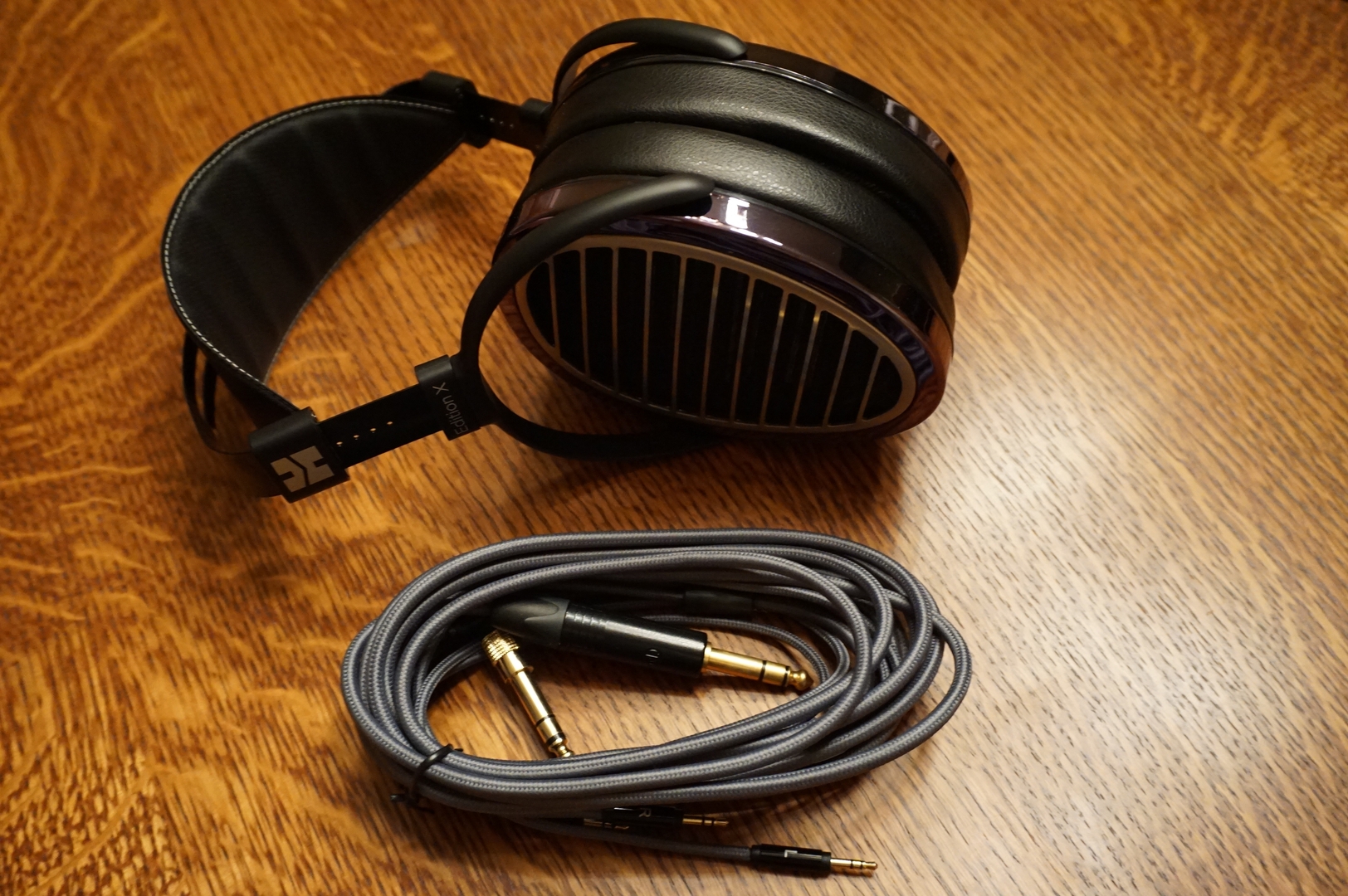
Upon unboxing, similarities between the HE 1000 and the Edition X immediately become apparent. The two headphones share the same brilliant industrial design created for HiFiMAN by Catalano Design, with asymmetrical, ear-shaped ear-cups, a light but supportive overarching frame, a clever suspended headband support strap, and HiFiMAN’s patented ‘Window Shade’ grilles to protect the drive units while preserving maximum sonic transparency. The look of the Edition X, however, is much different to the HE 1000; where the HE 1000 is all done up in warm amber wood tones and with soft brushed silver trim and a brown headband, the Edition X is done up in classy, ‘back in black’ treatment with a black frame, black headband strap, black-chrome finished ear cup treatments, and only the brushed silver ‘Window Shade’ grille to provide a just right touch of visual relief. Upon seeing and holding the Edition X in hand, guest listeners have been unanimous in their praise for its appearance.

Technically, the Edition X differs from the HE 1000 by offering the following:

·      An all-new double-sided asymmetric magnetic circuit,

·      A different diaphragm design created with the thought of striking an optimal balance between high sensitivity, high resolution, and high transparency,

·      A specialized signal cable featuring monocrystalline silver conductors, and

·      A concomitant jump up to a stonking 103dB sensitivity rating (meaning the Edition X is so easy to drive that you could, in a pinch, drive it from an iPad without any auxiliary headphone amplifier required).


We plan to offer an in-depth discussion of the Edition X’s sound quality in an upcoming issue of Hi-Fi+, but in the interim I thought I might offer just a few initial observations to whet your collective appetites for the future review.

First, the Edition X is in many respects similar to the HE 1000. It offers much of its bigger brother’s openness, transparency, neutrality of voicing, and powerful bass. The difference, though it can at first seem a subtle one, is that the Edition X is just slightly warmer in overall balance (with a touch more prominent low end and very slightly more softly focused upper mids and highs), coupled with the fact that the Edition X offers up an easygoing, take-it-anywhere, drive-it-with-anything demeanor that makes it pretty much the high-end headphone for any and all occasions. Stated another way, the Edition X is in many senses a ‘kinder, gentler’ HE 1000—one that is a lovable everyday companion, not a high-stress date with a beautiful but somewhat ‘high-maintenance’ supermodel. If your experiences are anything like mine, you may find that the more you listen through the Edition X, the more you’ll want to listen, and the sonic rewards are plentiful indeed.

One (potentially) useful suggestion: I have found that the Edition X matches up in a remarkably effective and synergistic way with Chord Electronics’ superb new Mojo portable amp/DAC. It’s a combination I wholeheartedly recommend and one I think many enthusiasts might be able to enjoy for hours on end of pleasurable listening.

I will much more to say about the Edition X in our full-length review, but for now I will leave you with the thought that it is a model well worth checking out at your local HiFiMAN dealer.

Until next time, happy listening.

Roy’s Round Up

We live in a world that seems to treat the terms “high-end” and “high-priced” as interchangeable. But they’re not, and nor should you ever accept that they are. High-end is all about attitude and thinking, goals and philosophy – and none of those things define cost. What makes a product high-end isn’t a high-price. Indeed, if we’re honest, we are regularly presented with expensive products that claim high-end status but are in reality, anything but. What actually does make a product high-end is its pursuit of performance, a notion that is absolutely central when it comes to audio, especially with it’s conjoined concepts of sonic performance and the musical performance itself.

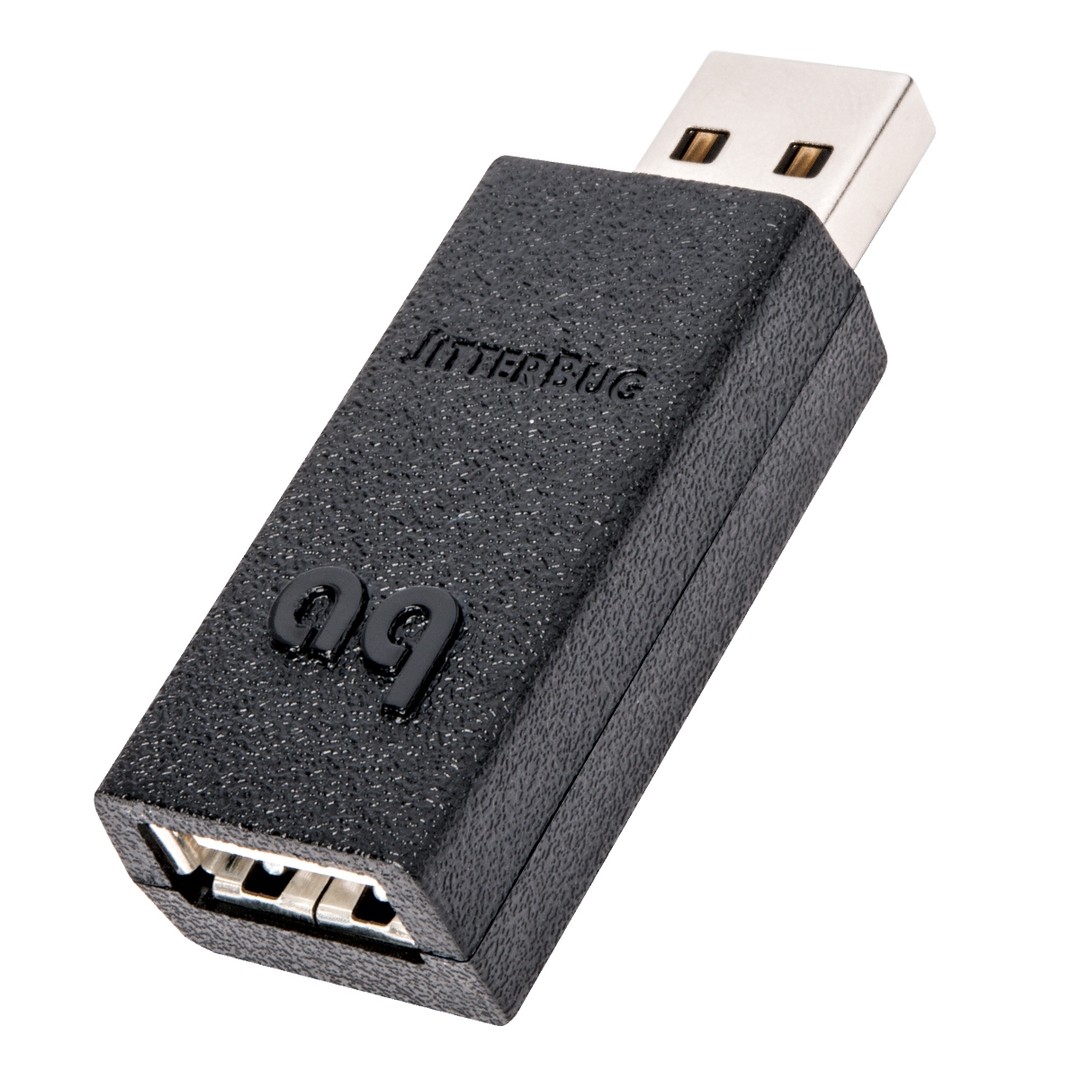
Perhaps the most dramatic example of this is contained in the unassuming shape of AudioQuest’s £40 Jitterbug, a blocky little dongle-like device that attaches, not entirely surprisingly, to USB ports everywhere – at least, everywhere in your audio orientated file-replay rig. If you are running music files out of a server, a MacMini, a MacBook Pro or just about any other computer-based audio source, stick a Jitterbug between the USB cable and the port its connected to and you’ll enjoy an instant and significant improvement in audio quality and a serious step forward in musical communication and rhythmic intelligibility. Now add another, either in line or in parallel on the same USB buss, and you’ll get another, similar improvement. In fact, you can go on adding Jitterbugs, scoring really effective improvements until you run out of ports and patience, or at least as far as four or five (the number varies with specific equipment and circumstances) where the scale of subsequent improvements doesn’t diminish. In fact, seemingly on the basis that dancing on your own really isn’t all that, using a pair of Jitterbugs is way more than twice as good as a single one. But what makes the Jitterbug a genuinely high-end device is that in a world where file replay is hailed as the inevitable future of home audio – and in which it so seldom actually delivers the musical performance available from CD, let alone vinyl – here’s a universal response that tackles fundamental issues with the format at source. This is the nearest thing to digital music magic I’ve come across – and you don’t hear me say that too often!

In somewhat the same vein, the HRS Damping Plates offer an absurd level of improvement to products that would consider themselves immune to such help. If high-end and high-priced are all too often synonymous, how about high-end and heavyweight? With the advent of affordable CNC machining it seems that every product on the market offers some variation on the sculpted front-panel and contoured casework recipe that was once the hallmark of only the most ambitious and expensive designs. Unfortunately, looking the part and sounding the part are two very different things – something that has become even more obvious as the importance of a product’s mechanical behaviour has fallen into focus. HRS’s deceptively simple solution to this problem consists of slabs of aluminium, combined with sheets of polymer material that act to interface with the chassis. Take one of the Damping plates and place it along the length of a chassis top-plate and what you do is create a constrained layer, the polymer sandwiched between the top-plate and the damping plate. Simple and – believe me – effective! Naim went to extraordinary lengths to control chassis resonance in their Statement amplifiers, yet a quick AB demonstration of their sound, with and without HRS damping plates atop the towers pretty much stopped designer Steve Sells in his tracks: more air, more resolution, less grain, more colour, better dynamic discrimination, and wider dynamic range. Basically, all things you’d associate with a lower noise floor. It works on Classic Series components too, but lest you think this is a case of Naim bashing, the Audio Research Ref 150 SE undergoes an even more dramatic transformation. In fact, I haven’t found a single product in my system that doesn’t benefit, especially if you combine the Damping Plates with the matching Nimbus or Vortex couplers.


Moving up in price, we come to two products at the opposite end of the price bracket, but two products (or even three, ‘cos I’m going to cheat) that both offer exceptional performance at their price, as well as exceptional performance together. First up is MartinLogan’s remarkable Motion 35XT, a small, two-way box-speaker in a world that’s seemingly full of small, two-way boxes. But the Motion 35XT is different. Firstly, because it’s a little larger than the average (well, larger than the also impressive 15XT anyway) allowing it to use a 165mm bass unit that’s actually capable of moving some air.  Secondly, because this is that rarest of beasts, a hybrid speaker that actually works. Now, if anybody is going to make a hybrid that works, the MartinLogan is a pretty good bet given how long they’ve been at it. What’s slightly ironic is that in the case of the 35XT, there isn’t an electrostatic driver in sight. Partnering its in-house aluminium coned woofer is a large diaphragm AMT folded motion driver, both housed in a heavily braced and beautifully finished high-gloss cabinet with sculpted edges, invisible fixings and a sloping top-panel (which comes in handy if you want to flip it over for better time alignment) adding up to a speaker that looks – and in this case sounds – a lot more expensive than its £1,300 asking price. Crisp, clean, and dynamic, the 35XT is detailed without sounding forced, enthusiastic without sounding overblown, and offers rhythmic fluency and articulation that many a flat-earth design would give its voice-coils for. Able and energetic, purposeful and communicative, the Motion 35XT is a timely and cost effective reminder of just what a good speaker should do – and just how good a really capable, compact two-way can be.

At the other end of the price and ambition scale you’ll find products from Gryphon Audio, legendary éminence grise of the Danish high-end. Best known for very big, very black amplifiers, stunning visual design, fit and finish, as well as even bigger (and occasionally even blacker) loudspeakers, full Gryphon systems are normally priced well into “If you have to ask…” territory. But what I’m talking about here is the company’s most affordable units, the Scorpio CD player and Atilla integrated amplifier. Outwardly almost identical (which is why I get to mention them both) these two elegantly styled, immaculately engineered and finished products share all the physical and aesthetic attributes of Gryphon’s flagship products, yet cost “only” €6950 a piece. That’s a Gryphon source and amplification for around a hundred notes the right side of £10K: just add speakers and you are ready to rock and roll. No, really, you really are ready to rock and roll. The Scorpio delivers a musical signal that’s supple, sinuous, and dynamic, while the Atilla’s Gryphon DNA is clearly audible in its powerful sense of drive and sheer musical presence. With positive, touch screen controls, and immaculate metalwork to go with the beautifully flush mounted glass fascia, Gryphon’s most affordable set up looks and sounds considerably higher-end than a lot of the company’s flagship products. A joy to listen to and a pleasure to use, the Scorpio and Atilla are brilliant individually, and even more powerful together; a timely reminder of those days when the terms “hi-fi” and “pride of ownership” used to actually appear in the same sentence.

If you want to talk cost-no-object options then, for once, the choices are easy. One seemingly inevitable audio trend is the apparently unceasing upward spiral in the prices being asked for top-flight components. But even in the rarefied atmosphere of the highest-end, the price-tags attached to Naim’s Statement amplifiers came as quite a shock. What also comes as a shock is the level and nature of their performance. These are Naim amps that will slot straight into a traditional high-end system – and show it a thing or two when it comes to temporal and dynamic coherence, absolute spatial stability, and above all, bass definition, texture, and energy: Truly, remarkable products, both for their genesis and their realisation.   

Neodio’s Origine is not only the most beautiful piece of hi-fi I’ve ever used, it is also of all the digital replay systems I’ve experienced, the one that sounds most like life. One box means one shelf and a lot less cabling, which makes the Origine almost cost effective. The more I use it, the more I love it and, like the Naim amps, this product has never failed to please and startle visitors in equal measure. It only plays CDs (although there is a USB input), but when CDs sound this good, who cares?

What non-hi-fi item has moved me recently? That would be an Orbea OMR frameset. This sub-900g, carbon-fibre bicycle frame is ridden at Pro-Tour level (that means in the Tour De France for you non-cyclists out there). It is the human-powered, two-wheel equivalent of a Formula 1 car. Yet despite that, a complete, pro-level build (frame, wheels and parts) will leave you change from £6K. It is (undoubtedly) more – or less, at least in material terms – bike than I will ever need, but it also serves as a timely reminder: I haven’t owned a cartridge that affordable for nearly a decade – and they wear out! In a world where we can buy more and more for less and less, if high-end audio hopes to have any continuing relevance then it’s going to have to offer not only performance commensurate with the prices it demands, but also that performance is going to have to be clearly demonstrable. Guys, we need to get used to the idea of justifying our existence all over again, for a whole new and whole lot more demanding audience.

Five sets of Chord & Major Tonal earphones worth up to £200 must be won!!!

Our good friends at Chord & Major are giving away five pairs of earphones. These were reviewed in issue 130 of HiFi+ by Alan Sircom who wrote “Chord & Major is a new name in the in-ear ‘space’; a Taiwanese brand with a range of similarly priced earphones designed with subtle variations in finish and voice to suit the tastes of different listeners. The company calls this the ‘Tonal Earphone’ concept and this results in five basic ‘flavours’ – Rock, Classical, Jazz, Ballad, and World Music. You will have the option to select the ‘flavour’ of your choice.

Competition Question

Which of these flavours is not included in Chord & Major’s

‘Tonal Earphone’ concept?

1. Rock

2. Jazz

3. Funk

4. Classical

5. Ballad

To answer, please visit Chord & Major UK website www.chordmajor.co.uk. Alternatively, send your answer on a postcard (including your name, address, and contact details) to Nue World Limited, Unit 5 Silicon Business Centre, 26 Wadsworth Road, Perivale, Middlesex UB6 7JZ, UK. The competition closes on March, 3rd 2016.

Please include validation code HF+1 on the website and write it on the postcard.

Competition Rules

The competition will run from January, 7 2016 until March, 3 2016. The competition is open to everyone, but multiple, automated or bulk entries will be disqualified. The winner will be chosen at random from all valid entries, will be contacted via email (where possible) and their name will be published in the magazine. The Editor’s decision is final and no correspondence will be entered into. Absolute Multimedia (UK) Ltd. is compliant with the Data Protection Act and UK laws apply. Our policy is such that we will not pass on your details to any third party without your prior consent.

New Year’s Resolutions

New Year is the time of making resolutions that you are destined to break by mid January. The longest I managed to stick to my resolutions was back in my college years, when I vowed to drink more alcohol, enjoy more recreational pharmacology, eat more bad food, and take less exercise – I lasted until March before ‘the intervention’. But nevertheless it’s possible to strive to and stick to resolutions in the audio world, and they can be surprisingly good for you too!

The first I suggest is to take stock of your audio system, and especially its place, both in your life and your environment. The replay of good music in the home can be a life-affirming and beneficial part of your daily life, it can be a place of refuge from the drudgery of work… or it can be a gilded cage of your own making. Audio at its best has what are described in the UK as ‘Reithian values’ (after Lord Reith, the first Director General of the BBC), in that it can “educate, inform, and entertain”, but many use it as a means of escaping from family life. There’s nothing wrong with using your man cave as a place of calm, but if you are spending every evening locking yourself away from friends and family in search of ‘calm’, maybe you’ve gone too far. It sounds counter-intuitive that an audio website might suggest turning off the hi-fi system, but sometimes you can have too much of a good thing.

Those aforementioned Reithian values only apply when you challenge yourself, musically. We are in a wonderful time of musical access, and online download and streaming services give all of us more scope to explore the musical canon than could have ever been dreamed of even 20 years ago. Rather than holing ourselves up with our finite collection of music on disc, why add to your musical experience with a diet of music you might never normally consider. Why not add a composer a month to your listening, or pick your favourite composer and include their less well-known contemporaries. And, while we are discussing this, why challenge yourself once a week with something entirely outside your comfort zone? So, someone who only listens to 1970s heavy rock spends one Sunday in January exploring the works of Bruckner or Mahler, or someone who has every Beach Boys album ever published in their collection devotes an evening listening to Josquin or Palestrina. For that matter, anyone who has a taste for the Baroque should jump forward to Progressive Rock or even Tool. OK, so it’s a stretch to imagine that inside of a year everyone will have a collection running from plainsong to gangsta rap, or from Dufay to dubstep, but a regular exploration beyond your musical norms is always worth the effort.

As a relative late-comer to orchestral music, this is precisely what I did. I found my own tastes in music were ‘sort of’ progressing, but those formative years from around 13-24 can leave you mired in the past all too easily. Every generation believes the music played during their teens and twenties was the best music ever (in fairness, if you were born around 1910, 1942, or 1950, you might have a point) and it is incredibly easy to just let the music that came out of that period become all the music you ever listen to for the rest of your life. In pre-digital terms, your musical life moves gently from FM to AM without you ever noticing. I still extract a lot of from music by Led Zep, The Clash, Kraftwek, and The Smiths (which just about cover my formative musical years), but it’s too easy to slip into only listening to these artists. However, it’s often difficult for someone born at the end of the Baby Boom to fully appreciate the music that is fundamental and formative to the present Millennial generation. There is a lot of excellent new music out there, but not all of it will resonate with a fiftysomething the way it does with someone still in school. Nor should it.

Rather than look like one of the dads at a concert, desperately trying to enjoy something they simply are not in the right demographic to ‘get’ on any level, I branched out. I looked to the influences of those who were important to my formative time, and their influences, and so on. Kraftwerk especially was like a musical can opener, leading to groups like, er, Can and Neu! But also to a more tempered electronic music style, which led quickly to Wendy Carlos playing Switched-On Bach, which led to trying to hear Bach’s inventions and Brandenberg Concertos played on original instruments. And then Bach became the Rosetta Stone of music for me, opening up avenues of musical exploration I thought beyond me back when everything had to have been written between 1955-95 at best.

Put simply: admit it… you won’t stick to that diet, so put yourself on a musical diet. You’ll feel better for it, and might just be holding on to those New Year’s Resolutions well into 2016.

Happy New Year!

Big speakers, bold vinyl, and beer!

I’m not sure I was particularly good this year, so I didn’t have any great expectations that anything featured below would find their way into my Christmas stocking (and fitting some of them into a stocking would be something of a challenge). But, as there are less than 365 days until it all happens again, if I live up to my promise to do better next year, then I hope Santa reads Hi-Fi+.

It’s been a fairly quiet 2015 for me; other activities have kept me from the hi-fi scene rather more than I’d have preferred, which means I don’t have as big a bag of goodies to choose from. Nevertheless, I have been fortunate enough to experience some truly great, and some surprising and remarkable hifi this year. The first was the current range of Accuphase products. My introduction to Accuphase came in a review I did, years ago, of the e213 integrated amplifier. At the end of the review, the distributor grew tired of the endless struggle to prise my fingers away from the amp, and decided the easiest solution was to sell it to me. Ever since then, I’ve had a soft spot for Accuphase kit, even though I’d moved elsewhere in my own system.

The new range has done remarkable things, retaining Accuphase’ marvellous musicality, warmth, and beauty, but raising its game with a natural, human touch which forced a bit of a rethink about how I would deploy the old cliché about getting closer to the performers. The DP550 is somewhere in the middle of the range of one box disc players, the cheapest of the range to offer both CD and SACD replay, and while the more expensive players are even better, I’m not greedy, and the DP550 does have the feel of a ‘forever’ product about it. Partly, of course, that’s down to build quality – the DP550 feels like something you could hide behind in the event of a global thermonuclear war, but mostly it’s because when I first heard it, my gut reaction was “That’s it! That’s what I want”. Having heard it a fair few times since then, it still is.

Quite a lot of product passes through the portals of chez Dickinson, but my core system hasn’t changed all that much in recent years, and one constant feature have been the Focal Electra 1028Be loudspeakers which continue to amaze and inform me. They’re not perfect, of course, as a quick listen to the Focal Utopia range will readily attest, but the Utopias are (once past the Diablo standmounts) a wee bit, well alright, far too large for my listening space. Even the larger standmount, the Viva Utopia, which I reckon to be the best of the range, is, size-wise, more like an Electra 1028 on a stick, with added bigness.


So, there’s a bit of a gap ‘twixt Electra and Utopia, and this year it was filled by Sopra. Specifically, the Sopra No.2. It concedes little to the Utopias in terms of scale, coherence, and downright musical communication, but is not all that much larger than the Electra 1028, so is probably well suited to many typical UK domestic settings. In terms of performance, it is another of those products which impresses largely because it doesn’t draw attention to itself. It just quietly (alright, pretty noisily but the neighbours are used to it) gets on with the business of telling you just how amazing so many of the musicians are in your music collection. It doesn’t flatter, this is no rose-tinted, soft-focus soft-soaping; there is no euphonious coloration to pretty things up, in fact detecting any form of coloration presents something of a challenge. It gives you confidence that the foibles of the loudspeaker aren’t getting between you and your music and that is a remarkable thing.

I’m going to need some considerably bigger stockings.

This was the year vinyl came back into my life in a big way, courtesy first of the Avid Diva II turntable, which reset my expectations as to what a sub-£2,000 turntable can achieve, but more recently thanks to the Audio Origami Uniarm. I’ve recently reviewed it, but suffice to say, it took the Avid turntable to a level of performance it has no claim to, at its price. The arm costs exactly as much as the turntable, so the pairing is £3,000, but I’m struggling to think of a combination, for that money or quite a lot more, which would approach the sheer levels of musical communication this remarkable tonearm brought me. It’s a unipivot design, and I like unipivots in much the same way as I like dogs, on a matter of general principle. The Uniarm is the Labrador of unipivots: solid, reliable, trustworthy, but huge fun to be around. It also looks pretty good, but happily for me, doesn’t eat cartridges like a Labrador would if you left one on the floor.

If you’ve got a Labrador, as we have, then some stern retraining might be required if you decide to invest in some Panda Feet, which are mostly intended as cable-lifters, not dog toys. A crisply-machined cube of compressed bamboo which serves as a neat and eco-friendly cable lifter, or could conceivably be pressed into service as a discreet equipment support under, say, a freestanding power amp. As a cable lifter, it seems to open out the music, creating more space around the instruments and contributing to the sense of fluency and life in the performance. At around £100 for a set of four, these can give an inexpensive, er, lift to your system, or a, somewhat more expensive few hours of entertainment to your dog. Don’t say I didn’t warn you.

If there is any space left in my stocking, I’d almost certainly fill it with various little bits of PEEK, from MusicWorks. Regular readers may recall the MusicWorks Revo support platform, an acrylic ‘table’ which resembles a normal hi-fi rack in much the same way that I resemble George Clooney. Lately, MusicWorks have been experimenting with PEEK, a type of engineering plastic, in key elements of their design. Aside from upgrades to the table, they have also produced a range of cones, feet and sundry bits and bobs to keep an inveterate tweaker like me happy for weeks on end. I’ve replaced the spikes under my loudspeakers with a set of turned PEEK feet, and may yet replace those with a set of cones. The thing is, I have no real idea what the PEEK is doing, or not doing, except that every change so far has taken me closer to the music and further from the hifi. It is truly bizarre, and not a little troubling, to hear the difference one PEEK cone makes, when replacing something else under the equipment. But it is fun and while PEEK is not a cheap material, and I can’t claim the bits and pieces are pocket-money prices – a set of cones can be had for under £100, which is not a lot for an opening into a world of better music, hours of harmless experimentation (points ‘up’ or points ‘down’, source, preamp or speakers first…), and bemused head-scratching.


After which, I might need a drink, and this year has been the year of barrel-aged sour beer. I’m not sure quite where this fits in the Chinese calendar, but I’m lobbying for having it every year because it’s been an experience, thanks to the creativity of the modern craft beer movement. Sour beers use naturally occurring yeasts, and associated bacteria like Lactobacillus and Brettanomyces, to ferment the liquor, producing a characteristically savoury and sour taste. It’s much the same process that is used in sourdough, and some of the smells in the beer are very much present in sourdoughs too. The flavour is, as you’d expect, predominantly sour, but the use of hops means a complex sour/bitter thing is going on which is definitely greater than the sum of its parts. Barrel-ageing brings a degree of creaminess, maturity and complexity to the flavours which I’d normally associate with wines, in fact one of my very favourites, ‘Sour Grapes’ (sadly, all gone now), aged three years in oak wine barrels, had the creamy complexity of a really fine white Rioja. There are lots of others, ‘Modus Operandi’ by the Wild Beer Company being a current favourite, but new sour beers, or ‘saisons’ are cropping up all the time and it’s proving hard to keep up. Nevertheless, I’ll do my best.