Up to 37% in savings when you subscribe to hi-fi+
hifi-logo-footer

Begin typing your search above and press return to search. Press Esc to cancel.

Hi-Fi+ Products of the Year: Digital Audio

DAC of the Year

Joint winner: Nagra HD DAC

There are a vast number of excellent DACs on sale at all prices, so it’s hard to justify a high price for a DAC unless that digital product is something truly special. The Nagra HD DAC – best used as a two-box design with the optional battery pack – is one DAC that more than justifies its place in the audiophile firmament. This hybrid converter isn’t just DSD capable, it upsamples regular CD audio to DSD performance. Of course, if you have Andreas Koch, one of DSD’s founding fathers, on the team that helps make this quite simply one of the best digital converters money can buy. The Nagra HD DAC – the first of the company’s new super high-end range – calls on the brand’s outstanding pro heritage in its use of individual transformers on each input, and relies on its own code instead of an off-the-shelf DAC chip. (Reviewed in Issue 122).

Joint winner: PS Audio DirectStream DAC

Many contemporary DACs are arguably PCM-centric, but the DirectStream DAC takes a different tack, converting all incoming digital audio data streams to DSD format,  upsampling them, and proceeding from there. Whether you prefer listening to PCM or DSD format files (or both) there is no arguing with the sublime results the DirectStream DAC achieves. We were and are greatly impressed by the unit’s richly detailed and highly nuanced presentation—a presentation that somehow manages to capture much of the fluidity, ease, and sonic grace of today’s finest analogue audio components. In short, the DirectStream DAC offers the full spectrum of digital benefits, yet also sounds somewhat like a reel-to-reel analogue tape deck, sans tape hiss, of course. Better still, as the underlying ‘operating system’ software of the DirectStream DAC continues to be updated, this already excellent sounding DAC continues to get even better over time. (Reviewed in Issues 125 & 128).


Streamer of the Year: AURALiC ARIES wireless streaming bridge

The disarmingly simple looking AURALiC ARIES is in fact a hyper-versatile digital audio content delivery system. In simple terms, ARIES can locate, catalogue, and then transfer high-res digital audio content from just about anywhere (for example, from NAS drives, network-attached uPnP/DLNA-compatible computers, Internet Radio stations, subscription-based streaming services such as Qobuz or TIDAL, AirPlay or Songcast-compatible sources, or even from a local USB music library drive) to whatever DAC or digital playback device you might choose. Importantly, though, ARIES is not just a digital audio ‘router’-type device; rather, it is a sophisticated yet surprisingly intuitive digital audio playback control system that gives fingertip access to entire worlds of digital audio content, while letting users control the proceedings from their iPads. Better still, ARIES sounds so good that to surpass its performance one should expect to spend several times what the ARIES system costs, and possibly more. (Reviewed in Issue 130).


Network Player of the Year: Moon Evolution 780D

If any product encapsulates change in the digital audio world, it’s the Moon Evolution 780D. Moon’s previous digital top dog of the Evolution range was the 750D CD player, and while this disc-spinner also featured a range of digital inputs, that wasn’t enough for today’s power users. As a DAC in its own right, the £10,500 780D can support digital inputs up to 24-bit, 384kHz in PCM and up to DSD256, making 24/192 and DSD64 replay a breeze. More importantly for today’s market, the 780D uses Moon integrated Network Device (MiND) technology as a high performance network player, both on a local network or to pull in services like TIDAL. Even in a fast moving market, there are brands playing a longer game, and the 780D is designed to stay the course, not only because of its outstanding build quality, but because it sounds damn good too! (Reviewed in Issue 129).


Server of the Year: Melco N1Z

One of two ambitious USB/Ethernet file-based music libraries from Melco, the audiophile-owned brand behind Buffalo computer peripherals, the N1Z is best thought of as a dedicated audiophile replacement to the computer (or even the network infrastructure) in a computer audio system. If you tried and disliked PC-based audio, this might be your way into tomorrow’s audio world. Best used as the digital buffer between the outside world of Ethernet in a network streaming system, or as a meeting point for USB drives in a system, the N1Z also sports its own SSD drives for both operating system and a limited portfolio of your best loved music. Our advice, replace the Twonky server software with MinimServer, and use it in place of a network storage drive in a network audio setting, and be amazed at just how much more sound quality you can get from any system. (Reviewed in Issue 124).


Integrated Player/Amplifier of the Year: Naim Audio SuperUniti

One of the core products in the modern UK audio environment, the SuperUniti strips what it takes to make good audio, Naim style, down to its core. A combined powerful-sounding 80 watt per channel integrated amplifier, married to Naim’s highly-respected own network audio system that can be successfully app-driven, makes this £3,675 device a consistent seller in stores across the land. This comes down to the SuperUniti’s intensely musical presentation that retains the fun factor throughout, and makes it a perfect partner to many of the most popular loudspeakers today. The SuperUniti preserves that distinctive up-tempo Naim sound quality and is akin to the SuperNait integrated amplifier, but it also adds in the network performance of a player like the ND 5 XS from the brand, all in a one-box form factor that appeals to minimalists, downgraders, and – as our reviewer discovered – space-saving wives alike. (Reviewed in Issue 122).


Disc Player of the Year: dCS Rossini

In part as a result of changes in the SACD world, the dCS Rossini is the company’s first disc player to replay CD only. In fact, the Rossini is the first disc player from the brand that has an option to not feature a disc player at all! In essence the Rossini platform is a high-performance upsampling DSD DAC and streamer (featuring the company’s latest custom digital conversion and Ring DAC boards), which can optionally support an integrated CD mechanism. All of this can be fully controlled through the dCS app. The £18,000 Rossini player – especially with its matching £5,000 clock – is not compromised by its CD-only replay, however: it’s ability to upsample CD to DSD performance is remarkable, and the Rossini not only blows away its predecessors, it actually sounds a lot more like the company’s top Vivaldi stack than you might first expect. (Reviewed in Issue 129).

First Listen: Ultimate Ears UE Pro Reference Remastered CIEMS

If you spend much time in the company of serious high-performance earphone and CIEM enthusiasts you will inevitably encounter the famous Irvine, CA-based firm Ultimate Ears. During its formative years Ultimate Ears was a standalone specialist company exclusively producing custom-fit in-ear monitors (CIEMs) and a range of universal-earphones, though it would probably be fair that UE’s CIEMs are the products that really put the company on the high-end audio map. In more recent times, UE has been acquired by the consumer electronics powerhouse Logitech, with the result that part of the UE range has been spun off into a Logitech sub-brand whose products are often branded as “Logitech-UE” models. However, the original, highly performance-minded core of UE has continued under the name Ultimate Ears Pro, which to this day offers a broad range of CIEMs at various price and performance points, plus a very ambitious high-end universal-fit earphone called the UE900S.

Over the years, I’ve taken some time to get to know the UE team and have visited their production facility to learn more about their CIEM fabrication process. From those experiences, I’ve come to trust that UE will as matter of course put a terrific amount of thought, care, and planning into any new model it chooses to release. (UE model launches are never, ever haphazard or casual affairs; everything new product is designed to address a very specific market need and/or ‘mission profile’). I mention this point because I now have in my hands, er, ears, a sample of UE’s brand new UE Pro Reference Remastered custom-fit in-ear monitor, priced at $999.

To understand the role of the UE Pro Reference Remastered in the Ultimate Ears product lineup, a brief UE history lesson is in order. As of just a few months ago, the top three models in UE’s product range were as follows:

·      UE Personal Reference Monitors – or PRMs, for short ($1999). While all CIEMs are in a sense customised (because they offer a custom-moulded, user-specific fit), the PRM takes customisation to an almost unimaginable extreme in that it—get this—allows the owner to personally specify the precise voicing curves for both the left and right PRM earpieces (you read that correctly; the left and right earpieces can have completely different voicing curves, if desired). There is also a powerful element of visual personalisation, in that PRM earpieces are offered with gorgeous exotic hardwood endcaps that are not available on any other UE models. I own a pair of PRMs and can vouch for the fact that they’re pretty darned glorious, though of course I would say that inasmuch as their voicing curves were hand-tuned by me, for me.

 

·      UE Pro Reference Monitors—also known as the In-Ear Reference Monitors or IERMs, for short ($999). The IERM was, in its day, one of the most neutrally-voiced of all UE models and it also enjoyed the distinction of having been co-developed by UE and Capitol Studios, so that the IERM was—upon its inception—the only CIEM to receive Capitol’s blessing for use in recording (and mastering) studio monitoring applications. As you might expect, the IERMs traditionally have been audiophile favourites owing to their overarching tonal neutrality. I have a set of Pro Reference Monitors in my collection and can tell you they are wonderful CIEMs for multi-genre music listening sessions in that they are fundamentally honest and impose very little in the way of unwanted tonal colourations on the music. What you hear is what you get and I like audio products like that.
 

·      UE 18 PRO ($1350). The UE 18 PRO is billed as Ultimate Ear’s top musician’s CIEM in that it offers a voicing curve that, while admittedly not quite neutral, is highly complementary to many types of live music—especially from the vantage point of a musician performing upon the aforementioned stage. Heaven help me, but I also own a pair of UE 18 PROs and can advise that they are terrifically ‘fun’ CIEMs to listen through, though perhaps not quite the last word in tonal neutrality or strict-interpretation accuracy. Still, they offer a very enjoyable listening experience.


Given this background, where does the new UE Pro Reference Remastered fit in? The simple answer is that it is the new and improved successor to the original Pro Reference Monitor, and as such it is a model passionate audiophiles need to know about (and possibly consider owning). In short, Pro Reference Remastered represent an attempt to improve upon the accuracy of what was already arguably UE’s most accurate model (no small task, that).

Excellent though the original Pro Reference Monitor was and is, however, the UE team identified several areas where the new Pro Reference Remastered could take meaningful steps forward in terms of performance.

First, the Pro Reference Remastered uses UE’s new proprietary True Tone Drivers in a three-way, triple-bore configuration that is said to “extend the frequency range and deliver response to 18 kHz”.

But make no mistake; the benefits of the True Tone Driver system are not limited to improved high-frequency response. In fact, UE says that the True Tone drivers improve response extension at both the upper and lower ends of the audio spectrum, thus enabling listeners to, “Hear the harmonic structure and overtones that are usually missing from most headphones.” Finally, UE adds that the “Pro Reference Remastered features an internal mechanical structure that makes sure frequencies are faithfully presented.”

These improvements, though presented by UE in somewhat vague terms, nevertheless sound good on paper. But what sonic impact, if any, do they have in terms of practical, real-world listening?

My finding was that the Pro Reference Remastered not only preserves but actually dramatically improves upon the neutrality of the original Pro Reference Monitors. Where the original had a very, very subtle touch of bass lift, the new model delivers more deeply extended bass and an ever so slight more tautly controlled bass presentation. And where the original Pro Reference Monitors had a tendency to sound softly focused or even slightly rolled-off at the highest frequencies, the new model has noticeably great treble extension, superior focus, and better overall top-to-bottom resolution than its predecessor. Although it’s an overworked expression, the fact is that, musically speaking, there is simply more ‘there’ there in the Pro Reference Remastered, making for a significantly more engaging and rewarding musical experience overall.

In simple terms, the Pro Reference Remastered is a worthy successor to the original Pro Reference Monitor—one that, in my view, is better than the original in every way, while still selling for the same price! It’s hard to argue with a rock-solid value proposition like that.

Watch for our upcoming review of the UE Pro Reference Remastered CIEMs in an upcoming issue of Hi-Fi+, and until then we wish you happy listening.


Hi-Fi+ Products of the Year: Analogue

Turntable of the Year: Kronos

The Kronos turntable turned the tables on vinyl – literally. The floating top-down suspended turntable (hanging from four towers by means of more than 300 silicone o-rings) features two platters: beneath the regular platter spins another identical platter in perfect counter-rotation. This two-platter arrangement (driven by a pair of extremely well-controlled Swiss DC motors) is designed to cancel out any torsional and residual rotational effects passing from the platter through the subchassis to the arm, and ultimately the cartridge. The result was a sound with a remarkably silent background, and a turntable that sounds like all the best turntables handed over what they do best. And once it is set up, it requires minimal maintenance. Just 250 Kronos turntables will be made: but if that – or the £30,000 asking price – is a problem, just look to the Sparta turntable from the same brand reviewed in this issue! (Reviewed in Issue 107).


Tonearm of the Year: VPI JMW 3D

Tested on the £3,750 VPI Prime turntable (itself a strong contender for turntable of the year), there can’t be many tonearms that point to the future as well as the JMW 3D unipivot arm. Why? Simply because where other arms are machined out of metal or fashioned from sheets of carbon fibre, the JMW 3D is one of the first products in the audio world to take advantage of the 3D printing revolution. The armtube – a retrofit upgrade for existing 10” and recently 12” JMW Memorial tonearms – is printed as a one-piece block of resin, joint free from top to toe (more accurately, from headshell to counterweight block). This makes for an inherently non-resonant tonearm structure, and this is patently obvious in audition – it makes most other armtubes sound like they are ringing along with the music. If this is the future, then it sounds great! (Reviewed in Issue 124).


Cartridge of the Year: Clearaudio Goldfinger Statement

There comes a point where ‘cost no object’ becomes unworkable. The Clearaudio Goldfinger Statement is an £8,995 low-output moving coil cartridge: how can you not object to that cost? Setting aside the 17g of solid gold and the half-carat diamond that forms the cartridge body, this is miniature bespoke precision engineering at its finest, and it justifies that high price in the sound it makes; the latest Goldfinger brings a new sense of flow and shape to performances, a sense of purpose and direction that brings them vividly to life. It brings a holistic quality to good performances and reveals what makes the great ones great. It doesn’t overstep the mark or exaggerate for effect. It simply gives you more of what separates the live from the recorded. Just don’t overtighten the cartridge bolts, because gold is a soft material to make a cartridge body from! (Reviewed in Issue 124).


Phono Stage of the Year: Pass Labs XP-25

This two-box phono stage is a perfect example of Nelson Pass’ pragmatic approach to amplifier design, not least because the company’s resident phono stage expert Wayne Colburn designed the XP-25. Using a power supply that can be shared by the matching high-performance line stage, the XP-25 is designed to extract the best possible signal out of any moving coil or moving magnet cartridge, through a trio of large front panel dials covering nine resistive and six reactive (or capacitive) loading levels, and three gain settings. This is an RIAA-only phono preamp, but one that extracts the musical marrow out of any good vinyl front end. This super-silent solid-state phono stage manages to balance sounding warm and inviting, yet super detailed and analytical. Little wonder that the XP-25 has installed itself in our reference system. It’s practically the benchmark by which all phono stages must be judged. (Reviewed in Issue 94).

Bristol Show Preview

Now in its 29th year, the Bristol Sound & Vision show at the Marriott City Centre hotel in Bristol, UK remains the most important audio show on the UK map. Running from 10am to 5pm on Friday 26th Feb to Sunday 28th Feb, 2016, the show promises yet again to be packed full of the latest and greatest high performance audio components – from the big ticket to the big bargain.

Despite being a distinctly UK-centric show, and one with a price ceiling that means the stratospheric end of the market often stays away, the show often highlights a range of new and exciting products that get their first public airing in the cold and wet of February in Bristol. Here are just some of the highlights we’ve heard about…

Audiolab will show the upcoming Audiolab M-One compact integrated DAC/amplifier with Bluetooth, alongside the forthcoming Audiolab 8300N network player and the Audiolab 8300P stereo power amplifier in the ever-expanding 8300 Series.

Bespoke Audio – which is every inch a bespoke brand, as it makes its preamplifiers to the customer’s express wishes – will be showing what it is capable of in Harbeth Audio’s room:  https://hifiplus.com/articles/everything-gets-better-1/

Cabasse will present the  Murano compact high-end loudspeaker design first seen in Munich last year, which features the honeycomb membrane bass from the La Sphère reference speaker and a coaxial tweeter. This £3,499 speaker is intended to bring the performance of Cabasse’s biggest models into a domestically friendly appearance.

 The Chord Company will show several new cables, at the affordable and the sharp-intake-of-breath levels. At the attainable end, the company’s new Shawline and Epic cables (in both digital and analogue form) will be on display and demonstration, and at the high-end, the company will be launching its ChordMusic range, that sits above its current top Sarum cable.

With the Entotem Plato still fresh and new, the brand celebrates its first year in business by adding an exclusive preview of its Class A amplifier module for the first model, and an announcement of the upcoming Plato Lite, and a slew of upgrades for the existing Plato. 


Kudos Audio will be showing its active Titan 808 loudspeaker once more, but this time driven by the innovative ‘Aktif Avec’ Devialet Expert system: https://hifiplus.com/articles/bristol-show-2016-exclusive-kudos-audio-flagship-titan-808-loudspeakers-to-run-actif-avec-devialet-expert-system/

Leema Acoustics will be highlighting its new £2,995 Quasar streaming amplifier/DAC, which will be expected to hit the stores in mid 2016.

Meridian-developed MQA (Master Quality Authenticated) high performance audio format will receive the acid test, as it is played to the public for the first time in the UK, with devices like the Pioneer XDP-100R DAP on demonstration, as well as demonstrations made by Onkyo in the show, and Bluesound at a nearby rival store! Meridian will also be demonstrating its high-resolution system.

Quad will be showing its Artera One combined disc player, amp and speaker due in the middle of the year, a new model in its upmarket Z series loudspeaker range, and the VA-One Bluetooth integrated DAC and amp, both of which are expected in the Spring.  

Rega’s ever popular Planar 3 turntable makes a welcome return. Although it’s a very different animal to the turntable I was selling in the late 1980s! The new high-gloss Planar 3 now comes with a new RB330 arm, an acrylic plinth, a new sub-platter, and a polished ‘optiwhite’ glass platter.

Roksan will be launching the Radius 7 turntable, a turn-key £1,900 turntable complete with Nima unipivot arm and significantly upgraded motor. We hope to have one of these turntables for review soon, so watch this space!

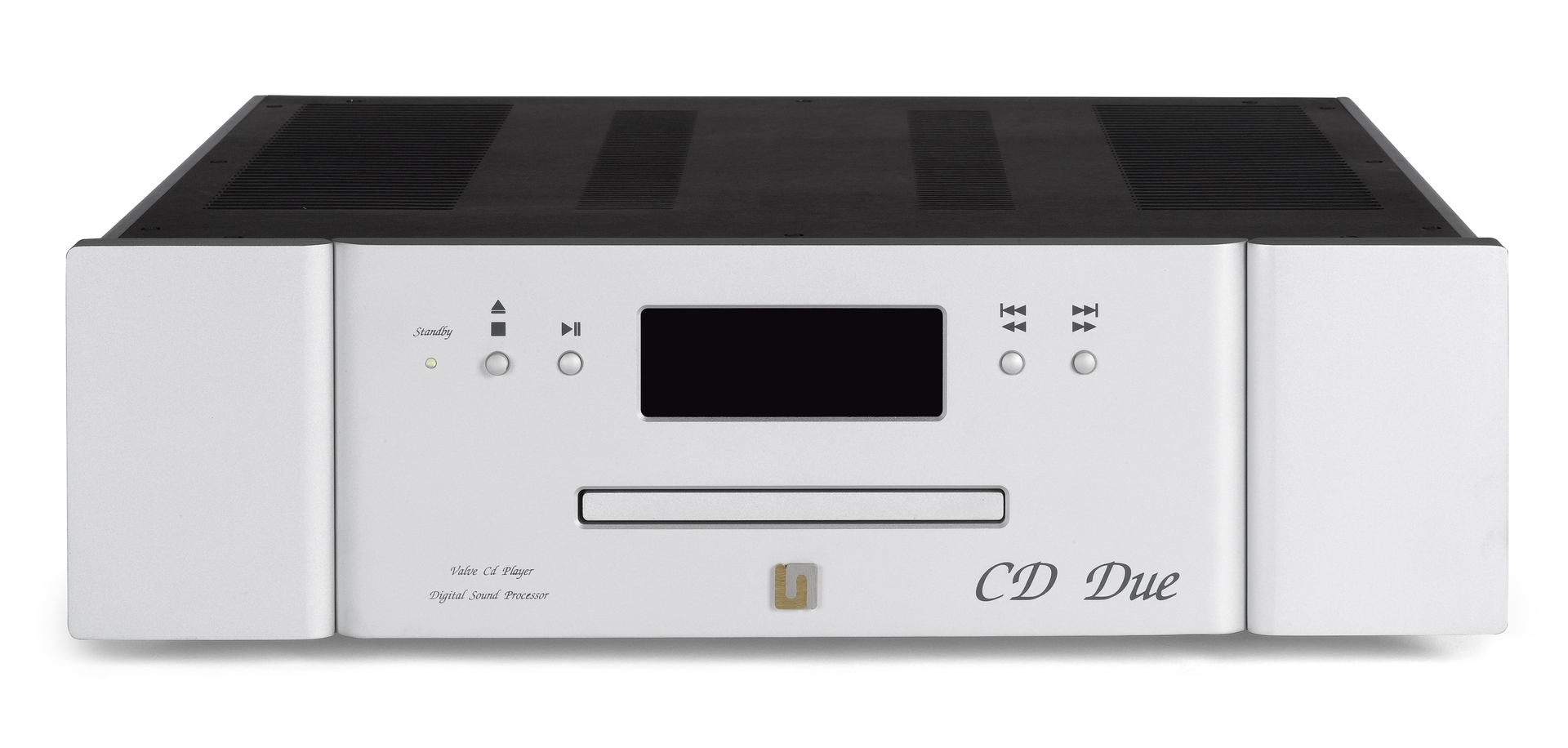
Italian audio experts Unison Research will be showing the new £3,200 Unico CD Due, which combines CD player, Bluetooth receiver, and full function DAC all playing through Unison’s signature valve hybrid output stage.

Finally, Wharfedale will be showing the forthcoming ‘true wireless’ Diamond A1 active stereo Bluetooth speakers and the Reva 2 standmount speakers from forthcoming Reva Series, the next step up from the Diamond 200 range.

Doubtless, this is only scratching the surface. Watch this space for more details…

What’s in the bag?

In the run-up to the Bristol Sound & Vision show, I thought it would be a good idea to showcase precisely what equipment we might typically take to cover a show, and why. It also gives us an opportunity to pose a question about show coverage.

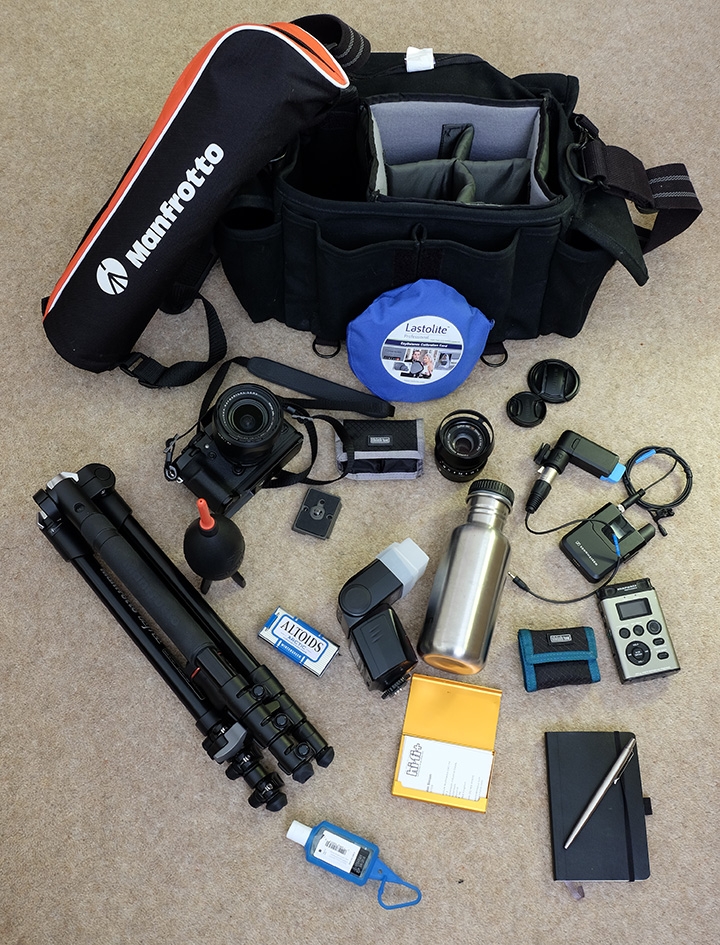
Show reports in general aren’t too demanding on camera equipment, and in great fairness, the limitations placed by this website mean that the smallest sensor inside the cheapest smartphone would notionally be sufficient for the task in hand. However, a property of many audio shows is that exhibitors are frequently in hotel bedrooms with the curtains drawn and the lights turned low. It’s not a unique property – I can think of at least one other photographic job where music is playing in a hotel bedroom with drawn curtains and the lights turned low – but in an audio show setting, photographing a black box in a darkened room is pushing the limits of a smartphone camera.

This is why most audio journalists take some kind of dedicated camera to an audio show. Modern camera systems are extremely competent in low light settings, so the actual choice of camera is more about personal taste and use beyond the audio show environment. My choice here is the Fuji X-T1 camera; a 16MP mirrorless design. The main advantage to this mirrorless type of camera (as opposed to a DSLR) is its weight, its ability to preview images through the viewfinder, and excellent out-of-the-camera JPEG images that need little or no post processing. It’s not the fastest focusing camera money can buy, and it can burn through batteries fairly rapidly, but for reportage, street and travel photography, and product photography as used here, the X-T1’s performance more than exceeds demands.

When two photographers meet now, they invariably talk settings. To address their needs, a photographer can adjust the way a camera operates, and the Fuji X-T1 is no exception: here comes the nerdy bit. For this kind of show – if there is time – I will use the camera on a tripod and keep the camera at base ISO (ISO200), otherwise I keep the camera in Auto ISO, with an upper ISO limit of ISO1600 and the lower limit at ISO200 and the minimum shutter speed of 1/60th second. Although I tend to use the out-of-camera JPEGs, I set the camera to record JPEG+RAW as a matter of course, just in case that once in a lifetime image needs some lovin’ after I took the shot. The Fuji’s WB system is typically very good, but the complex lighting found at a show can throw even the best auto system off the scent, so I’ve started including a fold-out Lastolite Eybalance, and taking a custom balance from that.

I set the camera’s film simulation mode to Provia (a good balance of tonality and saturation, especially as the vibrant colours of the Velvia mode can be overpowering when photographing black boxes next to wooden cabinets), keep DR at DR100, Sharpness at +1 and Noise Reduction at -1, keeping the highlight and shadow settings at their zero point. I also use single-point AF-S, usually relying on back-button ‘manual’ focus, and turn off the auto image review and turn on high performance mode. I tend to use the camera in aperture priority, often with +2/3rds of a stop exposure compensation.


I have a number of lenses in the Fuji ecosystem, but for a show like Bristol Sound & Vision, I have selected just two. For most of the show, I will use the extremely good, lightweight Fuji 18-55mm f/2.8-4 XF OIS zoom. This covers the region from wide to moderate telephoto, has excellent image stabilisation should I need it, and is surprisingly sharp and vibrant, especially when used between f/5.6 and f/8. Of course, using the lens at those apertures in darkened rooms demands the use of a tripod, and we’ll come on to that later. The other lens is a new one – the Fuji 35mm f/2 XF WR. This small, standard lens is fast, light, silent, makes excellent images, and has one huge advantage over the zoom – it’s weather sealed. Anyone who has stood outside the Marriott City Centre hotel taking photographs on a cold, wet morning in late February will know why that’s important – it’s like standing in a freezing cold car wash!

Until Las Vegas this year, when I managed to ever-so-slightly ‘ding’ the front elements of two lenses in one day, the only protection for the glass at the front of my lenses was the lens hood. However, in the wake of my bad glass day, I’ve been reconsidering this position. I use a B+W 007 filter on the front of my Fuji X100S effectively as a lens cap, and I haven’t seen a significant downturn in picture quality. Nevertheless, I’m still wary of doing this.

In addition to the camera and lenses, I will bring along two vital tools – a Fuji EF42 flash (and an off-camera cable) and a Manfrotto BeFree travel tripod. Because of the offset tripod screw thread on the X-T1, to use this camera with a tripod is best done with one of the many optional hand grips available. This combination gives me up to three different ways to ‘nail’ the exposure with minimum noise – tripod with available light, or hand-held with flash (in both cases usually with the camera set to ISO 200), or available light (with the camera in auto ISO up to ISO1600). In the last case, the lens is usually set ‘wide open’.

Alongside this, I normally take a Marantz PMD-610 audio recorder, pen and pad, business cards, Altoids, hand sanitiser gel, water bottle, spare batteries for anything that needs a battery, and anything else that will fit in a Domke F2 bag. A curious difference between reviewers from the US and UK here is our American counterparts often bring their own music to shows, and we rarely do. I’ve never been able to quite fathom that one out.

I said at the outset that there is a question to be posed. And it is this: this year at Bristol, I’m trying out video content as an experiment. We aren’t even sure if this can be hosted on our site, and my camera is not one best suited to video recording. However, to this end, I have borrowed an AVX wireless ME2 lavalier microphone system from those jolly nice people at Sennheiser for the duration to see if we can make this work. The AVX system is an incredibly easy wireless microphone system to use – you charge it up like a phone, through USB, you pair the microphone sender to the receiver like Bluetooth and as long as you know how to record manually and know how to plug XLR and mini jack cables in, everything is straightforward and described in visual terms on a two sides of a sheet of A3 paper. Even an audiophile reviewer couldn’t mess this up.

We’ll try this in earnest at Bristol as a kind of test bench. It may prove a horrible mistake. It may not work, it may not be able to be hosted, the camera may turn every loudspeaker grille into a hopeless moiré-fest, or worse. But we are going to give it a try.

What could possibly go wrong?

Everything gets better

The Bespoke Audio Company proudly announces the début UK showing of our highly acclaimed, award winning pre-amplifier this weekend at Bristol Sound & Vision 2016, Friday 26th – Sunday 28th February 2016, Marriott City Centre Hotel Bristol, Lower Castle Street, Bristol, BS1 3AD.

In 2015, our pre-amplifier received a coveted Class A Recommended Component accolade from Stereophile magazine, an Upper Echelon Award from Mono & Stereo and was Hi Fi Pig Recommended.

We now find ourselves in the prestigious position of having been chosen as show partners by the legendary Harbeth Audio. They will use our pre-amplifier together with their exceptional SuperHL5plus loudspeakers in Room 234.

The Bespoke Audio Company is founded on two principles: to hold the experience of the customer as paramount and to accept no compromise in anything we do. We want to raise the standards of what can be expected from a high end audio company. Nothing else will do for our customers, nothing else will do for us.

Our début product is a pre-amplifier, the heart of a high end audio system. A flexible design with six inputs and two outputs in any combination of balanced and unbalanced connections. A wide variety of finish and technical options allow it to be configured to suit any system. Every product that leaves our hands is crafted in a unique collaboration between us and our customers, by hand, in England and is guaranteed for life.

There is more information about our company and our products on our website here www.thebespokeaudiocompany.com and you can reach us by phone on +44(0)1424 756741 or +44(0)7410 696583.

We need to talk about Vegas… again

Last month, I posited a tough question for the specialty audio business (https://hifiplus.com/articles/we-need-to-talk-about-vegas/):do we still need to show up for the annual CES in Las Vegas every January? The response was fascinating. There was the public debate, from the Disqus comments boxes below the blog to the comment being picked up on several Facebook pages. But there was also the private debate, the series of ‘under the radar’ emails from industry people wishing to express themselves, but not in public. I’m going to honour those individuals desire for secrecy, but the content of their emails – if not their email addresses – deserve airing.

One of the most commonly suggested alternatives was to create a break-out music-only CES elsewhere and later in the year. Of these, perhaps the best version of this was to suggest hosting this in ‘a music town’; Nashville, Memphis, or – returning to the CES roots – Chicago. The advantage to this is it gives audio greater exposure to audio while remaining under the CES banner: the seemingly slow-moving audio stream presently fails to gain attention amid the autonomous vehicles and wearable tech markets. Moreover, with the world’s tech press increasingly viewing Las Vegas CES as the place to find the craziest gadgets and bleeding edge tech, more established technologies (such as audio, photo, and video) might be better served finding an exclusive Summer CES of their own. However, while this has its merits, I’m not completely convinced by this idea, however, because we risk making those breakaway CES sectors even more of ghost ship, as those outside the relevant specialists in the sectors will simply stay away.

The next largest group of statements were from companies saying, “don’t tell anyone, but I agree… but where do we go otherwise?” This came from mid-large sized companies (in our business), many of which already exhibit at Munich, at one or more of the public shows in the US, and in at least one of the Asian audio shows. Their concern was that pulling out of the consumer industry’s big event risks making their products shift from ‘almost invisible’ to ‘invisible’ in a wider market. But all shared a concern that this increasingly expensive week at the beginning of the year was not delivering the returns it once did, both in terms of media coverage and future sales.

There were also a number of people who suggested that the Las Vegas ‘no-show’ issue is pinned to the ups and downs of the US economy, and that any suggestions about moving away from CES are alarmist at best. While sheer numbers were down, they suggested, it was all about ‘quality’ rather than ‘quantity’, and those who did visit rooms were committed buyers, dealers, and distributors. In fairness, pundits in the wider tech community did view this year’s event as having something akin to ‘growing pains’ and a lot of the more established technologies were in a holding pattern this year, so maybe next year’s show will be more productive. While I think the situation in audio is potentially more damaged than these people suggest, I’m more than willing to accept that I’ve mis-read this year’s Las Vegas entirely.


A few commented that the show remains a necessary part of a company’s presence in the audio world, but that presence could be reduced. That could mean exhibitors only showing up every other year to the show, or even the Specialty Audio section of the show itself only appearing on alternate years. This might be the answer for some; we are not so fickle a market as to assume a company failing to appear in a hotel room in Las Vegas means that company has disappeared, and rocking up one January in every two or three with a host of new products still excites the audiophile world. A perhaps telling statement in all this was people were prepared to only attend CES once every two years, but wouldn’t dream of missing Munich!

Perhaps the most controversial – but arguably correct – response was to argue the audio world should make better products; ones more suitable to the wider marketplace. Certainly, in viewing the difference between CES audio rooms that were consistently full and consistently empty, the full rooms had products that passed the ‘elevator pitch’ test – they were marketable to a wide audience, and priced to reach that wider audience. The logic goes as follows: make enough of the right kind of product in the corridors of the Specialty Audio section of CES, and there will be more people attending. Frankly, however, I’m not convinced by this argument – the whole event has become so large that no-one can take time out of their schedule to visit, and if your specific ‘beat’ as a buyer or a member of the press does not include audio, you simply won’t be able to visit the audio section, regardless.

Finally, one suggestion was to state that the whole CES issue is far too ‘industry’ and no real people care enough about shows – especially trade shows – to give a damn about the whole thing. This particular comment signed off that there are too many audio shows and we should skip almost all of them altogether. This last, frankly, blindsided me, as I thought show reports are one of our regular ‘most popular’ features. Give one of the shows he thought particularly irrelevant was our coverage of the Bristol Sound & Vision show – a show we will be attending next weekend – this seems an appropriate time to reopen the discussion.

As ever, we welcome your views…

The Thomas Treasury

Down at this end of the audio food chain I don’t get to see a vast array of audio products flowing through the house. I have heard no cheap DACs and have a seriously uninformed and shamefully shallow view of the headphone market. My sense of detachment, that I really must address soon, is due to spending too many nights in studios with headphones baking my ears many moons ago. I have managed to avoid the glittering allure of Audio shows for years but, thanks to the editor’s tolerance, I still get my hands on components and systems that might be described as high-end in that they are invariably expensive. So I have been given special dispensation to avoid the brief here and write some words about stuff I like.  It’s a hard life, but I like to think I know a good sound when I hear it.

Every few years a really exceptional product or system arrives at my door.  Yes, I know the regularity with which some reviewers discover new reference products, but I guess I must have been unlucky in this respect.  My personal reality is that the changing of the guard happens at a more leisurely pace around here.  But, when it does, it tends to have a lasting musical value and impression. 

The dCS Vivaldi is one of those products, and it represents perhaps the first of a new breed of dCS products established after exhaustive work throughout the system and notably on the ring DAC and analogue output stage.  I am talking here of the two-box transport and DAC version, leaving the clock and upsampling boxes out of this equation.  It is expensive for sure, but it is beautifully built and finished: a real premium product, without the bling.

I love its performance with CD, and I usually convert at the transport to DSD. I have heard nothing so far, in the digital domain, that convincingly improves on it. But the caveat is that I haven’t heard everything! Play a disc, even one from the early days of the format, which were never known for their sound quality, and the Vivaldi does the business in a way that is far more sympathetic than the thin, squeezed, and disappointingly ‘small’ sounding efforts I have heard so many times. Its composure under fire is exemplary too, leaving the music intact, tonally balanced and flowing, yet superbly focused and as dynamic as I have heard from CD.  If you can possibly afford it, then adding the separate clock gives musical proceedings an even more locked-in feel, and the upsampler takes this even further into a rather creamy textural finish that is the cherry on top of a completely delicious recipe.

While I am on the hardware front, I really must mention the Naim Mu-So, which was one of those products that was a whole lot better than I was expecting.  It makes those other Bluetooth boom boxes I have heard sound over ripe and imprecise.  I am not looking for accuracy or indeed true hi-fi sound from such a device, but the audiophile in me took a bit of care where I sited it (it’s too big to regularly move around) and I also raised it an inch or so, kept it away from the rear wall and thought it was great. The Naim PR chap who delivered it told me that, if I used it in the same room as my system, I wouldn’t listen to the big boy as much. He was right. For Bluetooth playback or searching the world of Internet radio for new music, it’s the best I have heard.

Another product that has shown serious benefits recently has been the recently reviewed Stillpoints Apertures.  Having stripped my whole system down for a long overdue re-install, I took the room apart too, and over the course of a day, gave all the cabling a good clean, including the connectors and those on the equipment.  This whole, rather time consuming procedure involved a somewhat OCD dedication, but it gave me a chance to reinstate my Berning amplification and address the lunacy of the cables too.  I removed all the Apertures I had been using, and after the whole system had been reconnected and powered up it didn’t take too long to realise that the ridiculous amount of increased energy that the Bernings were pushing through the speakers had left the whole listening space in considerable trouble.  Without wishing for this to descend into a “Give Your Hi-Fi A Spring Clean” article, let me just say that things had quietened down 20 hours later, but only somewhat.  The speakers were moved about a bit, and then I started with a couple of Apertures behind them.  There are few miracles in audio, but this relatively painless addition made a huge difference.  Another single panel between the speakers, making 3 across the back wall, and things had taken a welcome upturn for the better, with no excessive energy sapping damping either. The message is, try a few Apertures if you can.  They are very interesting and the best acoustic panel I have tried. 


On the other side of the same coin is my latest musical instrument acquisition.  I love instruments of all types.  If I can strum, bow it, blow it, or whack it I will have a go and I have owned Martin acoustic guitars for many years, buying and selling them with unhealthy regularity. I do this purely as a selfish pleasure, of course.

Martin makes great acoustic guitars and in my opinion, the old ones are usually the best.  Something about the woods, the glue, and the years of use gives them a quality that, once you have heard or felt it, is just not there on newer instruments, fine though they are.  When you try a Martin from what has become known as their Golden Era (late 20’s to late 30’s) there is no stress in the instrument and no feeling that the thing is a taut composite of many individual pieces of wood glued together.  I travelled to the wilds of Kent to see a truly great collection of vintage Martins and ended up wanting them all.  But it came down to two, neither of which I could easily afford.  There was an 1888 model strung with silk and steel.  This was a crazily great instrument and something to be preserved and cherished. Men who fought in the American Civil War would have played this guitar, which was made exactly when Jack The Ripper was terrorising London’s east end.  Mind numbing stuff.  A beautiful but soft and gentle sound, full of under- and overtones, and a personally contemplative instrument for sure.  But then I was handed a true Golden Era model – a 1927 000-18 in very decent condition and with all the right credentials.  One of a mere handful built that year, it has the 12th fret neck join, the long scale, marvellous tonewoods of the type that are not available any more, a shellac finish, and an ebony fingerboard. All this glued together with boiled down bits of animals by someone most likely born in the late 1800s.  I think I played 3 or 4 chords on it before wanting it, badly.  Now it sits, perched on its stand opposite the sofa that I call home.  Apart from being a fantastic instrument, I do love it as an object.  Those round, sloping shoulders owe more to the early classical and Spanish guitars than to the later squared off look of the American flattop.  I like to say that I bought it because I couldn’t afford a high-end audio mains cable, a thought that lends some perspective perhaps.

Anyway, the cost is unimportant.  I have it now and I am not exaggerating when I say that all that I had read about guitars from this era has turned out to be true.  It has literally changed my life and most likely the way I listen to music. It is so light that the response from any input is amazing.  Change between a few chords and the interplay and tonal shading at harmonic level give it a voice that is incredibly complex but warm.  In fact, I say it has an expressive subtlety of character and a mojo of its own like so many of these true vintage instruments that I have never heard on any recording.  I know I am truly blessed to own it and I cherish our moments together.

Mad Scientist YANAM interconnect cable

This isn’t the mixologist Mad Professor nor the dub maestro Scientist. Mad Scientist turns out to be Bob Prangnell, a British expat who lives in New Zealand and clearly likes to tweak audio. He makes a small range of cables and tweaks that are sold direct in US dollars to the world at large. All the cables have strange names, but these are not merely random, as they relate to songs by Patricia Barber. So YANAM is an acronym of ‘You And The Night And The Music’ while the top interconnect TORFORB is short for ‘Too Rich For My Blood’. In fairness, it’s as good a system as any and more memorable than most: who knows, it might even snag the ‘Scientist some customers in the Barber fan club.

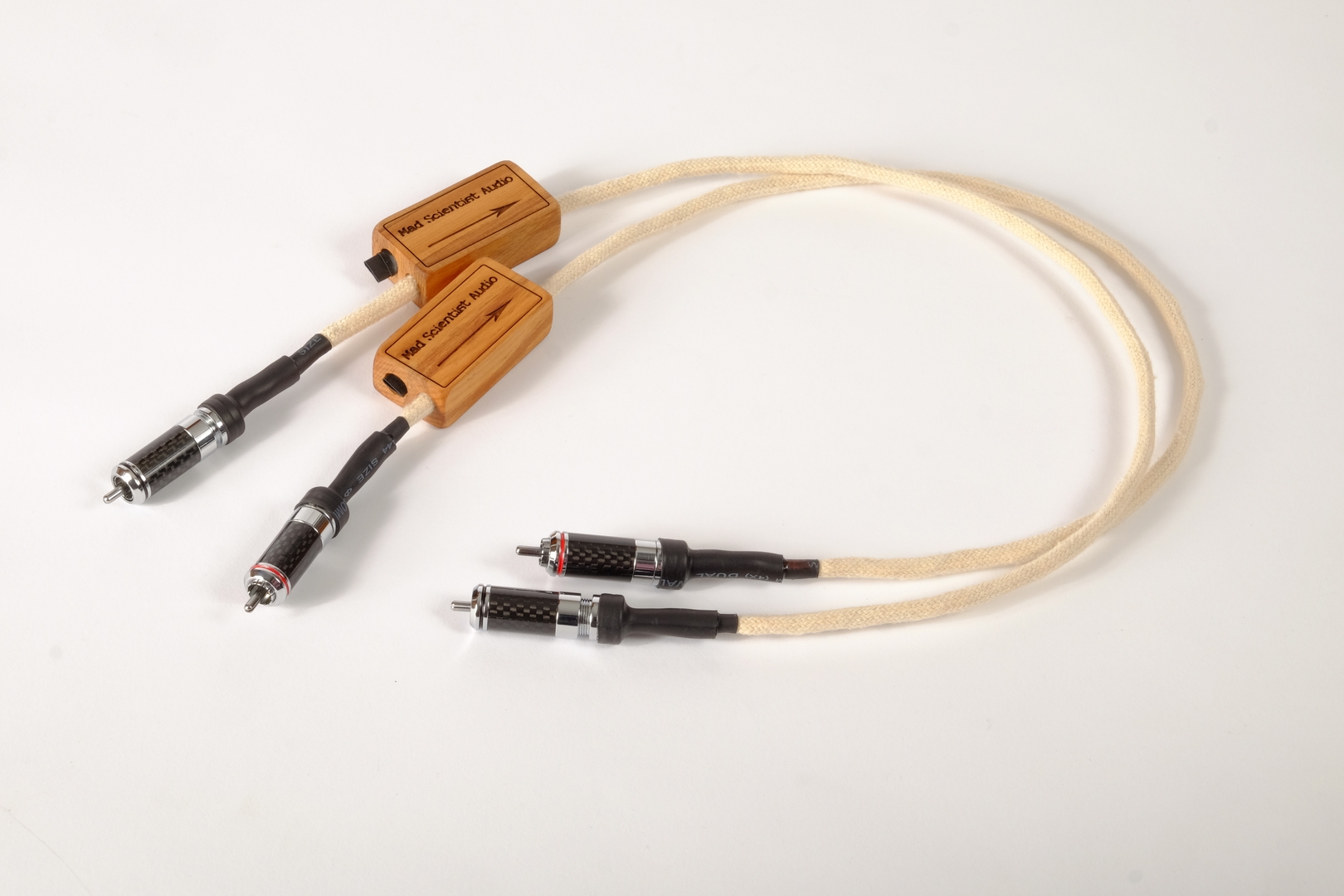
Mad Scientist’s interconnects are unusual in that they use carbon fibre rather than copper or silver for the signal conductors. This is something that Van den Hul started doing in the 1990s and continues with today, but thus far Bob is the only one to have joined the crusade. The main reason why carbon fibre is unpopular is that it has considerably higher resistance and early examples had distinctly rolled off treble, but Bob reckons he has cracked it by using carefully selected carbon fibre for signal conduction and various combinations of wire and foil for the earth or return conductor. Apparently the relatively high resistance of carbon fibre makes it unsuitable for return paths but fine for the signal wire. I noted that the Mad Scientist interconnects are relatively short, with the longest being just 1.5m, but Bob tells me that this is because they get increasingly harder to make the longer they are as he works by hand rather than with a machine.

The reason for choosing carbon fibre given on the Mad Scientist’s website is not that radical, as Bob feels it comes down to ‘skin effect’. First discovered with microwave cables, skin effect means that higher frequencies travel closest to the outside of metal conductors. Bob states that carbon fibre is effectively immune to skin effects, as high frequencies travel through the entire conductor. This conflicts with the fact that early examples of carbon fibre interconnects had rolled off treble, but the proof is in the listening and in this respect the product delivers easily as much bandwidth as metal conductors.

All the Mad Scientist interconnects have cotton outer jackets, an uncommon material, but one that is popular in Japan. Cotton is used here for the usual reason espoused by the empirical audio enthusiast – it sounds better. Cotton makes for a distinctly handmade looking product but the addition of wooden blocks with directional arrows helps it from looking too handmade! These are designed to hold Magic Tubes, which appear to have been designed to bait the sort of people who inhabit audio forums, so I won’t encourage them by going into detail!

YANAM is the middle model in the Mad Scientist range. The cable shares the topology of the top model in the range, but uses less expensive carbon fibre and copper (rather than silver foil) for the earth, alongside copper and silver wire. Because you cannot solder carbon fibre, YANAM has crimped RCA plugs from SonarQuest with rhodium plated metalwork and carbon fibre inserts. They seem quite chunky next to the cable, but do help with perceived value. Prices start at $499 for a 0.7m pair and come with a 30 day return option.


Cables bring out the cynic in me and those that purport to having any sort of magic doubly so: maybe this approach means I am more impressed by products that actually work, but suffice it to say this cable is actually rather good. In fact, it is among the best I’ve put into the system and assessed. The first system it was tried with was one of the most thrilling I have assembled in recent times and consisted of a Leema Libra DAC, Rega Elex-R DAC and RX3 speakers, also from Rega. This is an ‘air’ musician’s system par excellence, as it is impossible to sit back and listen – you have to leap about and join in, which is a lot of fun. Putting YANAM between source and amplifier relaxed the pace a shade, but improved the tonal richness. The presentation was marginally less percussive, but had better flow and it seemed less mechanical, which is usually a good sign. A cable or any other component should preferably not impose itself on the signal in any way and it seemed that this cable avoided this more successfully than usual.

I reverted to my reference system which is more revealing and effortless overall: here YANAM did a similar thing, it brought out the languid tempo of Herbie Hancock’s version of ‘It Ain’t Necessarily So’ [Gershwin’s World, Herbie Hancock, Verve] and delivered very clean high frequencies in the context of a solid, three dimensional image. The tempo is delivered precisely but without a hint of glare, which made me wonder if the treble was being rolled off, but the brilliance of cymbals suggested otherwise. Nor was the bass softened, instead it remained taut and solid, helping to place the band in the room with plenty of space between instruments.

It also makes cymbals and high hat sound more real, as if the actual thing were in the room. In a system that was already wired for maximum transparency and minimum coloration, this interconnect increased resolution and revealed more subtlety in the phrasing of a sax, and brought out greater extension in the bass. I rediscovered the brilliance of the Hadouk Trio thanks to the gorgeous timbre that YANAM exposed on their Live à FIP recording of ‘Vol De Nuit’ [Mélodie]. This sounded hugely evocative and present with this cable, the tympani producing a huge image and the reeds a deep and chocolatey tone.

It seems that this particular ‘scientist’ (actually an engineer) has hit on something with his interconnects, namely that there really are serious alternatives to metal when it comes to audio signal conduction. Bob Prangnell has succeeded where others have failed and offers the fruits of his labours at what, by cable standards, is a very good price. If you want to hear the music more than the hardware, I highly recommend you try a bit of Kiwi madness.

Technical Specifications

  • Type: Analogue interconnect with RCA jack terminations
  • Length: 0.7m pair
  • Conductor: carbon fibre
  • Dielectric: not specified
  • Shielding: copper foil, copper and silver wire
  • Capacitance: not specified
  • Resistance: 40 Ohm/metre
  • Inductance: not specified
  • Price: $499

Manufactured by: Mad Scientist Audio Ltd

URL: www.madscientist-audio.com

Back to reviews

Read more Mad Scientist Audio reviews here

Messenger’s Masterpieces

I might be well stuck in the past myself, but I am not entirely unaware of the devices that today’s youthful consumers use for music listening. The £70 Frankenspiel FS-1 is just such a device. It’s incredibly tiny, looks very cute, comes with rechargeable battery amplification (via USB), and operates wirelessly via Bluetooth. Best of all, a pair only cost £140 (and will automatically operate as a stereo pair!).

Assuming your Bluetooth is up to it (my MacBook Pro lap-top is a real problem here, but the Apple iPad tablet works very well), these little speakers incorporate some very clever BMR (balanced mode radiator) drive units that deliver a fine tonal balance alongside decent off-axis dispersion.

Such a small loudspeaker is bound to have serious bass limitations, and a measured rolloff of 10dB per decade below 200Hz seemed to tie in pretty well with their perceived sonic behaviour. In other words, the bass is severely restricted, but the importance of this will always depend on the material being played: bass-heavy stuff is severely compromised, of course, but speech sounds very good indeed. They will certainly go loud enough, though I did find the means of controlling them a trifle unpredictable, and I reckon taming them will take a bit more practice.

The pocket Bluetooth speaker system has become something of a minor revolution in very low cost home audio. The Frankenspiel goes some way to explain why, even to a curmudgeonly old audiophile.

I normally run a conventional and largely analogue hi-fi system, but I am increasingly finding it necessary to accommodate various digital sources, such as the computer, the hard drive, and the TV display. Many alternative strategies can be adopted to deal with this situation. One can of course use a different DAC for each source, but that tends to mean using up too many analogue inputs. Nearly all CD players incorporate a DAC, but only the more recent examples provide the socketry and switching to provide external access to it.

What one really needs is a digital pre-amplifier, which is where Arcam’s £400 irDAC comes into its own. It has plenty of digital inputs, including USB, and S/PDIF on electrical or optical, a remote handset to select between them, plus a stereo analogue output pair. If the feature roster sounds just right, the good news is that the sound quality is pretty good too. It is of course possible to spend much more on a DAC, but this little Arcam device does a very decent job in sound quality terms, as well as only needing to use one input on the main analogue pre-amp. The only bad news seems to be that it uses a switch-mode plug-top power supply, though this didn’t seem to cause any interference with my main system.


It might cost £3,000, but Rega’s RP10 is actually a real bargain, and the extra £600 for an Apheta 2 moving-coil cartridge is money well spent too. The RP10 might be costly by Rega standards, but it’s considerably less than most other ‘high end’ turntables, and can more than rival their performance too.

Construction is quite unusual, though entirely logical, consisting of a ‘sandwich’ construction subchassis that sits independently on the normal support shelf, deliberately separate from the conventional plinth and cover. The subchassis is actually a rather complex shape, but its main function is to link the main turntable bearing with the base of an RB2000 tonearm, a link which is further reinforced by a strip of aluminium oxide – the same exceptionally stiff material as that used for the platter. A complex external power supply is tuned to the specific example of synchronous motor sample used.

The bottom line, of course, is that the RP10/Apheta 2 sounds quite wonderful, with the fine dynamic expression and timing that makes vinyl replay so marvellous, alongside a notably low noise floor. Its ability to deliver clean audio from a vinyl source is very impressive indeed.

The £3,000 Existence Euphoric comes from Finland and is a curious loudspeaker by most standards. I couldn’t say that it’s particularly fine value for money, but because it is made from a selection of different and contrasting colour woods, it does look absolutely delightful, as does its partnering (£750) stand.

This speaker has a single full range drive unit, based on a Taiwanese Tang Band design. It is a fine example of the type, delivering the superior coherence that comes automatically with such a design, along with a tonal balance that’s significantly more neutral than the norm. Most single-driver speakers tend to over-emphasise the upper mid and roll off the treble, but the Euphoric minimises this effect: my far-field in-room averaged trace registered ±3dB . The only problem with this relatively large stand-mount seems to lie in its bass alignment, specifically the tuning of the reflex port, so some care will be needed to position the speakers carefully in the right room and site therein.

PMC’s £15,000 IB2 SE came as quite a surprise, as I’d been using its IB2i predecessor as a reference speaker for some years, and immediately found that this SE version was quite a lot better in several respects. It’s partly a result of work done at the National Physical Laboratory to improve the behaviour of the 75mm dome midrange that is this speaker’s piece de resistance (largely I suspect because that dome is driven from a huge 220mm magnet).

A lot of the improvement also comes from additional work done to improve the performance of the enclosure. This might benefit from the various partitions used to create a transmission line, but the panels here are also large. (Skinflints will no doubt notice that a similar looking but much less costly IB2S is available from the company’s professional range, but should also note that it’s actually a very different speaker in many respects, including that midrange driver.)

The bass and treble here are fine, and I have to add I’ve always found bass more convincing when it comes from a drive unit with space underneath (ie a stand-mount, like this PMC). Furthermore, because the IB2SE has plenty of bass, I find it works best when decoupled from my suspended wooden floor, either using Townshend Seismic Corners or a couple of Sonaris platforms. But it’s the midband that really sets this speaker apart. Despite its relatively modest diaphragm dimensions, it has real grip and drama, thanks, I suspect, to that huge magnet which drives the dome of the PMC75 midrange driver.


No question, the Kaiser Kawero! Classic loudspeaker is a very costly proposition, especially if the prices of numerous optional extras is added to the base of £41,000 (my review samples actually just topped 50 grand!), but it also unquestionably delivers the sonic goods.

The Kaiser Kawero! is a reasonably compact floorstander, is usually attractively veneered, and features slightly curved panels throughout in order to avoid parallel faces. It feels exceptionally strong and weighs a hefty 99kg, largely because it’s constructed from panzerholtz (tankwood) – a form of plywood that has been heavily impregnated with resin under high temperature and pressure, to the extent that it now sinks in water. As tough as metal, it retains its fibrous nature and so provides useful damping.

A 250mm bass driver has a Rohacell sandwich cone. A front-mounted bass/mid driver with a 120mm polymer cone operates and loads a rear-mounted 180mm ABR. The tweeter is a legendary RAAL ribbon (widely regarded as the world’s finest), and this is mounted in its own little enclosure, introducing some decoupling and allowing fore’n’aft movement for accurate time-alignment.

The fact that the speaker is also well filled with Vertex AQ components and techniques is probably another reason (over and beyond the tankwood) why it has such an obviously low noise floor and a wide dynamic range. The result is certainly able to deliver excellent detail and fine timing, irrespective of whether it’s playing quietly or delivering music at a high level. Indeed, its ability to hang together when playing at a high level is particularly impressive, and more than compensates for its mild lack of strict neutrality. In fact, the ever-expanding array of Vertex AQ equipment could also be considered for inclusion in a list like this, as well.

Finally, my ‘wild card’ choice from outside the hi-fi industry has got to be my local farm shop. Macknade is actually 13 miles away, situated just off the A2 near Faversham in north Kent, and it invariably refreshes the tastebuds our various supermarket chains ignore in their quest for cosmetic perfection. I make the pilgrimage every other week, in order to stock up on its wonderful selection of cheeses, breads, cold meats, chicken liver pate, Italian butter, pesto, scotch eggs, kohl rabi, and so on –  I am just grateful that such an emporium exists.

Bristol Show 2016 exclusive: Kudos Audio flagship Titan 808 loudspeakers to run ‘Actif Avec’ Devialet Expert system

In 2015 The Bristol Show saw the preview of Kudos Audio’s new flagship loudspeaker, the Titan 808, incorporating ground-breaking active Linn Exakt technology. Now, Kudos are ready to unveil yet another exciting development: active operation with Devialet’s Expert audiophile system.

Launched in 2015, the mighty Titan 808 is the new flagship of the Kudos range. It takes the place of the brand’s original Titan 88, but while the two may share a name, the new 808 is a completely unique design. Engineered and extensively tested using Kudos’ music-led approach to loudspeaker design, its drive units are among the best in the world, crafted exclusively for Kudos by renowned Norwegian specialists SEAS.

The Titan 808 can be run passively or actively. Last year the Kudos team collaborated with colleagues at Linn to incorporate Kudos’ active crossovers into Linn’s Exakt technology. In a Linn Exakt system the loudspeaker’s internal crossover is bypassed. Instead, the Exaktbox functions as a digital active crossover, routing the bass, mid-range and treble signals through separate amplifiers. As a result, an active set-up has the potential to deliver significantly more control, weight, impact and dynamics than its passive equivalent.  

Kudos ‘Actif Avec’ Devialet

Devialet’s Expert audiophile system combines all of the key components of high-end playback (preamplifier, amplifier, DAC, streamer, phono stage) in one single, extremely thin box: just add source and speakers.

The system incorporates a raft of Devialet’s patented technologies, including SAM® (Speaker Active Matching) which enables the precise adaptation of the music signal to the specifications of your speaker model. This is made possible by the powerful digital signal processing (DSP) at the heart of each Devialet system.


Devialet’s mission is to make all worldwide loudspeaker models SAM®-ready. At the time of writing the count is 625. Kudos Audio, in the meantime, are already working with Devialet to take the technology’s potential that little bit further in the Kudos loudspeaker range.

Based on his experience of working with Linn, Kudos’ designer Derek Gilligan spotted an opportunity to pursue active operation with Devialet’s Expert system, using the aforementioned internal DSP.

“Devialet’s powerful DSP offers a wealth of interesting possibilities,” explains Gilligan. “In this case, we’re configuring it to operate as an active crossover, specifically programmed to run our active-ready loudspeakers. All the customer needs to do is to download a piece of software, which will be available direct from Devialet.”

Gilligan is currently developing the relevant software for Kudos’ flagship Titan 808 model, with full support from Devialet. In time, the plan is to also create similar programmes for all three of Kudos’ active-enabled models, making the Super 20 and Super 10 also ‘Actif Avec’ the Devialet Expert system.

World debut at The Bristol Show 2016

Join Kudos Audio at The Bristol Show 2016 for the world’s first hearing of Kudos’ flagship Titan 808 loudspeakers running ‘Actif Avec’ Devialet’s Expert audiophile system.

The demonstration system will include 3 x Devialet ‘Le 400’ dual mono units programmed to provide bass, mid-range and treble for left and right Titan 808s operating in active mode.

Room 206, 2nd Floor

Sound & Vision: The Bristol Show

Friday 26th – Sunday 28th February 2016

www.bristolshow.co.uk

About Kudos Audio

Kudos Audio’s award-winning loudspeakers have established themselves as some of the best-sounding available, with each model setting a standard at its respective price point. Why? Kudos takes an uncommon approach to loudspeaker design.

In his earlier career as a live sound engineer, designer Derek Gilligan discovered that traditional technical measurements don’t reflect everything that we hear. While these measurements are useful for fault analysis, they don’t necessarily optimise a product’s musical abilities. This inspired Derek to pursue an alternative methodology, using music as the primary tool in loudspeaker design and assessment. This departure from traditional approaches takes confidence and a wealth of experience, and contributes towards what makes Kudos different – as well as making it one of the fastest-growing UK loudspeaker companies in recent years.

Derek and his team, based in Country Durham, work closely with some of Europe’s finest suppliers to ensure that the best possible components, connections and craftsmanship are brought together in the development of the Kudos range.


About Devialet

A French start-up founded in 2007 by Pierre-Emmanuel Calmel, Quentin Sannié and Emmanuel Nardin, Devialet is now the #1 worldwide in high-end audio. Devialet raised 45M€ and is supported by major entrepreneurs, particularly Bernard Arnault, founder of LVMH. 

Consumer contacts for publication

Kudos Audio

Derek Gilligan

Tel:       0845 458 6698

Email:   [email protected]

Web:    www.kudosaudio.com


Press contact

For more information, product samples or high-resolution print-ready images please contact David Denyer on 07976 646 404 or [email protected].

Unity Audio Products Expands With New Hi End Esoteric Consumer Division

Acclaimed British Pro audio manufacturer Unity Audio has expanded its operation to include a new focussed hi-end consumer audio division. Capitalising on the huge success and widespread adoption of its professional loudspeakers Unity will be launching a comprehensive range of active loudspeakers for discerning audiophiles who want to get closer to their music and film collections.

The new division will be headed by Kevin Walker Unity Audio’s managing director and owner, assisted by head of sales and marketing Paul O’Farrell-Stevens. Kevin comments, “Setting up an exclusive Hi-Fi division felt like a natural progression from our pro audio activities. In fact over the last six years we have sold a surprising number of systems to audiophiles and home cinema users around the world. I’ve long believed consumers want honest products that help them get closer to their music collections. From the inception of Unity Audio we have developed all of our products to deliver the truth.” 

Paul O’Farrell Stevens continues “Record producers, engineers and artists the world over have come to expect nothing less from our products and trust us to deliver, in fact a very large percentage of international hit records old and new that we listen every day are either tracked, mixed or mastered using Unity Audio loudspeakers. Our speakers are used as a reference by some of the worlds best recording and mastering studios. We aim to bring a flavour of that listening experience to homes around the world.

Recognising that studio monitors are often too revealing and just not musically engaging enough for home users Unity have completely re-voiced their designs and have made significant internal modifications. Discrete audiophile components from Mundorf and internal signal cable from Audioquest join custom amplification designed by Tim De Pavacini of Esoteric Audio Research. This exclusive design features class A/B topology with custom wound transformers.  Drive units are selected from the world’s best manufacturers such as ELAC, SEAS and Mundorf. Corian is used for the front baffles with superior birchwood ply employed for the cabinets throughout the range. Each model uses a sealed cabinet topology that is the cornerstone of Unity’s design philosophy.

At launch the range will consist of:

·         The Pebble Hi-Fi active two-way stand mount speaker

·         The Bam Bam Hi-Fi Peddle active stereo Bass extension speakers (upgrades Pebbles to three-way)

·         The Rock Hi-Fi active two-way stand mount speaker

·         The Super Rock Hi-Fi two-way stand mount speaker

·         The Boulder Hi-Fi three-way stand mount speaker

·         The Babe Hi-Fi– Boulder active bass extension stereo speakers (upgrades Boulders to four-way)

·         The Avalanche Hi-Fi active sub woofer

Unity Audio will be appointing an exclusive network of national and international dealers to represent its new range of Hi-Fi products to ensure the products are properly represented and demonstrated in a professionally environment.

Ends

Unity Audio Ltd

01799 520786

www.unityaudioproducts.co.uk

[email protected]