Up to 37% in savings when you subscribe to hi-fi+
hifi-logo-footer

Begin typing your search above and press return to search. Press Esc to cancel.

Hi-Fi+ Products of the Year: Ancillary components

Accessory of the Year

Joint winner: Townshend Seismic Podiums

Townshend Audio has been concerned with low-frequency resonance in audio systems for years, but the company’s previous attempts at a ‘fix’ have been difficult for domestic installation. Now, by placing the company’s adjustable Seismic pods at the four corners of a custom-made loudspeaker platform, all the teething troubles are resolved. You get the advantages of Townshend’s isolation concepts that can be applied to any loudspeaker, without the hours of adjustment required of the company’s earlier products. The Podiums simply reduce resonance at the 50Hz and 100Hz regions dramatically, as well as eliminating micro-tremors from the ground. The result is greater sonic precision, definition and articulation, especially in the bass. The Editor and two other Hi-Fi+ reviewers already use Podiums under their loudspeakers, and speaker companies are taking note, too. This is a real loudspeaker game-changer and could spell the end of loudspeaker spikes for many listeners. (Reviewed in this Issue).

Joint winner: AudioQuest JitterBug

One of the cheapest audio gizmos in a long time, the £39 JitterBug is ostensibly a USB filter that works in series or in parallel. The little AudioQuest box is proving absurdly popular among people who use computers in audio, which is – let’s face it – almost all of us. Whether hanging off the end of a network storage drive or in line between your PC and your DAC, the results speak for themselves – more authoritative, better controlled, and more natural sounding music and voices. The effects are cumulative, so many people who start with one end up with as many JitterBugs as will fit in every spare USB socket. As currently these little JitterBugs are in such short supply, if you try one and for some inconceivable reason don’t like it, you’ll make more than your money back selling it on eBay, what’s not to love? (Reviewed in Issue 130).

Joint winner: GiK Acoustics Room Kit 3

Room treatment is perhaps not the sexiest component in the audio signal chain, but bass traps, absorbers, diffusers, and reflectors can revolutionise the sound of a system. However, choosing the right room treatment can seem daunting at first. GiK Acoustics has simplified the task: by seeing repeatedly what is most commonly used to help resolve the sound of audio, GiK assembled four off-the-peg kits that cover most of the problems encountered in virtually every room. The company’s Room Kit 3 comprises four Toblerone-shaped ‘Tri-Trap’ corner bass traps, three 242 Acoustic panels for side-wall absorption, and one Monster trap, best used on the wall behind the listener’s head. These are broadband traps that cover most basic room problems. You will be surprised at how fine your system will sound, no matter how humble or how exotic that system might be! (Reviewed in Issue 108).

Power Conditioner/Distribution Product of the Year

IsoTek EVO3 Mosaic Genesis

UK audiophiles never took to power regenerators, until recently. In part, the reason for the change in stance is we are now swimming in EMI ‘backwash’ from phone chargers and computer power supplies, but it also comes down to high performance products like the £5,995 IsoTek EVO3 Mosaic Genesis. This product features technology pulled from IsoTek’s top EVO3 Genesis regenerator and Super Titan conditioner, but brings the cost down by designing the Mosaic Genesis specifically for smaller systems. This is the ideal regenerator for someone who doesn’t use big and beefy mono power amps, but wants the benefits of what regeneration and conditioning bring to the noise floor of a system. The five output (including two ‘high’ power outputs) regenerator uses a full Class AB amplifier to rework and rebuild the power waveform to deliver pure power to within 2% of the ideal in your country. (Reviewed in Issue 123).

Hi-Fi+ Products of the Year: Loudspeakers

Value-Priced Loudspeaker of the Year

KEF LS50

KEF had a long and fruitful connection with the BBC LS3/5a loudspeaker because it built the drive units for every original variant. So, when it came to celebrating KEF’s 50th year in style, what better way to show what the company was capable of than to make an homage to that quintessential standmount monitor. The result: the £800 per pair LS50. Featuring a custom Uni-Q two-way concentric drive unit derived from the top-end Blade, this loudspeaker sounds as striking and as exciting now as it did when first launched in 2012. The LS50 faces and still sees off many hot challenges, almost irrespective of price. We tested the LS50 in the context of a basic system featuring Arcam’s A19 amplifier and irDAC converter, and we think you’ll struggle to find a better-balanced system unless you spend thousands more. If that doesn’t represent good value, what does? (Reviewed in Issue 116).

Standmount Loudspeaker of the Year

Raidho D1

We’ve long been fans of Raidho’s ported two-way standmount concept. Starting with the C-1, and then the C-1.1, Raidho’s earlier standmount designs featured a stepped baffle with a sophisticated ribbon tweeter, and distinctive aluminium oxide-coated ceramic cone driver. But a couple of years ago, the company replaced that aluminium oxide coating with one and a half carats of industrial diamond, turning the bass driver black and making the Raidho D-1 as far above the C-1.1 as the C-1.1 is above most standmounts. It makes a clean, bright – yet not forward – sound with outstanding imaging properties and surprisingly deep bass. Paradoxically for a small loudspeaker it works best in free space in a big room, and when placed properly makes you wonder if you need anything bigger. Starting at £15,000 per pair with stands, the D1 is not the cheapest standmount option around, but when has the best ever been the cheapest! (Reviewed in Issue 105).


Joint winner: YG Acoustics Carmel 2 floorstanding loudspeaker

With build quality that would do military aircraft proud, YG Acoustics’ Carmel 2 is an exceptionally well-made two-way floorstanding speaker that, despite it’s modest size, delivers sonic performance that would put any number of larger and/or more costly loudspeakers to shame. Part of the speakers’ success involves their largely handmade drivers and the extraordinary quality of the parts (resistors, capacitors, inductors, and even machined—not printed—circuit boards) used in their crossover networks. But perhaps the biggest single factor influencing the Carmel 2’s sound is the proprietary, Yoav Geva-developed CAD/CAM software used to design the speakers—software said to be the only design package of its kind that simultaneously optimises both frequency and phase response. The result is a very nearly full-range speaker ideal for use in small-to-mid-size listening rooms and one whose qualities of focus, resolution, soundstaging, and overarching neutrality are second to none. (Reviewed in Issue 128).

Floorstanding Loudspeaker of the Year

Joint winner: Wilson Sasha Series 2

Reviewed in the context of an Audio Research, Crystal Cable, and HRS system context, the £30,998/pr Wilson Sasha Series 2 builds upon one of the foundation stones of today’s high-end audio world – the WATT/Puppy loudspeaker. Although no longer supplied as separate sections, the Sasha retains the two-way top box and two-driver bass unit sections of older designs, but now separated by a micrometer-precise adjustment system to perfectly integrate the loudspeaker in the listening room. In use, the loudspeaker retains all the best aspects of classic Wilson Audio designs (such as awesome scale, power, and ‘you are there’ dynamism) but adds increased dynamic, musical, and spatial coherence. Truer harmonics, a broader tonal palette, and sweeter, more natural balance are valuable by-products, but the key musical results lie in its more emphatic delivery, its ability to sound both more delicate and purposeful. Wilson Audio is at the top of its game here! (Reviewed in Issue 128).

Joint winner: Magico S5

Magico has two loudspeaker ranges. The no-quarter-given Q range, and its more universal S series. Almost any of the range could be nominated for each of the ‘best of’ categories, but the £33,000/pr S5 in particular may just have the best balance of performance, engineering, and price in the whole range. The three-way S5 loses the aluminium spaceframe construction of the Q models, but instead is made from half-inch thick curved aluminium extrusions. It also features a beryllium dome tweeter and a mid and two bass custom-made Nano-Tec drivers. The result is one of the most honest loudspeakers around. If you are one of the few who absolutely must know everything that is laid down on your recording then few audio loudspeakers come close to the Magico S5. (Reviewed in Issue 94). 


Cost-No-Object Loudspeaker of the Year

Joint winner: Marten Coltrane Supreme 2

Perhaps the most ambitious loudspeaker project ever undertaken by a small manufacturer, the Marten Coltrane Supreme 2 is a loudspeaker of extremes. Each speaker stands two metres tall, weighs 300kg, requires 30m of top Jorma cable internally, and the whole €390,000/pr system arrives in five large flight cases. Marten has a very close working relationship with drive unit maker Accuton – it needs to, because this loudspeaker has 16 of the company’s drivers per side! Of course, the Coltrane Supreme 2 needs exceptional upstream equipment and a very big room, but suitably partnered and installed, we were exceptionally impressed by the effortless and uninhibited dynamic range, the lack of distortion, the absence of a noise floor, and the remarkable sense of stereo imaging these loudspeakers produce. They also ‘scale’ and these big speakers can sound remarkably ‘small’ when the music demands – a sign of something truly exceptional. (Reviewed in Issue 123).

Joint winner: Estelon Extreme

Unlike many loudspeaker designs, where their often imposing height is fixed, the first and most obvious ‘thing’ about the Estelon Extreme is the remote controlled front baffle. This can rise or fall to fine-tune listener positioning, or can be effectively ‘stowed’ for more room friendly appeal. The curved, elegant £140,000/pr Extreme uses two separate enclosures per loudspeaker. The first is the fixed bass unit with its two side-forward firing bass units, while the floating front baffle contains mid-bass, midrange, and tweeter units, all from Accuton. Unlike many statement loudspeakers, Alfred Vassilkov’s best eschews drama and power, and goes for the ultimate in refinement and precision, portraying both the sophistication of the recording techniques and the mastery of the musicians. These are loudspeakers that can impress, but impress because of the way they portray musical intent and emotion, as well as sheer scale and energy. (Reviewed in Issue 117).

Lisbon Audioshow 2016

The romantic Pestana Palace Hotel, former town house of the Marquis de Valle-Flor, has been the venue of choice for Lisbon Audioshow organiser Audio magazine since 2012. It’s a small, growing event with 25 hotel rooms and also large public areas, both in the Palace itself and the nearby horse stables (the stables are a small palace in itself, and yes, even the horses were treated like royalty by the Marquis; the stables are now Lisbon’s Congress Centre). This year saw the Audioshow extending to one of the new modern wings, which connects to the main building by a long glass corridor across the beautiful gardens.

Built in the early 19th century, the Pestana Palace was designed by the Venetian architect Nicola Bigaglia in a mix of Romanticism and Revivalism. It has strong 18th century French influence with some decorated ceilings, stained glass, exotic wood floors and opulent furniture. The paintings in the lobby lounge ceiling are by the naturalist painter Domingos Costa.

In and of itself, the venue attracts a large number of visitors, especially when the unexpected cold and rainy weather precludes a walk in the park or a stroll by the beach with the children. Entire families showed up, with Grandma pushing the pushchair while the young couples listened to music in some of the tiny rooms on the third floor. Regrettably, although the hotel might be the venue of choice of the rich and famous, room acoustics were generally poor, no matter how much treatment was applied.

Nevertheless, in Portugal high-end audio gets the royal treatment!

Portugal is not known for its audio industry, mostly comprising a few tube geeks and horn loaded or open baffle loudspeaker cottage brands. However, three home-grown products stood out, one analogue and two digital, all aiming to better control time in music reproduction, and an attempt at the simple-is-best hybrid solid state/tube phono preamplifier.

The analogue side was Rui Borges ‘Pendulum’ turntable (€30,000), fitted with Kuzma 4Point tonearm and Ikeda Kai cartridge, shown here in the context of a system comprising CH Precision electronics, which drove a massive pair of Stenheim Reference Ultime loudspeakers in one of the two large rooms occupied by Ultimate Audio. An Aurender W20 streamer and MSB Select DAC fulfilled the digital duties in this system.

Every single piece – each of different materials to further eliminate resonances – is precision machined to zero tolerance. As the name implies it uses a heavy pendulum at the back to keep the belt tension at bay and avoid slippage and the consequent wow and flutter due to speed variation.

V-Acoustics Ultra Precision Master Clock VA-MLCK-01, designed by Vasco Soares, uses an ultra high precision 10MHz reference signal to synchronize D-A converters and transporters with perfect timing accuracy. Mounted in the loop of an Esoteric K01-X player, it increased the spatial location perception, improved the sonic clarity and texture characteristics, dynamic range, tone quality, and soundstage transparency.

In case you didn’t know, the promising Audolici AVP-01 audio phono preamplifier tube drive technology (€5,300) actively demonstrated at the show (with a Music Hall MMF 9.1 turntable by Absolut Sound & Vision), is also designed and built in Portugal. It’s a simple but highly capable hybrid phono/line preamplifier with just three inputs: MC-LINE-MM.

The MC section is based on low-noise high-linearity design with just one active bipolar unit. The MM section is hybrid and consists of one pair of low-noise discrete semiconductors and one tube. The output buffer section offers ‘hi’ and ‘low’ modes, either directly from a tube or through the buffer stages.


The new Sennheiser Orpheus is a true work of art, and was shown accordingly. It is priced accordingly, too: €50,000! This makes it the world’s most expensive headphone ever. That kind of money gives you a hybrid transistor/tube class A-A/B amplifier with eight quartz glass vacuum tubes mounted in a marble case that also houses a compartment for the head set, a USB DAC at a top resolution of 32bit/384kHz and DSD 5.6MHz capable, and a pair of electrostatic headphones with a built-in second stage amplification. At switch on, it puts on a motorised choreography as the lid opens and the tubes pop up from the marble base. Catchy and kitschy.

Pauca Sed Bona, latin for ‘few, but good’ showed the first ever full Avid system. Alongside the turntables for which Avid is famous, the company has a new two box Reference preamplifier, monoblock amplifiers and the Reference Three loudspeakers with embroidered aluminium side panel cabinets and dedicated stands.

As far as I can recall, this was the first appearance of Diesis at the audioshow, brought by Ars Antiqua Audio, a Spanish distributor, along with Jeff Rowland electronics that have no official distributor in Portugal nowadays, and were driving a pair of Diesis Caput Mundi open-baffle dipole/horn loudspeakers lost in a huge room at the horse stables. The source was a Diesis Neptune streamer, with files being played from a buffer memory.

Devialet is not new to the Portuguese market but Phantom is. Demonstrated ‘with a blast’ by the distributor Imacustica, that deals exclusively with extreme highend products, it literally made quite a ‘stir’ among youngsters, and not so young visitors, including the female gender. It played Marcus Miller with such ‘gusto’ and aplomb it sounded almost live. And you don’t even need a ‘pair’ to stand your ground. I foresee a great success for Phantom…


And now for something utterly new. The Ubiq Audio Model One loudspeakers from Slovenia, imported by JLM Group. The Ubiqs – driven by gutsy Arcam C49/P49 amplification and sourced either by a Music Hall MMF 9.1/Audolici phono preamp or Atoll DR200/Chord Hugo TT combos – feature a horn loaded tweeter and sounded fresh, lively, dynamic and involving, with a tight and articulate bass.

MBL is a newcomer to the Portuguese market; by the hand of distributor Ajasom, although we’ve had a sporadic taste of the radialstrahler over the years, distributor Ajasom is now officially the importer. The company’s  Corona line of electronics and loudspeakers were demonstrated to everybody’s delight with a Kronos Pro turntable by Louis Desjardins himself.

In an adjacent room, the cute little Vivid Giya 4 delighted both ladies and audiophile males with their alien ‘Fifth Element’ Pavlalaguna looks and earthly natural sound with the aid of the remarkable Hegel electronics.

The debut of the amazing Monitor Audio PL500II tower loudspeakers by distributor Delaudio was perhaps the most impactful – literally – of all the British breed. Driven by a Pass X350.5 amplifier and a custom designed passive preamp, with an Esoteric K01-X player as source, they took full advantage of the V-Acoustics Ultra Precision Master Clock VA-MLCK-01, designed by Vasco Soares. The sound was powerful and dynamic, with excellent balance and timing, all leading to an uncanny sense of pace and rhythm.

Naim is now part of the same group as Focal and accordingly shares the same distributor in Portugal. Esoterico did not cut on the expense and rented the gorgeous and aptly named Foyer Beau-Séjour with a magnificent view over the river Tagus. A full set of Naim electronics comprising the NDX streamer, NAC 252+Supercap preamp, and NAP300 amps played magic with a pair of Focal Sopra Nº2, the best effort of this French maker this side of ‘Utopia’. Outside the room, in a busy corridor, Esoterico showed the new Mu-So Qb to such good effect they sold the only one still available on site. Hélas, I’ll have to wait to test it…


Tannoy has managed to turn a small footprint loudspeaker like the DC8i into a full-range one. All in all the pairing with Unison Research tube amplification resulted in a musical and enjoyable sound concurrent with the romanticism of the venue. It even allowed me to travel in time while listening to a pristine LP copy of Supertramp’s Crime of the Century in a Project Audio xTension 10 Evolution, all being distributed by Support View (who also represent Cambridge Audio).

Linn perseveres in its one-brand only setups and the results obtained by the distributor Mind The Music were more than satisfactory with just a DS Player with Space Optimization and a pair of Linn Exakt 530 in their colourful hosery.

The new B&W 802 D3 was demonstrated through a complete Classé system. This is an obvious choice as the two companies are in the same group, but in my opinion the potential of the loudspeakers might be best realised with different electronics. While Linn and McIntosh spring to mind, I think they need something in the category of Gryphon Diablo 300 or, even better, a D’Agostino Integrated to come to terms with the music. They are that good!

American audio gear populates the dreams of Portuguese audiophile connoisseurs and music lovers alike. Imacustica, as the leader of American audio imports in association with Absolute Sounds of London, set up a fantastic system comprising Audio Research CD9/GS Integrated and Wilson Audio Sabrina loudspeakers, cabled throughout with Nordost, that sounded absolutely (no pun intended) marvellous: a full, meaty, propulsive, and dynamic musical sound. For me Princess Sabrina is, in relative terms of size and price, the best speaker ever to come from David and Daryl Wilson’s ingenuity and skill. And the ARC GS Integrated is also my amplifier of choice to drive them. In the same room, Audio Research and Krell teamed up with a pair of Sonus Faber Venere S(ignature) loudspeakers to demonstrate to good effect the Nordost upgrade programme.


There are a few audio distributors that concentrate on the ‘affordable and attainable’ in Portugal. Zen Audio is a fine representative, with its unassuming, low profile attitude, excellent musical taste, and capacity to make the most out of brands like Xavian, Goldnote, and Lyngdorf. Also noteworthy is Exaudio for its unwavering faith in old school brands like Audio Note.

The law of diminishing returns does not always apply in audio. At the Lisbon Audioshow 2016, Imacustica and Ultimate Audio, the distributors who invested the most, got the best results and concomitantly the best sound.

Provided you got the sweet spot, the Martin Logan Neolith was by far the best sound ever to grace the ears of all those who managed to attend the Imacustica show at the Campolino room, situated in the horse stable area, since the Audioshow came to Pestana Palace in 2012. The Metronome Calypso, the TechDAS Air Force 3, and the fabulous Constellation Audio Virgo III/Centaur II monoblocks did the rest with style and aplomb. The visual and acoustic transparency of the electrostatic panel and the sheer power of the Neolith passive bass section was awe inspiring for all those who lined up outside in the cold weather waiting for a chance to reach the warmth of audio Nirvana.

Imacustica set up a second Neolith-based system in a another dedicated listening room, this time with DartZeel amplification, and, boy, did that one sound glorious, too!

If, like Ultimate Audio, you can afford to invest half a million Euros in equipment and rent the largest room at the Pestana Palace Congress Centre, you are expected to deliver the best sound at the show. And so they did, with a system  of similarly no compromise: Rui Barros Pendulum turntable, Aurender W20 streamer, MBL Select DAC, CH Precision L1, P1, X1, 2 x M1, and a pair of massive Stenheim Reference Ultime speakers. The result was a system that created a sound that could breathe and develop a huge soundstage populated with solid, vibrant, and colourful images, which in all formed a high-quality audiophile sound.

The space around, behind and in front of the loudspeakers allowed the sound to breathe and develop a huge soundstage populated with solid, vibrant and colourful images that formed a high quality audiophile sound.

Ultimate Audio also attracted crowds of enthusiastic audiophiles to their second largest room in a modern wing of the hotel, where the company set up a full Gryphon system: Mikado, Kalliope, Diablo 300 and Trident II loudspeakers, which created a big 3D IMAX wall of sound of amazing proportions.

Russell K Red 150 floorstanding loudspeaker

You may be looking at the picture and thinking “Ho hum, just another mid-sized two-and-a-half-way floorstander, with doped paper cones and a soft dome tweeter”. And you’d be wrong.

Yes, it is a mid sized, two-and-a-half-way floorstander and, yes, it has doped paper cones and a soft dome tweeter, but no, the Russell K Red 150 is anything but ‘just another floorstander.’

Like its standmount siblings, the Red 150’s cabinet is undamped. Its designer, Russell Kauffman, argues that damping materials store energy and then release it, out of time from the music, leading to blurring and smearing of the sound. You can’t realistically prevent a cabinet from resonating, so Russell K makes an undamped cabinet to resonate in sympathy with the signal and, crucially, still in time with the signal, and then control that resonance by internal bracing as necessary.

That bracing also serves to divide the cabinet internally into cavities optimised for the output of each driver. The bracing comprises panels mounted horizontally between each driver, and additional panels in the bass cavity, each with holes of a specific size and number, different for each panel. Their function is to alter the mechanical impedance within the cabinet, so that only sounds within a certain frequency range can pass freely through the panel. In effect, the driver ‘sees’ a sealed box at mid range frequencies, a mechanically damped box at mid bass, and a reflex box at the lower bass. This gives many of the benefits of a sealed box, while allowing the bass extension and efficiency of a ported design.

Two ports vent from the bottom of the cabinet but are of different lengths, and there is also an internal port between two of the cavities in the bass section, responsible for the main tuning of both 165mm drivers to a very low 20Hz, while the asymmetric lengths of the two external ports affect the phase of the speaker system. The result is a bass output that is deeper, but also tighter and more tuneful, than is the norm for speakers of this size and, coupled with the other design features, leads to a high degree of phase coherence across the audio band.

Regarding the drivers themselves, these were chosen after extensive tests just listening to the raw output of the driver when fed a music signal directly. The bass/mid units are treated paper cones, but the cone profile has been carefully selected to control breakup modes by making the radiating area progressively smaller with increasing frequency. The crossover is a modified second-order for the bass/mid to treble and has been designed to ensure minimum phase distortion through the crossover region, while the sub bass unit is first order from a very low 80Hz roll off and it, again, is designed to minimize phase distortion. Only one component is in the crossover circuit between the amplifier and each of the three drive units, all of which are working in positive phase.


All in all, then, there is quite a lot of thought and sophisticated design under the hood of this superficially straightforward loudspeaker, and the results, er, speak for themselves. The phase-coherent approach, and the comparative lack of smearing of transients and bass, has created a loudspeaker with a highly natural sense of music‑making.

The review sample was supplied in a high gloss piano black finish, which looks sensational. The smaller speakers in the Russell K range can be a bit ‘Marmite’ in their looks, especially when fitted with the (optional) red front baffle, but there is no doubt in my mind that the Red 150, while pretty conventional in appearance, is both nicely proportioned and a bit of a looker; various wood finishes are also available. Size wise, the speakers fit nicely in my British Standard living room, taking up somewhat less space than the Focal 1028Bes they usurped and, thanks to their front-facing ports, happy to be positioned nearer to the wall than the Focals.

So to the sound, and I have news for anybody who has read so far and is now wondering whether these might turn out to be another brilliant but flawed loudspeaker, where the cabinet colorations are the price you pay for excellence in other areas. The news is that, no, while they are indeed brilliant, and while no speaker is going to be perfect (let alone a £4k one), cabinet coloration is not something to worry about.

The first thing that struck me on listening to the Red 150s, was how good the timing is, and how vividly they portray detail. Percussion is breathtaking: natural, fast, tactile, and rhythmic to a degree few peers can approach. The drum solo in Brubeck’s ‘Take Five’ [Time Out, Columbia], for example, shows clearly how Joe Morello works the melodic and thematic elements to the piece into his solo. Bass is similarly fast, agile, and tuneful, and not lacking in attack, Stanley Clarke fans, take note. Timing is one of those things which I rather suspect we audiophiles have learned to make allowances for over the years, certainly when you hear a component which times well, something inside immediately relaxes – it’s as though parts of your brain and body say “easy, guys, this is going to be OK”. Thus relaxed, one can get on with simply enjoying the music.

Detail retrieval can also be something of a double-edged sword: scads of detail can, if not properly resolved, simply obscure or confuse the music. On the other hand, detail, when properly placed and presented, can help make more sense of nuance and subtlety – we better understand the ‘how’ and the ‘why’ of the writing and the performing. So if, as here, you have a loudspeaker which can resolve the timing, and the detail, into a meaningful, coherent performance, you have the battle mostly won, assuming the upstream components can deliver, of course. I often pull out Graham Fitkin’s ‘Untitled II’ from Flak [self published] as its rhythmic complexities, and percussive piano playing have been the undoing of many a respectable system. The Red 150s not only separated the piece’s two pianos tonally and spatially, but led me to an appreciation of the two pianists’ phrasing which I’d not hitherto experienced. The pianos were also solid and appropriately massive, the bass being weighty but not heavy; nimble and responsive, with very little tendency to drag the proceedings down. This was married to a tonality which is clean and crisp, without becoming clangy in the upper registers.

Which brings me on to the lack of obvious coloration. Tonally, instruments sounded not only as they usually do, but also much as they do when heard live. The brass in the finale of the Saint-Saëns’ titanic ‘Organ’ Symphony [DG Galleria] was suitably strident without being shrill or forced, for example. Some speakers can make brass’ upper registers sound like they are being squeezed out after considerable effort, like (not particularly) musical toothpaste from the end of the tube. The Russell K’s made it clear that one should appreciate the effort of musicians; one should not have to sympathise.

Soprano sax, not a favourite instrument of mine, traded shrillness and aggression for ethereality, all the better to render the contrasts between the crispness of a marimba played with hard sticks, and the mellowness of soft hammers, set against the sax’ sometimes urgent, sometimes breathy plangency in ‘Frame’, another rhythmically complex piece by Graham Fitkin [Frame, self published].

So it’s pretty much ‘job done’ for the basics of scale, tonality, timing, and detail, albeit some due diligence in setup and placement reaps considerable rewards. When Russell brought the Red 150s round, we connected them up to my dCS Puccini and Albarry pre/power, using Audiomica’s Genimides and Europa speaker and interconnect cables, and spent a happy hour or so fiddling around with placement. A couple of centimetres one way or the other made all the difference to resolving the sense of stillness and contemplation in a Tord Gustavsen Trio track we used. Once we were happy, the benefits were obvious and the speakers began to disappear.

Vocals are highly natural, so that on Gretchen Peters’ ‘Idlewild’ from Hello Cruel World [Scarlet Letter Records/Proper Records] the Red 150s rendered the lyrics simply more meaningful and heartfelt, so that the song was just much more communicative and affecting. Something less obviously pulling at the heartstrings, perhaps, such as Blair Dunlop’s ‘Secret Theatre’ from Bright and Blossom [Rooksmere Records] was not only blessed with limpidly intelligible lyrics, but also its metre and rhythm worked better with the phrasing of the guitars.

Perhaps worryingly, I’ve struggled to identify a significant Achilles’ Heel in the Red 150s, my feeling being that timing and overall coherence, including phase coherence, is so fundamental to proceedings that any other flaws recede almost into irrelevance, especially when they are sufficiently well mannered as to not draw attention to themselves. It is not a particularly large loudspeaker, so while it worked very well with my Albarrys’ 110 Watts in my modest 12m2living room, appreciably larger spaces might make more demands, albeit I think the Red 150s have ample capacity to raise their game. However, I listen loud (my wife thinks I’m deaf) so I’d not expect the Red 150s to struggle until asked to fill a considerably larger volume.

Dynamics are vivid; it’s that speed and responsiveness thing again. I’ve always found the playing on Roberto Fonseca’s album Yo [Jazz Village] a little difficult and somewhat overly aggressive at times, but now the opening track, ‘80’s’ was explosively energetic, exhilarating rather than battering the listener into some form of acceptance. The Red 150’s soft dome tweeter is rolled off an octave or so below my usual Focals’ Beryllium unit, but the Red 150s don’t lack for speed and attack. Indeed those characteristics define much of what is so great about them.

I found the performance in the bass to be particularly impressive. They can go surprisingly deep, but remain agile and tuneful. I put on ‘Sorceress’ from Return to Forever Returns [Eagle Records], partly to see what they made of its vivid bass and drums opening, and found myself mightily impressed by the way they delivered the sheer speed and impact of their attack, while simultaneously giving a clearer sense of the fundamental note itself. But also, and unexpectedly, I was struck by the fact that the Red 150’s showed the whole piece to be much funkier than I’d thought, with Chick Corea’s piano especially having much more subtlety and swing in a piece which I’d always thought rather closer to prog rock than jazz. Big bands are sheer bliss through the Red 150s, and I gorged myself on Abdullah Ibrahim’s Ekapa Lodumo [Enja Records], which swings with such ebullience it’s hard to sit still.


What is so great is the Red 150s ability to present the sense and finer points of a performance, whether through scale and dynamics or in subtle nuance, and to do so with simple girl and guitar, driving rock, and complex jazz, or large and small scale orchestral. The Ariel Ramirez Missa Criolla [Naxos] had spaciousness and image depth aplenty, but retained the sense of intimacy of its comparatively small ensemble, whereas the Saint Saëns concerto had been suitably huge. Big band jazz has swing, exuberance, and dynamics, with an uncanny ability to show how the parts fit together in the whole.

In truth, I don’t think it pays to deconstruct the performance to any real degree, it’s far better to appreciate it as a whole. The Red 150s have a rare ability to get the timing and other fundamentals right, perhaps more right than experience has led you to expect, which makes it so much easier to just get on with the business of enjoying music – a remarkable achievement at any price. When I think about other loudspeakers with a similar mix of virtues, I’m struggling to think of any at much less than twice the Red 150s price, which makes them truly extraordinary. 

Editor’s Note: Russell Kauffman is a gifted audio designer, but is not blessed with good photographic luck. The ‘photographer’ he hired took two months to deliver these images, which arrived on the day we went to press. Find a new photographer, Russell!

Technical Specifications

Type: 2½-way, three driver, floorstanding speaker with bass reflex enclosure

Driver complement: one 25mm soft dome tweeter with double ferrite magnet system; two 165mm impregnated paper cone bass/mid units with curved, optimised acoustic profile and 25mm voice coil with aluminium former and high power ferrite magnet

Crossover frequencies: 80Hz (sub-bass roll-off at 6dB/octave) and 2.2kHz (nominal 12dB/octave). All drivers connected in positive phase. Tweeter attenuation by misaligned Zobel network as opposed to conventional L-Pad

Frequency response: (in-room, usable) 20Hz-22kHz

Impedance: 8 Ohms nominal

Sensitivity: 87dB for 1 Watt at 1 Metre

Dimensions (H×W×D): 950 (1000 with plinth)×240×250mm

Weight: 28Kg/each

Finishes: Piano black or piano white gloss; various real wood options with front panel in black

Price: £4000/pair (piano black or white); real wood from approx. £3750/pair

Manufactured by: Russell K Ltd

URL: www.russellk.co.uk

Distributed by: Kog Audio

Tel: +44 (0)24 7722 0650

URL: www.kogaudio.com

conrad-johnson CA150 integrated amplifier

In conrad-johnson parlance, there is no such thing as an integrated amplifier. Of course, integrated amplifiers exist, but c-j doesn’t make them. Instead the company makes ‘control’ amplifiers. This is a power amplifier with basic source switching and volume adjustment of a solid-state line preamplifier in the same box. Just to make things even more confusing, many audio companies used to call a preamplifier the ‘control unit’ or even the ‘control amplifier’. The new CA150 integrated, er, control amplifier is the first such design from c-j since the CA200 of 10 years ago.

Delve deeper into the concept of the control amplifier, c-j style, and there is a distinction between a device like the CA150 and most integrated amplifiers. The company suggests most integrated amps throw the baby out with the bathwater, eliminating key features and better quality components just to make a cheaper product. Instead, the CA150 is more an exercise in high-performance space-saving, essentially combining the company’s solid-state stereo power amplifier with a solid-state variant of one of c-j’s preamplifiers in one chassis. In the process, rather than paring down the quality too far, the CA150 eliminates the need for potentially sonically deleterious long interconnect cables between preamp and power amplifier. Eliminating the line stage – especially a c-j tube line stage – also has a direct benefit in that the output at the loudspeaker terminals is in absolute phase (c-j preamps typically invert phase).

In fact, the amplifier is so ‘two amplifiers, alike in dignity’ that happen to share the same case, the pull to separate the sections in description is incredibly strong. Normally we’d describe this as a six/seven line input amplifier that is capable of delivering 135W into eight ohms, but that seems too reductionist. The six/seven input stage (six line inputs, plus one extra line input that is also a theatre by-pass input if required) bears a striking similarity to the ET3 preamp from the brand, with a Burr-Brown level control and the removal of the single 6922 tube for voltage gain (and unlike the ET3, there is also no provision for adding an optional phono stage). Instead, the CA150 uses the FET-based voltage gain stage of the power amplifier, which is coupled to a bi-polar output stage. As with all c-j designs, this is a low feedback design. Eagle-eyed c-j amp spotters may notice the FET-in/bi-polar out design is remarkably similar to that found in the company’s recent return to solid-state power amplification, the MF2550 and MF2775, and given the power output and size of the chassis, it’s fair to conclude this is basically most of an ET3 meets all of a MF2775 in one box.

The CA150 shares another key design element with the MF2775 power amplifier – it takes forever to come on song. We had this amp happily working away on a low gas for the longest time, and judging by the performance upgrades delivered by running in the power amp, there’s still a way to go. It’s already sounding pretty much great, though, but we know that a month longer down the line and this amp will continue to give up more. Deadlines trump extended burn‑in, however.


In fairness to the CA150, it started well and just keeps getting a little better with every turn. Sounds that were already free and natural sounding are becoming just that bit more free and natural sounding over time. We know where this is going though, and it’s already got about 85% of the way there.

As with all things, there are trends in audio amplification. The current vogue in audio amps is to make things brighter and more forward sounding than previous generations. There are exceptions of course, but many of them are not solid-state designs. In fact, c-j makes many of those exceptions, and the CA150 tonally fits right in with the rest of the range.

There is a sense of unforced linearity and balance to the CA150’s sound and it bestows that sound upon everything it touches. And in the process, it doesn’t just challenge the received wisdom of going for forward sounding electronics, it presents the loyal but unshakable opposition. I can imagine those who think all music should be fast and forward will probably find alternative amplifiers, but there’s something intrinsically musical about the CA150’s sound that reminds you of listening to live concerts that few of those more forward sounding amplifiers can deliver to the same extent.

Musical examples here are legion. The CA150 lends itself towards jazz like the two were made for one another. ‘Bluesnik’ by Jackie McLean [Bluesnik, Blue Note] is a perfect example; McLean’s alto playing interplays with Freddie Hubbard’s outstanding trumpet work like the two were in the room with you. You hear how the two were at the top of their game, how jazz was undergoing massive change in the early 1960s and yet still retaining its melodic roots. This hard bop track is exhausting (horn players are especially fond of Hubbard’s extraordinary solo, knowing they’d struggle to ever replicate anything like that, let alone improvise that kind of musical dynamism), but through the CA150 it manages to retain that energy yet not prove in any way fatiguing. This is a sign of an amplifier that is delivering an accurate harmonic structure to the music played, but is not adding its own signature.

In a way, this amplifier represents the best of both worlds. It’s got the sinew and control over the music expected of a good solid-state amplifier, yet has a lot of the sensual flow and lyricism of a good valve amplifier. It doesn’t gloss over transients in the way too much harmonic distortion can sometimes, but it also isn’t so bleeding edge that it turns music into a stream of brash musical attacks. In other words, it’s a levelheaded performer. Once again, this is best highlighted by acoustic music, especially piano: Uchida playing Beethoven’s sonatas [Philips] can be too ‘clean’ for some, but the amplifier tempers this without suppressing it: the delivery is cut-glass perfect to match her playing style, bringing out the passion and energy she puts into her playing to such an extent you start to think the critic who once said, “she plays like a Japanese sewing machine” was not listening through good enough equipment. The sound this amplifier produces is so effortless, so unforced that it just gets out of the way of the music it is reproducing.

The tonal balance, however, is distinctly old-school in approach. This, to my mind, is a good thing – the tonal balance being distinctly honest next to more immediately exciting and crowd-pleasing presentations. However, this doesn’t necessarily make the best of a bad job and anyone listening to ‘Some Might Say’ from Oasis’ (What’s the Story) Morning Glory? [Creation] will find it sounding shouty, flat, and uneven. More forward sounding amplifiers make this forward and compressed sounding recording seem exciting and vibrant, but the pivotal word is ‘seem’. The reality is the track is shouty, flat, and uneven, and the c-j tells it like it is because it’s not presenting an artificially forward sound.


Let’s not get carried away by the unforced, ‘unforward’ aspects. This is an energetic, dynamic, and detailed amplifier with outstanding imaging properties, and more than a little punch to its performance. It’s not governed by its beat, but neither is it unrhythmic in its presentation. But basically the CA150 is honest enough with its musical wards that not very well recorded music has nowhere to hide. Not in an exposed, etched top end detail way, but simply that well recorded music sounds so damn great through the c-j amplifier, you are disappointed when recordings not so hot don’t sound anywhere near as good as you’d expect. And yet, this amplifier is not stark in its portrayal of sound; it’s just so great on acoustic sounds, you want the same throughout.

I’ve listened to a lot of different amplifier designs this issue: some solid-state, some hollow-state, and some undergoing some kind of identity crisis. None have been quite so approachable, so listenable, and just so damn enjoyable as the conrad-johnson CA150. It’s a grown up amplifier for grown up listeners. It’s a refined, civilised design in an age that has forgotten what refinement and civility mean. It’s a lot more than that, too; powerful, dynamic, potent, and even rhythmic in outlook. In short, it’s a delight to play music through this amplifier. Firmly recommended.

Technical Specifications

Type: Integrated ‘control’ amplifier

Inputs: 6× single-ended RCA, 1× Processor/tape pass‑through

Power: 135 watts per channel RMS both channels driven into 8 ohms from 20Hz to 20KHz at no more than 1% total harmonic distortion or intermodulation distortion

Small Signal Distortion: less than .1% at mid-band

Sensitivity: 2.0 Volts rms to rated power

Frequency Response (at 10 watts): 20 Hz to 20 kHz, +/– .5 dB

Hum and Noise: 100 dB below rated power

Input Impedance: 10k Ohms

Phase: speaker output is phase correct, sub-woofer output is phase correct

Dimensions (W×H×D): 48.3×11×37.2cm

Weight: 15kg

Price: £4,995

Manufacturered by: conrad-johnson

URL: www.conradjohnson.com

Distributed by: Audiofreaks

URL: www.audiofreaks.co.uk

Tel: +44(0)208 948 4153

Focal Sopra No. 1 standmount loudspeaker

As a company that started off primarily producing drive units for OEM use by other manufacturers, Focal have always had a flair for research and innovation that has resulted in some interesting technological advances and solutions within its range of loudspeakers. The Sopra No. 1 would at first glance offer nothing that has not been seen before within the more recent Focal range; it is a straightforward compact two way system, using the now-familiar beryllium tweeter and a single 165mm bass-mid unit utilising the ‘W’ sandwich cone in a line up similar to the Diablo Utopia, to which it bears a family resemblance. However, this is not Utopia-lite; Sopra represents the culmination of independent R&D and Focal decided that the results are significant enough to merit the introduction of a new range, comprising two models that sit between the current Electra and Utopia range.

Arriving in what would appear to be two very oversized boxes, the Sopra No. 1’s come complete with a pair of stands. These require bolting together and consist of a single column with a top plate on which the speaker can sit (with supplied small rubber feet), or screw in to the underside for greater stability. The base incorporates decent spikes with easy adjustment from the top, and can be retracted fully to enable the structure to be easily positioned before engaging the spikes into the carpet. This well thought out approach made setting up the Sopra No. 1’s very easy.

Not that there was a lot of messing about; the Sopra No. 1’s sounded really promising from the start, even before I had begun to think about the all important details of positioning and fine tuning. While no one would deny the importance of this process, I’m always encouraged when a product grabs your attention straight out of the box, and for once I was inclined to believe that they had been run in before arriving for review. Fed from a Naim 300DR, an amp whose abilities continue to make my jaw drop, there was an assured ‘rightness’ to the sound that had me figuring I was going to enjoy these speakers, although at this early stage if questioned I would have found it difficult to articulate exactly why.

A closer look at the Sopra range does reveal a few clues to some of the latest research carried out by the design team, however the aforementioned white paper suggests that quite a lot of the development is hidden from view. Focal is not alone in identifying the importance of somehow dealing with the rear radiation produced by the tweeter diaphragm, and in this instance, rather than absorbing the energy within a closed space, a progressively damped cavity and horn arrangement exits to the outside world at the rear. This not only provides a degree of loading to the diaphragm, but also achieves the desired absorption using less space than a sealed chamber. This leaves more cabinet volume available for the bass driver, an important requirement in a speaker of this size. In the process, this has had the effect of reducing distortion by up to thirty percent, principally at the lower end of the tweeter’s range and the crucial crossover point where the ear is particularly sensitive.


The bass-mid driver has benefited from two distinct areas of research. A new circuit has been designed using two neodymium magnets and a critically positioned Faraday ring for improved linearity and lower distortion, and the cone surround has been the subject of much investigation. In order to reproduce bass frequencies, the cone has to be capable of long excursion and the surround suitably flexible to achieve this. Unfortunately as a result it will tend to add unwanted colouration out of phase with the main diaphragm at higher frequencies. The solution Focal has come up with after much analysis is to add some additional mass in the form of two circular rings that oscillate out of phase with the rest of the surround to cancel out much of the unwanted vibration. It’s worth mentioning at this stage that having total control over every aspect of the fabrication of the diaphragm has enabled Focal to precisely match these components to achieve greater bandwidth and dynamic response, I believe the cone is considerably lighter than previous generations.

The cabinet is quite heavy and feels extremely rigid. It is built predominately from MDF with a 69mm front panel and gently curved sides to eliminate parallel surfaces; apparently there is some interior resonance control in the form of small Helmholtz resonators to further reduce cabinet influence. A small rectangular port at the rear serves to load the bass unit. Also at the rear is the much larger opening for the back of the tweeter, covered by a metal grille that, together with the protective plate at the front, might usefully be removed. I’m guessing that some kind of new legislation has meant that Focal now have to cover the beryllium diaphragm due to potential health hazards: in my opinion the risk of damage or poisoning is outweighed by the benefit of letting the unit breathe. Connection is via a single pair of solid 4mm/binding posts: personally, I’m glad to see the back of the bi-wiring trend as I was rarely convinced of its superiority.

Aesthetically, Focal speakers have always been striking and the Sopra is no exception. I have to admit that to begin with I wasn’t entirely convinced by the aesthetics, but the looks grew on me, and I would far rather have something that is a bit of a visual statement than the tired, drab ‘domestically acceptable’ veneer. The review pair came finished in a white lacquer; a number of other bright colours are available and I’d personally be drawn to the black or red. As for the stands, I really appreciate how practical they are with setting up, but I’m reserving judgement on their looks.

For longer than I care to remember I’ve had a certain empathy for the Focal sound: years ago, I used to use their drive units in construction projects for studio monitors at a time when the original inverted dome tweeter (then made of Kevlar) was still a bit of a novelty. The introduction of beryllium resulted in what I felt was one of the best moving coil high frequency units around. I used a pair of Micro Utopia Be’s at home for quite a while and reviewed some of the more ambitious members of the Utopia range. If I had to assign a character to those first generation of W cone/ beryllium speakers I would describe them as quite warm and generous; recent Focal models that I have heard erred toward a slightly brighter, leaner presentation. The Sopra to my ears sounds very neutral, and while I’ve heard a number of moving coil designs specifically engineered for low colouration and distortion that sound bland, lifeless, and totally uninvolving, the Sopra No. 1 is definitely not one of them.

While the considerable advantages of small loudspeakers have been well documented over the years, for some there is always the inevitable caveat of limited performance at the bottom end, whether we are talking extension or just the ability to generate satisfying levels of grunt when required. The generally preferred positioning for loudspeakers in my listening room is at the juncture of two distinct spaces, and tends to offer a little bit of reinforcement at low frequencies similar to wall placement, but not as profound and without any of the compromises. As such it often serves smaller designs well. The Sopra No. 1’s were immediately impressive in the way they drove the room, cleverly disguising a limited extension by never giving you a clue as to when it might run out, and with weight and authority when the music required it. As a self confessed bass head in another life (and someone who has spent too much time trying to engineer bass out of small boxes) the Focal’s never seemed to try too hard at this, succeeding without effort or drawing attention to themselves. A friend and session bass player staying for the weekend provided the opportunity to indulge in a little bit of nostalgia by playing quite a lot of 1970’s music: some embarrassing prog through to more sociably acceptable soul and funk, with plenty in between. All had one thing in common, by today’s standards they were well recorded and produced. The Sopra’s (particularly when driven by the 300DR) seemed to thrive on this diet whether fed from a Tangerine Karmen Linn or DCS Rossini front end, setting a wonderful sense of pace backed by solid dynamics usually laid down by kick drum and bass guitar. This was maintained at levels from late night suburban quiet through to antisocially loud; even very bass heavy recordings of the Massive Attack variety did not seem to stress the Focal’s too much.

If only to satisfy my curiosity, I substituted the Focal stands with a pair of Linn Sara open frame and relatively lightweight designs. I’m not going to suggest that the difference was night and day, but a slight ‘thickening’ or bloom that I had noticed in the upper bass was now all but banished, while the mid range sounded more open, tactile, and cleaner. To be fair (and typically I didn’t read the manual), it could be that the main column of the Sopra stand would benefit from some kind of filling, but I would be very tempted to experiment with rigid low mass stands in view of what I heard.

It could be argued that one of the shortcomings of a two-way design is that the main driver has to deliver the most crucial information and integrate with the tweeter while thrashing around trying to reproduce bass. The Sopra  No. 1 maintained complete composure by delivering a lively, fast, and detailed midband that was very open and clean. Transition to high frequencies was virtually seamless, the newly engineered beryllium unit delivering some of the most tactile, believable treble I’ve heard from a moving coil design.


But dissecting the performance of the Sopra No. 1 is actually doing it a disservice, and doesn’t even hint at its greatest asset: a tremendous sense of coherence where nothing stands out, or for that matter gets in the way. This is where on a musical level it proved to be quite addictive to listen to, whether pulling you in with a great sense of timing, or engaging one’s emotions with the sheer intimacy of a voice or an instrument. Being relatively small, after careful positioning the music was projected into a well-defined and spacious image, with the speakers all but disappearing with the right recording, and conjuring impressive dynamics from thin air. Under these circumstances, it was easy to find myself playing whole albums rather than individual tracks, and rather than sticking within familiar territory, venturing into music that I might have dismissed previously, which I think is always a healthy indication that the system is getting out of the way.

It seems to me that there is often a gulf between what are generally accepted as the parameters for a ‘good’ loudspeaker and the slightly mysterious factors that go to make a great one. It’s all a bit elusive, despite all the wondrous technology we have. I kind of like the idea that there is still an element of magic (for want of a better expression) in designing a product that should be part of a process that can stir the soul. But maybe Focal has just shattered that illusion; the extensive research they have put into the Sopra has resulted in a loudspeaker that raises the bar in a number of significant areas, but the real achievement is in the applied balance of virtues that allows music to transcend the mechanics of hi-fi reproduction. That’s what makes a good speaker great.

Technical Specifications

Type: Two-way bass-reflex bookshelf loudspeaker

Speaker drivers: 25mm inverted beryllium dome tweeter, 165mm “W” bass midrange cone driver

Frequency response: 45Hz-40kHz ±3dB

Low frequency point: 41Hz (-6dB)

Nominal impedance: 8 ohms

Minimum impedance: 3.9 ohms

Crossover frequency: 2.2kHz

Recommended amplifier power: 25-150W

Finishes: Black, White, Red, Orange, and Walnut veneer

Dimensions (H×W×D): 43×28×40cm

Weight: 19kg (stand 18.5kg)

Price: £6,599 per pair

Manufactured by: Focal

URL: www.focal.com

Tel: +44(0)845 660 2860

Coopetition – the Viking way to success!

‘Coopetition’ is an ugly portmanteau word, meaning ‘cooperative competition’. Although coined in the 20th Century, the concept can trace its origins back to the Vikings. Fierce and bitter Viking trader enemies would spend most of their lives plotting to kill one another, and yet would join forces and behave like the best of friends when securing the best rates for longboat transit.

The world of audio isn’t quite as cut-throat as that of the Vikings (although sometimes it smells as bad and is similarly obsessed by burnt meat and beer), but the concept of cooperative competition seems to have skipped many companies. It’s possibly down to spending most of your working life being the biggest fish in a very small pond, and not playing nice with the other fish when you should be working together. Napoleon complex. Big egos. That sort of thing.

This egotistical nature of small, designer-led companies often brims over at shows. Companies need one another to make a show demonstration happen – it’s pretty hard to show off what your loudspeaker can do if there are no amplifiers or sources in the signal chain. But this is sometimes accompanied by a sense of snooty high-handedness, as if borrowing a manufacturer’s products for a show is an act of beneficence from audio’s higher authorities, rather than a chance to showcase your products in a range of rooms.

One of the reasons why the headphone world is such a breath of fresh air in audio is that sense of snootiness simply doesn’t exist. Manufacturers view rivals as fellow travelers along the same path, rather than enemies to test out that Machiavelli play book you’ve been secretly designing. It’s not uncommon to see one headphone brand help set-up or pack away the products of another if their work is done; not to trash the products, not for a spot of corporate espionage, or even to ‘score points’. No, it’s because they don’t think this way.

Fortunately, that sense of cooperative competition is beginning to filter through to the old-school audio world. I sat in on a KEF demonstration in the Bristol Show. The point of the demonstration was to play three KEF loudspeakers on systems commensurate with their performance – using a Rega RP1 and a Brio amp with the LS50, for example. However, when it came to the middle system, Jonathan Johnson from KEF handed the floor over Costa Koulisakis from Simaudio to showcase the Moon ACE one-box system, and then to John Carroll from Renaissance Audio (distributor for VPI and Moon) to talk through the full VPI/Moon/KEF Reference system. My focus, however, is on Costa’s demonstration of Moon’s ACE.

The fact the Moon ACE played extremely well through the KEF R700 loudspeakers chosen for that system was, of course, fairly important. But this was KEF giving the room to Moon to launch its own products in KEFs own demonstration slot! This isn’t commercial suicide – far from it, Moon don’t make loudspeakers and KEF don’t make high-end electronics, and the two work together extremely well – but it’s a sign of companies working together in real harmony, instead of grudging acceptance of needing to have some products to make your thing work.

Of course there were other excellent demonstrations at the Bristol Sound & Vision Show, many of which didn’t involve KEF or Moon products, and some that used either Moon with other loudspeakers (most notably Totem), or KEF with other amplification (most notably Hegel for two channel audio, and Arcam for home cinema/home theater). But that’s not the point. These companies were actively working together in a wholly cooperative way that just doesn’t get seen that often in traditional audio shows. And in the same manner, I think such a 21st Century approach to business deserves praise.

I left the demonstration buoyed by the event. Not simply because it was a good demonstration of great products, but because I think that working together is a far better way of doing things than acting like petulant kids. I can imagine sanctioning such a plan took guts, but I think it paid off big-time. Well done!

Bristol Sound & Vision 2016

The 29th annual Sound & Vision Show at the Bristol Marriott City Centre hotel was surprising. It was surprising because having spent almost 30 years in the same venue, it was busier than ever on the Friday and Saturday, and even the Sunday attendance was better than expected. Rooms were filled to capacity most days and, because it’s a show where the public can buy products with a 15% show discount, many companies do a brisk trade in audio electronics.

Moreover, because it is such an important show in the UK audio calendar, many big name brands choose Bristol as the first place to showcase new devices for the year. And, in 2016 a significant number of those new product launches are in the analogue domain, with turntables, phono stages, and record cleaners dominating the new products. That being said, digital streaming devices and especially all-in-one player/streamer/amplifiers were some of the stars of the show.

It’s great to come away from a show with a sense of renewed optimism about the audio world. And that we could barely scratch the surface of what was on offer.. Here are just some of the best new products we found at the show. 

The show organisers take security VERY seriously. One of Atacama Audio’s team dressed as a Star Wars Stormtrooper for charity

Audio Note has reworked its top TT3 turntable. The three-motor deck now starts from around £5,000

Peter Madnick of Audio Alchemy flew in especially for the Bristol Show, and demonstrated the new £1,395 PPA-1 phono preamplifier in the Wilson-benesch room

In all the excitement about the new Bryston power amps and DAC at CES, the matching £1,149 BOT-1 optical transport was perhaps understandably overlooked

In a packed, dimly lit room, Cabasse presented the £3,499 Murano loudspeaker, with Parasound electronics, and GiK Acoustics room treatment

The Chord Company was demonstrating its headphone cables in a cheap yet innovative way. It also showed its Shawline and Epic cable ranges, and the new top ChordMusic cable in timed demonstrations

Launched at the end of 2015, the £1,200 Signature phono stage is gaining a reputation as being one of the finest RIAA-only stages on the market at any price!


Dynaudio showed both Emit and Contour ranges. The Emit £595 M20 two way standmount (centre) was launched late last year and was one of the true value-driven stars of the show

Better known for its distinctive spherical speakers, the French Elipson brand announced a range of low-cost turntables, including the £499 Omega 100 with built in phono stage and Bluetooth transmitter!

With the Plato still hot off the presses, Entotem announced a forthcoming version with a Class A amplifier in place of the Class D design. Name, price, and availability are still to be confirmed

Industry association The Clarity Alliance awarded Eric Kingdon of Sony a lifetime achievement award for decades of audio excellence

Do you remember the old Audio Technica ultrasonic stylus brush? Well, the idea is back, but this time in the guise of the £120 Flux Hi-Fi

Bespoke Audio and Harbeth joined forces for the show, the transformer-based passive preamp a perfect match for the intrinsically honest sounding Super HL5 Plus

Icon’s large range of amplifiers is joined by the new £1,799 Stereo 30SE single-ended integrated, which uses the new KT150 valve to deliver 18 watts of triode loveliness


The first product in the Pro line, from the ever-expanding iFi brand, the iCAN is a fully configurable headphone amp/preamp with the option of valve or solid-state operation

The £1,299 Zen music server by Anglo-Portuguese brand Innuos is excellent as it stands, but can be upgraded to the £2,499 three linear PSU, 2TB SSD wielding Zenith

KEF was demonstrating with Moon audio, and the £2,000 KEF R700 tower speakers with the new £2,500 Moon ACE one-stop audio shop performed extraordinarily well

The new £499 Core by newcomer Mass Fidelity is a battery-powered audio powerhouse, especially when used with the optional small subwoofer


Melco’s digital front ends (often with Chord DAVE DACs) were in many rooms at the show, and the new N1ZH brings 6TB of HDD to the top-line N1Z platform, for £3,500. This is also the first N1Z model available to US enthusiasts, the SSD versions being caught in legal wrangling.

In a move to relaunch the Mission brand, the company announced the new LX series, with the £200 LX-2 standmount and £400 LX-3 floorstander. There will be more to follow

Dean Hartley, Technical Director of Monitor Audio gives some sense of scale to the company’s £15,000 PL500II pinnacle of the new Platinum II range

The £3,999 Encore 225 from Musical Fidelity really does everything, from playing and ripping discs to streaming music, and adds the integrated amplifier might of the popular M6 too.

New headphones were relatively thin on the ground, but the new open backed £320 A800 and closed-back £230 H900M were the exceptions. Two in-ear models were also on show


The Polish brand PreAudio is a new name on the audio block, making a range of relatively low-cost turntables with parallel-tracking tonearms, like this ASP-1501 model

ProAc’s Response One design has been perpetually popular. The latest version – the £1,900 Response DB1, with its new acrylic pole piece on the mid-bass unit – suggests that will continue

Pro-Ject’s £299 VC-S record cleaning machine is a semi-automatic design that is gaining friends because it’s quiet, and sticks to Pro-Ject’s values of offering thorough, good value performance

Harking back some 30 years, the Planar 3 was the core product in Rega’s early days. Although everything about the turntable is actually brand new, the £550 Planar 3 is back for 2016!

Roksan’s evergreen lower-cost turntable returns in its £1,900 Radius 7 guise, now with decoupled motor, glass-effect dual layer acrylic plinth, and Nima arm supplied as standard


Spendor showed its two latest models; the new £6,000 D9 is a slimline standmount building on the strengths of the D range, while the £15,000 SP200 is a three way floorstanding design – a first for its Classic line

Vertere’s latest venture is a support system for the company’s range of turntables. Designed to entirely float the turntable (and act as a lid) this will form a whole stand system, and may cost £18,000!

Zellaton’s £19,000 Legacy standmount loudspeaker is the ideal size for UK homes… and Marriott hotel rooms. The speaker played on a Beyond Frontiers Audio amplifier was in the Flamingo Audio room

Hi-Fi+ Products of the Year: Amplification

Integrated Amplifier of the Year

joint winner: Jeff Rowland Continuum 2

The Continuum 2 manages to combine Jeff Rowland’s legendary build quality with high performance and very green power credentials. This £8,000 400W per channel integrated amp manages to deliver the goods without turning into some kind of heating element thanks to a set of well-executed Class D amplifier modules. Jeff Rowland was one of the first true audiophile brands to embrace Class D, and those extra years of expertise in working the technology have resulted in outstanding sound quality, with a wonderful sense of ‘holographic’ enveloping soundstages, and a very transparent overall performance. Of course, no discussion of Jeff Rowland is complete without talking about the scalloped aluminium front panel, the rich black side and top plates, and professionally finished rear panel block. This is not only for decoration, as the non-resonant properties of the case are a factor in the Continuum 2’s excellent performance. (Reviewed in Issue 120).

Joint winner: Hegel H160

Hegel’s £2,350 H160 integrated amplifier is a complete one-stop high-end audio shop. With its built in high performance DAC, there are many who use the 150W amp with a laptop and a pair of loudspeakers and that is their entire system. While it might not bristle with balance controls, tone controls, or even many analogue inputs, the secret to Hegel’s fine performance is the amp’s seeming inability to know its place in very fine audio company. It’s the kind of amplifier that is just as happy driving exceptionally ‘difficult’ high-end loudspeakers as it is powering up a pair of mid-priced loudspeakers you might expect to be used with an amplifier in this price. We continue to use the H160 in our reference system, as it’s capable of surprising performance with what some feel might be ‘amp-crushing’ loads, thanks to exceptional grip over a loudspeaker’s bass drivers.  (Reviewed in Issue 119).


Line stage of the year

Constellation Audio PreAmp 1.0

Constellation Audio makes exceptional products at exceptional prices, but unlike many brands that make a claim of ‘trickle down’ technology, Constellation actually lives by that goal. The technologies used in its Reference series helped create the Performance series, which in itself was the design jumping off point for the Inspiration line, like the £9,000 PreAmp 1.0. This is a line level preamplifier in a single box, but uses many of the circuits and components that made the two-box Altair II and Virgo II preamplifiers so well respected, at a fraction of the price. Most importantly though, it also retains a lot of the same sound quality characteristics of almost tube-like sweetness coupled with absolute precision and fantastic imaging. Best used with the matching Stereo 1.0 or Mono 1.0 amps and in fully balanced operation, this is, quite simply, one of the best preamps money can buy (Reviewed in Issue 130).

Power amplifier of the year

GamuT M250i mono power amplifier

The ‘Holy Grail’ of power amplifier design would be amps that combine abundant bandwidth, speed, subtlety, and nuance (properties normally associated with smaller amps), coupled with robust power and current drive capabilities, plus terrific grip and control (properties normally associated with larger amps). Sadly, most amps tend to exhibit one set of properties or the other, but not both at once. Happily, however, GamuT’s M250i monoblocks have proven to be the exception to the rule. Although they are very powerful (250Wpc @8 Ohms to 900Wpc @ 2 Ohms), the M250i’s are blessed with extremely simply, fully balanced circuitry (each amplifier uses just two giant NPN MOSFETs, applied in a very clever topology). Consequently, the big GamuTs exhibit exceptional agility, lightning fast transient speeds, and the sort of delicacy and purity typically associated with small Class A amps. In short, the M250i’s are amps for all seasons. (Reviewed in Issue 128).

Hi-Fi+ Products of the Year: Headphones, Earphones, and CIEMS

Value-priced Headphone of the Year

HiFiMAN HE 400S planar magnetic headphone

HiFiMAN has been on quite a roll for the past several years, creating an ever-expanding family of high-performance planar magnetic headphones. First came the excellent HE560 (which superseded the well-loved HE500), and then the also excellent but more affordably priced HE400i, which in turn lead to the spectacular flagship HE1000. Now, however, HiFiMAN has brought us its least expensive planar magnetic model ever: the entry-level priced yet nevertheless extremely high performance HE400S. Quite simply, the HE400S has redefined what’s possible in a mid-priced headphone. Here’s how the performance maths works: the £659 HE560 arguably offers best in class sound, while the £369 HE400i comes very close to the HE560 for substantially less money.  Then along comes the easy-to-drive £219 HE400s offering sound that in many respects invites comparison to the HE400i, but for a fraction of the price. Can we say ‘legitimate audiophile bargain’? Sure we can. (Review forthcoming.)

Closed-back Headphone of the Year

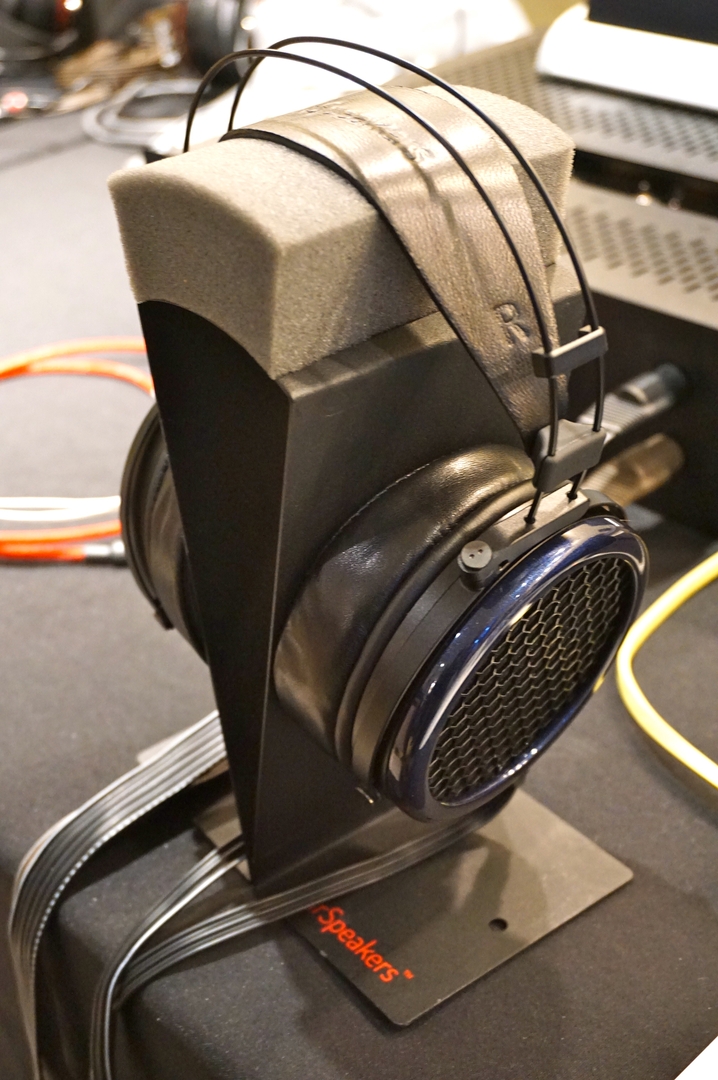
MrSpeakers ETHER C closed-back planar magnetic headphone

Most planar magnet headphones are open-back models, though some manufacturers have begun to experiment with closed-back variations—with varying degrees of success. Thus far, closed-back adaptations of open-back designs have almost invariably lost a few sonic steps when compared to their open-back brethren, typically sounding thicker, less transparent, and somewhat compressed. However, the superb ETHER-C closed back planar magnetic headphone from MrSpeakers is about to change  that perception forever. The ETHER-C appears almost identical to the firm’s excellent ETHER open-back model, yet with a carbon fibre rear enclosure and a driver tuned entirely differently to the ETHER’s – one specifically specifically optimised for use in a closed-back environment. As a result, the ETHER-C offers much the same precise, uncommonly transparent, and very evenly balanced sound that the open-back ETHER does, which is a remarkable achievement. Finally, there’s a closed-back headphone that can do everything its open-back sibling can. Bravo! (Review forthcoming)


Open-back Headphone of the Year

ENIGMAcoustics Dharma D1000 hybrid electrostatic/dynamic headphone

Up to this point, ENIGMAcoustics has perhaps been best known for its excellent Sopranino add-on electrostatic super-tweeter and for its clever Mythology M1 hybrid electrostatic/dynamic standmount loudspeakers, but we expect the firm’s new Dharma D1000 headphone will change all that. In essence, the Dharma D1000—much like the Mythology M1 speaker—represents an attempt to marry the virtues of the firm’s signature SBESL self-biasing electrostatic tweeter (in this case a miniature version of  thetweeter) with the sonic strengths of a 52mm Washi paper diaphragm-based dynamic driver. The result, we think, is an almost magical combination of high sensitivity (103dB!), exceptional responsiveness and delicacy, and hearty, robust output. In sharp contrast to many aspirational, upper-end headphones, the Dharma D1000 does not seem to be inordinately fussy about amplification and will happily give satisfying results when powered by everything from small digital audio players (e.g., the Questyle QP1R) up to state-of-the-art desktop amps. (Review forthcoming)

Cost-no-object Headphone of the Year

HiFiMAN HE1000 planar magnetic headphone 

HiFiMAN’s top-tier planar magnetic headphones have long pushed the envelope of top-tier performance, but with this year’s release of the flagship HE1000 model the firm has pulled out all the stops, creating a true benchmark headphone in the process. Sporting an ultra-thin and very low-mass ‘nanomaterial’ diaphragm, a powerful ‘asymmetric’ magnet assembly, a distinctive ‘Window Shade’ protective grille system, and an all new ergonomic design, the HE1000 is a technical tour de force that looks great and sounds better than it looks. In simple terms, the HE1000 offers the subtlety, detail, transient speed, and all-around nuance of a great electrostatic headphone, but with killer dynamics, the ability to play loudly and cleanly as the music warrants, plus the ability to be driven by conventional headphone amplifiers. In short, this brilliant do-all headphone sets the standard against which all other top-tier designs will be judged. (Reviewed in Issue 126).


Value-Priced Universal-Fit Earphone of the Year

RHA T20 universal-fit earphone

RHA Audio is known for its affordable yet excellent earphones, perhaps the finest example of which would be the firm’s £179.95 T20. Like RHA’s somewhat less costly T10 earphones, the T20s provide injection moulded stainless steel earpieces, three sets of user selectable voicing tuning filters, and well-made signal cables. However, the T20’s distinctive ‘DualCoil’ dynamic driver is what sets this earphone apart. The driver features a single, dual-zone diaphragm powered by two separate voice coils—one handling bass and lower midrange frequencies with the other handling mids and highs, with both coils sharing a ring-shaped motor magnet. Functionally, the ‘DualCoil’ driver provides the benefits of a two-driver array, but with the coherency only a single-diaphragm driver can provide. The sonic result is an earphone that offers greater resolution and sophistication, more expressive dynamics, and better tonal balance than it has any right to for its price. (Reviewed in Issue 126.)

High-Performance Universal-Fit Earphone of the Year

Westone W60 universal-fit earphone

Westone helped launch the whole high-performance earphone/custom-fit in-ear monitor movement and is second to none in terms of depth of experience in the category—experience that shows itself in the flagship W60 universal-fit earphones. Much like the firm’s flagship ES60 CIEMs, the W60s use a sophisticated three-way array of six balanced armature drivers per earpiece. Moreover, the W60 is a marvel of ergonomic design, providing excellent long-term comfort and a truly ‘universal’ fit. Attending to details, Westone ships the W60 with two sets of proprietary low-resistance EPIC signal cables, a broad array of ear tips, and a watertight carrying case. The real story here, however, centres on the sound, which offers uncannily natural tonal balance, finely resolved details, and disarming subtlety—all offered up in an almost self-effacing way. Thus, the W60’s compelling charms grow on listeners slowly but surely, gradually leaving them spoiled for anything else. (Review pending.)

Custom-Fit In-Ear Monitor of the Year

Noble Audio Kaiser 10 custom-fit in-ear monitor

Custom-fit in-ear monitors represent the pinnacle of the in-ear listening experience, but which CIEMs represent the best of the best? For many, the answer would be the Noble Audio Kaiser 10s. The Kaiser 10 is a ten-driver, four-way, triple-bore CIEM that offers an uncannily smooth, powerful, and cohesive sound. In fact, Noble blends the outputs of the K10’s drivers so expertly that the illusion created is one of listening through sets of ultra-capable, wide-bandwidth, full-range drivers. Again, cohesiveness is one of the K10’s greatest strengths. At first, we found the K10 was generally well balanced, but that it offered a judicious touch of bass lift, plus some degree of treble roll-off. Over time, however, our K10 review samples have continued to open up, gradually achieving a more transparent and balanced sound than they exhibited at first—changes that reveal the true greatness of this classic CIEM. (Reviewed in Issue 119).

WIN! Two chances to win superb Ensemble Cables, totalling £3,500!!!

We have teamed up with Ensemble AG to bring you an exciting competition. Ensemble’s INCANTO and DALVIVO cables, the fruit of 30 years of cable design, were reviewed in issue 130 of Hi-Fi+ by Alan Sircom who wrote: “The Ensemble sound is not about detail or expansive soundstage, although it’s actually extremely good at presenting a wide and deep soundstage, made up of extremely detailed, solid-sounding instruments. Instead it’s more about the gestalt, the music as a complete, legato, flowing entity, where many of its rivals tend to go more for the fleeting musical moment… Highly recommended!”

Our first lucky winner will receive a 2.5m pair of DALVIVO loudspeaker cables, worth £1,440, together with a £690 1.5m pair of INCANTO interconnect cables, forming a competition worth £2,130. Our runner-up will also receive a £690 1.5m pair of INCANTO interconnect cables, together with a £680 1.5m DALVIVO power cord, making a runner’s-up prize of £1,370.

Competition Question

According to Alan Sircom, the sound of Ensemble’s INCANTO and DALVIVO cables can be described as?

A. Hyper-real

B. Not shy of fireworks dynamics

C. Reproducing music as a complete, legato, flowing entity

To answer, please visit Ensemble’s dedicated competition page at http://www.ensembleexperience.com/competition. Alternatively, send your answer on a postcard (including your name, address, and contact details) to “Ensemble AG Competition, P.O. Box 215, CH‑4147 Aesch, Switzerland. The competition closes on May 5th 2016.


Competition Rules

The competition will run from March 3rd 2016 until May 5th 2016. The competition is open to everyone, but multiple, automated, or bulk entries will be disqualified. The winners will be chosen at random from all valid entries, will be contacted via email (where possible) and their name will be published in the magazine. The Editor’s decision is final and no correspondence will be entered into. Absolute Multimedia (UK) Ltd. is compliant with the Data Protection Act and UK laws apply. Our policy is such that we will not pass on your details to any third party without your prior consent.

Hi-Fi+ Products of The Year

Welcome to our first Awards in several years. The audio world went through some fairly radical changes in the last few seasons, and we felt it was so fast moving that to give a product an Award in a category that might not be relevant two months later serves no purpose to anyone. And, if we are being truly candid about such things, the volatile financial world had such an impact on high-end audio for a few years, we felt it was best to let things ‘settle’.

While the audio world is still very fluid, it does look more ‘predictably defined’ today. The ‘battle’ between DACs and streamers, for example, was raging two years ago and that meant products came and went very quickly in both categories. However, that battle (such as it was) ended in a draw and both DACs and streamers remain entirely relevant. As a result, they have both stayed on the shelves for longer now. Even the digital disc player – the end of which looked distinctly nigh just a year ago – is proving more resilient than anyone expected. But this means any awards in audio result in a lot of categories as we need to cater for everything from classic vinyl to innovative downloading services.

Having a hiatus in our awards does pose a problem, though. There are some great products that were launched in the last few years that remain relevant and worthy of an award, but how do we reconcile them with the constant cry of ‘what’s new?’ This is why we decided to move our awards issue from the usual spot of mid-way through the Autumn of each year to the first issue of the year. That way, our Products of the Year, are just that: products we have seen throughout the previous year, which we feel to be exceptional. In this particular case, however, we have simply extended the time-line back to include products we’ve seen in the last few years, not simply the best of 2015. Over the next two weeks, we will showcase all the best products we’ve seen in each category, starting today with source components. 

There is an important rule with awards that deserves repeating. These products may be the best engineered, the most important, or the best sounding products in their category that we have ever heard, but that doesn’t necessarily mean that they will automatically work together in a system. The importance of system building means that the best sounds may well come from a system that features award winning products, but simply vacuuming up the award winners in each section and assuming this will produce a great sounding system is, at best, naïve. Fortunately, this is unlikely with a high-end magazine like Hi-Fi+ because you would need some really deep pockets to buy all our Award winners! Nevertheless, not simply picking up a system made of Award winners is a good maxim to live by when reading any list of top-grade products.