Up to 37% in savings when you subscribe to hi-fi+
hifi-logo-footer

Begin typing your search above and press return to search. Press Esc to cancel.

Wilson Audio WAMM Master Chronosonic loudspeaker

One of the most important attributes in a reviewer of anything is a spot of cognitive dissonance: you need to simultaneously be yourself and distance yourself. In the case of the Wilson Audio WAMM Master Chronosonic, that cognitive dissonance gets Grand Canyon wide. Here is a product that is at once the finest loudspeaker I have ever heard by no small margin, and a product that is worth roughly as much as everything I own. Currently, it would take me more than a decade of putting every single penny I earn into the kitty to buy a pair and I still wouldn’t have anything like the space required to house them. Even using my magic powers, and casting the ‘accomodatio discountiarmus’ spell, I’d still be looking at a figure greater than my mortgage. And yet, there are people who both can afford the $685,000 admission fee, and do so.

While a loudspeaker that costs more than many people’s houses might seem like a bit of a reach on the ‘significance’ stakes, the story – and the back story – make this statement more justifiable.

Back in 1980, Dave Wilson’s first loudspeaker sold to the public was the WAMM. It was first shown to the public in 1981 and immediately sold two pairs, despite its then eye-watering $32,000 price. The WAMM continued on through several revisions for the next two and a bit decades, but was finally retired when faced with competition from within, in the shape of the Alexandria XLF. Despite the high price (it was closer to a quarter of a million dollars at its close), Wilson Audio did sell 53 pairs of the original WAMM. And the idea never went away.

If the WAMM was Dave Wilson’s first loudspeaker as Wilson Audio, the WAMM Master Chronosonic is his swansong at the helm of the company, because earlier in the year Dave handed over the keys to the company to his son, Daryl. Dave Wilson has no intent of simply retiring, however; he is now the ‘WAMMbassador’, leaving his son to the simple tasks of designing loudspeakers, running the company, and the rest. In a way, the WAMM marks a true transition, as it’s as much Daryl’s first loudspeaker launched with him in the big chair (although technically, that’s the Yvette), and so much of the design work, testing, and listening have come down to Daryl Wilson.

The new Wilson WAMM Master Chronosonic might sound like a wristwatch, but the reality is those invented words are more than just there for show. ‘Chronosonic’ (‘time and sound’) expresses much about what is so (literally and figuratively) pivotal about the WAMM, as the mid-range and beyond is extraordinarily precisely time and phase aligned in the listening room, for the listener’s precise position. This has been a constant theme in all Wilson Audio loudspeakers from the Sasha upward for some time, but the level of precision in these adjustments is taken to a new level in this multi-way, basketball-player tall loudspeaker system, and the results speak for themselves.


The drive unit line up reads more like a haul of loudspeakers. There are seven front-firing and two rear-firing drive units in each loudspeaker. Of these, the front and rear 25.4mm Version 5 Convergent Synergy soft-dome tweeter, and the front and rear 127mm pulp paper upper midrange units were designed specifically for the WAMM Master Chronosonic, while the 267mm and 318mm bass drivers were also designed for the WAMM Master Chronosonic, but the Alexx got them first. Only the pair of 178mm fabric lower midranges (used in seven other designs from the XLF onward) are not part of the WAMM design process. What’s more, treble, upper midrange pair, and lower midrange pair are housed in adjustable pods in a micrometer-precise framework. And it’s here where we get things wrong in audio. We glory in adjustable loudspeaker housings to help time-align the loudspeaker, but this seems slightly crazy if you think it through, because the slightest movement of your head relative to the time-aligned loudspeakers will throw everything out of balance. Instead, says Wilson through the medium of the WAMM Master Chronosonic, perhaps we should be looking at time alignment in terms of time coherence. This harks back to Wilson’s original patents on time alignment back in 1984, but these concepts remained largely unrealised in domestic loudspeakers until the arrival of products like the Sasha, Alexia, and especially the Alexx.

Our aural system is relatively insensitive to small changes in the time domain, and above 5kHz, our ears cannot detect timing-related issues less than about 10microseconds (µS). This is also one of those aspects of aural performance that does not decrease with age: our ears lose both high frequency performance and consistency with age, but our ability to determine time-delay errors is undimmed by maturity it seems. Given the speed of sound in air at around sea level, this relates to approximately 3.43mm. In other words, get the loudspeaker aligned so that the distance from speaker to ear and from ear to floor right with that kind of precision, and it will sound ‘time coherent’. Most loudspeakers get their time coherence right to within about 100µS, the WAMM Master Chronosonic gets to an impressive 2µS. Of course, this kind of precision requires two things; a loudspeaker capable of a significant amount of adjustment (and a rigid lock-down when adjustment is complete), and installers both trained and obsessive-compulsive enough to complete the installation process with a degree of absolute thoroughness.

The WAMM Master Chronosonic doesn’t just require a precise installation, it also requires careful selection and compensation for upstream electronics. Put simply, if you have 10µS sensitivity in-head, the loudspeaker is good for 100µS and the amplifier 50µS, the pinch-point is not the amplifier. But if the loudspeaker is capable of time-coherent precision down to 2µS, then the performance of the amplifier suddenly becomes a pinch-point. Wilson Audio has already started to analyse the ‘time profile’ of several amplifiers that might be used with the WAMM Master Chronosonic, with D’Agostino Momentum mono amps and the VTL Siegfried tube mono amps being the first candidates.


Installation is aided by the modualrity of the loudspeaker. No-one has quite worked out just how heavy the WAMM Master Chronosonic really is yet, because they haven’t started shipping and the Design Proof pair in Dave Wilson’s listening room aren’t going near a set of scales any time soon. But the likely weight and packing requirements are on the ‘substantial’ side. Fortunately, both the modules and the side ‘ears’ that cover the framework they sit in, and that framework itself, are all removable and designed to lock into the bass unit. This bass unit is – in itself – fairly substantial and about the size of a mid-sized Japanese car engine, but has a relatively low centre of gravity and makes placement easy. The modules are then built up from here.

When it comes to a loudspeaker of this magnitude, it doesn’t come to you: you go to it. I was one of a handful of journalists invited to travel to Provo for a one-to-one encounter with the WAMM Master Chronosonic in Dave Wilson’s fairly awesome listening room. The room is a bit of a known quantity among audio writers, as many of us have been there for the launch of one or more of Wilson’s designs, and the combination of the room size, it’s dynamics, and the equipment used to partner the loudspeakers is something of a benchmark in audio performance. Like the outstanding Steyning listening room of late Alistair Robertson-Aikman of SME (which sadly suffered a roof collapse a few years back, when a thick blanket of snow added even more load than the five tons of concrete used to build the sonically dead listening room ceiling). Practically every audio writer worth his or her salt has heard music in both listening spaces on more than one occasion and acclimatising yourself to Dave Wilson’s room is a relatively rapid process. What helps, of course, is it is a fine sounding room, too. 

There is always a touch of green-eyed jealousy that emerges whenever you have to deal with expensive products. There is an assumption (again something that one has to overcome as a reviewer) that anything significantly beyond your personal limits is ‘overpriced’ and never bought by ‘true’ audiophiles. In philosophy terms, this is mix between a form of Argumentum ad Lazarum (affirming a conclusion because the person saying it is poor) and the ‘No True Scotsman’ fallacy: an attempt to protect a universal generalisation from counterexamples. In reality, just as few people buy a pair of £2,000 loudspeakers to show off to their friends with £1,000 loudspeakers – and instead tend to buy a pair of loudspeakers on the basis of how they sound – the same holds across the board. Someone buying a pair of WAMM Master Chronosonic is buying the best loudspeaker they know of, and have the advantage of having enough financial clout to be able to buy the best. Just as someone buying the best loudspeaker from another brand; they have chosen that design because it suits them best, they love what it does, and can afford to own it. In other words, they buy them to enjoy them, just like everyone who buys a pair of loudspeakers does.

The difficulty we as reviewers face here (aside from reconciling listening to normal audio in the wake of a loudspeaker that costs $685,000 per pair) is one of terminology. We simply don’t have the words. That isn’t just the superlatives; it’s the basic terms. Our descriptive powers have inherent constraints (when we talk about the dynamic range of a system, there is an in-built assumption that the dynamic range is constrained compared to the original), and the WAMM has less of them than we’ve encountered before. A lot less. Making this more like the real thing than anyone who hasn’t visited a very nice room in Provo, Utah has yet to experience from recorded music. I thought the terms would come in time, but they didn’t.

The loudspeaker challenges all your perceptions of what you thought possible from an audio system; even those of us used to really high-grade audio and exceptional loudspeakers will find themselves wondering precisely how the WAMM is extracting that much musical information from even the most humble CD recordings. This isn’t a subtle, nuanced difference. Music played through these loudspeakers just has that ‘right’ sound that is more like real music and less like there are electronics involved in the signal chain.

The time-coherence concept suggested by Wilson Audio is not part of the traditional audiophile zeitgeist, so it’s likely to receive some degree of scepticism, but if this is one of the keys to why the WAMM Master Chronosonic sounds as it does, then it needs to be taken more seriously. There is certainly a complete absence of anything remotely like a temporal blurring, time-smear, or whatever you might want to call it. Normally too, at this point, there’s a temptation for UK audio writers to go all jingoistic and point to small loudspeakers and Quad Electrostatics suggesting they crack the timing nut by being essentially point sources. But, on the face of the evidence presented by the WAMM Master Chronosonic, we don’t have that luxury anymore. In the wake of listening to this loudspeaker, it’s possible to listen to supposedly spot-on products like the Quad and point to where the timing isn’t right. This is the audiophile equivalent of a hard reboot.

I have a couple of recordings designed specifically to tax ported loudspeakers, the most notable being ‘Chameleon’ by Trentemøller [The Last Resort, Poker Flat]. The fast, electronic bass notes effectively have nothing but attack and release and can ‘choke up’ a bass port, and the Wilson WAMM Master Chronosonic is the first ported speaker that doesn’t!

This lack of port choking shouldn’t happen, but it was one of the many things that shouldn’t be happening with the Wilson Audio WAMM Master Chronosonic, and do. Given all of those different drive units, integration and coherence should be a bit of a concern, but instead this sounds like it’s a giant panel loudspeaker. Granted it does all those things Wilson speakers are supposed to do well (outstanding soundstaging properties, effortless dynamics, high degrees of detail, and an ability to play extremely loud with ease), but it does them so well you find yourself listening to other excellent loudspeakers as if they are a little bit broken. Only the very best of the best of the best come close to the WAMM Master Chronosonic.

The problem, stated earlier, is we simply don’t have the words for this. We’re at the musical bleeding edge here, and discussions about the sound of the loudspeaker dissolve into discussions about the voice of the tenor, the skills of the guitarist, or the sophistication of the composer. And yes, we did do drum records and the audiophile thing, but they don’t sound like drum records. They sound like drummers. And when those drummers are Kodo drummers, it’s a cowering experience, one that audiophiles expecting the usual dynamic and impressive sound walk away from shaking. Dynamic and impressive? Of course. But this is more. This is visceral, real, challenging stuff, and I still haven’t done it justice in terms of both sound and technology.


Finally, I was asked several questions by audiophiles on the QT about the WAMM Master Chronosonic, and we all get it wrong. It’s not bright, not dull, doesn’t have a character, it is just music, red in tooth and claw, or subtle and delightful.

I’m normally on the loquacious side. Give me half a minute of dead air in a room and I’ll fill it. I may not fill it with Shakespearean prose, but I will chatter and gossip and talk, and talk. Not this time. I was truly humbled in front of these masterpieces, and several months later, I’m still processing the experience.

Sadly, this isn’t the kind of loudspeaker many of us will hear in the wild. They won’t be at many shows, they won’t be doing much of a dealer tour, and you probably need to be one of the handful who would be in the market for a loudspeaker of this magnitude to even experience one, unless you expend much of your Editor magic powers. But, if you can, you will have the same humbling musical experience.

This is as real as it gets!

TECHNICAL SPECIFICATIONS

Type: Modular four way ported floorstanding loudspeaker

Front firing drivers:
1× 25.4mm Convergent Synergy (Mk5) doped silk fabric dome tweeter
2× 127mm paper pulp composite cone upper midrange
2× 178mm doped paper pulp cone lower midrange
1× 267mm hard paper pulp cone woofer
1× 318mm hard paper pulp cone woofer

Rear firing drivers:
1× 25.4mm Convergent Synergy (Mk5) doped silk fabric dome tweeter
1× 127mm paper pulp composite cone midrange

Enclosure Type:

Main Tweeter (Sealed): X-Material

100mm Main Mid Module (Bottom Vent):
X-Material with S-Material Baffle

177mm Main Mid Module (Bottom Vent):
X-Material with S-Material Baffle

Woofer (Cross Load Firing Port (XLF)): X-Material

Rear Firing Enclosure (Sealed):
X-Material with S-Material Baffle

Gantry: Aerospace aluminium with W-Material Module Interface

Nominal Impedance: 3Ω

Minimum Impedance: 1.77Ω @ 310Hz

Sensitivity: 90dB @ 1W @ 1m @ 315Hz

Frequency Response: 20Hz-33kHz ±2dB

Minimum Amplification Power Recommended: 100 watts/channel

Dimensions (H×W×D, w/o spikes): 214×53×95cm

Weight: a lot!

Limited to: 70 pairs

Price: $685,000 per pair (VAT not included)

Manufactured by: Wilson Audio

URL: www.wilsonaudio.com

Distributed in the UK by: Absolute Sounds Ltd

URL: www.absolutesounds.com

Tel: +44(0)20 8971 3909 

Pearl Acoustics Sibelius SG loudspeaker

Once upon a time, audio used to march to its own beat. Now, it seems to march to the beat of the smartphone world. Launch a piece of hi-fi today, and by the end of the week it’s old news. Companies therefore keep pace by launching ever smaller and larger variations on the same theme. Pearl Acoustics begs to differ. It has just the one product – the Sibelius SG floorstanding loudspeaker – and there are no plans to expand, alter, change, restructure or turn the Sibelius into a ‘range’. In a time where ‘what have you done for me lately?’ rules the audio roost, the Sibelius is a loudspeaker for the ages.

The idea behind the Sibelius is a distillation of technology old and new. The loudspeaker cabinet is a quarter-wave, folded horn design that follows a tradition that stretches right back to Paul Voigt and the first years of electrical loudspeaker systems. Back in 1930, Voigt’s concept was to amplify the relatively small signals emanating from a loudspeaker drive unit using a column of air chambered within a cabinet, something Pearl Acoustic’s designer Harley Lovegrove was investigating some 82 years later.

It begins (as it so often does in audio) with a personal quest for musical perfection. Having listened to classic Lowther designs and even commissioning a variant on the Scott Lindgren Frugel-Horn, perfectionist Lovegrove began to think about building his own loudspeaker; he was drawn to the work of Voigt, and realised that such designs rely on extremely rigid cabinetry. MDF and its ilk simply did not cut the musical mustard. This prompted a move to a solid timber cabinet, and finding a similarly like-minded perfectionist in both driver and woodwork. This led to working with Mark Fenlon (of Markaudio-Sota fame), joinery expert Chris Cabergs, and to the use of unbraced cabinets of 3.3cm thick, slow grown, solid French oak, in timbers aged for 12 years (under the ‘if it works for whisky, it must be good’ rule). Coupled with a classic version of one of Fenlon’s wide-range drive units (Lovegrove prefers this to the latest voicing), and months of listening to damping materials (Lovegrove and his team don’t get out much), the Sibelius slowly came to fruition.

The Sibelius is a single-way loudspeaker with a relatively narrow front baffle and the exit point of the internal horn at the base of the loudspeaker. It is single wired to two solid connectors at the rear, with no filters or electrical components in between. It is offered with an adjustable steel base with an L-shaped upright for cable support. There’s a panel on the back bearing Jean Sibelius’ signature (this is not the kind of loudspeaker that ends up in the kind of dealer who would think Sibelius was the designer… hopefully), and that’s about it. There’s no grille or ornamentation, but they do offer a dust cover to protect the drivers from prodding fingers and adventurous household pets when not in use. So there is nothing to fall off, tarnish, or break. Even the manual is out of the ordinary, as it is a hardback autobiography, philosophical treatise on loudspeaker design and room treatment, and installation guide. Also the lack of bracing means although the loudspeaker is made from solid tree, it’s not too heavy as it comes in at around 29kg per loudspeaker.

You are not entirely without options, though. There are a range of stains available alongside the well finished, dozen year aged, solid French oak cabinet. There are also minor variants on the driver itself, such as a ‘CG’ version that replaces the silver alloy drive unit with a copper alloy cone (all other specifications remain functionally identical) and a ‘P’ version that replaces the metal cone with a paper one. This last is designed to be deliberately reminiscent of classic paper cone designs like Lowther. This makes the loudspeaker slightly more efficient, at the expense of a hair less maximum output and greater limits on power handling. On paper, at least… as we only had the standard ‘SG’ version to hand, we can’t comment on the performance of either of the other models.


If the term ‘SG’ sends you racing to the Gibson SG guitar and it being the preferred weapon of choice for AC/DC axe-grinder of note Angus Young, you are reading the wrong review. While these loudspeakers are perfectly comfortable playing almost all genres of music, the Sibelius’ power handling and maximum power output figures suggest a loudspeaker unsuited to playing power chords at high volumes, and this is confirmed in the listening.

Obviously, you are going to play Sibelius on a loudspeaker that bears his name, and for good reason: on Sibelius’ Symphony No 5 [Vanska, Lahti SO, BIS] these loudspeakers recreate the music’s almost perfectly organic sense of flow, from the French horns at the introduction of the piece to the powerful conclusion, the loudspeakers draw you into the music and the composer’s mastery of the thematic form. It made me want to skin a moose with a Nokia phone, or something equally Finnish.

The Sibelius (the speaker, that is) has an unfatiguing, almost sweet-sounding presentation. It’s possibly not the first word in modern-day audio transparency, but that doesn’t seem to matter to those who fall under the loudspeaker’s thrall. This is a loudspeaker for enjoyment, not audio engineering, and those who are in step with that kind of thinking will sit and listen to these loudspeakers happily for the next few decades, drinking in a sound that is deeply satisfying and designed for endless, effortless listening. In a way, this is a point source spiritual heir to classic British loudspeakers like the Castle Harlech, mixed in with the sound of good Horning Agathons: in other words a kind of slightly rich effortlessness that stays just the right side of ‘warm’.

That effortlessness also applies to its portrayal of dynamic range, although this is more about subtle micro-dynamic cues that draw you into the music than the rolling thunder of timpani and Led Zep drummers. This is the kind of dynamic shading of the tabla, not just in audiophile recordings, but on the zany but brilliant version of ‘Take Five’ by the Lahore-based Sachal Studio Orchestra [Sachal Jazz – Interpretations of Jazz Standards & Bossa Nova, Sachal Music]. This Pakistani take on jazz standards is a little hit or miss, but ‘Take Five’ is definitely a hit and the combination of microtonal playing and some extremely fine tabla musicianship needs a deft loudspeaker to sound at its best, and here it just shone.

Where the Sibelius really sounds at its best is on anything that plays to its strengths, and those strengths begin with  its exceptional imaging properties. This is perfectly understandable when you consider it’s basically a point source loudspeaker sitting in a quarter-wave enclosure, but even so the ability these speakers have at teasing out a soundstage is little short of remarkable. Harking back to ‘Take Five’ once more, the layering of the strings section and the physical space occupied by the acoustic guitar or the sitar between the loudspeakers is so precise, you could be in a studio half a world away.

Tonally, the loudspeaker is just about spot-on. It doesn’t mask errors of judgement on behalf of the producer or engineer, as it lays bare toppy, over-compressed, peaky, or dynamically compromised recordings. Play some over-produced, auto-tuned, X Factor runner-up, bleating on about yet another failed relationship as someone tunelessly mashes a few arpeggio chords on an over-reverberated piano, and that’s precisely what you hear, warts an’ all. On the other hand, play some Duke Ellington from the 1930s and the years evaporate. Yes, the recording might be the wrong side of ‘rudimentary’, but the overall balance and the musicianship of the recording shine through.


We live in an immediate, ‘always on’ world, and that comes with a lot of obsolescence in tow. People dipped in this way of thinking may struggle to parse the concept of a loudspeaker designed for decades of use. The Pearl Acoustics Sibelius SG is not for audio fly-by-nights who flit from shiny thing to shiny thing. It’s for people who got past that. This is a handmade musical tool for those who listen to a wide range of musical styles, and are mature enough not to be impressed by ‘loud’. This has to remain something of a cautious recommendation, because many people have not yet got to the Sibelius’ level of refinement and maturity in their audio system choices. But for those who have learned there is more to musical life than simply ‘wow’, the Sibelius is there for you, and will be your musical partner for decades.

TECHNICAL SPECIFICATIONS

Type: Wide-bandwidth driver floorstanding loudspeaker

Drive unit: 1× markaudio wide range drive unit (pair matched)

Impedance: 7.5 Ohms

Power handling: 35 Watts RMS – 70 Watts peak

Efficiency: 87.5db @ 1W @ 1 metre

Maximum output : 105db @ 1 metre

Frequency range: 28Hz–30Khz

Dimensions H×W×D: 109×23×30m

Weight: 29kg each

Price: £4,500 per pair (stands £500)

Manufactured by: Pearl Acoustics

URL: www.pearlacoustics.com

Moon by Simaudio 230HAD headphone amplifier

More than a year ago Hi-Fi+ favourably reviewed Moon by Simaudio’s superb Neo 430 HAD headphone amp/preamp/DSD DAC and found it to be a world-class product—one even the most particular headphonistas could happily embrace as a benchmark component. In practical terms, the only drawback with the Neo 430 HAD was that its £3,800 asking price placed it beyond reach for a number of otherwise passionate and sound quality-conscious headphone enthusiasts. What was needed, some thought, was a headphone amp/DAC similar in overall sonic characteristics to the 430HAD, but that would sell for a more manageable price. Happily, Moon by Simaudio had this very idea in mind when they created the Neo 230HAD headphone amp/DAC, which sells for £1,500.

How did Moon by Simaudio achieve such a dramatic reduction in price without cutting significant sonic corners? As is always the case in such design plans, the answer lies in deciding exactly where and how acceptable compromises can be made. If we take the original 430HAD as a starting point, then here are the cost-reducing changes Moon implemented in developing the 230HAD.

First, Moon decided that unlike the 430HAD, which features a fully balanced amplifier, the 230HAD instead would incorporate a single-ended only amplifier. Along with this decision came a concomitant choice to roll back the 230HAD’s power output specifications to what might be described as a ‘moderately powerful’ level—this in contrast to the 430HAD’s prodigious 8 Wpc (!) output capabilities.

Second, Moon elected to scale back the size (though not the quality) of the 230HAD’s power supply, which in turn meant the 230HAD’s circuitry could fit within a half-width chassis as opposed to the full rack-width chassis used for the 430HAD.

Finally, Moon utilised a traditional high-quality motorised-Alps volume potentiometer, in contrast to the sophisticated optical encoder-controlled 530-step attenuator of the 430HAD, which was itself derived from the company’s Evolution-Class products. The use of a potentiometer is a significant cost saving, even if it comes at the expense of the stepped attenuator’s ultimate transparency and ability to maintain tight inter-channel balance.

Taken together, these choices made good sense in that the sensitivity ratings of many top-tier headphones have steadily been climbing in recent years, meaning that as a rule there is less of a premium on sheer headphone amp power output than there used to be. The one potentially significant trade-off, though, is that the 230HAD’s 115dB signal-to-noise ratio is not as good as the 430HAD’s tomb-quiet 120dB signal-to-noise ratio—a difference partly attributable to the single-ended vs. fully-balanced circuitry of the two models, but also attributable (I suspect) to the 230HAD’s somewhat less beefy power supply.

On the digital audio side of things, it appears the 230HAD and 430HAD use similar if not identical DAC sections. The DAC sections of both units can handle PCM files at 16-32 bits/44.1 – 384kHz, and can decode DSD64, DSD128, and DSD256 files. Quoted frequency response, bandwidth, and distortion figures for the two units’ DAC sections are essentially the same, which is good news for prospective 230HAD buyers.

Then, as a final cost-reduction measure, Moon has configured the 230HAD so that it deliberately eliminates all non-essential features from the 430HAD, thus making the ‘junior’ model as simple and affordable as possible. For example, where the 430HAD had user-adjustable master gain settings and provided built-in user-selectable crossfeed circuitry (designed to provide a more three-dimensional, outside-the-head listening experience for headphone users), the 230HAD foregoes both features. Likewise, where the 430HAD sported extensive home automation-orientated features such as a 12V trigger output, an IR sensor, an RS-232 control port, and Simaudio’s SimLink system, the light and lithe 230HAD omits all of the above.

In theory, either the 430HAD or the 230HAD can be used as primary preamplifier/DACs in speaker-based hi-fi systems. In practice, though, it’s clear the 430HAD stands more as the versatile, audio rack-mountable, full-featured preamp/DAC/headphone amplifier, whereas the 230HAD presents itself as the streamlined, ‘everything-you-need-and-nothing-you don’t’ desktop model that likely will be used primarily for headphone listening.

With that said, however, here is an interesting factoid to consider. If you compare the performance specifications of the 430HAD and 230HAD side by side, you will discover that—apart from noise and power output specifications—the two units appear virtually identical. On paper, then, it would seem the 230HAD and 430HAD share a significant amount of sonic ‘DNA’, despite the obvious differences between the two. But this raises a key question: Are these seeming similarities borne out in real-world listening tests? In a word, yes, they are.


For my tests, I fed the 230HAD a mix of standard (16/44.1) and higher-res PCM and DSD music files from a Windows/jRiver-based music server, while listening through four sets of very high-performance headphones: the ENIGMAcoustics Dharma D1000, the Focal Utopia, the HiFIMAN HE1000 v2, and the MrSpeakers ETHER Flow. Here is what my listening sessions revealed.

First, I learned that Moon by Simaudio isn’t kidding around when it recommends giving the unit roughly 300 hours of run-in time before listening critically. Straight out of the box the 230HAD sounds good (but not great), initially exhibiting an opaque sound somewhat lacking in transparency and nuance. But as the hours accumulate, the 230HAD’s sound dramatically improves. Resolution of low-level details increases, tonal colours become more vibrant and fully fleshed-out, transient speeds and overall definition get better, and dynamic agility and expansiveness take big steps forward. In short, proper run-in helps the 230HAD be all that it can be.

Once broken in, the 230HAD serves up a hearty, vigorous, and expressive sonic presentation that centres upon, and is built around, a well developed, open-sounding midrange. There is the sense, always, that the 230HAD is capturing the energy and vitality inherent in good recordings and conveying these qualities with appropriate (but never exaggerated) verve. There are excellent levels of midrange, upper midrange, and treble detail as well, though it is that overriding quality of ‘aliveness’ that consistently catches and holds the listener’s attention.

These qualities are never more apparent than on intimate, well-recorded vocal tracks, such as Eva Cassidy’s live performance of the blues standard ‘Stormy Monday’ from Live at Blues Alley [Blix Street, 16/44.1] where the 230HAD—driving Focal’s superb Utopia headphones—creates the uncanny illusion that Cassidy is standing only a few feet away from the listener as she performs (in fact, the illusion so vivid that one almost wants to stand up and start clapping at the end of the song). Every small shift in inflection, every pause for breath, and every burst of vocal energy—whether large or small—become not just audible (in the usual hi-fi sense), but more importantly sounds gloriously vibrant and alive. This is the sound of the 230HAD at its best.

Similarly, listen to the sound of Miles Davis’ trumpet as he and his backing band offer their striking rendition of Cyndi Lauper’s ‘Time After Time’ on Davis’ Live Around the World [Warner Bros., 16/44.1]. The 230HAD enables great headphones to showcase Davis’ deft, subtle command of instrumental textures and timbres and also to show how Davis uses his trumpet’s very wide dynamic range for dramatic effect, with passages that range all the way from the whisper-quiet range on up into moments of full-throated expression. As in the Eva Cassidy record cited above, the 230HAD again captures a quality of musical intimacy on ‘Time After Time’, so that you not only hear but also feel the interactions between the musicians as they make individual contributions. For example, the performance of the electric bassist on the familiar (and downright infectious) bass riff from the song’s chorus, is at once a fine musical statement in its own right, but also the rhythmic engine that gently but firmly pulls the song forward. At every turn, the 230HAD shows the listener—in both intellectual and emotional terms—how the dynamics of songs are meant to work.

When it comes to the matter of detail, I would say that if you heard the 230HAD (again, after run-in is complete) in isolation you might rightly think it to be one of the more resolving headphone amplifiers on the market. However, if you were to do a side-by-side comparison with the more expensive 430HAD it would become apparent that the 230HAD’s bigger brother could dig down just a smidgeon deeper into the innermost aspects of fine recordings. There is no shame in this, though; the 230HAD does a great job for its size and price. Just be aware that if you want to push the performance envelope as hard as possible, the 430HAD might be the better choice.


In terms of overall voicing the 230HAD and 430HAD are very similar, though my instinct is that the 230HAD is perhaps every so slightly warmer sounding and thus just a bit more forgiving when it comes time to play less than ideal recordings (especially ones with a characteristically bright sound). Bass capabilities of the two amps are likewise similar (within the power output constraints of the 230HAD), though when push comes to shove the 430HAD offers perhaps a touch more grip and pitch definition, plus ‘bottomless pit’ reserves of low-end power. In contrast, the low end of the 230HAD consistently sounds energetic, with great pace and drive, but with the constraint that—when pushing very low sensitivity headphones—the 230HAD could potentially reach a point where it might run out of steam. (This never actually happened with the relatively high-sensitivity reference headphones I had on hand, but with low sensitivity headphones such as the Abyss AB-1266 or HiFiMAN’s new Edition 6, I suspect it could be a problem).

All in all, the 230HAD fulfils its mission brilliantly. It is a highly accomplished headphone amp/preamp/DAC that conveys much of the overall sound and feel of Moon by Simaudio’s flagship 430HAD, but for a fraction of the price. For those who want a big taste of what top-tier headphone amp/DACs are all about, yet without paying a full on, top-tier price, the 230HAD is worthy of serious consideration.

TECHNICAL SPECIFICATIONS

Type: High-resolution desktop headphone amplifier/DSD DAC

Inputs: One TOSLink optical digital input, two coaxial S/PDIF digital inputs, one USB input (32/384 and DSD256-capable), two single-ended stereo analogue inputs (one via stereo RCA jack, one via 3.5mm mini-jack)

Outputs:  One single-ended headphone outputs (one via a 6.35mm headphone jack), and two stereo analogue outputs (one fixed level and one variable level, both via RCA jacks)

Device drivers: PC will support up to 384kHz sample rates and DSD64/ 128/256 with installation of a Moon‑supplied “USB HD Driver”.

Frequency Response:

Amplifier: 20Hz – 20kHz ± 0.1dB, 5Hz – 100kHz +0/-3.0dB

DAC: 20Hz – 20kHz ± 0.2dB, 2Hz – 72kHz +0/-3.0dB

Signal-to-Noise Ratio:

Amplifier: 115dB @ full output, 20Hz – 20kHz

DAC: >114dB @ full output

Distortion:

Amplifier: THD, 20Hz–20kHz, 0.005%. IMD, 0.005%

DAC: THD @ 1kHz, 0dBFS (A-weighted), 0.001%. IMD, 0.004%

Power Output: 600 Ohms, 100mW, 300 Ohms, 200mW, 50 Ohms, 1 Watt

Dimensions (H×W×D): 178 × 76 × 280mm

Weight: 2.8kg

Price: £1,500

Manufacturer: Simaudio Ltd.,

URL: www.simaudio.com

Distributed by: Renaissance Audio Ltd

URL: www.renaissanceaudio.co.uk

Tel: +44(0) 131 555 3922  

LA Audio Show – AS Round Up

With AXPONA, Munich High End, and the Los Angeles Audio Show falling within six weeks of one another, it’s a pointless task asking, “What’s New?” at the last of the three events. There were a few products having their first US outing having been launched around 10 days earlier in Germany, and a handful of products that appeared in LA first due to geography, but this was more a ‘What’s Best’ rather than a ‘What’s New’ event.

A new show in a new venue is always something of a challenge. Exhibitors are not used to the acoustic of the new rooms, the show-goers might prove reluctant to travel to the new venue, and many will choose to play a watching brief, waiting out for the first couple of years to see how the show evolves. The LA Audio show had all the potential to succeed as it had extensive marketing, a good spread of exhibitors, and – being so close to LAX, it was easily accessible both to LA residents and those flying in to visit the show. Pre sales of tickets looked promising, too, and there were times when the show was busy, but during most of the event, footfall was low.

The layout of the Sheraton Skyline hotel in LAX also meant those in the larger conference rooms of the lower levels suffered different sonic problems to those in the hotel rooms of the upper floors. The conference rooms were larger, making them potentially ideal for bigger systems, but the combination of thin walls, irregularly shaped rooms, and large beams across the ceilings of the rooms restricted both volume levels and bass output. One company suggested that they had to play music at 20dB lower than usual to tame the bass and room gain problems. While ‘quieter’ is a good thing for an audio show (often, it becomes a game of ‘who can play loudest’), ‘too quiet’ can make systems appear undynamic. Meanwhile, the upper floors were largely struggling with smaller rooms that limited stereo imaging and overall coherence. The upper floors, however, had more rooms that sounded good overall.

Two worrying trends at this show were the return of Really Bad Audiophile Music and the rise of the Insular Demonstration. My dosimeter registered at over 6.5 Kralls per hour – anything more than eight is a lethal dose – and the show exhibited high levels of ‘Keith Don’t Go’ particulates and dangerous amounts of Eagles Unplugged, well-recorded dinner jazz, and approved classical works (Danse Macabre, Pictures at an Exhibition, etc). Also, I was concerned by the rise of the Gollum’s Cave approach to audio demonstration – eye contact never returned, no literature, no discussion of what’s being demonstrated and a ‘he covets the precious things in the room’ look when asked about the equipment. We are supposed to be working together to build new audiences, but both of these elements seem to push away all but the most hardened of audiophiles.

So, I’ve focused on a personal baker’s dozen of the best sounding and best presented rooms at the show, in order of when I saw them:

Audionet’s final statement Planck CD player and Ampere power supply are the company’s flagship, first seen last year. The Planck represents a ‘quantum leap’ in disc-player technology. Which proves Germans can make bad puns, too! This was playing in the YG Acoustics room, which also featured one of the fixtures of this show – the Kronos turntable.

VAC’s full range of Statement amplifiers were on full display, and sounded pretty good playing open reel and a Kronos turntable (again), all into Von Schweikert’s Ultra 11 loudspeakers.

Evolution Acoustics was showing a late prototype of its Maestoso loudspeaker, notable for having a crossover network independent of the loudspeaker and larger than most power amplifiers thanks to multi-layer boards. It was playing through DarTZeel amplification.

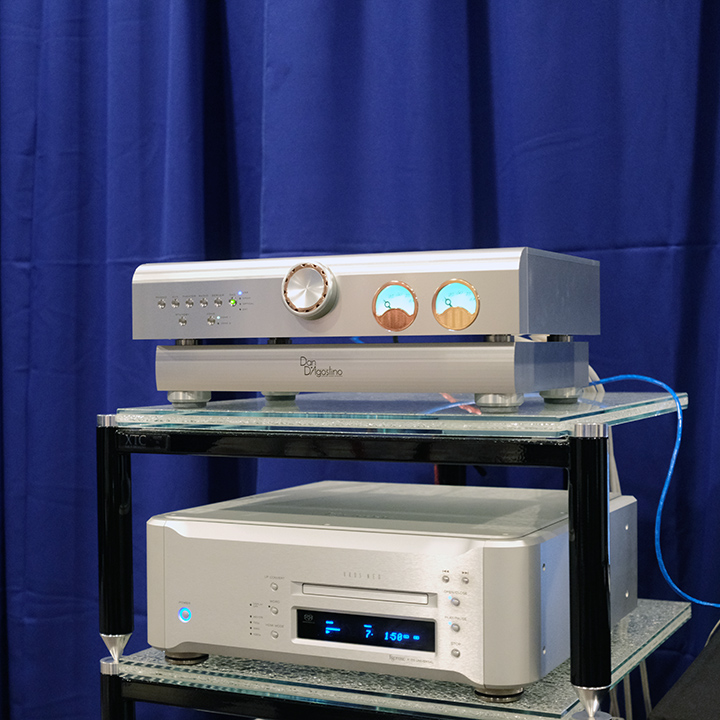
We’d only seen D’Agostino’s prototype to the Progression preamplifier about 10 days before at Munich. This time, we got to hear it in the flesh, playing an Esoteric front end, out to the matching power amplifiers into a pair of Focal Utopia floorstanders in a room run by The Source. This had excellent potential and dialled out the room for once!

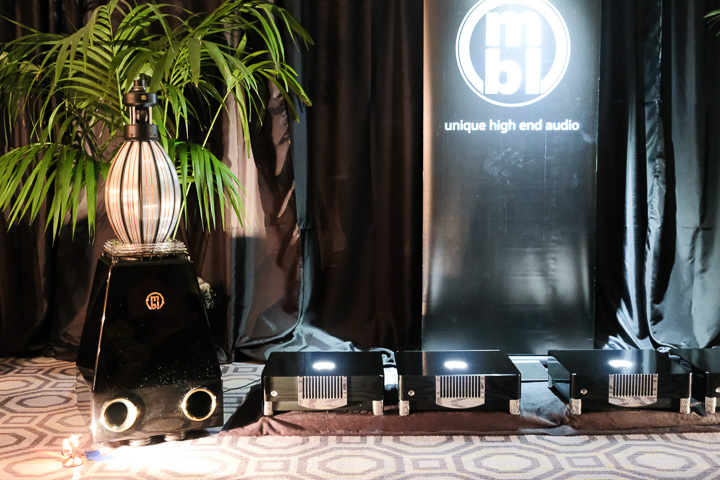
MBL’s demonstrations are always impressive, but this one was truly captivating. The system set-up was virtually identical to the one used in AXPONA, running both digital source and open reel. Wonderful stuff!

With a VPI Avenger, playing with a prototype 12″ 3D Printed ‘FatBoy’ JMW arm and a Lyra cartridge, all playing into German Physiks Borderline loudspeakers, the Merrill Audio amplification breathed an impressive sense of life and dynamic range extension into the room.


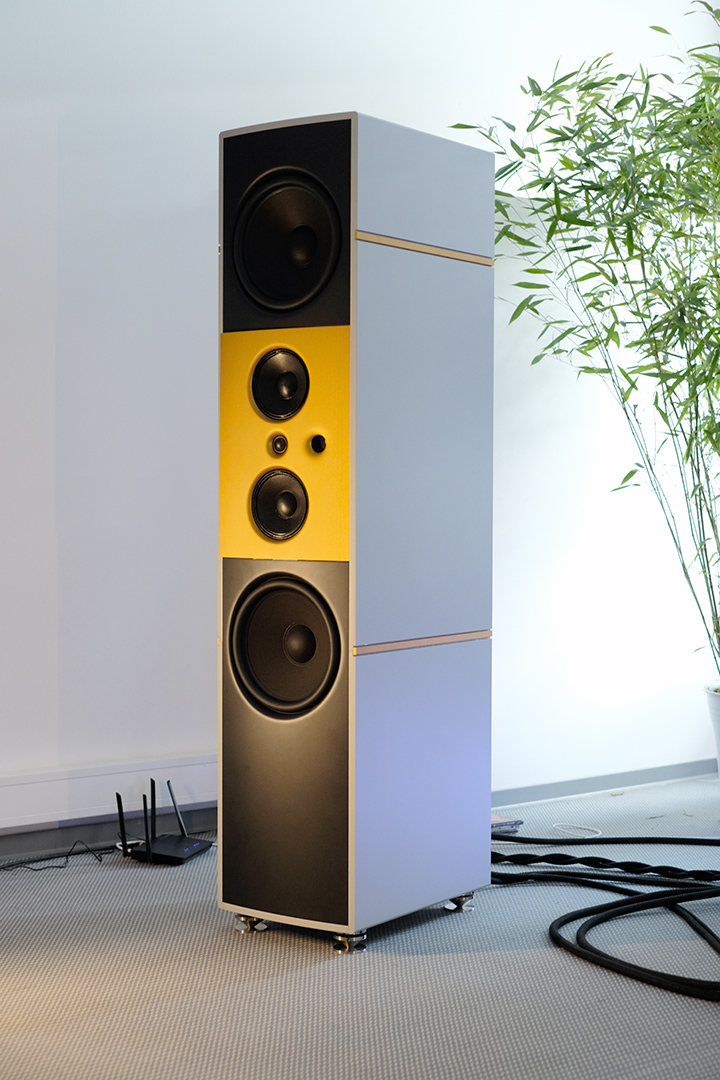
Not all of the best sounding rooms used punishingly expensive equipment. Several rooms featured speakers made by the Ryan brothers, Trevor and Todd. The new three-way, four driver $8,000 S840 looks to channel at least some of Ryan Speakers’ Tempus III flagship. The outstanding $2,000 R620 was singing sweetly in the AURALiC room, too.

Magnepan wasn’t doing much in the way of ‘normal’ demonstrations. The purpose of these sessions was to play with what we consider possible from a panel loudspeaker (or indeed any loudspeaker). Which meant you spent a few minutes sitting and listening to a curtain. Behind the curtain were a pair of stacked MMG loudspeakers (sitting in an utilitarian frame of angle iron, which you can just see poking out above the curtain) and a centre-fill loudspeaker. An interesting experiment!

Distributor Philip O’Hanlon of On A Higher Note was demonstrating Vivid Giya G2 loudspeakers with his usual aplomb, using a fine selection of records. There were amplifiers used, but no one seems to be able to recall precisely what brand of amplifiers! His demonstrations are always worth a visit!


One of the surprise last day sounds for me was the Einstein room. Einstein always makes a good sound, but I’d been told it was a ‘must see’ by several people. The other ‘must see’ rooms were disappointing, but Einstein, with TechDAS/Graham front-ends was truly mesmerising. Arguably the star of the show.

Nola Speakers was one of the few brands showing something actually new, in the shape of the $40,000 Metro Grand Reference Gold 2 loudspeaker. The main changes are an upgraded ribbon tweeter and mid-bass drivers, revised components in the crossover and more Nordost wiring internally. It also features a double platform ball-bearing isolation base. It’s still the ultimate Nola for the apartment dweller!

As in Munich, the $69,500 Wilson Benesch Resolution was playing sweetly through Ypsilon electronics, a Thales turntable with Ikeda cartridge and huge Stage III boa-constrictor sized cables. The room sounded good enough to pick up awards, and deservedly so.

Few rooms at the show were consistently packed. Steve Lefkowicz’ room was the exception. Steve amassed a collection of low cost audio components, which he was putting together in systems, using years of experience working with Positive Feedback. We need more of this!

There were more of course. PranaFidelity’s $4,950 Bhava standmount. Grand Prix Audio’s $16,500 Parabolica turntable, the lovely looking and sounding Chord Electronics/Jadis/Spendor system, Viola Labs excellent sounding system, Neat Acoustics Ultimatum XLS loudspeakers, the consistently excellent turn-out from Hegel, Magico, and Vandersteen.

There will also be a round-up by Chris Martens following presently.

Munich High-End 2017: Final Thoughts and Product of the Show!

As is often said – including by myself – Munich High-End has become the most important event on the audio calendar. This is not simply because of the attendance figures (even if they are continuing to rise), it’s because the show is a magnet for international business and those seeking to reach that international business. More than 500 manufacturers ply their trade in search of one or more of those dealers and distributors walking the halls in search of new products.

Except… does it really work that way?

Certainly there are hundreds of manufacturers exhibiting and there are hundreds of dealers and distributors from around the world attending, but it seems that a lot of the business done at Munich is unevenly distributed. Here’s how it works. Successful distributors have long-standing relationships with well-established companies. They attend Munich High-End to continue and extend those relationships with their existing brands, seeing the new products from those brands they will be distributing and selling. If a successful distributor has maybe 10 high-end brands, that process of meeting existing brands will take up almost all the time they have to spend at Munich High-End, and the smaller companies trying to get a foot in the door might be lucky if their potential distributors spend half a day walking around the rest of the show.

The only time this cosy relationship between the major brands and those who support them changes is when there is some sort of massive ‘falling out’ between the two parties. At which point the manufacturer goes in search of a new distributor, and the distributor goes looking for rival brands in that sector.

So, while there might be more than 500 brands on show at Munich High-End, possibly less than 100-150 of them write down any significant new business. I suspect these are the top 100-150 brands best known in the industry. I also suspect the 100-150 brands at the other end of the industry come away with a huge bill for attending and a growing sense of panic at how little business came their way.

In a way, we are all complicit in this. Dealers and distributors alike want those larger, more successful, more well-known brands because they sell. Magazines and websites gravitate toward those brands because they sell magazines and put more eyes on the website. And customers are drawn to owning and reading about products from companies they know well. An air of ‘forced positivity’ is pushed through the industry, too, because few of these small companies will admit to underperforming at Munich, as it represents being tested in the crucible of modern audio… and failing.

I don’t want to be a Cassandra in all this, but maybe we need to be a little more honest about the shape of the audio industry, and how that industry is changing. And to that end, I’ve chosen one product–from that ‘more successful’ end of the present audio world – as my Product of the Show.

With the new Leo (anticipated to be around $5,000) Constellation reset the levels. Leo is a departure for a company better known for making audio electronics that can cost up to the six-figure mark. Instead, Leo is a one-box stereo device that looks like a stealth fighter and features a three-way loudspeaker for each channel, 560W of Class D amplification, MQA-ready, 24/192-compatible, Roon-end point, as well as Chromcast, AirPlay, and Bluetooth wireless capacity. It even includes a MM/MC phono input, and can be configured as stereo speakers. The specs alone are impressive (many of these elements don’t sit entirely comfortably together, and Constellation resolves this by bringing some heavy lifting DSP to the table), but it’s backed up by some seriously impressive sounds in an otherwise drab show. In later discussions with the team, Leo forms the beachhead in a new ‘Dominion’ series of products with similar genre-bending goals. Keep watching the skies!

Arcam SR250 integrated amplifier

Audiophiles have a somewhat justified reputation for being conservative in nature. This can be a good thing: we are the people who kept vinyl alive before it was fashionable, and we are the people who are sparking a revival in open reel tape even though it’s been – at most – a niche within a niche for decades. But this has its darker side, such as our almost pathological rejection of all things ‘home cinema’. The Arcam SR250 challenges this prejudice head on, as it’s a two-channel AV receiver that is – from an audiophile perspective – bloody good! Perhaps still worse for the prejudice part, it’s bloody good in part because of its AV receiver aspects.

There is a touch of ‘huh?’ about the rationale behind the SR250, both from the traditional two-channel and the AV world, as it seemingly commits sins of commission for the former and omission in the latter. The two-channel world (erroneously) sees no need for HDMI connectors, Dirac Live room correction, or anything to do with Dolby or DTS, while the AV world sees this as having too few channels to be worth bothering with. While it’s hard to argue the latter with someone who has already installed a full Dolby Atmos speaker system and demands seven channels of amplification, anything more than a surface reading of the specification sheet shows up a really impressive design that runs roughshod over the rules of the Great Audio Divide.

All of which means the SR250 is a 2x90W Class G AV receiver designed for stereo systems, although it can be driven as a 2.1 or even 2.2 channel system. It supports both Dolby Audio and DTS HD Master Audio (these are not as pointless as it might seem to the stereo-only audiophile, as both are useful for accurately downmixing multichannel-encoded audio into two-channels in the manner and resolution intended at the engineer’s mixing desk). It also features Spotify Connect, so Spotify Premium users can send their music selections direct to the SR250 so long as they are on the same Wi-Fi network. It has both an FM and DAB radio tuner as standard, or you can drive internet radio through the company’s own vTuner service portal, and this can be controlled from the supplied remote.

Class G might be a new amplifier design to many, although is notionally similar to the Class H designs used in PA systems. The idea is to retain the properties of a Class A design in sonic terms, but with good, solid Class AB design power when needed, without the inherent heat issues of higher-power Class A designs or the crossover distortion of Class AB. This works by having multiple power supplies feeding the output stage; one set for those subtle ‘first watt’ moments, and a more muscular supply set for the heavy lifting duties. This is a complex, and therefore more expensive, circuit to design and implement, but the result is the clarity and finesse of Class A with the dynamic power and scale of Class AB, all in a package that runs efficiently.

As discussed earlier, there are seven HDMI audio/video inputs and three outputs (two standard outputs and one for a second zone), alongside six RCA phono stereo analogue inputs, four coaxial and two optical digital audio connectors, an Ethernet RH45 socket, an input for FM/DAB radio and, perhaps somewhat perversely, a USB A socket for use with USB drives and for software updates, but no USB B socket for a direct computer connection. There are also the usual RS232 and trigger connections for custom install use (with downloadable Control4 and Crestron modules), and a 6V output for those wishing to power one of Arcam’s rSeries products direct from the SR250 (a phono stage is the obvious choice, here).


Ethernet is the preferred pathway for stored music it seems, and Arcam makes an iOS app to control both the UPnP functionality and basic controls of the SR250. There is no matching Android app, unfortunately, which is a shame because the app works so well, the amp seems almost hobbled without it. For such a complex amplifier, its control surfaces and display are relatively minimalist, and one could be forgiven for thinking this just a bulky stereo integrated amplifier.

The big feather in the SR250’s cap is Dirac Live. This is a suite of room correction programs designed to measure, analyse, and compensate for your room’s idiosyncrasies. There’s a microphone supplied with the SR250 (although you’d be wise to obtain a microphone stand) and the program is downloaded to your Mac or PC. You take a number of measurements in preset locations around the listening position (Arcam recommends using the ‘sofa’ configuration rather than ‘chair’), the program then sends the results to Dirac, which analyses the resulting test tones to create a config file for the SR250.

This creates both a degree of compensation for the sub-200Hz region, carefully worked phase linearity across the frequency range, and a gentle tailoring of the frequency response to bring the loudspeaker in line with a notionally perfect model. There are three ways to think of this kind of equalisation; with knee-jerk horror at the inclusion of DSP (the pivotal word here is ‘jerk’), as a kind of Band-Aid to repair all kinds of installation ‘nasties’, and the right way: as a way of making a well-integrated and well-installed system sound even better. Set the system up with all the precision needed to make it sound as good as it can first, then run Dirac to bring out the last degree of nuance. Better still, hand this over to a professional installer who has both the tools (a good measuring microphone on a mic stand) and the skills to implement it properly. This is a mantra said throughout audio, but Dirac Live requires more ‘laptopping’ than most home audio, and a good dealer with a Black Belt in custom install will sail through what might cause you some bitten fingernails. Arcam has a very useful 15-minute long YouTube video on the reason behind Dirac and how to implement it. If this seems like it is too complex for you to parse, it’s installer time. Yes, of course, you can use the SR250 without implementing Dirac Live, but why would you? It’s like buying an airline ticket and then taking the train.

Perhaps more than most next-gen audio devices, the SR250’s learning curve is front-loaded. The complexity all hits you in the early stages of installation, and once completed, it then behaves like any amplifier, just with app support and UPnP. It’s very much ‘fit and forget’, even if the fit part demands a fairly steep climb.

There are good points and odd points to the overall performance. The lack of Wi-Fi, the lack of provision for USB B and especially capping the UPnP Ethernet signals to 24bit, 48kHz are all things that might prove problematic to some audio enthusiasts, but the provision for Spotify Connect and the Dirac option changes that round entirely. The overall balance of positives and negatives tilts very much in Arcam’s favour with the SR250.

Coming to terms with the sound of the SR250 is a slightly odd experience, especially when fully configured. It’s absolutely unlike what you might expect, especially if you are unable to quite switch off the “it’s a home cinema amp” mode in your head. Because, if you think home cinema and equate that to booming bass and splashy highs, the SR250 does precisely none of that. It’s clean, but not bright, incredibly detailed, and possessed of that kind of erudite refinement that normally comes with valve amplification. But it also has the control and dynamic drive that is normally associated with Class AB power houses. The Dirac’d phase correction and frequency curve do work wonders, although I suspect the phase correction is more useful with loudspeakers that are not Wilson Duettes. The Wilson speaker retained the energy and drive it does so well, but it also came with more of a ‘well mannered’ frequency extension rather than any kind of edginess or brashness that one sometimes gets when hooking a pair of loudspeakers to an amp that is almost one-tenth the price. This doesn’t sound artificial, like there has been a ‘toob-filter’ applied to the sound, more that the SR250 makes the loudspeakers sound a bit more like they should be sounding.

One of the reasons why this is slightly weird sounding at first is what you hear is often the sound of the limitations of other designs. The bass isn’t overt, and the treble isn’t overemphasised; these aspects of the frequency response are just honest. And that at first can make it seem to be almost dull sounding and quiet sounding. And it stays sounding quiet until you try to talk over the system and you realise just how much it holds in reserve. This is a remarkably honest, extraordinarily powerful amplifier (far more than the 90W might imply), which is quietly ticking over when other amplifiers are fully revved up.

That’s not to say it’s somehow laid back. That brief moment of ‘dull’ sound quickly gives way to a more honest appraisal of the sound of the loudspeakers. You realise the amplifier is just incredibly honest and undistorted, in a way that highlights just how rare those claims really are at this price level. Yes, if you go for cost no object audio and look to the biggest and best, then honest and undistorted are fairly achievable goals. But this isn’t a Constellation Audio product and isn’t priced at Constellation Audio levels, and yet a well set-up SR250 gets on the same page as the big hitters with even bigger price tags.

The usual indicators work wonders here. Piano and female vocal are perfect indicators of a system’s overall fitness, and the Arcam gets a clean bill of health. Playing ‘Take the Night Off’ by Laura Marling [Once I Was An Eagle, Virgin] is a perfect example of what the Arcam SR250 does so well to music, as her voice is remarkably pure in tone (like a modern Joni Mitchell) and so easy to get wrong. Here, she simply soars above the acoustic guitar tones, seemingly unconstrained by the electronics in the audio chain. It’s like listening to the live event. Once again, these are commonplace suggestions when dealing with very high-end audio, but rare at anything like this level.


Although we’ve concentrated on the naturalness and purity of the sound, the effortlessness also applies to things a little more raunchy, whether grungy rock chords or full-tilt orchestra swells. Ultmately, the amplifier might not have quite the metronomic accuracy of some of the true keepers of the beat, but it’s no slouch in this aspect either. Playing ‘April Skies’ from The Jesus and Mary Chain’s epic Darklands album [Blanco y Negro] highlights this perfectly; the music had the power and scale required to deliver the almost wall of noise created on this 30 year old indie classic, but only had some of the shoegazy rhythmic drive that makes you shuffle awkwardly from foot to foot. On balance, though, I’d take the clarity and dynamic range.

The Arcam SR250 is a really good stereo amplifier, and not just at the price. If you can get past the inherent fear of home theatre intrinsic to many audiophiles, and are prepared to delve into Dirac, this is perhaps the best £25,000 amp you can get for £2,500. Recommended!

TECHNICAL SPECIFICATIONS

Type: 2.1 channel stereo AC Receiver

Continuous power output, per channel, 8Ω: 2 channels driven, 20Hz – 20kHz, < 0.02% THD – 90W 2 channels driven, 1kHz, 0.2% THD – 120W Residual noise & hum (A-wtd) – < 0.15mV

Audio Performance (Stereo line inputs): Signal/noise ratio (A-wtd, stereo direct) – 110dB Frequency response – 20Hz–20kHz ± 0.2dB

Video Inputs: 7x HDMI (6x HDMI2.0a, HDCP2.2, 1x MHL compatible)

Video Outputs: HDMI – 2x Z1 (out1 ARC, HDMI2.0a, HDCP2.2, out 2 HDMI2.0a, HDCP2.2), 1x Z2 (HDMI2.0a, HDCP2.2)

Audio Inputs : 7x HDMI, 4x Coax S/PDIF, 2x Toslink, 6x RCA Phono, 3.5mm aux, USB input, Ethernet Client, Internet Radio, ARC (from display)

Audio Outputs : 2.1 Pre-amp output – 4x RCA Phono Zone 2 output – RCA Phono

Radio Tuner : FM / DAB / DAB+ (in appropriate markets)

General : 2x 12V Trigger x2, 2x IR in, 1x 6V rSeries PSU

Dimensions (W×D×H): 433 × 425 × 171mm

Weight: 15.1kg

Price: £2,500

Manufactured by: Arcam

URL: www.arcam.co.uk

Tel: +4(0)1223 203200

Back to reviews

Read more Arcam reviews here

YG Acoustics Sonja XV multi-cabinet loudspeaker system

The Arvada, Colorado-based firm YG Acoustics is widely considered to be one of the three leading producers of true top-tier loudspeakers in the United States (the other two being, of course, Magico and Wilson Audio). All three firms are known for their uncompromising and single-minded pursuit of sonic excellence, yet each takes its own distinctive approach in the ascent to the sonic mountaintop.

Since its inception in 2002, YG Acoustics has been a science and engineering-led company, but one whose work has always been informed by extensive critical listening and a keen and discerning musical sensibility. The firm has by tradition offered a comparatively simple product range where the aim was to produce a handful of equally superb but differently sized floorstanding loudspeakers that could scale up or down to fit the requirements of various sizes of listening rooms. Thus the first generation YG models were, in ascending order of size, the Carmel, the Kipod, and the Anat, while the second generation comprises the small Carmel 2, the mid-size Hailey, and the large Sonja—all of them, save for the single-chassis Carmels, configured as modular loudspeakers with milled aluminium enclosure systems.

For a long time, YG’s founder and president Yoav Geva felt that his three-model loudspeaker family could meet the needs and desires of the majority of demanding, performance-minded audiophiles, and with good reason. The speakers sounded great, measured very well, and offered exquisite build quality. All the models in the range shared the firm’s specialised design and construction technologies, and all were built to meet the same high standards for build quality and sonic performance. In practice, then, this meant that differences between the models were not so much qualitative ones (although some qualitative differences could be observed), but rather were more a matter of scale.

Over time, however, a number of YG’s distributors approached Geva to ask if he could create a larger and higher performance version of the flagship Sonja—a seemingly simple request, but one that posed two daunting questions. First, given how much of Geva’s personal expertise and know-how had already been poured into the flagship Sonja, was it realistically possible to exceed its performance in meaningful ways? Second, if hypothetical performance gains were possible, how could they be achieved in practical design and manufacturing terms? Geva has spent over two years seeking answers to these questions and the result is now the spectacular four-way, four-tower Sonja XV (‘XV stands for ‘Extreme Version’) loudspeaker system ($265,900) that is the subject of this review.

The Sonja XV system is a four-way, four-tower loudspeaker that incorporates a total of 20 drive units (two tweeters, four midrange drivers, six midbass drivers, and eight woofers) and an enclosure system that uses twelve dedicated modules made of CNC-machined, black-anodised aircraft-grade aluminium. Each Sonja XV speaker consists of two towers: a main and a companion woofer tower that are both 1.79 metres tall. The twin towers are similarly but not identically proportioned and share a common design motif, with each tower featuring three stacked modules, starting with broad-shouldered woofer modules at the floor level, and with middle and upper modules featuring subtly curved sidewalls that gradually taper inwards as the towers rise upward. Although YG Acoustics tends not to emphasise this point, Porsche Design played an essential consulting role in helping to develop the system’s elegant industrial design aesthetic.


The main tower consists of a midrange-tweeter-midrange module at the top, a three-driver mid-bass module in the middle, and a bass module at the bottom. The woofer tower, in turn, also has three modules, with three woofer modules perched atop one another. Visually, the illusion is that the three woofer modules are of different sizes, but in point of fact they are different in shape but identical in volume.

Obviously, part of Geva’s plan for improving upon the sound quality of the original Sonja was to distribute the Sonja XV’s workload over a much broader array of drivers, thus minimising the excursion and distortion levels of the drivers in the array. The objective was to give the speaker virtually limitless frequency extension and dynamic capabilities. Another element in Geva’s performance enhancement plan was to design the Sonja XV as the firm’s first-ever four-way model, with crossover points set at 1.75kHz, 337Hz, and 65Hz. The intent was to have each main frequency band—and especially the critical midrange and mid-bass bands—handled by their own sets of purpose built, frequency-optimised drivers.

Through the years, YG Acoustics has developed a number of specialised, proprietary loudspeaker design and construction technologies and of course the firm has applied all of this speaker-building know-how in the Sonja XV, while adding some impressive new technical features unique to the new flagship speaker system. It is worth taking at least a cursory look at these technologies, since they collectively play a huge role in defining the sound of the speaker.

Large YG loudspeakers use modular chassis where each module can be optimised for the specific set of drivers it encloses and where the modular approach simplifies transportation and installation tasks while also—as you will learn later on—affording at least some degree of flexibility in configuration. The enclosures are made of exquisitely finished CNC-machined, black-anodised slabs of aircraft-grade aluminium, and by design panel-to-panel joints leverage aircraft-style ‘pressurized assembly” techniques that impart tremendous structural rigidity while holding unwanted vibration to an absolute minimum. Then, within, YG uses its so-called FocusedElimination™ technology to apply various proprietary anti-resonance materials in strategically chosen cabinet locations, providing critical damping while minimising internal turbulence and friction. The result is a rigid, acoustically inert, and well-damped enclosure that manages to offer, notes YG, the sort of friction-free performance “associated with enclosure-free concepts”.

Unlike some manufacturers, YG does not use off-the-shelf drivers in its designs. Instead, all YG bass, mid-bass, and midrange drive units use the firm’s proprietary BilletCore™ driver diaphragms, where driver cones are CNC-machined from billets of aircraft-grade aluminium. This admittedly costly and labour-intensive technique offers several key benefits. First, machined diaphragms are claimed to offer tighter dimensional tolerances than either stamped metal or composite driver diaphragms and they make it possible to machine strategically positioned stiffening ribs into the rear surfaces of the diaphragms. Second and most importantly, YG’s machined diaphragms remain free of the micro-stress-cracks that eventually can and do form in stamped metal or composite diaphragms; in short, BilletCore diaphragms offer superior performance from the outset and over the long haul.

New for the Sonja XV is an impressive BilletDome™ tweeter, which YG says is the firm’s “most complex mechanical invention to date”. The tweeter uses a uses a resonance-free fabric dome that is reinforced by a light, stiff precision-machined aluminium ‘airframe’ that looks like a miniaturised, gently curved flying buttress that supports the sides and centre of the fabric dome from within. The airframe weighs just 30 milligrams, but its support legs are proportioned so that they add enormous stiffness—yielding a dome that is even stiffer and stronger than a solid metal dome would be. The result is a tweeter that offers incredible acceleration capabilities and effortless treble extension to 40kHz and beyond, yet that does not exhibit the hard, sharp resonance peaks most metal dome tweeters do. To complete the picture, the tweeter’s motor features YG’s signature ForgeCore™ magnet system, which uses a combination of forging and CNC-machining techniques to introduce what YG describes as “sophisticated 3D geometries” said to reduce distortion while imparting “a sense of ease to the sound”.


In lieu of traditional printed circuit boards, YG’s crossovers feature heavy-duty fibreglass boards covered with extra thick layers of high-purity copper, where—owing to the thickness of the copper—circuit traces and component mounting-pads are precision CNC-machined into the surfaces of the boards. Only the highest quality resistors and capacitors (sourced from manufacturers such as Mundorf and others) are used on the boards, but for critical midrange and tweeter applications YG uses its own proprietary ToroAir™ CNC-wound, toroidal air-core inductors, which are said to reduce crosstalk and to eliminate unwanted “harshness, brightness, or sibilance”.

Then, as a performance enhancement for the woofer section of the Sonja XV’s crossover network, YG introduces its new ViseCoil™ inductors. Typically, inductors used in high-power/low-frequency applications are prone to residual losses, non-linearity, and quite audible vibrations. ViseCoil inductors, however, are CNC-wound in the YG factory and then encased in ultra-beefy, vise-like milled metal enclosures that resist vibration, while cutting residual losses by 24%, and improving linearity by 60%. The result is audibly superior bass control, better low-end transient impact and pitch definition, and the sense that there is simply less low frequency noise.

Tying all these technical elements together is the jewel in YG Acoustics’ design crown: namely, the firm’s proprietary Geva-developed, DualCoherent™ speaker design software that has the singular capability of optimising the loudspeaker’s frequency and phase response at the same time—something no other computer-aided software design tool we know of can do. Geva’s DualCoherent design tool arguably gives YG’s speakers a significant performance edge and one not easily matched by competitors.

The Sonja XV is an ambitious, cost-no-object loudspeaker whose performance targets are as high as they come. But how does it actually sound when playing real music in real-world listening environments? To find out, I was offered the opportunity to have a private, multi-day listening session with the Sonja XV as presented in the large listening room at GTT Audio’s beautiful facility in Long Valley, New Jersey (a space that YG Acoustics feels is one of the best-sounding Sonja XV demonstration facilities in the USA). Driving the system was a Roon-based music server, an extensive suite of Audionet amplification and source electronics, plus a Kronos/Airtight analogue turntable system. Then, tying the components together was a mixed set of Kubala-Sosna Realization and Elation audio cables. The resulting sound was breathtaking.

First, I found the Sonja XV to be smoothly balanced and neutrally voiced with essentially limitless extension at both frequency extremes. These extension capabilities became particularly apparent when either evanescent, upward-reaching treble passages or powerful, deep-plunging bass passages came along.

For example, when I played the track ‘Bell Painting’ from Marilyn Mazur and Jan Garbarek’s Elixir [ECM, 16/44.1], which features a delicious mix of small, high-frequency percussion instruments in play, the Sonja XV responded with effortless transient agility and terrific resolution, beautifully recreating the sound of the instruments playing within the reverberant recording space. Despite its size, the big Sonja XV perfectly captured the small, intimate, and tightly focused sound of the performance, while doing a beautiful job with the distinctive voices and reverb tails of each of the instruments.


The Sonja XV also proved just as capable when faced with demanding bass tests. One such test would be the track ‘O Vazio’ as performed by the Jim Brock Ensemble on Jazz Kaleidescope [Reference Recordings, HDCD], which features several passages with high amplitude and very low frequency percussion content. Frankly, these passages routinely cause loudspeakers to become overloaded and to falter in audible ways, but when I played them through the Sonja XV all I heard was powerful and extremely low frequency bass delivered in a taught, precisely textured, and pitch-perfect way. Boom. No drama, no distress, and no histrionics: just powerful and dramatic bass content as required by the music. This pattern of the Sonja XV handling so-called audio torture tests without even breaking a sweat is one that repeated itself over and over again during my listening tests.

Next, I discovered the Sonja XV was capable of extraordinary resolution, but not of the type that draws overt attention to itself. Rather, the speaker offers ‘organic resolution’—the kind that slyly astonishes you with unexpected moments of sheer realism. A great example would be Miles Davis’ live performance of Cyndi Lauper’s ‘Time After Time’, from Live Around the World [Warner Bros., 16/44.1], where not only does Davis’s horn sound believably real, but where soft accompanying percussion instruments and indeed the entire acoustic setting of the performance stage sound real, too. As one guest who joined my for some of my listening sessions put it when hearing this track, “If you close your eyes, this presentation really is pretty much indistinguishable from being present at a live event.”

What makes this possible is the way the Sonja XV’s so perfectly capture the attack, bloom, and decay of notes from individual instruments in a holistic way that lets you hear and feel how the entire ensemble interacts with the performance space. What is also stunning, however, is the way the speaker serves up gobs of low-level transient and textural details, but without even a hint of dryness, overshoot, or excess treble brightness. As in real life, musical details are simply present and available to enjoy, but without unpleasant artefacts marring their appearance. Suddenly, it’s as if you’re no longer listening to recorded music, but rather are experiencing a taste of what it must have been like to be present when the music was made.

Third, the Sonja XVs proved to have superbly expansive dynamic capabilities, not just in terms of playing ‘big’ (although the speakers can certainly do that), but also in terms of playing both big and small while preserving the dynamic contrasts inherent in music. This can be quite dramatic when playing recordings whose dynamics might have seemed unremarkable in the past, but which the Sonja XVs show to be far more expressive than you at first thought. A good example came in the form of the second movement (Scherzo: Allegro molto) of the Copland Organ Symphony as performed by Michael Tilson Thomas, Paul Jacobs, and the San Francisco Orchestra [SFS Media: DSD64]. The movement came alive through the Sonja XVs, as the speaker sharply underscored the contrasts between the quieter and more contemplative organ passages vis-à-vis the louder and more vigorous orchestral passages. In fact, the Sonja XV made these contrasts much more dramatic than any other loudspeaker on which I’ve tried this recording. Through the YGs, the track seemed ‘reborn’ in a musical sense, taking on new dynamic shadings I never realised it possessed. In short, the Sonja XVs give music its proper lifelike scope and scale, providing the recording is willing.

Finally, the Sonja XV is capable of amazing imaging precision, focus, three-dimensionality, and soundstage width and depth. One recording that forcefully drove home this point was an old favourite: namely, the Von Karajan/Berlin recording of Bartok’s ‘Music for Strings, Percussion & Celesta’ [DGG, 16/44.1]. On this recording, the Sonja XV paints a vivid and spatially specific picture of each of the orchestra sections arrayed in their designated positions upon the stage, while nicely conveying a sense of both the size of the orchestra and of the recording space. Images are not just precisely placed from left-to-right and front-to-back, but also solid and almost palpable in their presence.

Put all of these technical and sonic factors together and the YG Acoustics Sonja XV stands as the finest and by far the most accomplished loudspeaker I have yet heard, and by no small margin at that. If your budget and listening space permit, the Sonja XV will serve you as a mighty musical force for good and one that will not easily be equalled, let alone surpassed.


The Sonja XV Junior – A smaller alternative to the Sonja XV

The Sonja XV is a big loudspeaker system that performs best in sizable listening spaces—rooms larger than some enthusiasts may possess. To address this potential issue, YG Acoustics can—on a special order only basis—build what is in essence a ‘Sonja XV Junior’ model that is identical to the full-size Sonja XV in most respects, but that foregoes the lower woofer modules from both the standard XV’s main and woofer towers, reducing the total woofer count from four to two per speaker. Naturally, this change also requires a special, purpose-built crossover network that compensates for the shorter system’s reduced number of woofers. The result is a significantly more compact system that—apart from its absolute bass output capabilities—sounds identical to the full‑size Sonja XV and that may better fit mid-sized listening rooms.

TECHNICAL SPECIFICATIONS

Type: Modular, sealed enclosure, four-way, four-tower, dynamic driver-equipped, loudspeaker system. Enclosures for tower modules are CNC-machined from solid aircraft aluminium.

Driver complement (per channel): One BilletDome™/ForgeCore™ tweeter, two BilletCore™ midrange drivers, three BilletCore™ mid-bass drivers, and four BilletCore™ woofers. (A total of 10 drivers per channel, or 20 drivers per stereo system.)

Frequency response: Below 20Hz – above 40kHz, ± 1dB in the audible band, ± 5° relative phase throughout the entire overlap.

Impedance: 4 Ohms nominal, 3.5 Ohms minimum

Sensitivity: 88dB/2.83V/1m 2π anechoic

Dimensions (H×W×D): Four towers, each 179×43×72cm

Weight: Four towers, each 210kg unpackaged. Shipping weight for the entire system (crated) is 1.3 tonnes.

Finish: Black anodised aluminium

Price: $265,900/pair

A word on product availability: The Sonja XV system is not yet available in all markets. Readers interested in the Sonja XV are advised to consult their regional YG Acoustics distributors to determine if the speaker is available in their home market.

Manufacturer Information: YG Acoustics LLC

Tel: +1 801-726-3887

URL: www.yg-acoustics.com

UK Distributor:

Padood

Tel: +44 (0) 1223 653199

URL: www.padood.com

Back to reviews

Read more YG Acoustics reviews here

Helius Designs Alexia turntable and Omega tonearm

One of the great woes of this period in the audio industry is that we seem to be coming to the end of the Age of the Personality. The audio world used to be littered with big, bold, and sometimes completely loopy characters that made products that were touched by genius. OK, sometimes the ‘loopy’ overarched the ‘genius’, but these big characters helped shape the high-end. They are all but gone now, pushed out by legislation – no bad thing: I was once nearly killed by an amp design guru who accidentally wired the case to the live AC – and replaced by interchangable corporate types and marketing jargon.

The one last safe haven for the Audio Personality is the turntable. Vinyl has long attracted more than its fare share of characters and eccentrics, in part because it’s more of an engineering solution than an electronics project. And, it must be said, many of those personalities have created some outstanding contributions to the turntable art. Any list of such personalities should include Geoffrey Owen of Helius Designs. Back in 1983, when the impending impact of the Compact Disc had turntable makers concerned for their future, Helius Designs launched its first tonearms, the Cyalene and Orion. These innovative designs were extremely well received in some circles. However, by the mid-1990s, sales of all things LP hit a nadir, people started talking about their ‘final vinyl’ system, and Helius just fell off the map for a few years, and Owen and his company turned its attention back to the other side of the company; astronomical (and later medical) imaging. Mechanical compliance gave way to laser optics, but the passion for music and the sound it makes never quite went away, and a few years ago Helius quietly returned to making tonearms.

The market has changed during Helius’ hiatus. In the 1980s and early 1990s, it was possible to have demonstrations of different turntable, arm, and cartridge options, and buying a turntable platform and ‘swapping out’ a few arms before happening on the right one was still a thing. That doesn’t happen anymore, and most people buy their turntable and arm from the same manufacturer, at least until you get to the super-high-end level where choice is bought at great expense. So, Helius Designs had three options; become a micro-manufacturer, turning out one tonearm every few years as and when someone happens on the brand, going back to Laser Life full time, or designing a turntable. Geoffrey Owen chose the latter option, and the Alexia was born.


Of course, it would be so easy for a tonearm designer to make a mediocre turntable that was simply a platform to showcase the tonearm, but that would ultimately be self-defeating. The Alexia is not simply there to reflect the underside of the tonearm, but is a distillation of Owen’s years of building telescopes and an understanding of how that kind of precision is relevant and applicable to making a record spin ‘right’. In Owen’s book, this means nailing platter rotation speed while reducing acoustic interference to a minimum.

Platter rotation speed is easy to get right, so long as you don’t mind a lot of acoustic interference. Simply make the platter as heavy as possible, give it a good motor, and any minor inconsistencies due to stylus friction are simply swept away. However, such designs are prone to pick up acoustic noise from the environment. It’s also easy to minimise acoustic interference by making the platter so free that any such interference is lost in the suspension system, but in the process the lightness of the design means stylus drag can influence speed stability. High torque motors help here, but power corrupts (and costs). In most cases, the answer is a compromise, and some of the more successful turntables of the last fortysomething years have been the designer’s expression of that compromise.

Helius decided not to join that continuum, but instead rethink the project through from scratch. It sounds fairly obvious to the point of being circular logic, but the way to control the platter speed is to regulate the speed of the platter: by using an optically controlled drive system that monitors the speed of the platter hundreds of times a second and applies corrective measures accordingly. Curiously, most feedback systems of this kind tend to monitor the speed of the motor, not the platter, and by shifting the locus of control to the platter itself, speed stability suddenly gets a lot more precise without having to call on over-engineered mass or motive force.

The Alexia’s suspension system also avoids the usual ‘springs and pillars’ arrangement with only platter and arm on the subchassis, because Owen feels this adds to problems rather than helps. The logic goes as follows: one spring starts vibrating, the rest join in. With these springs happily dancing around, the belt starts oscillating due to the varying tension created by its fixed position relative to the platter, and this causes pitch errors. To combat this, the Alexia has motor, platter, and arm all on the same subchassis, which is suspended on a double wishbone tuned to 1.5Hz. This can only move through the vertical plane, and any kind of horizontal movement is impossible. The bearing is a low-friction ruby design.

The overall look of the deck is timeless, in an almost Bauhaus form-follows-function way. The chassis sits on three points, and level adjustment is performed at this stage, the subchassis rests on the chassis, adjusting the ‘cruising altitude’ of the subchassis comes down to some extremely basic one-handed adjustment, and lots of the subchassis is made of Perspex specifically to prevent any high-frequency feedback from one sub-system to the others. There’s no need for a record clamp.

The Alexia’s natural partner is the Omega arm, as its clever use of non-coincident tungsten bearings and differential mass damping sing similar songs to those of the Alexia. We’ll concentrate slightly less on the Omega, because those with long memories will associate Helius with tonearms like this. It retains the clamshell like bearing housing of the Cyalene, but is more rounded. The non-coincident bearings mean greater integration of vertical and lateral components of a musical signal. In addition, the counterweight is an integral part of that housing, with a smaller downforce-only counterweight sitting on an outrigger shaft (there are two downforce counterweight options, enough to accommodate practically all cartridges).


The build quality of both is good, although fit and finish are best considered to be… OK. The problem any turntable designer has in 2017 is there are some extremely high standards of finish as you move further and further up the price scale. The contrast between the lacquered arm and acrylic deck in particular is noticeable, and the lacquering – though good – is not the kind of thing that might make Japanese marquetry experts nod in approval. The Helius deck and arm are not – in fairness – priced in the SME territory, but they will be compared to this ne plus ultra chunk of up-market production engineering mastery. The fact that SME has a team of finishers to bring the product up to its high standard and Helius has, basically, Owen notwithstanding, the finish is more Nottingham Analogue than it is SME, and there is nothing inherently wrong with that. What’s perhaps more important here is there are few screws that might strip like you are throwing twenties at them.

Similarly, the level of instruction supplied with the turntable is… also OK. In fact, the manual supplied with the turntable is pretty good, combining a step-by-step list of instructions coupled with a few engineering drawings. Whether this fits well with the YouTube generation who might panic at the sight of two pages of type and three line drawings, remains to be seen. There were no instructions supplied for the arm, but muscle memory (and a good alignment protractor and downforce stylus gauge) helped here.

The benefits of both deck and arm seem congruent, in that the ideas behind both seem to fall to limiting the compromises placed on that item by other parts in the chain. The arm is designed to work well with the largest number of cartridges with no complaint, while the deck is made to eliminate the ingress of the outside world on the slab of vinyl.

You can hear this working out almost immediately in a number of fairly obvious ways. There is a lot of detail on offer here, with a huge amount of layering to any image, and yet at the same time a really profound sense of stability of image. This is not a ‘phat’ or lush sounding design; it stays the right side of lean and has a very dry, but fundamentally right sounding, tonal balance. If anything, this puts the tonal onus on the cartridge: too bright, or too woody, and the deck will let you know. It’s not so revealing of cartridge that it’s a deck in constant search of the right partners, but neither is the Helius the sort of turntable you can use in a corner-cutting exercise and plant down any cheap stylus. It wants more than that, and you’ll want to feed it something in the £1,000 or so region. In terms of cartridge choices, tonally the Helius sounds more comfy with Lyras and Benz’ than it does with AudioTechnica or Ortofon. Although, if you want hyper-analytical, a good Ortofon and the Helius will let you know everything that is on the record, good or bad.

As many of us have spent years listening to LP and digital in equal measure, so we have become acutely aware of pitch stability. Digital’s admittedly surface rendition of pitch is so much more accurate than analogue as we know it that we quickly notice the wavering treble of vinyl. It’s almost imperceptible (and certainly not as thick-set as the watery mids and top of low-grade MP3) but when comparing like with like, you can sometimes pick out a very slight trilling of the top end of a soprano’s voice on vinyl that isn’t there on digital. We don’t worry too much about this because the rest of the vinyl performance is more enthralling, but it’s there all the same. Here, though, that pitch precision shone through, in a manner very, very few decks can muster. Given the next deck in price terms that I’ve heard that has this kind of pitch stability without losing a lot in the process is a Spiral Groove, and you might be able to buy an Alexia for every room in the house for the price of a Spiral Groove, this is a major feather in the Alexia’s cap. A great – albeit soprano-free – example of this is the D’Oyly Carte performance of the overture to Gilbert & Sullivan’s The Pirates of Penzance, which I have both on Decca SXL from the 1950s on vinyl and on the Australian Decca Eloquence label on CD. Toward the crescendo of the overture there is a perfectly clear triangle hit repeatedly. It sits in its own physical space in the recording and is remarkably high-pitched and pure-toned. It’s usually the one place where the CD outperforms the vinyl, but not through the Helius.


This is also an exceptionally dynamic combination; switching over to Rachmaninov’s ‘Symphonic Dances’ [Athena], the Helius combination coped with the full onslaught of the orchestra without problem, where so many end up flattening out the highs and lows and burbling along nonchalantly. The obvious parallel is with the classic Voyd turntable (because so many were supplied with Helius arms) and the dynamic range of this deck seems to match that masterpiece, albeit from memory. In fact, dry detail aside, perhaps the only big sonic issue with the Helius is you end up gasping for air after really powerful pieces of music.

OK, so from a traditional turntable perspective, glancing at the side of deck and seeing something that looks like the underside of a car might seem a little odd at first, but the design pays dividends in terms of performance. In a world where there is actually precious little development in turntables – and a lot of hype about recycling the same thing with a different finish – the Helius Alexia and Orion represent a genuinely different and novel approach to getting the job done. That’s well worth checking out.

TECHNICAL SPECIFICATIONS

Alexia

Type: belt-driven suspended turntable

Speeds: 33/45

Platter: Delrin

Motor: AC asynchronous

Speed control: electronic, push button

Price: £3,500

Omega

Type: tonearm

Effective length: 9”

Bearing: tungsten, non-coincident

Price: £1,465

Manufactured by: Helius Designs

URL: www.heliusdesigns.co.uk

Tel: +44(0)1386 830083

Back to reviews

Read more Helius Designs reviews here

Munich High End 2017 – Loudspeakers over €15k

I’m not making excuses for the sound at the Munich High-End show. It was uniformly awful, with a few exceptions. This actually works in our favour because we can concentrate on products of interest rather than ones that happened to sound good. Here is a short list of some of the finest:

Most promising new products/New Brands

Finkteam WM-4

Shown in early prototype form in the Marantz room, the wide, €65,000 WM-4 designed by Karl-Heinz Fink and his team sported BMR midrange units and 380mm paper cone bass drivers to deliver a tight, rhythmic, and yet deep presentation when played through Octave amplification and an Ideon Audio Ayzaki DAC. The performance was reminiscent of classic ‘pace, rhythm, and timing’ designs like the Naim DBL and the Linn Isobarik, so perhaps it was no surprise you could almost feel waves of air pressure from all the nodding heads and tapping feet.

Focal Scala and Maestro Utopia III Evo

Two main models in Focal’s high-end Utopia range – the €32,000 Scala and €50,000 Maestro – have been refined and updated this year. Both will sport Focal’s new Tuned Mass Damper suspension system, claimed to deliver greater linearity and lower distortion in the 1kHz-4kHz region, and the company’s Neutral Inductance Circuit, designed to lower harmonic and intermodulation distortion across the frequency range. The redesigned crossovers in both speakers are housed in their own internal chamber and bi-wiring is back, this time designed for bi-amping use. There are also three new finishes, including this excellent metallic blue finish. There are presently no plans to incorporate the Evo upgrades to other models in the Utopia range.

Magico S3 Mk II

First shown – but not demonstrated – at CES, the $28,000 per pair Magico S3 Mk II was being played for the first time to European audiences through a predominantly Spectral system. The S3 Mk II is a true trickle-down design, featuring the diamond-coated beryllium-diaphragm tweeter, and the graphene carbon midrange and bass drivers are derived from the units developed for the M-Project, which are filtering through the whole M-Series product line. The all-aluminium curved enclosure draws from developments in the line too, with a revised outrigger base, convex top plate, and chambered sub-enclosures for mid and top. The sealed box loudspeaker pulled in big crowds, in part because it was one of the least-compromised sounding rooms delivering surprisingly deep bass from a relatively small loudspeaker.

Art Deco Acoustics Sound + Design

Coming out of nowhere, Art Deco Acoustics trio of products are designed to work together as a system. The system is formed of the M15 two-way passive loudspeaker, which rolls off at 125Hz. As a consequence, it is designed to work with the huge B16 bass loudspeaker, which delivers the goods down to around 28Hz in room. The E17 integrated amplifier, a matching ultralinear, no feedback design sporting a pair of KT150s at the show to deliver 40W per channel, completes the system. The company chose to demonstrate in one of the exhibition hall booths, so proper evaluation was impossible, but the c€135,000 system showed some promise!

Stenheim Ultime

Stenheim’s new €184.5k Ultime, is a large, exceptionally heavy CNC milled aluminium floorstanding enclosure, featuring a four-way, eight-driver D’Appolito driver array. It uses an impressive four 32cm woofers, and two 17cm midranges, as well as a neodymium tweeter and a ribbon supertweeter. Driven by a combination of Kuzma and Wadax front-ends, VTL electronics and Fono Acustica cables, this was one of the rare systems that managed to transcend the limitations of the room, delivering excellent stereo imaging and great detail.


Best Presentation/Sound

Avantgarde

Avantgarde’s show at Munich is always something of an event, as it gives the company the chance to show off its Trio loudspeakers with a three-tall stack of Basshorns, all driven by its XA amplification. This year, this became an occasional PA rig for a drummer that I missed, but as I walked in the company was playing Rammstein at ear-levels. Of note this year, the Trio frame is now available in ‘shiny’. Not chrome-plated aluminium: solid bars of steel polished to a mirror finish. This adds about a quarter again to the already substantial weight and price of the Trio!

Estelon

I’m not sure how to categorise the new Lynx from Estelon. The €50,000 towers are fully active, include built-in DACs and wireless connectivity to be driven by a range of sources from phones on up, and they feature the motorised main baffle designed to align the speaker with the room (as seen on the company’s flagship loudspeaker, the Extreme). Estelon itself calls this the first in a range of Intelligent Speakers, a true plug and play device. And that was how the demonstration played out. This was an impressive idea, with an impressive execution, and an impressive demonstration, too.

Living Voice

Unless you count the new waxed bronze details and the European walnut veneer, there was nothing intrinsically new about the Living Voice Vox Palladian horn/Vox Palladian Basso bass horn demonstration, but once again it was the quality of the presentation that kept people enrapt. It was a hot glass box full of people listening to music, in a place where there were a lot of hot glass boxes part-full of people listening to a collection of sounds. Consistency of presentation is difficult to achieve, especially from year to year but the combination of Origine source, Kondo amplification, and Living Voice horn loudspeakers seems to achieve it. I’d love to say effortlessly, but I think that the effort involved is reason they achieve such consistency.

Joseph Audio

To my mind, the best sound of the show came from a system comprising open-reel tape and streaming into Alluxity amplification into a pair of Joseph Audio Pearl 3. Jeff Joseph had a pre-release, off the desk version of the latest Sgt. Pepper reissue on hard drive, and Dean Martin on UltraTape. Forget ‘all else was gaslight’. All else was drab!

Kharma

I’m calling this out not because of the quality of the sound, the €200k Enigma Veyron EV-4D loudspeakers or the rest of the system used, but just for the sheer effort involved in dressing a room with such professionalism. I’m not sure large framed power cords or grass on the walls is my idea of top-line décor, but absolutely full marks for giving it 100%!


“Mentioned in Dispatches”

Alongside its new turntable, Burmester showed its upcoming BC350, a somewhat less extreme version of the winged behemoth shown last year. Price is still to be determined (but it will be six figures) and will likely be launched in 2018. ELAC also showed a late prototype of the Concenrto M, a €30,000 slimmed down version of its flagship. Others worthy of note include the TIDAL La Assoluta, Raidho’s D-5.1 tower, and the Wilson Benesch Resolution played through Ypsilon electronics. I’m sure there were others, but I have to say I didn’t hear much that got past ‘mediocre’ and one or two that could strip paint at 100 paces. 

Munich High End 2017 – Loudspeakers €15K and below

Most Promising Newcomers

ELAC Adante floorstander prototype

ELAC loudspeaker design guru Andrew Jones brought newly assembled prototypes of his upcoming Adante floorstanding loudspeakers (to Munich and we found their sound promising to say the least. The Adante speaker family is the third (and most ambitious) range of speakers Jones has created for ELAC and they promise to continue Jones’ tradition of offering unusually sophisticated sound for their prices, plus the ability to compete with far more expensive designs. The Adante floorstanders use one of Jones’ signature coincident tweeter/midrange arrays, plus a three-driver bass array with a somewhat unconventional cabinet loading scheme. At Munich the Adante floorstanders candidly sounded more like a proof-of-concept design than a finished product, which is to be expected given that the prototypes were assembled just days before the show. However, the performance on offer at Munich suggests even better things are to come once Jones has time to tweak, tune, and refine his design.

Genelec “The Ones” self-powered, coincident array monitors

I have heard many self-powered Genelec speakers over the years and to be honest I would say I often found them speakers I could respect, but not actually embrace in a wholehearted way. All of that changed, however, when I heard the firm’s new “The Ones” monitors in action at Munich. The Ones monitors come in three sizes: the compact 8331 (€1900), the mid-sized 8341 (€2400), and the large-ish 8351 (€2850). All are three-way designs leveraging coincident tweeter/midrange driver arrays, plus concealed dual woofer hidden behind an aluminium front baffle that serves as a diffraction-free waveguide and whose edges provide subtly shaped slot-loading vents for the woofers within. Genelec calls the Ones “ultimate point source monitors”, which turns out to be much more than mere marketing hype. More importantly the Ones not only offer linear and evenly balanced frequency response both on and off axis (as befits proper monitoring designs), but they are also highly ‘musical’ as well, which is why I suspect they will be sure-fire winners in the marketplace.

Graham Audio LS6 floorstanders & Chartwell LS3/5a monitors with Sub 3 woofers

We have long admired Graham Audio loudspeakers and for Munich the firm showed three models that caught our attention (albeit mostly on static display). The models were Graham’s new LS6 floorstanders (£2995/pair to £3395/pair, depending on finish), new Chartwell LS3/5A monitors (£1750/pair to £2100/pair, depending on finish), and the firm’s new Sub 3 woofers (£1995/pair), which can add appropriate low-end extension either for Graham’s LS3/5 monitors or for the firm’s new Chartwell LS3/5a’s.

In essence, the LS6 floorstanders leverage everything Graham has learned through the creation of its LS6 monitors, but recast in an enclosure of even higher volume (albeit an enclosure that takes up no more floor space than would a set of LS6 monitors mounted on floor stands).

The Chartwell LS3/5a is an acknowledgement that some listeners might prefer the sound of the original and now classic LS3/5a BBC monitor to that of the authentic LS3/5 design (as faithfully reproduced in Graham’s own LS3/5), so that now the firm gives listeners both options.

Finally, the S3 woofer (let’s not call it a “sub” just yet) aims to answer this ages-old question: “What shall I do if want the LS3/5a or LS3/5 sound, but also want true deep bass extension?” The upcoming Sub 3 provides an elegant solution and one that also just happens to act as a height-appropriate “stands” for the LS3/5a monitors. 

KEF next-gen Q-series loudspeakers

For Munich the British firm KEF rolled out its new 2017 Q-series loudspeaker line-up consisting of the Q150 ($549.99) and Q350 ($649.99) standmount monitors; the Q550 ($549.99), Q750 ($749.99), and Q950 ($899.99) floorstanding loudspeakers; the Q650c ($649.99) centre-channel speaker; and the Q400b ($699.99) subwoofer. All models save for the subwoofer use an updated and enhanced new version of KEF’s signature Uni-Q array—one that incorporates a “damped tweeter loading tube” that, says KEF, “enhances performance of the lower treble register.” The 2017 Q models also receive redesigned cabinets said to provide “a smoother and clearer sound.”

Wharfedale Diamond 11-series loudspeakers

Wharfedale’s Diamond-series speakers have traditionally competed for best entry-level loudspeaker honours and so it is significant that the firm launched its new Diamond 11-series range at Munich. For now, the 11-series Diamond range comprises three models: the 11.0 (€199/pair), the 11.1 (€349/pair), and the 11.2 (€449/pair). Later on, additional models including Diamond 11-series floorstanders will be added to the line-up.

A Wharfedale spokesperson told Hi-Fi+ that revisions made to the range were more extensive than in past updates, with updates including: new drive units, redesigned crossover networks, and curved cabinet walls made from laminated of different types of woods of differing density. The proof will be in the listening and we’re eager to hear the results.

Xavian Epica Calliope

It is always exciting to discover new brands that show high performance potential and at this year’s Munich event one such loudspeaker brand was the firm Xavian, hailing from the Czech Republic.  Xavian’s lovely Epica Calliope floorstanding loudspeaker (€10000/pair) gradually captured my attention with its combination of neutrality, refinement, and its ability to let subtle inner details simply speak for themselves. The Calliope is beautifully made, yet styled in such an understated way that it might not initially grip your attention with the sort of purposeful technical flash one might find in, say, a Magico or KEF loudspeaker (speakers that tend, in a sense, to wear their advanced technology credentials on their sleeves, as it were). With the Calliope, it’s all about the sound so that if you stop to listen carefully (not always an easy thing to do at trade shows) they have real potential to win you over.


Best Loudspeaker Sound of Show, 15k and below

Dynaudio Special Forty monitors

The Danes at Dynaudio have managed to create a lovely 2-way standmount monitor called the Special Forty, in celebration of the firm’s 40th anniversary, which will sell for about €2999/pair. But here’s the thing: In every possible way including appearance and sound quality, the Special Forty could easily pass as a far more expensive product. The ‘special sauce’ in this design starts with two very wide range drivers, including a 28mm soft dome Esotar Forty tweeter with internal pressure conduit and frequency response said to extend down to “around 1000Hz—well into the midrange”, plus what Dynaudio says is its best-ever 17cm MSP (magnesium silicate polymer) woofer, whose frequency response extends upward to “around 4000Hz”.  Given the potential for successful overlap between these drivers, the Special Forty is able to use a first-order (phase coherent, 6dB/octave) crossover network, which perhaps helps to explain the Special Forty’s almost eerily lucid and coherent sound. Finally, the cabinets of the Special Forty are beautiful in the way that only fine Danish woodwork tends to be, meaning this loudspeaker should look right at home in the midst of well-made contemporary furniture. Summing up, the Special Forty is the sort of product that leaves one marvelling at the sheer amount of sonic refinement that €2999 can actually buy!

Manger S1 active floorstanding loudspeakers

The German firm Manger has long been a champion of self-powered loudspeakers and the active model that caught and held my attention at Munich was the firm’s two-way S1 floorstander (€15000/pair). The S1 design combines a fast, powerful, and very nearly full-range “Manger Sound Transducer” driven by a built-in Class AB 180 Watt amplifier along with an 8-inch woofer driven by a built-in Class AB 250 Watt amplifier. In the Manger demo system, the S1’s were fed signals from the superb Mola Mola Makua preamplifier/DAC, which sounded terrific.

What struck me about the Manger S1 was its remarkably balanced colouration-free sonic presentation plus the sheer resolution and effortless precision of the Manger Sound Transducer itself. All in all, the S1 is the sort of speaker that invites you to listen deeply and carefully to your favourite recordings, if only to see what new sonic treasures the S1 might reveal. I should also mention that the industrial design of the S1 is simple (but not simplistic), elegant, and very appealing, meaning this is a speaker that not only attracts the ear, but also the eyes.

Monitor Audio Silver 300 floorstanders

I don’t really know how he does it, but over the years Monitor’s Dean Hartley has consistently managed to find ways to improve his firm’s Bronze, Silver, Gold, and Platinum-series loudspeakers in significant ways, yet without imposing cost hikes.

A perfect case in point would be Hartley’s new 6th generation Monitor Silver-series loudspeakers, which were rolled out at Munich. On demonstration were the Silver 300 floorstanders (€1,900/pair), which use a three-way, four-driver configuration. The new Silver models feature new metal-diaphragm C-CAM drivers with, says Monitor, “beefed up driver magnets and improved voice coils”, which are said to yield “a cleaner sound even when listening at high levels. What is more, the Silver 300 and flagship Silver 500 floorstanders both feature a new teardrop-shaped tweeter/midrange module said to deliver “the purest mid-range quality in [this price] class along with precise and consistent imaging”. The upshot is an affordable tower type speaker whose performance could likely compete with that of models selling for twice the Silver 300’s price. In short, value is spoken here, which is a credit to Monitor Audio, to Dean Hartley, and to his team.

Totem Acoustics Sky monitors

The Canadian speaker manufacturer Totem Acoustic has long history of building overachieving monitor-type loudspeakers, but the firm and its legendary founder Vince Bruzzese have really outdone themselves with the new Sky monitors (€2200/pair), which held showgoers spellbound in Munich.

The trick with the Sky is that it is a relatively small two-way monitor of modest size and price, but it emphatically doesn’t sound that way. On the contrary, it offers a big, full-bodied, and room filling sound—a sound so expressive and complete that it is common to see first time listeners either looking for a hidden subwoofer (hint: there isn’t one) or else checking in disbelief to verify that the sounds they are hearing are in fact coming from the compact Sky monitors.

I think we all appreciate products that deliver more performance than we might reasonably expect in light of their size and price, and the Sky certainly fills that role to perfection.


Worthy of Note

Boenicke W5 stand-mound compact monitors

The Boenicke W5 (€2500/pair to €5000/pair, depending on the configuration chosen) is an extremely compact stand-mount monitor that employs a 3-inch wideband driver, a very long-throw 5.25-inch bass driver, and a small rear-firing ambience tweeter. Just how compact is “extremely compact”? Let’s put it this way: If you had two of those relatively thick courier’s satchels that bicycle messengers are found of using, you could likely fit a pair of W5s in your satchels with room left over for the speaker cables! That’s small.

But the trick is that the W5’s don’t sound small at all.  In fact, when heard in juxtaposition to much larger and more costly speakers such as Boenicke’s floorstanding W11 or W13 models, the tiny W5s sound more like their bigger siblings than not, which is most impressive. The longer you listen to the W5, the more you may be inclined to forget about their size and just enjoy the music.

Kudos Titan 707 floorstanders

The British loudspeaker manufacturer Kudos takes pride in creating loudspeakers that, says the manufacturer, are “designed not just for music, but by music.” In other words, Kudos engineers use music first, last, and always to evaluate and inform the design choices they make.

Kudos’ flagship range of loudspeakers would be the Titan series floorstanders, ranging from the Titan 606 (€998/pair), to the Titan 707 (€14,998/pair), on up to the flagship Titan 808 (€26,498/pair). Of these three, I found myself drawn to the middle Titan 707 models as offering much of the sonic goodness of the range-topping Titan 808s, but at a fair more attainable price. So what’s the draw with Kudos’ Titan models? The short answer is that they offer a nuanced yet at the same time very powerful quality of musical expressiveness that just won’t quit.

Meet Your Maker – Heinz Roher of Thorens

Thorens is one of the grand names in audio. The company’s began making turntables almost back when the rest of the world first started making records. 1903 to be precise, and this wasn’t even Thorens first product The Swiss brand began life making music boxes and clock mechanisms back in 1883. Some of the best, most highly praised, and still most highly desirable turntables from the 1950s and 1960s came with the Thorens name on the plinth.

Recently, Thorens announced a range of turntables that hark back to those classic designs: the new 900 series. These are more than just retro-throwbacks, as they also use some extremely advanced concepts.

So, it seemed like a perfect time to speak to Thorens CEO Heinz Roher about the company, its plans, and the future of all things turntables…

AS: How did you join Thorens?

HR: Around the time the EEC started, I was active in Hong Kong and Singapore in a duty-free wholesale company. But, I wanted to be around as my kids grew up, so I came back from the Far East and moved back to Switzerland.

My auditors said there is an old (then German owned) Swiss brand that needs support, both financially and in terms of the whole export business. That was Thorens, in about 1999. I immediately realised that financially it was a catastrophe! They had about 20 people and a turnover of not more than the equivalent of about £135,000 per year at the time. I said that I would not invest in the company, but I would found Thorens Export and control the export business, and the other half of the manufacture would remain going to Germany.

The problem soon became one of money. For example, there was an OEM factory making Thorens products that would no longer continue to supply products without payment of old debts. I paid these bills personally, but the German owners of Thorens claimed to have no securities to honour my payment. “Of course you have security!” I said, “You have the Thorens brand” at which point we agreed to a mutual amount, paid in shares in the brand.

That went on for about half a year, but then the German-owned Thorens got into real financial difficulties. I only had automatic turntables at that time, but I decided to continue with Thorens, as I understood what the brand is. We continued our arrangement until I had about 75% of the shares.

When was that?

I effectively started Thorens from zero, back in 2004. I am a businessman, not a strategist or a tactician, but in a way that helped Thorens start up again, because we were only thinking from the commercial side. So, almost immediately we started up our export business (especially in the Far East) with 40-50 distributors. 

Did that change the nature of Thorens turntables?

Yes. We began to make turntables with high mass and large platters. But, we burned through a lot of money to get these to market. We still had the automatic turntables, though. We then started to develop higher end automatic designs like the TD240. Then the breakthrough happened with the TD309.

It was also good to get our own developers back into the company.

How the TD309 come about?

It’s a nice story in fact; the designer came to me and showed me this shield form. I said at first, ‘would will never do that!” but then I was sleeping that night and realised it was exactly the turntable we need, to show we were not simply bound up by our own traditions. Sales-wise, the TD309 was not a great success (it was expensive), but it started Thorens down a path that led to the TD206 and TD350, and ultimately the TD550 and even the new 900 series, which is a classical Thorens subchassis layer with some unique modern touches.


How long from idea to final product?

I normally calculate depending on the product. If it’s an entry level product, and we are trying to make a smaller version of one of our bigger products, about 18 months to two years. With regard to the new 900 line, three years!

A lot comes down to listening and tuning. Even when you have the first idea, you need the right materials, and this is an iterative process. For example, with the original TD309, we evaluaged about six power supplies, eight platter materials, and several different tonearms before we were happy we got it right!

How is that assessment performed?

We do not have an in-house developer. The problem with any designer is just how modern he or she is nowadays. So, I look for developers. I have the same designer for the last six or seven years. My fight has always been against ‘old Thorens’. Not ‘classic’ Thorens, just ‘old for the sake of being old!’

How much of Thorens is now Chinese made?

I buy quite a few goods out of China: when I get a 309 chassis, it costs about twice as much when made in Germany as it does from China. PCBs right now are printed in China, and we’re working closely with the factories. Everything from dustcovers to screws are made there now! OK, by the time we get to the higher-end products like the new 900 series, almost 80% of the parts are sourced in Europe, but for the more entry-level products, we need to be competitive, so most of the parts are Chinese sourced.

How do you maintain quality control?

We have a strict quality control as the goods are coming out of the factory in China, before we get it! When we have plastic injection or PCBs, we get a sample from China. But when we get production runs, we cross-match to the original samples and speak to the factory about the results. The key element, here, is time. That back-and-forth conversation between our factory building the turntables and the Chinese factorires making the parts takes a lot of time to get right. Once you do get it right and the Chinese factory understands your tolerances and level of precision, things usually run smoothly.

But the turntables are still built in Switzerland?

The factory is a two-hour drive for me! Labour costs of not building in China are an important concern. Development wasn’t that complicated compared to putting them into production. It’s relatively easy to make one, but to make more and make them reliably and with consistency is a lot harder. Even getting the finish right is difficult, time-consuming, and costly to get consistent as a small manufacturer!

To this end, there is one small aspect of the design that I plan to improve. It is not an improvement that changes the performance or even the design of the arm, it is a more efficient way of construction, which becomes more important as demand increases. It’s not a cost-cutting exercise, it’s all about time!

Thorens had a reputation for long product shelf lives. Does that continue?

Luckily a turntable is not so much of a problem here. The development of a turntable is not passed over so quickly and they tend to stay in production for some years. The reputation is coming from old models, like the automatics, but the engineering required to remake them is too great for the returns.

It’s a project of mine to re-introduce a high-end automatic once more, but it’s an idea in my head, not on paper as yet!

How has the ‘vinyl revival’ changed the company?

It changed us in a good way – we have more money for development now! Before the revival, Thorens sold a little under half its products at its entry-level. Today it’s closer to 75%. I did see this, but we still don’t compete head on with the likes of Pro-Ject in this market.

The market for entry-level turntables is immense now compared to a few years ago. 

Munich High End 2017 – Analogue Sources

Most Promising Newcomers

Acoustic Signature Merlin turntable & tone arm

In the pantheon of fine turntable/tone arm rigs from the German firm Acoustic Signature, the entry-level models have traditionally been affordable, but not too many rungs up the performance ladder things start to get expensive in a hurry. What was needed, some felt, was an attractive, upscale step-up model that conveyed some of the look and feel of upper-tier Acoustic Signature models, but with a not-too-daunting step upward in price. At Munich, the firm rolled out a new turntable model called the Merlin (€2500) that exactly fills this bill. When fitted with an Acoustic Signature TA1000 tone arm the Merlin package will sell for €3700.

Avid Oxytone tone arm

Turntable manufacturer Avid showed prototype versions of its upcoming range of tone arms, the first ever from the firm, comprising the flagship Oxytone pickup arm, the middle-of-the-range Paroxytone pickup arm, and the entry level Barytone pickup arm.

Of these three, the Oxytone is by far the most striking design in a visual sense and is the one most likely to be paired with the flagship Acutus Reference SP turntable. According to Avid, the Oxtone arm follows much the same core design philosophy as the company’s turntables, where the objective is to control the flow of energy, “separating the good and bad vibrations at source, and giving the ‘bad vibrations’ a path-of-least-resistance to an ‘energy sink’ where it can be harmlessly converted into heat.”

With that objective in mind, the Oxytone arm uses an advanced 3D printing technique to create curved, almost sabre-like single-piece titanium arm tube with an internal bracing structure and an internal “energy-conducting beam that efficiently transfers bad vibrations to the sub-chassis.”

The arm, says Avid, incorporated “rigidly coupled bearings” and a unique preload system that keeps constant bearing pressure independent of temperature. The arm uses a so-called “bi-axis bearing configuration” said to position the counterweight “over the rotational axis, reducing damaging lateral inertia. Finally the arm provides a fixed-weight bias compensation mechanism, a magnetic mass compensator that “offsets bearing loading”, and an arm locking system said to allow VTA adjustment on the fly.

Avid says all three pickup arms will be in production but Q4, 2017, with prices TBC.

Bergmann Odin and Magne ST linear-tracking tone arms

The Danish firm Bergmann Audio is perhaps best known for its ‘entry-level’ (hey, it’s a relative term) Magne T.T. air-bearing turntable and radial-tracking tone arm system and for its flagship Galder T. T. air-bearing turntable, which is capable of carrying as mans as four tone arms. However, for Munich the firm chose to unveil two air-bearing/radial-tracking tone arms that are suitable for mounting on non-Bergmann turntables: the Magne ST arm (€3,450 – €5950) and the Odin arm (€5250 – €7950).  The Magne ST is essentially a lightly redesigned version of the same arm supplied with the Magne T.T. package, but repackaged so as to be suitable for mounting on non-Bergmann turntables.

The Odin tone arm, in turn, is a top-tier effort intended for use on flagship, high performance turntables such as the Galder T.T. or equally fine turntable from other third-party manufacturers. Bergmann says a similar design philosophy guided creation of both the Magne ST and Odin arms, with particular emphasis on strong but simple construction, low resonance, and a deliberately limited parts count.

Burmester 175 turntable/tone arm/phono stage

More than just a high-end turntable/tone arm package, Burmester’s model 175 turntable is more of an ultra-high quality, turnkey analogue system. We say this because the 175 is not only a strong turntable/tone arm package in its own right, but also incorporates a built-in version of Burmester’s famous (and quite expensive) model 100 phono preamplifier. Accordingly, the 175 comes with a noise isolated, external power supply for the phono stage embedded within the turntable.

The table proper features a distinctive 4-motor/quad-belt drive system that is said to ensure “no irregular tension” on the turntable’s main spindle bearing. What is more, the system uses AC synchronous motors that “are driven by digital motor electronics which perform their task with a high-precision oscillator and perfect sine and cosine voltages.” Burmester claims the system yields rapid spin-up times and that the drive electronics are “completely immune to fluctuations in the mains voltage frequency.”

In turn, the turntable features a massive platter featuring triple-layer aluminium-bras aluminium construction, with the platter supported by a bearing “designed to be maintenance free for life.” The tone arm offers a carbon fibre/aluminium arm tube supported by hybrid steel/ceramic bearings. The model 175 weighs a stout 60 kg. The Burmester 175 will become available in late autumn of 2017 and is expected to sell for about €30,000.


Clearaudio Concept Active vinyl playback all-in-one & Tracer tone arm

From the German analogue audio specialist Clearaudio came a new vinyl playback package called the Concept Active that gives new meaning to the term ‘all-in-one’. Basically, the ingenious package combines the ingenious and well-regarded Concept turntable and Satisfy tone arm, adds a Clearaudio Concept MC phono cartridge, and then incorporates both a built-in phonostage and a headphone amplifier. The upshot is a package where all you need to get started are some good vinyl records and either a hifi system or a good pair of headphones. Going from zero to vinyl has never been simpler (or executed in a more classy, eye-pleasing way).  The Concept Active is priced at €3,310.

Also new for Munich from Clearudio was the Tracer tone arm, which neatly takes its place in Clearaudio’s extensive ‘Tonarme’ family between the present Magnify and Unify tone arms. The Tracer is described as a minimalist design that places an emphasis on stable positioning of the phono cartridge above the record surface. The Tracer is offered with either silver or black carbon fibre arm tubes and sells for €1,900.

Dr Feickert Analogue Wren phono stage & Linear power supply

Many enthusiasts are familiar with the ingenious and extensive range of analogue set-up tools offered by Dr Feickert Analogue, as well as the firm’s beautifully made line of turntables, but for this year’s Munich event Feickert took its first-ever step into the world of analogue electronics as embodied in the new Wren phono stage (€7,000) and its companion Clean linear power supply (€749). The uncommonly versatile Wren can handle MM and MC cartridges and offers extensive programmable gain and loading options for multiple cartridges, which also can be adjusted on the fly. Once an ideal combination of settings is selected, users can store those settings in an internal database and label them, for example, with the name of the specific cartridge for which they are intended (e.g., “Lyra Atlas”).

Funk Firm AK1 tone arm

Funk Firm’s chief designer Arthur Khoubesserian unveiled his cost-no-object, shoot-for-the-stars AK1 tone arm, which will be priced at £24,000. The AK1 is a pivoting, tangential-tracking tone arm whose headshell is carried on a precision-made articulated mount and that—via a thread-driven cam-like mechanism—gradually adjusts its tracking angle to maintain tangency to the record groove as the arm traverses the record.

About now, audiophiles of a certain age might be thinking, “Isn’t this a little like the Garrard Zero-100 tone arm from days gone by?” The answer is that yes, both designs used articulated headshells to maintain groove tangency, but that no, the arms couldn’t be more different in execution.  (The Garrard Zero-100 is to the AK1 what the Wright Brothers’ first Flyer aeroplane is to a modern day Typhoon Eurofighter.)

In particular, Khoubesserian has laboured long and hard to eliminate all potential sources of bearing play in the connection between the headshell and the main arm tube, which is itself a resonance-free structure that leverages technology created for Funk Firm’s critically acclaimed FX-series tone arms.

In a conversation with Khoubesserian, the designer explained in some depth ways in which he thinks the design of the AK1 should enable it to outperform present day radial-tracking tone arms and also other articulated-headshell tangent-tracking tone arms presently on the market. At this stage, Khoubesserian plans to build just 50 of his exquisite and more-or-less hand-built AK1 arms, but our educated guess is that those might sell out surprisingly quickly. If this happens, it means Funk Firm might soon be faced with a decision as to whether to build more.
 

Kuzma 4Point 9-inch tone arm & CAR 60 moving coil phono cartridge


Kuzma’s 4Point tone arms in both 11-inch and 14-inch lengths have received critical acclaim from Hi-Fi+ and other publications, but with this said there are two potential problems with the arm(s). First, they are big and comparatively heavy, thanks in part to Kuzma’s beautiful but also massive VTA adjustment towers, which are a standard feature on the 4Point arms. Second, they are expensive (selling in the US for between $6,675 – $7,080, depending on the wiring options specified).

For Munich, though, Kuzma tackled both problems by introducing its new 4Point 9-inch arm, which is provided sans the aforementioned VTA tower, but is there for lighter, more compact (thus fitting on a wider range of turntables), and considerably less expensive. In fact, the new 9-inch 4Point will sell for €3,600. For those who have yearned for a cost-reduced and also more compact version of the desirable 4Point arm, your moment has arrived.

One other new development from Kuzma was the launch of what is by far the firm’s most exotic moving coil phono cartridge to date: namely, the CAR 60, which features (gulp!) a diamond cantilever and sells for €12,700. When Franc Kuzma took the CAR 60 from its case so I could snap a photo of it, he handled it with the sort of extreme care I imagine would be reserved for transferring vials of nitroglycerin to and from safety cases. Given its lofty price, the CAR 60 is one phono cartridge owners will want to keep far, far away from curious but potentially ham-fisted visitors.
 
Primary Control FCL (Field Coil Loaded) tone arm and Kinea turntable

Primary Control is an analogue audio specialist from the Netherlands that offers an unconventional and very well thought-out direct drive turntable called the Kinea (€12,000), which can be fitted with any of several Primary Control tone arms. What caught my eyes and ears, though, was the firm’s new field coil loaded FCL unipivot tone arm (€25,700) and the closely related Gravity tone arm (€13,900).

Under the FCL concept, one starts with a very high quality unipivot tone arm design, complete with a unipivot bearing positioned at the arm’s centre of mass, but then adds an externally powered and controlled constant current field coil torsional stabilisation system. Multiple benefits accrue, including a unipivot design that is free of bearing chatter, offers rock solid torsional stability (unlike other unipivots, the FCL doesn’t rock from side-to-side), offers very low friction, provides a non-friction magnetic anti-skating mechanism, and incorporates a low resonance arm wand. The net effect is of having a unipivot that does everything you would want a unipivot to do, but with no adverse side effects (in particular, no torsional rocking motions to contend with). The FCL isn’t cheap, but then cutting edge designs never are. Happily, the firm’s Gravity tone arm incorporates much of the thinking behind the FCL but at a (somewhat) lower price point.

The Kinea, though not new for 2017, is a big, beautiful variable-torque “coreless direct drive” turntable with an oversized 360mm platter. The motor is a relatively low-torque, brushless, air core design that is geared to minimise magnetic motor cogging effects. On start-up, however, the motor can temporarily go into a 5-second period of high-torque operation to bring the platter up to speed, but thereafter reverts back to a low-torque “standy” operating mode. An electronic regulation system enables variable torque operation. The platter is a five-layer composite, while the spacious plinth of the turntable allows room for arm boards supporting 9-inch to 13-inch tone arms.

Sonically, I was struck by the Primary Control analogue rig’s light, lithe, agile, and noise free presentation. Further listening is indicated.

Thorens TD907 turntable & tone arm

The German firm Thorens showed a family of three new 900-series turntables comprising the entry-level TD 903 (€6499), the mid-level TD 905 (€7999), and the flagship TD 907 (€11,500). All three turntables are thoroughly contemporary in internal design, but their external appearance features a deliberately retro look that is intended as an homage to classic Thorens turntables from the past (specifically the TD 160). All three turntables use a three-spring suspended sub-chassis design, plus high-rigidity plinth top and bottom plates fashioned from an internally dampened yet also stiff laminate of aluminium and polyethylene. The TD 903 and TD 905 come with glass platters and 9-inch TP 92 tonearms, while the TD 907 comes with a machined metal platter and a 10-inch TP92 arm.

The TD 907 ha certain distinctive features that its sibling do not, including provisions for levelling the turntable sub-chassis via top plate-accessible adjustment screws, plus and adjustable air-damping system for the sub-chassis suspension system. A further interesting touch is that the TD 907 tone cables provide the option of either single-ended (RAC jack-equipped) and balanced (XLR jack-equipped) output sockets as found on the turntable’s rear panel (user must choose to use either one option or the other, though, as the tonearm cables are soldered directly to one’s chosen set of outputs). The machined aluminium platter features an inset acrylic top disc that acts, says Thorens, as “a damping pad for the grooved surface of the record.” Finally, the feet of the TD 907 are adjustable and fitted with “triCom and viscose foam inserts.”

In many respects, the TD 905 is a “TD 907 Junior” and although the TD905 does not carry the full set of features that the TD 907 does, it can be upgraded at a later date to become a full-on TD 907 via a pre-planned Thorens upgrade path.


Best Analogue Sound of Show

AudioSilente Blackstone Reference turntable & BlackSilent tone arm

The Italian firm AudioSilente has long been a proponent of super high-quality idler-wheel drive turntables in the vein of certain classic designs from Lenco and Thorens) as evidenced first by AudioSilente’s original Blackstone turntable and now by the even more ambitious Blackstone Reference turntable (€39,000). Please understand that these are not ordinary idler-wheel designs, but rather turntables that execute the idler-wheel concept with aerospace-like precision and with attention to detail that makes the turntable drive mechanism seem more than a little like a fine mechanical Swiss watch writ large.

Accordingly, the thick triangular plinth of the Blackstone Reference is formed from “isostatic graphite HDG” (a very high density form of graphite that looks, well, like a slab of black stone, only better), wear components are made from precision ground and chrome plated casehardened steel, rotating parts are made of machined aluminium and then balanced, the 8kg platter is fashioned from brass and bronze with an isostatic graphite HDG sub-platter, the main spindle bearing is made of oil-pre-preg sintered bronze and milled to almost ridiculous tolerances (0.005mm!), both spindle and pulley bearings rest on grade 3 ceramic ball bearings (with ruby bearings as an option), and power is supplied by a very high-torque Pabst motor with speeds controlled by a Quartz-oscillator equipped electronic control system that promises speed accuracy of 99.9998% with a 50% reduction in motor speeds vis-à-vis competing designs. Capping things off is Audiosilente’s 13.5-inch Black Silent tone arm (also available in a 10-inch version with graphite arm tube.

The upshot is a turntable/tone arm combination that is extraordinarily quiet, offers authoritative pitch stability, and that supplies an unfailingly solid foundation against which the music can unfold. There is a subtle but pervasive sense of confidence and self-assuredness about the AudioSilente turntable, as if it is incapable of being flustered by anything short of a bomb blast and will never put a foot wrong. It’s a great turntable that bears further watching and listening.

SME 30/12 turnable and tone arm

After being away from the Munich show for roughly 27 years, the great British analogue audio company SME was back with a purpose. The SME stand featured a static display highlighting not only current SME turntable and tonearms models, but also including a glass “Wall of Fame” case featuring a display of SME’s greatest analogue products from the past.

But the best part of the stand featured an inner demo room where SME has set up a system featuring its flagship Model 30/12 turntable, Nagra electronics, and YG Acoustics Sonya 1.3 floorstanding loudspeakers. For those not familiar with the SME 30/12, it is in essence an uprated version of the firm’s Model 30/2 turntable, but one geared specifically for use with the flagship SME V-12 (12-inch) tonearm. The 30/12 is not a new turntable/tonearm system, but it is without a doubt one of the world’s finest—as was made very clear during the brief listening session I was able to enjoy. The SME/Nagra/YG Acoustics system sounded—in a word—“magnificent”, with levels of transparency, dynamic expression, and all-round quietude that rather forcefully reminded me of what a great record playing machine SME’s 30/12 really is. While the new and now has a certain fascination, the 30/12 reminds us, as the old saying goes, that “sometimes the old ways are best”.


Worthy of Note

Mag Lev Audio turntable & tone arm

Arguably the most eye-catching and wonderment-inducing turntable at Munich was the aptly name Mag-Lev Audio turntable and tonearm. I say this because the Mag Lev’s platter is held aloft, centred over a fixed point, and rotated by magnetic levitation/magnetic induction, meaning that in side-view the platter shows itself to be floating on air. Period. There is no main spindle bearing at all, nor is there any apparent mechanical platter-drive system such as a belt or idler wheel. Benefits are said to include elimination of all mechanical (that is, bearing-induced) plus looks that are assured to amaze and delight listeners/viewers. The Mag Lev turntable, complete with tonearm and cartridge, will sell for about €1,400.

Perpetuum-Ebner PE 1000 turntable & tone arm

German audiophiles will be well familiar with the name of analogue specialist Perpetuum-Ebner—a firm that had level the market for a time, but that was reborn in 2014 with the launch of the comparatively expensive flagship PE 4040 turntable. What was needed, some felt, was a more basic PE model that would embody the firm’s core values, both technically and sonically, yet would be more accessibly priced. The model that fits this design brief perfectly is the new PE 1000, priced at €1,490 with tonearm and cartridge.

The PE 1000 use Perpetuum Ebner’s signature solid split chassis (platter and motor support on one side, tonearm support on the other), offers an electronically controlled DC motor, features a minimalist 9-inch aluminium tonearm with “biaxial bearings” and a thread-and-weight anti-skating system, a satin-finished acrylic platter with felt mat, and that comes fitted with an Ortofon 2M moving magnet-type phono cartridge.

Stoic wall-mount turntable stand

Turntable stands and other types of specialist audio furniture are all well and good, but there are times when it would be desirable to decouple one’s turntable stand from the floor altogether. A wall-mount turntable stand would seem to be the obvious answer, but about today’s beefy and very heavy top-tier turntables? Does anyone make a wall-mount stand suitable for them? Stoic does.

The Stoic wall-mount stand is exceedingly strong, has a good isolation system for the top plate upon which the turntable will rest, and is built in such a way that it can be (and for now must be) bolted to a masonry wall—a type of wall that is relatively common in Europe and the UK. At present, three finished versions of the Stoic stand are offered: Birch ply (€1,100), Black (€1,170), and Slate (€1,700).

In conversations with the Stoic team, we discovered the firm had only recent become familiar with the stick-built construction methods commonly found in the US, complete with wall stud spacing that complies with a 16-inch centre-to-centre standard. In light of this, Stoic anticipates creating a US-spec wall-mount plate for its stand that will incorporate 16-inch spacing for the requisite wall-mounting bolts.

Tien Audio Ltd. Triple turntable & tone arm

The Tien Audio Triple turntable & Viroa tonearm (projected price $5,000) look very promising. The Tien Triple is so named for two reasons: first, because its drive mechanism features three, microchip-controlled DC motors sharing a common drive belt, and second because it can accommodate up to three tonearms. Moreover, the main spindle bearing is a floating magnet design with a ceramic main bearing shaft.

The Viroa tonearm is a unipivot design featuring a polished sapphire bearing, a carbon fibre arm wand tube fitted with an aluminium headshell, and a distinctive adjustable, magnetic azimuth and anti-skate system. All in all, this appears to be an awful lot of turntable and tonearm for the money.